Showing posts with label Saat Hindustani. Show all posts
Showing posts with label Saat Hindustani. Show all posts
Shiv Kumar Sharma was offered a role in Amitabh Bachchan's debut film, Saat Hindustani
8:17 AM
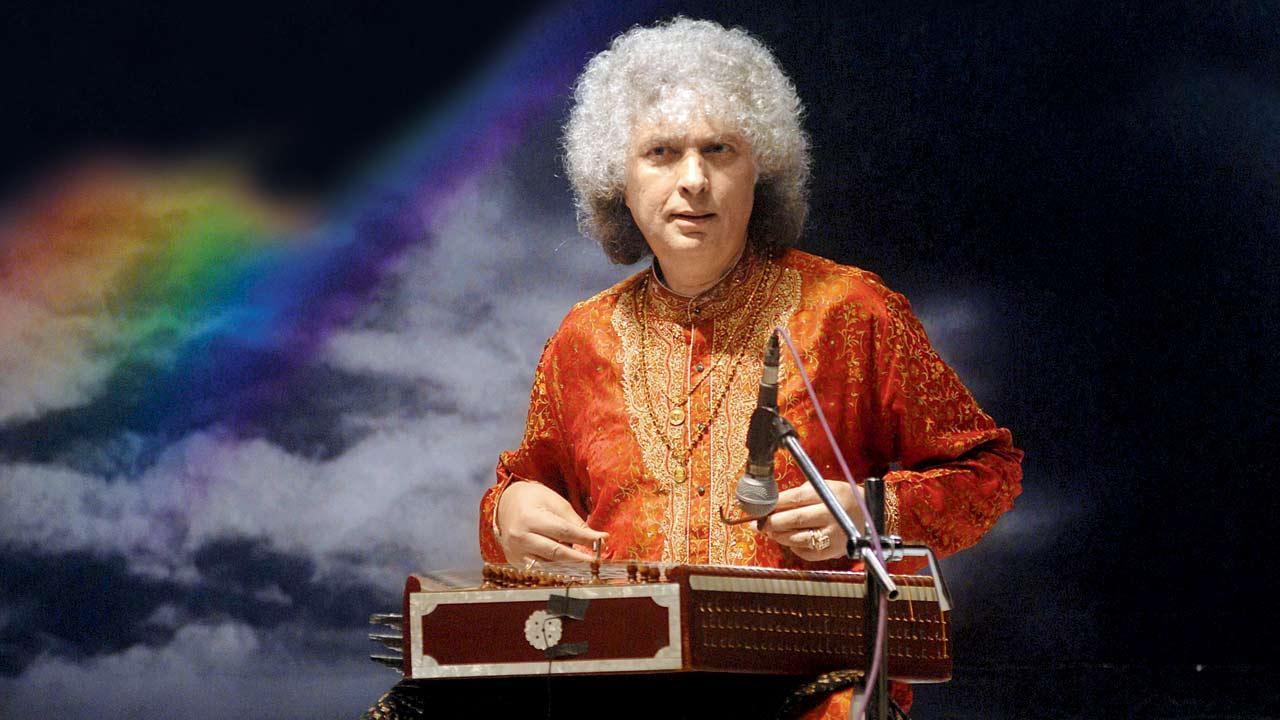
Ustad Amjad Ali Khan, flautist Rakesh Chaurasia remember the maestro who gave the santoor its exalted status in Indian classical music
Yogesh Pawar (MID-DAY; May 11, 2022)
The year 1967. Filmmaker K A Abbas was explaining a situation to musicians gathered for the background score of his Dharti Ki Pukaar. When his eyes fell on a young musician, he called him aside. The young man felt Abbas wanted something specific in the music, but was shocked when he was offered a role in Saat Hindustani (1969). “Dikhte-bolte bhi theek ho... kad-kaathi bhi sahi hai,” Abbas told him.
The young man folded his hands, and said he was happy to only pursue music. Had the 29-year-old agreed, he would have debuted along with Amitabh Bachchan. What that trajectory would’ve done for Pandit Shiv Kumar Sharma, we’ll never know, but the silver screen’s loss was music’s gain. The octogenarian legend was suffering from kidney problems for the past six months and was on dialysis. He breathed his last on Tuesday morning, following a massive cardiac arrest soon after his bath, according to his family.
Among those condoling the maestro’s demise was Prime Minister Narendra Modi, who tweeted: “Our cultural world is poorer with the demise of Pt Shiv Kumar Sharma ji. He popularised the santoor at a global level. His music will continue to enthral the coming generations. I fondly remember my interactions with him. Condolences to his family and admirers. Om Shanti.”
Talking to mid-day, sarod maestro Ustad Amjad Ali Khan said his demise marked the end of “a musical era”. “We were close. Our families share a great rapport. We are all deeply saddened by this tragic news. With him, a musical era has ended. We live in a cruel time when so many legends are bowing out. Apart from a pioneering musician, he was an exceptional human being.”
The santoor, previously confined to Jammu & Kashmir, rose meteorically to ensconce itself as a classical instrument, thanks to Sharma. Though connected with the Sufi tradition of Kashmir and called shatatantri veena in ancient texts, it didn’t enjoy its current exalted status at that time. The santoor maestro’s father Pt Uma Dutt Sharma came across the santoor as a music supervisor with a local radio station and felt it could lend itself to the classical style. A young Shiv Kumar (initially trained in tabla and singing) was introduced to santoor at 13. Within three years, he was playing it on the radio.
Despite purists curling their lip at the santoor, filmmaking legend V Shantaram was impressed with the 18-year-old Sharma and asked him to play for his Jhanak Jhanak Payal Baaje (1955) under Vasant Desai. Back in Srinagar, following an argument when he refused a secure job in the Jammu and Srinagar Radio, Sharma left home and came to Bombay with his santoor and Rs 500. Pt Shiv Kumar Sharma has often told this writer of those tough times. “I’d only have an anna in my pocket and nothing to eat. I’d accompany others on tabla since the negative criticism of the santoor meant no concerts,” he’d reminisce.
Odd film assignments helped sustain both him and his fire for the santoor. While the instrument was traditionally played in Kashmir on a small stand, with the player squatting in front, he placed it on his lap to cut vibrations. He worked on the tuning, increased range and discovered how to use mallets to reproduce the Indian vocal nuances. A decade of his toil finally saw the music fraternity warm up to his instrument. With Silsila (1981), both he and flautist Pandit Hariprasad Chaurasia turned film composers, following it up with Faasle (1985), Vijay (1988), Chandni (189), Lamhe (1991), Sahibaan (1993) and Darr (1993).
“In some songs, like Tere mere hoton pe, you can clearly see how he brought in elements of classicism and folk music from the mountains,” remembers ghazal exponent Pankaj Udhas, who says he has never met a more disciplined musician. “Once at an event, he gently stopped me from drinking water immediately after my meal, saying it was bad for digestion,” said Udhas, adding, “Even in his 80s, he never slouched on stage and sat ramrod straight.” He also spoke of Sharma’s prowess over rhythm. “As someone who had played tabla and could sing, it was interesting to see how he would even for Zakir bhai [Zakir Hussain] at times when they played together.”
Santoor exponent Satish Vyas, who trained under Sharma from 1975 to 2006, says he feels orphaned. “Both Pandit ji and his wife treated me like their son. Even when he corrected me, guruji did it gently, playing on each disciple’s strength.”
Sharma knew flautist Rakesh Chaurasia, his colleague Pt Hariprasad Chaurasia’s nephew, from when he was little. “Extremely loving and indulgent, he’d come up after a concert and praise even the smallest improvisation I tried. Sadly, I’ll miss uncle’s loving caress now,” says the flautist.
Career milestones
- Sharma gave his first public performance in Mumbai in 1955.
- In 1960, he recorded his first solo album.
- In 1967, he teamed up with flautist Hariprasad Chaurasia and guitarist Brij Bhushan Kabra to produce the concept album, Call Of The Valley.
- The santoor virtuoso was honoured with the Sangeet Natak Akademi Award in 1986, the Padma Shri in 1991, and the Padma Vibhushan in 2001.
On this day, Amitabh Bachchan's first film Saat Hindustani released in Mumbai
8:16 AM
Box Office India Trade Network
On this day exactly 49 years ago the first Amitabh Bachchan film SAAT HINDUSTANI hit Mumbai. The date was 21st May 1971 and the film released at Maratha Mandir in matinee shows only. It was a low key release as it was earlier released in Delhi/UP and fared very badly.
Coincidentally, the film clashed with a release of the box office king of that time Rajesh Khanna. HAATHI MERE SAATHI also released in Mumbai on 21st May 1971 though the film had released earlier in Delhi/UP and East Punjab. This film became the first film in history to collect 1 lakh nett in Mumbai on day one. It was released on 27 theatres and Rajesh Khanna beat his own day one record in Mumbai city which was set with SACHAA JHUTHA in 1970.
SAAT HINDUSTANI was the first release of Amitabh Bachchan but it was not the first time that Mumbaiites got to see the star that was going to become a future megastar. The other coincidence that in Mumbai the first sight of Amitabh Bachchan also came in a Rajesh Khanna starrer which was released a couple of months before Saat Hindustani in Mumbai city. The film was called ANAND.
Another point here is that last year there were celebrations of fifty years of Amitabh Bachchan hitting the big screen and that was not the case. The fifty years were actually hit a couple of months back. It was funny to see fifty years of SAAT HINDUSTANI celebrated when the film did not even release in 1969. It showed a lack of knowledge with these commentators and even the millions of fans but they cant really be blamed as the media has a tendency to follow what is out there rather than actually collect facts. Then the fans follow what the media has to say. Its understandable that the date of the first film is not known of some small actor but this is Amitabh Bachchan who is the biggest star the country has seen till date.
The fifty years of Amitabh Bachchan were hit on 27th March 2020 as SAAT HINDUSTANI first released in Delhi/UP on 27th March 1970. Amitabh Bachchan made his debut in 1970 and not 1969 as it is claimed by the media. The main cinema for SAAT HINDUSTANI was Sheila and it also released in Eros, Minerva, Amba, Ajanta and Radhu Palace as well as some theatres in UP. The release in Delhi of 6 cinemas was a good release as it was a small film and the biggest films released on around 8 theatres in the city at that time. The collections were horrific with just Rs. 10,000 apprx coming on day one with capacity of around Rs. 40,000. The film was out of theatres very fast and next it went to Mumbai a year later but the response in Delhi meant it was more of a token gesture release. The other circuits saw a release when Amitabh Bachchan had become a star with more creative posters keeping in mind the image Amitabh Bachchan but it was a black and white film and pretty much an art film so had no takers.
Just like SAAT HINDUSTANI had no takers, there will not be many takers that Amitabh Bachchan actually debuted in 1970 as there has already been a false picture painted by the media but facts are facts and anyone with access to genuine sources can do the research and easily check what is fact and what is fake.
Amitabh Bachchan completes 50 years in cinema; told to cut back on work
8:29 AM

On completion of 50 years as actor in Bollywood, veteran star playfully shares update about his health
MID-DAY (November 8, 2019)
Megastar Amitabh Bachchan, who completes 50 years in Hindi cinema and continues to be one of the busiest actors in Bollywood, shared a health update with his fans, saying doctors have advised him to cut back on work. Sharing several pictures alongside a photograph of a meeting with doctors at his Juhu home, Bachchan said he would be back to the grind, despite the warning by "the stethoscope dressed messengers from heaven".
Taking to his blog, the actor wrote: "The tunnel at the NSSH... indeed several tunnels and some more probing with the meter in hand that sonographs.. a few on the side injectables .. at various locations on this mine field of a body.. some venus strips punctured and the fluids dripped in.. a few hard core instructions to follow.. and back to the grind, despite the stethoscope dressed messengers from heaven giving strong warnings of work cut off.. or else (sic)."
A few weeks ago, the megastar had reportedly been admitted to the city’s Nanavati Hospital for a few days. Meanwhile, the industry got together to mark the completion of 50 years since Bachchan took to the big screen with Saat Hindustani, and subsequently acted in over 190 films. Actors like Farhan Akhtar and Riteish Deshmukh, lyricist Javed Akhtar, and musician Adnan Sami were among those who paid tributes to him.
Son Abhishek took to social media to share: "Not just as a son, but as an actor and a fan... We are all blessed to witness greatness! There is so much to admire, to learn and even more to appreciate. Several generations of cinema lovers get to say we lived in the times of BACHCHAN!!! Congratulations Pa on completing 50 years in the film industry. We now await the next 50! Love you (sic)."
Everyday 80-90 musicians would gather to play live. Pag Ghunghroo was one of the costliest songs then-Bappi Lahiri
9:19 AM

Roshmila Bhattacharya (MUMBAI MIRROR; February 23, 2019)
To borrow a line from The Sound of Music, let’s start from the very beginning and the genesis of a singer-composer called Bappi Lahiri who would go on to give Hindi cinema a revolutionary new sound with his disco beats in the eighties. Back in 1969, he was just a 17-year-old schoolboy when he landed the Bengali film Dadu, featuring Sandhya Roy and Bikash Ray, big names in Tollygunge studios. He could not do the entire album because he was prepping for his board exams but recorded songs with Lata and Usha Mangeshkar and Manna Dey. “Lata ji had worked with my musician father earlier (Aparesh Lahiri) and she not only showered her blessings on me, but has also helped me in many ways down the decades,” recounts Bappi da.
After Dadu he did a couple of more Bengali films before the need to make music in Bollywood brought him to Mumbai and straight to Sashadhar Mukherjee, who was family. Mukherjee had produced Kangan, Bandhan and Jhoola for Bombay Talkies and Munimji, Tumsa Nahin Dekha, Paying Guest, Dil Deke Dekho and Love In Simla for his own studio, Filmistan. They were working on Ek Musafir Ek Hasina at the time and Bappi got an opportunity to play his tunes to the movie moghul, as also his sons, Shomu, Deb and Joy. Impressed, Shomu who was planning a children’s film, Nannha Shikari with Tanuja, Deb and Laxmi Chhaya, signed him to compose the music. Bappi da recorded his first song, the title track, with his Kishore mama (Kishore Kumar). Fifty years have passed since and Bappi da today is India’s Golden Man.
Coincidentally, Amitabh Bachchan who began his career with KA Abbas’ Saat Hindustani in ’69, also celebrates a golden run in showbiz this year. Bappi da recalls that the first song he composed for Big B was for GP Sippy’s 1979 film, Ahsaas, in October. “Amit ji had a guest appearance and the song was 'Rutho Na' with Calypso style music, recorded at Mehboob Studio with Lata ji,” Bappi da recalls.
The mention of Mehboob Studio also brings back an intoxicating memory of recording “Jahan Chaar Yaar Mil Jaye” with Kishore Kumar and Bachchan for Sharaabi. “That’s a milestone in my life, the other being Geraftaar which featured three superstars, Rajinikanth, Kamal Haasan and Amitabh Bachchan. It had the superhit 'Dhoop Mein Niklaa Na Karo Roop Ki Rani' sung by Kishore mama and Asha ji (Bhosle). I also sang 'Aana Jaana Laga Rahega' for the film,” he beams, reminding you that Sharaabi also had 'De De Pyaar De' which he had sung for his album Super Runa. Amit ji loved it, and Prakash ji (director Prakash Mehra), on his urging, requested me for it. Kishore mama sang it in the film.”
Kishore sang all the songs, including “Inteha Ho Gayi Intezaar Ki”, “Mujhe Naulakha Mangaade”, “Jahan Chaar Yaar Mil Jaye” and “De De Pyaar De” and was the only male playback singer nominated for the Filmfare Award that year, winning it for “Manzilein Apni Jagah”.
Kishore also took home a Filmfare Black Lady for Namak Halaal’s “Pag Ghunghroo”, another Prakash Mehra film featuring Bachchan, with music by Bappi da. “It was a 12-minute song and no one else could have sung it. We recorded it over four days at Mehboob Studio. Everyday 80-90 musicians would gather to play live. It was one of the costliest songs then,” informs Bappi, adding that Kishore’s “Aaj Rapat Jaayein” and “Thodi Si Jo Pee Li Hai” and Asha’s “Jawani Jaan-E-Man” and his “Raat Baki” were equally popular.
Bachchan and Bappi da’s last film together was KC Bokadia’s Aaj Ka Arjun in 1990 which featured the chartbusters “Gori Hai Kalaiyan” and “Chali Aana Tu Paan Ki Dukaan Pe”. Almost three decades have flitted by and Bappi da is hoping to reunite with the actor with whom he struck gold. “Since we are both in our 50th year maybe we can collaborate again, if not on an album, maybe a single. If it happens, it will be another golden memory,” he promises.

“Pag Ghunghroo” (Namak Halaal); “Jahan Chaar Yaar Mil Jaye” (Sharaabi); “Dhoop Mein Nikla Na Karo” (Geraftaar)
'Salman Khan of theatre' to make debut in Rhea Kapoor's Saat Hindustani?
7:51 AM

Ankur Pathak (MUMBAI MIRROR; May 29, 2014)
Karan Pandit, better known as the Salman Khan of theatre for his penchant for stripping off his shirt and giving the audiance an eyeful of his chiseled body, is all set to make his Bollywood debut. Buzz is, he is in advanced talks with Anil Kapoor's daughter Rhea for her upcoming film Saat Hindustani, which will be directed by her boyfriend Karan Boolani.
Ask him about the Salman connect and the actor promptly brushes it off saying, "I have taken off my shirt on stage a few times but that was the demand of the script-they were torturous scenes and not fun moments." This reluctant Sallu of the stage then goes on to drop a bomb by adding: "I'm actually a Shah Rukh Khan fan. I admire him more as a person than as an actor." Hmmm!
Pandit has acted in several plays and commercials, and also seen in a short film produced by Karan Johar's Dharma Productions, Strangers in the Night.
He candidly confesses that the reason he wants to get into movies is money, among other things. "The transition was inevitable as it is impossible to make a decent living simply being a theatre actor. Moreover, as an artiste, I do not believe in restricting myself to a particular medium," says Pandit.
While the makers are tight-lipped on the film, Mirror has learnt that Saat Hindustani is a coming-of-age campus drama about seven Indian students studying in a university abroad.
Subscribe to:
Posts (Atom)