Showing posts with label Saaransh. Show all posts
Showing posts with label Saaransh. Show all posts
Anupam Kher talks about his ‘Shraap’ clash with Mahesh Bhatt during Saaransh
9:11 AM

Rishabh Suri (HINDUSTAN TIMES; November 26, 2025)
From picking up an audience member’s call in the middle of his session to going around the auditorium and asking people what they would call their biopic, actor Anupam Kher’s masterclass on ‘Giving Up Is Not A Choice’ at the 56th International Film Festival of India (IFFI) had something in store for each person present.
The actor shared some personal anecdotes, all in sync with the topic. For example, in his debut film Saaransh (1984), he was replaced even before the shoot started! “I had prepped for months, and asked Mahesh Bhatt,‘Why did you cast me?’ He replied, ‘Bald hai na!’ because the character required an old man. Later, I was told I have been replaced by Sanjeev Kumar. I got so angry… maine Mahesh Bhatt ko jaakar bola ‘aap duniya ke number one fraud ho. Main brahmin hoon, main aapko shraap deta hoon!’ I packed my luggage, and stormed off downstairs. Upar se Mahesh ji ne awaaz maari ‘vaapis aaja’! I did this because giving up was just not a choice for me.”
Further, recalling when Hollywood actor Robert De Niro, ‘God of acting’ for him, threw Anupam out during a heated scene in Silver Linings Playbook (2012). After waiting outside in the cold for 45 minutes, he confronted director David O Russell over his character’s treatment. Later, the scene was revised with De Niro supporting his view.
“Today I feel proud that I can call Mr Robert De Niro one of my friends. I did all that on the shoot day because giving up was not a choice,” he concluded.
Filmmakers of yesteryear had a gambler’s spirit. Now, executives decide when to greenlight films-Mahesh Bhatt
8:21 AM
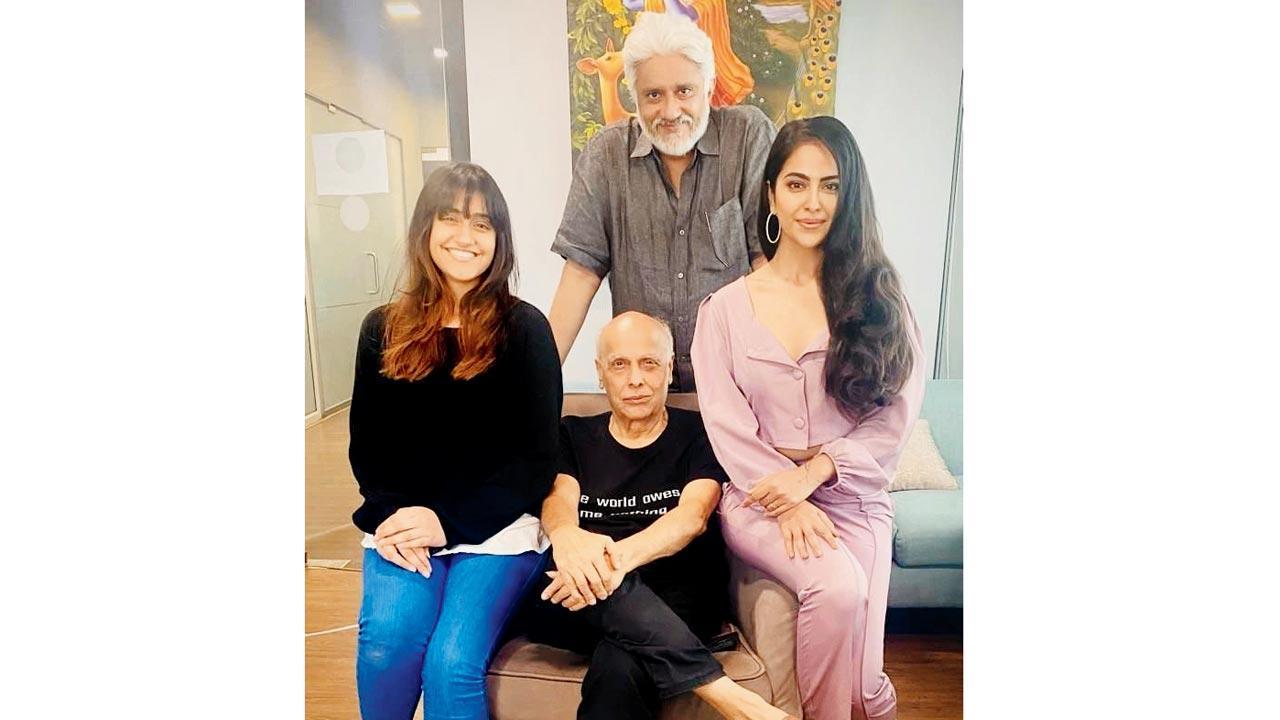
Having presented Avika Gor of Balika Vadhu fame in a different light in Bloody Ishq, producer Mahesh Bhatt on why he doesn’t rely on star power to deliver a success
Mohar Basu (MID-DAY; July 30, 2024)
Considering the fact that web releases are consumed by cinewatchers at a time that’s most convenient to them, the OTT boom has eased the stress related to a ‘Friday box-office performance’. But the day of his film’s release is still a euphoric one for Mahesh Bhatt, who has spent decades keeping tabs on the opening numbers of his movies. Bhatt’s Disney+ Hotstar production Bloody Ishq, which aired on the platform on Friday, opened to mixed reviews. What makes the offering particularly special, however, is that it marks a prominent commercial release for actor Avika Gor, who acquired immense fame as a child actor for her role in the teleshow, Balika Vadhu.
The casting, though unusual, is not a surprising move, given the fact that Bhatt has consistently invested in actors instead of ‘stars’. “[Late producer] Rajkumar Barjatya told me something vital during [the filming of] Saaransh [1984]. I was in search of a producer for the film. Sanjeev Kumar was a dear friend. People had assumed that Sanjeev would lead the film while Anupam [Kher] would be the second lead. But Anupam insisted that he lead it. He [spoke with] passion, and I agreed. When Sanjeev saw the film, he admitted that he wouldn’t have been able to do what Anupam did. Mr Barjatya told me, ‘You pick the actor you believe in, kyunki, ultimately, chalti toh picture hi hai’. Today, Anupam has done 500 movies, and Saaransh was a defining one for him. Since the release of Raaz, we have predominantly worked with new people. When the hoopla passes, the movie stays with you,” says Bhatt, lamenting that today, producers choose to invest in stars to make a project “safe”.
Calling the new breed of movie-makers “risk averse”, he says, “Moneybags know that star power makes a project safe. But, I don’t want to rely on the star to do well. I want our story to hold people’s attention.”
Easily among the names who’ve contributed to creating the identity of horror films in Indian cinema, Bhatt believes the decision to determine if the genre has evolved significantly over the years rests with the audience.
“We achieved a breakthrough with Raaz. Horror, until then, was seen with disdain. By stitching good music and keeping human relationships at the narrative’s core, we made a spectacular film. And while we made several franchises in the genre, I don’t think [today’s filmmakers] have been able to break new ground as storytellers. Filmmakers of yesteryear had a gambler’s spirit. Now, executives decide when to greenlight films. Storytelling today is not as path-breaking as it was a decade ago.”
He points to his daughter Pooja Bhatt’s film, Jism (2003), to further his case. “No one thought that a leading lady would promote the idea that ‘the body knows no love, just lust’. To make edgy, neurotic films, you need a free pass.”
Even though production houses have become commercially aware in the aftermath of the setbacks they faced during the pandemic, several artistes have faced challenges due to the industry’s changing norms. “It is difficult to make content these days. Even in Hollywood, people who have been in the industry for years are seeking alternate jobs. The industry is in shambles. The traditional way of movie-making is getting outdated.”
Initially, I would do everything for competition or to be called the best-Anupam Kher
9:07 AM
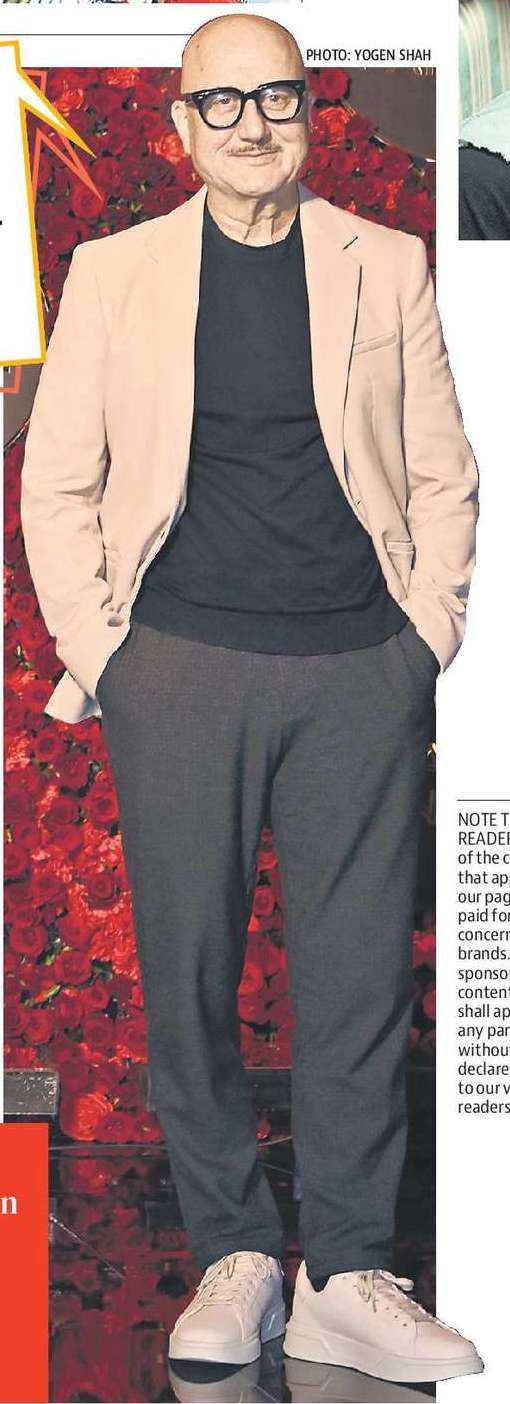
Akash Bhatnagar (HINDUSTAN TIMES; June 1, 2024)
For Anupam Kher, “it’s just the beginning”, as he completes 40 years in Bollywood this year. Calling it a “dream run”, the actor, who marked his debut with the film Saaransh (1984), adds, “People try to write you off on the basis of the number of years you’ve spent in an industry. But I have started doing my best work now.”
Kher says he has evolved as an actor and person over the years. “Initially, I would do everything for competition or to be called the best. But now, I am not a part of any race. In today’s time, people have to prove their worth with every film. It has become a box-office-dominated film industry. We are dominated by numbers, including how many followers you have or how many crores you make.”
Besides Indian films such as Dilwale Dulhania Le Jayenge (1995), Khosla Ka Ghosla (2006), A Wednesday (2008) and The Kashmir Files (2022), the 69-year-old has also worked in the West in films such as Bend It Like Beckham (2002), Silver Linings Playbook (2012) and the TV show New Amsterdam (2018).
“It was challenging, as I am a product of Hindi medium and I think in Hindi. I was petrified, because I don’t think in English. I was the first actor to do such varied roles. I did mediocre roles also, but I also did Saaransh at the age of 27,” he says.
In school, I got Prithviraj Chauhan's role because of my mimicry, but I messed it up-Anupam Kher
8:07 AM
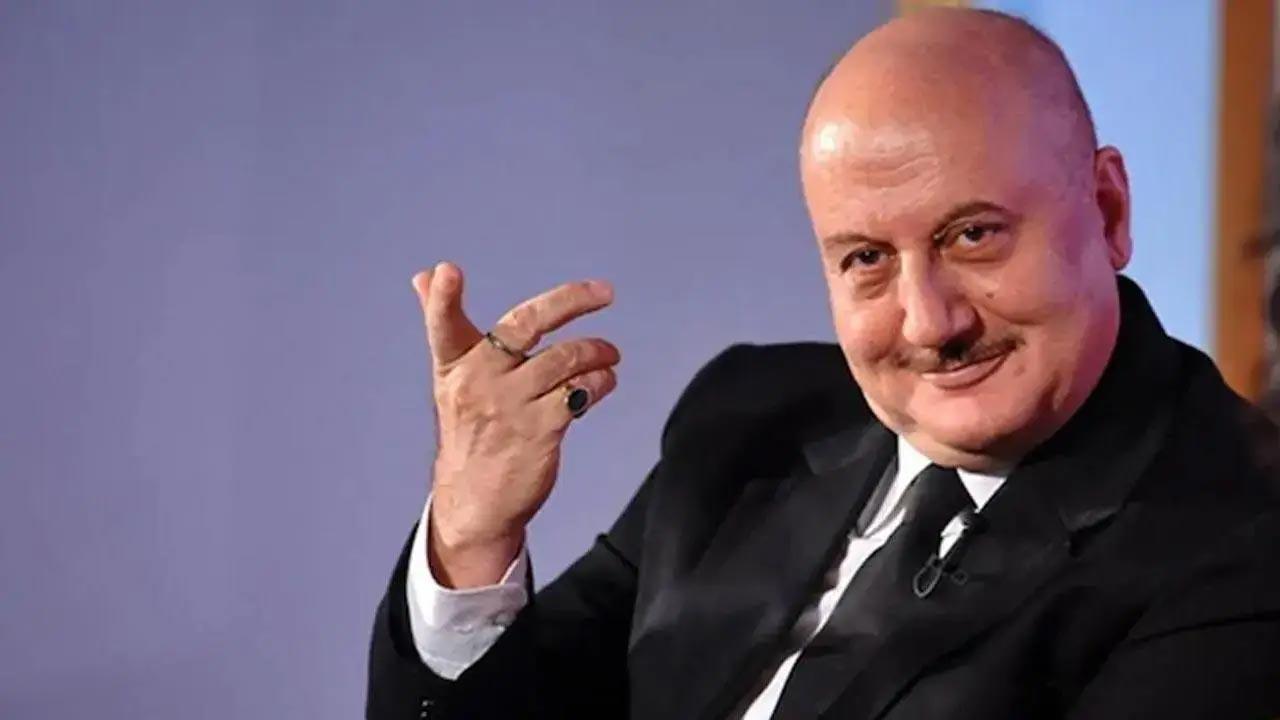
Kher’s masterclass on Performing for Screen and Theatre at IFFI
Janice Rodrigues (BOMBAY TIMES; November 28, 2022)
His many different roles over the years – starting out as a 28-year-old in Saaransh, where he played an ageing father grieving for his NRI son, down to roles in films like Midnight’s Children and Silver Linings Playbook – have marked Anupam Kher as a veteran of Indian cinema. So, when he spoke at the IFFI (International Film Festival of India) masterclass on ‘Performing for Screen and Theatre’ recently, there was a full house in attendance.
Talking about his first acting role in school, he shared that it wasn’t until a teacher had asked for the “boy who imitates everyone”, that he found the spark of acting inside him.
“I come from a non-filmi background, but I would always imitate people and wasn’t very good at studies. The teacher was looking for a person to play Prithviraj Chauhan where I had only one line, and I got the role because of my mimicry – but I messed it up!” he said. He had given up hope of acting further when his father, who was his biggest fan, got him a garland and said, “This is not for winning, but for trying.”
Kher then went on to act in several theatre productions before he landed the role in Saaransh (1984). “Theatre was my learning ground and I believe that no actor can be good without training,” he shared, stating that he is not a spontaneous actor. “I live the role for months before I face the camera. When I got Saaransh I was too young to understand the pain of a father, so I lived his life for six months,” said Kher.
Talking about the iconic scene with the Customs officers, Kher said that he would only be able to do it in one take. “Since I couldn’t feel a father’s pain, I dug into my own: that I would have to pack my bags and leave the city if I didn’t do this right, and thus the tears on screen were real,” he said.
But Kher revels in comic roles as much as he loves being part of dramas. “I believe an actor should be able to make a complete ass of himself; until you become a bewakoof, you cannot be an actor,” said Kher.
An intense performer, Kher called audience members up on stage during the Q&A session to give them a first-hand account of how he prepares as an actor. “You should be able to emote well when you act,” he told a young man who came up on stage to enact a scene with him. However, he was stern with those who looked disinterested, taking away the phone of a man who was busy with it. “You wouldn’t do that in a theatre, would you?” he asked the audience.
Main aaj bhi acting seekh raha hoon-Anupam Kher
8:47 AM
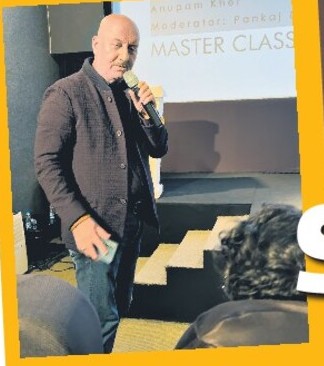
Unfiltered, funny and inspirational, Anupam Kher was at his best while doling out some much-needed gyaan to the younger generation
Rishabh Suri (HINDUSTAN TIMES; November 26, 2022)
Anupam Kher was truly in his element at his masterclass at the ongoing 53rd International Film Festival of India (IFFI) in Goa. He stopped an audience member from leaving, took away his phone, sprinkled water on someone who yawned, and recreated his crying scene from his debut film, Saaransh (1984) — the audience couldn’t get enough of the actor.
SMALL TOWN DAYS
Kher revealed that he used to mimic his teachers and parents, and the town started calling him ‘jo nakal utarta hai’. The actor said, “I had this adjective attached to my name. I didn’t know whether I wanted to be an actor... My father was too busy earning money for a family of 14. His salary used to be Rs. 90. Actors are not born. Log bolte hain na, ‘paidaishi actor hai’. If I were a born actor, my first acting stint would not have been a disaster.”
He stressed the fact, for all the aspiring actors in the audience, that an actor should be ready to make a complete fool of himself: “Jab tak goof up na ho, aap actor nahin ban sakte ho. Main aaj bhi acting seekh raha hoon.”
FIRST SALARY
The 67-year-old recalled his first salary of Rs. 10,000, and the subsequent jump was a humorous incident: “When you are successful, people come and get associated with you. Ashok Punjabi came after Saaransh and said I am your secretary. Ashok said, ‘We have to go for the signing of your second film. I will keep my foot on yours, and if I press it, it means you are saying something wrong. Paison ki baat main karunga’.”
The two went to filmmaker Ramesh Behl’s office, where he told Kher he could choose either actors Sharmila Tagore or Moushumi Chatterjee to star opposite him. “The narration started, and the only thing I was thinking about was, ‘Who do I like more, Sharmila or Moushumi?’ I said, ‘Main Sharmila wala role karunga!’”
BATTLING DEPRESSION
Kher was diagnosed with manic depression some years ago. “Everybody has issues, young actors too. But they think, ‘I don’t want to tell people I am weak’. No! Tell people you are weak or when you are feeling sad, lonely or feel like crying. Go out and have a cup of coffee with strangers. I, as a rule, never eat alone,” he shared.
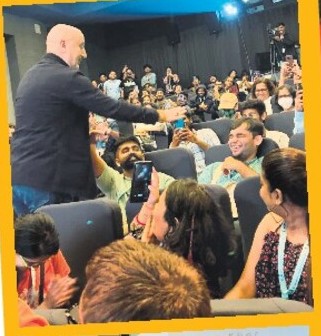
The Kashmir Files is one of Anupam Kher’s best films after Saaransh-Vivek Agnihotri
8:31 AM
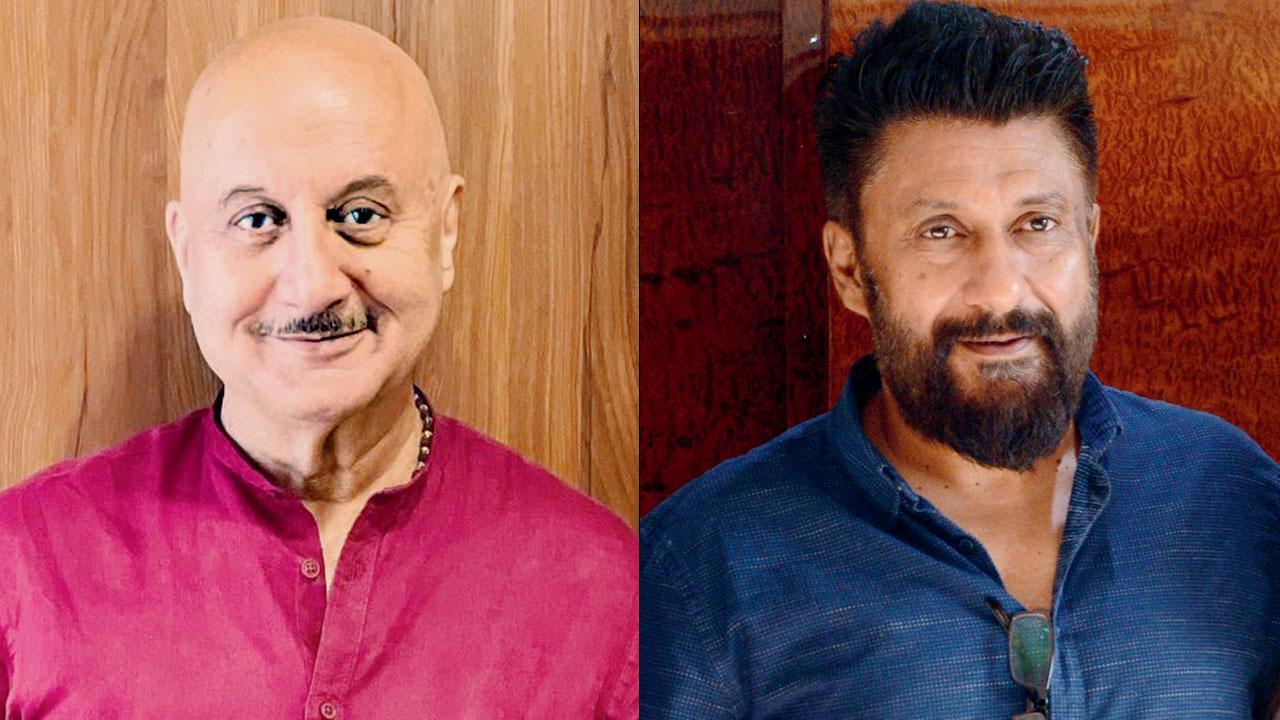
The Kashmir Files director Agnihotri on casting Anupam Kher for film that resonated with him
Uma Ramasubramanian (MID-DAY; January 4, 2021)
Following his 2018 offering on the death of Indian politician Lal Bahadur Shastri, filmmaker Vivek Agnihotri delves into another political offering. The Kashmir Files, backed by a powerful cast including Anupam Kher, Mithun Chakraborty, Pallavi Joshi, and Darshan Kumaar, sheds light on the killing of Kashmiri Pandits in 1990.
Agnihotri tells mid-day, “The biggest challenge in making this film was that nobody wants to finance a film that can [lead to] controversy. But, somebody has to do it. We want cinema to become the brand ambassador of India. This [is the kind of] cinema that takes the cause forward. The biggest compliment that we are receiving is that this is the most balanced and honest film on the subject,” he says of the response he’s received from audiences following several screenings in the US.
Kher’s casting in the film stands out as somewhat peculiar given that the ace actor is also a Kashmiri Pandit. Did his roots make him an ideal fit for the part?
“My selection criteria is to have actors who can easily become the characters. In Bollywood, characters become actors. I was lucky to have veterans be part of it. They are all National Award-winners. I think this is one of Anupam’s best films after Saaransh. Since he is a Kashmiri, it was easier for him to speak the language. He understands the pain, and it reflects in his eyes.”
His love for the genre, he admits, stems from the skewed world of politics. “Politics is [messy] because of political games. Everybody is part of that, without realizing that they are. I love to explore that deeply.”
Anupam Kher tours USA for his first live show amid Covid-19
8:14 AM

Titas Chowdhury (HINDUSTAN TIMES; September 19, 2021)
A while back, actor Anupam Kher flew to the USA to shoot for his upcoming project, Shiv Shastri Balboa. On the completion of the shoot, he decided to stay back and tour Dallas, Atlanta, San Jose, New Jersey, Indianapolis and Washington for Zindagi Ka Safar, his first live show amid the Coronavirus pandemic.
He says, “When we were shooting in New Jersey, a lot of Indians would come to the shoot. This pandemic has given us a strange sense of insecurity and uncertainty. Apart from the fact that I’m actor who they’ve been watching, they wanted to talk to me because they wanted some kind of reassurance about life.”
Kher’s two-and-a-half hour long show in Dallas ran house-full as the topic of first generation NRIs and generation gap struck a chord with his South Asian audience. “I didn’t want to do a star night or a meet and greet or a regular play. I wanted to have a chat. I primarily spoke about my life but people saw a glimpse of their lives too,” he shares.
The show saw Kher, 66, playing clips from his films, discussing books penned by him, philosophies he lives by and playing antakshari with the audience. Calling it an overwhelming experience, he says, “I recreated a scene from Saaransh (1984) because they requested me to do so. It was difficult to recreate a scene from a film that released 37 years back. It made me burst into tears.”
Joining Kher was Jugal Hansraj, his Shiv Shastri Balboa co-star. “I needed someone I was comfortable with; who was a listener and could ask me questions at the same time,” he ends.
All my younger actors, Aditya Roy Kapur, Varun Dhawan, etc, are not supposed to call me uncle-Anupam Kher
8:12 AM

Madhureeta Mukherjee (BOMBAY TIMES; January 18, 2021)
Anupam Kher spent many months of 2020 shooting in the US, and even now that he is back on the home ground, he has continued working. That apart, whether he is strolling through New York’s Central Park or the rose gardens of Chandigarh, the actor engages his followers and fans on social media with insightful videos and thoughts on life. At 65, Anupam who has excelled as an actor across genres, languages and geographical boundaries, believes that he is at the interval of his life and can give the young breed a run for their money. No wonder, he enjoys a huge following amongst the younger generation, too.
While talking to BT about how the workings in the industry have changed over the years, and how the new breed is very educated and informed, he says, “Look, we all like romanticizing about the past. Isliye antakshari mein hum purane gaane gaate hain. We always say ki pehle aisa nahi tha. The fact is, pehle actors 50 saal tak raaj karte they, ab bechare har actor ko tension hoti hai ki mere last film se mujhe jaana jaayega.”
Elaborating on his interactions with the young ’uns, Anupam explains, “There were certain things that were easier back in the days, but today’s generation has a lot more education and knowledge. They are disciplined, professional and talk to you as equals. They do not give you this false sense ki main aapki badi izzat karta hoon. All my younger actors, Aditya (Roy Kapur), Varun (Dhawan) and others, are not supposed to call me uncle. I do not sit on this pedestal and think ki yeh aayenge aur mere paaon chhooyenge. I feel that I am younger than them and I can give them a run for their money (laughs!). Today, if you are skilled at what you do, then you will get a good opportunity. I tell my students, that if you look different, you have more chances of getting a role in a small budget, OTT project or even a big-budget film. The fact that they are different, they will stand out. Remember that one of the reasons I got my first film Saaransh is because I was bald.”
Every person who meets with failure at some point, goes through depression. It is human-Anupam Kher
8:49 AM

Madhureeta Mukherjee (BOMBAY TIMES; July 11, 2020)
 At 65, Anupam Kher, by his own admission, has more fire in his belly than he had in his twenties. With over 500 films in his repertoire, he has traversed genres and movie industries seamlessly — thriving everywhere he went. Yes, he did step over some stumbling blocks, but he turned them into stepping stones. The actor, who calls himself an ‘eternal optimist’, tells us that his sense of wonder and curiosity about his craft has kept him on his toes all these years. He also explains how in today’s times, we need to express more, instead of finding a shortcut to every emotion.
Here’s Anupam Kher, revealing his emotional, expressive and comical self. Read on...
You complete 36 years in the industry, this year. You were 28, when your first film, Saaransh released, where you played a 65-year-old father. Now, at 65, when you look back, how does it feel? Did you have any dilemma about playing a character more than twice your age in your debut film?
I went to drama school (National School of Drama), had heard and learnt about other actors, and read world literature. So, when you are a trained actor, you don’t have these insecurities. I would give my left arm to play a 65-year-old man in my twenties. A lot of people told me, ‘Tu barbaad ho jayega, poori zindagi buddhe ka role karega’. Interestingly, at 28, I pulled off the look of a 65-year-old, but today, at 65, I don’t look like that old man. It feels like the The Curious Case of Benjamin Button story (laughs!). In fact, I broke this myth of actors being typecast in the industry. I have done films as diverse as Karma, Khosla Ka Ghosla, A Wednesday, Shola Aur Shabnam and Dilwale Dulhania Le Jayenge. So, I had no such insecurity. At a very young age, my father told me that failure is an event, never a person. On top of it, I am an eternal optimist — it’s a lethal combination.
So, would you say that your education and experiences before you became an actor, made you fearless in a way?
Well, I was confident. I knew that I needed a break and I waited for nearly two-and-a-half years for it. I have tried to be fearless throughout my life… halaki aadmi kuch banne ke baad kam fearless ho jataa hai. Jab aap kuch bhi nahin hote ho and you hit the lowest point, the only way is up. I did face bouts of fear at times, as I was financially in a bad situation, and there were days when I was so depressed and low, tab pata hi nahin hota tha achhe din kya hote hai. When I first came to Mumbai, I lived in Bandra (East), in a chawl with three others. Main har cheez mein achcha hi dhoondta hoon. The address of the house that I was living in then was 2/15 Kherwadi, Kher Nagar, Kher Road. I thought, duniya ki koi takat mujhe rok nahi sakti. I always found comical situations even in the most difficult phases of my life and that’s why I tell people that they should never feel dejected. You should dream beyond the skies. Dreams ka toh syllabus hona hi nahin chahiye. Jitna dream karoge, uska 10% toh kam se kam aasman tak hona hi chahiye. Even after nearly 515 films, I still feel that I haven’t reached the interval of my life.
I assume that’s also the reason why you are not particularly fond of titles like, ‘legend’ and ‘thespian’. And, in some of your earlier interviews, you had said that when you went to work in the West, you wanted to feel like a newcomer...
One of the reasons I wanted to go to America was that here, people had started calling me veteran, thespian, legend. Yahan, har kisi ko legend bol dete hain, when they reach a certain age. Legends are people like Dilip Kumar saab, Raj Kapoor saab, Mr Amitabh Bachchan, Robert De Niro. I am proud of the work that I have done, but titles like these often come with some connotations. It’s like people saying that you have done enough work, so we will now give you a lifetime achievement award and you can walk into the sunset. I do not want to carry the burden of being Anupam Kher on my shoulders. And yes, I wanted to feel like a newcomer, as far as my craft is concerned. Sometimes, it is good to unlearn things, because what you have learnt in the past becomes a burden. This thinking that maine jo kar liya hai wohi aakhri shabd hai...I don’t subscribe to that. I don’t take myself too seriously, and the people who do that are the most comical ones in the world.
 When you started work in the West, what did you feel were the most glaring differences between our movie industry and Hollywood?
I think that their pre-production is phenomenal. Their sense of time and punctuality are amazing, too. Everyone is a trained actor, no one is there by fluke. They are not there because their parents were somebody. They are thoroughly prepared, right from the spot boy to the producer — everyone is totally immersed in their work. At least, the people that I have worked with so far have been like that. Abhi yahan bhi hona shuru hua hai. Things are changing in our film industry, too.
You came to Mumbai from Shimla in 1981 and got your first break three years later. Today, there is a lot of talk about insiders-outsiders and Bollywood’s privileged club, et al. How was it back then? How much do you think the industry has changed over the years?
In the early 80s, everyone came to Mumbai from small and big towns to make a mark here. Back then, there was no such thing as I am an outsider, and you are an insider. We all had goals and we wanted to achieve them. What has changed over the years, and I am glad that I saw both sides of it, is that our relationships were much stronger. There was no technology, so there was more human contact. After a shot, there wasn’t much choice for us other than sitting with our co-actors and chatting under a tree. Also, that is the reason our old friendships have remained intact over the years. Now, we have PR companies, but back then, a few journalists that I knew were like my friends. Now, with professionalism of this nature, there is bound to be a certain degree of aloofness. The system makes you adapt and that has happened to some extent in our film industry, too. But, when I came here in my 20s, I never felt that I needed to pack my bags and leave, and I don’t know of anyone who felt that way. I don’t think we should divide the industry between outsiders and insiders. Everyone dreams and dreams follow no such theory.
 Today, there is a lot of conversation about mental health, and also, the kind of pressures that young actors in showbiz face and where it can lead them. You recently revealed that at some point, you were diagnosed with manic depression. Tell us about what you learnt during that period...
In India, there is still a stigma around mental health. I don’t think depression is necessarily attached to any profession. Today, we are all in an environment where people will make you feel that they are better off than you are. If someone has more friends on social networking platforms, the one with lesser followers feels inferior. The world is so much in your face, you are constantly made to feel that you are an underachiever. Real laughter and smiles have been replaced by emojis. We are not seeing and feeling things anymore. Mental health is something we need to talk about. Every person who meets with failure at some point, goes through depression. It is human and natural. It is a sense of loss. Grief ka koi timetable nahin hota, woh kabhi bhi aa jata hai. You have to fight it with positivity, and by talking and listening to people. You have to draw strength from yourself and your family. Usko samajhne mein time lagta hai. In the movie Hum Dono, ek gaana hai, ‘Jahan mein aisa kaun hai jisko gham nahin mila’. It is a fastpaced life, where we are running nowhere. Today, kids don’t have that sense of wonder that you and I have, as they are hooked on to their mobiles. Today’s generation hits the search engine to find quick answers to everything. Knowledge does not translate into experience unless you live that. Jab tak dil toota nahi kisi ki mohabbat mein, aap kitna bhi search kar lo, woh answer aapko online search mein nahin milega. We need to connect and engage more with people around us.

Saaransh made me who I am-Anupam Kher
8:21 AM

Titas Chowdhury (HINDUSTAN TIMES; June 7, 2020)
Actor Anupam Kher marked his Bollywood debut 36 years ago, and since then, there’s been no looking back. In his illustrious career featuring a variety of roles, Kher feels his debut film Saaransh (1984) helped him reach greater heights and establish himself. “Whatever I am today is because of Saaransh,” he admits, adding, “My character in the film, B V Pradhan, was an honest and fearless person wanting to do something in life. I was 28 back then. Not only did it prove my mettle as an actor, but it also made people silently applaud me for my courage to play a 65-year-old man convincingly.”
The biggest takeaway from his journey, Kher reveals, is to never give up. “I have learnt to enjoy every moment. I have learnt to not take myself seriously, because I’m not here to change the world. You can feel down and out, but it is important to have hope. If you give up on hope, it’s over for you,” he asserts.
Amid the Coronavirus scare, Kher, 65, feels it will be a while before showbiz gets back on its feet. “The entertainment world wasn’t prepared for this. There have been emotional and financial losses. I’m an eternal optimist, so I believe things will be fine soon. Outdoor shoots will be easier than shooting in studios. Necessity is the mother of invention. I’m sure we will invent a way to go about it,” he adds. Having said that, the actor feels we have to learn to live with Covid-19. “It is important to realise that we’re a tiny speck in front of nature. We’ve spent enough time reflecting on how the pandemic has affected our lives. Hopefully, people will be careful to not let it spread further,” he signs off.
Anupam Kher was absolutely and totally me. He got every nuance right-Hemant Oberoi
8:23 AM

How does Anupam Kher play a convincing Hemant Oberoi, grand executive chef at The Taj at the time of the 26/11 terror attacks, without having met him?
Mohar Basu (MID-DAY; November 10, 2019)
In the banquet hall of a suburban hotel, Hemant Oberoi paces up and down. Not many recognise one of the city's most famous chefs, now the owner of restaurants in Mumbai, Singapore and San Diego. Just then Anupam Kher walks in, spots Oberoi and makes a dash to give him a hug.
Kher plays Oberoi in the upcoming Anthony Maras thriller, Hotel Mumbai. It tells the story of what transpired at The Taj Mahal Palace & Towers at Apollo Bunder on the night of November 26, 2008, when militants from the Lashkar-e-Taiba stormed the five-star in a series of coordinated attacks. The hotel was the perfect target, a symbol of Mumbai's progress and pride and a catchment areas for foreign guests.
It's been over 10 years, but Oberoi's voice dips when he speaks of the night when his staff intervened to save the lives of scores of visitors by forming a human chain. "We just stuck to each other that night. No one wanted to leave. The courage of that team is rare to find. I lost seven chefs, including my deputy, who walked me home every night until then."
Incidentally, Kher and Oberoi have met only once before this chat, at the Toronto International Film Festival last year where the film premièred. "I did the film without meeting him [Oberoi]. That night at TIFF, Chef was the special guest. I remember the standing ovation we got. It was never-ending. It was the triumph for his courage. I am glad we are finally getting time to spend time today and I also had the privilege to serve him food cooked at my home," Kher says warmly, which Oberoi quickly calls "delicious and made with love". It was simple lunch, they tell us, of aloo methi, dal and roti, with dahi on the side. It's the rare time Kher and Oberoi are smiling.
A mention of 26/11 brings back the seriousness to the discussion, as Kher recounts that he was in Bandra that night. "Everyone remembers two incidents of terror in modern world history—9/11 and 26/11. When I was told that I would play Chef Oberoi, I was nervous. What would his reaction be? It wasn't just about how well I could act. There was a lot more at stake. [It was] a portrayal of someone's intensity and normalcy in a time of adversity."
Oberoi has not said anything about the film to Kher except, thank you. "He was absolutely and totally me. He got every nuance right. My demeanour, the way I command the kitchen. No one could have done it as beautifully. He was composed in every shot and knew exactly how I managed things that night. He brought back way too many memories." Kher turns to him to say, "This [the complement] is bigger than any award."
We wonder how he prepped without meeting the man he plays, and Kher shares that five minutes before the first shot was taken for his debut film, Saaransh, director Mahesh Bhatt told him that this was a character who was all about compassion. Compassion had to be the dominating emotion in the film. "It was the same with this film too, 500 movies after I did my first," Kher says.
On cue, Oberoi revealed that he named his child Saaransh after he watched the 1984 film about a retired school teacher and his wife coming to terms with the death of their only child who is killed in a mugging incident in New York. "Because I loved him in the film [I named my son after it]. Incidentally, Saaransh's wedding was the first event to be hosted at the Taj after it was restored and reopened post 26/11. I wanted to do it to put the message out there that you can't break our spirit."
Kher credits his performance to the script, which he calls unflinchingly honest in its depiction of the chef's character. Kher and Oberoi concede that their favourite scene is the one towards the middle of the film when Kher announces to his staff that they can leave the hotel if they want [to be safe]. "One of my staffers had to undergo dialysis every day. Even he didn't leave. 'Saath mein chalenge'," he had said. He passed on recently, but survived that night," Oberoi remembers. And so, while the story is of the horrors that unfolded leading to the death of 166 people across the city, the film reinstates faith in the human spirit. "It's about the heroism of ordinary people. We need to bring examples of extraordinary courage to the fore," Kher feels.
Oberoi carries on his face a calmness that Kher beautifully portrays. Chef says he draws serenity from the sea. "The high and low tide come and go. Marine Drive is my place to find peace. I believe in karma and destiny. When you see people closest to you dying, you want to celebrate life. Fishermen that night hailed three cabs to take me to various hospitals so that I could track down my staff scattered across wards and morgues."
Despite this, an international review snubbed the film, calling it out for depicting terrorism in a popcorn movie. Kher brushes aside the criticism. "It suits them when they want to make a film about World War and the Holocaust. When it comes to India, we can't make such films. Let's ignore the international media. There should be films made on such subjects. It is a fact that 10 people from a neighbouring country came here and killed the innocent. This film needs to be screened in India."
An unfazed Oberoi has the final word. "I want people to remember to do good deeds, be humane. You never know when you can find yourself in a similar situation. Help others. We also had the option [to escape] but it's necessary to not fall for the trap that takes us further away from human values."

An Indian soldier aims his weapon towards The Taj Mahal hotel on November 29, 2008. Three militants were killed in the final assault on the hotel that signalled the end of the two-day assault on Mumbai. Pic/ Getty Images
The wounds heal but the memories of pain don’t go-Anupam Kher
7:56 AM

Monika Rawal Kukreja (HINDUSTAN TIMES; November 6, 2019)
Actor Anupam Kher had a “great Diwali” this year with his friends from the fraternity during his recent trip to India after a gap of four months. Kher, who stars in an American TV series, has been stationed in New York City, USA, for almost 20 months now. With a glint in his eyes, he says, “Especially when Diwali is at Mr (Amitabh) Bachchan’s house, you know that lot of people will be there. Also, in our profession, you don’t meet everybody unless there’s a function. So, it was nice to meet everyone. I realised I’ve missed them all this while.”
Kher has been a part of Hindi film industry for over 35 years, and being a Kashmiri Pandit, he has always been vocal about his concerns and views towards the community. In the 30th year of the exodus of Kashmiri Pandits, the actor recalls how the whole incident changed the fate of countless families.
“For me it’s not an incident. For me, it’s my being. It’s not like aap kisi kiraye ke ghar par rehte the aur aapko maalik ne nikaal diya. We’re talking about 300-400 thousand people being thrown out of their houses on the night of January 19, 1990. The scar of that wound will always be there. Sometimes the wound heals, but the memories of pain don’t go,” Kher continues, “It’s the resilience of these people that they haven’t picked up arms and become violent. They just learnt to cope with the situation. But that doesn’t mean anybody who was thrown out of their houses has forgotten all of that.”
So, was this the reason Kher hailed the government’s decision of scrapping Article 370 earlier this year? He says the decision holds no political connotation for him, and it’s a part of history. “Humein puri jadd se nikal ke faikh diya gaya tha, so that’s why for me, the abrogation of Article 370 has a completely different meaning. My mother keeps talking about it because her childhood as well as her adulthood was spent in Kashmir. For 20 years of my life, all my summer holidays were there. My uncles, aunts, grandparents, parents were there. My mother says now she wants to go back. She keeps thanking PM (Narendra) Modi that ‘ab hum jayenge, mujhe apna ghar waha banana hi hai’. So, let’s hope that it happens in her lifetime,” adds the 64-year-old.
While one wonders if Kher and his family have visited the valley since the exodus, the actor reveals that he has been there; however, “the last time when I went there, I was stopped at the airport and was not allowed to go any further. I’ve mentioned this incident in my autobiography also”.
Anupam Kher's take on the senior actor's casting debate
I don’t agree with that philosophy at all. Actors are actors. Why shouldn’t a young actor be able to play an older character? Yeh kisi ki papauti thodi na hai. Yeh kya baat hui? I was 28 when I played a 65-year-old man in Saaransh. Marlon Brando was 42 when he played Godfather — a 70 year old man. Nobody should question you; that’s your capability as an actor that you can do that part. An actor’s job is to challenge themselves. So, I don’t agree with Neena (Gupta) or Soni (Razdan) on that level. I’ve great respect for both of them and I think they have a point of view, but saying, ‘mera role cheen rahe ho’. Arrey yeh kya baat hui? All the talk about equality and all are fine, but aap actors ko yeh mat bolo ki old age ka role aapko nahi karna chahiye. Kyu nahi karna chahiye? All my life I’ve done older people’s role. I’ve played father to Hema Malini and a grandfather to Rishi Kapoor on screen. So, I don’t think that’s a fair thing to say.
There have been many films that had young actors portraying older characters-Viineet Kumar Singh
7:50 AM

Co-star Viineet Kumar backs casting of Taapsee, Bhumi as 60-year-olds in Saand Ki Aankh
Sonil Dedhia (MID-DAY; October 4, 2019)
Even as select veteran actors, including Neena Gupta, had questioned the decision of the makers of Saand Ki Aankh to rope in young female actors for the role of 60-year-old sharp shooters Chandro and Prakshi Tomar, cast member Viineet Kumar Singh says the trend isn’t new in cinema.
“There have been many films that had young actors portraying older characters. Saaransh [Anupam Kher], Lamhe [Anil Kapoor] and Lincoln [Daniel Day-Lewis], are a few of them. All of these actors were appreciated. I’d urge people to make a judgement after watching the film, instead of harbouring any pre-conceived notions,” says Singh, who slips into the role of a coach to the shooters, played by Taapsee Pannu and Bhumi Pednekar.
Singh, who’s last release Bard Of Blood has received mixed reviews, says he has been receiving praise for his small but vital act of a RAW intelligence officer sent on a covert mission to Balochistan, in the Netflix offering. “I was looking forward to doing something on a streaming platform for a while. With this offering, I could see that my character, Veer, had something important [to offer].”
For Singh, green-lighting a Shah Rukh Khan production was also nostalgic. He recalls how as a participant of a reality show 17 years ago, he had received praise from Khan for his “zabardaast” act. “So, doing this show felt like an achievement.”
Singh has the Janhvi Kapoor-starrer Gunjan Saxena biopic, and another Netflix show, Betaal, in the pipeline.
Having violated every law in the book, I have no business pretending to the world-Mahesh Bhatt
2:04 PM

Richa Shukla (JAIPUR TIMES; May 8, 2019)
Not one to mince his words, filmmaker Mahesh Bhatt had many things to talk about when he was in Jaipur recently to attend a session, Khuli Kitaab, hosted by FICCI Flo. From delving into his troubled childhood to opening up on daughter Alia Bhatt and her relationship with Ranbir Kapoor, Bhatt had a lot to share with Jaipur’s audience.
Talking about Alia and Ranbir, Bhatt said, “They are in love. And you understand what love is… What their future plan will be is for them to decide. I have always respected my children. If they come to me, I give them inputs about what I think they should be doing. But I never put project myself as a role model, ki bhai, you should imitate this person. Having violated every law in the book, I have no business pretending to the world.”
Bhatt said that his scarred childhood contributed to who he is today. “I had a scarred childhood. I refuse to wear the lies my parents wanted me to wear. That’s why my family has always felt embarrassed with me. Raised by my mother, my siblings and I had a tough life. I had no answer when people would ask me about my father. It was one of the most difficult questions for me,” Bhatt said.
The filmmaker is making a comeback as a director with Sadak 2, the sequel of the 1991 hit, Sadak. And what made him put on the director’s hat after almost 20 years? “It’s Sanjay (Dutt), Sanjay and Sanjay, who nudged me to do the sequel of the film. I realised that my journey as a filmmaker is like an unfinished painting, which I need to complete. Once again, I am feeling like a beginner who needs to earn the right to grab viewers’ attention,” he said.
Despite his successful career in the Hindi film industry, Bhatt was apprehensive about returning to direction. He said, “The question, ‘Can I do it?’ kept haunting me. In this attention-deficit age, I feel like a gladiator.”
Bhatt doesn’t stop at critically analysing his daughter’s film too. Talking about Alia’s recent release, Kalank, Bhatt said, “Despite a good star cast, the film did not do well at the box office. I found the narrative too long. And there were some inherent flaws, which the makers could not detect while making it. The film does enchant the eye but does not move the heart. As far as Alia’s acting skills are concerned, she is effortless and committed.”
Ask him about his most acclaimed film Saaransh and he begins with a dialogue from the movie, “Tere chehre ki jhurriyon mein mere jeevan ka saaransh hai. It was the byproduct of a man who was 34-35 years old then and now is 70. Saaransh cannot be recreated again.”

Most senior actors refused the role as they didn't want to be seen de glam-Saand Ki Aankh producer Nidhi Parmar
2:41 PM

After Saand Ki Aankh team faces flak for casting Taapsee Pannu, Bhumi Pednekar to play 60-year-olds, producer, without naming names, claims several senior actors turned down Shooter Dadis' roles
Mohar Basu (MID-DAY; April 27, 2019)
 When the first look of Saand Ki Aankh was released earlier this month, netizens criticised the makers for roping in Taapsee Pannu, 31, and Bhumi Pednekar, 29, to play the country's oldest women sharpshooters, 60-year-olds Chandro and Prakashi Tomar. In an industry where roles are unfortunately hard to come by for senior female artistes, detractors opined that the Anurag Kashyap-production should have stayed true to the story and cast age-appropriate actors.
Taking the critique head-on, co-producer Nidhi Parmar claims that the team had approached almost 15 senior actors for the role, before tapping the younger bracket. "We approached actors in the age bracket of 55 to 60 since we felt the portrayals would be more convincing. However, most declined the role as they didn't want to be seen in an unglamorous avatar, or felt that they weren't ready for the physical preparation that the film demanded," she says, refusing to name names. "Even younger actresses had the same concerns. Bhumi and Taapsee have shown a great deal of pluck in essaying a role that's almost twice their actual age."
On her part, Pannu says that it takes gumption to age on-screen, especially since Bollywood is obsessed with the idea of young-is-beautiful. "I have played a college kid after turning 30, and no one questioned me then. Instead of making an issue, people should be surprised that we took up these roles, as there are few actors who take the risk of ageing on screen unapologetically."
Pednekar echoes the sentiment, stating that no part should be off-limits for artistes. "In the past, people have played characters older than their age successfully. Anupam Kher in Saaransh (1984) and Nargis ji in Mother India (1957) are great examples. If we can play characters younger than our age, why can't we play older characters as well?"
Jab tak David Dhawan ya Neeraj Pandey ki koi film nahi karunga, mazaa kaise ayega?-Anupam Kher
8:41 AM

Anupam Kher on being an Indian actor working abroad, and on essaying his most challenging role yet
Anuka Roy (MUMBAI MIRROR; December 23, 2018)
Anupam Kher is about 15 minutes late for our meeting, but that gives us enough time to study his tastefully-decorated office in Andheri. The walls of Kher’s cabin are lined with trophies, and there are two huge photographs of the actor receiving the Padma Shri and Padma Bhushan.
Soon enough Kher steps into the room, apologizing profusely for his tardiness. He is dressed in a light pink shirt, denims and sneakers, and has just returned to Mumbai after wrapping up a shooting schedule of New Amsterdam. Kher plays a neurologist, Dr Vijay Kapoor, in the hit US show that is set in a fictional public hospital. The National School of Drama alumnus has also been praised for his work in the British mini-series Mrs Wilson. “It is important to keep challenging yourself as an actor as well as a person. You need to test your capabilities and that can only happen if you choose to do difficult things,” says the 63-year-old about one of the best phases of his life. However, ask him about how he copes with the constant travelling and getting into the heads of numerous characters, and he nonchalantly answers: “There’s nothing to it, really. Work never tires me. And, I always remember those years when I did not get work. At that time I had promised that I will never complain when I get work.”
Kher has been working on international projects for quite some time now. His first project was Gurinder Chadha’s 2002 film Bend It Like Beckham. After that, he went on to star in Chadha’s Bride And Prejudice, Woody Allen’s You Will Meet a Tall Dark Stranger and the Academy Award-nominated Silver Linings Playbook. He has also been nominated for this year’s British Academy Television Awards for his work in The Boy with the Topknot, which is an adaptation of author and journalist Satnam Sangher’s memoir. But, despite picking up interesting roles in several international projects and spending half his time abroad, Kher prefers to describe himself as an “Indian actor working abroad”. “Phir bhi dil hain Hindustani. Jab tak David (Dhawan) ki film nahi karunga ya Neeraj (Pandey) ki koi film nahi karunga, mazaa kaise ayega? (Unless I do a film with David or Neeraj, I won’t have fun),” says the actor.
Kher will be seen next in The Accidental Prime Minister. The film is based on Sanjaya Baru’s book of the same name. Baru was a former advisor to prime minister Manmohan Singh, and Kher essays Singh’s role in the movie. The former FTII chairman has been vocal about his political leanings and was initially apprehensive about accepting the film. “I had first said no because my personal opinions, initially, were more important than the actor’s point of view. Then I read the book and the script, and realised how difficult it was to portray Dr Singh. And I said to myself that ‘This is going to be the most challenging role I have ever done’.”
Kher says that he read about Manmohan Singh and watched videos featuring him for over eight months, and he still thinks it is quite difficult to replicate the way the former prime minister walks. “That was among the things that really got me intrigued about the man. He is tough to get a handle on. But I played a 65-year-old when I was 28 (in Mahesh Bhatt’s Saaransh), so that also pushed me to take on this role. I thought the very least that would happen is that people would criticise me,” says Kher.
Kher says that his generation of actors is lucky to have experienced both a relatively quiet time and the technological era in their careers. “Today if you don’t make it as an actor, you have no excuse. You can make your own film on your mobile phone and exhibit your talent. At the same time you have to be consistently brilliant if you want to survive.”
The world might try and make you feel small, but you have to rise above that-Anupam Kher
2:59 PM

Renuka Vyavahare (BOMBAY TIMES; June 26, 2018)
He’s an actor who has awed the audience across the world with his performances for over three decades now. And even to this day, there is no stopping this powerhouse of talent. Having completed 34 years in cinema and 37 years in Mumbai, this BAFTA (British Academy of Film and Television Arts) nominee and recipient of multiple Filmfare and National Awards tells us how his path to success was muddled with obstacles, which he turned into opportunities. The story of his life is one that resonates with every aspiring actor and most of all, with the common man. To celebrate his 37 years in Mumbai, the actor took a local train ride, and BT caught up with him to talk about his real and reel life journey. Read on...
A small-town boy, who came to Mumbai 37 years ago with stars in his eyes, is today an international actor, who was also nominated at the BAFTA this year. You have said that all this feels surreal...
I was a teacher in Lucknow before I landed in Mumbai, unlike my drama school (NSD) friends, who headed straight to Mumbai after their graduation. I didn’t want to come here without any money. So after graduation, I stayed in Delhi for a year and then took up a temporary job of teaching acting in a drama school in Lucknow. I was 23 at the time, I was earning Rs 1,200 per month and everyone called me sir. I felt if I stayed in Lucknow further, I might just settle down there, so, a year-and-a-half later, I decided to move to Mumbai. It has been 37 years since I moved to this city.
Tell us about your initial struggles, when you first moved to Mumbai?
I came to Mumbai to teach acting, as I wanted a second job that could support me financially. I didn’t believe in the concept of ‘main bhookhey pet gujara kar lunga’. Eventually, I had to do that as it turns out, the school I was going to teach in, had no concrete building to begin with. So, I taught students on the beach as there was no place to stay. I soon exhausted my friends’ houses, too. This went on for almost two years and I spent all the money that I had saved. Eventually, I was homeless and had to sleep on the railway platform. I would take the local train from Bandra to Charni Road and back to kill time and observe people.
I used to act in plays, but there was no money. When you are not educated in the same field that you aspire to make a career in, you are bound to feel intimidated. But when you are a prestigious drama school student, who understands world cinema and then find yourself sleeping on railway platforms, you feel utterly humiliated. I had no alternative but to think that I have to make it.
Did you ever feel like you were reaching your breaking point?
The easiest thing in the world is to feel disheartened and disappointed. I knew that I was a trained actor and believed that I was good. That’s what education gives you — the power and confidence to carry on. My optimism was always by my side. My grandfather once wrote to me after I told him that I was contemplating going back to Shimla. He said, ‘Bheega hua aadmi baarish se nahi darta’. That changed me. Today when I talk about it, it’s a romantic take on misery and poverty, but when it was happening to me, it made me very lonely. I feel that when giving up is not an option, you just have to make it.
To top it, at that time, a hero had to look a certain type and fit in to a kind of mould...
I was not even the best looking guy to have landed in Mumbai in the ’80s! I was a skinny young man with a balding head. What you see today is a dignified, sexy bald look. Back then, having a head full of hair was more important than talent. Today, people can say that Anupam Kher actor ban sakta hai toh hum bhi ban sakte hai. Back then, there was nobody who I could refer to, so I used to look up to Telly Savalas (American singer and actor). Even Amrish ji (Puri) used to wear wigs.
You have seen the film industry change and evolve over the past three decades. In all the change you have seen, what really stands out?
Absolutely! Back then, it took me a month to just meet somebody and then another to get an audition. Today, there are so many platforms and opportunities — social media, casting directors, agencies, managers, reality shows and the entire PR machinery. Also, cinema has changed. It isn’t stereotypical anymore. Filmmakers aren’t thinking, ‘Yeh hero ya villain ke look mein fit hota hai’. This is an era of actors. If you are a good actor, it doesn’t matter how you look. Also, realistic cinema is being appreciated. I feel cinema has evolved, because it is no longer the only source of entertainment. You are competing with malls, restaurants, multiplexes, television shows and even the digital platform. Anybody who wants to consume your cinema today sits back and asks, ‘Show me what you have made. If it is good, it will work. If not, it won’t’. Every actor has a struggle story, but in today’s times, you get far more chances. When I look back, I see a beautiful journey. If I am asked if I would want the same journey again, I’d say ‘Yes’. I don’t want to sound arrogant, but I was the first actor who broke the myth of typecasting. If I did a Saaransh (1984), I also did films like Karma (1986), Ram Lakhan (1989), Khosla Ka Ghosla (2006) and A Wednesday (2008). The fact that I am not scared of failure has led me to doing projects like The Big Sick (2017), a BBC spy drama, an upcoming American TV show, as well as films like The Accidental Prime Minister.
In Saaransh, you played an elderly character, but you were just 28 years old then. While that continues to be one of your best works till date, you ended up playing a father to most actors who were almost your age later on. Do you ever regret that?
I was a beggar and beggars are not choosers. Also, only a trained actor could recognise the potential of the character that I played in Saaransh. Only an idiot will say, ‘Main buzurg aadmi ka role nahi karoonga’. You have to have confidence in yourself. If I hadn’t started off with Saaransh, I wouldn’t have survived all these years! Main gaane gaake kya kar leta? So many actors who did that in the past 34 years are nowhere today.
You have been a part of several acclaimed international films like the Oscar-winning Silver Linings Playbook (2012). You have even worked with the legendary Robert De Niro. How different is it to work in the West and interact with artistes from there?
English is not the language that I think in. I think in Hindi, translate it to English, and then to emotions — it’s a tough process. It is challenging for me. Sports people get to represent their country officially. When I work in the West, I feel that I am representing my country. Talking about Robert De Niro, I was watching The Godfather Part II (1974) the other day and I was amazed that this is the same guy who dines with me and sings ‘Happy Birthday’ for me! I was asked, ‘Everyone calls him Bob, why don’t you?’ I said, ‘Mere muh se niklega hi nahi’. Woh humare sanskar hai. Even their ADs call the actors by their first name. That’s their culture. Imagine Mr Bachchan saying, ‘Call me Amit’. Not that he will say that, but I won’t do it. These are the people who have inspired me. For me, Robert De Niro is the world’s greatest actor. I am always star-struck around him and people like Dilip sahab (Dilip Kumar). I have done a thesis on The Godfather (1972) as a drama school student and God has given me an opportunity to work with the actor who played the lead. I also look up to stalwarts like Ang Lee, Clint Eastwood and Woody Allen.
You will be essaying the role of former PM Dr Manmohan Singh in The Accidental Prime Minister. On the personal front, you are known to be an admirer of PM Narendra Modi. Was there any conflict of opinion?
It’s my job as an actor to ensure that I don’t bring my personal (political) philosophies to my roles. Just because you are vocal about somebody, it doesn’t mean you bring that into your performance. I cannot be dishonest with my profession. That’s not the purpose. If I have to say something, I will say it as a person and not as an actor.
Will we see you joining politics in the near future?
Nobody can talk about the future with confidence, but I have no intention of joining politics. Whatever I want to say, I will say it as an individual. The problem with people is that when you speak for the country, they feel that you are joining politics.
Your story of survival and success is fascinating. What are the key things that aspiring actors, who may have lost their faith, should keep in mind?
Failure is an event, not a person. An event fails, a person doesn’t. So, never give up. Reinvention is the name of the game. I have not used two words consciously in the past 27 years — bore and mood. Mood nahi hai and main bore ho gaya hoon. These words give you a false impression of being important. Also, you cannot place your happiness in someone else’s hands. The moment you do that, they will ensure that you stay unhappy all your life. Make your shortcomings your asset, then the world has nothing to mock you for. Speak in Hindi, eat with your hands — do what makes you comfortable. Aap khaake dikhaao meri tarah. When I go to a five-star hotel, they try to dwarf me with their culture. They ask, ‘Hot water, cold water, sparkling water or chilled water?’ I speak in Hindi with them and strike an instant bond! The world might try and make you feel small, but you have to rise above that. It’s liberating to be who you are and to be comfortable with that.
On Vishesh Films' 30th anniversary, Mahesh Bhatt revisits seven intensely personal dramas
8:19 AM

As Vishesh Films completes three decades on April 2, its lodestar, Mahesh Bhatt, talks about its latest offering and six intensely personal dramas that are cherished memories today
Roshmila Bhattacharya (MUMBAI MIRROR; April 1, 2017)

BEGUM JAAN (2017)
This Partition drama is a new spring for Vishesh Films. After a few flops, a gloom had descended over the establishment which had the infrastructure and access to money, but the core from where my films had come had withered. That’s when I accidentally stumbled on this Bengali film, Rajkahini, whose director, Srijit Mukherji, was suggested to me by my writer Suhrita Sengupta.
I’d liked his work and when invited to see the film at a preview theatre, I dragged my reluctant brother, Mukesh Bhatt, along. I was devastated by it. The film shook me, my body and soul. I came out of the screening, hugged Srijit tightly and said, “As long as there are storytellers and filmmakers like you, the moral compass of the nation is intact.” In that embrace was born the narrative of Begum Jaan.
When Mukesh saw how overwhelmed I was by the film, he decided to remake it in Hindi. With all his caution and worldly wiseness, Mukesh Bhatt has taken many risks based on my gut instincts. He’s as much a gambler as me, without whom we would not have come this far.

ZAKHM (1998)
So many painful memories because this film was semiautobiographical, based on my proud origin of having a Hindu father, a Muslim mother and a Christian schooling. It was my last directorial and because it dealt with communal politics and the carnage post ’92-’93, my mother was concerned believing that by taking up for secular values, I’d upset the ultra right-wing forces. She died after the first schedule and I had to unmask her Muslim identity which she had hidden behind a sari, tika and mangalsutra when she was alive and had to tell the family that her last wish was to be buried.
She went into the grave as Shirin Mohammad Ali as she didn’t have her husband’s name attached to her. It was graceful of the man in charge of the burial ground in Byculla to let me perform the last rites after learning that I was a Hindu by the name of Mahesh Bhatt. When I stepped into the grave and turned her face towards Kaba, it was the most intimate time I spent with my mother who was no more. That became the defining image planted in the climax which touched the nation’s consciousness.

SADAK (1991)
I remember an enchanting night in Mysore’s Brindavan Gardens where we were shooting Nadeem-Shravan’s romantic track, “Tumhe Apna Banaane Ki Kasam” with a young Pooja Bhatt and the new star Sanjay Dutt. In between shots, I would be listening to a commentary on the Gulf War. Sanjay wondered why I was interested in something happening in Iraq. We had to finish the shoot before dawn becauses it was an expensive location but even though we stretched ourselves, one shot remained. I resigned myself to completing it elsewhere but Sanjay protested, saying, “We have to shoot it here.”
I told him it was impossible to carry the equipment to a distant location before daybreak. “I’ll do it,” he said, and lugging one of the huge archlights, turned to the lightboys and commanded, “Follow me.” They did and we got the shot before the sun came up.

DADDY (1989)
Not for nothing was I labelled the “autobiographical” filmmaker. I went through the attics of my life and shamelessly pulled out stuff others shudder to reveal to the world, including my battle with the bottle, to launch my 16-year-old daughter Pooja Bhatt as an actress in Daddy. It’s a film about an alcoholic struggling to reform for his daughter, part fiction-part real.
My wife Soni Razdan is away in Hong Kong with our newborn child and Pooja was staying with me in Juhu during the shoot. Every night she would rehearse her lines for the next day, perform them for me, then go to bed. One night, after she and the rest of the world had fallen asleep, I had a sudden craving to go to a bar and have a drink.
‘Who would know’, I asked myself. My wife was away and my daughter, asleep. A voice replied from deep within, “You can con the world, you can con your child, but how can you con yourself Mahesh Bhatt? You would know.”
I didn’t have that drink and it was a turning point for me in my struggle with alcoholism. The next morning, I rewrote the climax with Anupam Kher who played the alcoholic, being offered a drink by the baddie before going on stage and tossing the whiskey and the temptation away. What happened in life was transported to the movies. Celluoid has been my intimate diary and I’ve let the world into that space because there’s nothing to hide.

NAAM (1986)
After the critically acclaimed Saaransh and Arth, this was my first money-spinner. It enjoyed a golden jubilee run and brought back Sanjay Dutt after a string of disasters. It also put the spotlight back on Salim Khan after a split with his scriptwriter partner Javed Akhtar.
I have to thank Kumar Gaurav for making Naam possible for us. When I narrated the idea to his producer-father, Rajendra Kumar admitted it was good but then apprehensively turned to his son and pointed out that Sanjay Dutt’s role in this two-hero film was more powerful. “Why not do a film with you at the heart of it?” he suggested.
Without blinking an eye Kumar Gaurav replied, “If we’re going to make this movie, it has to be on this story.” Seeing his conviction his father agreed but ironically, Rajendra Kumar’s fears are confirmed because despite Kumar Gaurav’s brilliant performance, Naam is Sanjay’s show.

ARTH (1982)
The film was done and was the talk of the town. But there were no takers. The end —Shabana Azmi’s character Pooja choosing not to return to her philandering husband or jump into the arms of her lover who promises her the moon but opting to live alone as a single mother to her maid’s daughter—was too bold and unconventional for our Hindi film industry.
There was another problem. My narrative stood on the shoulders of two brilliant actresses, Shabana and Smita Patil, but the latter had moved out of the art house circuit into Bollywood’s A-list. She was convinced I’d been grossly unfair to her character, Kavita, pruning some of her best scenes to make her look like a lesser actress to build up Shabana. An uncomfortable silence stretched between us which I didn’t know how to bridge.
One day, I ran into her at Parkview Hotel. I’d gone to drop off playwright Vijay Tendulkar whom she’d come to meet. The staircase was too narrow to avoid a collision. She tried to walk away but I wouldn’t let her. “Smita, you can’t do this to me. You can accuse me of being a less talented director who could not do justice to your part, but to accuse me of being partial is unfair and you know it,” I entreated, looking into her eyes.
“How can you do this to me? Now I can’t even be angry with you. You’ve taken away all my anger,” she wailed. She went on to watch the film and liked it. And our almost-sour relationship had a happy ending.
SAARANSH (1984)
On the first day of the new year, when my colleagues, after a night of indulgence were still recovering from the hangover, I was at Mehboob Studio with my actors and technicians, and the entire Barjatya family, gearing up to take the first shot of my new film. I shouted, “Action” and in the foreground a telephone began to ring. A grainy image of Anupam Kher as BV Pradhan, a retired school teacher of 70, walked into the frame to pick up the receiver. A disembodied voice — mine — informed him that his only son was dead after being mugged while returning from an Independence Day celebration in New York. The shot was okayed in one take but instead of the usual claps and smiles I could see that my producers were uncomfortable.
Rajkumar Barjatya, speaking for his family, asked me respectfully if it was the right shot for the mahurat given that we were announcing an end. I pointed out that the essence of Saaransh was coming to terms with the finality of death and debunking the popular notion of immortality. With my words their concerns melted away as the true meaning of Saaransh asserted itself with the first shot.

This is just the interval-Anupam Kher on his 500th film
8:03 AM

Anupam Kher on his 500th film, Hollywood production The Big Sick, which is set to premiere at Sundance
Roshmila Bhattacharya (MUMBAI MIRROR; December 24, 2016)
Five hundred may just be a number but when it’s the 500th film for any actor it’s a milestone. The Michael Showalter-directed The Big Sick, an upcoming American romcom, is inspired by the real-life story of comedian Kumail Nanjiani and his wife Emily V Gordan who’ve written the screenplay. Besides Kumail, the film also features Holly Hunter, Oscar and Golden Globe winner for The Piano, Emmy Award (Everybody Loves Raymond) winner Ray Romano, Zoe Kazan as Emilyand Anupam as the patriarch of the dysfunctional Nanjiani family. It will premiere at the prestigious Sundance Film Festival on January 20.
While it’s a story of the trials and tribulations of an American immigrant family and a father-son conflict, Anupam insists it’s not heavyduty serious and his is not a stock Caucasiun character. On his suggestion, he was turned into a mystery novel writer seeking his son’s approval with the recurrent query, “Have you read the manuscript?”
“For the first time I’m playing a comic-comic role in an international production. Michael did not stick to a fixed script but let us improvise on the set,” says the actor, revealing that he almost lost out on the role because there were issues over his work permit so he’d return to his hotel everyday without shooting. Finally. unable to wait any longer, he makers set a deadline. “They told me that if the work permit didn’t arrive the next day by 2 pm, they’d have to replace me. An hour before the deadline expired, I finally got my permit,”Anupam recalls, speaking to Mirror from London.
In 2017, he has three other international projects, including Tabrez Noorani’s film about sex trafficking, Love Sonia, the American-Australian thriller, Hotel Mumbai on the 2008 terror attacks, and a third project he can’t talk about yet. Quiz him on numbers, 500 in particular, and he says he was lucky to come into the industry in the 1980-’90s when a lot of work was happening, admitting that one year, he was shuttling between 27 films.
Not all the roles were memorable but he’d been told by maker Manmohan Desai that it is better to keep your diary full because people came to you more if you were not available and he took the advice to heart. “I was a gold medallist, from NSD, yet I was jobless for three years. I was hungry and humiliated so when the offers started coming, I was loathe to turn anyone away,” reminisces the actor who hates tags like ‘legend’ and ‘thespian’ because in India that would mean a Lifetime Achievement Award and retirement. “I’ve only reached the interval.”
Today, he agrees, things have changed but he’d still work in a Chinese film for the joy of being directed by Ang Lee and give the nod to a Robert De Niro or Clint Eastwood film even if it is a onescene appearance. But India is now a large market and he when touring the US, he was so delighted to see Priyanka Chopra’s solo billboards that he’d get out of my car and clickpictures. He’s equally proud of Deepika Padikone who trained at my acting school.
What keeps him going? “I like to challenge myself and still fear failure but now I am more relaxed and have started enjoying my work,” he says.
His debut film, Saraansh, is being remade. His take? “I don’t want to sound arrogant but Saaransh would work only if I return as BV Pradhan and Bhattsaab (Mahesh Bhatt) as director. It was not just a film, it was life’s philosophy created from the depths of passion, hunger and desperation. How do you replicate that?” he asks.

Mahesh Bhatt toying with the idea of remaking Saaransh in Marathi or Bengali
9:13 AM

Roshmila Bhattacharya (MUMBAI MIRROR; April 25, 2015)
A few weeks ago, speaking to Mirror (April 16), Hansal Mehta had confided that the remake of Saaransh, which he was to direct for Pooja Bhatt, was not happening. "I was the one who had come up with the idea but after the initial euphoria, I saw the film again and realised that it was still as fresh and relevant today as it had been three decades ago. That's when I admitted to Bhattsaab (Mahesh Bhatt) that I didn't know what to do with it. I couldn't remake the same film," he had reasoned.
Corroborating this, Bhatt admits that from time to time, his fans have suggested that he remake the 1984 film which revolved around BV Pradhan, a retired headmaster, and his wife, Parvati, who are coming to terms with the death of their only son in a mugging incident in New York. "When Hansal expressed a desire to rework this film, timeless because of its thematic content, I gave my consent, happy with what he had done with Citylights. Hansal gave his heart to it but then confessed that it would be hard to better the performances (Anupam Kher, Rohini Hattangadi, Soni Razdan) or the narrative and he, or anyone else, wouldn't be interested in a cut-and-paste job," says Bhatt.
However, when he was in Kolkata recently, Bengal's versatile matinee idol, Prosenjit Chatterjee, an avid admirer of Saraansh, told him that he'd be happy to act in a Bengali remake of the film. And the original writer-director admits that he's |mulling over the proposal.
"I could make it in Bengali or even Marathi given the fact that Marathi cinema is going from strength to strength and has found its own space both nationally and internationally. I had first planned to make the original Saaransh in Marathi. That option is open for me now," Bhatt points out.
Will he script and direct the remake too? "I can't direct it. Why would I want to do something I've already done before. I have moved on," he retorts.
However, he points out that if an individual or a group decided to explore this ageless theme, which looks at the finalitry of death with an unflinching eye, in this day and age, he would be happy to assist.
"And I will not peek over their shoulder to tell them that Saaransh is a masterpiece that cannot be re-interpreted," he promises.
Subscribe to:
Posts (Atom)