Showing posts with label Saajan. Show all posts
Showing posts with label Saajan. Show all posts
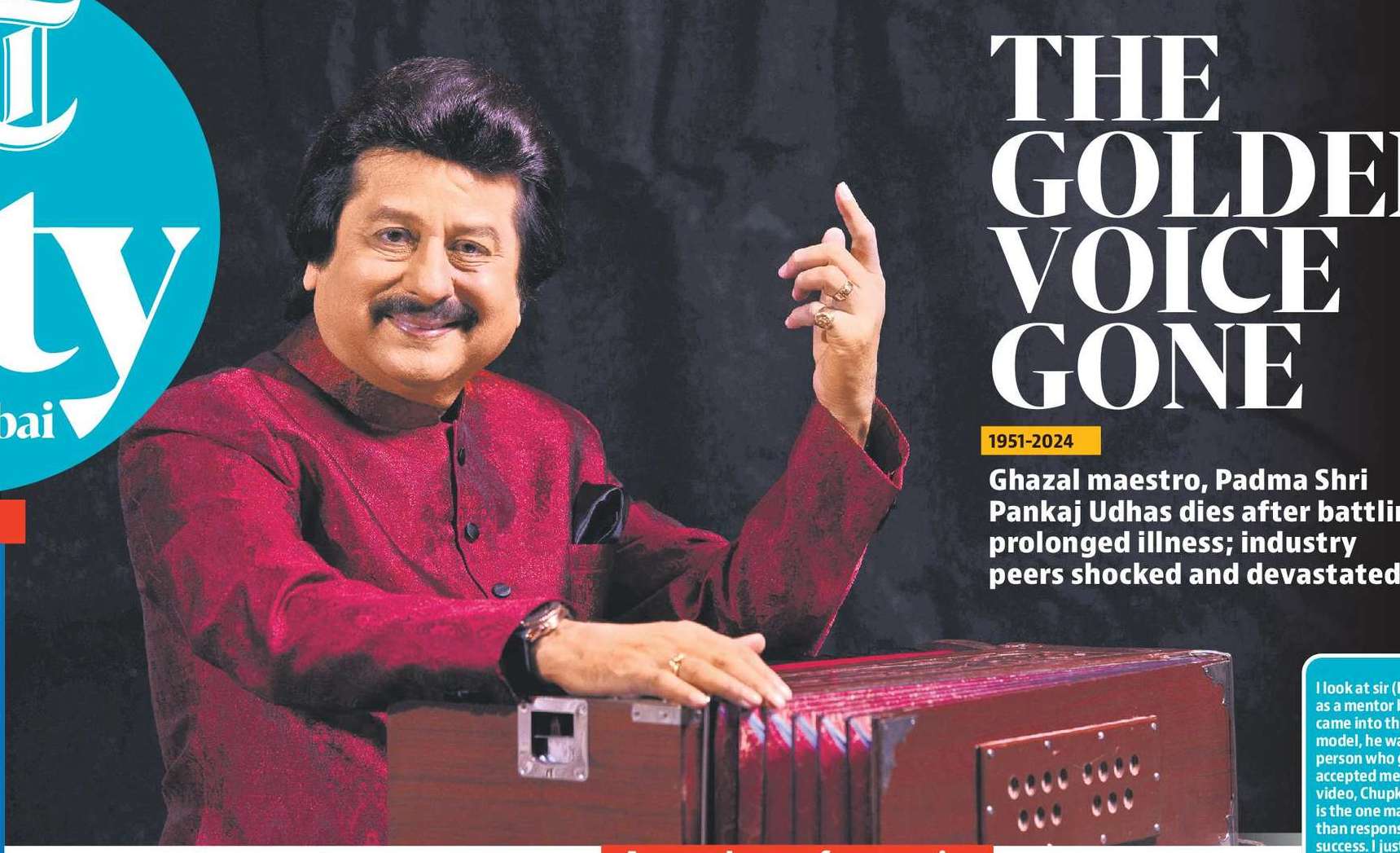
Pankaj Udhas no more, ghazal loses a chart-topper
8:13 AM

Avijit Ghosh (THE TIMES OF INDIA; February 27, 2024)
He completed evenings. In the 1980s and ’90s, ghazals sung by him were mandatory at parties and gatherings. They were like companions helping listeners unwind, enlivening many a ‘spirited’ sunset. Pankaj Udhas, whose audience-friendly renditions and easy on the ear compositions sold millions of cassettes, packed hundreds of concerts and took ghazals to new followers, passed away after “prolonged illness” at a Mumbai hospital on Monday. He was 72.
------------------------------------------
Ghazal chart-topper Pankaj Udhas, the voice behind ‘Chitthi Aayee Hai’ and ‘Jeeye Toh Jeeye Kaise’ passed away at a Mumbai hospital on Monday. His daughter, Nayaab, made the announcement on Instagram.
Primarily a singer of non-film ghazals and geets, Pankaj delivered Bollywood’s biggest 1987 chartbuster: ‘Chitthi Aayee Hai’ (lyrics, Anand Bakshi; music, Laxmikant-Pyarelal; film, Naam). The song, which topped Binaca Geetmala’s annual countdown show, touched an emotional chord, especially among NRIs and PIOs.
Some of Udhas’ finest numbers are in the 1981 album, Muqarrar. ‘Tum na maano magar haqeekat hai’ (poet Qabil Ajmeri) and ‘Deewaron se milkar rona achcha lagta hai’ (poet Qaiser-ul-Jafferi). Another popular track from the same album, Sabko maloom hai main sharabi nahi (poet Anwar Farook Habadi) spurred him to do a reprise with Paimana (1983), a collection of ghazals that went down well with tipplers; it had Thodi thodi piya karo (poet S Rakesh) and La pila de saakiya (traditional).
A science graduate from Mumbai’s St Xavier’s College, Pankaj spent his early years in Gujarat. In an interview to the Sunday Guardian in 2018, the singer recalled his father playing the musical instrument ‘dilruba’, and him liking the sound.
Pankaj also remembered being fascinated by the tabla and enrolling for a course but later switching to learning Hindustani vocal from Ghulam Qadir Khan Sahab in Rajkot. “Then I came to Mumbai to learn from my guru, Master Navrang Nagpurkar. He was a very famous singer from the Gwalior Gharana,” he said in the interview.
The 1980s saw two divergent trends in popular music. One was led by the breathless beats of disco, the other by the more reflective ghazal. The peerless pair of Jagjit and Chitra Singh had already initiated a new gene ration of the middle class to the non-film ghazals. A Padma Shri recipient who also worked to eradicate thalassemia, Pankaj was among the young bunch of ghazals singers - Talat Aziz and Anoop Jalota were the other two – who were part of that wave.
------------------------------------------
RWITC mourns a horse racing enthusiast
Ghazal singer Pankaj Udhas was a keen racing enthusiast too. A member of the Royal Western India Turf Club (RWITC), Udhas owned a few horses and would visit Mahalaxmi Racecourse. “He would call and ask if his horse has a chance to win,” RWITC-based trainer H J Antia told TOI on Monday.
Antia trained his horses. “And when I would tell him yes, he would specially make time to come to the Mahalaxmi racecourse,” added Antia. The late singer would also visit the stables at the racecourse to check on the horses, he said.
“We lost a very genuine member of the club,” said RWITC chairman Surendra Sanas. “It is also a personal loss for me. He would make it a point to visit the club on Classics race days and almost certainly on Indian Derby Day,” recalled Sanas.
Surgeon Dr Mehli Nazir, who jointly-owned horses with Udhas, said, “We bought our first horse called Aliyana sometime around 2010. And then we owned a couple of more horses together. When Aliyana won in Pune the first time, he was thrilled to lead the winner. It was his first ever win,” said Dr Nazir.
“He found it difficult to devote time to racing after 2018 because he had a busy schedule,” said Adhirajsingh Jodha, who trained a horse called Speed Of Sound owned by Udhas in partnership.— Shailendra Awasthi
------------------------------------------
Ghazal maestro, Padma Shri Pankaj Udhas dies after battling prolonged illness; industry peers shocked and devastated
HINDUSTAN TIMES (February 27, 2024)
Inarguably one of the most renowned ghazal voices, Pankaj Udhas has died at the age of 72. His daughter, Nayaab, issued a statement on Instagram on Monday to announce the news: “With a very heavy heart, we are saddened to inform you of the sad demise of Padma Shri Pankaj Udhas on 26th February 2024 due to a prolonged illness.”
Born in Gujarat, Udhas was keen about music from a young age. It was in 1986 that his playback career took off with the cult classic Chitthi Aayi Hai for the film Naam, and there was no looking back after that. Chandi Jaisa Rang Hai Tera (Ek Hi Maqsad, 1988) Jeeye Toh Jeeye Kaise (Saajan, 1991) and more cemented his legendary status. He remained active in films until 2016, when his song Raat Bhar Tanha Raha was featured in Dil Toh Deewana Hai.
He is survived by wife Farida and daughters Nayaab and Reva.
----------------------------------------------------------------------------
A symphony of memories
In a 2016 chat with Soumya Vajpayee, Pankaj Udhas spoke about his journey as a ghazal singer and the future of the genre
ON HIS JOURNEY
It’s been interesting, challenging and satisfying. When I started out, the ghazal had just started gaining popularity. Even then, Bollywood music dominated the scene.
ON WHAT MADE HIM POPULAR AMONG THE MASSES
When I started singing, I was influenced by Begum Akhtar and Mehdi Hassan’s styles. But as I grew up, I realized that I shouldn’t keep singing like them. I wanted to create my own space. That’s when I started creating a style of my own. I wanted to reach out to the masses, as the ghazal was always limited to a very small audience. I wanted to make it more accessible. So, I composed the ghazal, Aap jinke kareeb hote hain. Anyone who could speak Hindi could understand it. That clicked, and I realized that I had found the success formula.
ON NOT SINGING FOR BOLLYWOOD ANYMORE
To be honest, I would love to sing for movies, as that’s a very exciting medium. I cannot deny that some of the Hindi film songs that I sang have had a huge impact on my career. They helped me gain popularity. Songs like Chitthi Aayi Hai and Jeeye Toh Jeeye Kaise helped me reach out to audiences across the world. It’s a different story that the style of songs and the approach to music in Bollywood has changed drastically now. Perhaps that’s why we (ghazal singers) are not called in to sing anymore.
ON LATE MEHDI HASSAN AND JAGJIT SINGH’S ROLE
After they arrived on the scene, people started talking about ghazals. There was a curiosity about this kind of music. By the time I started out, which was around 1978-79, Bollywood music was struggling to impress the masses. The audience was looking for an alternative. That’s when the ghazal started to rise. After the ’80s, it became a craze. I am glad to have been around when the ghazal ruled the roost.”
Farewell, ghazal king
SONU NIGAM, SINGER
Pankaj ji was one of the most important parts of my childhood. I will miss him forever. My heart cries.
KAVITA KRISHNAMURTI, SINGER
He was my friend since college and the nicest man I’ve known. He would always smile and talk to everyone; he’d never discriminate. The world has lost not just a singing icon but also one of the sweetest and simplest human beings.
SUKHWINDER SINGH, SINGER
During the video shoot of one of my songs from the album Nasha Hi Nasha Hai, he invited us all for dinner and lunch. He even extended our stay for the next night, just because he wanted to talk to us. The world has lost a great icon and I still can’t process that he is gone.
SALIM ARIF, THEATRE PERSONALITY-DIRECTOR
I was working on a musical show, based on (poet) Mirza Ghalib’s letters, with Pankaj ji. We couldn’t meet the last four months as he was not keeping well. It’s a personal loss.
I look at sir (Pankaj Udhas) as a mentor because when I came into this industry as a model, he was the first person who graciously accepted me in his music video, Chupke Chupke. He is the one man who is more than responsible for my success. I just told him that your voice still sounds so beautiful, it’s amazing.
TALAT AZIZ, SINGER
I can’t believe I have lost my dearest and oldest friend. Pankaj, Anup (Jalota) and I go way back. This is really shocking. I spoke to Nayaab (Udhas’s daughter), too. Rest in peace, my friend.
ANUP JALOTA, SINGER
Mera yaar chala gaya. I am heartbroken. Hum logon ne kitni shaamein saath bitaai, kitni yaadein hain... yakeen nahin ho raha. We started Khazana (annual ghazal festival) together. Now, I would like to take it forward with his daughter Nayaab.
At 60-plus, I won’t be dancing with Alia Bhatt in a romantic song-Sanjay Dutt
8:30 AM
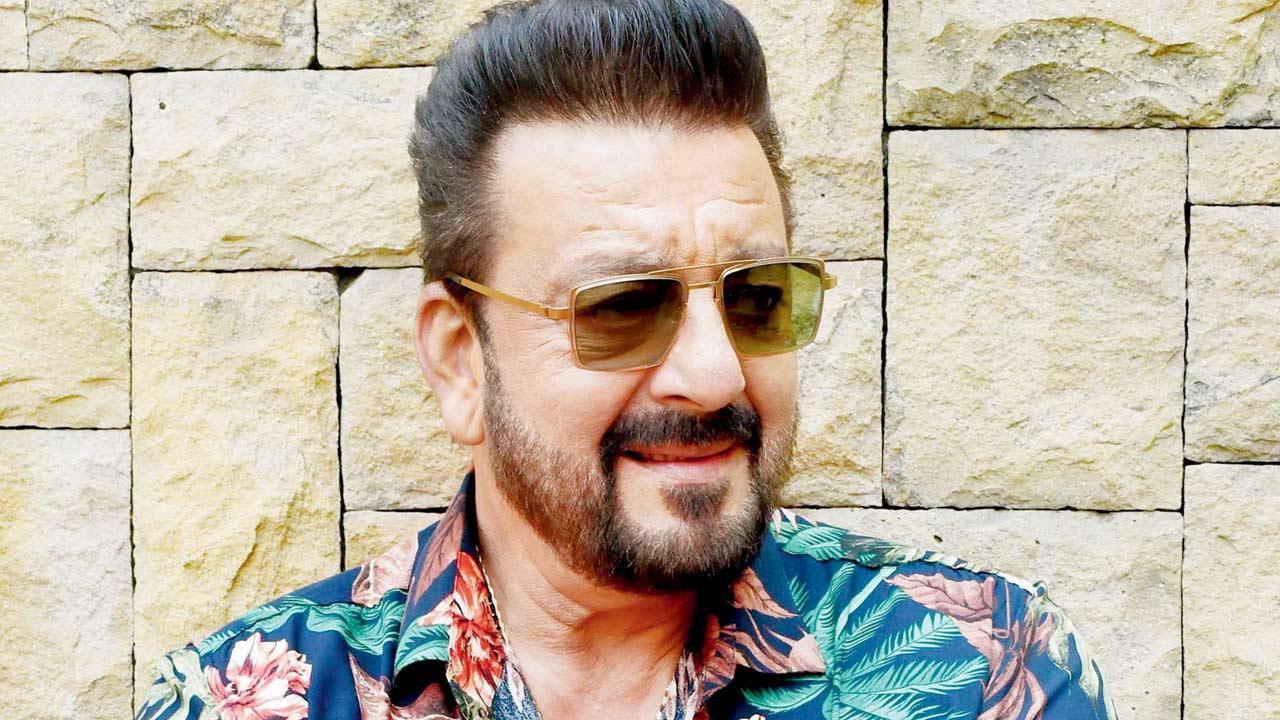
From reviving old-school heroism to fearing overspending on films, Dutt discusses his vision as he rolls out his new studio
Mohar Basu (MID-DAY; April 12, 2022)
In his four-decade career, Sanjay Dutt hasn’t shied away from taking risks — some have paid off, others have left him with a wise lesson or two. Now, as he rolls out his new studio Three Dimension Motion Pictures, the actor hopes that his fearless streak will reflect in his productions as well. “I did Saajan [1991] at a time when action heroes wouldn’t play a man with a limp. Munna Bhai was a brave move. I take these chances, and they work for me,” he begins.
This isn’t Dutt’s first brush with filmmaking. He had forayed into the business with Sanjay S Dutt Productions that backed Prassthanam (2019) and the Marathi film, Baba (2019). For Three Dimension Motion Pictures, the actor has put together a fresh team of content creators and writers.
“Movies and OTT offerings will be [created at] our stable. I believe some of the films that we are discussing will bring back the old-school Hindi film heroism to the screens. I don’t want to star in all my productions. I want to experience the producer’s life now,” he chuckles, before adding that he is not suited for number-crunching. “I am too emotional, and have a tendency to splurge. So, I have hired people to ensure I don’t overspend [on projects].”
The first film to come out of the stable will be a horror comedy. While the script has been locked, the casting is underway. “It will be followed by an action film. So far, we have locked five stories. The first film will roll this summer,” says the actor-producer proudly. Dutt has been a witness to the changing content landscape of the past few years.
Even as he will feature in some of his productions, the actor is certain that the offerings will depict him in a new light. “At 60-plus, I won’t be dancing with Alia Bhatt in a romantic song! I have to move on and pick roles that feel like a step ahead. For instance, OTT offers keep coming my way, but I need a good character to jump on the bandwagon.”
Covid claims Bollywood composer Shravan Rathod
7:57 AM

THE TIMES OF INDIA (April 23, 2021)
From Husnlal-Bhagatram to Shankar-Jaikishan, from Kalyanji-Anandji to Laxmikant Pyarelal, Hindi film industry has a rich tradition of musical partnerships. Nadeem-Shravan forged an illustrious link to this abiding chain composing a staggering bunch of chartbusters in the 1990s. On Thursday evening, the alliance was snapped forever as the Coronavirus claimed the life of Shravan Rathod at a Mumbai hospital. He was 66.
Speaking to Bombay Times, Nadeem Saifee said, “My Shanu is no more. We have seen an entire life together. We saw our highs, we saw our lows. We’ve grown up with each other in many ways. We never lost touch and no physical distance could ever separate the two of us. I am in deep pain as I say this but my friend and my companion, my partner of so many years is no more. It has left such a vacuum.”
The pair started off with ‘Dangal’ (1977), the first Bhojpuri film made in colour. ‘Kashi Hile Patna Hile’, a reworked version of the popular folk track, ‘Aarah hile Chhapra hile’, became a sensation. The two graduated to Hindi cinema in the 1980s.
Tuneful melodies for films such as ‘Maine Jeena Seekh Liya Hai’ (1982) got them work but major success eluded them.
The duo hit the jackpot with Mahesh Bhatt-directed ‘Aashiqui’ (1990). Every song in this intense romantic drama, from ‘Dheere dheere se meri zindagi mein ana’ to ‘Bas ik sanam chahiye’—rose to the charts. The film also vaulted Kumar Sanu, who sang a majority of the tracks, to the top. Nadeem-Shravan became a hot property.
The 1990s belonged to them. ‘Saajan’, ‘Deewana’, ‘Dil Hai ke Manta Nahi’, ‘Phool aur Kaante’, ‘Hum Hain Rahi Pyar Ke’, ‘Raja Hindustani’ and ‘Pardes’—they lorded over the decade blending old school melody with modern instrumentation. Songs such as ‘Mera dil bhi kitna pagal hai’ (Saajan) to ‘Pardesi pardesi jaana nahi’ (Raja Hindustani) to ‘Do dil mil rahe hain’ (Pardes) were as popular among the college crowd as the truck drivers on the highway. The pair won the Filmfare award three years in a row, 1991-93, for ‘Aashiqui’, ‘Saajan’ and ‘Deewana’ and again in 1997 for ‘Raja Hindustani’.
It seemed that the two would rule over Bollywood for another decade or two. But things were never the same after Nadeem’s name cropped up in the killing of a music baron and he fled to London. The duo still kept providing scores together in films such as ‘Kasoor’ and ‘Dhadkan’. The two split once, then reunited. This time, sadly, the separation is final.
I want my mom and dad to see my child-Salman Khan
8:27 AM

Salman Khan talks success, relationships, and babies...
Jitesh Pillaai (TIMES LIFE; September 23, 2017)
You Khans have lasted for more than 30 years. What would you attribute that to?
Today, there's so much awareness physical awareness, mental awareness. There are people to guide you. You keep on reinventing yourself. You keep on increasing your level from your previous film. You have personal trainers and dieticians. Earlier, you ate parathas and you did baithaks (sit-ups). So, no matter what the actors did, they could not get to this level (of fitness). This is the advantage we have over our seniors; they didn't have the right people around them. Akki (Akshay Kumar) and I have learnt it the hard way. When I was new, Jackie (Shroff) and Sanju (Sanjay Dutt) were much bigger stars than we could ever imagine. So was Sunny (Deol). Each time I felt my films were not working, I piggybacked on Sunny and Sanju. That's how Jeet and Saajan happened.
You've stood by a lot of people...
Yeah like Zareen Khan - you guys killed her by calling her Katrina Kaif.
What's the equation like between your brothers Sohail and Arbaaz (Khan) and you?
(Chuckles) We are all of the same age. Now, between dad (Salim Khan) and us, there's hardly a difference of a year and a half.
Salim saab's sense of humour is fabulous...
Yeah it is. Most of the time, it's directed at us.
If you had to rewrite your life... what would you want to change?
When you come to this planet, you're given a package. That package holds the good and the bad. And when you start flying there has to be something to hold you back, ki bhai zyada maat udo. This anchor God has been put to remind me 'don't think you are...' The bad things that happen are like the anchors that ground you. It's the way you take it. Most of the heroes believe they have become larger-than-life in real life. But that's not so. That's the silver screen. Celluloid ki image.
Has it ever happened with you?
(Laughs) No, no... I have enough people to ground me.
Who grounds you the most?
My father when we were growing up. But when you grow up, you understand yourself better too kahan galat jaa rahe ho, kahan sahi jaa rahe ho.
How do you view relationships today? Do you deal with things differently?
(Smiles) I used to deal with relationships then, I don't deal with it now.
Was there more drama earlier?
(Grins) Yeah. I was like what is this drama man? For what? I never spoke about any of my relationships but they all spoke about me. So there was one side that was coming out, which I didn't mind. Because if I had said anything, it would amount to disrespecting the person with whom I had spent an 'x' amount of time, and had a great time too. I just kept quiet about everything. Today, most of them are still in touch with me, we're still friends. It's like the best relationship now.
You're saying you are single right now?
Uh? No I'm not saying anything. I am what I am. Only I need to know what I am. Yeh single hone aur double hone se aapka toh kuch fayda hai nahi.
A lot of celebrities are having kids through surrogacy. If you don't get married...
If I don't get married that would be in consideration.
Do you fear time is running out?
No, not yet. (Laughs) But I'm sure when I'm 70 and my child is about 20, then I'd feel it. The only reason I'd want to have a child right now or in the near future, say in two to three years, is because I'd want mom (Salma Khan) and dad to see my child. They will be here for the longest time. Insha Allah! They're both healthy. Touchwood! We kids will have to worry about ourselves if we reach that age.
Margarita With A Straw: Getting real on reel with disability
9:10 AM

Disabled characters in Bollywood films are often unreal and clichéd. But there is rare candour and humour in a new coming-of-age film where the protagonist is a disabled teen
Kalpana Nair (THE TIMES OF INDIA; April 5, 2015)
The trailer for the film,
Margarita With A Straw, opens with Laila, played by Kalki Koechlin
applying lipstick in front of a mirror and heading out to meet a boy.
Just another teenager ticking off a rite of passage. Unlike most
teenagers however, Laila has cerebral palsy, a neurological disorder
which affects muscle function, so she is on a wheelchair and her speech
is impaired. Laila's disability is an important detail, but even in a
three-minute trailer, it's not the focus and never given top billing.
Releasing across India on April 17, Margarita With A Straw is a rare
film that focuses on a disabled protagonist without resorting to pit
, sympathy, villainy or cure.
Laila is a challenging role for any actor. Even Koechlin, who has something of a monopoly on fearless roles in Bollywood with films like Dev.D, That Girl In Yellow Boots and Shanghai. She worked extensively for six months to get right the distinctive speech patterns and physicality necessary for the role and says the film is unique in many ways.
“We never talk about disability and sexuality on the same page. What also struck me about the script was that it wasn't preachy. If you took the disability out, it was still an interesting film about a young, horny, awkward teenager and a coming of age story. It's actually a romcom about love and life,“ she says.
This is rarely the approach used in Hindi cinema. In Vishal Bhardwaj's Omkara, Langda Tyagi had a first name. But his parents (and the scriptwriters) needn't have bothered because it was his limp that became his calling card, quite literally. Ethan Mascarenhas in Guzaarish spent an entire film wanting to die rather than remain a dependant quadriplegic. And Gabbar in Sholay believed that living as a double amputee was a fate far worse than death, a punishment he doled out to Thakur.
The Bollywood environment of exaggerated perfection also makes it more hostile to physical disability. The onscreen disability of choice is usually blindness because it interferes the least with an actor's looks and speech delivery. If it can be cured miraculously by an operation or a divine statue or some blunt force trauma, even better.
Rustom Irani is an independent filmmaker, guest columnist and more than 60% disabled wheelchair user. He recently finished writing a ten-part series for Mumbai Mirror called 'Mumbai On Wheels' which focussed on life in Mumbai as a disabled person. According to him, recent Bollywood movies haven't made much progress in creating characters who are more than just a sum of their disabilities. “Except Barfi!, one can't really cite any progress or evolution in a Bollywood film. There are a few like Sanjay Dutt's blind turn in Dushman, Vidya Balan in Guru or Amitabh Bachchan's character recruiting three blind men to rob a bank in Aankhen. But if you go back a bit, then the 1986 film Qatl is a great film featuring a disabled blind person played by Sanjeev Kumar planning to murder his wife. Koshish in 1976 had two deaf-mutes fall in love and raise a normal child in a noisy world. In 1964, Dosti had a blind man piggybacking his physically disabled friend and teaming up to make a living. Show disabled people with flaws, evil, humour and I might say we are getting there,“ says Irani.
Shonali Bose, the director of Margarita With A Straw, is deeply familiar with cerebral palsy and disability. “I've grown up with my cousin Malini Chib who has acute cerebral palsy and my mother and aunt worked in schools that had kids with cerebral palsy. Malini and I were like any other siblings with our fights etc. and I never felt the need to tiptoe around her disability .“
Internationally, many acclaimed films like Jim Sheridan's My Left Foot and James Marsh's The Theory of Everything feature true stories of incredible grit that triumphed over disability. But when Bose set out to write the film, she was certain that Laila's story would not be a heroic triumph against adversity. “Within the first ten minutes of the film you will get past the disability. Not only will you not pity Laila, you will also not put her on a pedestal. We tend to put the disabled on a pedestal and make them amazing, heroic people. We didn't want to go down that route. We wanted to go with a character that was ordinary.“
Rustom Irani has a handy list of disability tropes that need to disappear from Bollywood. “First, if a handicapped character runs a race against an able-bodied person and loses, it's like, 'Wow! A+ for effort.' Why? They shouldn't be competing with the able-bodied in the first place. Or they should get really good, like in 'Iqbal'. Secondly, the handicapped character is either totally submissive or going all out with raging fury. Sanjay Dutt in Saajan is spurned early by a woman who says that no female would ever consider him worthy because of his disability. He accepts this and Madhuri Dixit's character has to go to great lengths to win him over. Good luck with that in the real world. Thirdly, please don't enhance the other senses and skills of disabled characters to superhuman levels because they lack a particular physical ability. And finally, no miracle cures.“
Laila is a challenging role for any actor. Even Koechlin, who has something of a monopoly on fearless roles in Bollywood with films like Dev.D, That Girl In Yellow Boots and Shanghai. She worked extensively for six months to get right the distinctive speech patterns and physicality necessary for the role and says the film is unique in many ways.
“We never talk about disability and sexuality on the same page. What also struck me about the script was that it wasn't preachy. If you took the disability out, it was still an interesting film about a young, horny, awkward teenager and a coming of age story. It's actually a romcom about love and life,“ she says.
This is rarely the approach used in Hindi cinema. In Vishal Bhardwaj's Omkara, Langda Tyagi had a first name. But his parents (and the scriptwriters) needn't have bothered because it was his limp that became his calling card, quite literally. Ethan Mascarenhas in Guzaarish spent an entire film wanting to die rather than remain a dependant quadriplegic. And Gabbar in Sholay believed that living as a double amputee was a fate far worse than death, a punishment he doled out to Thakur.
The Bollywood environment of exaggerated perfection also makes it more hostile to physical disability. The onscreen disability of choice is usually blindness because it interferes the least with an actor's looks and speech delivery. If it can be cured miraculously by an operation or a divine statue or some blunt force trauma, even better.
Rustom Irani is an independent filmmaker, guest columnist and more than 60% disabled wheelchair user. He recently finished writing a ten-part series for Mumbai Mirror called 'Mumbai On Wheels' which focussed on life in Mumbai as a disabled person. According to him, recent Bollywood movies haven't made much progress in creating characters who are more than just a sum of their disabilities. “Except Barfi!, one can't really cite any progress or evolution in a Bollywood film. There are a few like Sanjay Dutt's blind turn in Dushman, Vidya Balan in Guru or Amitabh Bachchan's character recruiting three blind men to rob a bank in Aankhen. But if you go back a bit, then the 1986 film Qatl is a great film featuring a disabled blind person played by Sanjeev Kumar planning to murder his wife. Koshish in 1976 had two deaf-mutes fall in love and raise a normal child in a noisy world. In 1964, Dosti had a blind man piggybacking his physically disabled friend and teaming up to make a living. Show disabled people with flaws, evil, humour and I might say we are getting there,“ says Irani.
Shonali Bose, the director of Margarita With A Straw, is deeply familiar with cerebral palsy and disability. “I've grown up with my cousin Malini Chib who has acute cerebral palsy and my mother and aunt worked in schools that had kids with cerebral palsy. Malini and I were like any other siblings with our fights etc. and I never felt the need to tiptoe around her disability .“
Internationally, many acclaimed films like Jim Sheridan's My Left Foot and James Marsh's The Theory of Everything feature true stories of incredible grit that triumphed over disability. But when Bose set out to write the film, she was certain that Laila's story would not be a heroic triumph against adversity. “Within the first ten minutes of the film you will get past the disability. Not only will you not pity Laila, you will also not put her on a pedestal. We tend to put the disabled on a pedestal and make them amazing, heroic people. We didn't want to go down that route. We wanted to go with a character that was ordinary.“
Rustom Irani has a handy list of disability tropes that need to disappear from Bollywood. “First, if a handicapped character runs a race against an able-bodied person and loses, it's like, 'Wow! A+ for effort.' Why? They shouldn't be competing with the able-bodied in the first place. Or they should get really good, like in 'Iqbal'. Secondly, the handicapped character is either totally submissive or going all out with raging fury. Sanjay Dutt in Saajan is spurned early by a woman who says that no female would ever consider him worthy because of his disability. He accepts this and Madhuri Dixit's character has to go to great lengths to win him over. Good luck with that in the real world. Thirdly, please don't enhance the other senses and skills of disabled characters to superhuman levels because they lack a particular physical ability. And finally, no miracle cures.“
Even today, at every show, I have to sing Mera dil bhi kitna pagal hain-Kumar Sanu
7:45 AM

Roshmilla Bhattacharya (MUMBAI MIRROR; May 13, 2014)
Twenty-three years have passed, but the mention of Saajan still gets Hindi film buffs humming one of its seven evergreen songs. The film, starring Sanjay Dutt, Madhuri Dixit and Salman Khan, was one of the biggest hits of 1991 and it was no surprise when the Filmfare Award for Best Music went to its music director duo Nadeem-Shravan.
Interestingly, in an interview to the magazine soon after bagging the coveted black lady, Nadeem had admitted that Laxmikanth and Pyarelal were initially signed for the love triangle.
But the film's producer Sudhakar Bokade was swayed when he heard the composition by Nadeem-Shravan.
"The first tune we played for Sudhakarji was Mera dil bhi kitna paagal hain, yeh pyaar to tum se karta hain and he loved it," he was quoted as saying.
Ask Kumar Sanu on this and the singer, speaking from London, admits that he does not know the details of the replacement. "All I can tell you is that the first time I heard the song in the studio I knew it will be a superhit," he says.
After Aashiqui, Nadeem-Shravan and Sanu had become a hit team. During that period Sanu recalls singing 10-12 songs a day. "I don't think any other singer has seen that kind of phenomenal success. I sang as many as five-six songs in a film and each one was a super success," he exults.
Interestingly, in Saajan, Sanu had just one duet with Alka Yagnik, Mera dil bhi kitna paagal hain, yeh pyaar to tum se karta hain, and another which he sang along with Alka, SP Balasubrahmanyam and Anuradha Paudwal--Jiye to jiye kaise bin aapke.
The Lawrence D'Souza directed film, partly inspired by the French play Cyrano de Bergerac, revolves around a disabled poet Aman who falls in love with his pen pal, Pooja, who only knows him by his pseudonym Sagar. Pooja is besotted by Sagar and his poetry but Aman's brother Aakash (the orphaned Aman was adopted by Aman's rich parents) falls for her and romances her under the guise of Sagar till the truth dawns on all three.
Since Salman Khan was playing the extrovert, exuberant Aakash, SP Balasubrahmanyam who had become his 'voice' after Maine Pyaar Kiya, got to sing most of the songs. However, it was Sanu's Mera dil bhi kitna pagal hain that turned out to be the biggest hit.
"Each time I stepped out of the recording room after completing a song which Nadeem felt would be a chartbuster, he would take out a bundle of Rs 500 notes and after waving it around my head would distribute it to the studio workers. So the workers were really happy to see me," laughs Nadeem's 'Tiger', admitting that this ritual was followed for this song too.
This was the first time Sanu was singing for Sanjay Dutt. Sanjay with his Lochinvar locks and sculpted physique had the image of an action hero. Saajan, which projected him as a romantic, sacrificing poet, was a turning point in his career.
"After the film's release Sanjay insisted that I sing for him in Sadak too," says Sanu.
For the singer, Saajan was also made memorable by Madhuri whose remains his favourite heroine, alongside Sridevi, whose Sadma had a lasting impression on him. Sanu remembers arriving at the film's premiere late and quietly slipping into his seat to watch his songs come to life on screen.
"Later, I saw the film again in the theatre and every time one of the songs came, there would be a shower of coins. Even today, at every show, I have to sing Mera dil bhi kitna pagal hain on public demand. It still drives people crazy."
Subscribe to:
Posts (Atom)