Showing posts with label Russell Peters. Show all posts
Showing posts with label Russell Peters. Show all posts
When I met Daniel Weber is when I was still just dating Russell Peters-Sunny Leone
8:27 PM
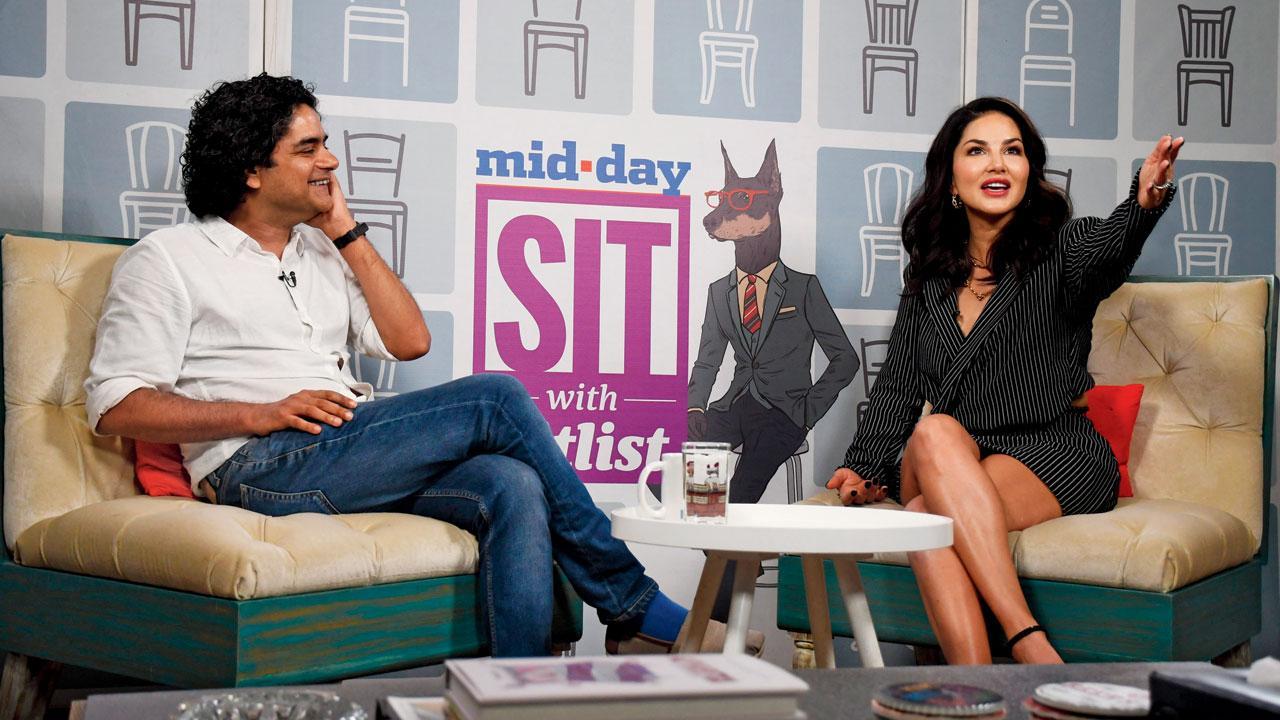
Peeking into Karenjit Kaur: world’s first adult entertainment star, to graduate to a mainstream actor, now at Cannes, no less
Mayank Shekhar (MID-DAY; July 22, 2023)
Sunny Leone. There, now that I have your attention, with the world’s most googled name, over multiple years—it might be easier to have you explore Karenjit Kaur Vohra, the actual person behind the screen name.
To start with, why is she Sunny Leone, of all names. I wondered about this, dozing off, watching a show recently, where they mentioned the African country, Sierra Leone in it, and I read the subtitles as Sunny Leone!
Wait, is she named after the African country? The real story, and I couldn’t find it detailed on Google, is equally random. When she was still Karenjit—meaning, not yet entered the adult film industry (the accepted euphemism for porn)—she was being interviewed, I’m assuming, for a girlie magazine, after debuting as a pin-up.
Sunny recalls, “So, I was at work. This was at a tax retirement firm, where I did all kinds of jobs, one of which was as the receptionist. During that call, that I had to finish fast, they asked me what should they name me? I couldn’t think of anything, so I said Sunny, which is my brother’s name. He is Sandeep Singh. For the last name, I asked them to pick one themselves.”
As it turns out, the magazine’s owner was Italian. Hence, Leone. Aha, got it—as in filmmaker Sergio Leone (popular Italian surname), not Sierra Leone! That said, Sunny Leone, which Karenjit sees totally as a brand, distinct from her, has gone through multiple makeovers itself. Besides the influencer behind several businesses, from cosmetics to crypto, Sunny Leone 2.0 is a Bollywood actor.
We take this for granted, of course. But, is there any other person from the adult film industry in the world, who’s made that critical transition into mainstream showbiz, in the first place? “In India, for sure, not. In the world? I don’t know! There is Paris Hilton, Kim Kardashian, Tommy Lee… Okay, they’re entertainers, not [mainstream] actors,” Sunny agrees.
And this breaking of a global taboo happened in India, of all places. She’d obviously been to India—where her Punjabi parents first moved to Canada from—quite a few times, growing up: “But as Karen, not Sunny Leone!”
When she got an offer from India to enter the reality show, Bigg Boss, in 2011, she first refused—wary of how the desi public will respond to her, besides understandable safety concerns.
The guys at Colors TV, evidently, made her an offer she couldn’t refuse. The money was good enough for her “down-payment for house” in LA. She had just got married to Daniel Weber, also her business partner. It was just two weeks’ work, and back home. That was the plan. The channel had also assured her that security would not be an issue.
Landing in Mumbai, she and her bodyguard from LA, decided to take a quick peek into what was going on outside the airport, while Weber went off to fetch the bags. And, phew, she saw a massive, uncontrollable crowd, jostling outside, to catch a glimpse of ‘Sunny Leone’: “We just rushed back. The military at the airport had to form a human chain, as we were somehow finally escorted out.”
That frenzy continues, clearly. Consider an image from Kerala that went viral online once, when Sunny had visited Kochi to promote a cellphone brand: “We’ve done such events, a million times. But with this one, the stage was small. From the car, I could see lots of people outside.
“Once I got out, there was a swarm, for as long as you could see, hanging from buses... It takes your breath away! People were analyzing later online, that they were from a political rally, nearby. But they were all yelling my name! It’s on my way back that I saw that picture you’re talking about: ‘Holy shit!’
“They were well-behaved, though, and the police were on guard. Security concerns depend on circumstances. Sometimes you’re at greater risk at a lounge or a nightclub than in a public place.”
What this insane love for Sunny reveals about us—an inherent non-judgmental liberalism, or sheer hypocrisy, is hard to tell. What’s common, regardless of where you’re in India, as she’s mentioned before, is Sunny being stared at.
“I think it’s an Indian thing. It’s not just with me. They just stare straight at you. I just walk with my horse blinders on. The funniest is, when I actually say hello to someone, on a set, or in general—they just slink away. They don’t say a hey, back. That’s even ruder!”
Ever since the Bigg Boss gig, Sunny says her life has been on a “wheel turning on its own”. Bigg Boss led to Pooja Bhatt’s Jism 2, her Bollywood debut, that was a hit, chiefly for its top-class soundtrack.
The film-offer happened with filmmaker Mahesh Bhatt entering the Bigg Boss house to publicly sign her up. She thought it was a gimmick/joke: “I didn’t know who he was. Recently, I was on the set with Pooja [Bhatt] getting into the Bigg Boss house. How life comes a full circle!”
On her maiden Bollywood shoot, she felt like a “fish out of water”. Otherwise, her knowledge of Hindi cinema was limited to VHS tapes of films her family played—on occasion, for late-night pyjama plus pizza parties at home.
It’s not that she thought about those films much, let alone imagine starring in them: “I could understand the movies, because Punjabi is similar to Hindi. Being from a conservative family, I spoke to my mother about how the heroines in those films were allowed to wear certain clothes, that I wasn’t permitted to at home. Those were my concerns!”
This tallies with the usual desi Diaspora life, doesn’t it? “It does. And I have a theory. Don’t know about now, but back then, the home-sick migrants, who moved to other countries, chose to create a ‘time warp’ around themselves—for when, and what they had left behind. So, inside their homes, they recreated the same philosophies of Indian life and culture [to feel like they hadn’t moved at all].” Sounds like Dilwale Dulhania Le Jayenge (1995), surely.
That was young Karen’s life. Before she became ‘Sunny Leone’, the adult film star, and thereafter a Bollywood actor, of course. There is a scene in Jism 2, where she heaves and moans, to tell her co-actor on screen, “You think this is easy. It looks like it. It’s not.”
While she didn’t write that line, she believes in it: “No matter what you do, if you’re an entertainer, it’s true, it’s a tough life. Even if you have families backing you—they can’t help you win the love of the public.
“And when you’re working, nobody asks you what your day was like, or what you’re going through, on that day—you just perform. Even if someone did ask—you wouldn’t say how you feel. You wear a mask, all the time.”
Take her journey to be taken seriously as a mainstream actor, for instance. She says she did go through acting workshops, before the shoot of Jism 2. And she’s had a team of coaches since.
At one point, she was paying an acting instructor, $200-$300 an hour—“they can be that expensive.” This is because a top Mumbai filmmaker had asked her to audition for the lead in a major production.
And, apparently, she declined—because she was offered economy-class tickets to arrive at the shoot? “Oh, no, that was still okay… It was everything across the board. And I am not talking about some small-budget film, or a production company that couldn’t afford things to be put into the budget for an artiste. It just seemed so unreasonable. But, hey, I did pass the audition!”
She doesn’t name the film. I’m thinking (in my head), Vishal Bhardwaj’s Rangoon (2017), where she could potentially crack the whip well, as Hunterwali, or the Australian-Indian Fearless Nadia. But why hazard a guess.
“Let’s just say, the gentleman’s films did very well, but this one, I auditioned for, went average. So, everything happens for a reason.” Sunny did bag and see through the lead part of Charlie in Anurag Kashyap’s Kennedy, post an audition, that was “held before the entire office, with everyone being asked how it went!”
She was terrified. Only to realize—when she hung out with these audience members, over a drink, much later—that she had been pre-selected, already: “Anurag sir probably just wanted to check if I’ll show up [for the audition]. Of course, I will. Since things have landed on my shoulders on their own, I may have created the impression that I won’t test for parts, which is obviously not true.”
This is the first time I’ve met Sunny. Strangely, one thing that most journalists say, once they do interview her, is how surprised they were to find her so sorted in the head. As if adult films stars posing, consensually, before a camera, must be ditzy brunettes.
If anything, you expect candour from a rare celebrity in this part of the world, who’s owned her life so publicly, through a documentary, Mostly Sunny (2016)—even a multi-season, semi-fictional series on her life, Karenjit Kaur - The Untold Story Of Sunny Leone (2018). Which, I’ve to admit, I couldn’t finish, because the crappy app it’s on (ZEE5) just wouldn’t allow me to!
“What’s in the series, is all true. I was clear about that, when they approached me for it. I’m very emotional about my family, and I wouldn’t have it any other way,” Sunny promises.
That series starts with an interview by a journalist, trying to slut-shame Sunny, to state it crudely. It’s somewhat based on news anchor Bhupendra Chaubey’s chat with her for News 18 in 2016. Which showed a really unfazed and warm side of Sunny—she says stuff like, it’s possible that superstar Aamir Khan may not wish to work with someone like her, but that’s okay.
Soon after, she got a call from Aamir, Sunny recalls, “He felt the same cringe. So many others too called up, to say they were proud of me: Anil Kapoor, Sonam Kapoor, Hrithik Roshan…”
Given the context, on a lark, I asked ChatGTP what Chaubey’s former colleague, broadcaster Rajdeep Sardesai, might ask Sunny Leone in an interview. All crappy questions. Our jobs are still safe. But I ask her one from that list, anyway.
‘You’ve faced a lot of criticism and backlash from some sections of society for your past work, how do you deal with such negativity?’ Sunny says, “I don’t deal. These people leaving comments are still there, only moving me up in Google rankings.” So, who’s the loser here—fair call/point!
The other thing interesting about the Karenjit Kaur series is it features a stand-up comedian called Rusty, who is so obviously based on the Canadian, desi comic, Russell Peters. Rusty makes jokes on Sunny part of his stand-up routine, while they had actually once dated. True story?
“Yeah, you should check it out. Not that I mind at all. It’s for the laughs, it’s totally fine.” How long had they dated? “For a hot second! We were great together, as friends—drinking, being silly, funny… We went on a date, and just messed it up. I’d still be so happy to meet him.”
As per that series, again, her boyfriend then (Daniel), husband now, beats the shit out of Rusty for using Sunny in his gags: “Oh, no that was just sensationalizing. That never happened. All that family parts in the series, though, are all true.
“Actually, when I met Danny is when I was still just dating Russell. Once Danny and I got together, I just had to drop my friendship with Russell. It’d be a mixing of weirdness, otherwise. Felt sad about it.”
Unsure if Sunny continues to make it to Russell’s stand-up set. Surely, it’d be better than other Sunny jokes floating around, forever: ‘What happens when Sunny Deol marries Sunny Leone? They both become Sunny Leone!’ She doesn’t find any of them funny, anyway: “Danny does; but he has a different sense of humour!”
Having spent over a decade in Mumbai—which, even for Indians is a tough city to live in—Sunny says it’s her pucca New Yorker, Brooklyn, Jewish husband, Daniel, who’s turned more desi, as a result.
She laughs, “Well, don’t go by my American accent. I’m totally Indian myself too. And even after I retire, Mumbai will remain my home forever. But when I see Danny order chicken tikka all the time, bob his head, say, ‘time-pass’, ‘just’, ‘only’… I’m like, ‘Who are you, dude?’”
The only thing that surprises me about Sunny is that she’s a Trump supporter, or at least a sufficient sympathizer—and this, only because she’s the daughter of Indian migrants herself. Trump’s views on migration, in general, are well-known.
Besides that it’s not proven (or proven otherwise) that Trump was a sexual offender at all, or that his supporters stormed the Capitol, when he lost the elections—Sunny’s arguments are focused more on Joe Biden’s supposed indiscretions.
We get into a bit of a political debate, to realize soon enough, thankfully—it’s kinda pointless in these polarized times. Waste of time. Nobody’s winning this.
But she has her firm opinions, and it’s do with the fact that her brother Sandeep (the real ‘Sunny’), a chef, has to be pay for Obamacare (America’s healthcare programme, supported by the Democrats.)
“Well, he can’t feed himself, and it’s okay that he must pay premium for Obamacare? He must have the choice, whether to, or not. America is all about choice.”
Okay, okay, moving on. If you follow her conversations, even casually, the only prism to assess Karenjit, as a person, is to see her quite simply as an astute business person. “And doing business is slightly different in India,” she says.
Something she needs to adjust to: “We are Americans. We do our work, and move on. Over here, more emotions get involved. That’s what businesses run on. That you must meet next week, too, even when the work is over. It was a learning curve. And something that Danny and I have realised we need to pay attention to.”
That said, Sunny sees India as the market to be in: “Even if you go to Bandra, and check with people selling slippers there, how much they make—it’ll shock you. Of course, there is competition, but running small businesses, even mom and pop shops, is much easier, than in America. Just look at the number of people here!”
As a big enough brand herself—with a premium valuation for everything, from ribbon-cutting, to product endorsements—there are businesses she runs, with Sunny Leone as the leverage.
She says, “It helps me live my passion, which was always business, since I was a child. I was that kid knocking on doors, selling you stuff—starting with lemonade, shoveling snow... Even when I entered the adult industry, I built my own website, learnt HTML, marketing, photoshop for images, video, ran my own affiliate programme…”
Not that we’re taxmen to ask how much she makes—it certainly sounds like an empire of sorts, by Indian standards. What does she do with her money—does she have guilty-pleasure luxuries, say, a private island?
“I hope Danny buys me one in Maldives, where we keep going for holidays. No, I’m just a plough-horse on a farm, that keeps working. I’m lucky, because my husband buys stuff for us. But we spent on our house here [in Andheri West], our cars… We also save money—we have three kids, a lot of it will go to them.”
How about a private jet? “Oh, I would never buy that. Not even reserve a seat in a time-share [programme]!” Why’s that? Well, there is a story.
“Okay, firstly, those private jets are nothing like you see in amazing images, and ads. They’re dinkies. We got into a private plane, going to Latur [in Maharashtra], because there is no commercial airport there. The plane got into a crazy air-pocket. We had the Sardar pilot loudly praying, ‘Waahe Guruji, Waahe Guruji...’ Our security guy’s legs were flying in two different directions, hands elsewhere. Danny was losing it with the manager, who’d booked us in the plane. I was trying to calm him down. I swore, I’ll never fly such a plane again.
“And guess what? A month later, we learnt, that we had matched with a girl [Nisha] for adoption. Guess where? Latur! I asked my manager to book a private charter, again. He said, ‘Are you out of your mind?’ We had to return to Latur, to eventually pick Nisha up, thereafter, as well. I guess, Latur and I are connected, in the most amazing and non-amazing ways! But yes, I don’t mind the last row of a commercial flight—no private jet!”
Done. No private jet for most of us who are reading this either. Just that we will never afford it—at least we can feel better about it! To think of it, everything began for Sunny with photos in girlie magazines, and videos that went viral, before that term was invented.
While production of porn is illegal in India, I tell her about how there is a thriving underground, local, adult films’ scene. One of the male stars of which, an actor called Shakespeare (it’s his real name), I’ve been in touch with, as a journalist, for quite some time.
Shakespeare tells me about how Sunny’s unthinkable commercial success had inspired a cottage eco-system of female aspirants. Which, in a way, also reflects a changing society, when it becomes to matters of shame and guilt, associated with sex.
Is she aware of this, or does she have a take on it? “How would I know [of what’s going on]? I live in my own bubble. When I go out to meet people, it’s not like they say, come on, let’s talk about sex!”
The truth is, those aspirants will not see anything close to Sunny days, ever. Maybe even get penalized/ostracized for it, in the long run, who knows?
Consider Mia Khalifa—an adult film star, about as well-known as Sunny. In 2014, she shot a dozen videos for $12,000, which remained her lifetime’s income from it. Her popularity subsequently soared, but she gained nothing.
And she never actually wished to be a ‘porn star’, she said—coming out in public, eventually, shining a light on the exploitative nature of America’s adult film industry. To which, Sunny responds, “How do I put this in a nice way? Read your contract!”
She adds, “I worked only with the best people. I have no horror stories. I read through and corrected every single contract, [to ensure] I was gaining something from it. I was in control of everything that I was doing. And I do believe, in that industry, there are different sides. But from my perspective, I was in complete control. I saw it as a means to get towards something different.”
As for whether she empathizes with Mia’s state/claims, at least, she argues, “Let’s say, you are going to broadcast this interview on one platform. But you also license it out to several other outlets. If I sign a contract that says, no, you can’t. Then, you can’t. Sure, you could end up with people who lie. But usually, at least in my experience, people are straightforward.”
In her own case, while she’s exited the adult industry, her videos continue to fly: “Exactly! You can’t get rid of the Internet, it’s impossible. But I did make sure—I got out of whatever time I spent on it. I did.
“Also, you know—it’s like me telling you to limit where you are going to put out this interview. Is that going to help me, or hurt me? Do I want you to exploit this interview? Of course.”
If we go back again to the Karenjit Kaur series, the one who was evidently hurt by Sunny’s choice of profession was her mother, foremost. Apparently, she veered towards alcoholism, as a result?
“No, my mother became an alcoholic, way before my life choices. We went through a lot of craziness in our house, because of this addiction. It was sad, because you always want to think that your mother loves you more than alcohol. But it wasn’t about that. It was an addiction—something psychological that needed to be repaired from the inside. That had nothing to do with me.”
“Was I a trigger? Most definitely. But I was always a trigger. It didn’t matter what I did—whether it was coming home late, or anything she didn’t like. When [the adult industry] happened, it was, you know, a stamp-trigger. It was not fun at all.”
Which brings me to what can only be termed the successful ‘porn star paradox’. And it’s something any libertarian parent might have to deal with. Which is—what if their child tells them they wish to follow in the footsteps of Sunny, given the immeasurable amounts of fame and money she has achieved? What would they even say? How would Sunny respond, if her children asked her the same?
“I would have to educate them as much as possible—to let them know of pros and the cons of this [decision]. They will obviously know [about] what I have done in my life, at some point. They are too young now. I made certain decisions, because of whatever circumstances in my life. So, if I can provide you with sound decisions—where you know what you are doing, and if you are okay with that—then I don’t think I would be able to stop anybody, after a certain age. I don’t know—they are only 5 and 7. It’s a long time from now. My main worry is how to get through their teenage years! I think that will be more difficult than some of the life choices they make after 18.”
Her children’s professional future is way ahead of them, of course—we may still be looking far too much into Sunny’s past as well, while she’s currently at another cusp in her career.
She returned from Cannes, where her film, Kennedy, premièred before a packed house, at the biggest venue of the festival. It’s surprising that this was her first time at the French riviera, given the number of stars, celebrities and wannabes walk the red-carpet there for a photo-op.
She was a rare one from India, with an actual film, to show for it. The screening at the world’s top cinema fete concluded with a reported seven-minute standing ovation. Sunny, you could see, was in tears.
“I was crying like a baby the entire week at Cannes. It was a really emotional trip. And there are two sides of it. One is the film itself, which I am so happy and proud of. Then, there is my personal journey—and what does Cannes means to me, in it? If you told me, when I stepped foot in the Bigg Boss house—that 11 years later, I would be walking the red carpet at the Cannes Film Festival, I would have told you to go, f*** yourself! That you are some crazy man, who took some blue pill. And that’s the crazy journey that I’ve had.”
Taapsee Pannu turns to stand-up comedy
7:46 AM

The actress recently performed a 15-minute set in front of an audience of 200 people, utilising her life experiences as material
Avinash Lohana (MUMBAI MIRROR; June 6, 2019)
While the likes of Johny Lever, Kapil Sharma and Vir Das got a foot in the Bollywood door after laying groundwork in the field of stand-up comedy, Taapsee Pannu is going in reverse. Mirror has learnt that after featuring in over 24 Hindi, Tamil, Telugu and Malayalam films since her debut in 2010, the 31-year-old actress has entered the comic fray.
According to a source close to the development, Taapsee is a long-time fan of the format and was recently offered a spot for an episode of a show. “She instantly came on board and performed in front of an audience of 200 people. Her set involved jokes around some of her life experiences,” the source shared.
Incidentally, the actress was at popular Indo-Canadian comedian Russell Peters Mumbai show on Monday with her Manmarziyaan co-star Vicky Kaushal. The event also saw Dhadak trio of Janhvi Kapoor, Ishaan Khatter and Shashank Khaitan in attendance, alongside Tara Sutaria and Nora Fatehi.
Taapsee started preparing for her 15-minute set three days in advance. “She was nervous and excited, but the audience’s constant cheer and applause was encouraging,” the source added.
On the big screen front, Taapsee will next be seen in the Anurag Kashyap production Saand Ki Aankh alongside Bhumi Pednekar and in Jagan Shakti’s Mission Mangal with Akshay Kumar, Vidya Balan and Sonakshi Sinha. She is also slated to start shooting for Anubhav Sinha’s Thappad, which marks her reunion with the filmmaker after Mulk.
People in India understand my jokes better than Indians who live abroad-Russell Peters
7:47 AM

Soumya Vajpayee (BOMBAY TIMES; May 30, 2019)
Though this marks his fifth tour in India, comedian Russell Peters holds the country close to his heart. “India has always been an integral part of all my comic sets, because I feel that’s my identity. When I’m in Canada, I’m an Indian man and when I’m in America, I’m an Indo-Canadian. So, India is something that’s constant in my life. I have many memories of this place, as both my parents were from here. I’ve been doing stand-up for 30 years and I figured that this would be the best way to show the people of India that I love and respect the country,” says the popular stand-up artiste, as he sits down for a conversation with Bombay Times. He talks about how the racism and bullying he experienced as a child continues to impact him, his love for Indian audiences, why politics doesn’t interest him and Bollywood. Excerpts:
Do you keep certain things in mind while preparing a set for your shows in India?
No, India is not that crazy when it comes to content. While performing in the middle-eastern countries, you need to be a little more careful about certain things. I’ve always bragged about the fact that people in India understand my jokes better than Indians who live abroad, because they seem to be more dialled in. People in India aren’t fixated on being Indian. They already know who they are. On the other hand, the NRIs still think that the country is stuck in the year that they left it in. So, if they left in 1975, in their head, India is still in 1975. It’s 2019, and the pace here is like you guys are already in 2025.
What do you like about the Indian audience?
I find them tolerant and sharp. They always get the little intricacies, which people in a lot of other countries don’t.
Do you follow the stand-up scene in India?
No, I actually don’t watch stand-up much. I’m at the comedy club all the time, performing with the best of artistes. So, for me, to sit at home and watch more comedy would be mindboggling.
You were subjected to racist bullying in school. And now, racist jokes are an integral part of the kind of comedy you do...
I’m glad you asked this. I crack racial jokes, not racist ones. They are two very different things. Racial describes people. If my jokes come across as racist, that’s because I am breaking down racism and making fun of racists.
So, how have those bullying incidents impacted you?
To this day, it actually shapes the way I look at myself. So, if I’m self-deprecating, that’s probably because from a young age I was told, ‘You are nothing’. It stays with you, no matter how much you have achieved. It’s like the seed that was planted when you were about five years old and it grows with you.
Is there any topic that you don’t like to touch upon while performing?
I don’t touch politics at all; I don’t know anything about it. Whether it’s here, in America or Canada, I don’t pay any attention to it because it doesn’t matter who is in power; no one is really going to do anything that will help the world. We still live in a weird, self-serving time, where people don’t care about other people. I’m an empath, so I’m always caring about other people.
But politics is a favourite topic among comedians in India…
Yes, I’m sure. In the US, when you turn on the TV, every talk show is doing political material. So, why would you pay to see someone talk about something that you could have heard for free on TV? I like to take people out of that and make them look at life in a different way.
In real life, how different are you from the Russell Peters the world knows?
The on-stage version is a less filtered version of me. When you give me a microphone, the filter just drops away.
You have also done a few films…
I like acting; it’s fun. The end product, being on set and meeting famous people is fun. I’m still a fan, so when I see famous celebrities, I still geek out. I remember, I was part of a table read with Robert De Niro about a month ago in New York. He was sitting across the table and I was doing scenes with him. I was trying to stay in the moment, but in my head, I was like, ‘Holy crap, that’s Robert Dr Niro right there and he is talking to me’.
Do you follow Bollywood?
No, I know some of the celebs because they are nice to me. I know SRK (Shah Rukh Khan) and Hrithik Roshan pretty well. Priyanka (Chopra Jonas) is cool; I’m happy for her.
Have you ever been offered a Bollywood film?
Not really. I don’t think that’s my scene. I wouldn’t want a role to be wasted on me. In fact, someone who is passionate about the genre and is good at it should get the opportunity. If a good film comes my way, I wouldn’t say no. So, if Shah Rukh says, ‘Hey man! I’m working on this and I really want you,’ then I might consider it.

I have a lot of friends in Bollywood despite what people think-Russell Peters
8:00 AM

Lasyapriya Sundaram (BOMBAY TIMES; April 1, 2017)
Russell Peters was in India
this week to shoot for his upcoming Canadian TV series (The Indian Detective), which will see
him teaming up with actor Anupam Kher for his first ever leading role on
the small screen. The celebrated comedian spoke to BT about why it was
essential that the series be partially shot in India and also cleared
the air about his love-hate relationship with Bollywood. Excerpts...
Do you share a love-hate equation with Bollywood because you had once claimed that you hate it?
I have a lot of friends in Bollywood despite what people think. Come to think of it, you don't say bad things about people you don't like. However, a lot of times, the message gets lost and twisted.
What's your take on Bollywood and Hollywood comedies?
I haven't seen any (comedy) in Bollywood. So, I can't say one way or the other. Are they making them now? (Laughs) In Hollywood, they are kind of dropping the ball. The truth is, I haven't watched any films in a long time. I watch a lot of documentaries, considered nerdy stuff, which you probably wouldn't associate with me.
What do you love about India?
We were recently shooting at Dharavi. When most of my co-actors went back to the vanity van during a break, I took a walk around. I was amazed by the lives I saw there. There was this little girl, who might not be living the optimum life, but she looked so happy. She made me think that maybe, I am not living the optimum life as well. She kept calling me English Uncle. I have been to many countries and visited underprivileged areas, but they always made me feel uneasy. You don't get that feeling in India. It's the mindset that sets us apart from the rest of the world.
What's your television debut as a leading actor all about?
I play a cop in Toronto, who gets suspended after landing in trouble. When my dad (played by Anupam Kher) gets to know about it, he fakes an illness to make me visit him in India. Once here, I meet a pretty girl named Mira, who lives in the same apartment as my father. She is a lawyer, who works for the poor and the destitute. She thinks I am a detective and asks me to help her solve some case, which upsets the corrupt local police.
Why was it imperative that you shoot in India?
The film was initially shot in Cape Town, but I kept telling the director that he can fake the interiors, but not Mumbai. In a way, I convinced him and the team to come here.
Do you share a love-hate equation with Bollywood because you had once claimed that you hate it?
I have a lot of friends in Bollywood despite what people think. Come to think of it, you don't say bad things about people you don't like. However, a lot of times, the message gets lost and twisted.
What's your take on Bollywood and Hollywood comedies?
I haven't seen any (comedy) in Bollywood. So, I can't say one way or the other. Are they making them now? (Laughs) In Hollywood, they are kind of dropping the ball. The truth is, I haven't watched any films in a long time. I watch a lot of documentaries, considered nerdy stuff, which you probably wouldn't associate with me.
What do you love about India?
We were recently shooting at Dharavi. When most of my co-actors went back to the vanity van during a break, I took a walk around. I was amazed by the lives I saw there. There was this little girl, who might not be living the optimum life, but she looked so happy. She made me think that maybe, I am not living the optimum life as well. She kept calling me English Uncle. I have been to many countries and visited underprivileged areas, but they always made me feel uneasy. You don't get that feeling in India. It's the mindset that sets us apart from the rest of the world.
What's your television debut as a leading actor all about?
I play a cop in Toronto, who gets suspended after landing in trouble. When my dad (played by Anupam Kher) gets to know about it, he fakes an illness to make me visit him in India. Once here, I meet a pretty girl named Mira, who lives in the same apartment as my father. She is a lawyer, who works for the poor and the destitute. She thinks I am a detective and asks me to help her solve some case, which upsets the corrupt local police.
Why was it imperative that you shoot in India?
The film was initially shot in Cape Town, but I kept telling the director that he can fake the interiors, but not Mumbai. In a way, I convinced him and the team to come here.
Subscribe to:
Posts (Atom)