Showing posts with label Rohan Sippy. Show all posts
Showing posts with label Rohan Sippy. Show all posts
Sholay was like a big and successful startup idea of those days-Rohan Sippy
8:38 AM

Rajesh Naidu (THE ECONOMIC TIMES; September 8, 2025)
Poet and cultural scholar A K Ramanujan in his essay Three Hundred Ramayanas observes: “In India and in Southeast Asia, no one ever reads the Ramayana or the Mahabharata for the first time. The stories are there, 'always already.'” It would not be an unpardonable exaggeration if one uses this insight in the case of one of the greatest films of Hindi cinema: Sholay.
One does not watch Sholay for the first time. One hears, reads, laughs and celebrates Sholay for almost anything—causes, agendas, sarcasm, personal communication and pure entertainment. It is a force which unites the elite with the mainstream and creates cliques even among people who do not share a deep bond. It has created a language of its own in which people speak to communicate the intimate, the profound, the routine and the mundane with absolute precision without losing the context. So, Sholay is a national cinematic language which has remained alive since its release. And it will remain the national cinematic language till the time Hindi cinema is alive.
Recently, Sholay completed fifty years of its release. ET’s Rajesh N Naidu caught up with Rohan Sippy, an accomplished filmmaker himself and son of Sholay’s director Ramesh Sippy, to know his thoughts about the film. Rohan Sippy has directed critically-acclaimed and commercially well-accepted films such as Bluffmaster! and Dum Maaro Dum and web series such as The Office, Sandwiched Forever and Criminal Justice: A Family Matter. He also shared his views about his own works and the current situation of the Hindi film industry. Here are the edited excerpts:
The world is celebrating fifty years of the release of Sholay. What are your thoughts when you look back at the film?
I think it is marvellous how almost everything fell into place for the film. One must consider the time in which the film was made. They were working at a time of political emergency. People were paying income tax, which was as high as 97%. Then, there was entertainment tax which was as high as 177%. This means that doing the movie business itself was challenging and required a daredevil spirit. In this backdrop, there is a director and an able producer who have an ambition to make a film which is larger-than-life than any film made before it.
One can have writers who are at the peak of their powers. One can have a competent producer who had a unique vision, courage and conviction to go into unchartered territory. Yet, one can go wrong and fail. But they all succeeded. This is the most startling part of the story.
One must bear in mind that a lot of technical work of Sholay was done overseas. Technicians were flown to London. Then, there is such a huge cast. It is unimaginable to pull off such a film even today.
It is just the passion to do something special which is palpable in Sholay. They found the right collaborators. They were able to ride out so many challenges on so many different levels. In today’s parlance, going by the sheer confidence and daredevil attitude of the director, Sholay can be considered a Start-up Idea which paid off. A one-in-a-million idea which succeeded. But I don't think one could predict or foresee the kind of success which the film earned over the years. I think this is the case with most great films. A director may have vision, confidence and conviction. But no director can claim to know the recipe of success of a film.
You are closer to the film’s creator than any viewer by the virtue of being his son. There might be stages of your understanding Sholay. You have watched Sholay as a teenager. Then, as a young adolescent. Subsequently, as a well-established filmmaker. As a filmmaker, what have been your key learnings from Sholay?
I first saw Sholay when I was about four years old. It was a magical and overpowering experience. The experience lingered in me for a long time. As a teenager I studied abroad. I showed it to my friends. They also liked it. It has cut across geographies and generations including my daughter and her friends. For me, it is a mystery beyond a point. It has become part of India’s popular mythology. It is like one of our epics.
There are so many lessons within Sholay. Over the years, the film has evolved into a Bible in filmmaking. One comes back to the film for a solution to a writing problem in a script. There are lessons about how to create a world, build characters and focus on certain specific aspects of a scene.
I will give you an example. You look at the introduction of Gabbar Singh in the film. You can study the shot taking one by one and understand how the character is unfolding. There is so much unpredictability in the presentation of Gabbar Singh. You look at where the camera is placed when Gabbar is laughing or where the camera cuts suddenly when Gabbar is in an aggressive mood. Also, the whole drama that unfolds when his gun comes out. The amount of thought which has been poured into these scenes is so awe-inspiring that one does not ever absorb these thoughts in the scene in the first viewing itself. Even the scene where Jaya Bhaduri’s character returns the keys to Jay and Veeru. It is so specific and adds so much emotional depth to the film’s narrative.
Importantly, Sholay’s sound design is another special thing in the film. Many a time, one is tempted to watch the film only for its sound design. You listen to the background sound when Sachin’s dead body is brought back to the village. It is a lesson in bettering your screenplay through an effective sound design.
So, everything from performance to staging scenes to editing them and then, sound design, Sholay has lessons in almost every department of filmmaking.
What are the lessons in filmmaking you have learnt from your father especially in the context of Sholay?
I don't think I have had a sit-down discussion with my father about Sholay. The last thing I want to do is be the millionth person asking him about Sholay. But we discussed a lot about the writing process. From these discussions life lessons would emerge. Lessons about how to take on challenges and keep pushing even when there are a lot of things pushing you back. I learnt that one needs to have conviction in one’s vision and an uncompromising attitude in the pursuit of excellence even when there are easy ways to do things. But the biggest lesson I learnt from the discussions I had with my father is clarity of thought. One needs to have clarity of vision and then pursue it doggedly.
Another thing which I learnt from him is the ambition to be different and not go down a path that either everyone else is going down or something that you have gone down before. You look at his body of work. He has worked in multiple genres. From a love story like Andaz to an out-and-out comedy film like Seeta Aur Geeta to an action adventure like Sholay to a James Bond-kind film Shaan and then again returning to a different kind of love story with Sagar. He also did a different kind of drama version of Mother India in an urban setting through the film Shakti.
This ambition to go out and expand one’s own cinematic language has been a big thing for me. I have followed this in my own way. Apart from Criminal Justice, I did a sitcom like Sandwiched Forever which I shot in a five-camera set up. It was a new learning experience for me.
What was the actual premise with which Ramesh Sippy started Sholay?
My father loved Westerns. He grew up watching them. He also liked horses. Even my grandfather owned racehorses and enjoyed that part of that passion as well. So, my father always thought about this idea of making a film which is close to a western. He always thought: Why cannot we make a film like a western in India? So, I think that was the kernel of the idea of Sholay. Then, I think the discussion with Salim sahab and Javed sahab started. Subsequently, the core story of the film emerged. Then, they bounced the story off with my grandfather. My grandfather instinctively saw potential in the story.
I think at that time there were two films. One was Majboor, a complete script. And the other was this idea of an outdoor western kind of film which will be Sholay. Then this story kept growing big day by day organically. They realized that they would have to fill a big canvas. So, they kept on working because they instinctively knew it was a good idea. I think this is the process by which they end up making the film.
The film’s screenplay was written in sixteen days and in another sixteen days the film’s dialogues were written. So, in a month’s time they had pretty much something very close to the shooting draft and maybe a few scenes here and there were fleshed out later.
There are certain scenes in Sholay which may not be directly connected to the main plot. In that sense, the film's screenplay does not seem tight and a bit scattered. Yet, they are so entertaining that audiences do not realize that they are not adding much to the main plot. What are your thoughts about it?
Those scenes reflect the power of a director who is at the peak of his powers. He was such a daredevil director. He knew that he was taking a little liberty. But he was confident that he will be able to pull it off. It could have been a tighter screenplay. But then the impact would not have been the same. These imperfections and slight diversions make Sholay what it is. These scenes give the film its soul.
Also, there are certain dialogues in Sholay which provide just information. According to you, what elements made these dialogues so iconic?
I think those dialogues are like the cherry on the top of a cake. They sound like a distinct cymbal clash in a beautiful 100-piece orchestra. This is the impact of these dialogues. Everything else is working in a perfect concert. These dialogues make the film memorable. A viewer who comes out of the cinema knows these dialogues. For instance, think about the dialogue: Purey Pachaas Hazaar. It works because there is a lilt to it. In that scene, there is threat, fear and the crescendo of the scene is the dialogue. There is an emotional impact on the audience. I think it was the first time a separate Long Playing (LP) record of dialogues of a film was released. This shows the extent to which the audiences connected with the film. This took the film’s acceptance to another level.
Directing a multi-starrer film could be a challenging thing. There is always a concern about stars not receiving proper footage. According to you, did Ramesh Sippy face any such challenges?
I think my father had earned a reputation as a young, incredibly talented and visionary director before he embarked on the journey of making Sholay. He had delivered two hit films. A lot of actors wanted to work with him. He had developed relationships with big and talented actors such as Sanjeev Kumar ji, Dharmendra ji and Hema Malini ji by this time.
Mr. Bachchan was not in the successful phase of his career. But my father loved him as an actor. My father knew that because he is not at that successful phase it would be easier to handle him than someone who might be at the peak of their power. Then, Jaya ji came on board as she also liked the overall story. There was a certain way in which actors worked that time. They would not just focus on their roles. They would focus on two important things. First: whether they want to be part of a story. And the other is: whether the story of a film was worth telling. This is how actors worked that time. So, it was not a difficult task to bring together these big actors. Also, one needs to bear in mind that the story needed these big stars given its scale. The casting of the film can be summed up as the right person emerging at the right time.
I am sure you have watched films such as Seven Samurai, The Magnificent Seven and similar films which spawned the western genre. How do you assess Sholay when you compare the film with these great western or samurai films?
I think inspiration is always there. One is inspired by others. The great Japanese director Akira Kurosawa was inspired by pulp western books. Then, he in turn inspired American filmmakers. Subsequently, American filmmakers inspired us and others. So, there develops a tribe of storytellers. I think this tribe of storytelling tradition goes back to William Shakespeare. So many of Shakespeare’s stories have geneses or roots in other stories and events. Then, you go back to oral traditions. One picks up from there also. But it is not an easy thing to do.
In Hindi, there is a saying which goes: Nakal Ke Liye Bhi Akal Chahiye (One must possess skills to borrow things and create well and convince others of the originality of one’s creation). One can give the same material to ten people. Nine of these ten people may fail to figure out as to how to use it. But the tenth person will copy certain things from the same material, change some things and present it in such a way that the material would look original. Most of us are like that only. A large part of our learning a language or what constitutes culture is achieved by copying each other only.
So, I think it is not that important whether westerns inspired the people behind Sholay. The world of films is a stream which keeps giving and taking things from one storyteller to another. I think the important thing is the relevance of a story and its ability to connect with audiences. That is the heart of filmmaking.
A lot of acclaimed directors made their great films when they were quite young. Francis Ford Coppola made The Godfather when he was just 32. In fact, Orson Welles who made Citizen Kane at 26, once said ‘ignorance’ in filmmaking was the key thing which worked in his favour. Ramesh Sippy was 28 when he made Sholay. Do you think when a talented director is young enough the ability to do out-of-the-box things is quite high in comparison with a seasoned director who may be set in his or her ways of filmmaking?
Yes, I agree. The spirit of a film reflects the people associated with it. When directors are talented and young, they are not straightjacketed in their worldview. Whether you call it ignorance or confidence, the cowboy mentality that I can do it is always there. This also worked in the case of Sholay. My father and Salim-Javed were like a bunch of cowboys. Even the actors in the film had swagger. The way these people interacted with each other and conducted their lives off screen made them so interesting. It is reflected in the film. One does not see such kind of people today. That is why one does not see that spirit in today’s films.
Which is your favourite character in the film?
I think there are so many memorable characters in the film. People even remember a small character like Samba who had very few dialogues. But I connect the most with Mr Bachchan’s character. One wants to be like the character. He is the coolest thing in the film. It is the most memorable and entertaining character in the film. I like his wit, the way he did his action and the whole emotional arc of the character. The character is very relatable to me.
It is a great tragedy that Sholay did not get many awards. It got the Filmfare Award for Editing only. Do you think it deserved awards in other important departments of filmmaking, especially direction?
It is bizarre to me how a small group of people make a subjective call. In hindsight, it looks ridiculous how such a big film got only one award especially when one considers the fact that the film has stood the test of time. Even after fifty years of its release, we are talking and discussing the film. It shows that the film was quite ahead of its time. It proves Wittgenstein's ruler theory which says a lot about the ruler than the thing which the ruler measures.
As a filmmaker, today when you look at Sholay, do you want to add, edit or delete anything in the film?
If I can go back in time, then I would like to release the uncensored version of the film. There is so much poetry in the way the uncensored version of the film ends. It deals with the idea of revenge in such an interesting manner. It makes the characters realize the futility and hollowness of revenge. In the uncensored version, after killing Gabbar, Thakur goes to Veeru, consoles him and says to him: ‘You lost your best friend. I killed Gabbar. I don’t know whether I have gained anything?’ I think if they had released this uncensored version, then the audiences would have loved the film even more. This is the original version of the film. This idea was used very well at the end of director Shriram Raghavan’s film Badlapur.
Do you think a web series based on Sholay exploring in detail the past of its key characters can be made?
I think it will be fun to look at the film in a web series form. The central mythology of the film could be fun to play around. Yes, a long form storytelling based on the characters of the film will be an interesting thing to explore. One can dig deeper and create more out of the key characters.
Now, let us talk about your work. In its recent research by media and entertainment research firm Ormax Media, Criminal Justice emerged as one of the highly watched original web series. You have directed the last three seasons of the web series. What elements in the series convinced you to be a part of this series?
I had previously worked with Applause Entertainment on some episodes of the Indian version of series The Office. I have long-standing relationships with Sameer Nair and Deepak Segal (producers of Criminal Justice series). In fact, Deepak was the editor of one of my grandfather’s films, Pathar Ke Phool. When I was approached to direct one of the seasons of Criminal Justice, it felt like a natural fit. The first two seasons were produced in the UK. The UK version introduces a new female lawyer character while here we chose to continue with the character Madhav Mishra. It made sense narratively.
Directing a series has been a different experience compared to films. Films typically require more holistic involvement from directors early on. But for a series much of the writing is done before a director's involvement. It is often shaped through discussions with a platform and then a shooting draft is finalized. Our input is focused and more contained compared to the broad scope a film director usually has in films.
One practice that has become a tradition across our projects is conducting table readings with all the actors and key crew members. This process allows everyone to hear the script aloud, which is valuable because television work is oral and visual rather than purely written like a book. Table readings clarify many aspects and generate new ideas. They offer actors insight into their characters' emotional journeys, especially because shooting is fragmented over long periods. I found this collaborative approach particularly effective.
Criminal Justice appealed to me partly because I have not explored the legal genre before. It presented an exciting challenge and an opportunity to discover new creative rules for me. I have directed three seasons. I have seen how the show has evolved into its own format centred on the character Madhav Mishra. The character Madhav Mishra anchors the narrative much like classic legal drama characters.
It has been a rewarding experience to revisit the series multiple times. Each season introduces fresh cases, which helps prevent the show from becoming stale. This mix of familiar characters and engaging new investigations keeps the series relevant to audiences. Overall, the whole journey has been quite gratifying for me.
Are you working on a new film?
I am working on a script. I have been approached by producers for a couple of scripts. But till something is locked, it is impossible to talk about it. But I am trying something in a lighter space.
What is your assessment of the present state of the Hindi film industry?
These are the times of correction. One of the hallmarks of Hindi cinema used to be strong films featuring newcomers. Over the past several years, however, we seem to have moved away from that tradition. I am glad that Yash Raj has embraced it again, and I can already see the benefits. Hopefully, this approach will encourage many more filmmakers to follow suit. It shouldn’t be limited to a single genre either—the larger idea is to back projects with younger actors. After all, the audience largely remains young though we often forget that we have grown older.
Of course, this does not mean films must exclusively feature young actors. But it is important to invite them in and give them space. Saiyaara has done that very effectively, and I hope it sparks fresh excitement among producers and in the market to support such ventures. What is really needed now is new ways of thinking about how to make this happen. If this succeeds, then I hope to see many more such films by the end of the year.
Lastly, what are the challenges in the Hindi film industry? Do you think there is a lack of passion, funding or absence of directors in the right sense of the expression?
I think the expression that sums up the present situation in the Hindi film industry is: Skin in the game. In the earlier time, you had to have skin in the game. A producer was liable. He would put his own cash and credibility on the line. So, in a sense, the risks got evened out. It is not that they weren't failures. A director also realized the risks a producer was taking. A producer knew that he would lose home or office if things go wrong.
Think about the time when Rajshri Productions’ Hum Aapke Hain Koun..! was released. At that time, only mass films were working. But they put everything at stake. They decided that they will not sell the film. They decided to release the film in 36 screens. It was a huge risk. If the film did not work, then they would have incurred losses. They were liable for everything. But it worked. Then, there are instances when producers made mistakes too many times and they knew they were not going to survive.
And this system of having a personal stake worked not just on producers’ level. It worked across the value chain of filmmaking: sub-distributor, distributor, sub-exhibitor and exhibitor. This is how the filmmaking system effectively ran. Today, among other things, this system must sustain for better scope and future of films.
In recent years, the biggest shift which has happened is the people who are authorizing films. They don't have a personal stake or skin in the game in the entire enterprise of filmmaking. They are working for a large studio. And that responsibility which producers and other entities in the value chain of filmmaking shouldered is diffused. So, in that sense, things have changed.
Jiyein Kyun changed everything-Papon
9:15 AM

As the song completes 13 years, Papon looks back at the track that changed his life
Samarth Goyal (HINDUSTAN TIMES; May 6, 2025)
When Jiyein Kyun from Dum Maaro Dum released in 2011, it didn’t just serve as a melancholic interlude in a crime thriller — it marked a turning point in Papon’s career. The track, which turns 14 this year, composed by Pritam and penned by Jaideep Sahni, introduced Bollywood to a new kind of voice: introspective, earthy and unmistakably real.
“Jiyein Kyun was my first big break in Bollywood,” the Assamese singer recalls. “Technically, I sang Sajana for Let’s Enjoy back in 2004, but this song changed everything for me.” At the time, Bollywood wasn’t even on Papon’s radar. “I had no plans from childhood to be in Bollywood,” he says.
“I was performing in Mumbai when Rohan Sippy heard me and asked if I’d like to sing for a film. Soon after, Pritam Da called me — he had heard my Assamese album Jonaki Raati and liked it. That’s how Jiyein Kyun happened.”
But it wasn’t just the opportunity — it was the sound that set the song apart. In an industry where soaring, high-pitched vocals were the norm, Papon’s grounded tone made listeners pause and feel.
“Back then, everyone was singing high,” he shares. “I was the only newcomer who sang that low. I actually recorded the song seven semitones below the original composition. That became my strength — but also a challenge. It wasn’t easy to place a voice like mine against the typical Bollywood hero.”
Yet, that very depth made Jiyein Kyun unforgettable. “I think people connected with the rawness of it. Over the years, it’s become something of an anthem — for quiet heartbreaks, for reflection,” says the 49-year-old.
Benedict Cumberbatch is not playing Shekhar, right? Nor is Robert Downey Jr. I am playing Shekhar-Kay Kay Menon
8:17 AM
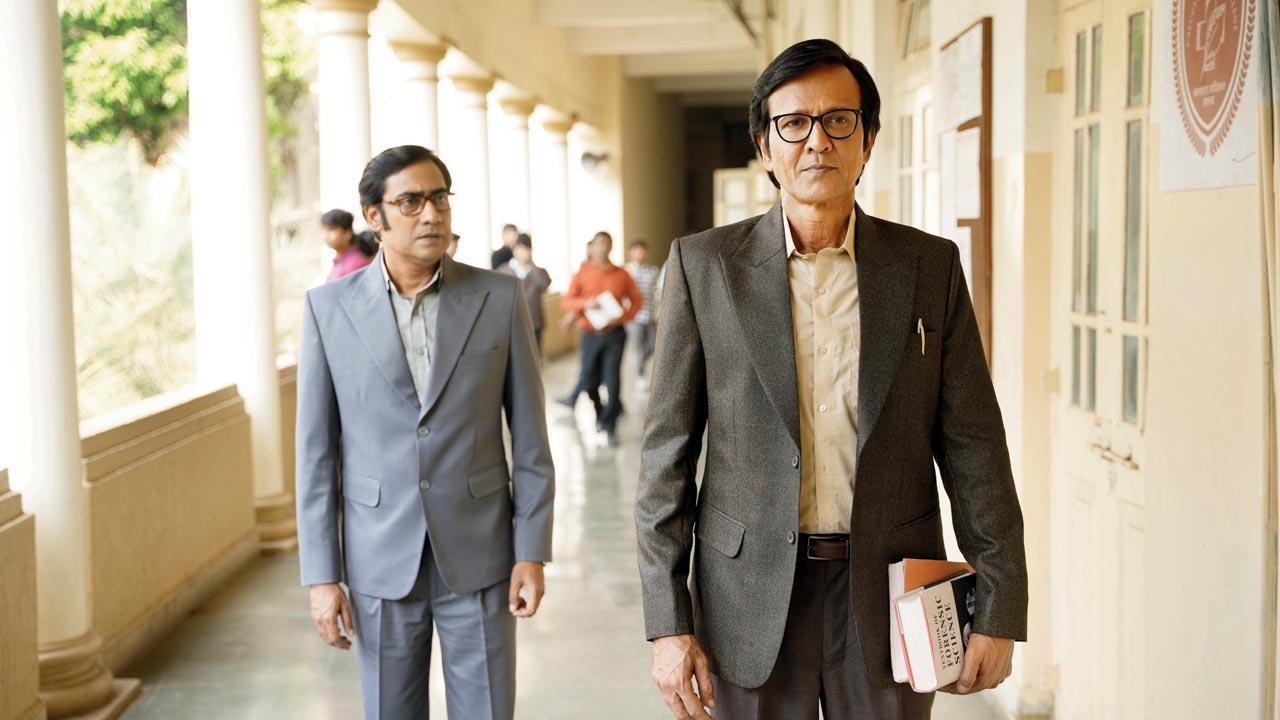
With Shekhar Home reimagining Arthur Conan Doyle’s famed detective Sherlock Holmes in 1990’s India, Kay Kay on how the setting influenced his acting
Letty Mariam Abraham (MID-DAY; August 13, 2024)
If Kay Kay Menon features in a project, it features in our watch-list. And if it blends his acting prowess with Sir Arthur Conan Doyle’s much-loved work, Sherlock Holmes, it’s a no-brainer. That explains why we’re looking forward to Shekhar Home. The Jio Cinema series reimagines the iconic detective in the setting of 1990s India. Playing the famed detective can be a big draw for any actor, but Menon says it was the story’s adaptation that attracted him deeply.
“I normally don’t go with inhibitions at all. I go with an open mind [when approaching] any script. This story is set in a sleepy town called Lonepur in the 1990s, without telecommunication, mobile phones, or Zoom meetings. It felt so good while reading it that I was transported to that era,” says the actor.
Helmed by Srijit Mukherji and Rohan Sippy, the mystery series also stars Ranvir Shorey, Rasika Dugal and Kirti Kulhari. Over the years, there have been many adaptations of Doyle’s detective series, including the hugely popular Sherlock, fronted by Benedict Cumberbatch, and Robert Downey Jr’s Sherlock Holmes (2009). Didn’t the fear of comparisons cross his mind? Menon says he embraced the challenge without falling into the trap of comparison.
“That is a trap. If I think like that, then I would never be able to perform. Benedict Cumberbatch is not playing Shekhar, right? Nor is Robert [Downey Jr]. I am playing Shekhar. I don’t look at it from the prism of something that has already been done. Otherwise, every love story would seem like Romeo-Juliet and Heer-Ranjha. I go with the principle that this is a unique script and given to me only, and I need to do justice to it.”
Holmes’ biggest strength is his power of deduction. The actor is quick to admit that he doesn’t have his subject’s observation skills. So, he embodied the character by gleaning out his other characteristics from the script, even letting the fictional town’s mood influence the role.
“I found that there’s a certain pace and rhythm that Shekhar sets, irrespective of the situation that he is in. I also represented Lonepur, that sleepy languid nature of the town seeping into this person. I let myself be; the mannerisms and body language happened. I don’t design as an actor. It’s all slightly transcendental.”
He adds that the production team had to carry out extensive recces before finalizing Bholpur and Haldia in West Bengal as the locations for the fictional town.
What added flavour to the story is that it was helmed by Sippy and Mukherji, each bringing their distinct voice.
“Their voices are very different. Srijit has a stereophonic voice, while Rohan has a softer voice. They are a powerhouse of talent and know how to go about a story. When I was doing Special Ops, I worked with both Neeraj [Pandey] and Shivam [Nair]. I love seeing the jugalbandi. Cinema is the most collaborative art possible.”
Vishal Bhardwaj, Vikramaditya Motwane, Rohan Sippy talk about changing landscape of Indian cinema
10:59 PM

Vishal Bhardwaj, Vikramaditya Motwane and Rohan Sippy talk about the changing landscape of Indian cinema and how filmmakers are dealing with it
Renuka Vyavahare (BOMBAY TIMES; May 29, 2024)
Cinema is considered as a medium of change and diverse new voices only contribute to elevating the artform. As part of MAMI Mumbai Film Festival’s initiative, five emerging filmmakers Archana Atul Phadke, Faraz Ali, Prateek Vats, Saumyananda Sahi, and Saurav Rai were mentored by Vishal Bhardwaj, Vikramaditya Motwane and Rohan Sippy, to help them redefine cinematic norms.In an exclusive interview with Bombay Times, the celebrated trio addressed some raging issues like stifling of creative freedom, censorship, corporate interference and more. Excerpts…
‘Private sector censorship has become more drastic than the CBFC’
Always the one to challenge the status quo, Vishal Bhardwaj confessed that times are volatile for filmmakers. “It is totally strangulating. You can’t say anything. Do you know what has happened? As filmmakers, we are self-censoring ourselves. Whenever a thought arises, you first wonder what the money men will think. Will they finance us to get this idea across? This is what the system wanted. Before going to CBFC we self-censor.”
Vikramaditya Motwane nodded in affirmative and stated, “You start second guessing everything and that’s bad. Lawyers run the studios in a way.”
Rohan Sippy added, “It happens at a corporate level. You are not independently distributing anymore so you are always dealing with large companies that are sensitive to anything that is deemed controversial. Private sector censorship has become more drastic than the CBFC. You don’t know what lies ahead so you feel it’s safer to not go down that path.
‘In filmmaking, the filmmaker becomes naked on screen, actors hide behind their characters’
The mentors ranked honesty high as a trait for filmmaking. “As a filmmaker, you must follow your heart and be completely honest with your feelings. In filmmaking, the filmmaker becomes naked on screen, actors hide behind their characters. Be it his political views or world views, you can see through the filmmaker. It is he who is seen. You can fake it as an actor. You cannot fake it as a filmmaker. Parda faash ho jata hai”, said Vishal.
Rohan begged to differ. He countered, “It’s also okay to do the opposite of what Vishal said. Author Hunter S Thompson modelled himself on Ernest Hemingway early in his career. In the beginning, it’s okay to look at others’ work and figure out what you want to do but don’t delay that start.”
Vikram explained, “There are no set rules. If you want to be a filmmaker, be a filmmaker. Go out and shoot 100 bad shorts until you make that one great short film. That’s what I did. I was lucky to get a video camera for my wedding when I couldn’t afford one. I used that to shoot everything. Be it a friend’s wedding, car racing. Read a lot and explore life, that shapes you into a good filmmaker.”
‘You can’t fight technology’
Film vs digital has been an ongoing debate. Christopher Nolan has been a champion of traditional techniques known for shooting on film. However, not everyone gets the budget he does, believes Vishal. “We can’t fight technology. When the sound became digital, we used to say the warmth of tape is not there. I don’t think that’s the case at all. Likewise, smartphones have revolutionized filmmaking. I shot a (short) film called ‘Fursat’ (starring Ishaan Khatter and Wamiqa Gabbi) on an iPhone and I was happy. In fact, whenever we do guerrilla shoots, for instance shooting in a train without permission, we use phones. Steven Soderbergh has shot his entire feature films like ‘Unsane’ and ‘High Flying Bird’ on a smartphone and he did it years ago. Nolan gets such huge budgets, he can afford to say anything (smiles).”
‘Not all filmmakers have the privilege of huge budgets like Nolan’
Agreeing with Vishal, Vikram explains, “Nolan can afford to have Imax cameras. Kodak created a completely new format of its black-and-white film for scenes in 'Oppenheimer'. Yaha pe you can’t afford to ask for extra film from the producer. Kaha se milega?”
There is a certain romance associated with shooting on film but whether it is better than digital is no longer relevant, he feels. “Digital is cost effective and easier to work on. I’d love to shoot something on film if it makes sense financially. I don’t see anything wrong with the digital format”, he says.
Rohan Sippy believes film and digital can co-exist instead of an either-or situation. “It’s great to have different religions in filmmaking and people like Nolan championing ‘film’. Francis Ford Coppola said this 40 years ago, that ‘people who normally wouldn't make movies are going to be making them and for once this whole professionalism about movies will be destroyed and it will become an art form’. That’s the beauty of digital technology. It makes filmmaking handy. How people consume it is up to them. At the same time, we are happy to see some are keeping the tradition alive and looking into conservation of film. You cannot deny the change though. You must embrace it.”
‘Cinema needs new voices’
There has been a generational shift, believe the makers. Vishal concluded by saying, “Cinema ko hamesha se hi new voices ki zaroorat hai. Every ten years ek nayi soch aa jaati hai and if we can give them a platform, why not?” Vikram pointed out, “The kind of realism the new generation is bringing to storytelling and performances is admirable.”
Rohan summed up, “The whole landscape is so different today. I remember we didn’t have multiplexes back then and Nagesh Kukunoor’s Hyderabad Blues (1998) turned out to be a game changer. It created new ways of thinking.”
I tell myself, ‘Don’t forget to play Beena from Mirzapir with dignity’-Rasika Dugal
8:02 AM

Rasika, who has Indian adaptation of Unreal and Mirzapur 3 in the offing, discusses lending a quiet strength to her homemaker role in the popular crime drama
Mohar Basu (MID-DAY; January 31, 2024)
Rasika Dugal believes that the most special projects happen when you least expect them. Just when she was ready to take a break, the actor was offered Rohan Sippy’s adaptation of the American series, Unreal.
“I wanted to take some time off, read, and watch movies. Rohan called me for the show, and I have always wanted to work with him,” begins Dugal. A week after the call, she was facing the camera for the Indian adaptation, which also stars Aadar Jain and depicts the behind-the-scenes working of a reality show.
“It was really last minute on the project. But in the madness, I found a part that no one has offered me. My character is snappy, sarcastic, and has a sharp sense of humour. The sarcasm and quickness of the original is present. I liked the series so much that I got bangs for it,” she laughs.
If 2024 has offered Dugal something new, there’s also something old in store. She has wrapped up the shoot of the third season of Mirzapur. Even though she has been playing Beena Tripathi—a quiet homemaker who knows how to get her way in a male-dominated household—in the crime drama for eight years, becoming her all over again was a challenge.
“I’m never prepared enough for Beena. Our characters keep evolving. The journey between the seasons is transformative, so you have to reflect that lapse. Beena is so interesting. [But before reprising the role] I sometimes worry that I have forgotten her. Here, I have to credit the writing that helped me understand the woman. Once, writer Puneet Krishna told me, ‘Aapne sab achche se kiya. The beauty is that you played Beena with dignity’. Before every season, I remind myself of the best compliment I have ever got. I tell myself, ‘Don’t forget to play her with dignity.’”
Adding to the diverse worlds she is inhabiting this year is Kartavya. Shah Rukh Khan’s production, headlined by Saif Ali Khan and her, is reportedly an investigative thriller. Even as she is tight-lipped about the project, she can’t help but underline that it has nourished her as an actor.
“I had a ball shooting for it. I want roles that will take the life out of me. I want to be so depleted that I have nothing to give for a bit.”
Every time, I think I will start developing a film after finishing the series but that doesn’t happen-Rohan Sippy
8:22 AM

Even as he is toying with film ideas, Duranga 2 director Sippy says helming back-to-back series has left him with no time to make features
Priyanka Sharma (MID-DAY; October 17, 2023)
In Rohan Sippy’s head, the ending of Duranga’s first season is an interval point, and a gripping one at that. The Gulshan Devaiah and Drashti Dhami-led crime drama ended by revealing the true identity of Amit Sadh’s character. When Sippy was approached to helm the second instalment, he knew it would be an exciting starting point.
“The writing was so clever, with Amit Sadh waking up as the real Samit Patel at the end of the first season. I saw that as the right scene for an interval point of a film. So, there is a great promise of a second half,” he says.
The opportunity to reconnect with an old collaborator was another highlight for the director. “I worked with Gulshan in Dum Maaro Dum 12 years ago. More than their work, I am drawn to people’s nature, and Gulshan is a lovely person. He has built an [admirable] repertoire.”
In the past few years, Sippy seamlessly shifted to digital entertainment, helming The Office, Criminal Justice, and Aranyak. It has left the director, whose last film offering was Nautanki Saala (2013), with little time to focus on features. But he is not complaining.
“I’ve got so many fun opportunities in OTT in the last two years that before I know, six months to a year go by in making a show. Every time, I think I will start developing a film after finishing the series in hand. But that doesn’t happen,” he smiles, adding that he is toying with a few movie ideas.
With theatres back to their old glory, larger-than-life spectacles have worked wonders at the box office, as have sequels—from Gadar 2: The Katha Continues to Fukrey 3. Would he like to make a sequel to any of his films? “Taxi No 9211 [2006] would be fun to reimagine. Its themes are good to revisit 15 years later. But I haven’t thought of it actively.”
I never imagined that Janhvi Kapoor and I would be paired together as we have different sensibilities-Gulshan Devaiah
8:11 AM

Ulajh actor Gulshan Devaiah, who never expected to work with Janhvi Kapoor because of their different sensibilities, says he is impressed by her hard work
Priyanka Sharma (MID-DAY; October 16, 2023)
There is a flip-side to a successful first season—it raises the audience’s expectations from the subsequent edition. Gulshan Devaiah will agree. The actor, who is gearing up for the release of the second season of Duranga, admits he was as nervous as he was excited about it.
“This is the first time that [my show] has got a second season, so I was happy. [But] I didn’t want to be complacent, which is good, because it made me pull up my socks,” he says.
What made the ZEE5 crime drama all the more special was that it reunited him with director Rohan Sippy.
“He gave me one of my first opportunities in Dum Maaro Dum [2011]. So, it was nice to come back to him 12 years later as his leading man.” The actor also considers himself lucky to have found good co-stars in Drashti Dhami, Barkha Bisht and Amit Sadh.
Good co-stars are a boon to an actor’s pursuit of excellence. Devaiah found that in his Ulajh co-star Janhvi Kapoor as well. From believing that they will never share screen space, to being deeply impressed by her, it has been quite a ride for the actor.
He shares, “I briefly met Janhvi during the promotions for Ghost Stories [2020] and found her funny. That’s a good first impression one can have of anyone. I never imagined that we would be paired together in a film because we have different sensibilities. Whenever two people with contrasting styles come together, it can be interesting. When we met, she mentioned a few nice observations about my character. She is extremely hardworking. I couldn’t do the amount of things that she does in a week.”
There is a reason why my mom was ready to give up all of her life for a man so interesting like my dad-Avantika Dassani
8:13 AM

Avantika Dassani, who made her OTT debut last year, talks about how the platform is providing opportunities to budding actors like her
Akash Wadhwa (BOMBAY TIMES; March 30, 2023)
Avantika Dasani, daughter of actress Bhagyashree, was in Lucknow recently. Avantika, who debuted on the OTT this year, talked about her relationship with her mother and how she plans to make her mark in the industry. Calling herself an ‘OTT Baby’, she says, “I am very excited to see where the web space takes me. Characters that we see on the web are not all goody two shoes. OTT gives you a lot more than what commercial cinema does. There is room being made for everyone and yes, I am very excited about that. The kind of stories, the character, the engagement, that is something that is really exciting. Also, it is a platform where there are different types of people, there isn’t any age barrier, look barrier or anything to be an OTT star. You have to be good at what you do as an actor. Take for example Raveena (Tandon) and Sushmita (Sen) ma’am, who are doing awesome stuff on OTT.”
Just like her mom, Avantika also has drawn some lines for herself for the kind of roles she would like to do. “I don’t like to use the word bold when it comes to such content. However, if ever I do such a scene, there has to be a proper reasoning for that. My openness to doing ‘bold’ stuff in films or OTT definitely has a lot of limits. There is a limit on what is allowed and what is not allowed and maybe it is in my blood and what I have seen around me. I do have my boundary set for bold content.”
Ask Avantika if the younger lot of actors crave to be a film star or if are they happy making their own space on the web, and she says, “To see yourself on the big screen as an actor is lovely and exciting. At the same time, I worked with Rohan Sippy on my web project, where Huma Qureshi was my co-actor along with Parambrata Chattopadhyay and Rajit Kapur. The craving for the big screen is definitely not that much today for the simple reason that the script that we are getting to see on the web is exciting for an actor.”
Avatika’s mom Bhagyashree got married at a very early age. We ask what Avantika has to say about her mom’s decision. “Well, there is a reason why my mom was ready to give up all of her life for a man so interesting like my dad Himalay Dassani. Also, when my mom got married that time was really different than what it is today. The kind of opportunities that I have got are very different from what my mom got. For example, I went to London to study for three years, while my mom didn’t. Today, my mom is a certified nutritionist and has had a successful business and has also done different things in life. Things are really different today,” she signs off.
— With inputs from Vivek Kumar
Not many people know about the juvenile justice system and its functioning-Pankaj Tripathi
8:50 AM

Reprising his lawyer role for Criminal Justice 3, Pankaj says series will educate audience about under-age crimes and how they affect families of accused
Uma Ramasubramanian (MID-DAY; August 15, 2022)
The first two seasons of Criminal Justice, critically acclaimed as they were, had the foundation laid out — they were adapted from the 2008 British television series of the same name. What sets the third instalment, Criminal Justice: Adhura Sach, apart is that it is an original story. This time around, Pankaj Tripathi aka Madhav Mishra takes on the case of Mukul Ahuja, a teenager who is accused of killing his child actor-sister. Through the Disney+ Hotstar offering, director Rohan Sippy trains the focus on India’s juvenile justice system.
“Not many people know about the juvenile justice system and its functioning. So, the series, besides being a gripping plot, will educate the audience about this system. When a child gets caught, his family and then, the society come into the picture. It’s an interesting [look] at how society impacts a family and a child,” says Tripathi, always happy to reprise his lawyer role.
Becoming Madhav Mishra, who hides a sharp mind behind his bumbling and clumsy ways, comes easy to the actor. “I completely relate to Madhav,” he says, gleefully.
Like his character, Tripathi was an underdog in his initial years in the industry. “I was Madhav Mishra at the beginning of my career, and wanted to make it big in Bollywood. I relate to his happiness, cunningness and sorrows. Even when I was performing, Rohan used to tell the team and writers, ‘Let him do it on his own. He knows Madhav Mishra better than any of us here.’”
The upcoming season, produced by Applause Entertainment and BBC Studios, also features Shweta Basu Prasad, Swastika Mukherjee, Purab Kohli and Aditya Gupta in key roles. For the actor, sharing screen space with Basu was a delight. “I used to sit and watch Shweta because she speaks so gracefully. It made me think that as a lawyer, I should lose against her. Shweta’s character is sleek and graceful, whereas Madhav is clumsy and all over the place.”
Comedy is under represented on OTT in India-Rohan Sippy
8:14 AM

Rishabh Suri (HINDUSTAN TIMES; March 11, 2022)
Filmmaker Rohan Sippy is quite active on OTT. After the Raveena Tandon-starrer Aranyak and Mithya with Huma S Qureshi, he has a comedy show in the pipeline next. Sippy admits that the digital format is his focus now.
“OTT is something I have been working in for the last four-five years. I don’t think that will change. The scenario for films to release theatrically was uncertain until now due to Coronavirus. Some even released directly on web platforms,” he says.
The 51-year-old adds, “For me, there’s definitely more likelihood that OTT is where I will be spending more time working.”
He points out that while variety is the second name of web, there are certain genres that get neglected despite their popularity. Sippy says, “Comedy is so under-represented on OTT. If you turn these platforms on, half of the trending shows will be sitcoms like Seinfeld, The Big Bang Theory, etc. It is such a huge part of consumption. It is likely to be the trend.”
In fact, the filmmaker is of the opinion that comedy is probably the genre with the most repeat value. “People might not see a mystery or thriller multiple times, but I know people who watched Indian or overseas comedy shows 10 times, almost 100 episodes. Comedy has that kind of shelf life,” he asserts.
Talking about his future projects, he shares that he has collaborated with Aranyak writer Charudutt Acharya for the comedy show. “It will be a bit more humorous family drama. I have a couple of directing assignments as well, but I can’t talk in advance. They will be of different genres,” Sippy concludes.
Earlier, people knew me as Cuckoo. Now, I am Phara-Kubbra Sait
8:14 AM

Nominated in Best Online Sensation category at mid-day and Radio City Hitlist OTT Awards, Kubbra says Foundation has opened new doors
Mohar Basu (MID-DAY; February 22, 2022)
What’s the one thing that has changed for the actor after Foundation? That’s the note on which we begin our chat with Kubbra Sait, who is a contender in the Best Online Sensation category at the third edition of mid-day and Radio City Hitlist OTT Awards, thanks to her role in the Apple TV series.
“I’m consciously putting myself out there more. I’m willing to chase more work across the globe. For a long time, I felt no one watched the show in India. But Apple TV is becoming a big thing now. The show was the start of bigger things for me. It gives me confidence that I was the only Indian in one of the biggest science fiction shows made in [recent times],” she exclaims.
Sait plays the antagonist, Phara in the series. “Earlier, people knew me as Cuckoo [her character in Sacred Games]. Now, I am Phara.” She adds that it was initially difficult to understand Phara’s menacing ways. “She was brutal. Her death is [more than] just about the bad guy dying.”
Game for more projects in the West, she admits she is being perceived differently on home turf too. Citing the example of a chat with filmmaker Rohan Sippy, she says, “[When we met], he said, ‘Hail Phara’. [The show] has left a lasting impact on those who watched it.”
Cast your vote for the Hitlist OTT Awards
Kubbra Sait has been nominated in the Best Online Sensation category for Foundation. The other nominees are:
. Anupam Tripathi (Squid Game, Netflix)
. Bhuvan Bam (Dhindora, YouTube)
. Sahdev Dirdo (Bachpan Ka Pyaar, YouTube)
. Sunny Hinduja (Aspirants, YouTube)
. Vir Das (Two Indias, social media)
Log on to www.radiocity.in/hitlistawards to cast your vote.
You can also vote via SMS. Send HITLIST <space> category name <space> your choice (a/b/c as on the website) to 57575.
Voting lines close on March 18.
Many questions remain unanswered in the first season of Aranyak-Raveena Tandon
8:17 AM

As makers confirm second edition of Aranyak, Raveena says thriller will see her character investigate the mystery of half-man-half-leopard creature
Upala KBR (MID-DAY; January 28, 2022)
One look at her portrayal of the tough-talking, slap-happy cop in Aranyak, and it’s evident that Raveena Tandon’s acting hasn’t lost its sheen. She ably led the cast of the Netflix crime thriller that revolved around the murder of a tourist in the fictional town of Sironah. While the series, in its final moments, hinted at a possible second instalment, makers Rohan Sippy and Siddharth Roy Kapur have since confirmed that the thriller will return for another season.
Tandon says that right from the beginning, the idea was to develop it as a multi-season affair. “There are so many questions that remain unanswered in the first season. We introduced a character called Rabbit in the end. The relationship between him and Kasturi [her character] has to be explained. We also have to [explore the track of] the half-man, half-leopard creature. People want to know what will happen further. There were many questions left unanswered between Angad [Parambrata Chatterjee’s character] and Kasturi’s relationship too.”
The next season of Vinay Waikul’s directorial venture will focus as much on the secrets of the sleepy town as it will on Tandon’s character, who struggles to find a balance between work and family life. “The show gives the message that families need to rally around their women and help them achieve their dreams. I must give credit to the writers [Rohan Sippy and Charudutt Acharya] for understanding what women go through. As the first season progresses, you see different layers to Kasturi. She starts talking like Angad; she becomes softer while he becomes more aggressive.”
From potboilers like Mohra (1994) to social dramas like Daman (2001), and finally, Aranyak, Tandon has come a long way. Assessing her career, she says, “It has been a conscious effort to do varied roles and not [box] myself. Whenever I got the chance to do something different, it worked well for me.”

Bhagyashree’s daughter Avantika to make her debut with Rohan Sippy’s series alongside Huma Qureshi
8:14 AM

Mohar Basu (MID-DAY; January 22, 2022)
It’s evident that Bhagyashree’s kids have inherited her love for movies. In 2019, the Maine Pyar Kiya star’s son Abhimanyu Dassani forayed into Bollywood with the quirky Mard Ko Dard Nahi Hota. Three years on, his sister Avantika is ready for her brush with showbiz. mid-day has learnt that she has bagged Rohan Sippy’s yet-untitled psychological thriller, which also features Huma Qureshi and Parambrata Chattopadhyay.
It’s evident that Bhagyashree’s kids have inherited her love for movies. In 2019, the Maine Pyar Kiya star’s son Abhimanyu Dassani forayed into Bollywood with the quirky Mard Ko Dard Nahi Hota. Three years on, his sister Avantika is ready for her brush with showbiz. mid-day has learnt that she has bagged Rohan Sippy’s yet-untitled psychological thriller, which also features Huma Qureshi and Parambrata Chattopadhyay.
Pankaj Tripathi to start shooting for Criminal Justice 3 this week
8:13 AM

Pankaj Tripathi will slip into the garb of a lawyer again for Criminal Justice 3, which rolls later this week
Mohar Basu (MID-DAY; January 10, 2022)
Having rolled at the turn of the year, Pankaj Tripathi’s Criminal Justice 3 will see him slip into the part of lawyer Madhav Mishra, again. The third instalment of Applause Entertainment’s popular courtroom drama is set to be filmed on a bigger scale when compared to that of its previous editions. Apart from several revered acts, a bunch of new characters are also expected to feature in this version.
Tripathi, who is currently spending time with his family in his hometown, Belsand will commence filming in Mumbai, soon. A source close to the production says, “Criminal Justice has always been a franchise that has been close to Pankaj. Madhav Mishra’s character is quite like Pankaj himself — he supports what he believes is right regardless of the consequences, believes in uplifting weaker sections of society, and relies on honesty and talent.”
Tripathi has been a recurring cast member of the series, the first edition of which featured Vikrant Massey. The second edition saw Kirti Kulhari in a prominent role. The show will stream on the web platform, Disney+ Hotstar towards the end of 2022. Director Rohan Sippy returns to helm the series, which will be shot across Madh Island and Dadar from this week onwards.
My first film Patthar Ke Phool was with Sippy Films, and now, my OTT debut is with them-Raveena Tandon
8:55 AM

Glimpses of the cast were depicted using projection mapping
As she forays into web with Aranyak, Raveena launches trailer with a special visual experience in Lonavala
Uma Ramasubramanian (MID-DAY; November 24, 2021)
Imagine 25 people in the heart of a forest plunged into darkness. Somewhere not too far away, eerie music begins to play. As if on cue, the trees around start lighting up, one by one. Sounds like the opening scene of a thriller? Here’s the twist though — the 25 people are journalists, and the forest, in reality, the lawns of the Hilton Shillim Estate in Lonavala.
On Monday, Netflix India launched the trailer of Aranyak, which marks the OTT debut of Raveena Tandon, in a special event. It won’t be wrong to say that the makers brought the fictional town of Sironah — in which the series is set — alive in Lonavala. Before we had a dekko at the two-minute trailer, we experienced the spooky universe of the crime thriller. Glimpses of the cast and the trailer were projected on the trees around, using 100-feet projection mapping, as the play of light created imagery of a dense forest around, all set to a spine-chilling score. We weren’t the only ones impressed by the experience — Tandon, who came on stage soon after, summed it up: “Earlier, we used to have mahurats. Today, when I saw this, I was overwhelmed.”
The actor, who was joined by Ashutosh Rana, Meghna Malik, director Vinay Waikul and producer Rohan Sippy, said she felt like a debutant all over again. “My first film Patthar Ke Phool [1991] was with Sippy Films, and now, my OTT debut is with them. Life has come full circle. Since 1991, I’ve been in front of you. I hope [this] will mark [the beginning of] another 30 years of you tolerating me,” she laughed.
At odds with their supernatural thriller, the mood was light-hearted as Sippy joked, “I have aged 60 years. But she still looks like she did in 1991.”
Tanya Bami, series head, Netflix India described Aranyak as a “propulsive thriller”, adding that every woman will identify with Tandon’s character.
Raveena Tandon starts shooting for Rohan Sippy and Vinay Waikul's web-series in Dalhousie
8:18 AM

Upala KBR (MID-DAY; October 18, 2020)
Among the early artistes to commence filming as soon as the lockdown was lifted, Raveena Tandon has followed a string of ad film shoots with her first web series. Work on the female-oriented psychological thriller started in picturesque Dalhousie, Himachal Pradesh, six months after it was initially meant to kick off.
A trade source tells mid-day, "It is a two-month start-to-finish schedule. The producer [Sidharth Roy Kapur] is following all safety protocols. The cast and crew are being tested, and are practicing social distancing. The web series is being directed by Rohan Sippy and Vinay Waikul, who has earlier made Mission Over Mars. While there were reports that Raveena would start shooting after the pandemic ended, the makers decided to begin now, given that many production houses have resumed shooting."
Tandon, who has also written the series, has four other scripts in her kitty, each of which is suited for the OTT medium. Discussing her foray into digital entertainment, the actor had previously told mid-day, "You can be experimental on the web. The story doesn't have to be limited to two hours, and thankfully, it's not censored."
My spot boy came home and requested me to 'pick up work'-Aahana Kumra
8:28 AM

Experimenting with comedy, Aahana Kumra on why she opted for Rohan Sippy's Sandwich
Uma Ramasubramanian (MID-DAY; October 11, 2020)
One of the web world's favourite children, Aahana Kumra is taking a break from intense dramas to try her hand at comedy. She resumed shooting for Rohan Sippy's upcoming series, Sandwich, after six months of the state-imposed Coronavirus lockdown.
On call since a month-and-a-half, Kumra claims she didn't fear getting back to work. "As actors, [being in front of the camera] is what we look forward to every day, that's why I wasn't scared. We are wrapping up the shoot in a week," says the actor of the Sony LIV series, which sees her in a comic role. "It has been an amazing experience as this is the first time I am attempting comedy on screen, especially with this mad cast [Kunaal Roy Kapur and Atul Kulkarni]. Although, I love doing humour, it is not an easy genre," adds the Lipstick Under My Burkha actor, who has done comedy on stage.
That she could enable her team to make an income by resuming filming was impetus to do this offering. "I am finally able to give my team work; they have been [unemployed] for months. My spot boy came home and requested me to 'pick up work' so he could pay his bills. I picked up the show for my staff. Luckily, the perfect project came to me at the right time."
Criminal Justice 2: Justice delayed, not denied?
8:13 AM

After March stint was called off due to Coronavirus pandemic, sources say Kirti Kulhari-Pankaj Tripathi resumed Criminal Justice 2 shoot in Mira Road last month to meet November release
Mohar Basu (MID-DAY; September 18, 2020)
Mohar Basu (MID-DAY; September 18, 2020)
A positive response to the first season of Criminal Justice, headlined by Vikrant Massey, paved the way for the second edition with Kirti Kulhari in the lead. With several projects having gone on floors in the past few weeks, it is learnt that the unit of the Disney+ Hotstar series too reported to the set last month and has managed to complete the principal photography. Sources say the patchwork for the crime thriller is currently underway.
While the first instalment was helmed by Tigmanshu Dhulia and Vishal Furia, Rohan Sippy and Arjun Mukherjee have picked up the directorial baton this time around. A source reveals, "We had initially kicked off the shoot in March, but had to call it off due to the Coronavirus pandemic. The latest stint was conducted across Vasai and Mira Road, with few portions filmed at Grant Road. The team will hopefully complete the dubbing and post-production in October so that the series can drop online by early November." Pankaj Tripathi reprises his role as advocate Madhav Mishra who provides legal counsel to Kulhari's character who is accused of killing her abusive husband.
Disney+ Hotstar remained unavailable for comment.
For Wakaalat From Home, we would continuously chat on the phone, toss ideas-Rohan Sippy
8:19 AM

Using the lockdown period as an opportunity to create relevant content, Rohan Sippy on creating his divorce-based show, Wakaalat From Home
Shaheen Parkar (MID-DAY; September 10, 2020)
 Rohan Sippy's latest web series, Wakaalat From Home was conceptualised by his team and him, during the Coronavirus lockdown. "We would continuously chat on the phone, toss ideas, jot them down, and hope something would come out of it," says the producer-director, adding that this offering was the brainchild of comedian Anuvab Pal.
"He arrived at a story of a couple going through a divorce, over Zoom calls. There have been reports of a spike in the number of divorce cases during the quarantine. So, it stemmed from the situation people are actually in," says Sippy, adding that the title was derived from the phase that's currently enjoying its moment in the sun — Work from home.
The Amazon Prime series, which drops today, features the Permanent Roommates duo Sumeet Vyas and Nidhi Singh, along with Kubbra Sait, Gopal Datt, and Akarsh Khurana.
Heading to the virtual medium to direct the series, Sippy says a fair amount of unlearning went into understanding the task at hand. "One is used to being on set with a unit, camera and the hustle and bustle of the crew. Here, I was alone, staring at the laptop."
Initially, the Nautanki Saala (2013) and Dum Maro Dum (2011) director was uncertain about successfully pulling it off. "Usually, we are used to having meetings at every stage. Here, the casting, script-reading session, rehearsals, and costume-approvals were done over calls. So, it was a new experience. An actor had to be a cameraman and make-up artistes as well. We also had to ascertain when the Internet connectivity was appropriate for everyone."
As though the task of filming the project virtually wasn't challenging enough, Sippy had to ensure that the pace of the comedy was retained so that viewers' attention could be retained.
Sippy, had previously directed the web show, The Office (2019).
It was a carnival for the first five days on the Goa sets of Dum Maaro Dum-Rana Daggubati
8:12 AM

As told to Akash Bhatnagar (MUMBAI MIRROR; May 29, 2020)
I still remember the first day I walked on to a film set as an actor for my Telugu debut, Leader. On the first day itself, I had scenes with Suhasini Maniratnam, who was playing my mother in the film. Sekhar Kammula, my director, and his ADs, all chilled-out people, were a bit overwhelmed since the scale of this film was slightly big. Eventually, Suhasini ji was the one who made me comfortable, sitting with me, rehearsing the scene and chatting about different things to familiarise me with my surroundings. I was stunned to see a veteran actress like her sit down and chat with me.
Coincidentally, my first shot was of the two of us sitting together after my father’s death in the film. She gives me his diary, which has a list of all that he wanted to do in his life. It felt somewhat surreal, but I was happy to face the camera.
Rohan’s (Sippy, director) wife Roopa had got some stills of mine from Leader through a friend from the sets. They were casting for Dum Maaro Dum at the time and Rohan called me to ask if I wanted to audition. I was game. He sent the script over and I loved it. All this happened around the initially scheduled release of Leader, a political film. At that time, there was a lot of political disturbance in Andhra Pradesh, with the erstwhile Chief Minister (Y S Rajasekhara Reddy) having just passed away. Our film was getting pushed repeatedly. So, when I got Rohan’s call, I took some rushes from Leader along, with the editor’s approval. Rohan liked them and told me that they would be shooting in Goa for three-four months. And I was on board.
Being from Hyderabad, I knew and spoke Hindi, but I never thought I would be speaking it in a film so soon. Luckily, since I was a Goan in the film, my accent didn’t matter. But I did undergo diction-training in Hindi and guitar classes, biking lessons. I was in Mumbai for around two months for the prep before the film rolled.
Dum Maaro Dum was set in Goa, with just Prateik (Babbar) and me there along with Rohan during the first week of the shoot. I’d been hanging out with them for a while during the training and since we were around the same age, it turned out to be the best film shoot of my life. For my first shot, it was just Prateik and me enjoying ourselves at a carnival. And for the first five days, it was only that, after which the main work started.
There was a sense of accomplishment after doing two films in two years, in two different film industries. But the euphoria faded away quickly, as my next films in both languages tanked the year after. In my first three years in the industry, I had two hits and two flops. That was a reality check!

Rana Daggubati with Suhasini Maniratnam in Leader; with Prateik Babbar in Dum Maaro Dum
Subscribe to:
Posts (Atom)