Showing posts with label Ritwik Ghatak. Show all posts
Showing posts with label Ritwik Ghatak. Show all posts
Ritwik Ghatak hid the scripts, he wanted his actors to be spontaneous-Madhabi Mukherjee
9:53 AM

Ritwik explains exactly what he wants during the shooting of his final film Jukti, Tokko aar Goppo. Pic courtesy Shamya Dasgupta
In the month we mark legendary filmmaker Ritwik Ghatak’s birth centenary, here’s an excerpt from a new anthology of essays on him. An actor recounts what it was like to work with the auteur whose work went largely ignored during his lifetime, but now places him among some of the greatest in the world
MID-DAY (November 30, 2025)
I didn't pay heed to what Ritwik da used to say then, but I do now. He’d say, ‘What are these films you act in—no one will remember them.’ And I used to argue with him: ‘I can’t be irresponsible like you are.’ He wouldn’t reply, just laugh in that way so typical of him. That only made me angrier. But the man I found so irresponsible, so unconcerned about everything then, I now understand was so right. Isn’t it true that an artist’s main responsibility is towards their art? Ritwik da isn’t around anymore. If he had been, I would have owned up to my mistake.
Sometime before Komal Gandhar was made, Sailen da, from Ritwik da’s production team, came to my home one day. He asked me to go meet Ritwik da at his Bhowanipore home. I did, I went and met Ritwik Kumar Ghatak. He read out the screenplay of Komal Gandhar. It was decided that I would act in the film. Some days later, Ritwik da informed me that the producer had asked for someone else to play the leading role. He asked me to try one of the other roles, but I didn’t agree to that. Maybe that was a wrong decision too.
Ritwik da’s habit was to keep changing his script as he went along with the filming. During the shooting of Subarnarekha, I watched two female actors playing significant roles. But, in the film itself, one of those actors had only one shot. That’s why I wonder—what if I had done that role in Komal Gandhar, and would Ritwik da have kept all of it in the final film?
The Ritwik da behind the camera and the Ritwik da outside the film sets were totally in conflict with each other. Seeing him drink and hurl abuses at everyone, you didn’t get to see the fire that was always burning inside him. I have seen so many directors lose their cool when working with the junior actors. Ritwik da would tell them, ‘Ma, it won’t work if you do it like that’ or ‘Baba, you sit here like this, rest your back’. He was always calm and cool-headed then. He knew how to make people work.
In Subarnarekha, my character was supposed to lip-sync to a song. He used to keep asking me to memorize the song. The tape recorder the song used to play on was a weak machine. But that’s what played during the shooting. Despite using such an anti-cinema technique and method, he managed to get the lip-sync right. I don’t think anyone else could have done it. In one scene in Subarnarekha, the sister watches her brother appearing. At the time of shooting, we realized that the lens required to take the shot the way Ritwik da wanted was not available. He placed a lens from his spectacles in front of the camera lens to get it right. Can you imagine that?
I am eternally grateful that I got a chance to work with both Manik da [Satyajit Ray] and Ritwik da. But the two were so different from one another—if one was restrained, the other was the complete opposite. The actors in Manik da’s films got the script well in advance, but Ritwik da preferred to keep the script hidden away. He wanted the actors to be spontaneous, act without preparation. The two of them had a lot of respect for each other, but when they met, they would argue about everything.
Manik da had been invited to attend the premiere of Subarnarekha. I think it was screened at Basusree. At the end, the two of them came face to face, cups of tea in hand. Ritwik da started, ‘In which film was Madhu better—yours or mine?’ Manik da replied, ‘In mine.’ Ritwik da didn’t agree. And they started arguing. Now I understand that they were just discussing and debating each other’s work. I was irrelevant. Manik da never spoke ill of anyone. And behind his back, Ritwik da would say, ‘Don’t watch films by anyone other than that giraffe. The rest are all buffoons.’
Although I ended up not working with Ritwik da again, our relationship didn’t change. The taxi metre would start from eight annas (half a rupee) in those days. Once, Ritwik da suddenly turned up at my house in a baby taxi. He got off and told me, ‘Madhu, pay him.’ I saw that the fare had come to four hundred rupees! This didn’t happen just once, it was fairly routine.
I went to Bangladesh not long ago. A gentleman came and introduced himself, but I couldn’t place him. Then he said that he had come to my place with Ritwik da—and I remembered. Ritwik da knew that I wouldn’t give him money for his alcohol, so he would try various tricks. Once he told me, ‘Give me twenty rupees, otherwise I won’t be able to get my ration.’ I didn’t flinch. So he said, ‘Okay, fine, they will all remain hungry.’
I thought maybe he wasn’t lying, and I should give him the money, but then I remembered that Lokkhidi (Surama Ghatak) had asked me not to give him any money. I had to go out for a shoot, but I realized that I was feeling uneasy about refusing money to someone like Ritwik da. So I went to Lokkhidi on my way to the shooting location and gave her the money. I told her, ‘Whether you need it or not, keep this. I can’t keep my calm and work if you don’t take it.’
At the same time, I have seen this same Ritwik da put his hand into the pocket of his kurta, pull out a fistful of coins, and give it to a technician who needed the money. Truly, it was so difficult to understand this man. His talent went unrecognized in his lifetime. This pained Ritwik da no end. It is my good fortune that I got a chance to work with him, spend time with him.
*This article first appeared in a special edition of the Bengali daily Aajkal on February 25, 2001.
Excerpted with permission from Unmechanical: Ritwik Ghatak In 50 Fragments, published by Westland Books
We were like schoolgirls on the set, say Vidya Balan and Ila Arun
8:17 AM

Debarati S Sen (BOMBAY TIMES; November 19, 2024)
At the recently concluded Literature Live! The Mumbai LitFest 2024, held at the National Centre for Performing Arts (NCPA), the audience was treated to a heartwarming exchange between Bollywood star Vidya Balan and the actor-singer-thespian Ila Arun. The event marked the unveiling of Ila Arun’s autobiography, Parde Ke Peeche.
The story behind the curtains
“After my song Choli Ke Peeche (Khalnayak, 1993) became popular, it became my signature,” explained Ila. “Koi yeh nahi janta tha ki Ila Arun kaun hai, parde ke peeche kya hai. And that’s how I named my autobiography. Logon ko aana padega parde ke peeche mujhe jaanne ke liye,” said Ila Arun, revealing the inspiration behind the title.
A friendship beyond generations
Vidya Balan expressed her deep affection for Ila Arun, highlighting the unique qualities that have endeared Ila to her over the years. “My favorite thing about Ila ji is her child-like quality, that immense enthusiasm she has in everything she does,” Vidya said.
“What is so amazing about her is that I never felt that there was any sort of age difference between us, from the moment we first met. I love her! She genuinely is one of my most favourite people. She has always been the youngest person in any cast, and I don’t mean this in an ageist way. Ila ji is just so much fun to have around! I’ve also had the opportunity to watch her on stage and she is magic. I’ve met Ishita, (her daughter), who was my junior in college, and she is great fun, but I feel Ila ji is the child! It’s just so easy to talk to her about anything. She levels with you so beautifully.”
Their camaraderie was evident as Vidya recalled their collaborations in films like Shaadi Ke Side Effects (2014), Begum Jaan (2017), and Sherni (2021). “We would be yapping away between takes, like schoolgirls! Yet, when the camera came on, she would just transform,” Vidya remarked.
The mischievous side of Vidya and Ila’s playful recollections
The stage was alive with laughter as both shared amusing anecdotes from their time on set. Ila Arun, tearing up at Vidya’s heartfelt praise, recounted a mischievous moment: “Vidya would crack a joke on set and make everyone laugh while she kept a straight face. Once, when I was preparing for a serious scene in Begum Jaan, she asked someone to play the song DJ Wale Babu! She knew that if I heard music like that my feet would tap to the music. When the shot was ready, she played the song and I couldn’t help moving! The director asked me to be still and Vidya stood there seriously for action!”
Vidya, laughing, added her version of events, “Ila ji was in a white sari, and we were doing a Holi scene. She kept asking the director, ‘Main nai Holi khel rahi? Rang mujhpe nahi lagayenge?’ The director explained the historical context, and Ila ji was heartbroken. She stood sulking in a corner. To lift her spirits, I said, let’s play DJ Wale Babu. It was her childlike spirit shining through!”
Adventures in Shantiniketan and Jharkhand
Vidya also reminisced about their shared adventures while shooting in Shantiniketan and Jharkhand. “On Saturdays, Shantiniketan would have a Boul Mela where folk artistes gathered to perform. Imagine having Ila Arun perform live with them! It was incredible.”
In another memory, Vidya spoke about their encounters with snakes and scorpions in the wild. “The director once chased us with a bottle containing snakes, and I hid behind Ila ji. But she was always such a sport, playing along!”
The blessing of Ritwik Ghatak
Vidya reflected on the opening chapter of Ila Arun’s autobiography, which recounts a blessing from legendary filmmaker Ritwik Ghatak. “He told her in Bengali, ‘You will die on stage.’ He saw in Ila ji what perhaps she couldn’t see in herself at the time. You’ve been on the stage in various avatars, on various stages, in various stages of your life. It’s so beautiful and inspiring."
Ila Arun, with her characteristic humor, responded, “That’s what I really want for me to happen. But Kunal pe taras aata hai (Kunal Kapoor, Trustee, Prithvi Theatre.) I want my last breath to be at Prithvi but aap itna arrangement kaise karenge. Meri iccha hai (to die on stage) but main location dhoondh rahi hoon, yahan (NCPA) nahi toh wahan.”
"People would champion my father Mrinal Sen while being unnecessarily critical of Satyajit Ray"
9:28 AM
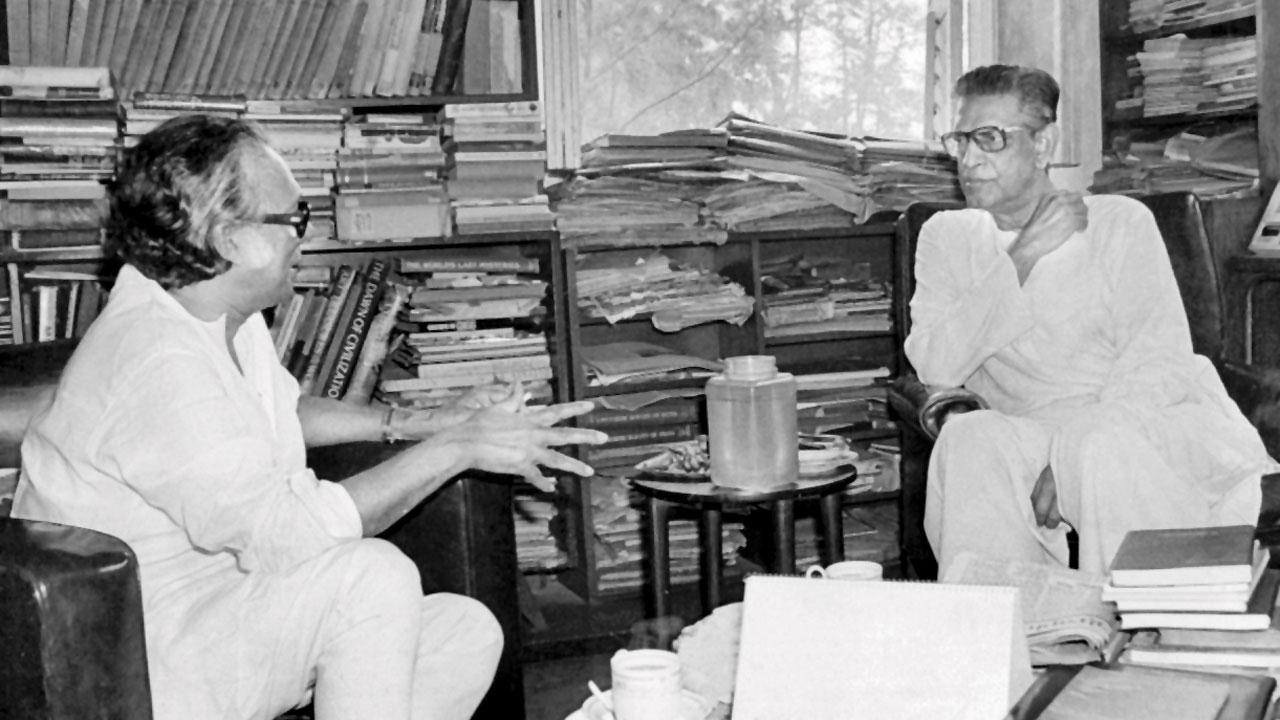
Mrinal Sen and Satyajit Ray
Why did the legendary director Mrinal Sen fall out with his equally talented friend, Ritwik Ghatak?
MID-DAY (May 28, 2023)
He was always surrounded by friends, though the nature of the circle changed over time. In the early days, they were all fellow travellers, equals, with similar views, similar ambitions, similar trajectories. Many from that group drifted away over the years, for various reasons. Tapas Sen was the only one who stayed close all through my father’s life. Hrishikesh Mukherjee and Salil Chowdhury moved to Bombay and became part of the commercial film world. Though every time they met my father, which was no longer very often, I could still see a spark of the old camaraderie.
Whenever Salil-kaka came home, he and my father would ask each other about common friends from the IPTA days. Sometimes Salil-kaka would sing songs from their activist past. But it was also clear that they lived in different worlds now, that the only common thread was the nostalgia for their time together, when they shared the dreams of a revolutionary future.
My father would sometimes stay with Hrishi-kaka in Bombay. Once, when I was four or five, my father took Ma and me to Bombay, and we all stayed at Hrishi-kaka’s Andheri home. Later, Hrishi-kaka’s son became a good friend of mine through a shared interest in electronics, and I’ve stayed quite a few times at their beautiful sea-facing bungalow in Bandra. However, my father and Hrishi-kaka were making different kinds of films, and slowly it was but inevitable that their intellectual lives would drift far apart.
Ritwik-kaka stayed in Calcutta, and though he and my father were both trying to make films with the same objective, another force was pulling them apart—Ritwik-kaka’s severe alcoholism. I don’t recall ever seeing him sober. No one in my immediate surroundings drank. Therefore, as a child, I was both curious and afraid of drunkenness. Whenever he came to our house, he would be senselessly drunk and abusive, often accompanied by people who could hardly stand straight. I don’t recall a day when he and my father had a normal conversation.
During my high-school and early college days, on numerous occasions, local boys would knock on our door and report that they’d found Ritwik-kaka lying drunk somewhere. It was then my job to organize a rickshaw to take him home. I was afraid of him if he visited us when my father was not home; he would engage in incoherent and dismissive conversations about my education.
Unfortunately, Ritwik-kaka and my father, who could have had the most meaningful conversations, never did so in their later years. They occasionally met, there were casual exchanges of information, but those lacked any kind of depth. The constant veil of an alcohol-induced haze made impossible any meaningful communication.
In the winter of 1976, after many such incidents, Ritwik-kaka was admitted to the hospital for what would be the last time. My father was beside him when he died. His wife, Surama, taught in a school far away, trying to protect her three children from the chaotic life he had created. All of them came to Calcutta and stayed with us until things settled down. It was as if we were one big family. What his addiction took away, it tried to return on his death.
When my mother died, I found a tattered letter addressed to her from Surama Ghatak, in which she’d written about the deep bond between the two families. My mother, for some reason, saved the letter in her handbag. I will never understand why we have such romantic notions about extreme addiction among artists.
It is nothing but a disease that destroys families, destroys integrity and ultimately destroys humanity. Even though his earliest circle dissipated over time, my father continued to surround himself with friends.
My earliest memories are from the early sixties, when we lived in a tiny two-room ground-floor flat on Manoharpukur Road. The living room was small, almost entirely occupied by a sofa bed and a few low cane stools or moras. And by visitors who came to my father throughout the day, friends as well as co-workers from his latest production. The friend circle in those days comprised people connected with the film-society movement, writers, family friends and artists. As far as I remember, the topics of their conversation spanned cinema, politics, literature and everyday banter. My father wasn’t that successful yet, so there were no fans or admirers.
That changed after his success in the late sixties and early seventies. I was older by then, and since that small living room was also where I was supposed to study, I became a silent participant in those conversations. There was a growing group of visitors who admired his work. Some were genuine well-wishers, but an increasing number hoped to benefit from the alliance or simply enjoyed belonging to a polarized camp. I am not sure my father could distinguish these factions as easily as I can today, in hindsight.
Praise can be a potent tool to blunt one’s ability to judge the real intent of people. Bengalis have a strange propensity to split any position into two opposite camps. Be it the support for a football team or the way a particular dish should be cooked or how a song should be sung, we indulge in strictly binary choices. If you belong to one side, you must oppose the other with all fury. The same thing happened then: people would champion my father while being unnecessarily critical of Satyajit Ray, with the reverse happening in Ray’s circle. A few people had access to both households, and they carried the conversations from one living room to another. They enjoyed the reactions they provoked. I think both Ray and my father were very respectful of each other, but this poisonous atmosphere did stain their thinking. Such is the power of sycophancy.
Excerpted with permission from Bondhu: My Father, My Friend by Kunal Sen, published by Seagull Books
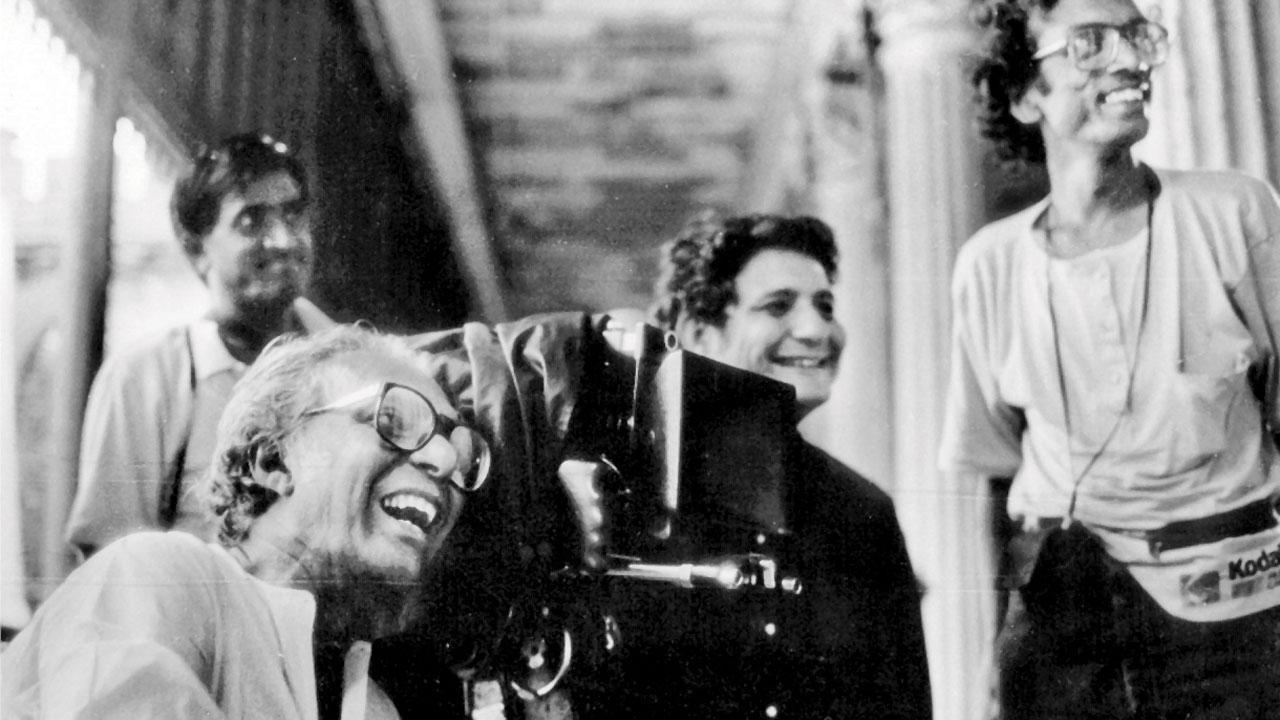
A lighter moment during the making of Antareen. PIC/SUBHASH NANDY
Kunal Sen and his wife, Nisha Ruparel-Sen, with actor Shabana Azmi, during the shooting of Khandhar. PIC/SUBHASH NANDY
Why Bengali films are giving trams a pass now
8:13 AM

Scrapped trams stored at the Tollygunge tram depot
Modern Kolkata Moves In The Metro And App-Cabs While Its People Are Shifting To Highrises. So, The Tram Is Reduced To A Cliche That Appeals To The Outsider But Not Contemporary Bengali Directors
Priyanka Dasgupta (THE TIMES OF INDIA; February 19, 2023)
There’s a West Bengal tourism commercial that shows the city through the lens of a foreigner. Its last sequence features a tram car chugging past the Maidans by night on Route 36. The climax is the spectacular entry of Bengal’s brand ambassador, Shah Rukh Khan, singing Tagore’s ‘Ami chini go chini tomare ogo bideshini’. When the tram car finally chugs out of the frame, the camera zooms in on the words, ‘Experience Bengal: The sweetest part of India’.
Six years since the commercial aired and a pandemic later, Kolkata’s once-ubiquitous trams are chugging out of the city. Even the sound design of contemporary Bengali cinema no longer uses the chimes of tram bells to capture Kolkata’s essence.
Inseparable For Years
Bengali cinema’s tram connection meandered from Satyajit Ray’s ‘Mahanagar’ (1963) to Amitabha Chaterji’s ‘Manohar & I’ (2018) via Buddhadeb Dasgupta’s ‘Kaalpurush’ (2005), Atanu Ghosh’s ‘Abby Sen’ (2015), Nandita Roy and Shiboprosad Mukherjee’s ‘Praktan’ (2016), Srijit Mukherji’s ‘Ek Je Chhilo Raja’ (2018), and Raj Chakraborty’s ‘Parineeta’ (2019).
Not just films, even their opening credits celebrated this connection. Subrata Mitra filmed the two-minute-long title sequence of Satyajit Ray’s ‘Mahanagar’ (1963) by only focusing on a moving tram cable. Once Ray’s credits for the film’s screenplay, music and direction have rolled, the camera moves inside the tram car to freeze on Anil Chatterjee’s tired face.
“Ray used just the electric cable to depict the big city. In the background score, he also changed the tempo and volume of violin, flute and cello to heighten the drama of everydaylife,” said Riddhi Goswami, a member of the Ray Society.
Criss-crossing tram wires form the backdrop for the opening title card of Mithun Chakraborty-Rahul Bose-Sameera Reddy starrer ‘Kaalpurush’. “My father loved everything quaint and old that stood witness to time and defined his Kolkata in its purest form,” said music director Alokananda Dasgupta, daughter of the film’s director, the late Buddhadeb Dasgupta.
Later in the film, Bose falls asleep inside a compartment and has imaginary conversations with his father about his love, hatred, regret and memories. “It is such a vulnerable and sensitive scene. What better than the long-lost tram to act out this metaphor of extended realism in his film,” she added.
Metaphorical Journeys
Ritwik Ghatak used trams in ‘Bari Theke Paliye’ as a metaphor for Kolkata’s mechanical transport. But film scholar Sanjoy Mukhopadhyay said Ray and Ghatak used trams differently. “In Ray’s ‘Apur Sansar’, the tram becomes a space where dreams turn into reality when Apu reads the editor’s letter. In contrast, the tram in ‘Bari Theke Paliye’ symbolizes crude mechanization and not fantasies.”
Trams also appear in Mrinal Sen’s ‘Interview’. “The protagonist nabs a pickpocket in a tram. That was more of an emblem of day-to-day life and living in 1970s’ Kolkata,” Mukhopadhyay said.
Parked In Nostalgia
Once an emblem of modernity and the metropolitan mind, trams now symbolize old-world charm. “People who joined college in the midor late-1980s remember how romantic tram rides were during noon, especially if a couple got the front seats just behind the driver’s cabin,” said Atanu Ghosh, who directed the 2015 sci-fi film ‘Abby Sen’. “As a tribute to my fond memories, I devised the tram ride scene as a metaphor for nostalgia and romance in ‘Abby Sen’. In the story, Abby travels 33 years back in time from 2013 to 1980 and meets his wife in an illusion scene inside a tram.”
Poet-turned-filmmaker Srijato penned ‘Chol rastae saji tramline’ for Srijit Mukherji’s ‘Autograph’ (2010) that highlighted the word tram. Despite the song’s popularity, Mukherji didn’t use a tram shot to picturise it. He waited for eight years to use the tram as the setting for the conversation between Aparna Sen and AnjanDutt in ‘Ek Je Chhilo Raja’. “Tram for me is quintessential Kolkata. I use trams to portray a character of the city which is traditional, old-world, slightly laidback with its own rhythm or something very intimate, quaint and personal,” Mukherji said.
Few contemporary Bengali films use trams for a nuanced portrayal of urban loneliness. One rare exception is a 13-minute-long scene from ‘Manohar& I’, which is among British Film Institute’s 10 great films set in Kolkata. Two strangers-turned-acquaintances hop on to a tram car. The languid pace and the empty space of a tram car allow a lot of time for the characters to communicate. The camera placed up close captures the hoardings and wall graffiti through the huge windows while the protagonist garnishes his narrative with half-truths and yearnings.
“In between their conversation, I deliberately kept some top shots of a serpentine tram negotiating the traffic. The tram becomes a metaphor for Kolkata’s indifference that alienates migrants from the suburbs. The metropolis shuts them up inside boxes. Their existence resonates with tram cars moving around the city like long matchboxes in motion,” director Amitabha Chaterji said.
Iconic For The Outsider
Most contemporary Bengali films steer clear of the tracks to avoid clichés. Besides, their plots have long shifted to highrises where the chimes of tram bells hardly reach. “As a child, I used the tram regularly while commuting. But trams have now disappeared from the cityscape. If I set a realistic film in the city, where is the space for trams since my characters will use the metro and app-cabs?” said director Aniruddha Roy Chowdhury.
But those who haven’t lived in this city as an insider rely on trams, Howrah Bridge and Victoria Memorial to reinforce a stereotype. From Mani Ratnam’s Yuva (2005) and ‘Guru’ (2007), Sujoy Ghosh’s ‘Kahaani’ (2012), Tigmanshu Dhulia’s ‘Bullett Raja’ (2013), Shoojit Sircar’s ‘Piku’ (2015), Dibakar Banerjee’s ‘Detective Byomkesh Bakshy!’ (2015) to Mridul Toolsidas’ ‘Toolsidas Junior’ (2022), Kolkata’s trams and even tram depots remain the perfect backdrop for period films and romantic songs.

The kind of cinema B R Chopra, Raj Kapoor, Guru Dutt used to make is coming back, thanks to OTT-Raj Babbar
8:12 AM

Titas Chowdhury (HINDUSTAN TIMES; January 4, 2021)
After 28 years in politics, actor Raj Babbar has now decided to recommence his career as an actor. In November last year, the former Member of Parliament, made his comeback with the web series Dil Bekaraar that marked his debut in the digital space.
“After my term ended, I thought of resuming acting. Fortunately, Dil Bekaraar came my way. Now, I’m being offered many films and web series,” he says, adding he featured in small roles in his friends’ films while busy with politics.
Like everyone else, Babbar, 69, has been caught by the OTT bug and wants to be a part of more web shows. “During the lockdown, I watched a few good shows and some amazing performances by actors from India as well as the world. That, subconsciously, had an effect on me. OTT platforms are a win-win situation for actors as well as filmmakers and writers. The medium completely belongs to them and we, actors, can do wonders now that we can showcase so many nuances,” he elaborates.
But what has truly captured his attention is the return of good content. “I grew up watching films made by filmmakers Guru Dutt, Satyajit Ray, Raj Kapoor, Ritwik Ghatak, Mehboob Khan, V Shantaram, and B R Chopra. I feel the kind of cinema these stalwarts used to make is coming back, thanks to OTT,” he says.
Quiz Babbar about the young lot of actors and he says, “They’re energetic and brilliant. They work hard and have the power to grasp the audience’s attention. They’re aware of the current atmosphere and so, they become prepared.”
New proposals on cinema censorship are wrong, unnecessary. Film board and courts are enough-Vishal Bhardwaj
10:01 AM

POSTER OF A RAY FILM: Remember, cinema is art
Vishal Bhardwaj (THE TIMES OF INDIA; June 30, 2021)

Included in proposed amendments of the Cinematograph Act, 1952, is the provision that on the complaint of any member of the public, the government can recall an already certified film to re-examine it and if it, unfortunately, agrees with the member of the public, a new process of certification shall start.
Why is this not necessary?
A few months back, the tribunal court in the film certification process was abolished. The reason given was that if a filmmaker is not satisfied with the certification board or a revision committee’s decision, they can challenge the verdict in courts. Why can’t the same reason be applied to the supposedly aggrieved member of the public who has problems with a film? Why is the autonomy of the board of film certification being diluted? What’s the purpose or motive behind?
Why is the certification board enough?
Let’s understand the formation of the film certification board. The board’s members are eminent people from various sections of society. These members are selected by the I&B ministry along with the chairperson of the board, who is also selected by the ministry. Usually, every film is seen and certified by a committee of these members along with an authority from the board.
It’s very hard to understand that when everyone is selected by the government and they represent various social groups, ranging from a professor to a homemaker, why should a film be recalled for examination, just because a member of the public feels unhappy about any aspect of the film.
Why is it futile to expect no disagreement?
In a healthy democracy, different opinions on the same subject will always exist. People will question, contradict, agree or doubt and there has to be a fair way to deal with their objections. Each person has the option and liberty to like and dislike a film, and if offended, take it to court. Authorities should honour and respect the decision taken by board members selected by them. The autonomy of institutions like these is a must for the health of the democracy of our country.
What is good about the proposed amendment?
There are also some long overdue good amendments, which should not be left unacknowledged, like a rating system based on the age of the viewer, stringent punishment for piracy of films, and many other recommendations made by a panel of experts headed by the legendary filmmaker, Shyam Benegal. I’m sure this recalling of the certification process was not proposed by Benegal’s brigade.
What strange rules have been proposed by other governments?
Let’s go back in time and review a farcical amendment made by the health ministry of the previous government which enforced a rule that a ticker of a statutory warning should run on the screen whenever a character uses tobacco products. This rule made us the only country in the world that imposes such an extreme measure that disrespects the art of cinema. In international film festivals, people laugh while watching our films. I wished that authorities treated the root of the disease rather than clipping branches.
Instead of forcing an unaesthetic and impractical ticker on the beautiful frame of a film, make tobacco products so expensive that they go beyond the reach of the majority. But, it seems that the tobacco lobby is much stronger than the film guilds of our industry.
How can new censor rules really complicate matters?
The proposed amendment will give the right to recall any film from the past. What if someone has a problem with creations of Satyajit Ray or Adoor Gopalakrishnan or Ritwik Ghatak and their films are recalled for recertification? What will happen if someone has a problem with Dadasaheb Phalke’s Raja Harishchandra?
How should we approach censorship?
By accepting cinema as a form of fine art. In fact it is an amalgamation of all the fine arts put together – painting, music, dance, drama and poetry. Let’s hope that the I&B ministry and bureaucrats work towards creating a space where cinema can flourish rather than chaining and caging it.
In a democracy we must learn to coexist with our nemesis. We must learn to agree to disagree.
The writer is a film director and music composer
Ritwik Ghatak and Uday Shankar films headed to IFFI
8:02 AM

Avinash Lohana (MUMBAI MIRROR; November 7, 2019)
 Last week, it was announced that Rajinikanth will be conferred with the Icon of Golden Jubilee Award at the upcoming 50th edition of the International Film Festival of India (IFFI), which is held in Goa. It was followed up by another announcement on Monday by Union Information and Broadcasting Minister Prakash Javadekar that the festival will be inaugurated by Amitabh Bachchan.
Now, Mirror has learnt that Ritwik Ghatak’s 1973 film, Titas Ekti Nodir Naam (A River Called Titas; above), which explores the life of fishermen on the banks of the Titas river in Brahmanbaria, Bangladesh, and Uday Shankar’s 1948 musical Kalpana (right), are set to be screened in the Restored Indian Classics section of the festival.
“The films have been restored by The Film Foundation of Martin Scorsese and will be screened on November 23 and 24,” informs a source close to the development. An official spokesperson for IFFI confirmed the news.
Pandit Ravi Shankar’s musical notes, letters, rare photos found at scrap shop in Mahim
8:01 AM

Rarest of rare memorabilia includes a letter from the sitar maestro’s son Shubho to his mother Annapurna Devi, in which he complains about being neglected on his birthday by Ravi Shankar; Author SMM Ausaja was searching for vintage movie posters when he stumbled upon a suitcase stuffed with memorabilia; contents suggest they belonged to Ravi Shankar and his musician wife Annapurna’s son Shubho who died in 1992
Khalid Mohamed (MUMBAI MIRROR; September 23, 2019)
Musical notations composed by sitar maestro Pandit Ravi Shankar, as well as letters written by him, photographs, press cuttings dating back to the 1960s, autographed brochures, and more have been recovered from a battered old leather suitcase which was dumped at a scrap dealer close to Mahim Railway Station. The suitcase made available for perusal to Mumbai Mirror, besides yielding a treasure trove of memorabilia, contains voluminous files of notes and notations by Bharat Ratna Ravi Shankar for some of his famed operas and ragas which were performed at shows the world over. That the material is authentic can be verified from the signature of Ravi Shankar on most of the rescued material.
A draft of a letter of complaint by the musician to the British organisers of a concert tour reveals that at the outset of his career, he would neither be paid nor given “a pat on the back” for his shows which had played to packed houses. In addition, notations for film scores have been discovered, albeit in a mottled condition which like the rest of the finds need to be restored digitally at the earliest.
There are photographs showing Ravi Shankar as a budding musician in his late teens, and snapshots of his first wife, the revered classical singer Annapurna Devi (born Roshanara Khan), daughter of Ustad Allauddin Khan, who laid the foundation for the modern Maihar Gharana.
Add to these, albums of sketches by their son, musician and graphic artist Shubhendra ‘Shubho’ Shankar, which have all been rescued in the nick of time before they were shredded, junked, or sold by their weight in kilos to re-cyclists of waste paper.
The suitcase was located by chance by SMM Ausaja, author of the book Bollywood in Posters. While scouring around for vintage movie posters, booklets and stills, the film scholar randomly picked out the suitcase and was startled by its content, retrieving it immediately. On being asked what he intends to do with it, he stated, “I’m a collector. I intend to preserve it for posterity.”
From all indications the suitcase belonged to the maestro’s son ‘Shubho’ aka Shubhendra Shankar, who passed away in California, at the age of 50, in 1992 after a bout of pneumonia. Towards the end years, he had withdrawn from the music scene and eked out a living for his wife and two children by working at a liquor store and drawing illustrations for telephone directories.
Ravi Shankar lived till the age of 92, succumbing to respiratory insufficiency in California in 2012. The mother of Shubho, the reclusive Annapurna Devi who resided in a Breach Candy highrise, passed away last year at the age of 91.
That the suitcase belonged to Shubho appears to be a given, since it contains his albums of drawings, including a striking pencil portrait of his father. Moreover, a greeting card designed as a gift to his father and signed by Ravi Shankar, could have been stored by the son as a remembrance. In a letter to Annapura Devi, he complains about being neglected on his birthday by his father.
Quite emotionally, the visiting card of the maestro mentioning his address in Pavlova building on Little Gibbs Road in Mumbai, and the apartment’s plastic door-sign have been preserved.
Ravi Shankar and Annapurna Devi had separated in 1962 after 11 years of marriage. Both had remarried. The maestro became an internationally-lauded artiste of mythical proportions, collaborating with greats such as Yehudi Menuhin and George Harrison of the Beatles. However, Annapurna Devi chose never to perform again, it is believed, because she had felt slighted when Ravi Shankar couldn’t quite accept a section of classical music aficionados that she was a superior artiste.
Quite oddly, a short poem written on a Viennese hotel’s letterhead and signed by the master filmmaker Ritwik Ghatak was also in the suitcase. Written in Bengali, the poem’s opening lines, translated into English read, “Where and when were my days of yore lost/ How they were lost, my heart doesn’t know…”
A close-up portrait of Ustad Allauddin Khan – whom Ravi Shankar acknowledged as his guru --is mouldering amidst the material, demanding professional restoration.
The Ravi Shankar Foundation, based in California, has sought to continue the legacy of the superstar sitarist’s music forward both in India and abroad. Meanwhile, the retrieved suitcase is a pointer towards a heart-touching story – of how a son clung on to a bagful of mementoes of his father -- a bag which eventually landed up with a scrap dealer.


The idea is to highlight impact of restoration-Shivendra Singh Dungarpur
7:53 AM

Shivendra Dungarpur on the fifth edition of his workshop, which will see screenings of Ritwik Ghatak, Bernardo Bertolucci classics, among other things, in Hyderabad
Avinash Lohana (MUMBAI MIRROR; September 17, 2019)
 After the film preservation and restoration workshops in Mumbai, Pune, Chennai and Kolkata, Film Heritage Foundation’s Shivendra Singh Dungarpur is gearing up for the fifth edition in Hyderabad in December. While Bahubali filmmaker S S Rajamouli has lent his support to the initiative, Southern heavyweights Chiranjeevi and Akkineni Nagarjuna will be present at the workshop to speak about the importance of film preservation.
 Dungarpur informs that the idea of this workshop is to train people to save India’s cinematic heritage. “Creating awareness about preservation is important and we need more people involved in this task. We chose Hyderabad this year as it is the centre of the Telugu film industry and we want its counterparts in other languages to participate actively. Students from across India and neighbouring countries will be a part of it,” informs the filmmaker-archivist.
Restored version of Ritwik Ghatak’s 1960 film Meghe Dhaka Tara (left) and Bernardo Bertolucci’s 1970 mystery drama The Spider’s Stratagem (above; right) will be screened at the workshop. “These kind of restored films have screened at the Cannes and Venice film festivals. The idea behind screening them is to highlight the impact of restoration. The workshop will also have Nora Kennedy from Metropolitan Museum of Art and Dawn Jaros from the Academy of Motion Picture, Arts & Sciences train the students. They will delve into photographic conservation, paper conservation, digital restoration and film repair, among other topics,” Dungarpur informs.
In the past, he has procured the Original Cinema Negative of the Guru Dutt-starrer 1963 film Bharosa, and some letters, notes and rare photographs of actress Sadhana from a scrap dealer. Earlier this month, Dungarpur rescued rare items like old photographs, handwritten diaries and letters (below) that belonged to lyricist Sahir Ludhianvi from another scrap dealer, in Juhu. “It is sad that such valuable materials are being discarded. Our conservators are working on preserving and digitising them,” Dungarpur shares.
He goes on to add that spreading awareness about film restoration and preservation is a source of immense joy for him. “Since 2015, we have introduced 200 individuals in this field. Now, there is increased awareness in the film industry and among government bodies as well. Moreover, it is now seen as a viable career option,” Dungarpur concludes.

To understand Ritwik Ghatak is to understand his wife Surama-Grandniece Nabarupa Bhattacharjee
6:26 AM

A tome on the seminal filmmaker brings to light a chequered life, and how his feisty wife saved the day
Abhinandita Mathur (MUMBAI MIRROR; November 27, 2016)
A photography project that uses the memories of our geriatric population to join the dots of our collective consciousness as a nation has led to a sparkling tome on legendary filmmaker Ritwik Ghatak. While the Bengali filmmaker is best known for his contribution to independent cinema, his personal life hitherto was an umbra, a chequered life debilitated by alcoholism and mental illness. Life After Ritwik Ghatak is an emotional anthropology to say the least. Created by the grandniece-grandaunt duo of Nabarupa Bhattacharjee and Surama Ghatak (the late filmmaker’s 90-year-old widow), it chronicles Surama’s life via old photographs and anecdotes. For Nabarupa, her grandaunt Surama is the unsung hero of Ritwik Ghatak’s life. It is in her story that she finds inspiration in and the book came to fruition thanks to the Photojaanic Photobook Grant under the theme ‘Personal history told through an inter-generational lens’.
Incidentally, Nabarupa’s inspiration for the project came from watching Satyajit Ray films. “I was inspired to do this visual narrative by watching and reading about filmmaker Satyajit Ray. He loved Ritwik Ghatak. In fact, he was one of the founders of the Ritwik Ghatak Memorial Trust. While much has been written about the late filmmaker, there is surprisingly little visual material about him and his family in the public domain. I wanted to present a visual narrative.”
While Life After Ritwik Ghatak showcases rare memorabilia, including a proposed syllabus for the perennially beleaguered Film and Television Institute of India (FTII), it also throws light on Surama’s complicated relationship with her husband. “Thamma generously shared her life story and memories that shaped this book. Through fascinating anecdotes and details, she has shared insights about his thoughts and personality. I am surprised at how she remembers everything so clearly. Ritwik was not an ordinary artist. His commitment to his art was most important to him. He did not fear consequences. But alcoholism and his struggle with mental illness ruined him,” Surama reveals.
Ghatak’s alcoholism worsened with time, she recounts. He would spend days drinking alone or with infamous drunkards from their neighbourhood in Kolkata. These were testing times for the family. In 1970, Surama with her three children left Kolkata and moved to Sainthia, where she found work as a teacher. “There was never any financial security in our marriage, but there was love and now that was shaken. This was the time I decided to wipe my tears, for good. I accepted the fact that we were no longer in a normal husband-wife relationship. From here on, I considered him only an artist. My life is dedicated to the artist in him.”
For a wife to leave her husband in those times was mostly unheard of. Nabarupa points out how Surama’s brave decision signifies her strength. “She was accused of leaving her husband. But in reality, she did not leave him; she just took up a job, which was needed. Perhaps, these questions would not have been asked had she been a man who left for work. We do not know the inner conflicts, we do not know their day-today life, we do not know how hard it must have been for a wife to see her husband in this state, with three children and very little money. We do not know the pressure she must have undergone, her emotional turmoil and grief.”
Ritwik Ghatak’s work too remained mostly under-appreciated in his lifetime. “He always told me his work would be recognised only after he is gone; his prediction came true,” adds Surama. The last two decades have indeed shown an increasing interest in his filmography. What makes his work relevant today? “He was a people’s artist, bringing forth their struggles, especially the marginalised. His work will always remain important,” she explains. For Nabarupa, “despite all the challenges, his sense of freedom is very inspiring for me. That is the freedom to think, to mix with people from different class backgrounds and look beyond manmade social divides. His life and work were not separate. This is how it should be.”
At 90, Surama vividly remembers details from her extraordinary life as she holds on to precious memories. Nabarupa explains, “Memories are very important. They make us who we are. My relationship with Surama and her memories helped me understand Ritwik Ghatak, whom I have never met. To understand Ritwik is to understand Surama: you need time and observation and a deeper understanding of human troubles.”
Life After Ritwik Ghatak by Nabarupa Bhattacharjee and Surama Ghatak is available on www.photojaanic.com

I was arrogant, difficult, volatile & violent. Anupama changed me-Vidhu Vinod Chopra
7:29 AM

Priya Gupta (BOMBAY TIMES; April 9, 2015)
Vidhu Vinod Chopra, 62, is
not just one of India's most respected directors, but is also
one of India's most successful producers. He is emotional, sensitive and
easy to read and is almost incapable of being diplomatic. He has always
made cinema he has believed in and is today more than living his
childhood dream. While we may never know how a Quentin Tarantino may
have made a film like 1942: A Love Story, we can comfortably say that
our own Vidhu Vinod Chopra has made a film Broken Horses that is
authentically Hollywood. Over an hourlong conversation, he talks to
Bombay Times about his violent past, his being a romantic and what made
him make a film like Broken Horses. Excerpts:
How did you come into films?
My parents originally come from Peshawar in Pakistan. I am a Punjabi Kashmiri born and brought up in Srinagar. I went to DAV School in a blue shirt and khakhi shorts and studied only Hindi and Urdu till Class VIII when I first learnt my 'A for Apple' lesson. There was a cinema called Palladium in Lal Chowk, Srinagar. Every time as a kid I passed by it and saw the posters on it, I wanted to be there. My father was a very honest insurance agent and that is why we were very very poor. But he gave me great values. He would say, 'Galli ka mochi banna, but become the best mochi.' And that always stayed with me. He introduced me very young to Khalil Gibran and Mirza Ghalib, so my entire childhood was spent in that. I finished my BA and then went on to join the FTII to follow my passion of becoming a filmmaker. Hrishikesh Mukherjee selected me as he liked the short stories I had written in Hindi. I had not studied English, so did not even know who Shakespeare was. Ritwik Ghatak slapped me when I asked him who Hamlet was, as he thought that I was fooling him. I suddenly realised at FTII how I knew nothing and my time spent there became the biggest learning for me. After graduating from FTII, my struggle was very less. I was on fast track as my diploma film Murder At Monkey Hill had won a National Award and got nominated for an Oscar. Amitabh Bachchan was a huge star even at that time. I remember he came to Natraj Studio, saw my film and said, 'When do we work together?' We got to work together many years later in Eklavya, but that is why I am so grateful to him as he was the first big star n the city who had said that he wanted to work with me. With the support of NFDC, I made my first ilm Sazaaye Maut.
You have been married several times. Are you a romantic person?
I was 19 when I married my first wife Renu Saluja in FTII. I have always loved women and had many women. I have always been a romantic at heart and have had many affairs in Kashmir, but now when I look back, I realise that I must have been crazy get ing married at just 19. I remember Renu and I used to go to this yoga class and one day the yoga teacher asked me, 'Why has didi not come today?' I was so embarrassed that I did not have the courage to tell her, She is my wife.
Who do you love the most in the world today?
My wife Anupama Chopra (she is his third wife). She has changed me. I have been with her for 20 years. I was a very arrogant, difficult, volatile and violent man. I am a much better human now living with her. She has brought out he best in me. She makes me want to be a better person and for her, I am constantly trying to be a better person. Can you imagine at the institute, I used to carry a big knife with me as I was anti ragging. I wasn't showing off. I would have actually killed anyone who would have ragged. Ragging stopped as they all knew how violent I genuinely was.
What was the lowest period in your life?
Surprisingly none. Coming from this small town, there is a strange kind of arrogance and confidence in me. There is a lot of Munna Bhai in me. But I think when Renu parted with me, was a low. We were married for 5-6 years and the reason we parted was that she did not want to have kids. Even after separating, we remained friends and she kept editing my films, but she was clear that she did not want kids.We then formally divorced. I felt very low when she died of cancer. She was a good woman and she didn't have to go so early.
What made you make a Hollywood film like Broken Horses?
The fact that it was a big challenge. It's the first time that an Indian has written, produced and directed a Hollywood film. You like it or not, Hollywood has always looked down upon our cinema as just song, dance and drama. This is my answer to them. I want ed to tell them that we too can do what you do, if not better. We choose not to do it and choose to sing songs as that is our culture, but don't think we are fools. I feel personally, it's a movie that will make every Indian proud. But of course, the only thing Indian in this film is the spelling in my name.
At it's core, Broken Horses is an emotional story about the love between two brothers. Does it have any connection with your real life?
I am very close to one of my older brothers, Veer Chopra, who actually paid my fees at FTII. He used to earn Rs 1,100 out of which Rs 250 went towards my fees. Had he not paid it, I would not have gone to film school. There is a lot of Veer in Broken Horses, just as there was in Parinda. Broken Horses is violent, aggressive and childlike and I feel that I have gone back to my old days of Parinda and Khamosh.
Why is it called Broken Horses?
It's an interesting term of the West, where when they tame a wild horse, they say it's a broken horse. So, in the film, the character of the older brother Buddy is a broken horse.
Do you have friends in the industry?
No, as for me friendship is a big word. It means that I can kill someone for my friendship. By that definition, I don't have any friends in the industry. Friendship in the film industry is like the dialogue I wrote in Parinda, 'Yahan har rishta dhande pe tika hai.'
You have two sides to you, one of a kanjoos and commercially savvy producer and the other of still being a simple small town man with his passion for cinema intact.
The point is that when they say business savvy, imagine in Munna Bhai there was a possibility of Shah Rukh Khan, but I put Sanjay Dutt there. I became business savvy as the film became so big. What if t hadn't? I did the same with Ferrari Ki Sawaari, but it didn't do well so who is business savvy? So, in ret rospect, it's easy to say.
Munna Bhai released and it was a flop. But I called Raju Hirani at that time and told him, 'I have Rs 11,000, let's make another movie. Fortunately, Munna Bhai finally made a lot of money. I had initially paid Sunil Dutt Rs 11,000, then 1 lakh, then 5 lakhs, then 11 lakhs and when I offered to pay him Rs 21 lakhs, he said, 'I am remembering my father, he would give his mooch ka baal in exchange for taking a loan.' He finally did not accept Rs 21 lakhs. I am very clear that I make cinema I feel strongly about. It's a miracle that most of the cinema I have made has become so successful, so people think that my brain works so well, but also see Eklavya that I made, knowing fully well that it could never make money. If I was business savvy, I would not have put my five years, behind making Broken Horses, I would have made 4 Idiots. I am involved in every project and film that I own, be it Munna Bhai, Ferrari Ki Sawaari or 3 Idiots.
How different was it working in Hollywood?
In our system there is a lot of warmth, but a lot of inefficiency. The actor will come late, give me a hug and say he got late in traffic and I will say nothing. In Hollywood, they are very cold but amazingly efficient. There at 4.30 am, I would be sitting in the desert and my actors would be ready with makeup on and their lines knowing exactly what to do. In Broken Horses, I took the warmth of my culture to the efficiency of their culture.
Do you have any regrets in life?
I wish I had gone to UCLA to study cinema. My education before FTII was nothing. I wish I had gone to Harvard. But I also feel that due to a lack of formal education, I am a very free mind. That's what made me make a movie that I didn't know where it would go.
You have had many spats with people in the past. Did that upset you?
No, as I have never done something that I didn't believe in. If you are doing right, then why will you feel shit? Abhijat Joshi said to me while I was shooting Broken Horses, 'Have you realised that in 33 days not once have you screamed or lost your temper?' I told him, `It's because I didn't have to.'
Do you believe in God?
I remember my father used to go to the temple every morning. I was very small once when I told him, 'Tussi mandir jaana chod do (Stop going to the temple).' He said,' Are you mad?' I told him, 'You should not go as you don't believe in God and you are wasting your time. If you believe in him then you must believe that he will look after you and your worries.' He slapped me lovingly and said, 'You have become my guru.' I believe in God and truly believe that I am blessed. He has brought me where I am today. I don't worry. I believe in not only God but in goodness, myself and my cinema. You have to have great belief in being able to write an English film, go to Hollywood, get the monies to produce it, get the actors and put it out there. I could have made a fool of myself and people could have laughed not just at me but at all people from Bollywood.
Will you direct a Hindi film in the future?
Of course, I will if I have a script that interests me. But at this point I have the option to do a big studio film. In India, we talk a lot but compared to world cinema we are nowhere. We have miles before we can sleep. Hum apni wah wahi mein khush ho jate hain. Look at Birdman. Look where we have to go. We are still playing verandah cricket, we still have not reached the stadium to play the world cup. After Broken Horses, I want to make a film in that world stadium. James Cameron is a difficult man to please but he has called it a triumph. I understand that I am somewhere around in the verandah of the stadium now, but I have a long way to go.

Subscribe to:
Posts (Atom)