Showing posts with label Riteish Deshmukh son. Show all posts
Showing posts with label Riteish Deshmukh son. Show all posts
We have never revealed our films’ budgets. It isn’t anyone’s business-Riteish Deshmukh
3:51 PM

Actor-director Riteish Deshmukh opens up on Raja Shivaji’s box office pressure, wearing multiple hats on the film, and why audiences should focus on the cinematic experience, not the numbers
Sonal Kalra (HINDUSTAN TIMES; May 9, 2026)
Riteish Deshmukh is a relieved man, physically, mentally and emotionally. His latest labour of love, Raja Shivaji, has worked at the box office, especially in Maharashtra. His craft as a director, apart from acting, too has found praise. Speaking on The Right Angle show, he spills the beans on everything, from the obsession with numbers to politics and the paparazzi:
Raja Shivaji is touted to be the most expensive Marathi film ever made. Do you feel that the moment the public comes to know the budget, it creates pressure that the film needs to open that big?
About the figures floating around regarding Raja Shivaji’s budget, only the producers know the real budget. The last thing we need to do as filmmakers is discuss a film’s budget because it doesn’t affect anything. Budget se kya lena dena hai? If someone asks me the budget, I ask them, ‘How much are you paying for a ticket to watch it?’ They say ‘Rs. 100’ or ‘Rs. 250-300’, and I reply that’s the budget, it should just be worth your time. One should stop talking about it. Let it be magical, you just go and experience the film. When I would go to watch Amitabh Bachchan ji’s films like Sholay in my childhood, I would never think, ‘Iska budget kya hai?’ I just wanted the big-screen entertainment. We would never know how much it collected. Unfortunately, that’s the game today. People wonder how much actors charge for films… it’s our mistake, we feed these numbers. Those who feel this is right, it’s okay. We have made seven Marathi films under our production house, and we have never revealed our films’ budgets. It isn’t anyone’s business.
You have worn multiple hats on Raja Shivaji. How nervous were you before the release?
You have so much work at hand that you don’t really get the time to be nervous. I can be nervous about a film where someone else is doing all this work. But when you are the one making it and ensuring that the film reaches people on time, so much time goes into it… you can’t even think about what people will say about it.
To be a director, the lead actor and co-producer at the same time on a mega-budget film like this is a humongous task. Which of these three roles has been the most stressful for you?
Genelia (Deshmukh, wife-actor) and I are a team, of course, but most of the heavy lifting was done by Genelia. This is a production-heavy film. The heavy lifting was not on my shoulders, so it became easier. As for the subject, you can make a film on Chhatrapati Shivaji Maharaj from any angle, you just have to decide the narrative. We understand the connection he has with people. The biggest pressure, hence, is how do you write the right things when making a film on him? I would ask all such questions to myself. The prep as an actor for such a role was as long as the prep for being a director on it.
We saw you and Genelia getting emotional at the film’s trailer launch. You had been trying to make Raja Shivaji since 2016. How did this dream come about?
Chhatrapati Shivaji Maharaj hamare liye bhagwaan hain. He is the first superhero whose tales you hear right from childhood. As you grow older, you start understanding the depth behind his decisions and actions. I first tried making this film with director Ravi Jadhav in 2016, but it fizzled out. I tried again in 2019 with filmmaker Nagraj Manjule, but then Covid struck and it again didn’t materialize. In 2023, after directing Ved, Genelia suggested that I direct this film myself. I wasn’t sure because it was too big a personality. She told me, ‘You’ve been dreaming this for a very long time. Just start writing the film.’ After a year or so, I gained confidence.
How did you convince your son Rahyl to also act in the film?
We had not thought about it. There was a part that required childlike curiosity and innocence because the character is only asking questions. Rahyl isn’t trained as an actor, but I wanted that innocence. If it hadn’t worked, we would have cast someone else.
Now that the film has released and received such a response, do you miss your father, late politician Vilasrao Deshmukh, wishing he could see this?
I do miss him. I missed him when I made my Marathi film debut in 2014 too. In Hindi films, my name appears as Riteish Deshmukh, but in Marathi films, it appears as Riteish Vilasrao Deshmukh. I carry him with me in Marathi cinema. Just like he was my childhood hero, Chhatrapati Shivaji Maharaj was his hero too, like he is for all of Maharashtra. I truly wish he was alive to see this film.
You and Genelia are often called a green-flag couple on social media. Is there pressure to live up to the image of a ‘perfect relationship’?
Not really. We are not trying to paint a picture of being a perfect couple. Of course, we support each other and are deeply in love, that’s the strength of our relationship. But we also maintain limits and respect each other as well as the people we meet.
Your children greeting paparazzi with a namaste has become a signature thing. Maybe your family really is just like that…
I have seen the pap culture grow. When we debuted, it wasn’t like this. Earlier, you would only get clicked at functions. Now there are photographers everywhere, chasing pictures. I feel the kind of effort they put in to earn money should be respected. I once asked a pap, ‘Ek photo ke kitne milte hain?’ He said, ‘Exclusive ho toh Rs. 1,000.’ I realised if their livelihood depends on pictures and I can contribute to that, why not? Till date, I have never refused a pap picture.
What’s the harshest thing you have read about yourself on social media?
Nothing really. If you are smiling when people praise you, then you should also be able to embrace criticism. But when comments become personal and abusive, I don’t bother. If I engage, I give it value.
When you are with your brothers, politicians Amit and Dhiraj Deshmukh, is it politics or films that dominate conversations?
Their knowledge of my films is much better than my knowledge of politics...I have watched politics closely, but they are the ones executing it on the ground. An election war room is a completely different ball game.
Raja Shivaji has cameos by stars like Sanjay Dutt, Abhishek Bachchan, Vidya Balan and Salman Khan. You seem blessed with strong friendships in the industry…
These relationships are my real earning from 23 years in films. If I go to Abhishek Bachchan, Salman Khan, Sanjay Dutt or Akshay Kumar and they agree to be part of my film, that’s a relationship I have earned. A Marathi film commercially cannot afford these stars. But when they lend support without burdening the film financially, it becomes special. We all came together to see if we could push this film beyond regional boundaries.
What’s the story behind you and Akshay Kumar calling each other ‘Sundi’?
This is all Akshay. Me, Akshay and Sajid Khan started giving each other funny names. We used to call Akshay ‘Jagtap’ because of a character named Jaadugar Jagtap, and he started calling me Sundi with love. It just stayed.
What is one life lesson you would like to give people who look up to you?
I once read a beautiful line: ‘If you are on time, you are already late.’ If you want to earn respect, you have to respect people’s time. You can waste your own time, not someone else’s. You should learn this from Akshay Kumar. He comes on time, delivers, and look at the longevity he has had. My father once told me something beautiful about respect. He shaved every morning and would ask me to shave too. I once asked him why. He said, ‘You don’t do it for yourself. You do it because when someone comes to meet you, you should look nice and clean as a mark of respect for them’.
The only thing I tell my sons is, ‘Getting clicked is an honour’-Riteish Deshmukh
9:37 AM
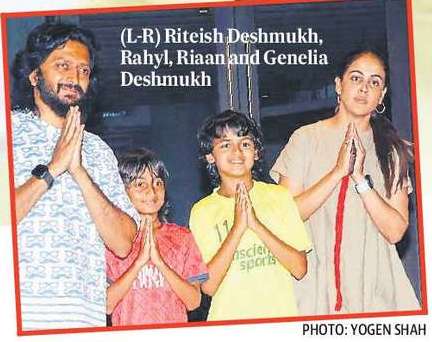
Not one to hide his sons from the paparazzi, Riteish Deshmukh believes it’s important they grow up without a sense of entitlement
Yashika Mathur (HINDUSTAN TIMES; July 5, 2025)
From Kareena Kapoor Khan-Saif Ali Khan and Alia Bhatt-Ranbir Kapoor to Deepika Padukone-Ranveer Singh, several celebrity couples have asked the paparazzi to avoid photographing their children to protect their privacy and safety lately. However, actor-couple Riteish Deshmukh and Genelia Deshmukh don’t shy away from getting their sons Riaan (10) and Rahyl (8) clicked. Their children are often seen greeting the paparazzi with folded hands, appearing at ease in the public eye.
“Our kids play sports and they are out there daily. Sometimes, when we watch their matches, some paps click us, so one has to learn to deal with it. You have to talk to the kids and ensure they don’t feel entitled. The only thing I tell my sons is, ‘Getting clicked is an honour. When the paps ask for pictures, you thank them for clicking and move on’,” says the 46-year-old, who was last seen in Raid 2 and Housefull 5.
Riteish adds that there is “no set norm” for how celebrity parents should approach their children’s exposure to the media. “Just because one person does something doesn’t mean others have to do the same. I think parents know what’s best for their children. If people feel they don’t want their kids to be in the media, it should be respected,” he ends.
I didn’t know I'd love being an actor so much. Else, I would have come better prepared-Riteish Deshmukh
7:49 AM

Onkar Kulkarni (BOMBAY TIMES; November 13, 2019)
It’s been 16 years since Riteish Deshmukh entered Bollywood, but despite his experience spanning more than a decade-and-a-half, the actor says that the new generation is keeping him on his toes. Ahead of the release of his next, director Milap Milan Zaveri’s Marjaavaan, he talks to BT about what’s stopping him from producing a Hindi film, why he has no plans to enter politics and how he is happy with the opportunities he is getting. Excerpts...
You play a dwarf in Marjaavaan. In Indian cinema, many actors have previously portrayed vertically challenged characters — Kamal Haasan in Appu Raja (1989), Anupam Kher in Jaan-E-Mann (2006) and Shah Rukh Khan in Zero (2018). Who among them was your inspiration while playing this character?
I didn’t have any inspirations as such, but each of these actors have been revolutionary in their approach to their movies. Almost 30 years ago when Kamal Haasan did Appu Raja, it was seen as something innovative. I am also thankful to Shah Rukh Khan. In fact, we were shooting Marjaavaan at the same time when Zero was being shot, and Shah Rukh was gracious enough to show us certain VFX shots from his film. He had the best equipment available and the production was also on a higher scale. Sometimes, budget can be a limitation and at such times, it is all about how smartly you pull it off. As a director, I think that Milap has shot intelligently.
What’s the toughest part of playing a vertically challenged person?
The most challenging part is shooting with the VFX. Of course, VFX has made it easy to a great extent. For example, actors no longer have to tie their legs behind and wear shoes on their knees to portray such characters. But still, it can be a daunting task. When two actors perform, one of them playing a dwarf, it’s important to maintain the right eye level. Though both actors would be standing while enacting the scene, they can’t look each other in the face. This means that they can’t see each other’s facial expressions. There were times when I used to check out how Sidharth (Malhotra) reacted to my lines on the monitor. And then, I would be like, ‘Achcha, tune aisa expression diya hai, toh mujhe mera expression change karna padega.’ Also, to achieve the desired result on screen, we used to give five different takes of the same shot.
Given that you play a vertically challenged character in Marjaavaan, were you apprehensive that it could turn out to be gimmicky?
No, I thought that the role was great. Imagine, someone comes to you and says, ‘I have a role for you. You are the villain, but you are vertically challenged’. I was like, ‘Wow!’ The character is not gimmicky, as he thinks too highly of himself. He might be all of 2 feet and 5 inches, but he thinks ki poora zaamana uske saamne dedh foot ka hai. He might be looking at people with his head up, but in his head, he is actually looking down on them.
For a long time, you were associated with comedies and romantic films. And then, you played the villain in Ek Villain (2014). Now, Marjaavaan, too, features you as the antagonist. Is this a deliberate attempt to change your image?
I am happy that new opportunities are coming my way. I am thankful, especially to Ekta Kapoor and Mohit Suri, as Ek Villain was a big turning point in my career. Today, I have got a similar opportunity and I am happy and thrilled about it.
Marjaavaan reunites you with your Ek Villain co-star, Sidharth Malhotra. Once again, you are pitted against each other on screen...
Sidharth and I met after five years for this film. I see a lot of maturity and poise in him. There’s also Tara Sutaria, who’s marking her second outing with this movie. I haven’t seen her debut film, but when I saw her on the set of our film, I was impressed with her confidence. That makes you wonder what you were thinking when you were just two films old. Today’s generation is well-prepared, and they keep you on your toes. It is inspiring to work with them. To perform without dialogues (Tara plays a mute character) and communicate with sign language is credible.
Taking off from your last answer, what was Riteish Deshmukh like when he was just two films old?
I didn’t want to be an actor when I started off. I was called to meet a few people, who were looking for a new face. After the first meeting, they asked me to fly down to Hyderabad, and when I went there, they offered me a film. I didn’t have any understanding of what a camera is, or what lighting is. I had to learn everything on the job. During the initial years, the critics had panned me. But, I see all those people as my teachers. I didn’t know that I would love being an actor so much. Else, I would have come better prepared. That way, I could have been better at my work when I started off. But God was kind, and the audience was kinder that they accepted me with all my flaws.
From acting to turning producer, you have come a long way. You have already produced two Marathi movies, when will we see you backing a Hindi film?
Hindi cinema is exploring a lot of interesting subjects these days. The content is so good that you get confused about which one to produce. I want to pick up the right script and plunge into Hindi film production soon.
Last year, your wife Genelia (actress Genelia Deshmukh) did a cameo in your Marathi production, Mauli. When will we see her making a comeback to Bollywood?
I hope she does it soon, as she is such a fine actor. She keeps reading scripts. She was interested in a couple of films, but they didn’t work out because of time constraints. She is getting offers from Telugu and Kannada films, and over the years, Genelia has picked up Marathi really well from my mother. So, she can definitely act in a Marathi film, too.
Do your sons Riaan and Rahyl watch your movies?
Not at all. I don’t think they know what an actor is. They only see dance videos online, and think that everyone’s parents dance in them. I remember Riaan visited the set of Housefull 4 one day. This was his first visit to a film set, and we were shooting for the song, Bala. He found it too noisy and just walked out. He told Genelia, ‘You told me that baba is working, but I didn’t see him working. He was only dancing.’ So, he doesn’t think that I work (laughs!).
You come from a family with political background and even campaigned for your brothers (Dhiraj amd Amit Deshmukh). Have you ever thought about entering politics yourself?
Politics is not like a restaurant, ki acting ke saath woh bhi chala liya. It is a full-time commitment. You need to actively participate in it, right from the grassroot level. Having said that, I never knew that I would be an actor. One day, an opportunity presented itself and I took the plunge. I am enjoying what I am doing right now. My brothers are doing well in politics, and I am totally aware of what’s happening in my country and the state.

Saturday is the new reality check-Riteish Deshmukh
7:58 AM

Riteish Deshmukh on the trade, changing trends, being on a career high as an actor and producer
Sarita A Tanwar (DNA; July 14, 2015)
Riteish Deshmukh started off his career as a solo hero
in Tujhe Meri Kasam in 2003 and followed it up with Out Of Control.
After just two films, he realised that perhaps his career needs a
different path to success. He found his space in films with a multi
star-cast like Masti, Maalamaal Weekly, Bluffmaster!, Cash, Apna Sapna
Money..!, Kyaa Super Kool Hain Hum and Aladin to name a few.
Unlike many heroes who start off with solo careers and stubbornly continue doing those till they are forced to retire, Riteish made the most of what was available to him. He came from an affluent background and could have continued making films mainlining him, but he didn’t let his ego get in the way of his dream. Today, he in the position to pick and choose films. I don’t know if success is always sweeter when it comes after a struggle, but it’s got to be lot more satisfying. Today he has earned the position he is at, along with respect. In the last two years, he has come into his own. He is flying high professionally and personally, but remains the same grounded guy I’d met during an interaction during the release of his first film. Here he talks about being on a high, career-wise, about changing attitudes in the trade and the way ahead.
The last two years have been rather significant for you in terms of your career. What do you attribute that to?
I think there are two things. I felt that the growth of the industry in terms of approach towards actors and not trying to cast them in the same roles, trying offbeat casting and people also being excited to see someone new in that role. Probably that has helped. I was lucky enough to have that opportunity be it, acting in Ek Villain, producing Balak Palak or doing a film like Lai Bhaari. Eventually, all these things timed out well for me. Thanks to them, I got Bangistan and YRF’s Bank Chor, which are not the typical comedies that I am associated with.
Grand Masti and Ek Villain took you to a different level, both crossing Rs 100 crores. In Marathi, it was Lai Bhaari that created new records. Is there a feeling of vindication?
One thing I learnt in the last ten years is that once the Friday is over, it’s the past. You have to let go. I have seen a lot of people who are living on Fridays that have really gone back. Saturday is a new day, Saturday is the reality check, you have to move on. As an actor, I feel the only day you should enjoy or be sad about is a Friday. Saturday you have to go out and start work again.
That’s easier said than done, no?
I know, but I have been a part of films that have not worked and of films that have been successes, but I don’t carry either forward. All that matters is the experience that you had while working on the films. Yes, it’s easier said than done, but I consciously try to work towards that, because everyone is on top of the game, everyone is doing great. There is so much to learn from female actors as well as from male co-stars. I saw Ranveer in Dil Dhadakne Do, and he was incredible, the way he did it. It was so easy and so nice, he was so wonderful. So it’s not about, ‘Oh, if I would have done the role would I do the same thing?” It’s about... he did it so differently so what I can do in my next film, that will be so refreshing? I got a chance in Ek Villain and I tried my best, I did my best but the film is done. What next?
You’ve always been a hero of the masses. With Bangistan, are you trying to reach out to a different set of people.
No. Till the time Ritesh Sidhwani called me for Bangistan I never thought that I would be the actor that Excel would approach or Yash Raj would want me for a lead for Bank Chor, but I was glad they had thought of me.
Bangistan looks too similar to Welcome to Karachi.
They are two different films. But it’s about two people caught in two different situations about India-Pakistan so in that way they are alike, but nothing else.
The director of Bangistan used to be a film critic. And he has always voiced his dissent at the kind of films you have done throughout your career. When your director shows contempt for the kind of films you have done, how do you relate to him?
That’s a very interesting question. For many years, I’d stopped reading reviews. So when I was told Karan Anshuman was directing, I was like ‘Okay.’ I don’t hold it against anyone if they dont like any film of mine. I am like ‘you didn’t like the film, everyone’s choice is different, so it’s okay.’ During a conversation much later, I mentioned to him that I had not read any reviews and at the time Grand Masti had released and Genelia told me he reviewed it. Karan said, “Read my review, I have in fact praised Grand Masti”. That’s the time I read the review.
He had praised it?
Yes, he had praised Grand Masti. More than anything, what I like about Karan or any director for that matter is when they narrate the film with a conviction. And it’s important how much a director understands cinema. I go with that feeling. And when Karan narrated it, it was wonderful. I didn’t know and I am not against any director who has had a flop film, no film, successful film...
As a hero, do you find attitude towards you changing after recent successes?
Whose attitude?
The film industry, in terms of the films that are being offered to you?
Yes. For sure. The films that have been offered to me now are different. Also, there are certain roles that people thought I would have done earlier, I like the fact that they now say, “Nahi, nahi... Riteish yeh role nahi karega”. In a way I’m glad they have decided to not approach me with certain kinds of roles.
You refused Kya Kool sequel because you consciously wanted to move away from that genre, but you are doing Great Grand Masti due to the emotional pressure from Indra Kumar. True?
I didn’t do Kya Kool... 3 because I wasn’t doing any adult comedies. Let me just say that I am doing GGM only for Indra Kumar. The only multi-starrer that I am doing right now are Great Grand Masti and Housefull 3.
You’ve emerged as a star in your own right now. Does it then become difficult to do films like Housefull 3 where you are sharing attention?
No. I am doing Housefull 3 because it’s my franchise. I feel it’s my film and I have grown with it, my career has grown with it and above all it has Akshay Kumar, Abhishek Bachchan, so I am working with my friends. There is no competition in terms of, there will never be a time when I am trying to do outdo Akshay or he is trying to outdo Abhishek. Everyone is comfortable and confident about their space.
One hears that now you are rather firm on the choice of heroine opposite you. She has to be of a certain stature. Is that correct?
No, no, not at all. I have never ever got into the casting of a heroine.
Has this change in your stance of doing a certain kind of cinema happened because of fatherhood?
In a way, yes. Marriage and fatherhood are two big life changing things. When you are single, your responsibility is for the day or for the week. When you become a husband then you start planning for the next one year or two years. But when you become a father, your life view suddenly shoots up and extends to the next ten or next fifteen years. And it’s great because I am looking forward to this responsibility.
Lai Bhaari has also given you a lot of responsibility towards Marathi cinema. One hears that you are getting the entire Marathi industry under your wings now.
Lai Bhaari was an attempt to do something more commercial within Marathi space and I’m glad it was received the way it was, and I think I am trying to just be a small contributor in this big wheel.
But suddenly, everyone is looking at you as the new hope of Marathi cinema.
I know I think it’s their bigness (sic) to look at me that way, and I will always try to live upto that. But there have been, and there are legends in Marathi cinema right now, who are doing their best and everyone is contributing towards success of the industry. There are so many advantages in Marathi cinema with regard to the kind of films you can make within limited budget and appreciation that you look forward to because those cinemas won’t be even attempted in the Hindi formats, unfortunately. Marathi cinema is the second choice in the State of Maharashtra, the first choice is always Hindi and we are struggling but hoping that changes. There are a lot of things happening. Hopefully, there is some film that will come and break the Rs 50 crore barrier. We have just broken 40. Hopefully 50 and 60, and Marathi cinema becomes stronger.
Lastly, most actors shield their children from the media. You have set a trend by coming out in the public with the baby pictures on social media. What was the thought behind that?
I wanted him to be part of my father’s birthday. It was my father’s 70th birth anniversary, and it coincided with Riaan’s six months, so we wanted to make that day special. Also, we have travelled with him and are going to travel in the future too. So why all the hiding and telling people, ‘Don’t click pictures’? It’s pointless. Especially, in this day of mobile phones, everyone is a paparazzi. So, we decided to put his pics out there and now I am not bothered. Whoever wants to click can click, but that was a special day and we wanted to make it extra special.
Subscribe to:
Posts (Atom)