Showing posts with label Remo Fernandes. Show all posts
Showing posts with label Remo Fernandes. Show all posts
After 6 decades, Remo Fernandes signs off from live acts
4:54 PM

Lisa Monteiro (THE TIMES OF INDIA; August 5, 2026)
Panaji: A guitar. A high chair. A final bow. Remo Fernandes fuelled his career with restless energy, cross-language hits and a stage presence that couldn’t sit still. His closing act came sitting down.
Indian pop-rock’s road warrior called time on his concert career at 73 and ended a 6-decade run with a live performance in London, saying he could no longer give audiences “100%” of himself.
Known for prowling every inch of a stage, Remo sang Sunday night’s show at a UK-Goan festival seated on a high chair, delivering favourites in English, Konkani, Portuguese, Hindi and French. The audience responded with thunderous applause, singing along to “Humma Humma”, “O Meri Munni”, “Maria Pitache” and even requesting “Pyaar To Hona Hi Thaa”.
“I’m used to moving around the stage. It was extremely constricting and limiting doing a show sitting on a high chair. Besides, in that crouching position, my lungs felt restricted for singing,” he told TOI over the phone from UK.
The Padma Shri recipient said he would not continue with seated performances. “I feel I’ll be cheating on my audience and myself if I’m not able to give 100% of myself.”
Remo said a mild stroke after his third Covid vaccination affected movement of his fingers. Persistent vertigo, worsened by a fall that required surgery, has left doctors advising him against performing standing up because of the risk of another fall.
Calling time on live concerts leaves him with mixed emotions. “On the one hand, I’m happy as I’m tired of performing... on the other hand, I guess I’ll miss it sometimes.”
His journey began at age 5 in then Portuguese-governed Goa, singing a Portuguese waltz with a banjo in Panaji. By 14, he was writing love songs. Architecture studies in Mumbai led to Indo-Western experimentation before hitchhiking across Europe and North Africa, busking, writing songs and poems, and eventually returning to Goa.
Remo went on to become one of India’s biggest-selling rock musicians before crossing into Hindi pop and film music, earning gold, platinum and double-platinum records, winning international honours and sharing stages with Jethro Tull, Led Zeppelin, Queen, Zakir Hussain, Trilok Gurtu and Eurythmics.
Now dividing his time between Portugal and Goa, he says there is no new project on the horizon after completing his autobiography and an opera on Mother Teresa. Instead, he hopes to spend his days reading, travelling and watching films. “Goa is home, however spoiled it is... my home in Siolim keeps bringing me back.”
No farewell tour. No curtain call stretched out over months. Just one final concert in London. Remo played his last live set. His music still soared. His feet stayed still.
Standard set by international concerts has made things tougher for Indian acts-Sunidhi Chauhan
8:31 AM
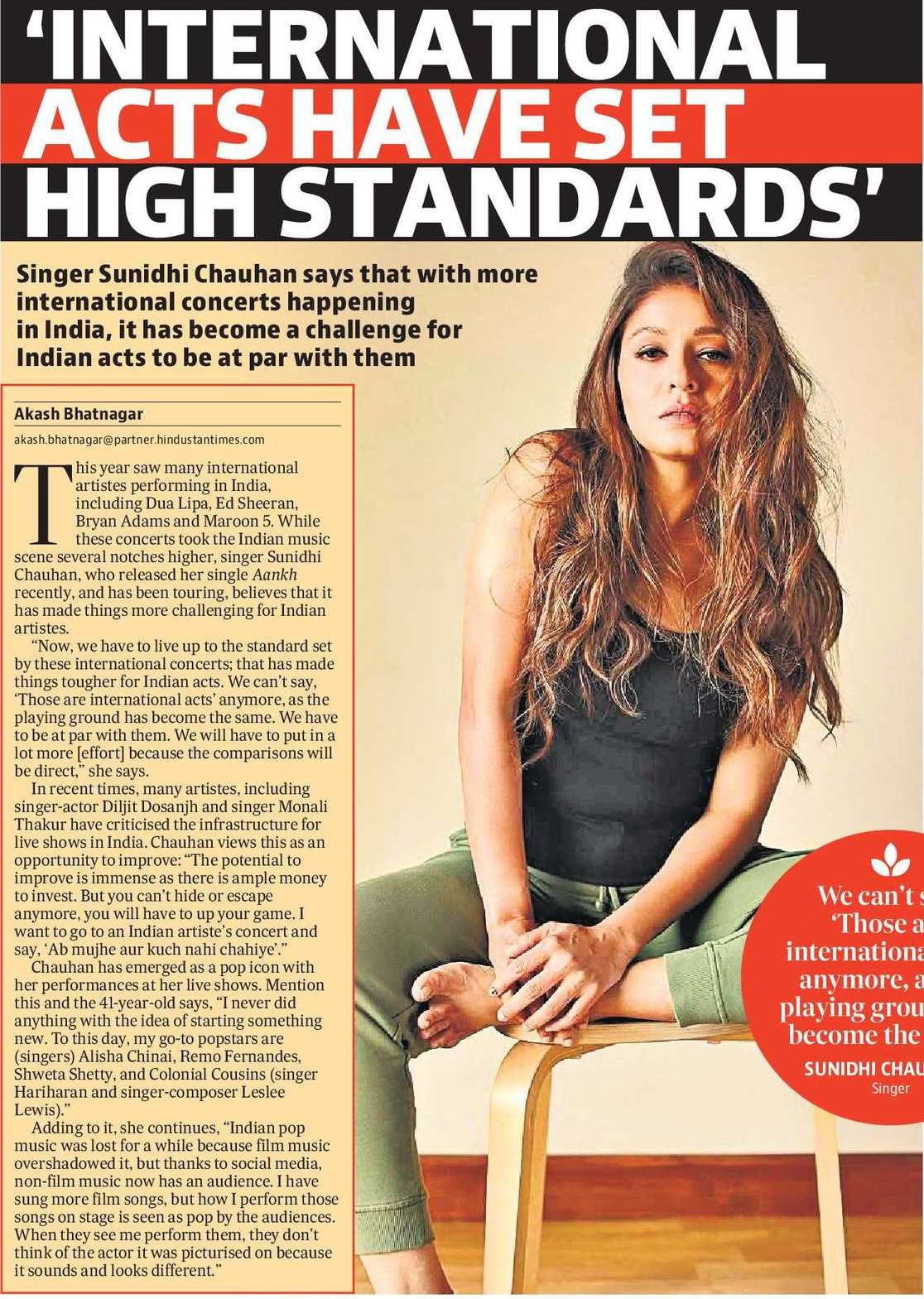
We have to live up to the standard set by these international concerts; that has made things tougher for Indian acts
Akash Bhatnagar (HINDUSTAN TIMES; December 28, 2024)
This year saw many international artistes performing in India, including Dua Lipa, Ed Sheeran, Bryan Adams and Maroon 5. While these concerts took the Indian music scene several notches higher, singer Sunidhi Chauhan, who released her single Aankh recently, and has been touring, believes that it has made things more challenging for Indian artistes.
“Now, we have to live up to the standard set by these international concerts; that has made things tougher for Indian acts. We can’t say, ‘Those are international acts’ anymore, as the playing ground has become the same. We have to be at par with them. We will have to put in a lot more [effort] because the comparisons will be direct,” she says.
In recent times, many artistes, including singer-actor Diljit Dosanjh and singer Monali Thakur have criticised the infrastructure for live shows in India. Chauhan views this as an opportunity to improve: “The potential to improve is immense as there is ample money to invest. But you can’t hide or escape anymore, you will have to up your game. I want to go to an Indian artiste’s concert and say, ‘Ab mujhe aur kuch nahi chahiye’.”
Chauhan has emerged as a pop icon with her performances at her live shows. Mention this and the 41-year-old says, “I never did anything with the idea of starting something new. To this day, my go-to popstars are (singers) Alisha Chinai, Remo Fernandes, Shweta Shetty, and Colonial Cousins (singer Hariharan and singer-composer Lesle Lewis).”
Adding to it, she continues, “Indian pop music was lost for a while because film music overshadowed it, but thanks to social media, non-film music now has an audience. I have sung more film songs, but how I perform those songs on stage is seen as pop by the audiences. When they see me perform them, they don’t think of the actor it was picturized on because it sounds and looks different.”
Bombay is perhaps the only Indian city that exudes industry in every slum and gully-Remo Fernandes
9:44 AM
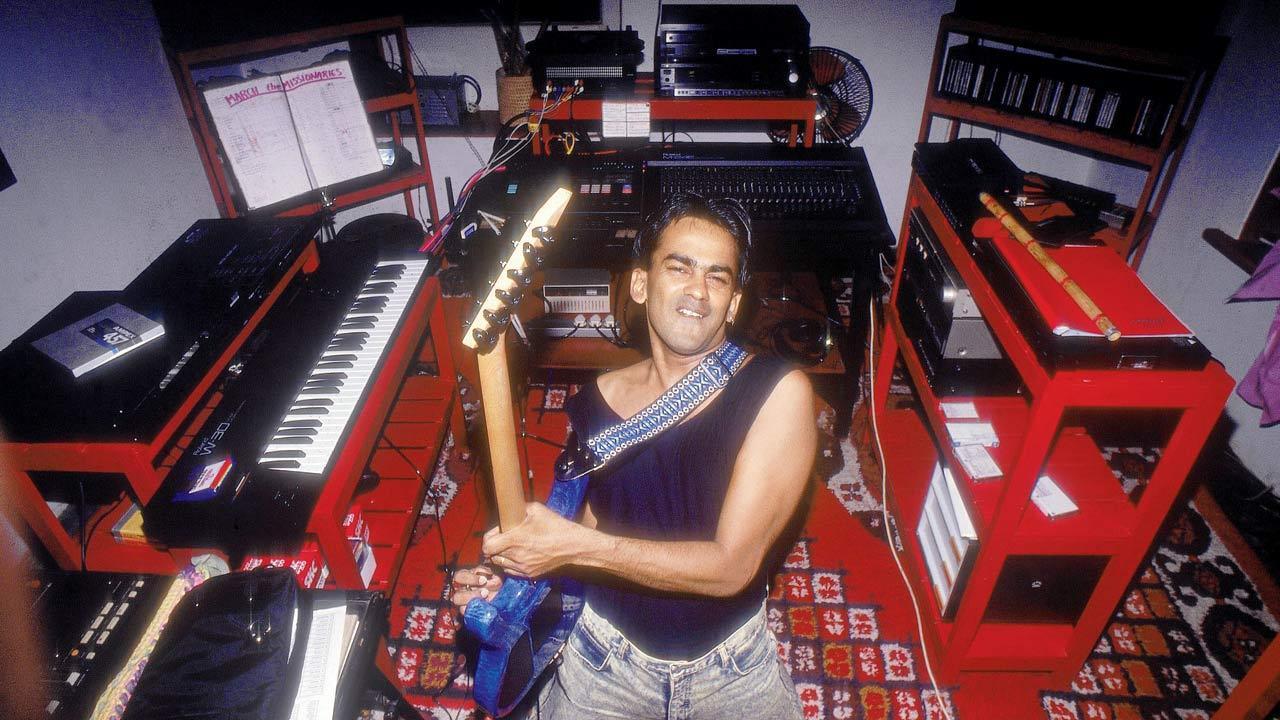
A file picture of Remo Fernandes dated 1990. Pics/Getty Images And Remo Fernandes, Harpercollins, India
Unabashedly honest, Remo Fernandes’ biography celebrates an illustrious indie music career free of Bollywood and a man who dared to write his own script
Fiona Fernandez (MID-DAY; December 5, 2021)
When we dial Remo Fernandes on his landline at his Siolim residence, we encounter disturbance in the audio. “It’s been pouring all day. Can you hear the pitter-patter?” Goa’s indie music veteran asks.
We can. But it’s the familiar voice at the other end that makes us swing back to the 1980s with a smile. On our black-and-white TV set, a Goan musician dressed in funky attire was making the audience groove to, “Graham Bell, Graham Bell/ You’re dead and it’s just as well/But if you saw the phones in India/You’d jump into the well.” It’s serendipitous then that a landline is the connector for this telephonic interview.
Ode to Graham Bell was part of a playlist where Indian pop musicians in the early days of the indie music movement performed for the Aid Bhopal concert to raise funds for survivors of the Union Carbide tragedy of December 1984. The grainy transmission, courtesy Doordarshan (DD), hardly mattered to school-goers like us. It was our first taste of a live gig where Indians sang in English. We realised that there could be a musician beyond Michael Jackson, Prince and Madonna, and he sounded good.
“We had some decent programming for music and films on DD back then,” Remo agrees. In fact, large sections in his just-released self-titled biography (HarperCollins India) act as a timeline for India’s independent music movement. Shows like Pop Time introduced Indians to desi pop and rock. By the early 1990s, satellite TV had arrived. Things were looking up. “The music video gave us two things—exposure to Western artistes, and wider accessibility to our own music. Before that, we’d be unsure if our music was distributed evenly across India. Music videos on Channel V and MTV did the trick. It was a golden era for Indi-pop. Then, Bollywood got wise and began to rope in the same artistes for films. Some of us sang those tunes, but kept our identity intact; others didn’t. It was far more lucrative,” he reasons.
Case in point was his jugalbandi with Juhi Chawla for a popular cola brand that took him to unknown corners of India. Remo admits that he was lucky to have worked with some of the best minds across art and commercial cinema, whether Shyam Benegal (Trikal) or A R Rahman (Humma, Humma; Bombay). “Here, all avenues of art appear to have been taken over by Bollywood. Some of our finest poets and dancers are working for them.”
Remo is proud he didn’t take the Bollywood route. He writes in the book how his father lost his cool just once about his choice of career, despite being supportive of the fact that he chose to ditch his architecture degree [Sir JJ School of Architecture], busk and back-pack across Europe and North Africa. Later, as fame and money came Remo’s way, he admitted to his wife with pride that his son had become rich and successful.
In fact, Remo’s childhood seems straight out of Kevin Arnold’s life in The Wonder Years—a secure, happy life surrounded by a loving family, friends and music in beautiful Panjim. “I feel lucky. Even if there was disagreement, we’d never break communication,” he says recalling how on his return from Bombay as a student, he told his parents that he had stopped attending Sunday mass. “You read about these episodes where families reunite only at someone’s funeral. That was never the case back then. And it wasn’t just about family. As Panjimites, we knew each other, and went all out to help.”
There are instances that reflect the simplicity of the time. “I call it the age of innocence,” he says, referring to when as a teen, he brought home marijuana to show his parents, who were curious. “There was ignorance about ‘drugs’. At our shows, some of them sponsored by Simla Cigarettes, after handing over complimentary packs, they would tell us that we were too young to smoke,” he laughs. “Now, we are suspicious of even the food we eat.”
He admits that music has always been riddled with danger. “The owners of venues always offer you a drink before the show. I cannot imagine any other profession where this happens. You are surrounded by vices. Back in the 1970s, everybody experimented with drugs. In Bombay, it was freely available around Colaba, and it was a cool thing to try. In Goa, many from my generation died due to drug overdose. It affected our youth,” he recalls. Years later, Remo would become the poster boy for Goa’s Anti-Drugs Campaign, composing hard-hitting tracks like, Pack That Smack.
As an architecture student in Bombay, Remo admits he tried it all—drugs, segwaying between multiple lovers, and slumming it in the big, bad city. He was the hipster musician, who got introduced to the Bhagavad Gita from where his discovery of Hinduism began. But Bombay wasn’t for him. Flood-prone Love Lane in Mazgaon and the mosquito-infested hostel in Bandra East, crowded buses and local trains were an irritant for the Goenkar.
But the next time he came to Mumbai, it was as a popular musician. “From my first visit student to later, where I moved around in chauffeur-driven cars and lived in five-star hotels, I saw things differently. Bombay is perhaps the only Indian city that exudes industry in every slum and gully. I noticed now that beneath a shanty’s roof, there were people earning money, they were industrious. This perspective cleared my mind.”
He paid a hat-tip to the city in the track, Bombay City: Bom Bom Bom Bom Bombay/They say you’re going to blow away/But I know you won’t, I know you’ll stay/Alive and kicking till Judgment Day.
He is glad the book is finally out since he took a six-year break in between writing. He admits that his literary agent Hemali Sodhi wasn’t aware of this detail when she received the first few chapters. “But the feedback I received was positive; I was relieved that the gap hadn’t affected my writing. But, self-editing was tough. How do you fit your life into a hundred thousand words?” He credits his editors for being accommodating.
Remo wrote the final pages in January 2021, bang in the middle of the lockdown. “I’m leading a peaceful semi-retired life with Zenia between Goa and Porto, doing the odd show, and making music in both studios,” he says. Yet, there is one production that Remo yearns to complete. It’s a precious score for the modern opera, Teresa & The Slum Bum, created after an inspired meeting with Mother Teresa in Kolkata. “That might happen in the future, but this felt like the right time to end my biography.”
Wise words from Remo
Find your own style. Imitation is a great school of learning; but after doing that, please find your voice. Make your own version of the song, even if it is a cover. If it is a rock song, change it to a bluesy one, or give it a Latino beat. Ensure you tweak the instrumentation; otherwise why would someone listen to your music?
Humma Humma in Ok Jaanu is a pale, insipid version of the original-Remo Fernandes
2:16 PM

Remo, the original voice behind 1995 iconic Rahman track, slams recreated version in OK Jaanu
Mohar Basu & Sonil Dedhia (MID-DAY; December 17, 2016)
Putting a new spin on an iconic song can be a risk. As far as the recreated version of AR Rahman's chartbuster Hamma Hamma in Aditya Kapur and Shraddha Kapoor-starrer 'OK Jaanu' goes, the risk doesn't seem to have paid off. The track rendered by Tanishk Bagchi and Badshah didn't open to the most positive remarks on social media, with many slamming the rap bit and calling it pointless and sleazy. One tweet read, "Badshah puts the no in nostalgia".
Remo Fernandes, who sang the original song in Mani Ratnam's Bombay (1995), hasn't taken to it kindly either. Speaking to hitlist from Portugal, he says, "There is nothing wrong in doing new versions of existing songs, as long as one brings something new to the table. It can be something plus, or at least something different. This version of Humma Humma, I am afraid, brings neither. It is but a pale, insipid version of the original. Vocally, instrumentally and arrangements-wise, it seems to be a hurried, uninspired job."
Aware of the brickbats thrown his way, Tanishk says the intention was to pay tribute to Rahman and "not spoil the track". "We are getting mixed reactions and a lot of people have also accepted it. When I was first approached for the song, I was excited because, as a kid, I would always dance to it. But, I had questioned the makers why we were remixing a beautiful track. Rahman sir has always been an inspiration, so for me, it was a chance to work with him (Rahman is the film composer). He suggested that Badshah and I work on the song since he knew we would bring a new flavour to it," clarifies Tanishk.
He calls the track an unplugged version. "Badshah and I started working together, so it is common sense that his presence would bring a rap element to the song. If you listen to it, the rap isn't the trademark Badshah style. He has done it in quite a unique manner," adds Tanishk.
Subscribe to:
Posts (Atom)