Showing posts with label Ravi Basrur interview. Show all posts
Showing posts with label Ravi Basrur interview. Show all posts
Music can be learnt in 12 days, says Singham Again composer Ravi Basrur
7:57 AM
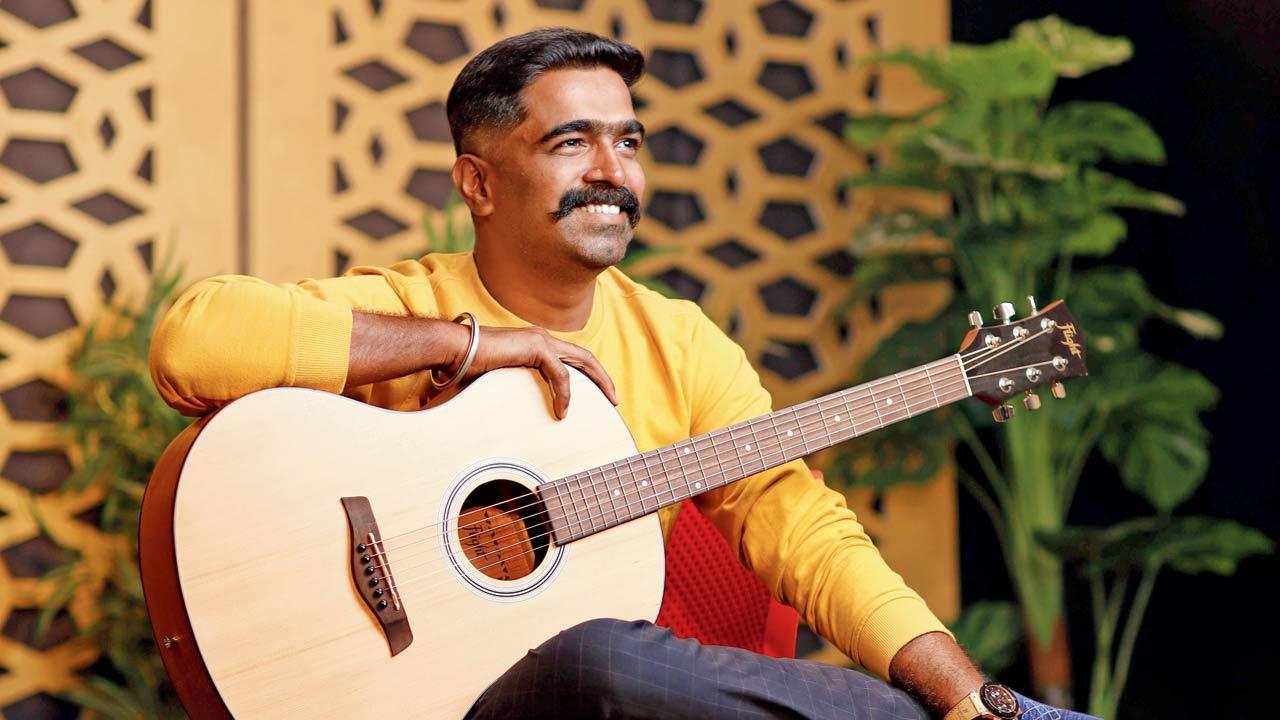
Investing several years into learning music is “rubbish”, says Singham Again composer Ravi Basrur, adding that accelerating his effort to become an independent artiste opened doors for him across film industries
Sonia Lulla (MID-DAY; October 14, 2024)
When a family discourse led to him being separated from his brother, Ravi Basrur set on to fulfil a dream that was his. “He was removed from an orchestra, and for him, I started one after we were separated due to family issues. [Back] then, I understood rhythm patterns. [Certain individuals] were paying my [team] double the money to leave me, and my keyboardist left. I had 12 days to learn the process [of playing the keyboard],” reveals the musician, who, inspired by that incident, now runs a 12-day course, training musicians to learn the craft.
“My recommendation is to not waste time learning music for five or eight years. It’s all rubbish. Think about it, if you sign up for guitar classes, you are taught for an hour each week. In a year, you would approximately spend 48 hours learning it. So, to learn material worth 48 hours, you end up wasting a year. Instead, if you invest your days and nights into learning an art, you can learn it faster. I have about 45 students learning music within 12 days. Thereafter, it’s on them to hone their craft,” says Basrur, reiterating the importance of practice in enabling an artiste to stand out from the crowd.
Basrur draws from his personal journey when highlighting how instrumental the art of practicing has been in defining his success. Before Prashanth Neel’s Ugramm (2014), which marked his debut as a composer, he had worked on 140 films as a producer. Interacting with and meeting the demands of film directors across industries gave him a first-hand account of the different ways in which he could establish his place as a solo artiste.
“I am grateful to Salman [Khan] sir for placing his trust in me with Antim [2021], and subsequently, Kisi Ka Bhai Kisi Ki Jaan [2023],” says Basrur, whose next is the November release, Singham Again.
Basrur was roped in to compose the title track for Rohit Shetty’s film. Shetty had told him to create a number befitting the grandeur that his films have come to be associated with. “They liked it, and then called me to create another number. Subsequently, I was told to work on the film’s score. We are working on creating musical tones for each character, including one for Arjun [Kapoor] sir’s Raavan avatar. We used music from the old [edition], including for the title track, and tweaked them using modern trends.”
Ask him what makes this project special, and he says he finds himself fortunate to bag the opportunities to compose for the multiple stars who are associated with it, “including Deepika Padukone”.
Irrespective of the industry he is roped in to create music for, Basrur believes the success of any musician lies in his ability to craft a winning melody. “When you understand the character completely, it makes the job of creating the melody easier. That’s why, more than the editor, it is the musician who watches sections of a movie over and over again. We find unique sounds for each instance, and select the ones that suit the situation appropriately. It’s an interesting art, but you need to be passionate about it,” he signs off.
Singham Again, the third instalment of Shetty’s franchise that is fronted by Ajay Devgn. It is set to release on November 1 to coincide with Diwali, and also features Akshay Kumar and Ranveer Singh.
The technical understanding that Salman Khan has about music is incredible-Ravi Basrur
8:31 AM

Antim composer Ravi Basrur heaps praise on Khan for fine-tuning the soundtrack of his debut Bollywood film
Sonia Lulla (MID-DAY; November 15, 2021)
A decade after he made his debut in the South Indian film industry, composer Ravi Basrur found himself tackling a Bollywood score. With none other than Salman Khan having his back, the Antim — The Final Truth composer and lyricist knew he’d have the freedom to give wings to his ideas. In this interview, he discusses the intricacies of his craft.
Edited excerpts from the interview:
Antim is your first film in Bollywood. How did your association with this movie come about?
[Tamil film industry stunt masters] Anbu-Arivu suggested my name to Salman sir [Khan]. Interacting with him was an eye-opener. The technical understanding that he has about music is incredible. He has a finger on the pulse of listeners. He knows that if a song is created in a certain way, it will appeal to viewers. For instance, there is a duet track in this film and the tempo was set at 100. It sounded nice, but we knew that something was amiss. Salman sir heard it at 2 am, and suggested that the tempo be reduced. We brought it down to 85, and it immediately sounded better.
What advantages do you have when you helm the score, soundtrack and lyrics?
I was initially called on to only do the background score. During the designing process, I had many ideas. Designing a film is like setting up a home — you analyse where you want the kitchen, and the temple. As score composer, you want to ensure that if a scene needs to look elaborate, the music facilitates that. For instance, if there’s a scene of the hero’s entry, you can’t musically play up the preceding sections. When you are the designer, programmer and song-maker, [executing such processes becomes easier].
How are the music-making processes in Bollywood different from those of other film industries?
I appreciate those who [value] our work. With this film, we were encouraged to work on our strengths. I was the one who thought that a song was needed at a section. When I worked on it and showcased it to [Khan], he agreed, and said that we should have a few more songs. He has been that [mediator] through which my craft could be showcased to [Bollywood’s audiences].
Will we see more of your work in this industry?
I hope so. My aim is to work as a musician, not a music director. When an album releases, the musicians celebrate for that day only. But what we enjoy are the moments between these days — the process of actually creating an album. That’s what I will focus on.

Subscribe to:
Posts (Atom)