Showing posts with label Ratna Pathak Shah interview. Show all posts
Showing posts with label Ratna Pathak Shah interview. Show all posts
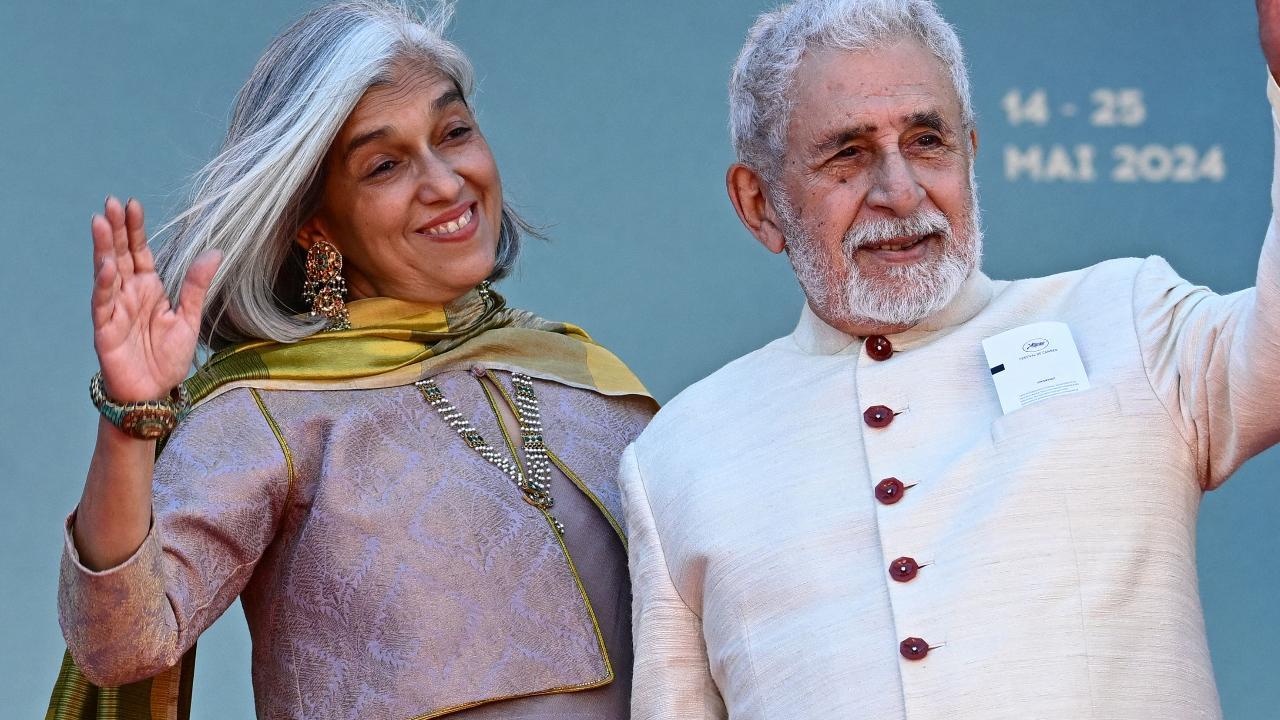
Naseeruddin Shah can be short tempered when a show is coming up-Ratna Pathak Shah
8:02 AM
Tanvi Trivedi (BOMBAY TIMES; March 26, 2025)
In a chat with us, veteran actress Ratna Pathak Shah speaks to us about the evolving landscape of Indian theatre and working with husband Naseeruddin Shah. Excerpts from a conversation:
In the current scenario, do you foresee a better future for theatre?
Since 1974, I have been hearing how theatre would not exist in the future. Then we had television shows which took over and now OTT. Every time there was something new, people felt theatre would die, but it didn’t! Even after the pandemic, drama zinda hai! Of course, things have changed and actors and writers have adapted to newer times, but there are things that I don’t like, particularly the unnecessary use of projections used in live theatres now. The desire to make plays that are thinly disguised films is limiting in many ways. Making a living out of theatre is tough, but theatre satisfies a creative need.
Do you recall your first play with Naseeruddin Shah?
My first play with Naseer was Sambhog Se Sanyas Tak. We were a group of rather inexperienced theatres actors, and he had the most experience among us all. That’s how I met Naseer. It was not a good play, but it was a learning experience participating in workshops and acting in plays. Then, in the early 1980s, Naseer started directing plays, and he directed me in a few.
What is it like being directed by Naseeruddin Shah?
I like the fact that he communicates very well when he is directing. He is generous with his knowledge and knows exactly how to bring out the best in an actor. As a co-actor, he is very confident and therefore, never keen to grab attention, that makes working with him a pleasure. He’s extremely reliable — if he says he’ll catch you at a particular moment in a scene, trust me, he will. He is very strict with pronunciations. But mostly, I feel he is an easy director to work with because he knows what he wants and helps you if you are stuck in a scene. He can be short-tempered when a show is coming up. There are times when I don’t agree with his ideas but have never faced issues trying to convince him. So, we enjoy an interesting collaborative relationship when we work together.
As an actor, whether it’s theatre or films, what kind of roles interest you now?
Definitely not the overly dramatic ones. I want roles that reflect the world we live in today — something layered, something real. I like stories that need sensitivity and depth. Roles should teach me something, help me grow, and offer a fresh perspective on life to me and also the audience.
People will be so fed up of OTT, they’ll happily go back to theatres-Ratna Pathak Shah
8:28 AM

Juhi Chakraborty (HINDUSTAN TIMES; July 14, 2020)
Theatre is actor Ratna Pathak Shah’s first love. But that love has seen a massive dent, as the Coronavirus crisis has kept her away from performing for a live audience “It is particularly painful for me, a theatre person,” she admits, adding, “The idea is to perform in front of a live audience, that’s what I’ve grown up on, that’s what I want to do all my life. To have that taken away is such a big shock to me.”
And given the present scenario, the theatre industry, like many others, has also gone digital. While she agrees online platforms have brought a lot of new people into the business, she’s quick to say, “My big fear with the OTT is that I don’t like plays being online. It is nowhere close to what the real experience is like.”
The actor feels OTTs will be around for quite some time. “But when things clear up, everyone will be so fed up of OTT that they would happy to go back to the theatres,” says Shah, 63, whose last film Thappad had a short theatrical run owing to the pandemic and eventually made its way to an online streaming platform.
Shah’s next, Jayeshbhai Jordaar, was slated to release this year, but has now been pushed. She was also gearing up for the performance of Samuel Beckett’s Waiting For Godot this month, but that, too, stands postponed indefinitely.
“This period has been hard, like for everyone else, to change one’s way of thinking, working and living. I suppose it has given everyone a comprehensive idea of what retirement will look like,” says Shah, who recently served as a jury member of the Lockdown Film Festival.
There is a serious lack of constructive criticism towards theatre in India-Ratna Pathak Shah
7:38 AM

Prominent film and theatre personality Ratna Pathak Shah is joined by actor Heeba Shah, in a candid conversation about performing arts in the country and more
Reema Gowalla (BOMBAY TIMES; May 16, 2019)
Naseeruddin Shah’s play, The Father had an exhaustive twoweek run outside the city recently. Centred around the subject of dementia, this production also features actors Ratna Pathak Shah and Heeba Shah, who essay the same roles in the play, but in different shows. We caught up with the two a little before their last performance. Excerpts:
Most interactions nowadays are limited to taking a selfie ...
Ratna: We don’t always get to interact a great deal with the audience, partly because of the length of the piece. And at the end of two hours, it’s difficult, especially for Naseer, to find more energy to interact with people. But what’s more unfortunate is that all are interactions have become limited to taking a selfie. We often say that no to photographs. But almost 50% of people, largely consisting of the middle-aged crowd, turn back and walk away. It’s the younger one who usually behind to talk to us; ask questions.
Do you think theatre, in a way, can be considered a source of living in India?
Heeba: Maybe in a way, you could. But it’ll require you to go out and ensure that you have a lot of grants coming in for your play. Right now, the kind of sponsorship that is available for films, is not there for theatre, unless the play is a replica of the film that one is doing. Having said that, I think it is good in a way. Because, the advantage of theatre as an art form is that it is not done entirely for money. It’ll be ideal, if you could survive on theatre and make a lot of money out of it, as in, we put in as much hard work on stage as our counterparts do in films. But again, there are certain aspects that are exclusive to theatre alone. There is always the factor of excitement on stage; you get the energy to live and be happy with it. On stage, you get to rekindle your flame that is about to go off. The creative freedom is always more in theatre.
Ratna: However small your production is, it costs money to bring about a play. And it’s not easy to raise that kind of money. India nurtures various kinds of theatre. There is commercial theatre in different languages, in which actors do manage to survive with the money they earn. I think film versus theatre is a bad comparison to make. Both are two completely different mediums that are made with different intentions and likewise incur different costs. The lack of money is a big issue in theatre. So, if you ask whether or not an actor or a playwright can survive by doing theatre alone? The simple answer is no! Partly because, we don’t believe in giving royalties. There are a number of people in this country who do theatre without giving any royalty to the writer. It also goes under the heading of ‘poor theatre’. This problem needs to be addressed too. Again, there is the lack of quality theatre also. One needs to constantly push boundaries to bring in good plays. The issues in theatre are complicated, and there are no easy answers to them. Nonetheless, despite having so little money in it, there are so many people who still want to do theatre. This art form gives you something that no other work can give.
How can the government help?
Ratna: We need more theatre hubs all over the country. And that is where I feel real government intervention can help — give us a place for rehearsals and spaces where we can perform. The government has completely abdicated its responsibility, and so have the corporates. They would rather organise an awards night, as part of their CSR activities, which would actually be of no benefit for the theatre community. Instead, that money should be directed towards building new spaces and make them available for theatre practitioners at a cheaper rate.
What’s your take on the lack of criticism towards theatre?
Ratna: We are past our prime. But for the younger lot in this country, this atmosphere is no good for creativity. Having said that, there is also a serious lack of constructive criticism towards theatre in India. But when I say criticism, I mean it in its technical sense — critical analysis. It does not necessarily mean finding negative things in somebody else’s work. This kind of an approach cannot lead to good work. There should be feedback — some mechanism, by which I am judged for what I am doing. There is a tremendous lack of criticism within the theatre community itself. Again, there is no professional criticism. Nobody is being made to stand up for their opinions. If you didn’t like my play, tell me why you didn’t like it. Don’t give me a half-baked patronising statement. I feel, this is very dangerous.
Yours is a family of theatre people. What happens when there is a disagreement among each at home regarding a play?
Ratna: When we have disagreements, we sulk for some time, and then we make up. Of course, discussions are often centred around theatre. But I don’t think we have identical opinions. There are things that I like, but the others don’t. And sometimes, it’s the other way round. We enjoy talking about theatre and performances a lot. In The Father, for instance, Heeba and I play same role. Of course, the age difference is obvious. But initially, there was a major problem in thinking of Naseer as my father. I thought I was doing it well until somebody pointed out saying, “Hey, he is your father in the play, not your husband. So, stop treating him so seriously.” That’s when I realised that she was right. We don’t take our parents half as seriously as we do our partners. You tend to speak with your parents with a familiarity that you don’t often manage with your partner. That incident changed my entire perspective of the play.
I’m quite tired of playing intense, suffering parts. I felt like doing something light hearted-Naseeruddin Shah
8:52 AM

Naseeruddin Shah will be next seen in The Truth, acomedy about adultery, because he’s “quite tired of playing intense, suffering parts”
Ekta Mohta (MID-DAY; November 4, 2018)
Between 2010 and 2012, French playwright Florian Zeller had written two brilliant plays called The Father and The Mother. Naseeruddin and Ratna Pathak Shah, the father and mother of Motley, staged the former last year, and the latter is on their “to-do list.”
In 2011, Zeller had also written The Truth, a breezy comedy about infidelity, a popcorn break between two serious works. The Shahs, following Zeller’s steps to the tee, are now ready with their adaptation of The Truth, which will premiere at Prithvi Theatre and Royal Opera House this week, as part of Prithvi Theatre Festival, and will also enjoy a month- long run at Prithvi from November 20 to December 16.
In The Father, a proud, intelligent, snarky man disintegrates, right before your eyes, into a doddering, old fool, as dementia takes over. Since the play ran for two successive months, Naseeruddin, who played the lead, put himself through the wringer, night after night. He says, “We ended up doing 58 shows within the space of three months, when we normally get to do 50 or 60 shows over a period of 10 years. It was a condensed experience.”
The reason he wanted to jump into The Truth was because, “It promised to be fun, and quite a different pace from The Father, which was a great relief because I’m quite tired of playing intense, suffering parts. I felt like doing something light-hearted.” Ratna, who is helming the production, adds, “The Father is a very, very painful view and experience of watching the man lose himself entirely. It’s not nice for the audience to watch as well. It’s a great piece of writing, but it’s heartbreaking as well. This is not. This is, in fact, so effervescent; it’s almost like a joke. That made me wonder: if one is to do a farce, which is so lightweight and delightful on the surface, is there anything else under it?”
The Truth’s characters have been described by the British press (it’s been translated into English by Christopher Hampton) as urban sophisticates; the kind who wear their cold, little hearts on their sleeves. The main protagonist, KC, is sleeping with his best friend’s wife. After breaking the trust of all who love him, he tries to smooth things over with white lies. When we ask Naseeruddin if playing a womaniser at his age feels alright, he cites the example of the patron saint of womanisers: “Haven’t you heard of Hugh Hefner?” he laughs. “That’s my answer.” Ratna says, “We were wondering if we should do it with a younger cast. Naseer read it and said, ‘I think it can be done with an older man.’ [The age difference actually] adds many other dimensions.”
While rhapsodising about the script, Naseeruddin recounts a dialogue from the play, “‘The truth: the advantages of concealing it, the perils of revealing it.’ Right till the end, you don’t know whose version to believe. I personally found it very funny, and I hope the audience does as well. He [Zeller] knows his onions as far as theatre is concerned. His observations of people are bang-on. I’m certain the play will raise a lot of uncomfortable questions in a lot of people’s heads. There are always dark areas in any marriage, in any relationship. Those dark areas come to the surface in the play.”
WHEN: November 6 at Prithvi Theatre; November 9-10 at Royal Opera House
Entry: Rs 300-Rs 2,500
Log on to: www. bookmyshow. com

I was more bossy than Supriya, so I got more attention from my mother-Ratna Pathak Shah
7:45 AM

Priya Gupta (BOMBAY TIMES; September 18, 2014)
Ratna Pathak Shah, 57, is
independent, impatient and extremely rational. While she may be a
worrier much like her mother Dina Pathak, she is able to keep a handle
on it unlike her mother, who was always hyper. Ahead of her upcoming
romantic comedy Khoobsurat, where she plays the part her mother played
in the original, she talks to Bombay Times about her Parsi values, her
emotional anchor Naseeruddin Shah and why she misses her mother.
Excerpts:
How did you become an actor?
People presumed that since my mom was an actor, I would become one, even though for a long time, I did not want to. But eventually, I started doing theatre and started enjoying it very much. My second play was with Satyadev Dubey that also had three other actors from NSD, including Naseer and Om Puri. Seeing them, I realised the difference between me and them and decided to go to NSD to study acting. While that was at that point the best way for me to train myself, at NSD, I learnt everything but acting. It had no acting teachers and there was a very ad hoc teaching system. Their style of acting was such that everyone seemed to be talking to a crowd of thousands. They were more involved with the appearance and the manner of the performance rather than the substance of the performance, with big voices, big costumes, big drama. BV Karanth, who was the director at that time, tried to change things, but it is not easy to drop that kind of mannered acting and there was nothing else to supplant it with. When I came back, I realised that I did not personally like to watch that style of acting as an audience and wondered how I would go about learning the other style of acting that I personally liked. Television came to my aid more than films, as I didn't get any films that could push me into any great discoveries. I got to be a part of a sitcom with my sister Supriya in Idhar Udhar, but I didn't think of myself as a comic actress. I was going to be a dramatic actress, playing roles like Lady Macbeth, but this was the only paying job I got and possibly couldn't say a no to it. But somebody up there was looking out for you, as Idhar Udhar turned out to be a great liberation. When the director narrated it to me, I thought I was obviously going to be offered to play the straitlaced officious kind of person, but when he finished the narration and told me that he wanted me to play Sunita, my jaw dropped as that is the part that my sister Supriya Pathak Kapur does well. It was such a relief to know that he wanted to cast against type. And that was good for both of us and helped us extend ourselves. Naseer and I had got married by this time, but did not have a television at home and thus we would not see our serial. While it was exciting to be the pioneer of some kind on television, unfortunately instead of getting better, television in India seems to be getting worse. Television has always had great potential, still does, but trust us to go and mess that as well. I didn't get interesting work in films, but theatre kept me going. And in a way that again was a blessing. Even if I had got roles, it would have been those of sisters of heroines.What do heroines in Hindi movies do except weep a lot and sing a lot? What kind of learning would that have given me as an actress? Whereas in theatre, I could do Shaw and Shakespeare, pushing myself to do things that I didn't know how to do. I constantly learn in theatre and that is the happiest thing for me.
Your sister Supriya Pathak missed the presence of her mother while growing up. What about you?
It was a very happy childhood as far I was concerned. We lived in Parsi Colony. I had a whole bunch of people who lived around us. She felt that her mother was not as much available to her. I, in fact, very often would wait for maa to leave the house to get on to do my own thing. I didn't need to have her around all the time. Also, we were surrounded by a bunch of so many supportive people all around us, my mami who was a second mother to us, my grandmom and Sita bai, who brought us up. If you got into trouble, you always had somewhere to go to. I wanted to be independent. I never felt the lack of my parents being around. I don't know what my children think. But our lives have been like that too. We are both working people. Our kids from day one have been used to comings and goings. I think it is perfectly alright as they have grown up, able and happy, capable of looking after themselves.I don't want to a create world of dependence. I hear a lot of parents say, 'I want to give my child everything that I didn't have.' But what about the learning you got out of the things you didn't have? How much growth, push and energy that gave your search. You want to give everything to your kids and make them nincompoops. I left home at 25 and didn't know how to buy things and how to manage a home. But you learn and that is how you become who you are. I am also a very secure mother when it comes to my children. And I don't want to know everything about them and I don't want to run their lives for sure. I can barely run my own life, so why would I want to run theirs? I can see that they are bright sensible people and don't need me to tell them what to do. Parsi Colony was a lovely place for us to grow up in. It had a healthy, happy environment and was the most beautiful part of Bombay then. In about 3 sq kms, there were about 18 gardens. Parsis are wonderful people and you can learn values from them that you can use for the rest of your life of how to be a good citizen, how to behave with decency and civility to everyone you meet, to be honest and stand up for your beliefs, to be kind and be able to just have a great time.
What is Naseer sahab like?
He is a very fair person. He is a very private person. He is a very generous actor to work with. And he is an extremely focused person. Acting is really all that he cares about. To see that kind of passion and committed focus can be extremely inspiring. As a person, he is quite a special person, that is not to say that he is not a difficult person. All special people are difficult. But I suppose, that can be said about me too. But the point is that you see what you get. He is very transparent and has no chal kapat. Naseer is a person who calls a spade a spade, and when you are at the receiving end, it's not all pleasant. So it is a hard thing to live with a person who has such a sharp eye and such a low tolerance for bullshit. But it's a good thing and I would recommend it to everyone as the alternative is awful.
What are you like?
Hopefully similar, as in, no chhal kapat. I don't much care about that. I am impatient. That's what everyone tells me and I tend to agree, but I am rational. I could well be a snob in the sense that I do find people, who don't think things through, irritating and I find that kind of kaam chori extraordinarily difficult to take. I do think that I am a thoughtful person rather than an emotionally reactive person but I am also emotional.
You play the part your mother Dina Pathak played in the original Khubsoorat. Any nostalgia?
I have very little nostalgia. I do remember seeing the film and that a lot of people were appreciative of the film particularly of maa's work in it. But I thought that she was much nicer in Golmaal. But as it happens, I have done a Golmaal and now I am doing a Khoobsurat.
Do you miss your mother?
Very much. Not just as a mother, but she was someone whose opinion of my performances I could trust very blindly , whose support I had in every way. I could talk to maa about practically everything and she was a very dear friend by the time she left. We had got past the unhappy time between mother and daughter. We both had come to accept and therefore, like each other.
Supriyaji feels that you were her favourite?
That's what Supriya keeps saying. I was the more bossy one so I got more attention. I didn't think I was doing anything wrong. I was doing what I was expected to do.But I suppose Supriya and my cousin brother, who grew up together, must have suffered.
Who is your emotional anchor?
Naseer, to some extent, for sure. He is very much my bouncing board for ideas. Particularly in matters of either the profession or, matter of the heart, he is very wise in the way he advises you. Also I feel that yoga very slowly over very, many years has finally made me a more stable and a more thoughtful person. I have a short temper and while I try not to shout loudly, I love it.
Have you taken after your mother?
In several ways. I am a worrier like she was. I try and take a grip on it but she didn't. I know how I hated her ability to worry everyone under the table. We just had to step out of the house and she would be worried. She would be expecting the worst all the time, that she would be run over by a car soon, silly worrier. I too, to, an extent am like that, but I manage to keep a handle on it most of the time. I am also a bit of self-pitier I suppose, just the way she was. But the nicer things that I may have taken from her is her interest in people. She could get on with every one everywhere. She could care very deeply about peo ple she loved. I can too.
Are there times you miss her?
Yes, specially when we are opening a new play. There was one place she would always be sitting during dress rehearsals. She would always be there and I would look out for that lovely laugh of hers that would ring out in the auditorium or her sob once in a while when she was moved. I miss her big time when we do a show. She was also a fantastic grandmother. Unlike her, I am a very rational mother. She was a very hyper and emotional mother. She did not force her ideas down our throat too much, but she certainly forced her fears down our throat. If we had mobile phones when we were growing up, we would have gone mad.
How did you become an actor?
People presumed that since my mom was an actor, I would become one, even though for a long time, I did not want to. But eventually, I started doing theatre and started enjoying it very much. My second play was with Satyadev Dubey that also had three other actors from NSD, including Naseer and Om Puri. Seeing them, I realised the difference between me and them and decided to go to NSD to study acting. While that was at that point the best way for me to train myself, at NSD, I learnt everything but acting. It had no acting teachers and there was a very ad hoc teaching system. Their style of acting was such that everyone seemed to be talking to a crowd of thousands. They were more involved with the appearance and the manner of the performance rather than the substance of the performance, with big voices, big costumes, big drama. BV Karanth, who was the director at that time, tried to change things, but it is not easy to drop that kind of mannered acting and there was nothing else to supplant it with. When I came back, I realised that I did not personally like to watch that style of acting as an audience and wondered how I would go about learning the other style of acting that I personally liked. Television came to my aid more than films, as I didn't get any films that could push me into any great discoveries. I got to be a part of a sitcom with my sister Supriya in Idhar Udhar, but I didn't think of myself as a comic actress. I was going to be a dramatic actress, playing roles like Lady Macbeth, but this was the only paying job I got and possibly couldn't say a no to it. But somebody up there was looking out for you, as Idhar Udhar turned out to be a great liberation. When the director narrated it to me, I thought I was obviously going to be offered to play the straitlaced officious kind of person, but when he finished the narration and told me that he wanted me to play Sunita, my jaw dropped as that is the part that my sister Supriya Pathak Kapur does well. It was such a relief to know that he wanted to cast against type. And that was good for both of us and helped us extend ourselves. Naseer and I had got married by this time, but did not have a television at home and thus we would not see our serial. While it was exciting to be the pioneer of some kind on television, unfortunately instead of getting better, television in India seems to be getting worse. Television has always had great potential, still does, but trust us to go and mess that as well. I didn't get interesting work in films, but theatre kept me going. And in a way that again was a blessing. Even if I had got roles, it would have been those of sisters of heroines.What do heroines in Hindi movies do except weep a lot and sing a lot? What kind of learning would that have given me as an actress? Whereas in theatre, I could do Shaw and Shakespeare, pushing myself to do things that I didn't know how to do. I constantly learn in theatre and that is the happiest thing for me.
Your sister Supriya Pathak missed the presence of her mother while growing up. What about you?
It was a very happy childhood as far I was concerned. We lived in Parsi Colony. I had a whole bunch of people who lived around us. She felt that her mother was not as much available to her. I, in fact, very often would wait for maa to leave the house to get on to do my own thing. I didn't need to have her around all the time. Also, we were surrounded by a bunch of so many supportive people all around us, my mami who was a second mother to us, my grandmom and Sita bai, who brought us up. If you got into trouble, you always had somewhere to go to. I wanted to be independent. I never felt the lack of my parents being around. I don't know what my children think. But our lives have been like that too. We are both working people. Our kids from day one have been used to comings and goings. I think it is perfectly alright as they have grown up, able and happy, capable of looking after themselves.I don't want to a create world of dependence. I hear a lot of parents say, 'I want to give my child everything that I didn't have.' But what about the learning you got out of the things you didn't have? How much growth, push and energy that gave your search. You want to give everything to your kids and make them nincompoops. I left home at 25 and didn't know how to buy things and how to manage a home. But you learn and that is how you become who you are. I am also a very secure mother when it comes to my children. And I don't want to know everything about them and I don't want to run their lives for sure. I can barely run my own life, so why would I want to run theirs? I can see that they are bright sensible people and don't need me to tell them what to do. Parsi Colony was a lovely place for us to grow up in. It had a healthy, happy environment and was the most beautiful part of Bombay then. In about 3 sq kms, there were about 18 gardens. Parsis are wonderful people and you can learn values from them that you can use for the rest of your life of how to be a good citizen, how to behave with decency and civility to everyone you meet, to be honest and stand up for your beliefs, to be kind and be able to just have a great time.
What is Naseer sahab like?
He is a very fair person. He is a very private person. He is a very generous actor to work with. And he is an extremely focused person. Acting is really all that he cares about. To see that kind of passion and committed focus can be extremely inspiring. As a person, he is quite a special person, that is not to say that he is not a difficult person. All special people are difficult. But I suppose, that can be said about me too. But the point is that you see what you get. He is very transparent and has no chal kapat. Naseer is a person who calls a spade a spade, and when you are at the receiving end, it's not all pleasant. So it is a hard thing to live with a person who has such a sharp eye and such a low tolerance for bullshit. But it's a good thing and I would recommend it to everyone as the alternative is awful.
What are you like?
Hopefully similar, as in, no chhal kapat. I don't much care about that. I am impatient. That's what everyone tells me and I tend to agree, but I am rational. I could well be a snob in the sense that I do find people, who don't think things through, irritating and I find that kind of kaam chori extraordinarily difficult to take. I do think that I am a thoughtful person rather than an emotionally reactive person but I am also emotional.
You play the part your mother Dina Pathak played in the original Khubsoorat. Any nostalgia?
I have very little nostalgia. I do remember seeing the film and that a lot of people were appreciative of the film particularly of maa's work in it. But I thought that she was much nicer in Golmaal. But as it happens, I have done a Golmaal and now I am doing a Khoobsurat.
Do you miss your mother?
Very much. Not just as a mother, but she was someone whose opinion of my performances I could trust very blindly , whose support I had in every way. I could talk to maa about practically everything and she was a very dear friend by the time she left. We had got past the unhappy time between mother and daughter. We both had come to accept and therefore, like each other.
Supriyaji feels that you were her favourite?
That's what Supriya keeps saying. I was the more bossy one so I got more attention. I didn't think I was doing anything wrong. I was doing what I was expected to do.But I suppose Supriya and my cousin brother, who grew up together, must have suffered.
Who is your emotional anchor?
Naseer, to some extent, for sure. He is very much my bouncing board for ideas. Particularly in matters of either the profession or, matter of the heart, he is very wise in the way he advises you. Also I feel that yoga very slowly over very, many years has finally made me a more stable and a more thoughtful person. I have a short temper and while I try not to shout loudly, I love it.
Have you taken after your mother?
In several ways. I am a worrier like she was. I try and take a grip on it but she didn't. I know how I hated her ability to worry everyone under the table. We just had to step out of the house and she would be worried. She would be expecting the worst all the time, that she would be run over by a car soon, silly worrier. I too, to, an extent am like that, but I manage to keep a handle on it most of the time. I am also a bit of self-pitier I suppose, just the way she was. But the nicer things that I may have taken from her is her interest in people. She could get on with every one everywhere. She could care very deeply about peo ple she loved. I can too.
Are there times you miss her?
Yes, specially when we are opening a new play. There was one place she would always be sitting during dress rehearsals. She would always be there and I would look out for that lovely laugh of hers that would ring out in the auditorium or her sob once in a while when she was moved. I miss her big time when we do a show. She was also a fantastic grandmother. Unlike her, I am a very rational mother. She was a very hyper and emotional mother. She did not force her ideas down our throat too much, but she certainly forced her fears down our throat. If we had mobile phones when we were growing up, we would have gone mad.

Subscribe to:
Posts (Atom)