Showing posts with label Rani Mukerji interview. Show all posts
Showing posts with label Rani Mukerji interview. Show all posts
Today, women are not willing to be silenced-Rani Mukerji
10:08 AM

Madhureeta Mukherjee (BOMBAY TIMES; March 8, 2026)
Three decades in cinema, and over the course of 71 films, Rani Mukerji has navigated romance, drama, comedy and fierce, socially charged roles with equal conviction, constantly redefining what longevity for a leading woman in Bollywood can look like. From early films like Kuch Kuch Hota Hai, Saathiya and Hum Tum, to powerful intense roles in films like Black, Hichki, Mrs Chatterjee vs Norway, to the successful Mardaani franchise – her career has been marked by reinvention and a refusal to be boxed in by industry stereotypes. In a special Women’s Day conversation on the Bombay Times Lounge, she speaks about shattering the glass ceiling, channelling her angst around crimes against women through her art, and embracing vulnerability in a world that constantly expects women to “have it all together.”
Over the years, you’ve played women who are strong, flawed, resilient, and often ahead of their time. Looking back, do you feel these roles shaped the conversation around how women are portrayed in Hindi cinema?
I do feel that many of these roles helped shape the conversation around how women are portrayed in our cinema. My characters have often been written with agency and emotional intelligence. Hum Tum marked a shift towards urban, contemporary storytelling. Black beautifully portrayed the strength of the human spirit and a woman’s ability to rise above immense challenges. In Mardaani, my character broke stereotypes by portraying a tough, morally driven police officer, proving that women-led stories could thrive in action-driven narratives. No One Killed Jessica highlighted the power of women standing up against injustice. Hichki was a heart-warming story that addressed inclusivity and learning disabilities with great sensitivity. With Mrs Chatterjee vs Norway, I had the opportunity to anchor an intense and emotionally powerful narrative almost single-handedly.
You rewrote the rules for yourself from the start. The industry, for the longest time, had a certain image of how a leading actress should be portrayed on screen. You made your voice one of your strengths, it’s what gave you a distinctive quality. But when you were starting out, how did you use all the comments or criticism around that to fuel you?
I think it is important that certain things hurt you, as you can then make them into building blocks for your life, instead of letting it pull you down. To be resilient at times when you have been hurt shows true character. It is normal to go through that; it is part of growing up and part of evolving as a true artiste. Also, I think to live your life according to somebody else’s opinion of you is not an intelligent thing to do. In life, no one thing remains constant, so if people didn’t like my voice back then, it didn’t mean they wouldn’t like it forever. You can’t take what people tell you at first instant too much to heart. I’m very, very grateful for the comments – good and bad – because they have shaped me into the person and the actor that I am today.
The first part of the Mardaani franchise released 12 years ago, and sadly, conversations around crimes against women and safety continue to be painfully relevant even today. How do you reflect on this as someone who has fronted the franchise?
What has changed in the 12 years is that today, women are not willing to be silenced. They have a strong opinion; they are finding their voice and want their voice to be heard. Women have always associated the word fear since childhood. At some point in our lives, most of us have faced untoward situations. It happened to me. It’s probably happened to you. It happens to women, irrespective of their age and where they come from. And it doesn’t only happen outside, it happens within the walls of our homes too. All these experiences have hardened us in their own way, and the problem also is that women trust people easily. Today, we have no choice but to tell our children to be less trusting of people around them. It is something that has disturbed me from my younger days, and not being able to do anything about it makes me angry. The only way to channelize that is through my work, my art form. And having a daughter (Adira) changes the way you look at everything. Now my niece is 18, and she wants to be independent and travel and it worries me. It’s like a part of you is out there. Crimes (like in Mardaani) are happening as we speak. That is our reality. The film raises pertinent questions and talks about these uncomfortable truths. Today, we are living in scary times.
Society often puts women through various contradictions — you have to be powerful but soft, driven but not too aggressive, ambitious but not too fierce. How do you view such contradictions, and in your own journey, how did you process them?
It is very difficult. I don’t think it is easy for women in any position. It generally comes from an attitude where no one wants to be scolded by a woman, no one wants to get a dressing down from a woman. For many, seeing women in a position of power can be unsettling. I think it’s more about the male ego, which comes into the picture. I have navigated this and also dodged it. You know, when people ask me why I cut down on doing so many films, the reason was a conscious one where I wanted to work with like-minded people. There comes a time in your life when you are in a position where you can pick and choose the people who you want as part of your journey. Especially after having my daughter, I think it’s so important that she knows what I am doing means something and that mamma is part of a story that has to be told.
You’ve done romantic roles, rom-coms and dramas. Would you say that Mardaani’s Shivani Shivaji Roy is closest to Rani’s inner fire?
Yes, absolutely! Not to say that I don’t love doing romantic roles. I really love romances and I am still waiting for somebody to write a really lovely love story.
There is often an unspoken expectation from women to “do it all” and “to hold it all together” irrespective of what emotional phase they are in — whether it is in the capacity of a daughter, wife, mom or a working woman. Did you ever see yourself going through this, and how did you navigate it?
Of course, we all go through that process and it’s natural to go through different hormonal changes which we have no control over. I don’t think we should fight it. But if there is education around these emotional journeys that women have to go through at every decade of our life, it will make life easier. If you have mood swings, it’s fine. It is okay to get exasperated. On some days, you’re so tired that your emotions get all mixed up with your physical exhaustion and you break down. Also, I think, this whole thing that we’ve always been told that women have to be strong to handle everything, that myth should be broken. Women should be given a break, because suppressing our emotions is the worst thing that we can do to our bodies and health. Sharing our sadness, confusions and the dilemmas that we go through with our close ones is important. A strong support system during such times can make a huge difference.
Adira is now 10, does she realise the impact of your work, the gravity of being Rani Mukerji? She’s slowly understanding it and she’s very proud of me, which is beautiful. What more do you want?
In the beginning, seeing the pride in my parents’ eyes made my life. Then, of course, came my husband (Aditya Chopra), and now, it’s my daughter. It’s important that people close to you and your inner circle are truly proud of you and root for you. That means a lot to me. The complete interview with Rani Mukerji will drop soon on the Bombay Times YouTube channel
Labels like ‘female-oriented cinema’ need to go-Rani Mukerji
10:43 AM

On her fiercely protective bond with daughter Adira to Delhi being a special character in her films, the actor gets candid in this edition of Stars In The City
Yashika Mathur (HINDUSTAN TIMES; February 1, 2026)
Actor Rani Mukerji is all for good cinema and even more for movies that spread awareness about social issues. With her film Mardaani 3 in theatres now, the actor visited HT City’s office in Delhi for the latest edition of Stars in the City, where she met her fans, played some fun games, and spoke about moving beyond labels in conversation with Sonal Kalra, Chief Managing Editor-Entertainment & Lifestyle.
“Gone are the days when we chose cinema only and only for entertainment. Now, we should choose cinema also for awareness,” the actor said, adding, “Gen Z and Gen Alpha are doing a fabulous job in trying to change that and to not give us labels like female-oriented. That needs to disappear.”
The actor, who portrays police officer Shivani Shivaji Roy in the film, feels strongly about focusing on a film’s content over the gender of its protagonist: “Films should be watched based on their content. Why to give labels like, ‘A film with a female cop in a female-centric film’? It’s so tiring just to even hear it!”
The latest edition of Stars in the City at HT City’s Delhi office, saw Rani Mukerji engage in a light-hearted chat with her fans as she opened up about her experience of shooting in the Capital and the beautiful bond she shares with her daughter. The actor, who recently had the release of her film Mardaani 3, also answered some interesting questions from fans. Here are the excerpts:
What is more challenging for you: an emotional role or an action role?
Dono achhe lagte hain. Emotion mein aake action karna bhi bahut achha lagta hai... Emotion ke bina action sirf action hota hai, par emotion ke saath hua action kya action hota hai!
What does feminism mean for you in terms of beauty standards?
I feel beauty always lies in the eyes of the beholder, and today, the concept of looking at oneself has changed. Self-love and believing and trusting your own instinct has become the most important. What somebody else feels about you is not important any more, it’s about what we feel about ourselves.
Many of your films have been shot in Delhi. How has the city been special for you?
Delhi has been a very important character in many of my films. I have shot so many films in the city and I love the chaat here.
Is your daughter Adira, your best friend now?
Of course! Adira (10) is my best friend and I’m constantly seeding that thought into her mind, that I’m her best friend too.
Does Adira sense her mother’s nervousness before the release of her film?
No. Her main intention is that I catch the night flight today so I can go to her Sports Day tomorrow (laughs). She asked me, ‘Mumma are you taking your flight, are you going to finish?’ And I told her, ‘Of course, of course. I’m wrapping up everything and I’m rushing for your Sports Day’... It’s very fulfilling for me too and I’m dying to be there for the Sports Day and run along with the children. I’m the most enthu (enthusiastic) mother.
Compiled by Yashika Mathur
I’m game for South projects; I just need something exciting and inspiring-Rani Mukerji
9:44 AM
Roopa Radhakrishnan (BOMBAY TIMES; October 16, 2025)
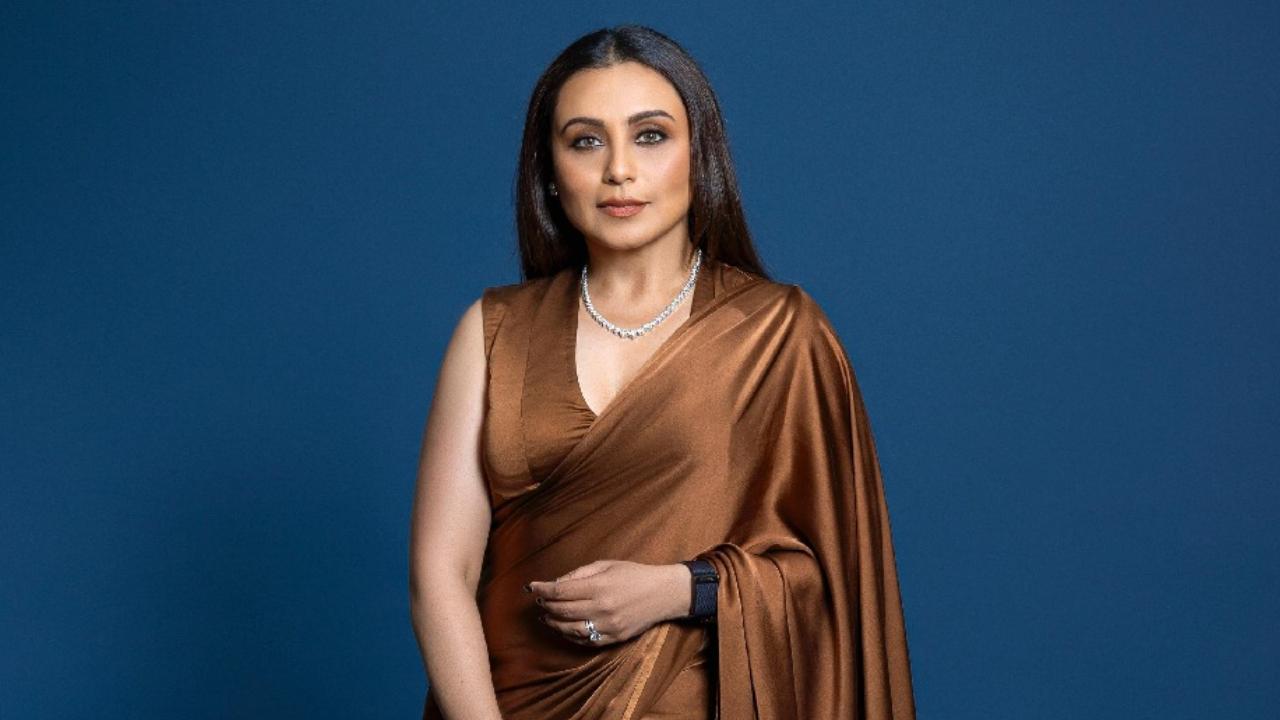
“All I need is the right role and the right mind to collaborate with, and I’m game to work in the South any day,” shares Rani Mukerji. The actress’ only South Indian film was 25 years ago — Kamal Haasan’s Hey Ram (2000). Rani, who was recently in Pondicherry to shoot for the third instalment of the Mardaani franchise, spoke about working in the South films, and why she keeps returning to the character of female cop Shivani Shivaji Roy.
‘MARDAANI’S SUCCESS BUSTS MYTHS THAT FEMALE-LED FILMS ARE SELDOM SUCCESS STORIES’
Currently reprising her role as police officer Shivani Shivaji Roy for the third time, Rani says she is fortunate to have the Mardaani franchise in her filmography. “Its success is special because it busts myths in our industry that female-led films are seldom success stories. It’s quite empowering to have the lead role in an action genre, and the franchise demonstrates how our audiences want to support a femaleled franchise. It also shows how society wants to see a woman’s success story due to her sheer merit in a male-dominated profession. I hope the franchise has impacted people’s minds to empower their girls to become police officers,” she says.
The actress adds that she considers the franchise and her character as a tribute to the Indian police. “I have the deepest respect for people who have chosen a profession for which they had to dedicate their lives in the service of others. Mardaani is a humble tribute to the Indian police force, especially the women cops who are the true mardaanis of India,” she signs off.
‘I’m always looking for disruptive scripts’
Rani says she is game to take up a film in the South if the right script comes along. “I’m always looking for disruptive scripts that present women in the right light. When the right script comes along, the audience can see me in a South film. I just need something that’s exciting and inspiring so that I can add value to the director’s vision,” she shares.
Delhi has so much character, it has so much to give-Rani Mukerji
8:05 AM

Back in Delhi to film Mardaani 3, the actress reflects on the city’s unique vibe, its cinematic role in her journey, and the memories
Rani Mukerji (BOMBAY TIMES; June 18, 2025)
Delhi has a very unique vibe that cannot be felt in any other city in our country. So, to be back here, to feel the pulse of this electric city, was a delight. I made sure I visited India Gate during my stay this time. I love visiting India Gate and seeing the majestic view of the city.
I always feel it has so much character, and it has so much to give me. I felt it in my bones while shooting for Mardaani 3, and I’m thankful to everyone for the smoothest shooting experience of the film. I cannot wait to come back again to Delhi for the promotions of Mardaani 3. I want to explore the city further and spend some quality time here. Being a foodie, it is also a delight to be here again and again. I’m going back to Mumbai with my heart full, having soaked in this beautiful city once again.
I feel Delhi has so much character, it has so much to give: Rani Mukerji
Delhi holds a very important place in my heart, as I have shot some of the most special films of my career in the capital, like No One Killed Jessica (NOKJ) and Mardaani. In both these films, the city played a very important role in enhancing the narrative, and I loved soaking in the energy of Delhi to deliver performances that people gave so much love to. So, I only have love to give back to the city every single time I’m here. I have met some of the warmest people here and made friends for a lifetime. The city has always supported me as an artiste, and I’m grateful to the people here for always cheering for me and coming out to see my films every single time they hit the theatres.
It was incredibly special to be back in Delhi to shoot the third instalment of my Mardaani franchise. Again, the city plays a very integral role in the story of Mardaani 3, and I had a brilliant shooting experience. It brought back so many memories of shooting NOKJ and the first Mardaani film. I missed Pradeep Sarkar a lot this time. He and I shared some really special memories while shooting for Mardaani here, and it brought back a deluge of moments from the past.
Little girls often look up to their mothers, and I love that Adira is connecting with our cultural heritage-Rani Mukerji
8:14 AM

Madhureeta Mukherjee (BOMBAY TIMES; October 10, 2024)
The sweet smell of Durga Pujo is in the air. The dhak players are ready with their drums, the pandals are filled with the aroma of khichuri bhogand the finest saris and jewellery are laid out for the five days of celebrations. On this occasion, Rani Mukerji talks about her deep connect with pujo, following tradition and the power of Shakti.
The Mukherjee family pujo has been around for 77 years. Generations have taken it forward, what do you think has changed about the festivities – in terms of scale, ideas and the young blood managing the show?
It is a moment of great pride that we celebrate 77 years of our pujo this year. The festival has always been extremely close to my heart, and I am eternally grateful that Durga Maa has blessed our family and friends associated with the pujo to be able to carry on the celebrations for 77 years. For me, it’s very emotional as my dad and mom used to manage this pujo successfully for many years with the help of other family members, and the baton passed on to Debu kaka (Deb Mukherjee) after my father fell ill and passed away. While Durga Pujo retains its core religious significance, the festival has undergone significant transformations over the years – right from our pandal décor, the bhog area, to the entertainment, everything has only become bigger with each passing year. I remember, as kids, we used to serve people on the floor on banana leaves, and then the table and chairs were introduced. At first, the volunteers were only family members, now every person who is a friend, member, or relative, participates in the bhog distribution.
You have been involved with this pujo since your childhood, do you see your daughter Adira getting deep into the culture, festivities and celebrations now?
Durga Pujo is more than just a religious festival; it is a cultural phenomenon that brings together people from all walks of life. I’m sure Adira will be attached to the Durga Pujo just as I am. She loves the Navratri festival as she has read books on Nav Durga. She knows the significance of the nine devis and their names and helps me prepare the bhog every day for nine days. She enjoys the Kanjak Puja I do each year, where I invite her friends and make them do a little garba and give them a feeling of the festivities. Little girls often look up to their mothers, and I love that she’s connecting with our cultural heritage. Dressing up, enjoying good food and spending time with family – it truly makes this the best time of the year for us, filled with joy and togetherness.
Which aspect of pujo do you enjoy the most – serving bhog to the devotees, the sounds of the dhak, the dhunuchi dance, sindoor khela?
Durga Puja is one of my favourite festivals, and I love everything about the festivities, including getting together with the entire family, bonding with friends, and dressing up. This celebration offers a unique opportunity to serve and enjoy bhog, a tradition I’ve cherished since childhood. The poribeshon (serving of food) is something we truly enjoy, and the bhog khichdi made during Durga Puja always tastes divine. I also enjoy participating in sindoor khela on the last day of the pujo, it’s a vibrant and heartwarming ritual. The dhunuchi naach is also a very important and unique part of our celebration, and it’s something which is not seen anywhere in the world.
Like most Bengalis, do you handpick the saris and jewellery you will be wearing during pujo?
Handpicking saris and jewellery for Durga Pujo is one of my favourite parts of the celebration. Each year, I look forward to selecting the perfect pieces that not only reflect our traditions, but also add a personal touch to the festivities. Choosing a sari is an experience in itself, so I enjoy every moment of it. When it comes to jewellery, I love wearing traditional pieces that enhance my attire. After all, we are dressing up for Maa Durga and her homecoming, so it is like a five-day party for us.
In Mrs Chatterjee vs Norway, a mother (portrayed by you), goes to lengths to save her children; she fights her family, society and the legal system. Do you believe women have this empowering force within them to protect their own and the people they love?
I absolutely loved shooting the Durga puja scene we recreated in Tallinn for the movie. I believe women have a powerful ability to protect themselves and their loved ones. They embody strength and resilience, often serving as the emotional backbone of their families and communities. Throughout history, women have taken on roles as caregivers, advocates, and leaders, nurturing and empowering those around them. Their courage shines in times of crisis, as they confront societal norms and fight for safety and justice, demonstrating remarkable determination and resourcefulness. We are, after all, Maa Durga's lineage and represent Shakti in its truest form. Without shakti, I'm sure nothing in this world would survive.
I got more serious about my career after Saathiya-Rani Mukerji
7:57 PM

Renuka Vyavahare (BOMBAY TIMES; March 7, 2024)
From her 27-year-old career in Bollywood as a leading lady to acting being a constant work in progress, Rani Mukerji touched upon many topics in conversation with Rajeev Masand at FICCI Frames 2024. Her evolution in terms of choice of cinema and process as an actor made for an interesting conversation. Excerpts...
‘You have to constantly work hard on yourself’
Attributing her longevity to the audience, she said, “Having faith in the audience and yourself is important. You have to constantly work hard on yourself to improve with each film. My motto is to better myself in each film. The audience tells us the trend and mood of what’s working. They are the reason for our longevity.”
‘When I had started out, acting was just a means to an end’
Citing some fun anecdotes, Rani reflected upon her journey. She said, “When I started off, there were different reasons why I did films. It was not the same process as today where you read scripts and make decisions. Back then, the director or producer would just tell us one line story and we accepted roles on that basis. No dialogues were given to us in advance to prepare. Story aisi shuru hoti hai, phir aisa hoga, the end. We were just told the beginning, mid and end. There wasn’t a conscious effort to even convince us to do the film. Yeh nahin toh koi aur kar lega was the perception. I was accepting films that my parents okayed. They told me today you have to go to film city, kal filmistaan, parso waha. I didn’t know any better then. Wisdom comes with age.
When I started to receive fan letters as social media didn’t exist then, that’s when I realized what my audience is liking or not liking. Acting for me was just a means to an end until then. I was just trying to earn bread and butter for my family but people were giving me much more than that. They made me part of their existence and that’s when I got more serious.
That’s when Saathiya happened. That’s when I realized there’s more to my work than merely doing a 9 to 9 shift or treating it as just a job. As a teenager I was happiest when the director would say ‘pack up’ because I loved going back home but that changed. Over the years, I wanted to stay back on set and perfect a shot. I evolved with my films. From being an 18 year old to now in my 40s, it has been a learning process. It never stops.
Indian cinema is looking inwards now
The actress was glad Bollywood and the south industry are working closely now. She said, “People used to say we are inspired but the west. Today it’s good to see that we are inspired by our own. Be it south or Hindi cinema. We are inspiring each other and becoming the best versions of ourselves.”
‘I dislike following a pattern. I follow my heart’
The actress dismissed the notion that she isn’t open to working for digital platforms. She said, “I am open to doing anything that excites me. I never follow any norms. I have been instinctive and dislike following a pattern. I follow my heart. I have to instinctively connect to a character. When I select a film, I am looking for an untold story comprising strong female characters as that’s who an Indian woman is. The story and character need to drive me and inspire me to play the part and make a mark on young minds. Growing up I sought inspiration from books, films. We need characters that we can connect with.
I don’t think I ever missed out on an interesting project because I was married or occupied with motherhood-Rani Mukerji
8:28 AM

Renuka Vyavahare (BOMBAY TIMES; January 16, 2024)
Rani Mukerji has been a quintessential mainstream entertainer and over the years, an actress with a purpose. She may have waltzed into our hearts as Tina (Kuch Kuch Hota Hai) but soon, shed that glamourous peppy exterior to reveal her mettle as an actor through diverse performances. We spoke to Rani about what inspires her, what moves the audience, and her priorities and choices. Read on...
In 2023, we saw you on the big screen as a fierce mother in Mrs. Chatterjee vs. Norway. It made people wonder why aren’t they seeing more of you on screen?
I think I have been quite consistent as far as work is concerned though it may not be perceived that way. I take up work when I am inspired by it. I can’t do films for the sake of it. There is an audience out there who has certain expectations from me, so I take time to choose my films. Also, great roles don’t come easily. You need to wait for them. Whenever something interesting comes to me, I jump at it. I don’t think I ever missed out on an interesting project because I was married, occupied with motherhood duties or other commitments. I will always put my work first for a role that inspires me and work things around it.
In many households, women prioritizing work is still looked upon as a privilege, isn’t it?
It’s easy for me to be in my position and say this, but the fact remains that I do have a very supportive husband (Aditya Chopra) and an equally supportive daughter (Adira). Even between my work, I ensure her needs are met. She knows that mamma is there for her always and when mamma needs to go to work, she needs to go to work. A lot of women don’t have this luxury. They may not have a supportive partner or a support system to look after their children. So, I understand that it must be very difficult for them. I can never take my job for granted. I am able to make my job a priority. Some women don’t get that opportunity. Everyone who is reading this, I urge them to be more supportive of the women in their lives, be it their mother, wife, sister or daughter. Let the women live their dreams as that’s the only way to raise a happy family.
Your choice of cinema has been a fine blend of entertainment and social messaging. From addressing domestic grievances in your earlier movies, to being an eye candy in Ghulam, Kuch Kuch Hota Hai, the girl next door in Saathiya, the crusader of truth in No one Killed Jessica, to a troubled, de-glam fierce mother in films like Talaash and Mrs. Chatterjee vs. Norway - you never followed a pattern. Was it a conscious choice?
Our choice of cinema is guided by the situation we are in at that point in time. Things change with every decade and so do our mindsets. The way I looked at life and cinema also changed. It was a very gradual and organic process. People have always been fascinated and inspired by cinema, so I always feel if I can use it as a tool to send a message across, why not? I always want to do things beyond entertainment. Art imitates life and it’s about growing up. When I started off, I was a teenager. I grew up with cinema, and I simultaneously learnt about life as a human being. As you grow older and wiser, different things inspire or trigger you. These things defined the choices in my life.
2023 proved that big screen entertainment can’t be replaced. A bunch of films went on to break box office records, stars like Shah Rukh Khan and Sunny Deol came back with a bang. Even your film (Mrs Chatterjee vs Norway) did well and changed the age-old narrative on ageism. Thoughts?
I would always like to be seen on the big screen. I have never shied away from being who I am in terms of my age. I have never believed age could be a factor for me not to get work. I won’t get work if I don’t know how to act. If I can do justice to a role, those roles will come to me. An audience is always looking for great films. They don’t have an agenda. If you entertain them, they will accept you wholeheartedly and entertainment doesn’t mean just dancing around. You can entertain them with a drama, a significant topic, action or comedy. More than the genre, it’s important to stay truthful to the story. I made my debut in 1996, so I can’t take credit for being a 90’s actor completely. And yes, when you speak of Shah Rukh and all my colleagues, I am happy for all of us.
When you start out as early as you did, there could be a burnout at some point. If given an opportunity to go back in time, would you take things slowly or follow the same path?
I didn’t become an actor out of my choice. I became an actor because my mother asked me to for her. If I would have waited, I don’t think I would have become an actor today. I am glad I did what I did. Regardless of the mistakes I made in my career, my audience has given me unconditional love for each of my films. I don’t think any actor can feel burned out until you burn yourself out. Sportsmen keep themselves fit because they need to perform well. Similarly, an actor has to work on themselves mentally and physically to face the camera.
A woman is never allowed to or asked, ‘Are you attracted to this man?’-Rani Mukerji
9:32 AM

Niharika Lal (BOMBAY TIMES; November 28, 2023)
Rani Mukerji isn’t big on Bollywood romance movies that do not talk about a woman’s wants and choices, and says that in that aspect, films like Kabhi Alvida Naa Kehna or Hum Tum were way ahead of their time.
While Kabhi Alvida Naa Kehna was not that big a hit at the time, it raised uncomfortable questions, says Rani. “I think it is important to always stand by strong films and strong roles. Sometimes, you may not get the (right) audience, but in the history of Indian cinema, it will always be remembered as a film that was ahead of its time,” she said during a discussion about her characters.
‘I WORK HARD TO MAKE MY CHARACTERS REAL’
“I work hard towards making my characters real – in terms of how they walk, how they talk – because I firmly believe that body language makes a huge difference in terms of how you perceive a particular person. Fifty per cent of an actor’s battle to make the character believable lies in the appearance. If you look the character visually, half the battle is won, and the other half is what you need to perform. I can be Tina (Kuch Kuch Hota Hai) and also be Alisha (from Ghulam), and I can also be Michelle (from Black).”
‘IMPORTANT TO TALK ABOUT A WOMAN’S WANTS AND HER CHOICES’
It is very important to talk about a woman’s wants and her choices. Just because the husband doesn’t beat you, it does not mean that you are in love with him. I think people give less importance to a woman being in love. What is important for a lot of people and their families is – is the man settled? Is he from a good family? But physical chemistry is not given too much importance. It’s like a man can choose that, but a woman is never allowed to or asked, ‘Are you attracted to this man?’ ‘Would you like to marry him?’
A lot of people were watching the film in extreme discomfort because nobody wants to face their own reality. That is the feedback Karan (Johar) received for his film. It opened the eyes of a lot of people, and they took the decision of being happy. The film was very different from what we are taught – that you have to compromise and adjust, and of course we have to, but there should (also) be love in the relationship. Because even in a relationship of love, there will be compromises, marriage as it is very demanding; and if you are in a marriage that is loveless then it becomes even more difficult.
‘IT IS IMPORTANT TO KNOW WHAT AND HOW A CHARACTER THINKS OR FEELS’
For Naina (from Hichki), I had to meet a lot of people who had Tourette syndrome. I also did an interview with Brad Cohen, who was the inspiration behind Hichki. To play a character, it is also important to know what and how that person thinks or feels emotionally. At the end of the day, we are portraying emotions that touch the audience. What distinguishes a scene is the emotion that comes from behind the scene. When a writer writes a scene, he is actually writing what a character is going through, and for me, it is very important to portray those emotions.
‘NO ACTOR SHOULD BE JUDGED ON THE BASIS OF AGE’
The audience has kept me going for the last 27 years, and I hope they keep me going for the next 27… My audience has helped me break the age barrier and I promise my audience that I will act till I’m 80. No actor should be judged on the basis of their age. I think it is only because our cinema is known as popular cinema, and you want to see young people all the time. The trick is also to accept that you are not always going to look young.
‘BLACK TRANSFORMED ME AS A HUMAN’
(Black made me realize) that there is nothing impossible, but we condition ourselves to believe that there are things we cannot do. Our attitude in life should be that we have to make this possible. And that’s what Black did for me; it transformed me as a human. Sanjay Leela Bhansali makes it a point to bring out the best in you and transports the audience.
-----------------------------------------
Monika Rawal Kukreja (HINDUSTAN TIMES; November 28, 2023)
With a diverse body of work, Rani Mukerji has impressed audiences each time she has come on the big screen. Perhaps the only female actor in Bollywood to have a franchise (Mardaani) that she carries on her shoulders, Mukerji has also essayed characters across age groups. At the 54th International Film Festival of India, during the masterclass Delivering Compelling Performances, she spoke about the debate around ageism in the film industry.
“[In our cinema], you want to see young people on screen all the time because that’s what probably compels the youth to watch films. But it’s also important to not be delusional and believe that you are always going to be young,” she said, adding, “You can be young at heart (comma) but to accept your age and the roles that suit your age is also important for the audience to accept you in a character.”
Since making her debut 27 years ago with Raja Ki Aayegi Baaraat, Mukerji has been able to stay relevant and, at the same time, experiment with characters that aren’t necessarily her age. “That’s how my audience has loved and accepted me over the years. In fact, they have helped me break this ageism barrier. I promise them that I’ll work till I’m 80,” she said.
Mukerji, who played a mother of two in Mrs Chatterjee vs Norway earlier this year, continued, “In my third film, Kuch Kuch Hota Hai (1998), I played a mum and did it throughout my 20s. I’ve consciously tried to not give importance to the age of the character and instead do justice to the role, so that the audience doesn’t think of Rani Mukerji but believes in that character.” Stressing on believability for every part one takes up, she added, “If I’ve to play a college student today, I would first tell the audience that I’m a mother, and at the age of 40, have decided to go back to college.”
Mukerji also played a 60-year-old in a sequence in Hichki (2018). “It was a challenge that an actor took up to look older. But when an actor takes the challenge to look younger, it’s ridiculed because you don’t want them to try and tell the audience that they’re young. So, it’s important to accept who you are, what you are and look after yourself,” she wrapped up.
Food tastes amazing only on pujo days as there is a different energy that passes through the food as well-Rani Mukerji
8:54 AM

Renuka Vyavahare (BOMBAY TIMES; October 21, 2023)
Soaking in the auspicious spirit of Durga Puja, Rani Mukerji takes us through the nuances of the festival and what it truly stands for. Here’s what she said as she took us on a trip down memory lane.
We love the sarees, jewellery, food and the spirit of festival, but that apart, what does Durga Puja truly mean to you as a woman?
Since childhood, I have seen my parents participate in our family Durga Puja, and this is our 76th year. For us, as probashi Bengalis, (Bengalis who stay outside of West Bengal), it was very important for my parents to inculcate the Bengali culture in us, especially during this festival. Whether it was performing on stage to Rabindranath Tagore’s plays, songs and skits, to enriching us culturally and educating us about the famous Bengali poets and writers – on these five days we did everything associated with our Bengali culture.
Can you take us through the rituals and their meaning?
The puja is elaborate and beautiful -- whether it’s the sandhi pujo which is done by using 108 earthen lamps, 108 lotuses, garland of 108 bel pattas. It’s a sight to behold. Even the dhunuchi dance is beautiful. The bhog that we serve and eat, is something we wait for the whole year and believe that food tastes amazing only on those pujo days as there is a different energy that passes through the food as well. We worship Durga Ma as she is the deity of war who symbolises the power of good over evil. We celebrate Dussehra also with a lot of fervour. On that day all the Bengali ladies offer meethai to the deities. The sindoor that is put on Durga Maa is a blessing and traditionally, very precious for Bengali women. We feel sad on the last day of the festival, because suddenly the five days of fun and celebration come to an end and we feel bad that Durga Maa is going back and we will only get to see her a year later.
Do you think there has been a positive change as far as the representation of women in Hindi cinema is concerned?
From the films of the 1940s and 50s to now, there has always been a great representation of women. We always had very strong women depicted in our films and it has been carried forward as well. Just because some films did not depict women in the right way, that does not mean that our cinema failed to do so. Cinema has always depicted the strength of women beautifully and at the end of the day, cinema is incomplete without women. Art imitates life. And honestly, nothing can ever exist without the presence of women. Hindi cinema has given us great films that represent strong women through decades, so to pinpoint and say it is not enough, seems unfair. I think there will always be a challenge for each generation and each decade to do their best work in the depiction of women. That is an ongoing process. But, in my career span, I have seen extremely strong depiction of women, who have had a very strong voice.
What drives you as an actor? Have there been women who have strongly impacted you?
As an actor, my motivation stems from the desire to tell compelling stories about women from diverse backgrounds and walks of life. I believe every woman possesses qualities akin to Goddess Durga. Every woman is a hero in her own right, regardless of her role, profession or social standing. In my films, I aim to showcase the strength and resilience that women possess. For example, my recent film, Mrs Chatterjee vs Norway, featured a simple housewife who displayed incredible power and resilience, truly embodying the essence of a hero. Throughout my life, I have been influenced by strong women. I grew up hearing tales of Rani Lakshmibai (Rani of Jhansi) because my father hailed from Jhansi. Visiting his ancestral home, I remember our early morning walks to the Rani of Jhansi fort, where he showed me the spot from where she bravely jumped off with her son on her back, fighting against the British. These are all stories about strong women that my father told me. Meeting Mother Teresa as a young girl and receiving her blessings was a significant moment, as well. Such encounters with remarkable women have left a lasting impression on me and continue to inspire my work.
Your family Durga Puja is legendary in Mumbai, how involved are you in the festivities?
All the Bengalis in Mumbai and outside the city congregate for our pujo. For us Bengalis, celebrating Durga Puja is like Eid, Diwali, Holi… all the festivals rolled into one. These five days are full of fun, food, culture, music, and everything to do with Bengali traditions, whether you are living in Mumbai, Delhi, Kolkata or anywhere in India and around the world. It is a tradition that I am now passing on to my daughter (Adira) and my brother has passed on to his children. The newer generation is imbibing the enthusiasm from us, like we did from our parents.
25 Years of Kuch Kuch Hota Hai: I was concerned if people would accept seeing Shah Rukh Khan with anyone other than Kajol-Rani Mukerji
8:23 AM
Navya Kharbanda (HINDUSTAN TIMES; October 16, 2023)
Kuch Kuch Hota Hai clocks 25 years today and actor Rani Mukerji, who played Tina in the film, says it feels “truly surreal because these are the people (the cast and crew) who I literally started my career with”. She adds, “What gives me immense happiness is the fact that we are such close friends. We are like family, whether it is my relationship with Karan (Johar; director) or Shah Rukh (Khan; actor).”
The film featured SRK, Kajol and her in the lead roles and Mukerji, 45, says she wasn’t sure if people would accept her alongside SRK on screen: “Right after I heard the narration, I shared a concern with Karan. I told him since Shah Rukh and Kajol were a part of DDLJ (Dilwale Dulhania Le Jayenge; 1995) that was an iconic hit, would the audience accept Shah Rukh’s character — Rahul — falling in love with Tina? He said, ‘You don’t worry about it. As long as you are doing the film, you leave that worry to me’.”
Mukerji recalls shooting the title track in Scotland. “Karan was shooting our honeymoon shots. He saw that I wasn’t wearing a mangalsutra. He asked Manish (Malhotra; designer) for it, but since he didn’t carry one, Manish told my mum, ‘Aunty, aapka mangalsutra de do’. I wore my mum’s mangalsutra and shot,” she ends.

As an actor, I cannot take my personal journey as a mother into a film-Rani Mukerji
7:39 AM
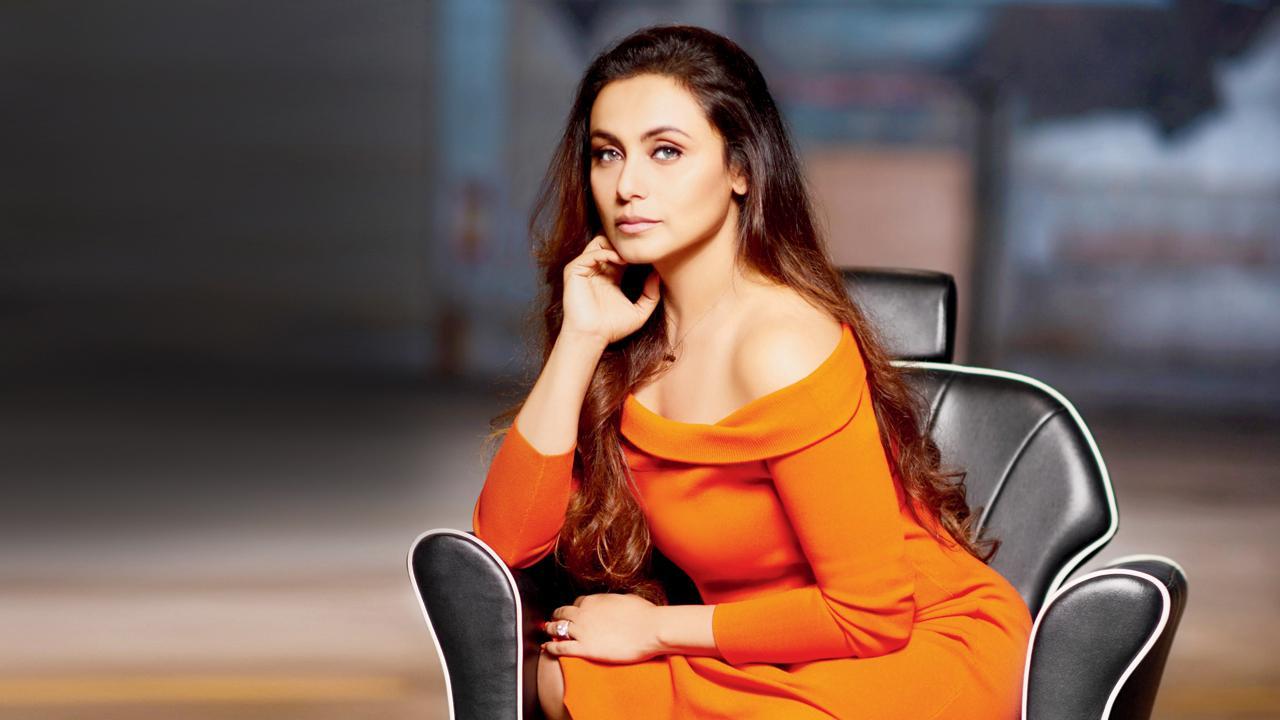
Admitting that it wasn’t easy to pull off Chatterjee vs Norway shoot amid pandemic, Rani on playing a mother who battles the state for her kids
Mohar Basu (MID-DAY; November 27, 2021)
Rani Mukerji completes 25 years in Bollywood this year. To mark the personal milestone, the actor was looking for a story that would speak to her. When she heard the narration of director Ashima Chibber’s Mrs Chatterjee vs Norway, Mukerji knew her search had come to fruition. The film is reportedly based on the true story of Sagarika and Anurup Bhattacharya, whose kids Aishwarya and Abhigyan were taken away from them in 2011 by the Norwegian welfare services, alleging extreme parental neglect. In 2012, after the Indian government’s intervention, the kids were sent back to India to their paternal uncle.
The drama will be a change of gears for Mukerji who was recently seen in the comic caper, Bunty Aur Babli 2. “My audience loves the fact that I am versatile. I can go from playing Babli to this film, which is a whole new world,” she begins.
But the Nikkhil Advani-backed film wasn’t easy to pull off. The team was to begin shooting in April, but the plan was thwarted by the second Coronavirus lockdown. The actor recounts, “The shoot was to go on until May. But the pandemic led to many changes. Estonia, where we were to shoot, closed its borders. So, we went back and forth [on our plans] and finally shot the film in August all the way till September-end.”
The drama is centred on a mother’s battle against a state machinery for her children. Being a parent to a five-year-old daughter, does Mukerji feel more aligned with her character? “When I play a part, I don’t play myself emotionally. I feed off the emotions and turmoil of the character. I can try and put myself in her place, and bring to screen her pain. As an actor, I cannot take my personal journey as a mother into a film. The story is not mine. I borrow emotions from my roles, and portray them to the best of my ability.”
Longevity comes from embracing your age and the person you are-Rani Mukerji
8:28 AM

Rani discusses how she has no qualms playing mother to 10-year-old in Bunty Aur Babli 2, and the joy of teaming up with Hum Tum co-star Saif Ali Khan
Mohar Basu (MID-DAY; November 13, 2021)
For someone who is recovering from a knee injury, Rani Mukerji is surprisingly upbeat as she promotes Bunty Aur Babli 2. The wacky energy of her film and the fact that it reunites her with Hum Tum co-star Saif Ali Khan after 13 years probably keep her going. But above all, she is happy to be Babli all over again after the 2005 hit. “When Bunty Aur Babli was first developed, we wanted to take the franchise forward. Shaad [Ali, director] wasn’t convinced. Adi [Aditya Chopra, producer] kept the story for a long time, looking for a director who would make it his own. Finally, it was Varun [V Sharma, director] who whipped up a fantastic screenplay. It is not a regular comedy; it has its heart in the right place,” she begins.
Mukerji believes that Khan and she have matured, just like their on-screen characters. “Saif was a little childish when I met him on the sets of Hum Tum [2004]. Today, he is mature and sorted. We have rediscovered our chemistry with this film. This time, we brought our love and respect on screen. I admire him as an actor; his comic timing is impeccable. We fed off each other’s energies. Our common ground this time was that we were both parents. So, we exchanged notes.”
Well, it appears our Hum Tum characters grew up. Probably the right time to ask if there will ever be a sequel to the romantic drama. “For now, no. But I hope there are more Bunty Babli sequels in the offing.”
Letting go of their vanities, Khan piled on the kilos to play the average Fursatganj middle-aged man while Mukerji plays mother to a 10-year-old in the con caper. That must be refreshing compared to 10 years ago, when vanity was sacrosanct to an actor’s existence. “Today, it’s liberating how movies have changed and how actors are viewed. Earlier too, I did Black [2005] and Yuva [2004] where I didn’t care about my characters’s [appearance]. I like interesting parts because longevity comes from embracing your age and the person you are. I don’t want to convince the audience otherwise. That said, I’ve done a glamorous film after so long.”
I think every Bengali, wherever they are in the world, waits for Durga Puja-Rani Mukerji
8:01 AM

Debarati S Sen (BOMBAY TIMES; October 15, 2021)
For as long as she can remember, Rani Mukerji has been closely associated with her family puja, the North Bombay Sarbojanin Durga Puja Samiti. The fact that this year she has been busy with her shoot has been a dampener of sorts for her. Talking exclusively to Bombay Times she says, “I have been missing the usual fun and festive atmosphere that we have during these five days, as I am shooting for my next film, but I managed to visit the pandal one day. This year our Protima (Durga Maa idol) is beautiful and mesmerizing and the décor is probably one of the best we have seen.”
The actress has always loved the grand celebrations, but due to the Coronavirus pandemic, the festivities have been low-key, keeping in mind the protocols and restrictions. She says, “We wanted to have a full-fledged Durga Puja this time, but since the planning happens seven to eight months in advance, we had no idea how things would be. That’s why we decided to go ahead with a low-key celebration.”
Rani’s love for the festival is well-known and she has many fond memories of the puja. She shares, “Over the years, my favourite thing about Durga Puja is getting together with the entire family and all my friends during these five days when we enjoy the food, dressing up and connecting with each other.”
Rani says, “The other thing that we love doing, which we missed this year again, is serving food to the many people who visit our Puja. I think every Bengali, wherever they are in the world, waits for these five days to rejoice with their dear ones.”
Rani’s daughter Adira, too, has already had a few Durga Puja moments and for the actress, those have been precious times. “I think my fondest memories are of my daughter, Adira, attending the Puja in 2019 when she was old enough to enjoy herself and experience everything. Surprisingly, she was only three years old then, and it is amazing that till date, she remembers the kadak chai that she had from one of the stalls at the venue,” says the actress.
The ritual of Sindoor Khela that is held on the last day of the Puja, on Dashami, will be held today across pandals (virtually or socially-distanced). Talking about it, Rani says, “I want to be a part of Sindoor Khela, but I am not sure whether I will be able to attend it as I am shooting for my film.”
We must constantly bring conversations about inclusivity for differently abled to the fore-Rani Mukerji
8:01 AM

On International Day of Persons with Disabilities, the actress talks about how portraying differently-abled characters has had a lasting impact on her
Harshada Rege (BOMBAY TIMES; December 3, 2020)


The actress further says that she was extremely inspired by the grit and inner strength that these characters showed in the harshest of situations. Rani adds, “I learnt about the resolve of people who are determined to triumph, despite the odds stacked against them. Essaying these powerful girls on screen made me a stronger human being. I realised the effort that they had to take for many things that we take for granted.”
Talking about more representation for the differently-abled in films and creating awareness about their needs among people, she shares, “For me, Black and Hichki were emotional experiences that opened my eyes more towards inclusivity for all. We must constantly bring conversations about inclusivity and equality to the fore. We need to do our bit to stop discrimination and stereotyping of individuals like those I have portrayed in these films.”
This Durga Puja, I am missing all our family members coming together-Rani Mukerji
8:32 AM

Madhureeta Mukherjee (BOMBAY TIMES; October 24, 2020)
It is that time of the year when Bengalis deck up in their finest, wear their cheerful spirit on their sleeves and come together in huge numbers to soak in the joy of the Durga Puja festival. But 2020 has changed the course of all festivals, briefly, we hope. In times of the pandemic, even the Mukherjee family’s legendary Durga Puja, which sees the presence of the Bollywood brigade across the five-day celebration, is a close-knit family and members-only affair this year. Rani Mukerji, in an interview with BT, talks about what she is missing the most during the low-key celebration this year, how she values the time she’s got during the pandemic to spend with her daughter, Adira, and how she’s concerned about the impact this phase will have on young children. Read on...
First time since your childhood, I assume, you will be witnessing a downsized version of the Mukherjees’ iconic Durga Pujo, which is in its 73rd year. Every year, thousands flock to the North Bombay Sarbojanin Durga Puja during all the days of festivity. This year the celebration is obviously different?
Yes, it is different and a very low-key affair because as a community and society, we need to abide by the law, and if there is a rule for how all the pujas and festivities have to be done, it’s only for the safety of every individual. As it is a puja, we did not want to put a halt to it, so it is being done in a very low-key manner where only the main puja of Maa Durga is taking place, and anything else that happens around the puja, for instance, serving bhog, distribution of prasad and even the entertainment, which is an important cultural exchange program that happens during puja — all that has been cancelled. Looking at the Coronavirus pandemic situation, especially in Mumbai and Maharashtra, there will be only the puja of the Goddess.
What are you missing the most about the otherwise elaborate celebrations, which I guess is a close-knit family affair this year?
Actually, it won’t even be a close-knit family affair because all the family members and the puja committee members have been told that they can come for the darshan only if they are taking proper safety measures. And safety measures are being taken at the pandal as well, but it is not open to the public the way it normally is since it’s a sarbojanin puja. I think what we are missing the most is the fact that once a year all the family members come together under one roof, but this year that is not going to happen. We also enjoy feeding so many people who come to visit our puja with our own hands. I think the poribeshon (serving food to everyone) is also something that I will miss and, of course, the bhog, which is something that we look forward to eating every year. I think there is so much that has happened this year that to let go of one year of celebration is the most sensible decision that the family and the puja committee members have taken. We look forward to doing it next year once everything is better.
Did you still manage to buy some special saris just to mark the occasion and soak in the spirit of the pujo?
This is the only year that I haven’t done that. I will definitely be doing a small puja in my house, as my daughter is still very young, and I want to keep the tradition alive. So, I am going to do the Kanjak Puja on Ashtami, which I do every year. I have got new clothes made for my daughter, Adira, and I am sure that I will find a new sari for myself in my closet.
Like many others, will you also be viewing the pujo virtually then?
If any committee or family member wants to watch the puja, they can do so from the safety of their homes, virtually. I join in during the aarti and pushpanjali. We also might have the whole family to do a video conference call so that we can say our ‘hellos’ and wish each other Happy Pujo!
Given that you are so attached to your family pujo, is Adira now slightly aware of what the festivities are about?
She knows about it completely because for the last two years I have been taking her to the pandal. Last year, she spent a little more time since she is older now, and it is unfortunate that this year she is not going to see that and there will be a year’s gap. I will still see if I can probably do a quick darshan, and knowing me, I will feel the urge to go, and might do it. There are no concrete plans as of now, I will take it as it comes. During COVID times, making plans is not a very sensible thing to do; we have to take it one day at a time.
We are all finally coming out of a long period of lockdown. It has been a tough, but an introspective phase for many. What have been your learnings from this phase?
What has been keeping me really busy is my daughter’s online schooling for the past seven-eight months and since she is only four-and-a-half years old, I had to be around throughout. I also finished shooting the remaining work for my upcoming film, which was a different working experience during the pandemic. We have to take each day as it comes and we all have to be very thankful for what we are blessed with. We should be thankful for our good health, having a roof over our heads and being able to eat what we eat. These are things which we have been able to understand and appreciate more in a situation like this. We are now humbler about all the things that we would have probably taken for granted when this pandemic was not there. It has been a good phase in terms of spending quality time with the family, being at home and doing things, which we couldn’t do owing to our busy schedules. I have taken to baking again that I always loved doing. I tried to hone my skills as I had so much time in hand. I have also learnt how to make Indian sweets from scratch, like sandesh, rasmalai, rasgulla and kaju katli. I have been learning a lot of things and I feel that learning for every individual is enriching and important.
I think what’s positive about the current situation is the kind of uninterrupted family time that many of us have got. It has also helped us understand each other better…
Well, it has let me understand my daughter completely because the time that she would spend at school, I would actually not know what she is doing in terms of her overall growth. So, just being there day in and day out has been a wonderful experience. I have always said that teachers are the most important community as they are the ones who lay the foundation for the way the next generation is going to shape up. A teacher’s contribution is so crucial, and going through these seven-eight months of the pandemic with my child and educating her at home has made me realise this. The news that we have been getting over the last few months about the difficulties that children in the world are facing has been the cause of my constant worry. Since my daughter is four years old, my concern has been for children of her age whose formative years that are spent in school has hit a roadblock because the most important aspect for them is to go to school physically, meet friends, play with them and interact with teachers… but that entire process has come to a standstill.
For adults, it has been a different experience, but for kids, it has been very different and difficult. I am experiencing this obviously because I have a child of that age. I think of all the parents who have children who are above two years of age and they are pretty much facing the same thing because you want your child to run around, go to the park, beach, school and have that experience of interacting with other kids. This is something that they are really missing out on. When the pandemic is over, we will have to see what effect it has had on them psychologically. Some children can’t even express what they might be feeling, and some kids can even block that feeling, so I don’t know how it will impact them. I am just hoping and crossing my fingers that all the children are protected and come out of this phase with a positive mindset. We have to work extra hard to remove the fear of this pandemic from their hearts and heads. Obviously, they know about COVID-19 and they know the reason why they are not being sent to school. The fear is instilled in them. It is something that we will have to work on to get rid-off. That has been my most worrisome thought during this pandemic. For me, it has been amazing, but as a mother, I am very saddened by the fact that my daughter is unable to do things, which she earlier could do. Parents have been communicating with each other and the teachers on how we can help our children to the best of our abilities.

I’d love Adira to be anywhere close to the creative side-Rani Mukerji
8:10 AM

Shreya Mukherjee (HINDUSTAN TIMES; February 15, 2020)
Growing up in an artistic environment often inspires young minds. And it seems Adira, daughter of actor Rani Mukerji and filmmaker Aditya Chopra, is no different. The adorable four-year-old, according to Rani, has already started showing interest in the performing arts. And the doting mother can’t be happier. In fact, Rani eagerly hopes her child chooses a creative vocation when she grows up.
“Adira sings, dances and at times, pretends to be an actor… She loves it,” says the proud mum. Though it’s too early to predict what she’ll take up in future, Rani would love it if Adira chooses to be an actor. “I’d love her to be anywhere close to the creative side and that could be painting, singing, dancing, acting, directing, whatever she wants to. I feel creative people are just amazing, so I hope for my sake that she is creative,” she smiles.
Adira will undoubtedly be fortunate enough to witness both sides of showbiz — in front of and behind the arclights. So can we see her alongside Adira in a film helmed by Aditya? “OMG… That’s an ideal situation… Fingers crossed!” she laughs.
Talking about giving Adira the required space, Rani hopes she grows up to be a strong, opinionated individual who follows her heart. At the same time, she is also trying to hold back her overwhelming love and constant concern to keep a tab on the young one’s life.
“I do understand that very soon, she will want space, and she is going to tell me, ‘Mum I’m going to be with my friends’,” says Rani. “I’ve a husband who also believes we need to give our children the right space... Being a Bengali, I’m probably the other way round (laughs), completely hovering around my child… Even if she doesn’t need me I want to be there… I know it’s important to bring up your child independently. The one mistake we make is [we don’t understand] that we’re responsible for the child till it is in the womb, when the child arrives, it becomes a child of the world. It’s only when they’re alone and make mistakes that they will be able to learn and be responsible for their actions… It’s nice to have a healthy mother-and-child relationship. As mothers, we should not forget that we need to balance loving and smothering them,” Rani adds.
I urge every woman to identify the power within-Rani Mukerji
8:11 AM

Rani Mukerji feels inspired by real-life female cops
Shreya Mukherjee (HINDUSTAN TIMES; December 7, 2019)
As a woman, mother and a public figure, the cause of women’s safety and empowerment is close to Rani Mukerji’s heart. Right from her maiden Bollywood film Raja Ki Aayegi Baraat (1996) to her upcoming drama Mardaani 2, the actor has portrayed strong women characters, and off the screen too doesn’t fear calling a spade a spade.
There is excitement about seeing her in a cop’s avatar again. And Rani says her character in the film is a tribute to all fearless women police officers who have dedicated their lives to their jobs. “When I was offered the script of Mardaani (2014), I had a lot of anger because of the Nirbhaya case. And the character of Shivani Shivaji Roy was giving me that outlet to channelise my energy and my anger,” she says. At the time, she interacted with several women cops and it made her “feel very inspired that here are these brave women who are doing so much for society”.
Her character in the film, she felt, put the focus on all the women police officers. “Today when you think of a cop, you do picture a lady cop as well. So I think that is something that has happened with Mardaani organically. It’s a film on women cops taking a stand on crime against women. The message is pretty clear that we all need to be aware of the growing threat in our society today and how we can protect ourselves from such incidents,” she explains.
In Rani’s words, her portrayal of Shivani is a culmination of extensive research and interviews with female cops. “We’ve put together everything… I would say it’s my observation, their stories, the way I understood them during our conversations, their body language… Whatever I have absorbed, I have put it in Shivani’s character,” she says.
The actor adds that in Mardaani 2, the audience will see many real-life instances, and that the film raises the issue of how to protect oneself. “Safety is a bigger concern. Today the most important topic is how do you protect yourself,” asks Rani.
She urges every woman to ‘identify the power within’ and face the world headstrong. This is also something she wants to pass on to her daughter Adira, who turns four on Monday (December 9).
That brings us to the question on what special plans she and filmmaker husband Aditya Chopra have for their daughter on the day. “The whole day is dedicated to her. It’s going to be a fun-filled day for all of us, we all are very excited. And I think I am going to get mental on that day,” Rani laughs.
What about the gifts for Adira? This time the mother in Rani comes to the fore. “The love that I give her is the biggest gift, the love that she gives me is my biggest gift. I make sure whatever she likes I make it happen on that day.” You can’t possibly miss the emotions in her voice.
I have always looked to celebrate the strength of women through my films-Rani Mukerji
7:53 AM

Actor Rani Mukerji says her roles reflect her belief in how women should be perceived
Rishabh Suri (HINDUSTAN TIMES; December 3, 2019)
Right from Shashi in Yuva and Saamiya in Veer-Zaara (both 2004), to Naina Mathur in Hichki (2018), Rani Mukerji has always made sure that she plays powerful female protagonists in her films. Shivani Shivaji Roy, her cop act in Mardaani (2014), was also plotted on similar lines.
What makes Rani zero in on such brilliant characters all the time? “I have always looked to celebrate the strength of women through my films, whenever I got the opportunity,” she says, “No One Killed Jessica (2011), Black, Mardaani, Hichki, etc. are some of the favourite films of my career as they resonated with who I’m as a person in real life and my belief in how a woman should always be perceived. For me, a woman is a pillar of strength for her family, community, husband, child, and I do feel we don’t celebrate women enough.”
The actor is all set to reprise the role of the fearless and committed superintendent of police, Shivani Shivaji Roy in Mardaani 2, which is a sequel to the hugely acclaimed Mardaani, in which she took on the kingpin of a child trafficking racket. In the second part, Rani has been pitted against a young, yet dangerous villain, who can be called pure evil.
Opening up on why she thinks her character in Mardaani became so popular with masses, she says, “Mardaani 2, which releases on December 13, is another attempt to showcase what a fearless, self-made, self-believing woman can do despite being pitted against all odds. Shivani is someone who will never back down in the face of injustice, and I’m glad people have showered her with so much love and appreciation. She is one of my most favourite characters because she lives life her way and isn’t cowed down by judgements and stereotyping. A boss in a man’s world, she ensures her work speaks the loudest. She is the quintessential spirit of a woman and maybe that’s why this character resonates with so many people.”
What the versatile actor is thrilled with is the current, new generation of actors, who are choosing to pick scripts with female protagonists. “I can see the tides changing, and I can’t tell you how thrilled I am as a woman and as an artiste. I have silently tried to do my best to bring out powerful women on screen and impact the psyche of people through their life. I get so happy when I see the young actors choosing to do women-centric films that give out the correct message about women to society,” says Rani.
When you are making a film like Mardaani, you can't shy away from reality-Rani Mukerji
7:51 AM

With Mardaani 2 tackling crimes against women, Rani Mukerji discusses why it was essential to adopt gory treatment for the thriller
Mohar Basu (MID-DAY; November 24, 2019)
"I want Mardaani to evolve into a franchise where Shivani Shivaji Roy is tackling different crimes," begins Rani Mukerji, almost wishfully, as if to put the word out in the universe. One would assume that the franchise will be restricted to crimes against women, but the actor views it differently. "We don't have restrictions creatively. It depends on what the writers are able to carve out."
Led by Mukerji's cop character, who is in hot pursuit of a serial rapist, Mardaani 2 tackles the subject of violent crimes against women. In fact, the gruesome depiction of a crime in the trailer indicates that the film may not be for the faint-hearted. Knowing that the subject required one to walk the fine line between disturbing and delicate, Mukerji says director Gopi Puthran and she were constantly in discussion over the treatment of the sequences. "We, as creative people, chose to do the film aesthetically. A rape is not titillating in this film. When you are making a film like Mardaani, you can't shy away from reality. The audience should get a first-hand feel of what's happening around us. We live in dark times, and the sooner we accept it, the better it is for us."
The actor views the outing as an attempt to build a counter-narrative that will portray women in positions of power, thus inspiring a generation of girls to be part of the force. "During my research, I met many women cops and they are badass. They have to balance their family life with this job that requires them to be out on the field for 70 to 76 hours. They are at the station for five days at a stretch, without going home to change or shower. There's no difference between male and female cops. People from the outside see it differently, which is why films like Mardaani are essential to tell them that women officers are just as boisterous."
Today, everything I know about my culture is because of Durga Puja-Rani Mukerji
8:04 AM

Madhureeta Mukherjee (BOMBAY TIMES; October 5, 2019)
You can hear the echoes of the conch. The waft of traditional Bengali khichudi is filling the air. And revellers are wrapped in fineries in reds, whites and all colours of celebration. It is Durga Puja, a time when all Bengalis in the city come out in large numbers to offer their prayers, bond with family, hop from one pandal to another, binge on their favourite delicacies, and keep binging as much as they can. Like Rani Mukerji rightly says, “For Bengalis, every celebration is about eating good food!”
Bombay Times met up with the actress, at the famous ‘Mukherjees’ puja pandal, which has changed by leaps since the time it started, 72 years ago. Yet, what remains the same is the love and commitment with which the family has kept the tradition alive through generations. Rani tells us, “For me, Durga pujo always brings back fond childhood memories. It is an important time for us, as this is one festival where Bengalis go all out and celebrate. We hang out with our families, eat our hearts out and soak in our culture. If you look beyond the festivities, in most pandals, you can see the kind of amazing art work and creativity that go into it. Even in the cultural events that happen on all days of pujo, we come together to perform dance dramas and plays. It’s a great cultural exchange for Bengalis, especially for probashi Bengalis like us (who live outside of West Bengal). I have been a part of the festivities since childhood, and luckily, we always had our family pujo (North Bombay Sarbojanin Durga Puja), so it was easier for our parents to make us feel closer to our tradition and culture.”
“In fact, I got to know and learn about Rabindra Sangeet through the various dance dramas and cultural performances that we would stage during our childhood days. Today, everything that I know about my culture, and my ‘Bengaliness’ is all because of Durga Puja.”
Festivals bring families together, and for the Mukherjee clan, who have been deeply involved in putting together such a large-scale sarvajanik celebration, it’s no different. “This is a great event for the entire family and during the five days of pujo, we are all under one roof. Everyone is usually busy with their own lives, and with time, our friend circle has also changed. So, Durga pujo is like a meeting ground for all of us, and this is the one place where we pick up from where we had left the previous year,” explains the actress.
Talking about her strong connect with her family puja, she adds, “I feel deeply rooted to this, and the participation of both my parents, along with Debu kaka (Deb Mukherjee) and all other kakus and kakimas (aunts and uncles) have made this pujo what it is today. There are people who are not part of the family, but yet, they have been an integral part of the celebrations and planning for years now. Earlier, it was more intimate and close-knit, and yes, I miss that, but from then to where we are now, it has been a huge leap. People from not just Mumbai, but even outside the city come to our pujo in large numbers. Ask her if she’s ever gone pandal hopping, before she became a movie star, and she reveals, “Of course, when we were younger, we would go pandal hopping every year. My strongest memories of pandal hopping are of going to the pandal at Shivaji Park, because there were so many food stalls spread across a huge area. At night, we would go there to eat machher chop (fish chops), mughlai rolls and more. For Bengalis, every celebration is about eating good food! I can’t go pandal hopping now, but I don’t miss it because our family pujo is quite large-scale and we have so many food stalls. I can binge right here! I often go online and watch how some of the pandals in Kolkata create the sets, décor and artistic themes. It’s a treat to watch them.”
Another essential part of the festival, as per their family tradition, is that they personally serve bhog to all the Durga puja revellers who visit the pandal. So, Rani chooses a day during the five-day festival, when she takes on the food-serving duties with pleasure. She excitedly says, “The bhog tastes divine during pujo, and if you try making it during some other time of the year, it does not taste the same. I think that it is the magic and miracle of the festival.” Ask her what her favourites are, and she’s quick to tell us, “Khichudi, paayesh (kheer), sandesh (mithai), beguni (batterfried brinjal) and cholaar dal (chana dal).”
Looking gorgeous in a pink silk sari, accessorised with light jewellery, the actress is soaking in the spirit of the festival. We go on to talk about how she handpicks her saris for each day of the festival. For Bengalis, flaunting their finest saris and jewellery on Durga puja is one of the highlights. Sharing some memories from her childhood, Rani says, “When we were younger, this was the only time of the year when we would buy clothes. My parents would buy us five-six sets of clothes, which we would wear all round the year. I don’t exactly shop before pujo, rather, I keep shopping for pujo throughout the year (laughs!). Whenever I see something that I like, I say, “Eta pujoi porbo.” (I will wear this during pujo).
Adira, her daughter, is gradually being introduced to the Bengali culture and festivities. “She is just about four and this year, I am trying to introduce her to the pujo. I’ve to request everyone to not click her pictures and I will have to try to bring her to the pandal at a time when the crowd is less,” she says. Does she see Adira perform on stage, just the way she used to perform as a child? “I think it is too early for her to be on stage. My brother’s (Raja) children are older and they participate in the cultural events,” she explains.
Durga puja festivities are incomplete without sindoor khela, an age-old tradition — which has seen a huge change over the years — that happens on dashami (the last day of the festival). “Even as a kid, I would play sindoor khela on dashami day, every year. Now, I participate as a married woman, the celebration has always been a lot of fun.”

Subscribe to:
Comments (Atom)