Showing posts with label Ram Sampath. Show all posts
Showing posts with label Ram Sampath. Show all posts
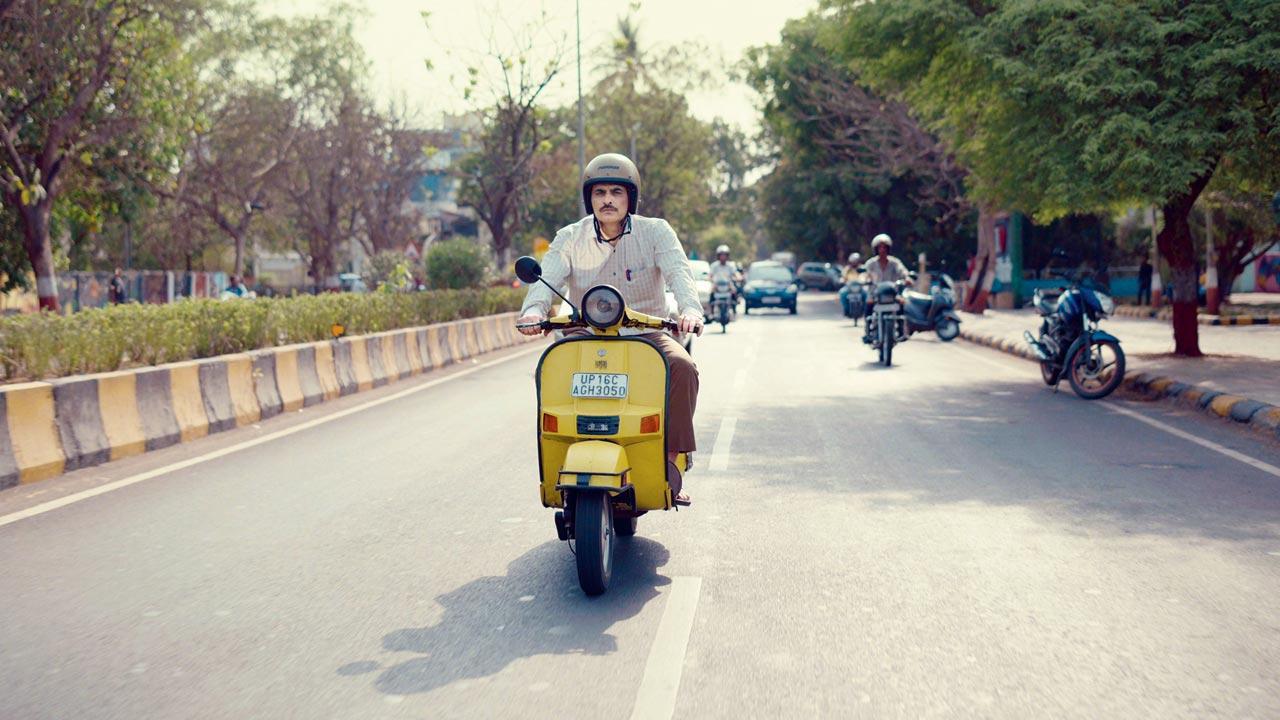
In Tribhuvan Mishra: CA Topper, Manav Kaul plays an ordinary man who becomes a gigolo to support his family
8:45 AM
Mohar Basu (MID-DAY; June 28, 2024)
What do you get when you bring together the makers of the slice-of-life series Gullak and the violent Mirzapur? A delightful comedy. Gullak director Amrit Raj Gupta and Mirzapur creator Puneet Krishna have joined forces for Tribhuvan Mishra: CA Topper, which tells the story of an ordinary man who becomes a gigolo to support his family. While Manav Kaul leads the nine-part Netflix series, he is joined by Tillotama Shome and Shweta Basu Prasad.
In a chat with mid-day, Kaul says he was so intrigued by the titular part that he chased creator Krishna and producer Ram Sampath.
“I was a mad actor hungry for a [good] story. I sent Puneet and Ram scores of texts to land the audition. I knew I could crack this character. His voice would echo in my ears long after the narration was over,” says the actor.
As the showrunner-creator, Krishna had to bring alive a world that had not only goons, guns and gore, but also love and family values. The most critical part was researching the world that the story was set in.
“We met a lot of [gigolos]; they were open about their experiences. What surprised us was the amount of respect in those interactions. The men address the women as Ma’am. The more we dug into these stories, we realised there is agency, desire and vulnerability.”
Sampath, who met Krishna during the making of Bangistan (2015), says his vision made him back the series. “Puneet has the foresight to know what will be relevant a few years from now. That makes his stories out of the box.”
'Tribhuvan Mishra: CA Topper' will be released on the platform on July 18.
12 years since Dhobi Ghat, Kiran Rao returns to direction
8:39 AM

Almost 12 years since Dhobi Ghat, Rao returns to direction with massy offering; kicks off Aamir-backed film near Pune
Upala KBR (MID-DAY; January 15, 2022)
Haven’t many of us wondered when Kiran Rao will return to direction as we watched the poignant Dhobi Ghat (2010), several times over? But you can’t hurry filmmakers true to their art; they will rekindle their romance with the camera only when they have a story to tell. And Rao seems to have found hers. Almost 12 years since her directorial debut opened to glowing reviews, the producer-director has quietly kicked off the shoot of her second project. mid-day has learnt that the drama-comedy, backed by Aamir Khan Productions, went on floors in a town near Pune on January 8.
Dhobi Ghat, which was an ode to Mumbai and the lives it witnesses, was dubbed as an arthouse movie. For her second offering, Rao has switched gears. A source reveals, “Kiran’s next is a massy entertainer. Aamir loved the script when she narrated it to him, and instantly agreed to come on board as producer. The two continue to remain friends and collaborators after their divorce.”
The film, written by Biplab Goswami with a screenplay by Sneha Desai, is centred on three characters. After an extensive hunt, Rao found her lead in Sparsh Shrivastav of Jamtara: Sabka Number Ayega fame. “Besides the Netflix series, he has acted in several serials, including Balika Vadhu. For the remaining two leads, she has zeroed in on Pratibha Ranta, who was seen in Zee TV’s Qurbaan Hua, and 15-year-old Nitanshi Goel, earlier seen in Peshwa Bajirao and Karmaphal Daata Shani.”
Owing to its subject, the film will be shot across different towns in Maharashtra. The source adds, “The first schedule, conducted in adherence with Coronavirus guidelines, will go on till January 20. Post that, the unit will take a break as per Coronavirus protocol, and resume after a few weeks in the next location. Kiran intends to wrap up the shoot by April. The film will also mark the return of composer Ram Sampath and lyricist Amitabh Bhattacharya to the banner after Delhi Belly [2011].”

(From left) Pratibha Ranta and Sparsh Shrivastav front the film
Laila from Raees was shoved down my throat-Ram Sampath
8:46 AM

Etti Bali (HINDUSTAN TIMES; August 4, 2020)
The insider-outsider debate has opened a Pandora’s box in the Hindi film industry. Even musician A R Rahman and sound designer Resul Pookutty spoke about facing rejection in Bollywood post their Hollywood stint. Now, music producer and composer Ram Sampath, who has given music for films such as Delhi Belly (2011) and Fukrey (2013), opens up about favouritism in the industry and how only a select few have the final say.
“Bollywood is a bunch of clans and as a music composer, you end up working for one of them. Unlike the West where there are studios, professional executives, a pipeline to launch talent and a pride in systems that nurture future stars and reward the meritorious, here, the shots are called by a few interconnected families, with rare exceptions,” he says.
Having composed music for advertising campaigns and pop songs, Sampath felt the need to take the leap into Bollywood as “having a few successful Bollywood films under your belt makes life much more tenable as a professional”. He shifted gears with Khakee (2004). What followed was requests to copy songs. “I can’t recall a single enjoyable experience of working with producers in Bollywood, except Aamir Khan. Everyone else has a contract that takes away your rights before you play a single note, or shop for third party music behind your back, or have limited budgets and unlimited changes,” he shares. His wife, artiste Sona Mohapatra, recently tweeted about his plight. “Getting a ‘Laila’ shoved down my throat in the last film I scored, Raees (2017), despite the initial brief being to make a dance song like my own, ‘Aisa Jadoo Dala Re’, was a blow,” he says.
The composer, who started working at the age of 16 to support his family, has now found solace in other activities. “With Sona’s help, I’ve been focussed on living a well-rounded life,” he says, adding, “The independent music scene is bursting with new talent and now is a good time to revive the music scene outside of Bollywood.”
We have to stop looking towards Bollywood for all validation of talent-Sona Mohapatra
8:22 AM

After Sonu Nigam lashed out at 'music mafia,' Sona Mohapatra puts the onus on artistes, the audience to reject mediocrity and nurture talent
MID-DAY (June 24, 2020)
Indian music is a vast ocean, yet all our attention seems to be focussed on one small pond that is Bollywood Music. It's time that changed.
While it is critical to have a discussion about music label monopolies and the lopsided clique driven power structure in the film industry, it is equally a time for all of us to self reflect. This includes the media which has little or no space for music or concert reviews and award shows that continue to give lip-sync acts by actors precedence over actual musical performances. It is important that even audiences start rejecting such mediocrity and aspire for world class standards in entertainment which comes from being more demanding of authenticity and integrity from our entertainers.
I've always been amazed by the popularity of non-film songs by Punjabi artists that are a part of all festivities. Songs like Taarey Gin Gin are great examples of non-film songs that became a rage across India and have lasted the test of time. These were later appropriated by Bollywood, which shows to you that it doesn't take Bollywood's marketing clout to make a super hit song.
For the last two decades, Bollywood has been devaluing the Hindi film song, abusing its creators and pandering to short term returns. This has led to its logical end: Bollywood is now merely regurgitating music from its past. It has lost all creative steam and cultural credibility. It's not the incubator for the next, Gulzar, Majrooh Sultanpuri, even Amitabh Bhattacharya or Madan Mohan, Vishal Bhardwaj or the next Shankar Mahadevan. Instead, it's a demoralising grinder of talent.
So where will the next A R Rahman, Amit Trivedi, Ram Sampath, Shaan or even Divine emerge from? The answer is, from the same place that Lucky Ali and KK or even I, Sona Mohapatra emerged from? The Indie scene. As a culture, we need to turn our gaze back to the source of creativity & not the hollow images fed to us by a rabidly toxic celebrity culture. We have to encourage artists & creators to collaborate and create timeless melodies, lyrics that inspire us for generations to come. Every generation has its own unique voice and perspective. We must create the space for those diverse voices to be heard. Music streaming can make that happen provided they are willing to fight the reductive bully that is the Bollywood music mafia.
A large onus of this lies with the audience who cannot be accepting of nursery rhymes or remixes as standard fare. Audiences need to question and reject artists who lip sync (too) on the live stage.
Every artist has an ally in technology, the internet and social media to put out their own music and build an audience base. One cannot just wait with bated breath for Bollywood to shine a light on you. India is vast and capable enough to spawn and have a music super star in each mohalla. We have to stop looking towards Bollywood for all validation of talent.
New and upcoming artists deserve our attention, even in my short tenure as a judge on a national TV reality show where I met, decided to not only back and help connect a Dharavi Rap Group 'M Town Breakers' to a talent agency; help them release an anthem with Ram Sampath and Virat Kohli but did so with several other contestants whom I believed deserved attention. We cannot wash our hands off playing a role in nurturing future talent and giving back to where we have gotten so much from
Most importantly we have to remember that the music of India is truly a treasure house of great depth and width. We have so many genres of music that deserve attention and not just film music. The film music scene is actually the stinky swamp in the garden of music which includes Bhajans, Ghazal's, Classical, Folk, Pop, Sufi, Qawali, Desi Hip Hop and so many other genres. Why is it that the audience and entire ecosystem including radio and media treat non-film music like it's some inferior music? There seems to be a caste system in play and that is sad. Good music and artists should be encouraged and celebrated no matter where it's source is.
As a society and culture, we stand to benefit aesthetically and even grow the size of the music industry turnover by many folds if we looked beyond Bollywood.

Lockdown Diaries: Sona Mohapatra goes live for fans
8:33 AM

Mohar Basu (MID-DAY; April 2, 2020)
Coming a close second to the barrage of exercise videos that have flooded social media news feeds amid the lockdown are live concerts from folk of the music fraternity. Joining the growing league of musicians enthralling fans from home is Sona Mohapatra, who recently conducted a contest for her fans, urging them to identify three looks from her music videos, and guess the songs they featured in. The first 20 to answer correctly were told to make a song request, and name a person they'd want to dedicate it to.
At a live concert to be held today at 4 pm, the singer along with composer-husband Ram Sampath, will belt out the numbers.
Mohapatra says, "Apart from performing these songs acoustically, we also plan to share a few behind-the-scenes anecdotes of working on our albums and films like Delhi Belly, Talaash, and Fukrey, and shows like Satyamev Jayate and Coke Studio. Fans will be able to ask us questions. We can engage with each other and share feedback." She urges individuals to take to such forms of communication while practising social distancing. "Human contact in these tough times is welcome."
We are terrible at preserving our past-Sona Mohapatra
8:46 AM

Singer Sona Mohapatra on what prompted composer husband Ram Sampath and her to build archive of folk music
Mohar Basu (MID-DAY; February 24, 2020)
With Bollywood songs dominating the taste of music aficionados, most other forms of music have unfortunately been relegated to the fringes. Keen to nurture the rich heritage of India, mid-day has learnt that singer-composer duo Sona Mohapatra and husband Ram Sampath have joined forces with NGO Virasat to build an archive for different forms of folk music in the country. Turns out, the couple has thrown open the doors of their studio to enable local artistes to record their folk songs, which will then be preserved by the non-profit organisation for perusal of music students.
"Both Ram and I are proud of our rich folk heritage. While Ram introduced me to world genres like Fado, Flamenco and Latin music, I introduced him to the folk music of India. Since then, it has been a fabulous journey of discovery," smiles Mohapatra.
For a country that is a treasure trove of literature and art, the artiste rues it is unfortunate to see how folk forms are all but forgotten. "As a culture, we are terrible at preserving our past — be it our architecture or even films. Since folk music is an oral tradition, nothing much is archived. Conserving folk music in our studios is a start in the right direction, but is far from being a long-term solution. We will continue to shine the spotlight on folk artists through our music. Bhavari Devi has become a sensation after debuting with us in Coke Studio."
Anu Malik denies #MeToo charges, threatens legal action
8:04 AM

MID-DAY (November 15, 2019)
Music composer Anu Malik, who has been accused of sexual harassment by singers Sona Mohapatra, Neha Bhasin and Shweta Pandit, denied the allegations yesterday, saying he was “being cornered” for something he did not do and may take legal action to safeguard himself.
Malik, 59, was first accused of misconduct last year during the #MeToo movement and was dropped as a judge of the music reality show, Indian Idol. The allegations resurfaced with his reinstatement on the channel this September.
In a statement posted on his social media accounts, Malik called the allegations “false and unverified,” which had affected his “only source of livelihood”. “It has been over a year that I have been accused of something that I haven’t done. I have been silent all this while as I was waiting for the truth to surface on its own. But I realise that my silence on the matter has been misconstrued as my weakness,” he wrote, adding that it had taken a toll on his and his family’s mental health and left him “traumatised and tarnished my career”.
The music composer said he wondered why the allegations were resurfacing only when he is back on “television, which is currently my only source of livelihood?” “Being a father of two daughters, I can’t imagine committing the acts that I am accused of, let alone do it. Fighting a battle on social media is an endless process, at the end of which nobody wins. If this keeps on continuing, I will have no option but to knock on the doors of the courts to safeguard myself,” he added.
Mohapatra was the first to call Malik out last year, claiming that he would call her at odd hours and once referred to her as “maal” in front of her composer husband Ram Sampath. Singers Neha Bhasin and Shweta Pandit also came forward with their stories of alleged harassment at the hands of Malik when they were young and looking for work. Pandit said she was 15 when she was called for an audition at the end of which Malik demanded a kiss in exchange for giving her a song. The incident, she said, left her scarred.
Bhasin, who had called out Malik last year and renewed her allegations, said she had met him to present her work in a CD and was hoping for a song break, but his behaviour turned out to be that of an “ugly pervert”. “I didn’t let myself get into a sticky situation beyond him lying on a sofa in front of me talking about my eyes in a studio. I fled lying my mum’s waiting below. He even messaged and called me after that to which I stopped responding,” Bhasin had shared in a tweet.
I want to be that ‘stop button’ for Kailash Kher and Anu Malik-Sona Mohapatra
8:27 AM

Singer Sona Mohapatra had recently called out music composer Anu Malik as a sexual predator. In a detailed interview with BT, she talks about her ordeal and also highlights why it was important for her to speak up. Excerpts...
Lasyapriya Sundaram (BOMBAY TIMES; October 22, 2018)
 Over the past few days, the #MeToo campaign has gained momentum in India. You were the first to call out music director Anu Malik of sexual harassment...
I chose to be the first to ‘bell the cat’ so that the many others, who he has done much worse to, get the courage to speak up. At the time that I shared my experiences with him, I did so knowing very well that many people and quarters will trivialise it, and they did. I was trolled and people said being called ‘maal’, being called at unearthly hours and being subjected to one-sided and unwanted conversations are not instances of sexual harassment. It is a terrible reflection of the world we live in when others, specifically men, decide as to what constitutes harassment in the first place. That they also legislate on our behalf is another matter. Anu Malik, in fact, denied meeting me ever. But I exposed that lie by presenting the timeline of our meetings and facts, subsequently. The point is, I shared my experiences, because it was my story to share and it is not in my place to share other gory stories that are an open secret in the industry. That would be conjecture, speculation and gossip. When people think that I have a right to speak up only when I’m raped or something equally serious happens to me, I will say, ‘You are the reason why serial predators get away’. That he didn’t do worse with me doesn’t indicate anything. I say this to the naysayers, ‘You are the ones who normalise this abhorrent behaviour and system’. Anu Malik’s behaviour with me was sexual harassment. There are no doubts about it. I blocked his number and chose not to work with the likes of him. I was lucky to find fewer, but good allies in the industry. But that doesn’t mean everyone can and that is not their fault. My speaking up about my experience with him gave the courage to another woman, singer Shweta Pandit, who was harassed as a minor by him, to speak up. Many more are writing in with their own personal horror stories to both of us. Most are scared to come out in the open for fear of being shamed or losing work, but I’m more than willing to do it if this empowers others and helps cleanse a system. As I read somewhere, #MeToo is only the beginning of an equal rights movement that is aiming to press a giant reset of the norms across a spectrum of systemic inequal, dehumanising and violent behaviour that women have been subjected to for times immemorial. This is across all workplaces, and not only in the entertainment industry. This needs to change. This change will not only benefit us women, but the whole country. Currently, India is second to only Saudi Arabia in terms of percentage of women in the organised urban workforce and these numbers have been shrinking over the last decade. This isn’t good for India. Women are 50 % of the population and our participation in all walks of life plays a big role in the country’s progress.
When he denied meeting you, you alleged that he had harassed singer Suman Sridhar as well. However, she says no such thing ever happened...
The movement is called #MeToo for a reason. If and when someone feels comfortable enough to share their story, it’s the right time to talk about it. If she wants to deny it, she might have reasons for that, too. Basically, it’s her prerogative. My partner at OmGrown Music (composer and husband Ram Sampath) and I both have a clear memory of this case and we stand by our story. Again, it did happen to us, it isn’t hearsay. Suman not only called us several times about this to ask for advice, but also met us to discuss it. This was after the release, Luv Ka The End (2011). At one point, Suman mentioned being paranoid about picking up the phone because he was calling her from unknown numbers. She was an upcoming singer in the industry and didn’t want to miss any other singing opportunity by missing a call, but she was being harassed by him. We did the best we could to help her, but lost touch with her eventually. She also had some issue with the song (Muskanein Jhoothi Hain by Ram) that she sang for the film Talaash (2012), after it was released by Excel Entertainment some years later. I was the EP on the film’s soundtrack. She was demanding singing royalty and residuals, which we couldn’t secure for her because forget about a singer, getting the same for composers and writers is impossible to start with in India. The last I remember is telling her that things in our industry don’t work like they do in the US as yet, her home base. She was very upset with me. We lost touch after that.
 After you, Shweta Pandit has now alleged that she was harassed by Anu Malik...
I stand by Shweta Pandit. It takes a lot of guts and integrity to come out and share a deeply traumatic experience, which has no benefit other than being personally cathartic. Those who accuse her of doing it for publicity and saying sick things like — ‘What’s wrong with just a kiss?’ etc. do not have any idea of personal and professional ethics or boundaries. Also, India needs to note that Shweta was a minor and she was 14 years old. That this man judges a reality show year after year, surrounded by vulnerable youngsters and their parents, scares me to no end.
Lyricist Sameer says that Anu Malik didn’t harass Shweta...
He’s entitled to his opinion, but I believe Shweta and stand by her. We all know the industry to be a ‘boys’ club’ and while I’ve met Sameer saab in the past and thought him to be a gentle and kind man, I am not shocked that he would stand up for his colleague of many years, Anu Malik. I guess there is much more to gain if the boys and men stick together and keep the lopsided power structure intact. I do ask him ‘why’, though. After all the success, money and fame, why would you try and dilute this story, Sameer saab? What does Shweta have to gain except for stress and negativity by finally gathering the courage to tell her story? Also, his account with detailed quotes of what he said during the recording, which took place 17 years ago, at a time when he was the busiest lyricist, sounds wrong to me. How can you remember such exact details Sameer saab, I ask? It is different for a child experiencing trauma, because it is not a date or incident one would forget. I know many more women will be coming up with their horrifying accounts and I am sure Sameer saab is unlikely to claim to have been present everywhere to protect Anu Malik.
You have called out Kailash Kher, too...
Calling out someone for their grossly inappropriate behaviour isn’t easy or desirable. I’m not against men, just against predators. They’re an entirely different species. They are men in power who are drunk on that power and use it to abuse vulnerable women and sometimes get so addicted to it that they forget when to press the stop or pause button. I want to be that ‘stop button’ for Kailash Kher and Anu Malik. Even if two go down, it will benefit all of us. We have seen this exploitative behaviour across all strata and it’s just simply wrong to let things be. We have told countless women, who have suffered at the hands of these predators, to shut up, bear with it and carry on. This is inhuman and untenable. If we want an equal society, we must deal with this head on. Kailash’s behaviour with me is just an indication of what he is capable of. Having known me and Ram for years, having gotten his first commercial break with my partner Ram, knowing how aggressive and strong I am, he had no fear and made passes at me, touched me inappropriately in public and called me to his hotel room, despite me avoiding his phone calls during a stressful concert day. Many women have spoken up after I called him out, seven of them in the public domain, including a journalist, and I am sure many more will in the coming days, too. I shudder to think what a person might do to someone more vulnerable than me and this is the only reason I shared my story at this point of time: To give strength to others.
Will calling out perpetrators on social media deter them?
Outing perpetrators is not easy. One can only share one’s own experience. But when there’s a groundswell of accusations against a particular person, as in the case of M J Akbar, Suhel Seth, Sajid Khan, Anu Malik, Kailash Kher and many others in the workspaces, it becomes obvious that the person has a pathological problem. The process of naming and shaming is already yielding positive results in corporate India and it is commendable that the response has been swift, so it has served its purpose. I do believe that this is only the tip of the iceberg.
While I stand for the movement unequivocally, I also ask for due diligence on all our parts. We are not here for a ‘witch hunt’ and cannot become the monster we despise. I have strongly stood in my support of writer Varun Grover because of the shady manner in which he was accused. No facts, contradictory statements and just on hearsay. That kind of thing is unacceptable, but thankfully, Varun has the grace and maturity to understand the bigger cause. He isn’t pressing charges and staying quiet for now. He doesn’t want to dilute a truly important movement where there is more truth than not. I would fight for his good name with just as much conviction as I fight for the #TimesUp #MeToo movement. So, we are all in this together. All the good men and women of India, not just the women. A happier sex-pest free society will benefit all of us.
Do you think after outing them on social media, the survivors should take legal action?
Legal action requires patience, an iron will and deep pockets. Not every survivor will have the stomach for a fight that’s arduous. We must give even the accused a chance to clear their name if the accusations are patently false or malicious, so legal action is an option. I have personally always believed in the system, fought and even won in court and set a precedent. I don’t know how many can do the same though. Cannot blame them either. It isn’t that easy. We all have a life to lead and livelihood to earn. To all the good men out there, I request you to stop being bystanders. We need your voices to speak and stand up for the right thing. This is as much your fight as ours.
BT reached out to both Anu Malik and Kailash Kher for their response to the allegations, but we didn’t receive any clarifications till the time of going to press. Earlier when both Anu and Kailash were ousted on Twitter, they had denied the allegations.
Meera decided to sing and dance on the streets, a problem for women even today-Sona Mohapatra
8:21 AM

Aastha Atray Banan (MID-DAY; March 18, 2018)
Singer Sona Mohapatra is dressed in red when she meets us on a weekday afternoon at her Santacruz home. The colour is now part of Mohapatra’s new identity — and what she describes as her alter ego — Lal Pari Mastani. “I wanted to express myself in ways beyond a singer. I wanted to connect the dots — at the heart is music, but then there is film, art, fashion, history, travel and social commentary. So, I decided to have a brand new avatar for myself, in terms of artistic expression. And that’s where this thought of launching an alter ego came from.”
Lal Pari Mastani, she says, is a moniker her fans have always known her by. “It’s my fascination for the colour red and all it stands for — energy, power, menstrual flow, the idea of being the only one who gives birth. You know, womanhood!” she explains.
The story behind the moniker is one Mohapatra stumbled upon during her travels. “I heard a story of a woman, who lived in the northwest frontier of Afghanistan, which was getting Talibanised. All the women here dressed in black, and the area was devoid of film or music. But, there was this lone woman, who wore only red, and sang and danced on the streets and lived in the dargah. That visual of all black and that rebel in red stuck with me.”
In recent years, Mohapatra has come out as a rebel in many ways, using her social media presence to call out injustices that she sees — right from women not getting the respect they deserve to the plight of women artistes in India. Lal Pari Mastani is now also her new project — the first song, Shyam Piya, released exclusively on Apple Music recently. Produced by husband and long-time work collaborator Ram Sampath, the song features artistes like Talvin Singh. The video — the country's first 360-degree video — shows Mohapatra walking around Vrindavan, the home of Krishna-lover Meera, who is also a personal inspiration for the singer.
“Meera has fascinated me for decades. We put her in a white robe and made her safe as a bhakt, a domesticated, calm soul. But, the Meera from Mewar that I know, decided to sing and dance on the streets and express herself, which is a problem for women even today. Her poetry is subversive, and she was a rebel, questioning issues like Sati. She was called a nautch girl. If I was not married, I would be branded a har*** as well. She also has this deep sensuality, which she expressed all the time.”
When we bring up Kiran Nagarkar’s Cuckold, which Mohapatra has devoured from front to back, and how Meera orgasms over Krishna, Mohapatra squeals, “If you hear Shyam Piya, you will know that I am orgasming through it too. It’s such a primal feeling, those words by Meera and Ram’s melody. It does something to me, and everyone who hears it. That side of Meera is never shown, and we wanted to show that. We shot it at a haveli in Vrindavan, where Meera stayed. It’s all about painting myself in Krishna’s colours. I am red, he is blue, and we smash into each other.”
The project comprises nine songs, videos of which will release every month. Sampath, who has composed all the original music for it, says that the songs are about “how music connects the feminine in us all”. Sampath sees Meera as relevant even today. “I wanted us to look at Meerabai’s words with fresh perspective. She’s an immortal songstress and poet, but her words aren’t superficial, and they’re more relevant than ever. I wanted to re-frame those words in the musical idiom of our times. And, so, we ended up calling it, ‘Meera Blues’, because she has the honesty of a Blues musician.”
When asked about collaborating with his wife, he breaks it down simply. “It’s simple. I’m the boss in the studio, she’s the boss on stage. Of course, it’s never that cut and dry, besides there’s no room for inflated egos in a collaboration. Sona enjoys a specific kind of music, so it’s always a pleasure composing songs for her. Also, we enjoy each other’s company, so that helps.”
Mohapatra on her part, is hell bent on going out and doing whatever she can, to express all her sides, all the while being honest to her core strengths and beliefs. “I can do songs like Jeeya Lage Na ( Talaash), and Ambarsariya (Fukrey), and still remain true to me. I never want to be just pretty or famous. I want to put out music independently, in different ways, and never make it small and niche, but larger than life. As an artiste, that's what you have to do — keep finding ways to reach out.”
Salman Khan said, my voice should be used as much as possible in Prem Ratan Dhan Payo-Aman Trikha
7:44 AM

Singer Aman Trikha is thrilled to be the voice of Salman Khan for two solo songs in Prem Ratan Dhan Payo
Kasmin Fernandes (BOMBAY TIMES; October 23, 2015)
How did Halo Re and Prem Leela happen?
Halo Re was a domino effect of Prem Leela, which was recorded earlier. Prem Leela is the grand entry song of Salman Khan in Prem Ratan Dhan Payo. Sooraj Barjatya had heard Go Go Govinda (OMG Oh My God). He had my voice in mind to be the voice of Prem (Salman Khan) in the film. He found this voice to be reminiscent of the grandeur of Salman in the entry song since all of his entries right from Maine Pyar Kiya to Bajrangi Bhaijaan have been phenomenal in the past few movies. The songs have been particularly created for his entry. So I got a call from Himeshji. There was a huge burden on my shoulders to make it the grandest ever, since the film itself is quite a visual spectacle in the history of Indian cinema. They wanted the song to be bang-on. Ultimately, the ball is in Salman's court. After Prem Leela was played to Salman Khan, he said that whoever this guy is, his voice I really love and he should be used as much as possible in Prem Ratan Dhan Payo. “This voice can portray my character in the film,“ he said. I modified and modulated my voice so it could be as close to the character of Prem. Prem Leela had already been tried out by 5-6 well-known singers since there was confusion about who would make the perfect amalgamation for Salman.
Prem Leela is like a celebration. It's a Dussehra song. The setting is of Ram Leela, the portrayal of Ramayana in north India. This song is a different chapter altogether and is as important as the film. There are a lot of surprising elements in the song you don't see which will be revealed when the film releases. Some old songs have been recreated. The lyrics are very folkish. Irshad Kamil has outdone himself as to how authentically one can write in this time of hip hop and rap. I got goose bumps while singing the songs.
What was the brief for Halo Re?
Sonam Kapoor's palace is the setting and Salman has come there and is trying to woo Sonam and her father Anupam Kher. He's with his close friend Deepak Dobriyal and is singing conversationally. I loved that aspect of Rajshri Productions that everything is planned out that nothing can be a fluke. If you're asked to sing, then you belong there. You're not just being tried out. With Mr Barjatya and Salman coming together after a span of 16 years. Salman was first named Prem by him too, so I am really privileged to sing these two songs.
What has the past year been like for you?
After Ekkees Toppon Ki Salaami, the theme song of The Shaukeens called Aashiq Mizaaj happened. Working with Hard Kaur as composer was a party. It doesn't feel like you're working since everything is so chilled out. There was another solo Har Har Gange (Bhoothnath Returns). In between, I had Narendra Modiji's official campaign anthem Achche Din Aane Wale Hain. We made it in a span of 24 hours. With people like composer Pankaj Awasthy and ad man Piyush Pandey at the helm, it was a compact package to capture the pulse of the nation. Right from Go Go Govinda, Son Of Sardaar, Po Po, Hookah Bar, I have been fortunate to get songs that have been uptempo. What people don't know is that I can sing other genres as well. I proved that with the ghazal Hum Tumhe Kaise Bataye (Ekkees Toppon Ki Salaami). That was a standout for me because it was composed by Ram Sampath sir. He named me 'ballad boy' after that one. I have huge respect for him as a composer and a person. I want to sing more romantic ballads and soulful melodies which can showcase my soulful side. In addition to the commercial, peppy songs you hear when you want to go out let loose, I want myself to come out as a singer who can be related to the sadness of a person, romance, devotion, call for the almighty. God has been kind to give me a voice with many dimensions so I should get the opportunity to sing those kind of songs as well. If you sing three songs of a particular genre, you are stamped. If I sing something different, the composer's memory is refreshed and he will think of me along with another set of singers.
Sona Mohapatra applies her 'Sona Filter' on everything she does-Ram Sampath
7:48 AM

Composer Ram Sampath talks about the making of the wacky soundtrack of Bangistan
Kasmin Fernandes (BOMBAY TIMES; August 7, 2015)
What was the brief for the soundtrack of Bangistan?
The brief was to create interesting, satirical and fun music for a film that is taking on the issue of religious extremism in a really wacky manner. My aim was to create something that reflected the film's heart as well as its spirit. Karan Anshuman (director), Puneet Krishna (lyricist) and I hit it off right from the first meeting and the songs came together quite organically post that.
There are many moments worth remembering in the making. One interesting story is the creation of Hogi Kranti. The song itself was something we decided on just days before principal shooting commenced, so we worked on it at a feverish pace and I was super excited for the team to hear it. I remember sending Hogi Kranti to Karan and Puneet when they had just reached Ladakh. It took ages for them to hear it because of bad network, so I had a nervous few days. When Karan got back saying they loved the song, it was a well-earned relief.
Which song stood out for you?
It's hard to pick one on this soundtrack because every song has a great reason to exist in the context of the film and that is a rarity nowadays. Nonetheless, Maula stands out for me because of its breadth and emotional content. It's a journey of a song. It's also one of the best vocals I've ever recorded. Rituraj (Mohanty) made the song his own by learning and understand ing the lyrics deeply. I also think Siddharth Basrur has done an amazing job on Meri Zidd. It's the performer's conviction that makes a song come to life.
You've also given vocals on Maula and Meri Zidd.
I sing most of my scratches in order to give the entire team a reference of what I have in mind. My mix engineer, Yash Divecha, retains what he thinks are key elements of those takes in order to retain the feel of the original scratch. I don't argue with him because I believe he has better taste than me.
You've featured a bunch of interesting singers we usually don't hear often, like Siddharth Basrur and Suraj Jagan. How did you choose them?
We simply went with the best singer for each song. The album has a lot of diversity from qawwali-EDM to gypsy influences to punk rock to Sufiana, which is why the eclectic casting makes sense when you hear the album. The common factor is that they are all good storytellers and they should all be heard a lot more in the mainstream. Of course, none of this can happen without producers like Ritesh (Sidhwani) and Farhan (Akhtar), who encouraged us to make bold choices.
Lyricist Puneet Krishna has gone crazy with coining the phrases and songs.
Puneet is a special talent. He can say a lot in a few lines and that's an exceptional gift. He has also got great craft and a twisted sense of humour, as does Karan. Both of them had a very clear idea of the lyrical content of the songs, but they were almost always pleasantly surprised by the direction in which I pushed the songs. They are amazingly open and generous collaborators, who gave me plenty of room to express my ideas.
The soundtrack has a strong rock connection.
That's because we wanted to plant the soundtrack in a younger, more irreverent place than conventional film music to milk it for honesty, irony and sarcasm. Rock music is our weapon of choice for acts of subversion. In short, it's an edgy, crazy comedy rock fit the bill.
What was it like working with your wife Sona Mohapatra on Ishq Karenge?
It's always exciting. She applies her 'Sona Filter' on everything she does, though Ishq Karenge has her in a slightly different avatar. She has changed her texture a bit to fit into the song without losing her identity.
I'm a big admirer of that strong, unique personality she has as an artiste.
Will we be hearing non-filmi music from you in the coming months?
Hopefully, you've already heard the four songs I recorded on a non-film musicbased television show. It has some interesting musical contrasts like live drum 'n bass with Rajasthani folk, Nirguni lyrics with rock music, etc., all connected to a concept of Bhoomi - love for the land we come from. Besides that, there's a lot more on the anvil. Non-film music is liberating and I hope to increase my output in the coming years.
Ghoor ghoor ke talks of the male gaze from the point of view of a woman-Ram Sampath
8:34 AM

Roshmilla Bhattacharya (MUMBAI MIRROR; October 2, 2014)
The idea was to create a desi dance track that reflected the nexus between politics and Bollywood and is a significant turning point in Ravindra Gautam's upcoming film, Ekkees Toppon Ki Salami. Set in the villain's den, it has the heroine -- or even the vamp -- admonishing the Bad Man for ogling at her. Even as music director Ram Sampath was explaining the 'don't-be-a-lech' concept to his lyricist Sandeep Nath, the words, 'Yun na dekho saanwariya ghoor ghoor ke' cropped up in the conversation naturally, to become the mukhda of the song.
"Ghoor ghoor ke talks of the male gaze from the point of view of a woman secure in her beauty, feminity and ability. It was an empowered space to start from," points out Sampath.
On screen, Neha Dhupia is on a song, borrowing get-ups from timeless chartbusters. From Mr India's Hawa Hawai and Kaate nahin katate to Beta's Dhak dhak and Khal-Nayak's Choli ke peechey kya hai, from Satyam Shivam Sundaram and Sailaab's Humko aaj kal hai intezaar to Sholay's Mehbooba Mehbooba and Jab tak hai jaan, the actress swings to Sampath's beat with glee as Sona Mohapatra croons Tu prem nagar ka waasi, Main prem nagar ki rani, Maine pooye pakaye hai, choor choor ke, yun na dekho saawariya ghoor ghoor ke.
The music director is quick to point out that this is just the visual treatment, choreographer Pony Verma decided on with the director following endless discussions. "But before that, Sandeep with his amalgamation of pure Hindi words gave the song a semi-classical feel and a retro flavour that put it in a space distinct from today's uber-urban ditties," Sampath reasons, adding with a laugh, "I love the lines Nahi prem se badhkar rajpaath, Singhasan aur lok laaj, dhol lagte suhaane hai door door ke."
The laugh resonates in the tone of his composition too. "Sandeep has a fantastic sense of humour, so does Neha and her villainous co-star Rajesh Sharma. They've brought a tongue-in-cheek quality to the song that makes it really enjoyable without degenerating into slapstick," asserts Sampath, adding that despite its ponderous title, Ekkees Toppon Ki Salaami is a crazy ride with funny lines. "This is reflected in our song which is quirky but has lots of subtext."
He admits that the words came quickly and it was recorded fast, but the arrangements took time in his effort to not adhere to market trends but remain true to the territory and come up something unconventional than traditional.
Quiz him on his choice of singer and Sampath says, "Sona is a fantastic singer and she has brought thumri ki adaakari into Ghoor ghoor ke, stopping it from being just another item song."
Ram Sampath walks out of Bhushan Kumar's Bhoothnath Returns?
7:50 AM
Bharati Dubey (MID-DAY; March 3, 2014)
 Here is another fall out in the music world. It has emerged that composer
Ram Sampath has walked out of Bhushan Kumar and Abhay Chopra’s co-production, Bhootnath Returns. A source close to the composer says, “Ram
had a difficult time with the producers of the film due to their
differing views on the music royalty issue. Now he has decided to not
work on this film.” It may be pointed out here that at the trailer
launch of the film, there was no mention of the film’s music composers.
Bhushan Kumar clarifies that it was ‘just a trailer launch’. “Once the
music goes on air next week, the composers’ names will be mentioned,”
he says, adding that Ram Sampat was one of the three music directors
working on the film.
Sources say that Ranbir Kapoor was supposed to feature in a song from the film but since Ram Sampat’s compositions were not well received, the actor only put in a guest appearance.
However, a source close to the unit says that the makers wanted Ranbir to do more than just appear in a song. Bhushan says, “We asked Ram to do a song with Yo Yo Honey Singh, but that didn’t happen. I was okay with this because Honey Singh anyway composes his own songs.”
On his part, Ram replied that they have parted ways amicably. “Let’s just say that I left the project due to creative disagreements. That’s all there is to it and I have nothing else to say,” he said.
Subscribe to:
Posts (Atom)