Showing posts with label Rajya Sabha. Show all posts
Showing posts with label Rajya Sabha. Show all posts
Dissent and dialogue are not acts of disrespect; they are essential to a healthy society-Shabana Azmi
4:55 PM

Renuka Vyavahare (BOMBAY TIMES; July 25, 2026)
Shabana Azmi is cut from a different cloth. At 75, while much of the film industry remained silent or issued carefully worded, "neutral" statements, she chose to travel to Jantar Mantar in solidarity with the student movement led by the CJP, demanding accountability from the education minister and those in power. The students remain resolute, vowing to continue their nationwide agitation until their demands are met. Back from Delhi, Azmi spoke to Bombay Times while recovering from an asthma attack triggered by tear gas during the protest. In a candid conversation, she reflects on why she felt compelled to stand with the students, what she witnessed on the ground, and why she believes silence is no longer an option. Excerpts…
At 75, you travelled all the way to Delhi to stand with the students, age and health issues not withstanding. What compelled you to take that decision?
The sheer injustice of it. Students of our country are peacefully demanding a dialogue for educational reforms. They seek an overhauling of the educational system and accountability for the several lapses in key entrance exams over the years leading to despair to the point of suicide. Why can’t you listen to them? We need to build their hope, not crush their spirit. The prolonged hunger strike by the students and Sonam Wangchuk whose deteriorating health we were all witness to deeply concerned me. Can you imagine the pain of their parents who made huge personal sacrifices to assure a better future for their children?
What was that particular moment that made you feel, "Enough is enough"?
The complete indifference of the ruling party to initiate a dialogue. Sonam Wangchuk is a respected scientist and environmentalist whose work on climate change is applauded across the world. Yet, attempts were made to discredit him through canards and insinuations. The students, too, were branded anti-national and accused of being stooges of "foreign powers." That was the tipping point for me.
You've often been labelled 'anti-national' for speaking out, yet you've never stopped raising your voice. What gives you the courage to continue despite the personal attacks?
These are attempts to obfuscate the real issue and replace dialogue. And we take pride in being the world’s largest democracy?
India has witnessed many protests over the years, but this movement seems to have united people across generations and, for many, broken the collective fear of speaking up. Why do you think it has resonated so deeply with people across the country?
Because we all know that the youth are the future of our country. Increasingly, young couples are choosing not to have children because they cannot guarantee them a secure or hopeful future. That should worry all of us. I remember a university student saying during a debate many years ago, "Humko azaadi aadhi raat ko mili thi, aur savera aaj tak nahin hua." ("We got Independence at midnight, but dawn has still not arrived.") Those words stayed with me. In fact, I used that line to open my maiden speech in the Rajya Sabha. Atal Bihari Vajpayee ji appreciated it, you can verify it in the records. He did not treat it as a personal insult or an attack on his government. It resonated with him because he understood the larger sentiment behind it and responded like a true statesman. They were leaders of a different mettle. It saddens me to see how far we've drifted from that spirit today, where every criticism is viewed through the lens of hostility instead of being seen as an opportunity for dialogue and introspection.
Many believe we as a nation are conditioned from childhood to equate obedience with respect, whether at home, in school or at work. The people who don't question authority are often rewarded. Do you think this culture of silence and unquestioning compliance has become one of our biggest societal challenges?
I don't think it can be generalized like that. I would leave that to experts in the field. Speaking for myself, I was raised until the age of nine in Red Flag Hall, the commune of the Communist Party of India (CPI) in Mumbai. It was a remarkable space where discussions on social justice, women's empowerment and India's composite culture were part of everyday life. Progressive writers, poets, artists and political thinkers came together there, and our parents believed that art should be an instrument of social change. My brother Baba and I absorbed these values almost by osmosis. We were encouraged to ask questions, voice our opinions and speak up whenever we felt strongly about something, even if it meant disagreeing with others. That environment taught us that dissent and dialogue are not acts of disrespect; they are essential to a healthy society.
The day of the Parliament march shocked the nation. Videos showed unarmed students, including young women, being beaten, while later claims suggested the crowd had turned violent. You were in the middle of it. What did you witness firsthand, and what would you want the nation to know about what really happened?
Prakash Raj and I had been helped into a police truck by the protesters. I had to lie down for a while to catch my breath after one of the activists rushed to pull me up because the police had entered the area, triggering a stampede. Looking through the truck's grills, I narrowly escaped being hit by a large stone that was hurled towards it. Soon after, the tear gas and lathi charge began. The police were furious because they claimed that a shoe had been thrown at one of their colleagues. Now, who can verify that? It is their word against the students. What is beyond dispute, however, is that there is a clear protocol the police are mandated to follow while dispersing a gathering they deem "unlawful." It is fair to assume that those protocols were not strictly followed. I personally witnessed young boys and girls, many of them barely out of their teens, badly injured and bleeding because of the lathi charge. When I sat down in the mud with the protesters, I saw students who had themselves been injured rushing to shield and protect me instead of tending to their own wounds. One young man told me, "Ek lathi khaane ke baad lathi ka darr nikal jaata hai." ("Once you've been hit by a baton, the fear of it disappears.") A 15-year-old boy said, "Had I not joined this protest, I would never have been able to look myself in the mirror." My respect and salaam to these young people. Their courage, compassion and conviction showed us the way.
Many people are now unfollowing celebrities and actors who chose to remain silent, arguing that silence in the face of injustice amounts to complicity. It seems people are rethinking who they want to look up to and consider role models. Even the formulaic statements now trickling in, many feel they sound pre-planned and follow a familiar template rather than expressing genuine conviction. All this has only added to the public's frustration. What's your take on this?
Every artist has to make that decision for themselves. I don’t think it’s fair to judge people for speaking out, and I don’t think it’s fair to judge those who choose not to. Everyone weighs the consequences differently. What is important is that we don’t lose sight of the real issue. The conversation should remain focused on the concerns raised by the students and on how those concerns are addressed, rather than on whether individual celebrities have commented. Artists can amplify conversations, but they are not a substitute for institutions or democratic processes. Lasting educational reform and the protection of democratic rights come through public engagement, civic participation and accountable governance. It is encouraging that many members of the film industry have chosen to speak this time. The issues affecting young people because they are our future and we are all stake holders.
My first priority will be to attend to Rajya Sabha duties. I can write in my spare time-K V Vijayendra Prasad
8:26 AM
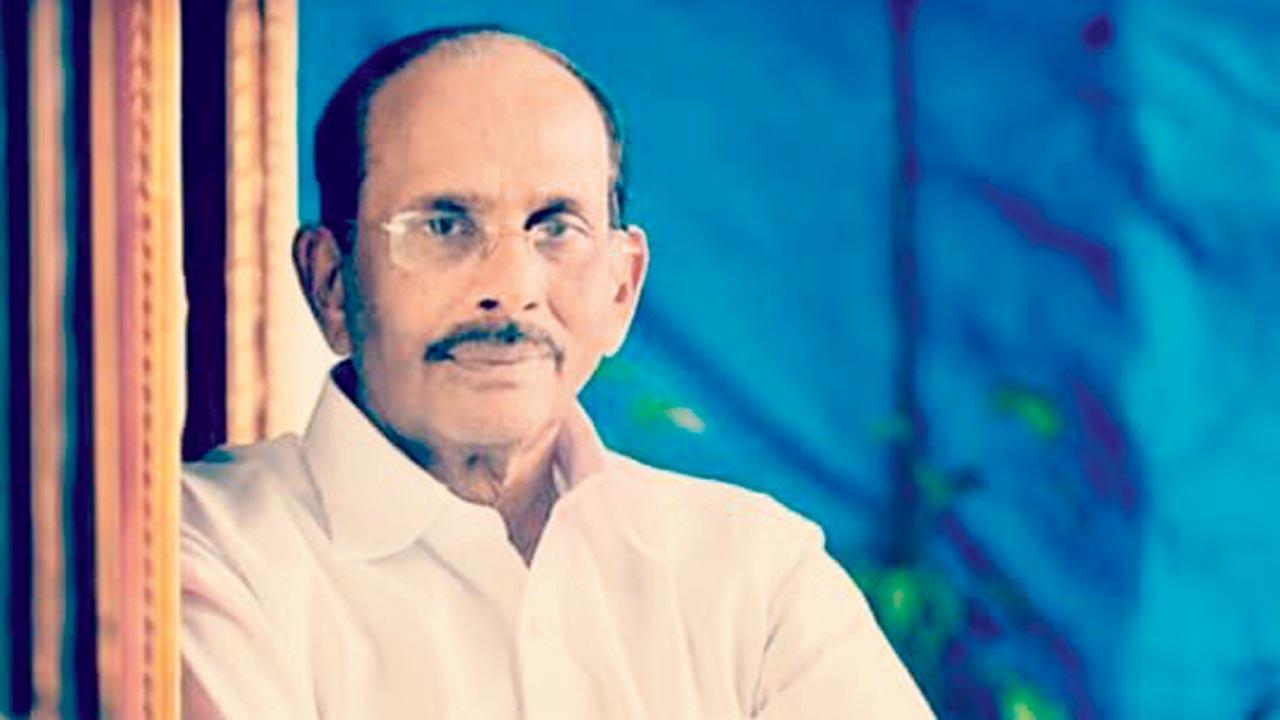
Honoured to be a nominated MP, screenwriter Prasad says political duties will be top priority, with his ‘spare time’ dedicated to films
Upala KBR (MID-DAY; July 8, 2022)
On Wednesday, veteran screenwriter K V Vijayendra Prasad — along with athlete PT Usha, composer Ilaiyaraaja, and Veerendra Heggade — was nominated to the Rajya Sabha in the category of eminent persons chosen by the President of India. It comes as a fitting honour for the director-writer who has successfully straddled Telugu, Tamil and Hindi cinema. With a career spanning almost four decades, he has been the mind behind blockbusters like RRR, the Baahubali franchise and Bajrangi Bhaijaan (2015), among others.
Prasad reveals that he got a call “out of the blue”, informing him about his nomination. “While it came as a surprise, I am deeply honoured to have been chosen by my country for the seat, and will honour it to the best of my ability,” he says. He is easily one of the busiest writers in India today. Where he is scripting Pawan Putra Bhaijaan — the sequel to Salman Khan’s Bajrangi Bhaijaan, he also has Rowdy Rathore 2, and 1770: Ek Sangram, the adaptation of Bankim Chandra Chatterjee’s 1882 Bengali novel Anandamath.
Prasad is also teaming up with filmmaker-son S S Rajamouli for the director’s next with Mahesh Babu. Juggling his work, and duties as a Member of Parliament may pose a challenge. “Dividing my time will not be a problem. My first priority will be to attend to Rajya Sabha duties. I can write in my spare time.”
The writer is said to be chosen for the seat as his films transcend regional boundaries, instilling a sense of cultural pride and unity. Point out how his movies have a strong patriotic theme, and he says, “To me, my country comes first. Hearing Bharat Mata, Vande Mataram and India puts me in an elevated state. That reflects in my work.”
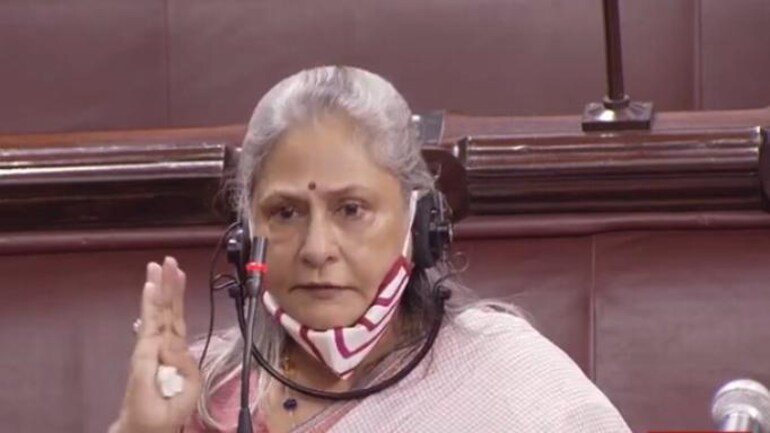
"People who have made their name in film industry called it a gutter": Jaya Bachchan fumes in Rajya Sabha
8:24 AM
BOMBAY TIMES (September 16, 2020)
The debate over drug use in Bollywood has now reached the Parliament. On Tuesday, MP and actor Jaya Bachchan raised the issue in Rajya Sabha on how the industry is being defamed. “Entertainment industry provides employment every day to five lakh people and indirect employment to five million people. At a time when the financial situation is in a depressing state and employment is at the worst level, to divert the attention of the people, we are being flogged by the social media and the government’s non-support. The people who have made their name in this industry, have called it a gutter. I completely disagree. I hope the government tells these people, who have made their earnings, name and fame in this industry, to stop using such language,” Jaya said in what is being perceived as a veiled comment on Kangana Ranaut’s statements against the industry. Last month she had tweeted, “If narcotics Control Bureau enters Bullywood, many A listers will be behind bars, if blood tests are conducted many shocking revelations will happen. Hope @PMOIndia under swatchh Bharat mission cleanses the gutter called Bullywood (sic).”
Jaya further added, “There are people in the entertainment industry who are some of the highest tax payers, they are still being harassed. All kinds of promises are made to the entertainment industry, but never kept. The government must stand by the entertainment industry, because it always comes forward to help the government in whatever good work the government takes up.”
On Monday, MP Ravi Kishan said in the Lok Sabha that there is drug addiction in the film industry, where people are seen as role models, and urged the government to take strict action. Slamming his statement, a visibly emotional Jaya said, “Just because there are a few people, you can’t tarnish the image of the entire industry. The industry brings international name and recognition also. I was really embarrassed and ashamed that yesterday, one of our members in Lok Sabha, who is from the film industry, spoke against it. Jis thaali mein khaate hain usi mein chhed karte hain!”
Subscribe to:
Posts (Atom)