Showing posts with label Rajkumar Keswani. Show all posts
Showing posts with label Rajkumar Keswani. Show all posts
Tigmanshu Dhulia to helm Mughal-E-Azam director K Asif’s biopic
8:20 AM
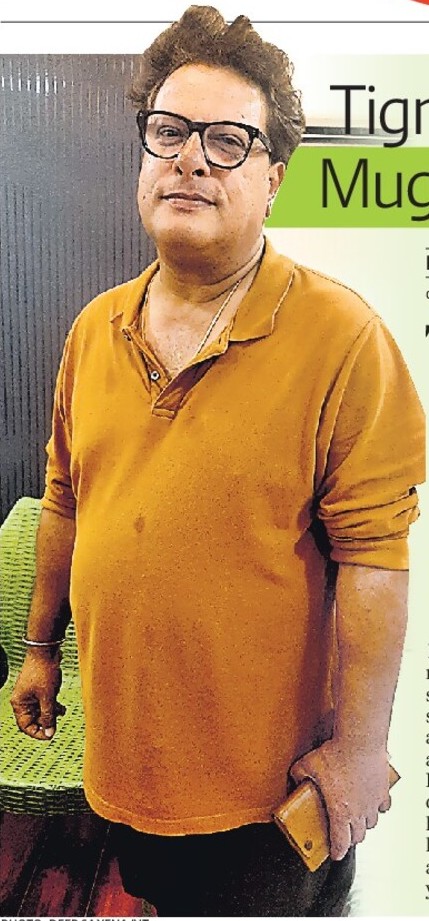
Deep Saxena (HINDUSTAN TIMES; March 23, 2023)
Tigmanshu Dhulia, who won a National Award for his film Paan Singh Tomar (2012), is excited to direct another biopic. This time, his subject of interest is producer-director K Asif, who is most noted for the 1960s classic Mughal-E-Azam.
The filmmaker shares that he has been working on the idea for the past few years, and as soon as he wraps up his film Ghamasaan, he is taking a long break to work on this project.
On his fascination with Asif, Dhulia says, “The film says a lot more than Salim and Anarkali’s love story. Then I came to know about some popular kissey (incidents) about the making of the film as well as K Asif, which intrigued me. Imagine, that man was a Class 5 or 6 dropout; tailoring was his craft, and he made just about two films in his life: Phool (1945), Mughal-E-Azam and Love and God (1986, released 15 years after he passed away in 1971).”
The filmmaker goes on, “The film is said to be a magnum opus, but from where I see it, that man was a magnum opus — his vision, flamboyance, four marriages, fallout with (late actor) Dilip Kumar (who played Salim), and so many other things. Sometimes, I feel that he was sent by God with a farman (order) to make this masterpiece.”
The 55-year-old further informs that “renowned journalist and Urdu exponent Rajkumar Keswani had written a lot about Mughal-E-Azam, its making and people associated with the film in his memoirs”. “Sadly, he (Keswani) died in Bhopal in May 2021 but Priti Sinha (Dhulia’s OTT series The Great Indian Murder producer) had taken its rights when he was alive. We (Dhulia with writers Kamlesh Pandey and Iqbal Rizvi) are working on the story,” says the filmmaker, who is also well-known for his role as Ramadhir Singh in filmmaker Anurag Kashyap’s cult movie, Gangs Of Wasseypur.
Rajkumar Keswani reveals in his book on Mughal-E-Azam how Madhubala was considered a distraction by K Asif
9:27 AM

Author, poet and journalist Rajkumar Keswani shares lesser-known stories about Indian cinema’s most iconic film, which turns 60 this year
Kunal Guha (MUMBAI MIRROR; September 6, 2020)
When Madhubala first arrived on the sets of Mughal-e-Azam to essay her career-defining role of Anarkali, she brought her usual cheerful personality to work. Known to light up many a room, and to always leave her co-stars and crew rolling on the floor laughing, it dawned on her much later that not everyone was charmed by her ebullience. In fact, filmmaker K Asif found her a bit of a distraction. Soon enough, Madhubala’s shots began getting postponed and she went without shooting for several days. The actor was a little taken aback when, one day, Asif’s assistant Sultan Ahmed informed her that the filmmaker didn’t appreciate her behaviour and expected the cast “to take their job seriously”. The superstar accepted the feedback graciously, submitting to the filmmaker’s approach, and soon, the shoot commenced as planned.
It is anecdotes such as these that feature in plenty in poet, writer and journalist Rajkumar Keswani’s Daastan-e-Mughal-e-Azam, a literary tribute to the iconic film about unrequited love, which clocks 60 this year. Considered a milestone in Indian filmmaking, K Asif’s magnum opus took over 10 years to create. Keswani, who was 10 when it was released, remembers watching the film in Bhopal’s Bharat Talkies. “Those three hours in the theatre changed my life forever,” he says, adding that he was so charmed that he had memorised most of the film’s dialogues.
When he embarked on this project, Keswani’s passion for the film also drew him to follow the life of its director. Music director Naushad told him how Asif had started out as a tailor before going on to weave stories on celluloid when nudged in that direction by his brother-in-law and actor Nazir. In fact, the filmmaker also had a tailoring shop in Dadar’s Khodadad Circle at the time. “Famous heroes of the 1940s, Prem Adib and Jeevan [Narad of the screen], ran a restaurant in partnership in the same locality,” says Keswani about the neighbourhood, which was synonymous with tinseltown dreams at the time.
Most fans will know that development of the feature film began in 1944, but hit a roadblock during the time of Independence, only to commence again with a new cast in 1951. But few know about Asif’s struggle in casting for Anarkali’s role, after Nargis, his original choice, turned it down. Newspapers ads were published across the country, inviting women between the age of 16 and 22 to apply with photographs and biodata. Many actors approached the filmmaker for the role and Dilip Kumar, who was already cast as Salim, recommended the popular actor Vijaylaxmi. But the filmmaker didn’t find anyone suitable.
Asif had tried casting Madhubala for an earlier film, but her father Ataula Khan had set terms that weren’t agreeable with the director. “‘Keep your daughter in a showcase’, is what K Asif told him then,” says Keswani. He adds that the actor was cast as Anarkali only after she reached out to the filmmaker and agreed to work on his terms. “She arrived in her car and the meeting took place in the car itself. She asked him to forget his interaction with her father, and agreed to cooperate with him, because she really wanted to work with him.”
Maratha Mandir theatre, which had planned its gala launch with the release of Mughal-e-Azam had to launch with B R Chopra’s Sadhna (1958) since Asif’s film wasn’t completed by then. The theatre’s leasee owner Seth Mehtabchand Golcha set a clause for every filmmaker who wanted to screen his movie there: When Asif decides to release Mughal-e-Azam, their film would be replaced without notice. And when it did release, it even got travellers from Pakistan who would come only to watch the film. “In fact, Golcha had made special provisions for his Pakistani audience — they wouldn’t have to stand in queue to buy their tickets and could pick it up from inside the theatre itself,” says Keswani, adding that the theatre’s patrons also included filmmaker and actor Guru Dutt and Feroz Khan, who would turn up at Maratha Mandir to watch Mughal-e-Azam every week in the initial months.
“Shapoorji Mistry, the film’s financier, and who famously had several disagreements with Asif over his extravagant production, was no less in love with the director and the movie,” says Keswani. “Shapoorji seth was so obsessed with the dialogues that he would say them aloud as if in an elocution contest.”
Keswani’s book also includes 25 paintings by M F Husain, which were dedicated to Asif and his magnum opus. “Hussain made these paintings during his stay in London, as a guest of K Asif’s son Akbar Asif,” says Keswani of the works, which the renowned artist had gifted to Akbar’s daughter Haya Asif on her birthday.
It took Keswani 15 years to compile his research into a book, but stumbling upon gems about the film made the effort worthwhile. “I didn’t work like a scientist while writing and editing the book. I worked like a passionate lover,” he says.
Subscribe to:
Posts (Atom)