Showing posts with label Rajiv Chilaka. Show all posts
Showing posts with label Rajiv Chilaka. Show all posts
Chhota Bheem maker seeks to raise Rs 250 cr at Rs 800 cr tag
10:24 AM

Javed Farooqui (THE ECONOMIC TIMES; December 3, 2025)
Green Gold Animation, the creator of the Chhota Bheem television series and the Krishna film series, is seeking to raise Rs 250 crore at a valuation of about Rs 800 crore to accelerate its next phase of expansion, founder Rajiv Chilaka said.
The Hyderabad-based studio, which employs around 500 people, plans to build new intellectual properties (IPs) and strengthen its animation production capacity in domestic and international markets.
“We are exploring a Rs 250 crore raise at a Rs 800 crore valuation to support our next phase of growth. The focus is on strengthening our animation capabilities and building new IPs,” Chilaka said.
The two decade-old company is also open to a change in ownership if it supports long-term growth. “We are open to a controlling investor if there is strong alignment and the partnership helps us scale responsibly,” Chilaka said.
The fundraising comes as India’s media and entertainment sector faces consolidation, tighter content budgets and shifts in audience behaviour, forcing studios to rethink scale, cost structures and monetization models.
“The media and entertainment sector is seeing consolidation and tighter budgets. This requires studios to reassess scale, efficiency and long-term strategy,” Chilaka said.
India Ratings expects Green Gold Animation’s operations to improve in this financial year, driven by higher revenue from VFX and the release of a live action film. For 2024-25, the company reported revenue of Rs 120 crore and earnings before interest, taxes, depreciation and amortization (EBITDA) of Rs 7 crore. Its revenue had increased to Rs 114 crore in 2023-24 from Rs 81 crore in 2022-23 on higher syndication income, though EBITDA declined after two films released in May 2024 underperformed, leading to cost provisions.
The company has to repay its non-convertible debentures in 2026-27, including a redemption premium of Rs 58 crore, taking the total payout to about Rs 229 crore.
Green Gold Animation, which has built its business on television and streaming distribution, YouTube channels, and licensing and merchandising, is now investing in new formats, including anime and theatrical releases. While it could not scale up its presence in the live action segment, animation remains its core strength.
The studio is developing a robust pipeline of new IPs across genres, with titles such as Jungle Trouble, Chutki, Lion Heart, The Assassin, Airavat, Krishna and Boy on Moon, underscoring its push toward multi-genre franchise creation.
“We want to expand our IPs across TV, streaming, YouTube, gaming and merchandising. There is still meaningful room to grow these extensions,” Chilaka said. “Theatrical releases are an area we are developing further, particularly as animation begins to find a wider audience beyond children.”
Anime—a style of animation originating in Japan—is emerging as a key growth area.
“Anime is a category with rising domestic demand. India is already the second-largest anime market, and we believe local production can grow meaningfully,” Chilaka said. “We see anime as a natural extension of our animation capabilities.”
Children’s content consumption continues to shift, driven by mobile usage, connected TVs and gaming. “Kids’ content consumption has moved from TV to mobile, then to connected TVs, and now gaming is taking a significant share. Children today spend around 60% of their entertainment time on gaming,” Chilaka said.
Animated content consumption among kids remains steady, though the platforms they use have shifted, he said.
Content commissioning pressures persist, according to Chilaka. “With consolidation and budget tightening at broadcasters and streamers, margins have come under pressure. Studios need to adapt to these realities,” he said.
Chilaka expects artificial intelligence to play a growing role in production. “AI will speed up certain parts of the animation process by handling routine tasks. This should help teams focus more on creative work,” he said.
Do high-budget VFX guarantee box-office success?
8:24 AM

Industry experts and stakeholders feel that filmmakers need a clear vision when it comes to spending money
Syeda Eba Fatima (HINDUSTAN TIMES; November 28, 2022)
A mere teaser for the high-budget upcoming film Adipurush managed to enrage the audience, which chastised the filmmakers for using heavy and unappealing VFX and special effects. A few months back, the Ranbir Kapoor and Alia Bhatt starrer Brahmastra, also made on a high budget of approximately Rs. 410 crores, faced criticism for only relying on VFX and not on a strong storyline. On the contrary, when the low-budget Telugu-language superhero movie HanuMan’s teaser gained attention for its impressive visual effects, it triggered a debate among movie buffs about whether makers really need to go overboard with VFX and their budgets?
We spoke to industry experts and stakeholders to find out if spending more on VFX guaranteed success at the box office.
Producer Ramesh Taurani asserts that one can never plan the budget in advance for large-scale movies: “It’s not necessary that a film’s budget will always stay the same. Filmmaking is a creative process, and sometimes a lot more or a lot less is invested than what the makers had initially planned. There are so many ifs and buts involved. Every big film, from Titanic (1997) to others, was never completed within the budget that was assigned at the beginning. And creative satisfaction is more important than anything else.”
Whereas, VFX artiste and creative director at Futureworks, Abhishek De, points out that quite often, the budget shown by the filmmakers and their team isn’t real. “Producers and distributors play a game where they show up different figures to hype up the film. It’s all about marketing. So even the smaller films that are not big in scale manage to create a buzz because of the figures. While it can work in their favour sometimes, it can also backfire.”
Animator and VFX company owner Rajiv Chilaka believes that first and foremost, filmmakers need a clear vision when it comes to spending money on VFX.
“The price of VFX will inevitably increase if the director keeps changing the script because he’s unsure of what he wants. With Adipurush, I feel they rushed a bit, and being heavy on VFX, they didn’t give proper time to the film’s pre-production, which needed to be very strong. When [filmmaker] S S Rajamouli makes a film, he shoots certain sequences for 200 days, hence its high budget. However, when people try to achieve similar results by spending the same amount of money but don’t devote enough time to it (fulfilling pre- and post-production requirements), things don’t go well,” Chilaka explains.
He adds that for the Indian market, the production budget should not exceed ₹150 crore, which can only be reduced with proper planning.
A toddler spinoff of Chhota Bheem series from over a decade ago is wooing kids from Australia to America
8:39 AM
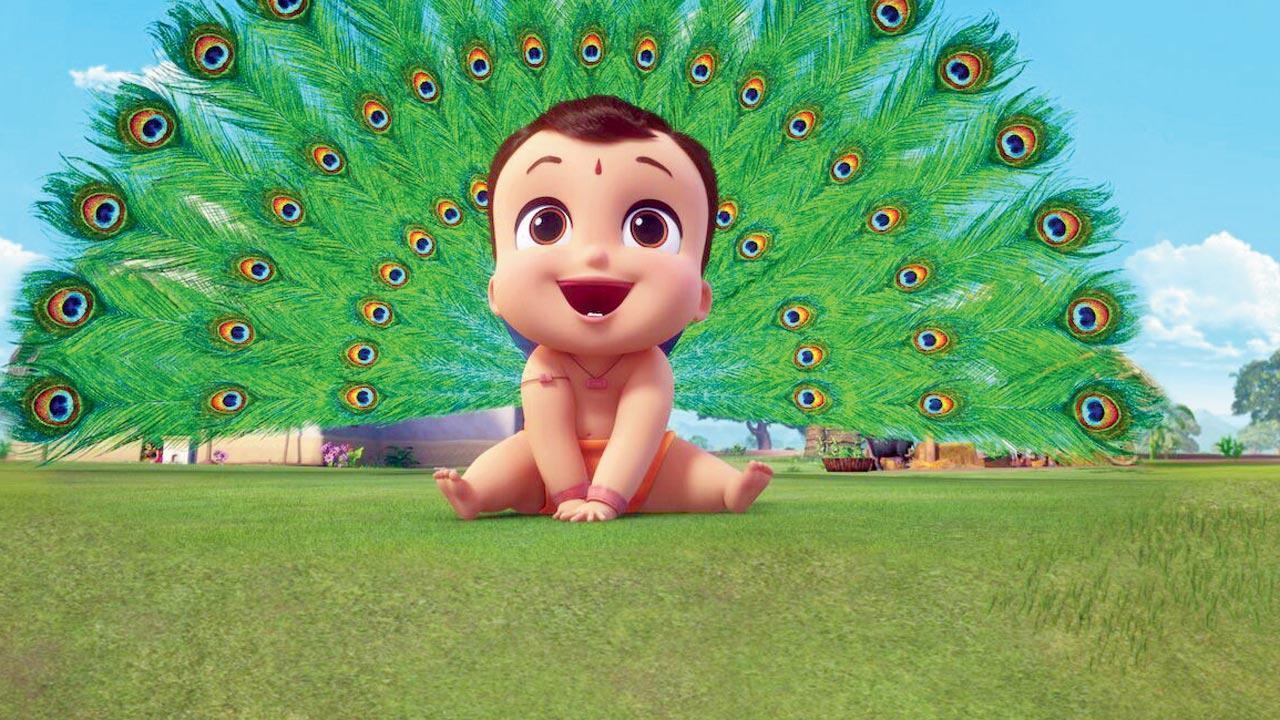
A toddler spinoff of the popular Chhota Bheem series from over a decade ago, is wooing kids from Australia to America
Aastha Atray Banan (MID-DAY; July 3, 2022)
If you click on the kids section on any streaming platform, get ready to enter a whole new world. Be it adventure or drama, children seem to have content created for them, which is at par with any mainstream Bollywood or Hollywood movie. When we took a shot at watching Mighty Little Bheem on Netflix, which is a spinoff of the superhit Chhota Bheem, which first premiered in 2008 on Pogo, we found ourselves lost in the story. It’s about Bheem and his friends protecting the rural town of Dholakpur, and is heartwarming and engaging.
The recently launched I Love Taj Mahal, where Bheem while on a trip to the monument of love, tries to help a little girl who is looking for her lost teddy bear, has become a hit with children in Latin America, Australia and New Zealand. The show has had the largest launch of any kids original and the animated series has crossed over a billion views on the channel’s YouTube.
As Netflix said, “The universality of Netflix shows emanates from the fact that they tell a very specific and authentic story incredibly well. Mighty Little Bheem is one such story that has been phenomenal across countries and cultures, giving children and families a window into India’s rich cultural landscape.”
In fact, the creators, Hyderabad-based Green Gold Animation, has become one of the largest toon companies, not just in India, but in the world. We spoke to Rajiv Chilaka, founder and managing director, Green Gold Animation Pvt Ltd, and the creator of the show, on why Bheem is so loved.
Edited excerpts from the interview.
Do you remember that first big idea, and the first story, for Bheem?
It all started with Chhota Bheem, which debuted in 2008 and went on to become India’s most popular IP, with a TV programme, films, and merchandising. However, it was never distributed outside of India. When Netflix first began streaming in India in 2016, we had the notion that Green Gold Animation should animate Mighty Little Bheem, Chhota Bheem’s preschool spin-off, which would be produced by both Netflix and Green Gold Animation. The first big idea struck me when my son was weeping nonstop at his first birthday celebration and refused to be photographed. However, once the cameraman placed a parrot beside him, he stopped sobbing and became intrigued. At the time, I thought how fantastic it would be to convey that narrative to a pre-school audience if Bheem was a baby.
How do you conceptualize the storylines that work across borders?
It is critical to raise awareness of India’s rich cultural legacy among younger audiences, and animation is possibly the most appealing and engaging way to do so. Chhota Bheem is India’s infant face and Mighty Little Bheem is the toddler version of it. The series shows a universal truth: the unconditional love of a mother and son which is fostered in every young Indian. Furthermore, every child is drawn to nature and animals. The “friendship” shown between the characters teaches youngsters the importance of bonding. This is a straightforward message to the youngsters about the importance of friendship in life. The primary point is that “good triumphs over evil”—a well-taught lesson to the children.
How did you take Bheem from Hyderabad to Hollywood?
Netflix recognized early on that India had a treasure trove of excellent stories ready to be told, with the country’s rich cultural heritage acting as a common thread. We met in 2016 to animate the younger version of Chhota Bheem and that’s when the journey started from Green Gold’s Hyderabad and Mumbai office. Everything about Bheem is Indian, from his mother’s saree to his love of laddoos. Addressing common issues offers cross-cultural appeal. All of this makes the curriculum an effective vehicle for introducing children to a broader worldview.
Where is Bheem going next?
Future plans include creating additional material centred on Indian culture, presenting multi-cultural, high-value tales to the public, and teaching children, teens, and the elderly through premium content around India.

Rajiv Chilaka
Mighty Raju to present Mighty Mother award to Kajol
7:53 AM

Roshmilla Bhattacharya (MUMBAI MIRROR; May 5, 2014)
Chhota Bheem, the nine-yearold animated hero of the children TV series, has already graduated to the big screen with two hit films, Chhota Bheem and the Curse of Damyaan (2012) and Chhota Bheem and the Throne of Bali (2013). Afraid of choking the market with more, Rajiv Chilaka, the CEO of Green Gold Animation, the producer-distributor of the series, decided against completing a hat-trick this summer. Instead, he turned his attention to his other and even younger superhero, Mighty Raju, who is just four. Raju will now be seen in a film.
Mighty Raju: Rio Calling is complete and awaiting the censor nod. “If all goes well, we’d like to release the film on May 16. Our research shows that young children are drawn to sports action adventure flicks with superhero masala,” says Rajiv, who flew out a team of 10, including writers, animators and even musicians to the Brazilian capital which is gearing up to host the FIFA World Cup in June and the Olympics in 2016. “We studied the way the locals dressed, spoke and interacted and even got a few songs recorded by Latino musicians and artistes there.”
Meanwhile, at FICCI Frames this year, the company’s stall had an enthusiastic visitor who happily posed with their Mighty mascot. Since she watches both shows with her kids, Yug and Nyasa, and chats with them about the characters, Kajol knew all about Chhota Bheem and Mighty Raju. “They are not just entertaining shows but they also offer a peek into our culture, mythology and roots through an interesting narrative which I appreciate,” she says.
When the makers sent Mighty Raju and Chhota Bheem to her Juhu office to meet her kids, the trio was thrilled. With Mother’s Day around the corner, the makers have planned to get Mighty Raju to hand over the Mighty Mother award to Kajol on May 9. “I don’t know if I’m a mighty mother but yes, I have always maintained that my children are my foremost priority and responsibility,” says the actress, adding that since both the shows are part of her living room, she’s excited about the film too.
Rajiv says they’ll wait and see how this film fares before deciding whether to take the franchise forward. “It’s a tough market,” he admits. “Frozen which made $ 1 billion worldwide could not make even .5 million in India. But there’s little by way of children’s entertainment here so you have to keep feeding the animation market. We’re already working on Chhota Bheem Kung-Fu Dhamaka in 3D.”
Subscribe to:
Posts (Atom)