Showing posts with label Rajender Singh Jyala. Show all posts
Showing posts with label Rajender Singh Jyala. Show all posts
Buy one get one, discounted ticket prices: Multiplexes, filmmakers go extra mile to woo moviegoers
4:52 PM

From innovative schemes to discounted ticket prices, multiplexes and makers are going the extra mile to make cinemas houseful again
Rishabh Suri (HINDUSTAN TIMES; June 15, 2023)
In a bid to lure audiences back to the silver screen, theatres are employing innovative strategies such as Buy One, Get One (BOGO) offers and reduced ticket prices. These tactics aim to not only attract moviegoers but also ensure the success of films that might otherwise struggle to find an audience. With several recent releases reaping the benefits, it appears that these approaches are yielding positive results.
One film that capitalized on the BOGO offer was Zara Hatke Zara Bachke (ZHZB). According to insiders, the offer came with a limited number of free tickets available each day. Once the cap was reached, tickets reverted to their regular prices. ZHZB managed to earn Rs. 5.49 crore on its opening day, with nearly Rs. 50 lakh coming from the BOGO offer alone. “Fortunately, ZHZB’s content was good, so the offer became an advantage,” says Rajender Singh Jyala, chief programming officer, PVR Limited.
Price matters!
The makers of The Kerala Story recently announced that audiences could now watch the film for just Rs. 99 (plus GST) nationwide. Sudipto Sen, the film’s director, explains that “this decision was driven by the exorbitant ticket prices in major cities. By lowering the cost, the film could reach a broader audience, including smaller cities where it hadn’t been released previously”.
While in the case of Shehzada, the BOGO offer couldn’t weave magic, it contributed to the success of the re-mastered version of Gadar (2001). Its director and producer, Anil Sharma, shares, “We made the tickets cheaper so that even a poor person could come to a multiplex. Otherwise, today, ticket prices are such that taking a family to one film costs anywhere between Rs. 1,000-1,500. This is also why films don’t work well.”
Innovation matters
Meanwhile, Hollywood movie The Flash has adopted a unique strategy by announcing “Flash Sales” twice a day for 20 minutes (the offer lasted for three days until June 14), where users who are able to book tickets through a multiplex chain’s app will get 50% off on tickets.
Exhibitor Akshaye Rathi encourages such tactics, but says, “This kind of strategy would never be successful for films like Brahmastra (2022) and Pathaan because it’d erode potential revenue. But for (small or medium-budget) films like ZHZB, it works like magic. This becomes the push to watch in halls instead of web.”

Screen Marathi films or pay up Rs. 10 lakhs, government tells Maharashtra theatres
8:25 AM

Rishabh Suri (HINDUSTAN TIMES; May 21, 2023)
Maharashtra’s cultural affairs minister Sudhir Mungantiwar announced that a fine of Rs. 10 lakh will be imposed on movie theatre owners if Marathi movies are not screened for at least four weeks in a year. According to artistes, this is a welcome move.
Shreyas Talpade is of the view that Marathi films should be given priority in the state. The Poshter Boyz (2014) actor says unlike Hindi films, where the opening weekend itself brings in Rs. 20-30 crore, Marathi films “don’t have much funds for promotions” and depend heavily on word of mouth. “This is why they need more time in theatres,” he reasons.
Chandramukhi (2022) actor Amruta Khanvilkar says, “Our audience consists of people who do 9 to 5 jobs. When they want to watch a film in a theatre [after work], they don’t find convenient timings. I think people are not coming to theatres because they don’t find the right shows. This is a welcome move.”
Theatre owners say the earlier rules were that at least 120 shows had to be screened. “It means a minimum four shows daily for a Marathi film. They have now made it more stringent. In our theatres, Marathi films play at prime time slots (between 12 pm to 9 pm). If the government wants to penalize someone who isn’t following it, that is fine,” says Rajender Singh Jyala, chief programming officer, PVR INOX Limited.
However, not everyone is happy about these new rules. Joginder Tuteja, trade analyst, says this decision “doesn’t make any sense”. “It’s like a quota system that exists in jobs, etc. You can reinforce this in the government sector, but when you do it in privately owned businesses, then what you are doing is restricting them from doing their business which I am not in favour of.”
Exhibitors, too, aren’t happy with this decision by the Maharashtra government. Akshaye Rathi feels it should only be about the films which the audience is keen to watch. “If people want to watch a film, why will theatres not showcase it and earn money? Sometimes Marathi films get lopsided heavy showcasing, and vice versa. I truly think if we want businesses to prosper, rather than penalizing theatres, the idea should be to incentivize a local industry. There are subsidies for the Marathi film industry anyway. The cinemas would feel the pinch especially in times where we are emerging from pandemic times,” he shares.
Sachin Pilgaonkar, actor-filmmaker:
Marathi films find it very difficult to find good shows in Maharashtra itself, which is the only place where those films release. The government is making the situation better [by imposing the fine].
Shreyas Talpade, actor:
What happens is, Marathi films pick up pace only in the second week; the first week goes in increasing word of mouth. If these films do a certain amount of business, prime time slots should be retained for Marathi films, too.

Is a tax-free film ticket cheaper? Experts share their views
8:18 AM

Every year, several films are declared tax-free by some state(s). In the past, some films have had eight to nine states declaring them tax-free. But what does that really mean – for the cinemas and for moviegoers?
Niharika Lal (BOMBAY TIMES; May 16, 2023)
HOW MUCH CHEAPER IS YOUR TAX-FREE TICKET?
In December 2018, two GST slabs were announced for films – 18% for tickets above Rs. 100, and 12% for tickets below Rs. 100. This tax is divided between the state and central government (State GST and Central GST). When a state declares a film ‘tax-free’, it exempts half of the entertainment tax, which would be either 9% or 6%, as per the ticket price. For the multiplex audience, since there are hardly any tickets available below Rs. 100, the default exemption would be 9%.
TAX-FREE STATUS HAD A BIGGER IMPACT IN THE PRE-GST ERA
Cinema hall owners say that declaring a film tax-free had a bigger impact in the pre-GST years, when every state had different entertainment tax and the state governments could exempt the whole amount. Now, with GST in play, a moviegoer still needs to pay Central GST even for tax-exempted films.

‘TAX-FREE EXEMPTION DECLARATIONS CREATE AWARENESS ABOUT A FILM’
Rajender Singh Jyala, Chief Programming Officer PVR INOX Limited, says, “Whether a film will perform better after tax exemption largely depends upon its content. For a moviegoer, tax-exempted tickets used to be cheaper in the pre-GST era. Now, when a film is declared tax-free (it is more about that) it creates awareness about the film among the audience. Hence, even if the film is declared tax-free in only one or two states, the film performs well in other states too.”
‘IT WORKS AS A PUBLICITY TOOL AND INCREASES LONGEVITY IN THEATRES’
Producer Girish Johar, several of whose films were declared tax-free in pre-GST years, says, “There are three reasons why producers want their films to be declared tax-free. First, it lures moviegoers to watch a film, second, it works as a publicity and marketing tool because a state government is endorsing your film; and third, the film gets longevity and instead of four weeks, it may end up getting eight weeks in the cinema hall.”
WHAT MAKES A FILM ELIGIBLE TO BE TAX-FREE?
There’s no fixed criteria for a film to claim exemption. Usually, socially relevant films or inspiring stories are made tax-free. From films on issues, such as Toilet: Ek Prem Katha, Chhapaak and Hindi Medium, to biopics like Mary Kom and historical films like Tanhaji: The Unsung Warrior have been declared tax-free over the years.
Sometimes states also declare films tax-free to show solidarity with its theme and in some cases producers apply for a tax-free status. In their film policy, some states have the provision of declaring a film tax-free when a certain portion of a film is shot in the state. Overall the decision resides with the state government.

Hollywood to rule screens this summer
8:33 AM

Rishabh Suri (HINDUSTAN TIMES; April 19, 2023)
This summer, Indian theatres will be dominated by Hollywood. Reason? There are as many as eight English biggies releasing in the next three months. April started on a good note, with The Pope’s Exorcist and the animated film The Super Mario Bros Movie finding takers. In fact, the former eclipsed the collections of the Aditya Roy Kapur and Mrunal Thakur-starrer Gumraah.
Devang Sampat, CEO, Cinepolis India, says that summer has been ruled by English films even in the past. “There are only about four-six Bollywood blockbusters in a year and summer has always belonged to Hollywood. They mostly release their big films around this time.”
However, this time around, the gap between Bollywood and Hollywood is glaring, with no Bollywood film releasing in May. Trade analyst Komal Nahta says, “Production was low last year. Films weren’t doing well, so people in Bollywood were not sure what was happening. They wanted to introspect.”
WILL BOLLYWOOD COPE?
Currently, all eyes are on the Salman Khan-starrer Kisi Ka Bhai Kisi Ki Jaan, which releases on April 21. After that, with big Hollywood titles such as Guardians Of The Galaxy Vol. 3, Fast X, The Little Mermaid, Spider-Man: Across The Spider Verse, Transformers: Rise Of The Beasts, The Flash and Indiana Jones And The Dial Of Destiny releasing, it’s sure to be international films shining all the way.
Later, (actors) Shah Rukh Khan’s Jawan, Ajay Devgn’s Maidaan, Prabhas’ Adipurush and Kartik Aaryan’s Satyaprem Ki Katha could help Bollywood shine again. “Everyone is looking forward to Bollywood releases in June. As of now, Jawan’s release date is confirmed for June 2,” shares Rajender Singh Jyala, chief programming officer, PVR Limited.
Trade expert Atul Mohan adds, “Hamare paas titles hi nahin hain abhi. So, there’s no competition between Bollywood and Hollywood.”
However, exhibitor Akshaye Rathi says franchises such as Spider-Man and Fast & Furious aren’t seen as outside films, because they have a huge following in India: “Tom Cruise and Dwayne Johnson are superstars in India too. Their films will have a solid impact, but I also have to give it (credit) to our industry for fighting tough times. We saw what happened with Pathaan and a bunch of films before that. It’s only a matter of time before we get back in a big way all over again.”
HOLLYWOOD FILMS
Guardians of the Galaxy Vol.3 — May 5
Fast X — May 19
The Little Mermaid — May 26
Spider Man: Across The Spider Verse — June 2
Transformers: Rise Of The Beasts — June 9
The Flash — June 16
Indiana Jones and the Dial of Destiny — June 30
BOLLYWOOD FILMS
Jawan — June 2
Adipurush — June 16
Maidaan — June 23
Satyaprem Ki Katha — June 29

Trailers at Re 1: Movie theatres' new move to draw crowds?
8:34 AM

Multiplexes are trying to break at-home movie viewing habits and how
Rishabh Suri (HINDUSTAN TIMES; April 13, 2023)
You are roaming inside a mall; you have shopped till you dropped; you don’t want to go to a theatre and commit two to three hours of your time? So, now, what’s next? Well, you go inside a theatre and watch something for just 30 minutes! Sounds strange? Yes, it is. In their latest bid to lure audiences back to the big-screen experience, multiplex chain PVR-INOX has started a new initiative. Titled Trailers Screening Show, available across India — except in a few states like Tamil Nadu where ticket pricing is fixed — you can pay Re 1 and watch 30 minutes of trailers curated from different industries.
Exhibitor Akshaye Rathi says, “These are unprecedented times. This is a unique offering to moviegoers, both as a tool and as a way to make them fall in love with the theatrical experience all over again. There are some very interesting experiments underway; this is one of them.”
He cites the example of the recent Cinema Day, where tickets were priced at just Rs. 75 and saw a massive response. “This will tell moviegoers what their moviegoing experience will be like for upcoming films. It doesn’t happen when you watch the trailer on a television or mobile phone, like experiencing a Salman Khan or Tom Cruise film. It gives the audience a glimpse of what it is going to be like if they buy tickets for these films,” adds Rathi.
Trade expert Joginder Tuteja is far from impressed with this move: “This point where a mall-going audience will go to a theatre to relax for 30 minutes was prevalent 20 years ago, when people were generally poor and didn’t have ACs at home. Now people going to the mall would much rather watch reels on their phones. Why will I step into a theatre? These gimmicks don’t make any sense.”
Trade analyst Taran Adarsh agrees, “I am surprised and amused, because the theatres don’t stand to gain anything from an economic point of view.”
Rajender Singh Jyala, chief programming officer, PVR Limited shares that there’s a limitation for the theatres on how many trailers they can play before a film starts: “We thought people watched trailers on their phones and YouTube, so if you give them a chance to watch them on the big screen, it will be a totally different ball game. The impact on small screens is not great. We thought, why not invite the audience to experience all of that for just one rupee? The response has been great. It’s houseful-.”
Pathaan delivers the biggest opening-day ever for an Indian film in IMAX
8:06 AM

Gross collections from India over Rs. 82 crore, set opening-day record for Hindi flick
Javed Farooqui (THE ECONOMIC TIMES; January 28, 2023)
Mumbai: Shah Rukh Khan-starrer Pathaan has garnered Rs. 219.60 crores in gross box collections globally in the first two days of its release, a new record for Hindi films, data provided by Yash Raj Films (YRF) on Friday showed.
The film produced by Aditya Chopra under the YRF banner posted gross collections of Rs. 113.64 crores on its second day on Thursday, breaking its own one-day collection record set on the opening day. The gross collections from India touched Rs. 82.94 crores on Thursday while the overseas collection stood at Rs. 30.70 crores.
On the opening day, the spy thriller that also features Deepika Padukone and John Abraham had earned Rs. 106 crores in gross global box office collections including Rs. 68.50 crore from India and Rs. 37.50 crores from international markets.
YRF chief executive Akshaye Widhani said Pathaan’s success is significant not just for the company, but also for the Hindi film industry at large. “As an industry, we are rejoicing today. This is the most important sentiment emerging out of Pathaan’s success,” he said. “All of us at Yash Raj Films are grateful for the incredibly humbling support from the media, audiences, and the industry towards Pathaan. It is this unanimous love for the film that has resulted in Pathaan shattering all existing records and creating new ones.”
Pathaan's net domestic box office collection from the Hindi and dubbed versions jumped to Rs. 127.5 crores in two days as the film broke its own record to collect Rs. 70.50 crores on the second day.
YRF said Pathaan has become the first Hindi film to breach the 70 crores net collection in a single day.
Earlier, Pathaan recorded the biggest ever opening day collection for a Hindi film with net earnings of Rs. 57 crores from the Hindi and dubbed versions. Pathaan is the third in the series of YRF Spyware Universe films after Ek Tha Tiger and War to set an opening-day box office record.
IMAX CEO Richard Gelfond said, “Pathaan delivered the biggest opening-day ever for an Indian film in IMAX and is another great indicator not only of the strength of Indian moviegoing, but of the huge demand for blockbuster Indian filmmaking around the world.”
INOX Leisure chief programming officer Rajender Singh Jyala said Pathaan’s performance on the first two days demonstrates that the extended weekend will be like a one-movie film festival celebrated across the country.
Advance booking discounts to special Friday offers: Movie tickets are set to get cheaper, but not every day
8:18 AM

While theatres won’t be dropping ticket rates to a uniform price of ₹75-100, they are open to rolling out more promotional offers on a per-movie basis
Niharika Lal (BOMBAY TIMES; October 7, 2022)
On September 23, cinemas celebrated India’s first-ever National Cinema Day in multiple states, with many theatres lowering their ticket prices to Rs. 75. With houseful boards back at several cinemas and people even watching movies back-to-back through the day, it was evident that lower prices can bring the audience back to theatres. As a result, cinemas are now discussing the need to reassess the current ticket pricing model. Several also offered movie tickets for a special festive price of Rs. 100 last Monday till Thursday, and many are planning to experiment with an affordable price model in the long run to sustain this momentum.
However, based on their learnings over the past two weeks, stakeholders say that while there will be “no uniform lower ticket price”, they are planning to offer discounts and promotional prices on a per-movie basis. Here’s more:
‘FLAT CHEAPER PRICES EVERY DAY OF THE WEEK DOES NOT TRANSLATE INTO HIGHER FOOTFALL’
According to Rajender Singh Jyala, Chief Programming Officer, INOX Leisure Ltd, “Even though we are still in the experimental phase, we have observed that last week’s footfall was higher than normal pricing days, but it wasn’t the same as National Cinema Day. The reason is that National Cinema Day was just one day, and so people didn’t want to miss it. When the promotional offer was spread out over five days, they must have thought, ‘if not today, then we can watch the film some other day’.”
Kunal Sawhney, COO, Moviemax also said during a recent discussion in Mumbai that keeping uniform lower prices is definitely not the way ahead, based on their observations from south India, where film ticket prices fall in the Rs. 100-200 slab on all days. He said, “A film’s ticket price can be fixed depending on the experience that film is providing. The right product has to be given at the right price.”
Regular, popular, blockbuster and mega blockbuster – prices are often decided on the basis of which category a movie falls in. Recently, for example, while Mani Ratnam’s Ponniyin Selvan: I’s ticket prices fell in the regular category, Hrithik Roshan and Saif Ali Khan-starrer Vikram Vedha’s ticket prices were revised from the blockbuster to regular category.
ADVANCE BOOKING DISCOUNTS TO SPECIAL FRIDAY OFFERS: EXPECT MORE PROMOTIONAL PRICES
For releases like the Amitabh Bachchan-starrer Goodbye, some cinemas lowered ticket prices on Friday, while for Ajay Devgn’s Drishyam 2, moviegoers got a 50% discount on advance bookings for a day. Jyala says, “In discussion with the makers, cinemas will keep offering lower rates on specific days for films or will roll out promotional offers.”
Kamal Gianchandani, President, Multiplex Association of India (MAI), told us, “There is a lot of experimentation being done by various cinema operators at this point. Disney, Dharma, and other studios, who have films playing in theatres, have been very supportive in this regard. We are constantly listening to our customers and other stakeholders in the business. We have always taken ticket pricing and other similar decisions keeping the interest of consumers and all stakeholders in mind. We will continue to do so in the future.”
After success of National Cinema Day, tickets to be available for Rs. 100 this week
8:28 AM

As cinema owners reduce ticket rates again, industry experts explain the reason behind slashed prices and the way forward
Rishabh Suri (HINDUSTAN TIMES; September 27, 2022)
On National Cinema Day (September 23), movie buffs thronged cinema halls, as the tickets were modestly priced at Rs. 75. From Brahmastra being sold out in almost all theatres, to Chup: Revenge Of The Artist and Dhoka Round D Corner, every film benefited. Now, to mark the festive period, film tickets will be priced at ₹100 till September 29.
TEST THE WATERS
Rajender Singh Jyala, chief programming officer, INOX Leisure, tells us, “After a positive response to the Rs. 75 plan, we thought of experimenting some more. We wanted to see if lower ticket prices get the same response again or if it was just a one-day phenomenon. If it gets the same kind of response, we can discuss about this (low ticket rates) with the stakeholders.”
Films such as Chup: Revenge Of The Artist managed to rake in the moolah due to the cheap pricing, says director R Balki: “It doesn’t immediately position itself as a mass film. The Rs. 75 pricing opened us up to the fact that so many people want to come to the theatres; it’s only the high ticket prices that keep them away.”
PEOPLE VS PRICES
The focus should be on getting more people to the theatres, than just making one ticket expensive, feels exhibitor Akshaye Rathi. “I hope the movie-going business can go back to being more accessible,” he shares.
FESTIVE HIKE
The festive period is usually accompanied by hiked ticket prices, as big films usually release around this time. So, why reduce the prices? Trade analyst Taran Adarsh says it’s because people are in the mood to spend during this time. “They travel, shop and watch films. When you keep ticket for as low as Rs. 75 and Rs. 100 on weekdays, it’s a great idea.”
What cannot be missed is the fact that the ticket prices have only been reduced until September 29, so two big films that release on September 30 — actors Hrithik Roshan and Saif Ali Khan’s Vikram Vedha and filmmaker Mani Ratnam’s Ponniyin Selvan: I (PS 1) — will not be available for Rs. 100 per ticket.
Jyala emphasises that producers feel if the budget of a film is high and the ticket prices are low, the recovery won’t happen: “Hence, Vikram Vedha and PS 1 will play at a regular price.”
-----------------------------------
After the success of National Cinema Day, some cinemas are selling tickets for as low as Rs. 100 as a special Navratri offer, and some are planning to experiment with an affordable ticket pricing model in the future too
Niharika Lal (BOMBAY TIMES; September 28, 2022)
“Would you go to watch more films at cinemas if tickets cost less?” – when we asked moviegoers this, almost all of them responded positively. And guess what? Multiplexes are listening and hence it was not just on last Friday (National Cinema Day) when tickets cost only Rs. 75 or this week when all films playing in theatres will cost you only Rs. 100 (offer lasts till Thursday), but cinemas are planning to experiment with an affordable pricing model in the long run.
‘LOT OF EXPERIMENTATION BEING DONE BY CINEMA OPERATORS’
Following the two-year hiatus due to the pandemic and later due to high ticket prices, when moviegoers registered a record of over 65 lakh consumers in a day on National Cinema Day, it led to discussions on lowering average ticket prices and hence the experimenting phase in cinemas has begun.
Kamal Gianchandani, President, Multiplex Association of India (MAI), says, “There is a lot of experimentation being done by various cinema operators at this point. Disney, Dharma and other studios, who have films playing in theatres, have been very supportive in this regard. We are constantly listening to our customers and other stakeholders of the business. We have always taken ticket pricing and other similar decisions keeping the interest of consumers and all stakeholders in mind. We will continue to do so in the future.”
100, 112, 120, OR 150 – CINEMAS TO DECIDE ON KEEPING THE TICKET PRICE LOW
Rajender Singh Jyala, Chief Programming Officer, INOX Leisure Ltd, says, “This week is an experiment to see if people will come on weekdays at this price. After Thursday once the numbers are in, we will analyze it and decide our next step.”
Does this mean that cinemas will continue to keep lower prices? “Yes, we are experimenting with this. Will it be 112 or 120 or 150 and so on that’s what we will decide. But 75 and 100 are too low to sustain. Big budget films will not be able to recover with this price,” he adds.
NO DISCUSSIONS WITH BIG BUDGET FILMS ON KEEPING 100 SLAB
Recently, when Mani Ratnam visited cinemas for an event, it was reported that there was a discussion on keeping tickets for Rs. 100 only for his upcoming release Ponniyin Selvan: I. However, Gianchandani has denied this.
He says, “This is not true. There has been no such request from Mani Ratnam. He is fully supportive of all ticket pricing-related initiatives that are being taken by the cinema operators.”
Similarly, there were other reports saying that the makers of another upcoming release Vikram Vedha have suggested the same but Jyala says that there has been no such discussion with the makers of this film.

Decoded: Who decides how much a film ticket costs – and how?
8:41 AM
Is a movie’s ticket price based on its star cast or budget? Who takes the final call – exhibitors, distributors or theatres? And why can’t prices be as low as Rs. 75 everyday?
Niharika Lal (BOMBAY TIMES; September 26, 2022)
A string of flops over the last two-and-a-half years has the film industry, distributors and cinema halls concerned. ‘Where is the future of moviegoing headed?’ – is the primary question on their minds.
Several cinema and trade experts had initially predicted that it seemed unlikely that theatres or the film industry would recover from the blow delivered to them during the pandemic. Many reasoned why – in the age of OTT – would the audience spend up to Rs. 400 + GST on a movie when they weren’t even sure it would live up to their expectations? When, in fact, they could binge on several movies, including the latest releases, at a considerably lower price from the comfort of their home?
On Friday, cinemas celebrated India’s first-ever National Cinema Day, with many theatres lowering their ticket prices to Rs. 75. Suddenly, houseful boards were back at several cinemas, with people even watching movies back-to-back. It’s evident now that lower prices can indeed bring back the audience, and there’s a need for a reassessment of ticket pricing strategies. But who decides the ticket price, and what keeps them from revising the current rates?
‘REGULAR, POPULAR, BLOCKBUSTER OR MEGA BLOCKBUSTER – PRICES DECIDED ON BASIS OF CATEGORY THE MOVIE FALLS IN’
According to Rajender Singh Jyala, Chief Programming Officer, INOX Leisure Ltd, the answer to how ticket prices are decided varies, depending on geography, as well as the film’s scale. He explains, “In the south, for example, it’s the government that largely decides the ticket prices, with many state governments placing a cap on movie ticket prices. In the north, apart from Chandigarh, it is largely the exhibitors who decide the prices in every state. At INOX, we have four pricing slabs – regular, popular, blockbuster and mega blockbuster. In a year, not more than 10 films would fall in the category of a mega blockbuster. An Avengers or an RRR would belong in this category. It’s the exhibitor who decides which slab the film should be priced within, and then they inform the producer, studio or distributor. ”
Producers of big budget films – that need to recover the amount invested in them – are often roped into these discussions, too. Jyala adds, “The film’s budget, star cast, scale and the hype around it – all these factors contribute in determining the price. “For example, Laal Singh Chaddha was placed in the popular slab, even though it was a big-budget Aamir Khan film, because exhibitors felt there was not much hype around the film, and the studio agreed.”
He adds, “The pricing is a matter of recovery. For a small budget film, even if we price it in the regular slab, it will be able to recover its investment. The same parameter is used for Hollywood films, in discussion with the producer, studio or distributor, whoever has the rights.”
THE THEATRE, EXHIBITOR OR PRODUCER – WHO TAKES THE FINAL PRICING CALLS?
Raj Bansal, exhibitor and industry expert, says, “During the era of single screens, it was the distributor who used to decide the ticket price, but after the advent of multiplexes, prices are decided by both. There is no hidden or secret price range. Usually, it is the multiplexes who discuss with each other and decide the ticket prices. For big-budget films, the price is decided mutually with producers and exhibitors. Exhibitors can’t decide on their own to lower or increase the price because then the multiplexes will lose out to competition.”
Akshaye Rathi, Director, Aashirwad Theatres Pvt Ltd, breaks down the pricing further, explaining, “If you look at multiplexes, then it is an organised sector. All major chains are in discussion with each other and they decide pricing on the basis of slabs in discussion with the producer/studio/distributor. On the other hand, the single screens are fragmented and each owner discusses the pricing with distributors. It is not about star value, but about recovery.”
‘TICKET PRICES ALSO CHANGE OVER THE COURSE OF WEEK, DAY, SHOWS, CITY & PERFORMANCE AT BO’
Rathi says that people are more likely to come to cinemas when the content matches the price. And so the price keeps changing depending upon various factors. Adds Rathi, “Within this, too, the blockbuster price in Mumbai would be very different than in Nagpur. Even within Mumbai, prices at Nariman Point would be different from Andheri. Hence, prices change according to the city, location, day of the week, time of the show, and more. It is quite dynamic. It is a matter of demand and supply.”
But what if the ticket price is in the blockbuster slab, and the film crashes at the box office, can the price then be revised? Jyala says, “It is revised more often than one would imagine. If the film doesn’t perform well on the first Friday, then the price is modified. From a mega blockbuster price, a film’s price can go down to popular, or even regular, by the 11th day.”
But that isn’t the case when it’s the other way round i.e. when a popular film turns out to be a blockbuster. He says, “We never do that (raise ticket prices) as the audience would feel cheated.”
Girish Johar, producer and business analyst, says, “There are no written rules on what will decide a movie’s ticket price. I would say that in this discussion, it is the exhibitors who have a slight upper hand over producers. But if the producer or the studio is big enough, then it’s them who’ll have the upper hand. In either case, one seeks a balanced equilibrium.”
He adds, “This negotiation is about revenue-sharing. The exhibitors create an agreement before the film’s release. Largely, the terms of revenue-sharing are that in the first week, revenue is shared 50-50 between both parties – exhibitor and producer. In the second week it may be 55-45 between the exhibitor and producer, respectively, then it’s 60-40 and so on. ”
-------------------------
FACTORS THAT MAY DETERMINE THE TICKET PRICE
-Star cast
- Budget
- Hype
VARIOUS SLABS FOR TICKET PRICES
- Regular
- Popular
- Blockbuster
- Mega Blockbuster
OTHER VARIANTS
- The city or state the cinema hall is located in
- The locations within the city
- The day of the week
- The timing of the show
WHY CAN’T TICKETS BE PRICED AS LOW AS Rs. 75 ON ALL DAYS?
Though experts agree there’s a need to discuss new pricing, Rs. 75 is not sustainable for multiplexes, as they have to bear the cost of rentals, electricity, staff and maintenance
Industry players answer 5 questions which everyone is asking
9:23 AM

As the country celebrates National Cinema Day today, we talk to industry players, who answer some of the biggest queries — from rising ticket prices to growing competition with OTT space
Text: Sugandha Rawal (HINDUSTAN TIMES; September 23, 2022)
Theatres are often criticised for charging higher prices for snacks inside the premises. Amid calls to regulate the prices or allow outside snacks, how do you plan to tackle this?
It is not a misconception that food inside halls comes at a cost. It is an individual’s choice whether they want to buy or not. Food and beverages revenue is important for us to build our infrastructure. It is one area where we need to recover some investment so that the cinema-viewing experience can continue growing.
- DEVANG SAMPAT, CEO, CINEPOLIS INDIA
--------------------------------------------
With some big-budget films falling flat at the box office, do you think OTT is a tough competitor and how can the hurdle be overcome?
National Cinema Day is a nice way to get people into the habit of coming to the cinemas again, especially with competition from OTT. Recently, an exhibitor said that ticket price of ₹75 should be a rule in the industry. After two weeks, when collections start dipping, ticket rates should be slashed, so that those who can’t afford tickets or usually feel inclined to watch on OTT, may feel motivated to come to theatres.
- KOMAL NAHTA, TRADE EXPERT
--------------------------------------------
While tickets are priced at Rs. 75 today, what about the ticket pricing in general? For many, it is still an expensive affair if they plan to go out with the whole family
The average ticket price is around Rs. 240, and the quality we offer is on a par with global standards. In India, every cost rises by 5-7% every year... People can choose between expensive cinemas and the more affordable ones. We also have days and shows where tickets are priced lower.
- KAMAL GIANCHANDANI, CEO, PVR PICTURES LIMITED
--------------------------------------------
Do you plan to devise a way so that every film, whatever its budget, gets fair play at the box office?
Allotment of screens and shows in a day is based on the potential of a film. If 25 titles release in a day, we’ve to see the demand. That being said, we assess the response after release and decide screen share. Films are running for longer now. Karthikeya 2 is in its 10th week, and Top Gun: Maverick is running till now
- RAJENDER SINGH JYALA, CHIEF PROGRAMMING OFFICER, INOX LEISURE LTD
--------------------------------------------
National Cinema Day is being celebrated when the world is witnessing the rise of panIndia stories. How do you think the lines can be blurred further, moving on from the North vs South debate
Today, nothing is regional. It is all about bridging the gap instead of focusing on negative things. For instance, my Gujarati film is being appreciated overseas, and I have also sold rights to a Spanish theatre. Events like National Cinema Day can help further the idea. Going forward, it should be more about exchange of talent and content all across the country
- ANAND PANDIT, PRODUCER
Is Brahmastra a hit? Film industry stakeholders discuss different aspects of its business
8:47 AM
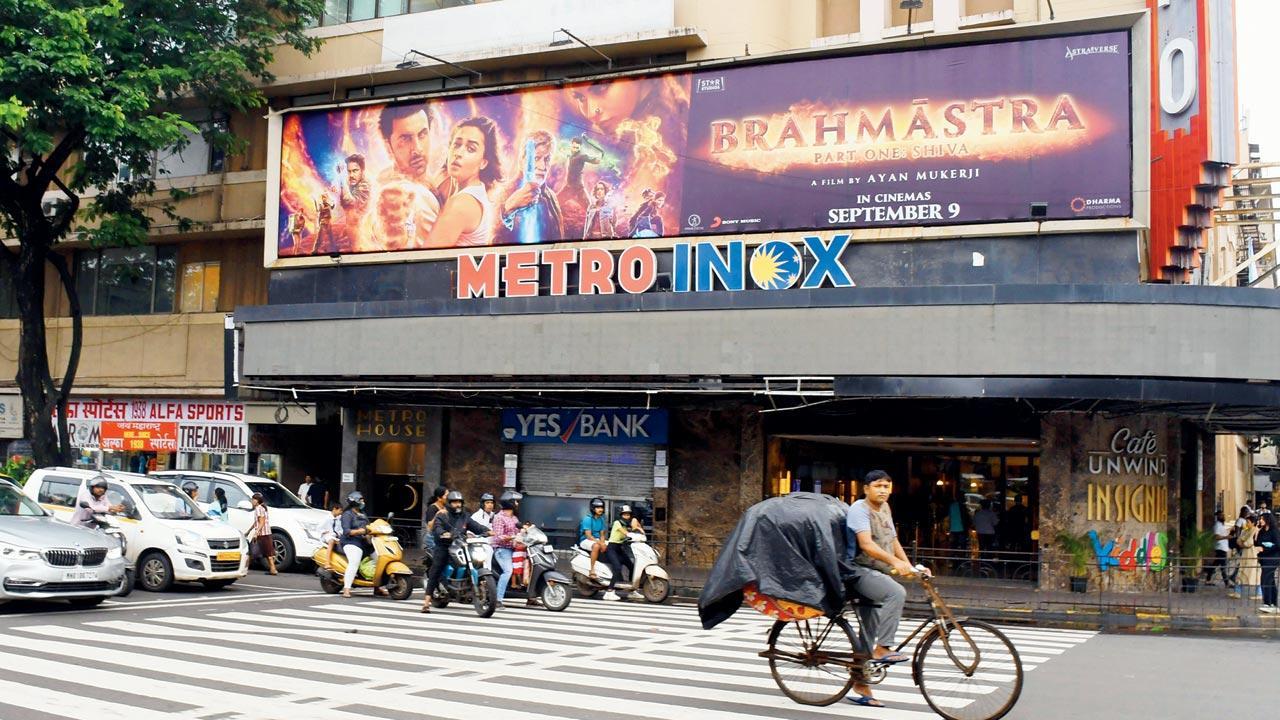
Why does Brahmastra’s proclaimed collection not match the scene in theatres? Is it inflated ticket prices or bravado, we ask stakeholders
Heena Khandelwal (MID-DAY; September 18, 2022)
It is important that Brahmastra: Part One–Shiva do well not only for the people directly associated with it, but for everyone in the Hindi film business. Film exhibitors and distributors pointed this out in mid-day’s report ‘Content is the problem, not #boycott calls’ (dated September 4, 2022). After Aamir Khan’s Laal Singh Chaddha and Akshay Kumar’s Raksha Bandhan’s lacklustre show at the box office, everyone was desperate to resuscitate Bollywood.
The Ayan Mukerji film saw the light of day after eight long years. Made at a budget of Rs. 410 crorse—a major chunk of which was spent on VFX—it opened to promising box office numbers, with a gross collection of Rs 300 crores worldwide in the first week, as pointed out by its producer Karan Johar.
But is the audience paying for this shot-in-the-arm? On Monday, a colleague bought a ticket for Rs 650 for a 2D show at a theatre in Malad; stubs for 3D versions in premium theatres crossed Rs 1,000. “Ticket prices have inflated,” says Kolkata-based film critic and trade analyst Sumit Kadel. “Producers have increased ticket prices by 30 to 40 per cent for weekend shows.”
This raised box office numbers, echoes Mumbai-based entertainment analyst Karan Taurani. “Prices were hiked by 35 to 45 per cent. This film has been adapted for 3D and IMAX 3D, which comes at an additional cost.”
Taurani adds the technology demands budgets of Rs 500 crore and more. “To make it profitable for producers, ticket pricing has to be higher,” he explains. “The audience is also willing to pay because they want to watch compelling content that is larger than life.”
Speaking for multiplex chains, Sanjeev Kumar Bijli, joint managing director of PVR Limited, said that just like airlines, cinema halls also have different ticket price slabs for the same film. Rajender Singh Jyala, chief programming officer of INOX Leisure Ltd, adds that price varies from theatre to theatre and area to area within a city. “A theatre in Nariman Point would charge Rs. 400, while a theatre in the same multiplex chain in Ghatkopar would charge Rs 200.”
He elaborates on the ticketing policy: INOX has four pricing categories—regular, popular, blockbuster and mega-blockbuster. “If a film looks promising, it is considered popular,” he says. “It is a blockbuster when it has a strong star cast and is made on a good scale. Only a few films—such as KGF - Chapter 2 and RRR—make it to the block-buster category. Brahmastra was put in the blockbuster category. If a regular ticket is priced Rs. 100, tickets for a popular film would fall between Rs 115-120, for a blockbuster it would be Rs 130-35, and a mega-blockbuster would be Rs 145-150.”
However, he dismisses reports that say ticket prices for Brahmāstra have been hiked. “In fact, the rates for Brahmastra are lower than those for KGF - Chapter and RRR,” he says.
A report in an online portal pointed out how stocks for PVR and INOX were gaining steam after Brahmastra’s release. “We are in the business of movies,” says Jyala. “If films do well, our stock prices gain momentum, and if they don’t, that too affects us.”
Much has been made about the box office collection. Mukerji puts it at a gross business of Rs 75 crores worldwide on opening day, and Rs. 300 crores in the first week. Domestically, according to Bollywood Hungama, the film opened to Rs. 36 crores on the first day, did a business of Rs 120 crore over the weekend and Rs 170 crores in its first week.
“The exhibitors are very happy,” says PVR’s Bijli, adding, “PVR saw 12 lakh admissions over the weekend across the country; it testifies that people do come to theatres. We feel that the movie has potential to run another week.”
Seconding him, INOX’s Jyala says the film has had a sizable box office collection considering the environment around it, including the call for boycott. “All big films are released around the holidays, but Brahmastra is the second highest non-holiday weekend film of all time; the first was Baahubali 2: The Conclusion,” says Jyala.
The scenes on ground contradict this confidence. Social media was filled with pictures of empty theatres, and soon there were memes, one of which said, ‘Brahmastra box office collections surpass GDP of India, Dharma Productions become world’s fifth biggest economy.”
Taurani has an explanation: “The weekday drop has been very high. Generally, if you compare weekday business to that of a weekend, the drop is usually 45 to 50 per cent; Brahmastra dropped 60 per cent.” Could word-of-mouth be blamed? “Yes,” says Taurani.
When asked if footfall and revenue have touched pre-COVID levels, Taurani says, “Yes, it happened last quarter when KGF - Chapter 2 and RRR had released. We saw a growth of 13 per cent even as the footfall was down by 10 per cent. [But] this quarter we are expecting a decline of 45 per cent when it comes to revenue and 50 per cent when it comes to footfall because none of the films has done well.”
Usually, traders call out fudged numbers. “But this time,” says film journalist and trade analyst Amod Mehra, “the outcry is from the public; and it is because the figures don’t match what they saw in theatres.”
Mehra says the situation is dismal in non-metro cities. “Mumbai and Delhi have prominent theatre areas, where many people go to multiplexes,” he says. “Places such as Lucknow, Jammu and the interior parts of Maharashtra are seeing empty theatres. The film performed well on Friday, Saturday, and Sunday, but the collection dropped Monday onwards. By Tuesday, shows were being cancelled.”
Then why does the box office say otherwise? And can the claim be verified? “In the good old days, trade papers and magazines would collate figures from every theatre,” says Mehra. “Then one could judge whether figures announced by film producers were inflated. There was also a fear of being exposed, so even if producers fudged numbers, it was only marginally. Today, if a film makes Rs 70 crores, you can exaggerate to Rs 100 crores, and it will be published without verification. Besides, earlier producers would manipulate box office collection by buying tickets and sending them to friends. Today, you can book tickets online, and cancel them one day or a few hours prior. So it may seem that seats are filling up fast, but in a theatre you’d find them empty.”
All this effort to raise hype pays off, says Mehra, because it becomes the benchmark to determine digital rights. “Whether it is satellite or OTT, these rights are swayed by box office collection. If a film is declared a hit, the producer can sell it for, say, Rs 150 crore,” he says. “But if declared a flop, the OTT rights could come down to R100 crore. Besides, every filmmaker wants to declare their film a hit, as do the actors. It decides their future [in the industry]. So everybody chimes in.”
Will Brahmastra register a profit? Unlikely, say distributors. While they recognise and acknowledge that the scale of the film brought audiences back to theatres, and proved that a Hindi film can have a huge opening, it would be far-fetched to say it will be a hit.
Manoj Desai, executive director of G7 multiplex and Maratha Mandir cinema, says the film did well over the weekend, but dropped in appeal Monday onwards. “Instead of running it at both Galaxy and Gaiety [theatres], we decided to run it only at Gaiety, keeping Galaxy free for other movies. Maratha Mandir is running only two shows instead of three,” he says, betting that the film won’t recover the cost of making. “The expectations were high,” he sighs, but blames the poor plot. “BrahmÄstra was an astra used in the Mahabharata, but here, they turned it into a love story.” Though every action film has a kernel of a love story within, this one couldn’t do it justice, he thinks.
Breaking it down to how profit for a film is calculated, Mehra says, “From a ticket priced at Rs 100, Rs 18 goes to GST. From the remaining Rs 82, Rs 41 goes to the producer/distributor, and Rs 41 remains with the multiplex. So, if a film does Rs 100 crores at the box office, it is bringing the producer’s home only Rs 41 crores.”
Brahmastra was made on a budget of Rs 450 crores, including promotion cost; so it will have to do a business of at least Rs 500 crores at the domestic box office to break even. This excludes money from digital rights and overseas release. “Say it gets Rs 150 crores from digital rights and Rs 50 crore from overseas [collection],” calculates Mehra, “it will still have to do a business of Rs 500 crore to earn the remaining money. This seems like a very distant dream.”
However, Mukerji has already confirmed that the second installment in the trilogy will be released in December 2025. “What Dharma did right is that they sold all rights to Disney,” says trade analyst Kadel. “Disney has been making films worth Rs 3,000 crores in Hollywood, [so] spending Rs 400 crores isn’t a deal breaker. Besides, they are looking at creating an intellectual property.”
The moving forward of National Cinema Day, so that it doesn’t interrupt the film’s collection, can be seen as a hefty vote of confidence. The Multiplex Association of India had announced it on September 16, which would be marked by all multiplexes selling tickets at Rs 75. However, it was postponed to September 23.
When asked why, a source close to the development said that distributors thought it would be best that the movie continues to gather momentum at the box office. “Cinema day was pushed by a week so that it doesn’t affect any major film’s chances,” he said.
Multiplexes stealing the show again after Covid break
8:01 AM

Buoyed by recent successes, cinemas looking to get cash registers ringing again
Reya Mehrotra (FINANCIAL EXPRESS; July 17, 2022)
There was a time during the Coronavirus pandemic when cinemas were totally shut, and audiences hooked to OTTs seemed to be a way of life that would prevail.
However, as theatres reopened and larger-than-life releases took over the big screens, the faith of cinema owners was reinstated. This year’s biggest releases KGF - Chapter 2, RRR, The Kashmir Files, Gangubai Kathiawadi and Bhool Bhulaiyaa 2 not only brought the money back into the business, but proved to be golden openers for theatres after the pandemic.
Recovery, which began in March, as the pandemic waned, has continued in the first quarter. Besides more occupancy, average ticket prices and spends on F&B are higher than pre-pandemic levels. Revenues of PVR Pictures and INOX Leisure, which have the biggest market share in terms of overall multiplex screens in India at 26.6% and 21%, respectively, grew from Rs 12,356 million in FY 22 to Rs 39,559 in FY 23 (estimated) and from Rs 6,863 in FY 22 to Rs 23,392 in FY 23 (estimated), respectively, as per data shared by an Anand Rathi report on Multiplexes: The Best is Yet to Come. PwC’s Global Entertainment & Media Outlook 2022-2026 further predicts a CAGR of 38.3% for cinemas, the highest growth rate amongst all segments.
As Kamal Gianchandani, CEO, PVR Pictures, told FE, “RRR and KGF have had unprecedented success at the theatrical box office. Both films have contributed immensely towards the V-shape recovery we are witnessing in theatrical and film business.”
The success of regional films also signals a trend of breaking of language barriers. Some of it has to do with the fact that dubbed regional films were popular on OTTs, which translated into success of regional films at the box office too.
Success of Hollywood films like Top Gun: Maverick also indicates that Bollywood is no longer the mainstay at the box office. “Non-Hindi Indian movies and Hollywood movies have broken the thresholds of geographical and language barriers, being dubbed in multiple languages aided by their larger-than-life appeal and formats such as IMAX and 3D, which have helped in expanding the movie viewing market. This is a massive positive for theatrical business, and will help boost the theatrical box office collections in a material way. I think FY 2022-23 could easily become the best year in the history of film business, thanks to this growing trend,” adds Gianchandani.
Rajendra Singh Jyala, chief programming officer, INOX Leisure, says he is confident that theatres have a bright future ahead and that both OTTs and theatres will co-exist and complement each other.
“Bhool Bhulaiyaa 2 was a medium budget film but did a business of more than Rs. 180 crore, JugJugg Jeeyo did decent business. So sooner or later, things will pick up. The upcoming lineup of films like Laal Singh Chaddha, Shamshera and Raksha Bandhan are promising and might impact the numbers positively,” he says.
Theatres also focusing on improving the experience of cinema with better food and beverage options and movie formats like IMAX and 4D will be an added plus to attract viewers.
PVR recently announced an exclusive tie-up with Oma Cinemas, the premium auditorium concept by French architect Pierre Chican, to roll out opera houses-inspired cinemas in India.
As Jyala of INOX points out, in the pre-pandemic days, over 300 films released every year but the success ratio was never more than 18-20%, with only about 40-50 hit films and only about 10 films entering the Rs 100 crore-club.
He adds, “Post-pandemic, the ratio has not changed, but the success of films from the south — KGF and RRR — contributed to the popularity of regional films, and also opened the tier-II AND III markets more.”
Theatres operate at 100% capacity; is it the end of tough times?
8:31 AM

Titas Chowdhury (HINDUSTAN TIMES; March 9, 2022)
After suffering immeasurable losses over the past two years due to the Coronavirus pandemic, cinema halls, post running in fits and starts, have been finally permitted by the government of India to operate at a 100% capacity in Maharashtra, Delhi, Rajasthan, Karnataka, Andhra Pradesh, Tamil Nadu, Telangana, Odisha and Uttar Pradesh. Needless to say, it has brought a wave of joy and relief to people from across the film fraternity.
Producer Amar Butala believes that the upcoming line-up of films such as Bachchhan Paandey and Runway 34 will bring in a large number of cinegoers to theatres. “It’s a welcome sign for both producers as well as the exhibition sector. With two long weekends, Holi and Eid, coming up, there are likely to be more footfalls in cinemas,” he explains.
Happy that theatres are running at a full capacity, Karnataka exhibitor B H Basha anticipates that the release of pan-India films such as RRR, Radhe Shyam and Etharkkum Thunindhavan will help improve the financial state of the exhibition sector: “The South states contribute immensely towards the film business. But my fear is that people have stopped wearing masks, thinking that the pandemic is over. I hope the 100% occupancy at theatres continues.”
Rajender Singh Jyala, CPO, Inox Leisure Limited, says, “We always thought that we can recover losses, but this is the fastest recovery we’re witnessing.”
Producer Anand Pandit adds, “We’ve already had a few blockbusters since theatres opened up and every exhibitor, distributor and producer is hoping that the pandemic doesn’t throw another spanner in the works to impair the progress that has been made.”

Badhaai Do proves people are ready to go back to cinemas to watch good content-Raj Bansal
7:20 AM

Despite COVID restrictions & 50% capacity in theatres, the film’s performance at the box office shows that moviegoers are craving the big screen experience, say distributors
Niharika Lal (BOMBAY TIMES; February 18, 2022)
Badhaai Do was the first major Hindi film to hit the big screen on February 11, right after cinemas reopened, and its strong run at the box office so far has exhibitors feeling optimistic about the industry rebounding from pandemic losses. Footfall has gone up not just on weekends, but weekdays too, they tell us, while trade analysts are confident that the film is headed for another good week.
IT WAS A BRAVE AND BOLD DECISION TO RELEASE THE FILM WHEN NO ONE ELSE WOULD, WHICH HAS WORKED IN BADHAAI DO’S FAVOUR: DISTRIBUTORS
Just as the Hindi film industry thought it was getting back to its feet after the pandemic, Omicron led several theatres across the country to pull down shutters, and all January releases were pushed to March and April. When theatres finally reopened, Badhaai Do was the first major Hindi release, and despite 50% occupancy and other Coronavirus restrictions — thanks to word-of-mouth publicity and strong content — the film is doing quite well at the box office, say trade analysts and distributors.
Raj Bansal, industry expert, says, “I am really impressed with the Badhaai Do makers’ decision to release the film on February 11, at a time when others weren’t ready to take the same call. It was a brave and bold decision and it has paid dividends. The film is doing very well, and the release date being close to Valentine’s Day was an added impetus. The film’s already collected Rs. 11 crore plus in five days, even with the restrictions in most of the states. It was a master strategy indeed.”
Stressing on how the lack of any other releases and the release date falling close to Valentine’s Day worked in the film’s favour, Girish Johar, producer and film business expert, explains, “Valentine’s Day is not a holiday, but it is a celebratory occasion, when young people like to go out. It’s had a positive impact on the film, specifically in metros like Delhi and Bengaluru, where the film is doing well. And with no major film scheduled to release next week either, Badhaai Do will get more audiences.”
Bansal adds, “Badhaai Do also has the added advantage of its prequel Badhaai Ho being a hit. With the audience appreciating the film, footfall is going up, and we are expecting another good weekend. It has shown the way to upcoming films by proving that people are ready to go back to cinemas to watch good content.”
‘IT IS 200% ESTABLISHED NOW THAT PEOPLE WILL STEP OUT FOR SOMETHING WORTH THEIR TIME AND MONEY’
Akshaye Rathi, director, Aashirwad theatres, and an industry expert, says, “Badhaai Do is an interesting film that’s designed to grow with word-of-mouth publicity. It’s performance at the box office — that was strong on the weekends, as well as the weekdays — was a pleasant surprise. I’m sure that it will continue to do well.” He adds, “It’s 200% established now that be it cinemas — or even restaurants or malls — people will step out if the product or service is worth their time, effort and money. The hesitancy to go out has definitely come down and the return to normalcy has happened quite quickly.”
WE’RE EXPECTING AN EVEN BETTER SECOND WEEKEND FOR BADHAAI DO: EXHIBITORS
Cinemas and distributors are expecting the film’s second weekend to be even better than the first. That’s because Badhaai Do managed to get a good opening despite COVID restrictions and many people being unaware that cinemas had reopened.
Devang Sampat, CEO, Cinepolis, says, “Badhaai Do’s content is very strong. Positive reviews are helping the film and we are expecting the second weekend of the film to be better than the first. During the first week of its release, most people didn’t even know that cinemas had reopened or that there were new releases. The film is gaining momentum in cities like Bengaluru and Mumbai, where the night curfew has been lifted. And now that people are getting to know that cinemas are open, footfalls are increasing.”
Agrees Rajender Singh Jyala, chief programming officer at Inox Leisure, “On the first day, many people were not aware whether the film would release in cinemas or OTT. Still, the film is holding up well and doing good in the north and Maharashtra. Delhi and Haryana still don’t have night shows, which has definitely impacted collections, but otherwise it’s a good turnout.”
‘THROUGH BADHAAI DO,THE MAKERS OF THE MOVIE HAVE PAID A TRIBUTE TO THE SHEER RESILIENCE OF CINEMAS THAT HAVE SAILED THROUGH THREE COVID WAVES’
Gautam Dutta, CEO, PVR Limited, says, “Badhaai Do is the first Bollywood blockbuster after the third wave of the pandemic, and has been well appreciated by our patrons. The timing of the release — right during Valentine’s Week — has been appropriate. Belonging to the hugely successful ‘comedy’ genre of movies, it has appealed to audiences while at the same time addressing an extremely relevant social angle of inclusivity portrayed by an excellent star cast. Through Badhaai Do, the makers of the movie have paid a tribute to the sheer resilience of cinemas that have sailed through three COVID waves.”
With its strong performance at the BO, Badhaai Do has shown the way to upcoming releases by proving people are ready to return to cinemas.
No new releases force theatres to shut shop
8:42 AM

Titas Chowdhury (HINDUSTAN TIMES; January 9, 2022)
G7 Multiplex’s Gaiety Cinema in Mumbai has been shut down temporarily since film releases have been indefinitely postponed due to the surge in Coronavirus cases. Many other cinemas all across the country have followed suit, with a few theatres in Tamil Nadu, Karnataka, Rajasthan and Uttar Pradesh running at 50% capacity. Theatres in West Bengal are currently screening Spider-Man: No Way Home, Pushpa: The Rise - Part 01, '83 and a regional film.
Manoj Desai, executive director of G7 Multiplex and Maratha Mandir Cinema says, “For how long can we continue screening films that released three-four weeks back?” Rajender Singh Jyala, CPO, Inox Leisure Limited shares that they had “done a business of over ₹1,000 crore in December, which was as good as in the pre-pandemic era” and all hopes were pinned on January, which was supposed to see the release of RRR, Radhe Shyam and Valimai.
Better policies are needed for theatres, feels Meenu Singh, AGM, Legend Cinemas, whose Haryana outlet has been forced to shut down. Whereas, Satadeep Saha, director, SSR cinemas Pvt Limited, says, “If the government asks us to shut down, we will or else we’ll continue to run even if we have to with one show of each film.”
Omicron wipes out January film release calendar
8:58 AM

From a star-studded mega lineup to ‘zero releases’!
Niharika Lal (BOMBAY TIMES; January 7, 2022)
With cinemas across the country either shutting down, or operating with 50% occupancy, with night curfews and weekend curfews in place due to rising Coronavirus cases, it seems filmmakers have little choice but to put release plans on hold. Jersey, starring Shahid Kapoor, was the first big ticket project to postpone release after cinemas shut down in Delhi, followed by RRR, which was slated for a January 7 release.
Now, Radhe Shyam makers have announced that they’ll be postponing the film’s release as well, while reports state that Akshay Kumar and Manushi Chhillar-starrer Prithviraj, which was meant to hit theatres on January 21, will be held back as well. So, what will be the fate of these films going ahead?

‘WE’RE STARING AT ZERO RELEASES IN JANUARY’
Girish Johar, producer and film business expert, says, “January was a month of solo releases, with one major mega star film releasing every week. Producers had ensured that their release got enough screens. However, now we are looking at an empty calendar. As an industry, we are hoping that this hiatus doesn’t last as long as the last one. Every other hour there is an update from another state and rules are changing quickly, hence there is a lot of confusion around.”

REGIONAL FILM RELEASES FEEL THE HEAT, TOO
While Bollywood releases — and those targeting pan-India audiences — have backed out of theatrical runs, the release of several regional films may depend on the scenario of their primary market. Akshaye Rathi, director, Aashirwad Theatres and an industry expert, cites the example of Valimai, starring Tamil superstar Ajith. “The film was expected to release on January 14, and now with the restrictions imposed in Tamil Nadu, it will be slightly unfeasible for the maker to release the film on that date. Then there is Bangaraju starring Nagarjuna and Naga Chaitanya, which might go ahead as planned because cinemas aren’t yet shut in its primary markets – Andhra Pradesh and Telangana.”
Yogesh Raizada, Corporate Head, Wave Cinemas, says, “A couple of other Punjabi films are still scheduled to release in theatres this month, but with new restrictions imposed in Punjab, occupancy will be low.”
Rajender Singh Jyala, Chief Programming Officer, INOX Leisure, adds, “We have no releases this week. Films that were already in cinemas will continue. Despite cinemas in some states still showing films, due to the restrictions, footfalls will be affected.”
‘FILMMAKERS READY TO WAIT FOR THEATRICAL RELEASE THAN GO THE OTT WAY’
Film business analysts say that filmmakers are likely to wait till the virus subsides to release their films in theatres than go the OTT route. Akshaye Rathi says, “Be it Sooryavanshi or Spider-Man: No Way Home, the business that these films have done recently is proof that the audience will come to theatres to watch films. Some producers with financial constraints may take the OTT route. However, most filmmakers are ready to wait and release films in cinemas. All of us are hoping that states will take a pragmatic approach – keeping both, the safety of people and the economics of businesses in mind – as the last one-and-a-half years have been extremely hard for the cinema industry.”
BIGGER ISSUE IS RESCHEDULING OF THESE FILMS: RAJ BANSAL, FILM DISTRIBUTOR
Raj Bansal, film distributor, points out that several filmmakers have been very reluctant to push back releases, and were ultimately forced to under the circumstances. He explains, “The biggest challenge for our industry is rescheduling the films that have been postponed. Now what happens is that till the first week of Diwali 2022 – the release date of the films announced in advance will remain the same. So, where will the makers shift these January-February releases to? Films which were earlier announced to be released in April, will either have to push back their release dates or go head-to-head with these films at the box-office.”

Cinema shutdown in Delhi will impact major Bollywood releases, say stakeholders
8:28 AM

Industry stakeholders say the move will lead to ‘irreparable losses’, and urge the govt to instead introduce safety measures such as allowing only double vaccinated audiences
Niharika Lal (BOMBAY TIMES; December 30, 2021)
The Delhi government’s order on Tuesday shutting down cinema theatres and multiplexes, in view of the sharp rise in omicron cases in the city, has come as a big jolt to the industry that was just getting back on its feet. An exhibitor says, “We have seen packed theatres this month for films like Spider-Man: No Way Home. The last week of the year is when people prefer going out and watching films. This will be a huge revenue loss for cinemas. ”
‘CINEMA SHUTDOWN COMES AT THE BUSIEST TIME OF THE YEAR’
Theatres in the rest of the country, including other parts of NCR and Mumbai, remain open for now. However, with Coronavirus cases rising across the country, exhibitors fear more cities will soon introduce restrictions and lockdown measures.
Akshaye Rathi, director, Aashirwad Theatres, and an industry expert, says, “This is the holiday season, when kids are on winter break, and business is robust across the sectors, including cinemas. It’s unfortunate that a sector is being closed at this specific time of the year, especially taking into account the scenario in the last one-and-a-half years when cinemas were closed for months. Be it Delhi, or other state governments who are contemplating lockdown, authorities need to find a more pragmatic approach. For example, only allowing double vaccinated audiences to enter cinemas, and other such measures.”
Girish Johar, a producer and film business expert, asks, “Why only cinemas? Cinemas are not being treated as a business. After Sooryavanshi opened big, people were coming back to the cinema. We have seen how Spider-Man: No Way Home changed everything and is now clocking around 200 crores at the Indian box office, which is a big deal. So, what now? Thoda gire, thoda uthe, phir se ye chot. We really hope Delhi gives some relaxation to cinemas.”
Rajendra Singh Jyala, Chief Programming Officer, INOX Pvt Ltd, adds, “Whether it was Spider-Man or '83, theatres had good occupancy, and moviegoers came out to watch these films because they found cinemas to be safe. We’ve worked so hard to gain this confidence. This year-end week is one of the busiest weekends for cinemas. In fact, even on Monday-Tuesday, we had over 50% occupancy in cinemas across NCR, which is a good number for weekday occupancy. We had almost 100% occupancy last weekend. While a few moviegoers may go to watch films in Noida and Gurgaon as Delhi cinemas are closed, this shutdown will adversely affect not just the business of films which are currently running, but upcoming releases, too.”
CONSIDER DOUBLE VACCINATION, REINTRODUCE 50% CAPACITY, BUT RETHINK SHUTDOWN: MULTIPLEX ASSOCIATION OF INDIA
The Multiplex Association of India has urged the Delhi government to consider introducing a double vaccination requirement to enter cinemas, instead of a complete shutdown. Kamal Gianchandani, President, Multiplex Association of India, said in a statement, “The Delhi Government’s decision to shut down cinemas in Delhi while enforcing the ‘yellow’ alert of the Graded Response Action Plan (GRAP) has caused massive uncertainty and could lead to irreparable damage for the Indian film industry. After being allowed to reopen, cinemas have already demonstrated an ability to operate safely for the public and employees via usage of enhanced ventilation systems, hygiene, and other safety protocols. Not a single outbreak of COVID-19 anywhere around the world has been traced to a cinema. While we fully understand the need at the government’s end to take necessary preventive measures, we’d request that cinemas should get equal treatment with comparable industries and institutions.”
“Instead of closing the cinemas, we’d urge the Delhi government to consider introducing a double vaccination requirement to enter cinemas, as is the case in some of the other states (including Maharashtra). Alternatively, the seating capacity restriction of 50% can be reintroduced at cinemas. We call on the government to recognise the unique social, cultural and economic value of the Indian film industry, and to provide the support it so desperately needs to survive this unprecedented period,” the statement added.
DELHI’S THE SECOND-BIGGEST MARKET FOR BOLLYWOOD; THIS WILL IMPACT FUTURE RELEASES: INDUSTRY EXPERTS
Producer and film business expert Girish Johar says that the closure of cinemas in Delhi can have a ripple effect. “The reason is that Delhi is one of the top two cities from the revenue point of view of Bollywood films. I don’t think that producers will release films when they are on tenterhooks.”
Akshaye Rathi, director, Aashirwad Theatres, and an industry expert, says, “The biggest territory for Bollywood films is Maharashtra, which is already operating at 50% capacity. Now, with the second biggest market – Delhi – shutting down, it is too much of a compromise revenue-wise for producers to continue releasing films, especially films which do well in Hindi-speaking markets. For a film like Valimai, there may not be that big of an impact because its main market is Tamil Nadu, but for an RRR or Prithviraj, it is a very tricky situation.”
Makers of Shahid Kapoor-starrer Jersey, have already postponed its release while upcoming films like Prithviraj and John Abraham’s Attack may also be impacted.

As the Delhi government shuts cinemas, theatrical releases likely to be impacted now
8:11 AM

THE TIMES OF INDIA (December 29, 2021)
New Delhi: On a day when new Coronavirus cases in Delhi jumped by 50% in 24 hours, the level 1 (yellow alert) of the graded response action plan (GRAP) kicked in with strict curbs.
Schools, colleges, cinema halls, multiplexes, banquet halls, auditoriums, spas, gyms, and yoga institutes will be shut. Religious places are open but no visitors are allowed. People can walk, run or play at parks and gardens, but picnics are barred. Private offices are allowed to operate from 9am-5pm at 50% attendance, unless they provide essential services. Public transport’s capacity has been limited to 50% seating and no standing passengers. Cabs, autos and e-rickshaws are also not allowed to carry more than two at a time.
Shops dealing in non-essentials can be open from 10 am-8 pm on an odd-even basis. Restaurants can operate from 8 am-10 pm with 50% capacity. Ditto for bars from noon-10 pm. Hotels and lodges can operate, as can barber shops and salons. Wedding gatherings must be restricted to 20 persons, held either at a court or at home. The 20-person cap is also for funerals.
--------------------------
Rishabh Suri (HINDUSTAN TIMES; December 29, 2021)
The film industry had barely started getting back on its feet and things seem to be going south again. The Delhi government, on Tuesday, announced yellow alert and theatres have now been shut down. Trade experts feel this will cause a domino effect, with films being pushed.
And it has started already. Actor Shahid Kapoor’s Jersey has been delayed. “In view of the current circumstances and new Covid-19 guidelines we have decided to postpone the theatrical release of our film Jersey. We have received immense love from you all so far and want to thank you all for everything. Until then everyone please stay safe and healthy, and wishing you all the best for the new year ahead!! Team Jersey (sic),” read a statement from the makers.
Rajender Singh Jyala, chief programming officer, INOX Leisure, says this move to shut down Delhi theatres will hurt. “After a long time, we were releasing films, and getting a good number at the box office. It definitely hurts. The cases were not that much, but if the government has taken a call we will abide by that,” he says.
Rumours are rife that actor Akshay Kumar’s Prithviraj will be postponed, too. Trade expert Atul Mohan says, “Why are cinemas the first casualty whenever we have any kind of threat coming in? You have venues operating at full capacity without protocols. We are the first ones to close down, last to reopen. Ab sab push ho jayega, including RRR starring Ram Charan and NTR Jr. This shutting down trend will spread to other states as well. This will be a bad start to the new year.”
Exhibitor Akshaye Rathi agrees that upcoming releases will also get affected. “When a market as important as Delhi shuts down, other releases will get postponed, too,” he opines.
DELHI SPAS AND GYMS SHUT, TOO
Alongside theatres, spas, gyms and banquet halls in Delhi will also be shut. “Jab spa shut ho jayenge, hum kamayenge kaise? Work from home had already reduced our business,” says Prashant Mehar, manager at a spa in Delhi.
Omesh Chandna, owner, Anytime Fitness in South Delhi, adds, “Starting a fitness regime and joining a gym is often a New Year resolution for many people. By implementing this restriction, we’ve lost the opportunity to get back on track.”
Manoj Nanda, manager of Orabella Banquet in west Delhi says, “We are heavily booked from mid-January, which is when wedding saaya dates start. Right now, we don’t have too many bookings.”
Text by Sanchita Kalra and Siddhi Jain
Big-ticket films to lock horns during the upcoming festival period
8:17 AM

Titas Chowdhury (HINDUSTAN TIMES; September 21, 2021)
After more than one-and-a-half years, a slew of big-ticket films are lined up for release during the festive season. Speculations are rife that Shahid Kapoor-starrer Jersey will clash with Marvel’s Eternals at the box office on Diwali. Tamil action-drama Annatthe starring Rajinikanth and Telugu movie Ghani featuring Varun Tej are also slated for a Diwali release. Besides these, Mahesh Babu’s Sarkaru Vaari Paata, Prabhas’ bilingual Radhe Shyam and Pawan Kalyan’s Bheemla Nayak are scheduled for Sankranthi on January 14, 2022.
“We’re expecting the films to run with 100% occupancy,” says Rajender Singh Jyala, chief programming officer, Inox Leisure Limited. He adds, “Clashes are bound to happen now that the release of a bevy of films is pending. We’ve a sufficient number of screens to accommodate multiple releases. So, footfalls won’t be affected.”
The audience turnout in multiplexes will be huge during festival periods, believes trade analyst Taran Adarsh. “Christmas is followed by the New Year and that makes for a long holiday period. So, two films can easily be accommodated. But Hollywood and regional films will pose a threat to Hindi films as both these industries have a pan-India appeal, especially Tollywood. Also, they are big in terms of scale and production,” he says.
According to Kunal Sawhney, chief operating officer, Carnival Cinemas, the upcoming months will bring good news. “Once Hindi films start releasing, we’re hopeful that people will come back to the theatres. The star-studded films that are releasing during festival periods are expected to garner Rs. 200-300 crore if the 50% occupancy clause changes to 100%,” he says.
Producer-trade analyst Girish Johar expects to witness “a box office upswing” during festivals. He opines that the upcoming releases are a testament to film production fraternities’ faith on the big screen: “Producers need big screens as a big chunk of revenue comes from there. And I don’t think these clashes are a threat. In a particular window, if we have two big films, they’ll cater to two different sets of audiences.”
Akshay Kumar’s BellBottom has spelled cheer, say cinema hall owners
10:09 AM

Sugandha Rawal (HINDUSTAN TIMES; September 1, 2021)
Considering the theatres are still running in limited capacity, or even shut in some places, the release of Akshay Kumar’s BellBottom was a huge risk. However, the gamble has paid off well, with the film spinning the box-office wheel in the right direction, paving the path for big screen revival.
As the first big Hindi film to release theatrically after the pandemic slump, it has brought hope and confidence among theatre owners. “This step by Akshay Kumar, (producers) Vashu and Jackky Bhagnani will be seen as a groundbreaking one. It helped revive the cinema exhibition business. The film is holding strong in the second week,” shares Kamal Gianchandani, CEO of PVR Pictures and president of the Multiplex Association of India (MAI).
Theatre owners were eagerly waiting for the magic of the big screen to be back. “We’re glad that Akshay kicked off this recovery process. We hope that the momentum built by the fantastic response to BellBottom would mark the onset of our revival,” asserts Rajender Singh Jyala, chief programming officer, INOX Leisure Ltd.
Co-starring Vaani Kapoor, Lara Dutta Bhupathi and Huma S Qureshi, the Ranjit M Tewari directorial, produced by Pooja Entertainment, released on August 19. BellBottom is inching close to ₹30 crore in India, with business growing overseas as well, especially in the UK and North America.
Trade expert Joginder Tuteja hails the team for their decision to look at the larger picture of course correction, instead of profits. “The film comes with a potential to cross ₹150 crore, and the producers knew that they wouldn’t be able to reach that mark with all the restrictions. Yet, they took the risk,” he says.
BellBottom’s growing collections are likely to encourage other production houses and exhibitors as well. “When good content comes to a cinema hall, collections follow. The film’s second Sunday collection was the same as the first Sunday. It instills confidence in the exhibition sector,” says Devang Sampat, CEO, Cinepolis.
The success of the film is also trickling down to single screens, too. Raj Kumar Mehrotra, general manager at Delhi’s Delite Cinema, shares, “The film had packed shows this weekend. All the safety precautions are being followed.” Officials from Rajmandir Cinema, Jaipur, thanked the team on Twitter for choosing a big-screen release.
In South India, trade guru Sreedhar Pillai from Chennai tells us, “The film had houseful shows in the first week itself. Akshay Kumar ne bahut confidence se apni film theatres ko di. It’s a great beginning.”
Now, theatre owners in Maharashtra are waiting for the green signal to bring life back into cinema halls. “Looking at this success story, we want theatres to open in our state as well,” says Arvind Chaphalkar from Pune’s City Pride multiplexes. Manoj Desai, executive director of Mumbai’s G7 Multiplex (Gaiety Galaxy) and Maratha Mandir Cinema, adds, “Hum bol bol ke thak chuke hain. We hope we’re allowed to open with 50% capacity.”
THEATRE EMPLOYEES REJOICE
Alongside cinema owners, even the employees are happy with the positivity that BellBottom has brought about. Galib Khan, ticket counter official, JP Cinemas, Madhya Pradesh, says, “Kaam ki bahut shortage chal rahi thi. Now, with BellBottom reviving business, we can expect regular income.”
Satish Gole, cinema manager at a single-screen theatre in Delhi, says, that it’s because of the efforts of the film’s team that people aren’t hesitant to step out of their home to watch a film on the big screen now. “It’s a good sign for the theatres and company, which helps us, the employees, as well,” he says.
Subscribe to:
Posts (Atom)