Showing posts with label Raj Babbar. Show all posts
Showing posts with label Raj Babbar. Show all posts
Dev Anand’s son, Suneil, passes away in London
9:15 AM

Avijit Ghosh (THE TIMES OF INDIA; July 29, 2026)
Actor Suneil Anand, fondly launched into the Hindi film world by his father Dev Anand in ‘Anand Aur Anand’ (1984), passed away following a heart attack in London. He was 70.
“We are comforted by the outpouring of love, prayers, and support, for which we are truly grateful. We kindly request privacy as we navigate this difficult time together,” his niece, Gina Narang, said in a statement on Tuesday. Incidentally, Dev Anand also died in the same city in 2011.
“Suneil didn’t seem ambitious. But he was extremely sincere towards his work. He was also very respectful towards senior actors,” recalled Raj Babbar, who worked with him in the film.
“My sincere condolences to his mother,” he added. Suneil's mother, Kalpana Kartik, a film star in the 1950s, is 94.
The 1980s saw a bunch of star sons being launched in style such as Kumar Gaurav, Sunny Deol and Sanjay Dutt. Suneil also made a carefully-crafted debut with much fanfare. He had learnt kung-fu in Hong Kong and displayed a felicity with dance moves as well as action scenes in ‘Anand Aur Anand’.
The film’s bouncy tracks, composed by R D Burman, proved to be popular. “Mr Ratan Tata who headed CBS Records at the time took keen interest in its (music) launch,” Suneil told this reporter in an email interview in 2020. But the film didn’t work.
Suneil also played the lead in the smartly lensed ‘Car Thief’ (1986), opposite Vijeta Pandit. He also starred in ‘Main Tere Liye’ (1988), directed by uncle Vijay Anand. A martial arts aficionado, he directed, ‘Master’ (2001), where the fights were choreographed by Hong Kong masters. None of these films succeeded at the box-office. Suneil had been working on a movie, Vagator Mixer for some years.
In his autobiography, ‘Romancing With Life’, Dev Anand provides a vivid account of how he was over the moon on hearing the news of his son’s birth. He was shooting for ‘Paying Guest’ for director Subodh Mukerji and enacting a drunken scene when the news arrived from a nursing home in Zurich. “I was in such high spirits that I gave a brilliant shot, probably my best in the film,” writes the star of superhits films such as CID, Johny Mera Naam and many more.
Shortly, Dev Anand and his wife Kalpana were invited to the Karlovy Vary film festival in (then) Czechoslovakia. The actor writes that an 86-year-old delegate and Suneil, then just two weeks old, were photographed together by the local press. The front page of a local newspaper carried the photo with the caption, “The oldest and the youngest delegates.”
In one of the chapters in the autobiography, Dev emotionally talks about flying out to Washington to meet Suneil who was studying there in a university. The Evergreen star writes how they embraced with moist eyes, how Suneil showed him around the campus, offered him a guided car tour of the US capital and helped him buy sunglasses. “These were great fatherly moments for me after the brutally harsh working schedule I had thrown myself into all these years, that kept me away from my family,” he says.
With Suneil's passing another chapter from the famed film family comes to a close.
That family was never there, that person (hinting at Raj Babbar) was never there in his life-Priya Banerjee
8:08 AM

Vinay MR Mishra (BOMBAY TIMES; March 23, 2025)
Prateik Smita Patil and Priya Banerjee, the newly minted husband-and-wife duo, are “finally settling into married life”. The lovebirds tied the knot on Valentine's Day in an intimate ceremony at Prateik's ancestral home in Bandra, surrounded by close family and friends. The wedding was followed by a whirlwind mini-moon in Goa.
“We feel like a responsible married couple,” Prateik declares. The lovebirds address each other as “Husband” and “Wife”. “He is very serious about me calling him husband. But he is definitely a better husband (than a boyfriend),” Priya quips. “It is cringe, but it is cute. But we are both stepping up to our new titles,” Prateik states.
The two sit down for a chat with us, talking about their “fairytale yet intimate” wedding, and all the chatter around it.
‘Our wedding was too meaningful’
Talking about the wedding, Prateik recalls the moment Priya walked in as the bride to be the most beautiful moment for him. “We automatically cried together. We were bawling but we couldn't let the tears out because she had her makeup,” Prateik recollects. Priya adds, “We had family with us. It was at home. It was so special. And this is what I wanted because I was never that girl who dreamed of a big wedding. It all fell in place in a weird way.”
Prateik states, “It was too meaningful. It had so much sentimental value for everybody involved; it was just perfect. It was blessed by my mother, my grandparents.”
‘All the controversy around our wedding was unnecessary’
Prateik and Priya's dreamy wedding was not without its fair share of drama. Prateik’s step-brother-actor Aarya Babbar made unsolicited comments about their actor-father Raj Babbar and the family not being invited for the wedding.
Ask the couple if they were perturbed by all that was going on and Priya answers, “We were unfazed. It was all noise. My mom and dad were here all the way from Canada. I had my closest friends. He had his aunts, who raised him apart from his grandparents. Everybody was there who we loved. So, whatever happened, we honestly, don’t have any comments because it didn't matter.”
Prateik, on the other hand, calls all of it “unnecessary”. “I'm really happy that it didn't matter,” he says. Priya chimes in, “It could have ruined the rest of our life. It had potential. But I feel like we've been protected. We have guardian angels around us. I felt throughout this event that we were so into the whole event, the wedding, the marriage and we were into each other, we didn't care about anything.”
‘If Prateik chooses to stay quiet, if I choose to stay quiet, that is actually out of respect and dignity’
Amidst the din of speculations, we question Prateik if he wishes to reveal the reason behind the conspicuous absence of his father and the Babbar family from the wedding. Before Prateik can respond, Priya, like a lioness protecting her partner, swiftly intervenes, “No, absolutely not. We don't want to talk about it. And it's not our place. It's all online. It's all on the internet. Let people go back in the past and read some articles perhaps from back in the day and find out what went down in anybody's life before passing a reckless comment which can affect somebody's special day. Nobody has any right to say anything about it. If Prateik chooses to stay quiet, if I choose to stay quiet, that is actually out of respect and dignity. That's it. We do not want to speak about this and get in detail because we're happy.”
‘There was never an equation with the Babbar family’
Ask Prateik if the episode will change his equation with the Babbar family and Priya replies, “There is nothing to change. There was never anything there. So, I'm confused when people comment, ‘You did this to somebody’. But no, that family was never there, that person (hinting at Raj Babbar) was never there in his life. So, I'm not sure why that question is coming up now, 30 years later.”
She adds, "Some people get limelight from talking about other people. You get a little bit of attention here and there when you talk about people. People will talk. We don't have to hear it. We have to live our life. We have to be happy. We don't have to sit and justify to the entire world. We're not here to answer anybody. Nobody pays our bills."
‘It’s complicated’
While in a previous interview Prateik mentioned about mending his ways with his family, remind that to the actor, and he clarifies, “When the time is right, I will chat about this. Let's just leave it the way it is for now. It's a bit complicated.”
Priya chimes in again, “It's too much too... and not just an interview. This is not something you can just ask and somebody can explain it. It is somebody's life we're talking about. Somebody went through something for 30 years. Not a lot of people would understand what a kid goes through when they lose their mom at first, right? That's the question I would like to ask everybody who's trolling and asking questions. Did you lose your mom when you were two weeks old? And if you didn't, I don't think you have any right to comment here. Whoever spoke during our wedding, may that be a troller, may that be some family member, whoever, nobody lost their mother at two weeks old, right? Nobody has the right because nobody can understand what this person went through. Whenever he feels the time is right to speak about it, to speak about things that he has never spoken about, he will. He's born into this industry. This industry is his friend. The media is his friend. He's nothing to hide. He's never hidden anything. His past, his present.”
Prateik further adds, "It's extremely complicated for the time being and as Priya mentioned, when I am ready to talk about things that I haven't before and that need to be spoken about, it will clear the air, not just for me, but for everybody, even that family."
‘Every time something goes down, they always point fingers at a woman’
During their wedding, a lot of allegations were made against Priya, while many including Prateik’s stepbrother Aarya hinting her to be the reason behind the Babbar snub. Priya reveals it didn’t bother her at all, however, Prateik felt otherwise. “It did bother me. It was really riling me up, as people are pointing fingers at her, saying she's the reason,” he says.
Priya adds, “It's not new to us, not new to you, not new to the world. We know that every time something goes down, they always point fingers at a woman.”
‘I'm striving to be like my mother and not like my dad’
Prateik has shed his paternal surname, rebranding himself as Prateik Smita Patil. This deliberate decision to drop the Babbar name from his identity doesn’t worry Prateik, who is unworried about the potential impact on his career or public persona.
“I'm not thinking of any of that. I'm just thinking about what makes me and my soul feel better, and what makes my heart smile, not thinking if it will negatively affect my career. I don't care about the repercussions. All I care about is the way I feel when I hear that name. I need to be wholly and solely associated with my mother (Smita Patil), her name and her legacy. I don't think any other name needs to taint that legacy, if you understand what I mean. It needs to just be her name and her legacy. That's what I'm striving to be. I'm striving to be like my mother and not like my dad. It feels like a new chapter.”
On a parting note, ask the couple if they are open to parenthood and pat comes Prateik’s reply, “I am ready”. “Our marriage and everything have been all about destiny. We are married now, we’ll see what happens next,” Priya concludes.
No one was missing from our wedding or celebrations-Priya Banerjee
8:44 AM
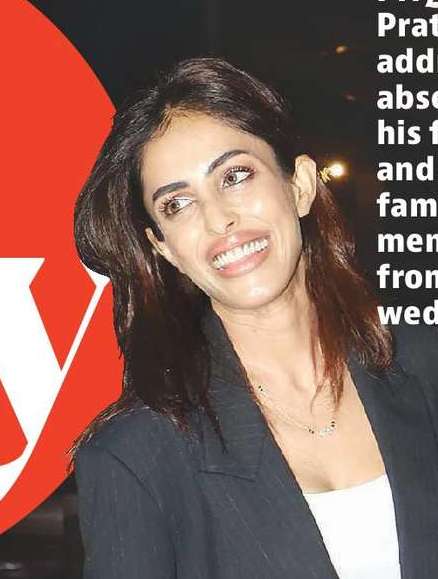
Priya and Prateik address the absence of his father and some family members from their wedding
Kavita Awaasthi (HINDUSTAN TIMES; February 18, 2025)
Actor Priya Banerjee and actor Prateik Babbar, who now goes by the name Prateik Smita Patil, tied the knot in an intimate ceremony on Valentine’s Day. In their first interview since the wedding, the couple opens up about their special day.
“Our wedding was exactly as we had dreamt — intimate, special and filled with the people we love the most. What made it even more meaningful was getting married at Rock Cliff, Prateik’s mother’s house. She (late actor Smita Patil) had bought it for him with the hope of raising him there, but unfortunately, she couldn’t. We believe it was her gift to us, her way of ensuring we got married in that home, and so we did,” says Priya.
While the couple has always been open about their relationship, their sudden wedding took fans by surprise. Prateik, taking a philosophical turn, says, “It feels like I’ve done this a thousand times before. It’s like another lifetime, another universe. I feel like I marry her in every lifetime, and this is just one of many more to come.”
The decision to marry on February 14 wasn’t just about Valentine’s Day. Priya explains, “What better day to celebrate love? But more importantly, my parents were visiting, and Prateik wanted to make it official. So, we gathered our closest family, kept it intimate and did the pheras. It felt perfect.”
For Priya, the most special part of the wedding was the presence of their closest family. “His two aunts and my parents were there to celebrate with us. These are the people we love the most, and getting married in his mum’s house made us feel her presence. We didn’t want a lavish event with hundreds of guests or a spectacle for the world. It was about us and the people who love us.”
ON THE BABBAR FAMILY’S ABSENCE
Addressing the speculation about Prateik’s father, actor-politician Raj Babbar, and other family members being absent, Priya clarifies, “No one was missing from our wedding or celebrations. I don’t know why there are rumours suggesting otherwise. Our families were there — my parents, his aunts who raised him, and everyone who truly matters. We were surrounded by love, and that’s all that counts.”
We don’t want to put Prateik Babbar under any pressure-Juuhi Babbar Soni
10:17 AM

Neha Maheshwri (BOMBAY TIMES; February 15, 2025)
Prateik Patil Babbar and Priya Banerjee tied the knot yesterday, but the absence of the Babbar family raised eyebrows. His half-brother, Aarya Babbar, made a surprising statement, revealing that none of them were invited to the wedding.
When we reached out to their sister, Juuhi Babbar Sonii, she said, “I’m not defending Aarya, but he is obviously hurt, just like everyone else. When someone is hurt, they have the right to express themselves. This is a sensitive topic, and it has been one even before Prateik was born. But no matter what, Prateik is my brother and nothing in the world can change that, nor the fact that hum ek hi baap (Raj Babbar) ki aulaad hain.”
Prateik is surrounded by a few people who have influenced him, says Juuhi Babbar Sonii
‘PRIYA IS A WONDERFUL GIRL, AND HE IS FORTUNATE TO HAVE FOUND A PARTNER WHO TRULY LOVES HIM’
Juuhi also suggested that certain people around Prateik might have played a role in his distancing from the family. She said, “Right now, he is surrounded by a few people — whom we don’t wish to name — who have influenced him. But we don’t want to sandwich him in the middle because that won’t help anyone. When I say sandwich, it doesn’t mean Prateik is caught between Priya and us — absolutely not. Priya is a wonderful girl, and he is extremely fortunate to have found a partner who truly loves and understands him. The real sandwiching is happening because of someone else — someone desperate for publicity and importance. Everyone knows that my mother (Nadira Babbar) has always been with Prateik. It’s such a strong and dominating presence that people get intimidated, thinking we will take the attention away on his special day. Bhai, behen ya baap koi importance lenge? Hum bas yeh chahte hain ki hamara bhai shaant rahe, khush rahe — that’s all that matters to us.”
‘There is no issue from our side’
Despite not being part of the celebration, Juuhi emphasized that there is no animosity. “He has had an unhappy experience in his first marriage, and now he has taken a big step by choosing to remarry. We don’t want to put him under any pressure. Shaadi-byah mein har parivaar mein baatein hoti hain. His first wedding was a grand affair for us, hum khoob naache thay, and when his marriage ended, hamaare papa uske saath khade thay and helped him through it. There is no issue from our side,” she said.
She added, “Right now, maybe he is processing things in his own way, woh khud ko khoj raha hai zara sa. Papa, mummy aur hum sab samajhte hain uski situation ko. Family ka sabse bada kaam hai bachhe ko samajhna. We may not have shared sweets this time, but there will be more occasions to celebrate together. Bahut mauke aayenge, tab hum mithai bhi khaayenge, naachenge bhi, aur phir pictures bhi post karenge. For now, we are letting it pass.”
I have never succumbed to the idea of fame-Juhi Babbar
8:37 AM

Roshni Olivera (BOMBAY TIMES; June 26, 2023)
Juhi Babbar Soni, daughter of Nadira and Raj Babbar, is an established name in the world of theatre, but she now wants to focus on other mediums as well. The actress, who was recently seen in Hansal Mehta’s Faraaz, talks about what lies ahead.
You started your career as a film heroine long ago, but after that, you focussed only on theatre. You are back now. What has prompted this move?
My first film Kaash Aap Humaare Hote was a sweet and simple film. I personally feel I was not so bad in it, but unfortunately, the film didn’t do well. I did get work after that, but nothing that really excited me.
In fact, I feel happy and proud when I look back that even at a younger age, I didn’t succumb to the idea of fame, money or glamour and completely shifted my focus to theatre. There had been a lot of television offers, but that would require me to shoot for almost 25 days at a stretch. Since I had got married and then my son was born, I did not want to be away from him.
In 2018, I did the film, Aiyaary, but unfortunately, the fact that I was back somehow went unnoticed. In 2019, I signed a big film and even shot for it, but then the film got shelved. But the good part was that I got on to social media and started posting pictures and videos and I started getting noticed. That’s how the casting director noticed me and Hansal sir offered me Faraaz. Recently, I shot for Alvira and Atul Agnihotri’s film and a web series, too.
As Raj Babbar and Nadira Babbar’s daughter, was it difficult to approach filmmakers and let them know that you wanted to return to films?
There have been instances where I have expressed my wish to work with certain filmmakers, but I am still not the person who would call someone and say that I was on a sabbatical, and now I am keen to work again. I never really did that. Being my parents’ daughter has always worked in my favour because my father, Raj Babbar, has a good reputation in the industry and is known for being versatile and self-made and my mother is known for her dedication towards her art.
Now that you are exploring other mediums, will theatre take a backseat?
When I did not get good work in cinema, theatre is all I had. In recent times, I have been shooting for movies and web shows, but all along, my play With Love, Aap Ki Saiyaara has also had shows across India. I am already working on another play, so theatre will never take a backseat.
‘ANUP AND I WOULD LOVE TO WORK TOGETHER AGAIN’
Talking about her husband Anup Soni and son Imaan, Juhi says, “I have worked on two plays with Anup – Begum Jaan and Pencil Se Brush Tak. We would love to work together again. But right now, as parents, we try and balance it out with at least one parent trying to be at home with our 10-year-old son. Imaan is aware that his mother is now returning to work slowly. In fact, it is because of him that I am working again… he expressed a wish to see me on screen. I guess his wish was so heartfelt that the universe worked around it.”
-------------------------------------
"If not for theatre, I would be depressed or would have lost confidence. Theatre gave me the opportunity to keep exploring myself as an artiste"
-------------------------------------
"I want to work with certain filmmakers, but I still can't call someone and say that I was on a sabbatical and now I am keen to work again"

Female actors don’t have a shelf life anymore. Today, a 40 year old can pass off as a 20 year old-Poonam Dhillon
8:04 AM
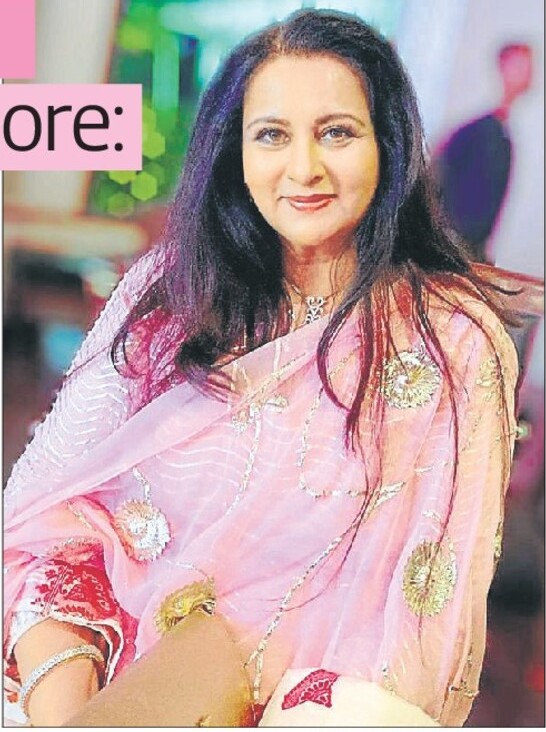
Rishabh Suri (HINDUSTAN TIMES; December 2, 2022)
Actor Poonam Dhillon, who took a break from acting to look after her family, has now decided to be back to work mode in full force. Recently seen in the web film Plan A Plan B alongside actors Tamannaah Bhatia and Riteish Deshmukh, Dhillon says she took a break after becoming a mother.
“Now, my kids, Anmol and Paloma, have grown up. They have become responsible and can look after themselves. So, I have more freedom to choose things [on the work front]. I consciously took a sabbatical because I was looking after them. I am raring to get back to work now,” she says.
Commenting on ageism that existed in the film industry, especially for female actors, the 60-year-old says, she doesn’t experience that anymore. In fact, she is being offered quite interesting roles. “Ageism no longer exists in the industry. Female actors don’t have a shelf life anymore. Today, a 40-year-old can pass off as a 20-year-old. They are so well-maintained and look presentable”, says the actor, adding, “Recently, I did a Punjabi film called Umran Ch Ki Rakheya with Raj Babbar (actor). It had a nice message that whether people are in their 50s or 60s, they can still find companionship.”
Talking about the way the industry functions now, Dhillon says that things have become more organized as far as shooting is concerned. “Shoots start on time. It’s easier to do a project now,” she ends.
K C Bokadia remakes Punjabi film Bhoot Uncle Tusi Great Ho in Hindi; to cast Raj Babbar and Jaya Prada
4:20 PM

Bokadia with Jaya Prada
Upala KBR (MID-DAY; August 26, 2022)
It has been a long wait for filmmaker K C Bokadia, who returns to the big screen with a Bollywood film, seven years after presenting Dirty Politics. As the Punjabi film, Bhoot Uncle Tusi Great Ho, featuring Raj Babbar, Jaya Prada, Ihana Dhillon, and Ghuggi Gurpreet, among others, releases in north India today, Bokadia, shares that he plans to remake the film in Hindi, with Babbar again.
“Babbar saab will play the role of Bhoot Uncle again in the remake, but the rest of the actors will belong to the Hindi film industry,” reveals Bokadia, adding that he has made over six movies with Babbar and Prada. “Both of them haven’t charged a rupee for this movie because they are excited about the subject, and have supported [me]. The Punjabi film marks Jaya Prada ji’s debut in the language, and also features Punjab’s top actors, and technicians from the south. I plan to complete the remake in a month,” says the filmmaker, often referred to as the “fastest producer to make 50 films.”
The film chronicles the story of a man who wants to build a hospital, but dies before his dream can be fulfilled. “His brothers want to sell off his property, but his two children, and Bhoot Uncle, will not let that happen.”
Bokadia’s next production — Gajendra Ahire’s directorial venture — features Anupam Kher, Ranvir Shorey, and Mahima Chaudhary, and is titled The Signature.
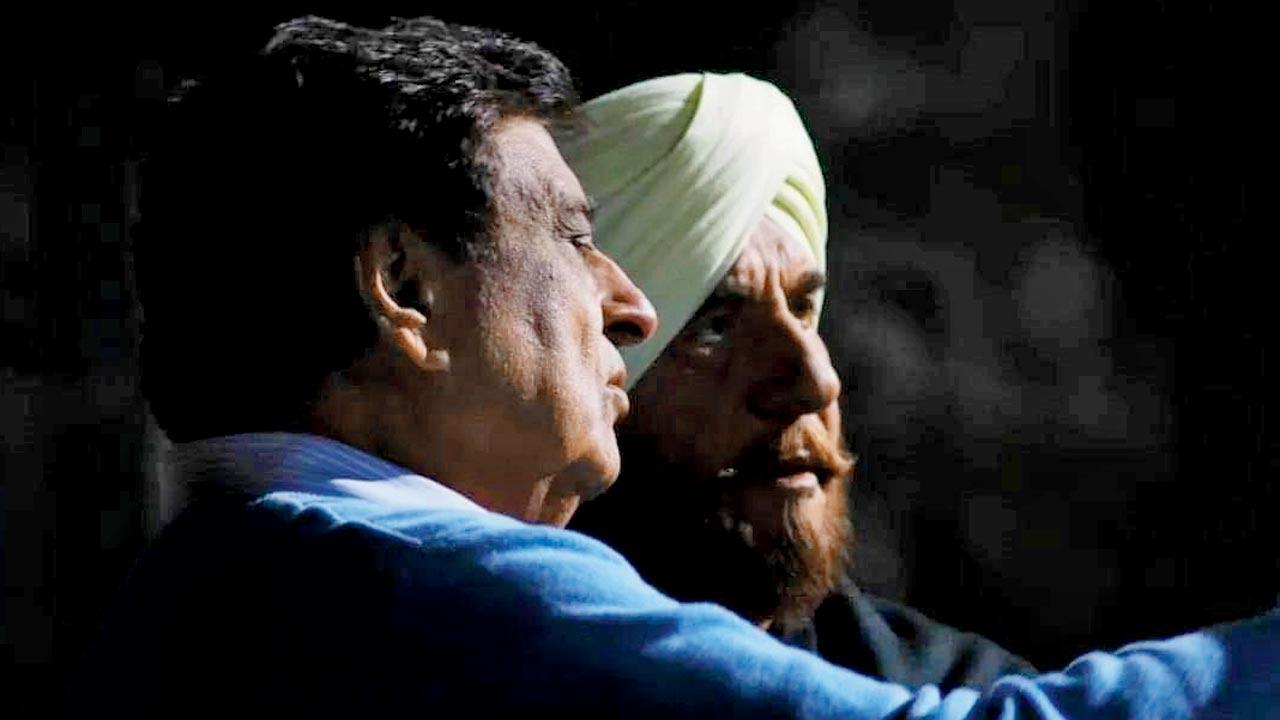
Bokadia with Raj Babbar
I still correct people when they say I work with my mother, Nadira Zaheer Babbar. I work ‘for’ my mother-Juhi Babbar
8:33 AM
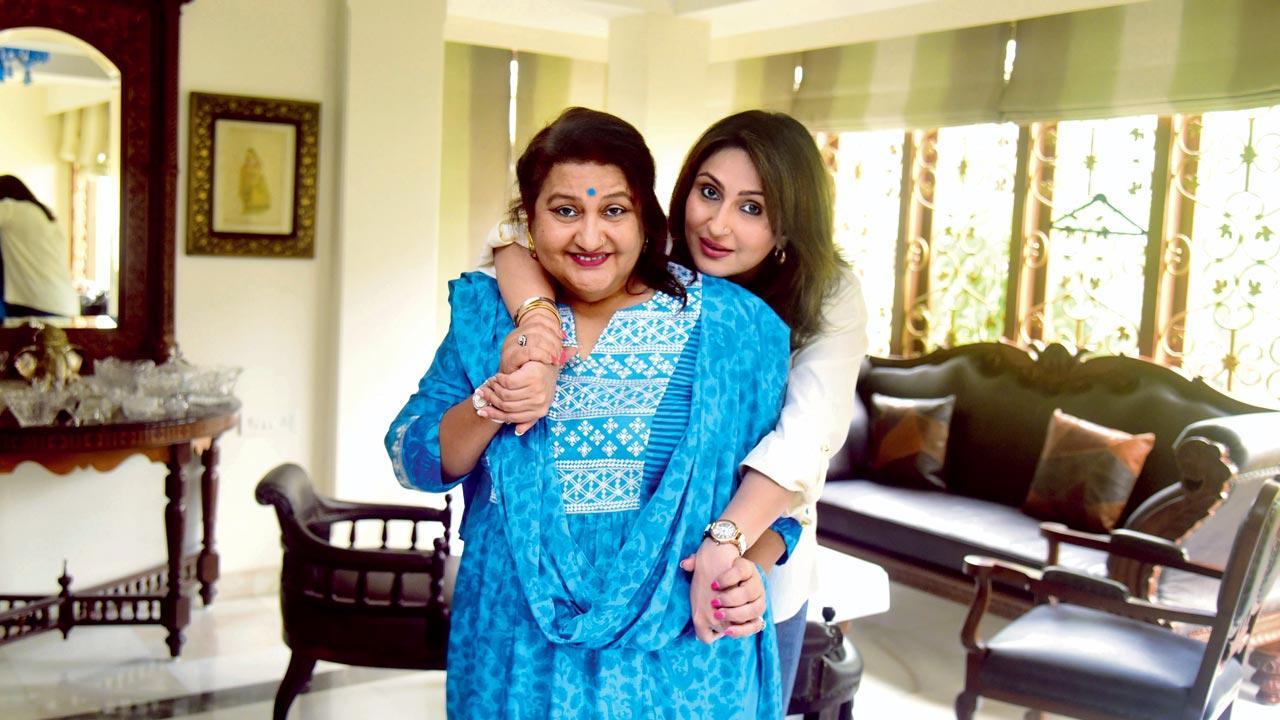
As their theatre group Ekjute enters its 41st year, Juhi Babbar hopes to see mom and legend, Nadira, on stage more often
Heena Khandelwal (MID-DAY; May 15, 2022)
It was in 1981, soon after shifting to Mumbai from Delhi, that Nadira Zaheer Babbar, an alumna of the National School of Drama (NSD), started her theatre company, Ekjute. The idea, she says, was to do theatre just as she was doing in Delhi.
“When things worked out well for Raj [Babbar], actors who were working with us back in Delhi too came to Mumbai looking for work. They wanted to work, do theatre… so we created Ekjute. The name symbolises the coming together of everyone,” says Babbar.
Her daughter, Juhi Babbar Soni, says Ekjute has always been family. “I was barely five years old when Ekjute was put together. Our house was home to so many theatre actors who had come down from Delhi [NSD], so everybody was either a chacha or didi… If my mother was stuck with something when we needed help with our homework, one of the actors would look into it.”
The initial members of Ekjute included Anupam and Kirron Kher, Satish Kaushik, Kavita Chaudhary, Raja Bundela, and Alok Nath, among many others. “Kirron worked in Chandanpur Ki Champabai, Satish directed Us Paar Ka Nazara,” she shares, adding that they eventually started getting parts in multiple television shows at a time, and couldn’t make time for theatre.
When asked whether she was hurt by this, she admits that she was. “It was painful, but I didn’t expect them to continue when they had things working out for them [in television and cinema]. How else would they make a living?”
Ekjute is now in its 41st year. Reflecting on her journey so far, she says, “Even I can’t believe it has completed 40 years. I never even dreamed of it; I only wanted to do theatre. However, today Ekjute is my life. It is difficult to say whether it is surviving because of me or I am surviving because of it.”
Although she describes theatre as soul sustenance, this wasn’t always the case. “I wasn’t good at studies,” she says, “While both my elder sisters were on the merit list in school, I was always scoring third division. They humoured me until I completed my BA. We had also moved to Delhi from Lucknow by then, and my sisters landed jobs. After I graduated, the entire family sat down together to discuss my career options. Nobody had an answer. Master of Arts was out, considering my marks until then. They even considered library science so that I could work as a librarian. I suggested I do nothing and eventually just get married! Coincidentally, my father met Ebrahim Alkazi [renowned theatre director, then the director of NSD] at a wedding reception and he suggested that I apply to NSD. I went but the classes didn’t interest me; I found acting and improvisation boring. However, a student cast me in his play for the final year exam, which did so well that my name was mentioned in a newspaper! A friend showed me a clipping of the article and I thought, ‘I can be good at something! I too have a skill’ and that’s how it started.”
Since then, there has been no looking back for Babbar. She was honoured with the Sangeet Natak Akademi Award in 2001, and Ekjute has produced close to 100 plays to date. They are as diverse as Yeh Hai Bombay Meri Jaan, which offers a glimpse into the lives of five people who move to Mumbai to pursue their dreams and live together in a small one-room apartment and Ji, Jaisi Aapki Marzi, a play about four women, at various stages of their lives, talking about their traumas; as well as Sakubai, the mono-act starring Sarita Joshi that looks at the lives of women we all call “bai”.
Almost all her plays have an underlying social message or delve into social issues, and no subject is beyond limits. One of her plays, titled Suman and Sana, is based in Gujarat and Kashmir, and addresses fanaticism. She says she inherited the political and social sensitivity from her father, Syed Sajjad Zaheer. He was a Marxist and founder of the Progressive Writers’ Movement. “It’s all because of what I heard around me,” says Babbar. Intellectuals such as poet and playwright Sheila Bhatia and playwright Mohan Rakesh (one of the pioneers of the Nai Kahani literary movement of Hindi literature in the 1950s) were frequent visitors to their residence.
Her daughter began her acting career with Ekjute. “Like any other person, I too had to attend a theatre workshop to enter Ekjute,” says Soni, “I worked backstage for close to two years; my experience in fashion designing helped with the costumes. In between, I got my first role in Yahudi Ki Ladki [written by Agha Hashr Kashmiri, it was also the first play that Babbar directed back in 1981. It explored the persecution of Jews by the Romans] and I played Shehzadi Desiya. In terms of importance, it was a supporting role. So it has been a step-by-step process for me.”
Soni marked Ekjute’s 40th year in theatre by writing, directing and acting in With Love, Aap Ki Saiyaara.
“We opened it in October 2021, in that brief period when life was returning to normal. It’s coming back again,” adds Soni, who has been touring with the play, which comes back to Mumbai at the Prithvi Theatre next week on May 22 and at the NCPA on May 28.
Currently, Soni has her finger in every pie baked by Ekjute. The most important one is the summer workshop for children aged between six and 12, where she works with 250 to 300 students. When asked when she took the reins of Ekjute, she replies, “I still correct people when they say I work with my mother. I work ‘for’ my mother.”
Ekjute’s new offering is a series of plays, including Kudugusu aur Shivji—a children’s play based on Sudha Murthy’s short stories—by Babbar. “I have been writing quite a few plays,” Babbar says, “one among them is a love story.”
And what are the plans for the decade? Soni says she wants her mother to be on stage more. “She is also a poet,” says the doting daughter. “One of her poems, which she wrote for her mother, became a one-and-a-half-hour-long mono-act titled Meri Maa Ke Haath. I hope to tweak it to make it more comfortable for her to perform now. It is lengthy and she is in her 70s.”
Babbar, who has also been busy writing new plays, agrees. “I want to do good roles so if I get a script, I would like to do it. Even in theatre, if someone has a lead role for me, I am happy to take it on, and if I write such play, I think it would be nicer to act and direct it as well.”

Raj Babbar pulls rickshaw, lends shoulder to Matheran
8:02 AM

Umesh K Parida (THE TIMES OF INDIA; March 14, 2022)
Navi Mumbai: Actor-turned-politician Raj Babbar, with a film crew, is currently in Matheran where Babbar pulled a hand-rickshaw in the hill station to showcase the plight of people on Saturday as part of a web series shoot. He took a number of rides in hand-pulled rickshaws. On seeing this film shoot, locals started demanding that the e-rickshaw trial commence sooner. Actors Atul Kulkarni, Ayesha Jhulka and director J D Majethia were also present.
The four, with over 200 crew members, are in Matheran since Tuesday. The crew stayed in a heritage bungalow. Raj Babbar pulled a hand-rickshaw at Matheran railway station and other locations and later enjoyed an amusement ride with a few rickshaw pullers.
“As photos of the film crew went viral on social media, we started a drive to support the e-rickshaw campaign to show our plight,” said Shivaji Shinde, a local.
Director J D Majethia said some of the actors declined to take a ride, citing the plight of the handrickshaw pullers, but he added that all workers must have a steady livelihood. “In some places, battery-operated vehicles have replaced hand-pulled ones; so why not in Matheran? However, the beauty of Matheran should be kept intact with battery-operated rickshaws,” said Majethia.
“Senior actors like Raj Babbar have shown the world the locals’ plight. Director J D Majethia also has appealed to the authorities to provide battery-operated rickshaws in the hill station to showcase it to the world,” said activist Sunil Shinde.
Damu Wagh, a hand rickshaw puller, said: “They were taken to Matheran railway station, Charlotte lake, and other places.”
Ambalal Waghela, another rickshaw puller, said, “I had brought Babbar from the parking area of Dasturi Naka to the heritage bungalow on Tuesday.”
The kind of cinema B R Chopra, Raj Kapoor, Guru Dutt used to make is coming back, thanks to OTT-Raj Babbar
8:12 AM

Titas Chowdhury (HINDUSTAN TIMES; January 4, 2021)
After 28 years in politics, actor Raj Babbar has now decided to recommence his career as an actor. In November last year, the former Member of Parliament, made his comeback with the web series Dil Bekaraar that marked his debut in the digital space.
“After my term ended, I thought of resuming acting. Fortunately, Dil Bekaraar came my way. Now, I’m being offered many films and web series,” he says, adding he featured in small roles in his friends’ films while busy with politics.
Like everyone else, Babbar, 69, has been caught by the OTT bug and wants to be a part of more web shows. “During the lockdown, I watched a few good shows and some amazing performances by actors from India as well as the world. That, subconsciously, had an effect on me. OTT platforms are a win-win situation for actors as well as filmmakers and writers. The medium completely belongs to them and we, actors, can do wonders now that we can showcase so many nuances,” he elaborates.
But what has truly captured his attention is the return of good content. “I grew up watching films made by filmmakers Guru Dutt, Satyajit Ray, Raj Kapoor, Ritwik Ghatak, Mehboob Khan, V Shantaram, and B R Chopra. I feel the kind of cinema these stalwarts used to make is coming back, thanks to OTT,” he says.
Quiz Babbar about the young lot of actors and he says, “They’re energetic and brilliant. They work hard and have the power to grasp the audience’s attention. They’re aware of the current atmosphere and so, they become prepared.”
Image: Papa Raj Babbar dances at Prateik’s Lucknow wedding
2:41 PM

Actor and his bride, Sanya, who tied the knot on Jan 23, will host a flapper-themed party on Friday
Avinash Lohana (MUMBAI MIRROR; January 25, 2019)
Mirror (January 8, 2019) was the first to report that after getting engaged last year, on January 22, Prateik Babbar and his writer-director-editor girlfriend, Sanya Sagar, would tie the knot in Lucknow in a two-day ceremony on January 22 and 23. The couple got married in a traditional ceremony on Wednesday, which was preceded by a mehendi and haldi function on Tuesday. The shaadi was followed by a reception for the family.
“It was a great wedding. Prateik is the baby of the house and him getting married is an amazing feeling. God bless Sanya and him,” an excited sister Juuhi told Mirror. Her actor-husband Anup Soni, brother Aarya with wife Jasmine and filmmaker Kishan Babbar with his daughter Kajri were also present on the occasion. Prateik’s actor-politician father Raj Babbar shook a leg to “Bachna Ae Haseeno” with guests. “We all go mad once the music starts playing. It was one of the biggest days in my father’s life. It is rare to see him dance but he did a lot of it at the wedding. He was very happy,” she beams.
Prod her on the newly-wed couple’s honeymoon plans and she informs, “They aren’t going on one at the moment as Prateik is tied up with work but might take up the holiday later. Meanwhile, Prateik is hosting a flapper-themed party on Friday for friends and colleagues from the film frat,” she signs off on a rush.

Why this short film by Zara Khan and Raj Babbar's niece Kajri is a must-watch
8:14 AM

Salma Agha's daughter, Zara Khan, and Raj Babbar's niece, Kajri, bring a short film on a Punjabi bride's determination to track down the NRI groom who had abandoned her
Dinesh Raheja (MID-DAY; March 25, 2018)
Three-and-a-half decades ago, singer-actress Salma Agha and actor Raj Babbar made waves with the 1982 blockbuster Nikaah; now Babbar's niece Kajri Babbar and Agha's daughter Zara Khan (aka Sasha Agha), have joined forces to make a short film, Khoj, on the subject of young Punjabi brides who are abandoned by their NRI husbands. Khoj is scheduled to open at the Shorts Corner at the Cannes film festival in May 2018, and Zara is excited at the prospect of walking the red carpet.
In the film, however, Khan doesn't sport a glamorous look. The actress says, "I play a 19-year-old from a small village in Punjab who can't speak English properly and is married off to an NRI. Abandoned by her husband, she tracks him down in London. It was difficult for me to relate to my character's way of living and her body language, but her spirit appealed to me. Nothing can break her. And this is something I wish for women of all ages."
Director Kajri Babbar, currently completing her Masters in film direction at Arts University, Bournemouth, UK, speaks on the issue her film tackles with the fervour of youth, "I wanted to tell the world the story of a strong Punjabi woman. During my research, I contacted the NRI wing of Punjab Police and they connected me with women who had been deserted by their husbands. What shocked me was that most of the girls were still in their teens!"
Zara acknowledges the role that her and Kajri's shared family history played in getting them together for this project. "Thanks to mom and Raj uncle's association, we all are very close," she says. When she saw Kajri's first short film, Pardaa (2017), Zara messaged the director expressing her desire to work with her. Kajri responded with the script of Khoj. "We did a reading through Skype and she thought I was perfect for the role. Together, we created Gurpreet Kaur Bedi."
Though mother Salma chided her for letting her "monkey ears" show on screen because of her character's hair-pulled-back look, Zara is all praise for the film's makeup artist Charlotte Annice Spruch for making her character look authentic. Zara's personal contribution was: "long hair that really helped me look like a sardarni."
By agreeing to look her part, Zara won over Kajri who had been sceptical about the actress' willingness to accept the deglamorised part of a pregnant young girl with chapped lips and dark circles under her eyes. Zara reasons, "My job as an actor is to look the part, so paint me red, blue, yellow, or do whatever because when I'm in front of the camera, I submit myself to the director completely. I can look pretty at any given time, but to look real is my kind of beautiful."
Realism enthuses Kajri too. Groomed and raised to be a socially responsible individual, the director believes that her work should convey her convictions. Kajri attributes the fascination for NRI grooms to the belief that "India is still living under a colonial hangover. We believe everything from abroad is better including the food, money, cars, brands, government and even Indian men born on foreign land."
She adds, "In a country like ours, women should stand together and help each other but we hear several horrible cases of mothers-in-law torturing their daughters-in-law or even grandmothers abandoning their granddaughters because they are female. The issue of patriarchy becomes even more complex with the participation of women; and that frustrates me the most. This film was my subtle way of conveying the frustration."
The climax of the 28-minute film offers education as the key to empowerment. But Kajri agrees that the problem needs to be addressed at various levels. She cautions against choosing a life partner in haste and says, "Families should conduct a proper background check on the groom; from the passport to the bank accounts, everything should be verified. And it is crucial for any woman to have legal proof of marriage especially if the man is a citizen of another country."
Zara draws solace from the fact that "Union Minister Kiren Rijju went to the United Kingdom and negotiated an agreement to resolve the issue of Indians abandoning wives and aged parents back home in India." For Zara, Khoj is her chance to set her film career back on track after her debut Aurangzeb failed. Zara smiles, "A YRF film is every actor's dream launch but unfortunately Aurangzeb did not do well and everyone presumed that I was just a pretty face. But whoever has seen Khoj has said, 'Oh we didn't know you were such a good actor!'"

Kajri Babbar
After Parliamentary discussion, what’s in store for Padmavati now?
8:36 AM

At the Parliamentary discussion on Padmavati, the 30-member panel concluded that a decision regarding the film’s release lies with the CBFC and its chief Prasoon Joshi
Lasyapriya Sundaram (BOMBAY TIMES; December 2, 2017)
Had everything been smooth running, Sanjay Leela Bhansali would have released his period drama, Padmavati on December 1 all over the world. For the last few weeks, various political outfits, fringe bodies and state CMs have been lashing out against the content of the film as perceived by them, which forced the makers to shift their release date expecting high tension around the release.
Bhansali and Prasoon Joshi, the chief of the Central Board of Film Certification (CBFC), were in Delhi on Thursday to meet a Parliamentary panel to discuss the controversy surrounding the film. It was a 30-member panel, spearheaded by Anurag Thakur (former chief of BCCI), which included actor MPs like Paresh Rawal and Raj Babbar, as well as officials from the Ministry of Information and Broadcasting. The meeting is said to have lasted over two hours. When BT reached out to Anurag Thakur, he said, “I am not at liberty to discuss what happened inside the Parliament.” When we asked him if there was an outcome in the offing, he said, “The outcome will be decided by Prasoon Joshi and his committee at the CBFC. Over the next few days, they will decide. You will have to wait for that.”
Apparently, a few members of the panel want the Censor Board to make the final decision on the issue. While some wanted to ban the trailer, others questioned the film’s certification in the United Kingdom. Prasoon has maintained that he hasn’t seen the film yet, while Bhansali insisted that the movie is not based on history but on a poem written by Malik Muhammad Jayasi.
A new release date for the film is yet to be decided. There is talk that the makers may opt for January 12, January 26 or February 14, 2018. We reached out to Paresh Rawal for a comment but were told that he is out of the country. Prasoon Joshi was unavailable at the time of going to press.
Gulzar's unreleased 1988 film Libaas to finally release this year
7:48 AM

Sonil Dedhia (MID-DAY; August 19, 2017)
Naseeruddin Shah, Shabana Azmi and Raj Babbar starrer Libaas, which was helmed by Gulzar, is finally getting a theatrical release, almost 30 years after it was made. Based on the short story Seema penned by the poet-lyricist, the film revolves around extramarital relationship and adultery.
Turns out, the film was not released upon its completion in 1988 as the producer, late Vikas Mohan wanted a different ending to the story. When Gulzar refused to alter the end, Mohan decided to can the film altogether. Now, the late producer’s sons Amul and Anshul Mohan, along with Zee studios, are planning to release the film by the end of the year.
Says Amul, “We’re in the process of locking a release date. We don’t want to clash with a big film, as the essence of Libaas will be lost.”
He further adds that the team intends to promote the film like any other new release. “We are planning a full-fledged marketing campaign, and hope to promote the film with the cast. There has been a huge section of the audience that has waited for this film to release. So, we also want to restore the original print and enhance the print quality when we release the film.”
Libaas was first shown at the International Film Festival of India (IFFI) in Bengaluru in 1992, followed by another screening at the same festival in 2014.
Evolution of the rape scene: Scenes of sexual assault on women are now shot more sensitively
8:13 AM

Clockwise: A still from Kaabil; Mom; Prem Granth; Damini and Matrubhoomi
Deepali Singh (DNA; August 5, 2017)
Hindi filmmakers are often trashed for their depiction of women on screen, for making eveteasing acceptable, for not giving women meaty roles, not making female-centric films, degrading women by making them do item songs... The list goes on. It’s time to give them some credit. Something changed when no one was looking. Graphic rape scenes, a staple in Hindi films for over three decades, vanished from our films.
From then to now
There was a time when you saw an unknown actress playing the role of the hero’s sister, you could bet that she would get crudely raped at some point in the film. Such scenes were weaved in the script. For decades, Hindi films have shown scenes or sexual assault with little or no sensitivity. I remember a particularly disturbing rape scene filmed on Shilpa Shirodkar and Anupam Kher in Bhrashtachar on a round revolving bed, shot in slow motion. It was clearly designed to titillate. Unfortunately, many such scenes were filmed for that explicit intention. They were uncomfortably long and graphic, with attention to detail. But such rape scenes slowly (and thankfully) disappeared.
Recall the 1980-film Insaf Ka Tarazu where Raj Babbar rapes Zeenat Aman and later, commits the same crime with her younger sister, played by Padmini Kolhapure? The scenes left nothing to the imagination. A number of films made during the ’80s and ’90s in Bollywood depicted rape sequences in graphic detail. Thankfully, that is where the filmmakers of today’s generation are different, or at least, are trying to be. Cut to 2017. There were two releases with the rape-revenge theme. Kaabil — in which Hrithik Roshan sets out to seek revenge for his wife’s rape. And Mom in which Sridevi seeks to wreck hell on the men who ravaged her daughter. I was reluctant to watch both films because I knew it involved molestation scenes. But I needn’t have worried.
The rape scene
Two men pick up a girl in a red dress as she struggles. Another comes running and lifts her up and she is thrown into the car. A hard punch on the face leaves her stunned. An aerial shot shows the car moving along the deserted streets of Delhi, with only the stray dogs for company. The eerily haunting music that accompanies the shot is enough to give you the chills. After a while, the car stops. The two men in the front exchange seats with the two men at the back. The car is back on the road and so is the music. Nothing is shown, yet the audience knows exactly the nature of the crime taking place inside the moving vehicle. That is how the gang rape scene was shown in Sridevi’s Mom. There was no tearing of the victim’s clothes, flashes of bosom and thighs, or men leering over her. We have come a long way. I came away with respect for the director Ravi Udyawar. Ditto for Kaabil and Sanjay Gupta for filming the dual rape scenes in his film.
Being sensitive
There is no doubt that in recent times, filmmakers have become sensitive to how rape scenes are shot and presented. Even Udta Punjab proved that the filmmaker can get the point across without getting into graphic details to relate the horror of the crime across to the audience. For director Onir, no rape sequence has come across as powerfully as the one in Bandit Queen. “It takes a director of Shekhar Kapur’s intelligence and sensitivity to portray such a powerful scene in Bandit Queen. It really shatters you. In recent times, I think the scene that made an impact was in Udta Punjab, also because of the way Alia Bhatt portrayed it. It was heart-wrenching,” he says. Some of Onir’s films such as Bas Ek Pal and I Am have dealt with the issue of rape, specially male rape, but the filmmaker insists that he would never show it. “I would show as little as possible and go to the before and after of it, not the act itself,” he adds.
Thank the censor board!
Akshaye Rathi, film exhibitor, columnist and entrepreneur, believes that there are multiple reasons for the new found sensitivity. “One, is that you can only show that much. If you try and do more, then there is something called the CBFC, which will chop it off. And rightly so, because rape is a hideous crime and you don’t want to influence young minds by showing anything of that sort. One needs to subtly, yet effectively get the horror across,” he explains.
Along with the changing mindsets of both the filmmakers and the viewers, what has resulted in this outcome, believes Girish Johar, film and trade business analyst, is the social awareness surrounding the crime. “Filmmakers don’t want to highlight the act, but instead focus on the evils of the crime. Titillation is not the agenda anymore,” he says. Rathi makes another interesting point. Storytelling in general has undergone an evolution, so things are bound to change, “Even the mindset of the movie goers has changed. Evolution is the name of the game and that’s how it will be.”
Less skin, more horror
Rajkumar Santoshi’s Damini (1993) was appreciated for the manner in which the filmmaker shot the horrific sequence. As the four men muffled the maid’s mouth, the audience is drawn to the expressions on Meenakshi Sheshadri’s face as she watches the crime take place in front of her eyes. “When I shot Damini, the idea was to let the audience view the scene from Damini’s point of view. I wanted their expressions to be as horrified as Meenakshi’s, as they are trying to feel what she is feeling,” he says. The filmmaker believes that while aesthetics should definitely play its role, the magnitude of the crime also has to reach the viewers. “As a director, I feel there has to be a balance between them. Yes, the audience should appreciate the way it has been shot, but they should also be moved by it. They should feel anger at the act. That is the reason I shot Meenakshi’s close-ups of her horrified expressions or Rekha’s expressions when the crime is being committed in my film Lajja,” he adds.
Director Sanjay Gupta, whose Kaabil received rave reviews, seconds Santoshi’s stand. “I don’t think any of us is interested in showing rape to titillate the audience,” he says. In Gupta’s film, the heroine is raped twice but the actual act is left to audience’s imagination. “My film was not so much about the rape, but about its aftermath. It was not about how she is getting raped, it’s about what happens after that. I don’t think graphic details were needed. It is a horrific act by itself,” he adds.
It seems that as long as the message is getting across, filmmakers want to spare audiences the gory and gruesome details. And thank god for that!
Why is Raj Babbar always missing from functions commemorating his late wife Smita Patil?
7:30 AM

Subhash K Jha (DNA; December 18, 2015)
It has happened before on several occasions.
Actor-parliamentarian Raj Babbar hardly ever attends events held in
memory of his late wife Smita Patil.
Recently, a book on Smita by journalist Maithili Rao, was released. While Smita and Raj’s son Prateik attended, along with many prominent admirers and friends of the actress, Raj was conspicuous by his absence.
Earlier this week, the Smita Smriti Puraskar function, an event in Nagpur where unsung heroes are honoured every year, was attended by Smita’s son Prateik, but not his father.
When asked the reason for his absence from the events held in his wife’s memory, Raj said with a laugh, “It’s partly intentional and partly because I am not invited. But I am glad Prateik attends these events. They give him a chance to get to know his mother.”
Without any struggle I had landed my big break-Salma Aagha
7:39 AM

Roshmila Bhattacharya (MUMBAI MIRROR; May 26, 2015)
Her maternal grandmother, Anwar Begum, had acted in Heer Ranjha with her grandfather Jugal Kishore Mehra in 1932 and her mother, Nasreen, with K L Saigal in AR Kardaar's Shahjehan in 1946. But surprisingly, light-eyed beauty Salma Aagha was more interested in a career in singing rather than acting. She was in the recording studio for a song rehearsal with Naushad for Chanakya Aur Chandragupta when producer B R Chopra walked in, took one look at her and said, "Yeh meri Nilofer hai!"
His composer-friend tried telling him that Salma was there as a singer, but Chopra was adamant about casting her as the female lead in his upcoming social-drama, Nikaah, and asked her to meet him the next day. He was a good friend of her grandfather's who had been with All India Radio before he entered films like Chopra, who was a journalist. So she went along and he once again reiterated that she was playing the lead in his film.
"That was it! Without any struggle I had landed my big break and I didn't even realise it then," laughs Salma recalling her entry into Bollywood over three decades later.
She was a complete novice but Chopra was the patient mentor-director, explaining every technical detail minutely to her, and Salma put her heart into her performance. So much so that after one particular scene she was so distraught that she just wouldn't stop crying even after the camera stopped rolling.
"Raj Babbar who played my second husband in the film and who has remained a good friend since, reprimanded me saying, 'Why do you take things to heart? It will make you ill.' But I continued crying," she laughs.
Chanakya Aur Chandragupta never got made but Nikaah, earlier titled Talaq, Talaq, Talaq, based on the Sharia laws of divorce and its misuse, opened in 1982. Made on a modest budget of Rs 19 lakh, it was a superhit.
"It was the story of every second home. I work for two NGOs, I've come across many instances of men messing up and women having to pay for their mistakes," says the film's singer-actress who was an overnight sensation.
Salma points out that many singers since have come up with remixed versions of Dil ke armaan aansoun mein bah gaye, even she is coming up with one with my daughter Sasha.
"But none of these versions have been as successful as the original, not because these singers aren't good but because my voice was unique at the time," she reasons.
She adds that many, including the film's composer Ravi, had tried to dissuade Choprasaab from using her voice, insisting he go in for another playback singer. But he was adamant. He not only got her to sing Dil ke armaan but also another solo, Faza bhi hai jawaan jawaan, a duet with Mahendra Kapoor, Dil ki yeh aarzoo thi koi dilruba mile and Chehra chhupa liya hai kisine hijab mein with Mahendra Kapoor and Asha Bhosle. "Dil ke armaan released before the film and was an instant hit. But I didn't know then that this fairly simple song would be evergreen," she admits.
After the film opened she'd visit theatres incognito to gauge people's reactions. And she was overwhelmed when, as she'd heard, she saw people streaming into the darkened auditorium just before Dil ke armaan came on screen. "When it started playing there would be shower of coins and after it was over, all those who had stepped in for a dekko would go away and the doors would shut quietly," she smiles.
Salma didn't win the Filmfare best actress award despite being nominated but she did return home with the black lady after being adjudged the best playback singer (female) for Dil ke armaan. She admits that with Lata Mangeshkar and Asha Bhosle also in contention, she didn't think she stood a chance of winning and was happily talking to someone when suddenly she heard her name being announced.
"The auditorium was packed and everyone was looking at me. For a moment my heart stopped beating. Then I stood up and walked to the stage to collect my first Bollywood award," she smiles.
Aarya Babbar is dating Ludhiana girl Jasmine
7:41 AM

Neha Maheshwri Bhagat & Lakshmi V (BOMBAY TIMES; January 21, 2015)
Aarya Babbar
seems to have found love this time around. The actor is in a
relationship with Jasmine, a Ludhiana girl, for a year now and has been
trying to keep it low-key.
 However, a source close to the star son
revealed details about the girl. “Jasmine is not from the industry.
She moved to Mumbai some time back. She had even sent a stuffed toy to
Aarya during his stay inside the Bigg Boss house.“
However, a source close to the star son
revealed details about the girl. “Jasmine is not from the industry.
She moved to Mumbai some time back. She had even sent a stuffed toy to
Aarya during his stay inside the Bigg Boss house.“
Apparently, Aarya's family has met Jasmine and blessed the couple. When asked if a wedding is on the cards, the source said, “We don't know about that, but going by the seriousness of the relationship, it may happen anytime soon.“
When contacted, Aarya refused to comment on the news.
Raj Babbar, who is enjoying his stint on the small screen with Pukaar, told us, “My prime concern while choosing TV was that I should do a role that matches my age and personality. And I'm glad I got something that suited me perfectly.“
On the home front, is it true that he is bride-hunting for son Aarya? “I think he has found love. He's introduced the girl to us and got s our acceptance. If he's ready, we will happily arrange his wedding,“ he says, and adds, “For now, he is working on a film that he wants to make.“
However, a source close to the star son
revealed details about the girl. “Jasmine is not from the industry.
She moved to Mumbai some time back. She had even sent a stuffed toy to
Aarya during his stay inside the Bigg Boss house.“Apparently, Aarya's family has met Jasmine and blessed the couple. When asked if a wedding is on the cards, the source said, “We don't know about that, but going by the seriousness of the relationship, it may happen anytime soon.“
When contacted, Aarya refused to comment on the news.
Raj Babbar, who is enjoying his stint on the small screen with Pukaar, told us, “My prime concern while choosing TV was that I should do a role that matches my age and personality. And I'm glad I got something that suited me perfectly.“
On the home front, is it true that he is bride-hunting for son Aarya? “I think he has found love. He's introduced the girl to us and got s our acceptance. If he's ready, we will happily arrange his wedding,“ he says, and adds, “For now, he is working on a film that he wants to make.“
Panchamda yaad aa gaye, says Gulzar as Libaas finally premiered at IFFI after 26 years
7:52 AM

Ankur Pathak (MUMBAI MIRROR; November 24, 2014)

Gulzar's Libaas a film
made in 1988 but never released finally premiered on Saturday at the
International Film Festival of India in Panjim, Goa. The
veteran poet-lyricist-filmmaker presented the film with Vishal Bhardwaj
and daughter Meghna by his side.
“I feel like a school kid appearing for an exam,“ the 80-year-old
Dadasaheb Phalke award winner confessed before the screening.
“The dubbing quality could be bad. Maybe we might not get to hear some
of the dialogue,“ he warned. Gulzar's words were
proven wrong as the film was screened without any technical hiccups. “What a relief!“ quipped the
filmmaker as the end credits rolled.
Set in Mumbai, Libaas stars Naseeruddin Shah and Shabana Azmi as a married couple working in theatre together. The marriage begins to crumble as the conflict on stage begins to seep into the reality of the duo's life. Things get worse when Naseer's wealthy, charming best friend, played by Raj Babbar, enters the scene and is attracted to the character played by Shabana, with whom he starts a relationship.
Although the film was in the cans for so long, its music found a way to the hearts of people and the film is today remembered for songs like Phir kisi shakh ne, Khamosh sa afsana and Silli Hawa Chhoo Gai, composed by RD Burman. “Pancham da yaad aa gaye,“ an emotional Gulzar said after receiving a fiveminute standing ovation.
He admitted that his biggest fear was that the film might look dated. “But whoever has written it did a bloody good job!“ smiled the writer-director of the film, pointing out that even after almost three decades, the themes it explores the disintegration of marriage, infidelity, the thin line that separates reality from fiction--remain relevant. “Human relations are so incredibly complex, there are several layers which you can keep uncovering. It will never go out of fashion. What excites me is the study of human nature it is something I draw from real life. It never fails me.“
Right from the producer not being able to secure a release, to the Censor Board deeming it too 'bold' for public consumption, there are several theories about why the film was in cold storage for so long. The film's producer Vikas Mohan says, “Gulzar's last few films had flopped. So we couldn't take the risk of releasing it then.“ But ask Gulzar about it and he ducks the question with his trademark wit. “Libaas was in the dry-cleaning. It took a while. I'm glad it's out now,“ he laughs.
Set in Mumbai, Libaas stars Naseeruddin Shah and Shabana Azmi as a married couple working in theatre together. The marriage begins to crumble as the conflict on stage begins to seep into the reality of the duo's life. Things get worse when Naseer's wealthy, charming best friend, played by Raj Babbar, enters the scene and is attracted to the character played by Shabana, with whom he starts a relationship.
Although the film was in the cans for so long, its music found a way to the hearts of people and the film is today remembered for songs like Phir kisi shakh ne, Khamosh sa afsana and Silli Hawa Chhoo Gai, composed by RD Burman. “Pancham da yaad aa gaye,“ an emotional Gulzar said after receiving a fiveminute standing ovation.
He admitted that his biggest fear was that the film might look dated. “But whoever has written it did a bloody good job!“ smiled the writer-director of the film, pointing out that even after almost three decades, the themes it explores the disintegration of marriage, infidelity, the thin line that separates reality from fiction--remain relevant. “Human relations are so incredibly complex, there are several layers which you can keep uncovering. It will never go out of fashion. What excites me is the study of human nature it is something I draw from real life. It never fails me.“
Right from the producer not being able to secure a release, to the Censor Board deeming it too 'bold' for public consumption, there are several theories about why the film was in cold storage for so long. The film's producer Vikas Mohan says, “Gulzar's last few films had flopped. So we couldn't take the risk of releasing it then.“ But ask Gulzar about it and he ducks the question with his trademark wit. “Libaas was in the dry-cleaning. It took a while. I'm glad it's out now,“ he laughs.
I did Pukaar because it was being made like a film-Rannvijay Singha
7:37 AM

Rannvijay Singha talks about his debut fiction show and his films
Namrata Thakkar (DNA; November 20, 2014)
Rannvijay Singha has hosted reality shows and acted in
quite a few films. Though he is a popular face, the Roadies host still
has a long way to go as far as Bollywood is concerned. Yes, he has few
films lined up but for now the good looking actor is gearing up for his
first fiction show Pukaar: Call For The Hero. We caught up with
Rannvijay to find out more about his serial..
You were supposed to join the Indian army but destiny had other plans for you. In Pukaar you play an army officer. Has life come full circle for you?
It has…it’s like homecoming for me. My father is still serving in the Indian Army. He is a Lieutenant General and he is serving in Syria. My chacha is a Major General and my younger chacha is Colonel. So it seems like all their desires and wishes have been granted and I am getting to live an army officer’s life, at least, briefly. The fact is that I do know all the nitty gritty that goes into being an army officer and that has helped me in playing this character.
Do you think your family will be most critical about you show?
My family is critical about everything I do. At the same time, none of them is from the industry so they kind of respect all the hard work that I have put in but in this case they might come up with, ‘you know this is not possible’ or ‘aise thodi na hota hai.’ They may say you should have done this or you should have used that language. You know army officers usually speak a lot in English. But the thing is as soon as I start doing that with my character, I will be alienating a lot of people who don’t understand that. So, sometimes when you’re doing a show which is made for entertainment, you need to make sure that people understand what you’re doing or saying. I don’t know if army officers talk like my character Rajveer Shergill does in the show but then that’s only because we want the audience to understand what we are trying to convey. Also, we are not using a lot of lingo which is used in the army as only army personnel will understand that.
Pukaar is an hard-core action show. Did you undergo any training for the same?
The thing is I have always been very active all my life with martial arts and stuff like that. Last year, I did a show called Rann VJ Run where I practiced Parkour and all my Roadies experiences and the life that I led before that thanks to my Dad, has been used here. Also, Vipul sir (Vipul Amrutlal Shah) knows me since London Dreams and Action Repalyy days. He knows my ability to do different things and we have used most of my capabilities in a good way during action sequences. Of course, I did lot of cable practices, martial arts flexibility and also spent some time with Vicky Arora who is a martial art fight choreographer. Few days before the shoot, we would choreograph the fight scenes so that on the day of the shoot it’s less time consuming and easy.
Was it easy for you to play the role of Rajveer Shergill?
Having knowledge about something doesn’t mean it will be easy when you do it. I know how to hit a sixer but in reality to do that it’s tough. You have to put all your knowledge into practice. There are dialogues which are intense. I have a lot of intense scenes with Raj Babbar who is playing my father and even action sequences are tough. Nevertheless, when you do tough things, you feel better, you get a better self satisfaction and you’re happier. But yes it’s tough. It’s actually a very gruelling schedule. If you equate the kind of work we are doing, we are actually shooting 12 films. Twenty four hours of a movie are being shown in one hour episode each. If you put that together then it’s 12 full-fledged two hour movies we are shooting in a span of eight to nine months. That means we are shooting every day back-to-back. It’s very intense but we all are consumed by it so it’s good.
Are the makers planning to take things forward and come up with season 2?
That purely depends on Vipul sir and the channel. But yes they are already hinting at season 2 because we are not going to extend the series like other serials. How we are different from the other daily soaps is that our show will have a definite end. The kind of equipment used on the show, the people involved in the show and the scale at which the series has been shot is all larger-than-life. A lot of movies you see won’t have such production quality and action sequences. If we do it in these 24 episodes, we will achieve what we want and then we can go forward and make another season. But we won’t drag it like a daily soap.
Did you watch action shows to prepare for your role?
There is no picking up cues when you’re already working with a guy who has made films like Commando, Holiday and Force. So in the action genre Vipul sir is a success. What I watch generally are shows like Homeland, Breaking Bad, Modern Family and Prison Break. I like series which are like mini movies because they have great production scale, amazing performance and plot.
Lastly, will you be focusing only on television henceforth or would you be working in films as well?
This is my debut in television fiction. I have never acted on small screen and I was never going to because what you see on Indian television an actor would do it only because it’s a steady source of income and popularity. As actors they were not satisfied. I did Pukaar because firstly we were making it like a huge film. Even the performances are very natural like in a film. Not over the top or dramatic. That’s why I did it. As for films, 3 A.M. released recently and I am doing another film which is releasing on January 16. It’s called Sharafat Gayi Tel Lene with Zayed Khan. As soon as Pukaar finishes, few films are lined up for which I will shoot in March and April. Also, I have done a film with Abbas Tyrewala called Mango which has Swara Bhaskar, Monali Thakur and Chandan Roy Sanyal toh wo bhi release hogi. Movies are happening side by side. There are a few Punjabi films as well but I have asked them to shoot it with someone else or wait a little bit.
Subscribe to:
Posts (Atom)