Showing posts with label Raanjhanaa. Show all posts
Showing posts with label Raanjhanaa. Show all posts
NCLT upholds Aanand Rai's plea in row with Eros International
9:54 AM

Maulik Vyas & Rajesh N Naidu (THE ECONOMIC TIMES; May 5, 2026)
The National Company Law Tribunal (NCLT) has allowed filmmaker Aanand L. Rai’s application to refer a dispute between him and a listed movie production house Eros International Media Ltd (EIML) to arbitration.
The division bench of judicial member Sushil Mahadeorao Kochey and technical member, Prabhat Kumar, while allowing the filmmaker’s application, observed that the petition filed by Eros is a ‘dressed-up petition’ instituted with the sole intent of ‘circumventing the arbitration’ contractually agreed upon by the parties and is therefore vexatious in nature.
“Although the petitioner (Eros) has claimed certain reliefs by way of declaration and injunction under the garb of alleged oppression and mismanagement, a holistic reading of the petition, its pleadings and the reliefs sought points to it being a dressed-up petition,” said the tribunal in its April 28 order.
The genesis of the dispute lies in the term sheet signed by the parties in 2014, under which Eros International had acquired a 50% stake in Colour Yellow Productions Pvt Ltd, a company founded by Rai and his wife. The agreement split the responsibilities between parties, allowing Rai creative control while vesting Eros with authority over financing, budgeting and other production decisions.
Under the term sheet, it was agreed that Colour Yellow Productions could collaborate with third parties only if Eros International declined to fund the project.
However, the dispute between the parties began in 2019-20, with Eros International alleging mismanagement at the company, diversion of funds, and Rai's non-disclosure of financial information to the company. The company also claimed it was excluded from key management decisions despite being an equal shareholder.
Countering this, Nausher Kohli and Prachi Wazalwar, advocates appearing for Rai, argued that the 2014 term sheet and a subsequent 2023 agreement both contain arbitration clauses. Therefore, as per the arbitration clause in the term sheet, the dispute ought to be referred to arbitration.
Rai’s lawyers also argued that the entire petition under Sections 241-242 of the Companies Act, 2013, is dressed up to avoid the agreed-upon forum of arbitration between the parties.
When contacted, Pradeep Dwivedi, group chief executive of EIML said Eros remains committed to protecting its rights and is actively evaluating all legal options available to it, including appropriate appellate remedies.
“Our position has consistently been that the matters in question involve serious issues of oppression and mismanagement, including concerns around financial governance and related-party transactions at Colour Yellow Productions which we believe merit full and proper adjudication,” said Dwivedi.
“We are confident that the appropriate forum will allow the complete facts to be brought on record, and we will continue to pursue all necessary steps to safeguard the interests of the Company and its stakeholders,” he added.
The tribunal, while allowing an application filed by Rai and disposing of Eros International’s petition, observed that the petition is nothing but an attempt to circumvent the agreed arbitration clause under the term sheet and may also amount to an effort to oust the respondents (Rai and Colour Yellow Productions), who are the original promoters of the company.
The moviemaker Rai and Eros have been at loggerheads at multiple judicial forums. In January, Eros International approached the Bombay High Court, accusing Rai and his production house Colour Yellow Media Entertainment of allegedly illegally riding on the goodwill of its 2013 blockbuster ‘Raanjhanaa’ while promoting and releasing the 2025 film ‘Tere Ishq Mein’.
Eros files Rs. 84-crore copyright suit against director Aanand L Rai
9:25 AM

Vinay MR Mishra (BOMBAY TIMES; January 17, 2026)
Eros International Media Ltd has approached the Bombay High Court accusing filmmaker Aanand L Rai and his Colour Yellow Media Entertainment LLP of illegally riding on the goodwill of its 2013 hit Raanjhanaa while promoting and releasing the 2025 film Tere Ishk Mein. In a commercial IP suit and a related interim application, Eros has alleged trademark infringement, copyright infringement, and passing off, claiming that Tere Ishk Mein was deliberately projected as a “spiritual sequel” to Raanjhanaa, without any permission. Eros is demanding Rs. 84 crores as compensation for the damages done by Rai.
Eros has named multiple parties in the suit — apart from Aanand L Rai and the Colour Yellow Media Entertainment LLP, the defendants also include Super Cassettes Industries (T-Series), writer Himanshu Sharma, and Netflix Entertainment Services India LLP, making it a multi-party copyright and trademark battle over Raanjhanaa and Tere Ishk Mein.
What is the case about?
According to the complaint, Eros says it is the producer and “exclusive owner of all intellectual property rights” in Raanjhanaa, including copyright, trademarks, characters, dialogues, and sequel and remake rights.
The suit states: “The Plaintiff is the producer and exclusive owner of all intellectual property rights in the highly successful Hindi language film ‘Raanjhanaa’ including without limitation… copyright, registered trademark rights in ‘Raanjhanaa’, character rights including in ‘Kundan Shankar’ and ‘Murari’, and remake, prequel and sequel rights.”
Eros claims the defendants — Colour Yellow Media Entertainment LLP, Colour Yellow Productions, Aanand L Rai , and others — misused these rights to market Tere Ishk Mein, which was released on November 28, 2025.
'From the World of Raanjhanaa’
A major trigger for the lawsuit was the teaser of Tere Ishk Mein that appeared online in July 2025. Eros says it found that the teaser used phrases like “From the world of Raanjhanaa” and hashtags such as “#WorldOfRaanjhanaa”. The interim application notes: “The Defendants have made unauthorized use of the Applicant’s Rights / Applicant’s Film/brand/mark ‘Raanjhanaa’ for the promotion… of the Impugned Film titled ‘Tere Ishk Mein’.”
It further states that the teaser even used footage, background score, and music from Raanjhanaa, despite Eros not owning the music rights anymore.
Same Actor, Similar Characters
One of the strongest allegations is about the use of the same actor, Mohd Zeeshan Ayyub, playing a very similar character in both films. The complaint says: “Murari, portrayed by Mohd. Zeeshan Ayyub, in both films, is a sharp-witted friend whose perspective adds conscience to the plot… The Respondents’ unauthorized reproduction and commercial exploitation of these characters… constitute a clear violation of the Applicant’s exclusive rights.”
Eros also claims that the lead character played by Dhanush in Tere Ishk Mein — named Shankar — mirrors Raanjhanaa’s Kundan Shankar, along with similar emotional arcs, dialogues , and themes.
Cease-and-Desist, Then Release Anyway
Eros says it issued a cease-and-desist notice on July 25, 2025, followed by reminders in September. Some references were briefly removed from promotional material, but the company alleges the film still carried strong similarities when it released. The complaint states: “Despite receiving explicit legal notices… the Defendants proceeded to release and exploit the Impugned Film on 28th November 2025 while persisting in wrongful acts.”
After watching the released film, Eros claims it found “extensive copyright and trademark infringement,” alleging that the film was repeatedly described and projected as a “spiritual sequel”.
We reached out to Rai and Eros for a comment, but did not get a response till the time we went to the press.
I don’t want to divert myself towards being safe or politically correct-Aanand L Rai
10:23 AM

Mohar Basu (MID-DAY; November 22, 2025)
With less than a week to go for Tere Ishk Mein’s release, filmmaker Aanand L Rai is surrounded by the familiar chaos of post-production — sleepless nights in mixing rooms, last-minute tweaks in VFX, and the works. As the Dhanush and Kriti Sanon-starrer is nearly ready to meet its audience, the questions begin. The biggest one this time: is Tere Ishk Mein a successor of sorts to Raanjhanaa (2013)?
“Every artiste has at least two spaces — the rom-coms and the intense love stories. [The latter] is the space I return to. This is my third intense love story, if you count Atrangi Re [2021], but for reasons reserved for the film, it’s actually my second. Maybe that’s why people feel Tere Ishk Mein is a spiritual successor to Raanjhanaa,” reflects the director.
Through Dhanush’s Shankar and Sanon’s Mukti, the director presents an unrequited love story that has shades of rage and self-destruction. Will the film offer a contentious take on love, like Raanjhanaa did? But these are different times, Rai notes.
“There was a beauty in the year Raanjhanaa released. You and I could disagree, yet sit and talk. Today, the nuance of conversation is dying. There is too much negativity, too much social media. Everything becomes polarizing.”
Did he second-guess his work because of this? “No,” he says instantly. “I don’t know any other way to make films. I live for debates. I don’t want to divert myself towards being safe or politically correct. My only job is to tell an honest story.”
Rai isn’t worried whether an intense love story like Tere Ishk Mein runs the risk of being labelled toxic. “In my head, Raanjhanaa was never toxic. I was talking about two people whose definitions of love are very different. But every feedback has taught me something. My biggest takeaway is that people walk into the movies and imagine things from [their perspective]. Critics have a different point of view; they are waiting to dislike you, and if you surprise them, they get happy. But the audience comes with love in their heart, to be entertained. They buy a ticket hoping to like you. That difference matters to me.”
For him, the Dhanush and Sanon-starrer serves a simple purpose. He shares, “I hope to make people think about love all over again. I hope we agree, or agree to disagree. I need that conversation. I want a relationship between the maker and the audience where something is being discussed.”
If the relationship between the maker and his audience is valuable, so is that between a director and his film. The latter was tested earlier this year when the producers of Raanjhanaa re-released the film with an AI-generated alternative ending. The move drew ire not only from Rai, but also from many filmmakers who felt it set a dangerous precedent.
Months on, as he looks back at it, Rai says, “What I realized is that the film doesn’t belong to me anymore. It belongs to the audience; they protested more than I did. Now, my contracts will have clauses. If I’m giving you the film, you cannot modify it. There will be one more clause in the 100-page contract. It’s not about me alone; it’s for future generations. This can damage your creativity if you’re not careful.”
‘Tere Ishk Mein’ is Aanand L Rai’s third collaboration with Dhanush after ‘Raanjhanaa’ and ‘Atrangi Re’. He beams, “Dhanush has done just two Hindi films in the last decade, and both with me.” They may have bonded on a creative note initially, but today it runs deeper. Searching for the right analogy, the filmmaker says, “Going to him is like going to my son and saying, ‘This is the story I want to tell.’ He has a perspective on how to make it and not whether he should do it.”
Even when I go back to Mumbai penthouse, I have to remind myself that 'Tu Dilli ka middle-class ladka hai'-Aanand L Rai
9:08 AM
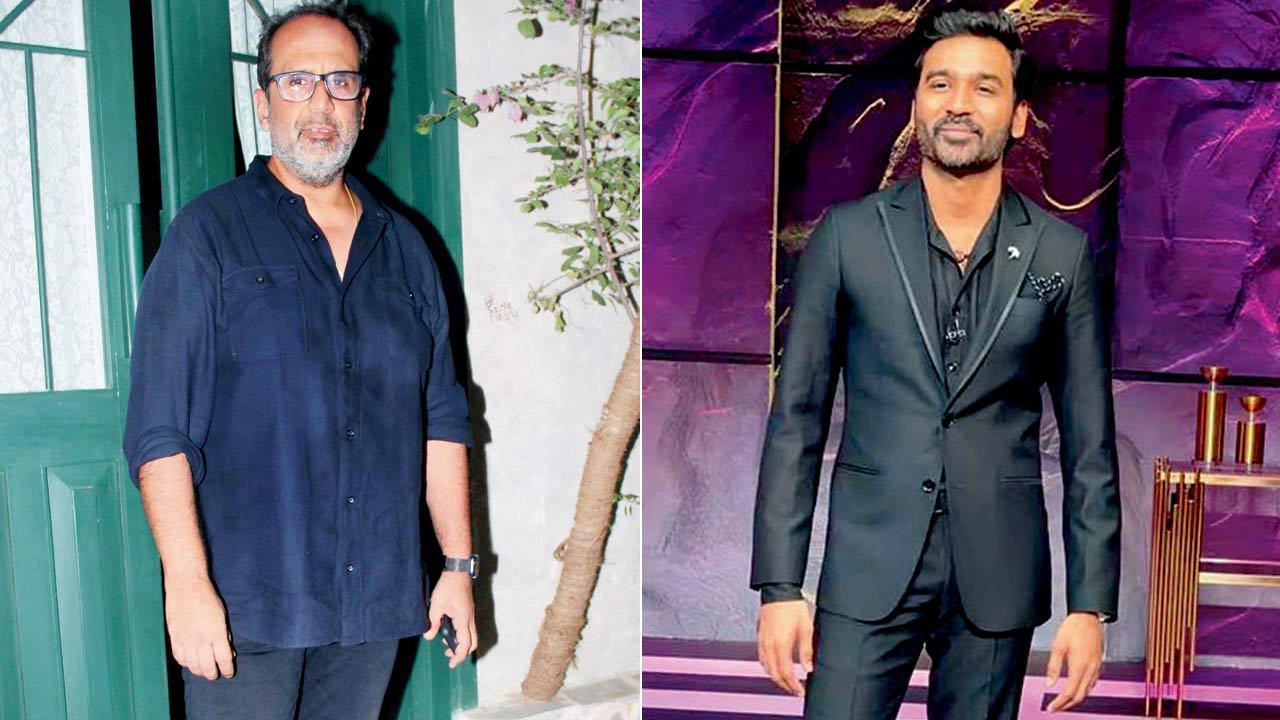
Anshul Chaturvedi (BOMBAY TIMES; November 17, 2025)
In an industry fixated with figuring out what the audience will opt for next, director Aanand L Rai insists that the real crisis isn’t of misreading the audience, but of diminishing honesty and genuineness from the filmmakers. It wasn’t the audience that changed, he says – it was the filmmakers whose conviction began to wobble. From his learnings from the success of Raanjhanaa and Tanu Weds Manu, and the failure of Raksha Bandhan, to the coming full circle and trying to reconnect to his middle-class grounding, the director opens up about an internal battle that many artists face, but few admit to.
Why are Hindi filmmakers often struggling to predict audience behaviour?
The audience has become very – how do I put it – woh thodi se bhi beimaani ab nahi le pa rahe hain storytelling mein.
What does that mean? Audience ka imaan jaag gaya hai ab?
Nahi, I think woh toh aise hi thay, hum (filmmakers) beimann ho gaye. Humko lagne laga, achcha, unka yeh emotion exploit kiya ja sakta hai. Iss tarah ki kahani, uss tarah ki kahani unko pasand aayegi. But in all that, joh ek cheez chali gayi in filmmaking, woh thi conviction – jo ki ek Pushpa ya KGF ya Kantara – inmein hai. They have proved that conviction works.
Define conviction. What’s the difference here?
Our approach to the film was just to please the audience. Their approach was to tell a story. There is a huge, huge difference between the two. I can speak for myself – kahani hi banayi thi na Tanu Weds Manu, kahani hi banayi thi na Raanjhanaa. But jahan mujhe laga ki audience ko yeh pasand aayega – Raksha Bandhan – nahi! It didn’t work for anyone.
So, when you made an audience-led film, it didn’t work because it was not with your personal conviction?
My conviction was that they will like it.
‘Maine detour liya toh mujhe sab yaad aaya’
When I was shooting last in Delhi, over a year back, I was staying near Nehru Place. And early morning I was on my way to the shooting location when I asked my driver to take a short detour to Sadiq Nagar. Our family stayed in Sadiq Nagar, government quarters – a Type III Quarter – that was allotted to my mother. I stayed there till my Class XII and then went to do my engineering. So on an impulse I told my driver, idhar le chal, main zara dekhoon Flat 152, Sector 1, kaisa dikh raha hai. Maine neeche khade ho kar dekha.
I remembered all those days. Roz wahin se nikalna, peeche bus stop se bus pakadna, uss window pe baithna, 2:45 pe ek ladki ka wahan se cross kar ke jaana, school uniform mein…that was such a memory. Maa ka chale jaana pyaaz ki rotiyan bana ke. Mera ghar aana, fridge mein se chhachh ka jug uthana…But if I don’t go there, all this is not happening to me. Main toh bhool gaya tha. Maine woh detour liya toh sab mujhe yaad aaya.
But the story was not your conviction?
No. Even if I make a film that I want to make, there is no assurance that it will work – but at least ek jana to khush hoga! Doosre tareeke mein toh dono hi khush nahi hain. This theory is easy, the practical – not so much. But when I think like this – mujhe mazaa aa raha hai – I can see the difference in how things go when I change the approach.
What is your learning curve of the last half a decade or so? What is your selfeducation in this journey?
My self-education is that when I was telling stories fearlessly, and at the same time, main apne pe kabhi successful film ka pressure nahi le raha tha, sirf kahani sunane ka pressure le raha tha – achche se sunane ka – tab tak meri duniya theek thi. Jab mujhe laga ki there are these growing expectations from this director, and I should go bigger – I started faltering.
That ‘formula’ work has been the reason for many an artiste to lose touch with their original craft.
Haan. At the end of the day, we are human – but at the end of the day, artiste jitna apni fakeeri mein reh jaye, utna achcha…
Artiste ki fitrat badal jaati hai toh uske kaam mein bhi farak aa jaata hai?
Aa jaata hai! Mujhe khud ko hi lagne laga ki bolta rehta hai middle class, middle class, but it doesn’t reflect in your work anymore – but it used to, earlier.
Achanak se sab badal gaya. So you keep talking about middle class, middle class, but you didn’t nurture the middle-class sensibility inside of you. My holidays changed – I began holidaying in Europe. I’m not saying that is wrong. If God has given you that success, you have to enjoy, there is nothing wrong with that. But it is a professional hazard – this profession makes you lose touch with your roots, and you have to understand that, and to hold on to it, if you want to remain in that space.
Midway nahi hai yahan. Ya toh aisa kar lo, ya toh phir udd jao. Be clear ki main toh aaya hi paise kamane ke liye tha. That is a different direction, a different track. But if you want to tell the stories that are inside you, then you have to stay grounded, stay in that world, and tell your stories.
And where are you placed – returning back to your original world?
Yes, I feel I am coming back to my world, jahan mujhe maza aayega.
What has changed in your approach to filmmaking now, as you come back?
I think if I am evolving, I should try to have my audience evolve with me. I will never be scared of telling an old story in a new way. I think the man-woman relationship was not depicted as an equal one for a long time. Many filmmakers got it wrong, and I need to make it right – that is my learning. Shayad main Tanu Weds Manu ya Raanjhanaa ke waqt iss tarike se nahi sochta tha, lekin ab sochta hoon.
You got a fair amount of flak for Raanjhanaa – not entirely unfair – in terms of your depiction of how a man behaved with a woman.
Yes, yes, and I took it. I understood. Ho sakta hai ki mere kaam mein going ahead you will see that I understood.
Hasn’t cinema sold the male entitlement pitch so often while making money at the box office? There is also a view that many of the blockbusters from the south have worked by playing that up while relatively more woke multiplex-ish Bollywood stories struggled.
I don’t disagree that many of the hits have a strong male perspective, they are very macho, and all that, but at the same time I think we cannot be the masters who decide beforehand what the audience should or should not watch.
I disagree with the thought that if we show them a lot of aggressive, macho male characters it will reflect in their behaviour. Because the reverse does not happen, does it? If I make films on Swami Vivekananda tomorrow, will all of them start doing sadhna? If they will not emulate what he does after watching a film on him, then they will not emulate the macho aggressive character either, will they?
Now you have seen me with my success and failures and trajectory. Obviously, success and failure matter, but at the end of the day, I enjoy the process. I am trying to not be afraid. I am trying to experiment. When I was making Raksha Bandhan I was thinking we don’t make enough cinema for the Tier-2 and Tier-3 cities. I thought I had it all clear in my head. But my judgement was wrong.
Staying connected is very important. Meri zameen chhoot jaati hai, phir mujhe pakadna padta hai, phir mai apne penthouse mein chala jaata hoon, phir mujhe yaad dilana padta hai apne ko Tu woh Dilli ka ladka hai, teri aadhi zindagi unn peele gharon mein guzri hai. Teri apni kahaniyan woh hain! Tu soch kyun nahi raha hai!
Isn’t it true that a lot of names, after they enter Bollywood, tend to forget the USPs or the nuances that brought them into Bollywood in the first place. Even if you’re circling back to the place you started from, mentally, that’s also part of any artiste’s graph, perhaps? And nothing teaches us more than failures, always, right?
Obviously (laughs)! The problem is that, fortunately or unfortunately, even when you have failures, so to say, your bank balance does not change dramatically. Your lifestyle does not change. So, you feel ki theek toh chal raha hai sab. After a point you have to realize that it does not matter how much you made or how much you lost in a project. You need to sit down and introspect and see how far you have drifted from your original path. If you don’t do that then even failure is teaching you nothing.
Right now I am enjoying myself. I am also relishing making films for other directors as a producer. I can’t compete with the big houses, but I will try to pick the stories that others won’t. I will search for an identity, something that is original, not a copy of anything ‘successful’. I have not reached a 200-crore movie ever. But I ask myself, what is a better option? To make something that I have fun making and have something that is still not a bad return, or to chase that number? I am not chasing that number. I am not chasing any number. I will keep my middle-class approach. Mujhe khana achcha chahiye, lekin mujhe chaandi ki thaali nahi chahiye.
It’s not just directors, though, is it?
Amol Palekar, Farooq Sheikh – they played some very relatable, everyday; then paused and said: Main dhoond raha hoon Vinod Mehra in this character. Tu mujhe bana ke de raha hai Vinod Khanna. If I do that, the character itself will change and you may not be the right fit for that version of it! Some directors complete the circle, like we were discussing, and come back to a more grounded version. But actors, if they do the same, wapas aa hi nahi paate hain. They reach a point of no return and sometimes they are neither grounded, nor superstars either.
Amol Palekar, Farooq Sheikh – they played some very relatable, everyday; then paused and said: Main dhoond raha hoon Vinod Mehra in this character. Tu mujhe bana ke de raha hai Vinod Khanna. If I do that, the character itself will change and you may not be the right fit for that version of it! Some directors complete the circle, like we were discussing, and come back to a more grounded version. But actors, if they do the same, wapas aa hi nahi paate hain. They reach a point of no return and sometimes they are neither grounded, nor superstars either.
Irrfan went to Hollywood but stayed capable of playing the everyday character, though.
Bilkul. Woh chala gaya, phir bhi aaj bhi kahaani bolte-bolte aap ruk jaate ho aur kehte ho, ‘Irrfan sahab hone chahiye thay…’ (Pauses) Bahut kahaniyan directors ke andar maar gaye woh. Ab aap suna hi nahi sakte, unke bina.
To wrap up what we’ve been talking about: Your USP, that you are rooted, gives you a nuance, an audience connect and also gives you commercial success. However, that success means that shortly thereafter, you are no longer rooted. So you lose your ability to repeat the original connect, and to do the same sort of work that brought you success in the first place.
Yes (laughs)! Yeh ajeeb sa circle hai! When you talk about great makers – and when I say great makers, I mean Hrishikesh Mukherjee or Bimal Roy, names like that – they somehow never lost connect with their roots or their storytelling. Even the Hollywood names who have taught us things about filmmaking – they have kept a consistency in their storytelling. I hope more of us can do that.
AI-altered climax stripped Raanjhanaa of its soul-Dhanush
8:12 AM
HINDUSTAN TIMES (August 5, 2025)
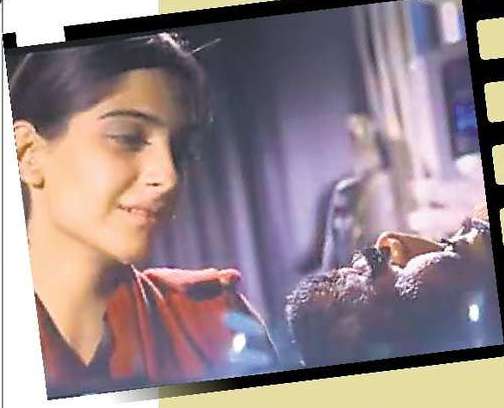
Days after the Tamil version of Raanjhanaa (2013) was re-released in theatres, actor Dhanush has come forward to slam the studio’s decision to use artificial intelligence to alter the ending.
Following director Aanand L Rai’s disapproval, the actor on Sunday issued a statement on his social media handles, revealing that “concerned parties” went ahead with the AI ending, even after he had objected to it.
Titled “For the love of cinema”, Dhanush’s note read, “The re-release of Raanjhanaa [titled Ambikapathy in Tamil] with an AI-altered climax has completely disturbed me. This has stripped the film of its very soul.”
In the original film, Dhanush’s character Kundan is wounded by a gunshot and dies with his love interest Zoya (played by Sonam A Kapoor) by his side. In the AI-altered ending however, Kundan opens his eyes and sits up on the hospital bed, leaving Bindiya (played by Swara Bhasker) and Murari (Mohammed Zeeshan Ayyub) in happy tears.
Noting that this has set a “deeply concerning precedent” for both cinema and artistes, Dhanush wrote, “This is not the film I committed to 12 years ago. The use of AI to alter films or content... threatens the integrity of storytelling and the legacy of cinema. I sincerely hope that stricter regulations are put in place to prevent such practices in the future.”
Raanjhanaa was re-released in theatres on Friday.
The Raanjhanaa AI re-edit tangle: Are we in an ‘ethical abyss’?
8:52 AM
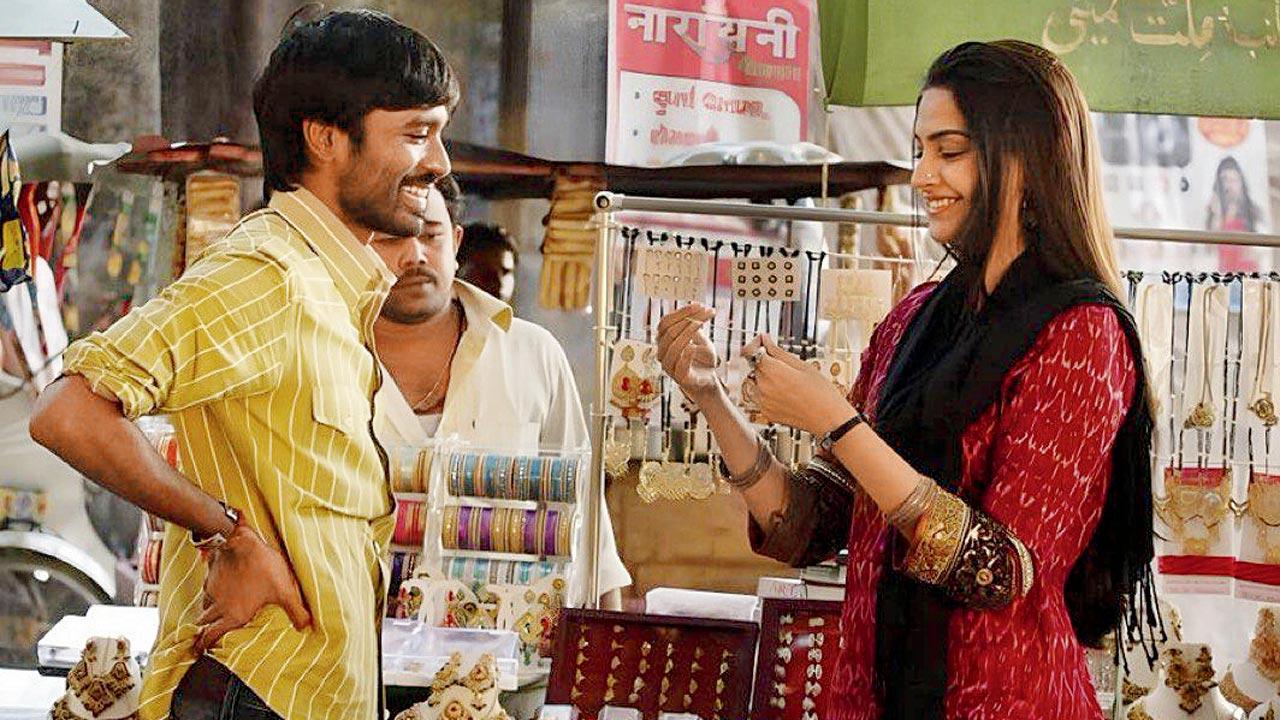
As a top studio rewrites the climax of a beloved film using AI, without the director’s consent, Bollywood is now reckoning with the grim reality that even the soul of a story can be reshaped without its storyteller, a decade after its creation
Mohar Basu (MID-DAY; July 27, 2025)
Artificial intelligence is not at the place where it can manipulate writers and creators yet. This is what we heard in February, during an interview with the acclaimed American writer Chris Keyser about the dangers of AI for screenwriters, when he was in the city for a conference. Keyser was the co-chair of the Writers Guild of America’s (WGA) negotiating committee during the 2023 strike by over 11,000 Hollywood film and television writers for better wages and conditions.
During our conversation, he had said, “We assumed that the studios were so protective of their own work that they would be scared of AI in the same way that writers were. They didn’t behave that way initially. By the end of the negotiation of the contract, (we) negotiated terms that protected writers’ core rights, their right to compensation and credit, and all their additional contractual rights for their material. It said that they can’t be forced to rewrite AI, nor can AI rewrite them, that AI can’t get credit.”
Back then, even we couldn’t have pre-empted what unfolded in India last week. Filmmaker Aanand L Rai’s 2013 hit Raanjhanaa is being re-released, but with an ending rewritten. And Rai doesn’t approve of it. The new version, scheduled for theatrical release in Tamil Nadu under its dubbed title Ambikapathy, has been altered using artificial intelligence. Without the director’s involvement or consent, the studio behind Raanjhanaa, Eros International, has digitally fabricated an alternate “happy ending” that, in Rai’s own words, vandalizes the soul of the film.
Unlike in Hollywood, where writers’ guilds have fought — and won — major protections against AI-led rewrites, Indian creators remain bound by contracts that often strip them of all future rights the moment a project is greenlit. Directors and screenwriters may shape the soul of a film, but legally, they seldom own it, as the norm is for the IP of a movie or show to transfer to the studio upon signing of agreements. With studios embracing AI for commercial “enhancements,” that legal void is turning into an ethical abyss, like in Rai’s case.
Entertainment lawyer Priyanka Khimani says while studios may assert ownership over a film’s copyright, the use of AI to fundamentally alter a creator’s original vision, especially without their consent, sits in a legally grey and ethically troubling zone.
She explains, “Studios often control 100% of the rights, although under the moral rights clause a director or author retain certain moral rights under Indian law — like the right to be identified as the author of the work, and to object to any distortion or mutilation that could harm their reputation.”
Another crucial issue relates to the Copyright Act’s 2012 amendment, which states that rights can only be assigned for formats and uses that exist at the time of the agreement. “In the case of technologies like AI, which wasn’t in existence or even foreseeable when the film was made, there’s a strong argument that the creator never assigned rights for those future uses,” Khimani tells us, adding, “The law is meant to protect authors and performers from losing control over their work in precisely these scenarios, where new technology enables uses that were never imagined at the time of creation.”
Khimani goes on to say, “In the case of Raanjhanaa, I believe the writers and actors may be on firmer legal ground if they were to challenge the AI-modified version. They can argue that the alteration compromises the integrity of their work, infringes on their personality rights, and constitutes unauthorized distortion. For the director, however, this becomes more of an ethical and moral objection rather than a strictly legal one.”
Khimani says this moment is important as “it’s opening a Pandora’s box” because if we normalize the ability to reshape existing works using AI, the long-term consequences for literature, cinema, and performance could be disastrous.
Clearly, Eros is not in agreement with this stand. Eros Group CEO Pradeep Dwivedi has been quoted saying, “We categorically reject Mr Rai’s allegations... The re-release is a respectful reinterpretation and not a ‘tampering’ of the original.”
Meanwhile, Rai is taking the matter to producer bodies. Though the matter is yet to be heard officially, a senior member of the Guild tells Sunday mid-day, “The Guild is made up of filmmakers. We’re in this industry because we’re passionate about storytelling. So when a writer or director feels their voice has been overwritten or erased, it strikes at the heart of why we do what we do. This is about respect. About honouring the soul of the work. We owe it to ourselves, and to the future of filmmaking, to have this conversation with honesty and courage.”
Dipankar Mukherjee, co-founder of Studio Blo, a new-age startup, has a sharp take here. Mukherjee tells us, “AI should be like a cinematographer — extending the vision of the creator, not replacing it. The moment it starts rewriting the emotional spine of a story without the writer or director’s approval, you’ve crossed the line. What happened with Raanjhanaa is revisionism. It’s like saying Devdas should have ended up with Paro to test better with audiences. Then it stops being Devdas. Even before AI, these lines were being crossed. AI just makes that overstep faster, cheaper, and invisible. We’re beginning to see requests to 'freshen up' past content — whether that’s to de-age characters, tweak endings, or reframe performances for newer markets. We are built from ground-up with anti-plagiarism systems integrated into our workflow. The red flag is when AI starts doing what studio executives tried doing in the ’80s, like the Harrison Ford voiceover in Blade Runner, against the wishes of Ridley Scott; or the Justice League producers’ edit after Zack Snyder stepped down. Except now, without needing a reshoot or a script change. The temptation to erase dissent, discomfort, or ambiguity is high. And in a country where creators often don’t own their IP, that temptation becomes unchecked power.”
The human cost at the end of the day when something like this happens is borne by the creator and writer — in this case, Rai and writer Himanshu Sharma. A well-known screenwriter, who was previously a part of the Screenwriters Association General Body, tells us, “We spend months, sometimes years building characters, shaping arcs, constructing emotional payoffs that mean something. And then, one day, a studio decides to rewrite the ending using a machine, without even informing the people who created it. It’s insulting. What happened with Raanjhanaa sends a very dangerous message that any writer’s vision is disposable.”
The terms
In a series of writer/creator contracts reviewed by Sunday mid-day, the terminology of the contract reads, “The Producer ... shall have the sole and exclusive right to exercise all rights ... in accordance with the Copyright Act, 1957. The Service Provider further acknowledges that the Producer shall be the sole and exclusive owner of Derivative Rights and shall have the sole and exclusive right to produce Derivative Works based on the Works and on all Modes, Media and Formats, for the entire Territory and in perpetuity.”
Raanjhanaa AI ending row: Producers say they have all the rights, not the director
10:10 AM
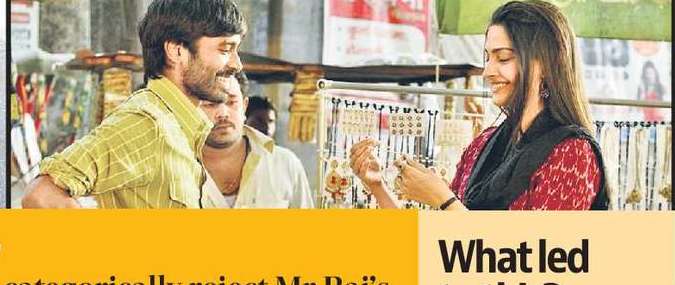
Eros defends call after Rai slams Raanjhanaa re-release with AI-generated alternate ending
BOMBAY TIMES (July 21, 2025)
‘THE REMARKS BY THE DIRECTOR ARE FACTUALLY INCORRECT’
Eros issued a statement saying, “We at Eros International Media Limited categorically reject and strongly object to the unfounded and sensationalist remarks made by Mr Aanand L. Rai regarding the AI-enhanced re-release of Raanjhanaa. These remarks are not only factually incorrect and misleading, but appear to be a deliberate negative PR stunt designed to distract public and industry attention from serious and ongoing legal matters concerning Mr Rai and Colour Yellow Productions Pvt. Ltd. We view Mr Rai’s public outburst, especially timed just days after these disclosures, as a conscious attempt to shift focus away from the legal and governance issues he currently faces. It is unfortunate that a filmmaker of his stature would attempt to conflate legal accountability with creative victimhood. It would be best if Mr Rai respectfully acknowledges the ownership of IP as per law of the land and his written undertakings, rather than use media unfairly as a platform to promote himself and thrive on unwarranted sensationalism.”
‘IT IS A STRATEGY TO REINTRODUCE CLASSICS TO NEWER AUDIENCE’
Defending their decision to re-release Raanjhanaa with an alternate ending, the studio states, “The re-release of Raanjhanaa in the Tamil market is part of Eros International’s broader strategy to refresh and reintroduce classic cinematic works to newer audiences in regional markets. Over a decade since its original release, the film continues to resonate deeply, and the reinterpretation of its ending aims to extend its emotional legacy and relevance. This is a creative reimagining, not a replacement, and is consistent with global industry practices including anniversary editions, alternate cuts, and modernized remasters.”
They continue, “We are the sole and exclusive copyright holder and producer of Raanjhanaa, and are fully entitled, both legally and ethically, to adapt and re-release the film. This includes re-imagining certain elements using advanced tools such as generative AI to reach newer audiences while preserving the original’s artistic soul. Contrary to the claims of “artistic vandalism”, our re-release is a respectful creative reinterpretation – clearly labelled and separate from the original version – offered as an addition to, not a replacement of, the original. Such practices are common in global cinema, and reflect our longstanding commitment to innovation, audience engagement, and cultural preservation. We reserve all our rights and intend to take all appropriate legal and remedial action to protect our reputation, brand equity, and commercial interests.”
‘EROS HAS INITIATED LEGAL PROCEEDINGS AGAINST AANAND L RAI’
The studio also stated that they have initiated legal proceedings against Rai’s production house. “It is important to bring to light that Eros has initiated legal proceedings before the Hon’ble National Company Law Tribunal (NCLT), Mumbai Bench, under Sections 241 and 242 of the Companies Act, 2013 against Colour Yellow Productions Pvt. Ltd., and its directors, Mr Aanand L Rai and Mrs Yogita Rai. The allegations include serious acts of mismanagement, lack of transparency in financial disclosures, unauthorized and related-party transactions without board approvals. On June 24, 2025, the Tribunal acknowledged these concerns and has ordered interim relief in favour of Eros,” said the studio.
What happened
Raanjhanaa which had hit the screens in 2013, is being re-released in Tamil Nadu with an altered AI generated ending, possibly a first for the industry. While director Aanand L Rai has slammed the move, the studio Eros International Media Limited describes this as a “creative reimagining” and says that the director’s comments are an attempt “to distract public and industry attention from serious and ongoing legal matters.”
The Tamil version of the unrequited romance drama, starring Dhanush and Sonam Kapoor, was titled Ambikapathy. Reportedly, Eros International has sold the AI-edited version of the film to a Tamil Nadu-based distributor. “The timeless love story returns to the big screen! #Ambikapathy rereleasing in theatres from August 1st... A new ending powered by AI,” Upswing Entertainment said while making the announcement earlier this month.
--------------------------------------------
HINDUSTAN TIMES (July 21, 2025)
After Raanjhanaa director Aanand L Rai expressed his displeasure at the AI-generated ending for his 2013 film, the production house Eros Media World reacted to his statement. “This is a creative reimagining, not a replacement, and is consistent with global industry practices. We categorically reject Mr Rai’s allegations, which are not only factually incorrect, but also legally unfounded. The re-release is a respectful reinterpretation and not a tampering of the original. It is clearly positioned as an alternate, AI-enhanced version — akin to classic cuts or re-edits seen globally,” Pradeep Dwivedi, the company’s CEO, told PTI.
The producer of a cinematographic work, under Indian law, is its legal author and moral rights vest with the producer, not the director, the company added. Asked if the film’s team was kept in the loop, they said they hold the sole copyright and producer rights of Raanjhanaa, including the legal rights.
The company added: “We regret that he (Aanand) has chosen to publicly distance himself from the project, despite the film being a product of collaborative effort where rights are lawfully vested with the producer. Our re-release is an homage to the film’s legacy, not a deviation from it. All rights, decisions, and creative control related to Raanjhanaa remain solely with Eros International Media Limited as the exclusive copyright holder.”
We reached out to Aanand, but got no response till the time of going to press.
What led to this?
The film has been re-released in Tamil Nadu with an AI-generated “happy” ending, reports PTI. The Hindi film was released as Ambikapathy in the Tamil version in 2013. Raanjhanaa director Aanand L Rai told PTI that he is “heartbroken that this is the future we’re heading towards, where intent and authorship are disposable”. He added that he will dissociate himself “from such a reckless and dystopian experiment”. A part of his statement read, “Raanjhanaa didn’t need a new climax. It had heart, and honesty. To see its ending altered without a word of discussion is a gross violation of the film.”
Aanand L Rai slams AI-altered climax of Raanjhanaa in re-release
11:06 AM
BOMBAY TIMES (July 19, 2025)
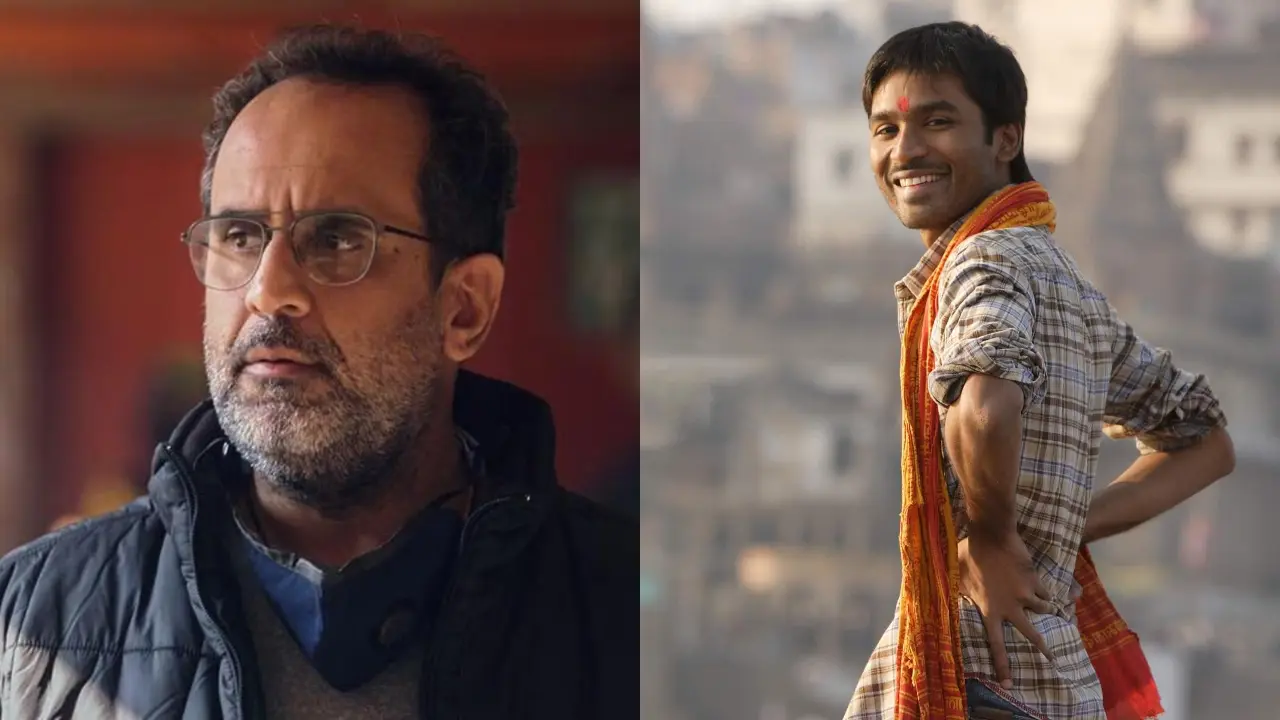
The Dhanush and Sonam Kapoor-starrer Raanjhanaa (2013) is re-releasing in theatres on August 1. However, this is unlike the spate of re-releases we’ve seen in recent times. Why? There’s a major plot twist here. Promotional posters tease “a new ending powered by Artificial Intelligence,” sparking both curiosity and controversy. Director and co-producer Aanand L Rai has voiced strong objections, stating that he was neither informed nor consulted by the studio, Eros International, before such a significant alteration was made to his original film.
Deeply upset about the altered climax, in a statement, Rai said, “Raanjhanaa didn’t need a new climax. It had heart and honesty. It became a cult film because people connected to it with its flaws and imperfections. To see its ending altered without a word of discussion is a gross violation not just of the film, but of the trust of the fans who’ve carried the film in their hearts for 12 years.”
Reportedly, Eros International has sold the AI-edited version of the film to a Tamil Nadu-based distributor. Rai added, “Eros’s actions open a dangerous door. They raise urgent legal and ethical questions, of the impact of decisions like this on the moral rights of creators. Even worse is their apparent decision to alter the actors’ contributions without their consent! How can they digitally manipulate an actor’s input almost a decade after a film’s release? This strips away their agency and raises serious concerns under personality and image rights. If this goes unquestioned, what stops anyone from 'updating' any film, performance, or legacy to suit short-term profiteering?”
How cinema made India Gate a site of protest
2:54 PM

Niharika Lal (BOMBAY TIMES; January 25, 2025)
Every year, the Republic Day parade begins at Rashtrapati Bhawan and proceeds towards India Gate. India Gate isn’t just an iconic location for Delhi but also for cinema. Back in 2006, on Republic Day, Rang De Basanti hit the screens and gave Indian cinema one of its most unforgettable protest scenes. A scene that still gives goosebumps to audiences – no shouting slogans, no waving banners, no chaos – just a crowd holding candles in silence.
The scene became a cultural phenomenon both onscreen and off-screen, inspiring many real-life protests at the site.
Since 2006, India Gate’s relevance as a protest site has been depicted in several films, including No One Killed Jessica, Raanjhanaa, as well as in the web series Delhi Crime. Ahead of Republic Day, we speak to directors to understand what keeps India Gate’s cinematic relevance alive.
‘For Rang De Basanti, I was drawn to India Gate because of the importance it holds’
Rakeysh Omprakash Mehra grew up in Delhi and attended Bal Bharati School. Talking about the protest scene in Rang De Basanti at India Gate, he says, “The entire area of India Gate and Rajpath has always been in my consciousness. It had a different meaning. I remember, in the 9th standard, I was part of the Republic Day parade. We were always mesmerized by the jawans who would stand there like a statue, without moving. Each brick has the names of martyrs from British India. I’ve always been drawn to India Gate because of the importance it holds for us. To me, India Gate also represents the Amar Jawan Jyoti.”
Talking about Rang De Basanti, which took inspiration from the real-life incidents where Air Force pilots lost their lives, he says, “In reality, when those pilots sacrificed their lives, nobody protested. I think it’s the duty of civil society to raise their voice. Everybody can’t just sit on the fence and point fingers this doesn’t work, and that doesn’t work. It is our responsibility to raise a voice, and it is very important. In Rang De Basanti, when we lose the Air Force pilot played by R Madhavan, his mother and his friends wanted justice, so they held a silent protest at India Gate. I was drawn to India Gate because of the importance it holds.”
‘INDIA GATE HAS BECOME A PLACE OF COLLECTIVE REBELLION’
Raj Kumar Gupta, the director of No One Killed Jessica, who also studied in Delhi, says that India Gate is the iconic place that defines Delhi. He showed India Gate as a protest site in No One Killed Jessica because it was the actual location of protests in the real case.
He explains, “Of course, Jantar Mantar was the place for protests in Delhi and still is. But India Gate very organically became a protest site after Rang De Basanti. Films only work as a catalyst; it was the people who made it the spot. While there are many iconic places in Delhi, India Gate is the first that comes to our minds. Over the years, India Gate has become a place of collective rebellion. It evokes strong emotions.”
He adds, “Democracy is about people’s voice, and one must speak against injustice. Over the years, with films using the imagery of a protest in the backdrop of India Gate, it has now become a symbol of the people’s voice. Besides, the monument has its own value.”
Initially, it used to hurt a lot, especially when my performance for Raanjhanaa went unnoticed-Mohd Zeeshan Ayyub
8:29 AM
Rishabh Suri (HINDUSTAN TIMES; August 29, 2024)
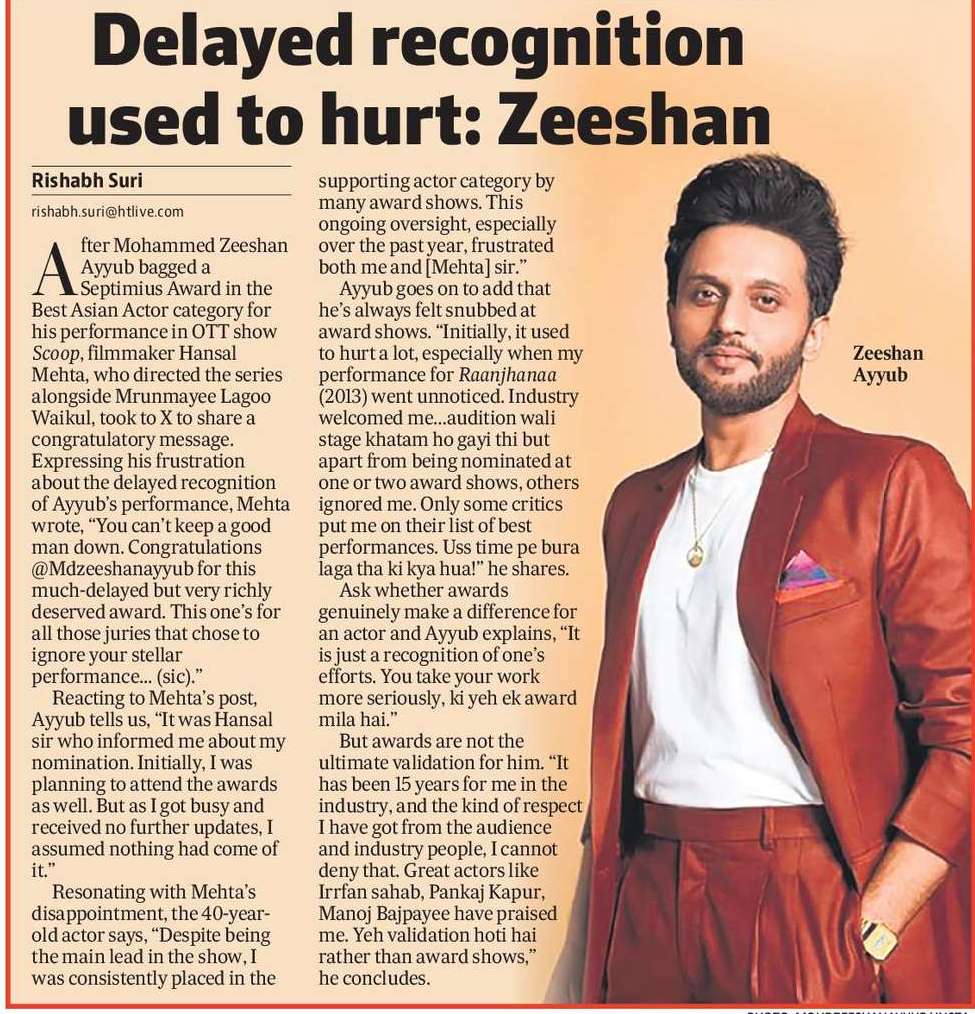
After Mohammed Zeeshan Ayyub bagged a Septimius Award in the Best Asian Actor category for his performance in OTT show Scoop, filmmaker Hansal Mehta, who directed the series alongside Mrunmayee Lagoo Waikul, took to X to share a congratulatory message. Expressing his frustration about the delayed recognition of Ayyub’s performance, Mehta wrote, “You can’t keep a good man down. Congratulations @Mdzeeshanayyub for this much-delayed but very richly deserved award. This one’s for all those juries that chose to ignore your stellar performance... (sic).”
Reacting to Mehta’s post, Ayyub tells us, “It was Hansal sir who informed me about my nomination. Initially, I was planning to attend the awards as well. But as I got busy and received no further updates, I assumed nothing had come of it.”
Resonating with Mehta’s disappointment, the 40-year-old actor says, “Despite being the main lead in the show, I was consistently placed in the supporting actor category by many award shows. This ongoing oversight, especially over the past year, frustrated both me and [Mehta] sir.”
Ayyub goes on to add that he’s always felt snubbed at award shows. “Initially, it used to hurt a lot, especially when my performance for Raanjhanaa (2013) went unnoticed. Industry welcomed me…audition wali stage khatam ho gayi thi but apart from being nominated at one or two award shows, others ignored me. Only some critics put me on their list of best performances. Uss time pe bura laga tha ki kya hua!” he shares.
Ask whether awards genuinely make a difference for an actor and Ayyub explains, “It is just a recognition of one’s efforts. You take your work more seriously, ki yeh ek award mila hai.”
But awards are not the ultimate validation for him. “It has been 15 years for me in the industry, and the kind of respect I have got from the audience and industry people, I cannot deny that. Great actors like Irrfan sahab, Pankaj Kapur, Manoj Bajpayee have praised me. Yeh validation hoti hai rather than award shows,” he concludes.
I know my intentions were right, whether it was Zero or Raksha Bandhan-Aanand L Rai
8:12 AM
Rishabh Suri (HINDUSTAN TIMES; June 28, 2023)
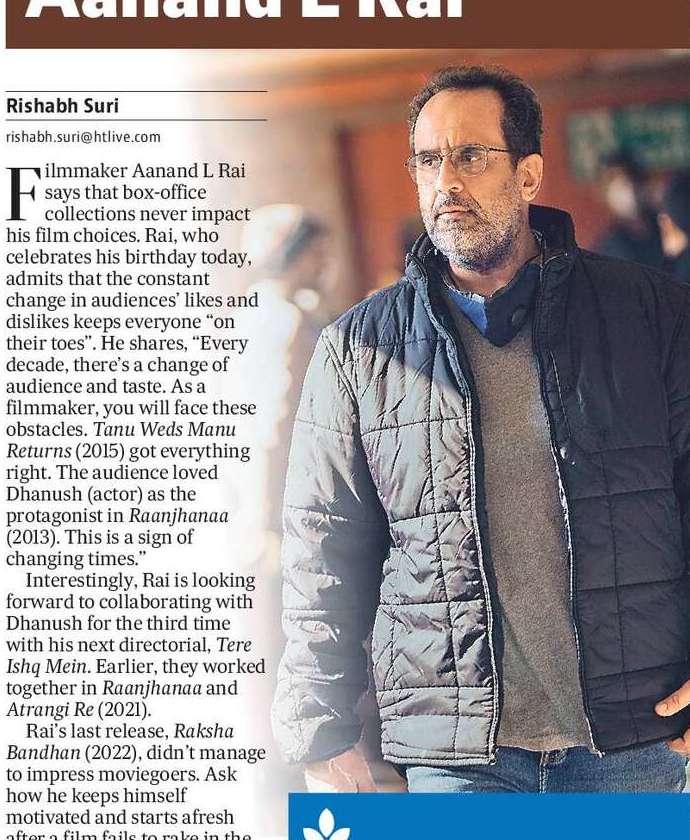
Filmmaker Aanand L Rai says that box-office collections never impact his film choices. Rai, who celebrates his birthday today, admits that the constant change in audiences’ likes and dislikes keeps everyone “on their toes”.
He shares, “Every decade, there’s a change of audience and taste. As a filmmaker, you will face these obstacles. Tanu Weds Manu Returns (2015) got everything right. The audience loved Dhanush (actor) as the protagonist in Raanjhanaa (2013). This is a sign of changing times.”
Interestingly, Rai is looking forward to collaborating with Dhanush for the third time with his next directorial, Tere Ishk Mein. Earlier, they worked together in Raanjhanaa and Atrangi Re (2021).
Rai’s last release, Raksha Bandhan (2022), didn’t manage to impress moviegoers. Ask how he keeps himself motivated and starts afresh after a film fails to rake in the moolah, and the 52-year-old says, “I am a student. There will be times when my thesis will not get everything right. The only time my confidence can be broken is if I falter in my intention. I know my intentions were right, whether it was Zero (2018; the Shah Rukh Khan-starrer) or Raksha Bandhan. I scored brilliantly with Tanu Weds Manu Returns. My intentions were the same for all the projects.”
Raanjhanaa lost its essence due to the glamorization formula for Hindi films-Abhay Deol
8:34 AM
Sugandha Rawal (HINDUSTAN TIMES; June 21, 2023)
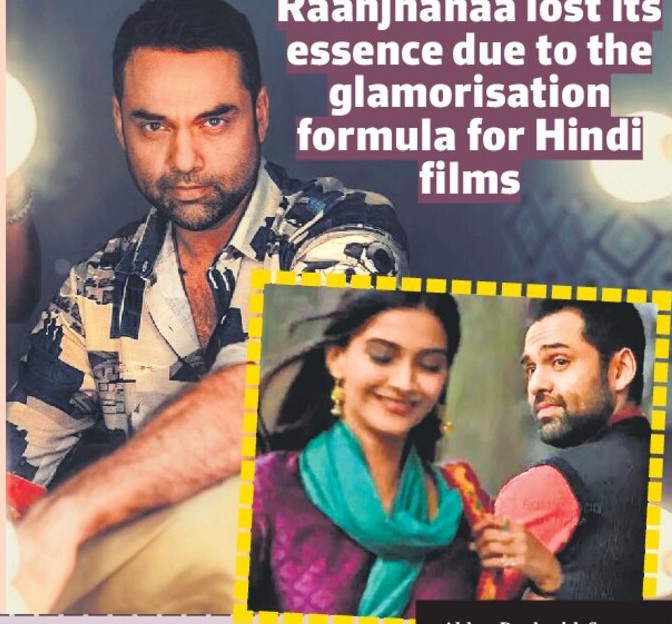
Aanand L Rai’s 2013 release Raanjhanaa continues to face flak for glorifying stalking and sexual harassment. As the film clocks 10 years, actor Abhay Deol weighs in on where the vision behind film failed to come to execution.
“The filmmaker’s motive was to have empathy and show the evolution of a character. But there is this formula that Hindi films go for, which is to add glamorization. In doing that, the film lost the essence of his message, which was about love, respect and boundaries. That was the intention with which the filmmaker came in,” says Deol, asserting that Rai’s vision was to depict what often happens in small towns.
The film follows Zoya (Sonam Kapoor Ahuja), a young woman in love with her college friend Jasjeet (Deol), even as she is pursued relentlessly by Kundan (Dhanush), a boy.
In 2020, Deol took to social media to call out the film. “History will not look kindly at this film... It’s been a theme in Bollywood for decades, where a boy can (and should) pursue a girl until she relents. Only in cinema, does she do that wilfully. In reality, we’ve seen time and again that it leads to sexual violence,” he wrote.
Mention the post, and the actor shares, “I shared what I felt and I don’t want to keep going on about it. I’ve tried to be idealistic in everything I do. Now, I have realized that it’s good to be idealistic, but you have to have a fair balance. I’m not in the space to be vocal about being idealistic anymore because people will be idealistic in their own time,” the 47-year-old signs off.
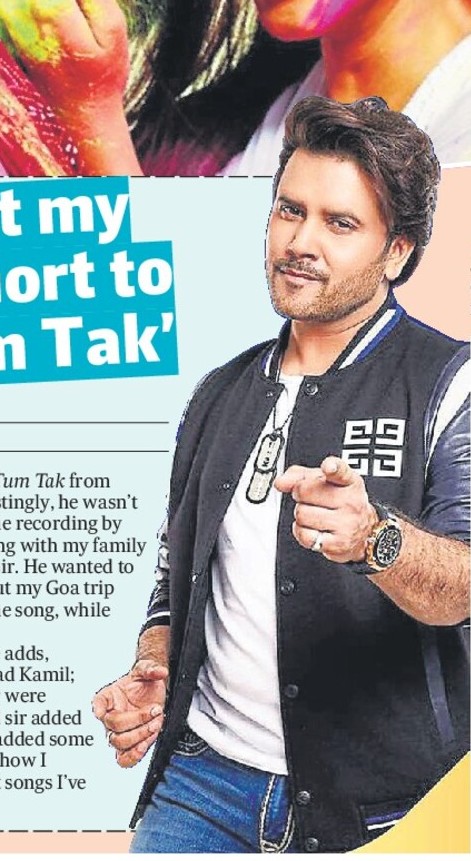
10 Years of Raanjhanaa: Irshad Kamil visited Banaras ghats for inspiration; Javed Ali cut short Goa trip
8:32 AM
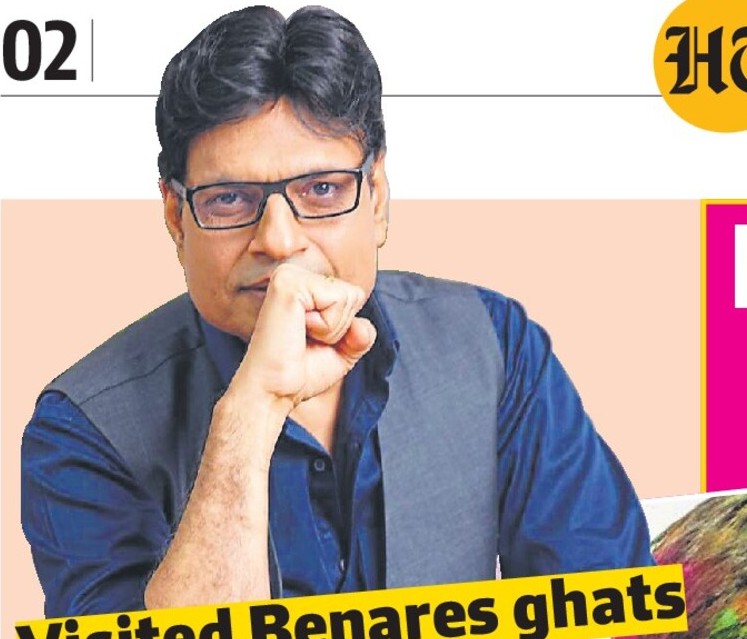
Soumya Vajpayee (HINDUSTAN TIMES; June 21, 2023)
Penning the songs of Raanjhanaa (2013) was quite a journey for lyricist Irshad Kamil. From writing during a vacation and travelling to Benares to seek inspiration — there are a lot of fond memories associated with the film, he says. Talking about his most challenging song,
Kamil says, “There is a situation in the film where a song is picturized while marriage preparations are on. The director (Aanand L Rai) was sure that he didn’t want a typical marriage track. So, I cracked the idea of mukrees, a form of writing invented by Amir Khusrow (late poet-singer) and came up with Ay Sakhi.”
Sharing the kind of research he did before penning the songs, Kamil says, “I visited the Banaras ghats to get the feel of the Ganga. I also interacted with the people there.”
Talking about his most special track, Kamil says, “It’s Nazar Laaye. My wife, Tasveer, and I were holidaying when one evening I got a call from A R Rahman (composer) sir’s studio that they’d mailed me the composition and had to record the song the next day. So, I woke up at 5 am, finished the song by 8 am and went sightseeing at 9 am.”
Kamil enjoyed working with Rahman on the soundtrack: “He is full of musical wonders. Whenever I work with him, I learn something from him.”
---------------------------------
Soumya Vajpayee (HINDUSTAN TIMES; June 21, 2023)
Singer Javed Ali recorded the song Tum Tak from Raanjhanaa (2013) in a jiffy. Interestingly, he wasn’t prepared when he was called for the recording by composer A R Rahman. “I was holidaying with my family in Goa when I got a call from Rahman sir. He wanted to record Tum Tak urgently. So, I had to cut my Goa trip short and travel to Chennai to record the song, while my family stayed back,” says Ali.
Sharing the recording experience, he adds, “When I reached there, Irshad sir (Irshad Kamil; lyricist) and Aanand L Rai (director) sir were there. Rahman sir had a tune, so Irshad sir added lyrics to the tune and I recorded it. We added some great variations to the song and I loved how I sounded in Tum Tak. It’s one of the best songs I’ve worked on.”
I am very competitive. Even if I am playing video games with my children, I compete with them without mercy-Dhanush
8:13 AM

Rishabh Suri (HINDUSTAN TIMES; January 5, 2022)
He may have played over-the-top characters in films, but off the screen, actor Dhanush is calm and he likes to speak less. Talking about his approach towards acting, he tells us, “I am a very competitive person. Even if I am playing video games with my children, I compete with them without mercy. But, you should know where to compete and what to compete for.”
The 38-year-old’s third Hindi outing, Atrangi Re, released recently. After Shamitabh (2015), in which he was seen alongside actor Amitabh Bachchan, he shared screen space with actors Akshay Kumar and Sara Ali Khan in the new film. Dhanush says he has no apprehensions about sharing the screen, “I’ve always been comfortable. Sara is hardworking and dedicated. She gave her everything for the character, Rinku. It was nice to see a youngster, who has done just three films, put everything on the line and understand the value of the jackpot character she had landed.”
Meanwhile, his film choices have been great over the years. In fact, he’s won two National Film Awards as an actor. But he surprises us when he says he didn’t even read the script of Atrangi Re before signing it: “It’s Aanand L Rai (filmmaker), that’s it! I don’t need any more details. I have immense faith in him and Himanshu Sharma (writer), and if they insist they need me for a story, I’ll know it is something special. Himanshu had mentioned about the plot when we were doing (Raanjhanaa; 2013) eight years ago.”
If there is a bigger and better word for brother, I would use that for Aanand L Rai-Dhanush
8:05 AM

Neha Maheshwri (BOMBAY TIMES; December 21, 2021)
Actor, director, producer, writer, lyricist and singer, Dhanush wears many hats. Self-admittedly a reluctant actor, the National Award-winning South star does not only have many powerful performances to his credit but has also charted new territories like Bollywood and Hollywood. The actor, who will be seen in Atrangi Re, talks to Bombay Times about his return to Bollywood after six years, blind faith in Aanand L Rai and the blurring of lines between Indian film industries. Excerpts…
After the success of Raanjhanaa (2013), one expected you to take up more Bollywood projects. With Atrangi Re, you are returning six years after your last Hindi film outing, Shamitabh (2015).What kept you away from Hindi cinema?
Nothing kept me away from Hindi cinema as such. I do a lot of films in the South, so everything should fall into place — meeting the right filmmaker with the right script and having the dates available to allot to that project. Having said that, with the kind of reception I have received for the trailer of Atrangi Re, I have made a mental note that I should do more films in Bollywood. So, I think you will be seeing more of me here.
As an actor, you are known to veer towards unconventional stories like Shamitabh. Is that a factor for you to take up Atrangi Re? Or is it the Aanand L Rai factor?
It’s just the Aanand L Rai and Himanshu Sharma (writer) factor. Those two names are good enough for me not to even listen to the script and agree to be a part of it blindly. That’s the kind of faith I have in them. Once Himanshu narrated the script to me, I understood why they wanted me in this film. It’s a beautiful story. I know when Aanand L Rai wants to say something in a specific way, he will cast me in his film. He wanted me for Atrangi Re and I am happy to be a part of it. He had a lot of faith in me even when nobody knew about me here. He roped me in for Raanjhanaa and was adamant about casting only me from the South for the film. He had almost every actor’s dates then. That’s the level of conviction he has in his stories and himself. It’s amazing how he does that. I am happy that I could be a part of this journey.
You are also a producer and director. Do Aanand L Rai’s cinematic sensibilities and approach resonate with you?
Absolutely! If there is a bigger and better word for brother, I would use that for him. We are family. We love each other. I call his wife, bhabhi. However, we make sure that part is not involved in the professional aspect. Work is a different ball game altogether. That’s why we have a healthy relationship.
You are an actor, producer, director, writer, lyricist and singer. How do you pack in so much in the time that you have?
I don’t think I do any of this properly. I have a lot of interest in all these things and I try to do a bit of everything. Some have worked brilliantly, while others may not have. It’s all about how passionate you are about your craft. I am very passionate about art and give it my best.
In an interview, you mentioned that you were a reluctant actor in the beginning. Has the scenario changed since? What are you more passionate about among the many hats you wear?
Writing and directing a film is what I enjoy the most. I took acting seriously after I met Balu Mahendra sir (he directed Sadma in 1983 and also Dhanush in Adhu Oru Kana Kaalam in 2005). He made a difference for me. I must have been 19 when I met him and had a heart-to-heart conversation. He made me understand that I had something in me which I don’t see myself. When something like that comes from somebody like Balu Mahendra sir, you tend to take it seriously and ponder over what he is saying. I started working hard on myself after that and have started enjoying the process in the last 10 years.
Since you love direction more, does it get challenging to suppress that aspect of your personality when you are being directed by someone else?
It’s not that challenging, I just have to shut up. It’s easy to do that when you enjoy your work. It’s like a kid playing a video game — he plays different games and he enjoys all of them. For him, a game is a game. I enjoy everything about this art, so for me, it’s like playing a video game. I don’t ever get tired of it.
Lines are blurring between cinemas like never before. We see a healthy exchange between Bollywood and regional cinemas. Many South Indian actors have made a smooth transition to Hindi cinema and Bollywood stars are also featuring in South films. How do you look at this creative exchange?
As you said, it’s a healthy exchange and a welcome change. The lines are indeed blurring. I wish it had happened 30-40 years ago, as so many brilliant gems of talent from South and North would have been known in each other’s regions. Nevertheless, it’s great that it’s happening, but it hasn’t happened overnight. I am happy that talents from across the country are being recognised everywhere now.
Not just actors, even regional content is enjoying a much larger audience today...
I don’t think it’s a recent phenomenon. Good content, be it from the South or the North, has always been appreciated. We were just not aware of it. Today, we have exposure. If a Tamil film has done amazingly well and is critically acclaimed, there is a platform for all of us to watch it. The same goes for Bollywood. The world has shrunk. Earlier, nobody would know if a Hindi film was remade in the South or vice versa. That’s not the case anymore.

Dhanush joke in Hindi web series Little Things puts the spotlight firmly on racial stereotyping of south actors
8:13 AM

Sunayana Suresh (BOMBAY TIMES; August 9, 2021)
At a time when Hollywood is making strides as far as inclusion of actors of colour goes, it is nothing short of appalling when racism and stereotyping is passed off for humour in India. Recently, a troll video calling out the racism in a scene in the web series Little Things, in which the lead characters are seen typecasting actor Dhanush for his skin tone, went viral. In the scene, the lead pair’s friends compare them to actors Dhanush and Sonam Kapoor from Raanjhanaa, tacitly referring to the complexion difference between them, as well as their looks, in what was supposed to be humour.
Calling for an end to racism, the troll page also highlighted Dhanush’s achievements, which was amplified by several south actors. “There is a fine line between humour and being incorrect and wrong,” they stated. Soon enough, netizens joined in to discuss the repercussions of the engrained stereotyping of south Indian actors in content from other belts.
WRITERS NEED TO BE SENSITIVE ABOUT RACIAL TONES IN DIALOGUES
“We are living in times when we need to be mindful and sensitive while writing stories or dialogues. We, Indians, are the first to stand up against racism outside the country, but often fail to recognise what is happening here. We need to call out such scenes and discuss the need for writing sensitively more often,” says former actor-politico Ramya, who has worked with Dhanush in a Tamil film.
Dhanush’s VIP co-star, Amitash Pradhan, says, “This ‘silly joke’ is distasteful. I’ve noticed a pattern in Hindi cinema when it comes to portraying the south. I am a huge Rajinikanth fan and have never heard him say, ‘Yenna Rascala’ in any of his films. When we portray a Hindi-speaking guy in our movies, do we make him say, ‘Arey kya yaar?’ every few minutes? No, right? We need to be sensitive to things and write better.”
INCLUSIVITY HAS TO START IN THE SOUTH, SAYS FILMMAKER VETRI MAARAN
Making fun of someone for the way they look is one of the most insensitive ways of expressing oneself. Why should we be made to feel lesser for our skin tones, when we actually should be feeling proud of it? Earlier, there used to be that pressure to cast fair-skinned actors in the lead, owing to which many talented people lost out on good roles. But with the new crop of filmmakers, that has changed. It’s refreshing to see actors with more ‘native’ skin tones playing important roles and that’s how it should be. The inclusion should start from the south. You can’t ask a Hindi filmmaker to change when you yourself are making fun of skin tones. When you want to write a love song, you invariably end up praising the heroine’s skin colour. Such songs are there even in my films and I regret that. When there is proper representation on screen, there won’t be any misrepresentation.
‘RACISM SHOULD NOT EVER BE PASSED OFF AS COMEDY’
Although south stars have been increasingly crossing over into Bollywood, every time that happens, there are trolls/memes about it. In recent times, actress Priyamani has been among the few South Indian actors who appears to have seamlessly transitioned to working in Hindi content, too. Priya tells us, “There’s nothing funny about the scene. Irrespective of what people say, by ‘making fun of him in whatever way’, Dhanush’s work is speaking volumes and that makes us all proud to be his fans!”
Pranitha Subhash, who’s been making inroads in Bollywood, after a successful stint in most south film industries, adds, “There are two sides to this dialogue. On one side, south Indians have been stereotyped as Madrasis and our accents and lifestyles have been mocked in the name of comedy. On the other hand, more North Indians are liking south Indian films and people like Prabhas are accepted as stars. In my previous Hindi film, Priyadarshan sir had an almost south Indian crew and we shot in Ooty, so it was like I shot for a film down south. Things are changing, but these stereotypes need to be broken sooner,” says Pranitha.
(With inputs by Sharanya CR and Lakshmi V)
I don’t have much of a personal life-Swara Bhasker
7:59 AM

Swara Bhasker reveals she has her plate full. Beyond acting, she is busy penning scripts for two films and is also turning producer
Pooja Sharma (HINDUSTAN TIMES; October 11, 2019)
After completing 10 years in the film business, Swara Bhasker is not only grateful for all the opportunities that came her way but also, aims to raise the acting bar. “I found love in equal measures from the audience and critics, and that’s been the most fulfilling part for me,” says Swara. Excerpts from an interview.
What are the perks of your job?
The most fulfilling part about being an actor is the number of lives we get to live via the parts we play. How we get to relive precious emotions of life, and how, sometimes, we get to experience things that we normally wouldn’t get the chance to. That and,of course, other people work hard to make you look good and glamorous all the time. (laughs)
Which films have helped shape your career?
Be it Payal from Tanu Weds Manu (2011), Bindiya from Raanjhanaa (2013) or Chanda from Nil Battey Sannata (2016), each of the characters were accepted wholeheartedly and what more can an artist ask for. It really has been a win-win situation till now.
Work wise, how would you like to push the envelope further?
I’m playing a man in a film next year. Every time, I’m playing a part that is alien to me or I’m part of a story set in a world I don’t know, I’m pushing the envelope further for myself. Also, I’m turning a film producer this year, besides writing a script and working on a second one, too. I’m diversifying beyond acting. So, there’s acting in two films, the scripts of which I’ve written like I said, and I’m producing one of them.
Have you been able to maintain your personal life?
Currently, I don’t have much of a personal life and I’m glad for all the work I can do. But I’m a very family-oriented person and I make sure that I spend enough time back home with my parents and old friends, who are like family. Ultimately, family is what makes it all worthwhile.
My 10-year journey in Bollywood has taught me to walk straight in heels-Swara Bhasker
8:32 AM

Swara Bhasker reflects on her decade-long Bollywood journey
Mohar Basu (MID-DAY; September 18, 2019)
"It has taught me to walk straight in heels," grins Swara Bhasker as she reflects on her last decade in the industry. It has been a significant journey for the actor, who — armed with a degree from JNU and the courage to play unconventional characters — headed to Bollywood 10 years ago. "I didn't know anyone here; had no contacts, no connections, apart from writer Anjum Rajabali, whose office I lived in," recalls Bhasker.
While she showed promise in a slew of supporting roles, she counts Raanjhanaa (2013) as the game-changer in her career. "Before Raanjhanaa released, I often asked myself, 'Should I drop it all and go back to Delhi?' But fortunately, good work and the opportunity to associate with good people kept coming my way."
Her crowning achievement in the industry has been her production house, that she launched earlier this year with brother Ishaan. Their first project is a biopic on Krishna Sen, an Uttarakhand-based woman who duped two women into marriage, convincing them that she was a man. In the process, she extorted money from them. Quiz her on the film's progress, and she says, "We are scripting the film."
Must read: Tracing Aanand L Rai's journey through cinematic adventures
8:48 AM

Don't Worry. Be Happy. That’s Aanand L Rai’s mantra and the reason why the producer director, in his decade-long trek through wonderland, has fearlessly broken with convention, experimented with taboo subjects and made the kind of films he believes in rather than what he believes will work. Tracing his journey through his adventures…
Roshmila Bhattacharya (MUMBAI MIRROR; August 13, 2018)

HAPPY PHIRR BHAG JAYEGI (2018)
Mudassar spent a lot of time on Happy Bhag Jayegi but somewhere along the way, I felt that he had not relished the film as much as he should have. So, I urged him to enter the ‘Happy’ space again and flush it out of his system completely since he already had a plot to take forward. I’d like to believe that this time it was a truly happy experience for him. Last time, since he was returning from a seven-year sabbatical, Mudassar had perhaps been on the back foot, this time he played on the front foot.

HAPPY BHAG JAYEGI (2016)
Mudassar Aziz came to me with this ‘Happy’ fi lm when I had just started prepping up for Tanu Weds Manu Returns. I’m a director first and told him that while I would have loved to involve myself with his baby, for the moment, my first love was myself and my film. I offered to speak to studios and line up a good producer for him. But Mudassar was adamant he wanted to make the film with me and insisted on waiting. It was his trust in me that led to my producing Happy Bhag Jayegi for him. The film brought about the realisation that I can become a good support for my directors.
SHUBH MANGAL SAAVDHAN (2017)
Coming from the middle-class world myself, I knew we had grown and it was time to shed the tag of ‘conservative’. The idea behind taking an ‘adult’ subject and turning it into a family entertainer was to bring what had, for all these years, only been spoken in whispers behind the close doors of the bedroom, into the living room. Being the father of a teenage daughter, I also wanted to bridge this generation gap. Shubh Mangal Saavdhan (see featured image) brought together two generations in a way that they could talk to each other as friends.

MANMARZIYAAN (2018)
During Mukkabaaz I met a director who was raw and yet so neat. The Anurag Kashyap you will meet in Manmarziyaan is more polished, milder but bolder. This two-film journey was all about getting associated with one of the most brilliant directors of the country. Mujhe apne andar kuch change lana tha, maybe he felt the same way. Working with him has made me a more gutsy filmmaker, while I think he’s more controlled today, perhaps a little happier too.
ZERO (2018)
We have finished shooting the film but I have yet to meet Shah Rukh Khan, the biggest actor in the country. Khan saab has met me like a friend and a brother, a philosopher and a guide, a senior colleague and a student, but ab tak unhone uss superstar se milne ka mauka nahin diya. I look forward to meeting him some day.

NIL BATTEY SANNATA (2016)
 I was 40, high on the success of Tanu Weds Manu and its sequel and
didn’t want to play safe. I wanted to do something out-of-the-box,
something daringly different, and through its overwhelming acceptance
make the Hindi film industry believe that our audience is far more
evolved than we give it credit. The film was about a maid who wants her
daughter to become an IAS officer. Her argument was that if a doctor’s
son becomes a doctor and an engineer’s son an engineer, toh bai ki beti
kya karegi? I’m grateful that a teacher’s son got this opportunity to
make films and told myself if that can happen to me, then why can’t a
maid’s dream come true? Nil Battey Sannata remains one of our most
important films and if it inspires even one maid to educate her child, I
would say it was the most successful film of the decade. More
recently, my associate Rahul Shanklya came to me with an idea and I told
him to just go ahead and make it on a minimal budget. Meri Nimmo (right)
was the purest cinema, a small film with a big heart.
I was 40, high on the success of Tanu Weds Manu and its sequel and
didn’t want to play safe. I wanted to do something out-of-the-box,
something daringly different, and through its overwhelming acceptance
make the Hindi film industry believe that our audience is far more
evolved than we give it credit. The film was about a maid who wants her
daughter to become an IAS officer. Her argument was that if a doctor’s
son becomes a doctor and an engineer’s son an engineer, toh bai ki beti
kya karegi? I’m grateful that a teacher’s son got this opportunity to
make films and told myself if that can happen to me, then why can’t a
maid’s dream come true? Nil Battey Sannata remains one of our most
important films and if it inspires even one maid to educate her child, I
would say it was the most successful film of the decade. More
recently, my associate Rahul Shanklya came to me with an idea and I told
him to just go ahead and make it on a minimal budget. Meri Nimmo (right)
was the purest cinema, a small film with a big heart.

NEWTON (2017)
For me, it was an important step to be associated with a film like Newton because while being an issue-based story, it was, to my mind, also a commercial film. As an audience, I believe the divide between the two cinemas is decreasing and viewers are looking for an intelligent film that’s also engaging. Newton, for me, was that film.

RAANJHANAA (2013)
After the box-office success of Tanu Weds Manu, everyone expected me to quickly come up with a sequel, but I didn’t wish to get typecast as a maker of romcoms. I wanted to challenge myself as a director with a tragedy and Raanjhanaa happened. It was a gamble making a film set in Varanasi with a South superstar, but I was confident that Dhanush was the right casting choice and that this was the best way to play my innings. Just before Tanu Weds Manu, I had lost my Dad and that transformed me as a person. I wanted my films to reflect this change that was happening within me. Raanjhanaa helped me grow not only as a director but as a person too. The fearlessness I carried forward from Tanu Weds Manu was now tempered with a new-found maturity.

TANU WEDS MANU (2011)
I had made two films before this, Strangers (2007) and Thodi Life Thoda Magic (2008), and they had not worked because I had been trying hard to prove that I was a director who knew his job. I realised later that you don’t have to impress people, you just have to tell a story. And that’s what I set out to do with Tanu Weds Manu. It was the best time for me because I was scraping the bottom of the barrel and had nothing to lose. I could behave like the biggest director because no one was looking at me. It took me three years to finish the film but I was sure from here I could only go up. It paid off.
TANU WEDS MANU RETURNS (2015)
In the four years that it took me to return to the franchise, I had grown as a director. But the best part was that I was not focussed on only my own growth but that of my actors as well. Queen had happened to Kangana (Ranaut) in the interim while Maddy (R Madhavan), after some wrong choices in Bollywood, had found the right path in Tamil cinema. Even my writer, Himanshu Sharma, had had his share of ups and downs and grown, as had my audience who were ready for a new cinema. They understood that Datto was not a gimmick but was for real and accepted her as warmly as they had embraced Tanu. Even the story took off exactly four years after the first film had ended with Tanu wedding Manu.

I am extremely ambitious, but earlier my ambition was misplaced-Sonam Kapoor
9:51 PM

Lasyapriya Sundaram (BOMBAY TIMES; February 5, 2018)
With her recent professional choices, she may have silenced some of her harshest critics, but there’s a long way to go. Having earned a name for being the most stylish among the young crop of Bollywood stars, Sonam Kapoor, in her 10 years in the industry, has also managed to create a space for herself as an artiste. In a no-holds-barred chat with BT, the actress talks about the lessons learnt under the arc lights, how privilege gives her the opportunity to make brave choices and how the society we live in is deeply misogynistic. Excerpts…
Your film Pad Man chronicles the life of Arunachalam Muruganantham, who invented a low-cost sanitary pad-manufacturing machine. He is a man who set out to solve an issue — menstrual hygiene — faced by millions of women in our country. On a lighter note, do you think that the world would be a different place if men menstruated?
Absolutely! We won’t be reproducing as much (laughs). I don’t think that they could have handled it. Talking about Arunachalam Muruganantham, his life is inspiring and it’s amazing to have Akshay Kumar play him in Pad Man. He is one of the leading heroes of commercial cinema and when he is at the helm of affairs, the message reaches far and wide. Plus, it is entertaining as well.
Over the past few years, one has seen you become extremely selective about films. Having spent close to a decade in the industry, would you agree that your career can be categorised into the pre- Neerja and post-Neerja phase?
I disagree, because I think I had a pre-Raanjhanaa and post-Raanjhanaa phase. I would like to give credit to Aanand L Rai (director) and Himanshu Sharma (writer), more than anybody else. Of course, I would also like to take some credit for it (laughs). Before Raanjhanaa, I took a break for one-and-a-half years and that was when I realised that there are two sides to my ambition. One is to be the biggest superstar in the country and the other is to become the best possible artiste and human being that I can be.
As soon as I shifted gears from wanting to be famous to becoming a better actor, I became more successful. That’s the reason I got to work in films like Raanjhanaa, Khoobsurat and Neerja. I am extremely ambitious, but earlier, my ambition was misplaced. A lot of people tell my parents, ‘She is not ambitious enough. She doesn’t have the drive to be the biggest superstar.’ And, my dad (Anil Kapoor) replies, ‘You have no idea how ambitious my daughter is.’ I work very hard, but I do it for the right things. I will kill myself for a film like Neerja and for shooting in a place like Maheshwar for Pad Man. I want to work with artistes and filmmakers who challenge me as an actor and help me become a better artiste. I might not be the most talked-about celebrity, but that’s not what I am gunning for. It’s important that R Balki tells me that a role was written with me in mind or Rakeysh Omprakash Mehra says that he thinks of me first when it comes to casting for his film. That’s the kind of relationship I want with my directors and my audience.
While we have seen an increase in the number of women-oriented subjects, the roles written for heroines in films that are fronted by leading men still leave much to be desired. Do you think that’s changing, albeit very slowly?
I don’t know whether it’s changing or not, but I hope it is. Everybody tells me that I am born with a silver-spoon, and that I have my dad. I know that it gives me an advantage over a lot of young girls out there. And, given my position, if I don’t make brave choices, shame on me! I made those choices because I have a safety net, but I hope that it encourages other women to make braver choices. If I am doing a Neerja and a Veere Di Wedding and refusing to work in films where I am not being paid the same amount as the hero, perhaps I will start something new and set a precedent of sorts. I hope other girls aspire to do the same. I joined the industry when I was 17. I know a lot of girls who have made some stupid choices between the ages of 17 and 25. My parents tell me that I have not made that many mistakes. My 20s were amazing, but honestly, my 30s supersede my 20s. The other thing is, I want to be able to front films with another leading lady, like Kareena Kapoor Khan in Veere Di Wedding. We should set an example that it’s okay to work with other women and understand that another woman is not your enemy. In fact, if you get the support of another woman, there is so much that you can achieve.
In an industry where diplomacy is the keyword, you are known for speaking your mind. However, of late, have you decided to be more politically correct?
I was reading a book on the Ramayana that’s narrated from Ravana’s perspective. I wondered why he was such a hated man, though he was so accomplished. It made me understand that there are always two sides to a story, everything needs to be seen in context. So, when people tell me that I am not as politically incorrect as I used to be, I disagree. I see both sides now and I don’t believe in judging anybody.
That might be the case with you, but generally speaking, haven’t actors clammed up a bit in the past few years? Do they fear being misquoted?
I don’t clam up. I just feel, why should I talk about someone who is not relevant to my life? I can be politically incorrect about things that matter and are going to make a difference. Be it about ridiculous bans, the tax imposed on sanitary napkins or critiquing things that are unjust — I speak up on these things. At times, when I say something, it gets sensationalized because it makes for a good copy, but what I wanted to say gets sidelined. Also, I have never treated journalists as my enemies. I never take offense to anything they say because I know that they are doing their job.
Do you think Bollywood actors will come together and say Time’s Up to sexual offenders, like Hollywood showed its solidarity for survivors of sexual assault at the Golden Globe Awards this year?
I feel we are light years behind Hollywood when it comes to saying #TimesUp for sexual offenders. Eventually, it will happen. If something like that were to happen to me, I would talk about it because I am protected and I am also so-and-so’s daughter/granddaughter/niece/sister. People are scared of misbehaving with me. Two of my closest friends, Swara Bhasker and Jacqueline Fernandez, have had their struggles, but everybody needs to be ready to talk about it. Right now, it’s difficult to do that, given the misogynistic society we live in. India, in general, is male-dominated and subliminally, even women are chauvinistic. During the making of Prem Ratan Dhan Payo, women were not allowed to be make-up artists. Strangely, the men were not against it, but there were women hairdressers who said, ‘Our sons are going to become make-up artists and their jobs will be gone.’ It’s up to the mother to tell her son that he’s not better than a girl, but they are equal. Daughters should also be made to understand their self-worth.
Along with your upcoming releases, there’s also a lot of buzz around your impending marriage. So, are you tying the knot?
Unfortunately for everyone, I have never spoken about my personal life in the last 10 years that I have been in the industry and I will not start doing it now. I cannot comment on whether I am getting married or not. It’s okay if people speculate, I am glad that they are talking about some positive things (laughs).

Subscribe to:
Posts (Atom)