Showing posts with label Purab Aur Paschim. Show all posts
Showing posts with label Purab Aur Paschim. Show all posts
Manoj Kumar's flops can be counted on one hand; was successful actor and even more successful director
4:10 PM

Box Office India Trade Network
Legendary actor director producer Manoj Kumar passed away on 4th April due to age related issues which had been going on for some time. Manoj Kumar was one of the greatest directors ever seen in India and also had a pretty impeccable record as an actor. He was known for his patriotic films due to the huge success of them but was also very successful in other genres.
Manoj Kumar (born Harikishan Goswami in 1937) started his journey in the late 50's and was on the payroll of producer/director Lekhraj Bhatia appearing in practically all his films. But the turnaround came in HARIYALI AUR RASTA in 1962 which put Manoj Kumar on the road to stardom and this was consolidated with the blockbuster HIMALAY KI GOD MEIN which made Manoj Kumar a bonafide star.
He only worked in 53 films (not counting guest roles) which is very less for a career spanning 20 years as hero for that era. From HIMALAY KI GOD MEIN till 1981, the track record was such as hero that his flops can be counted on one hand. The stardom was not like say the blind following of a Dharmendra but the audience knew a film which had Manoj Kumar's name attached to it meant its a worth a watch and flocked to see them.
Manoj Kumar was super successful as an actor but even more successful as a director and only comparable to the great Raj Kapoor as an actor director. But as Manoj Kumar made patriotic films, they were probably not seen in the same way in the English media in India as they saw patriotism as jingoism but that cant take away the insane success.
As a director, it was blockbuster after blockbuster which culminated in KRANTI in 1981 which is among the top ten blockbusters ever seen in India. The directing career started with SHAHEED in 1965. It was ghost directed by him and was not credited to him. Nevertheless, it was a huge hit. It was followed by UPKAR, PURAB AUR PASCHIM, SHOR, ROTI KAPADA AUR MAKAAN followed by KRANTI and all of them were huge hits. Health problems took over post KRANTI and it was never the same as a hugely delayed CLERK released in 1989 and could not do well.
The directed films listed above featured Manoj Kumar in the lead roles and were huge hits and the other big films were HIMALAY KI GOD MEIN, NEEL KAMAL, BEIMAAN, SANYASI and DUS NUMBRI. His films also always had blockbuster music be it as director or actor and he also had a part in this with the lyrics. The legacy left behind will always reverberate on Republic Day and Independence Day for years and decades to come.
Manoj Kumar said he would shelve Purab Aur Paschim if I didn’t feature in it-Saira Banu
3:18 PM

Saira Banu recounts how the veteran actor convinced thespian Dilip Kumar to have her star in Purab Aur Paschim after their marriage
As told to Upala KBR (MID-DAY; April 5, 2025)
A wonderful man has left us today. Manoj Kumar ji and I worked together in Shaadi [1962], Purab Aur Paschim [1970], and Balidaan [1971]. As soon as my first film Junglee [1961] became a big hit, I received many offers, among which was Shaadi. I used to be awkward while doing romantic songs. I had requested my dance director Satya Narayan ji to have one of his dancers as a stand-in for me, for the first song, Aaj ki raat naya chand. Manoj ji was very understanding. When my solo shots were being filmed, he’d quietly move away from the set.
A few years later, my family and I were attending a première at Metro cinema. After the film ended, I noticed Manoj ji at a distance, signalling something to my brother Sultan, but we could not reach him due to the crowd. The next day, he called my brother and suggested casting me in Upkar [1967]. I was also considered for Neel Kamal [1968]. Unfortunately, my dates were committed to other ventures. So, there went my chance of doing two films with Manoj ji!
His idol was Dilip [Kumar] Saab and when I married him, I could see that they both were close—always venturing together to make different types of omelettes, and indulging in sher-o-shayari. While shooting a scene in Aadmi [1969], Manoj ji started emulating Saab so much that Saab joked, “Yaar tu meri tarah shots kar le, main koi aur tarika nikalta hoon!”
After our shaadi, Saab and I had decided that I would not continue with my film career. But as luck would have it, one of the films I had signed just before the wedding was Purab Aur Paschim. After Saab and my wedding, Manoj ji came home and declared that he would shelve his project if Saab did not allow me to feature in it. Later, when I took ill during the shoot, Saab told Manoj ji that he could have me replaced. But Manoj ji said that he would rather shelve the film than replace me. I will always respect him for this magnanimous gesture.
In Balidaan [1971], Manoj ji played a dacoit. His wife Shashi was very close to us, and used to tell me, “How will he play a daaku? He won’t sit on the horse as he is very scared.” She joked that even if a bee came into the bedroom, Manoj ji would hide and tell her to drive it out.
When Dilip Saab starred in Kranti [1981], Manoj ji kept a special screening for me and my friends. After the show, when he asked me my thoughts about the movie, I said, “I missed seeing more of Saab in the movie.” To this, Manoj ji said that he wished that Saab would be in every frame.
Manoj Kumar and his wife's hospitality reflected their roots and show business of that time-Bhawana Somaaya
3:15 PM

Renowned film journalist and author Bhawana Somaaya bids farewell to the actor and filmmaker, whose love for movies and the country brought forth a new cinematic language
Bhawana Somaaya (MID-DAY; April 5, 2025)
It was a sunny afternoon, sometime in the 1980s, when I was visiting Manoj Kumar for an interview at his Juhu residence. The filmmaker and actor was narrating stories related to his movies, when it suddenly started raining. Kumar got up to shut the windows and said, “Aise mausam mein pakode khaane ko jee karta hai”.
A while later, the house-help entered with a tray of fragrant tea and hot pakodas. Kumar smiled and said, “My wife always knows what I’m thinking”. The attendant skilfully served us tea and snacks, and added, “Bhabhi ji ne kaha hai ke pakode ghar par bane hai, zaroor khaiyega”. It was the sweetest line any homemaker had addressed to a guest, and I was touched. Their hospitality reflected their roots and show business of that time.
Kumar loved cinema, was passionate about homoeopathy and was an engaging speaker, which explains why journalists frequently sought him. He had a traumatic childhood and the wounds reflected in his characters. During the 1947 riots, he saw his baby brother collapse in his mother’s arms on a hospital bed when the hospital staff deserted all the patients and ran away. Kumar was only 10 years old and unable to help his mother!
His family migrated from Pakistan to Delhi, India, and for a long time lived in the refugee camp. Kumar was always interested in movies, and rushed to the cinema halls whenever he had a few coins in his pocket. His friends encouraged him to travel to Bombay and try his luck in movies, so he strolled inside a suburban studio seeking work. Initially, he did odd jobs like moving camera trolleys, and sometimes sweeping the set floor, till one day, he was asked to stand in for a missing actor. That’s when the cameraman declared that the 20-year-old had something in him!
Kumar’s debut film Fashion [1957] led to eight more movies, but none of them succeeded till Hariyali Aur Rasta [1962] launched him as a star. The magic truly started with Woh Kaun Thi? [1964], followed by two more murder mysteries Gumnaam [1965] and Anita [1966].
Playing a patriot in Shaheed [1965] impacted him deeply. It is said that our then Prime Minister, Lal Bahadur Shastri, invited him to Delhi and asked him to make a film promoting the slogan, Jai Jawan Jai Kisaan. “Do it fast before the climate changes,” Shastri ji is supposed to have told him. Kumar had never written or directed a film earlier. He didn’t wish to work in isolation, and came up with a unique plan of writing the script. He booked himself on a Rajdhani train to Delhi and finished writing the film’s first half from Bombay to Delhi. The second half, he completed from Delhi to Bombay.
Upkar [1967] won two National Awards, but the person for whom Kumar made the film was no more. Shastri ji died on January 11, 1966, in Tashkent. The film was a turning point in his career, and made him a multi-hyphenate as he wrote, directed and acted in all his films—Purab Aur Paschim [1970], Shor [1972], Roti Kapda Aur Makaan [1974], and more.
His acting assignments continued simultaneously, and he was overjoyed when Raj Kapoor cast him in Mera Naam Joker [1970]. When the film bombed, a heartbroken Kumar watched it again and again to understand what went wrong. When he arrived at the answer, he phoned Kapoor to share that had he switched the second and the third story, the audience may have been more receptive. Kapoor agreed, but by then it was too late.
In 1980, he fulfilled his dream of working with his idol Dilip Kumar in Kranti. The film was a grosser, but by the end of the decade, he was losing interest in movies. A personal tragedy where his father died under unusual circumstances put him in depression. Slowly, he stopped meeting people. The only one he stayed connected to was his heartbeat, Sai Baba. Wherever he went, he carried a picture of the deity with him.
Rest in peace, Pandit ji [as his friends called him], and walk into the clouds with your deity.
Manoj Kumar passed away at the age of 87 in Mumbai
3:10 PM
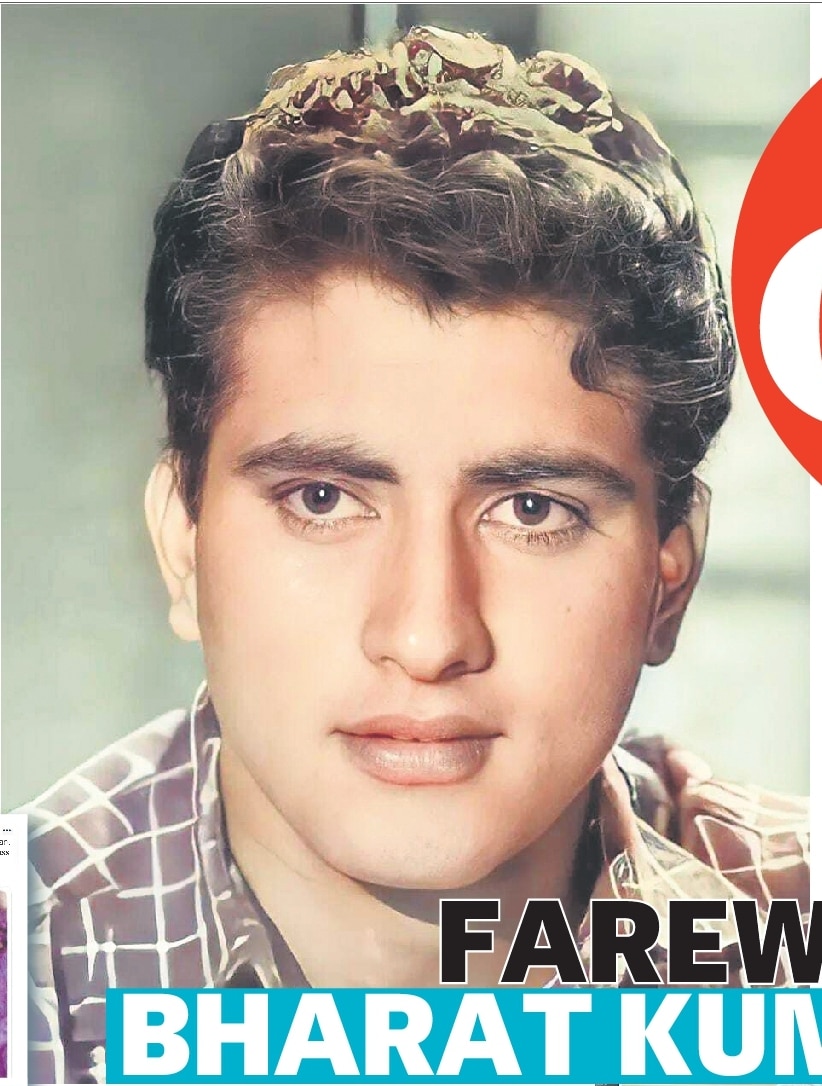
Avijit Ghosh (THE TIMES OF INDIA; April 5, 2025)
Manoj Kumar, who constructed and embodied Hindi cinema's ultimate nation-loving hero, Bharat, in blockbusters such as ‘Upkar' (1967), ‘Roti Kapada Aur Makaan' (1974) and ‘Kranti' (1981), passed away early Friday. He was 87. The actor was bedridden for the last few years battling health issues, his son Kunal Goswami told PTI. He was admitted to hospital for pneumonia some weeks ago.
A recipient of the Dadasaheb Phalke award in 2016, Kumar also starred in a bunch of stylish whodunits, notably ‘Woh Kaun Thi' (1964) and ‘Gumnam' (1965) and successful crime dramas such as ‘Sanyasi' (1975) and ‘Dus Numbri (1976)'. But it was Bharat — the screen name he often took in the films he produced and directed — that defined his image.
Bharat's idea of patriotism evolved over time. He was a nation builder in ‘Upkar' ploughing the fields, battling the enemy outside and personifying Prime Minister Lal Bahadur Shastri's slogan, ‘Jai Jawan, Jai Kisan'. In ‘Purab Aur Paschim' (1970), he was a cultural nationalist defending ‘Bharatiya sanskriti' from the ‘polluting' West while insisting that sari is better than skirt. Bharat rarely touched his heroine even though the movies weren't exactly shy in displaying the female anatomy.
Manoj Kumar constructed Hindi cinema's ultimate nation-loving hero, Bharat— the screen name he often took in the films he produced and directed.
In the 1970s when corruption and joblessness took centre-stage, the unemployed Bharat took on the enemy within, the black marketeers, in ‘Roti Kapada Aur Makaan' (1974), a film that started the multi-starrer trend in Hindi cinema. And in ‘Kranti', he time-travelled to the 19th century to fight brutish colonial masters.
Over the decades, the name, Bharat, blended Kumar's celluloid and private identities, looming large in public consciousness. "Is naam ka bahut bojh hai mujhpe. Zaroorat se zyada zimmedariyan dalta hai (The name burdens me. It puts added pressure and responsibility)," he once said in an interview.
Kumar's personal life was remarkably free from the controversies that gossip mags hungrily fed on in the 1970s and 1980s. Born in 1937 in Abbottabad, a town in north Pakistan, Kumar lost his uncle to Partition violence. At 10, he arrived in the capital, growing up in the refugee colonies of Kingsway Camp and Hudson Line in Delhi. His infant brother, Kuku, too died in the same period. "Bahut rota hua bachpan tha (I had a very sad childhood)," he said in Guftagoo, a Rajya Sabha TV show.
Recalling a moment in Delhi's Tis Hazari hospital during the Partition riots, he said, "When the sirens blared, the doctors and nurses would take shelter in the basement. My mother screamed. Kuku had died. I was angry. I took a lathi, beat up doctors and nurses. Later we immersed him in the Yamuna. As the body sank, I felt I was sinking. My father made me promise that night I will never fight again." The boy kept his word. His father was a poet who was given the pen name "khizr" (the knowledgeable) by eminent poet Allama Iqbal, he said.
Kumar got interested in movies after watching Dilip Kumar in ‘Jugnu' (1947). He even took his celluloid name, Manoj Kumar, after the character played by Dilip Kumar in ‘Shabnam' (1949), an actor who was to influence his style. His real name was Harikrishan Goswami.
A graduate from Delhi's Hindu College, Kumar arrived in Bombay in 1956. In TV shows, he recounted facing abuse, sleeping on railway platforms and getting beaten by cops before making his debut in a small role in director and relative Lekhraj Bhakri's ‘Fashion' (1957). He made his leading man debut in H S Rawail's ‘Kaanch Ki Gudiya' (1961) and survived a series of flops before striking gold in Vijay Bhatt's social drama, ‘Hariyali Aur Raasta' (1962).
Tall, fair and handsome, Kumar became a reliable box-office brand, delivering hits such as ‘Himalaya Ki God Mein' (1965), ‘Sawan Ki Ghata' (1966) and ‘Neel Kamal' (1968), a reincarnation yarn. The engagement with nationalism started with ‘Shaheed' (1965), where he played revolutionary Bhagat Singh. The film received National Award for Best Feature film in Hindi. Made at the request of then PM Shastri, his directorial debut ‘Upkar' (1967), partly shot in a village on the outskirts of Delhi, became a super hit. No song encapsulates rural India's idealized image better than lyricist Gulshan Bawra's ‘Mere desh ki dharti...'
As Kumar's career progressed, he developed a drawl for dialogue delivery; a signature hand movement across the face became more pronounced. Critics scoffed at the mannerisms but fans didn't mind. He also graduated to writing, editing, producing and directing his movies. In the 1980s, he even wrote songs, making him an accomplished all-round talent.
Manoj Kumar's multi-starrer historical ‘Kranti' (1981) was his biggest box-office hit. But thereafter the winners dried up. His final appearance as a leading man was in the vastly outdated ‘Clerk' (1989) which showcased Pakistani stars, the Rampur-born Mohammad Ali and Zeba Ali.
Kumar was married to Shashi, whose mother Savita Behen was a Congress politician of Delhi, who was nominated to Rajya Sabha, recalls Vivek Shukla, a chronicler of the capital. Initially a Congress supporter, Kumar joined the BJP in 2004.
His death on Friday was mourned widely. "He was an icon of Indian cinema, who was particularly remembered for his patriotic zeal, which was also reflected in his films. Manoj-ji's works ignited a spirit of national pride and will continue to inspire generations," posted Prime Minister Narendra Modi on X.
-----------------------------------------
HINDUSTAN TIMES (April 5, 2025)
Legendary actor-filmmaker Manoj Kumar breathed his last on Friday at Kokilaben Dhirubhai Ambani Hospital in Mumbai. He was 87. Manoj was affectionately known as Bharat Kumar for his portrayal of patriotic characters in films such as Shaheed (1965), Upkar (1967) and Purab Aur Paschim (1970). He is survived by his wife Shashi Goswami, and sons Kunal Goswami and Vishal Goswami.
Manoj died due to cardiogenic shock following acute myocardial infarction (heart attack). He was also struggling with decompensated liver cirrhosis for several months, according to PTI.
Born Harikrishan Goswami on July 24, 1937, in Abbottabad (now in Pakistan), Manoj began his career in the late 1950s. He emerged as one of Bollywood’s biggest stars in the 1960s and ’70s .
Apart from his patriotic films, he also has hits such as Hariyali Aur Rasta (1962), Gumnaam (1965), and Do Badan (1966) to his credit.
Manoj was known for his bold stance as an artiste. He sued and won a case against some of the laws imposed by then Prime Minister Indira Gandhi during the Emergency in 1975.
Over the course of his illustrious career, Manoj has received several awards and honours, including the Padma Shri, Dadasaheb Phalke Award, and National Film Award.
Actor Saira Banu, who acted with Manoj in films such as Purab Aur Paschim (1970), says, “He was unwell for a very long time. He was such a dedicated man... In later years, Manoj ji remained very close to us. We were both people of very few words, but we worked comfortably together.”
‘Was at peace with his loved ones’
Manoj’s son Kunal Goswami told ANI, “He was unwell for a long time, but he overcame everything with great intensity. It is God’s grace that he passed away peacefully. He was very happy, though a little unwell due to his age.”
Kunal also confirmed that Manoj’s last rites will be performed at 11 am today at the Pawan Hans crematorium in Vile Parle (Mumbai).
-----------------------------------------
“Veteran actor Shri Manoj Kumarji passed away peacefully early this morning around 3.30, due to age-related health issues. He had been hospitalized for the past few weeks.”
- Dr Santosh Shetty, CEO and Executive Director, Kokilaben Dhirubhai Ambani Hospital
I almost gave up Padosan and Purab Aur Paschim. Today, I’m happy I did both-Saira Banu
7:47 AM

Mehmood, Saira Banu (top), Sunil Dutt and Kishore Kumar (below) in Padosan
Roshmila Bhattacharya (MUMBAI MIRROR; August 9, 2019)
One of my biggest regrets is that he went away too soon with the result that I never got to meet him. So, every year, on his birthday, August 4, I scout for someone who knew him, worked with him, someone who can share memories of the inimitable Kishore Kumar with me. This year, as I mulled over whom to turn to, a song came to mind. “Ek Chatur Naar Kar Ke Singar, Mere Mann Ke Dvar Yeh Ghusat Jat, Hum Marat Jat Are He He He…” I had first heard it in Jhoola, sung by and filmed on Ashok Kumar. Twenty-seven years later, it returned with Kishore da singing it on screen in the 1968 film Padosan. As I hummed it to myself, I texted his co-star from the madcap comedy, Saira Banu, whom you remember even today, half-a-century later, as the impetuous Bindu. Equally memorable are her lovelorn neighbour Bhola, her Tam-Brahm music teacher Pillai, his mentor-friend Vidyarthi and their naatak mandali.
Padosan, Saira ji recalls, was like a picnic. Every day on the sets felt more like a holiday than work with an ensemble cast which included Sunil Dutt, Mehmood, Kishore Kumar, Om Prakash, Agha, Dulari, Keshto Mukherjee and Mukri. “Everyone, right down to the smallest artiste, was stupendous,” she asserts, admitting that she was laughing uproariously not just during the rehearsals, but sometimes even messed up a take or two with her mirth. “They would literally switch off lights, saying, “Madam has rahi hain, let her finish laughing first, then we will continue with the shoot,’” she recounts.
Interestingly, she almost didn’t do the film, following the decision to marry Dilip Kumar. “Our wedding was supposed to happen a year later, but then we suddenly decided not to wait. I almost gave up Padosan and Purab Aur Paschim. Today, I’m happy I did both,” she smiles.
A remake of the 1952 Bengali film, Pasher Bari, the 1968 cult classic was directed by Jyoti Swaroop and produced by N C Sippy and Mehmood. “Mehmood bhai made some big sacrifices for this film, he actually went bald. I remember I was sitting in front of him on one of the royal verandas of Krishna Raj Sagar Hotel where the shooting took place. There were a few other team members around, watching as the barber shaved his head. With every lock of hair that was snipped, unke aasoon tapak rahe the. He cried as he slowly went bald,” she laughs.
Prod her on Kishore da’s reputation of being an eccentric and difficult, and Saira ji admits that she had heard weird stories too. “But he turned out to be a perfect gentleman. Every time I stepped out of my car and entered the studio in Chennai where we were shooting, Kishore saab would instantly stand up and give a lady the respect that she deserved, even if he was sitting between shots or discussing something with the team. It was wonderful!” she exclaims.
Mehmood saab’s Master Pillai, who almost marries Bindu, had a worthy rival in Kishoreda’s Vidyarthi, who takes on the challenge of teaching his tone-deaf friend Bhola singing so he can woo his pretty neighbour. While Bindu’s music teacher sported a bald pate and a choti, his forehead streaked with sandal paste, Bhola’s “guru” frequently tossed back his wayward forelocks, his eyes lined with kohl and his lips stained with betel juice. “A platter of paan would be dressed and ready, waiting for him to pop them into his mouth when he arrived for a shot. Kishore saab would chew on them, splattering his white kurta with the stains of his saliva as is typical of a paan-eater,” Saira ji informs, recalling how she burst into peals of laughter every time he flicked back his hair. “And we shot 'Mere Bhole Balam' without a dance director. Every move was improvised, choregraphed by Kishore saab. I can still hear him croon, 'Meri Pyaari Bindu, Meri Bholi Bindu, Meri Matheri Bindu. Meri Sindoori Bindu'. He was such a joy to work with.”
Ask her to pick a favourite scene from the film, and she zeroes in on the one of Vidyarthi teaching Bhola “Sa Re Ga Ma”. “Kishore saab kept such a straight face all through and Sunil Dutt’s response when he stumbles in places was so hilarious, that I fell off my chair laughing. It had even my family, including my grandmother, in splits, every time it played out on TV,” she says.
Quiz her on her favourite Kishore Kumar song and she is stumped. “It’s difficult to say given his genius and the quality of his voice. All of them are beautiful, out of the world, from Padosan to Kora Kagaz to Aradhana ,” she signs off, humming “Gun Guna Rahe Hain Bhanvare.” Now, that’s another column for another day.

I don’t have an alternate career option. So, Shivaay has to work for me-Sayyeshaa
7:43 AM

Shivaay debutante is feeling the pressure of living up to grandparents Dilip Kumar and Saira Banu’s legacy as date of Diwali release inches closer
Sonil Dedhia (MID-DAY; October 20, 2016)
Sitting in the lobby of a plush Juhu hotel, Sayyeshaa appears like any other teenage girl. Dressed in denims and a beige top, she greets us with a broad smile. Grand niece to Hindi cinema legends Dilip Kumar and Saira Banu, she makes her Bollywood debut in Ajay Devgn’s Diwali release, Shivaay, a film is set to clash with Karan , ohar’s next, Ae Dil Hai Mushkil.
Sayyeshaa had just completed her IB in Science (with 97 per cent marks, shall we add) when she signed Shivaay two years ago. “Ajay sir liked my photographs and I auditioned for him. I enacted a couple of scenes and was finalised for the role,” she recollects. Since Shivaay was delayed, she took up a Telugu movie in the meantime and has recently signed a Tamil film.
With a grand legacy to live up to, Sayyeshaa is keeping her fingers crossed as the release date
inches closer. “The only insecurity I have is whether people will like me. I don’t have an alternate career option. So, Shivaay has to work for me,” she says, adding her legendary grandparents “loved” the film’s trailer. “They are looking forward to watch the film. I feel blessed to have them whenever I need advice.
Sitting with them and talking about movies is like attending a masterclass. My favourite Dilip Kumar film is Mashaal (1984) and as far as Saira Nani goes, I loved her in Purab Aur Paschim (1970). If the latter is remade, I would like to reprise her role,” she says.
Her parents, actors Sumit Saigal and Shaheen Banu, separated when she was two, but she is equally close to both of them. “I stay with my mother, but my father visits me everyday. I was too young when they decided to part ways, but they have always been available. They have constantly guided and supported me.”
It would be great if Ranbir Kapoor is cast opp me in Purab Aur Paschim remake-Sayyeshaa
7:41 AM

Neha Maheshwri Bhagat (BOMBAY TIMES; October 20, 2016)
 Even as Shivaay girl
Sayyeshaa is keeping her fingers crossed for the success of her
Bollywood debut, she says she would love to play her grandmother's role
if and when the iconic Purab Aur Pashchim (1970) is remade. And her
hero? Apna Ranbir Kapoor.
Even as Shivaay girl
Sayyeshaa is keeping her fingers crossed for the success of her
Bollywood debut, she says she would love to play her grandmother's role
if and when the iconic Purab Aur Pashchim (1970) is remade. And her
hero? Apna Ranbir Kapoor.Says Sayyeshaa, “My favourite films of my grandmother are Purab Aur Paschim and Padosan. I won't be able to do what she did, but I would like to be a part of Purab Aur Paschim if it is remade. It would be great if Ranbir Kapoor is cast opposite me.“
The newbie shudders at the thought of being compared to Sairaji. “Though I might look like her, please don't compare us. She had a style of her own. I won't be able to live up to her legacy and body of work. I want to be accepted without being compared to anyone.“
In a way, Sayyeshaa is relieved that her dinner-table conversations don't revolve around movies. “My grandmother has seen the trailer of Shivaay, but we don't talk about films. Our conversations are more about travelling, as my family loves to travel. I also discuss shopping with her. She is glamorous and owns the finest of things. She has beautiful shawls that she wants me to use,“ she says. The debutante also admits that she feels the pressure to live up to her family's name and reputation. “There is no pressure from them, but I still feel it. I know people expect me to be a good actress. My grandfather (Dilip Kumar) has done great work, and I can't even be compared to his toenail. Also, I have to maintain the respectability that my family has earned over the years,“ she concludes.
Can you believe that I almost didn't do Purab Aur Paschim?-Saira Banu
7:40 AM

Roshmilla Bhattacharya (MUMBAI MIRROR; October 21, 2014)
"Can you believe that I almost didn't do Purab Aur Paschim?" says Saira Banu. She recalls how the film's actor-producer-director Manoj Kumar had sent his representative, lyricist Gulshan Bawra, to Filmistan Studio where she was shooting, to convince her to give the nod to his 1970 patriotic drama.
A couple of days later, Mr Bharat turned up at the studio only to be mysteriously told by the actress that there was a possibility that very soon she would not be working in films. "Manojji was alarmed to hear that I was all set to call it quits after just three and a half years in the industry," Saira reminisces with a laugh.
She adds that earlier too she had turned down an offer to play the female lead in his Upkar (1967) because of prior commitments. He had approached her with this role while shooting for her family banner Roshanara Film's maiden venture Palkon Ke Chhaon Mein (1962).
Despondently, Manoj Kumar returned home. Two weeks later, Saira's 'secret' was out, taking the world by surprise. She was marrying Dilip Kumar with whom she had not even done a film.
"His brothers and sisters knew my mother (Naseem Banu) well and Dilip saab was a friend of the family. So there was a connection that not too many were aware of," she reasons.
Saira Banu's Shagird (1967) was nearing completion when she became Mrs Dilip Kumar and decided not to pursue her career in Bollywood. But, soon after, she again ran into Manoj Kumar and his wife Shashi at the premiere of Dilip Kumar's Ram Aur Shyam (1967). After the show, the couple stopped at Dilip Kumar's bungalow on Pali Hill.
"Dilip saab and Manojji were close, having recently worked together in Aadmi (1968). He used to call my husband Rajasaab after his character in the film. He told him that evening that he had offered me Purab Aur Paschim, a subject written with me in mind. Manojji added that initially he was supposed to direct the film for another producer but now wanted to make it under his own banner. He insisted that if I didn't do the film, he would shelve the project," recalls Saira.
Manoj Kumar's words and her "sterling performance" in Shagird, whose rushes Dilip Kumar had seen at a preview show specially organised by his wife, convinced the actor that Saira was a natural in front of the camera and it would be criminal to stop her from doing more films. And that is how she got his permission to do Purab Aur Paschim.
However, during the making of the film, she was suddenly taken ill with ulcerative colitis. She lost 20 pounds, had to be rushed to London for treatment and was nursed back to health there by her doting husband and mother.
In the interim, Subodh Mukherji Productions, which had established itself with her debut film, Junglee (1961), and had signed her for two more films, replaced her in Sharmilee (1971).
"This was a double role Gulshan Nanda had specially written for me because I couldn't do his Neel Kamal earlier. I had convinced the original producer, SK Kapoor, to give the subject to Subodh Mukherji on the condition that I'd do another film with him. But when I fell ill, they replaced me in two minutes without even taking my consent. Manojji however waited till I was fit to return to the sets," she says.
She had studied in a private school in London till she was 15 so was comfortable in the western outfits she wore in the film. At the same time, her parents and grandmother ensured that even while living in the West, she was rooted in Indian culture. "So I didn't look vulgar in those dresses. The film too was aesthetically shot and its is relevant even today," asserts Saira.
Manoj Kumar's gesture to patiently wait for Saira so moved Dilip Kumar that when he returned from a five-year sabbatical in the '80s, the first film he signed was his Kranti.
Subscribe to:
Posts (Atom)