Showing posts with label Prasoon Joshi interview. Show all posts
Showing posts with label Prasoon Joshi interview. Show all posts
We need to reduce and remove the mysticism around filmmaking-Prasoon Joshi
8:11 AM

Niharika Lal (BOMBAY TIMES; November 26, 2024)
Prasoon Joshi, now in his third term as the chairperson of the CBFC, spoke at IFFI about the role he never imagined himself in — regulation. He shared that he never thought he’d end up in a position where he’d have to tell people to change their work. During the conversation, he discussed his role as CBFC chairperson, his approach to writing, and why he believes creative people can’t operate like machines.
‘KISI KO PASAND NAHI HOGA KI AAP KAHEIN KI BADLAAV KIJIYE’
Prasoon said, “I’m a creative person. I never thought that I would get into something like regulation or a role where I have to tell people (to curb creative work). If I put myself in the shoes of creative people kisi ko pasand nahi hoga ki aap kahein ki badlaav kijiye. It’s a vantage point. Life is a vantage point.”
Explaining his point, Prasoon said, “If you’ll try to look at things from someone else’s point of view, then you’ll understand things. Let’s say there is a flowing river. Now, the one who is swimming against the tide of this river – you ask that person, how is this river? He might say that the river is aggressive. Nadi aakramak hai. But you ask someone who is standing at the riverbank, how is this river? That person will say, ‘This river is very quiet, beautiful. I have been meditating looking at this river.’ The same reality is seen differently from different vantage points. The river hasn’t changed.”
He added, “Hence, I felt that when I accepted my position in the film certification board, maine kaha vivaad nahi, samvaad. Aap baat cheet kariye aur aapko point of view samajh aa jayega. And there will be a way out. We are all human beings; we are creating something.”
‘AS FILM WRITERS AND CREATORS, YOU CAN’T BE A MACHINE’
Talking about the process of writing a song, Prasoon said that it doesn’t matter what he approaches – whether it’s a short film, a long poem, a song, or a script – it needs to have a vision. He said, “First of all, you need to have a very clear vision, a very clear belief. Your faith and belief in what you are trying to say are important.”
Recalling how he drew from his childhood memories to write the song Maa from Taare Zameen Par, he said, “I couldn’t write the song for days. The script format mentioned ‘separation song.’ There could be various ways of writing a separation song. I was challenged by it. How do I make it unique? The tone in it, the touch. As film writers and creators, we have a platform to share something very personal. If you don’t have that tone in it, the touch of yours, then you are a machine. You can’t be a machine. I kept struggling with it and I went back to my childhood when my parents were teachers. My mother had to go for a teacher’s training programme, and I was a young boy in Uttarakhand. You act brave, like ‘You are going? Fine. We’re fine without you. There’s no problem.’ But deep down, I didn’t know how to live without my mom. I just went back to that feeling – the feeling I had at that moment. That’s exactly what I wrote: ‘Main kabhi batlata nahin, par and here se darta hoon main, maa.”
‘FILMMAKING HAS TO BE MADE MORE ACCESSIBLE SO STORYTELLING DOESN’T FEEL INTIMIDATING’
In response to a question about how aspiring filmmakers can learn from established ones at IFFI, he said, “We need to reduce and remove the mysticism around filmmaking. People often say: himmatwala makes films, talent wala nahin. Filmmaking is a process that should be transparent and accessible. Those intrigued by the idea of making films should be able to do so the process needs to be simplified. Filmmaking has to be made more accessible so storytelling doesn’t feel intimidating. The fear that your ideas might not resonate with people, that’s what we need to work on. The process must be demystified.”
Aamir Khan is very conscious of the work he does. Taare Zameen Par made me a better person-Prasoon Joshi
9:00 AM
As he completes a three-decade milestone in his career, writer-poet Prasoon Joshi talks about his love for the lyric, the genius of Aamir Khan and why he disagrees with the notion that it’s difficult to make political films in today’s India
Priyanka Sharma (MID-DAY; September 22, 2024)
As far as he can rewind, Prasoon Joshi has always felt like a storyteller. “Writing mere hone ki shart hai (Writing is the condition of my existence),” he says. No wonder he has spent last three decades of his life dabbling in every possible extension of the art form—books, advertisements, poetry, short stories, songs and screenplays.
“I just wrote a musical, Radhiraaj: Love, Life, Leela. I am glad I can continue to experiment with different forms of writing,” Joshi says, as we try to decode his diverse career over an hour-long telephonic call.
Even before he entered the world of advertising, Joshi, all of 17 years of age, had published his first book, Mai Aur Woh. Born to classical vocalist parents, Joshi was surrounded by words from an early age. “It’s not like you decide one day, that from tomorrow, I will be a writer. It’s not a choice. It’s always there in you through your upbringing and how you are surrounded by that art form. I grew up reading poetry, Hindi poetry, a little bit of Sanskrit and folk music,” he shares. He knew his calling, but the question that Joshi struggled with was whether his pen could earn him a living.
“Hailing from a middle class family in a small town of Uttarakhand, I was sensitive about not being a burden to my parents,” he says. So after completing his Masters in Physics, Joshi pursued an MBA course and found the sweet spot for his passion.
“I found that the profession of advertising was where I could sustain myself and where there were takers for my storytelling.” Weaving sensitive, charming stories for numerous brands, Joshi revolutionized advertisements. Storytelling in Indian ads might not be accorded the same value as movies, but the poet-writer treated both the forms equally.
“People talk about higher and lower art forms but I don’t distinguish like that. In ads, I told stories for brands. In films, I told stories to bring across social values to people.”
Soon, Joshi began writing for independent artistes, including Mohit Chauhan’s Silk Route band and Shubha Mudgal, and his work reached the circles of the Hindi film industry. “I was fortunate that my work reached people before I did. I wasn’t knocking doors but my work had already opened their windows. Films were never on my mind because the kind of vocabulary I developed reading Hindi poetry, I wasn’t sure film industry people would like that. But here I was, writing my first film song for Lata Mangeshkar and Ilaiyaraaja.”
With Lajja, began Joshi’s stint in Bollywood. Hum Tum, Black, Rang De Basanti, Fanaa, Taare Zameen Par, Delhi 6 and Bhaag Milkha Bhaag stand tall as some of his most popular and acclaimed works as a lyricist. “My lyrics have always been poetic because I believe poetry is a gift that you are blessed with. You could be anyone in your professional space and still have a poetic eye.”
For Aamir Khan’s Rang De Basanti, Joshi also wrote dialogues, while Farhan Akhtar-starrer Bhaag Milkha Bhaag featured Joshi as its screenwriter. The Bollywood journey brought with it close collaborators, in the form of musician Shankar Mahadevan and Khan.
“Aamir is such a fabulous mind. We have collaborated on so many films. He is very conscious of the work he does. Taare Zameen Par really made me learn about children and dyslexia. It made me a better person. I am not a sportsperson but writing Bhaag Milkha Bhaag for two-and-a-half years made me realise what sportspeople go through.”
As he discusses one of his most powerful works, Rang De Basanti, Joshi reveals how his much-loved song, Luka Chhupi was an afterthought. “It’s the last track I wrote for the film. There was only a background score written for the scene. The tune was so special that A R Rahman said, ‘There can be a song.’ So, it occurred to me that why can’t it be about hide and seek between the mother and the son? And the mother is saying, ‘I can’t find you,’ and the child says, ‘You can’t find me now because I am in a place from where I can’t come back’.” His illustrious innings, however, wasn’t without its share of rough times. Joshi mentions the industry shows respect towards a lyricist only when he or she becomes popular.
While Joshi is considered one of the most prolific lyrical and poetic voices in the country, an aspect of his professional life remains under constant scrutiny—his position as the CBFC chairperson. Joshi, who was appointed as the chairperson in 2017, has faced his share of criticism over the board’s decisions on certain films. He admits that this journey hasn’t been easy.
“I understand I am on the opposite end of creative spectrum. But someone has to do that. A lot of people can be fence-sitters but nobody is ready to go into the field and do it. I am not someone who chickens out of responsibility. I distanced from films and a lot of my film work suffered after that. I had to do that to be absolutely objective. I always say that it’s a difficult job to balance artistic expression and society’s sensibilities. But I believe that creative people are not there to harm anyone. These things can only be solved through discussion.”
Over the last few years, the filmmaking fraternity has often felt and voiced that it’s not easy to make political films, especially those that are anti-establishment, in today’s India. Does he agree with the sentiment?
“All kinds of films will come out and there will be debates. Only through deliberation, will we understand. There are certain subjects that weren’t touched upon yesterday, but today they are. We are becoming more vocal. I don’t think there is fear among filmmakers that political films will be met with resistance or pressure.”
Recently, Anubhav Sinha’s Netflix series IC 814 had to add a disclaimer after a meeting with the I&B ministry as a section of the audience had taken offence over the Hindu code names that terrorists of the 1999 hijack had taken on during the attack. As we mention it, Joshi tells us he has to get to an event. “Probably we could talk about it later,” he says.
If certifying films fairly comes with a price, I’ve paid it-Prasoon Joshi
8:15 AM

At IFFI, the lyricist spoke about how his role as CBFC chairman has led him to maintain a distance from the industry, and the personal and professional price he’s paid for it
Niharika Lal (BOMBAY TIMES; November 27, 2022)
Prasoon Joshi, who has been the CBFC chairman for the last five years, says that he has maintained a deliberate distance from films, and written fewer songs, since taking on that role. “I was on the board of several major film companies and I resigned from them after becoming the CBFC head. Yeh mera style hai kaam karne ka. Main nishpaksh rehna chahta tha, main nishtha se kaam karna chahta tha. I am not part of certification of those films in which I’m involved. Somewhere, commercially, I’ve had to pay a price as well,” the lyricist said during his recently-held masterclass on Art And Craft Of Lyric Writing at IFFI (International Film Festival of India).
Prasoon continued, “I have been friends with a lot of people in the industry. But I have kept a distance to judge films judiciously and fairly so that everyone can reach out equally and everyone is judged fairly. If it comes with a price then I have paid the price.”
He added, “People can say whatever they want to, but all I can tell them is – main factory mein tarasha hua patthar nahin hoon. Main nadi ke kinare pada hua patthar hoon, jisne 50 thokrein khayi hain uske baad uska aakar gol hua hai. Aise hi gol nahin ban gaya hoon main. No one from my family was in films. No one came to Bombay with me and neither did I know anyone in the advertising world. I found my own way. Maine apni thokrein khayi hain aur un thokron ka prabhav ye hai ki kahin golayi aayi hai aur un golaiyon ka prabhav aap ko dikhta hai.”
‘IT IS IMPORTANT THAT THERE IS HIGHER REPRESENTATION OF WOMEN IN CBFC COMMITTEES, EVEN IF IT’S LOPSIDED’
Prasoon also said that 70% of the members in the CBFC committees today are women, and that it is really important for him to include more women members. “It is a bit lopsided. Who are these women? They are from all walks of life. Now, why is it important for me that women are in these committees? Kai baar woh maa bhi hoti hai, behen bhi hoti hain, receiving end pe hoti hain. It is important that they are comfortable. Since I have joined CBFC, I have ensured that there is unfair representation of women – lopsided representation of women – in those committees (i. e. higher ratio of women). I am not doing male bashing, but women take more interest in the shaping of the society. Unke upar dayitwa (responsibility) hota hai toh mujhe tasalli hoti hai.”
‘A FILMMAKER CANNOT SAY THEIR FILM IS JUST FOR SELF-GRATIFICATION IF THEY SEEK MONEY FROM A MOVIEGOER’
When asked if the CBFC sometimes tends to ‘unnecessarily use its scissors to cut films’, Prasoon expanded on his own philosophy on censorship during his tenure, saying, “We stay in a society, toh usmein kuch systems bante hain. Jaise hum sadak par chalne ke niyam banaate hain. Animal kingdom mein toh kapde nahi hote, but we celebrate wearing clothes, we make it an art form. Fabric design pe jaate hain. Koi usse yeh bhi keh sakta hai, aap mera freedom lerahe hain, mujhe kapde pehna rahe hain. But somewhere, there is an understanding in human civilization that we all want to see each other in a certain way. Aur bhasha ka istemaal hai, ki hum aapas mein public mein iss tarah se bolenge. Ek code of conduct evolve hota hai. It’s dynamic, ever-evolving. And kahin na kahin, doosre ke baare mein sochna important ho jaata hai. So, I have tried to handle this system (at CBFC) – jo pehle se chala aa raha hai – gracefully. And to solve these matters by asking ‘samaaj kya dekhna chahta hai?’. A filmmaker cannot say that a film is made just for their own gratification. If you’re seeking money from a moviegoer’s wallet, you can’t say that I don’t respect the opinion of the person from whose wallet I am seeking money. As long as we find the right balance between complete expression and responsibility and sensitivity towards the milieu and society we live in, I think we can solve it. And that has been my approach. As long as the intent is to solve it. The intent is not to play the blame game. The intent is not ki logon ko kathghare mein khada karo.”
‘LISTENERS SHOULD BE HELD EQUALLY RESPONSIBLE FOR THE TYPE OF SONGS BEING MADE TODAY’
Talking about the sexism in the lyrics of certain songs, Prasoon said that creators and listeners “should all be held equally responsible” for them. “If you want any change, then you have the biggest button. Uska bahishkar karne ka button aap ke paas hai. You can’t say that I will criticize objectification of women in songs during the day and in the evening, I will dance to those songs. Double standards are not going to work. Regardless of how harsh the market is, jo bikta nahi, woh tikta nahi,” he said.
Many people have made films about villagers and farmers without interacting with them-Prasoon Joshi
7:45 AM

Rachana Dubey (BOMBAY TIMES; November 23, 2021)
If I have to choose between writing or singing something that I like and something that can inspire, I will choose the latter,” said screenwriter and lyricist Prasoon Joshi during his masterclass at the 52nd International Film Festival of India (IFFI) in Goa. He added, “When I wrote Bhaag Milkha Bhaag, I often thought to myself if this piece of work could inspire more people in this country. Self-expression should in some manner attach itself with the larger good.”
Lauding the film festival for handpicking budding artistes through the 75 Creative Minds of Tomorrow competition, launched as part of the Azadi Ka Amrit Mahotsav this year, Prasoon said, “Cinema has to have magic, but making cinema should not be magic. It is a serious craft. We have to make it by design and not by default. Tukka or chance has to be reduced. When a child in a family says that he wants to become a singer, filmmaker or lyricist, the family should be able to take them as seriously as they would take him if he said he wanted to be an engineer or a doctor. That will happen when we start working towards serious exposure and learning.”
He added, “We also have to focus on getting more authentic with our stories. Many people have told me that they have made films about villagers and farmers without interacting with them. Unless more and more filmmakers come from various parts of our country, different milieus, different language sects, we won’t see diversity. Filmmaking is a business that generates employment. It should not be seen as akin to gambling. One should be assured of their craft.”
As the head of the Central Board of Film Certification (CBFC), Prasoon has overseen the certification of over 25,000 films nationally in his tenure. Given that his run has been more or less dispute-free, he was asked about his approach to the job. “There is a certifying process, and it is complex because our country is one of the most complex in the world with its cultural diversity in place. My approach was to open a discussion to find solutions, understand and accommodate different points of view. While talking about commerce and share of wallet, you cannot ignore the share of voice,” he said.
We have much to learn from Milkha Singh ji , no matter what our pursuit is-Prasoon Joshi
8:07 AM

By Prasoon Joshi (BOMBAY TIMES; June 20, 2021)

Charaiveti Charaiveti — keep walking, keep walking and keep inspiring, this seemed to be the mantra of Milkha Singh.
I knew little about athletics before I started writing Bhaag Milkha Bhaag. Milkha ji knew this early in our interactions that I am more interested in exploring a side and those dimensions, which probably a very few knew. After our many conversations over weeks and months, he did tell me that such intense discussions about his own life he hadn’t had with anyone before we interacted.
I know I made him visit painful alleys of this past and recall some best-forgotten incidents, and it was gracious of him to allow a writer to do his job and peel off layers. Some parts of his journey resonated with mine, and I could find my pen flow more smoothly — the fight to withstand adversity, endure unsavoury incidents and yet be up against all odds. And that the significant hurdle is placed not by strangers but by those familiar, claiming to be well-wishers but not indeed so. This is the hardest one to cross, and it must be.

We have much to learn from Milkha ji , no matter what our pursuit is.
First, be good at what you do — hone your craft. Milkha Singh used to run so hard during his races, even during some practice ones, that he would often faint after completing them; this is what you call giving your 100%. Then, believe in yourself and the force above at the same time. More importantly, as I have written in the climax, the bigger battle in life is to face your demons. When you do, you realise that they are not as big as they were in your mind.
Whilst meeting him in Delhi sometime in April, I happened to ask him how he felt now that he is running his 92nd year, especially about life and death. Without a second of hesitation, he responded, “I look at the positive side of things, I look at Fauja Singh who, at the age of 110, is still running. Life and death are not in our hands but staying optimistic is.”
Bhaag Milkha Bhaag encapsulated his journey. Life had thrown enough at him for anyone to run away. But Milkha ji bhaage nahi. Woh daude.
Daudna ek decision hai, a determined endeavour. Mushkilon se bhagna nahi hai — daud lagani hai unke saath.
Milkha Singh ji will continue to inspire all and especially us — Rakesh, Farhan and all the team of Bhaag Milkha Bhaag.
-----------------------
YOUR STORY WAS A CONSTANT SOURCE OF INSPIRATION: FARHAN ON MILKHA SINGH
Dearest Milkha ji,
A part of me is still refusing to accept that you are no more. Maybe it’s the stubborn side I inherited from you... the side that when it sets its mind on something, just never gives up.
And the truth is that you will always be alive. Because you were more than a large hearted, loving, warm, down to earth man. You represented an idea. You represented a dream. You represented (to use your own words) how hard work, honesty and determination can lift a person off his knees and get him to touch the sky.
You have touched all our lives. For those who knew you as a father and a friend, it was a blessing. For those who didn’t, your story was a constant source of inspiration and a reminder of humility in success.
I love you with all my heart.

Only 0.2% films were going to FCAT now-Prasoon Joshi
8:17 AM

CBFC chief says very few films needed to approach FCAT in the past few years, hopes all cine concerns will be handle amicably even post its abolition
BOMBAY TIMES (April 9, 2021)
Recently, through the Tribunal Reforms (Rationalisation and Conditions of Service) Ordinance 2021, the Centre has done away with appellate authorities under nine acts and vested those powers in the high courts. One of the appellates that have been removed is the Film Certification Appellate Tribunal (FCAT), the statutory body constituted to hear appeals of filmmakers aggrieved by Central Board of Film Certification (CBFC) orders.
After the move was announced, several filmmakers, including Vishal Bhardwaj, Hansal Mehta, among others, expressed their displeasure and said that the FCAT was a much needed body for the industry.
Now, Prasoon Joshi, Chairperson of the CBFC, has shared his opinion on the matter. “This is part of extensive tribunal reform. One understands that this a procedural rationalisation of multiple tribunals, and not just FCAT, which have been either merged or reduced from 26 to 19, based on functional similarity. Apart from increased functional efficiency this shall reduce the burden on public exchequer especially when the public at large is not a direct litigant in many of these tribunals.”
Explaining how it affects the industry directly, Prasoon adds, “From our industry’s specific standpoint, the fact is that over the last few years, the number of films needing to go to an appellate body has seen a steady decline. Over the last two-three years only around 0.2% films were taken to FCAT and I am sure this gap can be further closed. As I sincerely believe that when the industry has the key body — the CBFC — working in an efficient and pragmatic manner, all matters and concerns can be dealt with responsibly, amicably and in the spirit of collaboration between the stakeholders.”
Art can be interpreted differently, but the intent of the creator is very important, says Prasoon Joshi at IFFI
8:10 AM

Prasoon Joshi talks about controversies surrounding films and how he deals with them
Niharika Lal (BOMBAY TIMES; January 28, 2021)
During a discussion at the recently concluded 51st International Film Festival of India (IFFI), writer and lyricist Prasoon Joshi spoke about how he dealt with controversies and controversial films in the last three years during his tenure as the Central Board of Film Certification (CBFC) chairman.
‘SACCHA KALAKAR KABHI KISI KO NUKSAN PAHUNCHANE KE LIYE FILM NAHI BANATA’
During the last three years, Prasoon has seen many objections and protests against films, which were based on historic and political figures. Talking about how he dealt with such controversies, he said, “Ek saccha kalakar kabhi kisi ko nuksan pahunchane ke liye film nahi banata. Before coming to the CBFC, I probably never thought about how people see art. But one thing I have always understood is that a river has a different meaning for the one who is fighting its waves and for the one who is standing at the shore. It is the same river, but its interpretation is different for both of them — for one person, the river is aggressive and for the other, it is calm. Hence it is possible that the intent behind making a piece of art was different, but it is interpreted in a different manner. Lagaatar uss par baat-cheet karte rehna aavashyak hai. When I accepted the position of the CBFC chairman, I felt the need to keep this discussion open, and I was able to resolve many such issues.”
‘I ADVISE CREATORS TO DISCUSS THEIR SUBJECT WITH EXPERTS IF THEY DON’T UNDERSTAND THE FIELD’
Prasoon said that whether its mythological, historical or political subject, filmmakers must do their research and discuss the subject with experts of that particular field. Also, intent is key, “Jab koi iss tarah ke vishay par film banata hai, ya natak banata hai, jo logon ki bhawnaon se jude hue hain, then the foremost thing is that your intent should be to do justice to the subject/character. Aapke camera angle se aapka intent pata chal jaata hai. Next question is, whether you have researched the subject enough or not? Did you discuss it with the experts of that field? Unless you discuss it with the experts, you have no right to comment on it. I always advise that if you don’t understand the subject, then you should definitely collaborate with subject experts to understand the topic,” he said.
He added, “There has to be a sense of trust between the creator and the receiver. Jiske liye aap kala bana rahe hain agar uska apke prati vishwas nahi raha toh nuksan hoga kala ka. Kyunki kalakaar aur sunne wale (audience) ke beech vishwas ka setu hamesha jeevit rehna chahiye, baaki regulatory bodies toh aati jati rahegi. Uss vishwas ko jeetna padta hai, us vishwas ko kamana padta hai.”
Irrfan Khan wasn’t just one of the best actors of this era, he was one of the best we ever had-Prasoon Joshi
8:22 AM

Irrfan, an artiste of exceptional sensitivity, changed the perception about Indian actors in the West by reminding them that we are not about just mannerism and theatrics, says Prasoon Joshi
Anshul Chaturvedi (BOMBAY TIMES; May 5, 2020)
 Beyond the immediate reactions – the sorrow, the loss – what thoughts come to your mind when you think of Irrfan, the actor?
I was very closely in touch with him. He used to share a lot with me... meri kaafi us se baat-cheet hoti rehti thi, phone pe hi hoti thi aksar. Aur main aapko ye cheez keh sakta hoon ki pain se bahut guzra hai woh aadmi. I’ve spoken to him after his therapy sessions, they were like... he used to say, “Aisa lagta hai ki pain aur main ek hi cheez hain. Pehle toh main cheekhein marta tha, ab woh bhi band ho gaya hai. Ab aisa lagta hai main hi pain hoon, aur pain hi main hoon. Itna zyada painful uska procedure hota hai.”
I used to be stunned when, after saying that, he used to talk about coming back and finishing his work commitments. I used to feel ki aap ka pain agar aap puri tarah camouflage nahin kar sakte hain toh aap scene pe kaise aayenge? Aap kisi aur ka role play kar rahe hain. Toh completely, you know, overcoming that, and facing the camera, it’s remarkable – so the first thing is that.
The second thing is, he was a very sensitive artiste, a nuanced artiste. Sensitivity comes with you know... pain joh hota hai woh bhi utni hi shiddat se hota hai. Your intensity – the intensity you feel, the pain is also as intense as you feel other emotions. You accentuate it, and your pain is also accentuated. And that is the reason it is remarkable that he used to still come and face the camera. It is not an easy task.
And the sense of professionalism and commitment and also, you know... to laugh at the little ironies of life, that ability also he had not lost till the end. That is the reason I feel that it is something which is to be remembered, and to be inspired by. I used to feel inspired by it. In fact, when I used to talk to him, I used to feel kya yaar hum itni chhoti-chhoti problems mein uljhe hue hain, yeh aadmi itni badi problem ke baad bhi keh raha hai ki main aa ke abhi yeh kar raha hoon, woh kar raha hoon.
Is Hindi cinema feeling the loss of the man, or the actor, to a greater degree?
Irrfan was not a mannerism star. Even if he was doing an ad, he used to take over the screen. Iss generation mein itne fine kalakar bahut kam hai. I don’t think we (fully) acknowledge that sort of work. We are so used to fanfare and razzmatazz that what this man used to very subtly do probably will take a lot of study – which should be done. To see how effortlessly he has played so many roles which have, you know, found their space... and he’s completely versatile. He changed the perception about Indian actors in the western world also that – we are not about just mannerism and theatrics.
An actor for whom the gym wasn’t the core point of prepping for a role?
Yeah, yeah… That’s what, probably a new kind of stardom. The difference between ‘star’ and ‘artiste’ can very clearly be seen. Well, he is a star... but what’s the definition of it? Someone who lives the role and lives what he does, is what he did. We normally have less appreciation, especially in cinema industry, there is less appreciation for nonmannerism people because, you know, they are less bankable. Because they always reinvent the wheel.
So the people who reinvent the wheel are the people who always challenge the audience. He’s not someone who lulls you into passive consumption. He pushes you into active consumption. He makes you participate in what he is doing. So with Irrfan, it’s a two-way traffic. You also have to sort of, be with him in his exploration. While he is exploring a new way of approaching a role, you have to be with him. So he’s also a little demanding, thoda aap se mehnat ki tavaqqo (expectation) rakhte hain.
He doesn’t lull you into sitting and enjoying a spectacle. He expects you to hold his hand and go on a journey, and explore what he is exploring. Now that’s where the difference between star versus explorer is. A templated one is predictable so you know what you are expecting.
Like when you know what to expect from the popcorn, the cola and the movie at the outset, before you enter the hall – something that you couldn’t do with an Irrfan film?
Correct. Well said. But with Irrfan you are also on a journey as he was on a journey. He was a different kind of an actor, and a different kind of star. And a true star, in my opinion. I would keep him as one of the finest in the Indian film history. I will keep him there. I will not keep him as one of the great actors of this era. I think he was definitely beyond his era. Historically, I will keep him, as one of the best we ever had.
My tenure at CBFC has been about holding dialogues to resolve issues-Prasoon Joshi
8:19 AM

Rachana Dubey (BOMBAY TIMES; September 22, 2019)
Since August 2017, Prasoon Joshi has successfully chaired the Central Board of Film Certification (CBFC) with a fewer number of controversies. Prior to his term in office, the CBFC was seen as the villain in Bollywood’s narrative of undue cuts, personal comments and anger against decisions that they forcibly had to accept. In his last year as the CBFC chief, Joshi plans to make the most of his time in the office and leave it in a state of fine balance. Excerpts from BT’s conversation with him:
You’ve spent two years in office as the chairman of the Central Board of Film Certification. Buzz is that you might return for another term...
That’s not in my hands; it’s up to the authorities. I’m a poet at heart and I’m planning to work on a musical with lots of songs at some point. Right now, I am only thinking of making the most of the time I am left with in this office. My policy is, and has been, to iron out everything I can within the purview of the CBFC to ensure that it feels fit, and works as the fine balance between cinema and the citizens. In the last year that I have in this office, I plan to have more meetings, internal and external, in order to pave the way for anyone who steps in after me. So far, my entire tenure has been about holding dialogues to resolve issues. The intent of a creator is almost always good; it’s just that it’s misunderstood sometimes. That is when we need a middle ground, which we find through discussions.
What were the issues that needed to be ironed out or resolved?
First and foremost, most people don’t know or understand what an examining committee is and who its members are. It’s a body that comprises people from all walks of life. They present the probable point of view of a common person, who will eventually watch the film. There are lawyers, engineers, doctors and even housewives, who offer their valuable feedback to filmmakers. Now, a filmmaker might feel differently from what they think and may not agree with their point of view on certain scenes or dialogues, maybe because the intention with which he or she placed those elements in the film has not come across. Previously, we didn’t have as many discussions about these things. Now, there’s room for multiple, long and cordial discussions, which help both sides understand each other’s point of view.
Could you elaborate on what you mean when you refer to a filmmaker’s intent?
Sometimes, certain scenes or dialogues can give you an idea of how this person thinks when it comes to certain sensitive subjects or topics. For instance, the portrayal of women in cinema… While showing a policewoman in a film, if your camera is caressing her body, then there is something very questionable about your intent as a filmmaker. The time has come when we have to look at things differently. Our society is no longer ready to accept certain things. Sensitising filmmakers is very important and they also have to be less adamant and more flexible about what is being told to them. I have always seen my own work from the vantage point of being an artiste. Someone at the bank of a river feels peaceful seeing it, but someone swimming against its force may feel its aggression. The same thing, when seen from different vantage points, tends to have different perceptions and this difference needs to be understood by everyone. Also, the trust between an audience and an aritste should never be lost. If, as an audience, I don’t trust the intention of a filmmaker, I probably will never understand what he was really trying to convey through a film or a scene. There’s little difference between something commercial and something meant for self-satisfaction. A commercial product also has to be sensitive towards the needs and demands of the people.
For a long time, there has also been talk around the need to amend the Cinematograph Act, 1952, to make it more compatible for today’s times.
As the CBFC, we work within the parameters of the act. The changes or amendments are not in our purview. That can happen at the Parliament and ministry levels.
What about the new categories for certification that have been in deliberation stages for years now?
The introduction of categories is going through rounds of discussions and deliberations. The suggestions and recommendations in The Shyam Benegal Committee Report and several other reports submitted by committees formed before that are being discussed. The OTT platforms are a new reality of our times, which no one had probably accounted for when these reports were submitted. Categorisation and further classification of films is crucial, but it’s something that is being thought about. Certification happens in almost every country in the world. In a few countries, it’s an autonomous body and in countries like France, which are known for their bold and prolific content, the body is controlled by the government. Quality of cinema is different in different countries. We, as a nation, have to improve the quality of our cinema, and for that, we need a contemporary and an effective system of checks and balances. I have the utmost respect for artistes, who are also my fraternal friends, but we cannot ignore the need for improving the quality of our cinema. This year, I lead the delegation to Cannes where I spoke to many people and they didn’t have very complimentary things to say about our movies. So, we have to get out of the blame game internally, and make the country proud by making some world-class films. Poetry is one craft where we can say we have world-class poets; cinema has the potential to get there, too.
How do you think we can achieve that?
I think it’s a complex subject. We have some exceptionally talented filmmakers in our country, but we also need to tap talent from diverse backgrounds. Our cinema has a tendency to produce clones of anything that works at a given time. We need to get rid of that habit. We need more people from diverse places in the country, who can add a fresh perspective to a story. For instance, the story of a farmer can get a better perspective if it is narrated by someone who belongs to a farmer’s family. His or her perspective will be very different from someone who has only read about them. Uss cinema se mitti ki khushboo aayegi. Diversity needs to be encouraged and we need to get more talent from the grassroots level. This is a dilemma I face with advertising, too. We don’t need people who can do what anyone can do. People with distinct abilities and skill sets are needed to find a unique mix in the space of storytelling. At one point, we made some great films, but then, they started getting repetitive. India was shown from only one vantage point — from that typical exotic eye. We have to now make sure that the world comes out of that and sees the new India, which is going through a rapid change.
A sign of showing the rapidly-changing India is your recently-launched certificate and logo for the CBFC. What drove the design reboot?
So, change comes in two parts — one is the look and feel, and the second is how we work internally. We felt that certification should reflect the changing times that we’re living in. We’re digital and our cinema consumption is across all kinds of screens. While redesigning the logo and the certificate, we ensured that we have a font that is contemporary and the certificate is interactive. Also, for the last two years, I’ve been working closely with the officers and the board members to bring about a lot of changes in the way we work. We had participated in a lot of workshops and discussed ways to make the functioning smoother, internally and externally, and keep the house in order. With increasing dialogues with different pan-India industry bodies, we could also iron out issues that have existed for a long time. The industry put its faith in my intention of making the system smooth and I would credit them for being open to the idea of discussing and resolving problems amicably. The fact that I was trained to run companies came in handy. Even now, in the last year of my tenure, I am honestly trying to deliver on the work that I promised to do when I first held office. When you put the focus on work, half the issues are sorted on their own.

Some things and issues are not meant for public consumption-Prasoon Joshi on enforcing cuts in 'A' films
8:46 AM

Prasoon Joshi on using his corporate experience to plug the holes in the CBFC
Himesh Mankad (MUMBAI MIRROR; September 2, 2019)
On Saturday, Prasoon Joshi, the Chairperson of the Central Board of Film Certification, unveiled the new logo and certificate design of censorship in Mumbai, and cleared the air on several contentious isssues, from the importance of the present certification and additional cuts for adult films to last-minute title changes. Excerpts:
Since you’ve taken over as chairperson, controversies around film certification have been few and far between. How have you managed to resolve the issues that plagued your predecessor?
I have worked in the corporate world and my idea of running an organisation is very professional. For me, it’s important to have the house in order. So, I had several training programmes with officers and committee members and together we corrected all the glitches and plugged the loopholes. I spent most of my time in correcting things which needed attention. I’m thankful to some of the industry leaders who helped and mentored me during crisis. The change came through dialogue.
Yes, Padmaavat was the last major controversy one recalls…
I believe makers make films with good intentions and that should come through. If there is an issue, we should not drag it but resolve it through dialogue. This was a new job for me because I’m an artiste too and had to learn to see things from the audience’s point of view. I’m happy with what we have achieved during these two years.
Many believe that the 1952 Cinematograph Act is outdated.
There is a lot of discussion happening for a solution.
 What’s your take on the current certifications: ‘U’, ‘U/A’ and ‘A’?
The category of certificate is important as it informs the audience what they can expect from a film. Children are our future and we need to expose them to things gradually and not shock them. Sometimes, there is a disagreement on what makers consider adult content and grouse that the committees constituted of people from different walks of life don’t know much about cinema. But they are not supposed to know; their job is to express the point of view of the common person. For instance, a woman member saying that as a mother she feels strongly about a certain content. Maybe the maker has said something with a different intent, but it might be received differently. That’s where dialogue comes in.
But why should films which have already been certified as ‘A’ be subject to further cuts and beeps?
Some things and issues are not meant for public consumption. You won’t print an abusive word in the headline of your newspaper, will you? We follow the same code of conduct. Culture with respect to what to wear on certain occasions and how to present ourselves, has been created by us and now it’s our duty to protect it. Sure, we are evolving with time, but that should happen organically and collectively. One person can’t decide what is right because tehzeeb belongs to everyone.
 Titles of films like Cheat India and Mental Hai Kya were changed to Why Cheat India? and Judgementall Hai Kya just prior to their release, while their trailers and other promotional material had been cleared and were in the public domain for weeks.
The two instances you mentioned were felt ideal by the committee. It’s a different thing when a title is used in the film, but the poster as a standalone gives a different message. When sensitive subjects crop up, we need to handle them with dialogue. In these cases, we mutually arrived at a decision.
And what’s happening with Prasoon the writer-lyricist?
My hands were full as I wanted to do justice to my new responsibility, so I couldn’t take up much work. I did Manikarnika last year. A couple of scripts are in the pipeline and you’ll hear of them soon.
I request the filmmakers to not use CBFC for their marketing-Prasoon Joshi
8:17 AM

Itishree Misra (BOMBAY TIMES; August 29, 2019)
Writer, lyricist, poet and also the Chairman of the Central Board of Film Certification (CBFC), Prasoon Joshi wears all his hats well and with precision. At a recent event, the writer of several films, including Bhaag Milkha Bhaag and the more recent Manikarnika - The Queen of Jhansi, Prasoon talks about the popularity of content-driven films and making CBFC controversy-free.
Lately, we’ve seen content-driven films like Badhaai Ho, Andhadhun, Uri: The Surgical Strike and Raazi doing very well at the box office, as opposed to films that had big stars. Would you say that the story of the film is its hero now?
Yes, in a way. See we are dealing with a satiated generation of people. There’s so much of entertainment available vis-à-vis what we had before. Gone are the days when we used to wait for Fridays and wonder which film will release this week and woh chahe jo bhi ho, dekhni hi hai. That was the deprived generation, itna TV nahi tha, web toh tha hi nahi. Now when people go to watch a film, they make an informed decision. So your expectations are very different. Just watching your favourite stars doing something on screen is not what you’re there for.
Also gone are the days when you could not see your favourite star. Your favourite star is now in your phone! He or she is there on Facebook, Instagram, Twitter, and even on TV. So you’re no longer being deprived of seeing your favourite star. Your hero or heroine is now right in front of your eyes 24X7. The star looks more approachable, more tactile, so they appear less god-like. They are freely discussing their problems with you on social media. So today, if your film doesn’t promise good content, it’s unlikely that people will go and watch it.
So is the age of stars over in Bollywood vis-à-vis actors?
The age of stars can never be over, but the definition of stars is no longer the same. That god-like, larger-than-life persona is no longer there. There will always be stars. People will talk about a particular person and say I love the way he or she talks or looks or acts, but that sense of worship that people used to feel, that has changed. It’s now a more multidimensional relationship that people share with a star. They also want to know how their star lives, eats, how witty they are, is he or she intelligent or not, what he or she does in their everyday lives and their personal relationships. So it’s no more a relationship of a star and a fan, it’s more like that of a friend.
You have taken a strong stand against the open letter written by 49 filmmakers, activists and artists against mob lynchings to the government. You along with 61 others have said that they ‘expressed selective concern and demonstrated a clear political bias and motive.’ Would you want to say more on the topic?
I feel human life is very important. There’s no debate on that. If somebody says that human life is getting compromised somewhere, of course one will raise their voice. You have to raise your voice and bring it to the notice of the authorities. You can’t just let it go on, and you can’t justify it under any disguise or garb. But if the topic would have been that only, I would have said nothing. But unfortunately that’s not the case. The people who are bringing this to your notice, haven’t done this for the first time, they have been doing it again and again. I question the intent of it. I feel there is a definite dislike. I feel this is condescending and unfair. You look at any policy of the current government, they are not biased towards anybody or any particular section of the society. They’re being absolutely neutral. If you feel something is not right, then there’s two ways of looking at it. One is that ‘Oh! There’s something not right and we need to constructively look at this and solve this problem.’ Second is you’re portraying a dark picture and you’re making people feel as if nothing is going right in this country and it’s doomed. And that is depressing. That is misleading people; that is not constructive. That is because your approach is to malign the government and say that these people do not know governance. And that’s only because you don’t agree with them, you don’t like them. And all I’m saying is that if that is the reason of your criticism then I don’t find it genuine.
CBFC has really become non-controversial these days, so much so that it’s no longer in news.
That’s because I’m totally fair. No one can say that I am above board. The doors of CBFC are open. Main vivaad ki jagah vichaar-vimarsh mein yaqeen rakhta hoon. Mujhe lagta hai through discussion, through dialogue, you can always put forth your point. What is the role of the CBFC? It is a set of representation of people. Who is there in the committee of CBFC? Housewives, school teachers, engineers, advocates, these are the kind of normal people who sit in the committee and they watch a film to see how it will impact the people. That is what our job is. Filmmakers sometimes get agitated and say that the board doesn’t understand the film. Of course, they don’t understand the film! They are there to bring to you the point of view of the common people. So I tell them, please sit together and the filmmaker will tell you his or her point of view and you tell the point of view of the common person. There definitely would be a common meeting ground for them both, if they honestly talk. So I have only tried to bring a lot of transparency and dialogues through which you see, a lot of things have been solved. Take for instance Article 15, it deals with a sensitive subject, but still it was released. Also Padmaavat, there was so much of confusion but in the end it was released, also the film on our Prime Minister, PM Narendra Modi. I don’t know why there used to be so much of controversy. Also because I request the filmmakers to not use CBFC to create unnecessary controversies for their marketing or promotions. Because I would not be able to give any quotes for your promotions.

I am surprised at the irresponsible statements made about CBFC-Prasoon Joshi on PM Narendra Modi row
9:55 PM

In reference to Narendra Modi biopic release delay, Prasoon Joshi speaks up
As told to BOMBAY TIMES (April 8, 2019)
After the Central Board for Film Certification came under scrutiny following the delay in the release of the Vivek Oberoi-starrer PM Narendra Modi because it didn’t have a CBFC certificate, Chairperson Prasoon Joshi has cleared the air regarding the agency’s role in the delay of the film’s release, highlighting concern over “irresponsible statements” made about the CBFC. In a statement, Joshi said, “I am surprised by the irresponsible statements that are being made regarding CBFC. Facts should be checked before making such allegations.”
Stating that he wanted to “bring focus back on facts”, the lyricist explained that it wasn’t the CBFC that was responsible for the film’s release being delayed from its original date of April 5. “We had already stated that the film is yet to be certified and is in the process of certification as per the requisite guidelines. Let this be clear as well that the CBFC’s mandate is to review content as per guidelines, not to look into timing of release of the films. That is the prerogative of the makers,” the statement read.
The film, directed by Omung Kumar, was slated for release on April 5, but had to be postponed as it could not get the CBFC certificate in time. Several news reports at the time said that a film must be submitted 68 days prior to its release date in order to get the certificate. Joshi, however, clarified that this is a misconception as 68 days is the maximum time the CBFC can take to certify a film. He elaborated in the statement, “The period of 68 days is the maximum period within which CBFC has to certify films. However, most of the films, including regional films, are actually certified in a much shorter time than this. Therefore, the impression that is being attempted that every film should take minimum 68 days for its certification is absolutely false and contrary to the basic nature of our organisation, which is expected to facilitate industry within the checks and balances as per the statutory guidelines.”
The CBFC chief maintained that the body had followed “a fair and non-judgemental process” in the film’s certification and he felt compelled to clear the air after conflicting reports. He said, “In keeping with professional ethics a fair and non-judgemental process is followed as per the requisite guidelines in all films that come to CBFC. To the people at large, this clear and clean perspective is required to be given by all responsible organisations, not misinformation to mislead.”
At an early age, I realised that rozi roti nahi chalegi poetry se-Prasoon Joshi
10:49 AM

Riya Sharma (BOMBAY TIMES; February 19, 2019)
 Prasoon Joshi – chairperson of the Central Board of Film Certification and chairman of one of the world’s leading ad agency network – has been many things during the course of his career. A lyricist, screenwriter, poet and marketer – but for him, donning these ‘hats’ was a result of his ‘majburiyan’.
Speaking at the Business Conclave organised by Shri Ram College of Commerce, Prasoon shared with the audience how he got into advertising, his hometown in Uttarakhand and how it impacted his life, and why he was never a rebel.
‘INDEBTED TO MY CHILDHOOD DAYS’
Prasoon was the first speaker at the event and said that he had a great impression of the institute. “I haven’t studied here, but I have met many people, in my profession and company, who come from your institute and I have a great impression about what you learn here. I respect your institution immensely,” he said before answering questions by the session’s moderator.
The first question that the CBFC chief was asked was about his journey from the leisurely pace of Uttarakhand to the busy life in a metro. “My journey has been from a small, humble middle-class family. For a long time, I had no clue what I wanted to do, and that was the frustrating phase. But looking back, I think the confusing times are the most fertile times. When you do not know what you need to do is the time when you explore. And when you explore, life becomes clearer to you. The connectivity in Uttarakhand was not like today, so all you had were books, nature and elders to learn from. That’s the time I started writing and at a very young age, at 17, my book had come out because I was writing extensively. But at a very early age, I also realised the commercial reality of writing, especially poetry. Meri rozi roti nahi chalne wali iss kaam se. I knew I had to do something else to sustain myself. I came from a family of teachers, all I inherited was education. My initial days have been very rewarding in terms of learning,” he said.
He continued, “The place where I come from – wahan log apne gharo mein taale nahi lagate thay. Ek tarah ka trust aap seekhte hain, aur ye sab cheezein jo aap bachpan mein seekhte hain, these become an important part of you. That is why I am always indebted to my childhood days in Uttarakhand which taught me a lot.”
‘I FELT I COULD SUSTAIN MYSELF IN ADVERTISING’
Prasoon started his career with advertising, and is currently the CBFC chief, a lyricist, poet, and the list goes on. Which was probably why he was asked that since he has donned many hats, which is closest to his heart? He answered, “Hat is a very fashionable term. The problem is, unfortunately I did not have the luxury to be that fashionable, to think that these professions were hats. These were not hats, woh meri majburiyan thi. Jab aap ek madhyam pariwar se aate ho aur aap likhna chahte ho, aur aapko maloom hai kavitaon ki market nahi hai, what would you do? You can take just two decisions. Aap escapist ho jayein ya apne already pareshan ma baap ko aur pareshan karein. Unse bolein ki mujhse nahi ho raha, bhejte jaao paise. Woh kahein, beta kahan se bhejun? Jitni meri poonji thi woh tu apni kavitaon ki bhent chadha chuka hai, kab tak chadhaega?”
He continued, “The question is – we need to understand that our parents do a lot for us. Iski wajah se main rebel bhi nahi ho paaya. Woh hote hai na bachhe, kehte hain ki main guitar uthaake ghar se nikal gaya, I can’t relate to that because you know how much your family cares for you. I discovered there is a profession like advertising while doing my MBA. That is when I realised that someone will pay me to think of these crazy stories, narratives, ideas, songs and solving the brand’s problems. I found a fit there. And I felt I can sustain myself doing this. Honestly, I did not join advertising thinking that one day, I will head an agency. The only thing I knew was that it seemed natural and that I’d be able to sustain myself.”

I’m naturally inclined towards stories of valour-Prasoon Joshi
8:07 AM
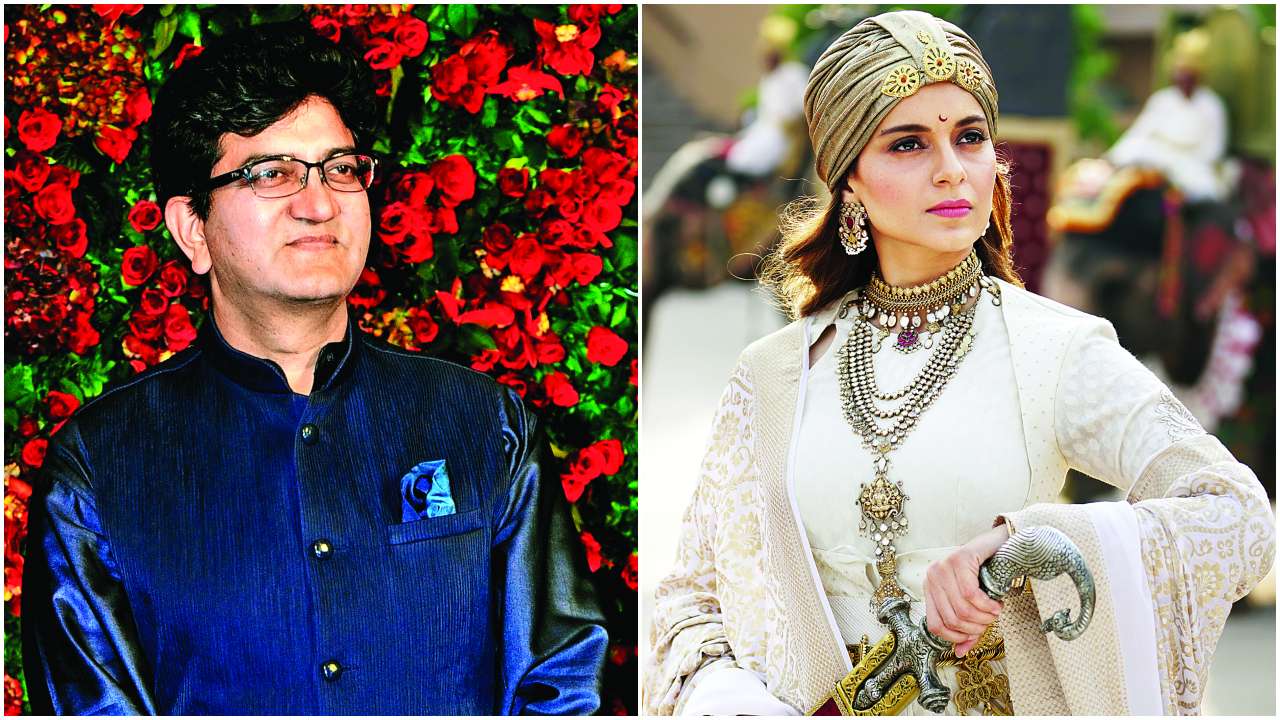
Deepali Singh (DNA; January 31, 2019)
Prasoon Joshi admits that when it comes to stories of bravery and national heroes, he has always wondered why Rani Lakshmibai’s story hasn’t found many takers in Bollywood. That’s why he was more than happy to green-light Manikarnika: The Queen Of Jhansi, when it was offered to him. In a candid chat, the wordsmith reveals more. Excerpts…
Post Neerja (2016), you didn’t choose any other assignment?
Yes, I was contemplating many subjects. Moreover, I was travelling a lot. I also became the chief of the Censor Board of Film Certification (CBFC) and was trying to streamline as well as smoothen the whole process. I signed Manikarnika two years ago.
So, what made you say yes to it?
I had been thinking of doing something new. Producer Kamal Jain explained the subject to me and asked me if I would be interested. Subsequently, I met the entire team. The one thing that struck me was why more films have not been made on Rani Lakshmibai before. She is a national hero and I felt ashamed that we haven’t done many movies on her... at least five films should have been. So, I felt I must write for this project.
What do you feel about Kangana Ranaut playing the lead role?
She was an apt choice. I have always liked her work. I feel she does every role with complete dedication. She was a natural fit here.
Does a historical require more research than a contemporary subject?
Every subject requires research and understanding. As for Rani Lakshmibai, I knew more folklore than the nitty-gritty of her story. But it’s something that has always interested me because I have this natural inclination towards bravery, valour and stories of our pre-independence era. So, writing for it was an organic process. The key message is that the independence we gained wasn’t achieved only because of slogans, but because of sacrifice. Sirf naaron se nahin, khoon ki dhaaron se bhi mili hai azaadi. Many people, especially the youth, don’t realise it. Rani Lakshmibai’s story inspires us. It asks whether you want to waste your youth or dedicate it to the country. What did she get out of it? She could have taken a pension and lived a good life. That’s what struck me and I wrote Main rahoon ya na rahoon, Bharat yeh rehna chahiye.
You have had a long association with Shankar, Ehsaan and Loy. How was it collaborating with them once again?
From Phir Milenge (2004) to Taare Zameen Par (2007), London Dreams (2009) and Bhaag Milkha Bhaag (2013), we have done a lot of films together. It’s always a joy to work with them.
A patriotic song is nothing but the reflection of the truth-Prasoon Joshi
2:13 PM
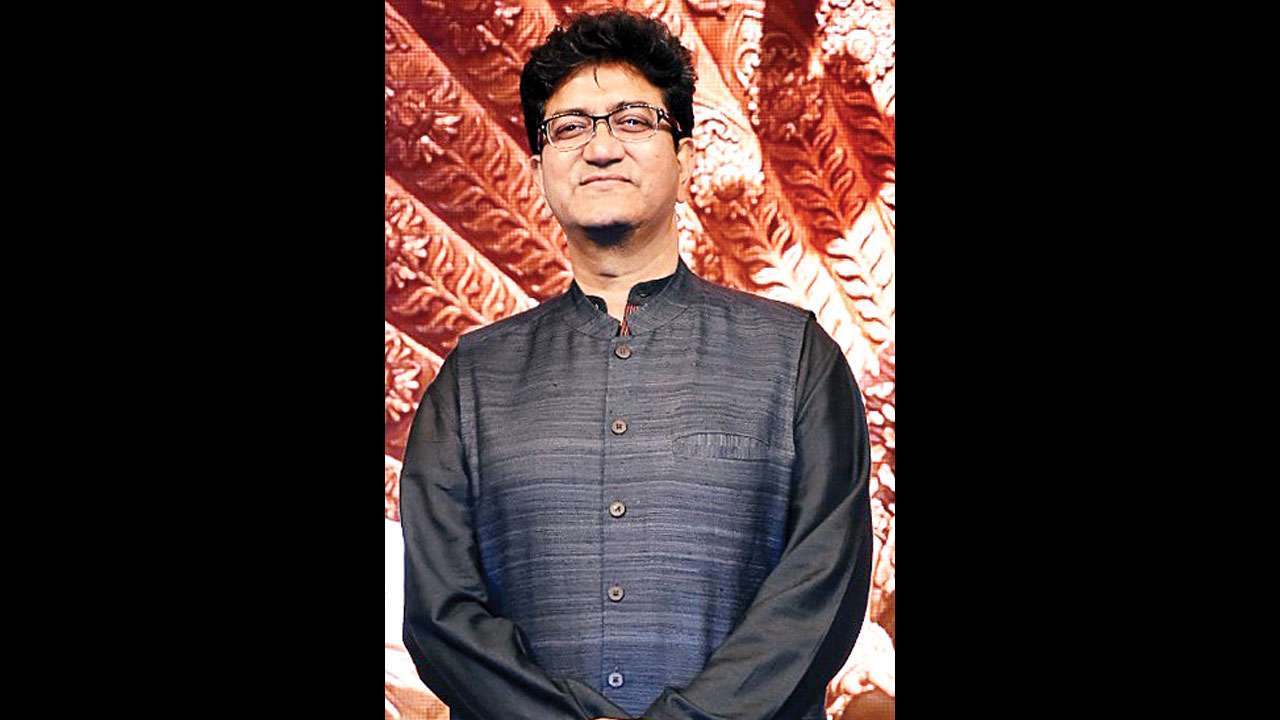
Deepali Singh (DNA; January 25, 2019)
On January 15, when the song Bharat from Manikarnika: The Queen of Jhansi was launched, lyricist Prasoon Joshi coined the hashtag, ‘Desh Prem Jatao’. Explaining the thought behind it, he tells us, “If you feel love for your motherland, show it. Express it in any way you want to, through art, music or social change. But don’t hesitate to show it.”
The wordsmith wears his patriotism on his sleeve. And he expresses it through his music and his words. How else can you explain the beautiful lyrics for Bharat that go, Main rahoon ya na rahoon, Bharat yeh rehna chahiye. Silsila yeh baad mere yun hi chalna chahiye. “The words resonate with you because Rani Lakshmibai’s sacrifice was real,” adds the Censor Board chief.
Over the years, Bollywood has seen quite a few desh-bhakti numbers that have struck a chord with the audience. The reason, he feels, is that they don’t have ‘manufactured patriotism’. “Machines don’t resonate, human feelings do. For instance, in another context, just like Bharat is the soul of Manikarnika, Roobaroo was the soul of Rang De Basanti (2006). You have to search for that soul. A patriotic song is nothing but the reflection of the truth,” opines the National Award winner.
Among his numbers, Prasoon likes the songs that he penned for Rang De Basanti. “I really like Des Rangila in Fanaa (2006) too,” he tells us. One of his all-time favourites is the Lata Mangeshkar track, Aye Mere Watan Ke Logon. “It still resonates with everyone because it talks about the sacrifices made by people to achieve this freedom we enjoy today. Hum kitna bhi jhuthla lein, hamare desh ke veeron ko bhulane ki koshish karein, aap nahi bhula payenge, kyunki woh balidaan sachche thhe,” he adds.
With such beautiful tracks being created in Hindi cinema, how does he react when people say that today’s lyrics have lost their depth and there is no poetry left in Bollywood anymore? “Every song doesn’t have depth, I agree. If you ask me, if there has been a decline in the quality of songs as compared to earlier, I would say, surely 100 per cent,” he admits. But then, the Padma Shri recipient asks, “When have we tried to nurture poets and poetry?”
“It’s easy to desire a rose to bloom in your garden, but you have to create the right atmosphere for it. Gulab ke liye mitti bhi toh honi chahiye. In a similar way, poets too require a certain atmosphere to be nurtured,” concludes Prasoon.
For many years, we have approached the portrayal of women in our cinema, casually-Prasoon Joshi
8:30 AM

Rachana Dubey (BOMBAY TIMES; November 27, 2018)
As a lyricist, he puts feelings into words. As a screenwriter, he adds visual imagination to what is a mere story. And as the chief of the Central Board of Film Certification, he strives to strike a balance between cinematic sensibilities and social responsibilities. At the recent International Film Festival of India, BT spoke to Prasoon Joshi about the importance of poetry and why certification plays a key role in India. Excerpts...
Just about everything in cinema, except writing lyrics and poetry, has become a profession. Can being a poet become a profession in India?
Poetry can’t be a full-fledged profession because certain things cannot be seen in a straight-jacketed or calculated manner. Can poetry be a factory product? No, but the significance of encouraging people to write poetry should be understood. You must have noticed that leaders and business bigwigs often quote poems in their speeches when straight sentences fall short and they want to express themselves. When people find poetry so helpful, I wonder why it is not taught adequately. If the poetic eye is dead, we lose a lot as a society. We should have more appreciators and nurturers of poetry to make our children better human beings. They will become more compassionate and we will have diverse views, become nuanced as people and have a more sensitive society.
With your role as the CBFC chief, Bollywood assignments and other engagements, how do you make time for poetry?
I make my plans broadly. Of course, I do miscalculate sometimes, but being a part of the advertising profession, which is more deadline-driven than films, I am disciplined with timings. It’s all a question of priorities. Life does take a toll on all of us, par kuch cheezon ke liye waqt churana padta hai.
Among your professional responsibilities, your role as the CBFC chief is probably the one that is more daunting. Do you agree?
CBFC’s work doesn’t come naturally to me because I am an artist, and assessing someone’s work while balancing cinematic sensibilities and societal responsibilities is not easy. It’s an honorary job that I have with the CBFC, but whenever I am asked for an opinion, I step in. For me, everything has been a learning experience. I believe in taking on challenges and when this role was offered to me, I decided to try my best. It’s easy to be an armchair critic; most people chicken out when the time comes to face challenges. I decided to brave the challenge. People in the industry were receptive with me, which is why things have been quite smooth so far. Film certification is an important part of filmmaking. You can’t tell a consumer that I love your share of the wallet, but I don’t want your share of the voice. It’s a different matter when you do something for your own satisfaction, but the moment you do it commercially, you have to act responsibly. My fundamental belief is that artists don’t want to harm and that makes things easy for me. Sometimes, people are so engrossed in creating their work that they can’t think of how things will be perceived. People listen to me, they understand my point of view, and so, we have a peaceful dialogue to reach a common ground.
Pahlaj Nihalani has been crying foul about the cuts being suggested in his film Rangeela Raja…
As creative people, we have to understand that there are certain issues which are more important than ever before and we can’t take them casually. One is the portrayal of women. The objections/suggestions/modifications that were suggested for Rangeela Raja were around that. In the name of humour, if you are glorifying violence against women, or if objectification of women is shown as entertainment, we need to take a call. Of course, you can bring in the age-old argument of freedom of expression and say, ‘I am free to express the way I want.’ Yes, you are free to express, but do it a little more sensitively. For many years, we have approached the portrayal of women in our cinema, casually. If we don’t introspect, we can’t change anything in that space. One important issue the CBFC faces is that when a film is offered an A certificate, which was the case here as well, the makers insisted on UA. When a film’s makers demand UA certificate for a film permissible only for adults, it puts us in a tight spot. We can’t allow children to watch content meant for adults. I don’t want to talk about Mr Nihalani here, because he is an elder and I have never commented on him as an individual. We need to understand that when a committee comprising 70 per cent women strongly feels that a particular film cannot be watched by children with their parents, we should respect that. The purpose of certification is to help people make an informed choice about a film.
Talking about the portrayal of women, you have written the dialogue and lyrics for Manikarnika - The Queen of Jhansi. Given that the film has been through plenty of ups and downs, how has the experience been? And how would things work when the film comes up for certification given that you are still the head of the CBFC?
Rani Laxmibai is exemplary, I have huge respect for her. It was a fantastic experience presenting her life on celluloid. Personally, it was a life-enhancing experience to learn so much about her. Bhaag Milkha Bhaag gave me an insight into the world of sports and the mind of a wonderful sportsperson. Taare Zameen Par helped me understand dyslexia. Manikarnika gave me an insight into our fight for freedom. While the fate of a film is not in anyone’s hands, a lot of hard work has gone into it over a period of time. When it comes to certification, I distance myself from every film that involves me. I did that for Vishwaroopam 2 as well.

CBFC has to balance cinematic sensibilities & social sensitivities-Prasoon Joshi
8:24 AM

Anshul Chaturvedi (BOMBAY TIMES; November 3, 2018)
The news space for the past few months has been lacking the almost default quota of stories about censorship vs free expression, and the theatrics of leaked stories, inexplicable cuts, appeals and tribunals. In that rare noncombative space, the CBFC and its chairperson Prasoon Joshi have been doing other things, such as a recent workshop that was attended by both the CBFC’s board members and representatives of Hindi and regional film associations. Prasoon explains why such dialogue is both unprecedented and essential, and why, while very few films are facing restrictions, collective viewing through the medium of cinema cannot yet be treated on the even more liberal benchmarks as individual viewing experiences. Excerpts:
How effective have been the recent efforts of the CBFC to engage with the cinematic community? You have held a meeting and workshop with industry representatives recently.
Filmmakers talk of sensitising the panel’s members. And we, the panel, need to get filmmakers on board, so we can both understand how people are looking at cinema with changing times. So, activities like that workshop was very important. They had their own queries in their head. It was a kind of a Q&A which I had with them to make them sort of familiar with what we are trying to do. I keep telling them it’s not about censoring, the spelling has to change to sensor. You know, if it comes from sensitivity and sensorial, then it should be sensor, not censor.
The idea is to keep talking to the film industry, taking feedback, and making sure that the staff and the people who work every day are sensitised to that feedback. That sensitisation has reflected in the kinds of films that are coming through, where people sometimes wonder how they came out without any cuts — films like Mukkabaaz or a Raazi or Padmaavat or a Mulk or recently, the documentary The Argumentative Indian, where I personally sat with the filmmaker. Or Manto.
Also, there’s more to it than clearing movies. We have digitised the entire process. We are going back to as much as our old record is, to digitise every certificate, so that if people want to get their certificate — if people have lost it and if the third generation of people want to obtain the certificate, you know — they can get it. Lakhs of them have already been done, and the process is on. We are also introducing a more contemporary design of film certificates which will also have a QR code.
Do digital processes translate into quicker turnaround time for movies?
Some filmmakers want their movies sorted very urgently. Sometimes I feel a filmmaker also needs to understand that no matter how digitised we’ve made the process, still, a film reviewing process is a human process — people have to sit, watch a three-hour film, discuss it, go through the Cinematograph Act, and offer their advice. That’s a human process. That cannot be shortened, that cannot be digitised. No computer can certify your film. It has to be understood ki yeh nahi hai ki aap aaj apply kar rahe ho aur kal aapko certificate dega... they have to give a minimum of three weeks. The process gives us many much more time — 68 days — but we don’t take that much of time, we usually take much less time, try to do it as fast as possible. But sometimes people don’t understand the volumes being handled. This year we have issued 20,000 certificates already.
By that benchmark, in 2018, the ‘CBFC vs filmmaker’ headlines haven’t been frequent.
See, those stories, when I consider them even as a marketing person, I feel it’s a very dirty way of marketing. People trying to portray as if they are resisting pressure and saying that CBFC has done this, has done that. That doesn’t do justice to the people. If you come and see the people who are working in the CBFC, they are working day and night. On Saturdays also they are working, trying to clear the backlog of films because staffing has not gone up so much as the number of films over the years. The amount of films we are producing every year has been increasing, and so has the workload.
As far as sensibility is concerned, I have worked really hard in terms of communicating that. You can talk to the CBFC people and they can tell you that films don’t face unnecessary deletions. Most of the times, in fact, people are going for voluntary cuts and voluntary changes.
Like Manmarziyaan? We’ve often had headlines saying that the CBFC buckled under a community’s pressure — this time they did not, but the filmmakers still opted to take cuts.
Yes. So, I have said that we are trying to do as much — as sensibly as possible towards the filmmaker. And being an artist I understand that, but there is also what needs to be understood is that the job of CBFC is to strike a balance. A fine balance between cinematic sensibilities and social sensitivities. It’s a tough job. And I think the industry has appreciated that.
Our interaction with the industry was a first of sorts. The industry has, in the recent past, no memory of interacting with the CBFC and tabling their issues. They felt that we are doing mostly certification, not censoring. There is nothing like that ‘the CBFC is trying to resist our creative work’. They were very appreciative, and at the same time I could communicate to them that how difficult the job is – and in terms of a fine line and in terms of striking the balance. Main hamesha kehta raha hoon — vivaad se zyada vichar-vimarsh se kaam hota hai. Vivaad se nahi hota hai. Vivaad, you know, makes everybody’s life difficult. There is nothing that comes out of it. By talking, by sitting across the table, you can resolve difficult questions.
Many filmmakers, when speaking about projects they have made for the online/streaming space recently, say ‘Here we don’t have to factor in about what certification we will get. We make it and we screen it.’
That’s their choice. What can I say about that?
When people in the censor system come with their questions and their clarifications, what are the areas where you find gaps that need to be addressed?
In terms of sensibility or in terms of process?
Sensibility...
What I ask them to understand is that ki intent kya hai. Don’t see things in suspension. Out of context aap koi cheez dekhenge, usske maayne apni tarah se aap nikalenge. But the intent of the storyteller is very important while holistically seeing the film. The camera’s intent could be objectification or portrayal. You can clearly see that, and you know when your intent is just to objectify. I will give you an example of a girl who is a police officer, and the camera is constantly, you know, caressing her body or portraying her body in a way which only reduces her to a body. It is gross disrespect to a woman in India —imagine, who fights so much to get education, then fights to get into a service like police, and is in a dignified uniform. If even then if you only see her as an object —that’s something which concerns me.
And these are things which are very fine. It can’t be communicated over one talk. You constantly interact with the people, this whole workshop thing which we are doing, and which we will be doing again, and we plan these workshops in various other regions —in Chennai, in Kolkata, in Hyderabad, in Trivandrum. We are planning to do this, more interaction with the board members because see, on one hand you have got regular staff of the CBFC, and on the other hand you have the board which has more of people who are from the world of art and cinema. So, it’s important that they spend time and understand each other’s point of view. Art is constantly evolving, sensibilities are also constantly evolving.
The judiciary has been on a liberal trajectory, with the verdicts on adultery, on Section 377, on Sabarimala. As a country, we have been opening up on at least some questions that we are not comfortable with earlier. On the other hand, something as simple as a WhatsApp video forward has caused much stress, sometimes violence and sometimes deaths. How do filmmakers, and certifiers, balance the line between ‘anything goes’ and the fallout of controversial content?
Society has a collective conscience. Things don’t change overnight. I feel ye kehna ki jaise hum kehte thay ki kya cinema samaaj ka darpan matr hai? Is it only a reflection of the society? Or is it also shaping the society? It’s both — it reflects the society and also shapes the society. You can’t just say it is purely reflecting the society. And also, sometimes cinema goes a step or two ahead and makes certain points. And also starts the debate in people’s head. It’s a two-way process. It’s constantly shaping. In every sphere, what is acceptable for society’s collective conscience is not easy to decide.
The thing is that you push it when you feel that your society is not ready to accept it because eventually you understand there’s commerce is related to it. When commerce is related, especially to cinema, you cannot just say that I want your share of wallet, but I don’t like your share of voice. With the share of wallet, the share of voice will come —you’ll have to respect that. Because it’s a commercial world, you are seeking the share of wallet, so you’ll have to respect the share of voice as well.
Would you say that the trust level between the CBFC and the filmmakers has increased in the past year or so?
I would say that. I would believe that. That’s for the filmmakers, for them to say, but I feel it being part of the industry as well, I feel, yes. I feel that they want to listen, and I want to listen. I feel that there was a dialogue.
Well, at least fewer cases seem to be going to the FCAT in the last few months.
Yes, that’s true.
How relevant is certification/censorship for cinema at a point of time when the content you can watch online is close to completely uncensored?
If you understand human psychology — you would know that collective viewing is a very different experience, a very different experience from personal viewing. And that is the reason there are certain things you might not find that offensive individually, but in collective viewing, you start finding them offensive because the person sitting next to you is not comfortable. These are the things which need to be understood. It’s not easy to take a broad stroke and say, everything should go, this is a free world. That kind of thinking —it’s not nuanced. I think it’s layered in every country’s culture, especially India. India is a very unique country- so many languages, so many intricacies of cultures. And they all cross-fertilise, intermingle.
At a personal level, are any of your equations in the industry impacted by you having to work with the industry as an adjudicator?
I have not been brought up in the industry in any case, waise bhi main aa gaya industry mein bhatakte hue. Ab aisa nahi ki mera ki main yahin pala badha hoon. I know people and they respect my work. You know, I think the fundamental thing is that I came to the industry because of my work. They know that he has a job to do. My reputation is of that kind —I have always been very professional in my projects. I have never ever missed a deadline. I have always tried to go beyond my job description to make sure that I deliver to the best interests of the film that I was working on. Now, I am playing a role where I have to strike a balance, and I think most of the people who have experience of working with me, have respect for me, would know that I will try to do this also sincerely.

‘CBFC-film industry meeting was iconic and a constructive beginning’
Divya Kaushik (BOMBAY TIMES; November 3, 2018)
In September, a two-day meeting and workshop, held under the guidance of CBFC chairperson Prasoon Joshi, was attended by CBFC board members and representatives of Hindi and regional film associations like Indian Motion Pictures Producers’ Association, Indian Film and Television Producers Council and South Indian Film Chamber of Commerce.
It was apparently after 25 years that the CBFC chairperson had held such a meeting. CBFC member Vani Tripathi Tikoo tells us, “Apparently, the last time such a round table discussion happened was when Vijay Anand was the CBFC chief and he had met representatives of film associations. But even then, it was only Vijay Anand who had met them and not the board. This meeting was a two-day affair, we had a board meeting and we had a workshop with the panel members, the actual people who form the examining and revising committee for films, to understand their point of view and to have deliberations on what sensitivity we should keep in mind while certifying film and how the changing narrative of Indian cinema should be kept in mind. Meeting the representatives from the film industry was iconic. This is good and a very constructive beginning to bring them on board because you can’t just meet for one hour and expect them to understand what the board feels. Even when we talk about the board, there are various segments, zones involved and we all got to meet together.” She added that mainstreaming the discourse with the film industry was the biggest USP of such a meet. “We are very happy and it is a welcome decision on the part of chairperson. This is an iconic moment for the CBFC that we sat across the table and started the dialogue. It is a constructive one.”
Talking about how an initiative like this will help in strengthening the relationship between the board and the film industry, Vani said, “I think this is going to be a game changer. At the end of the day, both parties need to be on the same page. Certifying has always remained an issue and we met representatives from different film bodies to understand that there are various levels of sensitivity involved when you are making a film, whether it is socio-political or rights of various communities, including the minorities. They had a lot of observations and inputs to give us, which was of great value to us and we also had some things to say to them because there is a deeper level of understanding which needs to come. Most people don’t understand that we certify more than 18,000 films in a year. It’s not a joke, and this process is also human resource related.”
One point that Vani feels should be a part of such meetings is the objectification of women in cinema. “One thing which I always speak about is objectification of women. Filmmakers will have to realise that it is non-negotiable as far as the CBFC is concerned. There is a great responsibility on the part of the board to decide that we will not negotiate on women objectification, we never have, we never will, at least this board won’t, and that is how it is,” said Vani.
Atal Bihar Vajpayee gave me a warm hug after hearing 'suraj ko main nigal gaya'-Prasoon Joshi
7:15 AM

BOMBAY TIMES (August 18, 2018)
"You may become an ex-PM but never an ex-Poet,” Atal ji apparently quipped at one time. It’s simplistic to separate the poet and the politician of his persona. The fact is that they walked in tandem. Both poetry and politics were an indelible part of his consciousness. He was not a recluse poet. He may have enjoyed his moments of solitude but he kept his poetry connected with the spirit of the times.
Many people say that the Poet dominates his Politician, but that would be a uni-dimensional assumption. He is much more than a Poet, much more than a Politician. In fact, he strongly believed that poets and writers would only enrich politics.

Somehow, I have felt that the hope in his poetry has a unique tenor, a kind of a responsible hope. He may not have, as an individual, felt particularly hopeful at a given time, but he felt responsible to transmit hope, for the larger good. He would have written poems like a poet would, but in many places, one can see the reflections of the political responsibilities he carried, he was mindful that he was talking to the nation.
Let’s not forget he could not be like an activist poet or point fingers at the system or tarnish the power structure. He also was the power, he was also the system. And this aspect put him in a tight spot. But I have always believed that such are the unique vantage points of life, such are the authentic voices which reflect a complex artistic life tenor.
So, if there is a dilemma, a contradiction, a tension found in his thought, it makes Atal ji’s poetry a lot more unique.
I was fortunate enough to have spent time with him, hearing him recite some of his work, and also more fortunate to have him recite words written by me in speeches on some key events. His warm hug post hearing the words: “suraj ko main nigal gaya” (I swallowed the sun) in my song Roobaroo (Rang De Basanti), is one my most cherished memories.
To carry the tradition of hope forward, I instinctively penned down some thoughts as a tribute, based on one of my personal favourite poems written by Atalji –

Subscribe to:
Posts (Atom)