Showing posts with label Prakash Mehra. Show all posts
Showing posts with label Prakash Mehra. Show all posts
Being a star’s son is a double edged sword-Kunal Goswami
9:40 AM

Tanvi Trivedi (BOMBAY TIMES; May 20, 2025)
Legendary actor and filmmaker Manoj Kumar, celebrated for his patriotic films and notable contribution to Indian cinema, passed away on April 4. In a conversation with BT, his son and actor Kunal Goswami reflects on his father’s legacy and his own journey in films. Excerpts:
How would you describe your bond with Manoj Kumar — as both a son and an actor?
As a son and actor, I’ve had the privilege of learning and unlearning many things about cinema and life from him. My father was affectionately known as Mr Bharat because he embodied patriotism. He pursued acting with great passion and dedication. Films like Upkar, Purab Aur Pachhim and Shaheed reflect how deeply patriotism was rooted in him — and we, his children, saw and lived that passion every day.
Did you always want to become an actor?
I was too young to make that decision myself. One day, my father simply said, “Chalo, aana hai set pe?” and suddenly, I was surrounded by the media and thousands of people while he was directing a scene with Dilip Kumar saab and Hema Malini ji. I was around 14 when I made my debut. I went on to work in Ghunghroo with Prakash Mehra and Kalakaar with Sridevi, which became popular for its music. I acted in around 10 films, but things didn’t quite take off. After my father directed me in Jai Hind (2000), I decided to step away from the film industry.
Was it a tough decision to make?
I didn’t want to cling to the idea of “once an actor, always an actor,” especially if it meant accepting roles that didn’t feel right. Being a star’s son is a double-edged sword — you get an initial platform, but there are assumptions. Many filmmakers believed they had to approach me through my father, who wasn’t very social or easily approachable. This hesitation worked against me. I reached out to filmmakers myself, but strong roles never came my way. Others like Kumar Gaurav and Chimpoo Kapoor went through similar struggles. Eventually, I moved into the catering business. My father encouraged me to stay in films because he saw my creative side, but he never forced me. Acting may be behind me, but I do hope to direct a film someday.
Do you plan to remake any of your father’s films to take his legacy forward?
No, I don’t think those films can be remade. You can remake a Don — it’s a commercial film, much like James Bond — but films like Upkar, Purab Aur Pachhim or Roti, Kapda Aur Makaan are in a league of their own. The emotional depth and context they carried can’t be replicated. Even though multiple versions of Shaheed have been made since, people still remember Manoj Kumar as the original Shaheed Bhagat Singh.
Bobby Deol reveals why dad Dharmendra turned down Zanjeer
10:40 AM

HINDUSTAN TIMES (April 19, 2025)
Last year, veteran writer duo Javed Akhtar and Salim Khan (Salim-Javed) revealed that Zanjeer (1973) was originally offered to Dharmendra before Amitabh Bachchan stepped into the iconic role of Vijay Khanna. Now, actor Bobby Deol has shed light on why his father chose to walk away from the film that ultimately launched Bachchan’s stardom.
In a recent interview with Instant Bollywood, Bobby shared, “My father did Satyakam (1969) for my aunt’s husband. They were going through a financial crisis, and my dad gave them Rs. 25 lakh.”
He went on to explain how a family situation influenced Dharmendra’s decision to turn down Zanjeer: “When Zanjeer was offered, dad wanted to do it. However, humari ek cousin sister thi, unki shayad koi problem hogyi thi (director) Prakash Mehra ji se. She came to the house one day and said, ‘Aapko meri kasam, agar apne yeh film ki, toh aap meri dead body dekhoge’.”
Back in 2022, Javed briefly addressed Dharmendra’s refusal, saying, “The script was written for Dharmendra ji, but for some reason, he refused to work on it.”
Later, Dharmendra took to X with a poetic response: “Javed… dikhave ki iss duniya mein haqeeqaten dabi rah jaati hain… Dilon ko gudgudana khoob aata hai… kaash sar chad ke bolne ka jaadu bhi seekh liya hota.”
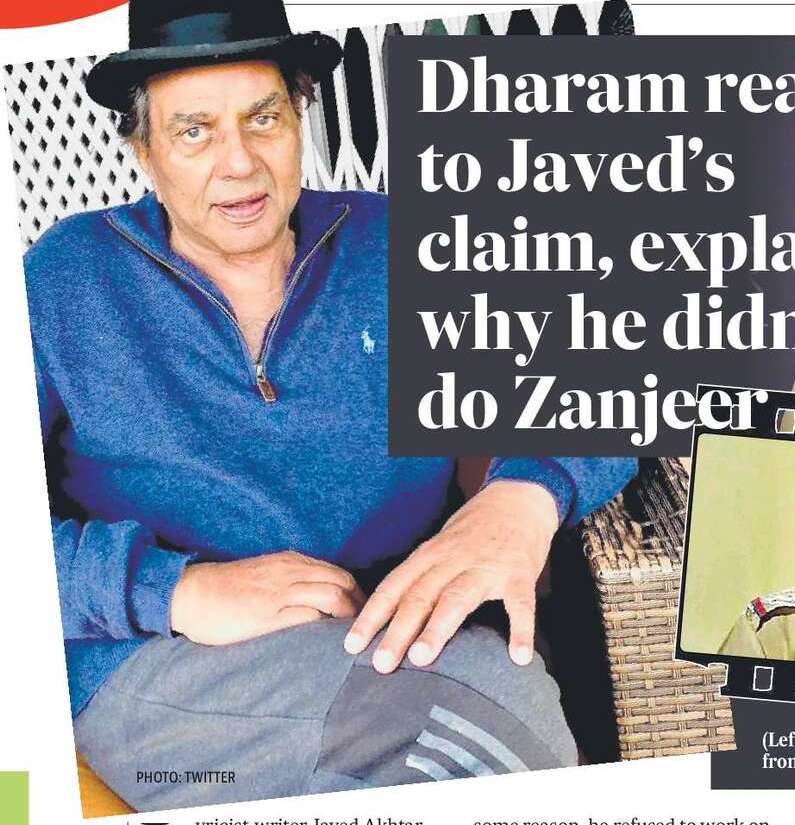
Dharmendra reacts to Javed Akhtar’s claim, explains why he didn’t do Zanjeer
8:37 AM
HINDUSTAN TIMES (October 12, 2022)
Lyricist-writer Javed Akhtar stirred up a hornet’s nest when, in a recent interview to mark actor Amitabh Bachchan’s 80th birthday, he said that instead of Big B, actor Dharmendra was the first choice for the film, Zanjeer (1973).
Akhtar claimed that the Apne (2007) actor turned down the role, among other actors. “Amitabh Bachchan was actually the last choice for Zanjeer. The script was written for Dharmendra ji, but for some reason, he refused to work on it. Prakash Mehra (the film’s director) had a script, but no leading man. He went from actor to actor to offer the role. Everybody refused to do the film,” Akhtar, 77, told India Today.
He added that many actors turned down the film as it had “no romance angle or comedy” and the lead character “was supposed to be a very grim, serious, bitter person”.
When HT City tweeted about the lyricist’s comments, the 86-year-old replied, “Javed, kaise ho... dikhave ki iss duniya mein haqeeqaten dabi rah jaati hain. jeetey raho... Dilon ko gudgudana khoob aata hai….. kaash sar chad ke bolne ka jaadu bhi sekh liya hota….. (sic).”
Soon after social media users started deciphering the tweet, Dharmendra clarified that his post wasn’t meant to signal any jibe: He wrote, “Refusing Zanjeer, was an emotional hurdle which i have mentioned in aap ki Adaalat. So please don’t misunderstand me. i always love Javed and Amit (sic).”
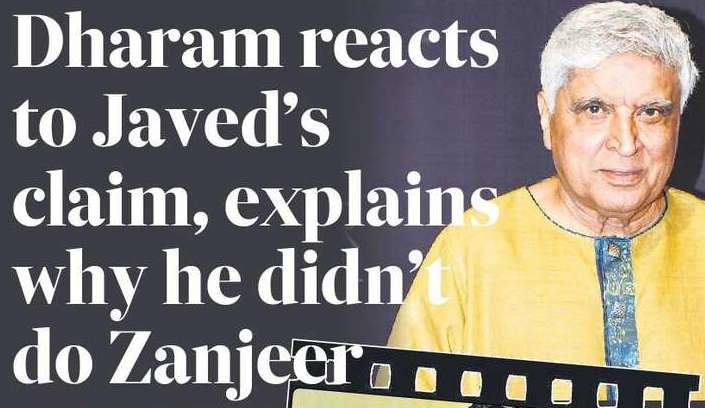
Amitabh Bachchan was an untapped dynamo before we paired-Salim Khan
8:22 AM

Salim Khan with Bachchan and Dilip Kumar
In a conversation with Mohammed Wajihuddin, writer Salim Khan deconstructs the myth behind the legend
Mohammed Wajihuddin (THE TIMES OF INDIA; October 11, 2022)
Q: Why did Bachchan personify the angry young man of India?
A: Cinema mirrors society. The youth of 1970s were disillusioned with corruption, nepotism. Amitabh became the hero who took on the forces that polluted the system. Disenchanted with pervasive hopelessness, the masses identified with Amitabh’s characters--the common man who wanted to right the wrongs and didn’t mind if he broke a few rules in the process.
Q: Why did established actors of the day refuse Zanjeer?
A: Before Zanjeer (1973), Amitabh had several flops and just two hits — Bombay To Goa and Anand. It was an era when films were made around stories of love and betrayal punctuated with melodrama and songs. Rajesh Khanna ruled. When we wrote Zanjeer, initially no one would touch it because it was so devoid of romance that the hero doesn’t hold the heroine’s hand even once. Dharmendra, Dev Anand, Dilip Kumar, Raaj Kumar — they all refused, they found the plot dry and not much for themselves in it. Once Dilip saab told me that he regretted refusing three films—Pyaasa, Baiju Bawra and Zanjeer.
Q: Was Zanjeer a gamechanger for both Bachchan and Salim-Javed?
A: Amitabh was immensely talented and needed a breakthrough script. When we created the character of police inspector Vijay Khanna, it suited the lanky figure with a booming baritone. I remember telling producer-director Prakash Mehra during the first day first show that the film would create history.
We were watching the scene where Sher Khan (Pran) visits the inspector and tries to sit. Vijay fumes: “Jab tak baithne ko na kaha jaaye, sharafat se khade raho, yeh police station hai, tumhere baap ka ghar nahin.”
Watching that scene, I told Prakash Mehra the film would be a hit. The intensity with which Amitabh delivered this line told us he had a lot of fire that needed to be tapped. We did it in subsequent films (Deewar, Trishul, Sholay...).
Q: He carried the roles that Salim-Javed wrote for him...
A: Amitabh was an untapped dynamo before we paired. He was educated and hugely talented but had not got the scripts to use his potential. Our scripts gave him ample opportunities.
Q: Why do we have a dearth of good scripts these days?
A: Today writers don’t read. When I came from Indore (Akhtar came from Bhopal) to Bombay to become an actor, I soon realized that acting would not take me to the peak. I turned to scriptwriting. A public library in Mahim became my second home. I read books and watched films voraciously.
There is a vacuum created by Hindi cinema with exceptions of filmmakers like Rohit Shetty-Vivek Oberoi
8:25 AM
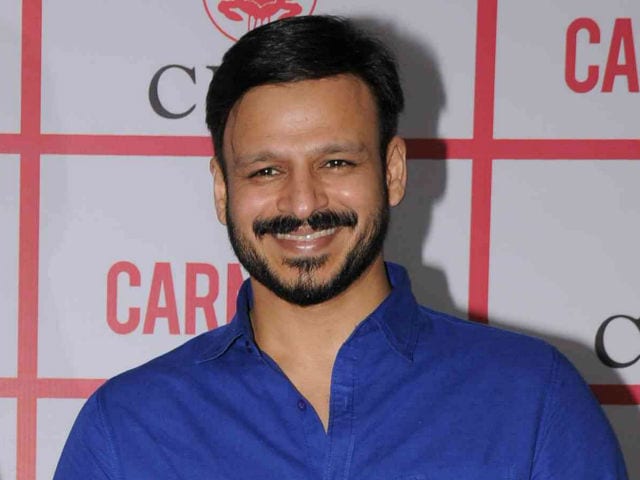
Rachana Dubey (BOMBAY TIMES; April 5, 2022)
While Vivek Oberoi has done a variety of films in his career in the Hindi film industry, he has occasionally picked up projects from the South, too, to push his boundaries. While Rakta Charitra (2010) marked his debut in Telugu cinema, more recently, he has been seen in films like Vivegam (Tamil), Lucifer (Malayalam) and Rustum (Kannada). His next outing is the Malayalam actioner Kaduva, which is set in the 1990s and will see him locking horns with Prithviraj Sukumaran.
“As an actor, it’s important for me to understand the milieu in which the film is set,” he says, adding, “Irrespective of whether it’s an out-and-out commercial film or a content-driven project, I create a backstory for my character and understand the motives which drive his actions. Whether I play the good guy or the bad guy, I approach every role with the same level of sincerity and aim to make it as genuine as possible.”
Elaborating about working in the south film industry, Vivek who has shared screen space with renowned actors like Ajith and Ram Charan, shares, “It takes a very different approach, especially Malayalam cinema. Clubbing them under one bracket is not has its own identity, peculiarities and specialities. What I like about Malayalam cinema is their innovation in storytelling and the intricacy with which they write their screenplays. Malayalam cinema never had enough money to make big scale films. The size of their content has grown considerably. Lucifer was big budget-wise and so is Kaduva.”
Vivek says, “Even with big budgets, it’s now part of their DNA to work with detailed storytelling and engage people, sometimes even without a visual spectacle.”
Talking about Tamil and Telugu cinema, the actor adds, “Tamil and Telugu cinema have been bigger in terms of financial play and in recent times, their films are engaging audiences all over the country, and registering great box office collections. There is a vacuum created by Hindi cinema with exceptions of filmmakers like Rohit Shetty. We have stopped the Manmohan Desai and Prakash Mehra entertainers and veered towards more urban stories. We went into the zone of calling family entertainers, formula films, something that all of India responds to. While it has its benefits, it leaves behind the ability to entertain an all-India audience. South Indian filmmakers are fulfilling that in great style — they’re able to do it with newness, visual appeal and storytelling. Initially, our films would be remade in the south and it is a kind of a role reversal now. We are constantly remaking films from their narratives. There is a connect on a story level with their content. The south film industry takes a very different approach, which is incredible.”
“The reason I love working in the South Indian film industries is because I have built wonderful relationships across industries. Working there is like working with friends. They have innovative ideas and there is a strong potential to bring them to the Hindi speaking audience. The other thing is the commercial success, which the south has been able to provide well,” he signs off.
Kavita Krishnamurti and Sameer remember Bappi Lahiri
8:20 AM

As told to Soumya Vajpayee (HINDUSTAN TIMES; February 17, 2022)
It’s extremely sad that another great musician has gone. Bappi da had so much music left in him. I have great respect for him. He was like a brother to me for many years. I got the opportunity to sing a lot of songs for him like Tu Pagal Premi Awara, Lal Dupatte Wali, and my Bengali hit, Aami Kolkata Roshogulla. He was so flexible and gave us diverse songs.
He loved his work and treated all of us like his family. Whenever I went to his place, he’d offer me Bengali sweets as I loved them. His family was always affectionate. My heart goes out to them. May his soul rest in peace. These last two years have taken so many amazing musicians from us. I’m sure even the Gods are enjoying their music.
Kavita Krishnamurti, singer
---------------------
Bappi da was like family to me. I’d accompany my dad (Anjaan, late lyricist) for the sittings. Whenever he saw me, he’d remember my father. I’ve had so many associations with him over the years. In fact, he called me a month ago for a project called Pyaar Mein Thoda Twist. But I think he fell ill. I didn’t hear from him after that.
He was an intelligent and multifaceted composer. Once, director Prakash Mehra asked Bappi da to call his mother, who was a classical singer, to compose a song for Namak Halaal. She was nervous as she was not a composer. Bappi da told her he’ll give her a phrase and she can compose it like a bandish. That’s how the original tune of Pag Ghungroo Baandh was made.
He made a mark when many composers were ruling the industry. He was synonymous to disco and the genre will always be associated with him. It’s truly a huge loss to the music industry and I’ll always miss him.
Sameer Anjaan, lyricist

Bappi Lahiri passes away in Mumbai at the age of 69
8:14 AM

Avijit Ghosh (THE TIMES OF INDIA; February 17, 2022)
Music director Bappi Lahiri, who harnessed and harvested the “disco sound” to produce chartbusters in films like Disco Dancer and Namak Halaal but was equally adept in composing gentler semi-classical and folksy tunes best exemplified in the less remembered songs of Aangan Ki Kali, Apne Paraye and Aetbaar, passed away in a Mumbai hospital late Tuesday night. He was 69.
The composer-singer had been under treatment for several weeks. “He was suffering from OSA (obstructive sleep apnea) and recurrent chest infection...He succumbed to his illness at about 11:45pm,” Dr Deepak Namjoshi of Mumbai's CritiCare Asia Hospitals said in a statement.
In the 1980s, a disco track became mandatory in Hindi films after the tsunami-like success of Qurbani’s ‘Aap Jai sa Koi’ (singer: Nazia Hasan, composer: Biddu). Songs became something that you both danced and listened to. For the young and the restless, beat acquired more prominence. And the electronic synthesizer became the busiest instrument. No Bollywood composer understood, captured and expressed the new musical ecosystem like Bappi.
His dalliance with disco started with ‘Hari Om Hari’ (Pyara Dushman, inspired by Neil Sedaka/Eruption’s ‘One Way Ticket’) and ‘Rambha Ho Ho Ho’ (Armaan). Director B Subhash’s Disco Dancer became his high noon. From the title track to ‘Jimmy Jimmy’, every track in Disco Dancer was dancey and delicious. If ‘Awara Hoon’ was Hindi cinema’s major cultural export in the 1950s, ‘Jimmy Jimmy’ remains a musical ambassador even in Vladimir Putin’s Russia today. Just go to YouTube for confirmation.
----------------------------
Bappi Lahiri’s breathless foottappers and Indeevar’s nursery-rhyme lyrics (‘Char baar marenge ek baar ginenge’, Mawaali) in Southern productions defined popular film music in the 80’s. They were integral to mind-numbing entertainers whose plots could match Donald Trump’s statements for incredulousness. Jeetendra’s Himmatwala, Mawaali, Maq sad and Tohfa were all propelled by these tunes. “He was a king in Madras,” director B Subhash told this reporter some years ago.
In the 1980s, Bappi da, as many called him fondly, provided the score for an eyepopping 230 films. In 1985, he gave music to 33 movies: 30 Hindi, 2 Bengali, 1 Tamil; which means a film released every 12 days! The composer lorded over the charts even when some of the songs were copies of foreign hits and desi classics. There was an alternative side to him as well.
In Basu Chatterjee’s Apne Paraye, he surprised critics with his folksy tunes. ‘Shyam rang rangaa re’, where he employed the Bengal percussion instrument khol, has the meditative feel of a Chaitanya kirtan. ‘Gao mere mann’ carries the smell of ponds, banana leaves and 19th century Bengal.
Not many would associate him with songs such as ‘Saiyan bina ghar soona’ (Aangan Ki Kali), ‘Chaar din ki zindagi hai’ (Ek Baar Kaho) or ‘Kisi nazar ko tera’ (Aetbaar). Many of them were sung by Yesudas and Bhupendra.
Born in north Bengal’s Jalpaiguri town to musician parents, Alokesh (his original name) trained under guru Samta Prasad and was hailed as a tabla prodigy at just six. Nanha Shikari (1973) was his debut Hindi film. But the composer made a distinct impression with Chalte Chalte (1976), among his finest scores.
Amit Khanna, who wrote the lyrics, recounts how Bappi got the film. “The film director Bhisham Kohli, also Dev Anand’s nephew, was looking for a music director. He was unable to get R D Burman and Laxmikant Pyarelal. Bappi had earlier come to Navketan looking for work. And I was impressed by some of the tunes I heard. I told Bhisham, why don’t you try him? During the music session, Bappi played the ‘Chalte Chalte’ tune. I wrote the opening lines. And this led to the song,” recalled Khanna.
Slowly, he worked his way up with hummable melodies in low budget action films such as Zakhmee, Ravikant Nagaich’s Surakksha and Wardat and the Ramsay brothers’ horror yarns (Saboot). Disco Dancer elevated his career. But when Prakash Mehra, then Bollywood’s biggest director along with Manmohan Desai, signed him for ‘Namak Halaal’, Bappi entered the super league. The music in Namak Halaal and Sharaabi (both Big B films) were worth the weight of the gold chains he fondly wore.
Namak Halaal’s ‘Pagh ghungroo baandh’ was nearly 12 minutes long but the tune was riveting. ‘Raat baaki’, which he sang with Asha, is a standout. Sharaabi earned him his lone Filmfare award in 1985. He tasted success in the 1990s too: K C Bokadia’s Aaj Ka Arjun and David Dhawan’s Aankhen, to name just two. ‘Gori hai kalaiyan’ (Aaj Ka Arjun) topped the Binaca Geetmala in 1990.
In recent years, Bappi sang in Baaghi 3 and Shubh Mangal Zyada Saavdhan. Last April, he had contracted Coronavirus but recovered well.
Now, the amiable and ever-smiling composer is no more. But the best of his 80s tracks remain groovy as ever. And even today, there’s no better farewell song than ‘Chalte Chalte’.
I’m the one who brought John Abraham to this world of masala heroism-Milap Zaveri
7:49 AM

Renuka Vyavahare (BOMBAY TIMES; November 23, 2021)
Writer-director Milap Milan Zaveri talks about the longevity of masala potboilers in an age of critic-friendly OTT platforms, creative conflict with John Abraham, why ’70s cinema influences him a lot and his upcoming film Satyameva Jayate 2. Excerpts:
John Abraham plays a triple role in Satyameva Jayate 2. It’s clearly an ambitious project for you. One sees the return of ’70s melodrama in it with lines like ‘Chappan inch ka jigra’, isn’t it?
Satyameva Jayate 2 is a film that wages war against corruption. It’s my tribute to filmmakers Manmohan Desai ji, Prakash Mehra, Subhash Ghai, Rakesh Roshan and Mukul Anand. It’s a tribute to these directors, the films they made and that era when cinema was larger than life and heroes had all the good qualities. They preached harmony, secularism, fought evil and corruption and protected women. They did it all while entertaining you. They sang, danced, cracked jokes and beat up the bad guys. That is the kind of cinema that I grew up on. I would go to Gaiety-Galaxy (chain of single-screen theatres) with whatever little pocket money I had and I would watch these films. Look at Rohit Shetty’s films today, for that matter. I don’t make films on a scale as big as his, but he inspires me to offer over the top entertainment. Someone might say, how can anyone rip a tyre apart? But a common man has an alter ego. He wants to display that kind of strength. They want to see a kind of heroism that gives them an adrenalin rush. I want them to feel for that moment that hum bhi hero ban sakte hai.
Did John’s sensibility match yours, or did you have to convince him to play along?
I had to convince him. John has a physique that looks like he can lift a bike. It looks believable. He asked me, ‘Milap, how can I tear a tyre or lift a bike?’ In Force, he picked a bike, I told him this time, you lift the bike with the rider (laughs!). I remember this was trolled a lot on Twitter.
John asked me, “Milap, are you sure!” He has often said that I am his cheat day. He generally follows a healthy diet otherwise, in terms of his film choices, and then there’s me. He gets to indulge in some masala entertainment with me. By nature, he leans towards something like a Parmanu: The Story Of Pokhran, Batla House or Madras Cafe. I am the one who has brought him to this world of masala heroism. Nikkhil (Advani) often teases me by saying, “Yaar, thode kam punch line likh.”
Theatres have reopened, and things have started to look up for the film industry. How do you weigh the two scenarios — comfort of OTT at home versus the movie-going experience?
Cinemas are ten thousand times more comfortable than sitting at home. This whole notion of how cinemas are over, and OTT is the way ahead, is absolute gibberish. The day a big film like Sooryavanshi was released, you couldn’t stop people from going to the cinemas. We saw that happening. Even Eternals! The box office was on fire that weekend. People want to see big-budget action extravaganzas and commercial films on the big screen. You cannot enjoy those on TV without a crowd whistling and cheering around you. Cinemas are back in a huge way; I would say bigger than before. It took a Rohit Shetty who waited for two years to give us the courage to hold on to our films, too. People are bound to come in big numbers as they want to get out. Everyone was in their homes for almost two years! OTT can never replace the big screen. Aap chaahe jitna bhi ghar ka khaana khaalo, aap restaurant jaoge.
So, would you say that co-existing is the way ahead?
I agree. Both offer unique experiences. They said radio will kill cinemas, TV will kill cinemas, VCR will kill cinemas, and now, OTT will kill cinemas, but no one has to die for the other to survive. Everyone can live and co-exist. I feel going forward, content that is critic-friendly may find its way into the OTT more. They will be appreciated more on that platform. Big budget extravaganzas will need the big screens. Look at the south market. They have never lost sight of the mass audience. Commercial entertainment rules there, so heroes are revered. The escapism that these films offer will never be obsolete. You want to get away from your day-to-day problems. Of course, I want to see realistic, gritty content as well, but I want some guilty pleasure, too. I want to be taken over by masala entertainment with its claps, whistle inducing dialoguebaazi and action.

It was pouring in Mumbai when we made Aaj Rapat Jaye Toh-Bappi Lahiri
8:09 AM

Prakash Mehra, Bappi Lahiri and Amitabh Bachchan during the making of Namak Halaal
As told to Sonam Joshi (THE TIMES OF INDIA; July 18, 2021)
When (director) Prakash Mehra ji and (lyricist) Anjaanji came to my studio, it was raining a lot in Mumbai. Mehra ji told me, “Bappi, can you make a song about this rain?” The lyrics had been composed by Anjaan ji, who was one of the best writers I have worked with. I made a mukhda for ‘Aaj Rapat Jaye Toh’, and when I played it for Prakash ji, he liked it so much that I didn’t even have to try another version.
Though I am credited with bringing disco to India, I also did many numbers inspired by classical ragas. ‘Aaj Rapat Jaye Toh’ was a totally Indian song. I used instruments such as santoor, violin, mandolin and the sitar and the first two helped evoke the mood of the rains. There are very few rain songs which go on to become evergreen hits, but ‘Aaj Rapat Jaye Toh’ went on to become one.
The song’s mazaa (fun) comes also from the singing and dancing. It was sung by Asha ji (Bhosle) and Kishore mama (Kumar) who added their own touches such as the arre, arre, arre in the beginning. Though I composed the song, I do my salaam to both Amit ji and Smita ji (Amitabh Bachchan and Smita Patil) for that outstanding rain dance.
Nowadays, there are fewer rain songs in Hindi films but I believe they will come back in fashion one day. On a personal note, I believe the rains have been lucky for me. I recorded my life’s most memorable song, ‘Chalte Chalte’, sung by Kishore Kumar in the 1976 film of the same name during the rains in July. Now, Namak Halaal is being remade but even if they remix this song, they can’t get Kishore Kumar’s one and only voice. The magic of ‘Aaj rapat’ can’t be copied.
My conversation with Parveen Babi kept getting deeper and the silences got comfortable-Mahesh Bhatt
8:49 AM

Mahesh Bhatt on how he got drawn into an affair with Parveen Babi after she left Kabir Bedi and returned from Italy and then, finding her with a knife, cowering in terror
MUMBAI MIRROR (August 21, 2020)
On the night the couple (Kabir Bedi and Parveen Babi) finally flew out to Europe, Kabir’s friend Mahesh Bhatt was at Bombay airport to see them off. ‘I remember they were moving away, lock, stock and barrel,’ he says. ‘It was a late night flight and she was there. They were both already dressed for Europe. There was a kind of sadness about her, plucking herself from here and going away. But she was Kabir’s girlfriend and they were in love. He was a star in Italy and there was a glorious future; so she went…’ As luck would have it, a manager from Air India, who knew Parveen and Kabir, organized a dinner for them with La Lollo (Gina Lollobrigida). It was going to be a private affair—just the four of them at a swanky Roman restaurant. It promised to be a memorable night. And it was, but for the wrong reasons.
At the dinner, a newly single (Gina) Lollobrigida had eyes only for Kabir. All evening, she showered her attention on him, completely ignoring Parveen… ‘It was almost the end of dinner when Gina turned to Parveen and said, “And you, my dear? What are you doing? Following the star?”,’ Kabir says, recalling the details of that evening. ‘Parveen was no pushover. She was very bright and quick-witted. So she replied, “No, my dear. I am with my man, because I have a man.”’ Before Lollobrigida could retort, Parveen turned to Kabir and suggested, ‘Let’s dance.’ On the dance floor, she told him quite clearly that she didn’t want to spend another moment watching the Italian star fawn all over him. ‘I didn’t know what to do,’ says Kabir. ‘Gina was one of the biggest names in international cinema, but Parveen wanted to leave. She said to me, “I’m leaving. The rest is up to you, whether you want to stay or you want to leave.” I told her that she was putting me in a very difficult situation, but she said, “That’s your problem. I’m leaving. I don’t like this woman.” Parveen wasn’t wrong; Gina had snubbed and disparaged her.’ When they returned to their table at the end of the song, Kabir told Lollobrigida, ‘I’m terribly sorry. We’ve got to leave.’
When Parveen began rebuilding her career after her return from London, she had started reaching out to old friends and acquaintances. Mahesh Bhatt was one of them. She invited him over to her Kalumal Estate home to ‘catch up with life’, as she put it.
‘I was a married man in my twenties,’ Mahesh recalls. ‘I was struggling and my movies weren’t doing well; travelling from Mahim to Juhu was an expensive affair.’ Yet, there was something that compelled him to visit Parveen. That evening, Mahesh began seeing her in a new light. ‘There was this gloom around her,’ he recalls. ‘This was a woman that truly belonged to the space where she lived; that space where she was solitary. She was beautiful and she was desolate.’ The last time he had met her, Parveen was living with Kabir. They were a couple and she was following him to greener pastures. Like everyone else who had known them as a couple, Mahesh was curious about what had gone wrong with their relationship, but he refrained from probing… Mahesh’s visit to Parveen’s home was meant to be a casual one. They were just two acquaintances spending time with each other for the first time without distractions coming in the way. With every turn of the conversation, they got to know each other better. They discovered commonalities, exchanged stories and shared secrets. Sunset was followed by the glow of twilight… At some point during the evening, Parveen placed a vinyl of Farida Khanum’s ‘Aaj jaane ki zid na karo’ on the turntable. As the ghazal played on a loop in the background, Mahesh felt the shift in mood.
‘That evening started off [with] two friends catching up,’ he acknowledges, ‘but the conversation kept getting deeper and the silences got comfortable. The attraction between us was palpable.’ At the back of his mind, Mahesh kept reminding himself that he had a wife and a daughter waiting for him at home. He might well have been a follower of the free-thinking spiritual guru Rajneesh for some time and influenced by his unconventional views, but he realized that releasing himself from the stranglehold of the value system he had grown up with was not easy.
‘I might have parroted the whole narrative of free love, but I was held back by morality,’ he confesses.
Reluctant to test his resolve further, Mahesh got up to leave. Parveen stood up as well. But she didn’t follow him to the door. ‘It was a long corridor from the living room to the main door,’ he remembers. ‘I was almost at the door when I realized that Parveen hadn’t come to see me off. Just as I opened the main door, I heard her call my name.’
He turned around and walked down the corridor for the last time that night. The door to Parveen’s bedroom was open. ‘She was lying there on the bed, waiting for me. There was complete silence, because there was no need for words anymore.’
One overcast July morning in 1979, Parveen woke up as usual and stepped out to get ready for a day of shooting for director Prakash Mehra’s Jwalamukhi, in which she had been cast opposite Shatrughan Sinha. Mahesh (Bhatt) was still in bed, drifting in and out of sleep. When Parveen tiptoed back into their bedroom, he was expecting his daily peck. Instead, she whispered that they should not have any conversation outside their room. Before he could react to her words, she had left...
When he came home that evening, Parveen’s mother, who was visiting, answered the door with an anxious looking Ved Sharma (her secretary) standing in the background...
He walked into the house and headed straight for their bedroom. ‘Here she was, curled up on the floor like a beast in one corner of the room,’ he says. ‘She was still in her film costume. She was holding a knife; it was the knife she used at the breakfast table.’ Mahesh slowly walked towards her. Before he could sit down next to her, Parveen whispered to him, ‘Shut the door.’ When he sat down close to her on the floor, her delusions came tumbling out and the source of her fear was revealed.
‘They tried to kill me,’ she told him. He asked who was trying to kill her. ‘Amitabh Bachchan,’ she replied, urging him to lower his voice, lest he be overheard. ‘The room is bugged,’ she went on.
‘You don’t know; you are an innocent man. They are going to drop a chandelier on me.’ Though he had had no past experience of dealing with someone in the middle of a psychotic episode, Mahesh was the only one in Parveen’s life who recognized that evening that there was something seriously wrong with her.
‘As a child, I had seen a south Indian actor named Ranjan in our neighbourhood,’ he recalls. ‘He was said to be a victim of schizophrenia and that was my only reference.’
Excerpted from a forthcoming biography on Parveen Babi by Karishma Upadhyay
Today is the day. It's been a labour of love that's consumed me for three years and now my biography of #ParveenBabi is out in bookstores and e-retailers. https://t.co/onb5dY6H3A— YellowGlassDragon (@karishmau) August 21, 2020
A scream stopped me in my tracks. The airhostess standing at the entrance was in shock-Ranjeet
8:23 AM

Ranjeet with and without wig (right) in Namak Halaal
Roshmila Bhattacharya (MUMBAI MIRROR; May 16, 2020)

That missed opportunity haunts me as much as the white stallion on the charm bracelet had haunted Vijay in the film. That prancing animal had eventually led the brooding cop to his parents’ killer while I was only served a thanda remake of Zanjeer 40 years later. By then, the quest for the story behind a story had started, and this week I dialed yesteryear baddie, Ranjeet, who had worked with Prakash ji in several memorable films, including Haath Ki Safai, Laawaris, Muqaddar Ka Sikander and Namak Halaal.
“Do you know I wore a wig in Namak Halaal? But only in one scene,” the veteran actor revealed, pointing to the sequence where Amitabh Bachchan’s Arjun Singh comes into his office for a job interview and, in response to his “Yeh kis cheez ko le aaye ho?” launches into the now-famous monologue, “I can talk English, I can walk English, I can laugh English because English is a very phunny language.” What happened to the wig? He chuckled, “The next day, I told Prakash Mehra I didn’t care for it and would go with my own hair. He didn’t argue. Those days filmmakers were accommodating because we were otherwise committed actors. That first scene was retained and the dialogue has since gone viral.”
If you think that’s hair-raising then you have to know how the climax of Haath Ki Safai was shot. The run-of-the-mill film revolved around two brothers, Vinod Khanna and Randhir Kapoor, and the lost-and-found theme, with Simi Garewal and Hema Malini as their leading ladies. Ranjeet, who was the baddie, was as busy as these stars. Yet, they managed to finish the film smoothly, with the exception of the climax.
“While shooting a scene in the hills of Khandala, I sprinkled petrol around a car, in which the dummies of the hero and heroine sat, and pressed the lighter to set it ablaze. As the flame sparked, the petrol ignited and a ball of fire rushed at me,” he flashbacked. Though he had a lucky escape, they couldn’t complete the shoot that day or the next. Prakash ji tried to rush the shoot through at the Dadar railway yard, but the presence of stars brought along the crowds. Some of the bystanders started pelting stones and once again, they had to quit midway.
“After that, I flew to Mauritius for Sanjay Khan’s Chandi Sona. On my way to Beirut from there, I had a five-hour stopover in Mumbai. Normally, you are not allowed to leave the airport when in transit, but the producer of Haath Ki Safai (I A Nadiadwala) had got special permission to whisk me off to Panvel railway station to complete the climax,” recounted Ranjeet.
He got into the car to find director Satyen Bose sitting inside, with his cinematographer. “Dada ki korcho?” Ranjeet asked, taken by surprise, and the filmmaker informed that he wanted some close-ups for his film, Mastaan Dada, and had come prepared. “He gave me the eye-patch which was a part of my get-up and the jacket I had been wearing, along with a cigar, and as the car sped along, they clicked several shots of me mouthing my lines. By the time we reached Bandra, he was done. I dropped dada off and sped towards Panvel, a car in front and one behind to ensure that there were no hold-ups along the way,” the actor reminisced.
By the time they reached Panvel railway station, Ranjeet had changed into his costume in the car and was ready for action. He just had to make a run, get fatally shot and fall face-down. End of the story. The scene went off without a hitch and with a flight to catch, Ranjeet dashed off, still wearing the blood-splattered white suit.
He ran into the airport as the last boarding announcement came on. “The security at the gate was shocked by my appearance and asked, ‘Saab, kya hua?’ I told him I’d been shooting and hurried inside. I was the last passenger to board. As I ran up the stairs and entered the aircraft, a scream stopped me in my tracks. The airhostess standing at the entrance was in shock,” he guffawed at the memory, saying it took a while to convince everyone that the blood stains were not real. “Since my baggage had already been checked in and I was not carrying a change of clothes, I had to keep the suit on, scrubbing at the stains with a pile of tissues the air-hostess brought me. They have remained, a memory of Prakash Mehra and Haath Ki Safai.”

A still from Haath Ki Safai
Amitabh Bachchan requested to shoot 'I can talk English' scene the next day-Ranjeet
7:48 AM

Roshmila Bhattacharya (MUMBAI MIRROR; May 4, 2019)
“I can talk English, I can walk English, I can laugh English because English is a very funny language. Bhairon becomes Baron and Baron becomes Bhairon because their minds are very narrow…” You only have to rattle off these lines and though the film opened on April 30, 1982, cinephiles will instantly nail the iconic dialogue down to Prakash Mehra’s action-comedy Namak Halaal.
Yesteryear baddie Ranjeet flashbacks to the hilarious scene when he as Ranjit Singh, the manager of a five-star hotel, encounters Amitabh Bachchan aka Arjun Singh for the first time when he comes to him looking for a job. He is stumped by the man’s verbal diarrhoea in answer to a simple query about whether he can speak English. Those days Ranjeet saab would report for film shoots on an hourly basis and in this case, he had to really juggle his dates to accommodate the film that day. “But after one shot, Amitabh retreated into his make-up room and finally emerged to request his director to continue with the scene the next day, so he could go home and rehearse his lines,” he recounts.
Ranjeet reasons that it was a long monologue with Arjun Singh going on to launch into a rib-tickling running commentary of a cricket match between India and Australia being played in Melbourne with Vijay Merchant and Vijay Hazare at the crease. After much “consideration” the duo took a run and chatty Arjun jumped a decade to another match, The India-Pakistan test match at Mumbai’s Wankhede Stadium with Wasim Bari giving the same “consideration” to his partner at the other end, Wasim Raja. But, this time, in the chaos of considerations, the two players ran themselves out and Arjun finally ran out of breath too. “The next day, the scene went off perfectly and almost four decades later, we are still talking about it,” adds Ranjeet saab.
 The actor was a favourite of Prakash Mehra who, he informs, was at his Juhu residence every evening, at least six days a week, for story sittings, music sessions or just gupshup. “Whether I was in town or not, Prakash ji and many of my co-stars, including Amitabh, Rajesh Khanna, Vinod Khanna, Danny (Denzongpa), Bindu and Prem Chopra would be in and out of my bachelor pad which was conveniently located. That was the kind of camaraderie and comfort we shared. We were one big family and knowing that I was a strict vegetarian and my drinking was limited to a glass of vodka at parties, they would holler for doodh or lassi and some ghaasphus when I was around, along with daaru and non-vegetarian snacks for them,” he guffaws.
It’s nostalgia times for the film’s composer Bappi Lahiri (left) too as “Pag Ghungroo” is one of the golden man’s brightest jewels. The long number was the perfect fusion song, starting out with a two-minute classical sargam by Pandit Satyanarayan Mishra, followed by Bappi da’s trademark disco beats. He recalls that it was recorded over four days with a 100-piece orchestra and took his Kishore (Kumar) mama a full day to dub it, fetching him the Filmfare Award for best playback singer.
 Another experimental track was “Raat Baaki” (right), a Bappi-Asha Bhosle duet. The plan was for Mohd Rafi to redub the male portions but Prakash ji decided to retain Bappi da’s voice. The provocative, come-hither song was filmed on a ‘vampish’ Parveen Babi trying hard to lure Shashi Kapoor to his death. “There is a dialogue track by Shashi uncle (Kisey nahi marne dogi? Yeh kya ho gaya tumhe? Haan! Tumhare maathe par pasina kyun? Kiski maut ke baare mein soch rahi thi? Meri? Huh! Arey meri zindagi aur maut toh ab tumhare saath hai aur pyaar karne wale, maut se dara nahi karte.) I told Prakash ji I wanted to record it musically in the studio with musicians and live beats. Shashi uncle was a little nervous because he had never done this before, but my father Aparesh Lahiri helped him. He had released my album with Baba, Moving Away, in London and they shared a great rapport,” reminisces Bappi da who describes the late actor as the “perfect gentleman” who always had a smile playing on his lips. Prakash Mehra had first offered the role of Raja to Raj Babbar who was a struggler then, but the distributors wanted a more saleable name and that’s how Shashi Kapoor entered the picture.
The rain-drenched “Aaj Rapat Jaayen”, Smita Patil’s first commercial Bollywood song, also clings to our collective consciousness but the bigger challenge for Bappi da was “Jawani Jaaneman” an eight-track experimental song, made memorable by the magical Asha ji. The song was remixed by DJ Jatin for the album Die Hard and more recently Tanishk Bagchi recreated “Raat Baaki” for the Ittefaq remake. Quiz Bappi da on whether “Pag Ghungroo” can have a contemporary spin-off too and he quips, “Why do you need a new version when the original still makes youngsters groove at parties and discos?” Touché.
From ‘Disco Dancer’ to ‘Sharaabi’, Bappi-Anjaan made musical hits
8:06 AM
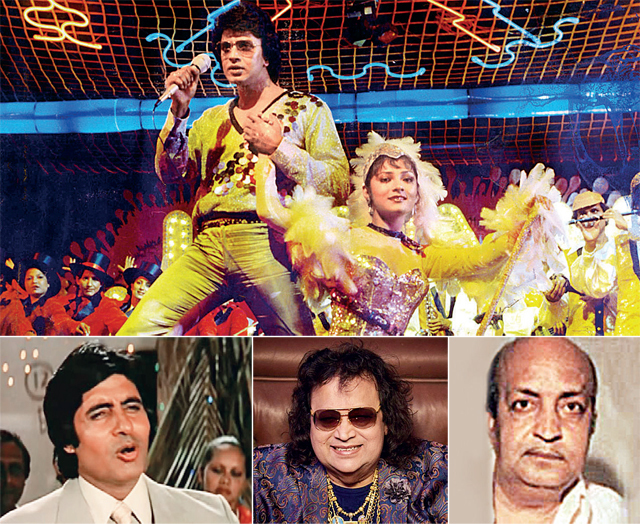
Top:
Mithun Chakraborty in Disco Dancer; (Above from left) Amitabh Bachchan
in Sharaabi; Bappi Lahiri; Anjaan collaborated on several hits
Roshmila Bhattacharya (MUMBAI MIRROR; November 2, 2018)
The name Lalji Pandey will not ring a bell even if you are a Bollywood aficionado but mention Anjaan and he’s not anjaan anymore. One of the most versatile and prolific lyricists, his words spun heart-felt melodies and foot-tapping chartbusters in equal numbers over five decades.
Among his frequent collaborators was India’s ‘Golden Man’, the irrepressible Bappi Lahiri who teamed up with Indeevar for the South potboilers, usually featuring Jeetendra and Sridevi, and scored equally big with Anjaan with Big B bonanzas like Namak Halaal and Sharaabi to name just two. “Indeevar and Anjaan ji were to me what Hasrat Jaipuri and Shailendra were to Shankar-Jaikishan. Anjaan ji and I gave innumerable kamaal ke superhits, including all the Disco Dancer songs, except for one Farukh Kaiser’s 'Koi Yahan Naache'. Hamara choli-daman ka saath tha and it was a proud moment for me to see the Tri Services band marching down Moscow’s Red Square to the beat of 'Jimmy Jimmy Jimmy Aaja Aaja, our song,” Bappida beams. This Disco Dancer track was also used in the Adam Sandler film, You Don’t Mess With The Zohan.
Bappi da goes on to inform that more recently, Dev Patel’s Oscar-nominated Lion also incorporated one of their songs from Kasam Paida Karne Wale Ki, “Come Closer”. Also, a special Hindi promotional clip of Guardians Of The Galaxy Vol. 2 had featured another popular song from the film, “Jhoom Jhoom Jhoom Baba”. The film’s leading man Chris Pratt reacted to it, exulting, “Whoa.. wow… I wonder if it’s too late to put that music in... instead of the music we’ve played... whoa... people are going to flip out!”
Prod the singer composer on the man himself and a picture emerges of Anjaan as a largehearted person with absolutely no ego, sincere and hard-working, who had a way with words. He flashbacks to Prakash Mehra’s 1984 film Sharaabi which bagged him the Filmfare Award for Best Music Director, and in particular “Manzilein Apni Jagah Hain Raaste Apni Jagah” for which Kishore Kumar, who had given playback for the song, took home a Black Lady as well. “Prakash ji gave Anjaan ji a mukhda he had scribbled telling him he could rewrite it if he wanted. Anjaan ji told him, ‘You have written such a beautiful mukhda, let me write the antaras for you now.’ He didn’t change a word of what Prakash ji had written which just goes to show his generosity of spirit,” Bappi da asserts.
He is also all praise for every antara of “Mujhe Naulakha Mangaa De”, saluting the wordsmith with, “Kya baat!” He then goes on to reveal that Amitabh Bachchan had requested Prakash ji to incorporate “De De Pyaar De” in the Sharaabi score. “Anjaan ji had written the song and I had recorded it in London with Runa Laila for the album Super Runa. In the film, they used two versions, one with Kishore mama and the other with Asha ji. Both superhit!” he avers. He adds that their song, “Gori Hain Kalaiyan” for Aaj Ka Arjun, was the No 1 song of 1991 on the countdown show Binaca Geet Mala.
Memories are mixed with melodies as Bappi da goes on to recall how Anjaan ji, when he was visiting him, had requested his singermother Bansari Lahiri for a Rabindra Sangeet. “My mummy sang 'Tomar Holo Shuru, Amar Holo Shara' and he reworked the lyrics to come up with “Chukar Mere Man Ko, Kiya Tune Kya Ishara” for Rajesh Roshan in Yaarana. Bahut pakad thi, he had a tremendous grasp over language. His son, Sameer, is a fabulous lyricist as well, with whom I have done a lot of good work, but aaj bhi main Anjaan ji ko bahut miss karta hoon. When he passed away, my heart broke and for a while I wondered how I would make music without life. Life goes on, but the musical memories remain,” he sighs, crooning “Yaad Aa Raha Hai Tera Pyaar, Kahan Hum, Kahan Tum, Hue Tum Kahan Gum…”
Ram Gopal Varma creates record, joins legendary filmmakers who have directed Amitabh Bachchan 8 times
7:58 AM

Joginder Tuteja (DNA; November 17, 2016)
With Sarkar 3, Ram Gopal Varma has become the only living director to make eight films with Amitabh Bachchan, joining the ranks of the late Manmohan Desai, Prakash Mehra and Hrishikesh Mukherjee, men who were the early pillars supporting Amitabh Bachchan’s film career.
Then
“Hrishikesh Mukherjee started it all with the likes of Anand and Abhimaan. Prakash Mehra made Big B take a different road with Zanjeer and followed it up with Hera Pheri. On the other hand, Manmohan Desai explored the comic actor in Amitabh with Amar Akbar Anthony and then took a dramatic route with Parvarish. With these three filmmakers, there was no looking back for Amitabh Bachchan and in years to come, he did eight films each with the trio,” says a film historian. This is not all; Big B also made a few cameo appearances for Hrishikesh and then featured in a few other productions of Manmohan where the latter was not the director.
Now
“Now with Ramu, he is repeating the feat. The association that started with Sarkar (2005) is now leading to Big B’s eighth film, with the maverick filmmaker, Sarkar 3,” a source adds, “Though they are yet to deliver a huge grosser or commercial blockbuster together, there is something about Ramu that keeps bringing back Amitabh Bachchan on the sets of his films. They collaborated last on Department (2012). Sarkar 3 comes after a gap of half a decade.” Incidentally, Big B has made only five films with Yash Chopra (as a director), another man who has been instrumental in his career, right from the days of Deewar to Silsila.
Going forward
Our historian adds, “On one end, Big B is working with the new breed of filmmakers like Shoojit Sircar (Shoebite, Piku, Pink) and R Balki (Cheeni Kum, Paa, Shamitabh). On the other hand, when it comes to further experimenting across varied genres, there is Ram Gopal Varma with whom he doesn’t shy away from associating with time and again.”
Subscribe to:
Posts (Atom)