Showing posts with label Pooja Tolani. Show all posts
Showing posts with label Pooja Tolani. Show all posts
I made Madhuri Dixit say ‘Mujhe pet mein gas ho rahi hai’ on screen; my life's biggest achievement-Pooja Tolani
9:56 AM

Priyanka Sharma (MID-DAY; June 28, 2026)
Good times have been raining on feminist screenwriter Pooja Tolani in the month of June. Fresh off the success of the dark comedy Maa Behen, she hosted the Mumbai screening of her directorial debut, Razaa on June 27. Co-produced by Maa Behen director Suresh Triveni, the short stars Geetanjali Kulkarni and Bhumika Sharma.
An excited Tolani informed mid-day that Razaa premiered at the Short Shorts International Film Festival in Tokyo and has been “making festival rounds since June 2025”. “But this is the first time we held a private screening.”
Even as praise pours in for both projects, Tolani has moved on to new stories. “There’s one feature and one series, and both are in nascent stages of development,” she said.
Asked whether it is easy to be a feminist writer in the industry, she said, “I feel it depends on who you are working with and what you are working on. Our industry is still trying to figure out how to make women feel comfortable, from basic things like washroom facilities to pay parity. There are [writer] rooms where if you call out something incorrect gender wise, you are sometimes scoffed at, joked about, or told, ‘Baap rey, jhanda gadhne aagayi’. But I have been fairly lucky to have worked with people who are feminists.”
On working with Madhuri Dixit-Nene
“I used to joke about this with Suresh that my biggest achievement in life is that I made Madhuri Dixit say ‘Mujhe pet mein gas ho rahi hai’ on screen. I will sleep peacefully now. It was great fun to work with Madhuri, to use her image [of a diva] and also break it.”
If content is called king then why are you not paying kingmakers, ask writers
8:14 AM
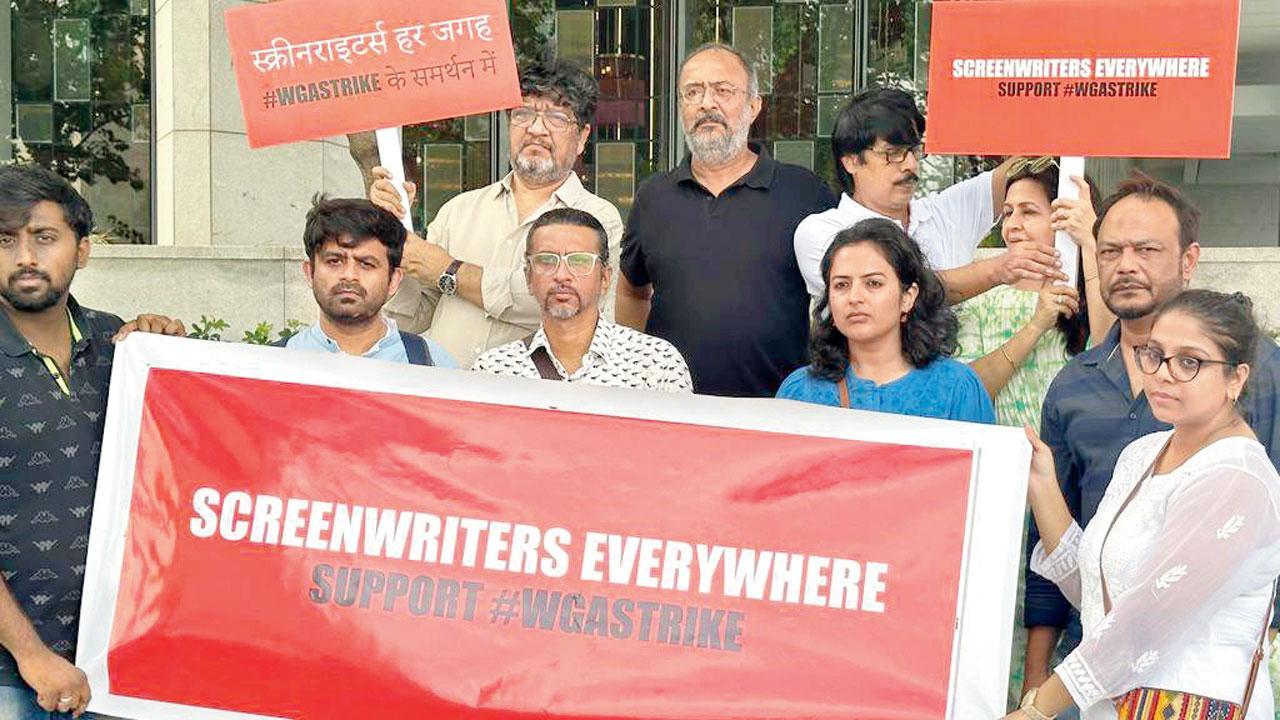
While writers in Hollywood are on strike demanding better pay from studios, screenwriters in India say that their condition is much worse compared to their US counterparts
Niharika Lal (BOMBAY TIMES; June 14, 2023)
The Writers Guild of America (WGA) strike, which kicked off in early May, is a result of a clash between writers, who see themselves working more but earning less in the streaming era, and studios attempting to rein in costs. Back in India too, writers of films and TV shows have demands that are quite similar – credit, compensation and fair contracts. However, many writers here feel that the situation is much worse compared to US.
Many writers point out, “Jinki stories pe taaliyan aur seetiyan bajti hain unko aksar screening pe bulana bhool jaate hai.” While the scenario has been slowly changing, writers feel it will take years for them to be at par with their US counterparts.
‘INDIAN WRITERS’ FEE MUCH LOWER THAN U.S. WRITERS’
In solidarity with the strike, India’s Screenwriters Association (SWA), asked all members working on US projects to stop working. SWA is fighting several battles on behalf of Indian writers. Anjum Rajabali, screenwriter and senior activist of SWA, shared his thoughts on the issues that Indian writers are facing:
‘CONTRACTS ARE ONE-SIDED’
Those who work on US projects are much better paid. In India, screenwriters, especially the new ones, receive fees far lower than the value of their work. Moreover, the contracts are one sided and protect their (producers and studios) rights, while the writer is left vulnerable. Credit is not guaranteed, termination can be at the whim of the producer, impossible indemnity is demanded from the writer.
‘OTT TREATS INDIAN WRITERS DIFFERENTLY COMPARED TO THEIR U.S. COUNTERPARTS’
More writers are now gainfully employed because of OTT. However, platforms brought in their own contract culture, with clauses that writers find unreasonable. OTT platforms treat Indian writers differently than their US counterparts. While US writers are striving to increase writers’ fees to fair levels, even their existing fees are still much higher than what Indian writers receive. Moreover, in the US, every time a show is aired anywhere outside of a cinema hall, the writer receives an additional remuneration.
‘SWA WILL NEGOTIATE FOR CREDIT’
Credit has to be given based on the work that the writer has done and not at the producer’s discretion. In case of a dispute between writers, SWA’s experts should arbitrate the issue by examining the respective written contribution of the writers to the final script and decide. Credit, dignified fees, regulation of the termination clause, indemnity, freedom to seek redress from the union are some of the clauses that need discussion with producers.
‘WHAT INDIAN WRITERS ARE SEEKING IS A SYSTEM CHANGE’
Screenwriter Mitesh Shah says, “What writers are seeking is a system change – equitable contracts, better compensation, credit guarantees, royalties. Streaming has given a lot of opportunities to writers. Things are certainly getting better but it’s still a long way to go. Be it a film or a web-series, everything starts with a blank page, and writers need to be accorded their due for filling up that page.”
Most writers say that they usually work on four-five projects at a time. Akshat Ghildial, who has written films like Badhaai Do and Badhaai Ho, shares, “From the initial idea to the dubbing, writers are paid in chunks. Kabhi kabhi chaar saal tak film ki total payment nahi aati. Agar aapne blockbuster likha hai toh aapki fees thodi zyada ho jayegi. Agar actor ki ek film blockbuster ho jaye to uski fees skyrocket ho jati hai, aisa writers ke saath nahi hota,” adding, “If content is called king then why are you not paying kingmakers?”
HOLLYWOOD STARS BACK U.S. WRITERS
The ongoing strike in US also saw many celebs step forward to stand in solidarity with screenwriters. Julia Louis-Dreyfus, Tina Fey, Rob Lowe and Modern Family stars Nolan Gould, Sarah Hyland and Jesse Tyler Ferguson, were among stars who protested with writers
WHAT INDIAN WRITERS HAVE TO SAY:
"A director doesn't ask for design credit when sharing his vision with a costume designer. But when it comes to writing credit, I have heard of many instances where directors have demanded their name be included. Sabko lagta hai writing sabko aati hai. Koi bhi aake suggest karta hai yeh dialogue work nahin kar raha"
- Akshat Ghildial, who has written films like Badhaai Do and Badhaai Ho
"It is quite common for some producers and directors to demand writing credit even for a minor input. It happened once with me when a producer wanted writer credit for giving feedback on the screenplay (that project never got made). In the last couple of years, writers have openly criticized these demands, which has changed things. Giving feedback is not the same as writing."
- Pooja Tolani, who has written Sacred Games
"The Indian screenwriting ecosystem is still learning how to read and execute a fair contract, negotiate good remuneration and deliver a good script"
- Hiteh Kewalya, who has written Shubh Mangal Zyada Saavdhan
"Because a lot of work is being done, the incremental value of writers have gone up in the last few years. But has it changed anything for writers and their rights in India? I'd say not much"
- Trishant Srivastava, who has written Jamtara
WHAT DO WRITERS DEMAND?
> Fixed minimum basic compensation
> Contract clauses like payment linked to approval, producer’s discretion if credit needs to be given
> Royalties – profit share in remakes and reruns
The curious case of identity theft on IMDb
8:32 AM

How a man, busted for fabricating entries on IMDb, exposes the entertainment industry’s struggle to find a safe home for credits
Jairaj Singh and Arnab Ganguly (MUMBAI MIRROR; July 12, 2020_
 Till a few weeks ago, he was a legend the film industry had failed to acknowledge. On IMDb — the largest and most popular TV and movie database on the internet — his feats were going spectacularly unparalleled, and there for all to see. Even Satyajit Ray — whom Akira Kurosawa hailed as a ‘giant’ — paled in comparison to his filmmaking prowess, if you compared the credits listed on their respective profile pages. The 18-year-old student from Navi Mumbai, who was running the page with his own name, claimed not only to be an actor and director, but also to have experience in animation, costume design, editing, stunts, visual effects and scriptwriting, among other things.
On June 23, screenwriter and poet Varun Grover exposed the IMDb account. He took to social media when he saw an ‘Abhishek Chaudhary’ listed as one of the writers of Sacred Games, the show Grover had developed from Vikram Chandra’s 2006 novel by the same name. Upon inspecting the profile page on the website, he found that this person also claimed to have played the role of a newborn in Good Newwz (2019) and a father in Badhaai Ho (2018), besides other stuff. “The guy is a bit of a credit-vandal. A normal talent would have credits in 4 or 5 different fields (writer, director etc). A genius like Mr Ray has credits under 14 categories. Our maestro ‘Abhishek’ has 30+ varied talents,” Grover wrote in a Twitter thread. He also questioned IMDb’s “strict monitoring and verification process”, which had allowed something like this to pass.
IMDb was quick to follow up as the posts went viral, and instantly wiped out almost all the fake credits on Chaudhary’s page, without acknowledging the oversight. It left behind the entries of two films, one genuine and one fake: Brazen Epiphany, which credits Chaudhary as an actor, and Chosen Few, a TVF short, which credits him as playing the role of a policeman. Within a week of the issue coming to light, a man claiming to be Abhishek Chaudhary messaged Grover on Instagram and confessed that he was behind the IMDb profile — and proved it by making fresh edits on the page. Chaudhary told Grover that IMDb had barred him from creating more fake entries, and then tried to justify himself.
“My initial impression, on discovering the fake credits on IMDb, was that he was misusing the mutual trust platform,” Grover tells Mirror. “But after interacting with him, I figured he has some kind of reasoning behind it. He thinks of himself as some sort of a vigilante, exposing loopholes in a system. Also, the joy of cheap thrills is difficult to resist. So I believe it’s a mix of everything.”
The (con) artist
On his LinkedIn page, Chaudhary introduces himself as a “pseudo-introvert, a web developer and a maker”. He also says he’s the “Chief Executive Officer of The Abbie”, which does not appear to be an organisation, and has only one follower on its page.
A second year student of computer engineering at an institute in Vashi, Chaudhary is not a self-avowed film buff but is “open to making films” once he gets his engineering degree. Last year, he and his friends took part in a contest organised by the India Film Project, where each team was given a theme and 50 hours to make a film. They made Brazen Epiphany, a 5.26-minute audio film about a journalist who is interviewed after winning an award. The film was uploaded on YouTube on April 11, and has had 45 views. “I knew my film was not going to win, but I wanted to promote it. My first step was to create an IMDb page,” Chaudhary tells Mirror. “I had to fill up a long form, which took two days to get approved. This left me wondering whether IMDb was actually verifying all the information that it was being fed.”
At first, Chaudhary claims, he would spend quality time on the crowd-sourced website by contributing genuine entries, like adding missing plot details and fixing the release date of a film. It was only once he discovered the existence of a loophole, and realised how easy it was to fabricate credits, that he started misusing the website. “I was jealous of not being famous,” says Chaudhary, who created his first fake entry in March by calling himself a comic who was a part of Comicstaan, the stand-up comedy reality show. “I was just eager for fame. At the time, Sacred Games was trending. I thought that if I add my name to it as a writer, people might recognise me.”
 While Chaudhary found it easy to create such fake entries, Pooja Tolani (left) — a writer who has actually worked on two episodes in the second season of Sacred Games with Grover — had to struggle to make even a legit entry. She was asked by IMDb to send a screenshot of her name in the end credits, and it took her, in all, almost three months to get the credit.
“At first, I did not pay much attention to adding my name to the show’s credit list. My colleagues had added their names and it had been a very simple process for them,” says Tolani. “I tried in December once, but couldn’t do it. Later, I learnt it had been declined because the information could not be verified. In February, I tried several times, and every time it said it could not be verified. I was then asked to submit evidence. I wrote on the IMDb website that I was one of the co-writers, and mentioned the two episodes that I had worked on, and also provided the links. It was still declined.”
IMDb, on its site, maintains that for users to get credit they “need to have at least one pre-existing credited entry in the database”. It says that it relies on end credits because “these days, end credits are much more comprehensive and most people who contribute eligible work, receive a credit”. Even though it operates as a crowd-sourced website like Wikipedia, on its own Wiki page, IMDb makes a distinction about how it is different by stating that “contributors cannot add, delete, or modify the data or text on impulse, and the manipulation of data is controlled by IMDb technology and salaried staff”.
When Mirror reached out to IMDb to ask how Chaudhary managed to fabricate credits while Tolani had to struggle to get her due, a spokesperson responded by sharing the information that’s already on the website. “The information in IMDb comes from various sources. While we actively gather information from and verify items with studios and filmmakers, the bulk of our information is submitted by people in the industry and visitors to our site,” reads the statement. “Our sources of information include, but are not limited to, on-screen credits, press kits, official bios, autobiographies, and interviews. Given the sheer volume and the nature of the information we list, occasional mistakes are inevitable and, when spotted/reported, they are promptly verified and fixed.” The website evaded all questions pertaining to the specifics of the case.
A flawed system
On July 8, filmmaker Apurva Asrani tweeted how his name, as co-writer of the legal drama Shahid (2013), “miraculously popped back” on IMDb after he wrote a blog, despite three years of chasing the website to include it. “Credits on IMDb should exactly reflect those that appeared on the film, but that’s not always the case,” says Asrani. “In the case of Shahid, Hansal Mehta and I are mentioned as additional screenplay writers in the film’s opening credits. We both even shared a screenwriting award with the film’s main writer, but for the last three years, my name and a mention of the award has been missing from IMDb. After I blogged about it, someone was able to edit the page and attach proof of my name in the opening credits. Now it is there, but I don’t know for how long.”
For most people in the entertainment industry — especially those still trying to establish themselves — IMDb is the go-to site. Filmmaker Bejoy Nambiar says that in recent years, an IMDb profile has become a “calling card”, an online resume, for people to verify and crosscheck credentials. It also helps actors, writers and tech crew to negotiate better deals. The loopholes in the system have, however, given rise to fraudsters, both online and offline. Last year Gaurav P Singh, an assistant director, had to conduct a sting operation to nab a man, his namesake, who was using his IMDb profile to get work. “I had to make him apologize to me on camera and write to all the production houses he had been doing the rounds of, seeking work by posing as me,” he says. “The funny thing is that he knew everything about me and my work and, during the first quarter of the meeting, tried very hard to convince me that he was me.”
Such incidents expose a major faultline in an industry which refuses to be transparent about giving credit to people. Other than the end credits of a film or a TV show, there is no way for people — involved in the larger creative process — to be formally acknowledged for their contribution. If production houses do create an official webpage, including all the credits, it is usually a transient exercise. IMDb is, arguably, the only database that one can refer to for information long after a project is done. So correct and honest representation is crucial.
Grover, like many people in the industry, feels the onus should also lie with production houses to ensure proper credits go on IMDb, but adds, “we are talking about an industry with no structure, no strict labour laws, no unity, and, in most of the cases, [sees] rampant exploitation”. As long as that continues, fraudsters and vandals will also continue to thrive.

The fake credits on the page (before IMDb removed them)
Subscribe to:
Posts (Atom)