Showing posts with label Payal Kapadia interview. Show all posts
Showing posts with label Payal Kapadia interview. Show all posts
It’s only in cinemas where you can cry in front of strangers-Payal Kapadia
10:18 AM
Niharika Lal (BOMBAY TIMES; November 18, 2024)
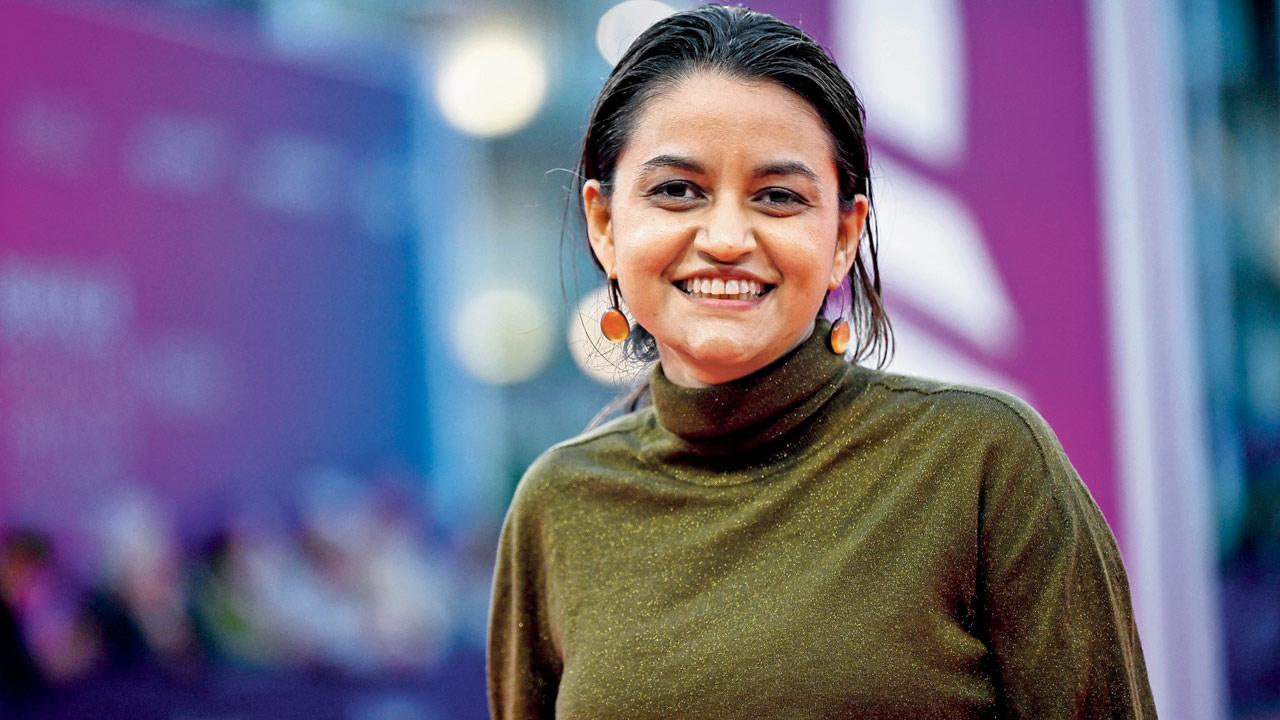
Despite her historic Grand Prix win at Cannes for All We Imagine As Light, Payal Kapadia says she didn’t want too much spotlight.
“I didn’t want to put so much out there because I felt that somewhere the film’s story gets lost in my personal story. It’s too much about ‘me, me, me’, and that sometimes overshadows the film. And I always felt like I (should) guard myself from that. As things moved on, I’ve tried to reconcile more to talking about myself and my work. Now that the film has got a lot of love, I’m feeling a little bit more confident. I want to show it around.” The filmmaker speaks to us about the themes in her film and the role that FTII played in her journey.
This FTII alumna, who brought the institution so much glory, was rejected in her first attempt when she applied for the editing course. Interestingly, becoming an editor was her first choice. "Woh safety bhi hota hai ki aap editor banoge toh you can get some work and job," she says. But then this rejection pushed her to work as an assistant director and in several other capacities in advertising and documentaries before attempting FTII again five years later in direction.
Payal believes in the importance of public institutions and says, "I love public institutions where you get some time to focus on your work, kyunki kuch bhi artistic cheez padhna aise jaldi se nahi hota. Hamare public institutes humein bahut support karte hain in sab cheezon mein. I'm totally for it. Ek accessibility honi chahiye ki aapko kuch bhi padhna ho toh ek university jahan pe aap afford kar pao. Journalism, filmmaking, or engineering - ek institutions hona chahiye jahan pe har koi ja sake. Normally, private film institutes are very expensive. It's too expensive! In our country, it is ridiculous to have it like that, I feel."
She adds, "For me, FTII was also about other students who were there. Itni diversity thi, pure desh se log aate thay wahan. Jab bhi itni diversity hoti hai toh koi bhi art school, film school, ya journalism school mein ek discourse banta hai jisse as a human being you can grow. That helped me a lot." Excerpts from an interview-
‘I love the catharsis cinemas bring’
Payal shares that when she is in India, then she go to watch films too and feels that the theater is only place where we can cry in the company of strangers. She says, "That's something you can only do in the cinema. To do it in a cinema, and where you feel so open, which is something you never do with people around. I love that catharsis. As an audience, I cry in most movies. For me, I want to be able to create that experience for the audience as a filmmaker."
Talking about the cinema scene from All We Imagine As Light she says, "The scene in All We Imagine As Light where Kani's character cries in the cinema hall is a homage to that feeling. She has tears; she is crying in the scene. I was thinking about a woman like her who's always saying - you should not show your emotions to anybody - and then she is sitting in the cinema where she finds a place to cry. Woh tab tak royi nahi aur cinema ke andar usne chhor diya aur woh aansu aane lage. That was what I was feeling."
‘I think my film is like QSQT in a way’
Whenever asked about the films she loves, Payal often says that while growing up, she used to watch Govinda's films and says, "Some of Govinda's films are really good, you have to watch them! I used to love QSQT (Qayamat Se Qayamat Tak). That was my favourite film as a kid. I used to love it. And I think my film (All We Imagine As Light) is that only. You see, how it is! It's connecting to my childhood days of QSQT (the escape theme). I loved that they were running away with the song - humne ghar chhora hai. It's a Romeo-Juliet. I loved that. And yes, so many more movies."
Hamara system aisa hai ki woh female friendship se bahut darte hain
The film is also about inter-generational friendships and female friendships. Elaborating on how female friendships are often not encouraged in our society and how women are frequently pitted against each other - whether in families, society, or the workplace - Payal said, "I wanted to make a film about this kind of internalized misogyny - hamara system aisa hai ki woh female friendship se bahut darte hain. Unko lagta hai agar ye sab auratein dost ban jayengi toh pata nahi kya ho jayega. So, that's what I wanted to make the film about. Sometimes, responses toward other women come that way, not because you're really feeling that way, but because the whole conditioning is such that it’s like we are pitted against each other."
She added, "That's something I wanted to talk about in the film because sometimes I find myself falling into that trap too. Then I think - why did I respond like this? It was a kind of self-reflexivity that I was thinking a lot about, and it came out in the writing. As I grow older, I'm reflecting more on my responses. I want to tackle that."
'So many times men are not physically in our lives, but they are still lingering there'
Talking about how she wrote about those men who seem to be present in women's lives even when they're either gone or not physically present, she shared, "Actually, my nani, to whom I've dedicated this film - when she was in her late 90s, she was kind of losing her memory, so I encouraged her to write a diary so that she could recall her past. So, she would write every day, and sometimes she would write – he (her husband) has come, and I can see him over there and smell tobacco. I started thinking about it because he died when my nani was 50 years old; she lived up to 98, so more of her life she was alone than she was with him. And I got the feeling she didn’t like him very much. Phir bhi woh aa rahe hain, woh 98 ke age mein woh tapak ke aa rahe hain, unke husband. Usko leke main bahut sochne lagi – what's this thing in our culture? That she would never remarry - at 50, you're still very young, but it's still hard for women that age to move on. Or be with somebody else because life can go on without men too, it's totally fine. That's what Parvati (Chhhaya Kadam's character) wants to do. It's her choice. I was thinking a lot about that. "
She continues, "Also, I have met women like Prabha (Kani Kusruti's character). So much of her life - how these women think and how they would respond to things - was about this guy who was not even there. Even when they were not estranged, just living somewhere else. Woh mujhe ek lady mili jo kehti thi – 'You're wearing jeans, I also want to wear jeans.' And I would say – 'Then wear jeans.' So, she would say – 'Mere pati rehte hain Dubai mein aur agar unko pata chalega ki main jeans pehen rahi hoon toh woh pareshan ho jayenge bahut, toh woh nahi pehen sakti.' He is far away, but still lingering there.
"There was another girl I met who was wearing a sari, and I asked her – 'Aren't you feeling hot? It's Bombay.' And she was like – 'My father-in-law lives in the village, but he will be very upset if I wear salwar.' Then one day, I spotted her on the street, and she was wearing a salwar. I asked her – 'What happened?' And she said – 'Off ho gaye.' (Laughs)."
Payal adds, "Toh yehi hai, ye log hote nahi hain tab bhi itna control karte hain. I connected the dots that how so many times men are not physically in our lives, but they are still there."
'It is so interesting to discover your own mother at the age of 21 - how she was and how she would think'
The title of Payal's film All We Imagine As Light has been borrowed from the title of one of her mother's paintings. Talking about how her mother and her work have encouraged her, she shares, "It took me a long time to make films. My mother was always encouraging - 'What do you want to do with your life?' Recently, she had an exhibition at Chhatrapati Shivaji Museum where they have the Jehangir Nicholson Gallery section, and they have the earliest paintings of my mother from when she was in her early 20s. So they decided to do an exhibition, and in that, I saw one of her works when she was 21. I'm just saying it is so interesting to discover your own mother at the age of 21 - how she was and how she would think."
She says, "I wish I had known at 21 what exactly I wanted to do. Seeing that painting was like meeting her again, but in a younger version. It really overwhelmed me. She was always pushing me, but never too much. She was like, 'Take your time and figure it out.' I was anyway doing odd jobs, making documentaries and all kinds of stuff. But she was always telling me - 'Maybe you want to study.' She herself went to JJ School of Arts in Bombay, where she studied for five years."
'These actresses are really the ones who made the film. They were not like actors who came to do the job'
These actresses are really the ones who made the film. Unke bina koi film hoti hi nahi. I thought it was very normal to take them there on the stage. They were not like actors who came to do the job. Hum bahut saath mein kaam kiye, script pe kaam kiye, dialogues pe, gestures pe. Nobody gives this kind of time to, especially, first-time directors like me. They were so giving and so generous. They didn't think, "Oh! It's your film, and we're part of it. They were like, hamari film hai. And not just them, but the entire crew - from make-up to costume - it became like a true team. It was really a collaboration, and I think that can only lead to a true feeling amongst all of us. Audience mein sab log baithe thay toh mujhe laga ki we should take everybody, but they were already giving me dirty looks, so I just took the three main actresses.
We need indie film fund like the French one that made Cannes win possible-Payal Kapadia
9:22 AM

Basking in the afterglow of bagging a historic Cannes Grand Prix, ‘All We Imagine As Light’ director Payal Kapadia speaks to Ardhra Nair about what made it possible, the various influences that have inspired her, and why filmmaking is like stitching a quilt
Ardhra Nair (THE TIMES OF INDIA; June 2, 2024)
Can you share your experience of making an independent film without the support of big banners?
The reason I was able to make this film is because of the French public funding system, and I would like to take a moment to talk about this system. In France, a small tax is levied on every film ticket sale and a tax is levied on TV channels as well. From this, a fund is created that allows independent producers and directors to apply for funding. Distributors and exhibitors also get funding to distribute these films once they are complete. In our country, charging audiences a tax would be rather unfair. However, a tax on the profits made on blockbuster films can surely help in funding an independent film fund. If such a system was made in our country with an autonomous body to run the fund, it would only encourage more independent filmmaking. For a democracy to thrive, voices need to remain independent from big studios that are run by rich industrialists.
Looking back, how do you feel about the FTII protests? Do you stand by what you all stood up for?
The protest at FTII was one of the early student protests that took place. It was followed by many others. I am happy that we could be part of the larger discourse of the relevance of public institutions in India. Being a student of FTII was very important to me. It was a space where we could not only formulate our thoughts about filmmaking, but also about the world we inhabit. Filmmaking does not exist in a vacuum. It is through debates and discussions, questions and self-reflection that we move closer to the films we choose to make. FTII was a place that encouraged independent thought. One reason this was possible was because of affordable public education. Unfortunately, public institutes are becoming more and more expensive nowadays. These spaces can only remain relevant and encourage discourse if they remain accessible to all. If they become elitist spaces like various public universities have over many years, it will be useless to the nation. There are many private institutions that are made only to give opportunities to the elite. A space like FTII is somewhere in between at this point in time. We should strive for it to be even more accessible than the direction in which it is headed.
One of your professors, Sandeep Chatterjee, mentioned that you are grounded in poetry, and this is reflected in your filmmaking. Can you tell us more about how poetry influences your work and your approach to filmmaking?
I am influenced by many different forms of art — poetry, painting, music, animation — all find their way into my work. I think of filmmaking like stitching a quilt with many small fragments that come together to give us a whole new feeling.
What kind of cinema do you like?
I am a huge cinephile and I love watching all kinds of films. However, the cinema that excites me the most is one that mixes forms of fiction and nonfiction, and sometimes even fantasy. I like when all these forms merge into one another. For some reason in India, we have a strong urge to compartmentalize each of these types of films. But I love to mix them all up and see where it takes me.
You’ve spoken before about the importance of sisterhood in your film. Can you elaborate on how sisterhood shapes the narratives you create and why this theme is so significant to you?
I have been thinking a lot about friendship in this film. It is a very open relationship that is defined only by you and your friend. In our society, women are made to feel as if they are being pitted against one another. That is very unfortunate. I think friendship can lead to greater inclusivity and solidarity. Perhaps my time at FTII has taught me that.
What do you think about the current state of the Indian film industry, and where do you see it heading?
We don’t have just one film industry in India! We have so many different industries. Especially remarkable to me is the cinema from Tamil Nadu, Kerala, Karnataka and Maharashtra. In these states, there is a range of films that are really taking on a lot of important questions. Recently, Kerala govt started a fund that supports female filmmakers as well as filmmakers from under-represented castes. I think this is the need of the hour. I hope more states start doing the same.
What stories are you looking forward to telling next?
I am interested in seeing how I can incorporate more nonfiction into my films. I am planning on doing some short experiments as a learning exercise. Let’s see where it takes me.
How do you think winning at Cannes will impact your career?
I don’t know yet! I am hoping that the next film won’t take five years to fund like the previous one did.
If your life were a movie, what genre would it be?
If my life were a movie, it would be a tragic comedy!
----------------------------------
BOMBAY TIMES (June 2, 2024)
Payal Kapadia’s All We Imagine As Light recently won the Grand Prix, the second-highest honour at Cannes Film Festival. The filmmaker, who has been showered with congratulatory messages since the win, has released a statement and shared what steps can be taken to make such accolades more common for the Indian film industry.
Addressing how the selection for Cannes made the team both “excited and nervous”, she said, “We were in the middle of completing the postproduction when we found out that it was selected for competition at Cannes. This was beyond what we had expected. It made us both excited and nervous. Just one year ago we had started preparation on the film and now exactly one year later we were all together again but in a completely different context and a completely different world. It’s always a pleasure when a unit can be like a family of friends. And this is an extension of what our film is about.”
‘WHY CAN WE NOT SUPPORT MORE INDEPENDENT FILMMAKERS?’
Reflecting on why it took 30 years for an Indian film to be selected in Cannes’ main competition section, she said, “People at Cannes asked me why it is taking 30 years for a film to be selected. While I did ask the selection committee this question, we should also ask ourselves this as well. Why can we not support more independent filmmakers? One of the reasons I was able to make this film is because of the French Public funding system – a small tax is levied on each and every ticket sale of a film as well as a tax levied on TV channels... In our country, charging audiences a tax would be rather unfair. However, a tax on the profits made on blockbuster films can surely help in funding an independent film fund. If such a system was made in our country with an autonomous body to run the fund, & would only encourage more and more independent filmmaking. For a democracy to thrive, voices need to remain independent from big studios that are run by rich industrialists.” Payal also lauded the Kerala government’s initiative of starting “a fund that supports female filmmaker’s as well as filmmaker’s from under-represented castes. I think this is the need of the hour... I’m thankful to people in the Kerala film industry. So many well established actors and producers were very supportive to our team.”
Subscribe to:
Posts (Atom)