Showing posts with label Pather Panchali. Show all posts
Showing posts with label Pather Panchali. Show all posts
There are commonalities in The Odyssey and the Mahabharata-Christopher Nolan
3:34 PM

Anshul Chaturvedi (BOMBAY TIMES; July 15, 2026)
Christopher Nolan is an avid consumer of fine Earl Grey tea. Christopher Nolan was relishing a very clearly non-Earl Grey chai with bun maska in Mumbai. Christopher Nolan’s films are so cerebral that they are interpreted and decoded and deciphered and analysed. Christopher Nolan’s film collections are as often bigger than those of the massiest, most dumbed-down cinema ever made.
There are many truths to Nolan’s persona and cinema that coexist simultaneously, and he is as layered a mind as the stories he tells.
And perhaps, The Odyssey is as layered a tale as he has ever told.
There is something about grand tales that delve into ethics, morality, philosophy and truths that transcend the barriers of both time and culture. It is on that account, perhaps, that our conversation in Mumbai with Nolan did not feel very ‘foreign’. The emphasis he places on the Greek concept of Xenia, of the thought that one should be respectful even to a humble beggar who comes at your door since he may be a god walking the earth in disguise, reminds one of Tulsidas’ ‘Na jaane kis vesh mein Narayan mil jaye’. The focus in his story on how a guest should be treated reminds us that ‘atithi devo bhava’ existed as a sacred thought across the world long before it became a tourism punchline. The stories of characters living on earth whose parents are gods, or at least non-human, reminds us of so many characters in the Mahabharata. The remorse that Nolan’s primary protagonist suffers even after engineering a famous victory reminds us of the name behind the Indian national emblem – how Asoka the Great’s remorse post-Kalinga shaped what he, and the land he ruled, have stood for a very, very long time.
“After years of war, no one could stand between my men and home” – when I hear Odysseus saying this, it made me think of another great Greek story, but one that is tied to India. Alexander The Great regarded Achilles as a role model. He carried a copy of the Iliad with him wherever he travelled. And some 850 years after Troy, Alexander’s troops, on the borders of India, rebelled and refused to go any further, and said, you know, like, nobody can come between us and home now. So, this universalness of the longing of a soldier to return home which cuts across cultures and across time, the diminishing thrill of conquest, these emotional contradictions of them both as brutal hardened warriors, and as sentimental individuals just wanting to finally get back home – as a filmmaker, how do you look at the psychology of such men, given that they are so conflicted in the two extremes?
I think it’s one of the eternal human contradictions. Love and war, essentially, that fuel drama and has fueled literature for thousands and thousands of years. I mean, the Odyssey is 3,000 years old, and I think it taps into very human truths.
I think that in my adaptation, I feel that – without going into spoilers, people haven’t seen it – but I think the character of Circe is given some things to say about that, and about that contradiction, that I think is very relevant to the overall story, because there is that contradiction of the qualities that make a good soldier.
Loyalty is one of them, loyalty and obedience and bravery and so forth, all these sorts of positive qualities – but aimed at this incredibly negative end, which is to inflict harm on somebody, to bring death and destruction, and so forth.
And that contradiction, I think, is one of the most interesting and evocative things that storytelling can deal with.
When I came to adapt the Odyssey, I found that that contradiction underlies everything really in the poem. And so, in different ways, I’ve tried to bring that out in the film, including the feel of the experience of the audience as well, in terms of what the audience’s relationship is with the adventure of the piece, but then also the gravity of the seriousness of war, of death, of destruction, all these things that are happening...
But I think it’s an eternal conflict that fuels drama in a very compelling way.
Is post-violence remorse the sign of an evolved soul, in your view, as opposed to people who relish it and enjoy it?
I mean, I think – even more complicated than that – I think within the same individual, there can be the element of remorse, there can (also) be element of inappropriate enjoyment of violence. Different attitudes towards violence at different times can exist within the same individual. And I think that’s one of the things that we’re dealing with, with the character of Odysseus, for example.
One of the reasons I wanted Matt Damon to play the part is, Matt, I mean, he’s a brilliant actor, that sort of goes without saying, but for me, even more than that, I wanted to retain the complexities and contradictions of the character of Odysseus, which are not the traditional characteristics of the hero of an epic.
And Matt is able to open that to the audience and bring the audience in, so you can retain those contradictions and complexities, but he can make you feel that you’re seeing the world through his eyes and you’re experiencing that with him.
And I think part of that is the idea of feeling grounded ethically in a character’s worldview, and then having that challenge, and especially retroactive, looking back at things you’ve already seen in the story, and maybe look at them in a slightly different way at the end of the film than we did at the beginning of the film. And that’s the kind of storytelling I very much enjoy.
You spoke about two things which intrigued me greatly. You talked about the epic being from a time when people saw divinity in everything — the thunder, the water, everything was from the gods. And you said that so many epics and modern stories come from the desire for us to believe that gods could walk amongst us. And in the story, you depict entities who are mortals on earth, but who are children of gods. These concepts are very familiar in Indian mythology and culture; the Mahabharata has so many stories of that nature. So my question is, in your filmmaking, the challenge or the goal often is to make the characters as ‘human’ and relatable as possible. But when you’re dealing with a god, there is no template. How do you approach the character of a god or a half god? How do you bring tears to his or her eyes?
Well, for me, you know, the film has something of a contradiction in this sense, because I have embraced the fantastical elements of the story, the creatures, for example, the cyclopses in the film, those things… But when it came to the gods and the portrayal of the gods, what I became interested in was something that you find in the poem.
It’s a Greek concept known as Xenia. In the film, we refer to it as Zeus’s law, very specifically, and it’s essentially the golden rule. It’s the idea that we have to treat each other with mutual respect.
And the theological underpinning in that Bronze Age is you may look like a humble beggar, but you might be a god in disguise. And so, I have to treat you the way I would want to be treated. In the modern world, we don’t necessarily have that theological underpinning, but of course, what I came to realize is it’s so essential for the story that modern civilization is founded on exactly the same principle, mutual respect.
But the fact that it’s a strong theological underpinning in the Bronze Age led me to want to portray the gods in the way that those people might have experienced them, through nature, through the evidence of the gods, that the sun rises in the morning, that the wind blows, that the tides come in. That’s all evidence of divinity. That’s evidence of gods.
And people walking amongst them may also be gods in disguise. They may be seeing gods in men. And I wanted to keep to that view of the gods, essentially, rather than portraying them as separate, in their own world, up on Mount Olympus or whatever, talking and so forth, as sometimes has been the case in older films.
I really wanted to stay within that mindset of the characters. I wanted to give it, because I think that idea of Xenia, that idea of Zeus’s law, by the end of the film, you realize how important that is. And I felt like portraying the gods in that way would make that more obvious.
Any Indian epic that would appeal to you tomorrow as a filmmaker, as a story?
I mean, I’m always interested in any great story. And I know that Indian culture is full of incredible great stories. But as far as the specifics of what attracts me to a project, I don’t know. I mean, there are commonalities in the Odyssey with, as you say, and the Mahabharata. But I have certainly enjoyed dealing in a mythological landscape, yes.
What is the finest work that you have seen of Indian cinema, in any space, directing, acting, music? Has anything held you?
I mean, I came very late to Satyajit Ray, Pather Panchali. It’s a masterpiece. It’s as good a film as I’ve ever seen. And I was, I did not realize, I think, how… obviously I’d heard of Ray, but some years ago, right before I came to India the first time, I watched that film for the first time, and it’s as fine a film as I’ve ever seen. He was an absolutely extraordinary filmmaker.
The moral centre that you wrote for Matt Damon’s character, like you explained, you know, that whole transition of hard and soft, conflicted, contradiction-filled – how different is that moral centre different from your own personal moral centre?
(Pauses) I think that’s a very tough question for this kind of interview! (laughs)
I mean, we’re all complicated… we’re all complicated the way that Odysseus is complicated… (but) I do not think the word that is most often applied to Odysseus, I don’t think people would necessarily apply that to me. And that word is wily. And, you know, it’s that idea of the trickster or somebody who’s always got – he’s hiding his motive, and has a sort of ulterior motive.
I don’t think, I don’t think I share that.
But even there, by the end of the story, you didn’t make him feel very proud of that. You made him go back and wonder whether it was the right thing to do.
Well, possibly because that’s how I would feel. This is… (laughs) Now I feel like I’m on the psychoanalyst couch!
But he’s not an apologetically wily character, is he? In your telling of it. He’s like somebody who’s been there and then is not so proud of it.
Yeah, I think so. But I also think that, you see, he’s aware of it, in a way, the whole film. But you still see him enjoying his intelligence and enjoying his way of working around things.
And so it’s that thing of somebody who knows what they should be doing and still perhaps isn’t doing it.
And, you know, we all share that.
(And as we wrap it up there, Nolan has a concluding take with a laugh: ‘That’s some tough questions!’ )
We've stopped fighting for the other's right to exist regardless of differences of opinions-Sudhir Mishra
9:12 AM

Filmmaker Sudhir Mishra has adapted his grandfather DP Mishra's memoir for his eight-part series Summer Of '76. He talks to us about how it is absolutely possible for different viewpoints and polarising opinions to peacefully coexist in a healthy democracy
Mohar Basu (MID-DAY; July 13, 2025)
On Samvidhaan Hatya Diwas, June 25, a reminder of the Indian Constitution’s suspension during the Emergency, we sat down with filmmaker Sudhir Mishra at his Versova bungalow to discuss his Sony Liv series, Summer Of '76. It’s supposed to be an adaptation of a political memoir by his grandfather Dwarka Prasad Mishra, former CM of Madhya Pradesh — Living an Era.
He clears the air right away saying “it’s not just based on my grandfather’s book”. Then what is it? For Mishra, it’s a retelling of a time that’s never studied with the clarity it deserves. “I have an intimate understanding of the power politics of the Congress and in a very odd way, the politics of India in general. My grandfather had been active since 1939. I’m not totally in agreement with his politics. I’m also my father’s son. My father’s a mathematician. For me, you know, there’s a hypothesis, and it has to be proved. DP Mishra may have been opposed to or followed another kind of politics, like the socialist movement. There was someone called Ramesh Dixit, one of the students who was arrested. So, we took the rights to his life. He’s very close to me, almost like an elder brother. There’s this person called Pushpesh, who is a writer. He was a professor. So he’s also an activist,” he says.
The series is a work of imagination based on the lives they have studied. As Mishra says, “It is roughly based on memories. I was 15 when the Emergency happened. We also have the benefit of hindsight. The Emergency, for me, becomes a metaphor. It’s when the powerful stop listening. What happened during the Emergency was that the connection to the ground was lost. There’s a whole generation of people who did not agree with the idea of India that was being handed down to them by their parents. They thought it was problematic. Summer Of '76 is a bit of everything. It’s a rebellion. It’s a rebellious time, which confronts people in power.”
The eight-part series for Sony LIV begins in a university in Delhi. That’s where the confluence of varied ideologies starts. Mishra says, “Everyone is from different backgrounds. There are characters from Dalit backgrounds for whom political commitment is not a choice — it’s a necessity. There are also Muslims whose parents chose to remain in India, and they wanted to participate in this development. It’s a flux of people who accidentally meet and then it becomes their story — a story of passion, of youth, of young people, and excitement..”
A common dialogue about Emergency is the blatant unconstitutional censorship. Censorship has been a constant in India regardless of the party in power. Mishra tells us, “Artistes find a way to tell their stories. Many times, we are censoring ourselves. There’s also market censorship. ‘You can’t make this film because people say it won’t run’. Or, ‘You can’t make a film with a woman protagonist because it won’t work’. When I was making Yeh Saali Zindagi, the head of the CBFC asked why the title should have ‘Saali’. Even when I was making Hazaaron Khwaishein Aisi, they said, ‘Take out the name of the Congress party’. But if you’re not a sensationalist, and if you have facts behind you, you can make it work. I’m not saying I want censorship, I’ve always opposed it. But sometimes it forces you to avoid the obvious and do something else. There’s a line I use all the time, ‘The shortest distance between two points is a straight line, but the shortest real distance between two points, taking obstacles into account, is never a straight line’. There are always obstacles. So, you have to mark that path and navigate it.”
But censorship in cinema in 2025 has been alarming. A few days ago, mid-day reported how the CBFC’s e-cinema website, which listed all the cuts made to films, went down due to a technical issue. And now it’s clear that people will no longer be able to access what cuts or changes are being requested by the body. Films like Punjab 95, Santosh, Monkey Man, L2 Empuraan, have faced the ire of the CBFC, most not even making it to the release. Mishra says filmmakers need to fight for each others’ rights regardless of their own beliefs.
“We’ve all retreated into our own rooms and platforms. We don’t meet each other like we used to. Something changed after the pandemic. The lockdown disconnected people. That community feeling is gone, which is sad. We have stopped fighting for each others’ right to exist regardless of differences of opinions! Politics has become quite polarizing. But contrast that with the 1970s during the Emergency. People were still taking stands, even if they were ideologically opposed. Everyone should have views, but we must also support the right to another view. Now, obviously, there are extremes — like supporting rape or genocide. I cannot support that. But if we disagree on how the world should be better, and we’re both coming from good faith, then that’s a healthy disagreement. I had a very good friend, we used to have massive fights. We’d yell and scream at night, but in the morning, it was fine again.”
Even at 66, Mishra constantly wants to be challenged. “I’ve had people come up to me and say, 'That’s the crappiest film I’ve ever seen'. And I didn’t agree, but they had their reasons. I remember one boy once told me, ‘Your film was like the binding on a canteen’s menu—it’s ugly.’ It’s the best criticism I’ve ever heard! It’s about having a view, engaging with the film. Now everything is about 'likes'. That word has become a four-letter word. Instead of provoking thought, we want likes. Even among left-leaning or liberal artistes—there’s a kind of toxicity that mirrors the right. I’m not into constant negativity either. A lot of critics sound like there’s nothing to celebrate in India. But I want to celebrate India more. And I have issues with nepotism too—especially the kind of liberal nepotism where people believe genius comes from genes. Nobody owns cinema. It belongs to all who love it. There are kids in Darbhanga making films now.”
One of the prototypes that came out of the ’70s was the Angry Young Man, which everyone says was born out of the rage the common man was feeling at the time. Was there an antithesis to the Angry Young Man?
“The angry young man broke the established monopoly and turned everything on its head. He broke the rules because that was the only way in. That’s why he was called a fixer — because there was no other way for him to enter the system. Not everybody was angry, but a lot of people were. They were not being heard. That’s what the Congress didn’t get at the time. The anger wasn’t directed at a specific figure — it was because people weren’t getting justice. They weren’t receiving what was promised. That’s what the Angry Young Man represented — especially in the Salim-Javed films, right? There were people before that too — like Guru Dutt and Bimal Roy — who had already begun questioning society. Popular filmmakers back then were very connected to the people. They came from among them. That’s not the case now. And that’s the criminal act of nepotism — today, cinema has been handed over to people who have no real connection to the audience. How will you make popular cinema if you’re not connected? Cinema needs healthy popular storytelling. For a while, it happened — with people like Vishal Bhardwaj, Anurag Kashyap, and Imtiaz Ali. They all came from small towns and had that connection. But then those doors shut again. Every few years, the industry needs a correction. Back in the day, the state supported cinema. Pather Panchali wouldn’t have been released without government support. That support made Indian cinema what it was.”
Pather Panchali: Going on 70, and still India’s finest film
8:25 AM

Pather Panchali was Satyajit Ray’s debut film and ode to realism. He made it on a shoestring budget in 1955, without a regular script or even studio lights. Now, once again, Time magazine has named it among the 100 best movies of the past 100 years
Srirupa Ray (THE TIMES OF INDIA; March 31, 2024)
If you could place only one Indian film in the same league as Taxi Driver, Psycho and Godfather II, which would it be? Time Magazine has chosen Pather Panchali again (last time was in 2005). Satyajit Ray’s debut film figures on Time’s ‘100 Best Movies of the Past 10 Decades’ list. That’s just one movie for each year from 1920 to 2019.
Released in 1955, the film evokes a small village with ramshackle huts, ponds blooming with water lilies, thick groves dripping dew and rain, and a train chugging past swaying white fields of kaash flowers. Although it’s based on Bengali author Bibhutibhushan Bandyopadhyay’s 1929 novel of the same name, Ray made a few narrative departures in the screenplay. In fact, he made the film from a storyboard with notes scribbled on the side rather than a proper script.
How Ray, a junior visualiser at British advertising agency D J Keymer & Co in 1950, became a filmmaker and picked Pather Panchali for his debut is a story. While in London, he also designed book covers for Signet Press. One of its commissions was to illustrate a children’s version of Pather Panchali, and Ray had begun the first drafts on his voyage to London.
The story deeply influenced him. At the same time he had been watching path-breaking films from around the world, including French filmmaker Jean Renoir’s ‘The Rules Of The Game’, Akira Kurosawa’s ‘Rashomon’, Soviet filmmaker Alexander Dovzhenko’s ‘Earth’ and, most importantly, Italian neorealist filmmaker Vittorio De Sica’s ‘Bicycle Thieves’. He is said to have watched around 100 films in London and by the time he returned, he was a changed man determined to translate Pather Panchali into film.
Incidentally, Bicycle Thieves is also part of the Time list. Ray literally followed in De Sica’s footsteps, refusing to either use studio lights or hire trained actors for enduring realism.
It took three long years to complete the film, and that was because no producer wanted to finance it. Ray kept his day job as a graphic designer and did the shooting on weekends. A good part of his salary went into the film, but that was obviously not enough. He sold off his prized gramophone records, pawned his insurance policy and even his wife’s jewels for the film’s production.
When Ray exhausted his means, West Bengal govt stepped into the role of ‘production company’. Chief minister Bidhan Chandra Roy agreed to help and the home publicity department loaned him money in installments. Curiously, the loan records say it was for road improvement, as govt officials thought it was a documentary on rural development. They probably took the ‘Pather’ in its title literally. The film went on to win major awards, including National Film Award, Palme d’Or at Cannes in 1956, Best Human Document, Vatican Award, Diploma of Merit from Edinburgh, San Francisco’s Golden Gate for Best Director and Best Picture, and Critic’s Award for Best Film at Stratford, among others.
Pather Panchali was also a milestone for Ray’s contemporary Pandit Ravi Shankar, who scored the film’s music. The soundtrack is part of the list of 50 greatest film soundtracks compiled by The Guardian in 2007.
PATH(ER)-BREAKING FILM
- Pather Panchali means ‘ballad of the road’
- Adapted from Bibhutibhushan Bandyopadhyay’s 1929 novel of the same name
- Inspired by Italian filmmaker Vittorio De Sica’s film Bicycle Thieves
- Made over 3 years
- Released in 1955
- Music by Pandit Ravi Shankar
------------------------------------------------------
THE TIMES OF INDIA (April 1, 2024)
An article, ‘Going on 70, and still India’s finest film’ published in TOI on March 31, stated the following, “Curiously, the loan records say it was for road improvement, as govt officials thought it was a documentary on rural development. They probably took the ‘Pather’ in its title literally”.
Responding to the statement, reader Amit Shanker has written, “This is absolutely incorrect. I know it for a fact, because my real uncle Prakash Swarup Mathur, who was director publicity in the BC Roy govt, was the person responsible for arranging funds for Pather Panchali. And he was the one who went to Cannes, on West Bengal govt’s behalf, to receive the award.”
Shanker adds, “To put the record straight, Ray had exhausted all his resources and the film had been rejected by both critics and financiers, when Ray’s mother approached a friend of BC Roy (then West Bengal CM) to enquire if the government could help with funds. An appointment was promptly granted and the lady was able to convince Roy to say yes to funding the film. Govt didn’t have any provision for funding films and Roy called in Mathur, my uncle, to find a way.
Roy and my uncle were both too highly educated for anyone to say they thought it was a documentary on rural development. They knew exactly what they were doing. Like any other bureaucrat would have done, my uncle too was initially reluctant to oblige but just because the CM insisted, he arranged for the funds from his department and put the expenses under the road improvement head.
Despite all the obstacles, my uncle managed to get Ray about Rs 2 lakh, which was the entire cost of the film. Mym other remembers vividly, Ray coming to their house regularly and showing my uncle and his colleagues the rushes.”

I studied Satyajit Ray in my university film course-Michael Douglas
9:38 AM

Niharika Lal (BOMBAY TIMES; November 30, 2023)
Michael Douglas was in Goa with Catherine Zeta-Jones and their son, Dylan to accept the Satyajit Ray Lifetime Achievement Award at the 54th IFFI. Reflecting on how meaningful the award is to him, Douglas, 79, said, “When I was studying in University of California, I was taking a film course, and one of the directors I studied was Satyajit Ray. This was about 1963-64. If I remember correctly, it was Pather Panchali, which was the first film (I came across), and then Charulata. While coming here, I was thinking about it.”
FILMS FROM ACROSS THE WORLD SHARE THE SAME LANGUAGE: MICHAEL DOUGLAS
Speaking at the press conference at IFFI, Michael added, “I think one of the strengths of IFFI is that it had so many foreign films’ participation. One of the best things about this profession is that movies share the same (emotional) language. Audiences from around the world can understand what is going on the screen. Indian films are known across the world, and streaming plays a big role in it.”
I LOVE OM SHANTI OM AND THE LUNCHBOX: CATHERINE
Catherine Zeta-Jones also spoke about her love for Bollywood movies and said, “I have always been a Bollywood fan, and I always dreamed that the British film industry would do a Bollywood type film so that I can be cast in it. When my kids were young, I showed them Om Shanti Om, which is one of my favourite movies. And when Dylan’s friends would come over, he would ask them, “Do you want to see a film from India?”
She added, “I would love to do some part in a film in Bollywood. In fact, one of my favourite movies is The Lunchbox. I came across this film on an international flight, and I watched it twice back-to-back. I called my agents, and I met Ritesh Batra, and I am still waiting for him to write Lunchbox II for me.”
I’m intending to make a movie that should be seen on the big screen-Martin Scorsese
8:27 AM
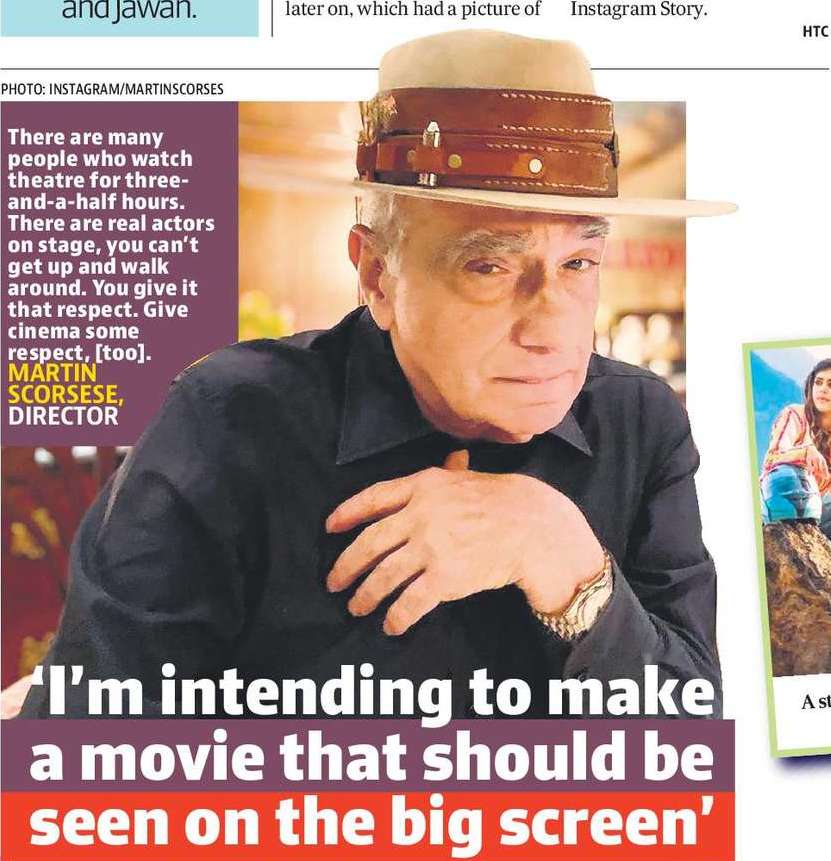
Devansh Sharma (HINDUSTAN TIMES; October 11, 2023)
For his second film in a row, filmmaker Martin Scorsese has turned to a streaming giant. But like his previous outing The Irishman (2019), Killers Of The Flower Moon, too, would release in cinemas first.
“It should be seen on the big screen. Are we intending to make a blockbuster? No, we’re making a movie, which should watched on the big screen,” says the 80-year-old, adding, “People say it’s three hours, but come on, you can sit in front of the TV and watch something for five hours. Also, there are many people who watch theatre for three-and-a-half hours. You give it that respect, give cinema some respect, [too].”
The film marks Scorsese’s 10th collaboration with actor Robert De Niro. “He’s the only one alive now who knows where I come from. It’s a formative relationship that goes back to when we were 16 years old. We’re drawn to the same subject matter and psychological and emotional conflicts in ourselves, people and characters,” he says.
He has been vocal about the need to “save cinema” from “comic-book movies” by backing individual voices. But doesn’t the success of Barbenheimer show that we’re getting there?
“I do think that the combination of Oppenheimer and Barbie was the perfect storm. The way it fit perfectly — a film with such entertainment value and bright colours and a film with such severity and strength — does offer hope for a different cinema. And the most important thing is that people went to watch these in a theatre.”
Martin Scorsese, who made his first film, Who’s That Knocking At My Door, 56 years ago, says most of his projects have taught him something. He explains, “I learnt after Raging Bull (1980) that I’d have to start all over again every time. And that led to The King Of Comedy (1982). I learnt, in a very good way, ignorance,” he tells us, adding, “By the time I did Silence (2016) and The Irishman (2019), I dealt with only the essentials — where you make it look simple, but it’s not actually that.”
While Killers of the Flower Moon is a story about America, Scorsese agrees that it will speak to all those around the world whose culture has been misappropriated. “Oh yes! For instance, when I saw Satyajit Ray’s Pather Panchali (1955), I said, ‘Wait a minute! Those are the people I usually see in the background of other films. What’s the difference here?’ The difference is that the film is being made by them,” he points out.
It’s a lesser-known fact that it was Robert De Niro who introduced Scorsese to Leonardo DiCaprio, another frequent collaborator of the latter. Does Killers of the Flower Moon, which also stars DiCaprio, feel like a reunion?
“I worked with Leo on Gangs Of New York (2002), then we pushed it further in The Aviator (2004), during the making of which we learnt that there’s a 30-year age difference! But I found that we had a similar kind of sensibility. We had a similar fearlessness, the will to try things and a very, very strong trust,” he says, adding that both actors are “quite different” in terms of their approach to their work and craft. “Bob (De Niro) is quieter. It’s all action. Leo and I talk a great deal. It’s our process of working through rehearsals. But I’ve been very fortunate with the two of them over the years,” he wraps up.
There's no country where they haven't heard of Satyajit Ray-Shyam Benegal
8:12 AM

Niharika Lal (BOMBAY TIMES; May 6, 2022)
Veteran filmmaker Shyam Benegal, who recently inaugurated the Satyajit Ray’s Gallery at the National Museum of Indian Cinema (NMIC) in Mumbai, as part of the filmmaker’s 101st birth anniversary celebrations – talks about what makes Ray iconic, an original and a marker for Indian cinema (“Everything is either before or after Ray”).
‘SATYAJIT RAY PUT INDIAN CINEMA ON THE WORLD MAP’
Ray’s Pather Panchali had its world premiere at the Museum of Modern Art (MOMA) in New York as far back as 1955. And according to Benegal, it was Ray who put Indian cinema on the world map. He explains, “Ray is that one Indian filmmaker whom everybody knows. In fact, there is no country in the world where they don’t know who Satyajit Ray was. If you go to a West African country – Niger in Nigeria, for example – and utter the words ‘Satyajit Ray’, they will know him. Everybody recognized Indian cinema because of Ray.”
‘IF IT WASN’T FOR RAY, WE WOULD NOT HAVE HAD AN FTII,IT STARTED BECAUSE OF HIM’
Talking about Ray’s reputation as one of the most original filmmakers, Benegal says, “Indian cinema was developing in a particular way when Satyajit Ray came on to the scene, and then there was a great amount of transformation. And therefore, he is a marker — there’s before Satyajit Ray and after Satyajit Ray.”
He adds, “If it wasn’t for Ray, we would not have had an Film and Television Institute of India (FTII). It started because of him. The whole idea was that filmmaking is not just about moving pictures — people singing and dancing and speaking dialogues. It’s an art form of its own. He not only made the audience and filmmakers conscious of the fact that cinema is an art, but also the government.”
‘RAY WAS A MULTI-FACETED GENIUS’
The NMIC — in association with the National Council of Science Museums (NCSM), Kolkata — has created a gallery on Ray, with a life-size statue of Ray set up at the NMIC. Here, visitors can interactively explore Ray’s filmography and get a glimpse of many of his films’ scenes. Says Benegal, “I find the gallery wonderful because it is very well-curated. The design gives an idea of what kind of filmmaker Ray was. He was not just a filmmaker, but a multi-faceted genius. He used to design his film’s posters, titles, and even storyboards. I don’t think we’ve had anybody quite like Satyajit Ray since his time – before or after.”
‘THERE WERE DEBATES LIKE – WOH TOH SIRF BANGLA MEIN FILM BANATA HAI, HOW CAN HE BE CONSIDERED AN INDIAN FILMMAKER?’
Despite the global accolades garnered by Ray, Benegal says that the Mumbai film industry continued to consider Ray as a regional filmmaker. He said, “Unke uss zamane mein bahut grudge hoti thi. Mumbai film industry used to feel – ‘Woh toh regional filmmaker hai. Hindi mein film nahi banata hai’. That’s why he made Shatranj Ke Khiladi. They used to say – ‘Woh toh sirf Bangla mein film banata hai, how can he be considered an Indian filmmaker?’ Iss kism ke debates hote thay.”
REVISTING RAY’S CLASSICS
This month, a three-day Satyajit Ray Film Festival was organized in Mumbai, Delhi, Chennai, Kolkata, Bengaluru, and Pune, in honour of the filmmaker, from May 2-4. In Mumbai, the opening film was Aparajito, about which Shyam Benegal says, “This is a film which is, again, underrated in its style. After Pather Panchali, when Aparajito came out in 1956,everybody felt that it didn’t match up to the original. But the funny part of this is that Aparajito is a very fine film. The Banaras sequence in it is just outstanding, and the way he used the city in Aparajito is very unique.”
Satyajit Ray's Pratidwandi to be screened at Cannes Classic section; NFDC screens Pather Panchali
8:12 AM
Ruman Ganguly (BOMBAY TIMES; May 5, 2022)
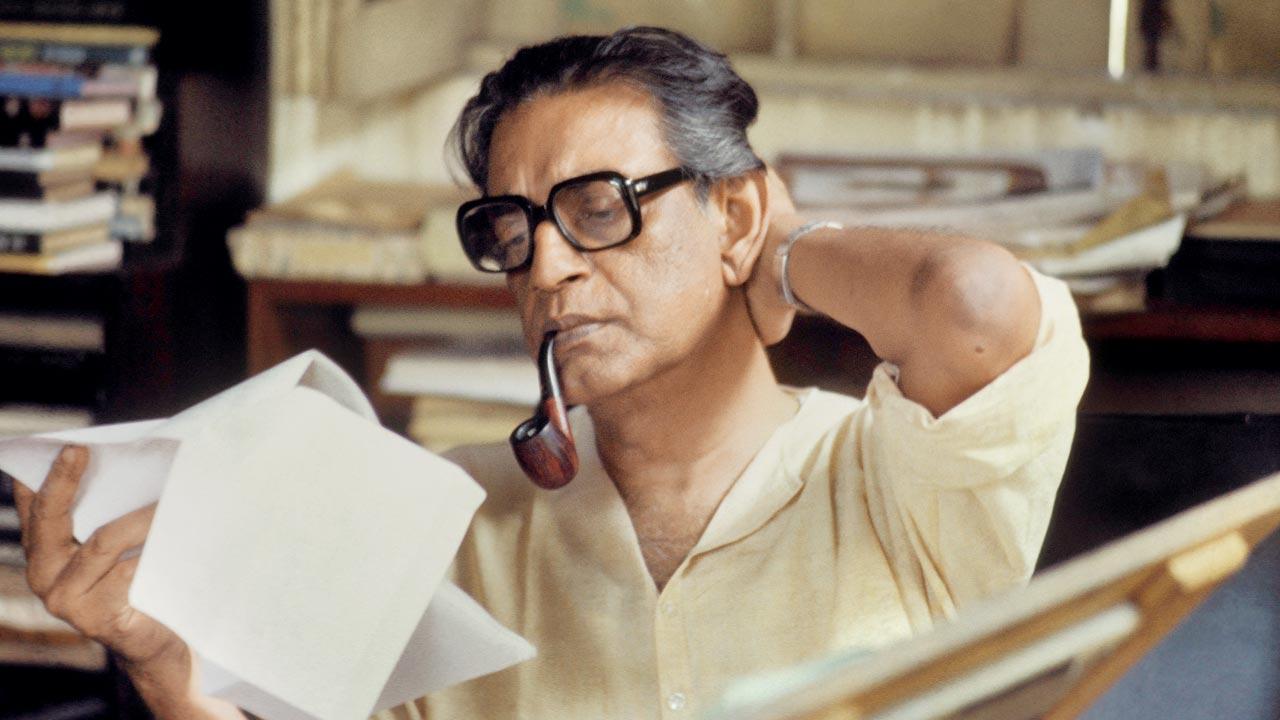
Satyajit Ray’s Pratidwandi has been officially selected for screening at the Cannes Film Festival 2022. The National Award-winning film of1970 will be screened at the festival’s Cannes Classics section. The news could not have come at a better time, as May 2 marked Satyajit Ray’s 101st birthday. Director Sandip Ray, son of the legendary filmmaker, says, “I heard Pratidwandi was restored recently, so I just hope that the restored version is screened at the festival.”
Pratidwandi, written and directed by Satyajit Ray, is based on the novel by Sunil Gangopadhyay. The film unfolds the story of Siddharta, an educated middle-class man caught up in the turmoil of social unrest. It bagged three National Film Awards, including Best Direction, in 1971. It also won a nomination for the Gold Hugo Award at the Chicago International Film Festival 1971. Pratidwandi is the first film of Ray's Calcutta Trilogy, which continued with Seemabaddha (1971) and Jana Aranya (1976).
-------------------------------
NFDC screens Pather Panchali on Satyajit Ray’s 101st birth anniversary by procuring Academy-restored print after the film was lost in 1993 fire
Mohar Basu (MID-DAY; May 5, 2022)
To celebrate Satyajit Ray’s 101st birth anniversary, the National Film Development Corporation of India (NFDC) hosted a special screening of Pather Panchali (1955), one of the legend’s most defining works, in Mumbai on Wednesday. Ardent cinephiles will know that the renowned drama has a history of its own. In 1993, the original negatives of many of Ray’s films were shipped to Henderson’s Film Laboratories in south London, from where they were to be taken to the Academy Film Archive for preservation.
However, when a fire broke out in July 1993 at the laboratory, it destroyed more than 25 original negatives, including The Apu Trilogy. Fortunately, the films were restored as the negatives were rehydrated, repaired and scanned in 4K resolution as part of Academy Film Archive’s landmark restoration.
Ravinder Bhakar, MD, NFDC, is proud that the organisation could facilitate the restored version’s first screening in the country, along with screening of other movies made by and on Ray. “We are happy to have the Academy-restored print from USA. It’s befitting for the museum to have the best restored version of Satyajit Ray’s most iconic film,” he shares, adding that the National Film Archive of India is restoring 10 more films. “Sonar Kella, Hirak Rajar Deshe and Seemabaddha will be screened.”
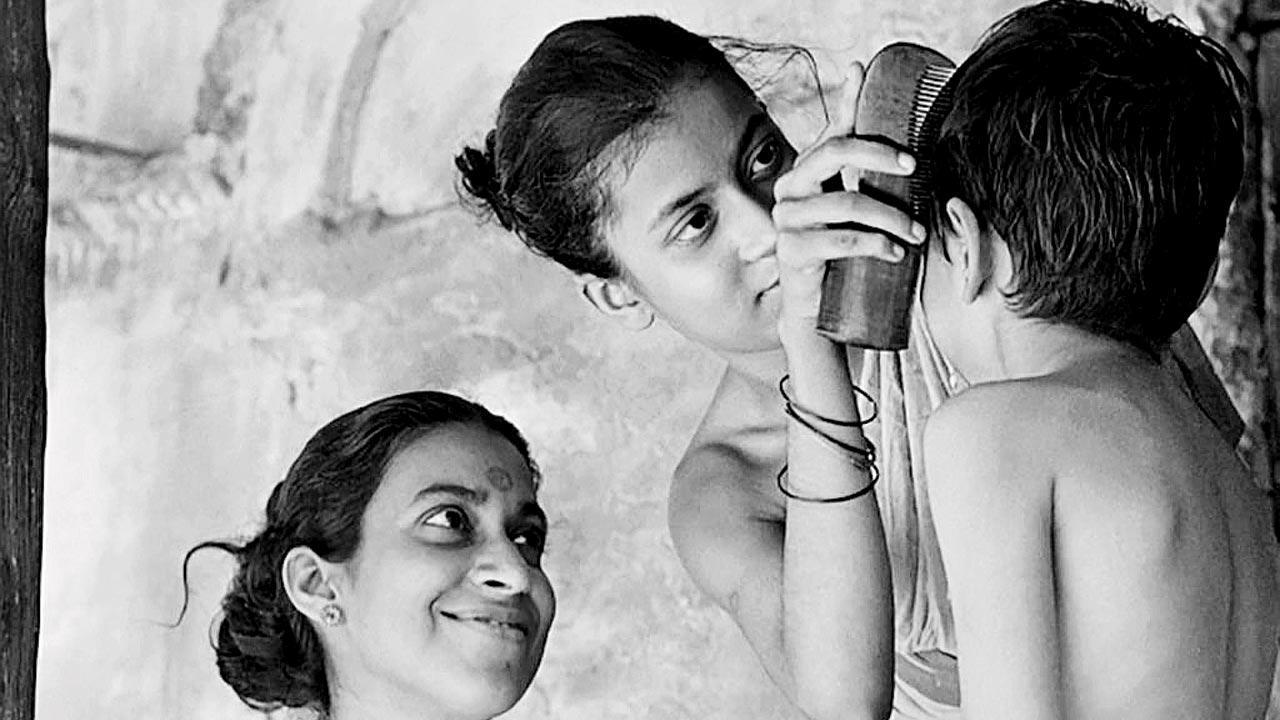
A still from Pather Panchali
Satyajit Ray ‘classics’ tumble out of loft in his son Sandip Ray’s lockdown clean-up
3:08 PM

TREASURE TROVE: Sandip Ray found 100 unseen photos of his father (like the one above) and over 1,000 negatives of stills from sets of the master’s movies
Priyanka Dasgupta (THE TIMES OF INDIA; April 26, 2020)
Kolkata: Feluda might be proud of what filmmaker Sandip Ray did during the Coronavirus lockdown – snoop around the attic of his Bishop Lefroy Road house in south Kolkata to discover a treasure trove of Satyajit Ray memorabilia tucked away without anyone seemingly knowing about its existence.
The priceless find includes, among other things, negatives of 100 hitherto unseen photographs clicked by Satyajit Ray, over 1,000 unseen negatives or transparencies of working stills from the sets of the master’s early movies, and letters and telegrams from stalwarts of world cinema such as Frank Capra, Arthur C Clarke, Akira Kurosawa and Richard Attenborough.
According to Sandip, who has carried the Ray legacy forward with a series of whodunits revolving around his father’s fictional sleuth Feluda, the long overdue clean-up had thrown up the perfect collection for Ray fans to feast their eyes on during his birth centenary on May 2 next year.
“We used to clear a bit of the loft once in a while, but there was never this kind of uninterrupted time to check if there was anything terribly important lying there,” Sandip said.
Till 1959, the Ray family’s address had been south Kolkata’s 31, Lake Avenue. From there, they shifted to 3, Lake Temple Road, before finally moving to their 1/1 Bishop Lefroy Road address. While shifting homes, a lot of stuff kept piling up, but throwing these away was never an option because the family didn’t want to risk disposing of something precious. But it wasn’t until Sandip decided to do some unhurried tidying that he realised what an invaluable treasure the loft held.
Some of the negatives in the collection have never seen the light of day. “I don’t remember seeing them printed. Among them are working stills from Pather Panchali,” Sandip said. When shooting for Pather Panchali began at Boral in South 24-Parganas in 1952, acclaimed photographer Nimai Ghosh hadn’t yet joined Ray’s unit.
Art director Bansi Chandragupta, who had done the production design of the Ray classic, used to shoot stills on the sets. Chances are these negatives, once printed, will add a fresh perspective on the making of the classic.
Asked to give a rough estimate of the retrieved negatives, Sandip said the count was huge. “During those days, one exposure meant 36 photos. We have retrieved at least 25 such wallets,” he said.
Why were 1,845 Indian films rejected at the Cannes Film Festival this year
8:30 AM

File photo of Amitabh Bachchan breezing through the French Riviera, 2002
While Bollywood glamour has been flashing on the Cannes red carpet, concluding today, as many as 1,845 Indian films were rejected this year by the festival’s decision-makers
Khalid Mohamed (MUMBAI MIRROR; May 25, 2019)
Sipping on a fruit smoothie, offseason on the French Riviera’s Croisette, Amitabh Bachchan had asked seriously, “So what does it take to get one of our films to compete at Cannes?”
“A serious theme and plenty of marketing,” an aide had replied succinctly, Bachchan had nodded, non-committally, and had completed his breakfast with a croissant.
This was circa 2002. Bachchan was travelling through Paris-Nice-Cannes-Monte Carlo in connection with the release of a fragrance named after him. Whether the superstar ever followed up the Cannes reverie, is doubtful – since no film of his has ever competed for the award of awards, the Palme D’Or.
Along with his The Great Gatsby co-star Leonardo DiCaprio, he did announce the opening of the event in 2013.
Despite constant grouses by trackers of the world’s most in profile international film festival, the Cannes bosses have still not opened the floodgates of its Palais des Festivals for Indian cinema.
In fact, this year – the 72nd edition of the event which ends today — marked a new low. A sizeable number of 1,845 films were submitted for consideration. None made the cut, except for the short film Afternoon Clouds directed by the Pune Film Institute graduate Payal Kapadia.
Neither was any filmmaker or actor included on the jury unlike Chetan Anand, Mrinal Sen, Shekhar Kapur, Mira Nair, Sharmila Tagore, Aishwarya Rai Bachchan, Nandita Das and Vidya Balan in earlier years.
Mira Nair, whose debut-making Salaam Bombay! way back in 1988 had bagged the Camera D’Or as well as the Audience Award, lately remarked in an interview, “The tastes and agendas of the selection committee and that of Indian cinema don’t necessarily align.” Quite.
Perhaps the usually feisty director was being polite. Without a doubt, she was left chagrined when her widely-hosannaed films Monsoon Wedding (2001) and The Namesake (2006) had been rejected. Ironically, Monsoon Wedding picked up the Golden Lion at the Venice festival.
Indefatigably, the late New Delhi critic, radio broadcaster and government civil servant, Indra Mohan Sahai, had addressed the festival’s then-President, Gilles Jacob, time and again about “the all to apparent prejudice” against Indian entries. To a degree, Jacob and the current President Pierre Lescure, did attempt to remedy this criticism but in fits and starts.
Suddenly Sanjay Leela Bhansali’s Devdas (2002) was showcased to mixed response among the Cannes cognoscenti. Steadily the Bollywood set, among them Shah Rukh Khan, Sanjay Leela Bhansali, Karan Johar and Preity Zinta, began fetching up for photo-ops at the Cannes famed Carlton Hotel.
Last year, Nandita Das’ Manto in the Un Certain Regard section and Rohena Gera’s Sir in the Critics’ Week had at the very least, stirred the attention of the festival goers.
Meanwhile over time, in lieu of Indian films, high-profile Bollywood heroines have been making a splash on the red carpet, merci beaucoup to top global beauty product conglomerates and fashion houses.
Cannes, then, in the public mind, is associated with the haute couture cool displayed most notably by Aishwarya Rai Bachchan and Sonam Kapoor. Ditto Priyanka Chopra. This time around, Kangana Ranaut, Deepika Padukone, Hina Khan, Huma Qureshi and the irrepressible Mallika Sherawat received their share of the paparazzi’s flash bulbs on the red carpet.
Director Anurag Kashyap and his team gained their share of the Riviera limelight with the screening of Gangs Of Wasseypur (2012). Four years ago, Neeraj Ghaywan’s Masaan, became an exception to the Cannes rule, by being laureled in the Un Certain Regard section besides bagging the FIPRESCI award, adjudged by the International Film Federation of Film Critics.
Yet, there’s no gainsaying that Cannes hasn’t opened up hidden masterworks by indie and rising auteurs of Indian cinema. Shyam Benegal flanked by his Nishant (1975) stars Shabana Azmi and Smita Patil, had made an impact. But were many of Benegal’s subsequent films screened there? No.
Ray’s Ghare Baire (1984) and Mrinal Sen’s Genesis (1986) did compete for the Palme D’Or, in vain.
Indian films which have aced Cannes are few and far between. Besides Masaan and Salaam Bombay!, count Ritesh Batra’s The Lunchbox (2013) declared as the Critics’ Week Viewers Choice, Murali Nair’s short film Marana Simhasanam (1999) lavished with the Camera D’Or for a debut director and Mrinal Sen’s Kharij (1982) presented the Special Jury prize.
Ray’s Pather Panchali (1956) was recognised as the Best Human Document, Bimal Roy’s Do Bigha Zameen (1954) was saluted with the Prix Internationale, V. Shantaram’s Amar Bhopali (1951) was thumbed up for Excellence in Sound Recording, and Chetan Anand’s Neecha Nagar was garlanded with the Grand Prix du Internationale du Film (the earlier name for Palme D’Or).
How many milestones of our cinema, in the last seven decades, have gone cavalierly ignored at Cannes is another story.
Perhaps the key reason for this rebuff is the fact that the nation’s meaningful cinema has been hardly marketed and promoted if at all. The National Film Development Corporation does set up a stall — complete with free cups of teas and samosas — at the Marche du Film. But do the spends of the ever-enlargening delegations fructify in monetary deals? Debatable.
To conclude on a positive note, here’s wishing Cannes unconditionally embraces the best of our quality cinema — and there’s plenty of that, I can assure you, compared to the best of Hollywood or any Wood.
And then who knows? Mr Bachchan will no longer have to ask, “What does it take to compete at Cannes?”

Richa Chadha, Neeraj Ghaywan, Shweta Tripathi and Vicky Kaushal at Cannes where their film Masaan premiered on May 19, 2015

Shyam Benegal with his Nishant actors Shabana Azmi and Smita Patil
Shah Rukh Khan to promote India-China cooperation in cinema at Beijing International Film Festival
8:16 AM

MID-DAY (April 11, 2019)
Shah Rukh Khan is set to take part in the Beijing International Film Festival (BIFF), scheduled to be held between April 13 and April 20. Satyajit Ray’s classic Pather Panchali (1955) and Khan’s last release Zero (2018) are among the five Indian films that have been listed to be screened at the event. Zero, which also stars Anushka Sharma and Katrina Kaif, will close the movie gala.
Khan, along with director Kabir Khan, is due to take part in a China-India Film Cooperation Dialogue, according to the brochure circulated by BIFF. China has emerged as a huge market for Indian films in recent years, with Ayushmann Khurrana’s thriller AndhaDhun, recently earning Rs 100 crore at the domestic box office since its April 3 release.
According to BIFF, the dialogue segment seeks ways for the common development of Chinese and Indian films, and creates more opportunities for further strengthening film cooperation between the two neighbours. The panel will also feature Chinese film personalities, including Wen Muye, director and screenwriter of Dying To Survive.
The festival also features a segment dedicated as India Week.
Politics has an expiry date, art doesn’t. An artiste should stay away from political games-Majid Majidi
8:02 AM

Madhureeta Mukherjee (BOMBAY TIMES; April 20, 2018)
His stories are deep-rooted in reality; the emotions are raw, unadulterated and simple, yet, they have the power to move you deeply. Iranian filmmaker Majid Majidi has spent the last two decades crafting some of the most enchanting stories (like Oscar nominee Children Of Heaven, The Color of Paradise and Baran), which stem from the culture and fabric of the country he comes from. This time, he has looked way beyond, towards India. In his latest offering and his first Indian film, Beyond The Clouds, he has captured Mumbai’s streets, slums, creeks and chaos with charming realism — which is his forte. Like his other celebrated Iranian films, this one too, reflects the life of those trapped in poverty, but it clutches on to that one word —hope. The filmmaker reminds us, “Hope is the biggest reference point, not only for me, but for whole of humanity.” In an interview with BT, Majid Majidi talks about his views on Bollywood cinema, how he idolises the legendary filmmaker Satyajit Ray, and his perspective on how art and artistes should remain depoliticised. Read on...
Most of your films show compassion for the underprivileged. You seem to have a deep connect with such subjects...
The middle class and the lower middle class form the majority of any society, so from my point of view, they are the most important and the most vulnerable, too. As a society and as filmmakers, we do not pay enough attention to their stories and lives. The people belonging to this level of society do not have as many opportunities to come out and talk about their trials and troubles, so it is our responsibility as artistes to draw attention to their problems. In India, women have a great role to play in society, but at the same time, they are oppressed and become victims in the same environment. My stories shed light on the bitterness that a human being goes through in life. It is common everywhere. Everyone needs hope, and that is my aim; to bring hope in each and every aspect of my character and my film. So, hope is the biggest reference point, not only for me, but for the whole of humanity.
The common thread in your films is the focus on a strong value system within the family and how that can stand the test of difficult times and circumstances…
Family as an institution has always been a very important part of my films. I believe that protecting and preserving this institution is a crucial function of any society. If cracks appear in the institution of the family, it gets reflected in society. Very often, the disorders that we see around us, is a reflection of the state of the family system. I think before we can build a proper society, we need to put our energies into building a solid family.
What were the challenges of shooting in real locations in Mumbai? Did you explore the length and breadth of the city while conducting recce for locations?
The first day when I showed my crew the locations where we would be shooting, they were taken aback. They said, “We cannot shoot here!” Unless there is no option, I shoot on real locations. I really enjoyed shooting at Dhobi Ghat, though it was a big challenge. Now I know Mumbai better than you (laughs!). I visited almost every place in the city during my previous trips, before I started filming. Since then, I have been observing the city and its people closely. Mumbai is a real city. I find it very fascinating to see the wealthy and the poor living side by side and co-existing. You can rarely see this anywhere else in the world. This is a unique and an absolutely remarkable feature of this city. In every other society, there is a clear geographical divide in the city between the rich and the poor, but in Mumbai it is all mixed up, which makes the city so dramatic and fascinating.
You did hundreds of auditions before signing on Ishaan Khatter and Malavika Mohanan. We also heard that you often identify interesting faces and people around you and go ahead and cast them in your movies?
Yes, besides the location, the casting process is very important for my films. My crew helped me a lot by reaching out to different actors, and showing me pictures that fit the brief for my characters in the film. I even met some extremely popular actors like Deepika Padukone, who is a superstar and a loving personality. For this film, there was no opportunity for us to work together; I hope we can make it happen in the future.
We did a lot of auditions and we were facing a tough time finding the perfect male lead. When Ishaan came to me, he was all beefed up and flexing his muscles. I looked at him and said that everything about him was good, except his amazing physique (laughs!). So my brief to him was to lose all the muscle and become a thin-looking boy. Ishaan is a talented actor; he grabbed this opportunity to the fullest. Even Malavika is a fine actress; I think both of them will shine in Bollywood. The child artiste Asha (played by Amruta Santosh Thakur) in the film, I found her playing outside while scouting for locations. I was so fascinated by her that I requested if I could click a picture, as she fit the character in my film beautifully. There is another lovable child artiste Chotu (played by Shivam Pujar), I lost my breath because of him. He was the director on the set, I wasn’t! Whenever we were ready with the shot, he was in a mood to play, so we all had to wait for him. I think everywhere in the world, children are the same. We have to make the environment comfortable to bring out the best in them.
What is your view of Indian cinema? Our country is very diverse, and so is our cinema. The popular Bollywood fare is what rules the box office mostly, though we’ve seen a growing trend and interest in different kinds of cinema , too, which goes beyond song, dance and drama .
India has all the potential to make good cinema; you have good actors, directors and technicians. India also has plenty of great stories that are deep rooted in their culture, which can resonate strongly with the audience. Let’s say that there are about thousand films that are made in India every year, but only about 200 of them are successful at the box office and the rest don’t even make it there. Remember that there are two key players in the global film industry — Hollywood and Bollywood. Overall, Hollywood has been able to strike a balance between commercial and art cinema. Bollywood has been more inclined towards commercial cinema, even though there is some great art house/parallel cinema being made here. So, even while there is an audience for different kinds of films, the balance has tilted in favour of commercial cinema. India needs to find the right balance between mainstream and parallel cinema as it has the potential to emerge as a major player globally. The youth of India have very strong opinions and they know what good cinema is, hence, they need to be shown more of that as they are the future of this country.
Did you ever deliberate over the language of the film, whether it should be made in Hindi or English?
I was contemplating this when I first came here. There were other creative people who said that I should make the film in English for an international audience. I took my time and thought about it. I felt that this is an Indian film and I am making it for the people of India. So, I was ready to take that risk and make it in Hindi. After the film was made and it was translated into English, I knew I had made the right decision.
How important is it for you to see your films reach out to the world, beyond your country? Would you ever make a film with Western sensibilities so that it appeals to a larger section of the audience?
For every filmmaker, it is a dream to be accepted by the audience around the world. But the important thing is that, if a filmmaker wants worldwide acceptance, he needs to tell a story about his or her own culture. Yes, I want my films to be viewed by a wider audience, but I don’t make films just so that they can travel to festivals. I know that all my films are deep-rooted in culture. Even with Beyond The Clouds, I knew that it was a risk making the film in Hindi, but I was aware that it would make it culturally richer and would eventually pay off. For instance, let’s talk about dance. Over the years, you might have seen films which showed their culture through dance. But right now, the dance that we see in movies is very Westernised, which is not a part of our culture. If you want to show that, you can. There’s nothing bad in doing that, but it would also be great to see your own traditional dance forms in your movie.
You have said that you are inspired by the genius filmmaker Satyajit Ray. His stories too, stemmed from the lives of real people, and they were hard-hitting subjects that were a reflection of our society. Is there any one film of his that has impacted you deeply?
One of my favourite Satyajit Ray films is Pather Panchali (1955). It ranks in my top 10 list of most favourite movies. Every time I watch it, I feel like I am discovering something new. Watching Pather Panchali is like going through an entire term of college. I can take a masterclass on the film and discuss every aspect of it for hours and days, because it is not a film, it’s a study of life itself. Even after watching it over fifty times, the acting, direction, cinematography and story doesn’t cease to amaze me.
Iranian filmmakers have often faced opposition and resistance from the government; in some cases they have been banned and imprisoned for their films. Some filmmakers have even moved out of Iran, because of the censorial policies of the nation. Do you ever feel creatively stifled as a filmmaker in your country?
I think art should not be contaminated with politics, because politics is ever changing. So, if I make a movie which makes a political statement, after one year, when the politics change, people will ask, ‘Why did he do this?’ So, an artiste should stay away from politics. That way, your art will not have an expiry date. Politics has an expiry date; art doesn’t. So, an artiste should stay away from political games. I have not seen any successful films by filmmakers who have migrated from Iran to other countries.

Unfortunately in my opinion, Slumdog Millionaire had a very touristy look-Majid Majidi
7:59 AM

DNA (April 19, 2018)
To a cinema-loving audience, Majid Majidi doesn’t need an introduction. His cinema, both Iranian and indi, transcends all barriers. His Iranian film Children of Heaven (1992) got him an Oscar nomination.
And, though Children Of Heaven lost the trophy to Roberto Benigni’s Life Is Beautiful, Majidi’s was the first Iranian film to make it to the prestigious Academy Awards.
The Iranian filmmaker, who has been wooed by Indian studios to make a film here, finally makes his India debut with Beyond The Clouds, starring Ishaan Khatter (Shahid Kapoor’s brother) and Malayalam actress Malavika Mohanan, who is also daughter of cinematographer KU Mohanan (Jab Harry Met Sejal, Raees and Talaash).
We chatted with the celebrated director about his beautiful offering. Excerpts from the conversation...
Beyond The Clouds really touched our hearts. How do you manage to get people moist-eyed especially when you make a film in a language (Hindi) you don’t speak at all.
For years, I have been planning to make a film here in India. I was interested in the ambience, culture and atmosphere here. Do you know that culturally, India and Iran are close? Iran is a very dramatic country as is India. I spent time in Mumbai to get a deep understanding of the vocations here. And what I learnt, inspired me to make a film here. One of the companies here has been following up with me for some years.
So, during my trips to India, I got an idea, which I developed into a script. I did my research in Mumbai, and set it here.
Then came the most challenging part. I decided to make the film in Indian language and not in English. Especially, because of the characters and the cultural aspect, the film had to be a local movie. Language is not a barrier. When you mention emotion, it is very important in the film; you should transport that emotion to the audience.
That’s what your film does..
I believe emotion is the first thing that can touch the audience. That is the most important thing you should do in a film, take the audience with you. I had this concern; that the language of the film should be Hindi, because it is close to this culture. That’s also why I selected my crew from India and not from Iran. They could help translate that cultural and emotional aspects on the screen. This was a big challenge, making the movie in real ambience, real locations and not inside studios. Fortunately, we could make it happen. The other aspect was casting, with the team here I could get the right actors for the characters. I believe a big part of acting is when you select good and proper actors.
Yes, of course. The right actors make that difference.
So, after extensive research and casting correct actors, we mounted the film with Ishaan. As for the other characters, like Jhumpa and the kids; do you know that other little girl? I found her while walking on the streets. She is a common kid.
Even the other boy, in the jail sequences; he is also a fabulous actor.
He was a big challenge as well. He was barely a few years old; and to make him act was very difficult.
While there is no comparison between Beyond The Clouds and Slumdog Millionaire, coincidentally both are based in Mumbai slums. Have you seen Slumdog Millionaire?
Yes, and unfortunately in my opinion, that had a very touristy look.
What has been your approach for the movie?
I’ve tried to take a really realistic and correct look into the city. All the characters are real. In this film, we can see the real Mumbai.
One can feel that besides the actors, the place also is a character and has a soul.
Yes, that was very important for me. I wanted you to see Mumbai through my film.
Is there anything else you consider as a reward or award, having won many awards internationally, like in Montreal, Cannes among others?
Usually, when I make film, I try to reach the common audience and the specific audience. In this case, I’ve tried to keep a balance between both sides. And then, winning or not winning is another aspect.
Considering that you don’t speak the language, how much of Indian cinema have you seen?
I’ve mentioned it before, I knew Indian cinema for long time. I’m a big fan of Satyajit Ray’s cinema. When you watch Pather Panchali, you get such a strong feeling, it’s like magic. After watching the film, you can visualize local Kolkata culture from wherever you are. Mostly, I know the art cinema of India. And Shyam Benegal makes beautiful films.
1st time in theatre: Bollywood stars on their earliest encounters with the silver screen
7:49 AM

Sanyukta Iyer (MUMBAI MIRROR; December 7, 2015)

KANGANA RANAUT
I was eight when I saw parts of Dilwale Dulhaniya Le Jayenge. I didn't sit through the whole film but I remember constantly humming “Na Jane Mere Dil Ko Kya Ho Gaya“. We don't have theatres in the valley where I grew up, so I only watched my first film when I was 14, in high school in Chandigarh. Some 30-40 of us girls accompanied our principal, her son Gullu, the warden, the hostel cleaning and cooking staff for Sanjay Leela Bhansali's Devdas. We had to sit through the film under the watchful eyes of our warden. When Shah Rukh Khan dies in the film, I was sobbing uncontrollably, deeply affected by the tragic fate of Devdas, Paro and Chandramukhi as also the grandeur of the maker's vision. I would smile in the physics lab after watching the film, thinking about the songs and the scenes.

SHOOJIT SIRCAR
 I was in standard 8 in Kharagpur. One day my father, who was training
pilots in the Indian Air Force, took me to watch Satyajit Ray's Pather
Panchali. I was bored and fell asleep. Three years later, we shifted to
Delhi and our class was taken for the same film. Halfway through, we all
walked out. At that point I was only interested in football. But later,
after I got into theatre, I watched the film for a third time at IFFI
Delhi. I was older and this time it made me cry. Later, I watched
the third part, Apur Sansar, and it made me howl. Now, I tell my actors
that before they work with me, they have to watch the Apu trilogy. I
made Deepika (Padukone) see all three films
before we shot Piku.
I was in standard 8 in Kharagpur. One day my father, who was training
pilots in the Indian Air Force, took me to watch Satyajit Ray's Pather
Panchali. I was bored and fell asleep. Three years later, we shifted to
Delhi and our class was taken for the same film. Halfway through, we all
walked out. At that point I was only interested in football. But later,
after I got into theatre, I watched the film for a third time at IFFI
Delhi. I was older and this time it made me cry. Later, I watched
the third part, Apur Sansar, and it made me howl. Now, I tell my actors
that before they work with me, they have to watch the Apu trilogy. I
made Deepika (Padukone) see all three films
before we shot Piku.

RAKEYSH OMPRAKASH MEHRA
 I remember watching V Shantaram's 1957 classic Do Aankhen Barah Hath on
TV and since then I have believed it's the greatest film ever made.
Since then, I have seen this story on humanistic psychology and how it
explored the idea of an “open prison“ many times and each time it has
revealed something
new to me. It has left an impression on my style of filmmaking.
I remember watching V Shantaram's 1957 classic Do Aankhen Barah Hath on
TV and since then I have believed it's the greatest film ever made.
Since then, I have seen this story on humanistic psychology and how it
explored the idea of an “open prison“ many times and each time it has
revealed something
new to me. It has left an impression on my style of filmmaking.

DEV PATEL
 The first film I saw in a theatre was Titanic in 1997 with my whole
family. We had booked an entire row and
that was the first time I saw my parents cry over a performance. I was
thinking about romancing my first crush, the gorgeous Kate Winslet, and I
think my dad felt the same way.
The first film I saw in a theatre was Titanic in 1997 with my whole
family. We had booked an entire row and
that was the first time I saw my parents cry over a performance. I was
thinking about romancing my first crush, the gorgeous Kate Winslet, and I
think my dad felt the same way.

SHRADDHA KAPOOR
 Films have been a part of my life since as long as I can remember. I was
five years old when Andaz Apna Apna (featuring her father Shakti Kapoor
as Crime Master Gogo) released. I was really excited and I loved the
absurd comedy so much that I forced my parents to take me for it several
times. Of course, Crime Master Gogo is my all-time favourite, a villain
with a soft heart.
Films have been a part of my life since as long as I can remember. I was
five years old when Andaz Apna Apna (featuring her father Shakti Kapoor
as Crime Master Gogo) released. I was really excited and I loved the
absurd comedy so much that I forced my parents to take me for it several
times. Of course, Crime Master Gogo is my all-time favourite, a villain
with a soft heart.

NANDITA DAS
My father is a painter and my mother is a writer. Watching films was not encouraged. The only films I saw were the ones at the Children's Society of Delhi. I loved Haathi Mere Saathi but my real brush with cinema was in college when an Indie filmmaker introduced me to French, German and Russian films. I never developed a taste for mainstream fare because of my upbringing.
I was eight when I saw parts of Dilwale Dulhaniya Le Jayenge. I didn't sit through the whole film but I remember constantly humming “Na Jane Mere Dil Ko Kya Ho Gaya“. We don't have theatres in the valley where I grew up, so I only watched my first film when I was 14, in high school in Chandigarh. Some 30-40 of us girls accompanied our principal, her son Gullu, the warden, the hostel cleaning and cooking staff for Sanjay Leela Bhansali's Devdas. We had to sit through the film under the watchful eyes of our warden. When Shah Rukh Khan dies in the film, I was sobbing uncontrollably, deeply affected by the tragic fate of Devdas, Paro and Chandramukhi as also the grandeur of the maker's vision. I would smile in the physics lab after watching the film, thinking about the songs and the scenes.
SHOOJIT SIRCAR
I was in standard 8 in Kharagpur. One day my father, who was training
pilots in the Indian Air Force, took me to watch Satyajit Ray's Pather
Panchali. I was bored and fell asleep. Three years later, we shifted to
Delhi and our class was taken for the same film. Halfway through, we all
walked out. At that point I was only interested in football. But later,
after I got into theatre, I watched the film for a third time at IFFI
Delhi. I was older and this time it made me cry. Later, I watched
the third part, Apur Sansar, and it made me howl. Now, I tell my actors
that before they work with me, they have to watch the Apu trilogy. I
made Deepika (Padukone) see all three films
before we shot Piku.
RAKEYSH OMPRAKASH MEHRA
I remember watching V Shantaram's 1957 classic Do Aankhen Barah Hath on
TV and since then I have believed it's the greatest film ever made.
Since then, I have seen this story on humanistic psychology and how it
explored the idea of an “open prison“ many times and each time it has
revealed something
new to me. It has left an impression on my style of filmmaking.
DEV PATEL
SHRADDHA KAPOOR
Films have been a part of my life since as long as I can remember. I was
five years old when Andaz Apna Apna (featuring her father Shakti Kapoor
as Crime Master Gogo) released. I was really excited and I loved the
absurd comedy so much that I forced my parents to take me for it several
times. Of course, Crime Master Gogo is my all-time favourite, a villain
with a soft heart.
NANDITA DAS
My father is a painter and my mother is a writer. Watching films was not encouraged. The only films I saw were the ones at the Children's Society of Delhi. I loved Haathi Mere Saathi but my real brush with cinema was in college when an Indie filmmaker introduced me to French, German and Russian films. I never developed a taste for mainstream fare because of my upbringing.

How Lee Kline managed to restore Apu Trilogy despite the reels being burnt
7:38 AM

Roshmila Bhattacharya (MUMBAI MIRROR; October 26, 2015)
 One of the highlights of the
17th MAMI Mumbai Film Festival partnered by Mumbai Mirror is Satyajit
Ray's Apu Trilogy. Digitally restored prints of Pather Panchali (1955),
Aparajito (1956) and Apur Sansar (1959) will be screened at Jio MAMI
which opens on October 29.
One of the highlights of the
17th MAMI Mumbai Film Festival partnered by Mumbai Mirror is Satyajit
Ray's Apu Trilogy. Digitally restored prints of Pather Panchali (1955),
Aparajito (1956) and Apur Sansar (1959) will be screened at Jio MAMI
which opens on October 29.Quiz Lee Kline, the restorer who has presided over the technical group at The Criterion Collection for the last 20 years, on the biggest challenge he faced on this project, and he says it started with tracking down the original negatives. Eleven reels of Aparajito, nine reels of Pather Panchali and two reels of Apur Sansar were located in the vaults of the Academy of Motion Picture Arts and Sciences in Los Angeles. “But because of a fire, parts of the negatives were warped from the heat and those were the hardest to restore,“ he reminisces.
The fire started in July 1993 at Hendersons Film Laboratories in South London and many of the Ray films which had just arrived from India en route to LA were badly burnt. Still, the negatives were shipped to the US and tucked away for two decades.
Kline was at Sony Studios' post-production facility, Colorworks, when the first of the burnt reels was delivered. He opened one of the cans to be faced with a warped reel with frayed edges, heads burnt, the film brittle and flaky. There was residue from tape, glue and wax all over the reel, yet, surprisingly, 30 digitised seconds revealed perfect images of Aparajito lying in between the sprocket holes.
Reel 3b of Aparajito was hand-carried to Bolgna, Italy, where after initial tests they realised the only way forward was to repair as much of the negative as possible and scan pin-registered wet gate, the most expensive procedure. The Criterion partnered with the Academy to fund the project. L'Ummagine Ritrovato offered a substantial discount. After a year at Bologna, repairing and scanning the restored negative, and hours of digital repairs and colour grading at The Criterion, they combed the archives for alternative film to replace the missing shots. They found it at Janus, a wing of the Criterion, and the Academy, along with some fine grain positives and dupe negatives at the British Film Institute.
“A complete assembly of the entire film was created in a digital timeline with an edit decision list identifying the best sections or shots of each film to be used. The scanning and digital restoration were kept in 4K resolution so that it would be the most affordable,“ explains Kline.
 He admits that Apur Sansar had
very little original negative remaining after the fire, but because it
was made later, they had access to the best quality safety elements. And
the 35 mm fine grain that they ended up using almost in its entirety
printed well and had an excellent grey scale, so the final result is
exceptional even without access to the negative.
He admits that Apur Sansar had
very little original negative remaining after the fire, but because it
was made later, they had access to the best quality safety elements. And
the 35 mm fine grain that they ended up using almost in its entirety
printed well and had an excellent grey scale, so the final result is
exceptional even without access to the negative.“Pather Panchali was in the worst condition. The optically printed dissolves in the film were made crudely and quickly, and they were cut into the negative so they would snap out of the beautiful images surrounding them. Certain scenes in the negative were replaced by duplicate footage, so they looked generationally inferior to other sections. Wax was applied on the surface of the entire negative to preserve it, but the fire had melted it. Wet-gate scanning helped but only 40 per cent of the original negative could ultimately be used due to missing footage or extreme warping of the film which made the image unwatchable,“ explains Kline.
Aparajito had the most usable footage from the repaired and restored negatives. The replacement film too was also in good condition, so the final version is better than the restored Pather Panchali. “The filmmaking and editing was also more advanced, so the optically printed shots for dissolves and fades are more sophisticated,“ he says.
Months were also spent fixing scratches and tears, warping, flicker and instability, cleaning the dirt and upgrading the sound. Ryan Hullings, supervisor of the audio department at The Criterion, informs that most of the soundtracks were so damaged they were completely unusable. “The best surviving sound element uncovered for Pather Panchali was a 35 mm magnetic track provided by the Academy. It's a safety master made in the '90s after the fire. Working primarily in Pro Tools and using various digital tools, we manually removed the vestiges of age (clicks, pops, crackle, thumps, hiss, hum, distortion, dropouts), shaped the timbre using EQs and tightly synchronised sound with picture. I believe the film sounds better now than at any time since the day of its release,“ Ryan asserts.
For authenticity, they intentionally didn't smooth out the occasional abrupt change in room tone or dialogue quality resulting from the overdubbing of a line or a coarse audio edit.
Suitable audio sources for Apur Sansar were the most difficult to come by. The best source, a 35mm print, was incomplete so several reels from a second, inferior print were used to fill the gaps, and then another 35 mm mag which had been previously restored so sounded very different from the other two prints to complete the soundtrack. “For Aparajito we were lucky to turn up a decent, complete 35 mm print in Italy that was transferred in Bologna. It conformed easily to match our picture master, which was a relief."
Satyajit Ray's son Sandip met the restorers in Kolkata before they started and kept in touch throughout. Says Kline, “The biggest honour was when he came to New York for the premiere of the restored Pather Panchali at the Museum of Modern Art 50 years after it was shown there by his father and said his father would have liked what we did.“
Pather Panchali completes 60 years; Victor Banerjee gives us the inside story
8:37 AM

THE TIMES OF INDIA (October 18, 2015)
 One of the greatest
philosophers of contemporary times, Ludwig Wittgenstein, had said: “If
we spoke a different language, we would perceive a somewhat different
world.“ The world can find no new words or language to describe with any
degree of originality, the phenomenon called Pather Panchali. As
Japanese director Akira Kurosawa famously put it: “Not to have seen the
cinema of Ray was like existing in the world without seeing the sun or
the moon.“
One of the greatest
philosophers of contemporary times, Ludwig Wittgenstein, had said: “If
we spoke a different language, we would perceive a somewhat different
world.“ The world can find no new words or language to describe with any
degree of originality, the phenomenon called Pather Panchali. As
Japanese director Akira Kurosawa famously put it: “Not to have seen the
cinema of Ray was like existing in the world without seeing the sun or
the moon.“But if the first film that Satyajit Ray ever wanted to make had been made, I would not have been asked to write this piece today. In 1948, a Hollywood-returned nuclear physicist Harisadhan Dasgupta paid the Tagore Estate Rs 20,000, a fortune then and three times the price paid for Pather Panchali, for the filming rights of Ghare Baire which he was to direct and Ray had written a script for. “I consider that the best of Hollywood and British films by John Ford and David Lean, should be the goals for filmmakers in this country - we are very much lost,“ he boomed as he scornfully manoeuvred the bylanes of Calcutta in his imported Chevrolet from the coffee house to Ray's pokey little flat where their intellectual addas continued into the night. They, together with art director Bansi Chandragupta, spent a great deal of time with Jean Renoir who was an early inspiration for our Ray-in-the-making.
 Their first financier, a slimy Ghosh, who traded in gold bars from
Nepal, disappeared mysteriously. Later, while Ray and Bansi Chandragupta
were scouting locations and looking for an actress to play Bimala in
Ghare Baire, in walked a meddlesome venereologist-turned-producer who
wanted changes that Harisadhan accepted unwillingly but Ray rejected
outright. I'd give anything to know what those requested changes were,
coming as they did from someone who had obviously made a fortune dealing
with the fallout from illicit sexual relationships. The film was
shelved, and the Dasgupta-Ray liaison ended.
Their first financier, a slimy Ghosh, who traded in gold bars from
Nepal, disappeared mysteriously. Later, while Ray and Bansi Chandragupta
were scouting locations and looking for an actress to play Bimala in
Ghare Baire, in walked a meddlesome venereologist-turned-producer who
wanted changes that Harisadhan accepted unwillingly but Ray rejected
outright. I'd give anything to know what those requested changes were,
coming as they did from someone who had obviously made a fortune dealing
with the fallout from illicit sexual relationships. The film was
shelved, and the Dasgupta-Ray liaison ended.Thirty years later, I was driving and being driven crazy by the Raja of Santosh's antique 6-cylinder coupé, a Studebaker Flighthawk, as it stopped and spluttered and ground to several halts on our way from Calcutta to Bombay. I lay back on a flea and bedbug infested charpoy, gazing at fireflies climbing into a starry sky, at a roadside dhaba. On the charpoy beside me, giggling naughtily as he always did, was my dear friend Pratap who always had amazing stories to tell. One such story, that Manikda later confirmed, was that Pratap had lent Ray his father's movie camera for a few days, during the filming of Pather Panchali.
Pratap, the grandson of the Raja of Santosh, and the young Ray, then working as a visualizer for DJ Keymer (a British advertising agency) were friends. The polite and charming Manik and the elegantly mischievous Pratap were, to put it discreetly, doing more than designing visuals for the Paludrine malaria pill ad campaign but I'll save the amusing details for a memoir I shall never pen.
Ray started Pather Panchali during his stint at the ad agency but ran out of funds. West Bengal CM Dr B C Roy sanctioned the money from the road development fund since he mistakenly thought it was a documentary on rural development.
I remember once sharing a laugh about how the cigar smoking RSP loudmouth Jatin Chakraborty, who was infamous for cracking the whip on Usha Uthup for her “Apasanskriti“ would have been glad to propagate the fiction that it was the West Bengal government's PWD department, his ministry, that once funded and paved the “little road“, and thus made the greatest contribution, not just to our Sanskriti but to the world of cinema at large.
I had the delightful pleasure of being acquainted with the family of a charming Brahmo lady who, in her youth, made Dr BC Roy weak-kneed but seldom took advantage of his affection, except to once hold his hand tenderly and ask for the salvation of an unusual film being made by an outstanding young Brahmo Samaji. He melted and complied, and later went on to invite Jawaharlal Nehru, who was on a visit to Calcutta, to a private screening of Pather Panchali. Nehru was impressed and ensured that the film was entered in the 1956 Cannes Film Festival despite a move by some to oppose the entry. It went on to win a special jury prize, and allowed Ray to become a full-time director.
And while Manikda may have been the auteur at the helm, it was his oarsmen on either side, Subrata Mitra, a 21-year-old still photographer who Ray chose as cinematographer despite his lack of experience, and Bansi Chandragupta, who helped bring the ship home to international applause and acclaim.
I had the pleasure of working with both of them and so I saw first-hand just how pernickety, meticulous and brilliant they were at their respective jobs and how well they complemented each other's work. To my mind, Satyajit Ray, without them, would have been like a Mallory who never peaked.
Together, Manikda, Subrata and Bansi were the calligraphers of cinema who transformed the mundane graphemics of the extremely ordinary consonants of existence into sensational and memorable pictures of humanity. Pather Panchali and The Apu Trilogy, therefore, in my opinion, with all its kudos, belongs to that great trio.
Some of the shots in Door Gagan Ki Chhaon Mein were similar to Pather Panchali-Amit Kumar
7:50 AM

Roshmila Bhattacharya (MUMBAI MIRROR; June 23, 2015)
Buzz is, Kishore Kumar's Door Gagan Ki Chhaon Mein was inspired by his mama, Satyajit Ray's debut film, Pather Panchali. But his son, Amit Kumar, insists that though his baba had lent Ray Rs 5,000 to complete his Song of the Road and had seen the film 13 times, he was actually influenced by Michael Curtiz's The Proud Rebel which he adapted in Hindi.
"Some of the shot takings were similar to Pather Panchali, like the croaking of the frogs in the rain, but the content was borrowed from the 1958 Western. Based on a story by James Edward Grant, it revolved around a former confederate soldier, John Chandler, and his 10-year-old son David who had not spoken a word since he had witnessed his mother's death in a fire," points out Amit.
Kishore himself stepped into Alan Ladd's shoes as the impoverished war hero and started auditioning for the role of his mute son. He was looking for a boy who could speak through his eyes and even placed an ad in the Times of India. None of them impressed him and finally, urged on by his cinematographer, Aloke Dasgupta, and his actor friend Ifftekar, decided to screen test Amit who was down from Kolkata on vacation.
"One day, baba called me and told me to hide behind the curtain. When he called out, I was to step out and say, 'Bapu, tum kab aaoge?' reminisces Amit who did what was asked and was rewarded with a "Bahut achche."
He was eight when the film flagged off in '60, and unfazed by the challenge, because he had no dialogue sheets to learn by rote. He spoke just one line of dialogue at the end which saves his bapu's life.
Kishore was going through a lean phase as an actor and everyone discouraged him from making a film without comedy or commercial elements. Only his mother, Gauri Devi, supported him, even pawning her jewellery. The first day's scenes in Juhu were shot in the light of the car's headlights. It took him three years to complete the film.
Door Gagan Ki Chhaon Mein opened in 1964. The press show at Blaze in Liberty cinema drew all the top critics, including Baburao Patel, the editor of Filmindia. A line in his review, 'Door Gagan Ki Chhaon Mein just misses out on being a classic' made Kishore happy and proud since he rarely praised a film.
The premiere, at Metro cinema, was attended by George Fernandes, the leader of the Opposition, along with half the film industry, including Raj Kapoor and Ashok Kumar. "Baba was very quiet during the screening. And after it was over, too overwhelmed to speak, so Iftekhar uncle gave the speech," recalls Amit.
The next day, they watched the film with six others at Lotus cinema. There were only half-a-dozen others in the stalls below and distributor Hiranandani was beating his head, moaning, "Kya hoga iss film ka?" Kishore laughed away his concerns, chiding him for buying a film without any naach gaana.
Collections were poor in the first week but following the reviews and good word-of-mouth publicity, started picking up and by the third week it was drawing full houses. "Baba and I would go and sit outside Alankar theatre. He would chew paan and wait for the 'Housefull' board to go up, then tell the driver to take us back home," laughs Amit.
After seven weeks at Alankar, Door Gagan Ki Chhaon Mein moved to Super Cinema where it ran for 23 weeks. Collections only started slipping in the 22nd week. Kishore was asked to put in some money so the film could complete a silver jubilee run. "But baba had got more than what he had expected and pulled it out after 23 weeks," says Amit.
However, the film celebrated a silver run in Delhi and Uttar Pradesh. In Kolkata, to everyone's surprise, it ran for just eight weeks but Amit remembers that the premiere was a star-studded affair. Everyone from Uttam Kumar and Chabi Biswas to Pankaj Mullick and Satyajit Ray was there. Ray liked the 'sensible' film and admitted it wasn't what he had been expecting from Kishore.
"Door Gagan Ki Chhaon Mein proved that baba was as good with serious films as he was with comedies. Today, half a century later the strains of Koi lauta de mere beete hue din and Aa chalke tujhe mein leke chaloon still echo through the vales, dales and our memory lanes. It makes me speechless today, literally," admits Amit.
Subscribe to:
Posts (Atom)