Showing posts with label Parzania. Show all posts
Showing posts with label Parzania. Show all posts
Films inspired by Raees went on to make more money-Rahul Dholakia
11:01 AM

Director Rahul Dholakia believes history has been kinder to Raees even though the box office wasn’t, as he returns seven years after the Shah Rukh Khan-starrer with Agni
Priyanka Sharma (MID-DAY; December 2, 2024)
Why did we not think of this until now? The question hit director Rahul Dholakia as soon as he thought about making a film about firefighters. The oversight also told him how India doesn’t place enough importance on the real-life heroes. From there was born his next, Agni. “I had read about a little boy in America, who was made a fireman for a day as firefighters were his heroes. We don’t see that in India. The audience doesn’t consider them as heroes,” rues the director.
Starring Pratik Gandhi, Divyenndu, Saiyami Kher and Sai Tamhankar, the Prime Video offering seems like a natural fit in Dholakia’s filmography, which consists of intimate stories bearing social relevance. Did going back to a smaller film after the ambitious Raees (2017) feel more comfortable? “Every film is different. The idea is to tell a story with conviction and make it reach as many people as it can. Sometimes, I feel like releasing Parzania [2007] on YouTube so that more people watch it,” he says.
Most of Dholakia’s work has earned more appreciation long after the release. It’s true of the Shah Rukh Khan-starrer too. On its release, the industry and audience only spoke of how Raees couldn’t set the box office on fire. Does he feel history has been kinder to it? “I feel history should be kinder to Parzania too. But yes, so many films have been compared to Raees. People have said that it had one of the first bad guys [as the central figure, in recent times]. [Filmmakers] have got inspired by Raees and made films that went on to make more money,” he smiles.
Raees will always be special to the director as it gave him the chance to collaborate with Khan. “One grows and learns when working with Shah Rukh. I don’t know how I have changed since, in terms of choosing my stories or directing. But the beauty of working with him is he could be a superstar outside; on set, he is Shah Rukh, the actor. On the first day of the shoot, he said, ‘Why don’t you come and eat with me over there?’ We had built his dressing room on the set and called it Mini Mannat. When I told him that I’ll eat with the crew in the cafeteria, he said, ‘Theek hai, main bhi aata hoon.’ He ate with us for a few days. If he was Shah Rukh Khan, the star, he would have kept that distance. People can say anything about his acting, but he does what’s needed.”

In the battle of bans and tax-free benefits, cinema is the loser
9:48 AM
Avijit Ghosh (THE TIMES OF INDIA; May 21, 2023)
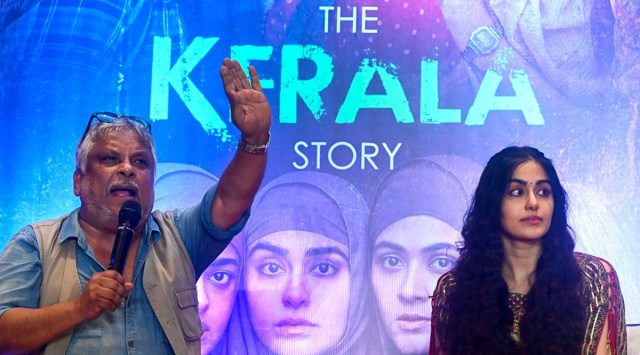
Nothing reflects India’s polarized polity better than the conflicting reactions to ‘The Kerala Story’, a film that recounts the ordeal of three girls — two Hindu and one Christian — who suffer in different ways at the hands of a bunch of radicalized Muslims. One of them ends up accompanying an ISIS terrorist.
On Thursday, the Supreme Court stayed a ban on the film imposed by Trinamool-run West Bengal. The film is not banned in DMK-ruled Tamil Nadu but theatres in the southern state are not showing it; just like cinema halls in Gujarat had once bypassed ‘Parzania’ (2005) and ‘Fanaa’ (2006). ‘Parzania’ was based on the 2002 Gujarat riots. ‘Fanaa’ landed in trouble after its lead actor Aamir Khan spoke up for those displaced by the Narmada dam project.
On the other hand, several BJP-ruled states such as Uttar Pradesh, Madhya Pradesh, Haryana and Uttarakhand have declared ‘The Kerala Story’ tax-free. Similarly, ‘The Kashmir Files’, which focused on the impact of terrorism on the lives of Pandits in the Valley, earned a tax-holiday in at least eight BJP-governed states last year. Assam even granted a half-day leave to its government employees to watch the film.
Granting tax exemption or banning a film is a state government’s prerogative. However, the privilege was meant to be given to award-winning films and to movies that helped forge a more progressive social order. But as recent events show, banning a film or declaring it tax-free is part of a new playbook where support or opposition depends on the ruling party’s ideological moorings and vote base. In this running battle, ‘ban’ is the other of ‘tax-free’.
It wasn’t always like this. To understand how the sands have shifted in the politics of tax exemptions and bans, one must look at the past. Since Independence, dozens of films have been banned temporarily (like ‘Aandhi’ during the Emergency) or permanently in India. Hundreds have been declared tax-free, many for dubious reasons.
In June 1970, TOI reported that many big daddies of Bombay cinema were rushing to Bhopal for tax exemptions. In a short period of 10 months, as many as eight films were declared tax-free in then Congress-ruled Madhya Pradesh.
“Some ministers and ex-ministers are alleged to have specialized in exerting pressure on reluctant officials, who see no point in sanctioning such requests at the cost of the state exchequer. One such official who refused to attend a special show of a third-rate film and be a party to the exemption business incurred the wrath of a prominent ex-minister,” the report said.
In 1980, Feroz Khan’s guns-and-glamour yarn, ‘Qurbani’, which began with a panegyric to the late Sanjay Gandhi, was declared tax-free by the Congress government in Maharashtra. “The controversial award…was widely discussed in the media,” noted Ashish Rajadhyaksha and Paul Willemen in ‘Encyclopaedia of Indian Cinema’.
According to the Bombay Entertainment Duty Rules, 1958, exemption could be granted to films winning the President’s Gold medal (later National Award winners) or to films which fulfilled criteria of educational, cultural or social purpose of a high order, following the recommendation of an advisory committee appointed by the state government.
But the Maharashtra government routinely flouted rules announcing tax-holidays for 55 films over a period of seven years in the 1990s, a CAG report said. The report, which did not mention these films by name, estimated that the government had lost at least Rs 19 crore. Congress (1990-95) and BJP-Shiv Sena (1995-99) were at the helm then.
Several of the tax-exempted films were routine formula films. ‘Agni Sakshi’ (1996), a remake of the Julia Roberts thriller, ‘Sleeping With The Enemy’ (1991) produced by Binda (Bindumadhav) Thackeray, the eldest son of Shiv Sena supremo Bal Thackeray, received tax exemption. That apart, regular commercial films got a no-tax run.
Producer Pooja Bhatt’s film, ‘Dushman’ (1998) starring Kajol and Sanjay Dutt, was given a 40% tax exemption by the BJP-Shiv Sena government after a special committee endorsed its “social and educational value”. The same year, letters to TOI raised questions over the tax-free status of films like ‘Major Saab’ and ‘Satya’.
The trend continued in the new millennium. In 2005, ‘Fareb’, an extra-marital thriller with Manoj Bajpayee and Shilpa Shetty in lead roles, was granted tax exemption in UP, then governed by Samajwadi Party (2003-07).
Evidently either proximity to power or corruption were key to earning tax exemption to undeserving films. The reasoning is different in the case of ‘The Kashmir Files’ and ‘The Kerala Story’, both major box-office winners. In these cases, it seems, tax concessions are being weaponized to boost ideologically aligned films in an effort to capture cine-goers’ minds and hearts.
On the other hand, banning the same film reveals the hollowness and the cynical side of those claiming to offer an alternative, discourse-driven politics.
Ironically last year, director Nagraj Manjule’s ‘Jhund’, a sledgehammer film on caste, class and the transformative power of sports, was denied the concession. Art and film lovers were the losers.
Rahul Dholakia restores Parzania from 35 mm to 4K digital
8:29 AM

Filmmaker Rahul Dholakia on converting his award-winning 2007 drama from 35 mm to 4K digital, his next, a slice-of-life story, and his former leading man SRK
Avinash Lohana (MUMBAI MIRROR; September 12, 2017)
Over seven months after the release of his SRK-starrer Raees, Rahul Dholakia is restoring his 2007 drama, Parzania, featuring Naseeruddin Shah, Sarika and Parzan Dastur, from 35 mm film to 4K digital. The film earned him a National Award for Best Direction, while Sarika got the Best Actress honour.
“It has been 13 years since I shot the film. Before the negatives get spoilt, I decided to restore it so if I want to televise it or put it up on a digital platform in future, 4K would be the best format,” Rahul says, whose film was inspired by the true story of a 10-year-old Parsi boy, Azhar Mody, who disappeared after the Gulbarg Society massacre, one of the events sparked by the Godhra riots in Gujarat. “It is a human story above everything else which should be told irrespective of the era.”
He contends that since different types of films have flourished recently, it would have been easier to sell the film today. “Parzania was a big struggle, not just to make but also because I had to distribute it on my own. Nobody was willing to do it because of its subject,” he explains. But given that the film remained unreleased in most parts of Gujarat in 2007, does he think it’d still be easier to unveil the film today?
“I don’t intend to release it for now,” Dholakia says, adding that it’s strictly to preserve the negatives.
Next up, he is almost done writing his next project, a slice-of-life story. Will his screen Raees, Shah Rukh Khan, be back for another collaboration? “I have yet to decide on the cast and will get to it after I finish writing the script,” the filmmaker says, shortly.
We are working on Shah Rukh’s look and accent for Raees-Rahul Dholakia
8:10 AM

Director Rahul Dholakia opens up about his upcoming film
Subhash K Jha (DNA; February 21, 2015)
Raees will take Shah Rukh Khan in a world as far
removed from Dilwale Dulhaniya Le Jayenge as Punjab is from London.
Rahul says it wasn’t at all difficult to convince SRK at all. “I had
narrated the script to him with my producers Ritesh Sidhwani and Farhan
Akhtar present. I think SRK got interested because mid-point, he said
he’s doing the film. I felt like a schoolboy who’s been told he has
passed.”
The second-half of the script had to be reworked a bit. “Not much. But changes had to be made, because it was the unusualness of the script that appealed to Shah Rukh.”
What blew Rahul’s mind was SRK’s memory. “I went back to him with the second half of the script after almost a year. He remembered details from the first narration that even I had forgotten. This kind of dedication coming from a superstar of his stature left me deeply impressed.”
Rahul, who begins shooting Raees in February-end, is now working on the actor’s look and accent. “He plays a man from the ghetto in Gujarat. He dresses and speaks in a particular manner.”
Buzz is that Shah Rukh plays a real-life character in Raees. Says Rahul, “His character started off as a real-life person. But as we wrote and re-wrote several drafts of the script, his character become more and more fictional.”
The idea for the film started with the issue of prohibition. “We wanted to make a film on the issue. And since Gujarat is the only state that has prohibition, we decided to set the story there.” The last film Rahul shot there — Parzania — had a bitter aftermath. But that’s not the reason he is staying away from the state. He explains, “It’s practical to not take Shah Rukh into the crowds. He is a star with a mammoth following. To shoot with him on the streets in Ahmedabad is not only impractical, it’s suicidal. I remember when we were shooting with Sanjay Dutt in Kashmir for Lamhaa. Huge crowds would gather and obstruct shooting.”
Rahul says he didn’t want a repeat of that situation. The film will be shot on a sprawling set in Mumbai standing in for the slums of Ahmedabad.
Akshara Haasan is fearless, like an innocent child-Sarika
7:52 AM

Sarika talks about her younger daughter Akshara who will take a bow as Balki's baby
Roshmila Bhattacharya (MUMBAI MIRROR; December 30, 2014)
 Her younger daughter, Sarika
admits, has always been artistically inclined,
impressing with sketches since a young age. So, it didn't come
as a surprise when Akshara decided to figure out her true calling by
turning an assistant to Rahul Dholakia on Parzania and later Society.
Her younger daughter, Sarika
admits, has always been artistically inclined,
impressing with sketches since a young age. So, it didn't come
as a surprise when Akshara decided to figure out her true calling by
turning an assistant to Rahul Dholakia on Parzania and later Society.“She's a hardcore actress; this is what she wants to do. Even before she decided to be one, she was spoofing films on home videos. She has a great sense of humour, a clarity of vision and a sense of responsibility which will work to her advantage. Her decision didn't surprise us but it had to come from her,“ says the proud mother,“ says the proud mother.
Sariika was delighted when R Balki presented Akshara with a “brilliantly original“ script and the opportunity to work with two National Award-winning actors, Amitabh Bachchan and Dhanush, in her debut film, Shamitabh.
“It was like going to university and Akshara took it in the right spirit. As an actor she has the fearlessness of an innocent child. Anything different, even if it's dark, excites her,“ says Sarika, who like her former husband Kamal Haasan, has always been open to daring, offbeat subjects. “But at the end of the day every child is an unique individual and this fearlessness is a part of Akshara's character rather than her legacy.“
Talking of legacies, Sarika sympathises with the fact that being the youngest, Akshara has to constantly field questions about her parents and elder sister Shruti. “But she's putting up with the three of us rather gracefully,“ she laughs.
Interestingly, Sarika is yet to see her daughter on screen and has been on the sets only twice. “I was dying to see her everyday but when your parents are from the same industry, it's inevitable that they would know the people you are working with. I was working simultaneously with Mr Bachchan for a TV series, but it was important for Akshara to think of him as her co-star and the rest of the Shamitabh team as hers. So though we discussed work, at the end of the day, professionally she was Balki's baby.“
Subscribe to:
Posts (Atom)