Showing posts with label Parinda. Show all posts
Showing posts with label Parinda. Show all posts
Once I started doing movies, theatre se darr lagne laga-Nawazuddin Siddiqui
10:54 AM

Onkar Kulkarni (BOMBAY TIMES; July 28, 2026)
For an actor who has spent over two decades redefining realism on screen, theatre has always been home. That’s where his story started. Now, after a 30-year gap, Nawazuddin Siddiqui is finally returning to the stage with Naqaab, directed by Paritosh Painter. This also marks a personal milestone — the acting debut of his 15-year-old daughter, Shora.
The play premiered in Chicago on July 17 and will do a nine-city US tour. Nawaz opens up about why films had begun leaving him creatively unfulfilled, why theatre continues to be an actor’s greatest school, and the reason he wanted Shora to make her acting debut on stage, instead of the screen.
‘I started feeling that as an artiste I haven’t done something challenging for long’
Speaking about returning to theatre, Nawaz says, “When I came from the National School of Drama (NSD) to Mumbai, it was a struggle and then I started getting smaller roles. Once I started doing movies, theatre se darr lagne laga. Camera ke saamne maza aane laga. Aur phir theatre kiya hi nahi. Over the years, I started getting the feeling that as an artiste I haven’t done something challenging for long. Mujhe lagne laga ki shayad uss type ka kaam hi nahi ho raha movies mein where I can experiment. I am not dismissing cinema. Great work is happening in cinema too, but sometimes you get that feeling when you are doing films year after year.”
‘Depth wale characters hote hain theatre mein. Cinema mein limitations hoti hain’
Explaining why theatre intimidates even seasoned film actors, Nawaz says, “Cinema has retakes. In cinema you don’t get to explore much. In this play I am playing four-five characters. Depth wale characters hote hain theatre mein. Cinema mein limitations hoti hain. In theatre I can play Hamlet, Othello, but it is not possible in Hindi films. When they make movies, they want to play safe, and after all, they have to make money. So, I wanted to experiment and theatre helped me do that.”
‘Theatre actors have brought realism into this industry’
When asked if one of the reasons to turn to theatre was because today’s films no longer excite him, Nawaz reflects on the cinema that inspired him to become an actor.
“When I saw Parinda, I was shocked to see Nana Patekar’s role. When I saw Seema Biswas’s performance in Bandit Queen, I was blown away. Films like Satya, Maqbool and Sparsh excited me. These experiments broke industry clichés. If you see these films, you’ll realize that it’s theatre actors who have delivered some of the most realistic performances on screen. They brought realism to the industry. Today, cinema is all about the box office. People ask, ‘How much has the film made? Rs 100 crore? Okay, let’s go and watch it.’”
‘Shora hasn’t even seen much of my work’
Equally special for Nawaz is introducing his daughter Shora to acting through theatre rather than films. At just 15, she is playing a 26-year-old character in Naqaab. “Shora also wanted to act, so she trained under Paritosh Painter who’s directing the play.”
He firmly believes theatre teaches what workshops cannot. “Shora did five-six workshops in London, but it wasn’t enough. I thought let’s get her on stage and make her learn. We started from 50 instead of zero and she needs to reach 100. The role is very difficult. It will be easier for her to do films now.”
Nawaz admits his daughter doesn’t go easy on him. He smiles and shares, “She doesn’t like my roles. She hasn’t even seen much of my work. She has seen Gangs Of Wasseypur. If I make a mistake on stage, she tells me. She is critical of my work. I am not.”
12th Fail was me saying, ‘Let’s be honest’-Vidhu Vinod Chopra
8:34 AM

Niharika Lal (BOMBAY TIMES; November 27, 2025)
Vidhu Vinod Chopra watched the restored version of 1942: A Love Story with veteran screenwriter Kamna Chandra at IFFI, who has also written films like Chandni, and said, “Pehli baar 1942: A Love Story maine aisi dekhi hai jaisa maine socha tha. Uss waqt colour correction hota nahi tha.”
A day later, during a session titled Unscripted - The Art and Emotion of Filmmaking, Vidhu Vinod Chopra spoke about his films, struggles and with his long time collaborator Abhijat Joshi.
'I can't make 1942: A Love Story anymore'
When Abhijat Joshi asked him how his filmmaking style has changed over the last five decades, he said that 1942: A Love Story he can’t make the film now.
He said, “I saw it yesterday for the first time in 8K resolution in the theatre here. But that’s a movie I can’t make anymore. I made it then because I was in love with the woman I married, and that love shows in the movie. For an artist, the right thing is to represent what he’s going through in his work. So my films reflect what I see and feel (at that point) in life. Every film reflects who I am at that point. I was angry when I made Parinda. You can see that violence in the movie. Today I’m calmer.”
He added, “So that film was made at that time because that is who I was. And 12th Fail… when I see the level of corruption in our system, it was a reaction to that. Because, you know, I am personally sick and tired of the level of corruption. I’m sure everybody is trying to make sure that it calms down a bit. But 12th Fail was my attempt at saying, ‘Let’s be honest for a change’. I told Abhijat when I made the film - even if I can convert 1% population, 1% bureaucracy, 1% political system to work honestly instead of dishonestly, I would have succeeded. I react to times. An artist is not independent of the times he lives in. I’m a reflection of society. What I see, my cinema says that, and it says it in that particular style. You cannot impose the Parinda style on 12th Fail or 1942.”
When someone from the audience said she doesn’t understand when people ask her to think commercially about a story, he responded, “How to make the film commercially - even I don’t understand what that means. Meri jo dharmpatni hai, woh jaanti hai cinema ke baare mein. Unhone kaha - ‘Vinod, tu theatre mein mat laga 12th Fail. Teri aur Vikrant ki film dekhne koi nahi jayega.’ Saat mahine tak film theatre mein thi.”
Sharing an incident about how an OTT platform refused to buy 12th Fail, he said, “One of them said - ‘aise log toh ab hain hi nahi.’ Maine kaha - ‘ek toh tumhare saamne hai, main toh hoon.’”
Giving parting advice to the FTII students who were sharing their difficulties, he recited a line from a song in 1942, “Ye safar bahut hai kathin magar… na udaas ho mere humsafar.”
'I couldn't change Parinda climax because what I was saying in the film was that violence begets violence'
“When Parinda was to be released, all the distributors got together and brought 11 lakhs in cash. They said, ‘We will give you 11 lakhs,’ at a time when I didn’t have money to eat dinner. And they said, ‘Please don’t kill Anil and Madhuri; kill Jackie Shroff. And we will give you 11 lakhs.’ And I said, I can’t do that, because what I’m saying in the film is that violence begets violence. So I cannot change that.”
'It moves me how hard we worked. That is the joy of life'
“There’s a shot - when Manisha is running - kyun naye lag rahe hain ye dharti gagan. When you see this shot, you will see that she is running on a mountaintop, and there are birds on top. Those birds are not digital. There were no birds on that mountain. And I wanted birds. I said, I want the sky full of birds. They said birds don’t come that high. Sanjay Leela Bhansali was my assistant on that film. I said, I need birds. Those guys went at night and spread breadcrumbs on that mountaintop. Because of those breadcrumbs, the birds came. When I saw the birds yesterday, I said, ‘My God. Birds.’ That’s the level of pursuit of excellence. And those birds give me so much joy, 35 years later. It moves me how hard we worked. That is the joy of life.”
--------------------------------------------------------
"If I say I have 20 crore now, tomorrow I’ll have 200 crore and I will make a film - what joy is there in that? Beyond your basic needs, money is the same. It’s the same cup of tea I’m drinking that I drank 35 years back. The point is - if the pursuit of excellence drives you then there is joy."
--------------------------------------------------------
“The joy comes from honesty, in whatever you’re doing - whether you’re a filmmaker, a writer, a politician, a bureaucrat. The joy comes from honestly pursuing whatever you’re pursuing. So I would request all of you- it’s difficult, but it’s a very happy path. Take it.”
An actor should do everything, not just lead roles-Jackie Shroff
9:45 AM
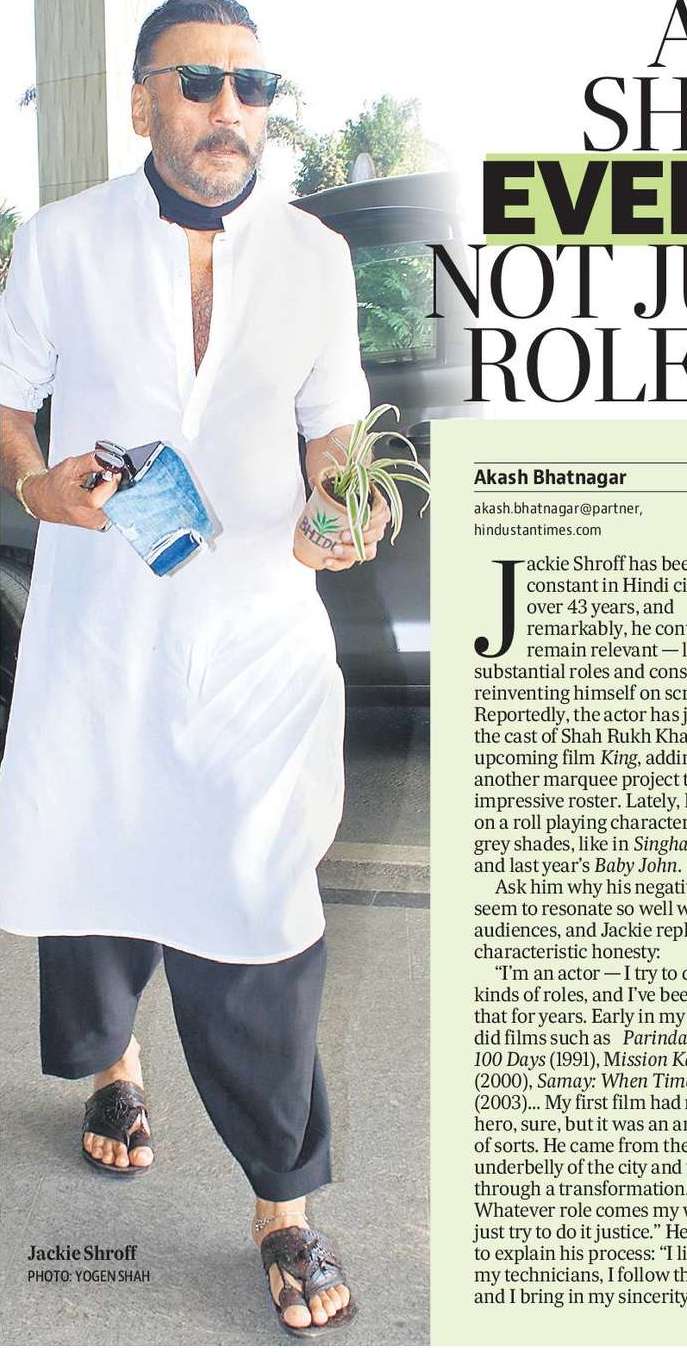
Akash Bhatnagar (HINDUSTAN TIMES; May 21, 2025)
Jackie Shroff has been a constant in Hindi cinema for over 43 years, and remarkably, he continues to remain relevant — landing substantial roles and constantly reinventing himself on screen. Reportedly, the actor has joined the cast of Shah Rukh Khan’s upcoming film King, adding yet another marquee project to his impressive roster. Lately, he’s been on a roll playing characters with grey shades, like in Singham Again and last year’s Baby John.
Ask him why his negative roles seem to resonate so well with audiences, and Jackie replies with characteristic honesty:
“I’m an actor — I try to do all kinds of roles, and I’ve been doing that for years. Early in my career, I did films such as Parinda (1989), 100 Days (1991), Mission Kashmir (2000), Samay: When Time Strikes (2003)... My first film had me as a hero, sure, but it was an anti-hero of sorts. He came from the underbelly of the city and went through a transformation. Whatever role comes my way, I just try to do justice to it.”
He goes on to explain his process: “I listen to my technicians, I follow the script, and I bring in my sincerity and emotions. Whether it’s the bad guy, the good guy, a cameo — I enjoy it all. I genuinely love my work, and when you love what you do, that connects with people.”
So what’s his secret to staying relevant even today? “There is no strategy,” Jackie shrugs, “I never plan or calculate. I work on impulse — I decide things on the spot. Sometimes, I take up a film because the writer’s a friend or a camera person says, ‘Do din ka kaam hai, kar le.’ Sometimes it’s because I need the money, or a big banner offers me good work along with good money.”
Importantly, he has no regrets about any of the choices he’s made: “I’m not complaining about the kind of roles I’m getting. An actor should do everything, not just lead roles. A chair has four legs — take one away, and it collapses. I aim to be that pillar in the film, whichever one it may be. I’m doing a bit of everything and having a great time.”
Even today, Jackie remains one of the busiest actors in the industry — arguably working more than some of the younger stars. “I’ve never really thought about whether I’m doing more or less work,” he laughs. “Back in the day, we used to juggle two or three films in one day. Now, I’m doing one film a day. And honestly, sometimes even that feels like a lot!”
Naseeruddin Shah said if you’re a great director, then make Jackie Shroff act-Vidhu Vinod Chopra
8:00 AM
Vidhu Vinod Chopra gave some interesting insights into his movies during a session at IFFI
Niharika Lal (BOMBAY TIMES; November 25, 2024)
Vidhu Vinod Chopra recently spoke about his zero moments (low points) that became turning points in his career. During a conversation with Shantanu Moitra at the ongoing 55th International Film Festival of India (IFFI) in Goa, he said that he was a very, very angry young man. Chopra described his relationship with stars as “not good.” When asked how, as a director, he trusts other directors when he becomes a producer, he explained, “I don’t trust directors. I only trust a human being.”
‘I REMEMBER HOW EVERYBODY LOVED KHAMOSH, BUT NOBODY BOUGHT IT’
Recounting the time when he decided to make films, he said, “Of course, I couldn’t tell my father because when I did, he was very angry. His whole idea was, ‘Tu doctor banega toh Kashmir mein sab tere ko Doctor Chopra bolenge’. But the only dream I had was to assist Vijay Anand and to somehow reach him.”
Chopra says, “A relative promised me that he will send me a letter from Vijay Anand. Every day after school, I used to run to the little letterbox we had at 35-A Wazir Bagh, waiting for that letter that never came. That was my zero moment — I never got the letter.”
Chopra shared that everybody loved Khamosh (1986), but nobody bought it. He said, “NFDC had financed it and given me Rs. 8 lakhs. In 8 lakhs, we made that film, and the rule with NFDC, which is a fair rule, was that unless you paid back the loan, you wouldn’t get another loan. So unless I paid that, my career as a filmmaker was dead.”
He shared that everyone praised the film, but nobody bought it. He then showed it to the owner of Regal Cinema, who liked it. “He gave me his theatre for two weeks at a 50% profit-sharing agreement,” Chopra revealed.
“On the first day, for the 3 pm show, the theatre was empty! After the show ended, a man (who turned out to be a black marketeer) told me, ‘Tension kyun leta hai? Tera night show housefull hai.’ They had bought the whole hall and started selling tickets in black after putting up a housefull board. The hall was empty, but with a housefull board. That was the marketing of that time. That’s a zero se restart moment,” he said.
‘DIDN’T CHANGE THE ENDING OF PARINDA’
Talking about his film Parinda (1989), he shared, “In the film, Anil Kapoor and Madhuri Dixit die, and distributors had told me, ‘Sir, aisa mat kijiye. Jackie Shroff ko maar dijiye, hero-heroine ko maarenge toh picture nahi chalegi.’ They offered me Rs. 10 lakh to change the ending. But I said, what I’m trying to say in the film is that violence begets violence. It was also self-therapy because, at that time, I was a violent man, too. I didn’t change the ending.”
‘JACKIE WENT ON TO WIN THE BEST ACTOR AWARD FOR PARINDA’
Narrating Jackie Shroff’s zero to restart moment, he said, “Everybody called him a wooden actor. Naseeruddin Shah was supposed to be in Parinda, but we had a fight. He said, ‘I won’t do it’ and I said, ‘Okay.’ He said, ‘If you’re a great director, then make Jackie Shroff act.’ I was young and angry, and I said, ‘You watch, I will make him do it.’ Jackie read the script and told me, ‘Bhidu, tu sambhal lena. Mere ko acting nahi aata hai.’”
Chopra shared that Jackie’s biggest problem was hitting his mark (the spots where actors are supposed to stand in a scene). So he decided to remove the marks entirely. Jackie got angry, said a few things, and left the set when he found out there were no marks. He returned 20 minutes later.
Chopra said, “Jackie thought for a moment and then told me, ‘Main yeh scene window se shuru karega kyunki yeh mera dream hai, toh main dream dekh raha hoon bhai ka. This was the beginning of Jackie Shroff, who went on to win the best actor award for Parinda.”
Months after son’s death, Hazaaron Khwaishein Aisi writer Shiv Subrahmanyam passes away
8:14 AM

Avijit Ghosh (THE TIMES OF INDIA; April 12, 2022)
Writer-actor Shiv Subrahmanyam, who authored the edgy yet evocative screenplays of ‘Parinda’, ‘Is Raat Ki Subah Nahi’ and ‘Hazaaron Khwaishein Aisi’ and who could stamp his presence as an actor irrespective of a role’s length, passed away on Sunday night in Mumbai. He was 62.
Movie fans would remember Shiv as the corrupt cop in ‘Kaminey’ and the hard-to-please father in ‘2 States’. He also marked his presence on the theatre circuit as an actor and playwright. ‘Clogged Arteries’ and ‘Irani Café’ were notable works. His more remembered performances on stage came in ‘The Dumb Waiter’ and ‘Extremities’.
Director Hansal Mehta tweeted, “Incredibly talented, he was much loved and revered personally as well as professionally. ”
In an Instagram post, producer-director Anurag Kashyap revealed how Shiv helped him get his first screenwriting credit back in 1994. “The most generous, beautiful man I have known,” he wrote.
Director Sudhir Mishra recalled being introduced to Shiv by Naseeruddin Shah on the sets of Saeed Mirza’s ‘Mohan Joshi Hazir Ho!’ in 1983. In the years that followed they would often hang out together, crack jokes and spar over playwrights. “We shared the same sense of humour. I could start a joke and he could finish it,” Mishra said.
Those unplanned moments of creativity marked by absence of deadline led to the scripts of ‘Is Raat Ki Subah Nahi’ (1996), ‘Hazaaron Khwaishein Aisi’ (2003) and ‘Chameli’ (2003). The starting point of Hazaaron, for which Shiv shared credit with Mishra and Ruchi Narain, were two characters in Frantz Fanon’s anti-colonial classic, The Wretched Of The Earth. “Shiv had such sharp insights…The script was written over a year and half. The project took over 3 years. And there was no money to be made. But we did it,” said Mishra.
Shiv’s early work happened with Vidhu Vinod Chopra. In an interview, Shiv said he was a student of English literature and just out of college when he assisted Vidhu Vinod on ‘Khamosh’ (1985). ‘Parinda’, a gritty gangster drama, was born out of a single visual image that Vinod had narrated to him: two orphaned boys on Bombay’s streets--the younger one scared and the elder one telling him not to worry. “It took us 2-3 years to write it,” Shiv said. He received the Filmfare award for best screenplay.
Shiv acted in at least 30 films and TV serials. Tragically, his teenage son, Jahaan succumbed to brain tumour in February. Theatre director Bhupendra Deshmukh, said the actor was suffering from multiple ailments since two years. “He was also busy attending to his son's illness, which made him set aside his own treatment."
Shiv’s funeral at the Amboli crematorium was attended by film personalities including actors Naseeruddin Shah, Nana Patekar and Makarand Deshpande. He is survived by his actor wife Divya Jagdale.
If I were to cast artistes from Mumbai to play the refugees, Shikara would lose its authenticity-Vidhu Vinod Chopra
8:34 AM

Shikara director Vidhu Vinod Chopra ropes in Kashmiri Pandits to lend authenticity to film revolving around 1990s exodus from the Valley
Upala KBR (MID-DAY; January 11, 2020)
 For his return to direction after 13 years with Shikara, filmmaker Vidhu Vinod Chopra has chosen a subject that stems from a chapter of his life — the movie revolves around the exodus of Kashmiri Pandits from the Valley in the 1990s. To lend authenticity to the real-life episode, the director decided to rope in Kashmir-born Aadil Khan and Sadia as the leads, while zeroing in on several Kashmiri Pandits for the principal cast.
Explaining his decision, Chopra says, "If I were to cast artistes from Mumbai to play the refugees, the film would lose its authenticity. It was generous of the inhabitants of the Jagti refugee camp [in Jammu] to agree to be part of this movie. We held auditions in Jammu, following which those shortlisted were flown down to Mumbai. Here, they had to undergo several rounds of auditions."
Interestingly, Sadia, who was studying in Jammu, was helping casting director Indu Sharma in roping in locals for the ensemble cast. "Indu felt that Sadia would be the perfect fit [for the female lead]. However, her family had their own set of inhibitions [about her being part of a movie]. I had to make long video calls to convince her family. It helped immensely that I spoke in Kashmiri," laughs the filmmaker. Since the cast primarily included real-life people who had no acting background, Chopra reveals they were made to undertake several workshops over two years to hone their skills.
Though he has written the story with Rahul Pandita and Abhijat Joshi, the filmmaker describes the project as a "recreation of his life". "It is inspired by my mother's story — she had come to Mumbai, with only one suitcase, for Parinda's [his film] premiere in 1990. But she could not return to Kashmir until almost a decade later."
Parinda was a movie ahead of its time-Anil Kapoor
8:43 AM

Prashant Singh (HINDUSTAN TIMES; November 3, 2019)
Some films stand the test of time. Vidhu Vinod Chopra’s Parinda, which completes 30 years today, is one of them. As it clocks three decades, actor Anil Kapoor is thrilled talking about his “special film”.
“It was a movie ahead of its time. It gave me the chance to work alongside powerhouse performers and be part of Vidhu Vinod Chopra’s ambitious vision. Parinda has been one of the most special films of my career,” Anil says.
A few days back, the 62-year-old — who is still remembered for his powerful act as Karan — took to Instagram to reminisce about the film that also starred Jackie Shroff and Madhuri Dixit Nene. “Can’t believe it has been 30 years since Parinda released! Join me & @vidhuvinodchoprafilms as we celebrate this milestone from today till 3 November. Stay Tuned!” he captioned the picture.
Kapoor has indeed been a part of a few promotional videos and interviews to celebrate Parinda’s special landmark. “I cherish the entire process of shooting the movie and the incredible appreciation that followed its release. It was a memorable experience. A big thanks to the viewers for loving the film,” the actor says.
At the time of its release, the gangster drama received both critical and commercial acclaim. Many critics and film enthusiasts feel that the film was the turning point in the introduction of realism in Hindi cinema. Parinda went on to win a number of awards and honours, including two National Film Awards. It also was India’s official selection for the 1990 Academy Award for Best Foreign Language Film, but wasn’t nominated in the final list.
We created Parinda in a budget of just Rs 12 lakh-Vidhu Vinod Chopra
8:42 AM

Three decades on, filmmaker Vidhu Vinod Chopra recounts how a tight budget ended up lending authenticity to the iconic multi-starrer
Monika Rawal Kukreja (HINDUSTAN TIMES; November 3, 2019)
 For filmmaker Vidhu Vinod Chopra, it seems like “yesterday” when his film, Parinda, which completes 30 years today, released. The iconic film not only proved to be a milestone in his filmmaking journey but also changed the fate of actors Madhuri Dixit Nene, Anil Kapoor and Jackie Shroff who starred in it. Chopra recalls memories of those bygone years and why Parinda remains one of his most special directorial ventures. Excerpts:
Looking back at the journey of making Parinda, what all memories are you reminded of?
The most striking aspect for me would be that we created the entire movie in a budget of ₹12 lakh, which was too less for a film of that scale. But what it did was it lent an even greater authenticity to the film, because we couldn’t go beyond our budget but wouldn’t compromise the integrity of the story, so the locations, the crowds screaming — they were all real. It helped the film stay true to the city that we were portraying. So our weakness became our strength.
We heard your mother had come down from Kashmir to attend the film’s premiere. Do you remember her reaction?
When she first saw the film, I still remember her turning towards me in utter surprise and asking me,‘You have made it? Really, you?’ (laughs). She was staying in Kashmir then, and when I first planned on calling her to Mumbai, her main concern was if I could afford the fare! I managed to send her an air ticket though, and she came with very little baggage. But sadly, after this visit, she could never return to Kashmir as disturbances broke out in the valley.
At a time when ensemble cast films weren’t the norm, you made Parinda. Was it tough back then to bring together, and direct so many actors?
At that time, Madhuri was unknown. She even did a screen test for the role. It was one of her first films and she was yet to achieve stardom. Nana Patekar was known in the theatre circuit. It was his first major film role. So, it wasn’t difficult as there were two newcomers and the only two stars were Jackie and Anil, who were like brothers to me. So, I never felt I was doing a big star cast film. It was more like a family coming together.
One of the cult films today, in what sense would you say that Parinda is still relevant?
Parinda, at the heart of it, is a film about the relationship between two brothers. The reason why the film cannot age, is that it deals with two brothers and the affection between them, and that bond is valid even today. I dedicated the film to my brother Vir. Like ours, the bond between brothers is timeless and so is Parinda.
Parinda won two National Film Awards besides being India’s official selection for the Oscars. Did awards matter as much as they do in today’s time?
Before Parinda, I was actually nominated for the Oscars in 1979 for my short film An Encounter With Faces, and I did attend the ceremony in Los Angeles that year. But not many know about this as there was no social media in those days, and the noise levels around it were less. And therefore I guess the perception of an award was much muted as compared to today’s time.
If I were to make Parinda with Tiger Shroff, I’d underplay the emotions a bit-Vidhu Vinod Chopra
8:35 AM

Roshmila Bhattacharya (MUMBAI MIRROR; November 2, 2019)
 Thirty years have gone by since Kabutarkhana opened in theatres on November 3, 1989. The name may seem unfamiliar, but for a Hindi cinephile, the connect with the gangster drama is instant when you mention Parinda. “Kabutarkhana was the title I was sold on for a long time as that was what I first saw, at Dadar, when I landed in Mumbai. But Javed saab (Akhtar, scriptwriter-lyricist) insisted it didn’t gel, so I went with Parinda as it embodied the idea of peace doves,” informs writer-producer-director Vidhu Vinod Chopra.
He also admits the ending changed on location in Pune. The sequence had Jackie Shroff as Kishan walking into the home of his gangster boss Anna, (Nana Patekar), to be greeted with a hail of bullets. Vinod even went around the house with Arun Patel who was doing the special effects, putting bullet marks on the walls. Then, just before they were to roll, his editor, Renu Saluja, wondered if he wanted more gunfire given that they had already been heard enough in the previous scene when Kishan’s brother Karan and his bride are gunned down on their wedding night. Realising the wisdom of her observation, Vinod instructed that Nana should tell his henchmen to hold their guns and let Kishan enter. When Arun told the actor this, he protested, pointing out that Vinod himself had orchestrated the scene. Even action director, Ravi Dewan, told him he'd gone crazy, asserting that when his funeral procession set out after the release, he was not going to lend his shoulder. “I understood their apprehensions because 30 years ago, when shootouts were the norm, it was unthinkable to shoot a climax in a single room with two men talking. But today, the image of Nana engulfed in flames, is unforgettable,” Vinod smiles.
Why fire, you prod, and he points out that at a time when one believed that the stronger the villain, the stronger the film, he was trying to find a fatal weakness in his bad man. One by one he started thinking of the elements... Air, water, earth, fire… And fire it was! However, since this was the pre-digitised era, the blaze was real, built by putting a match to rubber solution. And as Jackie watched Nana totter on the swing, he was convinced this was the end of him, while Vinod taking a top angle shot, marveled at how brilliantly he was performing, not realising that he was actually burning, having refused to wear fire-protective trousers. “He had to be treated at Nanavati Hospital for a couple of weeks. When he returned to face the fire, Nana and Anna had become one, and his fear of fire was real,” he says.
Parinda bagged Renu and Nana National and Filmfare Awards, for best editor and best supporting actor. The film also bagged three more Filmfare Awards, for best director (Vinod Chopra), best screenplay (Shiv Kumar Subramaniam) and best actor (Jackie Shroff). The latter accepted his Black Lady from Rekha, with his sleeping son Tiger cradled in his arms.
Vinod had taken the role of Kishan first to Naseeruddin Shah who turned it down. “When I asked Jackie, ‘Karega?, he replied, 'Mujhe acting nahin aati.' It was his honesty that convinced me he was Kishan,” recounts the filmmaker. Jackie was wooed with the song, “Tumse Mil Ke”. He said, ‘If he can shoot a song so beautfully, toh film bhi achcha banayega.’ And once he was on board, there was nothing to distinguish the person and the actor. He used his own car and even wore his own clothes.”
Not many recall that Sanjay Leela Bhansali was a part of the film, as associate director (songs). Vinod remembers him as a sweet, talented kid and a gentle soul who rarely spoke. “When we were shooting “Pyaar Ke Mod Pe”, I asked him to tell Madhuri to adjust her dupatta. He was reluctant. We worked together in many films and songs, including 1942: A Love Story. Today, it’s hard to believe that shy, quiet kid has become today’s SLB,” Vinod laughs.
Parinda today is regarded as a genre-defining film, but back then, distributors were upset with Vinod for killing Anil and Madhuri, riding high after Tezaab . “Two hours after the first 3 pm show, my Punjab distributor called to say the audience was thinking their death was part of a dream sequence. He suggested I let Madhuri and Anil live and kill Jackie instead, offering me an extra Rs 11 lakh if I complied,” he flashbacks. But Vinod refused to turn away from his basic message that violence begets violence.
Is there something he’d change if he made Parinda today? “Thirty years ago, it was low-key in its projection, but today, it may seem overly dramatic. If I were to make it with Tiger (Shroff), I’d underplay the emotions a bit,” Vinod admits. So, he does think it could be remade? “Now that you say so, yes,” he smiles. “So many, including my trainer, haven’t seen Parinda,” Vinod signs off.

A still from the film; Jackie Shroff at Filmfare Awards
MUST READ: Bollywood’s Foley artists aka Sultans Of Sound create a bewildering variety of everyday sounds
8:38 AM

From thumps and thwacks in Dangal to Amitabh Bachchan’s ‘subtly intimidating’ footsteps in Sarkar, Bollywood’s Foley artists create a bewildering variety of everyday sounds
Kunal Guha (MUMBAI MIRROR; August 19, 2018)
When Karan Arjun Singh was tasked with creating the sound effects for the climax in Vishal Bhardwaj’s Rangoon, he was in a fix. The scene had the film’s leads Shahid Kapoor, Kangana Ranaut and Saif Ali Khan perched precariously on a dilapidated rope-and-bamboo bridge which eventually gives way. Since recreating a bridge inside his 10x16 ft studio wasn’t feasible, Singh had to innovate. “I removed the string from a charpoy and tied a thick metal wire across it. Then, I balanced myself on it and created all the sounds,” says the 45-year-old Foley artist who has produced sound effects for over 2,000 films including Tiger Zinda Hai, Dangal, Sultan, Neerja, Raees and Baahubali.
Initially referred to as ‘sound effects’ or ‘live effects’, the function was dubbed ‘Foley’ after Jack Foley, who pioneered various sound-effect techniques for Western films. Crushing a film reel to convey the rustling of leaves; gently shaking an ageing almirah to create the creaking of a bullock cart; or twisting a plastic bottle to produce the eerie ambient noises synonymous with horror films, are all part of Foley. “It includes reproducing everyday sounds such as footsteps, objects being placed, moved or broken, to even punches, crashes and explosions,” says Singh, who is among the top Foley artists in the industry today. Shankar Singh, who has worked with Karan on some 1,000 films, adds that since cinema is larger than life, the sound effects must be too. For instance, a punch is no longer a simple ‘dhishoom’ — it, too, must have character. Which is why the two Singhs once collaborated to create a distinctive punching sound. They recorded the ‘thud’ of a slab of meat being punched, and layered it over with sounds of a watermelon and a head of cabbage being hit. The cumulative effect — fine-tuned and assembled like a musical arrangement — packed a real punch, says Shankar.
Interestingly, some of the most commonplace sounds are produced in unusual ways. For instance, flapping a wallet recreates the sound of a flight of pigeons; waving a cloth through the air replicates the whooshing of wind; and one of the most popular effects — that of heavy rainfall — is made by dropping large granules of salt over an umbrella. And these touches cost filmmakers anywhere between a lakh and six lakh on an average per film. Depending on the level of customisation required, Foley for a film can be wrapped up in anywhere between 15 days to a month.
In these days of CG effects, one wonders why Foley artists are still relevant. But filmmakers attest that no software can deliver all the sounds required in a film. And if you want to be authentic — and original — you have to go to the experts. “Today, films are made with sync sound, but that largely captures the dialogue. Once the dialogue is cleaned by the sound engineer, the rest fades. So, to give the feel of a location, we come in,” says veteran Foley artist Karnail Singh, who has worked on over 3,000 films in the last 33 years, along with collaborator Sajjan Chowdhry of Aradhana Studio.
Right foot forward
Seated in his busy Goregaon recording studio, littered with props — from jewellery and shoes of varying styles and sizes, to door knobs, garage equipment and other curios — Karan points to a small dugout in a corner of the room. “That’s where we recorded all the thumps and thwacks for Dangal,” he says. Karan even invited a wrestler from Jaipur to the studio to recreate the body-to-body contact sounds. “A wrestler’s body is perfectly tuned to replicate the sounds we hear in the akhada,” he adds. The Olympic bouts shown in the movie required a more expansive, booming sound, so Singh recorded them at a larger studio in Andheri.
While production houses supply Foley artists with props used in the film, Karan says they don’t always deliver the desired sound. “In Singham, Ajay Devgn’s shoes couldn’t produce the firm-footed sound required to convey the determination of Bajirao Singham (the lead played by Devgn), so we used the shoes worn by Murali Sharma’s character instead, as they seemed more appropriate.” Apart from conveying the correct body-weight in every step, a character’s walk is moderated by various factors. “Har jootay mein alag tone hai, har character ki apni chaal hai,” he explains. “A regular office-goer’s footsteps won’t sound the same as a villain’s.” Syed Aslam, 53, another veteran Foley artist, specialises in this particular aspect and is credited with ‘creating’ the footsteps of stars such as Amitabh Bachchan’s Subhash Nagre in Sarkar and Hrithik Roshan’s Akbar in the historical, Jodhaa Akbar. “In Sarkar, Bachchan wore chappals and in Jodha Akbar, Hrithik wore mojris. But the characters’ mood, state of mind and personality still had to come through from the sound of their footsteps,” says Aslam, adding that “a badshah strolling imperially in his courtyard required a different sound from the footsteps of Bachchan’s Nagre, which had to convey subtle intimidation”. Aslam’s enterprising streak was evident when he replicated a canine’s footsteps in the animated film, Roadside Romeo by wearing long, artificial nails and tapping a table.

Sajjan Chowdhry and Karnail Singh recreate the clip-clop of a horse cart (PIC: NILESH WAIRKAR)
Sourcing sounds
Most Foley artists have a catalogue of stock sounds, which include the smashing of glass, the breaking of wooden objects and their signature interpretations of mundane, onscreen actions. But often, films demand an entirely new sort of sound. In Krrish 3, the supervillain, Kaal, had a serpentine tongue with which he lashes at his victims. “After testing various objects, we decided to create the ‘zupppp’ sound of the whipping tongue by whirling a long nylon rope in the air,” says Singh, with understandable pride.
While productions today are more helpful in enabling Foley artists achieve the precise sound by providing actual props, this wasn’t always the case. Old-timers Singh and Chowdhry remember having to recreate a fight sequence for the 1989 film, Parinda. They had to produce the sounds of footsteps on a tin roof, a body falling on the roof, and even the ‘clang’ of a dropped sword. “We used a metal sheet that used to serve as a makeshift bridge over a gutter between Natraj Studios and Seth Studios for that,” remembers Singh, who has kept the metal sheet in his studio as a memento. Today, however, the duo rarely goes prop hunting. In fact, they have filmmakers reaching out to them for suggestions. “While recording for Raazi, Meghana [Gulzar] came to the studio with the spy equipment used in the film, to explain the kind of sounds she wanted,” says Karnail.
Devil in the details
Karnail and Sajjan consider Bajirao Mastani as their most challenging yet gratifying work. “We sourced a ‘dandpatta’ (a gauntlet-sword) to get the precise swish of a sword being waved around in the air. But they didn’t actually use one in the film because it was too dangerous,” they explain. While Sajjan enjoys recreating the sound of “punches and clothes tearing”, Karnail is a master of more nuanced noises such as the ruffling of garments and the clink of cutlery. “When we worked on Parinda, Vidhu Vinod Chopra wanted a certain kind of mood for the grim scene in which Madhuri and Anil Kapoor’s characters are killed. So we created some wiretaut tension with just the sound of a creaking chair,” adds Karnail, whose forthcoming films include Paltan, Manmarziyaan and Rajma Chawal. The duo, however, has had to contend with the fact that 50 to 60 per cent of their work may get drowned out by a background score and often, even escapes the notice of the audience. “But some filmmakers ensure Foley sounds are audible alongside the score, since they help establish the mood.” He refers to the scene in Rajkumar Hirani’s Sanju in which Paresh Rawal, playing Sunil Dutt, invites his son to have a drink with him. “He pours himself a drink, sits down with a sigh and then gulps it down,” says Karnail. “I had to create the gulping sound as well, along with the others.” And, he says, it is simple sounds like these that often “create atmosphere for an entire scene and elevate it from the mundane”.

Karnail Singh sourced a dandpatta to create authentic sounds in Bajirao Mastani
The fiasco of Dil Chahta Hai and it's kind of cinema
3:08 PM

Box Office India Trade Network
DIL CHAHTA HAI was a film released in 2001 and was a mediocre success at the box office (loosing in all circuits barring Mumbai and South. Delhi/UP just about covered). The fiasco with this film was not the box office but how a section of the industry followed the story telling style and narrative of this film despite rejection. So instead of the tradition rooted desi Hindi film, this western style urban (so called cool) film which was not relatable to most was being attempted by many. Most of these films fell flat on their faces barring a few exceptions but even here the appreciation and recovery was not so high that so many had to be made week in week out. The corporates were just coming to India when the film released and they backed this cinema allowing it to be made as independent distributors were never going to touch unless at very low prices which held no attraction to producers as then the losses will be in their books. Even DIL CHAHTA HAI had MG's cut on release by many distributors and this was despite it having stars like Aamir Khan and Preity Zinta.
Around 4-5 years back this DIL CHAHTA HAI cinema was still in control as far as budgets were concerned and the losses were not back breaking. But in the last few years these so called urban cool niche films are budgeted so high that they have to be liked by the majority to cover and that is where 20 or 30 crore and even 40 and 50 crore losses led to the corporates pulling the plug on Hindi cinema. What is hard to understand is why a section of the industry went this way. Was it because of the corporate world backing who were mainly Hollywood studios and maybe this more western cinema appealed to them and they thought it was the way forward (though obviously wrongly) at the expense of the real Hindi cinema or was it that the media ranted and raved about DIL CHAHTA HAI and some believed there was something in this and didn't want to miss the bus.
The same ranting and raving had happened many times before but generally for small films. But in 1989, a film named PARINDA released and the media just went bonkers over it although it was like a leftover NFDC film and a sleep fest which the audiences rightly rejected. The difference PARINDA had from a NFDC film was a cast and a budget so the media basically got to see an art film with better production values and a cast but you can't fool the audience. If its a sleep fest then you will get results of a sleep fest. The other filmmakers ignored the fuss and went on with business as usual and rightly so. The team of PARINDA obviously though different and probably thought they were unlucky in some way and the media was correct and made a bigger budgeted 1942 - A LOVE STORY (1994) and here at least the songs were not forced like a PARINDA and Tax Exemption in Maharashtra meant some numbers but still an inevitable flop.
If a PARINDA can be ignored and seen for what it is then surely a DIL CHAHTA HAI can also for a better industry. There can be two reasons for this, one is that in 2001 there were younger filmmakers and they were inexperienced like their counterparts in 1989 or it was the coming of multiplexes which they thought were more likely to accept western type cinema rather than the more desi Hindi cinema. The first reason you cant do anything about but second one is just common sense. Cinemas are changing but its still the same people going to those cinemas or has this multiplex audience just come out of thin air? The misjudgment was probably because all multiplexes were in metros and up market areas and that was probably seen as multiplex cinema when actually it was South Mumbai or South Delhi cinema. A point to note is that a KABHI KHUSHI KABHIE GHAM which released a few months after DIL CHAHTA HAI did more than double the numbers in these same multiplexes. But what happens then filmmakers who believe in DIL CHAHTA HAI cinema put it down to huge cast but in those days the numbers were not about 3 days or 7 days where a cast can do the job but about 10-12 weeks and films did not run that long just on cast.
The film industry is probably the only one across the world which has held out from the challenge from Hollywood but now in India its only regional cinema for which Hollywood holds no fear while for Hindi films many filmmakers have to look at the calendar for Hollywood releases as someone of them can actually take out the DIL CHAHTA HAI type Hindi films at the box office. This was unthinkable earlier as Hindi films ruled but now many films are just Hindi in language whereas treatment is foreign. Regional cinema has no such issues and so there is no outside threat.
The funniest thing is that you get to read reports in newspapers that how great a DIL CHAHTA HAI remake or sequel will be which is just crazy. The film had Aamir Khan as main lead and lesser actors like Saif Ali Khan and Akshaye Khanna. These two can today be replaced by superstars Salman Khan and Shah Rukh Khan and the results would not be better. DIL CHAHTA HAI got 1 crore footfalls at the time and even with the three Khans you are not getting much more than 1.5 crore because its still not going to work outside the few cities that it did in 2001 even though expectations will be for the highest ever (at least highest in multiplex era)
Just for the record putting aside the box office failure in most parts, the bigger failure as a film for DIL CHAHTA HAI was post release which makes it clear for all. In the decade of its release, repeat runs were still happening though business was not like earlier. In 2006, DIL CHAHTA HAI had a repeat run at just 12 theatres across India through the year and GADAR also released in 2001 had repeat run in 205 theatres and this is not counting very small centres where repeats are tough to track. This shows the insane gap five years after release and if we go to 2011 then the TRP rating of a screening of DIL CHAHTA HAI was 0.18 and Gadar was 75% higher in one screening and 65% higher in another while KABHI KHUSHI KABHIE GHAM was 55% higher in one 60% higher in another and 70% in another. Not only where the blockbusters of 2001 screened more times but each time rated far higher and this was ten years after release. So after ten years the actual results were no different but the a section of the industry was going totally into DIL CHAHTA HAI type cinema. Something had to give in and it did
Last week there was report how Disney India came unstuck with this DIL CHAHTA HAI cinema (Link). But even bigger advocates of DIL CHAHTA HAI cinema are Excel Entertainment the makers of DIL CHAHTA HAI where practically all there films belong to this cinema even when its an action film like DON. Obviously there is a change now as results with DIL CHAHTA HAI cinema were bad and now there is RAEES which looks a mass film and no doubt the trailer is pretty good.
But it is a film from Excel Entertainment and they are pulling away from their normal cinema obviously for better box office and that's why doubts arise. In 1974 there was a film released named GEETA MERA NAAM (Sunil Dutt, Sadhana, Feroz Khan) and the film had a caption "Its a R.K. Nayyars conception of a super hit film" whatever that was supposed to mean. But credit to the maker the film may not have been a super hit but it was hit in many circuits. So when the promo of RAEES which is actually good but that caption came to mind as is this an Excel Entertainment conception of a Hindi mass film or is it a real Hindi mass film. If its the latter then there will be no stopping it but if its the former then...?
When I first got in Mumbai, I took a big gulp of the sea water-Vidhu Vinod Chopra
10:20 AM

Vidhu Vinod Chopra (63), Anupama Chopra (48), Vikram Chandra (54)
An abiding interest in Mumbai brings together an acclaimed author, his journalist sister and filmmaker brother-in-law
Shreevatsa Nevatia (MUMBAI MIRROR; December 6, 2015)
Flanked by writer Vikram Chandra and filmmaker Vidhu Vinod Chopra, journalist Anupama Chopra is arguably more than just a familial bridge. Obvious affection for her brother Vikram helps make somewhat earthly his literary celebrity, while her few amused interjections render mellow her husband Vinod's many boisterous assertions. As director of this year's MAMI Festival, film critic Anupama's confessed obsession with cinema tangibly transformed into a contribution Mumbaikars could identify. Chandra speaks of their itinerant childhood — they moved from Delhi to Kolkata to Baroda — and Anupama instinctively completes his thought. "Bombay was home," they say together.
Unlike Chandra who moved here when he was in Class X, the Srinagar-born Vidhu Vinod Chopra came to the metropolis only after graduating from Pune's FTII. "I was more of a villager," the director-producer confesses. "When I first got here, I went to the sea and wondered how salty could the water possibly be. I took a big gulp. I instantly threw up." Unmistakably shaped by their experience of the city, the collective work of all three does seem to owe a certain debt to their arrival here. Chandra's gritty and masterful Sacred Games (2006), in particular, has been hailed by many as the quintessential Mumbai novel. His story of the Hindu mobster Ganesh Gaitonde and insomniac inspector Sartaj Singh appeared to make conspicuous this town's much-famed underbelly. Crime, even hardened city reporters agree, had finally, and rather definitively, been elevated to high literature.
Chandra says that in 1991, he was with his father in a car when they heard guns being fired. The Lokhandwala Complex shootout, it turned out, was unfolding nearby. "During that time, you opened the papers to read that two or three people had been shot. There were encounters. Every day, the death count resembled a cricket scorecard." A decade later, the threat from the underworld became even less abstract when Chopra received threatening calls from extortionists. After initially being "freaked out", Chandra took to discussing cricket with his brother-in-law's armed bodyguards. "It gets ordinary very quickly," admits Anupama.
For all its palpable menace, however, gang-related crime has given many a Bollywood filmmaker adequate narrative nourishment. Parinda (1989) had virtually pioneered the modern mafia movie. Chopra, though, claims his acclaimed film wasn't a by-product of lawlessness' lure. "I came from Kashmir and I had seen enough violence while growing up. Jean-Luc Godard had once said, 'You can make the film you want to make, but to make it interesting, make your lead either a cop or a gangster'. My intention was never to make something as real as Vikram's fiction." Careful research, it is evident, inspires Chandra's realism. In his essay, 'The Cult of Authenticity', the author writes about interviewing the Dagdi Chawl don Arun Gawli on the terrace of his house.
Anupama remembers she had accompanied Chandra for that meeting. "I thought I could protect him from Arun Gawli." Chandra explains his sister's courage — "She believed the power of a journalist would help."
Anupama goes on to say that much like her, Chandra, the author of Geek Sublime, was quite the nerd when growing up. "My abiding memory is Vikram with his collar in his mouth, and a book in front of him all day." Chandra remembers having signed up for science at St Xavier's College. "I lasted three weeks." Anupama breaks into a chuckle and says, "He quit, saying the chicks were damn ugly." Chandra corrects her, "It was the other way around. The art chicks were damn hot."
Credited for having worked on the story of Chopra's Mission Kashmir (2000), Chandra was also instrumental in putting together the script of the forthcoming Wazir, which the Broken Horses director and screenwriter Abhijat Joshi had imagined would be an English-language film. "We would send him these pages. He'd FedEx them back to us, saying, 'Rubbish. Bulls**t'. He once sent us our pages all torn up, with the remark, 'That explains it'. It took us four years to please him. The day he sent us one uncorrected page, Abhijat and I celebrated with wine."
Chandra, who teaches creative writing at Berkeley, blames his usual adherence to the workshop format of creation. "I must say, I am not meant to be in cinema. I am used to working on my own, and maybe then showing some pages to my wife Melanie [writer Melanie Abrams] who never pulls her punches." Anupama and her filmmaker sister Tanuja Chandra had read the early drafts of Chandra's first novel Red Earth and Pouring Rain, but the National Award-winning film writer confesses she suspends some of her critical faculties when responding to the work of both Chandra and Chopra. "I haven't read enough to be able to criticise Vikram's work, and think I am too close to the making of Vindod's films to ever be entirely objective."
Chandra's 'The Cult of Authenticity' was a response to the charge that the compulsions of a Western audience had somehow diluted his Indianness. His deconstruction of a mythical 'Real India' seems pertinent in a climate where several actors of Chopra's films are being forced to decry intolerance. "The essential question always is — what does it mean to be Indian? That just keeps reincarnating itself." Making the case for a conciliatory compromise, he adds, "If you look at Indian history, debate has always outlined public thought. But there's a difference between vivaad and samvaad. The former lays stress on winning an argument, while samvaad, by insisting on respect of one's opponent, is a more holistic search for truth." Chopra seems delighted.
"Bahut accha hai yaar. Learning hai isme. I really understood it." Anupama reaches for his hand. "Very good. Will you be calmer now?" She smiles, looks away, and adds, "Now, only if we were that lucky."
Nana Patekar developed pyrophobia on Parinda sets-Vidhu Vinod Chopra
7:49 AM

Roshmila Bhattacharya (MUMBAI MIRROR; April 7, 2015)
During
a train journey, filmmaker Vidhu Vinod Chopra and his frequent
collaborator, Abhijat Joshi, decided to write one more movie together.
It started with two brothers and took five years to complete. And even
though Chopra's first Hollywood film, Broken Horses, which opens this
Friday, has its genesis in his 1989 Hindi movie, Parinda, he insists
that it's turned out very different.
"For one unlike our Indian bhais, an American will never die for his brother which is one reason why the macho Kishen, a hired mercenary, transforms into a childlike Buddy who's a little slow mentally. And the violence which was slightly over-the-top in Parinda, is more real in Broken Horses," points out Chopra.
He admits that he's always been drawn to stories about brothers or friends and partners who're like brothers, perhaps because he's always been really close to his own brother, Veer. "I was frustrated because even after a year, no distributor wanted to buy Khamosh, a really good thriller with an unconventional plot, so I decided to make a more commercial Hindi film about two brothers on the streets of Mumbai. The younger one is hungry, the older one dries his tears and tells him not to worry, he's there and will look after him. Parinda started with that premise," reminisces Chopra, adding that he used all the pillars of Hindi cinema in plot construction. "And after I'd built the edifice, I removed the pillars, one by one, and to my surprised delight found that it still stood its ground."
He cast Jackie and Anil Kapoor to play the brothers. They were the youngest stars at the time and the only ones ready to work with Chopra who had the reputation of being difficult. "They were very nice to me," he smiles.
However, Naseeruddin Shah who he'd worked with in a few films, including Khamosh, wasn't ready for an encore. So, for the kurta-pyjama-clad don Anna, Chopra settled for a new face, Nana Patekar, whom he'd seen in a play, Purush. The ganglord's den was a water tank on top of Antop Hill, strewn with the scrap of nearby slum dwellers which Chopra rented from BMC for Rs 500. "And the screams you hear are for real because Nana actually got burnt during the shooting of the last scene," he informs.
Those days there were no digital fires and the fire they built of rubber solution and petrol went out of control. Nana was critically injured and was in hospital for almost two months. It took almost a year for his injuries to heal and Nana returned to the sets with pyrophobia, a real fear of fire. "So we built a set in Film City where we could complete the fire sequence in more controlled conditions," says Vinod, admitting that the fear of fire is also integral to the plot of Broken Horses, along with water. "But there are no pigeons."
Parinda was initially titled Kabutarkhana and a quarter of a century later, is still remembered for Inspector Prakash's reunion with Karan which ends abruptly when he's fatally shot and dies in the arms of his childhood buddy who recognises the goons. "It was filmed at Kabutarkhana one of the first things I spotted, probably because of all the pigeons flying around, when I stepped out of Dadar station. I thought through the pigeons would could convey the concept of emancipation of the spirit of the dying man," he points out. The Kabutarkhana is a busy junction of five roads and the shopkeepers in the area downed shutters for the shoot believing Chopra was the younger brother of the Prime Minister.
The film's climax was shot at the Gateway of India on New Year's eve. "We shot there on three different New Year over three years because money was short. Once before we started the film, the second time with the actors and finally, just before the release. All the shots were incorporated," informs Chopra, adding that Parinda was made in 66 days while Broken Horses took half the time. "I hope it is a far better film because the idea was to rectify all the mistakes I'd made the first time."
Subscribe to:
Posts (Atom)