Showing posts with label Paresh Rawal interview. Show all posts
Showing posts with label Paresh Rawal interview. Show all posts
Bahut khushi hoti hai when you see your kid going on the right track-Paresh Rawal
9:35 AM

Debarati S Sen (BOMBAY TIMES; October 26, 2026)
For actor Paresh Rawal, sharing screen space with his son Aditya Rawal in Pastt Tense was a special experience that went beyond their relationship off screen. While the two had appeared in earlier films, this was the first time they acted in substantial roles, facing each other on camera. Paresh talks about watching Aditya hold his own alongside seasoned actors, resisting the urge to advise him on set and the quiet joy of seeing his son find his footing as an actor. Excerpts...
‘ADITYA WAS COMPLETELY MINIMAL IN HIS APPROACH’
Paresh says he enjoyed working with Aditya. “This was kind of the first time we were acting together. Earlier, Aditya did a small role in OMG Oh My God, and the role of my younger version in Ferrari Ki Sawaari. But this time, in Pastt Tense, we were face-to-face, literally and figuratively also. There is a joy because I know he is a very hard-working, very balanced kid. Low-profile wala banda hai, but he is extremely focused.”
While working with a family member can initially feel unusual, Paresh says he was comfortable sharing the set with his son. “When you are working together on set with your family member, there could initially be a little oddity. But I've been on stage with my wife, so with Aditya I didn't find it odd. Maybe he felt it, but he concealed it and did his job extremely well. Toh mujhe toh bahut maza aaya.”
‘AISA KOI MAUKA AAYA NAHI KI MAIN ADITYA KO ADVISE KAR SAKOON’
For a father watching his son perform, resisting the urge to step in with suggestions can be a challenge. Paresh, however, says he was conscious of letting the director take the lead.
“On set, there is always a kind of impulse you have to control. You want your son to perform in a certain manner, but you have to control that because there is a director like Ananth Narayan Mahadevan, who is very good. On set, aisa koi mauka aaya nahi ki main Aditya ko advise kar sakoon. I was happy with the way he went about the scenes. Also, set pe main kabhi tension nahi leta hoon; I'm a very easy-going, friendly person with everybody. But Aditya ka nature aisa hai ki he is kind of very closed. He was extremely concentrated, headphone laga ke baitha tha, toh uske saath toh main zyada interact nahi kiya. Of course, after pack-up, when I'd ask him, ‘Dinner pe kya khayega tu?’ he'd say, ‘Main order kar loonga.’ Bas utna hi interaction tha.”
‘KHUSHI SE BHI BETTER IS THAT YOU ARE RELIEVED’
What particularly impressed Paresh was Aditya's restraint as a performer. Sharing screen space with experienced actors such as Adil Hussain and Sharib Hashmi, as well as Paresh himself, could have been daunting for a newcomer.
“Yeah, Aditya did surprise me as an actor on the set. Normally, when you are new and are pitted against stalwarts, you tend to overdo, overdeliver, just to conceal nervousness. But surprisingly, Aditya didn't do that at all. He was completely minimal. Toh mujhe uska approach bahut accha laga.”
Paresh was also impressed by the questions Aditya raised during the shoot. “The kind of questions he was raising during the shoot, I used to really enjoy it a lot. I used to think, ‘Yeh toh bahut accha hai.’ Bahut khushi hoti hai when you see your kid going on the correct path. And khushi se bhi better is that you are relieved that he was on the right track.”
SWAROOP WAS THRILLED TO SEE THEM TOGETHER
Paresh's wife, actor Swaroop Rawal, was equally excited about seeing her husband and son share screen space. Recalling her reaction, he says, “She asked me, ‘Tum dono ka koi fight scene nahi hai na?’ Actually, she was very thrilled as a mother and as a wife. She said that it will be fun to watch us.”
Paresh Rawal, Aditya Rawal on craft, clashes & strange intimacy of making theatre across generations
9:48 AM

Jane Borges (MUMBAI MIRROR; November 23, 2025)
As a theatre veteran and proud parent, Paresh Rawal has followed his son Aditya’s work closely. At the recent Prithvi Theatre Festival, where Aditya, 32, premiered The Queen, set in 1567 in the fictional kingdom of Banasvan during Akbar’s reign, Paresh attended an earlier show that week and then returned to see it again. Seated just an aisle below this writer, he watched the entire performance and later stood with the audience as the cast received a standing ovation.
“It was a thrilling experience,” says Paresh, 70, when I meet him at Aditya’s Juhu residence days later. “I’d seen the play when it was first staged in America [Theatre for the New City in New York] back in 2016, but was keen to experience it again, because I knew he’d made several changes to make it tighter, more effective, and more impactful.”
Was he pleased with the result? “Very happy,” he says, smiling at Aditya. “He is on the right path.”
Aditya is a spitting image of his father. “There’s an old picture of my father standing on stage, from 1979, I think… everything from his posture, the body structure, the height, even the hair, reminds me of me,” Aditya says. What Paresh passed on is not only resemblance but instinct for the stage.
Aditya has worked in film. He co-wrote Panipat in 2019, acted in Bamfaad in 2020 and won the Filmfare Award for Best Debut Male for Faraaz in 2023. Yet theatre remains home. “I don’t find anything more glamorous than 300 people who’ve come to see your play, talk to you right after the show is done. We are buzzing, they are buzzing, hopefully. It beats the high of a red carpet any given day.”
Life, arranged in acts
The apartment reflects a life built around theatre. Minimal furniture sits pushed aside. “We rehearse here often,” Aditya says. A bookshelf covers one wall, next to a metal trunk that catches Paresh’s eye. “What’s inside it?” he asks. “Some of the costumes and props for the play.”
Three more shows of The Queen are lined up at Prithvi. He says it “keeps evolving with every performance.” Directed by Daniel D’Souza and produced by his mother, Swaroop Sampat, the story follows Durga, once adored as queen and counsel, now numbing herself with drink after her husband Amar takes another wife. When Amar must decide whether to join Akbar in battle against his own kin, she becomes the mind he turns to.
His influences include Macbeth and Medea. “I never understood how she could do that to her children, until I actually wrote The Queen,” he says. Paresh nods. “As a writer, he is quite radical. On the one hand you have Siachen and on the other hand, you have The Queen.” Aditya responds lightly. “And as actor, my father knows exactly what will work for the stage.”
The first cue
Paresh’s association with theatre began when he was nine. “There were these open-air dramas that would be staged in the ground next to my building in Vile Parle East. They would go on till 2 or 3 in the morning, and I’d strain my ears to listen to the dialogues,” he recalls.
Soon he turned up for rehearsals. “Since my memory was good, I’d sometimes help with prompting and even moving around stage furniture.”
A small part followed. “I got bitten by the keeda… I couldn’t imagine doing anything else,” he says. His formal debut came in 1972 with the Gujarati play Vairi (Hasty Heart).
Aditya’s path was less direct. He first pursued football at a professional level. “When I wasn’t training, I was filling up my days writing stories,” he says. Theatre had already seeped in; he grew up watching his father on tour, seeing Kishan Vs Kanhaiya almost 30 times. Eventually he chose the stage, leaving for New York University to study drama.
In the wings
Paresh hopes his son will take on more acting roles, while Aditya prefers to keep writing and performing separate. “Aditya also has this Leftist leaning, you know, and that happens with every artist,” Paresh says. “I had it once, too. There’s this rebel streak in us. But hopefully he is balanced and can analyze things for himself.”
Talk turns to Paresh’s recent release The Taj Story, criticized as “right-wing propaganda.” He dismisses the label. “When this script came to me, I was zapped by the research. It was very meticulous,” he says. “The writer even provided me all the primary resources… I don’t like doing anything for the sake of sensationalism.”
His son listens, quietly. “As an artiste, I truly have an advantage… I can come home and have a two-hour conversation about my work with somebody who has done 100-plus plays, 5,000-plus shows,” he says. Paresh laughs. “But normally, you don’t have this two-hour conversation with me, ha.” “Yes, normally we don’t, but at least for the interview we can say it,” Aditya replies.
Their laughter lands in the same rhythm. A collaboration, they agree, would be the perfect sync to their parallel acts.
Haste, muskuraate shoot karte, Garam Masala became a truly memorable experience-Paresh Rawal
10:59 AM

S Farah Rizvi (HINDUASTAN TIMES; November 3, 2025)
For veteran actor Paresh Rawal, life seems to have come full circle. His 2005 Priyadarshan-directed blockbuster Garam Masala, starring Akshay Kumar and John Abraham, completes 20 years this year, and coincidentally, Rawal has reunited with the filmmaker for two new projects in 2025. “Yes, life does come full circle. Working with Priyan was enjoyable then, and it still is now,” he smiles.
Recalling the cult comedy, he says, “Garam Masala was based on the famous French play Boeing-Boeing, which had already been adapted into several languages, including Gujarati. But what made it special was that it brought together two studs, Akshay and John, with such flair on screen. The glamorous air-hostess characters were also something new for Hindi cinema back then.”
Talking about his memorable character, Mambo, he explains, “He wasn’t just a caretaker but also a silent observer, adding the perfect layer of humour. The pace of the film was its biggest strength, we were constantly switching between scenes, rooms, and even small details like changing photographs in a frame. There was no time to pause, and that urgency created natural comedy.”
Rawal says that the film’s success also came from its easy camaraderie on set. “Haste, muskuraate shoot karte, Garam Masala became a truly memorable experience,” he recalls fondly. On his approach to humour, the actor adds, “Comedy is a serious business. You can’t treat it lightly, or it turns into slapstick. Bahut log wahi galti karte hain, and that’s where things go wrong.”
Recently seen in Thamma, Rawal says he that continues to be drawn to stories that challenge him. “Any role that scares me a little is worth taking up. I’ll always do comedy because it connects instantly with people. These are difficult times, laughter is what keeps us going,” he ends.
‘Mac and Mambo are still my favourite characters’
Actor Neetu Chandra made her Bollywood debut with Garam Masala and still remembers the film as pure joy. “What a blast it was! During the shoot of Dil Samundar, the choreographer was losing it because the steps weren’t syncing and Akshay sir and John were just cracking up. We all ended up laughing more than rehearsing.”
Looking back, Neetu says the film still holds a special place in her heart: “I’ve watched Garam Masala several times, and it’s still as funny as ever. My favourite characters, Mac (Akshay Kumar) and Mambo (Paresh Rawal), are unforgettable. The way Paresh ji played the caretaker role was just brilliant, it redefined how such characters were written in Bollywood.”
The film industry needs to reinvent itself to bring magic back to theatres-Paresh Rawal
8:29 AM

Abhimanyu Mishra (BOMBAY TIMES; March 20, 2022)
Over the years, Paresh Rawal has lit up the silver screen with some stellar performances. The actor recently made a a comeback to Gujarati cinema after 40 years with Dear Father. In an interview with us, the veteran actor opens up about how we need to make films with a global appeal and why the enigma associated with stars is vanishing due to social media. Excerpts:
‘MEGA OPENINGS AND STAR-DRIVEN FILMS WILL SOON BECOME A THING OF THE PAST’
The pandemic has brought about a huge shift in the way things are perceived and consumed. Those big-ticket films, mega openings and star-driven success will become a thing of the past as cinema has lost its magic in a number of ways. The mindset of the audience seems to have changed. If the film industry wants to bring the audience back into the theatres, they will have to make some big efforts. Expensive tickets, food and beverages, parking, etc. make movie-watching an expensive affair, and a middle-class family can’t afford it. Masses can make or break a film. So, we need to make things affordable for them, for our survival.
‘OTT PLATFORMS HAVE IMPACTED FILMS IN A BIG WAY’
Today, OTT has become a safe medium for filmmakers to release their films. They get their money back and after that, it’s not their headache to see how the film is doing. But they have also made things easier for small-budget, content-driven films. Such films now have a huge platform to reach out to a bigger audience.
‘NOW,THE STARS ARE EVERYWHERE,THERE’S NO EXCLUSIVITY LEFT’
Earlier, film stars carried a sense of enigma. We saw them only on the big screen and their personalities made the audience watch them in awe. But that has completely vanished due to social media. Now, the stars are everywhere all the time. We know what they do in their vanity vans, at their homes, on their vacations. There is no enigma left, which is hurting their stardom. Stars must maintain a certain distance. Otherwise, the exclusivity of a star is lost.
There is stability and depth to such romances-Paresh Rawal
8:18 AM
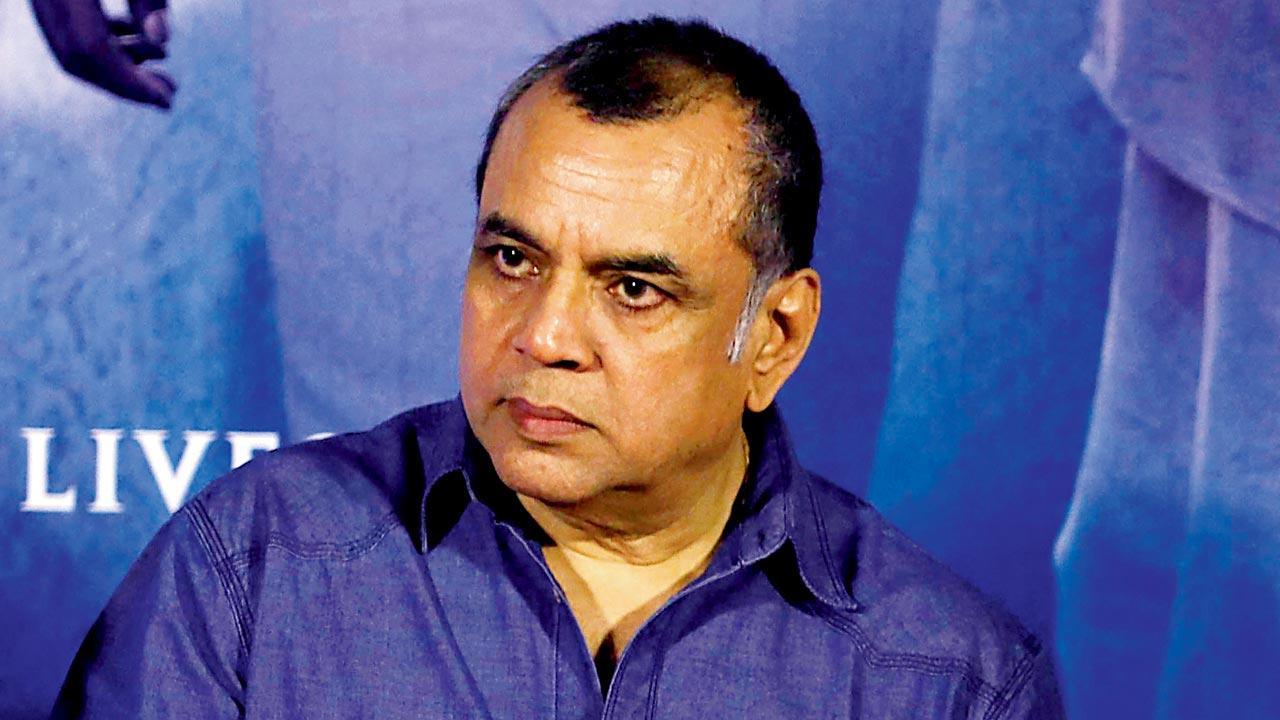
Paresh Rawal, who is teaming up with Ratna Pathak for Hum Do Hamare Do, proud that Hindi films are exploring mature love stories
Mohar Basu (MID-DAY; October 29, 2021)
"Kya alag kism ki kahani hai!” That was Paresh Rawal’s first thought after the narration of Hum Do Hamare Do. “I found the premise of adopting parents quirky,” begins the senior actor, who has joined Rajkummar Rao and Kriti Sanon in the comedy. While the film focuses on the protagonist’s efforts to woo his ladylove, director Abhishek Jain also showcases an elderly romance through Rawal and Ratna Pathak Shah’s characters.
With the movie coming a few years after Badhaai Ho’s (2018) success, Rawal is glad that filmmakers are developing mature love stories. “Usually, romances are associated with the youth. The only other elderly love story with recall value is Cheeni Kum [2007]. You need such films to be grounded and mature. What people are unable to bring on screen is that the intensity of love increases with maturity. There is stability and depth to such romances.”
The senior actor was delighted to join forces with Pathak whom he has deeply respected since their theatre days. “When you have a tremendous actress like her, you can approach every emotion from a fresh perspective. The material is only a part of our job; the rest is about enhancing the written word.”
Collaborating with Rao was another draw for Rawal. Describing himself as a “huge fan” of Rao, he says, “When I first watched Shahid [2013], I didn’t have his number. I called up Hansal Mehta twice. I have seen every film of his. He is truthful in every performance. This new generation of actors is full of gems.”
I am glad to get a chance to do a Gujarati film after 30 years-Paresh Rawal
8:06 AM

The senior actor is looking forward to reprising his role in the play Dear Father for a film in his mother tongue
Kavita Awaasthi (HINDUSTAN TIMES; July 31, 2021)
After 430 shows, all over the world, of the popular play Dear Father, senior actor Paresh Rawal is now looking forward to reprising the role in a Gujarati film. Excited that he would be acting in a Gujarati film after 40 years, after his last outing Parki Jani (1991), Rawal explains, “Dear Father is close to my heart. I wanted to turn this play into a film script for a long time. I have been doing plays for many years and have exhausted most of them. I wanted this story to reach a wider and diverse audience. I also wanted to be part of a meaningful and valuable film, made in my mother tongue - Gujarati. Glad to get a chance to do a Gujarati film after a long time”.
He explains that the play has a good story and is an emotional thriller, but turning it into a good screenplay took some work. He is glad that the team was able to bring it to fruition. “The film will have a small cast, so there won’t be any hassle while shooting or else amid the pandemic, shooting with a bigger unit has its own challenges. Primarily, it is the story that drew me and drove me to turn it into a film. In terms of the screenplay, the story will be racy and gripping while my approach towards acting will be unlike my theatre performances. Over there, one has to be loud for the audiences in the back. In cinema, you can be subtle and can internalise feelings and emotions,” he says.
Up next, Rawal will be seen essaying the same role, played by the late Rishi Kapoor in Sharmaji Namkeen. He shot for the scenes required to complete the film after Kapoor’s demise and shares he got very emotional while performing.
The actor also admires the concept, wherein after the death of an actor, another actor essays the same role completing pending portions. “It is a unique concept and I felt very different while shooting. Walking in his steps and working on his characterisations were difficult initially. But, with the help of the director and co-actors, I completed the film. In fact, in recent years, I have not come across a script as good as Sharmaji Namkeen. A slice-of-life film with an endearing story,” he explains.
With his recent film releasing on OTT instead of in theatres, Rawal says he understands the producer’s dilemma. He replies, “What can one do? How long can you hold on to a film? The economy is being affected. The producer’s money is stuck in one film, he won’t be able to make another project and thereby people won’t be hired. So many people are dependent on shoots and the entire cycle has to work for people to be employed.”
The senior actor admits that while OTT tickles his curiosity, he is waiting for a project that is both “interesting and good”.
Ask him about the pandemic and the last trying 15 months and he reveals, “I focussed on my health and tried to stay as fit and healthy as possible. I also kept my mental health in check by reading, watching films and making time for myself.”
Priyadarshan’s comedies have innocence; there is nothing vulgar about them-Paresh Rawal
8:18 AM

Reuniting with Priyadarshan for Hungama 2, Paresh Rawal says filmmaker’s brand of innocent humour sets him apart
Uma Ramasubramanian (MID-DAY; July 12, 2021)
Pick any Hindi film directed by Priyadarshan, and chances are Paresh Rawal plays a pivotal role in it. The duo has collaborated on over 10 films together, including Hera Pheri (2000) and Bhool Bhulaiyaa (2007). So, when the director developed Hungama 2, the second instalment in the franchise, Rawal was an obvious choice.
The senior actor says, “Priyadarshan’s comedies have innocence; there is nothing vulgar about them. Also, he has a keen sense of economics and will never overshoot [the budget]. He knows how much leeway to give to his actors. As a result of these factors, the experience of working with him becomes unmatchable.”
True to the filmmaker’s style of situational comedies, Hungama 2 revolves around the confusion that ensues when Rawal’s character believes that his wife — essayed by Shilpa Shetty Kundra — is having an affair. “If you have a wife looking like Shilpa Shetty, any husband would be insecure. What I like the most about her is that she is so passionate about her work.”
The senior actor adds that the film — also featuring Meezaan and Pranitha Subhash — is the perfect example of a well-written laugh riot, which does justice to every character. “One should not sacrifice a character for the sake of laughter. As an actor, if you go in believing that you’ll make everyone laugh, that’s not the right approach. The comedy has to be situational and spontaneous.”
Originally designed for a theatrical outing, the movie will drop on Disney+ Hotstar. While he has had his share of movie premieres online, Rawal has yet to try his hand at a web series. “I want to do a show that gives you an opportunity to develop your character, like Kay Kay Menon’s in Special Ops or Manoj Bajpayee’s in The Family Man.”
The time of only one actor ruling for decades is gone-Paresh Rawal
8:18 AM

Juhi Chakraborty (HINDUSTAN TIMES; January 7, 2021)
The biggest highlight in the entertainment industry in the last 10 months has been the growing popularity of OTT platforms. Acknowledging the same, actor Paresh Rawal feels that the web has broadened the playing field for actors.
“Now Pratik Gandhi (who starred in Scam 1992) is an overnight star — this is a new type of stardom, which the OTT platforms have ushered. It’s not like we used to have in Hindi films that one actor becomes a star and rules for decades. That time has gone. OTT has shifted gears. We don’t know how, but it’s definitely changing. You can see the turbulence already,” notes Rawal.
The actor himself got to dabble in the OTT medium in 2020 with Tamil film Soorarai Pottru and the Hindi film Coolie No 1.
Talking about whether the equal chance factor for everyone was missing in the Hindi film industry before OTT came into the picture, the 65-year-old says, “Tanashahi thi ya nahi main uski baat nahi kar raha hoon. But everyone is now getting a chance. There’s a level playing field now.” Rawal adds talent is finally getting its due. “It’s like come and showcase your story, your acting, and if people enjoy it then you win,” he adds.
The actor shares that beyond the web, there’s a change in general in Bollywood and its seed was planted some years back. “Changes have been happening with films like The Lunchbox (2013), Masaan (2015). Good films are being made for some time now. OTT ke aane ke baad maidaan khula hai, jwalamukhi fata hai. For a creative mind, there isn’t a better space than this,” he concludes.
OTTs shouldn’t get too much to arm twist us later-Paresh Rawal
8:20 AM

Juhi Chakraborty (HINDUSTAN TIMES; December 6, 2020)
The prominence of OTTs amid the pandemic has put a question mark on the relevance of cinema theatres, which are slowly trying to crawl back to business. Actor Paresh Rawal feels that cinemas would never lose their relevance, and cautions makers to approach the OTT release process with care. “Cinemas will never fade away, but people will have to work on the cost factor. Restructuring is required, because if everyone wants to continue to run their business, there has to be rethinking... But then OTT people should not get so much that they can arm-twist us later,” shares Rawal.
The actor, 65, lauds the contribution of theatres to the film industry. “We have survived because of the big screen. We should not discard and marginalise them, no matter what the demand and need of OTT is. We have to keep a balance,” adds Rawal, who has also had projects releasing on OTT, such as the Tamil film Soorarai Pottru. Mentioning the wide variety of content available on digital platforms, he adds, “The taste of the audience has changed. And we have to be mindful of that.”
I plan to open more theatres, encourage and nurture talent-Paresh Rawal
8:36 AM

Paresh Rawal talks about his new role as Chairman of the National School of Drama
Hiren Kotwani (MUMBAI MIRROR; September 11, 2020)
On Thursday, Paresh Rawal was appointed Chairman of the National School of Drama (NSD). The two-time National Award-winner and Padma Shri awardee is thrilled with the new responsibility, given that he has been doing professional theatre since ’72. “I will enjoy this a lot,” he told Mirror. Excerpts from an interview:
Given your experience on stage, any plans for the NSD?
I want to increase theatre spaces for maximum reach. Even Mumbai needs five-six more Prithvi Theatres, not just in terms of space, but also quality, and to see more diverse content. So, I plan to open more theatres, maintain them well, encourage and nurture talent.
Anything that needs to be changed or corrected?
Every time someone new is appointed, changes are anticipated. But I don’t want to change anything just for the sake of it. If something is going good, why change it?
NSD has given us actors like Pankaj Kapur, Naseeruddin Shah, Om Puri and Irrfan Khan. Will you take forward the NSD legacy?
It’s up to the actors to decide if they want to groom themselves better and enhance their craft, the way Pankaj ji, Om ji, Naseer saab and Irrfan did. There are many actors who want to do more theatre than films. I’ve worked in films for so many years, but I’ve also got so much from theatre. It’s not as if actors use theatre as a stepping stone to a film career.
Did you ever want to join NSD?
I’m a Mumbaikar and from the time I started, Marathi and Gujarati theatre has been there. After Prithvi, Hindi and English theatre consolidated too. There’s also Bengali theatre in the city. Back then, I didn’t think that I needed to join NSD, but definitely going there now will be an advantage. Any kind of education and training definitely helps.
Do you wish this responsibility had come earlier?
I believe everything comes at the right time. There’s no such thing as early or late. It’s a golden opportunity.
Paresh Rawal is not as mad as his Hera Pheri character, but he’s great fun to grow old with-Swaroop Sampat
8:24 AM

With Paresh and Swaroop Sampat Rawal’s son, Aditya, making his acting debut, the family talks about adapting to the times and the changing face of cinema
Kunal Guha (MUMBAI MIRROR; May 17, 2020)
The only “silver lining” in the nationwide lockdown so far, says Swaroop Sampat Rawal, is that the family has got a chance to watch Aditya’s acting debut in the web film, Bamfaad.
“After watching it, Aditya and [older son] Aniruddh spoke to Paresh at length about cinema and acting. It was like being part of an in-house masterclass,” says the 61-year-old actor and education counsellor, who made her comeback on the big screen with Uri last year.
Surprisingly, Aditya’s father, veteran actor and former Lok Sabha MP, Paresh Rawal, only learnt about his son’s decision to face the camera five hours before he went on set. “For some reason, he decided not to tell me earlier,” says Rawal Sr, whose only bit of acting advice for his son was “to preare hard and be spontaneous”.
Before his debut, the 28-year-old had pursued the dramatic writing programme at the Tisch School of the Arts, New York, and an initiation course in theatre and performance at the London International School of Performing Arts. He also wrote and directed The Queen, a stage production about a 16th century Rajput queen who is abandoned by her husband for a younger woman. The play, which premiered in New York, was to be staged in Mumbai, but had to be postponed due to the Coronavirus pandemic. It did, however, enjoy a 12-week run in the Big Apple, and earned him the New York Innovative Theatre Award.
Reflecting on her son’s debut, Swaroop points out how the entertainment industry has become a lot more organised now. “In my time, it was just luck by chance. I became Miss India in 1979 and shortly after, landed two roles with Yash Raj [Dilip Naik’s Nakhuda, 1981] and Hrishi da [Hrishikesh Mukherjee’s Naram Garam, 1981],” she says, of her memorable onscreen turns. “Even Paresh got one of his early breaks in Arjun (in 1985) because the one of the producers [Karim Morani] was in college with him.”
Swaroop says she took a break from films in the mid-1980s, when she felt she was seen as “too old to play the heroine”. “I have a problem of not being able to look old. Even when I played an older character, I would look as young as the heroine,” she laughs, adding that her decision to turn away from films was also to be a full-time mum. “Paresh was working two to three shifts a day. Someone had to be at home with the boys.”
Aditya says his childhood was far removed from the world of cinema, where conversations about films and theatre were few and infrequent. “In fact, the only time I remember being on a film set while Dad was shooting was OMG Oh My God [2012], where I was an assistant director,” says the youngster, who has also assisted Ashutosh Gowarikar with the story and screenplay of Panipat [2019]. But he does have his share of memories of his father speaking fondly about theatre and acting in plays. “My favourite performance of his is Khel [2000], with Naseeruddin Shah. Watching them together was fabulous and enlightening. They are both so passionate about their craft,” says Aditya, referring to the Hindi adaptation of British playwright Anthony Shaffer’s Sleuth.
In recent years, Swaroop has delved into experiential learning, which essentially employs her skills as an actor in teaching. Having received a full scholarship from a UK university, she completed her doctorate in education on the role of drama in enhancing life skills. Last year, Swaroop trained 2.5 lakh teachers in the subject over a four-day workshop in Gujarat, and plans to conduct a similar session for nearly five lakh teachers in Maharashtra soon. She has also visited tribal areas in the country and taught life skills through drama to children from low income households.
“They were so excited to learn from me that they went home and proudly told their parents, ‘Our teacher is a Miss India’,” she says. Her newly-discovered passion for teaching has had a profound effect on her. “While narrating a story in a classroom, you have to be louder than usual, which makes Paresh often ask me, ‘why are you so animated?’ In fact, when I’m on screen now, I have to readjust my levels,” she says, adding that her work in cinema has given her a lifelong training in adapting to new things. “I remember Hrishi da would explain a whole scene and ask me to do it in one take… and if I protested, he would say, ‘you guys are theatre actors, you should manage it’.”
Her return to films has been smooth, even though she sometimes “feels like a dinosaur” on the sets. “I didn’t grow up in the digital age. I was thrown into it. We had huge cameras and lights then, and now, the camera has shrunk so much that you don’t even feel its presence,” Swaroop says.
Even a veteran actor like Paresh Rawal finds it tough at times to keep up. At 64, he feels there’s “plenty to learn and even more to unlearn”. “You realise that a lot of what you’ve picked up over the years is rubbish,” he says, lauding contemporary actors such as Nawazuddin Siddiqui, Ayushmann Khurrana, Rajkummar Rao and Adil Hussain for their compelling work. “When you look at them, you can see that the standards of acting have also changed.”
Films, too, have come a long way since he made his debut in 1982 with Naseeb Ni Balihari, says the Padma Shri recipient. Earlier, films were clearly categorised as either commercial or arthouse and parallel cinema, the latter being dominated by heavyweights such as Shyam Benegal, Ketan Mehta, Govind Nihlani and Syed Mirza. “Now, films are not so segregated,” he says. “Another blessing is that since the foreign companies have opened offices here, we can no longer copy from their films, lest we get penalised,” he says with a chuckle. “This is also why we have begun mining our own stories and histories.”
Known for his comic timing, Paresh likes to subject his family to his one-liners. “Often, his sense of humour lands us in sticky situations,” Aditya says, referring to his father’s tweets. “He’s not as mad as his Hera Pheri character, but he’s great fun to grow old with,” says Swaroop.
Rejection is part of the journey-Paresh Rawal
8:20 AM

Veteran actor Paresh Rawal says that rejection is part of every actor’s life and it’s important to embrace it as it may come handy in future projects
Gayathri Menon (HINDUSTAN TIMES; February 13, 2020)
Be it in forms of roles such as Teja from Andaz Apna Apna (1994), Baburao from Hera Pheri (2000), or Manilal from Awara Paagal Deewana (2002), Paresh Rawal’s contribution to the Hindi film industry has been immense. Apart from his comical roles, the actor also manages to amuse one with his intense performances in films such as Sir (1993), Sardar (1994) and Tamanna (1999), to name a few. Rawal is also a popular face in the Gujarati and Hindi theatre circuits, and has been ruling hearts, be it on the big screen or on stage.
With great comical performances come funnier goof-ups. Remembering one such funny incident, the Padma Shri award-winning actor says, “I was part of this play which happened a long time ago. The goof-up that comes to my mind doesn’t involve me. There was this one scene, where there were two characters — one is holding a gun and the other is holding a knife. So, the guy with the gun was supposed to shoot the other actor but unfortunately, the sound effect didn’t play at the decided time. Now, the other actor, who was supposed to act as if he got hit by the bullet and died, acted on time and fell on stage. The audiences were confused and the whole scene was stuck for more than five minutes and it was quite funny. And then suddenly, came the sound of the bullet. It was all misplaced. We all were laughing and these kind of things happen all the time.”
Rawal, who was last seen on stage in his play, Kishan vs Kanhaiya, and after three decades of acting experience, says that learning never stops. “I am still learning the craft. The only thing that I can say is that one needs to work hard and must never lose focus. Rejection is part of the journey and it always comes handy in future,” he concludes.
Real-life characters play karne ka ek alag hi mazaa hai-Paresh Rawal
8:23 AM

Deepali Singh (DNA; January 16, 2019)
Last June, Paresh Rawal had shared an image of himself on social media, looking like NSA Ajit Doval, prompting somebody to comment, ‘Ajit Doval might be wondering... ye mera humshakal kaun hai?’
Indeed, the talented actor seems to have morphed into the real life hero, who was the man behind the retaliatory surgical strike carried out by the Indian Army in Pakistan in September 2016, just 11 days after the terrorist attack in Uri. When we praised him for the physical transformation, Paresh who was seen in the recently released, Uri: The Surgical Strike, laughed and said, “It’s all thanks to my make-up man and some to my parents ki aisa kuch bana diya ki thoda bahut unse milta julta rahe!” Over to him:
Apart from the physical transformation, what else played a part into becoming the character you play in Uri?
People like Ajit Doval are so unassuming and self-effacing; they keep a low profile. It’s only when you speak to them that you realise their worth and value. Till then, you don’t even look at them. That’s the hallmark of a great spy or a great undercover agent. When you listen to his speeches, you come to know that he has in-depth knowledge of foreign policies, the history of our country, etc. and that becomes an interesting combo. So, one has to bring in all this — not bringing himself in the forefront but still calling the shots.
Did you get the chance to meet him personally?
Yes, I met him personally once or twice in the Prime Minister’s Office, but even if I had not, the videos I saw of his would have sufficed.
You have done several roles where you’ve portrayed real-life characters, including Sardar Patel and Sunil Dutt in last year’s Sanju. Is it more fun playing a part based on a real person?
Real-life characters play karne ka ek alag hi mazaa hai. It’s a challenge, and if you have the backing of a good director and writer, then it’s a lot of fun. The outcome is fulfilling and satisfying.
In Sanju, you shared screen space with Vicky Kaushal. How was it working with him in Uri?
It was a joy. These guys (the younger generation of actors) prepare so much and their performance is seamless. There are no tantrums on set, no brooding, no pretence. Their preparation is done in their room. They come to the sets and once the camera is switched on, they are in character. Unki iss quality mein mazaa hai.
The film’s director Aditya Dhar makes his debut with this film...
He had written a film called Aakrosh. At that time, we were doing a lot of outdoors, so we got to interact quite a bit. Aaadmi ki depth pata chal jaati hai uski baaton se. So, I’m really happy he directed this film. I don’t know how anyone else would have handled the subject, lekin Aditya ne kamaal kar diya hai. He has kept the dignity and the drama of the subject intact.
Making a film on the Indian Army and observing them at close quarters, does it make you appreciate their sacrifices more?
Absolutely. At the risk of sounding sentimental, I say that even parents have expectations from us; that when they grow old, we will be there to take care of them. These guys (the army men) are not going to meet you ever, but they are still giving away their lives for your safety. For you, everything is intangible, but for him, his life is tangible. And in spite of that, aap unke jazbe pe shaq karte ho, surgical strike ko galat batate ho, Army Chief ko gunda kehte ho, army ke baare mein galat kehte ho? What kind of desh bhakti is it?
So, you hope the film clarifies all those thoughts?
Bilkul. We call the army for so many things, even when an area gets flooded. They come because they want to help their countrymen. Aur unko aap... border pe dushman ki goli khayenge aur desh mein logon ki gaali khayenge. It’s very sad!
It’s fine to criticise the government, but criticising your army... woh bahut hi dukhad baat hai-Paresh Rawal
7:21 AM

Renuka Vyavahare (BOMBAY TIMES; January 11, 2019)
While negative roles seemed to be his forte, it didn’t take long for filmmakers to tap into his versatility. Hailing from a theatre background, Paresh Rawal continues to be one of our finest actors to date. In a chat with Bombay Times, he speaks about his upcoming film URI: The Surgical Strike, his dual role as an actorpolitician and his film being touted as a propaganda movie. Excerpts...
There was speculation that URI might turn out to be a pro-government propaganda film. You are also a BJP MP. What’s your take on that?
The government hasn’t backed the film. Jo hai woh dikhaya hai. What’s the propaganda in that? Whatever has been shown, army ne woh kar dikhaya hai. Agar ussme kisiki waah waah hoti hai toh kya burai hai? Agar unhone achcha kaam kiya hai toh waah waah bhi nahi kar sakte? What kind of logic is that? If this would have happened during Congress’ rule and a film was made then, would people still say this? Some people even say that the surgical strike never happened. These talks only demean, malign and tarnish the image of the Indian Army.
Consciously or subconsciously, do your political views influence the roles you choose today?
Not at all. I look at a character strictly as a character. My offscreen views and roles don’t clash with my onscreen performances. Of course, I won’t play a character jissey meri country ko nuksaan ho and one which could hurt the sentiments of the citizens of India. Lot of people feel that politics is the reason why acting has taken a back seat in my life, but that’s not true. I am waiting for the right scripts. I would love to work with young actors and filmmakers. There’s still so much to learn.
What according to you is the essence of Uri, the film?
Yeh naya Hindustan hai, yeh Hindustan chup nahi bethega. After 26/11, the army had given a proposal that we should go across the border and shoot down the bases (terrorist camps), but that proposal was shot down by our then government. Itna sab kuch ho gaya. Woh Mumbai tak aa gaye, uskey baad bhi we didn’t do much. So, a strong political will is important. Coming back to Uri, the way the army handled this operation with such precision and sharp planning, is commendable. I feel for the soldiers, for them it’s like ‘border pe dushmanon ki goli khao, aur desh mein deshwasiyon ki gaali khao’. Unka bhi toh hausla badhna chahiye.
Aditya Dhar, the director of the film has said that URI is not anti-Pakistan, but anti-terrorism. Do you agree?
I hate jingoistic cinema, which unnecessarily indulges in Pakistan bashing. In URI, hum army ke jazbey ki baat kar rahe hain. That mission was the victory of the skill and bravery of the army and of strong political will, too. I feel army bashing has become fashionable today. Log anaap shanaap kehte hai. It’s fine to criticise the government, you are welcome to do that, but criticising your army and country, woh bahut hi dukhad baat hai. You are playing with fire. We are fortunate that our army believes in democratic values. Jis haalat mein woh kaam kartey hain, usko toh samajhiye aap. For instance, just think about what happened with Major Gogoi.
 You are talking about the debatable 2017 incident where Indian Army reportedly used a human shield (Kashmiri man Farooq Ahmed Dar was tied to a jeep as a ‘human shield’ against protesters by Major Nitin Leetul Gogoi) to stop stone pelters in Kashmir?
Agar bandey ne goli chala di hoti toh kitna carnage ho jata. Usney dimaag lagaya, ek bande ko bandh diya aur gaadi chala di. That was a trick to leave the place tactfully. Agar aapki war alag kisam ki ho, toh aapko bhi improvise karna padta hai. You have to think of innovative ways to defend yourself.
In Sanju, you played Sunil Dutt, in URI, your character is based on Ajit Doval (the current National Security Advisor to the Prime Minister of India). Is it more challenging to play real-life characters on screen?
I have met Ajit Doval a few times at the PMO. He is a superhero. He has such a discreet, unassuming kind of personality and yet, he’s doing such heroic work. Uske liye jigra chahiye. While playing real-life characters, pressure hota hai, but you shouldn’t fall into the trap of mimicking the people you portray. When we were doing Sardar (the 1993 biopic on Sardar Vallabhbhai Patel), prosthetics was an issue as the technique wasn’t fully developed back then. I am talking about the early 90s. So, Ketan Mehta (the director) and I decided to let it be. If you are playing Sardar Patel, you have to behave like him. Even if you don’t ‘look’ exactly like Patel, it’s fine, as long as there is some resemblance. I feel mimicking someone makes your performance caricaturish. You have to capture the spirit of the character. That’s more important. The same thing happened with Sanju, as well. I told the makers, ‘Kitna bhi prosthetics karlo, main ulta bhi latak jaoon, toh bhi main Sunil Dutt nahi dikhunga’. So, I aimed at focusing on the psyche of a father. It will be expected that you look like the character you play, but you shouldn’t get sucked into that trap.
Many believed that Sanju whitewashed the story of Sanjay Dutt.
Koi whitewash nahi kiya tha. If it had been made before Sanjay’s court verdict, one would have said it’s to impress the judiciary. He served his sentence and everything that was shown was in the public domain. Beta bigda hua tha — we showed that. Rajkumar Hirani and Abhijat Joshi are honest. They won’t resort to such things.
Speaking of biopics, you were supposed to play PM Narendra Modi. Is that film still going to happen? Vivekanand Oberoi (Vivek Oberoi) is also slated to play Narendra Modi in a biopic. There was speculation that you backed out, since the film will speak of the Gujarat riots and you wouldn’t want to be a part of that.
Let anyone do what they want to do or say what they want to say. We are making that film and I am playing that role. It is not shelved. There can be multiple films on Modi. He’s that kind of a personality.
Do you think the roles that were offered to you at the beginning of your career did justice to your talent?
Agar main yehi sochta rehta toh mujhe koi roles nahi miltey. The negative characters that were offered to me initially were all third-grade villains. Very rarely was I offered a wellwritten negative role. How to then make those roles palatable or relatable was my prime concern. That’s why I started giving an amusing twist to whatever characters were offered to me. Yehi meri koshish rehti thi. Also, kisne socha tha ke villain ke roles karte karte, mujhe Sardar Patel ka role mil jayega. People warned Ketan Mehta against casting me as I was stereotyped. But, directors like him put their faith in me and believed that I was a good actor, irrespective of the roles that I was known for playing. I was fortunate that Bhatt saab (Mahesh Bhatt) offered me a film like Sir (1993). That was the turning point in my career. I did Tamanna (1998) after that. These films proved that I could act well.
Of all the characters you played, the comic roles you essayed in movies like Andaz Apna Apna(1994) and Hera Pheri (2000) have stayed with people the most.
When you are doing something, you don’t realise that it might turn out to be a cult character. You just attempt it with all your honesty. In fact, during Hera Pheri, I distinctly remember that no one laughed during its trial show and that had us worried. The producer was petrified. Priyadarshan was clear that if my character (Babu Bhaiyya) doesn’t click, the film will flop and nothing would be able to salvage it. I improvised a lot and since I come from theatre, it was easy. When we were shooting for Andaz Apna Apna, Rajkumar Santoshi would enact and show us what he expected and he was hilarious. He is a fantastic actor. Itni innocence thi unkey narration mein, it was fun to bring out his imagination to the screen. I feel that if you over-plan as an actor, it doesn’t work.
Your film clashes with The Accidental Prime Minister at the box office, which is another political drama.
These films will open doors in the country for good political thrillers. Why can’t we create content like JFK, Zero Dark Thirty or Frost/Nixon? We can also make these kind of films. Content is the king today. Look at Rajkummar Rao, Ayushmann Khurrana, Vicky Kaushal... they are all doing content-driven cinema. I wish such films were made when I was younger. I think Dil Chahta Hai (2001) and Lagaan (2001) changed the game in Bollywood. They paved the way for contentdriven films.
No one can play Narendra Modi better than me-Paresh Rawal
11:14 PM

Paresh Rawal on contesting against Vivek Oberoi as two biopics on Indian PM Narendra Modi hit the floors simultaneously
Sonia Lulla (MID-DAY; January 8, 2019)
A mere two hours before the first look of Vivek Anand Oberoi as Narendra Modi from an upcoming biopic on the Indian PM, titled PM Narendra Modi, was unveiled yesterday, Paresh Rawal sat before us reiterating a statement he made six months ago: "No one can pull off the role better [than me]." While the senior actor had announced his film early last year, he is yet to zero in on a director for the project.
Undeterred by Oberoi's film on the same subject that will be helmed by Omung Kumar, Rawal says that Modi's life has sufficient fodder for multiple filmmakers to explore. The biopic that he will reportedly produce will take inspiration from the attention that the politician commands, courtesy his honesty. "When I was nine years old, my mother told me that we would avoid eating rice on Mondays, since the then PM Lal Bahadur Shastri - who was allotting ration for the Army men in our war-struck country - had requested the citizens to do so. The demand was honoured by many because it had been made by an honest man. Similarly, when Modi told citizens to give up their [cooking gas] subsidies, people paid heed, because the request was made by an honest man."
The veteran says his biopic will also highlight how a man with limited experience first managed Gujarat, and then the entire country. "He's not an armchair [prime minister], but a passionate countryman who has visited abundant villages [to study problems] firsthand. These factors will be the driving forces of our biopic." Ask him if he will ever play the leader of an opposing party, and he says, "I'll do it. I'm an actor, after all."
As a wave of political films - including The Accidental Prime Minister (on Dr Manmohan Singh) and Nawazuddin Siddiqui's film based on Balasaheb Thackeray - are on the anvil, Rawal says one can expect a flood of controversies. "There are a lot of stories that will unfold, and many controversies [will arise]. However, makers should have a sense of authenticity when portraying them. Only then will the experience be fun."
Before he can breathe life into his idol, he is looking forward to his Friday release, Uri. Rawal plays former intelligence officer Ajit Doval, who apparently supervised the 2016 surgical strikes. "I had met him in the PMO, and am fascinated by him. His reading of the political scene and understanding of the neighbourhood is noteworthy. Even Americans are taking his advice."

I salute Varun Dhawan, Rajkummar Rao and Ayushmann Khurrana-Paresh Rawal
8:27 AM

Rinky Kumar (DNA; November 11, 2018)
In his career spanning over three decades, Paresh Rawal has given several memorable performances. The versatile artiste has portrayed villainous, comic as well as powerful character roles with equal aplomb. Now, he is happy that the younger lot of actors are breaking the barriers when it comes to their roles. They aren’t shying away from portraying character roles as well as those with grey shades.
The 63-year-old is appreciating artistes who are making intelligent choices. He says, “I salute young actors like Rajkummar Rao, Ayushmann Khurrana and Varun Dhawan who are doing exceptionally good work. Take the case of Varun, for instance. He has managed to strike a balance between commercial and not-so-commercial movies. He did October, along with Sui Dhaaga: Made In India and Judwaa 2. Earlier, actors would never have so much courage.”
Likewise, Rajkummar, who started out as a character artiste, has been shining bright in movies such as Newton, Bareilly Ki Barfi and Stree. Ayushmann, on the other hand, has acted in films such as Shubh Mangal Saavdhaan, AndhaDhun and the recently-released Badhaai Ho.
In fact, Paresh was all praises for the Amit Sharma directorial on his Twitter account. He had tweeted, “Badhai Ho is like a cool breeze on a hot humid day — an endearing n delightful family entertainer -congrats @iAmitRSharma for the magic superb performances (sic).” Ask him, if today’s actors are uninhibited due to content-rich movies lapped up by viewers, and he replies, “The audiences were always ready for such kind of movies. But we weren’t offering such fare to them. Now that we are giving it to them, they are loving it. It has proved that irrespective of how big a star you are, you have to play a character. A star can no longer pull off a film on the basis of his star power, he has to play a solid character.”
‘SANJU WASN’T WHITEWASHED’
Earlier, this year, Paresh was seen in Rajkumar Hirani’s Sanju as Sunil Dutt, while Ranbir Kapoor played Sanjay Dutt’s part. While their performances were appreciated, many felt that it ‘whitewashed’ Sanjay’s chequered past.
However, Paresh is quick to dismiss such feedback and says, “Sanju (referring to Sanjay) has completed his sentence. He had served his time, after which the film was made. Had it been made before the completion of his tenure, then we could say that it was whitewashed. Whatever is there in the public domain has been depicted in the film. Every person has an emotional thread and when it snaps, it propels him to commit a crime. So, how can anyone say that the movie has ‘whitewashed’ him?”
‘URI IS A BRAVE FILM’
Now, the Padma Shri recipient is looking forward to his next project, Uri: The Surgical Strike, which opens in cinemas in January 2019. The military drama is based on the Indian Army’s surgical strikes on terror launch pads across the Line of Control (LOC). In this film, the actor plays Ajit Doval, the National Security Advisor to the Prime Minister of India.
Quiz him about this movie, whose teaser has got a positive response, and the actor says, “I’m excited to be a part of it. It showcases the indomitable spirit of the armed forces, who show a lot of grit, courage and determination in the face of adversities. It’s difficult to make a war film that is truthful and authentic, but writer-director Aditya Dhar has managed to do so.”
I have been feeling the pinch of having not worked with Rajkumar Hirani-Paresh Rawal
8:30 AM

Having rejected the role eventually played by Boman Irani in Hirani's Munna Bhai MBBS, Rawal confesses he was eager to work with "fantastic" filmmaker before Sanju came his way
Shaheen Parkar (MID-DAY; June 10, 2018)
Politicking hasn't slowed down Paresh Rawal's Bollywood outings. The veteran actor says life is all about juggling various roles, and striking a balance. The Bharatiya Janata Party MP visits his constituency, Ahmedabad East, at least four times in three months. "I shuffle between Mumbai and Ahmedabad. I come from a theatre background, so, I am used to hopping from city-to-city for shows."
Presently, Rawal is promoting his next, Rajkumar Hirani's Sanju. Sanjay Dutt's biopic sees him play the late Sunil Dutt. We meet Rawal at Hirani's office on the Andheri-Kurla road. The air conditioner isn't working properly. It's hot, but he isn't perturbed. He is used to finding himself in sticky situations — literally, in this case — especially after entering politics in 2014. Social media savvy, he often finds himself trolled for taking on the opposition. "Now, everything's out in the open. You can discuss about any topic," he reasons. Last seen in Tiger Zinda Hai (2017), Rawal says, off late, he picks films he genuinely wants to invest time in.
"At this stage in my career, I don't want to work on any [and every] film. I don't want to waste time doing something I may not end up liking. I have done my share of masala films. Now, the makers and the subject matter. There is really good cinema being made." Hirani's Sanju certain qualified as one among them. "I know that there were many actors who were considered [for this part] before me."
Hirani had approached his 3 Idiots (2009) and PK (2014) actor Aamir Khan for the role. But, Hirani had said that since Mr Perfectionist had already played a father in Dangal (2016), he did not want to take on another role that saw him as one. Khan told him he would only be given roles of similar nature if he agreed to do so. But while playing Sunil Dutt was reason enough for Rawal to give his nod to the role, another factor was instrumental in sealing the deal. "Raju had approached me for Munna Bhai MBBS (2003) for the part that was eventually played by Boman Irani. But, I could not do it then. Over the years, I have been watching his films, and feeling the pinch of having not worked with him. His films are well made, and the results are fantastic."
This is Rawal's first collaboration, not only with Hirani and writer Abhijat Joshi, but also with Ranbir Kapoor, who plays the titular role. Rawal says that while it was stated to Kapoor that he must resemble Sanjay, no such demand was made of him. Rawal had briefly interacted with the late actor on matters concerning the Nargis Dutt Cancer Foundation. Even his collaboration with him in Rajkumar Kohli's Virodhi (1992) did not lead to much communication since the two did not share screen space.
"Once, Dutt saab sent me a birthday card, out of the blue. I still have it. I always wondered why he had sent it to me when we barely knew each other. Strangely, I am now playing him." Rawal has not tried to ape his mannerisms. "Dutt saab had an affable personality and a unique voice. I looked up to him as an actor, and person. He went through a lot in life, wife [Nargis] coping with cancer, son battling with drugs. He endured it because of his strong personality." As for the film's protagonist goes, Rawal says Hirani has been particular about showcasing the man without sugar-coating his actions.
"He has not hidden any aspect of his life. Usually, a biography paints the protagonist as a noble man. I am told, Sanjay's precondition was to show his life with honesty." He is hoping that he has done justice to Dutt saab's character, which he feels is a father-son story. Coming up next for Rawal is Aditya Dhar's Uri based on the 2016 attacks in which he plays National Security Adviser Ajit Doval. He is also part of Ashutosh Gowariker's Dear Dad, based on his ongoing play by the same name. A Priyadarshan film is also lined up. Rawal terms his political outing as a "pilgrimage". "The coming months are crucial in the run-up to the 2019 general election. Ask him about rising petrol prices and he says, "We have to repay the debts of the past government. Only if people had raised their voice earlier, we would not have to see such days due to the past government's heavy, indiscriminate borrowings from the World Bank." Now, he is ready to take the plunge again in the electoral fray next year.
Junior Rawals eyeing Bollywood
Rawal's sons, Aditya and Aniruddh are also Bollywood-bound. Aditya studied script writing in New York while Aniruddh, who worked as an assistant director on Sultan (2016) and Tiger Zinda Hai (2017) is keen to be an actor. “I will not be launching them, they will have to find their own way." Rawal's actor-wife Swaroop Sampat will be seen in a web show, The Great Indian Dysfunctional Family. “She is engrossed with her life skill programmes for healthy living,” says Rawal.

Rawal with his family at a book launch in the city
Only I can play Narendra Modi on screen-Paresh Rawal
8:24 AM

Deepali Singh (DNA; February 7, 2018)
Paresh Rawal believes he could not have asked for a better end to 2017 or for a happier beginning to 2018. “Last year, I worked with Yash Raj Films in Tiger Zinda Hai for the first time in my 35-year-long career. And now, I’m working for the first time with Rajkumar Hirani in the Dutt biopic. God has been very kind,” says Paresh, folding his hands in gratitude and looking upwards. We are at the actor’s office in Juhu, and even in the chaotic midst of acting in movies and performing in plays, there is a sense of calm that pervades him.
Ask him about his positive, Zen-like frame of mind and he attributes it to the Dutt biopic. “I think I’m blessed that my desire to work with Rajkumar Hirani has been fulfilled. Then, I got to play someone like Sunil Dutt and the cherry on the cake was working with Ranbir Kapoor,” he says with a smile.
For somebody who has been a part of the film industry for more than three decades, the veteran actor says he still feels gung-ho about getting up each morning and going to the sets. “Work is exciting when it’s challenging. It should be something that makes me afraid initially and prompts me to ask myself whether I’ll be able to do it or not. That fear motivates me to pull up my socks. Otherwise, with so much experience, certain things we can do just like this,” he says with a snap of his finger.
Over a cup of chai, he shares his thoughts on playing an artiste whom he admires, the current crop of actors and filmmakers and his plans for the Modi biopic...
You’re playing Sunil Dutt in the Dutt biopic. Had you ever met him?
First of all, he’s been my favourite actor and human being. I have met him two or three times. The first time, a friend of mine had some cancer-related issue, so we went to meet Dutt Saab. Then, after the Bombay riots in 1992-93, a token fast had been organised, in which both of us had participated. He had to deal with a lot of things — his wife’s illness, his son going adrift — but in spite of that, he was a dignified man. When your character and values are good, only then can you carry on like that. The only other person who comes to my mind when I think about all this is (Amitabh) Bachchan saab. Despite facing so many hurdles in his life, he never had a bad word to say about anyone. God was with him. You get to learn a lot from people like them.
You have worked with Sanjay Dutt in a couple of films. Do you think Ranbir Kapoor has managed to depict the nuances of his character?
It was such a huge challenge. You think that it’s about mimicking his mannerisms or his walk. Haath paer koi bhi hila dega uski tarah, magar aankh mein baat leke aani hai. It was important to look like a lost child who doesn’t know what to do. That’s what Ranbir has managed to do. Plus, I think he’s a great actor. Look at his choices. No faaltu roles! He has done films like Rocket Singh: Salesman of the Year and Wake Up Sid. An actor is known by his choices, not by his box-office figures. And Ranbir (Kapoor) has shown that. Humko bhi aise actor ke saath kaam karne mein mazaa aata hai, varna humko bhi boriyat ho jaati hai.
What about the Modi biopic? Is it happening?
Yes, we are making it. The script is almost locked. There are one or two issues yet to be resolved, then we will move ahead with it.
And you’re playing Modi?
Only I can play Modi (smiles). I say that even at the cost of sounding pompous because I really love him. Baat samajh mein aati hai unki. I have observed him a lot. I am also acting in a film on the 2016 Uri attack, where I play the role of National security advisor Ajit Doval. We have been talking about who should play Modi in that. I said just by sporting a white beard, someone can’t be Modi on screen. Aankhon ka power aur anguish hai Modi. People have tremendous faith and trust in him. They know this man is right. Some mistakes might happen lekin accha kaam karte karte galti ho rahi hai.
You’re working with some of the current crop of actors, filmmakers and writers. What do you think of the present Hindi film scenario?
According to me, the golden period of films has started. We are going to go very far. Look at the new breed of writers, directors and actors. Whether it’s Rajkummar Rao, Nawazuddin Siddiqui, Irrfan Khan, Sushant Singh Rajput or Vicky Kaushal — pakad pakad ke character karte hain. They don’t do 10 films together, they will do just one but they will hold it together. They have enriched the acting space. Work ethics have changed. You get to see a written, full-bound script. It’s a positive and hopeful sign. I’m really happy that I’m getting to be a part of such wonderful stories. I just have to do one thing, and that is to keep myself fit and healthy.
You can’t remain theatrical in your performance-Paresh Rawal
9:06 AM

Deepali Singh (DNA; January 29, 2018)
It’s not easy to adapt a play into a film. Ask Paresh Rawal. After his Gujarati play Maharathi, and Hindi production Kishen Vs Kanhaiya, his Dear Father is all set to be adapted into a film, which will be produced by Ashutosh Gowariker and directed by Satish Rajwade. While the first film didn’t make any noise, OMG – Oh My God! adapted from Kishen Vs Kanhaiya ran largely because of its “courageous content”, according to the actor. He tells us more...
When a play is adapted into a film, do the dynamics change?
Yes, they do. We could not succeed in terms of the screenplay in Maharathi, while OMG ran hugely because of its courageous content. So the screenplay was not much of an issue as the content itself was so powerful, sensational and shocking. In Dear Father, you will see some remarkable work in terms of the screenplay. In a movie, you also have to work on your acting. You cannot remain theatrical in your performance. But mainly, you have to work on the screenplay.
Does it become easier to spread the message of the play via a bigger platform of a movie?
Yes, if the content of the drama is good, then with the help of camera, locations and visuals, you can enhance the message. You can make it more palatable and interesting. In a film, I can show you the beach, the sunset, the roads, while in a play you have to imagine all that. But the more advantage you have, your responsibility also increases.
You have worked with Ashutosh Gowariker in the past. How did he approach you for the adaptation?
Ashutosh saw the play and told me that he really liked the premise and wanted to adapt it. I was happy that somebody wanted to do this play as it’s very close to my heart. (The Gujarati play has completed more than 600 shows, while the Hindi version is currently on and doing pretty well, too). It is being made in Marathi first, titled Aapla Manus, with Nana Patekar playing my role. The shoot for the Hindi film will start from May.
What do you think of Nana Patekar as an actor?
To talk about him is like talking about sunrise in the morning. He’s the first character actor to demand Rs 1 crore, main uske guts ko maanta hoon. He does so much for the farmers of the country, such noble work. Nana as an actor, as a human, as a citizen is an asset for any country. As for playing my role, I did it my way and now he will do it his way. It will be fun and interesting to see how the same subject is approached by different actors.
Theatre-wise, are you looking at doing something new?
I’m looking for a good script, but I’m yet to find one. There has to be something to say in it. If I have to do a show every day, then I should have fun. It must have an element that enriches you as a person and as an actor.
My films have nothing to do with my political ideology-Paresh Rawal
7:38 AM

Hiren Kotwani (BOMBAY TIMES; July 6, 2017)
He's undoubtedly one of
Bollywood's best actors. Comedies, tear-jerkers, negative roles - there's
little Paresh Rawal hasn't done in his career spanning three-and-a-half
decades. And to say that he has performed each role with aplomb is, as
the cliché goes, an understatement. While he's a delight to watch on
screen, off it, he's known
for his brutal honesty.
Clearly, the actor-politician doesn't believe in being politically correct. As he says during the course of the interview, “If I'm not aware of something, I won't comment. Main gol gol jawab nahin doonga.“ Rawal recently courted controversy when his comments on writer-activist Arundhati Roy sparked a national debate. We caught up with him in the midst of promotions for his upcoming entertainer, Guest Iin London, which releases this Friday. Excerpts...
It has been two years since your last release, Welcome Back. Have you become extra choosy?
Not extra choosy per se, but kuchh dhang ki script toh ho yaar. Kabhi mil jaati hai... I have a good line-up now. Rajkumar Hirani's biopic on Sanjay Dutt, Tiger Zinda Hai, Ananth Mahadevan's film based on Satyajit Ray ... I'm happy with the movies I'm working on. Like my next film, Guest Iin London, is a family entertainer in which I have a good role. The fact that it has people I love working with was an added temptation. After so many years, you become confident that you have some control over your craft. So, I look for roles that can challenge that confidence. Money is not the criteria. In fact, I'm doing a couple of limited-budget movies; the biggest joy is to be associated with good cinema.
This time around, you play an unannounced guest in the house of a young couple (played by Kartik Aaryan and Kriti Kharbanda) in London...
In Atithi Tum Kab Jaoge (2010) too, Ajay Devgn and Konkona Sen Sharma were younger than me. I love working with younger actors. Today's generation is focused and career-oriented. They are not greedy to sign 10 films. They are selective and don't mind waiting to do good work.
Talking about the younger generation, are your sons planning careers in movies?
My younger son Aditya is into screenplay writing. He has completed his graduation from New York University . My elder son Aniruddh is an assistant director. I will support and encourage them the way my parents supported me, but if they expect me to launch them, that won't happen. They should make it on their own.
On a lighter note, your character in Guest Iin London is that of an unannounced guest. How do you treat such visitors in real life?
Honestly, I hate anyone except friends coming unannounced to my home. I never pay surprise visits to people. In fact, even when I call up someone, I ask if they are free to talk. Yeh toh ghar par jaane ki baat hai! So, if someone drops in suddenly, I tell them that I'm stepping out. I'm blunt that way. Kyun faaltu ka jhelna!
As a guest, do your hosts go out of their way to please you, keeping in mind your celebrity status?
I don't like being given extra attention. If I am coming over for lunch or dinner, cook whatever you would have prepared for yourself. Don't show me your culinary skills. Main milne jaata hoon, khaana khaane nahin. Milne ka mazaa aana chahiye. If you get good food, then you're busy eating and don't get time to talk. Uss mein mazaa nahin hai.
Coming back to movies, does being a Member of Parliament (he is a Lok Sabha member from Ahmedabad East) influence your choice of roles?
Not at all. My films have nothing to do with politics or political ideologies. My work as an actor is different from my work as an MP. I don't mix the two.
Be it the content or the way of functioning, Hindi cinema has undergone drastic changes over the years. Have you ever had difficulty adapting to them?
No, this is the golden era of cinema. There are talented actors, and writers and directors with fresh ideas. Work ethics have also changed. Financial dealings are structured and every actor gets a bound script. It's all very professional now and it's a joy to work in this atmosphere.
Do you mean that you miss nothing about the previous decades?
Earlier, we used to shoot on raw stock and producers would be worried about unnecessary retakes. Now everything is digital, so shots are taken from all angles. Direction kum aur coverage zyada ho gaya hai. Kabhi kabhi thodi boriyat ho jaati hai. What happens is that certain key scenes lose their purity and emotional intensity after three-four takes. From that aspect, I miss the raw stock days. However, the scenario has improved overall.
Nowadays, marketing and promotion play an important role in generating buzz around a film's release. Compared to yesteryears, do you find it all a tad too aggressive?
It is necessary to promote films, irrespective of whether I like it or not, but how innovative we are and how we capitalise on the available avenues depends on us. For example, I am okay with interviews, but if you ask me to visit malls to promote a film, I won't do that. That's foolishness; the crowd in malls doesn't translate into ticket sales. I won't take names, but there was this actor who promoted his movie at a mall packed with people who had gathered to catch a glimpse of him; but despite all that, his film sold only 83 tickets. See, stars will do whatever they are asked to, but it's better to utilise that money on advertising spots.
You are known for not mincing words. As an MP of the ruling coalition, what is your take on the government's stance on various industry-related issues, including the censorship controversy?
Shyam Benegal sahab has given his views; let's see when they will get implemented. It will take time, as the government cannot change its decisions frequently. Some people insist on removing Pahlaj Nihalani (the Censor Board chief). Where is the guarantee that there will be no issues when someone else is appointed in his place?
Gajendra Chauhan's appointment as the head of FTII (Film and Television Institute of India) was also controversial. Students strongly opposed it and even went on strike...
I agree that Gajendra Chauhan's body of work is not up to your expectations, but every actor has done bad films. That is not a yardstick to measure his managerial abilities. You first listen to him and his plans before accepting or rejecting him. You talk about democracy, toh democratically usko suno toh sahi.
When it comes to controversies, your tweet that writer-activist Arundhati Roy should have been tied to the jeep to avoid stone-pelters in J&K (Jammu and Kashmir) evoked a lot of criticism, and raged a debate on social media. Reportedly, Twitter wanted you to delete the post, too...
Well, they asked me to delete it, but I didn't. My first attack was on her lies. Usne jo anaap-shanap baka tha, uska proof post kiya tha maine. I'm not apologetic about Arundhati Roy at all. She has no right to abuse the army.
But your tweet was seen as inciting violence towards a woman...
Like I explained, if she had been tied to the jeep, no one would have pelted stones. She is their wellwisher. Maine to shaanti ka kabutar chhoda hai. Arundhati knows the condition in which the army works. Jo 'Bharat tere tukde honge' ka sloganeering karte hain, woh violence failate hain.
You were planning a biopic on our Prime Minister, Narendra Modi. Is it still on?
I'm yet to nail the script. It's not easy to write a script for a biopic on Narendra Modi. Where do you put the full stop? Generally, biopics are made on those who are on the shelf, yeh toh ongoing hai.

Subscribe to:
Posts (Atom)