Showing posts with label Parched. Show all posts
Showing posts with label Parched. Show all posts
In 90% of our commercial cinema, the depiction of fully developed female characters is lacking-Leena Yadav
9:03 AM

Niharika Lal (BOMBAY TIMES; March 10, 2024)
Leena Yadav, who directed the 2015 drama Parched – the film revolves around three women living in seclusion in their village, who decide to take charge of their lives – tells us that depiction of female desire on screen has increased, which is a step forward because it sparks conversation.
She says, “Female desire is shown from a lot of perspectives, and many of them are not to my liking, but it's fine as long as it's there (on screen) and there is a conversation about it. I think we still have a long way to go. We need to normalize depiction of the female desire. It is still the case that one film on such a subject will come out, there will be some conversation around it, and then no other project on similar lines will follow. In a love story or any portrayal of a relationship, a depiction of a woman’s needs should be normalized. It should be the most normal thing to explore, like we have been exploring the male desire for years and years.”
She adds, “Actors should not have a problem with portraying female desires on screen, but they do, which is fine. After one gets past that, there is society. The societal framework is important to navigate. I remember some sex scenes from Parched were leaked online. That is how suppressed and starved we are for sexuality as a society. At that time, there was another (short) film that Anurag Kashyap had done with Radhika Apte; those scenes were also leaked. I think there needs to be a change at the societal level. Just putting some content out is not enough. We have to create enough awareness and normalize it in society to really progress further."
Addressing the same depravity in society, when Radhika Apte’s scenes had leaked from the Anurag Kashyap short, the director had said, “You try to take a step forward as a filmmaker, they take you five steps back."
‘Depiction of female desire should be normalized; we’ve been exploring male desire for years’
'There are even a few films that pose as feminist films but actually are a male fantasy of feminism'
Leena Yadav says, “To be honest, the depiction of sexuality on screen is a distant goal right now. I am appalled at the content now, where one sees such underdeveloped female characters, at times. If the conversation has progressed to discussing sexuality, let’s at least see female characters being portrayed properly. But we still come across sloppy writing of female characters. Within the setup of any blockbuster, there’s nothing preventing filmmakers from better defining the female characters – it wouldn’t make the film less commercial. But, in 90% of our commercial cinema, the depiction of fully developed female characters is lacking. Therefore, a decent portrayal of female sexuality remains a distant destination."
She adds, "We have to create enough awareness about the female desires and normalize it in society to progress further.”
Kausar Munir, lyricist who has written songs like Doobe Doobe for Gehraiyaan and Main Pareshaan for Ishaqzaade says, "When one thinks of songs portraying female desires in films, the first song that comes to mind is 'Na jao saiyaan' from Sahib Bibi Aur Ghulam which had pathos, longing, and oppression, capturing the beauty of the scene. But that song was more about a woman who is wronged and oppressed. Many of Gulzar Saheb's songs, such as 'Aaj kal paon zameen par nahi parte mere,' when looked at from a woman's perspective, are songs about female desire. In fact, 'mera kuch samaan' is tinged with longing, desire, and loss. Gulzar saheb comes out as a champion of (writing) female desires in songs. Even a song like Kajra Re, which is kind of a club song with the line 'aankhein bhi kamaal karti hain, personal se sawaal karti hain', is the ultimate flirtatious line, layered with context where she is asking -'what's next? where do you want to take it now?' Many of Kaifi Azmi's songs have also expressed female desire. One of the best songs on female desires is Jaan Nisar Akhtar's 'Ae-dil-e-nadaan,' with the second line 'Aarzoo Kya Hai, Zustajoo Kya Hai,' beautifully depicts desire."
She adds, "When people, and by people I mean mostly men, think of an item song, it's often very different from what female desire actually encompasses—it's much more varied."
Talking about her songs, she says,"'Gehraiyaan' is particularly fascinating; it goes into forbidden desires. But it is for both men and women. I was asked to capture the film's essence in the song. I coined the word 'besafar' for the song, which many people thought was an actual word. Similarly, I created the word 'Ishaqzaade,' which, in fact, is not a real word. Reflecting on it now, 'Main Pareshaan Pareshan Pareshan' from Ishaqzaade is also about female desire. What else would she be pareshaan about?"
It’s ridiculous to troll Radhika Apte or make a big deal about that scene-Adil Hussain
8:24 AM

Rishabh Suri (HINDUSTAN TIMES; August 18, 2021)
Actor Adil Hussain calls the #BoycottRadhikaApte hashtag, which recently trended on social media, “absolutely ridiculous”. It all started with some pictures of their intimate scene from the 2015 film Parched doing the rounds on the internet, and people objecting to Apte’s nudity. He says, “I got to know about it a couple of days back, when I saw some Google alert. I think it’s ridiculous to troll Radhika or make a big deal about that scene. I don’t pay much attention to such things.”
The actor laments that people trolling the scenes between him and Apte don’t understand the “difference between art and porn; art is still questioned”. And hence, he asserts that these people should “go to the school of life and school of art”.
Hussain largely blames it on the lack of education among people. “Our education system is almost to get a job, be job literate. It’s not the education, which we’re receiving since British era. The purpose of education was to make them a working machine for the British Raj. It needs radical change,” he says.
Keeping him busy meanwhile on the professional front is the release of the film BellBottom. Hussain is “very excited” about its theatrical release.
“People have to get into the habit of going to cinema halls. I hope people come out, taking all precautions, and watch it,” he ends on a hopeful note.

My child has adopted me and not the other way around-Tannishtha Chatterjee
8:17 AM

Renuka Vyavahare (BOMBAY TIMES; October 27, 2019)
Actor-turned-director Tannishtha Chatterjee is now the mother of a little girl. She always wanted to adopt a child, and she turned her dream into reality a few months ago. Given the sensitivity of the issue, the actress took her time to speak about it, also hoping that others, who harbour dreams of adopting a child, will be encouraged by her story. In a chat with BT, during which her three-year-old daughter accompanied her, Tannishtha opened up on various issues. She spoke candidly about motherhood as a single woman and why she was clear about bypassing marriage. Excerpts:
Our society often believes that the institution of marriage offers ‘stability and security’ to a woman. While that is subjective, as a single woman, how tough was it to overlook that, follow your heart and dive straight into motherhood?
I am not married, but I have a child now. I tell a lot of my male friends and exes that instead of adopting a guy, I preferred to adopt a child. I have been thinking about adopting since the time I was 16. I was clear from a very young age that I wanted to adopt. When you say these things as a teenager, people tend to dismiss it, saying, ‘Yeh toh sirf aisa bol rahi hai’. At that point, even I thought that I am being very uptight, and it’s about a social cause given that there are so many abandoned kids in our country. As I grew older, the thought of adoption not only stayed with me, but only became firmer. There’s this brilliant Japanese film called Like Father, Like Son (2013). It revolves around a couple who learns that their biological son was switched with another boy at birth. The parents are then faced with the difficult decision of choosing their biological son or the one they raised as their own. While watching the film, I realised that this ‘our child carries our genes’ thing is a very patriarchal idea. You don’t have to give birth to a child to be a mother. Even when you look at our culture, Krishna was raised by Yashoda and not his biological mother, Devaki. Over the years, this thought got affirmed in my head.
How easy or tough was the adoption process as a single woman?
She (daughter) came to me eight months ago. You don’t choose. Central Adoption Resource Authority (CARA) is a government organisation, and in the last few years, they have streamlined the process. It is not like getting a baby at a shopping mall. You can’t choose. This whole designer baby thing is not fair. Even when you have a biological child, you don’t know how the child is going to turn out. The only thing that you can suggest during adoption is the age bracket and gender of the child that you wish to adopt. I wanted to adopt a child of this age because older children often get left out. Most people prefer babies who are three-six months old as they want a clean slate. I chose that age bracket for a reason. I know so many single moms who have adopted children and CARA is, in fact, supportive of single women. Especially for the girl child, they prefer single women as they feel they are safer with women. I think my process was faster because of that. I jumped the queue and the entire process took about a year.
Is it true that being a part of the film Lion (2017), in which you played a cameo, helped you understand the process of adoption better?
When I was doing that film, I was nowhere close to realistically doing this thing. Director Garth Davis and Deepti Naval were doing research on this subject for her role in the film, and she shared many things related to it with me. We went to an orphanage in Kolkata during that film. I realised foreigners adopted a lot of older kids. Indian couples prefer adopting very young children. When I was shooting for Parched (2015), I went to an orphanage in Bhuj and I started sponsoring two kids there. All these things happened. That’s when I got to know the process and how one needs to go about it.
What was your parents’ reaction to this decision of yours?
Obviously, they had a few questions. Marriage was one; also, they told me that having a child is not a child’s play. They told me to think it over as it’s a lifelong commitment. My mother warned me and told me that I have always lived a teenager’s life and I haven’t taken responsibilities of raising a family, so this should not be something that I was temporarily excited about. They were apprehensive, but when I was sure about wanting to do this, they were supportive. It’s been eight months now, and it’s been a beautiful journey. Whoever is thinking of doing this, should just do it. I wasn’t sure if I should talk about it or not. On the one hand, it’s a very personal decision, so I didn’t want to make news out of it. I didn’t post anything about it on social media either. On the other hand, I want to reach out to those who want to do this and are privileged enough to take care of a child. I read a report in The Times of India a while ago, about couples who are opting not to have children owing to rising population and other crisis. I want to tell them, just adopt. A lot of them don’t want kids at all. Of course, that’s their choice and they are entitled to it, but I want them to just think once about adoption. Surrogacy, IVF —people do so many things to have their biological children. Give adoption a thought, too.
Your daughter is a little over three years. Do you think of talking to her about where she has come from, how you brought her home…and things like that?
She understands Bengali now and is really sharp. Now that she goes to an English school, she understands English as well, so I avoid using certain words in front of her. I spell the word adopt in front of her instead of saying it. Some orphanages believe that the children should know, so she knows that she has come from another place. That’s all she knows. She thinks I am the new mom as I picked her from the place where her biological parents dropped her off. Slowly that memory has faded. Now, she believes that I am the one who dropped her at that place, and I am the one who picked her up as well. As she grows older, she will start making sense of it on her own. It will never be a shock or a surprise for her. Another beautiful thing is that she has never asked me about her Dad. In the park one day, a little boy asked her why she doesn’t have a dad. She told him, “But you don’t have daadi and dada. I have them and mom.” These days, kids are so mature and adaptable. Their emotional maturity is amazing. As adults, we underestimate them.
The world is getting cynical. This step that you have taken makes it hopeful, isn’t it? To give a better life to someone…
A lot of people thought that I was being pessimistic for not wanting to give birth to children in this world. Environmentally, we are a disaster. Be it war or climate crisis, look at what we have done to our planet. Greta Thunberg (16-year-old Swedish teenage environmental activist) is speaking for all of us. Food is adulterated, oxygen is depleting. What are we leaving for our future generation? Why not help those who already exist? All of these things posed many questions. We are destroying the planet and there is no value for human life. Survival is the biggest challenge. A child brings so much love and beauty to your life. You can give the child a nice home. My child has adopted me and not the other way around; it was so organic.
There are challenges of raising a child as a single mom, especially when you are working in an industry that is so demanding and fast-paced, right?
I don’t want to compete with men, and I don’t want to be a man. I want to celebrate my femininity. But equality also means that I don’t need to be taken care of. I am an adult and I make my choices and live my life according to what suits my interests. Also, yes, your life does change after a child comes into your life. I can have friends over after she goes to sleep, but I rarely go out now and it’s all worth it.

I can’t do a part that’s not strong-Sayani Gupta
8:46 AM
Deepali Singh (DNA; June 22, 2019)
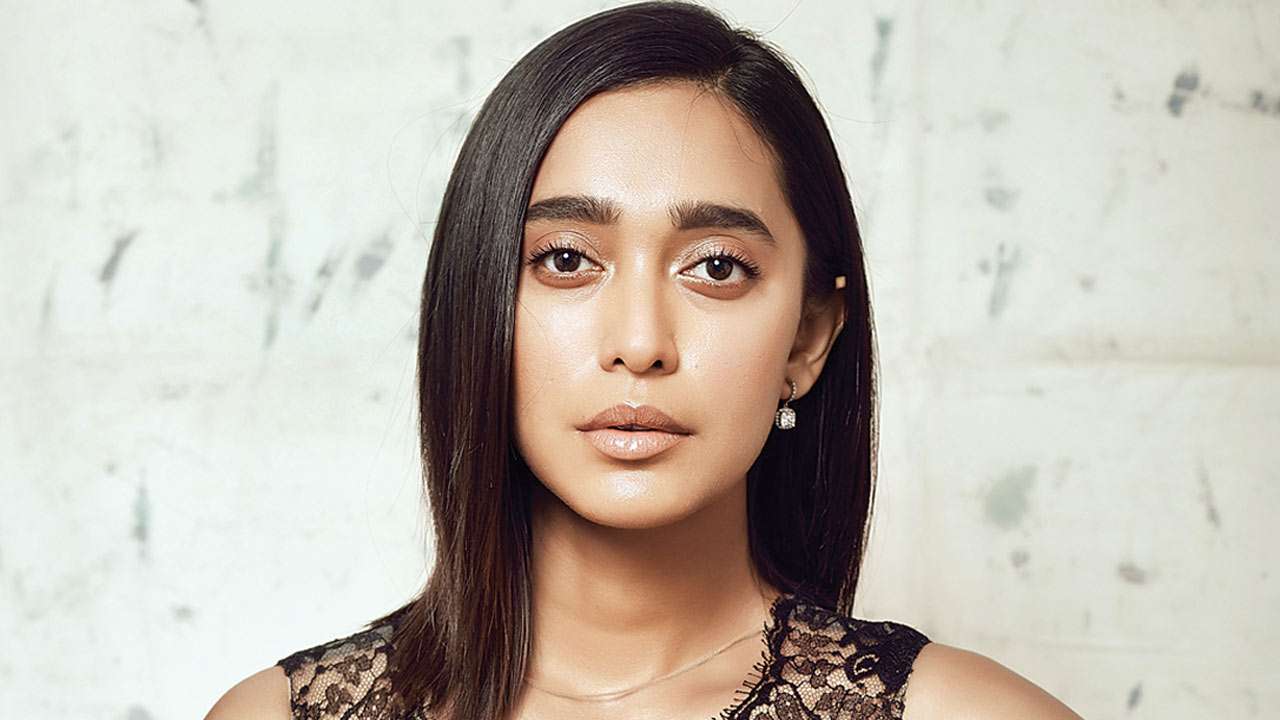
Sayani Gupta has an interesting story to tell about how she was cast for her role of a Dalit girl in the Anubhav Sinha directorial Article 15, which is backed by Zee Studios. The actress shares that the director had liked her work in Jolly LLB 2 and the duo had been wanting to work with each other for a while. However, when he did call her for a role, she was supposed to be doing a Bengali film and didn’t have the required dates. “I was sitting in his office when I got to know that the Bengali movie is not happening and I told him that my dates have just been freed up!” she laughs.
While Anubhav did cast her in the social drama which also stars Ayushmann Khurrana, Sayani admits that the filmmaker was a little apprehensive about how she would carry off the look of a villager. Adding to the apprehension was the fact that the promotions of the web series Four More Shots Please! was going on, in which she has self-admittedly played her most glamorous role yet! “I showed him a clipping from Parched and he was like, ‘who’s this?’ Then the look test put all his doubts to rest,” she adds.
The script of Article 15 was what caught her attention and Sayani says she felt extremely overwhelmed to think that somebody was saying this story. “It’s an investigative drama which is also entertaining. It has everything required for a commercial film, but its politics is so correct. As actors, we are not only looking at the character we are playing, but also the story,” says the 33-year-old. For her own role,
Sayani says that while she has earlier played a girl from the rural quarters in Parched, this role is quite different. “It’s a beautifully written part — she is so strong. There is a lot that goes on in her life but she still holds her ground with extreme affirmativeness. I can’t do a part that’s not strong. Even if it’s a meek character, she has to have some semblance of wisdom or ethics I can relate to,” informs the actress who is currently shooting for the second season of Four More Shots Please!
The insecurity of sacrificing everything to pursue acting did play on my mind-Anirudh Tanwar
8:03 AM

Lasyapriya Sundaram (BOMBAY TIMES; November 26, 2018)
He is a commercial pilot-turned-actor, who quit the aviation industry to pursue a career in the movies. Hailing from Jaipur, actor Anirudh Tanwar struggled for almost five years before he landed a role in the upcoming film Rajma Chawal, directed by Leena Yadav. In a candid chat with BT, he shares how he wants his journey as an actor to continue. Anirudh also admits that he wants to be known as a good actor and is not gunning for stardom. Excerpts...
Did you harbour dreams of being an actor since childhood?
I am born and raised in Jaipur. When I was in school, my father asked me what I wanted to be when I grew up and I said I wanted to be an actor. He didn’t discourage me. But growing up in Rajasthan, I realised that nobody really looked forward to somebody becoming an actor and also, there weren’t many avenues to pursue the same. Then, I became a pilot and started working, but I was keen on taking that leap of faith to pursue acting. I eventually quit everything and decided to shift base to Mumbai in 2012. Since then, I have been trying to get a break. I assisted on films and also managed production work. I joined Barry John’s acting classes. I did workshops with graduates from the National School of Drama. I pursued street theatre in Banaras and also went to Lee Strasberg in New York to train. There was a film, which was supposed to happen, but it did not and I returned to Mumbai.
Since 2013 till the time Rajma Chawal was shot and completed, as an actor, it was a tough period for me. The insecurity of having sacrificed everything in order to pursue a career in the movies did play on my mind. Now that my film is complete and is releasing, I feel that period was not tough, but a rite of passage. Also, as a child, I was painfully shy, but when I would act on stage, I would come alive. I was also charmed by cinema. In fact, when I shifted to Mumbai and would watch stage plays, I was keen on being an actor on stage as well. Acting for me is a liberating experience.
After struggling to find a foothold in the industry, you finally landed the lead role in Rajma Chawal. How did that happen?
I assisted filmmaker Leena Yadav as part of the production team for the film Parched. She was also aware that I wanted to be an actor. After wrapping up the film, she called me a few months later and told me about Rajma Chawal and how it revolved around the relationship between a father and son. She told me that the film is not a typical launch pad, but that I would be perfect for the role. I was skeptical about Rishi (Kapoor) sir agreeing to act alongside a newcomer, but those were my own insecurities. He came on board because he liked the script a lot.
What, according to you, is the ideal launch pad? Even though Leena Yadav told you that Rajma Chawal is not a typical film that is designed for a Bollywood launch, did you believe otherwise?
Frankly, I think Rajma Chawal is the ideal launch pad for me. For many others, this film might not come across as a launch vehicle because it doesn’t have a larger-than-life quality about it, which is almost a prerequisite for a debut in Bollywood. I relate to cinema that is real. This film is a drama that addresses concepts like family values. Also, I was thrilled that I got to share screen space with Rishi Kapoor.
Every year, the industry witnesses new actors trying to make a mark. However, only a few manage to make an impact and also sustain a career. Isn’t it difficult to break through the clutter?
I think it’s a huge challenge, but what I do hope is that my journey as an actor continues. When an actor ventures into the industry, the first challenge is to simply get work. I want to first grow as an actor. I will be happy even if only 10 people recognise me, but I want them to appreciate me as a good actor. I aspire to be an actor more than being a star. I will die of embarrassment if somebody were to say that I am a star, but I don’t know how to act.
Your father is also one of the producers of the film. Didn’t you want to be in a film which didn’t have your father backing it?
My father started producing films after I moved to Mumbai. In fact, I was constantly asked if he is producing films, why isn’t he producing mine. My father was the opinion that I need to find my own way and that he wouldn’t want to bankroll a film for me. We had different producers when the film was kicked off. However, at that time it was a small film. But when my father heard the story from Leena, both of them wanted to take it to the next level. That’s when he agreed to come on board as one of the co-producers.

I don’t feel the pressure just because of my National Award-Riddhi Sen
7:55 AM

Lasyapriya Sundaram (BOMBAY TIMES; October 10, 2018)
He is just 20, but has already bagged a National Award. Now, Riddhi Sen is all set to play the lead along with Kajol in Pradeep Sarkar’s Helicopter Eela, a film that revolves around the relationship between a mother and son. In a candid chat with BT, Riddhi talks about why he was eager to do Helicopter Eela, how winning the National Award (in the Best Actor category) last year, inspires him to do good work and how it was easy for him to slip into the role of a transgender in the Bengali film, Nagarkirtan. Excerpts…
You have acted in Hindi films earlier, but you are playing a prominent role for the first time in Helicopter Eela. Tell us about your journey of getting here.
Yes, I have acted in Hindi films like Kahaani, Parched and Bhoomi. I also did Children of War, which was Farooq Shaikh’s last film, but sadly, it didn’t get much recognition. I also featured in Chauranga that was produced by filmmaker Onir. In Helicopter Eela, I am playing the lead role.
Actors dream of getting an opportunity like Helicopter Eela and the credit goes to my director, Pradeep Sarkar. There are many actors waiting to land a role like the one I play in this film, but Pradeepda was confident about me essaying this role. Two years ago, I worked in a commercial with him in Kolkata and that's when he decided that I could pull off my role in the film. I didn’t have to audition a lot. In fact, I was cast in the film because my work in my earlier movies was appreciated. When Sujoy da (Ghosh) came to shoot in Kolkata for Kahaani, people from the Bengali film industry referred me to him. I thought I might have to audition for Helicopter Eela, but I didn’t have to.
Last year, you won a National Award in the Best Actor category at the age of 20 for the Bengali film Nagarkirtan. Having achieved that kind of recognition so early on in life, does it put pressure on you?
I have a long way to go. The fact that I won a National Award right at the start of my career scares me, because I have a lot to learn and explore. Today, thanks to the internet, I can familiarise myself with films which are being made all over the world and stay updated. More than being affected by people’s expectations, I want to live up to my own. I don’t feel the pressure to deliver because I have won a National Award. In fact, I have forgotten that chapter of my life. I have very high regard for the award, as well as for the jury who chose me, including Shekhar Kapur and I am extremely grateful for it. However, if I keep thinking about that achievement, I will not progress. I was the best, according to some people, but the next year somebody else’s performance will be lauded. In the next ten years, if I do good work then I can proudly say that I had won it.
The mother-son relationship that’s being portrayed in Helicopter Eela talks about how parents are overprotective and sometimes can also go overboard. Tell us about your relationship with your mother?
The film talks about what happens in most Indian homes. In the process of bringing up their children, parents don’t pay heed to their needs. They focus on only looking after the children and that is common in Indian society. Also, many parents feel that children should not have an opinion of their own. Some aspects of the relationship showcased between the mother and son in the film are similar to the bond that I share with my mother. Whatever I have achieved in life is because of her. Children observe their parents and I have seen my parents strike a balance between work and home. Both my parents are actors and they don’t have a nine-to-five job. However, that never affected my upbringing. They were there for me when I needed them and they also managed to work as well. My mother is my best friend and I have no inhibitions when it comes sharing my thoughts with her.
You have the experience of working in the Bengali, as well as the Hindi film industry. How different are they from each other?
The industries are different when it comes to the budgets of films. We have talented directors in Kolkata. If a Hindi film is shot in 50 days, a Bengali film has to be shot within 16 days. However, the end product is the same. The preparation before the shoot is immense. I played a transgender in Nagarkirtan for which I won the National Award. Usually, actors get close to six months to prepare for a role like this. The film was shot in 18 days. In the beginning, nobody was willing to produce a movie that revolved around a transgender. My director really rallied for the film. I had to prepare myself for the role much before the film went on floors. I knew the film will be made, but I didn’t know when it would go on floors, so I had to be ready to shoot at any given time. A low budget film shouldn’t look like one and that’s the trick the Bengali film industry has managed to pull off.
Was it important for you to do Nagarkirtan because it focusses on the love story of a transgender man? It’s a brave attempt and relevant to our times…
Aligarh is one of my favourite films. Nagarkirtan also addresses a similar concept. I am proud that the film’s director Kaushik Ganguly chose to narrate a tale that revolves around the love story of a transgender. I could play the role of a transgender with ease because of my upbringing. I grew up in a family of artistes. Also, I was part of theatre. I grew up surrounded by people like Aparna Sen, Soumitra Chatterjee and Rituparno Ghosh, who influenced me as far as my choice of roles was concerned. My upbringing helped in cultivating awareness on what happens. While growing up, my parents didn’t childproof conversations. They always gave an explanation. I watched my first ‘A’ rated film, Parzania, when I was seven years old. I was explained why the film was ‘A’ rated and also why a film with such a rating didn’t indicate that it was bad. By the time I was 19, I had an evolved understanding of gender. My parents also considered acting as a subject. In India, acting is not considered among subjects like Physics and Chemistry. But I hope things change some day.

Rishi Kapoor is the most unfiltered actor I’ve met-Leena Yadav
7:58 AM

Leena Yadav on working with the actor on a father-son story and developing four-fi ve international projects, among them the biopic of the first woman to join the LTTE
Roshmila Bhattacharya (MUMBAI MIRROR; July 17, 2018)
Who came up with the intriguing title of Rajma Chawal?
Rishi Kapoor did. It plays a crucial part in the father-son relationship. He suggested the title during the narration. And I admit we ate a lot of rice and beans, along with other local delicacies found in Delhi’s Chandni Chowk, during the shoot which Aseem (Bajaj, her producer-DoP husband) would get for us. Rishi would wave them away, saying he’d get fat, then stop Aseem, saying, “Wait, let me take a bite.” We feasted and laughed our way through the film.

Not just him but every man on the sets. Every son craves for his dad’s approval which is often hard to express in words. Even though we are three daughters in my family, this relationship has long fascinated me as I wondered if the dynamics might have been changed with a male sibling around. It’s the basis of five-six half-baked scripts lying around.
This story is Vivek Anchalia’s and I was instantly drawn to it as whenever we’re at a restaurant, I find every member of a family on the phone with no time for personal interaction. Aseem and I make sure the cell phone is never between us. We don’t even have a TV at home. Besides conversation, the only other thing we do is read. Even when we are working together, we have different lives and there’s so much to share.
Would you say your last film Parched, which won awards and accolades worldwide, has changed you as a filmmaker?
It has. I was hungry to make a film the way I wanted and when I was not able to do so, I told Aseem I was giving up. He wouldn’t let me quit and told me he’d produce Parched even though it was a difficult film to raise finance for. It was run down by everyone till Ajay (Devgn) came on board as producer. That gave us credibility, he also gave us the money to start the film. Without him Parched wouldn’t have been possible and working with a foreign DoP (Russell Carpenter) and editor (Kevin Tent) made me realise artistes have no boundaries. I learnt from them and their takeaway was that music is not just a distraction but can help tell a story. Shabd’s rejection had stunned me, Parched liberated me as a filmmaker and Rajma Chawal has grown out of that space.
After Parched you could have got your pick of actors, why settle for a newcomer, Aniruddh Tanwar?
I never write with actors in mind but take actors who fit the part. The role is bigger than all else.
Is Rishi Kapoor is a difficult actor to direct?
He’s the most unfiltered actor I have ever met and rather than get offended, I appreciate this quality. This collaboration has been most enriching because he comes with years of experience and an innate curiosity that makes him ask, “Why do you need a scene like this?” or “Why are we spending so much time on this when it’ll be edited out?”
You’ve travelled the world with Parched. Do you see yourself becoming a global filmmaker now rather than remaining an Indian director?
Absolutely, I’m already doing 4-5 international projects. One is an Australian production set in Sri Lanka, a biopic of one of the first women who joined the LTTE movement. I’m also doing two hardcore American films. I’ve spoken to Ajay about an international film that I hope will feature him. I’m grateful I’m getting to interact with such amazing minds.
The problem arises when nudity on screen is seen out of context-Radhika Apte
8:19 AM

Lasyapriya Sundaram (BOMBAY TIMES; February 1, 2017)
Radhika Apte has no industry
lineage to speak of. The Pune girl, who began her acting career with
theatre, has risen up the ladder in Bollywood on the sheer strength of
her performances and choice of roles. She is as bold off camera as she's
on it - not once shying away from addressing questions on nepotism,
nudity and inequality among the sexes in B-Town. In a freewheeling chat
with BT, Radhika holds forth on her life as an actor. Excerpts...
Was 2016 a turning point in your career?
I don't look at it that way, but yes, the past two years have been really good. My career has received a boost. Especially last year, when I had seven releases - while one of them was critically acclaimed, the other one fared well at the box office. I see this as a beginning and I am waiting to see where it takes me.
It has taken a long time for you to get your due...
It takes time for everyone. If you are an industry kid, the first film is given to you on a platter. However, the pressure and expectations are immense. If you are an outsider, there's nothing to weigh you down, but it takes a long time to make your mark. There is no set way of getting a role - you don't give an exam, score well and then nail a film. Though I have achieved a little bit in my career, I have to continue working hard. What I want is more than what I have achieved.
Parched had a topless scene, which was relevant to the story. But do you think the way the audience in India reacted to its leaked version was immature?
Films are big in our country and people are emotional about it. I am aware of what happened with the nude scene in Parched. But men and women who connected with it, didn't see it through the prism of nudity. The problem arises when nudity is seen out of context. Even then, I don't think our audience is immature.
There's a difference between the aesthetic portrayal of nudity and the objectification of women. And the latter does happen in Bollywood.
Nudity is justified if it's relevant to the plot. The intention should be right. But if it's just about showing women dancing naked in the name of entertainment, that's not acceptable. It really depends on why you are putting it in.
Having said that, the situation is slowly changing. We have more female-centric films today...
Yes, there has been significant change in the way roles are being written for women. In fact, the last decade has been good. Interestingly, not just actresses, even actors are stuck with clichéd roles. Udta Punjab and Piku are exceptions. The image of an actor plays a huge role in deciding if he or she can experiment with roles. The fear of the audience not accepting looms large, too.
You have done films in the South as well. Do you think sexism is more blatant there?
I have barely done three films there, so commenting on the whole industry would be unfair. Kabali was a pleasant experience. I was treated well by Rajinikanth and the director (Pa. Ranjith). But the same cannot be said about the other films - the hero was put up in a far better hotel than the heroine. While the hero's call time was 9 am, I was asked to report on the set two hours earlier. I haven't seen that happening in the Hindi film industry.
What is it that you love about Bollywood? And what is it that you dislike?
It's an amazing place to be. There are so many talented, hard-working people who inspire you. They are also very supportive. The most wonderful thing is that you meet new people all the time. There are exceptions, but most people don't pay on time in the industry, and you are made to feel guilty when you ask for your money.
Was 2016 a turning point in your career?
I don't look at it that way, but yes, the past two years have been really good. My career has received a boost. Especially last year, when I had seven releases - while one of them was critically acclaimed, the other one fared well at the box office. I see this as a beginning and I am waiting to see where it takes me.
It has taken a long time for you to get your due...
It takes time for everyone. If you are an industry kid, the first film is given to you on a platter. However, the pressure and expectations are immense. If you are an outsider, there's nothing to weigh you down, but it takes a long time to make your mark. There is no set way of getting a role - you don't give an exam, score well and then nail a film. Though I have achieved a little bit in my career, I have to continue working hard. What I want is more than what I have achieved.
Parched had a topless scene, which was relevant to the story. But do you think the way the audience in India reacted to its leaked version was immature?
Films are big in our country and people are emotional about it. I am aware of what happened with the nude scene in Parched. But men and women who connected with it, didn't see it through the prism of nudity. The problem arises when nudity is seen out of context. Even then, I don't think our audience is immature.
There's a difference between the aesthetic portrayal of nudity and the objectification of women. And the latter does happen in Bollywood.
Nudity is justified if it's relevant to the plot. The intention should be right. But if it's just about showing women dancing naked in the name of entertainment, that's not acceptable. It really depends on why you are putting it in.
Having said that, the situation is slowly changing. We have more female-centric films today...
Yes, there has been significant change in the way roles are being written for women. In fact, the last decade has been good. Interestingly, not just actresses, even actors are stuck with clichéd roles. Udta Punjab and Piku are exceptions. The image of an actor plays a huge role in deciding if he or she can experiment with roles. The fear of the audience not accepting looms large, too.
You have done films in the South as well. Do you think sexism is more blatant there?
I have barely done three films there, so commenting on the whole industry would be unfair. Kabali was a pleasant experience. I was treated well by Rajinikanth and the director (Pa. Ranjith). But the same cannot be said about the other films - the hero was put up in a far better hotel than the heroine. While the hero's call time was 9 am, I was asked to report on the set two hours earlier. I haven't seen that happening in the Hindi film industry.
What is it that you love about Bollywood? And what is it that you dislike?
It's an amazing place to be. There are so many talented, hard-working people who inspire you. They are also very supportive. The most wonderful thing is that you meet new people all the time. There are exceptions, but most people don't pay on time in the industry, and you are made to feel guilty when you ask for your money.

My next directorial is on battle of Saragarhi-Ajay Devgn
10:56 AM

But only after Ajay Devgn completes two films as an actor; also ready to produce a film for wife Kajol
Roshmila Bhattacharya (MUMBAI MIRROR; October 24, 2016)
He directed U Me Aur Hum in 2008. After eight years, Ajay Devgn is back in the director’s chair and is encouraged by the heartening response to Shivaay's trailer from all over the world.
“When I designed the shots, many wondered how we'd take them in the locations we'd chosen. I had the passion to push myself into shooting in minus 20-25 degrees celsius and, watching me, the rest of the team jumped in and soon owned the film,” says the actor-filmmaker, pointing out that doing something new requires stepping out of one’s comfort zone. “We have the talent, we can do what Hollywood does, we only need to push ourselves. I’m proud I could prove that.”
After Shivaay releases and a six-day break, he'll jump into Milan Luthria’s action thriller, Baadshaho. He’s looking forward to reuniting with his old friend, Milan, and Emraan Hashmi. “For a few months, I’m going to enjoy just shooting without responsibilities before jumping off the deep end again,” he laughs, adding that this will be followed by Rohit Shetty’s Golmaal Again which starts at the end of January or early February.
Once these two films are wrapped up, Ajay promises to get back to direction again with Battle of Saragarhi. Isn’t Rajkumar Santoshi’s war drama, Saragarhi, on the same subject? He reveals that Santoshi was aware he was making this film as he'd announced it two years ago. “It doesn’t matter, he can go ahead and release his film. Mine has to be mounted on a large scale and will take a while to get made,” he says.
Meanwhile, a routine clash between two biggies this Diwali has turned into something bigger after Karan Johar’s Ae Dil Hai Mushkil was embroiled in a controversy over Fawad Khan’s cameo following the Indo-Pak tensions. Ajay argues that the controversy would have come up even if the two films were releasing on different Fridays.
“When we announced a Diwali release for Shivaay, there was no other film in the fray. The other film announced its release a few months later. Fair enough, they must have had their own reasons,” he shrugs.
Had there been a situation with the UK or Poland, how would he have reacted and what are his views on Karan’s video statement not to work with Pakistani talent again? “I've worked with Pakistani actors, singers and musicians, we were one fraternity then. There comes a time when you have to stand up for your nation. This is the time for me to stand by my country,” he asserts.
And how does he react to MNS politicking, the Union Home Minister, Rajnath Singh, Maharashtra CM Devendra Fadnavis and even the army being dragged into a film’s release? “It’s sad, these things draw attention away from the content. I’d want to talk about what we've accomplished, ditto for the other maker, instead we are answering questions which have nothing to do with our films," he grouses.
You can understand that he’s disgruntled and hate to bring up the name of a particular individual (Kamaal R Khan) who has been consistently running down his film on Twitter... Before you can even complete the sentence Ajay interrupts, “Don’t mention his name or give importance to someone like him. Your industry and mine are one, we depend on each other, when people like him come in, it ruins the reputation of our fraternities,” he warns.
But its being said that his actress wife Kajol and Karan’s decade-old friendship is over because of this individual and his admission that he accepted money from the latter to promote his film over Ajay’s. “All I can say is whatever was there was over long ago and has nothing to do with professional work. There are personal reasons for it which I don’t think anybody would want to talk about," he says.
Meanwhile, Kajol, as co-producer, has jumped into the promotions because after one three-day US tour, Ajay has been working 20 hours on post-production. He will be producing a film for his wife which rolls in January. “The script is locked, it’s a humorous, emotional, sliceof-life film,” he informs.
He’s quick to describe Shivaay as an emotional drama more than a maar-dhaad thriller... A father-daughter love story. Talking about daughters, Nysa, accompanied him to the London premiere of Parched which he produced. Is she likely to follow in her parents’ footsteps? “Parched spoke about empowering the girl child so I thought it was a good platform to take Nysa on. She also went with me to the Smile Foundation.
As a father I want her to realise how privileged she is and do her bit for them,” he asserts, exulting that the film a couple of days ago was celebrating a silver jubilee run in France. “Silver and golden jubilees were terms I had heard 15 years ago. To know that my film ran for 25 weeks and is being appreciated all over the world is heart-warming. That’s the reason I make the films I do,” he signs off.
Adil Hussain told me, 'Sorry if I get a hard-on & sorry if I don't'-Radhika Apte
8:12 AM

Radhika Apte reveals why her lovemaking scene in Parched was hilarious
Mohar Basu (MID-DAY; October 3, 2016)
Radhika Apte’s lovemaking scenes from her latest release, Parched, are being marketed as porn, but she would rather not dwell on the negative buzz around the critically-acclaimed film. She terms her experience of filming the under-the-sheets action with Adil Hussain as a ‘hilarious’ affair, adding that the biggest challenge on set was not going nude, but finding a flesh-tint sock that covered Hussain’s modesty.
“We kept cracking up all through. Your body is the last thing you are conscious about when shooting a sex scene. It was inside a cave and had we not found the sock, the shooting would have been delayed. The unit thought an erotic dance sequence was being shot,” she says, giggling at the memory.
The dirty talking that preceded the scene was funnier, she says, adding, “Adil even blurted out, ‘I am sorry if I get a hard-on and I am sorry if I don’t’.” The film’s director, Leena Yadav, along with choreographer Ashley Lobo executed the scene, Radhika says.
Why hadn’t she discussed the ‘fun’ part of the ‘controversial’ scene earlier? She quips, “Those who raising eyebrows and rolling eyes would have never got the humour in this. People look at things as black and white. Unfortunately, everyone saw it from a unilinear perspective. They were either angry or sympathetic. Ask us, we have laughed throughout. It will be the most memorable scene ever for the amount we have laughed and for what we take away from it. I have been criticised and praised equally, but films are a learning process and that scene will be a milestone.”

Colors channel apologises to Tannishtha Chatterjee, director Leena Yadav blames self
2:51 PM

'Parched' director Leena Yadav owns up for taking Tannishtha Chatterjee to Krushna Abhishek's show 'Comedy Nights Bachao Taaza', where she was allegedly humiliated
Mohar Basu and Letty Mariam Abraham (MID-DAY; September 29, 2016)
 After Tannishtha Chatterjee spoke up against her roast on Krushna Abhishek's show, 'Comedy Nights Bachao Taaza', director Leena Yadav has said "it isn't one person's fault".
Speaking to hitlist, Leena said, "Clearly, there was nothing else to talk about other than the colour of her skin. Tannishtha can blame Krushna, and he can say she did it for publicity, but I know she is not speaking up for this one issue; she is against the mentality. It is my fault that I took my actors to a show I have never watched before. If our sensibilities were not in sync with that of the show, we shouldn't have gone."
She mentions the problem also rests with film promotions. "It has a set pattern. On one hand, there is such good content and on the other, all we want to do is to fill spaces. It is a trap within a trap and there is no one person to be blamed. It is not as trivial where one man's word is pitted against the other. There is a larger issue. I am terribly disturbed about this," she says.
In her open letter on Facebook, Tannishtha wrote about facing humiliation on the show for her complexion. As it went viral, the channel posted an apology online: "It is rather unfortunate that what you had expected to be a fun and novel experience turned out to be traumatic for you. It was never our intention, nor a practice for us or the makers of the show to offend anyone at all with the jokes. We have taken this up seriously with the creative team and the production house to ensure that the show is produced in line with the vision of the channel. Please accept our apologies for any hurt that was unwittingly caused."
Krushna, however, is not apologetic. "I am shocked. Tannishtha met me first when she entered the venue. Ours is a popular show and we assumed they have seen it before. They shouldn't have come to the show if they weren't familiar with our format," he says.
The stand-up comic adds that Tannishtha's humour is "classy and British", but his is desi. "Yesterday, she didn't object, why is she talking today? She was not enjoying. Radhika Apte and Leena Yadav were enjoying. The ladies danced with me. Hamare idhar yehi chalta hai. You can't expect pasta on Mohammed Ali Road," Krushna says.

My husband is getting threat calls-Parched director Leena Yadav
9:45 AM

'Parched' director Leena Yadav files police complaint as Gujarat's Rabari community raises pitch for ban on film
Shaheen Parkar (MID-DAY; September 27, 2016)

The callers apparently claim that the costumes in Parched are similar to what the Rabari women wear and that the film shows them in poor light and is defamatory to their community. Parched stars Radhika Apte, Surveen Chawla, Adil Hussain and Tannishta Chatterjee.
Says Leena, "It is a scary scenario. My husband is getting threat calls. I do not know how they got his number, but since the film released on Friday, he has been getting calls from different numbers. They are hurling expletives and have told him that the Rabaris are a six-million-strong community, so he should be wary. He has been flooded with nasty messages on WhatsApp as well."
As a precautionary measure, the makers have lodged a complaint with the Oshiwara police. "The cops have asked for the numbers from which the calls have been coming," informs the director.
Leena says her film does not make any mention of the Rabari community. "I have not named any community, caste or religion. There is a disclaimer about resemblances too. They are reacting to the costumes. I have used a mix of Gujarati and Rajasthani costumes. But, they feel it looks like theirs. If I wear a costume from Thailand, I do not become a Thai. Our identity is not made by the clothes we wear," she explains.
She adds that they initially tried to engage them in conversation, but they were in no mood to settle for anything less than a ban. Last Thursday, the Gujarat High Court issued notices to the Central government, the Central Board of Film Certification and Leena acting on a PIL seeking ban on the film's release. The petitioner, Masarubhai Rinabhai Rabari, had demanded the ban claiming that the film is against the sentiments of his community.
The matter will come up for hearing today (September 27).
Racism is propagated through shows like Comedy Nights Bachao-Tannishtha Chatterjee
8:28 AM

Tannishtha Chatterjee storms out of a comedy show after jibes about her complexion
Sanyukta Iyer (MUMBAI MIRROR; September 28, 2016)
At 22, Tannishtha Chatterjee’s performance in the 2004 German film, Shadows of Time, put her on a 13-year journey exploring world cinema. Last week, Leena Yadav’s Parched opened in India. Tannishtha went on Comedy Nights Bachao Tazaa on Tuesday as part of the film’s promotions and was appalled by repeated jibes about her complexion. She was described as a “kaali kalooti” and asked if she has been eating jamun (blackberries) since childhood as a result of which “mooh kala hai”. The show is hosted by popular stand-up comedians, Krushna Abhishek, Mona Singh, Ssumier Pasricha, Bharti Singh, Nia Sharma and Sumeet Vyas, who usually manage to raise a laugh with insults but this time they crossed the line. “I had been led to believe that it was going to be a ‘Roast’. In the West they cheer your achievements by making fun of them and I was excited about being ‘roasted’ on a comedy show on a leading national channel,” says the actress, adding that she had been promised that it wouldn’t be as “extreme as in the West”.
Two segments into the show, a shocked Tannishtha walked out, admitting that when she repeated some of the comments, her sister from New York who's currently in Mumbai couldn’t believe her ears. “She questioned the regressive script, the show runners and the audacity of the channel to propagate such racism,” says the actress.
Tannishtha points out that she doesn’t have a ‘white’ hangover and has been to every A-list festival in the world and never felt humiliated. “Even today this is not about me being offended but because a burning issue is being promoted through such shows. It’s as bad as making a joke about a marginalised community. That is not the spirit of Parched or the face of a woman who believes dark is beautiful,” she asserts.
After the first segment, the 35-year-old actress thought the jokes would move from her skin tone to her performances, films and personal life like any insult-comedies, but when the next segment continued to be peppered with “kaali kalooti, baingan looti”, she told her publicist she wanted to leave immediately.
She also made it clear that she did not want to be featured on the episode or be associated with the channel in any manner since no apology was forthcoming. “They did not understand why I was angry and told me that if I was offended by any particular dialogue, they would edit it out and mock something else about my features. When I refused to continue, the best they could come up with was, ‘Madam exit toh shoot kar lo!’”
Tannishtha's part in Sarah Gavron’s British film Brick Lane brought her global acclaim while she was nominated for the British Independent Film Awards alongside stalwarts like Dame Judi Dench and Hollywood actress Anne Hathaway for her contribution to cinema. Referred to by international media as the “India’s Princess of Parallel Cinema”, she sang at London’s Royal Opera House with British composer Jocelyn Pook. In March, she won a special award at BAFTA for her cinematic work. Has she ever felt discriminated against before? She admits that while getting her make-up done in India, she’s often told, “Ek tone light kar lo, it’s a city girl, had your character been a villager it'd be okay."
“Racism is rampant in the Indian film industry and being propagated through films and such crass shows. Once I was asked that since my surname is Chatterjee, I must be a Brahmin, so why wasn’t I faircomplexioned,” she fumes, pointing out that while Indians rave about how “exotic” foreigners find them, they themselves look down on a dark complexion. “Africans are proud of their skin colour, but look at how we treat them in India. We are misguided by a deep-rooted casteism,” she signs off.
Movie Review: PARCHED by FENIL SETA
10:06 AM
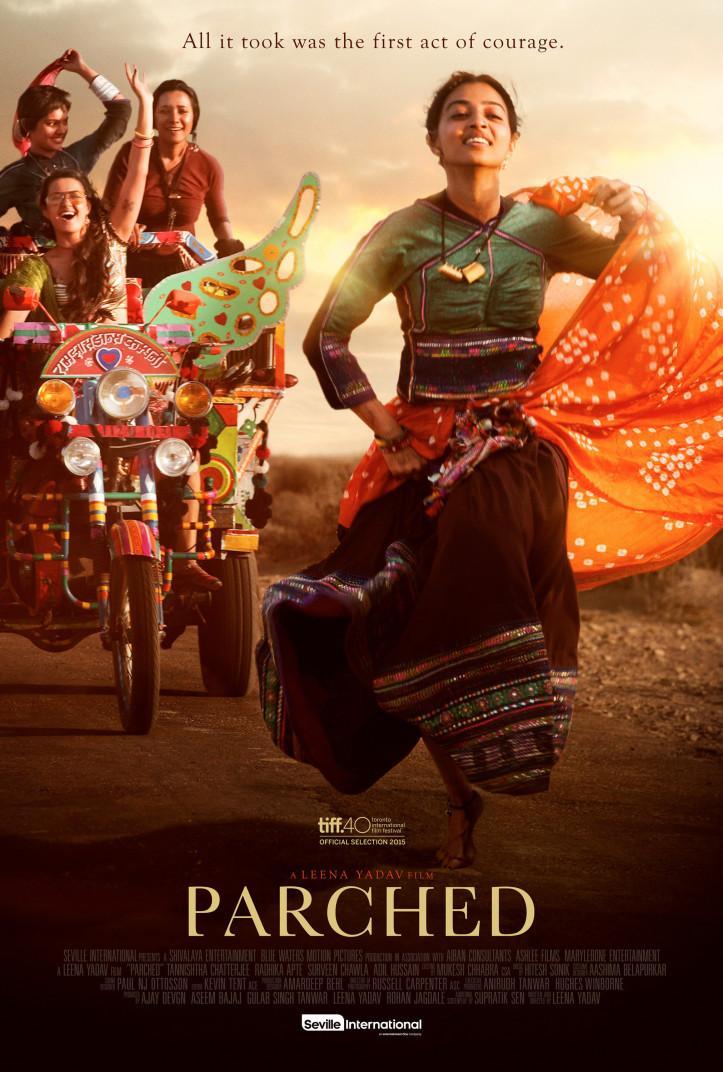
It’s no longer a shocker that women are oppressed in India, especially in the interiors, and how. Yet, when one sees Parched, one is left stunned. The material is strong but the execution is also such that it doubles the impact in many scenes. It has its glitches as well but the plusses outnumber the minuses, making it one of the best films to have come out of Bollywood in recent times!
The story of the movie: Rani (Tannishtha Chatterjee) is a widow who stays in a remote Rajasthan village. She has finalized Janaki (Lehar Khan) as wife for his teenaged son Gulab (Riddhi Sen). Gulab seems to have gone the wrong path and Rani hopes the marriage brings him on track. Her friend is Lajjo (Radhika Apte) who is married to Manoj (Mahesh Balraj). She has failed to conceive despite numerous attempts and is shamed for being infertile. Both are good friends with Bijli (Surveen Chawla), a local erotic dancer and also a sex worker. She is rebellious but has her own personal issues. How these women become each other’s support and face their respective problems, sometimes single-handedly and sometimes unitedly, forms the crux of the film.
Parched transports one into another world altogether from the first scene itself. The energetic background score makes one feel that one is about to see a light-hearted film. In 10 minutes, it all changes as the makers highlight how women get exploited and oppressed in various ways. The writing is topnotch and each character is nicely fleshed out. The best part is that the principle characters aren’t all white either. Rani makes it clear how she was oppressed when she was a newly wedded wife but then metes out the same treatment to her daughter-in-law. The most interesting character undoubtedly is Bijli. It’s thanks to her that there are some funny moments in the movie. Also, her struggles and dilemmas are heartbreaking. Not that Rani and Lajjo’s problems aren’t big but the bus stand sequence comes out so unexpectedly and makes such an impact that one is left stunned!
Sadly, the film is not without its share of blemishes. The beginning 10 minutes are not that great and the film gets on track only with the sequence of Champa (Sayani Gupta). The ending is great but seems a bit too convenient. The film has an open ending but it culminates by raising several questions. And the answers possible for those questions are quite unsettling!
Parched rests on some wonderful performances. Radhika Apte is in top form like always. If you thought nothing could be better than what she did in Phobia, then Parched will surprise you! She is highly expressive and knows how to touch viewers – one laughs when she laughs and cries when she is in pain. Hats off! Tannishtha Chatterjee delivers yet another powerful performance. Initially, she doesn’t stand out but as the film progresses, she really comes out and impresses a lot. Surveen Chawla is highly explosive. She is quite sizzling and gets totally into the skin of her character. Watch out for her in the bus stand sequence – she just kills it! Here’s hoping she gets to play more such interesting roles! Lehar Khan does very well without going overboard. Riddhi Sen is terrific in the negative role. One can’t help but hate him! Sumeet Vyas (Kishan) is lovely. He plays an adorable character and he lightens up the mood with his performance and dialogue delivery! Nancy Nisa Beso (Naobi) and Mahesh Balraj are decent. Sayani Gupta rocks the show with just one sequence. Same goes for Adil Hussain. Chandan Anand (Rajesh) is an actor to watch out for!
Hitesh Sonik’s music is quite nice. The so-called item songs are nicely incorporated in the movie. His background score is much more impactful. Russell Carpenter, who shot Titanic, does a great job as a cinematographer. The barren Rajasthan is beautifully captured. Even the indoor scenes make a huge impact somewhere thanks to him. Amardeep Behl’s production design is rich but also authentic. The tent and the ‘jhakda’ are very well decorated. Leena Yadav’s story is very interesting. Dialogues are brilliant. Leena Yadav and Supratik Sen’s screenplay makes an impact. Some of the scenes they have thought of are brilliant – for instance, when Gulab is having his first night or when Lajjo removes her top. Kudos to her direction as well! These and many other scenes are exceptionally shot. Most importantly, she has comes miles ahead from her previous films – Shabd and Teen Patti. Sadly, there are blemishes here and there and if they were taken care of, Parched would have been a classic!
Some of the best scenes:
1. Champa confronts the sarpanch
2. Rani and Lajjo meet Bijli for the first time
3. Gulab’s first night with Janaki
4. Gulab in trouble over money
5. Rani, Lajjo, Janaki, Bijli go for a ride (terrific!)
6. The intermission point
7. Adil Hussain’s scene
8. Bijli at the bus stand
9. The last 15 minutes
On the whole, Parched is a well-written and well-made film that creates an impact. The characters are very impressive and nicely woven in the narrative. All the principle actors – Radhika Apte, Tannishtha Chatterjee and Surveen Chawla – leave a huge mark. The film could have been better especially towards the end. Nevertheless, it’s a film to watch out for! Do go for it if time permits!
My rating - *** ½ out of 5!
Fenil's Bollywood Talk # 431
2:02 PM

Here comes another Friday which is riddled with releases of small and moderately budgeted films. Sadly, not a single film stands a strong chance of being a commercial success. My analysis:
BANJO: It marks the Hindi debut of Marathi director Ravi Jadhav. The film stars Riteish Deshmukh and Nargis Fakhri and as the title suggests, it deals with the story of banjo players. It is a rare film produced by Eros International single handedly. The trailer is decent and the song Udan Choo has caught attention. But there’s hardly any hype and this will affect its opening day collections. The film might do slightly better in Maharashtra due to the local flavor.
PARCHED: The film was shot almost 2 years back and is ready since almost a year. It is directed by Leena Yadav and makes a strong comment on women emancipation. Set in Rajasthan, it is produced by Ajay Devgn and his presence has surely given slightly more prominence to the project. The film also got in news for wrong reasons when a sex scene of Radhika Apte got leaked. Also, the film is out on torrent websites since a month and this is not good news for any film. Anyways, it’s a niche film and hence, it’s not going to get a huge turnout. But with the leak, its prospects will be further narrowed down. However, the film is carrying excellent reports and hence, it can still work at the ticket window.
WAH TAJ: Starring Shreyas Talpade and Manjari Fadnis, this is a comedy that deals with an interesting topic – a couple from Maharashtra claiming that Taj Mahal was made on their ancestral land and they move court to get their property back! The trailer however doesn’t give out the impression that it would be a laugh-a-minute-riot. Also, the awareness is hardly there. The makers tried to go for innovative publicity by coming out with ‘Taj Mahal Closed’ posters, causing a lot of trouble for them.
DAYS OF TAFREE: This is a remake of the super-hit 2015 Gujarati film Chello Divas and deals with college students having the time of their lives in their final year of graduation. Chello Divas didn’t open with a bang but slowly and steadily, made its mark. Days Of Tafree sadly won’t have that advantage as it’s a Hindi film. The opening will be low but it can grow amongst the youth. But chances are very remote as the film just doesn’t have star value or hit music or great promotion.
WHICH FILM WOULD YOU LIKE TO SEE AND WHY? DO LET ME KNOW!
Radhika Apte speaks up on the furore over her leaked sex scene in Parched
8:10 AM

Radhika Apte on the furore over her nude scene being leaked, and hubby Benedict’s support through it
Mohar Basu (MID-DAY; September 21, 2016)
Radhika Apte has been in the news more for the leak of her nude scene in Parched than for her performance. One would assume she is seething with rage at an irrelevant slice of the film taking the focus away from the issues at its core. But when hitlist caught up with her, she was surprisingly nonchalant. “I didn’t react when it happened. You can actually find any nude scene of any film on YouTube. I did the film, didn’t I? I want everybody to watch the movie. I was never under the impression that I should do the film but it shouldn’t be shown openly. That would be prudish, right?”
With statements like ‘nude scenes can be liberating’, she has earned the reputation of bold. But she says that she isn’t trying to be groundbreaking. “If I were one bit worried, I would be diplomatic, measured with my words. What others look upon as bold is just who I really am. I can’t fake it and I don’t want to have double standards,” she adds.
Supportive husband
For a married woman, it could be difficult but for Radhika, her violinist husband Benedict Taylor is her support system. “When he watches my films, he doesn’t respond as a husband, he responds as a viewer. Every person has a point of view. Sometimes, he likes what I do, sometimes he doesn’t. As a husband, he doesn’t really have a say. I don’t really have to take anybody’s permission to decide what I work on. He (Benedict) is one of the most liberal men I have met. He encourages me to break boundaries. This kind of support from the whole family helps. You don’t have another battle to fight at home at least. But, support is irrelevant, in the end. Not everyone has family backing. It is good to have it but if you don’t, you can still make it all by yourself.”
Mainstream ambition
She’s known for parallel cinema, but has no qualms about dancing and singing onscreen. She says, “I did Lai Bhaari which was a masala flick. I love dancing and I like good, peppy music. But the film should offer something enticing. I don’t want to be reduced to a small role that has no scope for performance. Luckily, mainstream films are becoming content-rich. I never had a plan for a career but I can’t bring myself to do movies that I don’t enjoy watching.”
Censor Board gives Parched an ‘A’ certificate; breast shot blurred
8:16 AM

Subhash K Jha (DNA; September 19, 2016)
Leena Yadav’s globally acclaimed film Parched about
four spirited women in rural Rajasthan battling patriarchy is all set
for an Indian release next Friday.
The Central Board of Film Certification has not only lauded the film for its content, but also shown tremendous liberality by leaving the film’s powerful, sometimes disturbing content untouched.
Says the film’s producer Aseem Bajaj (cinematographer and the film’s director Leena’s husband), “The board has passed the film for ‘Adults Only’ with just a few cuts. We are very grateful to CBFC. They’ve shown immense empathy, sensitivity and generosity towards Parched.”
Apparently, there were two women members in the jury of the Censor Board who were moved to tears by the film. Says Aseem, “They were reluctant to cut anything except a shot of a bare breast. They said it (a breast) does not jell with the Indian audiences’ sensibility. We were okay with that. They gave us the option of removing or blurring the breast. We chose the latter option.”
The Censor Board has also objected to some abusive language. That too was willingly removed. Adds Aseem. “There were scenes showing little boys using abusive language. The board members felt it was not needed. We agreed to remove the abuses and the breast shot as they in no way affected our storytelling.”
Aseem feels the Censor Board is a much-maligned entity and says, “In my experience they are fair and just and doing their jobs to the best of their abilities.”
This is not a publicity gimmick-Parched producer on Radhika Apte's leaked nude scene
8:31 AM

Parched producer says he doesn’t know who to file complaint against for Radhika Apte nude clip
MID-DAY (August 16, 2016)
"We don’t know the source of the leak," says Aseem Bajaj, producer of Parched, a day after clips of two intimate scenes featuring Radhika Apte went viral. One wondered if it is a marketing strategy to keep the critically acclaimed film in the limelight, especially since the makers have chosen to not approach the cyber crime cell yet. Bajaj, however, explains that lodging a complaint is pointless.
“The film is in public domain [Netflix] since it was released in France and a few other countries. We were contemplating legal action, but realised that we can’t do anything about it because we don’t know who to name in the complaint. But, this is definitely not a publicity gimmick. If we are getting mileage out of it, good for us. In a way it’s helping creating awareness about the film,” the producer explains.
The Censor Board has asked the makers to blur a few scenes for the India release. “We have abided by the recommendations,” adds Bajaj.
Parched has done the rounds of various film festivals and is available on Netflix, says an industry insider.
Radhika Apte's nude scenes from Parched get leaked
8:02 AM

Two love-making sequences from the actress's upcoming film emerged online, taking the makers by surprise
Natasha Coutinho (MUMBAI MIRROR; August 15, 2016)
 The Leena Yadav-directed Parched has been getting rave reviews and
winning awards on the international festival circuit. But on Sunday, the
dusty drama revolving around three women in a remote village in Gujarat
who break free of century-old traditions which have kept them locked in
servitude was making news for a different reason after two lovemaking
sequences featuring Radhika Apte emerged online.
The Leena Yadav-directed Parched has been getting rave reviews and
winning awards on the international festival circuit. But on Sunday, the
dusty drama revolving around three women in a remote village in Gujarat
who break free of century-old traditions which have kept them locked in
servitude was making news for a different reason after two lovemaking
sequences featuring Radhika Apte emerged online.One of them showed the expanse of her bare back as she locks lips, while the other featured frontal nudity. The makers had planned to blur out the latter for the film's theatrical release in India. Them going viral come as a rude shock.
Producer Aseem Bajaj was unaware of the incident and when informed said he may approach the cyber cell of the Mumbai police to have them removed. "I don't think the leak happened in India. The film has released in the US and France and its possible someone uploaded them from there. The scenes are not sensational or titillating in any way. But in our country while rape videos are available freely, sex is still considered taboo so we had planned to blur out the breasts. Radhika plays a woman who has been beaten up all her life and is yearning for a loving touch," he informs.
The producer goes on to add that there was never any intention to objectify the actress. "She's like my sister, we did not set out to exploit her in any way. This kind of attitude stems from the way people view such scenes. I didn't see men in the US and France 'getting excited'. We haven't sent the film to the Indian censors yet but I am confident the CBFC will understand the thought behind them and agree that they are integral to the narrative. We are not ashamed of these scenes."
This isn't the first time Radhika's nude scenes have been leaked online. Last year, a clip from Anurag Kashyap's 20-minute short film made its way to the internet too. The cyber cell had registered a case against an unknown person for leaking the clip.
Anurag's film was part of an anthology which featured top directors from countries like Japan, Chile, Australia and Mexico with the recurring theme of `forbidden love.' It was meant to release only in the international market and was inspired by a true story. The sequence in question was only a few seconds long and had the actress lifting her dress to expose her lower front part. It was absolutely non-sexual and, sensitive to his actress, Anurag had filmed it with an allwomen crew.
Even during the post-production, the sequence was either sent blank or pixelated so nobody would even know who it featured. The film was delivered to New York around March 2015 and out of nowhere the video popped up online. Anurag had got in touch with then Mumbai Police Commissioner, Rakesh Maria, and the cyber crime branch took it on as top priority.
Facebook and Whatsapp were also written to and the video was eventually taken off.
Nysa had hijacked my social media for a day-Ajay Devgn
8:21 AM

Ajay Devgn walked the red carpet in London with his 13-year-old daughter
Avinash Lohana (MUMBAI MIRROR; July 19, 2016)
 Even though Ajay Devgn
couldn't attend the world premiere of his first global production,
Parched, at the Toronto International Film
Festival last year, the actor was there for his film at the London
Indian Film Festival last week, walking the red carpet with
writer-director Leena Yadav, the actors and daughter Nysa. “We've got a
standing ovation from audiences all across the globe and London was no
different. It was gratifying to see viewers, irrespective of age or
culture, laugh, cry and think alike after the screening,“ points out the
actor-producer, adding proudly that in Paris they had started with a
17-theatre release which has since grown to 217 theatres.
Even though Ajay Devgn
couldn't attend the world premiere of his first global production,
Parched, at the Toronto International Film
Festival last year, the actor was there for his film at the London
Indian Film Festival last week, walking the red carpet with
writer-director Leena Yadav, the actors and daughter Nysa. “We've got a
standing ovation from audiences all across the globe and London was no
different. It was gratifying to see viewers, irrespective of age or
culture, laugh, cry and think alike after the screening,“ points out the
actor-producer, adding proudly that in Paris they had started with a
17-theatre release which has since grown to 217 theatres.Parched featuring Tannishtha Chatterjee, Surveen Chawla, Radhika Apte and Adil Hussain, is an inspirational drama about four women in a village in Gujarat who fight their personal wars and in the process begin to discard traditions.Ajay is encouraged by the fact that his 13-year-old daughter is aware of the issues the film raises, but since it is rated 15-plus, Nysa couldn't see it. “But it was great to have her walk the red carpet with me, I love the time I spend with Nysa. She had hijacked my social media for the day,“ he laughs, admitting that his lil' darling is his strength and it's a delight watching her grow up, so savvy and socially aware with strong opinions.
Does she aspire to follow in her parents' footsteps and become an actress like mum Kajol or foray into film production and direction? “She is just 13, so it's too early to discuss what she would like to do with her,“ Ajay says shortly.
As an actor despite having done socially relevant films like Zakhm, Gangaajal, Omkara, and Raajneeti to name a few, Ajay's been known for his macho image thanks to films like Phool Aur Kaante, Singham and Once Upon A Time in Mumbaai, so what propelled him to back a feminist film like Parched? “Amongst all the commercial films we do, when you hear a script like Parched, it becomes our duty to support good storytelling in cinema. Box-office is important, but the decision to back a good project is not always dependant on the promise of the returns. Everything is not about money. A good film backed with good intention always touches the audience's hearts and goes on to make money too,“ he reasons.
He is all praise for his writer-director Leena who has extracted stupefying work from the entire team. “Her work and that of the cast and crew, including DoP Russell Carpenter who has won an Oscar for Titanic, is commendable,“ he asserts, informing
 'SHEKHAR AND I SPOKE ABOUT COLLABORATING ON A PROJECT'
 Ajay bumped into filmmaker Shekhar Kapur in London. He had assisted the Elizabeth director early in his career and it was a nostalgic meeting for the duo. Though he refused to divulge details about their conversation, the actor-producer did reveal that there are plans to collaborate with Shekhar on a project.
“Shekhar Kapur and I have a long-standing relationship. He is a fantastic craftsman and there is so much to learn from him. It was a personal interaction but we did converse on professional matters too and spoke about collaborating on a project. The details are still to be worked out but we will be taking this discussion forward,“ he asserts. that he plans to release the film in India in September-October.
However, this is just the beginning for Ajay who plans to produce many such films. He's already started working on scripts in different genres for world cinema. “There is a growing independent cinema voice in India and as a production house we are geared to produce quality cinema for audiences across India and the globe,“ he states.
Subscribe to:
Posts (Atom)