Showing posts with label Pappu Lekhraj. Show all posts
Showing posts with label Pappu Lekhraj. Show all posts
YRF begins vaccine drive; FWICE adopts no-vaccine-no-shoot policy
8:40 AM
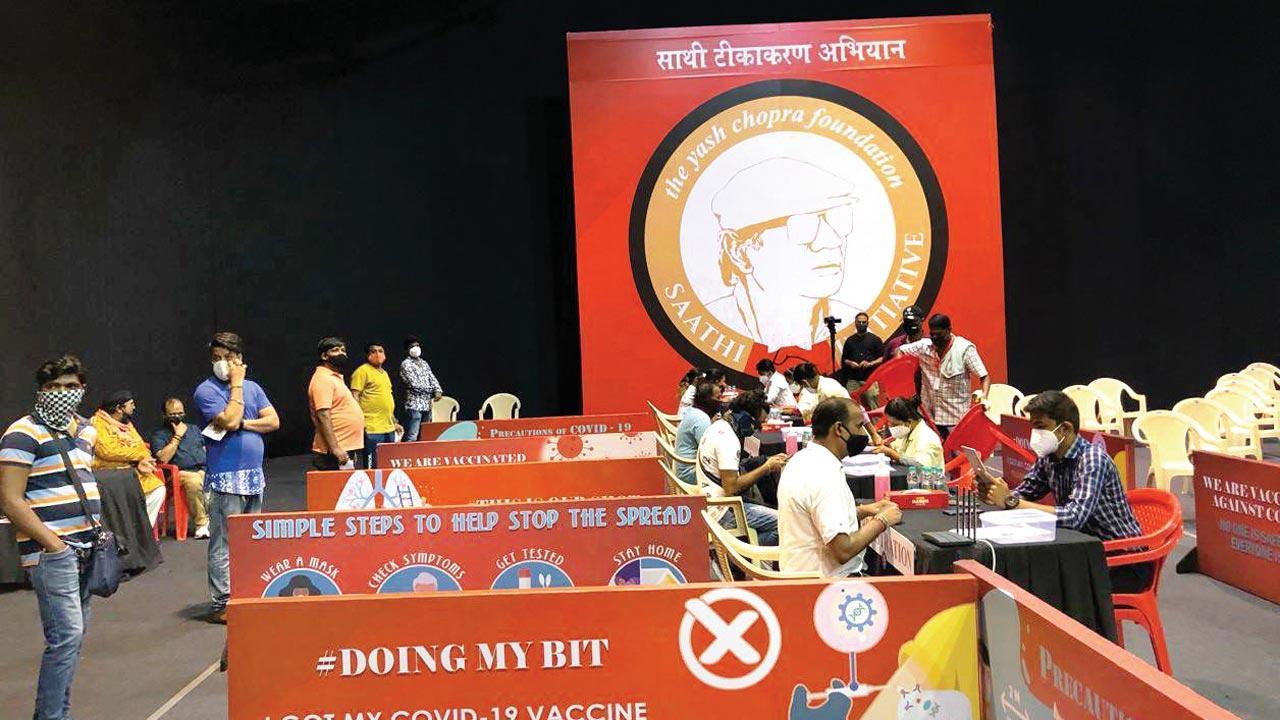
As YRF begins ambitious drive, film body introduces no-vaccine, no-work policy for its workers to tackle hesitancy
Mohar Basu, Uma Ramasubramanian (MID-DAY; June 9, 2021)
On Tuesday, filmmaker and Yash Raj Films’ (YRF) head honcho Aditya Chopra threw open the doors of his studio to kick off the vaccination drive, thus staying true to his word of inoculating 30,000 daily-wagers of the Federation of Western India Cine Employees (FWICE). Even as the first day saw close to 3,500 workers getting immunised, the drive has faced a setback in the form of anti-vaxxers in the industry.
With many harbouring misplaced fear and suspicions about the vaccine, the studio and FWICE find themselves bearing the additional responsibility of educating workers about its necessity. In a bid to encourage people to take the jab, FWICE has now adopted the no-vaccine-no-shoot policy where only those who have taken the first dose will be allowed on a set.
Pappu Lekhraj, who supplies the largest number of daily-wage artistes to Hindi film productions, reveals, “It has been a struggle on the part of the studio and FWICE to convince people to get inoculated. YRF is sponsoring the vaccination of workers and their families, while [the cine body] has announced that unless a worker takes the jab, he/she won’t be allowed back on set. Be it YRF or Bhansali Productions, there’s an emphasis on vaccinated workers.”
Going forward, several other production houses, including Excel Entertainment and Rohit Shetty Picturez, will follow the policy. Ashok Dubey, general secretary, FWICE, says, “Very few daily-wage artistes, workers and spot boys had filled the form [to take the shot]. But when the initiative kicked off, many others came forward. We have told them vaccination is compulsory, and that producers will call only those immunised for their shoots. So, out of the fear of losing jobs, people are now getting jabbed.”
YRF, one of the biggest studios of Bollywood, meanwhile is going full steam ahead on its multi-phase vaccination programme. Akshaye Widhani, senior vice president at the studio, said, “After inoculating all the employees at the studio and the crew members of our films, we have now started the vaccination drive for the Hindi film industry. This will result in the daily-wage earners returning to work and gaining financial stability. The drive will have to take place in phases, given the huge number of vaccines that are required to cover the industry.”
Death cover of Rs 25 lakh due to COVID-19 and hospitalisation cover of Rs 2 lakh have been provided-B N Tiwari, FWICE
8:21 AM
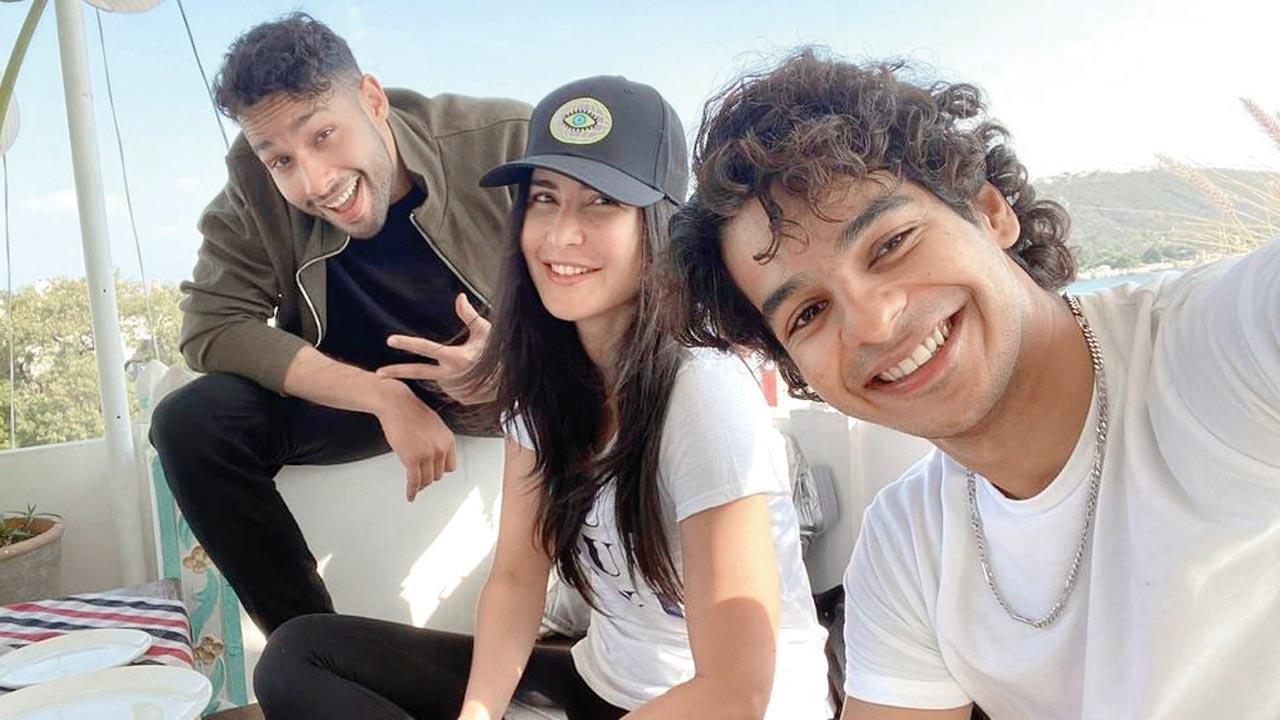
Phone Bhoot, starring Katrina Kaif, Ishaan Khatter and Siddhant Chaturvedi
With filming suspended, Guild VP distributes food to daily wagers; FWICE ensures studios bear treatment cost of those who contracted virus on set
Uma Ramasubramanian, Mohar Basu (MID-DAY; April 20, 2021)
The daily-wage workers, who had returned to Mumbai after the entertainment industry resumed work last October, have taken a beating again as the state government suspended filming till May 1. As they face economic strain while the Coronavirus cloud looms large, leading cine bodies have sprung into action to alleviate their troubles. The Federation of Western India Cine Employees (FWICE) is ensuring that the concerned production house bears the treatment expense for every daily-wager who has contracted the virus during the shoot of its project.
Sharing the details, Birendra Nath Tiwari, president, FWICE, says, “A death cover of Rs 25 lakh due to COVID-19 and hospitalisation cover of Rs 2 lakh have been provided. Recently, one of our members [who was working on a television show] met with an accident on his way back home, post 18 hours of the shoot, and lost his life. We ensured his family was given the Rs 25 lakh compensation, even though he didn’t die on the sets or due to the virus. He was an assistant art designer; we have offered the same position to his wife if she wishes to take it up. As far as the members who are not working are concerned, they can contact us if they [come down with the infection]. We’ll do everything we can, in our personal capacity.”
Manish Goswami, vice-president, Producers’ Guild, believes things will take a turn for the worse if the junta curfew is extended. “In my personal capacity, I am doing whatever I can for the daily wagers. I have distributed groceries among them,” he says.
Pappu Lekhraj, who provides junior artistes to Bollywood, says the Junior Artistes’ Association was happy to see the safety measures adopted by the production houses. “Yash Raj Films was shooting two major projects [Pathan and Tiger 3] in a bio-bubble; they were testing weekly and had put up all artistes at a Goregaon hotel. Excel Entertainment had mandatory bi-weekly RT-PCR tests on the sets [of Phone Bhoot and Dongri To Dubai], and it took care of anyone who came down with the infection. The chance of contracting the virus in such set-ups was negligible,” he recounts, adding that some television shows, unfortunately, cut corners. “They rely solely on antigen tests, which is not the right yardstick. Now, most serials have shifted base to Goa, Silvassa and Rajasthan. I appraise the safety norms [employed on sets] before assigning my artistes to them.”
For a better purpose
With film shoots stalled in the state, Ketan Rawal — who is among the biggest vanity-van suppliers in Bollywood — has deployed about 10 vans to Marol, Malad, Dahisar and Ghatkopar, where they are being used by frontline workers. Cops on COVID-19 duty have been utilising them to change, have meals and use the restrooms during their long shifts. Each vehicle is demarcated into three distinct areas that can host up to 10 people. Rawal has about 30 more vans that can be assigned to frontline warriors, should the suspension of shoots continue.
Coronavirus cuts out the film extras who are now struggling to feed families
9:27 AM

The fate of countless junior artists in the world’s largest entertainment industry hangs in balance due to the pandemic
Kunal Guha (MUMBAI MIRROR; July 19, 2020)
 Of all the communities felled by Coronavirus – migrants, farmers, the urban poor – there is one that we know the least about. Ever since the shooting of films and TV serials has stopped, junior artists, who usually get paid by the day, have been in deep distress. With no work for the last four months, and struggling to feed their families, many of them have been living on dole and ration packets. Some of them have been forced to find alternative employment as delivery boys, security guards or even vegetable vendors to stay afloat.
 Veteran junior artist Shahjahan Shaikh is in dire straits. After three decades in the entertainment business, and with a filmography that runs into over a hundred films and TV shows, the 57-year-old is today working as a guard in Powai. Not a security guard, but someone who has to keep an eye on the rickshaws parked in a stand for the night. Watching him share a packet of biscuits with three strays who keep him company through the night, it’s difficult to imagine Shaikh has played a bodyguard, a policeman, a gangster and even a godman in films. “When I was a junior artist, I’d get paid Rs 1,000 daily. But now, I’m struggling to even cobble together Rs 200 every night and I am under severe debt,” says Shaikh, who has been featured in films like Plan, Company and Haseena Parkar, and TV shows like Kumkum and Chandrakanta.
Shaikh’s bank balance was precarious even before the pandemic. In September, his 31-year-old son was killed in a road accident in Chennai, and Shaikh had to borrow money from friends to cover the hospital bills and, later, the final rites. “It’s been 10 months since my son’s death, and those who had helped me out, are now asking me to pay them back,” he says. “We’re in such a desperate state that my wife’s sugar levels have spiked because of the tension.”
The state government’s stringent protocol in these Covid times, mandates that film and TV crews — if they want to resume shooting — must strip down to only 30 per cent of their overall headcount. This doesn’t bode well for junior artists who are often only utilised as fillers in a crowd scene or as a backdrop to the action. While crucial in regular circumstances, they are becoming rapidly redundant in this pandemic. “People don’t even gather in real life so how can we imagine crowd scenes in films and TV?” asks Pappu Lekhraj, the city’s biggest junior artist supplier for films, TV and web series.
According to him, more than 1,500 junior artists used to shoot every day. But with a handful of productions on the floors right now, less than one per cent have any sort of work. “One of our artists got a job as a security guard, with a monthly salary of Rs 10,000. But after working for a bit, he contracted Covid and has blown up his savings on his treatment,” says Lekhraj.
Mukesh Ahuja, who has featured as an extra in over 100 TV shows and films, first tried his hand at selling vegetables in Borivali East. Following several run-ins with BMC officials, who would routinely haul his cart away, Ahuja doesn’t know what to do next. “My bike and mobile are on loan and I haven’t been able to pay the EMI in months,” he says. He had even considered joining a delivery service, but opted out on learning that he would be paid only after 45 days of completing 12-hour shifts. “In my childhood, I used to make a living by selling kites on the street. But now, things are really tight and I don’t know what to do,” says the 42-year-old who last shot for the TV show Nazar, some months ago.
Selling onions and potatoes outside his society didn’t work out for junior artist Sarfaraz Khan either. “[Actor] Manoj Kumar sir would say that if heroes and heroines are the flowers, junior artists make up the rest of the bouquet,” says the 60-year-old wistfully. “We are professionals too. But without work, how are we to feed out families?” Khan has two sons who live with him in Andheri’s Seven Bungalows area. “My brother got me a room but I don’t have money to pay the rent. Sometimes, when our children are sleeping, I feel like consuming poison and ending my life,” says the veteran artist who has worked in Shah Rukh Khan’s My Name is Khan.
For older artists like 59-year-old Mohd Bashir, who goes by the nickname of Vicky, the fear of contracting the infection is limiting their employment options. “I was being considered to be a watchman at Arogya Nidhi Hospital, which is behind Amitabh Bachchan’s house in Juhu. But given my age, I don’t feel confident about working in a hospital flooded with patients,” says Bashir, who lives alone in Vile Parle’s Nehru Nagar chawl ever since his wife’s death. A month into the lockdown, Bashir took up the job of a security guard at a defunct five star hotel in Juhu, but was let go within 25 days when someone was hired for less. “I was promised Rs 12,000 as salary, but the new contractor found someone who was willing to work for Rs 8,000, so they let me go,” says the artist who has featured in over 450 movies, and has shared the screen with Ajay Devgn (Pyaar To Hona Hi Tha), Salman Khan (Pyaar Kiya Toh Darna Kya) and three generations of Deols: Dharmendra, Sunny and his son, Karan.
In the absence of shoots, many are trying their hand at entrepreneurship. Farooq Jani Badshah Khan, a junior artist for 26 years, who lives in Bandra’s Behrampada area, took advantage of the month of Ramzan to sell fruits for iftar. “During Ramzan, everything sells, so I made some money selling chikoos and mangoes,” he says. “But now, the situation is such that I may be reduced to sweeping the road to make a living. I’m prepared to even do that,” says Khan.
He has been in films and shows such as Agneepath, Company, Balika Vadhu and Mere Angne Mein. “During shooting, I would get Rs 900 per day,” he says, and then rattles off the going ‘rates’. “If I had a line of dialogue, it was another Rs 300. If I got some paint on my body (like ‘blood’, for a shootout scene), that was another Rs 300. So on any given day, I would make somewhere between Rs 1,200 to Rs 2,000,” says the 40-year-old, who’s the sole earning member in his family of six.
Ayub Khan, 52, who took to selling vegetables, blames his losses on the fact that his neighbourhood has thinned out. “Most residents in our area were migrants who have left for their villages,” he says. “Those who stayed back have either run up huge debts, or have some other problem. How can they afford vegetables?” he asks. Still, Khan pushes his cart, with potatoes, onions and spinach, around the locality every day in the hope of making a few rupees to feed his family of five children, his wife and elderly mother.
 Driven to desperation, some artists are falling prey to scams as well. Ahmed Shakil Khan, who last shot for the Sanjay Dutt and Ranbir Kapoor starrer Shamshera at Kamalistan Studios, says he was approached by an agent for the job of a security guard at a tony club in Khar. The agent promised him a monthly salary of Rs 18,000, but asked him to first pay Rs 800 for the uniform that he would need to wear on the job. Luckily for him, Khan’s sixth sense kicked in and he refused the offer. “I joined a food delivery service instead, but even after slogging for 10 hours, I barely make Rs 400 because very few people are ordering in now,” says the 34-year-old who has acted in Rab Ne Bana Di Jodi.
 Some junior artists are even working two jobs just to meet their household expenses. Nadim Nasir Shaikh, who has been in the entertainment profession for 22 years, and will be seen in Salman Khan’s Radhe, has been pulling 12-hour night shifts as a security guard in Goregaon. “I am looking for some work during the day as well, otherwise my family won’t be able to survive,” says the 41-year-old. He hasn’t been able to pay his rent for the last five months and has run up a debt of Rs 50,000 which he’s not sure if he can pay back. For those who already have financial liabilities, the pandemic has pushed them to the brink.
Nikki Rajvir Dulgach, 50, who has been an extra for 15 years, has had to borrow money from friends and local moneylenders to pay off her home loan. “I could pay my EMIs on time when I had work. But now our bank balance is almost zero and the bills have been piling up,” says the Mira Road resident whose husband, Rajbir Dulgach, is also a junior artist. “At this rate, we will have to sell the house, since we barely have enough to buy food.”
In troubled times, one hopes to lean on family. But for Dhanalaxmi Kapadia, there is no such relief. The 64-year-old junior artist’s older son, who is a dancer, had a heart attack two years ago that put him out of commission. Her younger son, who is a driver, is currently out of a job too. “The bank doesn’t extend loans to us and the shops don’t give us ration on credit since we are daily wagers,” says Kapadia, who began her career with Raj Kapoor’s Bobby and has since worked in films like Refugee, Phata Poster Nikla Hero and Angrezi Medium.
But not everyone is living hand-tomouth. Some artists are dipping into their reserves and working towards building alternative careers. Nishith Bhatia, who played gangster Dawood Ibrahim in Shootout At Lokhandwala, has been a junior artist for 20 years. He says that he had tried his hand at civil and development jobs as a side hustle before the lockdown. “I had decided to pick a second line of work in case films don’t work out. You must have a backup plan so that you don’t starve,” says the 49-year-old, who has been in Khakee, Babul, Bbuddah Hoga Terra Baap and Bluffmaster. He says he’s okay without work for now, but perhaps not for long.
With the number of Covid-19 cases on the rise across the country, there’s no clarity on when shoots will resume in full strength. Or whether — even when they do — junior artists will be called upon in their usual strength.
Filmmaker Hansal Mehta, who shot with over 1,000 extras for his forthcoming series on stockbroker Harshad Mehta earlier this year, feels that their contribution to a project cannot be discounted. “The industry treats them like cattle. We have failed to treat our entire workforce with respect and dignity,” says Mehta. “When I shot Simran in the USA, I saw how respectfully the background actors are treated.” Mehta feels that while VFX may be able to recreate crowd scenes, “it would be an expensive option, if not a creative compromise”. “Even then, it would only work for dummy parts. After all, human beings are human beings, and they’re irreplaceable.”


Amjad Khan wanted to create a fund system for us, but he passed away soon after-Saeeda Shaikh
8:15 AM

As mid-day traces a day in the life of a daily wager, 70-year-old junior artiste Saeeda Shaikh, who has worked with Rajesh Khanna, Sanjay Dutt to Shah Rukh Khan, rues the plight of elderly women in the industry
Upala KBR (MID-DAY; April 9, 2020)
 Minutes into the conversation, Saeeda Shakil Shaikh regales us with stories about the good old days of Bollywood. "Shashi Kapoor would join us [junior artistes] during meals on set, joking, 'You all forgot to invite a poor man like me,'" she laughs. Her situation today is at odds with the days of yore, but the junior artiste's grace remains intact.
Shaikh, 70, was shooting for Bunty Aur Babli 2 when the industry shutdown was announced. The three weeks since have been hard on her family of five. "Pappu Lekhraj [talent co-ordinator] usually finds us work. I make Rs 1,000 in an eight-hour shift. My son is a cab driver, and we managed to make ends meet. But now, things have become difficult. In the mornings, I go to the local grocery store for the essentials. Since we don't have money at this point, I told [the grocer], 'Bhai, de do. Once we resume work, we will pay you back.' We have been buying items from him for the past 30 years, so he trusts us," says the Saki Naka resident. When she is not busy with household chores, she spends time with her grandson. "We all watch TV together. Before going to sleep, I offer my prayers; jo bhi ho, upar wala bhooka toh nahin sulata hai."
Having joined the film industry in 1972, Shaikh has been a member of the Mahila Kalakar Sangh, which falls under the purview of the Federation of Western India Cine Employees. "We haven't got a call from [any association]. I know about 10 to 12 junior artistes who live in the Marol to Saki Naka stretch, and nobody has got any aid from the cine bodies."
Citing an instance from the shoot of Kabhi Khushi Kabhie Gham when Shah Rukh Khan had funded the cancer treatment of a junior artiste's mother, Shaikh is hopeful that Bollywood stars will rise to the occasion, this time too. "When Sanjay Dutt had heard about my illness, he had invited me home and borne my medical expenses. I am a breast cancer survivor and heart patient; Salman [Khan] bhai has been funding my treatment for over five years. There should be an association or a provident fund for the elderly women who no longer get work in the industry. Amjad [Khan] bhai wanted to create a fund system for us, but he passed away soon after."
Fortnight of fund crunch: Bollywood still groans under cash crisis
8:02 AM

Bharati Dubey (MID-DAY; November 21, 2016)
The cash crisis sparked by the overnight demonetization of high value currency notes has dealt a blow to Bollywood with daily wage workers struggling to keep the fire in their kitchens burning. The Federation of Western India Cine Employees (FWICE), which controls 22 unions covering various crafts, held a meeting to discuss various modes of payment to daily wage earners.
FWICE general secretary Dilip Pithwa said, “A few suppliers and producers are now issuing ‘group cheques’. Workers have been clubbed into groups. The cheque is made out in the name of one worker, who withdraws the money and disburses it to the others. In our industry, many workers still don’t have a bank account, but we have no choice but to make cheque payment mandatory.”
Pithwa said the heads of various unions under FWICE have adopted cheque payment, but a few categories like carpenters, junior artistes and other technicians are still paid on a daily basis. "A supplier who used to distribute Rs 1 lakh per day, is now able to withdraw Rs 50,000 a week. So, they are now merely managing to pay Rs 50-100 as conveyance allowance to daily wage workers,” he adds.
Pappu Lekhraj of the Junior Artistes’ Association says cheque payment isn’t a feasible solution for daily wage earners. “We are running to banks and petrol pumps to get money, but the withdrawal limit is coming in the way of payment. We have started maintaining an attendance register for all workers so that when things ease out, we will clear their payment," he says.
A member of the Mahila Kalakar Sangh, who is working on Sanjay Leela Bhansali’s Padmavati and another small-budget film, alleges, “A few producers have put payment on hold while some others are continuing paying in Rs 500 and Rs 1000 notes. I am unable to get change for the big notes. Those who agree insist on taking a cut.”
Gangeshwar Srivastav of Film Studios Setting and Allied Mazdoor Union says workers have no choice but to accept the old notes and get it exchanged at banks. “If they don't, they might lose their jobs. But we plan to take up the issue with producers.”
Producer Mukesh Bhatt says the industry’s day to day operations have been crippled following demonetization. “We can hand out cheques to contractual employees, but what about carpenters, spot boys and junior artistes? I cannot ask them to work on credit. I cannot pay them in cash because I cannot withdraw enough money. Work is suffering and many have postponed shoots. Television producers, who have to deliver daily episodes, are reeling under the crisis.”
Cash-strapped Bollywood in a quandary thanks to demonitization of Rs 500 & Rs 1000
8:04 AM

Junior artistes struggle to put food on table, producers worried for unit folk
Mohar Basu & Sonil Dedhia (MID-DAY; November 10, 2016)
In a cul de sac of an Aarey Colony slum, Rakesh and his four-member family have an awkward conversation over their measly lunch — chapattis (fewer than usual) and daal. His wife, Kamla, didn’t have money to buy vegetables last morning. Unlike other days in their happy household, the air was tense and uncomfortable.
Their sons, aged nine and seven, could feel something amiss, but hadn’t dared to broach the subject that was on everyone’s mind. “Discussing and debating the unfairness of it all is futile for us. We only care about how much aloo, gobhi and bhindi cost,” says Rakesh, a junior artiste, who, like all his other colleagues, seems to be the worst hit by PM Narendra Modi’s announcement to demonetise Rs 500 and Rs 1000 yesterday onwards. He received his Monday wage on Tuesday evening and within a couple of hours, the news trickled in. “I don’t know when I will paid next.”
Pappu Lekhraj of the Junior Artistes’ Association says, “People like Rakesh are the worst affected because they depend on daily wages to light fire in their kitchens. We also need to get organised. For the last many decades, we have not maintained records since we make payments on daily basis. On Tuesday, we cleared Monday’s dues. Wednesday onwards, we are keeping track of each junior artiste and their shifts, including overtime. Most extras make money from daily soaps, but producers have asked us to make payments only when the situation normalises.”
Fortunately, the situation for the stuntmen, who also draw daily wages, is a lot better. Mohammed Aejaz of the Stuntmen’s Association of Motion Pictures says, “We get our payments in bulk, by way of NEFT or pay order. There is hardly a two per cent cash transaction for stunt artistes. Producers commission stunt directors, who, with the help of our association, choose fighters and body doubles. The payment is made to the association which then disburses money to individual bank accounts. Even spotboys and lightboys are part of a larger organisation, which don’t do cash dealings.”
Veteran producer Mukesh Bhatt maintains the demonetisation move is for the industry’s larger good. In recent years, Bollywood has seen a decline in black money, which was mostly prevalent in the ’80s and '90s. “Since 2000, black money has been abolished from the film industry. We are a clean industry. Today, everyone is paid in cheques. But, I worry for my associates. My security guard has been stressed all day since he had just two Rs 500 notes in his wallet. They have no value now,” says Bhatt.
-----------------
Question mark hangs over Friday footfalls
Amod Mehra, trade analyst, says the effect of NaMo's decision was felt on Wednesday since there was a big drop in footfalls in theatres. "People's focus now is on getting daily life back on track, rather than going to watch a film. So, it will definitely make a dent in the collections of 'Rock On 2', which releases tomorrow." Hardly 10-20 per cent of the audience prefers online booking, he adds, "In smaller cities, people buy tickets at the windows. Without cash in hand, how will they go to a theatre?"
Distributor-exhibitor Akshaye Rathi, however, disagrees. He says the impact on 'Rock On 2' would be minimal. "If it were a more massy film, like a Sultan or a Dangal, and evokes as much curiosity in small towns of Uttar Pradesh as much as in Mumbai, then there was reason to worry. Rock On 2 is mainly for college kids who like to avail cash back on credit cards and use other online payment methods. The convenience fee being waived off would also work in their favour."
However, the impact on Harry Baweja's 'Chaar Sahibzaade – Rise of Banda Bahadur', which is also releasing tomorrow, could be lethal. The first part was a hit, the maximum revenue coming from Punjab. "In urban centres, the footfalls should be good, but in smaller cities, it may get off to a weak start. You can't expect a card-swiping machine in small towns," Rathi says.
Comedy Nights With Kapil ordeal brought my family to tears-Sachin Acharya
9:04 AM

Sachin Acharya narrates the ordeal he and his family had to undergo on the set of Comedy Nights with Kapil; the audience was not allowed to eat, drink water or even take a bathroom break during the shoot
Sharad Vyas (MID-DAY; June 20, 2014)
The country’s highest-rated comedy show on television, Comedy Nights With Kapil, reduced me and my two children, aged nine and 14, to tears on Wednesday when we had the misfortune of being part of its studio audience.
For almost nine hours — from 2 pm to 10.30 pm on June 18 — we were asked to sit in one place, without water, without food and without any bathroom breaks. We were not even allowed to leave our seats while we waited for the stars to appear, and we waited even more for the show’s recording to start on its sets in Goregaon.
The impeccable comic timing of its host Kapil Sharma and the witty banter of the comic cast aside, the nine- hour nightmare that my family and I endured under inhuman conditions made us feel we were in some kind of detention centre.
It was not only my family, but several others in the audience who had travelled hundreds of kilometres from various parts of the country to watch this hugely popular show felt the same. All this while the actors and the crew kept drinking water, coffee and even protein shakes on stage.
This left a bitter aftertaste because of the taken-for-granted rules for audience conduct and utter disrespect for the fans by the crowd management team. Women and children were denied a bathroom break for hours.
Not just that, Sharma, easily one of India's most-loved comedians, taunted a female fan who stood up to inform him that her husband and her children were not allowed to return to their seats following a loo break which they literally had to fight for. “We have heard of joint families in India, but not loo families,” he told the woman. An uproarious laughter followed, thus humiliating her further.

No sympathy
Instead of showing any sympathy or concern for the children who were left outside without their mother, Sharma laughed at her plight. I was anything but amused at this crass humour. The crowd had entered at 2 pm, and after a four and a half hour wait, the shoot finally began at 6: 30 pm.
During this time, our phones were taken away from us, we were not allowed to drink water, or given any food.
Two senior citizens, who got tired of being shuffled around and later denied a bathroom break for a long time, were heard muttering profanities under their breath. At one point they were overheard discussing the poor lighting and seating arrangements made available for the audience in their row, which was at a precarious distance from the camera equipment. There was little illumination for the audience to move around.
After many protests from the audience, we were allowed a loo break. But even here, we were allowed to leave only one by one. If your bladder was screaming, well, bad luck. The bathrooms were far from the set and thus the agony only increased.
Once the shoot began, no movement or water breaks were allowed. This was unfair as the cast and crew themselves munched on biscuits during the break. This went on until 10.30 pm, when I decided enough was enough. I told my family we should walk off. After all, how long can children wait without food or water?
While I was leaving, one of the crewmembers tried to stop me and when I did not relent, he threatened to “fix me”. But I was in no mood to listen. Which parent would? What pained me the most was that I was hoping for one of the most exciting experiences of my life along with my children; instead I was left hungry, thirsty and dejected. Even the kids of Karisma Kapoor, who had come with two nannies, left the show for more than an hour. When they returned, Kapil asked them, “Bachchon neend aa rahi hai kya?”
VOICES
Pappu Lekhraj, a veteran event coordinator,
This is really wrong, and it should not happen. Kapil's show is incomplete without the audience. The audience should also get the same importance. I don’t know much about this incident, but this does not happen on TV shows. There’s always a proper break, and arrangements are made for the audience in other shows
THE OTHER SIDE
Preeti Simoes, creative director of Comedy Nights with Kapil, denied there was any unprofessional behavior on her team’s part. She said the shooting was scheduled for 4 pm and “there is no way we would call the audience at 2 pm.” She added that actor Karisma Kapoor’s kids were in the audience, too. “Do you think we will do this to kids?”
Audiences in reality shows get paid to clap, laugh, ask questions
7:58 AM

Gaurav Dubey (MID-DAY; April 8, 2014)
You are sitting at home before the TV screen and watching a show or a film. Chances are you’re thinking: I wish I could do this for a living! As it turns out, there are people who do just that. Not only do people get cast as characters on a TV show, there are many who form part of what is called the ‘paid audience’. The latter comprises a segment of people who often queue outside a studio as they are on the lookout for a show where they can play the audience. These are people who are made to laugh and clap on cue.
Money, food and celeb sightings
The irony, of course, lies in the fact that while many of these shows cost crores of rupees to make per episode, the people who make the audience don’t earn more than Rs 1,500 for a single 12- hour shift. But they are provided with food, especially if it’s a daylong shoot. Moreover, audiences are categorised according to their looks and attire.
Pappu Lekhraj, who has been working as a casting agent for 25 years now, says that playing an audience member is a good career option for many people. “A lot of reality shows are in constant need of audiences on the sets, and those who take up these jobs get paid on a daily basis. They are also given free food and water during a 12- hour shift,” he says.
Ajit Dadheech, who has been a production head for fiction shows such as Pratigya and Khamoshiyan, tells hitlist , “The casting of audience members and junior artistes in fictional shows is different from casting for reality shows. Audience members for both types of shows get paid on a daily basis. At times, the production house provides them food or they are given some money for it. Fictional shows have an 8-hour shift whereas reality shows go on for 12 hours.”

Meet the audience
Salim Razzak, who has been an audience member on many reality shows says, “I have been sitting in the audience for more than a year now and I earn anywhere between Rs 6,000 to Rs 8,000 every month. I also get to see my favourite celebrities in person. I am quite happy with the money and the job.” Amit Patil, who has been working in the same field for over six months now, reveals, “I was not doing anything for a living till a friend of mine told me about this job. I now earn between Rs 4,000 to Rs 6,000 every month. All we have to do is sit in the crowd and follow the instructions.”
Models v/s junior artistes
It’s also important to know the category one falls into. There are two different categories for audience members: first is that of models and then come the junior artistes or ‘the crowd’. Models are usually hired for shows where they are made to sit or stand behind a certain judge. Since they often appear on screen, they are expected to meet certain requirements in terms of their appearance. For instance, they need to be tall and slim. Since the camera trains its sights on them, they have to wear makeup and look attractive. The other category has junior artistes whose looks don’t really matter.
Moolah matters
In reality shows:
Rs 400
The amount junior artistes earn for a 12-hour shift.
The amount junior artistes earn for a 12-hour shift.
Rs 1,500
The amount models earn for a similar shift (12 hours)
The amount models earn for a similar shift (12 hours)
In fictional shows:
Here, only members of the junior artistes’ association are allowed to sit in the audience
Here, only members of the junior artistes’ association are allowed to sit in the audience
Rs 850-900
The sum male junior artistes earn for an 8-hour shift
The sum male junior artistes earn for an 8-hour shift
Rs 1,200
The sum a female junior artiste earns for the same shift
The sum a female junior artiste earns for the same shift
Subscribe to:
Posts (Atom)