Showing posts with label Pankaj Udhas. Show all posts
Showing posts with label Pankaj Udhas. Show all posts
After meeting Pankaj Udhas, aapko shaq hone lagta tha ki koi aadmi itna accha kaise ho sakta hai-Vishal Bhardwaj
8:37 AM

(L-R) Vishal Bhardwaj, Sudeep Banerji, Talat Aziz, Papon, Rekha Bhardwaj and Anup Jalota
Renowned singers who are a part of Pankaj Udhas’s musical dream, the annual two-day concert Khazana Festival in the city, remember the legend and talk about taking his legacy ahead
Debarati S Sen (BOMBAY TIMES; July 26, 2024)
It’s been around five months since Pankaj Udhas’s demise, and while his friends miss him deeply, they are eager to carry forward his musical legacy. The ghazal singer’s initiative, the annual two-day concert Khazana Festival, which helps raise funds for cancer and thalassemia patients, will take place on July 26 and 27 in Mumbai. For the last four months, the team, including Udhas’s daughters Nayaab and Reva, have been gearing up for the 23rd edition of this event.
On Wednesday afternoon, BT got an exclusive preview of the show, as we captured the musicians - Vishal Bhardwaj, Sudeep Banerji, Talat Aziz, Papon, Rekha Bhardwaj, Anup Jalota and Kavita Seth jamming during their rehearsal.
The concert this year is a tribute to our friend: Talat Aziz
Talat reminisced, “Back in 2001, we (Pankaj, Anup Jalota and I) were sitting in his study, and that’s where it all began. There are so many fond memories. We toured and did concerts in India and abroad for years. We would conclude most of our shows together. Pankaj would call Anup and me on stage after his performance, and together, we would sing Ghungroo Toot Gaye. The concert this year is a tribute to our friend.”
We will miss him tremendously on the stage: Anup Jalota
Another founding member, Anup Jalota, also Udhas’s close friend, says that the void Pankaj has left cannot be described. “Khazana without Pankaj Udhas is going to be like a soulless body because his vision and total involvement were unparalleled. We will sing some of his most beautiful ghazals, including Deewaron Se Milkar Rona, Dard Ki Barish Sahi Maddham Zara Aahista Chal, Chitthi Aai Hai, Chandi Jaisa Rang Hai Tera and others,” said Jalota.
Koi aadmi itna accha kaise ho sakta hai: Vishal Bhardwaj
Vishal Bhardwaj says, “I used to be an A&R (artists and repertoire) Manager at a recording company, and Pankaj’s brother Manhar Udhas used to sing there. I would go to his home in the capacity of an A&R Manager. Unko itni zyada tehzeeb thi, itni zyada humanity and humility thi, woh kamaal ki thi. He’d treat me as if I was the owner of the company. He was such a good human being ki aapko shaq hone lagta tha ki koi aadmi itna accha kaise ho sakta hai. But after two or three meetings, I realized he was genuinely like that.”
He adds, “All of us came together got this festival just for one person - Pankaj Udhas. Aisa lag raha hai ki woh ab bhi yahan par hain.”
We are celebrating his music, legacy and dreams: Rekha Bhardwaj
Rekha, who knew Udhas for a very long time, remembers, “Every year, the festival would go on until the wee hours, and once, he went on stage at around 2.45 a.m. He noticed that I had stayed back to just listen to him. He mentioned that and recited one sher, especially for me. That was such an honour, and that’s how he would make people feel special. I will always carry this memory in my heart.”
Pankaj ji had asked me to compose the theme song for Khazana: Sudeep Banerji
Sudeep Banerji, who has been an integral part of the festival for almost a decade, shared, “We were in the 15th year when Pankaj ji asked me to compose the theme song for Khazana. He gave me the entire responsibility, and it was a huge thing for me. I used to compose a lot for him, and not many people know that I also composed Pankaj ji’s last song, which is still unreleased. It was his dream to take the legacy of ghazals forward, and this year will be one of the biggest Khazana festivals ever.”
He began a fantastic legacy that has kept ghazal singing alive all these years: Kavita Seth
“Artiste toh bahut log hotein hain, but Pankaj ji kamaal ke insaan thhe. He began a fantastic legacy that has kept ghazal singing alive all these years. Few artistes are able to achieve this kind of love and devotion," said Kavita Seth.
It’s not even six months that he is gone, and everyone has come together for the festival with so much love: Papon
“We always do a medley in Khazana and last year we paid a tribute to Bhupinder Singh ji. I sat next to Pankaj Ji that evening and sang ‘Ek Akela Iss Shahar Mein’. This year’s medley will be for him and I’ll miss sitting next to him. Its not even six months that he is gone, and everyone has come together for the festival with so much love. This is the first year without him and we all want to take his legacy further ahead.”
----------------------------------
Soumya Vajpayee (HINDUSTAN TIMES; July 26, 2024)
Khazana - a Festival of Ghazals has been celebrating the genre for 23 years. A brainchild of music legends Talat Aziz, Anup Jalota and late Pankaj Udhas, the festival, alongside offering a platform to new talent, also works towards charitable causes such as raising funds for thalassemia and cancer survivors. This year, the theme of the two-day event is to celebrate the legacy of Udhas, who passed away in February.
While the artiste lineup for day one (today) features Aziz, Rekha Bhardwaj and Vishal Bhardwaj, Sudeep Banerji and Ananya Wadkar, day two will see Hariharan, Papon, Anup Jalota and Kavita Seth take the stage.
Aziz says, “This Khazana would be different because one of the main founders (Udhas) is no longer with us. But, as they say, the show must go on. I will perform my popular ghazals, including one of Pankaj’s favourites, Kaise Sukoon Paoon.”
Jalota adds, “Many of Pankaj’s ghazals will be sung by the singers, who have performed at the festival over the last 23 years. I don’t know which song to sing. I will plan when I get on stage. But, I’ll surely sing Chitthi Ayi Hai (Udhas’s ghazal from the 1993 film Naam) as a tribute to Pankaj.”
Banerji says it will be tough for him, “emotionally”. He explains, “Pankaj ji was the pillar and guiding force of the festival. He always treated me like a younger brother and always encouraged and appreciated by work. As he always wanted original compositions to be performed at the event, I would be singing some of my own compositions.”
Catch it live
What: Khazana - A Festival Of Ghazals
When: July 26 and 27
Where: Trident Hotel, Nariman Point
Timing: 7 pm onwards
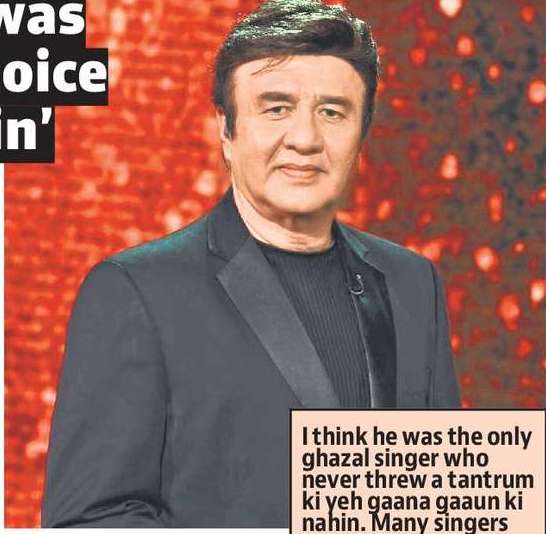
Pankaj Udhas was my first choice for Kitaben Bahut Si-Anu Malik
10:43 AM
Rishabh Suri (HINDUSTAN TIMES; February 28, 2024)
Anu Malik’s first hit song, Kitaben Bahut Si (Baazigar; 1993), was originally sung by Pankaj Udhas. While the makers ultimately decided to go with singer Vinod Rathod’s version, the composer maintains that the late ghazal maestro was his first choice.
“I had chosen Pankaj ji for Kitabein. I asked him, ‘Sir aap gaaoge?’ and he very sweetly agreed. When I played it, he said, ‘The lyrics are by Zafar Gorakhpuri (poet), how did you turn a ghazal into a commercial song?’ I was taken aback by the compliment. He gave me a hug and said I would go places,” recalls the musician. “He was a star then, and he was a star when he died,” says Malik.
Having worked closely with the ghazal legend, Malik is yet to come to terms with the loss. He says, “I am anguished just like everyone else. 72 is too early an age to go.”
The humility and honesty with which Udhas operated reflected in his music. Ask the 63-year-old how the singer reacted when Rathod’s version was picked for Baazigar, and he says, “I had told him, ‘Pankaj ji, main ek album kar raha hoon because I have no work. If the song is picked for the film, a different voice will be used. He simply said, ‘Kya farak padta hai?’ He was completely okay with it.”
Calling Udhas “soft-spoken like late Mohammed Rafi sahab”, the composer adds that the music legend was open to singing any kind of song: “I think he was the only ghazal singer who never threw a tantrum ki yeh gaana gaaun ki nahin. Many singers just refuse to sing a track if it doesn’t fit their format. But, Pankaj ji could sing any song well.”
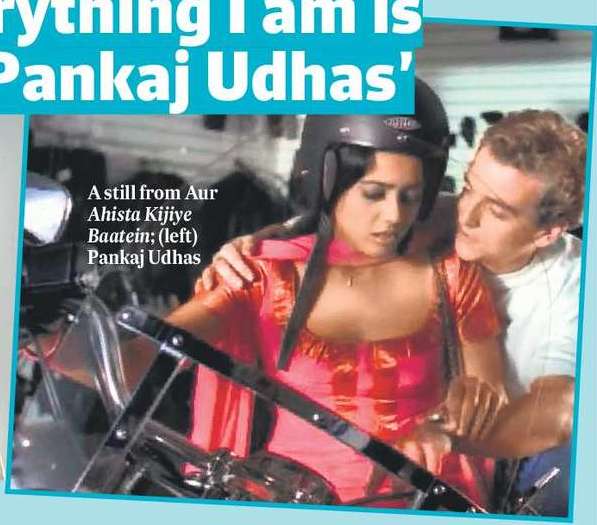
Today, everything I am is because of Pankaj Udhas-Sameera Reddy
10:42 AM
Navya Kharbanda (HINDUSTAN TIMES; February 28, 2024)
Sameera Reddy is “heartbroken” over the death of late singer Pankaj Udhas as the music video for his song, Aur Ahista Kijiye Baatein, helped her break into the film industry.
“Today, everything I am is because of him,” says the 45-year-old, adding, “They spotted me in 1998. I was a young kid with no aspirations. Somehow, I became a part of this cult song. It was a privilege and an honour.”
Meeting the Chitthi Aayee Hai (Yaad; 1993) and Rishta Tera Mera (Jai Vikraanta; 1994) singer after she made it big, Reddy says, “I remember meeting him, at a party, when I became an actress, I took a bow [in front of him] and said, ‘People spotted me because of you.’ He was so touched and pleased. He smiled and said, ‘It was only because of your hard work’.”
Her voice breaking as she speaks to us, the actor says, “He was always so grounded. Nobody will forget him. He is a legend and his music will last forever. Even today, my generation comes together in solidarity whenever that song begins. It is nostalgic and brings emotions and people together.”
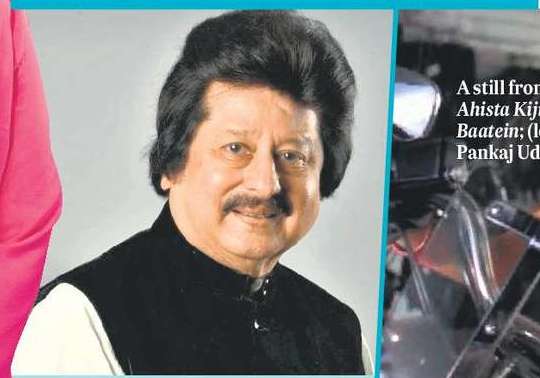
Talat Aziz, Anup Jalota, Sadhana Sargam, Sivamani remember Pankaj Udhas
8:18 AM
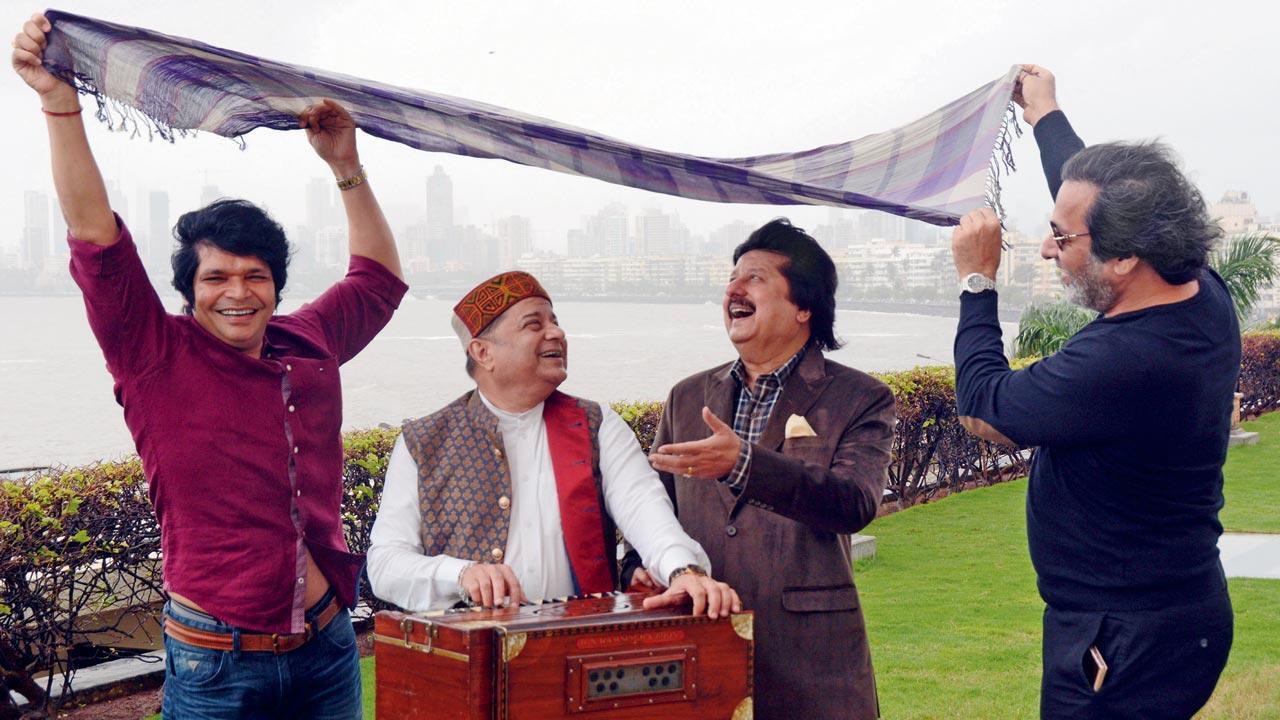
Udhas flanked by Rakesh Chaurasia, Jalota and Aziz. Pic/Satej Shinde
As the Khazana troika that popularized ghazals loses one of its pillars, Talat Aziz and Anup Jalota remember their friend who encouraged young musical talent
Sonia Lulla (MID-DAY; February 27, 2024)
Were they artistes first, friends later? Or was it the other way around? It’s hard to tell. But one thing is for certain—their shared love for ghazals brought Pankaj Udhas, Talat Aziz and Anup Jalota together, creating a troika that would give the genre of ghazals its fitting place in the world of music with their initiative, Khazana.
On Monday, as news of Udhas’ demise reached Aziz, it marked the end of an era for a friendship. Talking to mid-day from Lucknow, Aziz refers to his late friend’s ghazal to convey his heartbreak.
“All I can say is, [aaj] ghungroo toot gaye. Pankaj and I started our careers together in 1980. He started off with sharabi numbers and branched out to create simple lyrics that appealed to the common man. A lot of his film songs, like Chitthi Aayi Hai [Naam], appealed to the masses. This song used to be his final number [in every show].”
It was in 2002 that the three singers decided to join forces and create Khazana, an annual ghazal festival that would not only put the spotlight on the genre, but also create a platform for aspiring singers and new talent. What started over an informal conversation between the trio soon took on a life of its own, becoming a popular festival that had its 21st edition last year.
Remembering how Udhas wanted to scout young talent, Jalota says, “We wanted the young gen to be exposed to ghazals and create suitable compositions to make it appealing for them. He would try to bring young talent together, which was his endeavour with Khazana. We will continue bringing out Khazana even now.”
He adds that he will always remember the singer for his kindness. “He was kind-hearted and ready to help individuals. His voice was perfect for playback in films, and his music was soulful.”
The last time Aziz spoke to him was when Udhas was admitted to the Breach Candy Hospital. “[At the time], he said he had a viral bug. I saw some videos of him, and he appeared to have [lost a lot of weight]. That’s when I knew something was wrong. We later learnt of his pancreatic cancer. We couldn’t communicate with him at all because he had withdrawn. We knew then that it was only a matter of time.”
-----------------------------------
Sadhana Sargam and Sivamani remember their friend, colleague and co-collaborator
Sonia Lulla (MID-DAY; February 27, 2024)
Singer Sadhana Sargam remembers Pankaj Udhas as “a kind-hearted, sophisticated and very good-natured person.” She says, “His voice was beautiful, a gift from God. His contribution to the field of ghazals [is unparalleled], and he had made a special place for himself in this world. Despite the presence of several revered ghazal artistes, he could create an atmosphere that was [unique to him]. He created an era, and that is a commendable thing that few can do.” Shocked by the news of Udhas’ demise, Sargam admits she had no idea he was so unwell.
“His film songs were popular, and some of the songs that I sang with him, including Mohra’s [1994] Na Kajre Ki Dhar Na Motiyon Ke Haar, continue to hold a special place in my heart. Pankaj ji and I sang it together on stage on many occasions thereafter,” she reminisces.
She also collaborated with him on Khazana and co-created the album, Kabhi Aasoon, Kabhi Khushboo. She adds, “Pankaj ji was successful in bringing Urdu to the people by simplifying it for the masses. His poetry was as simple as he was as a person.”
A self-confessed fan of Udhas’ work, Sivamani shares, “Pankaj ji’s demise is a big loss for the industry. He has given so many singers the chance to showcase their skills on this platform, and that is admirable.”
Calling Udhas a great master, the percussionist adds, “He had a unique voice and was capable of pulling off phenomenal concerts. At his concerts, he focused on presenting and furthering his traditional music appropriately and did it in the most beautiful way possible.”
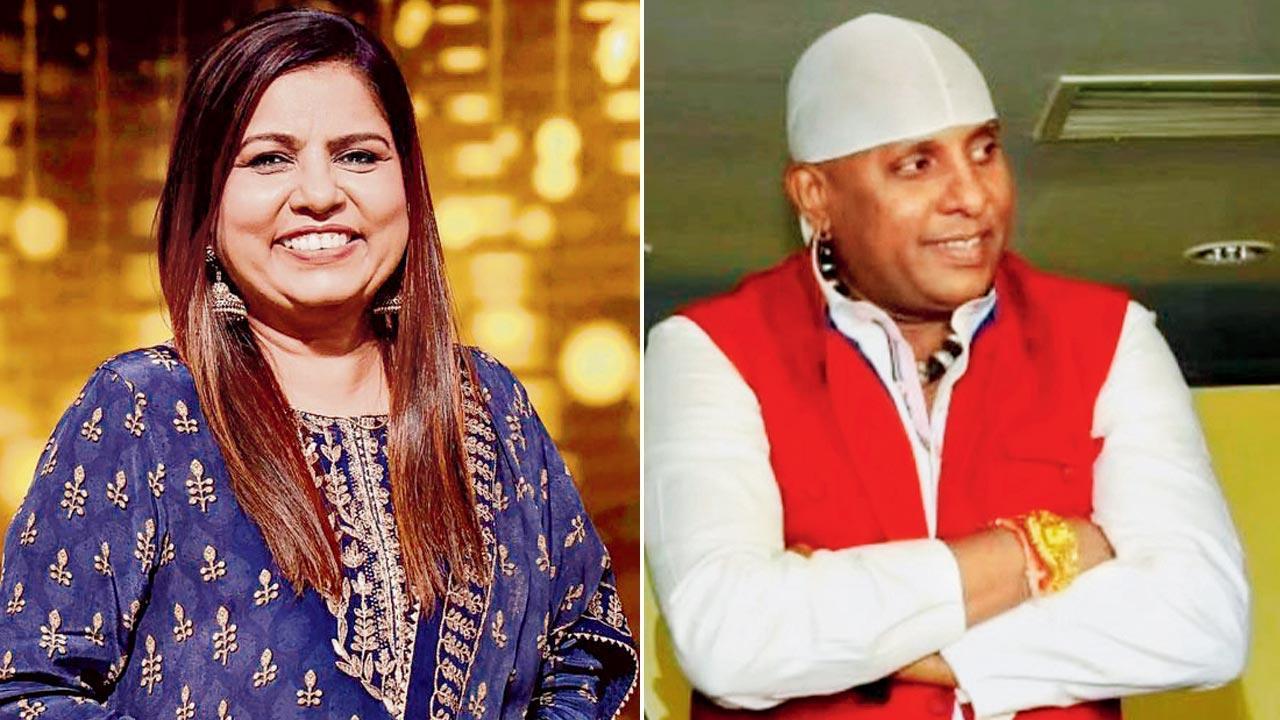
Pankaj Udhas no more, ghazal loses a chart-topper
8:13 AM

Avijit Ghosh (THE TIMES OF INDIA; February 27, 2024)
He completed evenings. In the 1980s and ’90s, ghazals sung by him were mandatory at parties and gatherings. They were like companions helping listeners unwind, enlivening many a ‘spirited’ sunset. Pankaj Udhas, whose audience-friendly renditions and easy on the ear compositions sold millions of cassettes, packed hundreds of concerts and took ghazals to new followers, passed away after “prolonged illness” at a Mumbai hospital on Monday. He was 72.
------------------------------------------
Ghazal chart-topper Pankaj Udhas, the voice behind ‘Chitthi Aayee Hai’ and ‘Jeeye Toh Jeeye Kaise’ passed away at a Mumbai hospital on Monday. His daughter, Nayaab, made the announcement on Instagram.
Primarily a singer of non-film ghazals and geets, Pankaj delivered Bollywood’s biggest 1987 chartbuster: ‘Chitthi Aayee Hai’ (lyrics, Anand Bakshi; music, Laxmikant-Pyarelal; film, Naam). The song, which topped Binaca Geetmala’s annual countdown show, touched an emotional chord, especially among NRIs and PIOs.
Some of Udhas’ finest numbers are in the 1981 album, Muqarrar. ‘Tum na maano magar haqeekat hai’ (poet Qabil Ajmeri) and ‘Deewaron se milkar rona achcha lagta hai’ (poet Qaiser-ul-Jafferi). Another popular track from the same album, Sabko maloom hai main sharabi nahi (poet Anwar Farook Habadi) spurred him to do a reprise with Paimana (1983), a collection of ghazals that went down well with tipplers; it had Thodi thodi piya karo (poet S Rakesh) and La pila de saakiya (traditional).
A science graduate from Mumbai’s St Xavier’s College, Pankaj spent his early years in Gujarat. In an interview to the Sunday Guardian in 2018, the singer recalled his father playing the musical instrument ‘dilruba’, and him liking the sound.
Pankaj also remembered being fascinated by the tabla and enrolling for a course but later switching to learning Hindustani vocal from Ghulam Qadir Khan Sahab in Rajkot. “Then I came to Mumbai to learn from my guru, Master Navrang Nagpurkar. He was a very famous singer from the Gwalior Gharana,” he said in the interview.
The 1980s saw two divergent trends in popular music. One was led by the breathless beats of disco, the other by the more reflective ghazal. The peerless pair of Jagjit and Chitra Singh had already initiated a new gene ration of the middle class to the non-film ghazals. A Padma Shri recipient who also worked to eradicate thalassemia, Pankaj was among the young bunch of ghazals singers - Talat Aziz and Anoop Jalota were the other two – who were part of that wave.
------------------------------------------
RWITC mourns a horse racing enthusiast
Ghazal singer Pankaj Udhas was a keen racing enthusiast too. A member of the Royal Western India Turf Club (RWITC), Udhas owned a few horses and would visit Mahalaxmi Racecourse. “He would call and ask if his horse has a chance to win,” RWITC-based trainer H J Antia told TOI on Monday.
Antia trained his horses. “And when I would tell him yes, he would specially make time to come to the Mahalaxmi racecourse,” added Antia. The late singer would also visit the stables at the racecourse to check on the horses, he said.
“We lost a very genuine member of the club,” said RWITC chairman Surendra Sanas. “It is also a personal loss for me. He would make it a point to visit the club on Classics race days and almost certainly on Indian Derby Day,” recalled Sanas.
Surgeon Dr Mehli Nazir, who jointly-owned horses with Udhas, said, “We bought our first horse called Aliyana sometime around 2010. And then we owned a couple of more horses together. When Aliyana won in Pune the first time, he was thrilled to lead the winner. It was his first ever win,” said Dr Nazir.
“He found it difficult to devote time to racing after 2018 because he had a busy schedule,” said Adhirajsingh Jodha, who trained a horse called Speed Of Sound owned by Udhas in partnership.— Shailendra Awasthi
------------------------------------------
Ghazal maestro, Padma Shri Pankaj Udhas dies after battling prolonged illness; industry peers shocked and devastated
HINDUSTAN TIMES (February 27, 2024)
Inarguably one of the most renowned ghazal voices, Pankaj Udhas has died at the age of 72. His daughter, Nayaab, issued a statement on Instagram on Monday to announce the news: “With a very heavy heart, we are saddened to inform you of the sad demise of Padma Shri Pankaj Udhas on 26th February 2024 due to a prolonged illness.”
Born in Gujarat, Udhas was keen about music from a young age. It was in 1986 that his playback career took off with the cult classic Chitthi Aayi Hai for the film Naam, and there was no looking back after that. Chandi Jaisa Rang Hai Tera (Ek Hi Maqsad, 1988) Jeeye Toh Jeeye Kaise (Saajan, 1991) and more cemented his legendary status. He remained active in films until 2016, when his song Raat Bhar Tanha Raha was featured in Dil Toh Deewana Hai.
He is survived by wife Farida and daughters Nayaab and Reva.
----------------------------------------------------------------------------
A symphony of memories
In a 2016 chat with Soumya Vajpayee, Pankaj Udhas spoke about his journey as a ghazal singer and the future of the genre
ON HIS JOURNEY
It’s been interesting, challenging and satisfying. When I started out, the ghazal had just started gaining popularity. Even then, Bollywood music dominated the scene.
ON WHAT MADE HIM POPULAR AMONG THE MASSES
When I started singing, I was influenced by Begum Akhtar and Mehdi Hassan’s styles. But as I grew up, I realized that I shouldn’t keep singing like them. I wanted to create my own space. That’s when I started creating a style of my own. I wanted to reach out to the masses, as the ghazal was always limited to a very small audience. I wanted to make it more accessible. So, I composed the ghazal, Aap jinke kareeb hote hain. Anyone who could speak Hindi could understand it. That clicked, and I realized that I had found the success formula.
ON NOT SINGING FOR BOLLYWOOD ANYMORE
To be honest, I would love to sing for movies, as that’s a very exciting medium. I cannot deny that some of the Hindi film songs that I sang have had a huge impact on my career. They helped me gain popularity. Songs like Chitthi Aayi Hai and Jeeye Toh Jeeye Kaise helped me reach out to audiences across the world. It’s a different story that the style of songs and the approach to music in Bollywood has changed drastically now. Perhaps that’s why we (ghazal singers) are not called in to sing anymore.
ON LATE MEHDI HASSAN AND JAGJIT SINGH’S ROLE
After they arrived on the scene, people started talking about ghazals. There was a curiosity about this kind of music. By the time I started out, which was around 1978-79, Bollywood music was struggling to impress the masses. The audience was looking for an alternative. That’s when the ghazal started to rise. After the ’80s, it became a craze. I am glad to have been around when the ghazal ruled the roost.”
Farewell, ghazal king
SONU NIGAM, SINGER
Pankaj ji was one of the most important parts of my childhood. I will miss him forever. My heart cries.
KAVITA KRISHNAMURTI, SINGER
He was my friend since college and the nicest man I’ve known. He would always smile and talk to everyone; he’d never discriminate. The world has lost not just a singing icon but also one of the sweetest and simplest human beings.
SUKHWINDER SINGH, SINGER
During the video shoot of one of my songs from the album Nasha Hi Nasha Hai, he invited us all for dinner and lunch. He even extended our stay for the next night, just because he wanted to talk to us. The world has lost a great icon and I still can’t process that he is gone.
SALIM ARIF, THEATRE PERSONALITY-DIRECTOR
I was working on a musical show, based on (poet) Mirza Ghalib’s letters, with Pankaj ji. We couldn’t meet the last four months as he was not keeping well. It’s a personal loss.
I look at sir (Pankaj Udhas) as a mentor because when I came into this industry as a model, he was the first person who graciously accepted me in his music video, Chupke Chupke. He is the one man who is more than responsible for my success. I just told him that your voice still sounds so beautiful, it’s amazing.
TALAT AZIZ, SINGER
I can’t believe I have lost my dearest and oldest friend. Pankaj, Anup (Jalota) and I go way back. This is really shocking. I spoke to Nayaab (Udhas’s daughter), too. Rest in peace, my friend.
ANUP JALOTA, SINGER
Mera yaar chala gaya. I am heartbroken. Hum logon ne kitni shaamein saath bitaai, kitni yaadein hain... yakeen nahin ho raha. We started Khazana (annual ghazal festival) together. Now, I would like to take it forward with his daughter Nayaab.
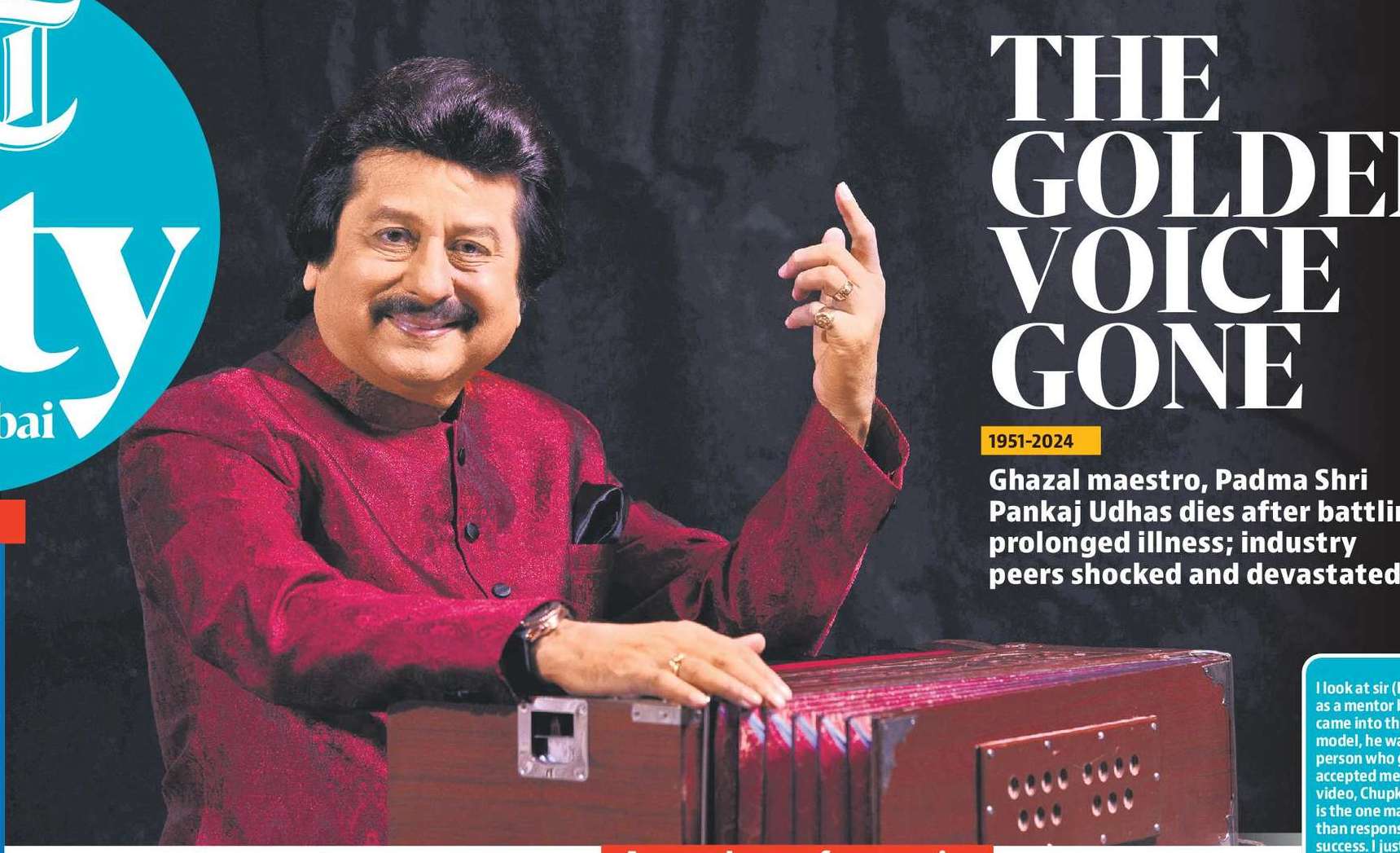
It’s been our dream to perform together on stage-Vishal Bhardwaj, Rekha Bhardwaj
8:48 AM

Debarati S Sen (BOMBAY TIMES; November 10, 2023)
Music brought Vishal and Rekha Bhardwaj together, and their passion for music has only strengthened their bond over the years. The duo always dreamt of singing together on stage, but that never really happened until now. After over three decades of being together, the couple will perform for an upcoming concert this month for a special cause.
In an exclusive conversation, filmmaker-composer-singer Vishal Bhardwaj and singer Rekha Bhardwaj talk about their love for music and what keeps them connected and rooted.
During your Hindu College days, music was what brought you both close. That was decades ago. What took you both so long to come together on stage?
Vishal: I never thought I was a good singer, I always considered myself to be a composer. Later in my career, I started singing tracks. I used to sing Lata ji’s (Lata Mangeshkar) dummy tracks. I would sing to explore songs with musicians on track and then the singer would dub. In that process, mujhe bahut zyada experience aaya gaane ka. Kai baar aisa hua ki sab logon ne bola ki yeh meri awaaz mein accha lag raha tha. So, maine apni singing bahut late in life discover ki. Rekha is classically trained, and I am not. Mujhe stage fright bhi tha bahut zyada. Jab mere shows hone lage, mujhe stage ka confidence aaya. So now, I can dare to sing with her.
Rekha: It’s always been a dream. Vishal aur hum bahut saalon se chah rahe thay ki we should perform together. Aur Gulzar saab bahut kehte hain ki saath mein program karo, hum log saath kartein hain. Pankaj Udhas and his daughter Nayaab planned this concert for the welfare of Thalassemia patients, and we are happy to support the cause.
Vishal: What Naayab and Pankaj Ji is doing (for Thalassemia patients) is commendable and great. Iss cause ki ladai pata nahi kab khatam hogi. Pata nahi kab iska ilaaj ho payega. If we can contribute even a little from our side in this fight, it will be great.
While this will be the first time the two of you will be singing together on stage, you must’ve sung together earlier, too?
Vishal: Long ago, we had sung a duet together. When the Copyright Act was passed in 2012, we had performed for Parliamentarians at the Parliament House. Kapil Sibal sahab liked old songs, toh unki farmaish pe maine aur Rekha ne Haal Kaisa Hai Janab Ka gaya tha. Bahut maza aaya tha.
Have you both been doing a lot of riyaaz for this performance?
Vishal: Riyaz nahi, hum log tayyari kar rahein hain. Bahut mehnat kar rahein hain. We are doing this for the first time, toh kafi nervousness bhi hai. It should be extraordinary. The other thing is that hamare keys ka bhi issue hai. Rekha has a low-pitched voice and mine is a high pitched one jo normal male voice hota hai. So we have to design a duet ki kaise hum log ek middle ground mein aa jayein ki Rekha ke liye high na ho aur mere liye bahut low na ho.
Rekha: We will also sing solos along with duets. Aisa nahi hai ki saare duets hi honge.
What keeps two creative people like you going so strong for over three decades? Just like everyone you must have also faced challenges and hiccups in your relationship. How have you dealt with them?
Rekha: Actually, four decades. We’ve known each other since 1984. During college, we were friends, and then we started dating. Yes, mushiklein aatien hain relationship mein. But I think the emotional bonding and our compatibility, jo music ko lekar hai, helps. Now, we have started giving each other space. Beech-beech mein problems aatien hain. There is no formula for a perfect relationship. You have to accept the other person with all his or her good and bad.
Vishal: Yes. There is a formula. You have to keep working on your relationship and on yourself every day. That’s the only formula. When you are in a relationship, then you have to do both these things. You may have a different point of view on various things – brushing you teeth, waking up in the morning, reading at night or watching laptop, then you have to work towards that. Relationships are a everyday work. Auto pilot pe rakkh diya yeh kabhie nahi ho sakta hai.
Rekha: I have realised that jaise jaise expectations kam hone lagtien hain, that helps a lot. Otherwise you keep expecting the other person to react the way you want them to.
Vishal: You should never want to change the other person. You have to be ready to change yourself and then the relationship will work.
Rekha, in an Instagram post, you said, ‘What kept us close was the crazy streak we both have, perhaps still have’. Tell us more about this crazy streak…
Rekha: When we met in college, Vishal was singing for a programme. Later, at the annual function, all the participants had to sing Ramaiya Vastavaiya on stage. Hum dono do corners mein they, and we went really crazy. Hamara kya hain na, we get carried away. We don’t care for the world and just do our own thing. It’s not that ki we plan it. Aaj tak hum aisa kartein hain. Hum emotionally bhi carried away ho jaatein hain. While singing also hamare mazak jo chalta hai, bahut funny sa ho jata hai. Masti mein pagalpan ho jata hai.
Wouldn’t you like to add anything to this?
Vishal: Nahi, nahi, bol hi diya hai inhone. (laughs)
Rekha: Saari details toh share nahi ki jaa sakti hai. (laughs) Hamara ek bada cute sa memory hai. Earlier, when Vishal wouldn’t be so busy, our son Aasmaan was fond of DJing and he would put on music after our meals and we would all dance! There were times when we have stood on his windowsill and danced! We have had wild times.
You have played state-level cricket Under 19. You have a passion for cricket. What do you feel about the ongoing World Cup?
Vishal: India is playing so well. I hope that we win the world cup!
I was nervous when I got back on stage after two years-Pankaj Udhas
8:26 AM

Soumya Vajpayee (HINDUSTAN TIMES; May 17, 2022)
“I am like a fish without water when I am not on stage. I have been a performing artiste all my life and the pandemic phase was the toughest,” says veteran ghazal singer Pankaj Udhas, who has been performing regularly in India and abroad ever since things opened up a few months ago.
Ask how performing live feels like after such a long gap and the Padma Shri recipient says, “Before the pandemic, there used to be a lot of confidence in me before any concert. But the lockdown phase was tough for all, even psychologically. Though I did my riyaaz regularly and tried to keep up and not get rusty, there was a lack of exposure to the stage and audience. So, when I got back on stage after two years with a concert in Rampur (Uttar Pradesh), I was really nervous. But when I went up on stage and saw 6,000 people cheering for me, I had tears in my eyes. It was a really emotional moment, as I was deprived of the stage for so long.”
Though the singer has been performing frequently and has a string of concerts lined up, one thing he doesn’t compromise on is his safety. “When I started performing live again, I’d be so paranoid. I feared contracting the virus even by touching things at concerts,” he says, adding, “Safety really matters to me. I make sure that nobody comes close to me without wearing a mask.”
So, has he observed any change in the audience’s conduct? “They have become more enthusiastic compared to pre-pandemic days. They value your performance much more than before,” says Udhas, who turns 71 today. Sharing how he will spend his birthday, he says, “Coronavirus is still around and people are still suffering. So, I am not really in a mood to celebrate. I’ll have a low-key birthday with my family.”
Shiv Kumar Sharma was offered a role in Amitabh Bachchan's debut film, Saat Hindustani
8:17 AM
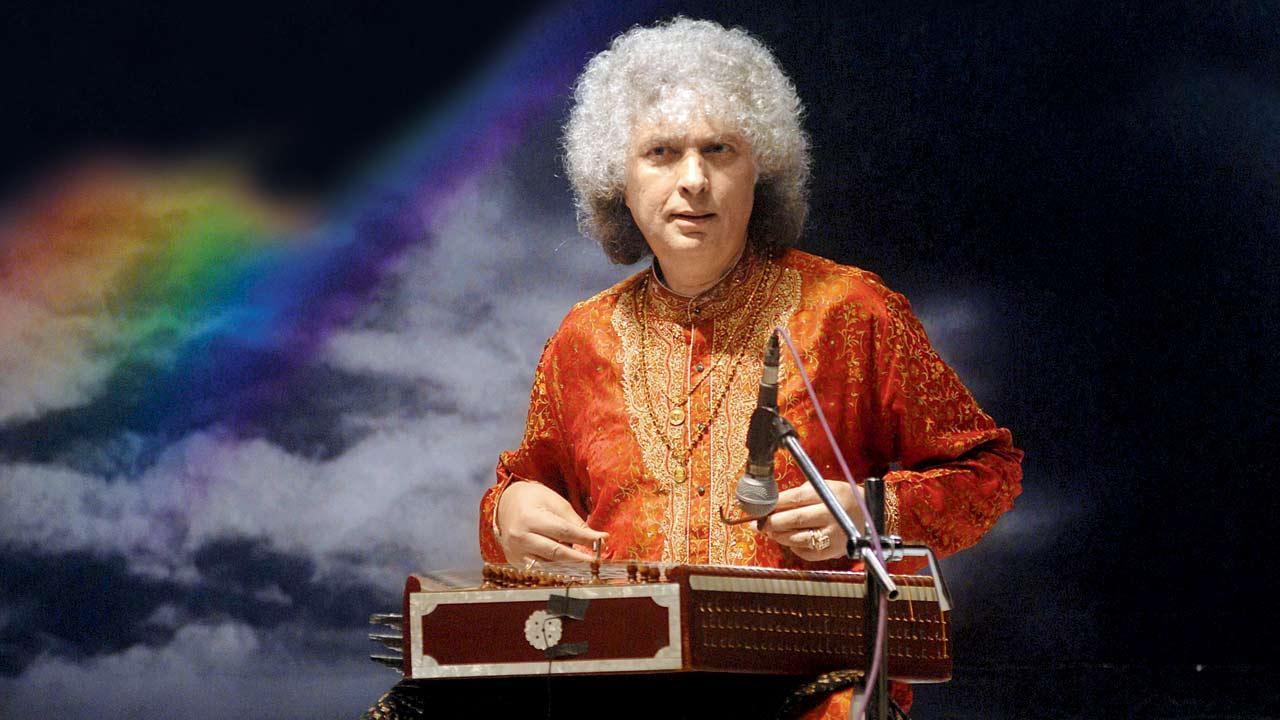
Ustad Amjad Ali Khan, flautist Rakesh Chaurasia remember the maestro who gave the santoor its exalted status in Indian classical music
Yogesh Pawar (MID-DAY; May 11, 2022)
The year 1967. Filmmaker K A Abbas was explaining a situation to musicians gathered for the background score of his Dharti Ki Pukaar. When his eyes fell on a young musician, he called him aside. The young man felt Abbas wanted something specific in the music, but was shocked when he was offered a role in Saat Hindustani (1969). “Dikhte-bolte bhi theek ho... kad-kaathi bhi sahi hai,” Abbas told him.
The young man folded his hands, and said he was happy to only pursue music. Had the 29-year-old agreed, he would have debuted along with Amitabh Bachchan. What that trajectory would’ve done for Pandit Shiv Kumar Sharma, we’ll never know, but the silver screen’s loss was music’s gain. The octogenarian legend was suffering from kidney problems for the past six months and was on dialysis. He breathed his last on Tuesday morning, following a massive cardiac arrest soon after his bath, according to his family.
Among those condoling the maestro’s demise was Prime Minister Narendra Modi, who tweeted: “Our cultural world is poorer with the demise of Pt Shiv Kumar Sharma ji. He popularised the santoor at a global level. His music will continue to enthral the coming generations. I fondly remember my interactions with him. Condolences to his family and admirers. Om Shanti.”
Talking to mid-day, sarod maestro Ustad Amjad Ali Khan said his demise marked the end of “a musical era”. “We were close. Our families share a great rapport. We are all deeply saddened by this tragic news. With him, a musical era has ended. We live in a cruel time when so many legends are bowing out. Apart from a pioneering musician, he was an exceptional human being.”
The santoor, previously confined to Jammu & Kashmir, rose meteorically to ensconce itself as a classical instrument, thanks to Sharma. Though connected with the Sufi tradition of Kashmir and called shatatantri veena in ancient texts, it didn’t enjoy its current exalted status at that time. The santoor maestro’s father Pt Uma Dutt Sharma came across the santoor as a music supervisor with a local radio station and felt it could lend itself to the classical style. A young Shiv Kumar (initially trained in tabla and singing) was introduced to santoor at 13. Within three years, he was playing it on the radio.
Despite purists curling their lip at the santoor, filmmaking legend V Shantaram was impressed with the 18-year-old Sharma and asked him to play for his Jhanak Jhanak Payal Baaje (1955) under Vasant Desai. Back in Srinagar, following an argument when he refused a secure job in the Jammu and Srinagar Radio, Sharma left home and came to Bombay with his santoor and Rs 500. Pt Shiv Kumar Sharma has often told this writer of those tough times. “I’d only have an anna in my pocket and nothing to eat. I’d accompany others on tabla since the negative criticism of the santoor meant no concerts,” he’d reminisce.
Odd film assignments helped sustain both him and his fire for the santoor. While the instrument was traditionally played in Kashmir on a small stand, with the player squatting in front, he placed it on his lap to cut vibrations. He worked on the tuning, increased range and discovered how to use mallets to reproduce the Indian vocal nuances. A decade of his toil finally saw the music fraternity warm up to his instrument. With Silsila (1981), both he and flautist Pandit Hariprasad Chaurasia turned film composers, following it up with Faasle (1985), Vijay (1988), Chandni (189), Lamhe (1991), Sahibaan (1993) and Darr (1993).
“In some songs, like Tere mere hoton pe, you can clearly see how he brought in elements of classicism and folk music from the mountains,” remembers ghazal exponent Pankaj Udhas, who says he has never met a more disciplined musician. “Once at an event, he gently stopped me from drinking water immediately after my meal, saying it was bad for digestion,” said Udhas, adding, “Even in his 80s, he never slouched on stage and sat ramrod straight.” He also spoke of Sharma’s prowess over rhythm. “As someone who had played tabla and could sing, it was interesting to see how he would even for Zakir bhai [Zakir Hussain] at times when they played together.”
Santoor exponent Satish Vyas, who trained under Sharma from 1975 to 2006, says he feels orphaned. “Both Pandit ji and his wife treated me like their son. Even when he corrected me, guruji did it gently, playing on each disciple’s strength.”
Sharma knew flautist Rakesh Chaurasia, his colleague Pt Hariprasad Chaurasia’s nephew, from when he was little. “Extremely loving and indulgent, he’d come up after a concert and praise even the smallest improvisation I tried. Sadly, I’ll miss uncle’s loving caress now,” says the flautist.
Career milestones
- Sharma gave his first public performance in Mumbai in 1955.
- In 1960, he recorded his first solo album.
- In 1967, he teamed up with flautist Hariprasad Chaurasia and guitarist Brij Bhushan Kabra to produce the concept album, Call Of The Valley.
- The santoor virtuoso was honoured with the Sangeet Natak Akademi Award in 1986, the Padma Shri in 1991, and the Padma Vibhushan in 2001.
Pallavi Joshi to host an indoor live music concert to collect funds for Covid-19 relief
8:00 AM
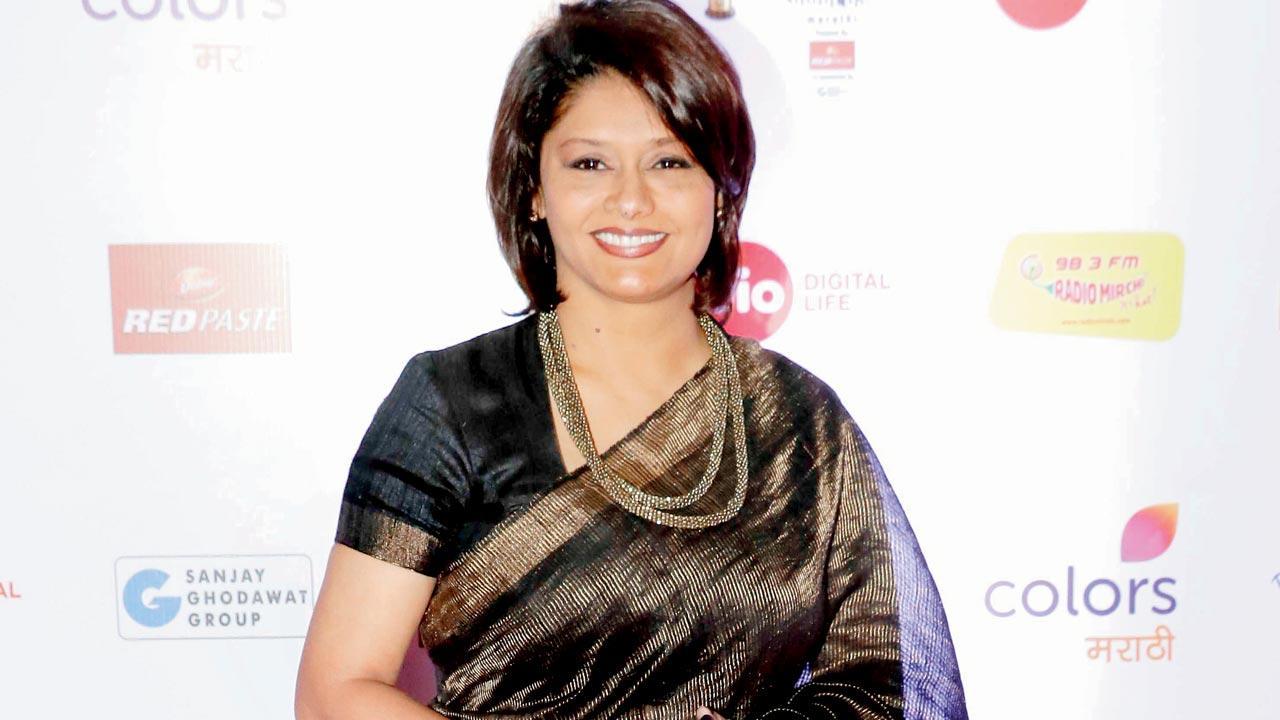
Mohar Basu (MID-DAY; May 29, 2021)
The entertainment industry has gathered again to do their bit for Coronavirus relief. While several have donated their time, money and social media space to the cause, Pallavi Joshi is set to host an indoor live music concert to collect funds. “Whenever the country has faced trials, we, as a society, have stepped up to help each other,” says the actor, who will be hosting singers Sonu Nigam, Talat Aziz, Pankaj Udhas, Hariharan, Prasoon Joshi, Alka Yagnik, Papon, Daler Mehandi, Babul Supriyo, among others for the music event called Ek Saath-India Will Rise Again, on June 5.
In the face of tragedy, Joshi asserts that the film industry has always come forward to help people. “When I was a kid, I remember actors — Sunil Dutt, Balraj Sahni, Amitabh Bachchan, Dharmendra, Shashi Kapoor — everyone had take rallies on streets to collect money to help drought-affected villages. The second wave has been devastating and we want to help orphans, daily-wage workers, women widowed, migrants, refugees and everyone who has lost their means to livelihood [during the pandemic].”
I put on 35 kgs while I saw other actors who bounced right back after child birth-Sameera Reddy
8:31 AM

Ahead of releasing her book on the subject, actor Sameera Reddy talks about the unrealistic standards that women are expected to conform to and the toll it takes on them mentally and physically
Anjana Vaswani (MUMBAI MIRROR; January 4, 2021)
Sameera Reddy was just 19 when she made her first appearance on film. It was in a video of a Pankaj Udhas ghazal. And, dressed in a simple outfit, her frizz-free dark hair cascading down her back as she etches out a rangoli pattern on the floor, Reddy looked dropdead gorgeous, effortlessly so. “Ahista kijiye baatein (“Speak softly”),” Udhas sings in the video. Now, some 22 years later, Reddy’s poised to do the exact opposite. For over a year, she’s been using her social media streams to raise her voice about the pressure to look perfect that women of all ages and in all careers experience; and this year, she’ll be releasing a book on the subject, titled, “Imperfectly Perfect” (Westland Books).
In the forthcoming title, Reddy – whose sisters Meghna and Sushama are also in the entertainment business, having started their careers as models – takes readers through her journey. She talks about life as an insecure teenager, as a model and actor struggling with eating disorders, and then as a new mum coping with post-partum depression and weight gain. “Today, my aim every day is just to be happy,” says Reddy, who hopes her book will guide readers to the sanguine headspace, “where one can be kind to oneself, and one is ready to feel happiness”.
It has taken her a while to get here, and the journey hasn’t been easy. A little over a decade and a half after she made heads turn in that Pankaj Udhas video, Reddy, who had been a successful model and actor and was now mother to a baby boy, found herself grappling with body image issues, and more, she recalls. “Every time I checked social media, the people around me seemed to be living these amazing, perfect, filtered lives and I felt I didn’t have the strength or the courage to be myself,” Reddy recalls. “After the birth of my first child, I broke,” she says, “I just could not live up to expectations”.
Right from the day she heard she was expecting, Reddy had gone by the book – by several, in fact, to prepare for the big day. “I had this picture-perfect idea of marriage and childbirth and pregnancy. I had read the books and was prepared with the hospital bag, and had checked all the must-haves off all the lists, but no one prepares you for the hormonal ups and downs, and the depression that can follow.”
Even the unwavering support of an understanding spouse did little to counter the downer. “I put on 35 kgs and neighbours and people around me would say ‘What happened to you? It’s been a year since you’ve given birth and you’re still so big’. I saw other actors who bounced right back after child birth.” The constant comparisons triggered the deep-seeded body image issues Reddy had already been grappling with for most of her life.
“I felt I had failed,” she says, looking back. The absence of role models who presented a more realistic image of life after childbirth didn’t help. Thankfully, in recent years, celebrities like Soha Ali Khan and Mandira Bedi have also talking candidly about their experiences with the baby blues and postpartum depression, so the future generation of women have healthier, more natural, role models to look to.
This is vital, because, in fact, an estimated 60 to 80 per cent of new mothers experience this. Hormonal changes can cause mild anxiety in some, but in others, the chemical imbalance coupled with the sheer exhaustion of the early days of motherhood can bring on a deep, dark sadness. For most, it lasts for about a week or two after delivery, but left untreated, the condition could sustain for years, too. To make matters worse, the chemical imbalance is often compounded by feelings of low self-esteem when you’re not happy about the way you look and – this one’s often brushed under the rug – disappointment, because you just don’t feel that gush of love or joy that women are expected to after childbirth. Conditioned to believe it’s the happiest experience of one’s life, women who don’t feel that way, tend to assume something must be wrong with them. Often, they, like Reddy, feel they’ve ‘failed’.
In hindsight, Reddy says, “We put so much emphasis on success and failure but really who defines that?”
But Reddy also wants to emphasize that it’s not just new mums who feel this pressure to look, feel and act a certain way. A 2018 study on eating disorders in South India, conducted by N Nivedita, G Sreenivasa, T S Sathyanarayana Rao and S Suttur Malini, showed that over 26 per cent of participants suffered from some sort of ED. Readers would have been recently reminded of Princess Diana’s struggle with Bulimia Nervosa by the new season of a popular TV show. It’s a cycle of bingeing and purging, believed to be commonly triggered by societal and cultural stress, peer pressure, body image issues and poor self-esteem. It wouldn’t surprise Reddy to learn that women have been seen to be nine times more likely to suffer from Bulimia Nervosa than men.
“Environmental conditioning starts weighing down on women very early. Most teens feel this need to adhere,” she says, adding that this is in fact what drove her to speak out in the first place. “We need to break these patterns, and we can only do that if we do it together, as a society.”
It took two whole years of work – therapy, introspection, yoga and homeopathy – before Reddy could arrive at this place, one from where she would inspire and lead others into this journey of self-love. “When you break apart, you can put yourself together in the most liberating way,” Reddy says, “and it’s exhilarating to be where I am today.”
Bollywood music, known for its melody and poetry has taken a back seat-Pankaj Udhas
8:30 AM

Nikita Deb (HINDUSTAN TIMES; October 11, 2020)
Even though ghazal meastro Pankaj Udhas has completed 40 years in the music industry, he says it doesn’t feel like it. “God is kind that I find something new and exciting everyday,” says the singer, who has given hits such as Chitthi Aayee Hai (Naam; 1986) and Aur Ahista.
Udhas, who had come to Mumbai from Rajkot (Gujarat) as a young boy, to become a musician, says that the journey has been quite fulfilling. “It has been a straight graph, I have had a very eventful and satisfying journey. From a very young age, I took up after this particular form of music which is ghazals, and I think because of my tremendous passion, I always wanted to do what was my forte, and therefore, it is even more interesting that I have survived in this field for 40 years singing ghazals. And I am still very much there in the sense that people still do listen to me, and I still have sold out concerts,” says Udhas.
The Padma Shri winner adds that he has constantly been reinventing himself and his music. And he says that the music industry has such a huge range that one end of the spectrum may not be familiar with ghazals at all.
“Even though the common belief is that people do not listen to ghazals at all, but since the advent of social media, I have realised that the number of people who listen to ghazals is unbelievable. I have never made any bones about it but we all know that in India, there is nothing more popular than Bollywood and cricket. And in the field of entertainment, no one has ever come anywhere close to Bollywood, and that has been the case for years. So, we have to accept it with a pinch of salt or sugar. Cinema music has always prevailed but ghazals have been part of our very old tradition. And you have to accept the fact that a style of music, which has been around for 400 years, must have something to offer otherwise, it could not have been around for so long,” says Udhas.
The singer adds that he feels elated when he sees youngsters on social media singing covers of his popular ghazals.
“This genre has its own charm and attraction. In my 40 years of career, I have seen times when ghazals used to top every chart, and I have also seen times post 2000s when people barely listened to this genre. So, I have seen both the extremes, but now again, in 2020, there is a vast audience for this form of music because somewhere, Bollywood music has faltered. Bollywood music which was always known for its melody and poetry has somehow taken a back-seat because somehow, the element of good poetry and good melody is missing. Most of the music that we listen to today, is not up to the mark. I am sorry to say but ghazals have always been a second choice, but I am happy that at least, it is a second choice so that when the whole world gets tired of listening to Bollywood, they can resort to this genre,” concludes Udhas.
Singer Anuradha Paudwal’s son Aditya passes away due to kidney failure
8:51 AM

BOMBAY TIMES (September 13, 2020)
Singer Anuradha Paudwal’s son, Aditya, succumbed to kidney failure on Saturday morning. According to reports, the 35-year-old, who was a music composer, arranger and producer, was battling kidney-related ailments for a long time. From the music fraternity, Shankar Mahadevan, Adnan Sami, Pankaj Udhas, Harshdeep Kaur and Armaan Malik were among those who took to social media to express grief over the young musician’s demise.
Shankar wrote, “Devastated hearing this! Our dearest Aditya Paudwal is no more!! Just can’t believe this! What an amazing musician and a lovely human being!! I just sang a song which was programmed by him so beautifully two days back! Just can’t come to terms with this!! Love you brother... miss you (sic).”
Singer Harshdeep Kaur said, “Extremely devastating news. He was truly talented and such a sweet person. May his soul rest in peace.”
Vocalists feel orphaned today, says Pankaj Udhas in his heartfelt tribute to Pandit Jasraj
8:20 AM

Ghazal maestro Pankaj Udhas pays heartfelt tribute to the doyen of Hindustani classical music, Pandit Jasraj
As told to Sonia Lulla (MID-DAY; August 18, 2020)
 My first interaction with him was in the mid-'70s, when I was struggling to find my feet. After that, I met him frequently. He was full of love and blessings, and always motivated people. My most recent memory of him is from this February: The sons of famous qawwali duo Shankar-Shambhu hold an annual felicitation event, the Shankar-Shambhu Awards, where they honour a musician of high calibre. This year, they gave the award to Pandit Jasraj ji. At the age of 90, here was a man who was so alert. He held my hand as we made our way to the stage, and for the entire duration that I spoke about him, and his speech that followed, he didn't let go of my hand.
I won't forget how he expressed his love for me.
He was the doyen of classical singing. Indian classical vocalists feel orphaned today. Artistes like him are not born anymore. At 90, he had the same dedication for music that he did 50 years ago. He dedicated himself to the upliftment of the genre.
I had worked on an album with Sadhana Sargam, who was Pandit ji's student. I recall [being mesmerised] as soon as she began singing. I told her she was fortunate to have learnt from him, and that I wish I too had a chance to be his student. His [superior] method of teaching is evident in the success of his disciples. [He was a great teacher] because he had an understanding of Indian classical music, and was well-versed with our scriptures and Vedas. Hence, he knew the techniques of classical singing, which also involves voice culture. The technique includes voice modulation, breath-control and the perfect pronunciation. If you've worked with Pandit ji, you are likely to be well-versed with ragas. Only someone who is familiar with them can do justice to them. We will miss his presence, but his music will live on in the hearts [of his fans].
Even today, I never get tired of ghazal-Pankaj Udhas
8:27 AM

Singer Pankaj Udhas, who completed 40 years in the industry, reminds us that Ghazals — the genre he pioneered — should go through a revival
Sanskrita Bharadwaj (HINDUSTAN TIMES; March 22, 2020)
 As a young girl growing up in the ’90s, it would be an anomaly if you didn’t gush over John Abraham in Pankaj Udhas’ music video for Chupke Chupke, or if you didn’t empathise with Sameera Reddy’s in Aur Ahista. Udhas, in the Indian context, is a Ghazal singer beyond recognition. Not only a prolific singer, he had a certain flair for coming up with romantic and mushy, yet unusual videos for all his songs.
This year, the maestro has marked 40 years in the industry. A feat, he says, he’s proud of as he never thought he could be “popular”. “My passion for this form of music is absolutely pure. Even today, I never get tired of the genre. I genuinely believe that it is my passion and hard work which has paid off,” he adds.
 Back in the day
The singer, who comes from a family where everyone was into music in some way or the other, says, “My father used to play an instrument called the dilruba. It is closer to a sarangi and he played it like a hobby. I have two elder brothers — Manhar and Nirmal Udhas. They’re both well-known singers. Manhar has sung quite a few popular film songs. I am the youngest of the three, so, I grew up learning a lot from them. I took it up from there, and then, internally decided that I wanted to sing. I completed my school and college education. The point is that I grew up in an era, where there were only two music labels available and to get a deal with them was like winning an Oscar. You had to really prove yourself. I was lucky to be able to record a film song at only 20 years of age, for a film called Kaamna (1972), the music for which was composed by Usha Khanna. I sang a nazam; it was a beautiful one. After that, I struggled hard to get a break.”
He admits that at one point he had plans of “giving up”. “I felt I should look for an alternate vocation in life, because it was not working out. I took a break and went away to Canada for some time. I thought of making a living there. You wouldn’t believe… within three to four days of my arrival in Canada, I ended up singing. I did many concerts there. I realised two things. Firstly, I could hold an audience of 600 to 700 people for three hours by singing Ghazals. Secondly, I gathered tremendous confidence about being able to entertain people,” he elaborates.
The market in Canada, Udhas says, was limited and he knew his future and destiny lay in India. So, he packed his bags and came back.
Udhas grew up in the era of the radio. For him, there were no other means of listening to music. “We had a radio at home that kept playing most of the time. Two singers who really inspired me were Begum Akhtar and Lata Mangeshkar,” he says.
Four decades
The singer, who lent his voice to cult songs like Chitthi Aayi Hai (Naam; 1986), has performed all across the world and has also made an impact in Bollywood and Indie music through his songs. He is witness to the change that music has gone through, especially in India, over the years.
“The business model of music has changed tremendously since I started my career in 1980. Back then, it was a brick and mortar business of CDs and cassettes. Although it was difficult to 'make it big', if you were good, 60,000 cassettes could be sold out within five days of the song being out. The revenue generated also went on in promoting and giving a space to new artistes. But, today, we have reached a point in the music business where not enough revenues are made. If you do a single or an album, you put it on iTunes. But India is still not ready to use a credit card and purchase music online. There are online payment options, but at the grassroots, buyers are still not using it,” Udhas explains.
Will times change?
There is a known concept, Udhas says, that television does not work anymore. “I feel it still does. It is very effective. Television drove my music videos as well. The other important elements are various social media apps, where you create your channel and try to make a base. Bollywood, of course, is still big,” he says.
According to Udhas, YouTube needs to be used more effectively. “I have my own channel and I have more than 1,00,000 subscribers as of now. I was a little late and a little slow on it, but what I have tried to develop is a certain side of my personality. I think there should be informative programmes about Ghazal singers and Ghazals. That could be a way to keep the genre alive,” the singer signs off.
Mohra: The movie that caused the world’s water crisis
8:55 AM

MOHRA MOVES: Akshay Kumar is set to do a remake of this song. However, the drenched lady will be played by Katrina Kaif instead of Raveena. (Right below) Alia Bhatt dances to the same tune
Arnab Ray (THE TIMES OF INDIA; July 7, 2019)
 As Indian cities struggle with dwindling supplies of water, prompting even Leonardo DiCaprio, the man who died from too much water in Titanic, to tweet about the dangers of too little, it is worth remembering the great film Mohra.
Released twenty-five years ago (on July 1, 1994), many scientists blame it for triggering the water crisis that has swept the world. According to legend that was spread over the WhatsApp of the day, during the shooting of ‘Tip Tip Barsa Paani’, a song featuring Akshay Kumar and Raveena Tandon, entire oceans were drained through the action of drenching reporter Roma Singh played by Raveena Tandon, as she danced on the roof under a deluge that would make Noah keep his ark tethered to the shore, while Akshay Kumar, observed the effect of buoyancy and Bernoulli’s equation in real-life fluid conditions, and then decided to become a Canadian citizen. This song, over the course of 25 years, has led to much wastage of wetness, and to this day, remains a popular staple of Bhojpuri orchestra performances where water is poured on the dancer to the tune of this song in tepid simulations of the original, with nary a concern for the environment.
But to limit the scope and impact of Mohra to just this one song is like dismissing Sistine Chapel as just a painted ceiling.
Mohra is a cinematic milestone, the kind of movie that not influences a genre but who you choose to become. Released a month before Hum Aapke Hain Koun...!, which would irrevocably change the face of Bollywood with chocolate, lime juice and “mausam ka jadoo hain mitwa”, Mohra was the last Elaan-e-Jung of the old Bollywood action potboiler, before the Barjatyas, the Chopras and the Johars would flood out the genre forever with their pink slush of fraud NRInostalgic romantic sugar-water.
Inspired by Death Wish 4, Mohra almost had its thunder taken away by an earlier released inspired by the exact same film. Called Bhookamp (Earthquake) it had the legendary Rahul Roy dancing to “Tum jo mile gulshan khile” with Mamata Kulkarni, but for reasons I shall never understand, like how cricketer Devang Gandhi never became Don Bradman, it sunk without a trace.
Mohra though was made of sterner stuff. Akshay Kumar, Raveena Tandon, who was the real hero of the movie and the joker of the pack, Sunil Shetty (then without the “e”), ably backed by Paresh Rawal and Naseeruddin Shah, this was 90s cinema at its very best.
Names like Jindaalll and Tyson and Gibran.
Superhit tunes from the Amit Shah of techno-qawwali, Viju Shah.
Roaring action.
Lyrics like “Subaah se lekar shaam tak, shaam se lekar raat tak, raat se lekar subaah tak, subah se phir sham tak, mujhe pyar karo” which depending on your mood could be a soft romantic song or the tag line for Viagra.
Never-saw-that-coming twists like Pankaj Udhas doing the voice of Sunil Shetty.
The most beautiful description of fault tolerant system architectures I have ever encountered in popular cinema in “Ei kaash kahee aisa hota, ke do dil hote seene mein, ek toot bhi jata ishq mein to, taqleef na hotee jeene mein”
The most poetic excuse for an unintentional breaking of wind in “Chalee kaisi yeh pagal pawan main kya karoon”.
But all of this pales in front of the most bizarre ending of the era, something straight out of David Lynch, with Naseeruddin Shah, the villain, who rather than escaping from the clutches of the hero, chooses to waste precious time trying to humiliate him, first by making him get down on his knees, then slap himself and then finally making him take off his pants, while giving live commentary “Patloon utaar raha hai, Baat accha hai” in the deliriously happy tone of Manjrekar when a player from Mumbai plays well, while all the while Sunil Shetty screams Naheeee naheee, which would inspire years down the road, some of the most iconic sequences of Dhadkan, the last great 90s movie ever made, again starring the two leading heroes of Mohra.
Twenty-five years ago. All of this happened.
Aah how time flies.
Seems just like yesterday, Tu Cheez Badi Hai Mast Mast rocked Superhit Muqabla.
Seems just like yesterday a twenty-something with oversized glasses walked into a singlescreen theater elbowing through the crowd steaming with sweat and expectation.
Seems just like yesterday, that watching Hindi films was fun.
Had I been an inch shorter, I might never have made it as an international model-John Abraham
7:49 AM

As told to Roshmila Bhattacharya (MUMBAI MIRROR; July 2, 2018)
I grew up in the City of Dreams, schooled at Bombay Scottish and after graduating in Economics from Jai Hind College, did my masters in management studies from the Mumbai Education Trust (MET). I then got started with the four Ps. For those who are wondering about the Ps, let me explain... To understand what a product or service can offer the consumer and plan for a successful product offering, we have what is known in marketing terms as the four Ps — Price, Product, Promotion, Place.
I wanted to be a strategic planner and an implementation buyer so I interned with an ad agency, Euro RSCG, working under V Ramani. After that, I joined Enterprise Nexus Communications Pvt Ltd as a media planner. My boss Hiren Pandit gave me the opportunity to become what I am today.
Media planners analyse data and thinking creatively come up with innovative strategies to help the client reach specific markets and target audience. Depending on the package, the idea is to come up with the most effective media plan. This can take a couple of months and involves hours of backbreaking research, sometimes ending in heartbreaks. If one number changes, you have to go back to the table.
My first account was The Times Of India group. It was exhausting but at the same time exciting to work with one of India’s biggest publishing houses with credentials to match. Meanwhile, when a model didn’t show up for a shoot, I was pushed into taking his place. I ended up showcasing a pair of jeans and became a part-time model.
In 1999, I took part in Maureen Wadia’s Gladrags Manhunt Contest while planning a move to a bigger agency. To my surprise, I was shortlisted for the international Manhunt contest in Manila, Phillipines. I was the first runner-up and magically, the world opened up for me. But when I look back, I realise that had I been an inch shorter, I might never have made it as an international model. At 6 feet 1 inch, I just made the grade and was signed by Carrie Models. I worked in Singapore, Hong Kong, London and New York. Then, I returned home, continuing to make merry.
My first ad campaign was for a soap brand. I was the Cinthol Man. Sabal Shekawat gave me my first break and I recall running through the jungles of Mauritius, 20 top models, including Madhu Sapre and Diandra Soares, chasing after me. It was a memorable shoot!
Along with modelling assignments, I also started featuring in music videos, going on to collaborate with popular singers like Hans Raj Hans and Pankaj Udhas. I’ve never forgotten Pankaj’s “Chupke Chupke” whose music video Anubhav Sinha had directed. It was a sweet, innocent song which went on to become all the rage then and is still remembered today. Then, Bollywood beckoned...
I got two film offers from two Bhatts. Vikram Bhatt offered me the role of a baddie in Aetbaar while Mahesh Bhatt approached me to play the antagonist in Jism, an erotic-thriller his daughter Pooja was producing for which he wanted a new face and not a star. The agency didn’t want to lose me but my closest friends insisted I give films a go. My family has always supported me in everything I’ve done and encouraged by their confidence I took the plunge into showbiz.
It was a challenge because as a model you are just a face and a body, endorsing a brand, but as an actor you play a character who can be your polar opposite. It needs a mind and takes you places.
In 2003, I appeared on screen in my first feature film, Jism, as an alcoholic lawyer who gets caught up in an extramarital affair which destroys him. Fifteen years later, I am not just acting in but also making my own movies, from Vicky Donor and Madras Cafe to Rocky Handsome, Force 2 and the recently released Parmanu. The era of the supermodel which had yielded the likes of Milind Soman, Arjun Rampal and Dino Morea ended with me. And I ended up in the movies but the media planner in me still touches different aspects of my life. I plan my life and investments and position my films in a way that they reach the audience in the best possible way, calling into play all that I have learnt about GRPs, TRPs and OTS. I even strategise on my football team’s (he has 90 per cent stakes in NorthEast United Football Club which plays in Indian Football League) jersey, brand positioning and ticket sales. Once you enter the market, you are there to stay. But that’s not enough for me, I want to ensure I am always at the top of my game.

A still from Pankaj Udhas’s ‘Chupke Chupke’; John in his early days (top)
Why have the Ghazals disappeared from Bollywood films?
7:45 AM

BT talks to a cross section of artistes from the industry to find out why Bollywood has fallen out of tune with the genre
Rachana Dubey (BOMBAY TIMES; November 18, 2016)
 Ghazals are evergreen. A
mesmerising blend of poetry, intense thoughts and simple melody, they
can never go out of fashion. But when was the last time you heard them
in a Bollywood film? Or for that matter, one that was promoted well?
Ghazals are evergreen. A
mesmerising blend of poetry, intense thoughts and simple melody, they
can never go out of fashion. But when was the last time you heard them
in a Bollywood film? Or for that matter, one that was promoted well?For instance, Ae Dil Hai Mushkil had two ghazals, Mujhse Pehle Si Mohabbat and Aaj Jaane Ki Zid Na Karo, but neither was promoted in the film's soundtrack. Similarly, Vishal Bhardwaj recreated Gulon Mein Rang Bhare for Haider, but it's not the most recalled track in the album. Neither is the Dedh Ishqiya version of Woh Jo Humme Tumme Qarar Tha.
That's why it's refreshing to see (late) Jagjit Singh and Rekha Bhardwaj's Teri Fariyad from Tum Bin 2 being in the limelight. Ankit Tiwari, who has recreated the track, says, “Ghazals stand out in any album. I admit that I have not composed one for a movie, but that's because they didn't have any scope for it. But in the future, I will explore this genre.“
This track has also rekindled an age-old debate: Why has Bollywood deprived itself of the most poetic means of expression? “These days, filmmakers want dance numbers, which are totally out of rhythm and have no meaning. Sometimes, even if we write something that's borderline ghazal, it's dropped because it cannot become an instant hit,“ lyricist Javed Akhtar rues. Singer Pankaj Udhas agrees, adding, “I think ghazals can fit in anywhere. People turn to them for solace. Recently, I performed in Gangtok where most people don't even speak fluent Hindi, but they love ghazals. Yes, the sound of Bollywood music has changed. But to say that ghazals won't work in that space is a misconception.“
 Bollywood had incorporated this form of poetry decades ago. But the decline started towards the end of the 1990s. Singer Anup Jalota says, “Now, people make films for the weekend. This ideology somewhere defines the shelf-life of a film's music, too.
Also, Westernised plots don't leave much room for ghazals. Thankfully,
we have albums where we can afford to write great poetry and compose it
the way it should be done.“
Bollywood had incorporated this form of poetry decades ago. But the decline started towards the end of the 1990s. Singer Anup Jalota says, “Now, people make films for the weekend. This ideology somewhere defines the shelf-life of a film's music, too.
Also, Westernised plots don't leave much room for ghazals. Thankfully,
we have albums where we can afford to write great poetry and compose it
the way it should be done.“Muzzafar Ali whose Umrao Jaan is remembered today even today for its mellifluous ghazals, says, “We need more filmmakers driven by poetry. It's a challenge to bring out that poise in today's hurried scores. Till the sound of music doesn't become more conducive to Urdu poetry, no poet can lend himself to Bollywood. They wouldn't like to sell their souls here. They have to be inspired. The 'quickie' phase has forced even writers like Javed Akhtar and Gulzar to write below their usual standards. It's high time that we go back to our roots.“
Priyanka Chopra and top musicians come together for digital music extravaganza
10:07 AM

BOMBAY TIMES (May 18, 2015)
Top musicians will come
together to support and present awards on India's only digital awards
for independent music artists. The 'Artist Aloud Music Awards 2014
powered by Hungama' got fans on social media to vote for their favourite
artists and they got an overwhelming response (the digital reach across
various social networking sites crossed 50 million).
Today, finalists from 4 categories - Bajaate Raho Song, Best Song, Best Male, Best Female and Best Group - selected on basis of public voting will be announced. Also, the winners of special jury awards in categories like Best Album, Best Video, Best Lyrics, Best Composition, Best Single - Jury, Best Genre, Best Sound & Best International Artist will be announced.
Bollywood actress and singer Priyanka Chopra will present the award for Best Single (Jury). With her, the final winners will be announced and presented their awards by musicians, including Pankaj Udhas, Himesh Reshammiya, Salim Merchant, Sulaiman Merchant, Kailash Kher, Shaan, Lesle Lewis, Sona Mahapatra, Shankar Mahadevan, Abhijeet Bhattacharya and RJ Malishka.
Talking about the awards, Soumini Sridhara Paul, Vice President, Artist Aloud said, “Tapping into the growing popularity of music consumption on mobile and tablet through internet, ArtistAloud.com has fast become a name to reckon with for lovers of independent music. The fourth edition of the digital music awards has garnered an unconventional support in the online space. Also, it is very humbling to have all great music icons of India to come forward to support the awards.“
This year, television partner 9xO and radio partner 93.5 Red FM have also extend their support in amplifying the awards.
Watch the digital extravaganza today on http:www.artistaloud.comaama from 10 am to 10 pm.
Today, finalists from 4 categories - Bajaate Raho Song, Best Song, Best Male, Best Female and Best Group - selected on basis of public voting will be announced. Also, the winners of special jury awards in categories like Best Album, Best Video, Best Lyrics, Best Composition, Best Single - Jury, Best Genre, Best Sound & Best International Artist will be announced.
Bollywood actress and singer Priyanka Chopra will present the award for Best Single (Jury). With her, the final winners will be announced and presented their awards by musicians, including Pankaj Udhas, Himesh Reshammiya, Salim Merchant, Sulaiman Merchant, Kailash Kher, Shaan, Lesle Lewis, Sona Mahapatra, Shankar Mahadevan, Abhijeet Bhattacharya and RJ Malishka.
Talking about the awards, Soumini Sridhara Paul, Vice President, Artist Aloud said, “Tapping into the growing popularity of music consumption on mobile and tablet through internet, ArtistAloud.com has fast become a name to reckon with for lovers of independent music. The fourth edition of the digital music awards has garnered an unconventional support in the online space. Also, it is very humbling to have all great music icons of India to come forward to support the awards.“
This year, television partner 9xO and radio partner 93.5 Red FM have also extend their support in amplifying the awards.
Watch the digital extravaganza today on http:www.artistaloud.comaama from 10 am to 10 pm.
Naam: The film Kumar Gaurav made for buddy Sanjay Dutt
7:40 AM

Roshmilla Bhattacharya (MUMBAI MIRROR; October 28, 2014)
Sanjay Dutt's career got off to a Rocky start in '81. Following a battle with drugs and a series of flops, it had hit a dead end five years later. In these testing times, his buddy who became his brother-in-law, Kumar Gaurav, not only stood by him but was determined to make a film that would bring him back into the race. This film was Naam.
The idea of two half-brothers came from Mahesh Bhatt, who during his growing up years was haunted by the ghost of his own illegitimacy. He sketched out the story of Ravi and Vicky to the two young actors and instantly, impulsively, Kumar Gaurav decided to turn it into a film under his banner.
His father, Rajendra Kumar, wasn't convinced, having spotted the dangers inherent in the script. "Even though it was a two-hero project, Rajendra Kumar knew that the audience's sympathies would eventually swing from Kumar Gaurav's character Ravi to Sanju's bad boy Vicky," reasons Bhatt who went on to direct the film.
Naturally, no father would want his son to get over-shadowed in a film he was producing but Kumar Gauarv stood his ground and insisted he wanted to make this film and none other.
Eventually his dad gave in.
Bhatt then took his idea to Salim Khan. After the split of the Salim-Javed jodi, Javed Akhtar was the one getting the plum offers and it was being said that Salim had been just the business component in the partnership that had given Bollywood blockbusters like Sholay, Zanjeer, Trishul and Seeta Aur Geeta. Naam brought Salim Khan back into the spotlight as a scriptwriter and he gave it all he had. "He added box-office sparkle to my offbeat story of two half brothers and turned it into a blockbuster. Naam was my first golden jubilee," reminisces Bhatt.
Sanjay Dutt, he remembers, was like a bhakt who surrendered himself completely to the film with single-minded dedication and boundless energy. "I never saw that kind of focus in Sanju again. With his stunning performance, he broke people's heart. We became a lifelong friend and years later, on the eve of his departure to the Yerwada Jail, I remember sitting with him and feeling as helpless as Kumar Gaurav's character in Naam because there was so little that I could do for him," he sighs.
There's a word of praise for Amrita Singh too who played Sanjay's wife and the mother of his unborn child for whom he finally decides to give up his life of crime and return home. It was like waking up to a new day after a long dark night and was beautifully expressed in the song, Chhiti aaye hai.
"Laxmikant-Pyarelal scored some beautiful songs for the film, but this is the one people still want to talk about whenever I travel to the Middle-East," says Bhatt, recalling how when Rajendra Kumar first heard Anand Bakshi's lyrics he innocently asked about the mukhdas and the anatras, convinced that a song that strayed from the traditional format would not work. Bhatt was far more accepting and Bakshi told their producer, "That's why you have put a younger director in charge. He understands my language, you don't," Once again, Rajendra Kumar gracefully gave in.
Pankaj Udhas, a popular ghazal singer in the '80s, not only recorded it but it was also picturised on him. "Pankaj would shoot for us during the day and sing at concerts at night. He struck a chord with the Indian and Pakistani diaspora," points out Bhatt, adding that Salim saab had stressed on the bonds of brotherhood between the two countries through the friendship of Sanjay and Aakash Khurana, his Pakistani neighbour who stands by him when he is imprisoned in Dubai.
As he signs off Bhatt adds Naam's misguided search for identity would not have had the emotional impact it did without its mother figure. He says, "Nutan wasn't keeping well at the time but she instantly agree to do the role and would come on the sets an hour-and-a-half early to get into the skin of the character. As always she was outstanding!"
Subscribe to:
Posts (Atom)