Showing posts with label Pakistan. Show all posts
Showing posts with label Pakistan. Show all posts
Jinnah wanted to be in Bombay even as he governed Pakistan-Nikkhil Advani
9:00 AM

As a boy in 1980s Bombay, Nikkhil Advani tuned out his grandmother’s stories of Partition. Forty years later, he has made it his business to tell them
Anindita Paul (MUMBAI MIRROR; September 20, 2026)
In the late summer of 1947, as the British empire unspooled into the blood and panic of Partition, Nikkhil Advani’s ancestors left Sindh on a commercial flight. They were not among the millions crammed onto wooden train roofs or marching through the dust of the Punjab; his father, Suresh, was an infant, born in 1946 into an affluent, well-connected Sindhi family in Karachi and Hyderabad. When his great-grandfather sensed the geopolitical tides turning, he booked tickets, gathered the family, and flew to Bombay. They landed unmaimed, stepped off the tarmac, and walked straight into the cold, levelling reality of displacement.
On the journey, Advani’s grandfather carried a heavy money belt strapped around his waist. But the cash was not his. He worked for Habib Bank, which was shifting its headquarters to Karachi at Muhammad Ali Jinnah’s behest, and had been entrusted to deliver the funds to its Bombay branch. He handed over every rupee. For Advani’s grandmother, Lila, the story was a testament to her husband’s unyielding integrity—though during the lean years that followed, she would occasionally wonder aloud how different their lives might have been had he simply kept it.
The family’s fortune was gone. In the single-room flat on Raghavji Road that they lived in, Advani’s grandmother nursed no soft, weeping nostalgia for lost estates; she wanted her sons to work towards careers in engineering, and demanded flawless academic credentials.
“I don’t want to belittle those who suffered the horrors of migration by pretending their pain is mine,” Advani says. “My family was fortunate. But the atmosphere in that one-room flat was defined by a single imperative: every generation must outperform the last.”
A generation, removed
Growing up in the comfortable, cosmopolitan Bombay of the 1980s—his father by then a corporate executive in a pharmaceutical firm—young Advani initially tuned out his grandmother’s constant monologues about Partition. “To a kid in a safe, prosperous city, it felt like an endless lecture,” he admits. “My reaction was, ‘Who cares? I’m not struggling.’ It took 30 years to realize those weren’t history lessons; they were meant to remind us of how we had built – rebuilt – everything from scratch.”
When Advani announced his intention to forgo a conventional career for the unstable world of Hindi cinema, his grandmother viewed it as sheer madness. How could making movies constitute a proper profession? What she may not have realized just then was Partition wasn’t this family’s only inheritance. A deep love for cinema may have been handed down genetically, too. Advani’s grandfather, the one who had guarded the bank’s cash through that trip from Karachi, had a Friday ritual: he would leave his jacket draped over his office chair so that his manager would assume he’s around, while he slipped out to catch a matinee.
Besides, Advani’s true artistic education unfolded outside formal classrooms. After studying at St Xavier’s College and taking a film appreciation course at FTII, he served an apprenticeship alongside the fiercely political, iconoclastic directors of 1990s Bombay—Saeed Mirza, Kundan Shah, and Sudhir Mishra. These were sets where filmmaking was treated as social inquiry rather than commercial gloss. Nights were spent in messy apartments listening to Hindustani classical records and late-night ghazals; Mishra once dragged him to a gathering at Shekhar Kapur’s house where Nusrat Fateh Ali Khan sang until daybreak. Advani absorbed the music, the politics, and the intellectual friction without quite knowing where to put them.
“When you’re young, you’re like a sponge,” he says. “You don’t always have the context for what you’re taking in, but it stays somewhere inside you. Then, years later, something happens and you realize, ‘Oh, I heard this before. I saw this before. I was around this before.’”
Flying Blind in 1947
That delayed understanding eventually collided with his work as a director. When Advani turned his camera to history, he eschewed monumental hagiography in favour of panicky, unscripted friction. In Freedom At Midnight, his epic streaming chronicle adapted from Larry Collins and Dominique Lapierre’s book, Independence arrives through argument, and administrative absurdity—where bureaucrats haggle over splitting railways, treasuries, and even the instruments of a police band in Lahore.
At the centre of the storm, the architects of Indian independence—Gandhi, Nehru, Patel, Jinnah, Mountbatten—are stripped of their textbook composure. They sweat in humid rooms. They operate in a lacuna of intelligence.
“Today, we have the privilege of hindsight,” Advani, now 55, observes. “Eighty years later, it is easy to debate what a statesman ought to have done. But in 1947, they were flying blind—there was no precedent, no telemetry, no script. I wanted the audience to be there with them, without knowing what was going to happen.”
That idea also drove The Revolutionaries, adapted from Sanjeev Sanyal’s book. The series turns its lens toward armed anti-colonialists like Rash Behari Bose, Bagha Jatin, and Sachindra Nath Sanyal, whose militant struggles were largely swallowed by official Congress narratives. Yet rather than reducing them to violent zealots, Advani recovers their intellectual world—their debates over Irish resistance, poetry, and philosophy, alongside the quiet, personal sacrifices of women like Pratibha Lahiri.
“I knew after Freedom At Midnight that critics would point at the stories I have left out,” Advani says. “In modern India, if you leave a vacuum in historical storytelling, someone may fill it with cheap propaganda. My job isn’t to hand out moral verdicts, though of course I pull the frame toward the people I admire. My job is to resurrect the volatility of the moment before the history books froze it in place.”
Ruptures of Empire
That insistence on context over caricature met its stiffest test in his portrayal of Muhammad Ali Jinnah. Freedom At Midnight drew both sharp praise and fierce pushback for humanising the founder of Pakistan.
“Before Jinnah was the Quaid-e-Azam, he was just a Bombay guy,” Advani says. “And he wanted to be in Bombay even as he governed Pakistan. I found that incredibly interesting.”
He has watched that fluid relationship with the past extend to his own filmography. Younger audiences now dissect his earlier mainstream hits like Kal Ho Naa Ho or Chandni Chowk To China through entirely modern lenses—sometimes with nostalgia, sometimes with utter bewilderment.
“The people asking me for a Chandni Chowk sequel today were four years old when it was released,” he laughs. “They didn’t care about narrative structure; they just saw Akshay Kumar [who plays a chef in the film] fighting a giant potato and somehow it worked for them.”
Films wait intact for the next generation; family memory does not. With that in mind, on his father Suresh’s 80th birthday this year, after the release of the second season of Freedom At Midnight, the family invited Gitanjali Chandrasekharan’s Talered, a platform that specializes in customised oral histories, to help them document their vanishing memories of Sindh. The result, a custom-made coffee-table book with a record of survival, food, family jokes, and small evasions, was then gifted to family members.
Remembering Tamas: A lesson in history for the ‘reasonable and strong-minded’
10:16 AM

Arushi Jain (BOMBAY TIMES; August 14, 2026)
As India observes Partition Horrors Remembrance Day, Govind Nihalani’s Tamas remains a searing depiction of Partition. First telecast on Doordarshan in 1988, the six-part adaptation of Bhisham Sahni’s novel tells the story of the violence and upheaval that accompanied the splitting of a nation into two. Nearly four decades later, its questions around history, memory and intolerance remain relevant. While Nihalani has maintained that a work like Tamas is not easy to make today, late actor Om Puri believed it would remain relevant for generations.
‘Those who forget their history are condemned to repeat it’
Adapted from Bhisham Sahni’s 1973 novel of the same name, which won the Sahitya Akademi Award in 1975, Tamas brought together a formidable cast of Om Puri, Amrish Puri, A K Hangal, Pankaj Kapur, Dina Pathak and Surekha Sikri. Sahni himself was closely involved with the series, though certain details were altered to create a more compelling screenplay.
Every episode started with a reminder: “Those who forget their history are condemned to repeat it.” The series unfolded in a fictional Punjab town, beginning with a pig carcass left on the doorsteps of a mosque, an act that sparks riots. From there, it traced how rumours snowballed into violence, how neighbours turned into enemies, and how women took their own lives to escape dishonour.
Years later, at a 2011 event, Om Puri explained why Tamas remained relevant: “A film like this should be shown to every community. This is a work of art which should be shown to every child, and it will be relevant for generations to come.”
Govind Nihalani had a story, but no money to make it
Making Tamas was not easy. Born in Karachi, Nihalani had long been intrigued by the Partition, but the courage to take it on as the subject of a film came only after he stumbled upon Bhisham Sahni’s novel. “I first saw the book at a store in Mandi House. I didn’t know the writer or what it was about, I just read the title and liked it. I still remember the first sentence – it read – ‘Aale mein rakhe diye ne ek jhapki lee’. And as I finished the first paragraph, I said to myself, ‘This is it. I am going to work on it.’ But I had no money to make the film,” he recalled in a 2017 interview with Delhi Times.
The same year, he met then Prime Minister Indira Gandhi during the International Film Festival of India (IFFI) in Delhi. During their two-minute conversation, Nihalani asked if the government would support a film on Partition. She told him, “It will all depend on the political condition of the country when you make the film.”
Nihalani soon realized that turning Tamas into a film would be a herculean task, particularly when it came to finding the money. He eventually found Lalit Bijlani of Blaze Films, who had produced Shyam Benegal’s Ankur (1974), willing to back the project. Nihalani had warned Bijlani that the film could be controversial, but he went ahead nevertheless.
His apprehensions proved right when Tamas ran into controversy after its 1988 Doordarshan telecast, with Nihalani facing threats and court cases. Yet, the film has endured as one of the finest works on Partition.
‘Making Tamas was an act of faith’
“When Partition happened, I was a little kid, but my first memory of fear, panic and blood comes from that period. My family migrated from Karachi and we settled down in Rajasthan. I was very emotional while making this film,” Nihalani had said in a 2013 interview.
That personal connection also shaped the making of Tamas. “Making Tamas was an act of faith,” Nihalani had remarked. He said he was fortunate to find some of the finest artistes for the project, “I was just lucky.”
'Some roles change your life’
For the actors, too, the series was transformative. Ila Arun, speaking at a 2011 event marking its DVD release, had said, “I didn’t know the pain of Partition until I played Lalaji’s wife. I understood what the Partition took away from people. After working on Tamas, I learnt a lot about humanity and Hindu-Muslim friendship.”
Deepa Sahi had also echoed the sentiment: “Some roles change your life and Tamas is one of those. I can write a book on my experiences from the Tamas shoot.”
Amrish Puri, though wary of overexposure on television, agreed to play an elderly Sikh community leader at Nihalani’s insistence. “It really was an agonizing role in Tamas. I was very selective about television appearances and accepted this for the sake of personal associations. When Govind wished to cast me, I didn’t allow stardom to affect my decision,” he recalled in his autobiography.
Tamas takes us to a historical past – unpleasant at times, but revealing and instructive
The Supreme Court in its 1988 judgment
Om Puri, who played the tanner Nathu, believed the show carried a larger lesson. “It is a reminder of the price we pay if we divide on the basis of communities,” he had said at the 2011 event. To look the part, he shed further kilos despite already being lean.
Tamas went on to win three National Awards – for Nihalani (Nargis Dutt Award for Best Feature Film on National Integration), Surekha Sikri (Best Supporting Actress), and music director Vanraj Bhatia (Best Music Direction). The series is currently streaming on YouTube.
‘Tamas is not entertainment. It is history’
The telecast was followed by legal battles. On January 21, 1988, a writ petition led to a Bombay High Court stay on further telecast of the serial. But two days later, on January 23, a division bench of the Bombay High Court, comprising Justices Bakhtawar Lentin and Sujata Manohar, overturned it after watching all six episodes in one day. The court famously declared: “Tamas is not entertainment. It is history. And you cannot wish away history simply by brushing it under the carpet.”
The controversy didn’t end there. There were protests, demonstrations, and Nihalani received threatening calls and needed police protection. The case reached the Supreme Court, where Soli Sorabjee, India’s former Attorney General, argued on Nihalani’s behalf that free speech could not be judged by the standards of a fanatic. On February 1, 1988, the Supreme Court upheld the High Court’s decision, ruling that Tamas must be seen through the eyes of “reasonable, strong-minded” citizens.
The court added that the HC judges who had seen the film had come to the conclusion that “the average person will learn from the mistakes of the past and realise the machinations of the fundamentalists and will not perhaps commit those mistakes again.”
An India Today report from the time had quoted Nihalani as saying, “We are becoming polarized as a society and strong consciousness is needed among people so that the saner elements in each community see this pattern.”
Ironically, the controversy also boosted sales of Bhisham Sahni’s novel. By the time the final episode aired on February 13, 1988, Tamas became both a cultural flashpoint and an important case on free speech.

Amrish Puri featured as elderly Sikh community leader Teja Singh
What Mumbai is now, the stars of that time used to stay in Lahore-Vedang Raina
10:19 AM

Nishad Neelambaran (HINDUSTAN TIMES; August 15, 2026)
Vedang Raina has been riding high after the success of Imtiaz Ali’s Main Vaapas Aaunga. The 26-year-old actor has been praised for his strong performance in the romantic drama that revolves around the partition period in 1947. It wasn’t just a film for Raina, but a redemption after Jigra (2024), and an eye-opener in a lot of ways, as he holds the film responsible for changing his perspective on the significance of Independence Day and what it meant for the country back then. Excerpt:
What a year you have had with Main Vaapas Aaunga. Did you always anticipate it becoming the biggest movie of the year?
No, I still don’t think it’s the biggest movie of the year. But it’s done its bit and found its audience. I’m very grateful for that. While shooting the only thing I understood at that time was that it’s an honour to be part of a film in which Imtiaz Ali is directing, and to be playing the younger version of Naseeruddin Shah. I think those two things were like the highlight of my journey in this industry.
What was Imtiaz Ali’s process like?
It wasn’t really like a narration, not in the typical sense. With him, it was like he had certain ideas in his head. It lasted maybe two minutes, and he spoke about the concept of the film. And this is the character I want you to play. And for me, it was the fact that Imtiaz sir was making it. I said, okay, fine. Like, I’m on it. Let me know when we start.
What does Independence Day mean to you after Main Vaapas Aaunga?
I feel this immense sense of belonging to the country and an immense sense of pride. After Main Vaapas Aaunga, I’ve had a different outlook on what that day meant, how much it means to the people and how important it was in the history of our country. As a kid, I did not get into it that much. But now, I really got in-depth into what that day was like for so many people. And what it stands for now.
You also went to the partition museum. Did that open up a different world to you of what actually happened decades ago?
Yes, 100%. That was probably the most important thing that I did in pre-production. Sharvari and I went to the partition museum in Amritsar. We spent four hours there. The museum was amazing, but it was those anecdotes from the people. There were 15-20 minute videos of actual people who went through that partition journey. And what that migration was like for them. That experience was really important.
What were the things that you found that we don’t talk about when we talk about Independence Day and partition?
The Radcliffe Line [drawn by Sir Cyril Radcliffe] that we know of: I didn’t know that Sir Radcliffe hadn’t ever been in India before. He came here for a few weeks, and he was in his hotel room. And he had so much pressure from the higher-ups to make the line between India and Pakistan that he didn’t really get to go talk to the people, understand what it means, what those areas mean, what those people are like in those places. And for them, it was kind of just like a line that they drew. Which sounds so terrible. Lahore was such a big part of Indian culture. It was the heart of India. What we call Madhya Pradesh right now was Lahore because that was kind of central India. It was not the capital, but it was the hub of culture, art, music and movies. What Mumbai is now, the stars of that time used to stay in Lahore and everything used to come from there... And I’m thinking just that line could have changed the lives of maybe 1000s of people.
Have you heard anything about partition or the freedom struggle from your grandparents or parents?
I must have heard stories about the partition, but also we are from Kashmir. My grandparents were in Kashmir at that time. So, it was different for them. They didn’t experience any migration at that time. Later they did, of course. My nana used to talk about how things were, what Mahatma Gandhi was doing, what Pandit Jawahar Lal Nehru ji was doing, and what the political climate was. He is very politically aware. He’s always had very strong opinions on politics.
Do you have strong political views as well?
Yeah, I’d say not as extreme as him. I do have political opinions, and I do have strong opinions.
Diljit, in Main Vaapas Aaunga, says the major problem in partition was that there was no social media. If we had to go through something similar now, how do you think the Gen Z would react? Will they ‘clock it’?
(Laughs) 100 per cent they will. We’ve seen a little whiff of what social media and something that is an important subject to our country means in recent times, right? And just imagine something like the partition [happening]. Well, there would be one side where Gen Z would be making those reels, but also we are such a strong collective voice now. And not just Gen Z, but all generations. Because of social media, we have a strong, collective voice that cannot be ignored. That is something that we’ve proven.
Pakistani singer Mustafa Zahid in talks to reprise Tera Mera Rishta in Awarapan 2
4:17 PM

Mohar Basu (MID-DAY; August 6, 2026)
Emraan Hashmi’s ‘Awarapan’ (2007) remains memorable as much for its songs as for its unrequited love story. So, as soon as ‘Awarapan 2’ was announced, speculation abounded whether its hits ‘Tera Mera Rishta’ and ‘Toh Phir Aao’ would be revisited. Now, mid-day has learnt that Pakistani singer Mustafa Zahid, who voiced the original ‘Tera Mera Rishta’, is in talks with producers Mukesh and Vishesh Bhatt to record its reprised version.
This development comes as a surprise — after all, following the 2016 Uri attack, the Indian film industry stopped working with Pakistani artistes. In the aftermath of the 2025 Pahalgam terror attack, cine bodies reiterated their stance of boycotting artistes across the border.
However, talks about a potential collaboration are on between Zahid and the ‘Awarapan 2’ makers. If things go as planned, the recording will take place in Dubai this week.
A source said, “Should the deal materialize, it will mark one of the rare instances in recent years of a Pakistani playback singer recording for a mainstream Hindi film. The song won’t be used in ‘Awarapan 2’ as that may land the film in certification trouble. So, the makers are considering bypassing its theatrical use; it will be used only in social media-led promotions. The professional reunion is awaiting approval from both parties at this stage.”
mid-day reached out to Vishesh Bhatt, who didn’t respond till press time.
When you acquire Indian citizenship, your loyalty is greater than anyone-Adnan Sami
8:59 AM

Having faced scrutiny from “both sides of the border”, the singer says people who consciously choose a country value it differently
Akash Bhatnagar (HINDUSTAN TIMES; May 30, 2026)
Singer-composer Adnan Sami, who became an Indian citizen in 2016 after giving up his Pakistani citizenship, says he has made peace with people questioning his loyalty to India because of his roots. “Main unko maaf karta hun, they will learn eventually,” says the singer, who recently released his single Lipstick.
Known for hits such as Lift Kara De and Tera Chehra, Adnan says he is happy to connect with a younger audience while staying true to his musical style. “I know all people are looking at today is that 15-second hook in their song, but I don’t let that govern my thought process,” he says.
The singer also believes music today is becoming too algorithm-driven. “Musicians today put so much emphasis on the hook that the rest of the song suffers at times. But if you make a good song in its entirety, the hook will come on its own,” he says.
Apart from music, Adnan often makes headlines for his political views. Earlier this year, he drew criticism online after sharing pictures from his meeting with RSS chief Mohan Bhagwat, with some social media users once again questioning his patriotism.
Reflecting on the scrutiny he has faced, the 54-year-old says, “I had to fight for over 18 years and there were many rejections along the way. I have been subjected to a tremendous amount of scrutiny on both sides of the border.”
He adds, “When you acquire it (Indian citizenship), your loyalty is greater than anyone. So, when someone questions it, I just laugh at them as they inherited it, but I fought for it.”
Adnan had earlier addressed similar criticism in 2023 as well, when online debate around his political views and nationality resurfaced.
Farhan Akhtar in talks to play a Pakistani cricketer in Aamir Khan’s Lala Amarnath
10:00 AM
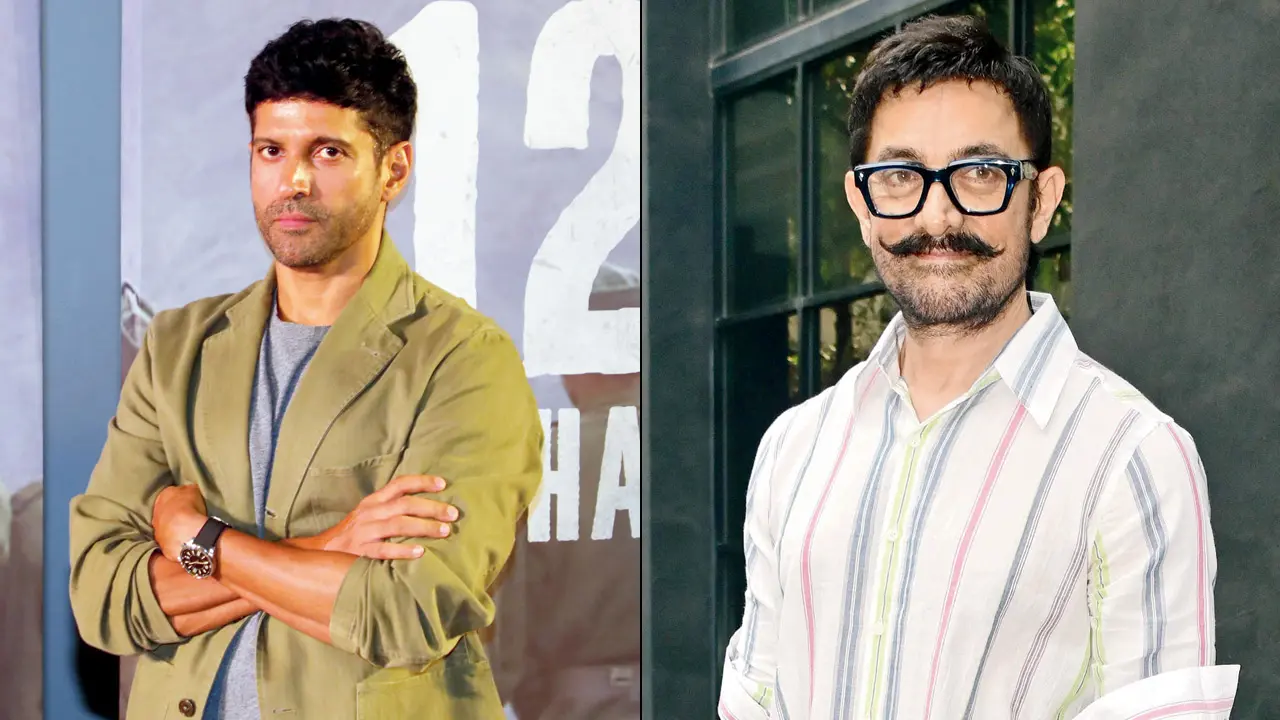
Sources say Farhan Akhtar approached for a cameo in Ashutosh Gowariker’s next; to play a Pak cricketer to Aamir Khan’s Lala Amarnath
Mohar Basu (MID-DAY; May 26, 2026)
Filmmaker Ashutosh Gowariker’s next has become one of the most talked about projects in the industry, and for good reason. It sees the director reunite with Aamir Khan over two decades after their classic ‘Lagaan’ (2001).
Now, word is that Farhan Akhtar may have a special appearance in the film that is set against the backdrop of India’s Partition and will chronicle the life of Lala Amarnath, independent India’s first cricket captain.
Akhtar has been attached to the project as a producer, along with Aamir Khan Productions. But he is not ruling out the possibility of stepping in front of the camera.
A source told mid-day that he is likely to slip into the role of a celebrated Pakistani cricketer. “Even though it’s an extended cameo, Farhan’s role is emotionally pivotal to the narrative. He plays Lala Amarnath’s close friend, who remains in Pakistan after the Partition. The film isn’t just about cricket; it’s about friendship during one of the most turbulent moments in the subcontinent’s history. Ashutosh has asked Farhan to consider the role, but it’s not locked yet,” shared a source.
Is Daadi Ki Shaadi plagiarized from a Pakistani telefilm? Sadia Khateeb reacts
10:43 AM

Mohar Basu (MID-DAY; May 6, 2026)
With days to go before Daadi Ki Shaadi’s release, the Neetu Kapoor, Kapil Sharma, and Sadia Khateeb-starrer finds itself at the centre of speculation. Rumours are rife that Ashish R Mohan’s directorial venture is plagiarized from a Pakistani telefilm by the same name, which was aired in March 2026. Khateeb is unfazed by the plagiarism rumours.
“We announced our title way before [in December 2025]. We did so when we started shooting for the film, and this Pakistani [offering] came much later,” she stated.
The May 8 release revolves around a family’s matriarch who falls in love and decides to remarry, to her family’s surprise. Coincidentally, a similar theme is explored in the Pakistani family comedy.
Dismissing the comparisons, Khateeb clarified, “It’s not that we have copied from anyone. Our Daadi [protagonist] is not [similar to] what we have seen in their trailer. It’s a different plot.”
Daadi Ki Shaadi came Khateeb’s way just when she was seeking a light-hearted subject. What it also brought along was a special co-star in Kapoor. “She is such a delight to work with. Neetu ma’am doesn’t meet you with the baggage of her legacy; she keeps it real. She made everything easy, light, and fun for me.”
"Why London? Come to Mumbai": Asha Bhosle’s advice that changed Adnan Sami’s life
10:54 AM

HINDUSTAN TIMES (April 13, 2026)
The passing of Asha Bhosle on Sunday morning has left the music world grieving. For singer Adnan Sami, her loss also brings back memories of a turning point that changed his life. Sami, who became an Indian citizen in 2016, has spoken about feeling sidelined by the Pakistani music industry early in his career.
In an interview with India TV in 2025, he recalled how Bhosle’s advice helped him find a new path. “After I released a few songs in 1998, people in the Pakistani music industry just decided I was done,” he said. “There was no promotion, no marketing. It disappeared like it never existed. That really broke me,” he added.
Living in Canada at the time, Sami reached out to Bhosle. “I told Asha ji, ‘I’m dejected…’ and asked if we could record in London.” Her response changed everything. “She said, ‘Why London? Come to Mumbai. This is where magic happens’.”
Sami followed that advice. “Main boriya bistar le ke pahuch gaya Mumbai,” he recalled, adding that Bhosle and her family welcomed him warmly. “She made me stay in RD Burman’s house.”
What followed was a career-defining phase. Kabhi To Nazar Milao and Lift Karadey became massive hits. “The love and acceptance I received… I never imagined it,” Sami said.
There is no love for Pakistan in Main Wapas Aaunga-Imtiaz Ali
10:51 AM

Sonal Kalra (HINDUSTAN TIMES; April 11, 2026)
He’s been in the film industry for almost 20 years now, and people swear by his school of filmmaking. Unrequited, often incomplete love (barring a few exceptions) forms an integral part of his stories. Yet, when you speak to him, he’s all heart. Filmmaker Imtiaz Ali, gearing up for the release of his next film Main Wapas Aaunga, spoke about everything under the sun on The Right Angle with Sonal Kalra. Excerpts:
Do you still get asked about a Jab We Met 2 or Tamasha 2?
I do keep hearing about Rockstar 2 and Jab We Met 2. But especially for Jab We Met (2007), I won’t [make a sequel]. Some things are best left untouched. I don’t want to start from a point of view that this is a money-making plan or a professional move… Good films cannot be made that way. They have to come from a point of, ‘This is a nice story, I want to be in this world’. Love Aaj Kal 2 (2020) bhi toh banayi thi na… woh toh itni achhi nahin gayi.
How did you come up with the title Main Vaapas Aaunga?
When I was in school, I read a poem called The Highwayman, which was very effective. I was thinking this is such a thing to say, that ‘I’ll come to thee by moonlight, though hell should bar the way.’ Then there was a song actually in Khuda Gawah (1992), in which the character of Badshah Khan (Amitabh Bachchan) says, ‘Main vaapas aaunga; main agar mar bhi gaya phir bhi vaapas aaunga’. I remember the impact of that song. Even while shooting this film, I didn’t think that it would be called Main Vaapas Aaunga. There was this scene we were shooting on a moving train. I had briefed Vedang Raina (actor), who is playing Kinu in the film, that he comes and he screams these same words. He’s making this promise to somebody, and it happened to be those words. During the take, I realised that this has to be the title of the film.
Have you received Love Aaj Kal-like comparisons?
I saw some on the internet, but I’m not worried about that at all. This is not two love stories; it is just one story.
You’ve taken two risks—one, telling a romantic story in a time dominated by high-scale violent films, and two, exploring love involving Pakistan when sentiments are sceptical.
There is no love for Pakistan in the film. It’s a very personal story of one person. And it is not casting an allegation. It is not saying anything which is politically one way or the other. Anybody watching the film will not feel slighted by the fact that this is catering to anyone. The second thing is, is there a time for a love story to work? I’ve seen all of my life that any good film, whether it’s violent, bold, romantic or a comedy, is working at any particular time that it’s released. The audience is very strategic in the way that it wants to see films, and if the socio-political climate becomes very intense, maybe comedies will also work very well, and a film which is very intense and bloodthirsty will also work.
Which of your films comes closest to perfection?
Perfection— no! As for things which made me happy, there are certain points in Rockstar (2011) and Amar Singh Chamkila (2024). In Chamkila, there was this portion where we had a beautiful sunset, and somehow, we had time in hand. I don’t know what we were doing, so I just asked Diljit (Dosanjh), ‘Please sit here, and I’ll play the song. You just listen to it and turn and look at the lens when I say.’ That’s the longest take in the film. And I thought, let’s take a chance at Mainu Vida Karo. So then I played it, and he heard it for the first time. Sometimes, you don’t even know why, and it feels nice.
Do you see flaws in any of your past films?
Oh yes, I discover flaws very early. I remember that I saw Socha Na Tha (2005) after many, many years, and then I was laughing along with it, which is not something that ever happened for the first 10-15 years since its release. For a film like Jab Harry Met Sejal (2017), there was something very nice, which did not really turn out nicely. This whole angle of somebody being a womaniser or looking at themselves like an unstable character but having a story behind it… It was very enticing. I feel that even in Love Aaj Kal (2020), there were certain things which were underwhelming. There was a very beautiful thought, but I couldn’t bring it out in the best possible value.
Is a reunion with Ranbir Kapoor (with whom he worked in Rockstar and Tamasha) on the cards?
There is no present plan as such. But hopefully there’ll be something that will have to top the other work that we’ve done.
What’s that one thing about the film industry that you have still not been able to understand in 20 years?
Everyone here is very passionate and always trying to come across as strategic and professional. But I think they’re just a group of passionate drifters. I don’t know how they have so much time to just do gup-shup. When I met (actor) Shah Rukh Khan... he was sitting calmly for 5-6 hours, talking to me. How does he have so much time? It’s the same for all of the Khans, various other producers, directors — whoever you meet. I love that about the film industry. But unfortunately, what happens in the film industry is that with popularity comes power. Each one of them have so many people on their social media… it’s almost unfair. And if somebody has to say something about politics, etc., maybe we are not the most qualified, but we have to be damn careful.
I also feel lucky to be a part of the industry because I didn’t know anybody when I came here. It’s only with the support of these people that I could do anything.
Raj Kapoor’s ancestral Haveli in Peshawar partially collapses after heavy rains, earthquake
8:31 AM

The century-old Kapoor Haveli, once owned by (right) Raj Kapoor, was home to his father Prithviraj Kapoor, the first in the family to enter films. Photos: x
HINDUSTAN TIMES (April 6, 2026)
The historic Kapoor Haveli in Peshawar, Pakistan, once owned by the late actor Raj Kapoor, has sustained significant damage following heavy rains and an earthquake on Friday night.
Continuous rainfall had already weakened the structure, and late-night tremors on Friday further destabilized the building. Shakeel Waheedullah, secretary of the Heritage Council in KPK province, confirmed the damage, saying, “A section of the haveli’s wall caved in after the quake.”
The century-old Kapoor Haveli was once home to late actor Prithviraj Kapoor, the first member of the Kapoor family to enter the film industry. Built by his father, Dewan Basheswarnath Kapoor, between 1918 and 1922, it remains a significant cultural site and was declared a national heritage site by the Pakistan government in 2016.
Over the years, the estate has been visited by several members of the Kapoor family. Prithviraj’s sons, late actors Shashi Kapoor and Shammi Kapoor spent time there before Partition, while Raj’s sons, late actor Rishi Kapoor and actor Randhir Kapoor, visited in the 1990s and urged the Pakistan government to undertake its restoration.
Dhurandhar’s dialect coach Faiz Mohammed Khan says Aditya Dhar aimed for ‘asli Pakistani’ lingo
4:31 PM

S Farah Rizvi (HINDUSTAN TIMES; April 3, 2026)
Actor Faiz Mohammed Khan, who played the role of Sajid Mir in Dhurandhar (2025) and Dhurandhar The Revenge (2026), has a double reason to celebrate: his performance in the film as well as his role as dialect coach for the film. After 14 years in the industry, he’s proud to be part of a film he calls a “history in the making.”
Faiz, an NSD alumnus, was brought on board by casting director Mukesh Chhabra. “One day Mukesh ji asked, ‘Faiz kya tum dialect par bhi kaam karoge? You are well-versed in Urdu. So that’s how my dialect coaching began,” he shares. He adds that director Aditya Dhar’s focus on the Urdu dialect was for it to be accessible. “It was never about ‘khalis (pure) or difficult Urdu’, but rather about the ‘asli Pakistani’ lingo that felt more like more like ‘hamare beech ki language’,” says the 39-year-old.
Faiz considers all the actors on set as his favourite students. “Sabko sikhne mein maza aa raha thaa because the entire team was so passionate about the narrative.” However, he singles out Sara Arjun, who played Yalina, as an amazing student. “She would say, ‘Sir, abhi theek aya nahi dialogue, aur practice kare, aur acha hona chahiye’,” says the actor who was previously seen in Kedarnath and Padman (both 2018).
The dialogue, ‘Darling, darling, dil kyon toda…,’ by actor Gaurav Gera’s character Aalam became an instant hit, and Faiz remembers they both worked really hard to set the right tone.
Currently, Faiz is balancing acting, with projects like Gandhi ready for release, with backstage work on Pankaj Tripathi’s play La Ilaaj.
Meghna Gulzar wrote a nasty message to me after Raazi shoot-Harinder Sikka
4:27 PM

Natasha Coutinho (HINDUSTAN TIMES; April 1, 2026)
Author Harinder Singh Sikka, whose espionage book Calling Sehmat was adapted into the 2018 film Raazi, insisted in a post on X on Saturday that choosing Meghna Gulzar to direct the film was his “gravest misjudgement”.
Speaking to us, Sikka says he has been raising the issue for a while and is bringing it up again in light of the buzz around the spy franchise Dhurandhar. “I wasn’t willing to sell the rights of the book but agreed because of a promise to (poet-filmmaker and Meghna’s father) Gulzar,” he shares, adding, “My problem is that she removed the tricolour from the movie, while the Pakistani flag was flaunted. Even the Pakistani army was shown in a soft light. While in the book the protagonist was welcomed with (the Indian national anthem) Jana Gana Mana when she returned to India, all that was missing in the film. The climax was made to show that Sehmat made a mistake by fighting for India, which harmed the cause of Kashmiris.”
Recalling his first meeting with Meghna, he says, “I told her that I was appointing her on her father’s request, even though she didn’t have a good reputation in the industry. After the film’s completion, she wrote a nasty message saying, ‘I don’t want to speak to you anymore’. The director’s cut was shown to the armed forces but not to me.” He adds that he appreciates films like Dhurandhar for showing Pakistan in its “true light”.
We reached out to both Gulzar and Meghna for a comment, but received no response till the time of going to press.
Harinder says that the changes done from the book for Raazi “undid” his hard work. “Meghna changed the story and then got her father to write the song Ae Watan Mere Watan. There is not a word about Bharat in it. It was cleverly worded and presented. It took me eight years to write the book, and with one film, the hard work was undone,” he says, adding that while the film was a commercial success, he knew that it won’t win any National Film Award: “It isn’t worthy of that. The film did India dirty.”
The author adds that he also didn’t agree to the film’s title change from Sehmat to Raazi. “Meghna didn’t want to acknowledge Sehmat for who she was. I was taken for a ride,” he says, claiming that Gulzar also got him excluded from speaking at an event: “I have a letter by the Jaipur Literature Festival team, that says Mr Gulzar pushed them to not let me speak at their event. When I questioned him, he said it was a typo.”
Sikka expresses disappointment as he feels that films like Raazi are made to show that “the tricolour need not be celebrated”. “Even though that is what our martyrs come home wrapped in,” he ends.
When films miss the Gulf market, how much does it impact?
8:17 AM

From Border 2 to Dhurandhar and The Diplomat, films remain unreleased across key Gulf markets — a pattern trade can’t ignore. We speak to experts to understand how it impacts business
Yashika Mathur (HINDUSTAN TIMES; January 30, 2026)
Border 2, starring Sunny Deol, may be flying high at the Indian box office, but the war drama will not release across key Gulf markets including Bahrain, Kuwait, Oman, Qatar, Saudi Arabia and the UAE. While no official reason has been issued, industry insiders point to the film’s India-Pakistan war backdrop and strong military narrative as the likely factor behind the decision, a pattern seen with several recent titles in the region.
Why the Gulf matters
The Gulf Cooperation Council (GCC) region remains a crucial overseas market for Hindi cinema, often contributing 3-5% of a big film’s global business. Trade figures suggest a well-performing Hindi film can earn between Rs. 30 crore and Rs. 50 crore from the region.
Film exhibitor Akshaye Rathi explains: “For a film like Border 2, expectations are massive, so the loss is felt. At the same time, exhibitors in the Gulf also lose out by not being able to screen big titles. For Indian films, 3-5% of business going away is still a large number.”
Border 2 isn’t the first high-profile Hindi film to face resistance in the Gulf. Last year, Ranveer Singh-starrer Dhurandhar did not release in the region despite a strong global run. Earlier, The Diplomat, starring John Abraham, and Fighter, led by Hrithik Roshan, faced similar roadblocks, though Fighter was later cleared for release in the UAE.
Trade reactions
Trade analyst Taran Adarsh believes the impact varies by film: “A Shah Rukh Khan film would mean something very different in the Gulf compared to others. In Dhurandhar’s case, which has already done well without a Gulf release, the loss could be Rs. 20-40 crore. For Border 2, it’s early to judge, but business in other territories could compensate.”
Filmmaker Ashoke Pandit, president of the Indian Film and TV Directors’ Association, has called for diplomatic clarity. “We are told India shares strong relations with the UAE. If a film talks about fighting terrorism, why should it be blocked?” he asks.
Looking at intolerance at present, I would not have been able to make a film like New Delhi Times today-Ramesh Sharma
10:04 AM

Earlier this year, Bangladesh asked Pakistan for a formal apology for 1971 war crimes. But responsibility for the massacre of civilians does not rest with Pakistan alone. Ramesh Sharma’s latest documentary ‘Chronicles Of The Forgotten Genocide’ looks at the role of the US in the violence that accompanied the birth of Bangladesh. The Emmy-nominated filmmaker speaks to Shruti Sonal about the legacy of American imperialism, and the lingering scars of 1971
Shruti Sonal (THE TIMES OF INDIA; December 7, 2025)
Earlier this year, Bangladesh asked Pakistan for a formal apology for the 1971 war crimes. But responsibility for the massacre of civilians does not rest with Pakistan alone. Ramesh Sharma’s latest documentary ‘Chronicles Of The Forgotten Genocide’ looks at the role of the US in the violence that accompanied the birth of Bangladesh. The Emmy-nominated filmmaker speaks to Shruti Sonal about the legacy of American imperialism, and the lingering scars of 1971.
Your debut film ‘New Delhi Times’ (1986) came at a time when political thrillers were rare in Indian cinema. Nearly 40 years later, what drew you to a project that revisits a turbulent political moment — the 1971 Bangladesh genocide?
I’m always looking for subjects that combine human interest with elements of politics and injustice. When Bangladesh was marking 50 years of its creation, I had just finished a documentary called Ahimsa and began to realize the amount of violence and lack of accountability that defined the Partition of India. After reading about what I call the Bangladesh genocide of 1971, I realized there had been no accountability in this either.
You focus on the role played by the CIA and the Nixon-Kissinger duo who backed Pakistan.
Almost every genocide that has taken place in the 20th century has the fingerprints of American imperialism — besides Bangladesh, there is Cambodia, Vietnam, Chile. You might say that this was during the Cold War and America was fighting a proxy war with Russia. But that doesn’t justify the killing of millions of innocent people. Because these were brown people in a country that probably no American could even point out on the map, they were ignored. However, the research of American scholars like Kai Bird and Lawrence Lifschultz helped shed light. I also came across an incredible number of documents that were declassified, largely due to the efforts of historian Gary Bass who fought for the Freedom of Information Act, which is similar to the RTI in India. I was sure that my film couldn’t just focus only on the genocide. It also had to unveil the puppet masters like the CIA and Henry Kissinger who were helping Pakistan. Even though there was a Congressional ban on giving it equipment and arms, they were doing it slyly through Iran and Jordan. A lot of people advised me not to focus on this angle, but I was clear about one thing: I’m not anti-American. I’m anti-American imperialism.
You spoke to a lot of survivors and journalists in Bangladesh. Do old scars continue to impact politics?
Most of the survivors I spoke to were in their 70s and 80s. But their families had suffered, too. Some lost their fathers, some lost their brothers. Even though Gen-Z hasn’t experienced that trauma, I think the scars still run very deep.
Your film comes out at a time when there is a lot of political churn in Bangladesh. How much did you see first-hand?
While I was filming, Bangladeshi politics was changing. I finished two phases of shooting and then couldn’t go back to Bangladesh because Sheikh Hasina was ousted. You can call her an autocrat. And yes, she did a lot of things that shouldn’t have been done. She made mistakes, like her father made mistakes. But I don’t think the involvement of the US in the regime change can be discounted. Also, a lot of the trials related to the 1971 pogrom took place only when Hasina came to power — the same trial that is now being used against her.
What do you make of the current strain in ties with India?
If we look at the history of the events of 1971, we have also made mistakes. In the decades since, we should have also been nurturing friendships with the people of the country, not just with one family. Yes, we gave shelter to 10 million refugees but that doesn’t mean Bangladesh should become a vassal state. Such a Big Brother approach has made us unpopular in our neighbourhood.
In the Emmy-nominated ‘The Journalist And The Jihadi’ about the killing of American journalist Daniel Pearl, you have also looked at Islamic radicalization. Do you see a role of imperialism in fostering it too?
Making that documentary made me see how much America is responsible for all that happened in Afghanistan. The Russian entry into the country was undoubtedly one of the biggest mistakes they made, but America’s fight against them in many ways legitimized jihad. If you go back even further to 1953 Iran, and the way America toppled the first elected prime minister, Mohammad Mosaddegh, you can see how in the chaos that followed, Ayatollah Khomeini, who was in exile in France, became more popular, eventually leading to the Islamic Revolution. It shows that whenever there is no democracy, people go to the mosque. Whenever there’s no freedom of the press, they go to the streets. Compared to other countries, the radicalization in India has been far less, and that’s because we still have democracy. A true democracy is the greatest safety valve against radicalization. It is what keeps this pluralistic and incredibly varied country together.
In the documentary, you’ve used AI visuals to recreate a few historic scenes. Isn’t that unusual in non-fiction filmmaking?
I used AI for two reasons. First, because some archival footage or photos had been destroyed or not documented. When available, they were often so expensive that I couldn’t afford them. I think in a couple of years, AI will become so sophisticated and low cost that it will be the go-to source for archival-based documentaries.
There has been talk of a sequel to your National Award-winning film New Delhi Times, which dealt with the nexus between politicians and media barons.
Honestly, looking at the kind of intolerance we see today, I would not have been able to make the film today. Having said that, I would love to make a sequel, but nobody will fund it, and that is the tragedy of it.
I gave Akshaye Khanna darker colours like black and navy to reflect his Dhurandhar character’s gravitas-Smriti Chauhan
9:26 AM

Costume designer Smriti Chauhan reveals how Dhurandhar’s look was shaped by extensive online research into Lyari and Karachi’s underworld
Mohar Basu (MID-DAY; December 11, 2025)
What’s not to love about styling five of Bollywood’s most good-looking men — Ranveer Singh, R Madhavan, Akshaye Khanna, Arjun Rampal, and Sanjay Dutt? But with Dhurandhar, costume designer Smriti Chauhan had a bigger responsibility — to stay true to the world of Lyari, in which director Aditya Dhar’s spy actioner is set. The costume designer says that rigorous research by Dhar and Ojas Gautam, director’s assistant, preceded the styling.
“Aditya and his team couldn’t conduct field research because the world they created was Pakistan,” she begins. So, they settled for the next best thing. “They did deep research — mostly online, and referred to many books. For the underground parties of the Karachi underworld shown in the film, [we referred to the] raid videos online. Many are available on YouTube. YouTube and Getty videos were circulated among teams so that all departments could get as much information possible,” Chauhan recalls.
The director was certain of a few things that had to be depicted through outfits. Chauhan cites an example, “Lyari’s love for football had to be shown. So, Mukka, one of the gang members, is seen in football jerseys quite a few times.”
With the story set in Lyari, Chauhan says Pathanis dominated the style palette. “But each Pathani has different shoulder pleats, bottom cuts, and fits. Pairing them with waistcoats, jackets, shawls also helped in differentiating them.”
Ranveer Singh as Hamza Ali
Hamza is spontaneous. So, I depicted that spontaneity in his silhouettes, like a sharply tailored kurta layered under a distressed jacket. The raw detailing reflects his volatile energy.
R Madhavan as Ajay Sanyal
His character is inspired by Ajit Doval. Since Doval is usually seen in suits, we gave Madhavan variations of suits with breakdowns over time — broader cuts in the ’90s, then slimmer cuts.
Sanjay Dutt as Chaudhary Aslam
We stayed true to the real-life figure’s white Pathani, unbuttoned cuffs, and gruff texture. His hair and beard styling reflect this as well.
Arjun Rampal as Major Iqbal
His character is rugged and grunge, yet an ISI Army General. To reflect that, we fused military design with coarse, rugged fabrics, switching between safari suits and Pathanis, based on the scene in question.
Akshaye Khanna as Rahman Dakait
Rahman is calm on the surface, but with depth like a still pond. I gave him darker colours like black and navy. They reflect his character’s gravitas.
1 day Dadi Ki Shaadi shoot remained as there was talk of conflict between India and Pakistan-Ashish R Mohan
9:50 AM
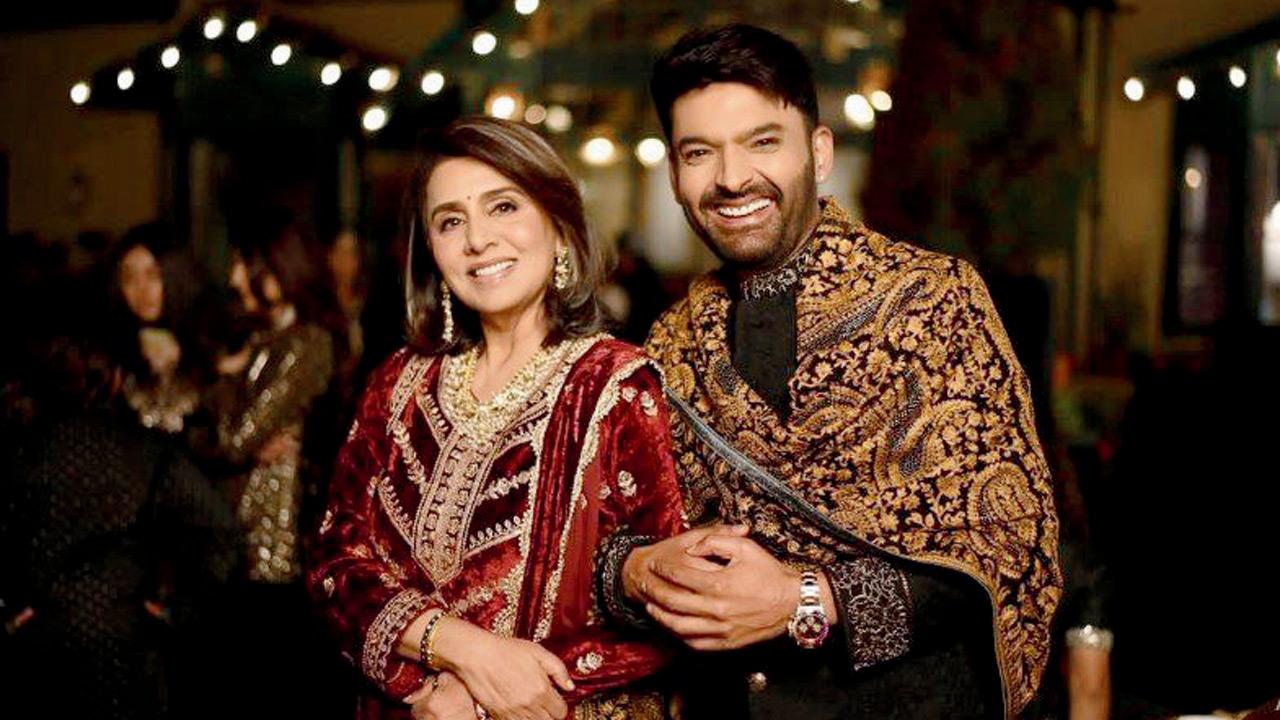
Director Ashish R Mohan on wrapping up ‘Dadi Ki Shaadi’ after the end-credit song and scene with Riddhima Sahni
Upala KBR (MID-DAY; December 7, 2025)
The buzz has been building since April when the announcement was first made — Neetu Kapoor and Kapil Sharma would star in Dadi Ki Shaadi, marking Riddhima Kapoor Sahni’s Bollywood debut. Now, director Ashish R Mohan tells mid-day that the family entertainer is set to wrap up soon, and he hopes to release it on Mother’s Day (May 10, 2026) or sometime in April.
After a 40-day schedule in Shimla, Mohan shares that although most of the shoot is complete, some patchwork scenes, including an end-credit song, remain to be filmed in January.
“I wanted to complete the film after I locked my release date. We had shot a song choreographed by Ganesh [Acharya] master in Shimla earlier this year, but a one-day shoot remained as there was talk of a [conflict between] India and Pakistan,” he recollects.
On May 7, India launched strikes on Pakistan in an operation code-named Operation Sindoor. For safety, Mohan returned to Mumbai with the cast and crew.
He shares that the finale number features “700 children from the schools in Shimla and outside and has the entire cast in it. I will invite the entire cast to come down [to] shoot the song and scenes — in Golden Tobacco Factory or Film City. [We also have] one-day scene to shoot with Riddhima,” adds the filmmaker.
Currently in post-production, Dadi Ki Shaadi is a comedy revolving around a family who gets involved in a family matriarch’s marriage. Earlier, the film — also starring South superstar Sarath Kumar, Nikhat Hegde, Tejaswini Kolhapure, and Sadia Khateeb — was planned for a December release. The makers will now announce the release date on December 20.
Zee 5's Pakistani shows shift to a new platform; streams in Middle East
9:16 AM
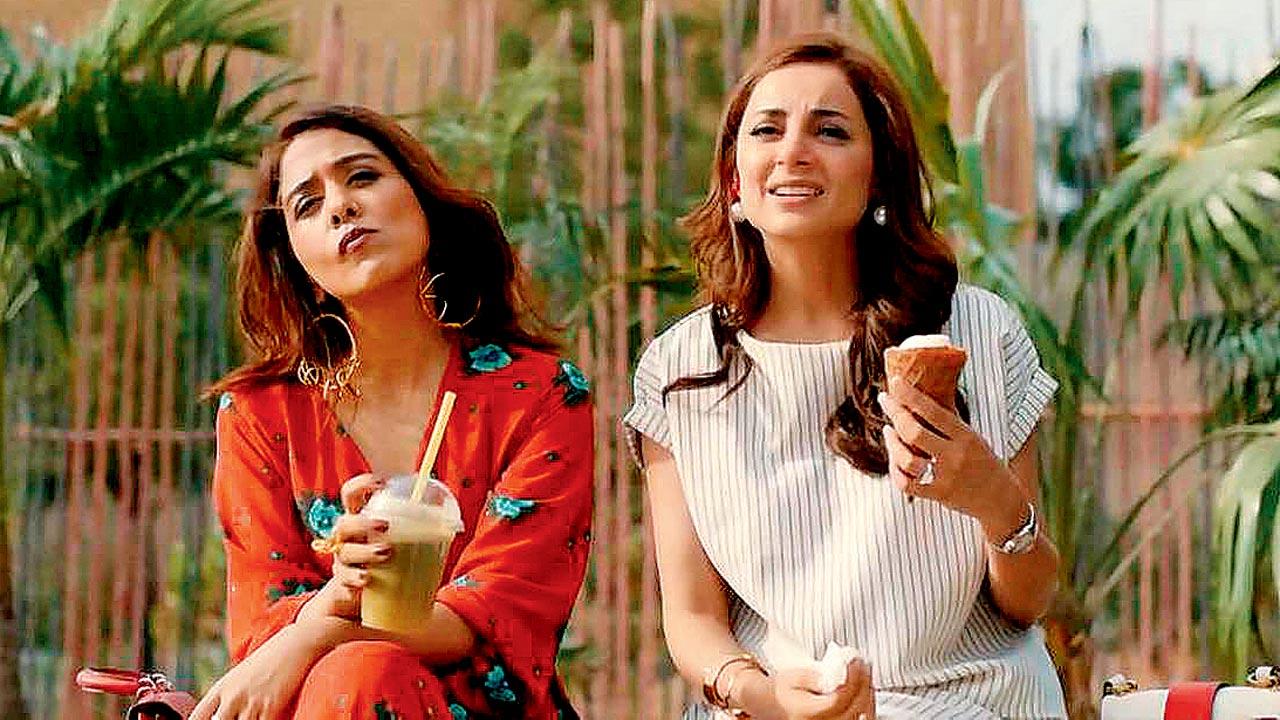
A still from ‘Churails’. Pics/Instagram, Youtube
Months after all Pakistani content was removed from Indian screens in wake of Operation Sindoor, several Indo-Pak collaborative shows of Zee5 acquired by Begin.Watch; being streamed in the Middle East
Mohar Basu (MID-DAY; October 22, 2025)
In May, after Operation Sindoor, the Ministry of Information & Broadcasting had issued an advisory directing Indian OTT platforms to remove all streaming content originating from Pakistan (This link is broken, May 9). As a result, Zee5 had pulled the plug on its Pakistani shows and Indo-Pak collaborative productions. Five months on, some of those acclaimed shows have found a new home in the Middle East. Executives based in Dubai tell mid-day that several Indo-Pak joint productions, which were formerly housed under Zee Entertainment’s cross-border entertainment vertical Zindagi, have now been acquired by Begin.Watch.
Launched in 2022, Begin.Watch is a Pakistan-based streaming platform. In recent months, it not only expanded its presence in the Middle East, but also secured rights to multiple shows caught in the crossfire of the May ban.
A prominent example is The Pink Shirt, starring Mom (2017) actor Sajal Ali and Wahaj Ali. The romantic drama was originally developed under Zindagi along with Indian content studio Applause Entertainment.
An industry insider reveals, “While The Pink Shirt did the festival rounds, its 2023 release kept getting pushed. In the aftermath of Operation Sindoor, it never hit Indian screens. In such Indo-Pak collaborations, there was ambiguity about who owned the show anymore. Begin. Watch negotiated directly with the Pakistani producers.”
After it became clear that Zee5’s Zindagi vertical had been shut down in India, Begin. Watch acquired several cross-border collaborations such as Churails and Qatil Haseenaon Ke Naam. Yet conspicuously missing from its catalogue is Barzakh (2024), director Asim Abbasi’s fantasy drama starring Fawad Khan. The show had streamed on Zee5 in India.
The source explains, “Since the show was produced for Zindagi, which was part of an Indian platform, it’s tangled in a rights dispute. The now-defunct Zindagi slate has led to a situation where many creators can’t access their own work. These collaborations were made with Indian money and Pakistani talent, and are now in a grey zone.”
An artiste may not be political but is definitely a patriot-Adnan Sami
9:16 AM

Singer Adnan Sami emphasizes the need for Indian artistes to unite against terrorism and talks about why the ban on Pakistani artistes was ‘justified’
Rishabh Suri (HINDUSTAN TIMES; September 27, 2025)
Adnan Sami is a patriot above all else. For him, the country is the first priority, even above his music. Born in Pakistan and granted Indian citizenship in 2016, the singer shares his take on the intersection of politics and art, especially in light of the ban on artistes from across the border after the Pahalgam terror attack in April.
“Politics is something else, nationalism is something else. An artiste will always belong to a country. An artiste may not be political but is definitely a patriot. You can turn around and say, ‘This artiste doesn’t conform to any political ideology’. Okay, that is understandable; you can’t force them,” Adnan tells us, reiterating, “But an artist will always belong to a country.”
The 54-year-old, who returned to playback singing with the song Bheegi Saari from Param Sundari, explains, “The nation has to come first,” adding that there’s no distinction between one’s home and country. He says, “You have to stand by the home you belong to and protect it. If people came to disrupt an artiste’s residence, wouldn’t they stand up and fight?”
Content featuring Pakistani artistes has also been banned in India, such as actor Fawad Khan’s film Abeer Gulaal. Adnan feels the move was “justified”.
He continues, “The point of the matter is right now our country, our home, has been threatened, attacked. So in that situation, we have to stand by and protect our home. We have to take a united stand. If an artiste is expecting the government to protect them, then they also have the responsibility.”
We didn’t want to make Saare Jahan Se Accha jingoistic-Pratik Gandhi
9:26 AM
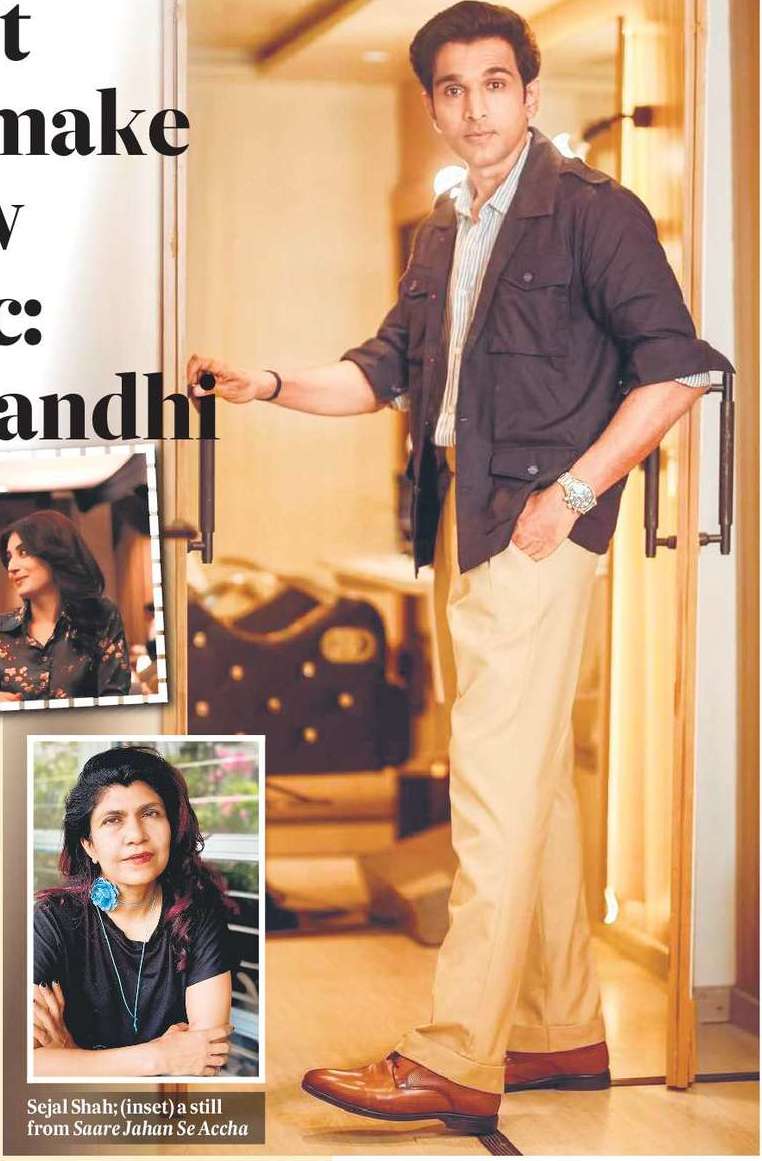
Akash Bhatnagar (HINDUSTAN TIMES; September 8, 2025)
Actor Pratik Gandhi recently led the patriotic series Saare Jahan Se Accha, released just before Independence Day. Set during the Indo-Pak tensions of the 1970s, the series explores a spy’s story. With the show premiering shortly after the recent India-Pakistan conflict, Pratik admits the timing made promotions tricky.
The 45-year-old says, “We were very clear when we shot that it’s not about jingoism. But the concern did arise. Once we learned the release date — and considering what had happened recently — the context shifted in the audience’s mind,” adding, “That’s when you have to be very careful while talking about your project, because you know there’s no agenda, propaganda or jingoism involved. But how do you convey that to an audience whose mindset has already shifted?”
Producer Sejal Shah echoes the sentiment, emphasizing that the aim was never to push an agenda. “The storytelling in the show was always about emotions. It’s a story about love for one’s country and the sacrifices people are willing to make for it. The goal wasn’t about revenge or violence; it was peaceful — aimed at stopping a war.”
Pratik adds that the team consciously avoided loud patriotism. “There is a fine line between patriotism and jingoism, and we were clear that we didn’t want to make it jingoistic. In today’s hyperactive social media world, if something is repeated enough, people start believing it. I believe patriotism is an emotion you carry within, and there are multiple ways to express it – the easiest being to shout about it. But when you add depth, make it interesting, intriguing, and relatable, that’s where the real difference lies,” he says.
The actor adds, “When you feel ‘Mera Bharat Mahaan’, just communicate it. Actually, even without you saying these words, I should feel that oh my God, this guy feels a lot about his country.”
Vaani Kapoor-Fawad Khan's Aabeer Gulaal to skip India; to have an overseas release
9:36 AM
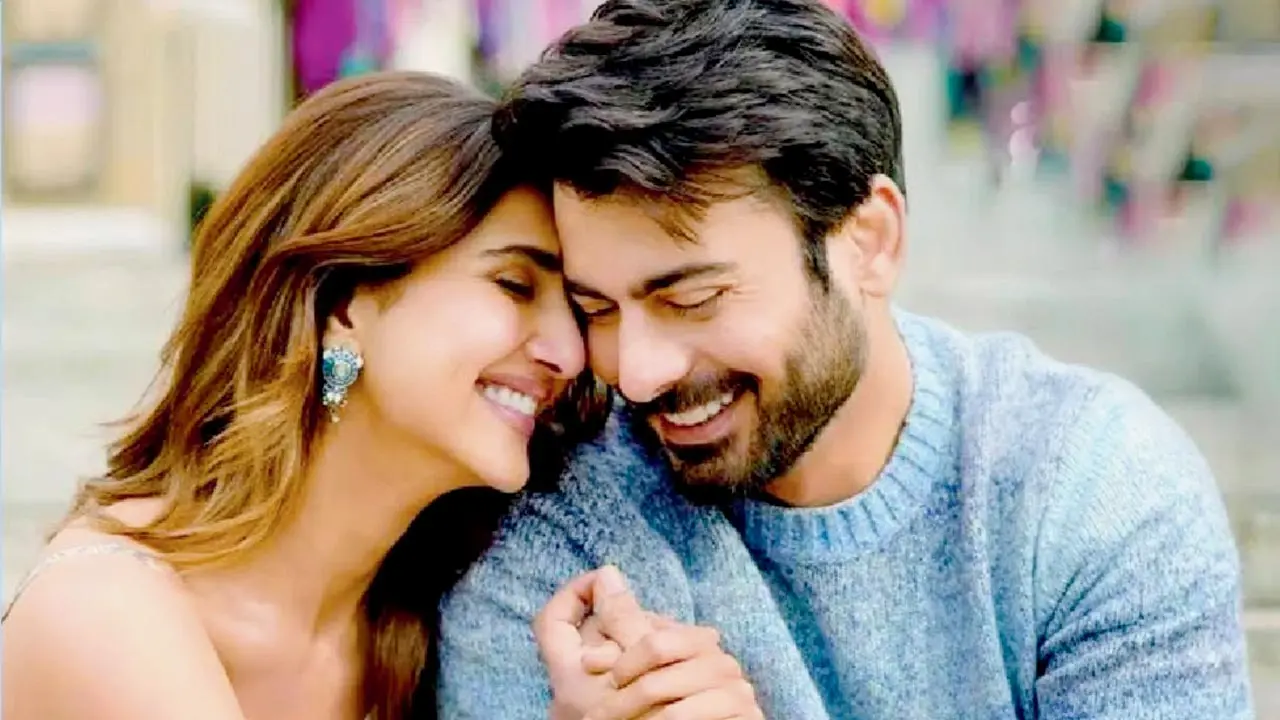
After the release of ‘Aabeer Gulaal’ was halted in light of the Pahalgam terror attack, Fawad Khan and Vaani Kapoor’s romantic drama is set to skip India as it opens worldwide on August 29
Mohar Basu (MID-DAY; August 12, 2025)
Just a week before it was to hit the theatres on May 9, the release of Abir Gulaal, led by Vaani Kapoor and Pakistani actor Fawad Khan, was called off in light of the April 22 Pahalgam attack. Over three months on, Aarti S Bagdi’s directorial venture, now spelled Aabeer Gulaal, is set to arrive in theatres on August 29. But there’s a catch — its India release remains off the table. The romantic drama, produced by Vivek B Agrawal and India Stories Limited, will screen across cinemas in the UK, the US, Canada, Australia, Singapore, and the Middle East.
After the Pahalgam terror attack in April, the Federation of Western India Cine Employees (FWICE) called for a boycott of Pakistani artistes working in India and announced that they would block Aabeer Gulaal’s release. Now, the makers of the romantic drama — which was to mark Khan’s return to the big screen in India nine years after Ae Dil Hai Mushkil (2016) — are bypassing a release on home turf due to the ongoing tension between India and Pakistan.
A trade source reveals, “The film has not yet been picked up by any Indian streaming platform. In today’s scenario where digital rights sales often provide major revenue, this is unusual. A streaming debut in India is not in the offing.”
The love story’s rollout remains uncertain across the border, even as Diljit Dosanjh’s Punjabi movie Sardaar Ji 3 performed exceptionally well in the market. We’ve heard that Aabeer Gulaal has yet to be granted certification from Pakistan’s three provincial certification boards — the Central Board of Film Censors (CBFC), the Punjab Film Censor Board (PFCB), and the Sindh Board of Film Censors (SBFC).
When mid-day reached out to Nadeem Mandviwalla, a leading distributor in Pakistan, he was optimistic about its release.
He said, “A preliminary NOC has not been issued so far. Once that is done, it will go to the Pakistan censor bodies. The movies should run. People want to fight over entertainment, but only artistes end up losing in it. We were happy with the response to Sardaar Ji 3, which is the second-highest grosser in Pakistan after The Legend of Maula Jatt [2022]. We will try our best to release Aabeer Gulaal too.” Meanwhile, it has been submitted to the British Board of Film Classification. Trade insiders predict that the Middle East will be its strongest market.
mid-day reached out to Aabeer Gulaal’s makers, who confirmed that it will be released in cinemas around the globe, with the exception of India.
Subscribe to:
Posts (Atom)