Showing posts with label Paatal Lok. Show all posts
Showing posts with label Paatal Lok. Show all posts
Lights, camera, North-east: With UP-Bihar setting wearing thin, filmmakers are exploring new landscapes
11:26 PM

With UP-Bihar setting wearing thin, filmmakers are exploring new landscapes but can they move away from old tropes?
Mohua Das (THE TIMES OF INDIA; January 4, 2026)
For years, Bollywood’s favourite ‘badlands’ lay along the UP-Bihar belt of dusty highways and men with guns and grudges. Now, that compass is swinging North-East, once barely on the mainstream filming map.
In just three years, the region has become the backdrop for Hindi cinema and streaming’s biggest crime and thriller titles. Filmmakers are digging into folklore, cross-border politics, forest corridors, trafficking routes and scenarios where drug deals are struck, ministers beheaded, borders breached, and relationships tested. Basically, a fresh set of tensions and terrain for filmmakers to tap.
‘Anek’ director Anubhav Sinha’s conversations with his Tai Chi teacher from Nagaland led him to explore the churn caused by the stalled 2015 Naga Peace Accord to questions of identity. Varun Dhawan-starrer ‘Bhediya’ draws from Arunachal’s shape-shifting werewolf lore, Kangna Ranaut’s ‘Emergency’ was shot across Assam, including Kaziranga and Karbi Anglong, and ‘Fighter’ staged key action scenes at the Tezpur Air Force Station.
And then came the OTT surge. ‘Jaanbaaz Hindustan Ke’ shot in Meghalaya’s dense Tura jungles, ‘Paatal Lok 2’ filmed deep across Kohima using Nagamese and local actors. ‘The Family Man 3’ was set in hill and border towns like Kohima, Khonoma, Jakhama, and Jotsoma.
If you ask Simanta Shekhar, chair of the Assam State Film Finance and Development Corporation, this shift was enabled by the building of key infrastructure like roads and airports. The region is also not the tinderbox many outsiders still imagine. “There is less instability and crime indices are low, and people roam till midnight.” He adds, “Almost all the north-eastern states have a woman-centric society, which is reassuring to cast and crew who tend to ask, ‘kitna safe hai?’”
James Handique, the go-to line producer who facilitates shoots in the region, agrees. “People haven’t faced any tensions during shoots,” he says. Only Manipur, with unpredictable shutdowns, remains sensitive.
Where the region still lags is logistics. “Accommodation, availability of equipment and transport often decide whether a production stays or shifts mid-shoot to Thailand or Malaysia which have similar terrain,” explains Handique, adding that govts are now expanding homestays, developing community tourism projects, improving roads and investing in film infrastructure. “Compared to 2011, a lot has changed,” he says, but flying in 300 people from Mumbai is still pricier than shooting in Bangkok.
It’s why, for decades, Handique’s memories of filming in the region were limited to “a few sequences of the film ‘Koyla’ in Arunachal”. Oddly enough, it was reality TV that broke the ice.
“When MTV Roadies rolled into Nagaland, Assam and Arunachal around 2011-12 with a large crew and long schedule, they were amazed. They discovered three distinct visual worlds. Sikkim and Arunachal with snow-capped mountains, Assam with the Brahmaputra plains and rice fields, and Meghalaya with its caves and waterfalls.”
The big wave arrived after the pandemic, when the UP-Bihar template had been stretched thin. The NorthEast — visually spectacular, culturally layered — became an obvious next frontier.
When filmmakers dwell on the region’s darker side, Simanta doesn’t object, as long as the storytelling is fair. “They can show it, but in a positive way of how it’s tackled,” he says. Handique says that The Family Man 3’s depiction of Nagaland as a corridor for narcotics moving from Myanmar “is not factually wrong at all”. If done responsibly, he says, it “can bring the right kind of attention and awareness.”
States have sharpened their pitch. Assam’s new film policy — awaiting cabinet approval — promises “lucrative subsidy” and faster permissions. To help writers explore the region’s hidden histories and tales, Handique says a new writers’ room is forming. “I’ve handpicked regional writers and experts and connected them to national creative teams.”
Folklorist and Guwahati University professor Meghna Choudhury — part of this writers’ bench — hopes filmmakers begin noticing more than “forests, insurgency and inaccessibility”. Locals ensure that the nuances are captured right. For instance, filmmaker Tiakumzuk Aier doubled up as dialect coach, teaching Nagamese and fixing “small details” like names and pronunciation. His troupe from Dreamz Unlimited — among Nagaland’s biggest YouTube channels — turned up in force.
Aier himself appears as a cop in ‘Paatal Lok’ and a Naga minister in ‘The Family Man’. The unit, Handique says, had a crew of 2,000 per day, “out of which 200-300 were locals which gave them experience and training”. Anungla Longkumer joined ‘Paatal Lok 2’ as cultural consultant and was involved in things like scanning the script to making sure costumes of Naga tribes were in the right style and colours. On set, she had authority to remove anything that might “hurt the sentiments” of their communities.
She now wants writers to look beyond familiar tropes. “The region is far more than the headhunter or warrior tribe stereotype.”
I’ve been shooting so much in Kohima that Nagaland government should give me a house-Jaideep Ahlawat
10:00 AM
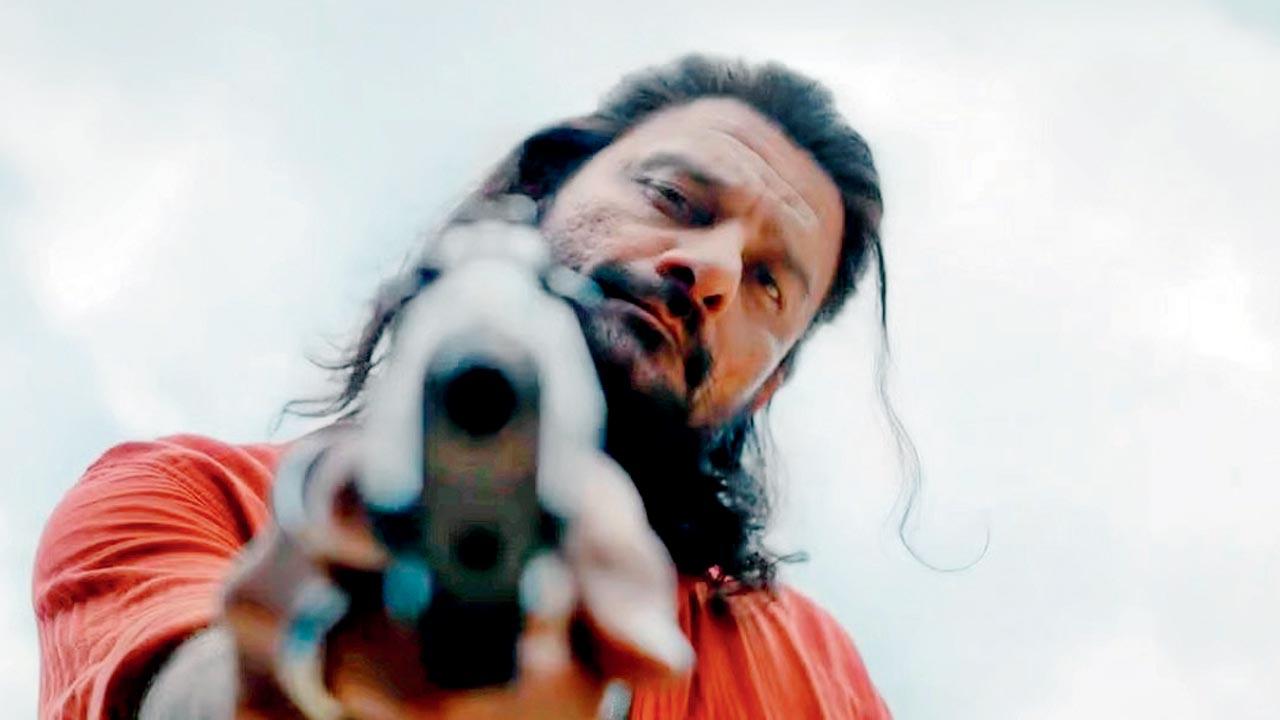
Jaideep Ahlawat discusses how he relished playing the antagonist in ‘The Family Man 3’ and returning to Nagaland after ‘Paatal Lok 2’
Mohar Basu (MID-DAY; November 27, 2025)
Nagaland was a silent witness to Jaideep Ahlawat when he transformed into the lawman Hathiram Chaudhary for the second season of the acclaimed Paatal Lok. For The Family Man 3, the actor returned to the state, only this time his character was firmly on the other side of the law.
“On day one, I remember thinking that my character is nothing like Hathiram Chaudhary. How do you process that? Then I realised that you don’t; you just enjoy both sides,” begins Ahlawat, who plays Rukma, the antagonist to Manoj Bajpayee’s Srikant Tiwari in the spy thriller.
The state and its politics have been a big part of Paatal Lok as well as the Raj Nidimoru and Krishna DK creation. What’s different, Ahlawat reflects, is his character’s perspective.
“There is a spot where I was standing as Hathiram once, and then later as Rukma. It’s the same place, two different men, but nobody can see [the similarity] because the art direction has changed so much. It’s an interesting feeling of being in the same place, but living a completely different life,” he says philosophically, before joking, “I’ve been shooting so much in Kohima that the Nagaland government should give me a house there!”
House or not, Ahlawat is certainly being rewarded. The actor’s portrayal of a drug smuggler and hitman in the Prime Video series is being widely praised. He shares, “I finally got the chance to let loose without worrying about conscience or consequences. It felt liberating in a twisted way to play someone like Rukma.”
The cherry on top was his reunion with Bajpayee, over a decade after they shared screen space in Chittagong (2012) and Gangs Of Wasseypur (2012). Tell him that their on-screen face-off was the most anticipated element of the new season, and he says it’s something he looked forward to as well. “Working with Manoj is like going back in time. There is a discipline that he brings. Doing an action scene together after all these years was a thrill. There is the greed to work with him, and this show is a dream come true!”
Ask Jaideep Ahlawat his most memorable sequence from the series, and he points to the elaborate action set-piece in the first episode — a gripping chase sequence between Manoj Bajpayee and him. “Manoj was driving the car, and I was riding the motorcycle [chasing him]. The camera didn’t have to cheat; it travelled from him all the way to me. There were no stuntmen involved. That’s my most memorable scene in this season,” he smiles.
I would it take at least six months to get Abhishek Banerjee on board for Stolen-Gaurav Dhingra
8:36 AM
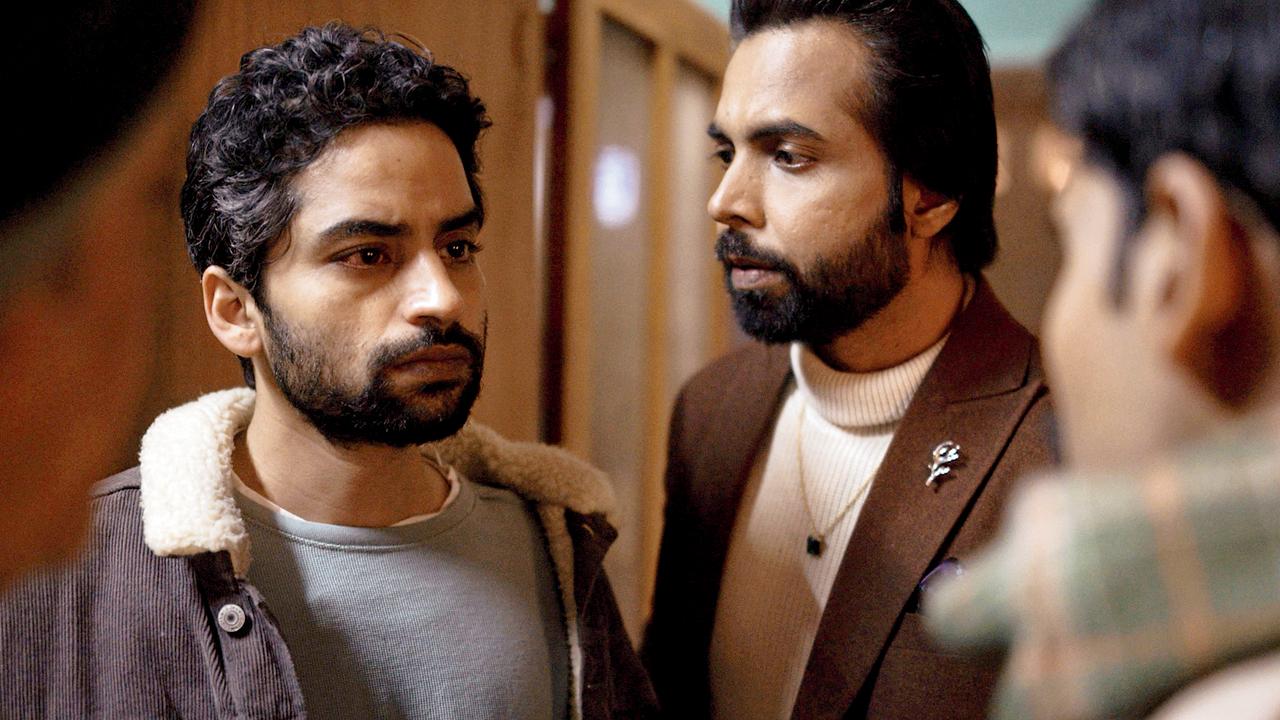
Co-writer and producer Gaurav Dhingra discusses how he got Abhishek Banerjee for Stolen in three days
Priyanka Sharma (MID-DAY; June 1, 2025)
Actor Abhishek Banerjee-led thriller, Stolen, is finally arriving home following its acclaimed international film festival run. But the film’s origin can be traced back to 2019, when debutant director Karan Tejpal shared with producer Gaurav Dhingra a story about two boys who were mistaken to be child lifters.
“Karan showed me some videos of two Assamese boys from Mumbai, who had gone fishing in Karbi Anglong, in Assam. They were mistaken to be child lifters, and then lynched [by a mob]. Karan wanted to explore the idea and shoot it in one take. That got me excited,” says Dhingra, who has also co-written the film.
At the same time, the producer was working on a separate series about missing children in India. “While this was going on, one of the stories we found, for the series we were doing, was about missing children being picked up from a bus station. Both the Karbi Anglong and the child lifting stories merged, and gave birth to Stolen,” he says, adding that it took them almost two years to write the script.
The time spent, however, was worth it as every actor they approached gave their nod after reading the first draft itself. Banerjee’s confirmation came in three days, shares Dhingra.
“We had just seen Paatal Lok. I felt Abhishek had a lot of range. He read the script the very next day. Usually, you need to give a lot of narrations. I was shocked because I thought it would take at least six months. But Abhishek said he wanted to take a day to read it again and respond. Two days later, he said he wanted to do it. It was that simple,” he shares.
Heaping praise on the actor, Dhingra says, “Abhishek is fantastic. We couldn’t ask for a better person.”
Another rarity that has happened with Stolen is the coming together of four top Bollywood filmmakers — Anurag Kashyap, Vikramaditya Motwane, Kiran Rao, and Nikkhil Advani — as executive producers. How difficult was this feat to achieve? Dhingra says he actually didn’t have to do anything.
“Everything is in the power of the material. We did a screening in Mumbai, and called some friends from the industry. Nikkhil and Vikram saw the film and were blown away. They asked me what I needed. I said that I was trying to sell the film. But then the industry was down. Later, Anurag called me, and said that he had heard much about the film and wanted to see it. Kiran, who saw it last, [was someone] I knew [as an assistant director] from Swades [2004], and Mangal Pandey [2005]. Earlier this year, I brought them together to present the film so that the audience sees their credibility and makes the film bigger. I’m so grateful. It’s extremely rare that such level of filmmakers come together to push a film.”

Gaurav Dhingra, Kiran Rao, Nikkhil Advani, Anurag Kashyap, Vikramaditya Motwane
For many filmmakers, Northeast feels like an alien region, as though it is from another planet-Jahnu Barua
8:12 AM
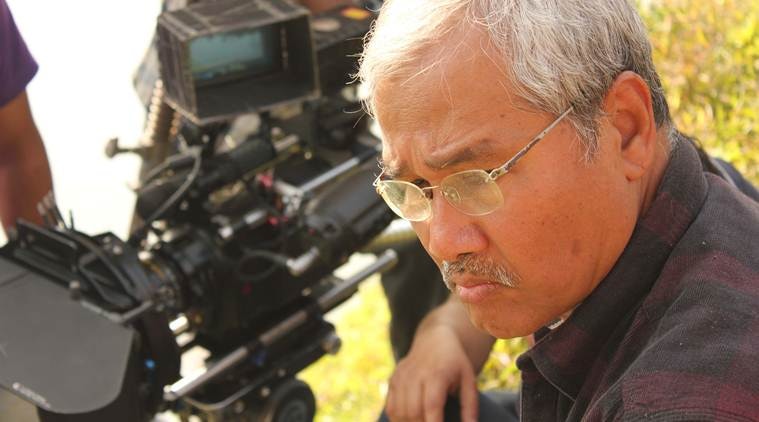
Shantanu Nandan Sharma (THE ECONOMIC TIMES; February 9, 2025)
In the early 1970s, Shillong became the stage for an unexpected flashpoint when a Bollywood movie laced with stereotypes ignited the fury of Naga students. Ye Gulistan Hamara, a Hindi film starring Dev Anand and Sharmila Tagore, revolved around a tribal community in the Northeast. But something cut deep. The Nagas found the song, “Mera Naam Aao”, and its picturization a crude and offensive misrepresentation of their Ao brethren. Outraged, the students vandalized a movie hall, forcing the Meghalaya police to crack down with lathis. Several student protesters later found their way into the ranks of Naga insurgents, with one of them, V S Atem, becoming a top commander of the National Socialist Council of Nagalim (NSCN-IM).
Bollywood has long played fast and loose with the sensitivities of the Northeast, a region rich in linguistic and ethnic diversity. So when the second season of Paatal Lok dropped last month—featuring characters speaking Nagamese, the lingua franca of Nagaland, and capturing the state’s turmoil with rare nuance—it came as a refreshing surprise to those familiar with the region. Among the unexpected highlights was the presence of award-winning Assamese filmmaker Jahnu Barua, 72, who stepped in front of the camera to play Uncle Ken, a former rebel leader torn between his past and his vision of peace and prosperity for the troubled state. In an interview with Shantanu Nandan Sharma, the Mumbai-based director shares his thoughts on Bollywood’s portrayal of the Northeast and what led him to step out from behind the camera and into the spotlight. Edited excerpts:
You rarely step in front of the camera. What made you act in Paatal Lok Season 2?
I acted in school plays a long time ago. But ever since I became a filmmaker, acting was never on my agenda. However, my close friends have known for decades that I have a knack for mimicking characters. Once Basu Chatterjee offered me the role of a Japanese astrologer in the television serial Kakaji Kahin (1988), and I obliged. Several fellow filmmakers have approached me with acting roles, usually for characters with a northeastern look, but I invariably declined. Often, such characters are introduced merely for comic relief, and I don’t appreciate that approach.
When the writer of Paatal Lok 2 narrated the script to me, I felt the story was genuine and presented the Northeast with authenticity. The writer, Sudip Sharma, grew up in Guwahati and, more importantly, understands the sensitivities of the region. That convinced me to accept the role.
Is acting a challenge for a director?
For a filmmaker, acting in a film is a beautiful experience, it brings a realization. It is easy to shout at actors from behind the camera, but once you step in front of it, you truly understand the difficulties actors face. Playing Uncle Ken was particularly difficult. He is physically worn out, battling terminal kidney cancer, yet remains mentally strong. I was given a walking stick, but I had to portray a character with a strong mind.
What’s your take on the portrayal of Northeast India in mainstream Hindi movies?
It’s a two-fold issue: how the rest of India perceives the Northeast and how the Northeast views the mainstream, particularly cinema. For many filmmakers, the Northeast feels like an alien region, as though it is from another planet. Hindi cinema, driven by commercial interests, often overlooks themes or characters from distant regions because the market dynamics don’t demand it. This is a misguided perception, but that’s how films are made.
Is that the only reason we hardly see Northeast faces in Bollywood? Are language and accent a barrier?
Language and accent are not a problem at all. In the realm of visual arts, audiences often embrace diversity in language and accent—it’s seen as something beautiful. The real issue, I feel, is that many young talents from the Northeast, though full of dreams and talent, lack the aggression required to enter and survive in Bollywood. Danny Denzongpa (an actor from Sikkim) is an exception. Despite many obstacles, he carved a niche in popular Hindi cinema. The challenges are clear: most people from the Northeast have distinct physical features, which lead to discrimination. However, we must recognise that discrimination can happen anywhere in the world.
As someone from the region, does it hurt you?
Yes, it hurts. I recall popular actors and filmmakers asking me, ‘Is it safe to travel to the Northeast?’ That kind of ignorance hurts me. For decades, the perception was that we lived in jungles. But I don’t want to solely blame filmmakers. The entire system is at fault.
What do you mean by the fault of the system?
To a large extent, political leaders—particularly from Assam and the Northeast—have allowed such ignorance to seep into society. For many decades, Indian history textbooks didn’t even include a chapter on the Northeast. Did our own leaders address this with the Central government? No. The Northeast has a rich, vibrant history. When society is ignorant about a region, it manifests everywhere, including in Bollywood. The Northeast may have been politically integrated into India, but social integration is still far from complete.
Why is Bollywood reluctant to explore the Northeast as a destination for film shoots, even though the insurgency has receded?
I believe there should be more films and series that feature Northeast themes and actors. The state governments in the region should encourage such initiatives.
When you become famous, suddenly life becomes easy-Jaideep Ahlawat
8:45 AM
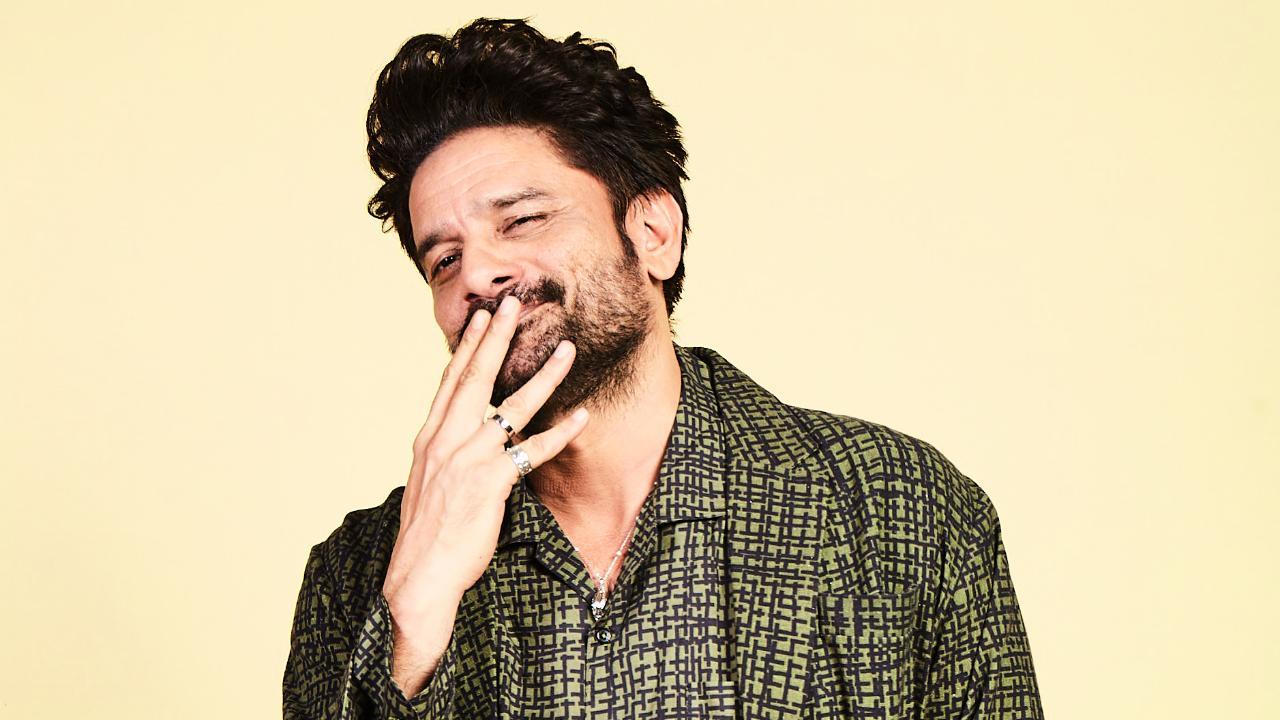
Ahead of the release of Season Two, Jaideep Ahlawat reflects on his life after the success of Paatal Lok as he doesn’t feel the weight of their expectations on his shoulders
Priyanka Sharma (MID-DAY; January 14, 2025)
Fans of Paatal Lok have their eyes pinned on the upcoming second season, but leading man Jaideep Ahlawat doesn’t feel the weight of their expectations on his shoulders. After all, reprising the role of Hathiram Chaudhary in the crime thriller was special for Ahlawat, given that working on the show was like returning to familiar territory.
“The place that this character has held in my heart has remained the same even after four years. It’s like, when a child leaves home for higher studies, his room is locked and left as it is. When he returns, he picks up from where he left off. For me, Hathiram is that character. Within a week of reading the script for season two, I was in sync with the requirement. Also, [it was of help] that there were people around me who understood Hathiram better than I did,” he says.
Ahlawat rose to fame playing the role of the cop in Sudip Sharma’s Prime Video series that made its debut in 2020. Ever since, he has bagged multiple projects, including An Action Hero (2022), Three of Us (2022), Jaane Jaan (2023), and Maharaj (2024). Ask him what his new-found fame has afforded him, and he says, “You no longer need to stand in a line!”
He adds, “There are many small perks I get that are beautiful. If you head somewhere and are recognized, people treat you with respect. Suddenly, life becomes easier. Being popular is also a nice criterion to earn more money.”
IN 2025, the actor has several projects, including The Family Man season three, Jewel Thief, Hisaab, and Ikkis, in the pipeline. The last one on this list, a Sriram Raghavan-directed film, has him share the screen with the “amazing” Dharmendra.
“One of the reasons I said yes to that film was to work with him, and to be able to tell the next generation that I worked with Dharam paaji. I want to say this line to someone for the next 20 years,” he signs off.
The missing case of spin-offs in India
8:31 AM
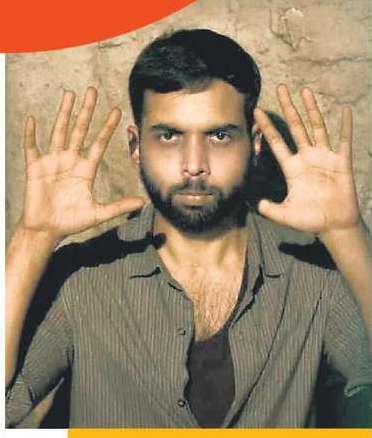
While the spin-off culture is soaring in popularity among Western makers, Indian industry seem to be lagging in this area. Assessing the reasons, experts weigh in
Rishabh Suri (HINDUSTAN TIMES; August 24, 2024)
While spin-offs have been around for a long time, superhero franchises and fantasy series have recently popularized the idea of giving fan-favourite characters their own spotlight, especially on OTT platforms. The offshoot plotlines of these characters, who would otherwise get minimal screen time in big-budget blockbusters, successfully allow makers to not only satisfy the audience but also utilise world-building. Some of the popular examples of spin-off series, which already have multiple seasons in the pipeline, include Gen V (The Boys), House Of The Dragon (Game of Thrones) and The Rings Of Power (Lord of the Rings).
Even though such offshoot productions, whether as films or shows, are all the rage in the West among the makers, the trend is yet to gain momentum in India. To understand more, we speak to some Indian makers and actors for their take on its surprising absence in India, along with pros and cons of the same.
MAINTAINING THE MYSTERY
A project includes a specific number of characters, each with a unique role to play. For actor Gulshan Devaiah, who plays Chaar Cut Atmaram in the series Guns & Gulaabs, not everyone’s story needs to be highlighted in a separate spin-off, as that might take away from the original plot.
“I have no idea why we’re not doing spin-offs but I’m not sure if it’s a good trend to follow. In my case, I’d say there shouldn’t be any spin-off for Atmaram. Some characters lose their charm if there’s no mystery to them,” Devaiah shares.
PRESSURE OF THE ORIGINAL PLOT
Actor Sharib Hashmi, who plays JK in The Family Man series, echoes a similar sentiment and feels that spin-offs shouldn’t be made just so that the original project remains relevant. “It should only be made if there is ample scope, and should not be seen as a mere opportunity to earn money or stay relevant.” However, Hashmi is not altogether against the idea.
He continues, “I would be the happiest if my character gets a spin-off but only if there is a good story. Look at Better Call Saul (Breaking Bad), which had such a brilliant storyline, and is as good as the original.”
BEGINNING AFTER THE ENDING
While original plots might leave very little room for detours, for Kanishk Varma, director of Sanak (2021) and the third season of the cricket-based thriller Inside Edge, a spin-off is a great way to immerse in the universe whose original story has reached a certain finale.
“You have to know when to throw in the towel. You cannot keep on dragging a story. So, spin-offs are a very cool idea of coming back. You have a scope of going back to a series and working on something you wanted to do in a particular season of the show.”
NEED FOR A CHANGE
While offshoot productions are lacking in India, writer Kanika Dhillon, who has been behind the story of Hasseen Dillruba (2021) and the latest instalment, Phir Aayi Hasseen Dillruba, opines that we are soon going to catch up.
“We have already caught on to the multi-universe sequel culture, which is prevalent in Hollywood. So, I am sure spin-offs will become a thing here as well, especially since people give a lot of love to [side] characters,” she shares.
Abhishek Banerjee, whose character Hathoda Tyagi from the series Paatal Lok fetched him critical praise, adds, “A lot of characters have the potential [for a spin-off] after they become a hit with the audiences. So, I feel the audiences would definitely want that change.”
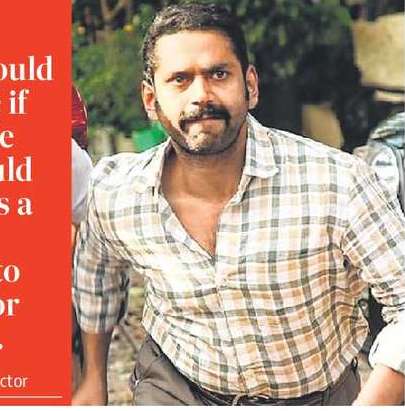
When Paatal Lok 2 got pushed, I had no work. I got nervous, says Three of Us director Avinash Arun
8:13 AM

Helming a tender love story in Three of Us, Killa director Avinash says Shefali-starrer is his attempt to revive Mukherjee’s brand of cinema
Priyanka Sharma (MID-DAY; October 31, 2023)
Sometimes, a seeming loss turns into an unexpected gain. That’s what happened with Avinash Arun. When the production of Paatal Lok’s second season was delayed due to the pandemic, the director had no idea that it would lead to the creation of Three Of Us. “When Paatal Lok 2 got pushed, I had no work. I got nervous. One night, after meeting director Chaitanya Tamhane, I got so inspired that I returned home and started writing. Within a week, my two friends, Arpita Chatterjee and Omkar Barve, and I wrote the screenplay for Three Of Us,” recounts the director.
What followed was a smooth ride as lead actors Shefali Shah, Jaideep Ahlawat and Swanand Kirkire, dialogue writers Varun Grover and Shoaib Nazeer came on board quickly, and the film was ready to roll in three months. It reminded Arun that when a movie is destined to be made, things fall in place.
“When I sent the first draft of the screenplay to Shefali, she replied, ‘I am on.’ After I sent the dialogue draft to Jaideep, he video-called me and said, ‘This is so beautiful. I am doing it.’”
Arun is aware that things are usually harder than this. After all, it took him eight years to get his second feature film as a director, even though his debut feature Killa (2015) earned a National Film Award. But he agrees that the stupendous success of Paatal Lok has given him an impetus. Now, as he presents an unrequited love story with Three Of Us, the director wants to bring forth the lost magic of films rooted in simplicity.
“I miss those times when Hrishikesh Mukherjee films were mainstream. We have grown up watching films by him, Sai Paranjpye, Basu Chatterjee and Gulzar saab. Such stories are gone. So, this is my attempt to get that genre back to the mainstream.”
Nobody does bizarre ideas better than Raj and DK-Rajkummar Rao
8:29 AM
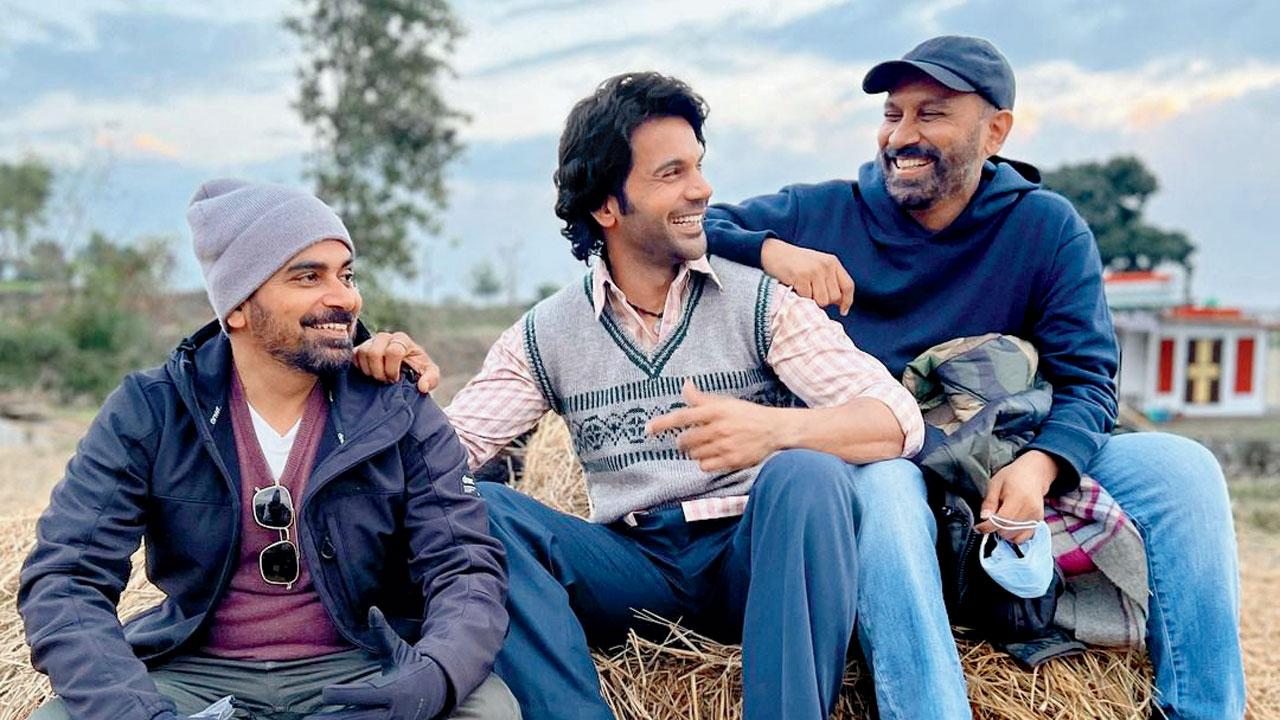
Keen to be directed by Raj-DK ever since they wrote Stree, Rajkummar on how Guns & Gulaabs’ sharp script made it easy to portray his eccentric role
Priyanka Sharma (MID-DAY; August 14, 2023)
To Rajkummar Rao, Raj-DK (Raj Nidimoru, Krishna DK) are friends first, then collaborators. The opportunity to be directed by them, coupled with an exciting story, made Guns & Gulaabs an instant choice for the actor. “While Raj-DK were my co-producers and writers on Stree [2018], this is the first time they directed me. They are two of my closest people in the city. We had been meaning to work together for a long time,” he smiles.
Rao is known for seeking novel stories, and Guns & Gulaabs didn’t disappoint on that count. The Netflix crime comedy, also starring Dulquer Salmaan and Adarsh Gourav, has all the ingredients of a Raj-DK offering—oddball characters and quirky humour tied neatly into an engaging narrative. “There have been many serious crime and investigative dramas, but sometimes you need a break. You just want to sit and laugh out loud at bizarre things, and nobody does that better than Raj-DK,” says the actor.
In the upcoming series, he plays Paana Tipu, a love-struck mechanic with a violent streak. The actor credits Raj-DK and their writing team for conceiving a screenplay that gave him enough scope to explore his character’s eccentricity. “When you get great material and fabulous [collaborators] like Raj and DK, it becomes easy. You just have to push yourself a little and do something that you haven’t done earlier. If you aren’t here to just say lines and if you do your job for the right reasons, you get the results.”
But hard work doesn’t always assure you of great box-office results. Since the pandemic, there has been a shift in viewing patterns of the audience, who prefer watching tentpole movies on the big screen and content-led offerings on OTT. Rao looks at the upside of the situation, pointing out that with streaming services, actors don’t need to depend on box office to achieve stardom.
“For instance, I was blown away by Suvinder Vicky’s performance in Kohrra. For me, he is a star. It doesn’t matter to me if 1,000 people have watched Suvinder Vicky’s work or only 400 have, but he is one of the best actors we have today. The same thing happened with Jaideep [Ahlawat] in Paatal Lok [2020] and Pratik Gandhi in Scam 1992 [2020]. Manoj sir’s [Bajpayee] second innings started with The Family Man, and today, he is right up there.”
I went to last page of Kohrra's script to see if my character is killed-Suvinder Vicky
8:21 AM

Nurturing Bollywood dream since 20 years, Kohrra’s breakout star Suvinder says he was in disbelief when he was offered the lead role
Priyanka Sharma (MID-DAY; July 27, 2023)
Until a few weeks ago, Suvinder Vicky would feel anxious about his career, worried that it wasn’t moving in the right direction. But that has changed dramatically since Kohrra dropped online over 10 days ago. “Maybe this is what fame feels like. My phone hasn’t stopped ringing,” laughs the actor, talking to us over a call from his Chandigarh house.
With Netflix’s gripping investigative crime thriller emerging as a sleeper hit, the Hindi film industry and the audience have found a new breakout talent in Vicky, who plays a Punjab cop investigating a murder case. The actor, 50, points out that his success is not overnight; instead, it’s the culmination of a 20-year journey. To him, Bollywood was always the destination, but he was too scared to pack his bags and move to Mumbai.
“I come from a humble background. My parents weren’t keen on sending me to Mumbai because it felt unsafe. You keep hearing stories of outsiders, struggling to find work and pay bills. I could never muster the courage to follow my Bollywood dreams. So, I kept honing my craft, working in Punjabi films,” he says.
But Bollywood often knocked at his door, even if with smaller opportunities. The actor featured in Hansal Mehta’s Shahid (2013), and Abhishek Chaubey’s Udta Punjab (2016). Unknown to Vicky, it was during the making of Udta Punjab that Kohrra creator Sudip Sharma spotted him. Sharma, who wrote the Shahid Kapoor-Alia Bhatt crime drama, was so impressed by Vicky that he decided he would cast him in a bigger role whenever the opportunity arose.
“Sudip sir then cast me in Paatal Lok [2020], where I just had a few days’ shoot. So, I found it unbelievable when he rang me up and asked if I would do Kohhra,” the actor shares.
Even though he played a significant role in CAT (2022), headlining a Hindi show was beyond Vicky’s imagination. He candidly shares, “I read the first few pages of the script, and then went directly to the last page to see if they have killed my character.”
There was no denying that the story—exploring the dark side of love, father-son bond and familial violence—was powerful. But more than that, it was Sharma’s unflinching faith in him that made Vicky come on board. “The script was complex. I was so scared if I would be able to do it. But when the show’s creator says, ‘I won’t make the show if you don’t do it,’ then that becomes your guiding light.”
Now, Vicky feels emotionally prepared to visit Mumbai and explore more opportunities. “I have done many credible films, where I’d be mentioned as a scene-stealer, but it’s the first time, every praise mentions me as the leading man. It’s such a different feeling, especially when directors like Karan Johar, Hansal Mehta and Deepa Mehta specifically mention your name,” the actor smiles.
Unless aap Hindi shows ya films karo, aap national audience ko dikhte nahi ho-Swastika Mukherjee
8:00 AM
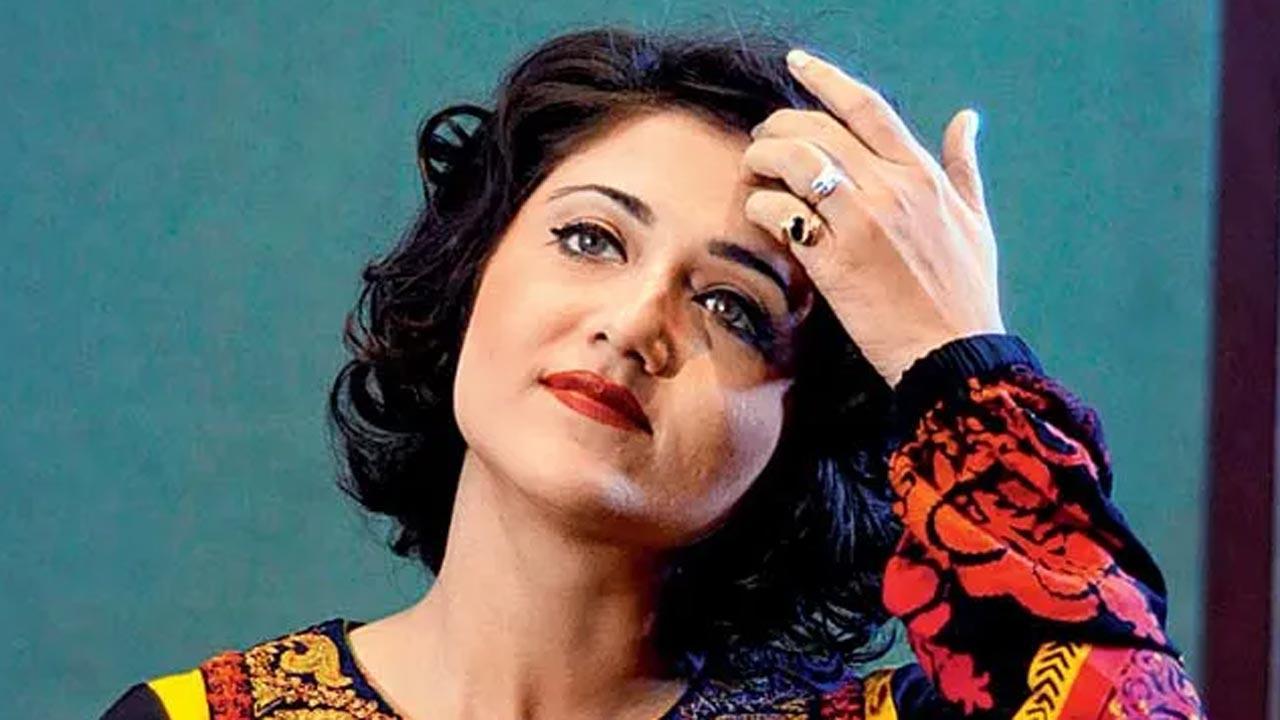
Soumitra Das (AHMEDABAD TIMES; February 12, 2023)
While Swastika Mukherjee is a known face in Bengali cinema, audiences across India and beyond have got to know about this powerhouse performer in recent times thanks to OTT projects like Qala and Paatal Lok. Swastika was in Ahmedabad recently as a speaker at the Karnavati Literature and Film Festival 2023.
While answering a question about the importance of mental health after her session, Swastika, who has always been vocal about women’s rights and issues, shared, “When women talk about anxiety and depression, there are many men who relate it to their menstrual cycle and say, ‘Mahine ke woh din chal rahe hain kya?’ They need to understand that a woman’s mental health has got nothing to do with her menstrual cycle.”
In a chat with us, Swastika spoke about how OTT has given her national recognition, her memories of Ahmedabad and more.
‘I NEEDED TO MOVE OUT OF MY COMFORT ZONE’
While Swastika was already an established name in Bengali films, she started exploring Bollywood as she felt “bored”. “In the Bengali industry, people were very happy with what I was doing. I had a great career and I was being paid well. But after a point, I felt bored because there was no one to really push me. So, I thought of going somewhere else and starting from scratch. I’ve been trying to make things happen since the release of my Hindi film Detective Byomkesh Bakshy! (2015). As an artiste, it is important to move out of one’s comfort zone. It makes you work harder on your craft,” shares the actress.
She adds, “After Paatal Lok (2020), I received great feedback; people started asking me, ‘Where were you all this while?’ However, things were tough initially because I had to start from scratch. In Bollywood, while people are aware of what’s happening in the Punjabi film industry or down south, they are not deeply invested in what’s happening in Bengali cinema. So, as an actor, you have to keep your pride, ego and social status aside and keep auditioning. Unless aap Hindi shows/films karo, aap national audience ko dikhte nahi ho. But I’m glad that nine years of hard work and patience is being rewarded now.”
‘FOND MEMORIES OF SHOPPING AT LAW GARDEN’
Swastika visited Ahmedabad “after almost 19 years” and this was her second visit to the city. She shares, “My sister used to study here, and my mom would come to Ahmedabad and stay with her for a month or two. I had come here once, and I have fond memories of shopping at Law Garden. The city has changed a lot since then. But I enjoy coming to Gujarat and visiting the Rann Utsav in Kutch with my daughter Anwesha is on my to-do list.”
If actor’s fee is more than the budget of the show, then something is wrong-Sumeet Vyas
8:32 AM
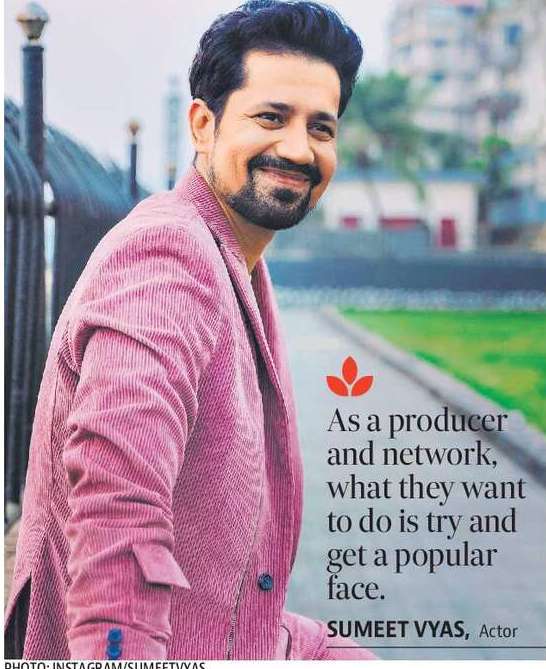
Actor Sumeet Vyas has been part of the Indian web space since the very starting, having seen its growth as well as the changes that have come with the mo
Syeda Eba Fatima (HINDUSTAN TIMES; February 9, 2023)
Actor Sumeet Vyas has been part of the OTT world since its inception and has seen its growth as well as the changes over the years. While the actor agrees that makers at times cast popular faces for the shows for various reasons, he feels that there is nothing wrong in doing so.
He explains, “I do not feel there is anything wrong in casting a film actor, if he is right for the part. But, if his acting fees is more than the entire budget of the show, then there is something wrong. There is a certain budget for the salaries of the entire unit, for the shoot to happen and if twice that number is being paid to one actor, then that’s not right. I do not think any actor brings that much value to any project. It’s the balance that we need to learn.”
Emphasising on his point, Vyas gives example of the shows that have done well in the digital sphere, which do not feature well-established film stars.
“Pataal Lok (2020), Mirzapur (2018), Rocket Boys (2022), Pitchers (2015), Permanent Roommates (2014), Panchayat (2020) and many more. These are all those shows that did not have stars and still they were superhit. In fact, shows which had bigger stars in them and ridiculous money spent did not do well.”
He adds, “Sacred Games (2018) would be exception where they had two stars (Saif Ali Khan and Nawazuddin Siddiqui) and it performed nicely. My point is, nine out of the ten shows that did well, were the ones with actors you did not think were stars. They were just good actors who suited the part.”
Ask if biases are even more apparent when stars are cast for big projects, Vyas agrees but explains that it happens because of the commerce.
“As producers and networks, what they want to do is try and get a popular face so that they are at least covered on those grounds,” he signs off.
OTT feels like reading a novel, while films are short stories-Adil Hussain
8:30 AM
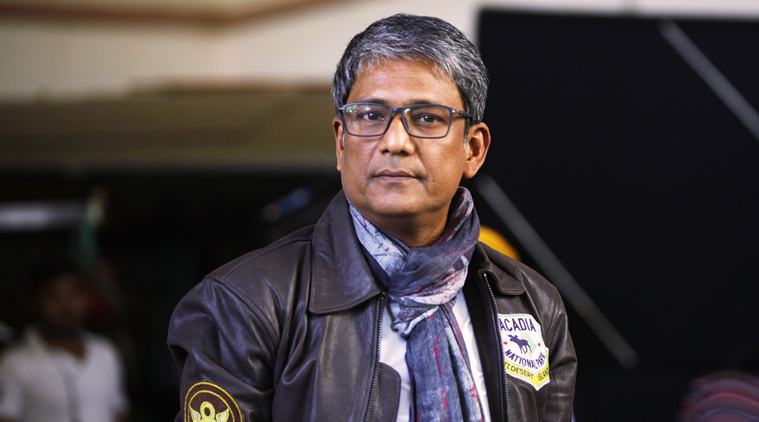
Adil Hussain on how OTT is set to get bigger and better, his upcoming projects and more
Eesha Thorat (BOMBAY TIMES; December 25, 2022)
A dil Hussain was recently in Delhi to be a part of the annual pop-culture festival Delhi Comic Con. The actor, who played Aditya Sahil in Star Trek: Discovery, spoke to us about his upcoming projects, how OTT has given good actors opportunities they didn’t have before, his favourite comics and more.
‘OTT IS SET TO GET BIGGER’
Having been a part of multiple OTT projects and with a few more lined up, Adil feels that while films are like short stories, OTT is like reading a novel as it gives creators more freedom to tell their stories.
“Because it has the liberty of giving creators longer formats and due to its sheer reach and expanse, we can go home with the smaller characters, who otherwise remain in the background, and explore their worlds. You can go home with someone playing a havaldar and see their world. We get to see so many good actors, who we wouldn’t have otherwise been aware of. Actors like Jaideep Ahlawat from Paatal Lok or Rajesh Tailang from Delhi Crime, who was my classmate at the National School of Drama, would not have gotten such opportunities if not for streaming platforms. Rajesh would’ve been playing some hero’s friend or a smaller role, which is a disgrace,” says Adil.
The actor adds, “Apart from that, audiences are now being introduced to different lifestyles and cultures. For instance, I have the freedom to watch a film like Kantara any time I’d like and on whichever device I want. So I feel OTT is not just here to stay but is set to get bigger and bigger. I feel lucky to be a part of this boom.”
‘VFX AND STORYLINE BOTH NEED WORK IN INDIAN SUPERHERO FILMS’
When asked about what he feels about a surge in films belonging to the action, adventure, sci-fi and fantasy genres (like Brahmastra, Minnal Murali or the upcoming Shaktimaan film), Adil feels that while it is a good start, creators need to work harder to achieve perfection.
“See, if I have two or three hours to watch something, I’d rather watch something that is very well done. Although I’d love to see Indian films making a mark in the superhero genre, and I can be biased towards an Indian cinematic creation, but I’d prefer giving marks to quality rather than just being a loyalist. In many Indian projects, I feel the VFX and storyline both need work,” says Adil.
Talking about his upcoming projects, he says, “There is one upcoming international project I’m doing with a popular streaming platform, but I’m not allowed to talk about it (laughs). I’m also doing a few films, which audiences shall know about soon.”
Since we caught up with Adil at a pop-culture convention, how could we let him go without knowing his favourite superhero? “I know new heroes have come in, but my favourites shall forever remain The Phantom and Mandrake The Magician,” he says.
The awareness Hathiram’s popularity can also create fear-Jaideep Ahlawat
8:23 AM
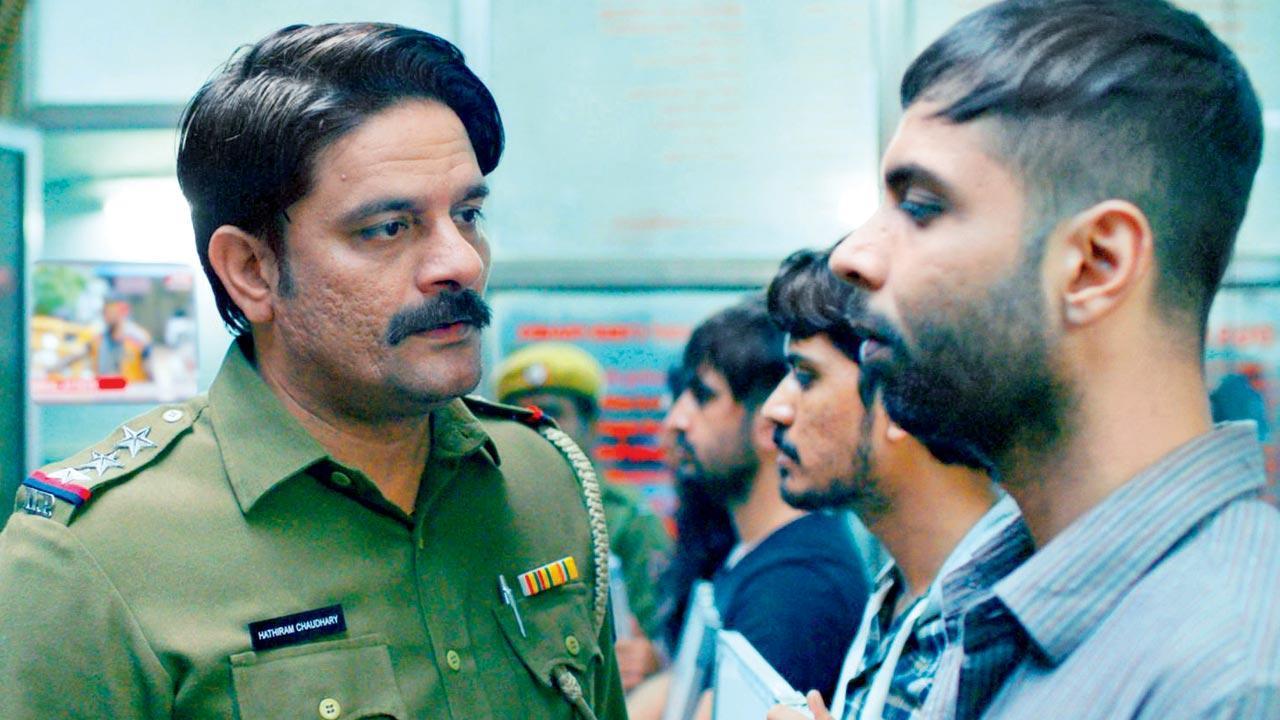
Ahlawat, who has kicked off Paatal Lok 2 shoot, says the weight of audience’s expectations makes it difficult to reprise his much-loved character
Priyanka Sharma (MID-DAY; December 6, 2022)
Jaideep Ahlawat has reported back to duty as Hathiram Chaudhary, the unassuming cop who unearthed the maze of Delhi’s deception and politics in the first season of Paatal Lok. One would think that reprising his role in the second instalment must be easy for the actor. But Ahlawat says revisiting the part is nerve-wracking. Reason — Hathiram’s popularity often interferes with his approach to the character.
“The awareness [about his role’s popularity] can also create fear. You start feeling a responsibility because people will watch the character with increased expectations,” states the actor, who began shooting for the latest season last month.
It’s almost impossible to channel the rawness while playing a character the second time around. Ahlawat says he is trying to recreate the feeling that accompanied him when he had first stepped into the dark, grimy world of the Amazon Prime Video series, which catapulted him to fame.
“You have to return to the feeling you had when you had first performed the role. At that time, there was no pressure. I didn’t even know how many people would like it; I was just lost in the character. So, I try to have that approach.”
The actor is currently basking in the appreciation coming his way for An Action Hero, which also stars Ayushmann Khurrana. In a way, the action comedy signals that filmmakers are trusting him with mainstream projects. “I like this [faith] where people think that if I am in a project, it would be interesting. There is an increased trust in directors and writers that I can pull off a role, irrespective of the story. People are more accepting of me.”
I was really surprised that you could get admission in college on the basis of your acting skills-Abhishek Banerjee
8:46 AM

Niharika Lal (BOMBAY TIMES; July 16, 2022)
Abhishek Banerjee’s role as the hammer-wielding gangster Hathoda Tyagi (in Paatal Lok) made him a household name. An alumnus of KMC (Kirori Mal College), Delhi, Abhishek says he took admission in that college because it was Amitabh Bachchan’s college. In Delhi for a project, he talks to us about his college days and how it took him almost a decade to crack the code as an actor, while he worked behind the scenes as a casting director and also did small roles. Excerpts from our chat with him:
‘I DIDN’T KNOW ONE COULD GET ADMISSION IN DU WITH ACTING SKILLS’
The Delhi boy shares, “Even when I was in school (Kendriya Vidyalaya in Delhi), I wanted to get into KMC because I was a huge fan of Mr Bachchan and he was an alumnus of KMC. Main yeh sochta tha ki main thoda ghoos (bribe) khila ke kaam chala lunga. Then I met Mohd Zeeshan Ayyub; he was from my school and studied in Kirori Mal College. He told me that I could also get admission by appearing for the theatre auditions (under ECA quota). I was really surprised that you could get admission in college on the basis of your acting skills, and that’s how I got into KMC and then Players (the theatre society of KMC).”
Talking about Players, he adds, “It is one of the best theatre groups in the country, and I’m not talking about amateur theatre groups. It is the best professional theatre group in the country. We have many talented people working in the film industry from Players – from Ali Abbas Zafar to Divyenndu (Sharma) and Zeeshan (Ayyub). And of course, we have veterans like Satish Kaushik and Kulbhushan Kharbanda.”
‘AS A CASTING DIRECTOR, I COULD NEVER BE PARTIAL, EVEN TO FRIENDS’
Abhishek’s first brush with films was on the sets of Rang De Basanti (2006). He played a small role in the film. He says, “It was the first time when I went on a film set, and I realized that there are so many other things to do on a film set apart from acting. But I wanted to become an actor.”
Apart from Rang De Basanti, where he played the role of a DU student, the actor also had a small role in Bombay Talkies (2013) and played a pickpocket in No One Killed Jessica (2011). Abhishek had auditioned for the role of Manish in the film but was rejected. The role was eventually bagged by Zeeshan Ayyub.
Abhishek shares that while he did not go to FTII (Film and Television Institute of India) or NSD (National School of Drama), he learned from his experiences on film sets, where he started working as a casting director. He has 90 credits on IMDB as a casting director, which includes films like Secret Superstar and Toilet: Ek Prem Katha. He says that over the years, there have been many times when his fellow casting directors would reject him for roles.
He says, “In Ghanchakkar, I thought I could have been cast as I knew the team, but I was not. It was a learning from my seniors, and that is why I could never be partial as a casting director, even to friends.”
While he kept doing small roles and got a lot of offers for playing the hero’s friend, Abhishek says he didn’t want that. He adds, “In 2018 when I was offered the role of Rajkummar Rao’s friend in Stree, I was not convinced. But Amar sir (Amar Kaushik, director of Stree) told me that it is a film with three guys. While it was an important role, I think the role after which people started noticing me was Hathoda Tyagi. And then they would recall Stree and Phillauri and so on.”
Talking about his experiences and learnings as a casting director, he tells us, “I have been casting from the time when we were known as casting coordinators and not casting directors. We know a lot of good actors who haven’t got space. We try to not waste them on small roles – and when the time and the role and the director are right, we cast them. And then people wonder yeh kahan se aaye? Yeh yahin thay – yahin theatre kar rahe thay.”
I have to up my game because the story is shouldered by me-Jaideep Ahlawat
8:20 AM
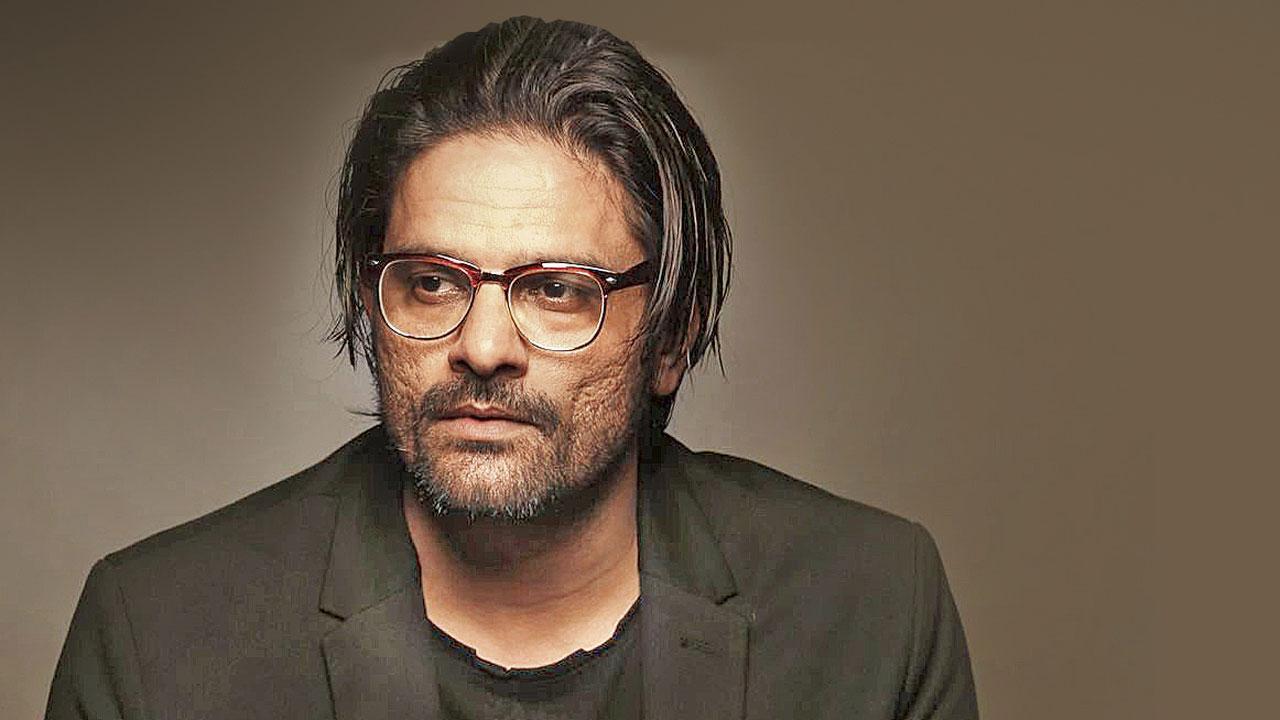
Jaideep, who fronts Bloody Brothers, says playing the lead is a responsibility as well as a relief
Uma Ramasubramanian (MID-DAY; March 19, 2022)
After Jaideep Ahlawat delivered a nuanced performance in Paatal Lok (2020), many of us wished to see him in a comedy, a genre that would be an antithesis of sorts to the gritty web series. It looks like the actor heard us. His latest offering, Bloody Brothers, sees him spin a web of lies and deceit, to hilarious results, when his brother — essayed by Mohammed Zeeshan Ayyub — runs over an elderly man. Ahlawat holds the black comedy close to his heart as it sees him in a leading role.
“It’s liberating to play the lead. But, along with that, comes great responsibility. Now, I have to up my game because the story is shouldered by me. At the same time, as an actor, there is a sense of relief. I can pick and choose the stories I want to tell. Paatal Lok has been a game changer for me in that regard. People started trusting me more as an actor,” he says.
The ZEE5 series is an adaptation of BBC’s Guilt, a thriller set in Edinburgh. While the original was a taut mystery, director Shaad Ali has infused dark humour into his adaptation. The satire is a change of pace for Ahlawat who was almost getting pigeon-holed in intense roles. “There was a phase when [I was getting typecast]. Now, I feel relieved that I am not being typecast, and all sorts of roles are coming my way.”
I never expected to be approached for a love story after Paatal Lok-Abhishek Banerjee
8:10 AM
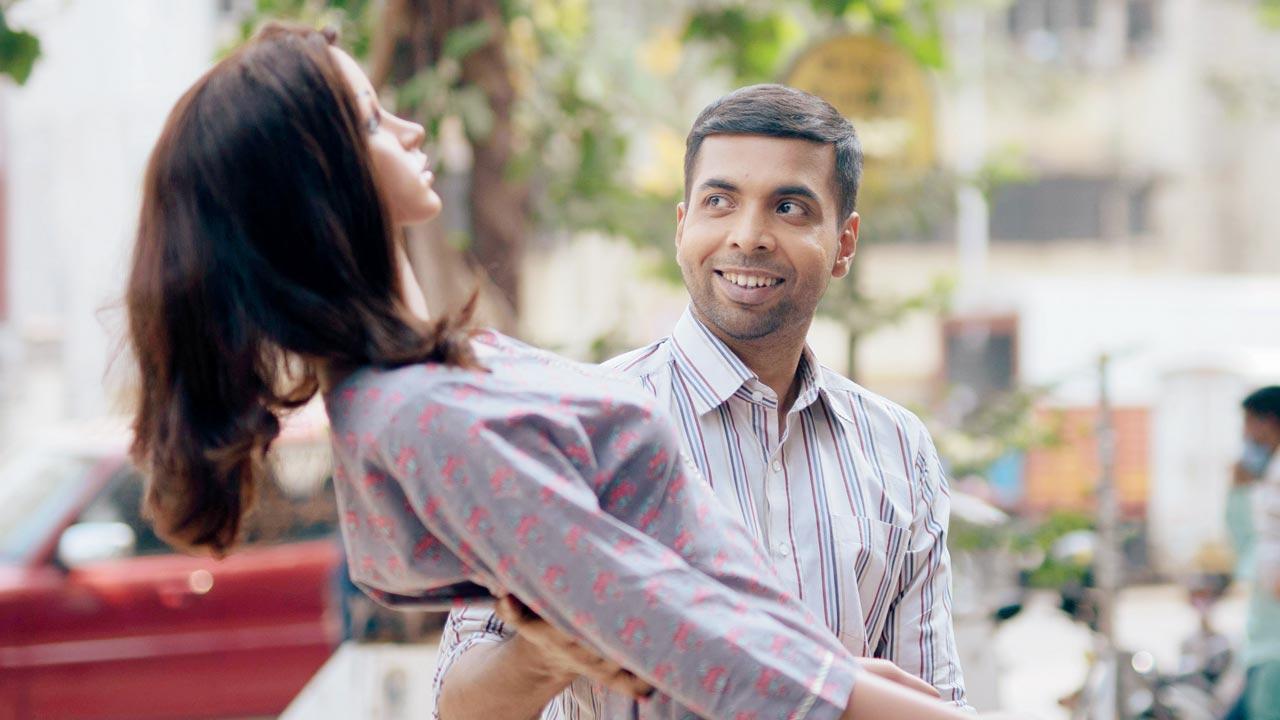
Surprised to be cast as a romantic hero in Ankahi Kahaniya, Abhishek Banerjee says working with Ashwiny Iyer Tiwari has been experience of a lifetime
Uma Ramasubramanian (MID-DAY; September 16, 2021)
"I never expected to be approached for a love story after Paatal Lok,” laughs Abhishek Banerjee, the casting director-actor who caught everyone’s attention with his menacing act as Hathoda Tyagi last year. There has been no looking back for him since as he bagged pivotal roles in several films and web series. His latest offering Ankahi Kahaniya, however, is special to him as it marks his first brush with the genre of romance.
“It is a difficult emotion to portray on screen. As actors, we practice dramatic and comedy [scenes]; hardly does one portray romance. During my theatre years, we never thought about doing what Shah Rukh Khan has done [in terms of depicting love]. Growing up in India, the dating culture has always been understood through films,” he says.
The Netflix anthology on love though is a far cry from the mainstream boy-meets-girl romantic dramas. In her short film, director Ashwiny Iyer Tiwari weaves in loneliness and the need for companionship as she tells the story of a salesman — essayed by Banerjee — who finds an unusual companion in a mannequin.
To the actor, working with Tiwari has been an “unforgettable” experience. “I hope to work with her again because she lives in a beautiful world [created by her imagination]. Her creative energy reflects in the films she makes. The minute she started directing me and telling me how she [visualises] the story, it was clear that I needed to see her world through her eyes.”
OTT shows decode Delhi's diversity: "Delhi carries many cities within it"
8:23 AM

Abhimanyu Mathur (DELHI TIMES; September 11, 2021)
One would assume that a comedy about living independently, a satire on the lavish lifestyles of the elite, and a true-crime story of the most horrific gang-rape in recent memory would have nothing in common. However, the three do have one thematic connection – their geographical setting is Delhi. With the proliferation of web content over the last few years, there have been many shows set in the national capital. Filmmakers say that Delhi, as a location, offers contrastingly different landscape and architecture, ranging from small bylanes to broad highways and from crowded slums to plush localities and highrises. This means that shows set in Delhi are not just diverse in terms of locales but also themes and genres. The creative minds behind the various OTT shows set and shot in the capital tell us what makes Delhi so easy to depict in such diverse and new ways.

EXISTENCE OF DIVERSE STORIES IN DELHI
Even as multiple OTT shows have been based in Delhi, almost all of them show starkly different shades of the capital. Reema Kagti, one of the co-creators of Made In Heaven, called Delhi “the wedding capital of India” while promoting the show in 2019. The show tells the story of two wedding planners handling the nuptials of Delhi’s filthy rich. The show’s other co-creator Zoya Akhtar added, “Delhi is a beautiful place to shoot. It’s differently cinematic. For the kind of story that we wanted to tell, we needed spaces like that.”
But Delhi was equally fitting as a setting for the Emmy Award-winning Delhi Crime, the show inspired from Delhi Police’s investigation of the infamous 2012 Delhi gang-rape. Rajesh Tailang, who played one of the policemen in the show, argues that even if it was a fictional tale, it would have been set in the capital. “Of course, this show had to be set in Delhi. The incident which inspired this show took place in Delhi. But even if it was a fictional show, this would have made sense being set in Delhi. It’s not as if women are only unsafe in Delhi but if you ask me for a comparative between Delhi and Mumbai, I’d say the problem of women being unsafe in an urban metropolis while venturing out at night is associated more with Delhi,” he says.

‘LONGER RUNTIME ON OTT ALLOWS US TO SHOW NEWER PARTS OF DELHI’
The depiction of Delhi in OTT shows has moved away from how the city was portrayed in cinema over the years. Instead of shots of India Gate or Qutub Minar that cinema had often employed to depict Delhi, web shows are moving beyond these usual suspects to depict newer parts of Delhi that had never found their way on to screens.
Filmmakers and writers attribute this to the longer run time that web series offer as opposed to feature films. “When you’re narrating a long format story, as a creator, you’re aware that you have the advantage of runtime. Hence, it doesn’t become too important to establish a city via the typical or iconic locations,” says Mayank Sharma, creator and director of Breathe - Into The Shadows. The series showcases neighbourhoods, roads and bylanes of various parts of Delhi, shot almost exclusively during the winters.
Mayank adds, “What I find interesting is for us to invest and spend time to show different settings and locations of Delhi that people have probably not seen or experienced yet. An unexplored or a new location demands shots that have to be contrived entirely from scratch, which brings freshness to the storytelling.”

‘AUTHENTICITY KEY WHILE SETTING A SHOW IN DELHI’
Creators say that authenticity becomes important when setting a story in a real place, in this case Delhi, particularly for the web medium. “Unlike a movie, which caters to a family crowd, web series are mostly consumed by individuals. Most people watch it on their laptops. They expect it to be real. So, the tone and language need to convey the same,” says Siddharth Singh, co-writer of Shaadi Boys, one of the first OTT shows set in Delhi.
And the creative minds behind these shows say they are willing to take extra pains to showcase Delhi as authentically as possible. While shooting for Breathe - Into The Shadows, Mayank and his crew made sure they shot at Delhi’s Ramlila. He elaborates, “We made sure that while the Ramlila mela was happening in Delhi, I flew with my core team and we captured the authentic visuals from the actual event itself, which added a lot to the authenticity of the scene, showcasing the way people celebrate that festival. Today’s audience can quickly make out the difference between what’s real and what’s made up. Hence, hands-on research is pivotal for realistic and engrossing storytelling.”
-----------------
OTT SHOWS SET IN DELHI
LIFE SAHI HAI: Four young friends, who decide to live independently for the first time ever, move to Delhi and live together, facing unpredictable challenges
MADE IN HEAVEN: Two wedding planners from Delhi discover a lot about themselves and the city’s society as they plan lavish and expensive weddings for the capital’s elites
SHAADI BOYS: Three aspiring actors, having failed in their Bollywood dreams, move to Delhi and decide to use their skills in Delhi’s lucrative wedding industry
DELHI CRIME: Set in the aftermath of the horrific 2012 gang-rape, the series follows the Delhi Police team that investigates and solves the case amid mounting pressure
THE AAM AADMI FAMILY: The comical tale of the Sharma family of Dilli trying to deal with their ‘middle-classness’ as they go about their day-to-day affairs
PATAAL LOK: The investigative thriller is about a disillusioned east Delhi cop, investigating a case of a failed assassination of a prominent journalist
BREATHE - INTO THE SHADOWS: A capital-based psychiatrist must commit a series of murders as ransom for his kidnapped daughter while the Delhi Police Crime Branch is hot on his heels
-----------------
‘DELHI CARRIES A LOT OF CITIES WITHIN ITSELF’
Even when some of the Delhi-based stories are similar thematically, a mere shift in geographical setting within Delhi makes them tonally different. So, while Made In Heaven and Shaadi Boys both deal with wedding planning, the former deals with the weddings of Delhi’s ultra-wealthy elites, the latter is set around west Delhi’s middle class shaadis. Filmmakers add that this diversity across Delhi allows them to retain the individuality of stories.
“The representation of Delhi in Indian cinema has either been tinted with a lens of nostalgia or set around almost a make-believe upper middle-class west Delhi world. But even though the cinematic representation has been two-dimensional, Delhi is not one city. It carries a lot of cities within itself. It carries a lot of different kinds of lives and cultures within itself,” argues Sudip Sharma, creator and co-writer of Pataal Lok.
The crime thriller follows a cop from ‘Jamuna paar’ – the part of Delhi that seldom finds cinematic mention. “In Delhi, they look at you a certain way if you are from a certain area,” continues Sudip, “You are immediately boxed in. Depending on whether your answer to the question ‘where are you from’ is Vasant Kunj or Patparganj, you are looked at differently. Where you set the story sets it apart from another story with a similar theme.”
-----------------


Pataal Lok makes the distinction between the different parts of Delhi based on the class inhabiting them, labelling them as pataal lok, dharti lok, and swarg lok respectively
We are thrilled that some of our bets are starting to pay off-Aparna Purohit
8:05 AM

Amazon Prime Video, which is a preferred home for creators and talent, focuses on local stories, diverse voices and authentic casting
BOMBAY TIMES (June 22, 2021)

The new season of The Family Man has been a huge hit. What do you attribute this success to?
Our key tenet is to back a good story when we see one — a story that is unique, inspiring and intensely local. When green-lighting a project, we bet on the authenticity of the story and the passion and vision of the creators. Good stories connect and have the potential to transcend all barriers of language and geography. The reason for The Family Man’s success is the fact that it is relatable, yet inspirational. Raj and DK (Raj Nidimoru, Krishna DK), the extraordinary creators of The Family Man, have reimagined the spy-thriller genre by chronicling the dual life of a middle-class family man who also happens to be an exceptional agent. Or, as Manoj Bajpayee aptly puts it, is the James Bond of Chembur! The creators’ quintessentially distinct, independent voice is what sets this story apart. In just two weeks, The Family Man’s new season has become one of the most watched on our streaming service in India.
Successful stories do not flourish in isolation — they come alive with collaboration. Our goal is to help create a community, a creative space for storytellers. My opening gambit to creators is to come to us with their passion projects, stories that might be locked in their closet, ideas that are keeping them up at night. The success of our Originals is the result of our commitment towards nurturing and championing the distinct vision of our creators.

Our strategy has always been to think from the customer-backwards. This is Amazon’s core philosophy across all businesses. We strongly believe that there’s never been a greater appetite for quality content. Audiences have become discerning and have high expectations from what they’re watching. We prioritise distinct storytelling styles and are bringing forth diverse multi-genre stories.
A show builds a community — a sense of belonging and loyalty. The audiences spend a lot of time with the characters and build a relationship with them. These characters start representing the common experiences of people, they become a part of everyday conversations — they truly become part of the pop culture.
For instance, the character of Chellam sir from The Family Man has become a cultural icon overnight and his fandom cuts across demographics. It is important to invest in development — give the creators all the support and tools to build an immersive universe the audiences can relate with.

We believe that our discerning customers expect every character to be crafted with depth and cast with authenticity, and we continuously support creators in their endeavour to meet this expectation.
We see collaborations with the same creators for multiple projects… will this trend continue?
Over the past four years, we have been able to nurture and support the birth of a robust creative ecosystem of storytellers, creators, and artistes who trust us and come back to work with us on multiple projects. Currently, we have over 70 projects in development with both established and emerging creative voices. We are working with over 60 different production houses across languages. Many of our partners have multiple projects in development and production. For instance, we are doing several shows with D2R, Abundantia, Excel Entertainment, Emmay Entertainment, Pritish Nandy Communications, OML and Still & Still. We encourage storytellers to bring to life their vision and shoulder the responsibility of helping them take their passion projects to audiences in 240+ countries and territories.
Amazon Prime Video is also bringing some exceptional talent to the fore, in front of the camera…
Our undeterred focus is authenticity. We encourage creators and producers to cast for characters — whether it is Mairembam Ronaldo Singh as Cheeni, Jaideep Ahlawat as Hathiram in Paatal Lok, Ritwik Bhowmik as Radhe and Shreya Chaudhary as Tamanna in Bandish Bandits and Samantha Akkineni as Raji. And wouldn’t you agree that there can be no better Srikant Tiwari than Manoj Bajpayee in The Family Man or Kaleen bhaiya than Pankaj Tripathi or Guddu bhaiya than Ali Fazal in Mirzapur? This is liberating and has led to a level playing field for emerging as well as established talent. We are thrilled that some of our bets are starting to pay off. We truly want to be enablers for a prolific creative community and a dynamic creative zeitgeist.

I want to tell everyone that I am a dancer as well-Jaideep Ahlawat
8:13 AM
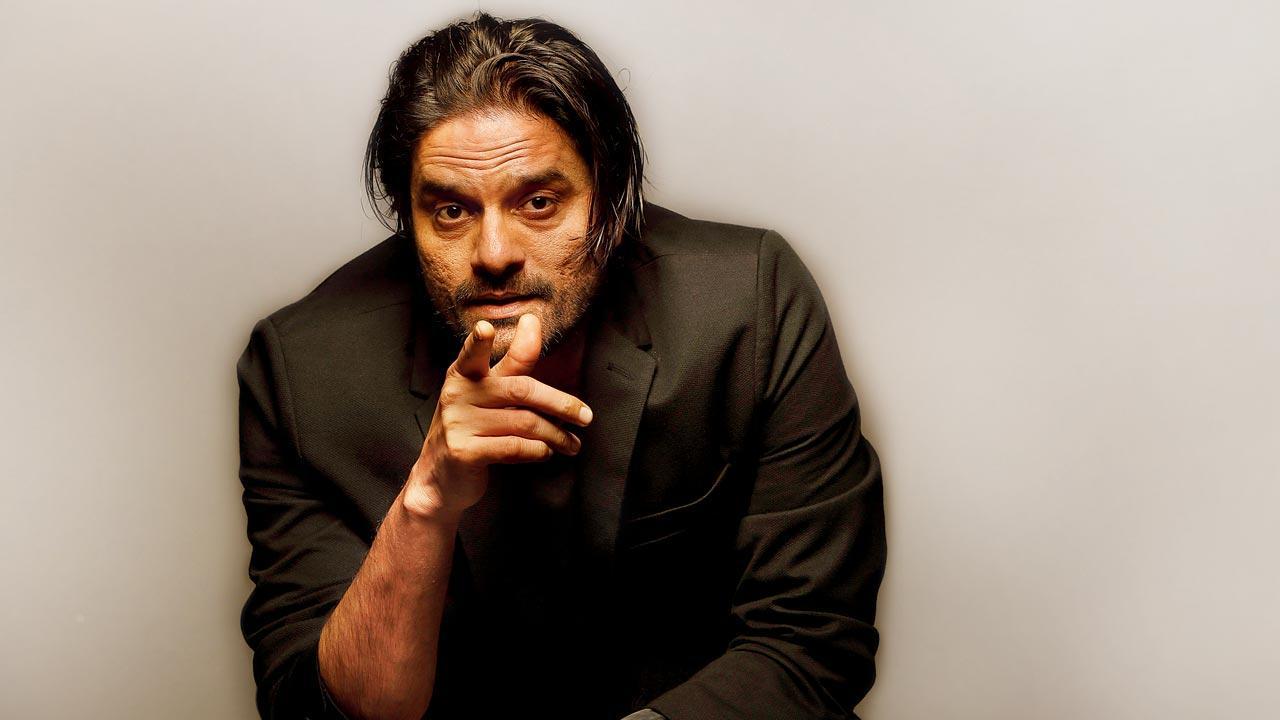
Paatal Lok star Jaideep sheds his brooding image as he attempts love story in Ajeeb Daastaans; is keen to put on his dancing shoes for future projects
Uma Ramasubramanian (MID-DAY; April 15, 2021)
Jaideep Ahlawat has an appeal for filmmakers — he wishes to be cast in a project that explores his dancing skills. The actor and dance don’t seem to go together, did you say? But here’s the thing about Ahlawat; he is a step ahead of the sometimes unimaginative ways of the industry. Before Bollywood — inspired by his stellar performances in Paatal Lok (2020) and Raazi (2018) — can pigeon-hole him into brooding roles, he has shed the image and charted the unfamiliar territory of love stories with Netflix’s Ajeeb Daastaans.
“I am grateful Shashank [Khaitan, director] thought of me for this character. Considering the way he narrated Bablu bhaiya’s [his character] complexities, I was keen to try my hand at the role. [That said], I was fearful whether I would be able to tell the story the way he intended,” begins Ahlawat, who is joined by Fatima Sana Shaikh and Armaan Rahlan in the short film.
For the actor, the anthology is the first step towards dabbling in romance. “I would love to play a romantic hero. I want to tell everyone that I am a dancer as well. I might not be one of the finest dancers around, but I can catch the beat, and have done several stage shows in my college days. I want [filmmakers] to write a script [that helps me explore the art].”
The raging success of Paatal Lok last year made him an overnight star. But with success, comes the pressure to sustain it. He admits that whatever he does here on, the audience will “view it through a different lens”. “Since we delivered a show that was deeply loved by people, the pressure is to deliver something better. I want to explore different roles, otherwise the audience and I will get bored. I must say, I am amazed to read the kind of scripts that have come my way, post the series.”
The second season of the gritty crime drama was to roll early this year. Asked about the developments on that front, he says, “We can’t travel due to the current situation, so everything is on hold. We hope to start [shooting] once normalcy is restored.”
I don’t want to do mediocre work just for the Bollywood stamp-Swastika Mukherjee
8:08 AM

Kavita Awaasthi (HINDUSTAN TIMES; March 18, 2021)
Swastika Mukherjee is glad that people noticed her work in 2020. “Last year was amazing work wise. Paatal Lok (web series) and Dil Bechara put me on the national map. A lot of appreciation came my way from the masses, critics and all kinds of audiences,” says the actor, adding both projects “happened” over the last three years and people felt the impact as they released one after the other.
She also had two significant Bengali releases on OTT platforms and adds that in the recent years, she has been conscious about not repeating herself. “My goal is to not do the same kind of roles, not look the same on screen, not repeat myself. I’ve always tried to present myself in a new way to the audience. I don’t want to just be on screen,” she shares.
Talking about her foray into Hindi projects, Mukherjee reveals it has been a long 20-year journey. “I started with TV and shifted to movies. I did some hardcore films, later sensible cinema came my way. I shot for Detective Byomkesh Bakshy! (2015) but I had so much work in Bengal that I didn’t want to leave everything and try Bollywood. I’ve tried to balance both Bengali and Hindi projects and in the last two to three years, I’ve been getting many offers from Mumbai. I don’t want to do something for the heck of it. I am an established brand in my industry and I don’t want to do mediocre work just for the Bollywood stamp,” she says.
Mukherjee emphasises that she wants to make a mark with her talent rather than being everywhere and going with the idea that “I am also doing Bollywood. I’ve been slow and steady and it has paid off well. After watching the recent Hindi web shows, a large non-Bengali audience watched my Bengali work. That was a bonus,” she concludes.
Subscribe to:
Posts (Atom)