Showing posts with label Once Upon A Time In Mumbaai. Show all posts
Showing posts with label Once Upon A Time In Mumbaai. Show all posts
In Bollywood, we play it too safe. I think we should change that-Emraan Hashmi
10:05 AM

Onkar Kulkarni (BOMBAY TIMES; February 13, 2024)
Bollywood’s OG serial kisser boy has evolved. It has taken him time to break out of the box, but he did. In recent years, he’s been seen experimenting with a range of roles, including two-film hero projects like Selfiee and Tiger 3. The latter where he played the anti-hero brought him back into the spotlight. Emraan talks to us about why he doesn’t want to be slotted as a villain, his foray into south films and more.
‘Earlier, my idea of a villain was that he will only be painted as this dark character’
Talking about the switch in his career, Emraan says, “People wouldn’t have thought of me featuring me in a Salman Khan or Akshay Kumar starrer. They are two different worlds and when they collide, there’s something that sparks off. I think Once Upon A Time In Mumbaai would be one of my first films in that space. It took a lot of convincing on Milan’s (Luthria, director) part to get me to do that part. I was reluctant because I was playing just the main leads until then. Earlier, my idea of a villain was that he will only be painted as this dark character. But in that film, I played the anti-hero. The same goes with my role in Tiger 3. He is the hero of his own narrative. I wouldn’t like to play a one-toned villain in a film. I am grateful to filmmakers to have realized that and experimented with that. I just go with the flow, and I don’t yearn to do films in a certain genre.”
‘I don’t want to get slotted as a villain’
He enjoys playing the antagonist in films, but he doesn’t want to do that repeatedly. He elaborates, “I have done few antagonist roles. I don’t want to get slotted in villainous roles. Yes, it is an interesting time to experiment. People are liking the larger-than-life experience in films where two titans are taking on each other.”
‘There was a deliberate effort to try something different’
When he had started out, Emraan was known for a certain kind of cinema – intimate and bold. He was trapped in the image for years before he finally broke away from it. Ask him what’s his hook as an actor today and he says, “I think that finding a groove is dangerous because that could put you in a box again. I hated the fact that I was boxed into certain kind of roles for almost 15 years. There was a deliberate effort to get out of that box and try something different because I wasn’t growing as an actor. I was sleepwalking on every set. That is when I took up films like Shanghai and Once Upon A Time In Mumbaai. It’s actually a huge trap. A lot of actors from the West also probably bail out from doing characters like Bond, because you gradually get boxed in sometimes. They say it is detrimental to your career because people can’t see you as anything else when you come out of that.”
‘I never imagined myself getting into the south film industry’
Between all the leaps he has been taking as an actor, the biggest plunge is venturing into a pan-India south project. Talking about the film, where he features with Telugu star Pawan Kalyan, he says, “I never imagined myself getting into the south film industry. But it was a fantastic script and a great character. Sujeeth is a great director and is making this film on an enormous canvas.”
‘We have a lot to learn from the way south films are made’
Ask him how different it is working in the south film industry, and he says, “I think south filmmakers are way more disciplined than we are (in Hindi cinema). Every penny that they spend on their film shows on screen. I think we often spend money in the wrong areas in Hindi films, and it doesn’t eventually translate on screen. They have finesse in their films when it comes to VFX, the scale and choice of path-breaking stories. We have some ground to cover before we can match that and we have a lot to learn from the way they make films.”
Madhur Bhandarkar, Ketan Mehta and Milan Luthria pay tribute to Nitin Desai
8:45 AM
BOMBAY TIMES (August 3, 2023)
Renowned art director and production designer Nitin Chandrakant Desai died by suicide at his studio (N D Studios) in Karjat, 80 km from Mumbai, yesterday. As per reports, he was going through financial stress and speculation is that this could have been the reason for him to take this step.
In his career spanning 20 years, he worked with prominent filmmakers like Ashutosh Gowariker, Vidhu Vinod Chopra, Rajkumar Hirani and Sanjay Leela Bhansali. He was the brain behind the sets of Hindi films like 1942: A Love Story (1994), Hum Dil De Chuke Sanam (1999), Lagaan: Once Upon A Time In India (2001), Devdas (2002), Lage Raho Munna Bhai (2006), Jodhaa Akbar (2008) and Once Upon A Time in Mumbaai (2010) to name a few.
His last venture as an art director was Panipat (2019). He had also created the sets for the Oscar-winning film Slumdog Millionaire (2008). Desai won several awards throughout his career, including four National Awards.
In 2005, Desai established N D Studios in Karjat, which was spread over 52 acres. This studio has played host to many movies as well as the reality show Big Boss. He also tried his hand at acting and has been credited as an actor in Daud (1997) and the Marathi movie Hello Jai Hind! (2011), which he directed.
Last month, Desai had performed a pooja at his studio in anticipation of the upcoming festival of Ganesh Chaturthi. He was working on the pandal decoration for Mumbai’s iconic Ganpati mandal Lalbaugcha Raja. He was also busy with an OTT show on Maharana Pratap.
Regarding his demise, Raigad Superintendent of Police (SP) Somnath Gharghe said, “Police were informed by a worker on the set. When the team reached the studio, we saw his body hanging. We are investigating further to ascertain all the aspects in this case.”
- With inputs from ANI
---------------------------------
Directors Bhandarkar, Luthria and Mehta pay tribute to one of Bollywood’s finest art directors, who could create lavish mansions for Devdas and rustic villages for Lagaan with equal ease
Upala KBR, Hiren Kotwani and Priyanka Sharma (MID-DAY; August 3, 2023)
There is a sense of magic as the lights in a theatre dim for we are often, within moments, transported into another world. And if we were lucky, we would be transported to a world created by art director Nitin Desai. From the earthy village of Lagaan (2001) to the vibrancy of Devdas (2002), from the 16th century palaces of Jodhaa Akbar (2008) to the ’70s Bombay in Once Upon A Time In Mumbaai (OUATIM, 2010), there wasn’t a setting that the four-time National Award winner had not introduced us to.
OUATIM director Milan Luthria remembers how he began shooting the gangster film with Ajay Devgn and Emraan Hashmi in real locations across Mumbai. Soon, crowd-management issues made him consider filming on sets. That’s when someone recommended the production designer to him.
“I told Nitin what I had in mind. He said, ‘Don’t worry, it will all happen in my studio [ND Studios, Karjat].’ He came back with a plan and sketches of how he was going to turn around various parts of his studio. He made a vintage café, made Sultan’s [Devgn’s character] house all white, and made the bustling streets where we shot the song, Pee Loon. His greatest quality was that he could adapt to the sensibility of the film. He realized that each movie had a different demand, which is why every film of his looks different,” he shares.
The director remembers that the climax where Devgn’s character is shot at while delivering a speech was the most challenging. But Desai, he says, came up with quick solutions.
“The studio originally didn’t look that way. There was chaos, but he quickly changed the colours of the backdrop, erected a wall on one side and removed certain fountains, saying that the style did not match the era we were depicting. He was hands-on. If you had an issue and needed a solution, Nitin was the man,” adds Luthria.
The studio originally didn’t look that way. There was chaos, but he quickly changed the colours of the backdrop, erected a wall on one side and removed certain fountains, saying that the style did not match the era we were depicting. He was hands-on. If you had an issue and needed a solution, Nitin was the man,” adds Luthria.
Desai had won National Awards for his work in Dr Babasaheb Ambedkar (1998), Hum Dil De Chuke Sanam (1999), Lagaan and Devdas. But to Bhandarkar, his work went beyond grandeur.
“Nitin was synonymous with [elaborate] set design after his brilliant work in Hum Dil De Chuke Sanam and Devdas. But he was equally a genius in creating realistic sets for films like Traffic Signal, Jail [2009] and Indu Sarkar [2017]. He visited Yerawada and Thane prisons to create a realistic set for Jail. When I asked him [to recreate] Connaught Place, he promised that it would be as real as Delhi’s landmark location. I was amazed at the transformation. I clicked some pictures and sent it to my friends in Delhi, who couldn’t believe it was a set.”
A trait of Desai that endeared him to the director was his ability to make good his promises. “He was always flexible with budgets and would say, ‘Main kar ke deta hoon.’”
Director Ketan Mehta shares that the Aamir Khan-led Mangal Pandey: The Rising (2005) was the first endeavour to be shot in ND Studios that opened in 2005. “When he launched the studio, the qawwali song from Mangal Pandey was the first shoot on the location. Nitin was a disciplined and systematic designer. So, even before we began shooting, everything was pre-visualized and pre-decided with major contributions from the creative genius that Nitin was,” says Mehta, who worked with him over 28 years and several films.
Producer Ronnie Screwvala, who collaborated with Desai on several films, most notably Jodhaa Akbar and Fashion, remembers him as someone who thought big and created even bigger. “He always gave his all to whatever he did. He always thought big and then actually made it happen. I am very sad to hear the news, ” he says.
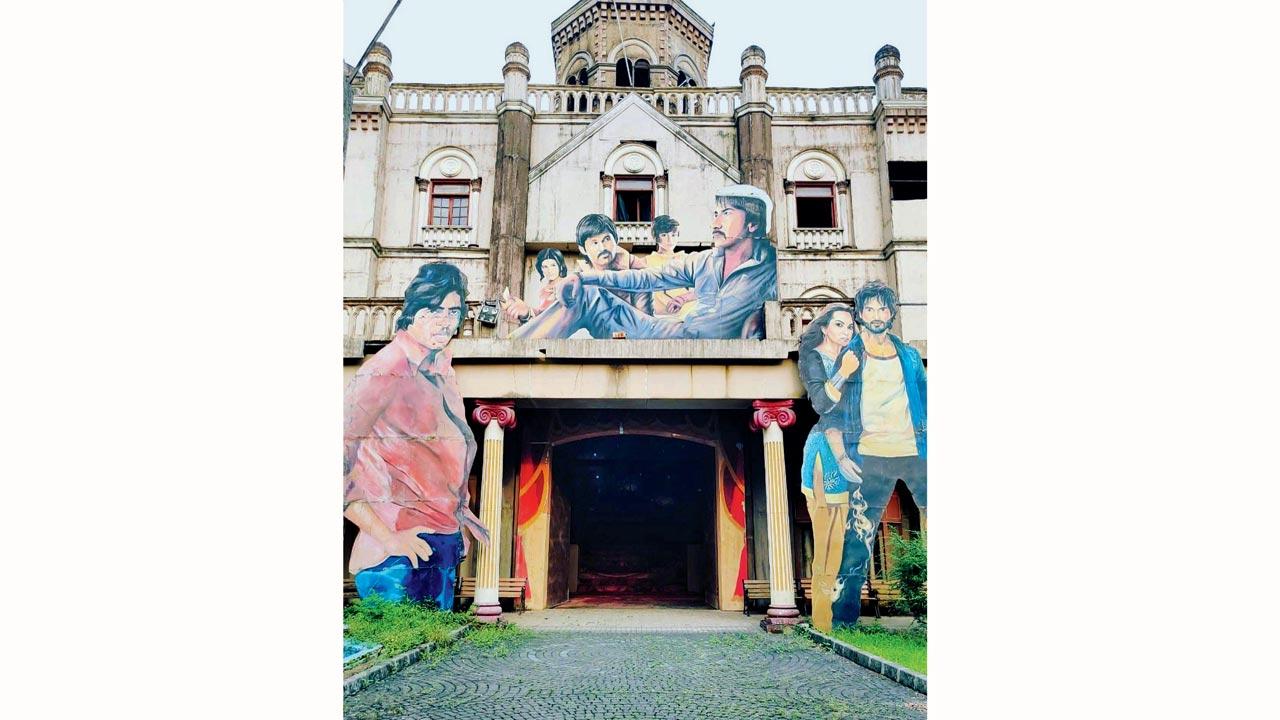
The particular permanent set in ND Studios, Karjat, where Desai was found dead on Wednesday

Set pieces used for the filming of Lagaan. Pics/Nimesh Dave
I went completely unrecognised on Mumbai’s streets-Emraan Hashmi
7:54 AM

Emraan Hashmi's Indo-American production is the only Indian film in the main competition of the upcoming Busan Film Festival
Roshmila Bhattacharya (MUMBAI MIRROR; September 17, 2020)
How did you manage to keep your Indo-American production, Harami, under wraps despite it being shot in Mumbai?
We didn’t want much fuss around the shoot because we were filming guerilla-style in places like CST and Churchgate stations, the Dharavi slums, and on Mumbai streets…
You were filming at CST and Churchgate stations?
I couldn’t, but I did shoot in the crowded Mohammed Ali Road area. And since we didn’t want to attract any attention, I was told I’d have to cover the last 300-400 metres on a bike. Despite the security, I was apprehensive, but delighted that I went completely unrecognised on Mumbai’s streets in my ‘look’ of a 50-year-old man with salt-and-pepper hair, beard and moustache, glasses, and a cane since he walks with a limp. After that, I’d stroll to the location, with my staff 20 steps behind. It was a thrill because when we shot in Dongri for Once Upon A Time In Mumbaai, the whole area was cordoned off, with a car parked on the doorstep of the house where we were shooting to whisk me off. This time I could move around freely because Sagar Bhai looked nothing like Emraan. I’ve never played a character this old before.
Your character is a gangster?
He is a former English teacher who does a U-turn to become the ringleader of a gang of young pickpockets who frequent Mumbai locals. So, while everyone around him speaks Bambaiya Hindi, Sagar Bhai chooses to speak in English because he’s tutoring these slum kids in the language too, so they can hoodwink unsuspecting foreign tourists and flick their wallets. It’s heartening that our film will be unveiled at the Busan Film Festival in a tough year. We had wanted to go to Cannes, but Covid-19 complicated things. Busan is very prestigious too.
Having faced censor problems with Why Cheat India earlier, will a title like Harami get passed?
This title is not against the country and the English translation of ‘harami’, which is ‘bastard’, is filed in the Oxford dictionary. I just hope it isn’t misconstrued as a cuss word. We haven’t titled the film Harami for effect; it’s an appropriate title given the subject.
Tigers, the 2014 drama by Oscar-winning director Danis Tanovic, didn’t perform as well as was expected…
That was a controversial subject with a Pakistani protagonist. By the time the film was ready for release, after a few delays, tensions between India and Pakistan had escalated and the film was blasphemous. No distributor would touch it. Thankfully today, Tigers is among the top 5 OTT films. Every film has its own journey.
As an actor, how difficult is it to strike a balance between a Harami and a Mumbai Saga?
I’ve always been a sucker for good content and cinema is all about stories. So, while I’d love to do another connoisseur film, I also want to do a Jannat 3. None of us know what will be accepted; we can only be true to the idea, work hard and with honesty. It’s important for an actor not to get stuck because commercial success can bring complacency.
Mumbai Saga is in the space of Once Upon A Time in Mumbaai, unabashedly commercial and entertaining, playing to the gallery and looking for ceeties and taalis. That kind of cinema will always be my first love.
And Chehre?
That’s a very different film. I’m playing a traveller whose car breaks down and he takes refuge for the night at an outhouse where two men, one pretending to be a public prosecutor and the other a defense lawyer, put him on the dock in their mock courtroom because “behind every successful man is a crime”. It was always my dream to work with Mr (Amitabh) Bachchan, so the script narration was just a formality. It was the same with The Body. I was intrigued by the original Spanish film, but there was also the delight of working with Rishi ji (Kapoor).
Buzz is, you are playing Alia Bhatt’s husband in Gangubai Kathiawadi who sells her into a brothel?
I’ve met Sanjay sir (Sanjay Leela Bhansali) but I haven’t signed the film yet. (Laughs) And it would be bizarre to play my cousin’s husband on screen.
You’re doing a comedy too…
Yes, Sab First Class Hai, which will be directed by Mubarakan and Saand Ki Aankh writer Balwinder Singh Janjua. The script is a riot.
Are you planning on resuming shooting soon?
I can’t sit at home forever as the Coronavirus isn’t going away anytime soon. People are getting reinfected, so even if a vaccine happens, we’ll have to top it up, again and again. We are the most exposed because of our proximity to our co-stars and since we can’t wear masks and PPE suits. Still, I plan to complete Mumbai Saga, Chehre and the horror film Ezra before the year-end before starting new projects next year. It will be shoot, quarantine, shoot…
In Kick, Devil’s personality matches Salman Khan’s-Rajat Arora
8:43 AM

Rajat Arora is scripting the sequel of the thriller, along with Part 3 of Shootout; he also has films with Sanjay Leela Bhansali and Ekta Kapoor
Himesh Mankad (MUMBAI MIRROR; July 22, 2020)
 Bollywood writers have diverse opinions about the lockdown—with some finding much-needed time at home to write, while for others, the on ground scenario of Coronavirus pandemic has taken a toll on their creativity. Rajat Arora who has scripted films like Taxi No 9211, Once Upon A Time In Mumbaai, The Dirty Picture and Kick to name a few, admits that some days are very good, and some very bad. “Sometimes, nothing happens for months; then, you get into the flow and write in one go,” he shares, adding that in the last few months, he has completed the script of Shootout 3, which will be directed by Sanjay Gupta.
The first two installments of the franchise were based in Mumbai — Lokhandwala and Wadala. “The third installment steps out of the city. It’s essential to go one up on the previous film. This is my first film for Sanjay and we quickly aligned with each other’s vision. We started in February and locked the script in four months,” says Rajat, who is now working on the dialogue as he revisits the gangster genre a decade after Once Upon A Time In Mumbaai. “I was offered several gangster films, but I didn’t want to repeat myself. I couldn’t say no to this one as it’s a great story, very different from what I have done so far.”
Rajat is also working on the sequel of Kick, Sajid Nadiadwala’s directorial, which will again be fronted by Salman Khan. He’s evasive on the subject, saying it’s work in progress. The 2014 action thriller had several crowd-pleasing one-liners like “Mere baare mein itna mat sochna, main dil mein aata hoon, samajh mein nahin” and “Aap Devil ke peechhey, Devil aapke ke peechhey, too much fun.” Are there more in store? “In Kick, Devil’s personality matches Salman sir’s and that’s how those lines came about. Nobody talks like this in real life, but you don’t want to disappoint a huge star’s fan base. Eventually, it’s the character that dictates the language,” he reasons.
 Writing larger-than-life characters comes naturally to Rajat, as he has grown up watching Salim-Javed, Kader Khan, Vijay Anand and Manoj Kumar’s brand of cinema. “My childhood was full of larger-than-life characters and my writing just sums that up,” explains the writer of another Sajid Nadiadwala production, an official remake of the Telugu film, RX 100. It is being directed by Milan Luthria and will introduce Suniel Shetty’s son, Ahan, opposite Tara Sutaria. “A remake is like adapting a true story and this film is great, so you don’t want to ruin it. This is my eighth film with Milan and it’s been a good partnership.”
Besides the above-mentioned films, there are multiple others in the pipeline. “I’m writing another film for Sajid sir, one for Bhansali sir (Sanjay Leela Bhansali) and a third for Ekta (Kapoor), but I can’t talk about them right now,” he signs off, leaving one to speculate about these projects.
As a child, I wouldn’t eat till Sholay or Mr Natwarlal played-Emraan Hashmi
8:47 AM

Emraan Hashmi on working with Amitabh Bachchan in a thriller and playing a uniformed cop for the first time with a period gangster-drama
Avinash Lohana (MUMBAI MIRROR; March 31, 2020)
 In February, director Sanjay Gupta had tweeted that everyone in his Mumbai Saga team was anxious, wondering if Emraan Hashmi would be able to pull off the look of a deadly cop. “Just look with what style he has pulled it off,” the filmmaker had continued, unveiling the actor’s first look from the upcoming period gangster-drama, which he is also producing with Bhushan Kumar.
Emraan informs that he was blown away by his character during the narration. “I played an undercover cop six years ago in Ungli (Rensil D’Silva’s 2014 vigilante film) but had never played a uniformed cop before. This guy is ruthless and opinionated. He is no less than a gangster himself,” he informs.
The actor, who had earlier featured in Milan Luthria’s gangster-drama, Once Upon A Time In Mumbaai, admits there have been few good films in the genre. “After it released, I got many offers in the same space, but I didn’t accept any of them because I needed a director who had the skills to narrate an interesting tale and revive the genre,” he avers.
Mumbai Saga was in its last leg of shooting when an industry-wide shutdown was announced in mid-March after the coronavirus outbreak intensified. Emraan has completed his portions and the last schedule was with John Abraham, who plays a gangster in the film. Prod him on his co-star, and Emraan describes John as a “helpful, professional who is dedicated to his craft”.
Meanwhile, the 41-year-old actor is also awaiting the release of Rumi Jaffery’s Chehre, a mystery-thriller revolving around a group of friends, some of whom are retired lawyers, one of them being Amitabh Bachchan. They meet at a bungalow in Shimla and play a psychological game, with Emraan in the role of a business tycoon. “I agreed to be a part of the film on the basis of Rumi ji’s two-hour narration. Usually I ask for a day or two to read the script, but this one ticked a lot of boxes,” shares the actor, adding that it was his dream to work with the Big B. “I’m a fan and as a child, after returning from school, I would not sit down to eat unless Sholay or Mr Natwarlal played. That’s the kind of connect I have with his films since I was seven or eight. So, working with Mr Bachchan in a film was a surreal experience. He is constantly reinventing himself. To have someone with his kind of experience on the set and observing him, helped me evolve as an actor too.”
Mumbai Saga: ‘Cop’ Emraan Hashmi wanted to don a ‘gangster’ avatar
9:37 AM

Prashant Singh (HINDUSTAN TIMES; February 6, 2020)
During his college days, when a young Emraan Hashmi watched Sanjay Gupta’s Kaante (2002), he was instantly hooked, thanks to the filmmaker’s “narrative style and the way he positions his actors”. “It’s amazing how Sanjay delves into the underworld space and always does something marvellous with it,” says the actor.
Naturally then, when Emraan got a call from Sanjay about being part of his next project, Mumbai Saga, the actor was expecting a gangster’s role “in the story of gangsters”. But that was not to be. “I was hoping that I will take on the mantle of Shoaib (Khan; Emraan’s gangster character from Once Upon A Time In Mumbaai; 2010). In fact, after that film, I rejected a lot of offers which were in the same zone. Maybe, I was waiting for Sanjay’s film (laughs). But when Sanjay said he is offering me the role of a cop, I was a little taken aback,” he says.
After Once Upon..., Emraan says he wanted to “try and experiment with different roles (and not just gangsters/criminals)”. “I feel it’s also very essential for an actor. Success or no success, it is imperative for an actor to venture out. Then, of course, there is your home territory. Here, I was being offered a cop’s character by Sanjay and till that point, I hadn’t worn the uniform in any of my films,” says the actor.
Now though, Emraan’s dilemma was if the cop’s part is the “righteous kind”, which “tends to be slightly unidimensional and carries a been-there-done-that feel”. He says: “I was hoping it’s not that and to my surprise, the way the part has been penned and the kind of character I play, he is almost like a gangster. An encounter specialist, he can put a bullet into someone if it accomplishes his motive. He is a bada** character in a dog-eats-dog kind of world wherein this guy is the wolf.”
Emraan, in fact, admits that in reel life, he has “almost always been the guy who is on the opposite side of law”. “No one would imagine that I am playing a cop but for this policeman, he is, as I said, like a gangster. Be it by fair or unfair means, he will bring down the guy he is going for. So, it’s kind of home turf but it’s a very entertaining pitch for a character in a pure Sanjay Gupta style, who has created his own brand of cinema. And as an actor, I am always up for doing something different,” he concludes.
Wary movies play safe with ever-expanding disclaimers
8:19 AM

Niharika Lal (BOMBAY TIMES; August 19, 2019)
Take a look at this — ‘Use of certain expressions in this film are purely for dramatising the performances’, or ‘This film does not support the use of expletives’, or even ‘Under the Hindu Marriage Act polygamy is illegal in India’. These detailed and explanatory sentences are disclaimers that have been carried with films recently. From the standard disclaimer, ‘All the characters and events depicted are fictitious…’ to those like the ones mentioned above, disclaimers in films seem to have entered a new territory.
In the beginning of Batla House, a disclaimer states that the film is “based on events and information only available in the public domain”. And that the film is “not a documentary and is not intended to accurately reflect events”.
Be it Kalank, which had three to four frames just of disclaimers, to last year’s Padmaavat, which had a disclaimer for every aspect of the film, disclaimers seem to have become long-form writing, with detailed ones for every topic — social, political, religious — that might spark an outrage. They are no longer a few lines, disclaimers have now become lengthy paragraphs — there can be even five-six disclaimers — covering every possible aspect, that can “hurt sentiments”, thereby leading to protests and landing filmmakers in trouble.

‘DISCLAIMER’S A MUST FOR FILMS THAT ARE BASED ON HISTORICAL INCIDENTS’
Currently, each film carries around three to four disclaimers. A Central Board of Film Certification (CBFC) official tells us, “The CBFC panels do not ask the producers to add any disclaimers without watching the film. We suggest disclaimers only when a film has a historical/research-based/non-fiction premise, because sometimes ,filmmakers simply write ‘inspired by true events...’ which is vague. However, it differs from case to case.”
Last year, when Padmaavat was banned in multiple states as protests ensued regarding the depiction of Rani Padmavati and the Rajput history in general, the filmmakers issued seven declarations and clarifications through full-page newspaper ads even before the film released. Also, the film had one of the longest disclaimers ever, including explanation of the dance forms and clothes in the film not claiming historical authenticity. Another film that was banned in several states was Ashutosh Gowariker’s Jodhaa Akbar (2008), again for allegedly depicting wrong history of the Rajputs. Ashutosh was reportedly quoted as saying, “There’s a disclaimer about the Rajput queen’s name at the beginning of the film. But to see that, the protesters have to see the film.” The said disclaimer clarifies that historians do not agree with Jodhaa’s name.

‘DEPENDING ON THE SUBJECT, FILMS CAN HAVE FIVE-SIX DISCLAIMERS’
Some CBFC officials complain that filmmakers put lengthy disclaimers to get away with anything and everything. A CBFC member says, “These days, lengthy disclaimers are used frequently in films so that filmmakers don’t get into unnecessary trouble. They don’t want any ‘hurting sentiment’ arguments to halt the release of the film, which is why they add them.” Last year, before the Akshay Kumar, Rajinikanth-starrer 2.0 released, Cellular Operators Association of India (COAI) sent a legal notice to the film’s producers, alleging that the film has “obscurantist and anti-scientific attitudes towards mobile phone, towers and mobile services”.
But a disclaimer in the film was added even before the objection, stating, “The theme of this film is based on an article that appeared in various newspapers and social media platforms. The characters and events depicted in this film are purely a work of fiction.”
Depending on the subject of the film, the number of disclaimers can go up. An Information and Broadcast Ministry (I&B) official tells us, “The number of disclaimers can go up to even five-six — it depends upon the subject of the film. There is a disclaimer for the subject being fictional, against consumption of nicotine products, for animals not being hurt etc. As per I&B’s 2016 circular to filmmakers, if a movie has rash driving scenes, filmmakers also have to add a disclaimer stating that ‘Performing such scenes by the audience may violate traffic laws/rules hence should not be emulated’.”

‘COURTS ASK FILMMAKERS TO ADD DISCLAIMER TO PROTECT THEIR ARTISTIC FREEDOM’
“There have been instances where the courts have asked films to include a disclaimer, so as to protect the filmmaker’s artistic liberty,” says an I&B official. In one such instance, in 2012, during the release of Chakravyuh, Bata India Ltd moved the Calcutta High Court, objecting to the lyrics of the song Mehangai. The lyrics were, “Birla Ho Ya Tata, Ambani Ho Ya Bata, Sabne Apne Chakkar Mein Des Ko Hai Kaata.” The Calcutta HC refused removal of the song, but asked the filmmakers to add a disclaimer to the song. The disclaimer, which appears in the beginning of Chakravyuh, states, “Use of the names in the song are merely as example. No injury or disrespect is intended to any particular person or brand.”
One movie in which a disclaimer was inserted after its release was Once Upon A Time In Mumbaai (2010). The Lucknow Bench of Allahabad HC directed the makers of the film to add a disclaimer before the start of the film, stating that the character of Rehana, played by Kangna Ranaut, has no resemblance with the ’50s actress Rehana. Anurag Kashyap’s 2016 release Udta Punjab was again in trouble with the censor board as the CBFC had asked the makers to remove Punjab references. The Bombay HC ruled in favour of the film, but asked to change the disclaimer. The modified disclaimer reads, “...Punjab has been a highway of drugs and not the end consumer”. In fact, the film had four frames of disclaimers, all revolving around the use of expletives and drugs.
SOME DISCLAIMERS THAT ARE SEEN IN FILMS CURRENTLY
Padmaavat: The film Padmaavat is inspired from the epic poem Padmavat, written by Malik Muhammad Jayasi,which is considered a work of fiction. This Film does not infer or claim historical authenticity or accuracy in terms of the names of the places, characters, sequence of events, locations, spoken languages, dance forms, costumes and/or such other details. We do not intend to disrespect, impair or disparage the beliefs, feelings, sentiments od any person(s), community(ies) and their culture(s), custom(s), practice(s) and tradition(s)
Chakravyuh: Use of the names in the song are merely as example. No injury or disrespect is intended to any particular person or brand
OMG: OMG Oh My God! is the journey of the protagonist who discovers his faith through the happenings and occurrences in his life and goes from being a non-believer to a believer. The film is meant for entertainment purposes only and we do not intend to hurt the sentiments of any individual, community, sect or religion
Gangs Of Wasseypur: Wasseypur is an actual place located in Dhanbad, a district of Jharkhand (esrtwhile Bihar). Though the film is based on real incidents, reported widely in media, it is a fictionalised account of the same. Names and timelines have been changed and the related incidents have been fictionalised for dramatic purposes. The film has NOT been shot in the real locations of Wasseypur
HOLLYWOOD RELEASES IN INDIA
In 2009, when Avatar was to be released in India, a religious group asked James Cameron to attach a disclaimer at the beginning and end of the film, explaining that it has no relationship with Hinduism or its concepts
In 2006, Sony Pictures had rejected a CBFC notification, which stated that a disclaimer had to be put at the beginning and end of the film The Da Vinci Code to clarify that it is a work of fiction, which eventually delayed its release

Just when Once Upon A Time In Mumbaai was to flag off, we were hit by the recession-Milan Luthria
7:40 AM

Kangana Ranaut, Prachi Desai, Milan Luthria, Ajay Devgn, Emraan Hashmi and Rajat Arora
Roshmila Bhattacharya (MUMBAI MIRROR; August 2, 2019)
It’s been almost a decade since Milan Luthria’s gangster drama Once Upon A Time In Mumbaai opened in the theatres on July 30, 2010, yet it still resonates with the audience. The director reveals that it was conceived in 2008, the same year that he got married. “The offer came out of the blue and I gave my nod because I liked the idea. But just when the film was to flag off, we were hit by the recession and could no long afford to make the film,” he shares.
Even when the project was revived, it was difficult to get the dates of all the actors—from Ajay Devgn and Emraan Hashmi who played the protagonists, underworld kingpin Sultan Mirza and his right-hand, Shoaib Khan, to Kangana Ranaut, Mirza’s actress-lover Rehana, Prachi Desai cast as Shoaib’s sweetheart Mumtaz after Milan was impressed by her performance in Rock On!! and Randeep Hooda as ACP Agnel Wilson. “On the first day of the shoot, I was in the van with Ajay, and five minutes before he stepped out, he asked me how I wanted him to play Mirza. I told him I cast him for the intensity in his eyes and the way he walked. Responding with a 'Okay, let’s go,' he strode out, dressed from head-to-toe in white. “A hush descended on the set, the awe was palpable,” Milan reminisces.
He however wasn’t happy with the first shot. “I thought Ajay looked like Malik from RGV’s Company,” Milan confides, and pointed out to the actor that this was not a brooding gangster but a flamboyant character in love with a movie star. “Okay got it, roll camera,” Ajay nodded. And from that moment he was Sultan Mirza.
Emraan was a perfect foil to him but Milan admits that everyone around warned the actor against doing a negative role and taking on Ajay. “Emraan read the script two-three times before telling me that he’d do the film only if he could be the bad guy unapologetically. We were happy to comply since we’d only been trying to appease him with excuses and justifications for his character’s betrayal,” says Milan.
Kangana earned the nickname “chameleon” from her director because of the ease with which she flitted from one getup to the next. Her Rehana was an amalgamation of many actresses who’d been courted by real-life gangsters. She gifts Sultan Mirza a watch in the film which runs on his pulse beat and invites the cryptic comment, “I hope my pulse doesn’t stop before this does” which is a pointer to what is to come.
“In the original script, Shoaib tries to kill Sultan, misses and runs away. To stop the bloodbath that follows, the other dons of the underworld get the two together and make them swear on the Quran that they will not go after each other,” reveals Milan. The film eventually ended with Shoaib firing and hitting target. Sultan falls in Rehana’s lap and shows her the watch, telling her his time was up.
“The last shot was of him looking sightlessly up at the sky but Ajay pointed out that it would be impossible for him to keep his eyes open against the glare of the sun. So then, we had him falling to his knees and looking straight at Shoaib as he exits, stamping on a poster with his face emblazoned on it, along with the slogan, ‘Sultan Mirza zindabad,’” Milan recounts.
The film made Ajay’s Sultan Mirza a cult figure and proved Emraan’s brilliance as an actor too. It remains Milan’s most unforgettable film. “Even today, at a party, I’m introduced as the guy who directed Once Upon A Time In Mumbaai ,” he smiles. “To quote one of Rajat Arora’s famous dialogues from the film, ‘Iss vajah se log hamein dua mein yaad rakhenge.’”
I am here because of films like Raaz and Murder, but I am not the same guy I was 15 years ago-Emraan Hashmi
8:25 AM

Renuka Vyavahare (BOMBAY TIMES; January 13, 2019)
Emraan Hashmi has portrayed varied characters in a career spanning over 15 years, and proved his mettle in films like Awarapan (2007), Jannat (2008), Once Upon A Time In Mumbaai (2010) and Shanghai (2012). And finally, one can see the ‘serial kisser’ tag, which he unapologetically carried for years, wearing off. Known for playing morally ambiguous screen characters and the one to call a spade a spade, Emraan tells BT about his upcoming film Why Cheat India and how he is finally done with kissing on screen. Excerpts…
 Your upcoming film, Why Cheat India, revolves around some of the problems plaguing our education system. Tell us about your character in the film...
Rakesh (his character) is not a torchbearer or a vigilante, he wants to make money and be successful. He finds a hack in the education system and goes down that road. He isn’t apologetic about what he does. He wonders why nobody is holding the system responsible for students’ suicides. Lack of seats in universities and the pressure it causes... no one’s addressing that. He feels that at least no one’s dying because of him.
Your wife, Parveen, is a co-producer on the film. Did any alarming personal experience convince you to make this film?
We are busy building colleges, but is knowledge being imparted there? Our education system is all about how much information you can withhold as opposed to sharing practical knowledge, analytical thinking or communication skills.
Education system teaches you two things — how to make a living and how to live. Sadly, our education system for most part teaches you the former and it’s not very good at it either. I don’t want to put my son through the torture that I went through as a child. I hated school and the homework. I used to daydream in class, while some wise teachers talked for eight hours a day. It’s a factory system that cultivates home-grown ‘yes men’. Emphasis is on things that you barely use in day-to-day life. Basic choices were science, maths, and engineering. Right now, arts has gone blazing ahead, but back then, it had no standing. Poetry or dance was looked down upon. Basically, you can’t enjoy what you study. I always found that appalling. Kids need to be kids. You can’t make them competitive by pitting them against each other and labelling them as winners and losers. I felt like a loser when I didn’t score a certain percentage. It affects their morale and self-esteem early on. Why Cheat India is a two-hour film, so we cannot show everything in it, but it does put the spotlight on these long-standing issues. It also emphasises on the scams that are built around the education system. You have to get rid of the age-old system and the middle men who are eating into it.
With socially relevant films like Why Cheat India, are you trying to reinvent your image as a hero?
I don’t see it as a reinvention. I don’t know how people will perceive or accept Rakesh. I did the film, because it’s a fantastic concept that hasn’t been explored in our country. I love taking risks. It’s relatable not just for students and educational faculties who are in denial, but also future parents. On the infrastructure front, though we are a country that’s blazing ahead, we could be going faster. The most important part is educating a child’s mind and if you can’t contribute to that, it’s a dark road ahead.
Lately, you have been working in films which have been a clear deviation from the kind of work that people have seen you doing in the past. Are you trying to keep pace with the changing trends of Hindi cinema?
Hindi cinema has changed in the past three years, but before that, in the kind of films that I did — and I don’t mean to dis them — I didn’t get to play ‘characters’. You get stuck in a box. You can’t step out of it, as the industry sees it as a safe bet. If you are a commercial actor, this is what you will have to do. Agar aapko arty film karni hai, toh aap Shanghai kijiye, which I did. It’s a divided industry. Certain critics understand cerebral cinema and they push for it, but there’s another side that dismisses it. Such films are closest to my sensibilities. Somewhere, I had to bend my sensibilities to cater to my audience and my country. I am not complaining, but it’s far from my world. Now, there is a new dawn. The audience and the industry have woken up. You can’t dole out shit year after year and expect it to work. We have had a couple of massive big-budget debacles last year and that’s because the audience’s intellect was taken for granted. It’s great that people now look forward to good subjects. Why Cheat India is one such topic.
Did you reach a point where you thought, ‘Not anymore! I can’t keep doing what I have been doing’?
I said that the first day I entered this industry (laughs!). I feel that you don’t look for scripts, the scripts find you. At least in the initial stage of your career, there are people who will say, ‘This kind of films work for him, let’s give him that only’. My need to explore myself as an actor along with the risk that producers took to make movies like Jannat, Once Upon A Time In Mumbaai, Shanghai and Awarapan helped add a different dimension to me. These films are the reason why people feel that I can do a Why Cheat India. I could have done this long ago, but growth and maturity takes time. Ten years ago, good scripts rarely came my way. Ghanchakkar (2013) was ahead of its time. People dismissed it because they didn’t understand the comedy. It is relatively easier for these new-age talented actors like Nawazuddin Siddiqui, Rajkummar Rao, Vicky Kaushal and Ayushmann Khurrana, because the scripts have evolved.
Today, do films solely work on content, as opposed to entertainment?
Not just content. Through a documentary, I can reach a few houses, but by bringing in the commercial element, retaining the script’s authenticity and not making it a jingoistic fest, you can reach millions of people. Films can’t bring about a change overnight, but it can get the conversation started.
Looking back, do you feel that films like Raaz Reboot(2016) and Murder (2004) restricted you to a certain image as the bad boy of Bollywood? Did such roles hinder your growth as an actor?
Bollywood is like a dish in which you add various ingredients to add tadka. It follows norms and is formulaic. Everyone has had their share of massy films. Fight hai, paanch gaane daal doh, film chal jayegi. But after a while, it has changed. I am here because of films like Raaz and Murder, but I am not the same guy I was 15 years ago! Lot of things happened after that. Marriage changes you, your child changes you. That change has to reflect in your films, or you stagnate. I wanted to grow as an actor and it was frustrating when it didn’t go my way. Now, I am happy with the roles that I am doing. I choose scripts that make me happy as opposed to what will work.
Almost every actor today has no qualms about kissing on screen, but the serial kisser tag refuses to leave you...
I am done with it. I am letting it go now, because I am just fed up of it. Kissing is fine. I don’t have an issue with kissing on screen, but it’s what happens after that. Everyone puts the spotlight on whether I have a kiss in a film or not. My producers have been guilty of using the kissing scenes for promotions of films, but I feel things are different today. Youngsters are okay with it. Call it a generation gap or anything, but I shut my ears on hearing half the things. It’s a culture shock for me! I fear for my son when he grows up (laughs!).
Have you ever wondered why you never get offered noble, righteous or heroic characters?
I think it’s my face (laughs!). I don’t look like a noble person. I am not saying nobility doesn’t exist in society, but I also feel that it’s a big sham. Anyone who says that they haven’t done anything wrong in their life is a big scam artiste. We all function in grey zones. I hate people who pretend to be saints. I won’t touch them with a barge pole. I can’t stand their holier than thou attitude. I look for a certain reality in films. A man who saves the day, does everything right or is super sweet... a hero like that doesn’t exist.

If I have to start shouting out loud about myself, I might as well not work and do just that-Ajay Devgn
8:18 AM

Madhureeta Mukherjee (BOMBAY TIMES; March 14, 2018)
He raged on to the silver screen 27 years ago, on a roaring hot bike in the action drama, Phool Aur Kaante. Ever since, his career has not always been a bed of roses, but neither have the thorns left him bruised. Like he says, “Even in my low phase, I have always had one hit in a year”. Ajay Devgn has deftly balanced the art and the mart. For every Zakhm, there has been a Golmaal. For every 100-crore-hit, there’s been a critically acclaimed drama to root for. A director’s delight — he could tear the screen with rage or turn into silent dynamite. Off-screen, he’s a man of his own mind. Rare and solid. He doesn’t say much, but when he does, he fires bullets — direct and dauntless. A few days before the release of his upcoming film Raid directed by Raj Kumar Gupta, he settles into a comfortable chat (which is a rarity) with us and talks about his lucky streak, how he’s averted a mid-life crisis and the fact that the industry today has better business sense, but lacks the emotional quotient. Read on…
You are playing a tough-as-nails IT officer in Raid, who is investigating one of the most high-profile and controversial cases that we have seen. While essaying heroic characters in our films, the natural tendency is to go OTT in order to make the character seem more superhuman. Here, you seem to have played it out subtly. It is a challenge, isn’t it?
The film happened because we met this IT officer and realised that there was a great story to be told. We were toying with the idea of making it for four years. Finally, the writer Ritesh Shah narrated the story to me and I loved it. Then, we got Raj Kumar Gupta (of No One Killed Jessica fame) on board, as he understood the space that this movie is set in. I have never worked with him before, but he is this quiet and honest guy, who talks about nothing other than the film he is working on. Also, I like Ritesh because he writes dialogues that are not filmi or flowery, but hard-hitting. They don’t sound like… yeh kya line likhi hai, and yet, leave an impact. I think that whenever you have a great line, you should deliver it with nonchalance. By that, I mean that a lot of actors believe that if they have a good dialogue, they should stretch it to make it more dramatic. I feel that when you deliver such lines subtly, they work out better. In Raid, Amay Patnaik is real; he doesn’t become aggressive or resort to violence. He is not a cop, he is an IT officer who is honest and retaliates silently.
Well, OTT also works well for the audience, like in a film like Singham, where you play a hotheaded cop…
Yes, OTT works very often in our films, but it doesn’t work for every character. It can get irritating, too, so you need to strike a balance. In case of roles that demand a subtle performance, you have to express a lot through your eyes and body language. Sometimes, when people do it, there are chances that it could look like they are sleepwalking. There is a very thin line. Being cool and calm does not mean that you are performing well either.
You have always said that you don’t spend too much time getting into the skin of the character. You simply understand your character and let the cameras start rolling. Have you ever made an exception to that process for any of your roles?
I still can’t do all that prep work. I am just spontaneous, so I either feel the character or I don’t. I don’t know of any other process, or let’s say that I can’t explain it. I can understand it for myself. I start thinking and feeling like the character. My body language and thought process change and I start thinking what the character would do or wouldn’t do. Yes, I do put a lot of thought in to how I would play a character differently. For instance, after Ram Gopal Varma’s Company (2002) got a lot of appreciation, I had to think about how I would play an underworld don again in Milan Luthria’s Once Upon A Time In Mumbaai (2010). The cop in Prakash Jha’s Gangaajal (2003) is dramatically different from the cop in Rohit Shetty’s Singham (2011), though both the characters have similar beliefs.
When you are doing a film like Golmaal vis-à-vis a film like Raid, as an actor,is the ultimate feeling of creative satisfaction similar?
There is a lot of satisfaction in doing both kinds of films. Doing a comedy is tough business; the energy and timing has to be perfectly tuned. People think that it is easy to be stupid on screen, but it is not. I realised that while working on Golmaal Again (2017). On the first day of the shoot we performed a few scenes and we realised that there was something missing. We had shot the last Golmaal movie seven years ago. Since then, we had all grown up. Then Rohit (Shetty, director) played a few scenes from Golmaal 3, and we saw how stupid we were in that film. The energy was on a different level. And while shooting Golmaal Again, we were trying to be stupid, but there was a little maturity in it. So, we had to take the stupidity a notch higher and when that worked, it was as satisfying as anything else.
What was the turning point for you? Was it Mahesh Bhatt’s Zakhm (1998), a film where you received immense appreciation? For the longest time, you were asked why you didn’t do more films like that…
I don’t think that there was any turning point in my career, it was all a process. I am glad people have started doing such films now; in the 90s no one attempted these films. What we call niche films today, I was doing those films in the 90s when no other mainstream actor was doing them. I did films like Raincoat, Dil Kya Kare, Thakshak and Zakhm. Thank God, I did those films because you learn a lot from directors like Bhatt saab and Govind Nihalani, as their thought process is very deep and different. The learnings from those films can be applied in commercial cinema too, and it can work differently. I have done all kinds of cinema, because I never bothered about things like how it would affect my image as an actor. Yes, I had an action hero tag, which I think changed with films like Ishq, Pyaar Toh Hona Hi Tha and Hum Dil De Chuke Sanam, which were in a different zone. It was never a conscious choice; it all just fell into place. I don’t plan most things in life; I simply follow my heart and instinct.
Did you ever go through a mid-life crisis in your career wherein you were confused about the direction in which it was heading?
Given the fact that I didn’t ever plan my career, and I didn’t take things too seriously, I think I have been very lucky. I’ve been around for 27 years and there has never been a situation in my life where I have had one or two bad years. If I have had three releases in a year, if two have not worked, one has always worked out. Even in my low phase, I had one hit a year. I have never gone through a phase jahan mujhe kaam ki kami rahi. Everyone gets films, but it gets difficult for actors to get the kind of films that they want.
Looking back, do any of your films from the past make you cringe now?
Yes, I have done so many films just for the sake of relationships with people in the industry. Not just me, I think many other actors from my generation have done that. We knew that the film was not going to work (I won’t name them), but we still went ahead and did it for emotional reasons. I don’t regret doing it. Back then, we didn’t bother, but today, we obviously won’t do the same.
In that sense, would you say that today the industry has become far more professional and practical? Is there a certain emotional quotient missing?
That emotional quotient, which was there in the film industry in the past, has gone. Everything has changed and business has taken over. In some ways, it is good for the industry, but we also miss the old times and sometimes we wish things would go back to the way they were. Back then, we could talk and say whatever we wanted, and we would walk into each other’s sets whenever we wanted. We were like a close-knit group, which is not the case anymore.
You have always been a fairly elusive star. You are on social media, but you aren’t too vocal. Do you think that today, actors are fearful of speaking their mind, knowing that they could be lambasted for their views?
Yes, there is a fear of speaking your mind as people start targeting you. You might say something, and they might misconstrue it or turn it into something else. I think people know what you mean, and yet they want to play mischief. Hence, we have to be cautious about what we say. Sometimes, it is not about what you say but how you say it. At times, I use social media to say something important, or voice my opinion on a topic that I feel strongly about. People use social media to promote themselves, not to always make a point.
Talking about promoting yourself, one has never seen you do that aggressively. You haven’t really used the PR machinery to your advantage…
Why should I do it? I have always been this way and I really don’t want to change. I think that my work speaks for itself. If I have to start shouting out loud about myself, I might as well not work and do just that. If there are people who don’t understand this, I don’t care a damn about making them understand (laughs!).
Do you still feel the jitters before the release of a film?
I still get nervous before every role. Even today, before doing a shot I wonder if I will be able to pull it off. I think it is a good thing to feel this way, because if I start thinking… arre yeh toh ho jaayega, then it means that I have started taking things for granted.
The industry is becoming increasingly competitive. Do you ever feel insecure, or do you harbour any fears?
Not anymore. The only thing I want to do is that I want to work till I die. What can I feel insecure about after 27 years? You also have to realise that you won’t be around forever. We are all getting older; I will turn 49 this year. So, I know that I have to evolve and change and take on a different role altogether. In that sense, I am very balanced and realistic.

Raees, Daddy: What makes gangster films so appealing to our filmmakers?
8:11 AM

Dhaval Roy (DNA; September 2, 2017)
With the release of the political crime drama Daddy, once again the underbelly of society finds space on the big screen. Daddy is the biopic of the gangster-turned-politician Arun Gawli, starring Arjun Rampal in the titular role. Bollywood has, over the decades, seen many such films like Parinda (1989), Agneepath (1990), Satya (1998), Vaastav (1999), Company (2002), Sarkar (2005), to more recently Once Upon a Time in Mumbaai (2010), its sequel, and Raees (2017). The bedraggled underworld has consistently found favour with filmmakers and audiences alike. A peek into the world of grime and crime, and why gangster films are so popular.
Mumbai mafia
As much as the person, it’s the story behind him that’s interesting for the filmmakers. Especially real life stories. For director Milan Luthria, Once Upon A Time in Mumbaai and its sequel Once Upon A Time In Mumbai Dobaara were not just supposedly based on Haji Mastan and Dawood Ibrahim, they were also about how the gangsters entered the world of crime. Milan says he found it interesting “They used the sea to their advantage and how smuggling began, about protection, extortion, gambling, and bootlegging.” Rahul Dholakia, who directed Raees, wanted to make something on prohibition and therefore the film happened. The underbelly has always been an integral part of Mumbai and it has always inspired writers and makers. “People want to know the behind-the-scenes and the stories of this side of the city,” says Madhur Bhandarkar, whose National Award-winning film, Chandni Bar dealt with gangsters, too along with bar girls.
Badass is good
The authority these gangsters exude makes them captivating for filmmakers and audiences alike. “Whether it’s Godfather, Untouchables, or Indian films, gangsters have always been fascinating because of their power and romanticism,” Rahul says. Milan adds, “There’s something about being bad that everyone likes. The risk they are willing to take, and the unexpected things they do are appealing.”
Normal is boring
Through every underworld era that we have lived, says Rahul, the gangsters have been formidable personalities. “Gangsters have seemed larger-than-life, very giving, and at the same time, ruthless. They have always been mysterious and hence fascinating.”
Rags to riches
Not just in films, mobsters always have big cars, moolah, glamorous girls and guns. No wonder, the anti-hero is as popular as the hero. Milan says, “The viewer sees these characters as powerful, charismatic, surrounded by hot women and having a lavish lifestyle.” They are sort of a role model because they live life on the edge. Most gangster films are about an underdog reaching the top by any means possible. “Everyone loves a ‘rags to riches’ story. For that matter, even dacoit stories have been successful,” Milan adds. Just like Gawli became a local Robin Hood from a humble background.
Glorifying criminals?
While more and more top actors like Shah Rukh Khan, Sanjay Dutt or Ajay Devgn have played gangsters in films, and now Arjun Rampal in Daddy, these films don’t glorify the baddies. Milan argues, “A filmmaker is not socially committed to doing everything right but to making a good movie.” Rahul adds, “When we made Raees, we made a conscious effort not to glorify the gangster. In the end, he does die at the hands of the cop.” Daddy director Ashim Ahluwalia has gone on record to say that they are not white washing Gawli’s character in the film.
What seems out-of-the-box to others seems normal to me-Emraan Hashmi
7:56 AM

Rachana Dubey (BOMBAY TIMES; August 27, 2017)
He might come across as
arrogant. Undeniably, there's self-pride, though not necessarily driven
by his stardom.He doesn't care how you interpret his body language. Nor
does he believe in following norms - he doesn't socialise to get work, is
ignorant about competition and irreverent when it comes to his
professional choices. Unapologetically real and refreshing, Emraan Hashmi
calls a spade a spade. Here's what he had to tell BT about
his upcoming film Baadshaho and outgrowing his serial-kisser
tag. Excerpts...
You are collaborating with Milan Luthria after more than six years, your last outing together being The Dirty Picture. Previously, you guys had worked together in Once Upon A Time In Mumbaai (OUATIM). Did the fact that you were not cast in that film's sequel ever strain your ties with Milan? Also, did you discuss it before starting off on Baadshaho?
It was exciting to merely come back together. I am detached from my films and roles... you have to be. It's a director's prerogative who he casts in a film. I had enjoyed the first part and didn't even think about the sequel, neither did I bring it up with him. Milan has always given me distinct characters in all his films. He did away with the gangster film stereotypes in OUATIM. In The Dirty Picture, I was this cocky, brash South industry filmmaker, who thinks it's his way or the highway. I love such roles, which once defined the out-of-the-box space and are now considered commercial. There's a thin membrane that separates both the spaces today and Milan treads the path carefully, merging both.
 After seeing the dialogue-promos, it looks like Dalia, your character in Baadshaho, is quirky, too...
I have a dialogue that says, 'Iss Dalia mein biryani ka mazaa hai.' So, as much as his name is insipid, he's entertaining. Dalia true sense mein kameena hai - he is flamboyant, devious and thinks like a thief. He's edgy, volatile and borderline paranoid. He's the prophet of doom and also a skirt-chaser, who has the tattoo of a woman on one arm and a gun on the other - that pretty much explains his space.
You have played a womaniser in many films. Have you ever analysed why such roles come to you so often?
I have no idea (smiles), perhaps there's something in my face. Right after my first film, people assumed that I'm good at grey characters. It's a tightrope walk, as such characters pose a risk of tilting to an extent where they don't deserve redemption. I find the typical good characters on screen boring; I don't see a hero's role as the most interesting part to play. I find it clichéd. There is a dark side to all of us and I'm interested in that.
In Bollywood, playing the conventional hero is a must if you want to make it to the top. So, are you saying that you are not part of the rat race?
I am not very proud of it, but I don't watch what my contemporaries are doing. My outlook towards cinema has always been different, with more Western influences. When I see the script, I don't see it as 'Yeh hero hai...' If I had been a product of the Bollywood machinery, I would have gone that way. Thankfully, I'm not. So, what seems out-of-the-box to others seems normal to me.
For close to 15 years, you held onto the tag of a serial kisser in Bollywood. Did you start feeling stifled in that image, eventually? Did that lead to a change in your role choices?
I don't know what exactly a serial kisser is. Years ago, when I was shooting in Mauritius, I bought a T-shirt which had 'Serial Kisser' written on it. Around that time, I had played bold roles in four films in a row. While it was normal for me, it wasn't for a lot of others. People were noticing that I was kissing so many women on screen. And then, when I made a joke out of that tee, it got stretched too far. I've never associated myself with the serial-kisser image. It was blown out of proportion.
But you cannot deny that it became difficult for people to accept you in films like Azhar, where the sex and kissing scenes were not as amplified as, let's say, they were in the Bhatt camp's movies...
We have a prefixed notion of what the audience wants. After one of those many erotica thrillers that got me the serial kisser label, I reached a saturation point and decided to do something different, which drove me to do movies like Awarapan, Jannat, Shanghai, OUATIM and Ghanchakkar. However, all throughout, people either underlined the fact that the raunchy scenes were there, or highlighted their absence. I found the latter amusing. After a point, it was stifling and boring to play up to that perceived image. Today, I don't even think about the tag because I moved on from it 10 years ago. It's lost its punch. So, I don't think that was the reason people thumbed Azhar down. It was made well, but there was a perception that people had of the story and what they saw didn't meet that. Ours wasn't the Azhar they knew.
You may have moved on, but the tag continues to be a part of your image. Your uncle, filmmaker Mahesh Bhatt, had said on a chat show that people flocked to theatres to see you lock lips...
That trick made sense at one point, but now, the audience wants something new. Personal and professional experiences have changed me, though not many acknowledge it. Today, it is disastrous for any actor to go back to his safety net. The terrain has changed. The last two years have made out-of-the-box the new commercial. These are also scary times because the web and social media are on an over drive and are unforgiving. People are less lenient towards average and mediocre films, which wasn't the case a decade ago. Cinema was the sole source of entertainment then, but now, it has stiff competition from television, games, the web and social media. Earlier, word about a film didn't trickle in for a week at least. Today, a bad review at the noon show can have your night show cancelled.
Do you mean to say that you have really kissed the Murder and Raaz franchises goodbye?
Yes, I have kissed those franchises goodbye, but I thank those films for helping me get this far. I'm now doing what I always wanted to do. If I return to that space now, it will be the undoing of the brand; I will look tentative and disinterested. These franchises need new actors to take them forward.
Today, we are seeing strong acceptance for women-centric cinema, where women play meaty, strong characters. In retrospect, do you feel that some of those franchises did objectify women?
Women were objectified? I was also objectified in those films. It's just the zone you are grappling with. After films like OUATIM, I could have chosen big-budget, hero-driven films, but I opted for The Dirty Picture, which was woman-centric. As an actor, I don't see women as objects; they have always been central to the plot in all my films. Heroines are shining in the films being driven by them today. I am not among those male actors who feel insecure about women-centric films.
You are collaborating with Milan Luthria after more than six years, your last outing together being The Dirty Picture. Previously, you guys had worked together in Once Upon A Time In Mumbaai (OUATIM). Did the fact that you were not cast in that film's sequel ever strain your ties with Milan? Also, did you discuss it before starting off on Baadshaho?
It was exciting to merely come back together. I am detached from my films and roles... you have to be. It's a director's prerogative who he casts in a film. I had enjoyed the first part and didn't even think about the sequel, neither did I bring it up with him. Milan has always given me distinct characters in all his films. He did away with the gangster film stereotypes in OUATIM. In The Dirty Picture, I was this cocky, brash South industry filmmaker, who thinks it's his way or the highway. I love such roles, which once defined the out-of-the-box space and are now considered commercial. There's a thin membrane that separates both the spaces today and Milan treads the path carefully, merging both.
I have a dialogue that says, 'Iss Dalia mein biryani ka mazaa hai.' So, as much as his name is insipid, he's entertaining. Dalia true sense mein kameena hai - he is flamboyant, devious and thinks like a thief. He's edgy, volatile and borderline paranoid. He's the prophet of doom and also a skirt-chaser, who has the tattoo of a woman on one arm and a gun on the other - that pretty much explains his space.
You have played a womaniser in many films. Have you ever analysed why such roles come to you so often?
I have no idea (smiles), perhaps there's something in my face. Right after my first film, people assumed that I'm good at grey characters. It's a tightrope walk, as such characters pose a risk of tilting to an extent where they don't deserve redemption. I find the typical good characters on screen boring; I don't see a hero's role as the most interesting part to play. I find it clichéd. There is a dark side to all of us and I'm interested in that.
In Bollywood, playing the conventional hero is a must if you want to make it to the top. So, are you saying that you are not part of the rat race?
I am not very proud of it, but I don't watch what my contemporaries are doing. My outlook towards cinema has always been different, with more Western influences. When I see the script, I don't see it as 'Yeh hero hai...' If I had been a product of the Bollywood machinery, I would have gone that way. Thankfully, I'm not. So, what seems out-of-the-box to others seems normal to me.
For close to 15 years, you held onto the tag of a serial kisser in Bollywood. Did you start feeling stifled in that image, eventually? Did that lead to a change in your role choices?
I don't know what exactly a serial kisser is. Years ago, when I was shooting in Mauritius, I bought a T-shirt which had 'Serial Kisser' written on it. Around that time, I had played bold roles in four films in a row. While it was normal for me, it wasn't for a lot of others. People were noticing that I was kissing so many women on screen. And then, when I made a joke out of that tee, it got stretched too far. I've never associated myself with the serial-kisser image. It was blown out of proportion.
But you cannot deny that it became difficult for people to accept you in films like Azhar, where the sex and kissing scenes were not as amplified as, let's say, they were in the Bhatt camp's movies...
We have a prefixed notion of what the audience wants. After one of those many erotica thrillers that got me the serial kisser label, I reached a saturation point and decided to do something different, which drove me to do movies like Awarapan, Jannat, Shanghai, OUATIM and Ghanchakkar. However, all throughout, people either underlined the fact that the raunchy scenes were there, or highlighted their absence. I found the latter amusing. After a point, it was stifling and boring to play up to that perceived image. Today, I don't even think about the tag because I moved on from it 10 years ago. It's lost its punch. So, I don't think that was the reason people thumbed Azhar down. It was made well, but there was a perception that people had of the story and what they saw didn't meet that. Ours wasn't the Azhar they knew.
You may have moved on, but the tag continues to be a part of your image. Your uncle, filmmaker Mahesh Bhatt, had said on a chat show that people flocked to theatres to see you lock lips...
That trick made sense at one point, but now, the audience wants something new. Personal and professional experiences have changed me, though not many acknowledge it. Today, it is disastrous for any actor to go back to his safety net. The terrain has changed. The last two years have made out-of-the-box the new commercial. These are also scary times because the web and social media are on an over drive and are unforgiving. People are less lenient towards average and mediocre films, which wasn't the case a decade ago. Cinema was the sole source of entertainment then, but now, it has stiff competition from television, games, the web and social media. Earlier, word about a film didn't trickle in for a week at least. Today, a bad review at the noon show can have your night show cancelled.
Do you mean to say that you have really kissed the Murder and Raaz franchises goodbye?
Yes, I have kissed those franchises goodbye, but I thank those films for helping me get this far. I'm now doing what I always wanted to do. If I return to that space now, it will be the undoing of the brand; I will look tentative and disinterested. These franchises need new actors to take them forward.
Today, we are seeing strong acceptance for women-centric cinema, where women play meaty, strong characters. In retrospect, do you feel that some of those franchises did objectify women?
Women were objectified? I was also objectified in those films. It's just the zone you are grappling with. After films like OUATIM, I could have chosen big-budget, hero-driven films, but I opted for The Dirty Picture, which was woman-centric. As an actor, I don't see women as objects; they have always been central to the plot in all my films. Heroines are shining in the films being driven by them today. I am not among those male actors who feel insecure about women-centric films.

Multi-starrers were easier to make in the 70s, today it's tougher-Milan Luthria
8:12 AM

Hiren Kotwani (BOMBAY TIMES; July 1, 2017)
Milan Luthria's tryst with
Bollywood began 18 years ago, with his directorial debut, Kachche
Dhaage. With hits like Once Upon A Time In Mumbaai (OUATIM) and The
Dirty Picture, he soon became a name to reckon with in the industry.
Coincidentally, both his last successes were set in the 1970s. While Once
Upon A Time In Mumbaai Dobaara! didn't repeat the success of its
predecessor, the response to the trailer of his upcoming venture,
Baadshaho, set against the backdrop of the 1975 Emergency, suggests
that he's back in form. We chat up with the filmmaker on what makes the
70s his
favourite decade, his friendship with Ajay Devgn, the music and
dialoguebaazi in his films and more. Excerpts...

While Baadshaho is reportedly inspired by true incidents during the Emergency, when the government conducted raids on the royal families of Rajasthan, the title suggests that it's a mainstream masala film. So, is it a hybrid of fact and fiction?
These incidents did happen during the Emergency and are documented. So many valuables, including antiques, gold and jewellery were taken away, but nobody knows what happened to them. That is the premise on which our film is set. We wanted to make an entertainer that is larger than life and with six strong characters, the title had to justify them all. All six are baadshahos.
Your film OUATIM was also set in the 70s. What's it about that era that fascinates you?
I am enamoured by the period, with its larger-than-life elements, machismo and drama. More than me discovering the era, it seems to have found me. Baadshaho began with a friend in Rajasthan narrating a story he had heard. I was figuring out what to do next, and this tale fit the bill. While multi-starrers were easier to make in the 70s, it's tougher today. To begin with, it wasn't easy getting the cast in place. However, I must add that the film has been styled differently. While OUATIM was shot in the 70s' style, this movie has a different energy as far as the music, visuals, styling and attitude of the characters go.
Ajay Devgn seems to be your favourite actor. You began your directorial journey with him and then followed it up with films like Chori Chori, OUATIM and now, Baadshaho. What makes you two click?
The energy and understanding we share bring out the best in each other. It's evident in the work we do. There is that X-factor when Ajay does a movie with me, as he looks different from his other films. We have never talked about it, but we know that there is a connect. This is also my third film with Emraan Hashmi, after OUATIM and The Dirty Picture. On the other hand, there are also actors like Ileana D'Cruz, Vidyut Jammwal, Esha Gupta and Sanjay Mishra, with whom I am working for the first time. So, it's a nice mix of new people and some whom I am familiar with.
You go a long way with Ajay and Emraan. How did you zero in on Vidyut?
I was looking for someone who can match up to Ajay and Emraan's personality. Vidyut is very good with action, and I felt that their combination would be extremely interesting.
What about Ileana and Esha? Are their characters central to the plot? Did women play a pivotal part during the 1975 raids?
The impact of the raids on the women in royal families is well documented. I found Ileana perfect for the role. She is a good actress and is yet to get her due. Esha is more in the Zeenat Aman mould, the saucy tough girl. She has a great personality.
Pacy background scores and interesting soundtracks played important roles in OUATIM and The Dirty Picture. Did Baadshaho offer you as much scope to experiment with music?
Music adds flavour to films and if one stays close to the genre, it enhances the product. In Baadshaho, the music merges the Rajasthan of 70s with slight hard rock sounds, lending it a new-age feel. I believe that the audio is subconscious while the visual is conscious. Ajay once told me, 'People talk about your background score,' which is not the case with most filmmakers. Background score is very important and if you look at the West, their greatest films feature memorable background music.
You seem to lay a lot of emphasis on dialogues as well...
Rajat (Aroraa, writer) and I don't overdo it. We ensure that even a normal dialogue gets applauded. I'm sure that he slogs a lot on the dialogues before discussing them with me. It's nice that there is an audience that likes dialoguebaazi, it's probably in the DNA of Indian viewers.
What's next on the cards? Any 70s film you'd love to remake?
The movies of that era were milestones. Deewaar, Amar Akbar Anthony, Trishul... you can watch them repeatedly and admire them. I have many stories and am waiting for the right time.

I was on director's 'fav actress' list but not a single one signed me-Kangana Ranaut
8:01 AM

Ankur Pathak (MUMBAI MIRROR; March 25, 2014)
Kangana Ranaut is enjoying a lie-in at her new Bandra pad when we knock on her door. She welcomes us into her elegant (though unfinished) space, dressed in pyjamas, then goes back to reading online reviews of her much-lauded Queen.
She responds to our “How does it feel?” question with, “I have been the struggler of the century. Fortunately, everyone loves the underdog. But it would be hard to start with a film like Queen. All my years as an actress led to this.”
No trace of modesty here? “Modesty is good. But not when it comes at the cost of honesty,” Kangana retorts. “Sucking up to a director means you are unsure of your talents. I’m not. I don’t seek validation outside, not even with the audience. Today they like me but tomorrow they may hate me. I don’t want to be anybody’s role model.”
The actress then goes on to decode her journey from a “struggler doing bit roles” to being the Queen.

GANGSTER (2006)
I’m proud of my performance but disappointed with the reaction I got because I think it was a much better performance than Queen. The film clicked and suddenly I was on every brilliant director’s “favourite actress” list. But not a single one signed me. It was a lonely battle, me against the world.
I’m proud of my performance but disappointed with the reaction I got because I think it was a much better performance than Queen. The film clicked and suddenly I was on every brilliant director’s “favourite actress” list. But not a single one signed me. It was a lonely battle, me against the world.

FASHION (2008)
After Gangster, I was confused. My talent wasn’t helping me get work. I did some bad films just to remain visible. Life In A... Metro wasn’t ‘my’ film, nor was Fashion though I slogged really hard. After Fashion, people thought I was a dopehead and that was not a good feeling (Laughs). My biggest apprehension was whether I’d be able to convey the complexity of Shonali in the 15 minutes that I had. And boom there comes a National Award!
After Gangster, I was confused. My talent wasn’t helping me get work. I did some bad films just to remain visible. Life In A... Metro wasn’t ‘my’ film, nor was Fashion though I slogged really hard. After Fashion, people thought I was a dopehead and that was not a good feeling (Laughs). My biggest apprehension was whether I’d be able to convey the complexity of Shonali in the 15 minutes that I had. And boom there comes a National Award!

ONCE UPON A TIME IN MUMBAAI (2010)
I worked very hard although I had very little screen-time in a male-centric film. Milan (director Milan Luthria) really helped me with the character. In the second half, we had to establish the fact that Ajay Devgn’s character gives up everything for this girl. Is she worth it? Through my look, expressions and limited lines, I had to convey the passion that she feels for this man.
I worked very hard although I had very little screen-time in a male-centric film. Milan (director Milan Luthria) really helped me with the character. In the second half, we had to establish the fact that Ajay Devgn’s character gives up everything for this girl. Is she worth it? Through my look, expressions and limited lines, I had to convey the passion that she feels for this man.

TANU WEDS MANU (2011)
The phone was ringing but not with great offers. Milan (Luthria) offered me The Dirty Picture but how many times could I play ‘the girl on the verge of a nervous breakdown’. Aanand Rai noticed me in OUATIM in a romantic role and offered me Tanu... . The film changed the game for me. Vikas Bahl was convinced I could play Rani after watching Tanu...
The phone was ringing but not with great offers. Milan (Luthria) offered me The Dirty Picture but how many times could I play ‘the girl on the verge of a nervous breakdown’. Aanand Rai noticed me in OUATIM in a romantic role and offered me Tanu... . The film changed the game for me. Vikas Bahl was convinced I could play Rani after watching Tanu...

QUEEN (2014)
I was confused about why (director) Vikas wanted me for Rani. I'd played a supermodel (Fashion) and a superwoman (Krissh 3), how could I be Rani? I don’t think it's a great performance. It's the supporting cast that elevates it. Rajkummar Rao’s arrogance makes Rani more vulnerable while Lisa Haydon’s liberated ways made her appear caged. There are films you do justice to and then there are films that do justice to your talent. Queen proved that the century-long struggle paid off!
I was confused about why (director) Vikas wanted me for Rani. I'd played a supermodel (Fashion) and a superwoman (Krissh 3), how could I be Rani? I don’t think it's a great performance. It's the supporting cast that elevates it. Rajkummar Rao’s arrogance makes Rani more vulnerable while Lisa Haydon’s liberated ways made her appear caged. There are films you do justice to and then there are films that do justice to your talent. Queen proved that the century-long struggle paid off!
Subscribe to:
Posts (Atom)