Showing posts with label Niloufer Dubash. Show all posts
Showing posts with label Niloufer Dubash. Show all posts
Mumbai's Paradise Cinema shuts operations
3:31 PM
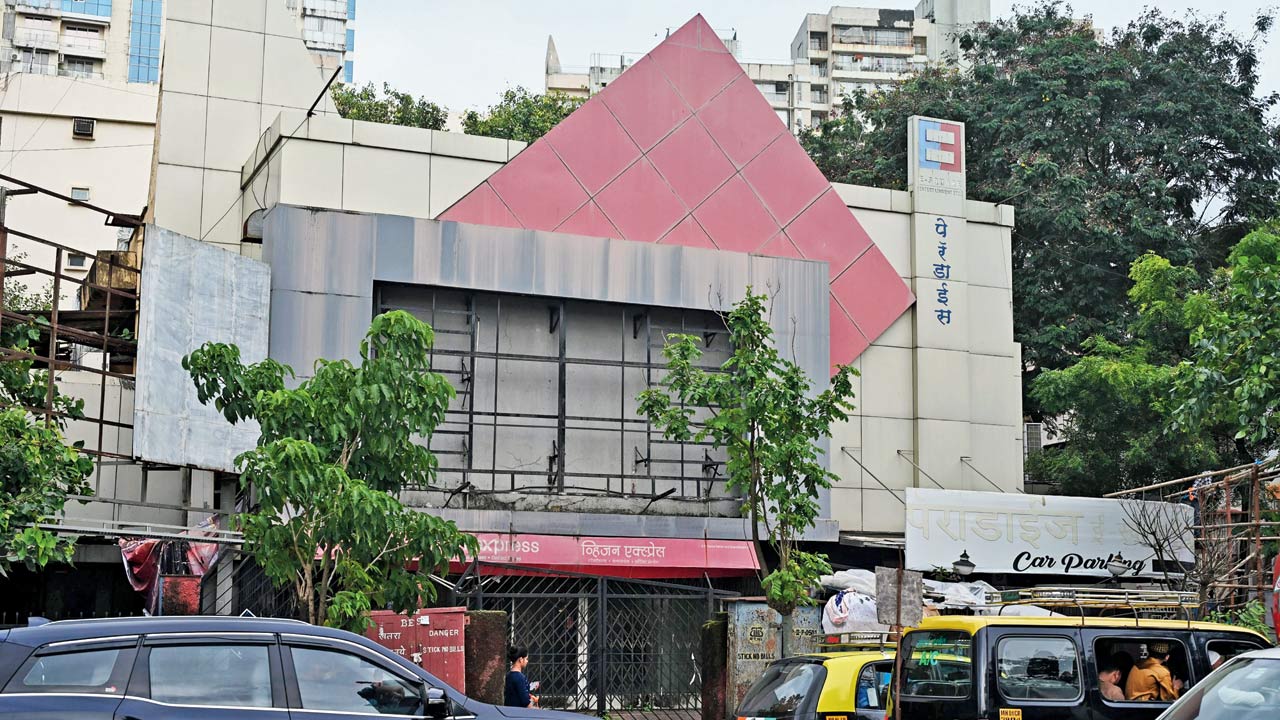
Paradise Cinema in Mumbai's Mahim stops operations, with owners saying they will soon decide on future course of action
Mohar Basu (MID-DAY; August 27, 2024)
Traffic snarls, Sitladevi Mandir and Paradise cinema—these three have long been the mainstay of Mahim’s Lady Jamshedji Road. But in the past three weeks, the theatre, among the oldest in Mumbai, wears a different look. The posters have been pulled down, gates locked and a deserted air has filled the space that used to be bustling with the latest releases and ardent fans.
Buzz suggests that plans to tear the property down and turn it into a multiplex are afoot. This has sparked buzz among cinephiles and heritage enthusiasts, as Paradise Cinema—currently owned by the Dubash family—has been a landmark since its establishment in 1939-1940.
When we visited the cinema on Monday morning, one of the security guards told us that the last film to see heavy footfall was Fighter in January. While the single-screen theatre stopped playing films before June, the operations completely stopped in early August. “We stopped playing films before Munjya and Kalki 2898 AD released,” he said.
When we contacted Niloufer Dubash, she confirmed that the cinema has shut operations for now. “We have closed because there was no good stock of movies.” Chatter suggests that the property will be turned into a swanky multiplex, while some residents have also heard buzz about it being converted into a parking lot.
Dubash laughed at the rumours, stating, “We are looking at a change, but what [that may be] is something we, ourselves, are uncertain of at this point of time. I’m not saying neither is true. It’s all rumours till we take a call on this.”
Paradise Cinema’s shutdown signals a change in Mumbai that has been home to it for over 80 years. It was originally built by Sorabji Bhathena, and later acquired by the Dubash brothers, Shavaksha and Bapuji. With the Dubash family’s love for cinema and keen eye for business, it became a landmark theatre in the following years.
Though the cinema was temporarily closed in the aughts, it was reopened during the release of Golmaal Returns in 2008. It was at the same time that they collaborated with E-Square Cinemas and rechristened it Paradise E-Square.
---------------------------------------------
Bella Jaisinghani (THE TIMES OF INDIA; August 28, 2024)
Mumbai: Mahim’s iconic Paradise Cinema has closed its doors. The financial unviability of small, single screen theatres has claimed this hall which was a shining star on the movie firmament for approximately 80 years.
It is reported that the property may be redeveloped to accommodate a multiplex cinema, commercial outlets or a parking lot, though owner Niloufer Dubash did not confirm or deny this, saying she was yet to firm up her plans. Dubash had earlier cited the lack of good film content as a reason for Paradise's closure.
Paradise was constructed by Sorabji Bhathena around 1940. Years later it passed into the hands of the Dubash Brothers who forged a tie-up with E-Square Cinemas to develop the present-day Paradise ESquare Cinema, as it is called.
Filmmakers and distributors are not known to favour single screens. Moreover, lack of audience patronage, low ticket rates, meagre parking space and high outgoings, including power tariffs, have forced hundreds of single-screen cinema halls across the state to close. The govt does not provide support or tax relief either, say theatre owners' associations. Film lovers on the other hand cherish the single screen option for affordability.
Paradise was frequented by thousands of filmgoers in its heyday. Amitabh Bachchan's movies drew large crowds. During 'Paa', people did not leave their seats even during the interval as they soaked in his unusual performance, Dubash had earlier said.
Elaborating on the problems faced by single-screen theatres, the owner of one said air-conditioning costs, staff salaries, taxes and overheads run into crores of rupees when his annual income is not even Rs 5 lakh. Moreover, the state govt has imposed the condition that all theatres must screen 44 shows of Marathi movies per year within Mumbai limits, and 112 shows in the rest of the state. Should they fail, their annual licence is not renewed. But there is no viewership for these films, he said.
Reviews of Paradise in recent years also show viewers appreciating its low ticket rates that averaged Rs 100, relatively affordable samosa (Rs 70), popcorn (Rs 100) and tea-coffee (Rs 50). But many patrons said the seats seemed too compact and uncomfortable. They labelled its picture screen, acoustics, hygiene and parking facilities as average. Now it’s requiem for the cinematic landmark.
Happy 80th Birthday Amitabh Bachchan: Theatre owners recall the Don of silver screens
8:24 AM

Bella Jaisinghani (THE TIMES OF INDIA; October 11, 2022)
A diminishing breed of single screen owners and managers today remember the Shahenshah’s reign as the high noon of cinema. TOI spoke to exhibitors in Mumbai, Kolkata and Belgaum who recalled the frenzy when an Amitabh movie came up for release.
Manoj Desai, executive director of G-7 Multiplex (Gaiety-Galaxy), Bandra, and Maratha Mandir, Mumbai Central, says, “The public went mad, especially for the films he made with Manmohan Desai, Yash Chopra and Prakash Mehra. They would buy tickets for multiple shows and watch back-to-back.”
Desai produced the star’s ‘Khuda Gawah’. Azam Patel, manager of Nishat Talkies near Nagpada, describes a line of 15-20 halls in south Mumbai named Roshan, Gulshan, Moti, Alankar, Shalimar, Super, Alfred, Royal, etc, in an era when watching films required entry into an auditorium. “At each of them, long lines unfolded, all shows were packed to capacity,” he said.
Amit Singh, manager of Hindmata Gold, Dadar, remembers teary-eyed audiences exiting shows of ‘Baghban’. “The next batch of spectators would notice this too. This is how word spread about Bachchan’s extraordinary performance,” said Singh, who as a student made multiple rounds of halls in his native Jaunpur before he bagged tickets to ‘Mohabbatein’.
Manager Errol Lobo of Liberty Cinema said, “When ‘Kabhi Khushi Kabhie Gham’ released, queues stretched right up to Marine Lines station. We would ration two tickets per person to make sure all who had waited for hours got to see the film. Police kept vigil to ensure there was no black marketing.”
The scene was replicated in other cities. Avinash Potdar, owner of Nartaki theatre in Belgaum, said, “It was a golden era for exhibitors. People would bring bedrolls and camp outside the hall day and night till they got tickets.”
His nephew Nitin said, “First-time viewers like me would be baffled when Amitabh would start to say in ‘Kaalia’, ‘Hum jahaan khade hote hain’ and the entire hall would chorus, ‘Line wahin se shuru hoti hai!’ We heard only part of the dialogues, the rest was drowned out in whistles, catcalls or choruses!”
Kolkata has a special fascination for its “Jamai Babu”, said veteran producer-distributor Krishna Kumar Mangla of Bijoli Cinema who is known as Lalaji in the trade. “Amitabh started his career in Kolkata and he is also married to a Bengali, Jaya. I remember that two theatres Paradise and Orient had released Shakti. They are located barely 200 metres from each other. In both places, mobs were beating down the ticket windows demanding seats, and ‘maara maari’ broke out,” said Lalaji.
Niloufer Dubash, who owns Paradise cinema in Mahim, was surprised when scarcely anybody left the hall to buy refreshments during the interval of ‘Paa’. “People were stunned by his performance and would not even step out for popcorn. We made a good sale of tickets although the food counter sales suffered,” she laughed.
Subscribe to:
Posts (Atom)