Showing posts with label Nila Madhab Panda. Show all posts
Showing posts with label Nila Madhab Panda. Show all posts
Sameer Khakhar aka Khopdi from Nukkad passes away
8:13 AM
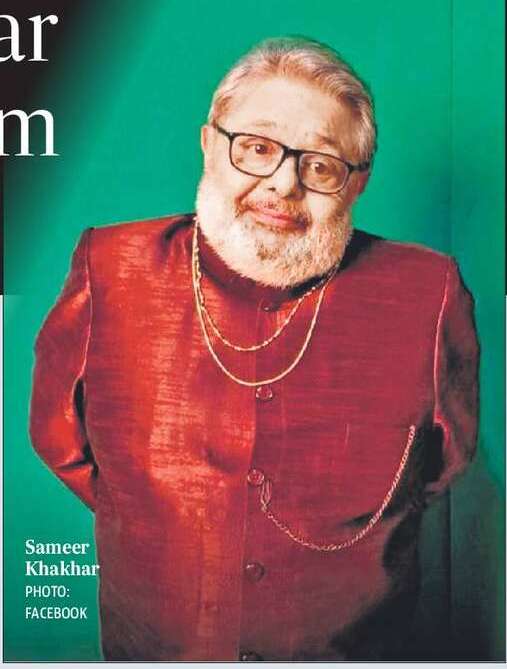
Mumbai: Actor Sameer Khakhar, whose portrayal as the drunken Khopdi in the iconic TV serial ‘Nukkad’ (1986) became his calling card, passed away at age 71 after suffering multi-organ failure Wednesday.
His younger brother Ganesh told PTI, “He had respiratory problems since yesterday and later he went into an unconscious state, so we called the doctor at home and he asked us to hospitalize him. Sameer was admitted to the intensive care unit of MM Hospital. Slowly and gradually, he suffered multiple organ failure, he was unconscious and then he collapsed. He passed away at 4:30 am.”
It was the power of Khakhar’s performance that drove viewers to despair at his demise. In real life, they would have turned up their nose and sidestepped the stout, unkempt drunkard with slurred speech, but the reel life character of Khopdi was so well loved that Khakhar’s death evoked mass disappointment. Fans remembered his roles in TV serials ‘Circus’, ‘Manoranjan’ and ‘Shriman Shrimati’ and films like ‘Raja Babu’, ‘Parinda’, ‘Shahenshah’ and ‘Jai Ho’. He appeared in some web series too.
Social media buzzed with memories of his silent act in the film ‘Pushpak’ which had no dialogues. Khakhar played a wealthy alcoholic businessman who is kidnapped by the protagonist Kamal Hassan. Other notable roles include ‘Hasee Toh Phasee’ and web productions like ‘Sunflower’, ‘Serious Men’ and ‘Farzi’.
Khakhar had moved to the US in the 1990s for a few years to become a software developer. He worked at a company as Java developer till recession hit in 2008. Fewer assignments followed by the lockdown worsened his circumstances.
In 2021 he bravely appealed for work, saying in an interview to PTI, “Everybody is looking for work and so am I. And by looking for work I mean approaching and applying for a job. In the case of actors, it is a daily exercise with every film or show. But I am a bad salesman.”
On Wednesday, Khakhar’s last rites were performed at a Borivali crematorium in the presence of family and some friends from his days in Gujarati theatre. He is survived by his wife.
On social media, big names from cinema and TV held off. But condolences trickled in from the likes of Hansal Mehta, Gulshan Devaiah, Bhuvan Arora and the makers of ‘Farzi’. Cine & TV Artistes' Association also mourned his loss.
Hansal Mehta wrote, “For some reason I was nicknamed Khopdi in college after his iconic character in Nukkad. My closest friends from the time still call me Khopdi. But I guess it’s time to say goodbye to the OG. Goodbye Sameer Khakhar. Thank you for the memories.”
Director Nila Madhab Panda said, “Khopdi has left this Circus and gone to the Nukkad in the sky.”
-----------------------------------------------------------
Tanvi Trivedi (BOMBAY TIMES; March 16, 2023)
Senior actor Sameer Khakhar (70), best known as Khopdi in the TV world, passed away yesterday in Mumbai due to multiple organ failure.
Film director and writer Saeed Akhtar Mirza, who directed Khakhar in the TV show Nukkad during the 80s, shared how the actor’s character and his portrayal of the drunk Khopdi became iconic. He said, “I don’t remember who coined the term ‘Khopdi’, but through his character, we were able to convey social messages and depict the times of that era. He was a man of huge talent and had the capacity to do many different roles, but unfortunately, he got typecast. He had told me how unhappy he was about getting slotted in drunkard roles. If it was not a drunkard’s role, it would be something similar, so that’s the saddest part of his career because he was capable of much more. He was a great theatre artiste, and I wanted to see him flourish, but unfortunately, he did not get enough work. His passing away has left a hole in my heart. He will live on in our hearts forever.”
Pavan Malhotra, who shared screen space with Khakhar in Nukkad, said, “He was extremely talented and added to every scene in the show. I remember in those days. . . we used to take three days to shoot an episode. All our characters are remembered even today, especially Khopdi. Sameer was a talented and fun-loving guy.”
Khakhar’s last TV show was Sanjivani 2, a couple of years ago. He played the lead actor’s uncle in the show, who is childlike and keeps forgetting things. Producer of the show, Siddharth P Malhotra, shared, “When this character was written, we wanted to cast only him. Whatever scenes he had in the show lifted the quality of the show. His passing away is sad and heartbreaking.”
Director Hansal Mehta also tweeted for Khakhar. He wrote, “For some reason, I was nicknamed Khopdi in college after his iconic character in Nukkad. My closest friends from the time still call me Khopdi. But I guess it’s time to say goodbye to the OG. Goodbye, Sameer Khakhar. Thank you for the memories (sic).”
-----------------------------------------------------------
HINDUSTAN TIMES (March 16, 2023)
Actor Sameer Khakhar, who was best known for playing the lovable character Khopdi in the show Nukkad, died on Wednesday at a hospital in Mumbai due to multiple organ failure. The actor, 71, was last seen in the web series Farzi.
“He had respiratory problems since Tuesday and later became unconscious. We called the doctor at home and were asked to hospitalize him. Later, he was admitted to the intensive care unit of MM Hospital,” his younger brother, Ganesh, told PTI.
Besides Nukkad, Khakhar also played pivotal roles in shows such as Circus, Shrimaan Shrimati and Sanjivani to name a few. Filmmaker Hansal Mehta, actor Parineeti Chopra and chef Kunal Kapur were among those who paid tributes to Khakhar on social media.
Back in 2010, when I first visited Cannes I had no support system as such-Nila Madhab Panda
8:23 AM

Nila Madhab Panda, who has been attending the Marché du Film at Cannes for the past 13 years, decodes what the Film Market is all about
Niharika Lal (BOMBAY TIMES; June 5, 2022)
The Marché du Film at the 75th edition of the Cannes Film Festival saw huge participation from India. Nila Madhab Panda, who has been attending Marché du Film since 2010, spoke to us about the importance of attending the film festival and the film market, and how attending Cannes can help young filmmakers. Talking about the breakthroughs so far, Nila said that this year, a lot of foreign producers have shown interest in Indian projects.
‘BY TAKING FILMS BY YOUNG FILMMAKERS TO CANNES’ FILM MARKET,THE I&B MINISTRY PROVIDED A SUPPORT SYSTEM’
This year, at Marché du Film, there were projects from India in sections like special screening, pitches, and Goes to Cannes. Nila says, “Back in 2010, when I first visited Cannes I had no support system as such. But this year, by taking several films by young filmmakers to Cannes’ film market, what the I&B Ministry did was to provide a support system to young filmmakers. Some of these films were by debut filmmakers. And Cannes is the best place for networking for a filmmaker. At Marché du Film, they can get their work recognised on an international scale. Besides, the market gives us a chance to get our films selected in international film festivals and distributed in cinemas across the world.”
‘THE FILM FEST PROVIDES A PERSPECTIVE TO FILMMAKERS’
Nila points out that even at the Marché du Film, the careers of filmmakers have been launched because of the exposure they get and the networking they can do here. He adds, “Beyond this, the Cannes Film Festival provides a perspective to filmmakers. You get to understand the viewpoints of film industries from across the world, and you get a fair idea about catering to the international audience. You get a lot of insights. I am a regular at film festivals across the world and have been a regular at Cannes, that’s why I feel this exposure to the film market will help independent filmmakers even in their future projects.”
‘SHOOTING IN INDIA IS CHEAPER THAN SHOOTING IN EUROPEAN COUNTRIES’
Nila says that even for European filmmakers shooting in India is cheaper than shooting in European countries because of expensive location prices. He says, “I know a Polish filmmaker who was planning to shoot somewhere in Asia, and she was thinking of filming in Thailand or somewhere, but after looking at what India is offering in terms of incentives and locations, she has now decided to shoot her film in India.”
India was in focus at the Marché du Film, this year. Talking about how being the ‘country of honour’ brought India under the spotlight, Nila says, “The outcome is incredible. This year, at India Pavilion, there were queues of foreign filmmakers to enter the venue. I’m part of an international producers’ network and several foreign producers have shown interest in Indian pitches, projects, and even filming in India.”
‘WITH NEW INITIATIVES, THERE’LL BE A JUMP IN CO-PRODUCTIONS’
Nila says co-productions are a norm for European filmmakers. He says, “But we have had very few co-productions in India like The Lunchbox and Sir. With recently announced initiatives by I&B Ministry for co-production projects, I believe we will get to see a jump in co-productions. This year, one of the things which happened at Cannes was ‘action oriented dhamaka’. It is a great business model, too. For example, if an Indian filmmaker collaborates with a Sri Lankan filmmaker, then there are possibilities for the film to gain traction in both countries, and get a Sri Lankan film release in India.”
‘YOU BUILD CONNECTIONS AT CANNES,AND THEN YOU SET MEETINGS AND FOLLOW-UP’
Recalling his first visit to Cannes in 2010, Nila says, “I first came to Marché du Film with I Am Kalam. A special screening was organized at the India Pavilion, and Barbara Broccoli, producer of the James Bond series, came to the pavilion to watch my film. I had earlier worked on a documentary Stolen Childhoods (2005), which she had produced, so I had invited her for the screening. Over the years, I have presented several projects at the Marché du Film. One may not see immediate results, but you’ve to follow up after Cannes. You build connections at Cannes, and then you set meetings and follow-up. People know people, and that’s how it works out.”
WHO VISITS CANNES’ MARCHÉ DU FILM?
- Filmmakers who want to pitch their films
- Those aiming to create partnerships through co-productions
- Those who need financing or a postproduction partner
With less red tape, filming in India has now become a lot more simplified and streamlined, say facilitators at Cannes 2022
8:35 AM

Niharika Lal (BOMBAY TIMES; May 28, 2022)
At the India Pavilion, at Cannes Film Festival’s Marche Du Films this year, a session titled – ‘Filming In India – A world of opportunities’ – saw the panel, comprising both creators and facilitators, discuss how India has become increasingly shooting-friendly after almost a decade of efforts and how ease in permissions has been fuelling a boom in filming projects in the country – with an aim of sustaining this and turning India into one of the most coveted content production hubs, the Ministry of Information & Broadcasting also rolled out film shooting incentives at the festival recently. Excerpts from the discussion:
‘OUR PILOT PROJECT OF SINGLE-WINDOW PERMISSIONS IN MAHARASHTRA WAS A GREAT SUCCESS’
Recent years have seen several initiatives by the government to make shooting in India a smoother process. This includes the single-window permission system. During the session, Ravinder Bhakar, MD, National Film Development Corporation, said it has made the process much easier. “In the sense that if you want to shoot at an Archaeological Survey of India monument, then you don’t need to go to ASI, you can go to the Film Facilitation Office (FFO),” he explained.
The FFO has also been collaborating with states and central agencies to ensure not just timely permissions for shoots, but has also come up with a grievance redressal system. Ravinder added, “There was a need for such a system. Now, we immediately connect with the state system and around 68 such cases of filmmakers have been resolved immediately. Besides that, more than 50% states in India have come up with a film policy and we have also come up with a real-time incentives-tracking system.”
Saurabh Vijay, Secretary, Cultural Affairs, Maharashtra, said, “The Maharashtra government and our Film City Corporation took the initiative of introducing a pilot for single-window shooting which was implemented for Mumbai (in 2018-19). What we tried achieve was to have the police department, as well as other departments, streamlined. Around 2,000 applications have been successfully processed in this manner.”
He added, “Recently, the government of Maharashtra decided to extend this system across the state. It requires capacity building even at the district level, the collector’s office level. We are now in the process of onboarding them on the portal that we have created. We have rich locations in Maharashtra – from beaches to forts, which are mentioned on the portal, which also has the ASI. Recent examples of film shoots that happened here were Christopher Nolan’s Tenet (in 2019) and Shyam Benegal’s Mujib (in 2021-22). We are also inviting private players – for instance, if there is a good bungalow for shooting, we are trying to bring it all under the single-window system.”
He said that the government of Maharashtra has been working on a policy for ease of filming, and will look into concessions for film shoots at monuments.
Line producers often say that when filmmakers visit cities such as Delhi and Mumbai, they prefer to film at iconic locations, however, Ravi Kottarakara, General Secretary, Film Federation of India (FFI) and South India Film Chamber of Commerce (SIFCC), pointed out that there’s a gap between the kind of locations filmmakers want to shoot at and the kind of locations that are offered on film cell websites.
Calling the latter ‘postcard locations’, he said, “What we should do instead, is take a vast series of photos and canvas the different locations which are available. It could be a monument, it could be a road, it could even be a small gali – we should have photos of all. We should have photos of even villages and small settlements.”
Filmmaker Jayarajan Rajasekharan Nair also pointed out, “Almost all the monuments across the country have raised the location fee. For modest budget filmmakers, it is very difficult to shoot at the monuments because of such high rates. I faced similar issues while shooting at Maharashtra’s Ajanta Ellora caves. I feel a concession is necessary.”
‘THERE’S A PLETHORA OF GREAT LINE PRODUCERS AND FACILITATORS HERE’
Kilian Kerwin, Head of Production, South Asia & Latin America with Los Angeles-based company SK Global Entertainment – who was here for the shoot of the 2019 series Delhi Crime – said that many of the difficulties they faced filming in India were similar to the what they’ve faced in any other part of the world.
He said, “The first thing you do as an outsider is to partner with the right people inside. I needed help in navigating the paperwork, finding locations. There’s a plethora of great line producers, facilitators, co-producers, and location scouts in Delhi. Like in any part of the world, you find the right people, and they make it easy for you, but yes, there was some guerrilla shooting happening too.”
Recalling an incident, he said, “There were certain things that happened, in a good way. Like, when we wanted a clear street, the AD just said something in Hindi and the entire neighbourhood got out of the way for us to get our shot. That would never happen in New York or LA, people would make an obscene gesture at you and probably try to spoil your shot to be mean. I think it’s the fascination with the magic of filmmaking (in India) that people are willing to help from the ground up.”
‘NO LONGER A NIGHTMARE TO GET PERMISSION FROM THE RAILWAYS TO SHOOT’
Be it Rajesh Khanna hanging out of a jeep while serenading Sharmila Tagore travelling in a toy train in Darjeeling (Aradhana) or Shah Rukh Khan dancing to Chhaiyya Chhaiyya atop a train (Dil Se), Indian films have always featured iconic train sequences. However, for foreign productions, shooting on trains has always been an issue. Back in 2011, for example, makers of the James Bond film Skyfall tried and failed to shoot a train sequence, after they couldn’t get permission from the Indian Railways. And so, the scene was filmed in Turkey.
However, today, Bond producers would find it much easier to shoot on an Indian train, say officials. Ravinder Bhakar, MD, NFDC – who had a long stint with the Railways before joining as the Central Board of Film Certification CEO in 2020 – said during the discussion, “As far as the Railways are concerned, we go through the script, evaluate it, do the necessary formalities and a dedicated officer is there to facilitate makers. The whole matter takes only two-three days. The Railway Board also came out with an exhaustive list of prices. So, whether you want to shoot in the yard, the coach or on the platform – there are prescribed guidelines; and the process is much simpler these days. You can also approach the Film Facilitation Office (FFO) for permissions from the Ministry of Railways.”
Presenting a comparative, filmmaker Nila Madhab Panda said, “I shot something in 2011 and it was a 30 day-long nightmare to get Railways permissions. However, in 2018, I got permission from the Railways within seven hours for a shoot in Delhi. It has become that fast.”
Due to Coronavirus, IFFI may feel different. But it’s as good as previous years, or even better-Nila Madhab Panda
8:14 AM

Niharika Lal (BOMBAY TIMES; January 21, 2021)

‘IFFI IS A REMINDER OF HOW OUR CINEMA HAS FOUGHT COVID’
Talking about attending a film festival amid the pandemic, Nila tells us, “Due to the pandemic, IFFI may feel quite different this year. But I’d say it is as good as the previous years, in fact, it is even better. The only difference is people are wearing masks. One has to be at IFFI in Goa to see how officials have reinvented it for the pandemic. IFFI 2021 is a mixture of virtual and outdoor events to adapt to the COVID-19 era. You can feel the love and magic of cinema at IFFI, and it is a reminder of how cinema has fought Coronavirus.”
‘ENTERED A THEATRE FOR THE FIRST TIME IN 11 MONTHS, IMPRESSED WITH ARRANGEMENTS’
Nila says, “When I entered the auditorium, I realised that I’m entering a theatre after almost 11 months. When I came to attend the screening of my film in Goa, I was a bit apprehensive whether people would come for the screening or not, if there would be any decor this year, will it feel like previous years or not. Mujhe laga mahaul dukhi sa ho hoga. But I felt so good being here, it was just as good as the previous years. The decorations are beautiful, people are so friendly and the air is fresh. So much of efforts have been put into making the fest a success.” He adds, “I’m here for four to five days, and will be attending physical screenings of other films too.”

I’m cynical now. I’ve seen too much. Nothing really changes-Ranvir Shorey
8:42 AM

BOMBAY TIMES (July 29, 2020)
Amidst the anger and debate following Sushant Singh Rajput’s death, Ranvir Shorey has been one of the more vocal voices commenting on the functioning of the cine industry. Nila Madhab Panda, an ‘outsider’ himself, who has directed Ranvir in Kadvi Hawa and Halkaa, asks him what’s got him so upset and if he thinks anything’s really going to change in the power dynamics of the industry. Excerpts from the chat:
Nila: As someone who has directed you, as a friend, and as someone who lives in Delhi and Bhubaneshwar, distant from Bollywood, I wanted to understand what has been troubling you, making you so vocal the past few days.
Ranvir: Right now, the debate going on is about mainstream Bollywood, it is not about the Indian or Hindi film industry. It is about that group within a group, the top of the pyramid of mainstream Bollywood. Every actor aspires to be at the top, what happens is that you hit a glass ceiling, or you enter the gatekeeper zone where approval of a select few people can give you access to the top, otherwise you keep working for smaller rewards.
Taking Sushant’s example, he had been doing very well on his own. He had blockbusters under his belt but, like even Anurag (Kashyap) mentioned in one of his interviews, he wanted validation from this group, this cabal. These people wield a lot of power in terms of distribution and exhibition of cinema and marketing budgets. Seeking validation from these people is what I think went wrong for him.
Nila: That is a fact for all of us, however independent you are. I sold my house to make a film that everyone loved, but it could never make it big in terms of business as the validation was not there.
Ranvir: No matter how good a film is made, when you are not going to get shows in the cinema halls, what are you going to do? Dekho agar kisi ke paas power ho toh accountability honi chahiye, agar accountability nahi hai toh grace honi chahiye. Inke paas dono nahi hai. Anybody who has power doesn’t want to let go of it. And they end up abusing that power.
Nila: When you were in your mid-twenties or thirties, what was happening then that is reflecting now?
Ranvir: After Sushant’s death, I was also devastated, thinking what the hell happened! When the circumstances around his death started being discussed and the names of the people he was involved with started coming out, I was shocked. These were the same names, same people involved at the time when I went through all this in 2003-05, the same circumstances. The psychological pressures were created for him also.
First, you isolate someone at work. And in our business what happens is if you isolate someone at work, their social life is also affected. Aapko bade banner ne liya toh aapke dus dost hain, aapko bade banner ne drop kiya toh suddenly you have only three friends left. I was reading that his girlfriend was being told by one mainstream director that you better let this guy go or else you will also suffer. Then she also left him. What is the guy left with then? You isolate him socially, professionally, and then one last thing that a young man in his thirties would want to hold on to, his girlfriend, you affect that also. He just didn’t know what hit him.
When these things came out and the names of the persons involved were the same that I had suffered at the hands of, with no accountability, that’s when I started speaking. And I was upset that if Kangana (Ranaut) is talking about this, why are people asking her to keep quiet? Why should she not speak?
Nila: How do we find a way for each of us to work this out?
Ranvir: For the disparity in power for distribution and exhibition, the streaming platforms will be equalisers. Marketing and media will be equalised a little with social media. These things will bring a little relief, but it’s not that the world order will change once theatres reopen. The same people will still be in power.
Un logon ko fark nahi padta hai. People like you and me, those who don’t enjoy that privilege, hum log kabhi aise bol sakte hain, ki kaisi bhi film bana dete hain, 100 crore toh ye banayegi hi kyunki shows toh mere paas hain. Main aisa performance de sakta hun, ki arey yaar main kuch bhi kar deta hun, public toh taali maregi. Toh incentive hi nahi hai better kaam karne ka. Isiliye inki filmein itni gandi banti hai. Doesn’t matter how many crores they make, but they make s**t films.
Nila: Can you sustain here if you are this rude, this direct?
Ranvir: Woh joh hope hota hai na – ki mere ko bhi kabhi mainstream picture milegi, 100 crore ki picture banegi – woh toh inn logon ne pehle hi maar diya hai. So mere ko fark nahi padta. I have stopped wanting to please those people for a while now.
Thankfully, there are talented filmmakers like you who have faith in me. There are people like Rajat, Abhishek Chaubey, these are people who care about cinema, who care about making good films. I am very happy doing this. Mere ko big reward chahiye hi nahi, main small reward mein khush hoon.
But many don’t want to burn the chance they might get later of being accepted by the cabal. And you can’t judge them for it either.
Nila: Is all this speaking out going to start a phase of transition?
Ranvir: The hoo-ha on social media with hashtags is not a reflection of what is happening in the real world. Once theatres open up, we might see a small difference in the disparity, the desperation and the despair that exists — that will be because of the presence of streaming platforms as a safety valve. But I have a feeling that the theatre game is going to go back to the same. I am a cynical man now. I have seen too much. Nothing really changes.
--------------------------
ON THE 100 CRORE RACE
“Why do most big stars want to make 100 crores in the weekend? Because they know that by the time Monday comes people will start talking s**t about the film. The primary objective is not good cinema, and not even entertainment. It is to make money. I am not saying that the film should not make money. Aapka secondary objective making money hai, theek hai, because the film costs money. Yeh work culture mein difference hai.”

If I earned enough from acting, I’d not have felt the need to sell fruits-Solanki Diwakar
8:17 AM

Solanki Diwakar, who’s acted in films such as Dream Girl and Sonchiriya, sells fruits on Delhi’s streets to support his income when he isn’t working on a film
Niharika Lal (BOMBAY TIMES; May 29, 2020)
 Solanki Diwakar, an actor who has worked in films like Dream Girl, Halka, and Sonchiriya, has been supporting his family with his ‘side-business’ of selling fruits from Okhla to Malviya Nagar in Delhi. The 38-year-old actor, who hails from Agra, lives in Sriniwaspuri in Delhi, and when he is not auditioning for (or acting in) films, he’s back on the streets with his fruit cart.
But it’s not like filmmakers haven’t tried to help him. Solanki says, “When directors came to know I’m selling fruits during the Coronavirus pandemic, they got in touch with me to help, but I have been selling fruits as a part-time job for almost 10 years, and now when shoots have completely stopped, this is what’s keeping me afloat. My directors Nila Madhab Panda, who gave me a role in Kadvi Hawa and Halka, and Raaj Shaandilyaa, who directed me in Dream Girl, got in touch with me, but I’m doing well. Everyone’s in distress during the pandemic, not just me.”
 Cine associations are supporting actors and crew members in Mumbai, didn’t he get in touch with them for support? He says, “While I am supporting myself by selling fruits, several artistes and crew members want to do only film industry-related work, hence they need more help to sustain themselves right now. All shoots have stopped. Maybe, in a couple of months, we’ll start shooting again.”
Solanki adds, “I have done small roles in over 30 films. I went to Mumbai in 2005, but I didn’t get the opportunities I wanted, so I came back to Delhi.” He says that since the income from films is not sufficient, he can’t stop selling fruits.
But with interested customers, Solanki loves to share his experiences from the film world. He says, “Yes, people often ask me, ‘Aisa lagta hai aapko kahin dekha hai.’ I smile and tell them that they must have seen me in movies.”
I initially turned down I Am Kalam as its budget was equal to my fees-Gulshan Grover
8:12 AM

Niharika Lal (BOMBAY TIMES; December 2, 2019)
Speaking on the first day of the Times LitFest Delhi, Gulshan Grover, whose film I Am Kalam (2011) won multiple awards, told the audience that he had initially decided not to do the film, but after hearing the storyline, he was so impressed that not only did he change his mind but he decided to do the film for free. Gulshan said, “When I was offered I Am Kalam, I decided not to do the film because the budget of the entire film was equal to my fee. But when I heard the story, I was so impressed that I decided to do it for free. I have huge respect and love for the producers of the film, and Nila Madhab Panda, our director.”
In reply to a question about his inclination towards villainous roles, Gulshan said, “I have been offered a hero’s role several times but I always turned them down. I never wanted to be a hero.” He added, “When I came to the film industry (in the ’80s), the actors didn’t want to change their look for a film. They didn’t even want to put on a fake moustache while playing the role of a police officer. I was the one who changed this by experimenting with my looks, and now actors like Aamir Khan go through the process of changing their looks to make the character look real.”
Talking about the work he has done in foreign films, the actor said, “When I went to Hollywood, our films used to be screened at film festivals. They didn’t know much about Bollywood, be it Amitabh Bachchan’s films or Dilip Kumar’s, which has now changed.”
The climate change is catastrophic; We are living in a gas chamber-Nila Madhab Panda
8:15 AM

Nila Madhab Panda on being one of the 11 filmmakers selected by the UN to be a part of an anthology on climate change
Himesh Mankad (MUMBAI MIRROR; July 23, 2019)
Nila Madhab Panda, best known for his directorial, I Am Kalam, is one of the 11 filmmakers from across the globe selected by the United Nations to make a film on the worldwide phenomenon of rampant climate change. “The project is titled Interdependence and filmmakers from 11 nations will talk about this very relevant issue and how it plagues their countries. It’s essentially an anthology,” informs the maker. The other 10 directors on board include Faouzi Bensaidi (Morocco), Asa Hjorleifsdottir (Iceland), Mahamat-Saleh Haroun (Cannes winner from Chad, Sahel Region), Salome Lamas (Portugal), Bettina Oberli (Switzerland), Shahrbanoo Sadat (Afghanistan), Silvio Soldini (Italy), Daniela Thomas (Brazil), Leon Wang (China) and Karin Williams (New Zealand).
Nila’s film, primarily a courtroom drama, is set in our capital city. It features Divya Dutta as a judge and Tannishtha Chatterjee as a lawyer, with Manjari Fadnnis and Chandan Anand as a married couple on the verge of divorce. “I have been living in Delhi for a long time now and the change is catastrophic. We are living in a gas chamber and being the parent of a growing child, I am worried about his health all the time. Since we are responsible for what is happening, we should come forward to do something. Running away won’t help. This film is a portentous narrative which will show us how we can fight the problem in our own way,” he explains.
Nila is ecstatic to be the chosen one to represent India at a global platform. “There is an Oscar- nominated filmmaker, directors who have won at Cannes, Berlin and other prestigious film festivals. All 11 of us have come together for one ultimate cause: climate change,” he exults, admitting that it was tough getting his cast together. “I got lucky and now have a nice ensemble in place. I have always been fond of Divya’s work, I believe she has more to offer than what we have seen and you will get to see another shade of her talent in my film,” he promises.
The film will open in Italy and travel across the globe with the intention of making everyone aware of the world we live in. “A release in India is the distributors’ call, but I hope it finds its way to the country,” Nila signs off.

Whose film is it anyway? List of upcoming movies that filmmakers and actors are competing for
8:02 AM

Chaya Unnikrishnan (DNA; October 6, 2017)
With filmmakers and actors wanting to make movies based on real-life stories and personalities, there is a clamour for subjects that can be brought alive on the celluloid. Though there is no dearth of fascinating life stories and happenings in India, what’s interesting is that the makers end up choosing the same subject and that, too, around the same time! For instance, both Salman Khan and John Abraham came up with the idea of making a biopic on wrestler Gama Pehlwan in 2014, but neither materialised. Now, Salman is producing a serial on the wrestler with his brother Sohail Khan playing the title role, while there’s no news on John’s film. A couple of years ago, Ekta Kapoor bought the official rights for the film adaptation of the suspense novel Devotion Of Suspect X, which is said to have been the inspiration for Malayalam Drishyam. A miffed Ekta has sent a notice to the makers, but the film went on to be a box office hit spawning several remakes.
In recent times, two films — Qaidi Band and Lucknow Central — with the theme of prisoners forming a music band in jail were released within a month of each other, but neither did well at the box office. Earlier too, there have been instances of multiple films made on the same subject like Khelein Hum Jee Jaan Sey and Chittagong based on the Chittagong Uprising. Freedom fighter
Bhagat Singh inspired three filmmakers at the same time. In fact, The Legend of Bhagat Singh, Shaheed and Shaheed-E-Azam even released on the same day!
And, now, again we see the same subjects becoming the bone of contention between actors and filmmakers. Akshaye Rathi, leading exhibitor and analyst, says, “While creativity is subjective, in case of most films, it’s not like rights have been bought to make them. It could be plagiarism or trying to cash in on an interesting subject. It’s nice and interesting that people are thinking of the same subject at the same time, but ultimately, what they need to focus on is making a truly engaging film by putting significant time and money in it.”
A lowdown on such films in the pipeline...
Film: Based on Rudrakesh Jena
Contenders: Nila Madhab Panda and Ujjwal Chatterjee
A few days ago, there was news of I Am Kalam director Nila Madhab Panda gearing up to make a biopic on Rudrakesh Jena, the coach of the rugby team of the Kalinga Institute of Social Sciences (KISS) with Abhishek Bachchan playing the lead. The film is slated to go on floors early next year and will be shot in India and the UK. Now, another National-Award winning director Ujjwal Chatterjee is also planning a film on Jena, who coached the under-14 team to victory in London, and has approached Farhan Akhtar for the role. He claims to have the rights to Jena’s story. The movie for which he has roped in former British footballer Paul Walsh will roll in November. In an interview, he said he was shocked to know that another film is being planned on the same subject.
Film: Based on Maharaja of Jamnagar
Contenders: Ashutosh Gowariker and Omung Kumar
First there were reports of Ashutosh Gowariker making a film based on Jam Sahib Digvijaysinhji Ranjitsinhji who helped save the lives of 640 Polish children during World War II by providing refuge to the orphans at his Jamnagar palace. A few days later, Omung Kumar announced a film on the same subject with Sanjay Dutt playing the role of the Maharaja. His film was to go on the floors by the end of next year. But now there is a twist to the tale, as the heirs of the Maharaja, Hershad Kumari and Himanshu Kumari have raised an objection and sent a legal notice to the maker saying that they did not take the permission of the family before kickstarting the project.
Film: Based on Battle of Saragarhi
Contenders: Karan Johar, Ajay Devgn, Rajkumar Santoshi
Ajay Devgn had announced the sequel of Son of Sardaar last year in June. The film’s plot was to be the historical Battle of Saragarhi that was fought between Sikh soldiers of the British Indian Army and Pashtun Orakzai tribesmen. The Sikhs, led by Havildar Ishar Singh, chose to fight to death, in what is considered by some military historians as one of history’s greatest last-stands. Earlier this year, Karan Johar and Salman Khan came together to co-produce a film on the same subject with Akshay Kumar playing the lead role. He will start shooting for it in December. Then, there is Rajkumar Santoshi who is making his version with Randeep Hooda playing Havildar Singh. However, the film has hit a roadblock due to differences between the producers and the director.
Film: Based on coalmine hero J S Gill
Contenders: Akshay Kumar and Ajay Devgn
In May this year, there were reports of Akshay Kumar playing coal mine engineer JS Gill, who rescued 64 miners trapped in a mine in Raniganj. A month later, there was news that Ajay and not Askhay is playing the coalmine hero and that the makers have obtained the rights and work on the script has already begun. Tentatively titled Capsule Gill, it is to be helmed by Rustom director Tinu Suresh Desai.
Nila Madhab Panda's Abhishek Bachchan-starrer rugby coach film in copyright row
7:45 AM

Two days after Mirror report on Nila Madhab Panda’s rugby coach film, Ujjwal Chatterjee says he’s working on the same subject
Natasha Coutinho (MUMBAI MIRROR; October 4, 2017)
 Mirror had earlier reported (October 2) that I Am Kalam director Nila
Madhab Panda is gearing up to make a biopic on Rudrakesh Jena, the coach
of the rugby team of the Kalinga Institute of Social Sciences (KISS)
and was in talks with Abhishek Bachchan to play the lead. The film is
scheduled to kick off early next year and will be shot in India and the
UK. Now, we have learnt that National award-winning director, Ujjwal
Chatterjee, is also making a film on the same subject. His film kicks
off in November and Farhan Akhtar has been approached to play Jena. He
has also roped in Paul Walsh, a former British footballer.
Ujjwal told Mirror, “Mukesh Khanna, the chairman of Children’s Film Society of India (CFSI), and I started our research in 2011 and have been working on the project since the last one year. Our story is about 12 tribal boys from Mayurbhanj, Jharkhand and Bhubaneshwar who are students of the KISS and won the international School Rugby Tournament in London. I was shocked to learn that another film is being planned on the same subject. CFSI has already informed KISS that we have the rights to Jena’s story.”
He went on to add that he is in touch with Farhan’s manager and is waiting for the actor to revert. “The film will be directed by me and produced by CFSI. It will be shot in Mumbai, Kolkata and Bhubaneshwar.”
In 2007, KISS’s Under-14 rugby team won the International School Rugby Tournament in London. It was a milestone achievement for this one-of-its kind school which provides free accommodation, food, healthcare and education from class one to post-graduation, along with vocational training, to its players.
Mukesh Khanna pointed out that the film was taking time to roll because of insufficient funds. “Meanwhile we learnt that another film is being made planned with Abhishek Bachchan on the same subject. We can’t stop people from making films on a real life person. From what I know, the producer of that film was supposed to make it with Ujjwal but is now going ahead with someone else which is not right,” he asserted.
Mirror reached out to Shabbir Boxwala, the producer of Panda’s film, he said, “Ujjwal has taken money from me and has to return it. It is a legal matter.”
Abhishek Bachchan in talks to play a rugby team coach in Nila Madhab Panda's next?
9:45 PM

Natasha Coutinho (MUMBAI MIRROR; October 2, 2017)
Rudrakesh Jena, the coach of the rugby team of the Kalinga Institute of Social Sciences (KISS) in Bhubaneshwar, will soon take on a starry aura. Buzz is, Abhishek Bachchan could step into Jena's shoes to take his story to the world.It will be directed by Nila Madhab Panda for whose debut film, I Am Kalam, actor Harsh Mayar had won the Best Child Artist at the National Awards in 2011.
The film is expected to roll next year and will be shot in India and the UK. In 2007, the under-14 rugby team from KISS lifted the trophy at the International School Rugby Tournament in London. It was a milestone achievement for this one-of-its kind school which provides free accommodation, food, healthcare and education from class one to post-graduation, along with vocational training, to its players.
A source associated with the Shabbir Boxwala production reveals that the makers who have officially bought the rights to Jena's story have been in talks with Abhishek for the last month and is hoping to get him to be a part of the biopic soon. The film will highlight how young boys from some of the most backward districts of Orissa who almost missed the flight to London because they didn't even have valid birth certificates that are mandatory for passports, did the country proud. Here it can be mentioned that timely intervention from the Ministry of External Affairs helped to get them to the Queen's City in time for the tournament which they went on to win.
"The sport has helped change the lives of many kids in Orissa. Rugby is not a popular sport in India but the makers are hoping the film will help generate interest among the aam janta," the source signs off.
Shankar Mahadevan records song with Rising Star contestants for Nila Madhab Panda's Halka
6:54 AM

Natasha Coutinho (MUMBAI MIRROR; March 31, 2017)
Singer-composer Shankar
Mahadevan was so floored by the performances of the Diljot Qawwali group
and Ankita Kundu on the singing reality show Rising Star, which he
judges alongside Monali Thakur and Diljit Dosanjh, that he's giving both
the contestants a Bollywood break. On Thursday, Ankita and the group,
whose members are between the age of 10 to 40, recorded a song for I Am
Kalam's director Nila Madhab Panda's next film, Halka, revolving around
children living in the slums.
“The Diljot Qawwalli group are a rocking bunch of singers who don't strictly sing qawwalis. They are always in perfect sync and always trying to improve themselves. Ehsaan (Noorani), Loy (Mendonsa) and I were composing a qawwali-style, peppy number when it struck me that the energy of these happy kids would only enhance it,“ Shankar said, adding that he believes Ankita can become a top-class playback singer if she continues with her passion. “She's a young kid but her voice is mature and she sings perfectly. If we are able to fulfill some of the dreams of these children, it will be great,“ he says.
About scoring for an off-beat film, Shankar says that the composer trio accords equal attention to both mainstream and small films that support causes. “We decided to do it the moment we heard the script which aims at spreading social awareness,“ he signs off.
My whole life came back to me-Nila Madhab Panda on his Padma Shri honour
7:25 AM

MID-DAY (March 29, 2016)
"I did not aspire for a big house or other such stuff; I wanted to be known by my work," National Award- winner Nila Madhab Panda told hitlist soon after receiving the Padma Shri on Monday. Describing the felicitation ceremony as a surreal moment, the 42-year-old Odisha-born filmmaker said he was filled with pride when President Pranab Mukherjee asked him to “keep up the good work”.
“As soon as I entered Rashtrapati Bhavan, seeing the President and the Prime Minister and other bigwigs, it was a surreal moment for me. I had never imagined myself here. My whole life came back to me. I went into flashback. I always wanted my work to give me identity. This honour also comes with a huge responsibility,” said Panda, who won the National Award for I Am Kalam (2010).
At the event, he met poet and writer Haldhar Nag who also hails from his home state. “He comes from a humble background and always wears a vest and banian, and walks barefoot — that’s how he attended the ceremony too. It is so fulfilling to see such people bag awards,” he added.
So, what are his plans to celebrate the joyous occasion? “I plan to celebrate this day with a few friends at a restaurant in New Delhi. I am not into fashion, but made it a point to wear a bandhgala to the event,” he said.
APJ Abdul Kalam was a true hero of modern India-I Am Kalam director Nila Madhab Panda
7:46 AM

Nila Madhab Panda, the director who made I Am Kalam speaks about his encounters with the departed visionary
Subhash K Jha (DNA; July 29, 2015)
The death of the former President Of India, Dr APJ
Abdul Kalam on Monday has plunged the nation into a state of mourning.
National award winning director Nila Madhab Panda whose I Am Kalam was a
homage to Kalam’s vision of a child-literate India, met the great
visionary on several occasions for the film.
Nila recalls the gentle intellectual giant with much affection. “I came from a similar background as Dr Kalam, where basic education and survival were an issue. Then when I became a filmmaker, I made feature length documentary for Barbara Broccoli. For this documentary, I met lot of street children. The thing that haunted me the most was their dreams. I had seen the dreams in the eyes of these children I met on the streets, railway stations, brick factories and brothels.”
That’s when Nila began planning his film on Kalam. “I used to read a lot on Dr Kalam. I always thought of making a film which can inspire children, and tried to think of a hero, who can inspire. Ab hero isss desh mein hain kitney, aur kahaan? I felt the most inspiring living hero for our children was Dr Kalam. He was a true leader, a true hero.”
Remembering his first meeting with Dr Kalam, Nila grows emotional. “The first thing he said to me was, ‘Come come, you have a great smile, it means you have a good soul.’ He held my hand and asked me, ‘Are you married?’ I said yes. Then, he asked, ‘Are you with family after marriage or separated from family?’ I said, my family is in the village, but I am in the city because of my profession. It was then that Dr Kalam made a beautiful statement, which I can never forget. He said to me, ‘Joint family means growth, prosperity, love, trust, blessings unity....nuclear family ..you are finished.” Nila also can never forget the time he spent with Dr Kalam during and after he made the film. “Apart from being a president or scientist, Dr Kalam’s understanding of modern India and its cultural heritage was unmatched by any other living leader. He was a star which you can’t touch but can feel in every sphere of activity,” he says.
Nila’s film will remain a cinematic legacy of the great man’s reach and influence. He says, “I simply made a film on his philosophy and his statements, and it became a super hit. You know, he was not into self-congratulation, so instead of talking about himself after my film he said ‘Good you are spreading some good message for the new generation’. Our generation never met Mahatma Gandhi, Lal Bahadur Shastri or Jawaharlal Nehru. But we are lucky and proud to have had such a great living legend in our midst. A true hero of modern India.”
After Sushant Singh Rajput's Paani, now Kunal Kapoor comes up with Kaun Kitne Paani Mein
7:49 AM

Subhash K Jha (DNA; September 20, 2014)
 Many years ago, director Dev Benegal made Split Wide
Open with Rahul Bose, a film about water scarcity in Mumbai. When
Shekhar Kapur announced Paani for the first time 10 years ago, Benegal
cried foul regarding his film’s subject being suspiciously similar to
what Shekhar proposed.
Now when Shekhar has begun prepping for Paani, another filmmaker has crept up with a similar subject. National award winning director Nila Madhab Panda’s Kaun Kitne Paani Mein seems to share uncanny resemblance to Shekhar’s Paani. Madhab’s film features Kunal Kapoor in the lead whereas Shekhar’s film has Sushant Singh Rajput as the protagonist.
While Kaun Kitne Paani Mein is set in two parts on a village in Odisha named Upri and Bairi where water is a constant source of friction, Paani is set in a futuristic city divided into two parts — the Upper Level and Lower Level — warring over water. Panda plays down the similarities, “I’ve heard Paani is an urban film on water scarcity and also a scientific and futuristic film, whereas mine is a rural film set in present times on water scarcity... and even if there are similarities, I say, the more the better. Water scarcity is a growing epidemic across the world. We need many more films on the theme.”
Subscribe to:
Posts (Atom)