Showing posts with label Neena Kulkarni. Show all posts
Showing posts with label Neena Kulkarni. Show all posts
Vikram Gokhale is one of the greatest actors that I have ever worked with-Sanjay Leela Bhansali
8:03 AM
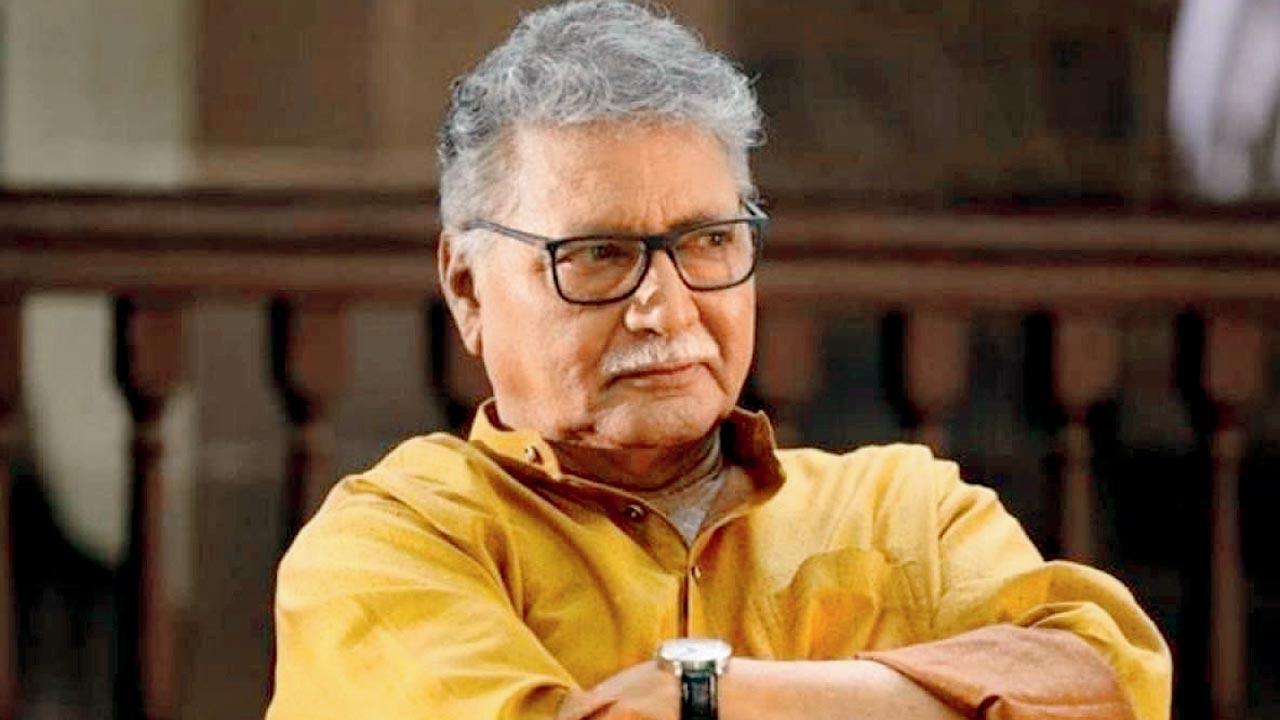
Bhansali, Kulkarni, and Manjrekar remember the actor’s tremendous talent and down-to-earth nature
Priyanka Sharma (MID-DAY; November 27, 2022)
National Award-winning actor Vikram Gokhale, who was a stalwart in Indian cinema, television and theater, has passed away following multiple organ failure. The actor, aged 77, breathed his last at a hospital in Pune, his daughter told mid-day. “We would like to thank everyone for their good wishes, support and prayers through this difficult time,” she said.
Gokhale remained synonymous with substance throughout his five-decade-old career that saw award-winning performances in both Hindi and Marathi. He debuted in the Hindi film industry with the Amitabh Bachchan-starrer Parwana (1971). Even in an ensemble that comprised popular stars, Gokhale stood out, courtesy his tremendous talent. In fact, it remained his strength to elevate even the smallest appearances and the thinnest characters offered to him.
What also set Gokhale apart from his contemporaries was his reliance on minimalism. Whether it was as the strict patriarch in Sanjay Leela Bhansali’s Hum Dil De Chuke Sanam (HDDCS, 1999) or the portrait of grief in Anubhav Sinha’s Tum Bin (2001), Gokhale performed with just his expressions, where others needed words.
“Vikram ji is one of the greatest actors that I have ever worked with. I feel people should learn from his legacy. Despite being a great reader, orator, and so well-read, he was simple-hearted. When I met him, he was like a friend and colleague, who often told me, ‘Sanju main tere saath hoon. Tu bol kya aur kaisa karna hai’. He was a great colleague to be on the set with, as he was always there for [me]. Vikram ji introduced me to Indian classical vocalist Pandit Ajay Pohankar, who suggested the Albela sajan raag [a version of which is used in HDDCS]. It was hard, but he [barely] took an hour to learn the song,” says Bhansali, adding that he learned the nuances of the craft when he saw Gokhale perform.
“Vikram ji was the complete master of his craft. Always in control of every aspect—in words, dialogue, expressions, and diction. He was spontaneous. We don’t get actors like him anymore.”
Thicker than his association with the Hindi film industry was his relationship with Marathi cinema and stage. In return, Marathi directors did justice to his talent, as he became one of the tallest stars in the fraternity, also earning a National Award for his work in Anumati (2013).
Gokhale’s Anumati co-star and longtime collaborator, Neena Kulkarni, fondly remembers him as the one of the most knowledgeable artistes she had ever met. “He was an intelligent and responsible actor. You could talk to him for hours on the process of acting. He was also well-informed about everything—from literature to politics. His performances are acting classes for the next generation. In Godavari [2006], he had just one dialogue, but he delivered it in variations; that is education in itself. I will obviously miss [my] friend, as we go back a long way. The fact that we have portrayed all relations from husband-wife, lovers to siblings and to me even playing his daughter-in-law was a running joke between us,” she reminisces.
“He used to call me Maya,” says Mahesh Manjrekar, who directed Gokhale in Natsamrat (2016), after which, they did another movie together, Me Shivaji Park (2018). “Vikram Gokhale was an institution in the field of acting that has shut down today. He was the most complete actor in the industry. He could enhance a scene by just using a handkerchief and make it look believable. I have seen him in theatre doing everything, including comedy. [Even though we were] young, he always treated us on par with each other. He was a close friend. Vikram was a director’s actor, but I never had to tell him what to do. Despite his acting prowess, he was casual about it on the sets,” adds the director.
-----------------------------------------
HINDUSTAN TIMES (November 27, 2022)
Vikram Gokhale, a towering personality in the Indian theatre and cinema space, died on Saturday, after days of being hospitalised. The actor, who was 77, suffered multiple organ failure and breathed his last around 2pm, Shirish Yadkikar from Deenanath Hospital, Pune, confirmed.
Born in Pune, the actor comes from an illustrious lineage. His father, Chandrakant Gokhale, was a renowned theatre and film actor, while his great grandmother, Durgabai Kamat, is credited for being the first female actor in Indian cinema. Having worked in Marathi theatre productions, Gokhale made his Bollywood debut in 1971 with Parwana. Thereafter, he starred in hits such as Hum Dil De Chuke Sanam (1999), Bhool Bhulaiyaa (2007), De Dana Dan (2009), Mission Mangal (2019), etc. A man of many talents, he donned the director’s hat in 2010 for the Marathi film, Aaghaat.
In 2013, his Marathi film Anumati fetched him the National Film Award for Best Actor. While he retired from stage work in 2016 due to an ailment, he continued working in films. He was last seen in Nikamma.
The last rites took place on Saturday evening, ANI reported. htc
Smita Jayakar
I worked with Vikram ji since the beginning of my career, in Marathi and Hindi projects. He was a very good friend and an amazing human being. I met him two months ago at a wedding in Pune. He didn’t look very healthy, but I did not imagine he’d leave us within two months. It is a big loss.
Neena Kulkarni
I’ve played his wife, girlfriend, sister and in our last film, his daughter-in-law. You would not see an actor like him. The fearlessness of Vikram Gokhale is what I’ll take from his life. I’ve lost a very good friend.
Subodh Bhave
The first commercial play I watched was Vikram ji’s. I was zapped by his performance. I’ve been fortunate enough to work with him in a few films. He was like my father, as he has played my father on screen. I’m certain that he’ll be talking to God passionately about plays.
Ameesha Patel
The more that is said about Vikram Gokhale, the less it is. I had the privilege of working with him in Bhool Bhulaiyaa, I got to learn a lot. His death leaves a huge void in the industry.
Shilpa Shetty Kundra
Vikram Gokhale ji was a fantastic actor, a thorough professional. I worked with him in Nikamma. He had great memory. He remembered an entire scene and did the whole monologue in just one shot.
TV is where actors earn. I won’t leave it-Neena Kulkarni
8:08 AM

Vinay MR Mishra (HINDUSTAN TIMES; March 28, 2022)
Actor Neena Kulkarni’s year “started on a good note” with the kind of work she did on the digital platform. “I am going to concentrate on OTT,” she says, adding that after Breathe, she got “sporadic” offers from the digital medium.
Kulkarni admits that she was among the few actors to have work in her kitty during the pandemic. “I started valuing my work even more. I realised that there were people who were not getting work and I’ve been fortunate to get work even without a manager. My work was a passion, but it has become precious now,” she elaborates.
She likes the fact that social distancing has become a norm, thanks to the Coronavirus pandemic. “The hugging was getting too much. We are back to our culture with namaste,” she quips.
Kulkarni’s last stint on Hindi TV was Yeh Hai Mohabbatein and she admits “daily soaps were a culture shock” for her. However, she is certain that quitting the small screen is not on her mind. “TV is where actors earn. I won’t leave it. Daily soaps are where you earn your daily wages and make money. Then you can easily do something where your heart lies,” Kulkarni explains.
In the recent times, she has been part of a couple of Marathi TV shows and films, including director Sachin Kundalkar’s Pondicherry, but she is of the opinion that OTT has blurred the lines: “There’s nothing like Marathi films [as such], they are just films now. People are watching content from Turkey with subtitles on,” Kulkarni mentions.
At this stage of her career, “the length of the role doesn’t matter” to the 66-year-old actor. “I have done all kinds of roles. It’s the depth of the role that interests me,” she ends.
Mogra Phulaalaa trailer launch: Swapnil Joshi and Neena Kulkarni's mutual admiration club steals the show
11:02 PM

As we climbed the stairs towards Plaza Preview Theatre, we paused. The star of the afternoon – Swapnil Joshi – was right there, posing up for photographers as he posed with Mogara flowers. The message was clear – the talented actor was completely mood and all set to unveil the trailer of his upcoming Marathi film Mogra Phulaalaa. While the mini cinema hall is sufficient to launch the trailer of a film and house all the mediapersons and cast and crew, this trailer launch however was an exception. The number of mediapersons was unusually high. Moreover, most of the crew members and the sprawling cast were also present. As expected, there was overcrowding with many not even getting a seat. But the organizers were prompt and instantly arranged extra chairs.
As everyone settled down, it became clear that the homely feeling, which is the film’s USP, has also been recreated at the trailer launch. The event began with some laugh-a-minute riot gags of Sandeep Pathak. The cast of the film was then gradually introduced. The best part of the afternoon was experienced at this point when Swapnil Joshi and Neena Kulkarni spoke highly of each other. Neena, while explaining about her fondness for Swapnil, said, “I can’t look at him objectively.” Swapnil meanwhile emphasized, “She is an institution and yet she surprises in every project.”
Sachin Mote, the film’s writer, showed his humble side and it was heartening when he said that it was a high to know that the dialogues written by him were mouthed by Neena Kulkarni. Director Shrabani Deodhar gave a touching speech, highlighting her journey. She also remembered her deceased hubby Debu Deodhar, also assuring that though lead actress Sai Deodhar is her daughter, she has been casted because she fits the bill.
Sai Deodhar made quite a late entry to the podium but made up for it with her brief speech. Unlike other film events, the supporting actors of the film also were given a chance to speak up. The music team too shared their thoughts in the end.
Mogra Phulaalaa is the story of a simple, clean-hearted man who wants to get married but is unable to do so, chiefly due to his loving but controlling mother. Talking of his character, Swapnil Joshi in the press statement said, “I am in a different look in the film. The subtle story, melodious music and above all, talented direction by Shravani tai makes the film a must watch. The film gave me a lot of satisfaction while shooting and I am sure the audience too will be satisfied.”
Neena Kulkarni meanwhile stated, “I enjoyed shooting for the film as the director of the film Shravani is very dear friend of mine. I am doing a film with Swapnil Joshi after a long gap of about 14 years. Chandrakant Kulkarni is also playing an important character in the film and I have acted in some of very popular plays directed by him. It was a different experience working with him again. Mogra Phulaalaa is a very beautiful and sensitive story and gave me immense satisfaction in playing the role of the mother. I extend my special thanks to the producers Arjun Singh Baran and Kartik Nishandar for producing such a film.”
Finally, Shravani Deodhar said, "I am happy that I am making a comeback after a long time through this film (she has earlier directed some well-received Marathi films like Lapandav, Sarkarnama, Lekru). Mogra Phulaalaa is a love story woven very subtly. It revolves around a youngster who is engaged in the issues so much that he even forgets that he has well gone past his age to get married. He falls in love with very strong woman having an independent personality. She is very unique with an upbringing of a different kind. The love story progresses to an advance stage even before he realises that he is in love."
Mogra Phulaalaa is produced by Arjun Singgh Baran & Kartik Nishandar of GSEAMS (Global Sports Entertainment And Media Solutions Private Limited). Producer of Fugay, Tula Kalnaar Nahi, Ranangan and presenter of Bhikari, GSEAMS is one of the top studios in Maharashtra. GSEAMS has also produced Nakalat Sare Ghadale on Star Pravah. Mogra Phulaalaa will be distributed by Panorama Studios, one of the leading producing and distributing company in Indian Film Industry and which has backed films like De De Pyaar De, Raid, Baazaar, Andhadhun, Satyameva Jayate, Drishyam, Pyaar Ka Punchnama 2, Gabbar Is Back etc.
Mogra Phulaalaa releases on June 14


Given the prep that I put in for Neerja, I won’t lie and say that it didn’t hurt to not get it-Neena Kulkarni
7:44 AM

Model, theatre artiste, film and TV actor, Neena Kulkarni discusses her career spanning 40 years...
Yogesh Pawar (DNA; September 23, 2017)
As a model, theatre person, film and TV actor, filmmaker and columnist, Neena Kulkarni wears several hats and brings the sincerity of her craft to every frame making each character she portrays, real and imbuing even similar ones with an edge that make them different. To do this once in a while is itself worthy of admiration so what does one say to someone, who has done this for four decades. On the completion of 40 years in the industry, the seasoned actor opened up on her exceptional work, her life and her hopes from the future...
It’s been four decades of acting. Does it still thrill you like when you started in the mid-70s?
Of course, it does. Nothing gives me the same high as acting. Acting will always be my biggest love. I think that’s happened because I’ve enjoyed and made the most of every part, however, big or small. I’ve almost never taken up a part that I didn’t like under compulsion.
Do you feel the Padma awards have taken their time to find you? After the National award for Shevri (2006) and state awards for theatre and films, not many have come your way?
What is recognition after all? Recognition and love I get from people when I step out? The way someone recalls/praises a play/serial/ad I did even from the early 80s? Or the respect and warmth I receive from people in the fraternity? Isn’t that more important and satisfying? Having said that, I haven’t stopped hungering. Who knows, a better, more challenging role and the recognition it will bring in its wake may still be ahead. After all, we live in really interesting times when filmmakers are pushing the envelope, both with subjects and genres.
How does that affect you?
You know how this plays out. An actress is assumed to have a certain shelf life after which she’s thrust into a ‘character role.’ I’m 62. There was a time when someone my age would be just another glorified prop, but not so anymore. One of the nicest things about contemporary takes on gender and sexuality have meant assertive women. And filmmaking has had to make space for that. That is why films are being written for a Meryl Streep, a Judi Dench or a Sridevi here. Even if one has to etch a mother she isn’t simply filling the frame. Look at how wonderfully Shabana ji (Azmi)’s character stood out in Neerja.
Didn’t you too audition for that part?
Well, I did. And given the prep that I put in, I won’t lie and say that it didn’t hurt to not get it. But when I saw the film, I was floored with what Shabana ji brought to the role. We come from really different schools of acting so obviously her take on the character is very different from mine.
You did not grow up in a filmi family.
Not at all. I was always the upper middle-class Mahim girl. My parents were both doctors and really well-respected names in the medical fraternity and I schooled at Canossa Convent and then pursued my BA from Elphinstone College. So acting happened as a matter of chance.
Really?
You can blame that on our short college hours and lack of diversions like social media. (Laughs) We’d have a lot of time on our hands. I’d begun doing fashion shows and modelling for a lark even doing the odd experimental play. My progressive parents were quite supportive and never resisted. And so I carried on.
And then you met Pt Satyadev Dubey?
Satyadevji is known as a director, actor, playwright and screenwriter. But his greatest contribution has been his mentoring of an entire generation of actors helping them discover their own strengths. Imagine my luck that I met this walking encyclopedia of theatre and went on to be part of several productions under him. Though extremely moody and temperamental, he was a very generous teacher. I was young and all of this was totally new, so I’d be excited about everything. I hadn’t had any formal training in acting. It all began with Satyadev ji. He’d make us learn the whole play, all dialogues for all parts. And anyone could be called to play anyone if that person didn’t turn up. It trained and opened up doors for me to act in other plays like Mohan Rakesh’s Adhe Adhure, Shankar Shesh’s Mayavi Sarovar and Willie Russell’s Educating Rita.
You were to shortly meet your second mentor Vijaya Mehta...
All of us call her 'Bai' respectfully. She was already quite a big name and I was quite chuffed she chose me to play Shabbo in Anil Barve's Hamidabai chi Kothi (1978). The grammar, craft and technique of her theatre work is at a complete variance from Satyadev ji. She wants you to find your character yourself. Given my enthusiasm, I adapted and picked up soon. It set the stage for me to do iconic plays like Mahasagar and Savitri with her. Later I did other plays like DhyaaniMani, Prem Patra and Vatvat Savitri. A few years ago in a hugely emotional development, I got to step into Bai's shoes and play Hamidabai's character which she played when the play was revived. At her behest, I have joined her to conduct workshops for young actors.
You also did a play with autobiographical shades of the dynamics between Medha Patkar and her ex over her career and cause choices.
Yes, a lot of people saw resonances of her life in a play I did with my late husband Dilip, Aaicha Ghar Unhaat. I only met her much later personally when she was asking many of us to join her in the Narmada Movement.
And did you?
No, I didn’t. I felt it should be something one does full-fledged and not as occasional photo-ops. I was by then faced with the prospect of running a home by myself and couldn’t make time.
Are you talking about the passing away of your husband Dilip Kulkarni?
Yes, till it happened very suddenly in 2002, I’d thought of what I do as only a passion. True, I contributed to the family kitty, but he was the man of the house in my head. You know, he acted as a part-time thing, but worked in a cooperative bank full time. With his passing away, once I was past the sorrow what stared at me was providing for my two children and running the house.
Do you still miss him?
I know it’s been 15 years. I’ve reconciled to the idea of his passing away, but how can one not miss a partner one loved and shared a life with? You know when we first met during rehearsals for a play, he’d maintain a shy distance. That drew me to him and made me fall in love. We came from really different backgrounds. He came from a working class background in Deolali and was settled here in a bank job. On my insistence, he agreed to buy a flat in the same housing society I grew up in from early childhood and set home here. Even now when I’m by myself I feel like talking to him.
Your children are both in the entertainment industry now.
Yes, but both have decided to be behind the scenes. My daughter is into TV production and my son is into advertising.
Speaking of the latter, you are an Indian model with one of the longest innings. Aren’t you?
Well, I began early. I was the Clearasil girl when I was barely 16. I have played everything from young girl, wife, mother, elderly old age home inmate selling everything from hair oil, insurance and what have you. I have never sought work. But over the years, people have always approached me and I feel lucky to have done campaigns like Bisleri, Sprite, Mother Diary, Cadbury and Life Insurance Corporation and others. Besides, ads don’t tie you down to a project for long.
You mean daily soaps like Yeh Hai Mohabbatein where you are Madhavi Vishwanathan Iyer since 2013?
TV is no longer the poor cousin of the big screen. With its wide reach, it has pulled actors towards it. Actors of my seniority too get a lot of different characters without getting stereotyped. Many big actors are coming to the small screen since it gives them a direct connect with fans. But I must mention here that sometimes TV can be a blur. Some people think as long as they look good and say their lines properly, it’s fine. This is unfair to other actors really working on their craft. But given the rush, even a not-so-good take is canned and often makes it on air too. That hurts because I come from a culture of worshipping my work.
Will you continue to do plays?
I’ll continue to do theatre till I breathe. I only feel the work should challenge me. Wedding Album or a Mahatma versus Gandhi with Naseeruddin Shah was quite fulfilling and I want more of that kind of work. The last play I was doing was Chaapa Kaata. After I point, I was unhappy about turning up at work. The idea of travelling long distances for a three-hour-show, which is not doing anything for me got to me and I stopped doing that play.
And you’re equally selective about films?
The medium seems to love me. I’ve worked with greats like Mani Ratnam, Amol Palekar, Priyadarshan and Shankar. I even played a cameo opposite Amitabh Bachchan (Bhoothnath) because it was a BR Films project. Also, many new indie filmmakers are doing fascinating stuff. It will be great to work with them. Unlike TV, here it matters who the director is and what the set-up is.
You have to talk about working with Judi Dench.
The modesty and humility of a legend like Judi Dench can only be seen to be believed. For a scene in The Best Exotic Marigold Hotel where she was not even in the frame, just to cue me she came and stood in front. Here if an actor realised that s/he was not in the frame a spot boy would replace her/him.
You've done a French TV series Raani which ran to great acclaim on channel France Deux and a French film Noces. Did you learn especially learn French?
French was what I majored in while graduating from Elphinstone College. I did occasional translation jobs till I got drawn to fashion, modelling and acting. Of course, my French is quite rusty but in both these projects, it suited the context of my characters. I haven't quite gotten over the fun we had while shooting for Noces in Luxembourg last year.
Who are your favourite young actors among the current lot?
I think almost all of them bring such energy and drive to what they are doing that its almost inspiring. When we began we were just looking for work. These guys come looking careers.
Any advice for the younger actors?
Who am I to advise anyone anything when I learn so much from them? I have learnt to lighten up, live the moment and have fun. They help me stay young. Who would have thought, but it’s also kept me busy on social media.
Who are you closest to in the industry?
Given my innings, I get along with almost everyone. But in the passing away of Reema Lagoo, I have lost a soulmate. A fellow acolyte of Vijaya Bai, I’d discuss anything personal/professional with her with complete ease. I’ve now reached a stage where I prefer being a loner.
Reema Lagoo & I were like sisters-Neena Kulkarni
7:34 AM

As told to Natasha Coutinho (MUMBAI MIRROR; May 19, 2017)
She was one of my closest friends of almost 40 years. The Marathi acting community was small when we started out and we grew together under the tutelage of the same guru, Vijaya Mehta. Reema went on to do Hindi films and changed the face of the onscreen mother. But she never left Marathi theatre. She never realised how big she had become.
We would go on trips together; we had our own group—Bharti Achrekar, Suhas Joshi, Smita Talwalkar, Vandana Gupte, Reema and I. We lost Smita to cancer a few years ago but we continued to hang out together. Buland marked the beginning of my friendship with Reema as we were travelling together for it. Nobody knew that she was a banker before she ventured into films. She was friends with my husband (Dilip Kulkarni) who was a banker too. When he passed away 15 years ago, she was by my side.
She inspired people like Smita Jayakar and me to try Hindi films. With her around, Bollywood didn’t seem like a scary place after all. We went on to do a film together, Shaadi Karke Phas Gaya Yaar, with Salman Khan and Shilpa Shetty. I had just stepped into Hindi films and, to her horror, I was playing her mother-in-law. On the first day, she refused to talk to me. Later, she came into my makeup room and said, “Why are you starting out like this? Never take up such roles.” She taught me to choose roles well.
We did Marathi films together too, including the National Award-winning Anumati and the popular Gho Mala Asala Hawa, for which we were in Konkan for 20 days. The place didn’t have best of facilities so we had to share everything. She was very accommodating.
She was doing Mukta Barve’s play Chapa Kata and performed with a lot of aplomb. I had gone for its mahurat and first show. After 100 shows the producers came to me and asked if I’d like to step into her role as she didn’t want to do the play anymore because her daughter was getting married. When I called her up before accepting the offer, she said, “Neena, I have too much on my plate. Go ahead, do it. I don’t want a running play to shut down.” People thought we’d never talk to each other after that but we grew even closer. I did 150 shows of the play.
Today, I was going through the pictures she had sent me from her Bhutan vacation last year. We were like sisters. We were even working for the same channel— I am doing Yeh Hai Mohabbatein and she was doing Naamkarann. She was scared to get into a daily soap but I pushed her to do it. I started watching Naamkarann only for her.
Subscribe to:
Posts (Atom)