Showing posts with label Nau Do Gyarah. Show all posts
Showing posts with label Nau Do Gyarah. Show all posts
Goldie and Dev Anand’s cinema has this spirit of survival-Tanuja Chaturvedi
8:58 AM
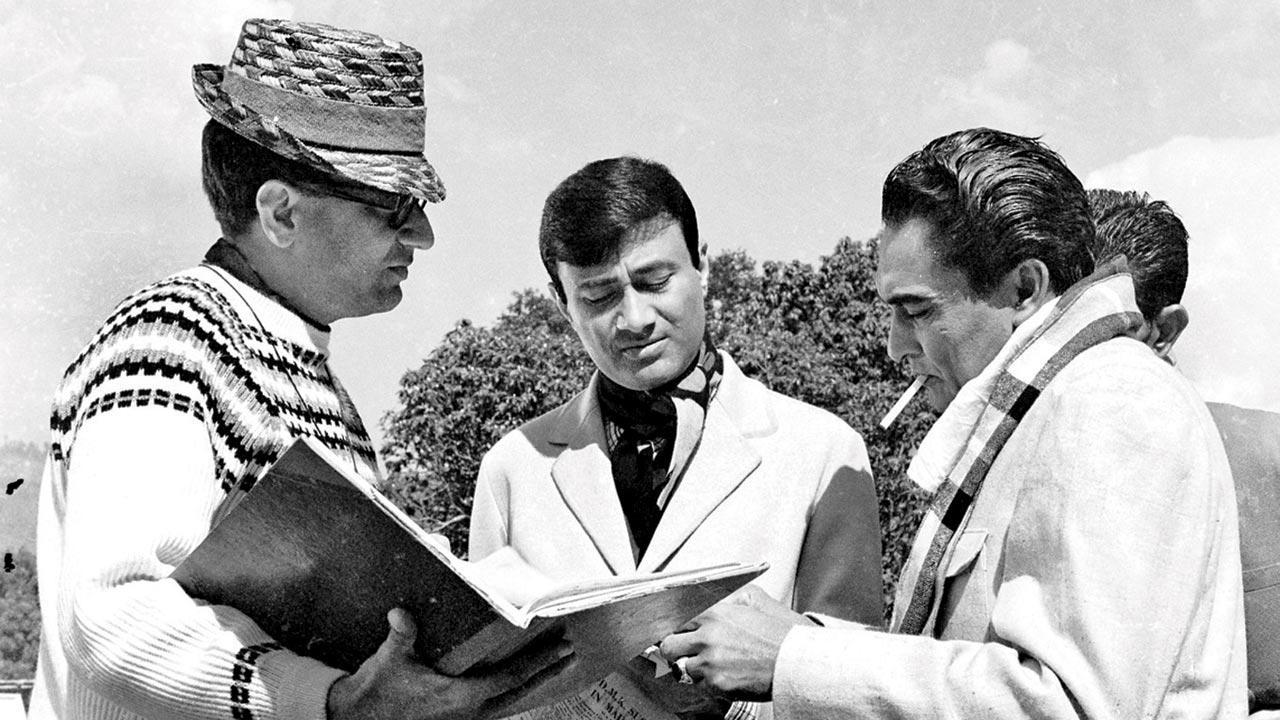
Goldie Anand explains a scene to Ashok Kumar and Dev Anand on the set of Jewel Thief in Gangtok. Pic Courtesy/Bloomsbury Publishing
A new book discusses the fascinating bond of the Navketan siblings, whose creative journeys were inextricably linked over eight movies
Sucheta Chakraborty (MID-DAY; August 18, 2024)
In Hum Dono: The Dev and Goldie Story (Bloomsbury India), Tanuja Chaturvedi who has worked in radio, theatre, film and television in varying capacities as an actor, producer, director, editor and teacher, writes how in 1988 after graduating from FTII, she dialled, on a sudden whim, a number off the film directory. “I asked for Dev sahab and heard the famous drawl, ‘Dev here,’” she writes. And just like that, she was invited to meet Hindi cinema’s famous evergreen hero at his Anand Recording Studio in Pali Hill. Thus, began the author’s abiding affiliation with the Anand brothers which finds its culmination in the book.
From Vijay Anand’s experimentation with film time in Kala Bazar to why Ashok Kumar went MIA during the shoot of Jewel Thief, Hum Dono bustles with anecdotes and analysis as an insider delves deep into some of the duo’s most memorable collaborations. Edited excerpts from the interview
Tell us about the experience of putting this book together. I understand that you drew from the material that you acquired during your research for a film on Navketan around 1990 which ultimately fell through...
This being Dev sahab’s centenary year is an unexpected miracle for me. I never planned a book to meet this momentous occasion. Goldie and Dev sahab’s cinema has this spirit of survival. That longevity is what I wanted to celebrate. The early research was very exciting for me because I had access to the Anands and met people I never even dreamt of meeting, like Pancham da. The interactions were very intense. Then I segued into working with Dev sahab and that relationship continued. But the stirrings of the book were always inside me. It was a generational transference of fandom starting with my mother, who was his die-hard fan, and my brothers, who took me for his black-and-white reruns. Dev Anand’s never-say-die spirit, his optimism and his charm used to just leap out at us. His spirit attracted us kids who weren’t even born when he started making films. Plus, he was very westernized, he was hip and cool. He was like us. I met him as a five-year-old. He had picked me up at the premiere of Pyaar Mohabbat in Delhi and I never let him forget that! He was almost like a father figure to me. I argued with him a lot and I used to get away with a lot as well.
With Goldie sahab, the interest began during our student days at FTII as we began studying his almost invisible craft. There was nothing that he did not excel in—screenplay, dialogues, editing, direction. And he was a self-taught maverick. He owes nothing to cinema that came before him. He is so original. He is a genius and we have not celebrated our geniuses enough. When I was invited to teach film appreciation at Whistling Woods International, the standard practice is to start with Pather Panchali but I decided to begin with Johny Mera Naam. I saw the craft work, the story’s magic work, the breathless narration work. So, this [admiration that I had] got confirmed. It was all inside me and it actually took me just a month to write the first draft of the book. It just came pouring out—there wasn’t any sort of consciousness.
You write about the Goldie-Dev partnership as belonging in the tradition of great director-actor collaborations like Kurosawa and Mifune or Wong Kar Wai and Tony Leung. In case of Goldie and Dev, what do you think each brought to the equation?
They were extremely individualistic people. Goldie Sahab was very goal-oriented, which you have to be if you are a director of a film. Dev Sahab was process-oriented which is why his career is very different. It just lasts. It just goes on. He just loved the fact that he was making films. He was like as Mani Kaul said “swaant sukh ke liye banata hoon (the joy of creation which is its own end)”. But they were completely intertwined in the creative process from the get go. They understood each other, shared the same ethics, the same gene pool. They had common values, were both educated, well-read people. They were intellectuals, passionately fond of knowing what was happening in the world. There were some buttons as an actor that got pushed and there was a coming together of energy, an osmosis, a collision, a cohesiveness when they worked together. If Dev Anand became Goldie Anand’s alter ego on screen, then Dev Anand’s own philosophy of life imbued Goldie Anand’s cinema.
But they also had creative differences. During the shoot of Nau Do Gyarah, for instance, Goldie insisted on stretching the climax which brought him into conflict with the team. He turned five minutes of real time and stretched it into ten minutes of film time. In the climax, the villain gives the hero five minutes to get the police cleared out of the area. At stake is the heroine’s life; she is held hostage and drugged. Goldie wished to expand this time to make each character’s tension mount. He edited the film for 13 continuous days, sleeping overnight at the editing room. He got into battles with the editor Dharam Vir who was unsure if the stretched-out climax would work. Dev was appealed to reason with Goldie. He tried but Goldie was very sure and wouldn’t budge. Finally, at the mixing stage, the sound recordist also expressed uncertainty over whether the long climax would hold the audience’s attention. Finally, Goldie asked them to run his version once. If the audience booed, then from the next show on, the shorter, edited version could be played. But he was so frustrated that he did not even attend the film’s première, reaching at the end of the film’s first showing. He saw that the climax had audiences spellbound, breathless and rooting for the lead actors. Goldie’s gamble worked.
At the same time, Goldie knew how to control Dev sahab. A director needs to push Dev sahab in directions he felt uncomfortable with. You need a person who will be able to say no. You need a person who will be able to orchestrate performances. He was also intuitive about when to liberate the actor. If you see the song ‘Khoya khoya chand’, it’s about the exuberance of falling in love so he just lets Dev sahab loose. But when you see ‘Tere Mere Sapne’ from Guide, which is only three shots, it is shot in the magic hour with the light fading and you’ve got a five to 10-minute window to shoot the whole song which involves complex camera work, framing, focus points, lip sync and expressions. And that’s also the key song for the film. Their synergy and deep understanding of each other is evident in ‘Pal bhar ke liye’ where the camera and Dev dance in tandem.
Which is your favourite film by the duo and why?
My favourite will always be Guide because it is a very difficult film to make. It’s about so many things—it’s a love story, about a woman finding her strength through her passion, about a guide who loses his own path and falls abysmally. There’s something fascinating that happens in every viewing I’ve had with Guide [like with students at the Xavier Institute of Communications, Mumbai]. The film starts, Raju (Dev) gets out of jail. And then the flashback from Rosie’s (Waheeda) point of view starts, which is the whole body of the film, more than two hours encompassing the love which blossoms, the love which decays, the death of love itself. By the time you have been taken through this entire emotional journey, you are so engrossed that you have forgotten how the film begun. The film is actually working on two completely different planes. And that is the brilliant part. Raju’s awakening, his enlightenment is why the film resonates with us. To seek for the meaning of life is ingrained in the DNA of the people of this country, and that is reflected in the film.
If there was one thing you could say you learnt from each of the Anands, what would they be?
From Chetan Anand, I would say his imagination, rigour and his image-making—the way he uses colour palettes in films. So, if you see Kudrat, it’s how he makes the two characters dress in complementary colours as they’re coming closer, or what he and Jal Mistry did to the colour palette of Heer Raanjha. He had an experimental, vivid kind of an imagination. From Dev Sahab, I think I learnt passion, I learnt complete dedication and immersion. It was literally the Gita saying about how you have the right to work, but for the work’s sake only and the desire for the fruits of work must never be your motive in working. That was possibly the spirit behind even writing the book because when I wrote, I didn’t even know a publisher. It was just that it was a work which was fulfilling me. It was a work which I was giving everything to, believing that this love will reach the readers because it was coming from a place of love. From Goldie Sahab, I think I have learnt everything about cinema. He made films within the matrix of Hindi mainstream yet each of his films is intensely personal—they are experimentations with cinema time, explorations of themes of redemption, man-woman relationships in all their hues, and even appeals to our neighbouring countries to live in harmony with us. That’s the big learning—that you can communicate something personal in the free-flowing format of mainstream film.
---------------------------------------
EXTRACT: How Vijay convinced Dev to make Nau Do Gyrah
Chetan was the patriarch of the Anand family’s creative experiment, Navketan. All creative calls were run by him. On the sets of Funtoosh, when he fell ill during the shoot, he gave Goldie the responsibility of a song picturisation. Dev was uncertain; Goldie was very young. Yet, keeping his doubts aside Dev gave Goldie a chance. Goldie picturised his first song for Hindi cinema with pizzazz, surprising now a rather pleased Dev. The song was ‘Ae Meri Topi Palat Ke Aa’. Interestingly, though the credit titles read S D Burman this tune was composed by yet another young prodigy, R D Burman.
Once again Dev discovered that Goldie’s script was yet to see the light of day. This time he heard good things about the script from his House No. 44 director Mandi Burman. Dev asked Goldie for the script. Goldie was insistent; only he would give a narration.
So, on a drive to Mahabaleshwar, ensconced between Dev and his sister-in-law Kalpana Kartik, cameraman V Ratra seated next to the driver, Goldie narrated the detailed script of Nau Do Gyarah. By the time they reached Mahabaleshwar Goldie was reading the last page of his twister climax.
After finishing, he waited. Silence. No reaction. The car entered Fredrick Hotel, Dev’s favourite haunt in Mahabaleshwar. The lamps aligned on the pathway here are shaped like the logo which appears before the early Navketan films. Life imitating art?
Dev got out of the car and instantly booked a trunk call to his Bombay office. He asked his production manager to delay the film they were to start and announced that he had selected the next film by Navketan, Nau Do Gyarah, to be directed by Vijay Anand. A floor at Kardar Studios was booked for ten days. Goldie’s first venture was on the roll.
Excerpted with permission from Tanuja Chaturvedi’s Hum Dono: The Dev and Goldie Story published by Bloomsbury India
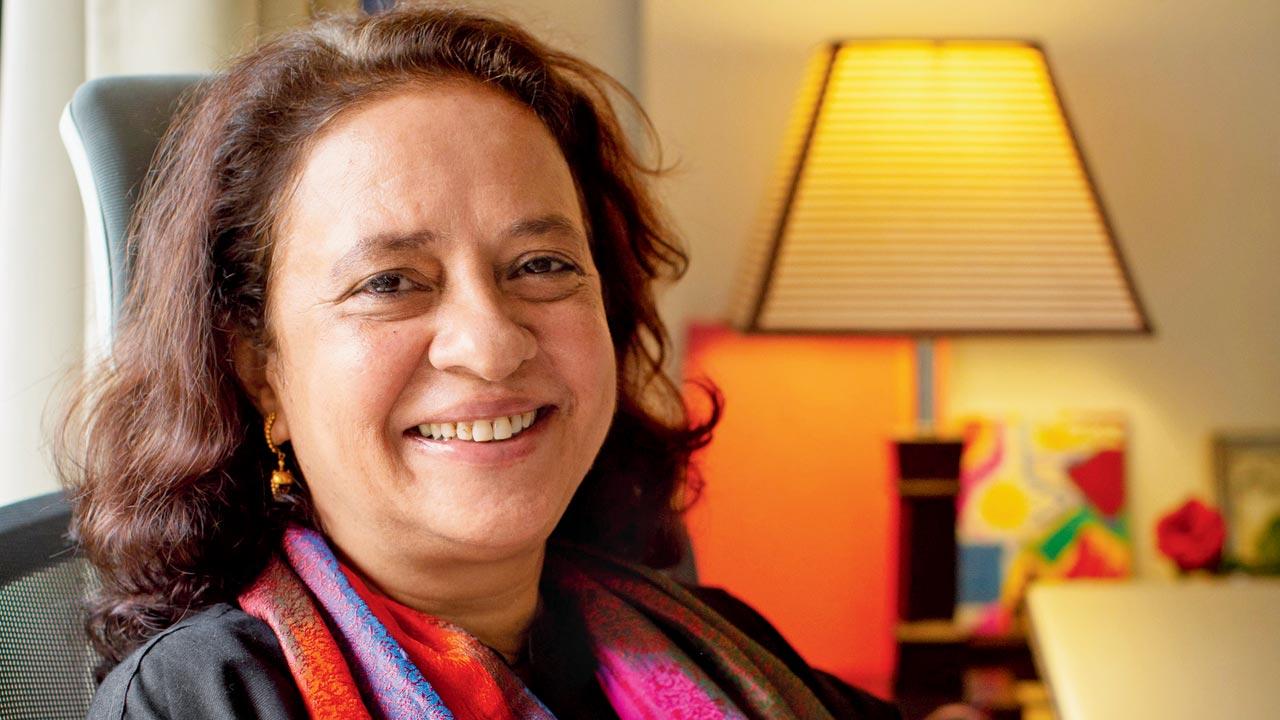
Tanuja Chaturvedi
"Vijay Anand was only 21 when Nau Do Gyarah released; one of Hindi cinema's youngest directors"
7:38 AM

Roshmilla Bhattacharya (MUMBAI MIRROR; January 20, 2015)
 After Funtoosh, the ninth
highest grosser of 1956, Dev Anand started work on
Khaali Botal, based on AJ Cronin's 1953 novel, Beyond This
Place, about a son's quest to prove the innocence of his father
convicted for a murder. The actor was on his way to Mahabaleshwar for a
shoot when his younger brother, Vijay Anand, fondly called Goldie, told
him that he wanted to narrate a script he'd just completed. “Why don't
you drive down with me, you can tell me your story on the way,“ Dev
suggested.
Goldie immediately got into the car and started narrating the story of Madan, who sets out from Delhi in his truck upon learning that his uncle has left him nine lakh rupees in cash and two lakh rupees worth of property in Mumbai, after a fallout with his own son. En route, he stops at a wedding where the bride, disguised as a Sikh boy, sneaks into his truck. He discovers later that the bickering partner is actually a pretty girl and loses his heart too.
They reach Mumbai only to learn that Madan's uncle is dead and his son has inherited everything. When he protests, he is thrown into jail on charges of kidnapping the runaway heiress. The many twists and turns in the plot fascinated Dev Anand. On reaching his hotel in Mahabaleshwar he immediately called his office in Mumbai and informed them that since Raj Khosla, the director of Khaali Botal, was not ready with the script yet, they would roll with a film Goldie had written and which, on his insistence, he would direct too. The film's title, Nau Do Gyarah, borrowed from the familiar Hindi idiom meaning 'to run away' and the numbers were also a pointer to the legacy Madan hoped to inherit.
“Nau Do Gyarah marked Vijay Anand's debut with Navketan as an independent film director. He was only 21 when the film released, one of Hindi cinema's youngest directors,“ says Mohan Churiwala, a close associate of Dev Anand.
They bought a truck in Delhi and drove down to Mumbai, with Dev at the wheel singing Hum hain rahi pyaar ke, Kishore Kumar's song reflecting his own philosophy of life. “Back in the '50s, Hindi films weren't as technically proficient and many wondered how Goldie saab managed to can the kind of shots he did. He revealed that they had tied the camera to the bonnet of the truck with cinematographer V Ratra clinging on to it. Goldie saab, holding him by the waist from behind, would whisper instructions in his ear which Ratra followed, sitting atop the moving vehicle,“ recalls Churiwala.
The film had other evergreen hits like Aaja panchi akela hai and Aankhon mein kya ji set to tune by SD Burman and penned by Majrooh Sultanpuri. Sahir Ludhianvi had been Dada Burman's frequent collaborator till their fallout during Pyaasa and Majrooh entered the picture. “After convincing Majrooh saab to write some sher-o-shayari for my film, I went and bought all his books and read up all that had ever flowed from his pen so by the time we started work on Nau Do Gyarah, I understood his poetry well and felt confident enough to suggest some changes,“ admitted Goldie, pointing out that while writing Aankhon mein kya ji, Majrooh had suggested the words, sunhera badal. “But since the song was to be picturised at night, I told him that rupahala badal would be more apt as you expect silvery moonlight rather than golden sunlight at night. He agreed.“
Churiwala reveals that the song got them into a sticky situation with the censors because after this Dev asks, “Baadal mein kya ji?“ and when Kalpana Kartik answers, “Kissi ka aanchal“, prods, “Aanchal mein kya ji?“ The pointed reference to a part of the female anatomy was veiled in a play of words, “Ajab si hulchal.“
“The song was only passed after Dev saab persuaded the censors there was no double entendre involved,“ says Churiwala.
Nau Do Gyarah was Mona Singh's last film. Introduced by Navketan as Kalpana Kartik in the 1951 Baazi, she went on to star with Dev Anand in Aandhiyan, Taxi Driver, Humsafar, House No.44 and Nau Do Gyarah. She secretly married him on the sets of Taxi Driver in '54 and two years later their son Suneil was born. After Nau Do Gyarah she was never seen on screen again. Dev returned with Madhubala and Nalini Jaywant a year later in Khaali Botal, retitled Kala Pani.
Subscribe to:
Posts (Atom)