Showing posts with label Nargis. Show all posts
Showing posts with label Nargis. Show all posts
We all have rough edges; I'm glad cinema is now embracing that reality-Madhuri Dixit
8:30 AM

Renuka Vyavahare (BOMBAY TIMES; July 1, 2026)
One look at Madhuri Dixit Nene, Indian cinema's timeless icon, and you're struck by her seemingly effortless perfection, the radiant smile, unmatched grace, and captivating screen presence. Yet, a conversation with her reveals a different perspective. The celebrated actor believes that true strength lies not in perfection, but in embracing one's flaws.
In a candid conversation with Bombay Times, Madhuri spoke about her recent film, Maa Behen, directed by Suresh Triveni, and how Hindi cinema's portrayal of mothers has evolved over the years. Excerpts...
A scene in Maa Behen shows your character warning her wayward daughters that if she goes to jail, they'll go with her. The writing portrays mothers as ordinary people capable of making mistakes, doesn’t it?
When we think of mothers in Indian cinema, the first name that comes to mind is Nargis ji in Mother India. Then there are iconic performances by actors such as Rohini Hattangadi in Agneepath, Nirupa Roy in Deewaar, and Rakhee Gulzar in Karan Arjun and Ram Lakhan. These characters were powerful and memorable, but they were also idealized. Mothers were often placed on a pedestal. They couldn't do anything wrong. They were expected to sacrifice everything for their children. What struck me about Maa Behen was its realistic approach. My character isn't the ideal mother or wife. She's independent, chaotic, and imperfect. Despite belonging to a dysfunctional family where everyone is constantly at odds, she deeply loves her children and will do anything for them when it truly matters.
As you mentioned, there's a moment when she tells her daughters, "Main jail jaaungi toh tumko lekar jaaungi." That's not something you'd traditionally hear from a cinematic mother. Characters today feel more real and relatable. These are women you encounter in everyday life. Everyone is flawed, and flaws are wonderful. We all have rough edges, and I'm glad cinema is finally embracing that reality.
You have ruled the film industry for decades. People often associate you with perfection, whether in your work or your appearance. Yet you see imperfection as a source of strength.
Beauty lies in the eye of the beholder. And honestly, imperfection is power. I don't believe perfection truly exists. No one can be perfect. My journey has always been about striving for excellence, about trying to give my best in everything I do. The pursuit itself is what fascinates me. The process of constantly learning, improving, and challenging yourself is far more meaningful than achieving some impossible standard of perfection.
As a Bollywood superstar, does working in the streaming space feel more liberating since there is no box-office pressure?
There is certainly a sense of freedom in the OTT space because you're not bound by commercial expectations. It is more relaxing. You're not worrying about how many crores a film or series will earn. The pressure of delivering a blockbuster doesn’t hang on your head. Instead, the focus shifts to creating something meaningful and engaging, something audiences genuinely enjoy watching. The goal is to tell compelling stories and create content that feels relatable and authentic.
What kind of work excites you at this stage of your career?
I want to explore characters that are different from anything I've done before. I enjoy challenges, whether it's learning a new dialect, stepping into unfamiliar territory, or portraying someone completely unlike myself. Anything that pushes me out of my comfort zone and makes me feel vulnerable, fascinates me as an actor. That's where growth happens. I have no reservations about playing any role, as long as it is well-written and offers something meaningful to explore.
Auditorium in Gaya to be named after Sanjay Dutt’s grandmother
10:22 AM

Abdul Qadir (THE TIMES OF INDIA; February 13, 2026)
Gaya: In a move that reconnects Gaya with a chapter of Indian cinema and classical music history, the auditorium-cum-academic building coming up at Daulat Bagh in Gaya — the address once associated with Jaddan Bai, grandmother of film actor Sanjay Dutt — is set to be named after her.
The old-style, sprawling house at the site originally belonged to Mir Abu Barkat Ali alias Zafar Nawab of the Kada estate, the then zamindar and a patron of art and music. The palace-like, two-storeyed airy structure had been earmarked by the Nawab for Jaddan Bai, who lived there for several years before settling in Calcutta (now Kolkata) and later moving to the then Bombay (now Mumbai) to pursue a career in films. Even after leaving Gaya, she is said to have frequently visited the residence.
Originally from Allahabad (now Prayagraj), Jaddan Bai was an acclaimed exponent of thumri and other forms of Indian classical music. She is also regarded as one of the pioneers of Indian cinema. In her early years, she found patronage under the Nawab. Her daughter, Nargis — the iconic actor of ‘Mother India’ fame — and her (Nargis’) husband, actor and former Union minister Sunil Dutt, maintained their Gaya connection during the lifetime of Zafar Nawab’s son, Muzaffar Nawab.
Sanjay Dutt, during a political visit to Gaya a few years ago in connection with a Samajwadi Party meeting, had turned nostalgic and described Gaya as his ‘nanihal’ (maternal home).
According to Nawab Iqbal Sayeed Quadri alias Humayun and Nawab Fareed Quadri, surviving members of Zafar Nawab’s extended family, the Daulat Bagh premises were acquired by the govt in the 1950s.
Several years after the acquisition, the state govt constructed the District Institute of Education and Training (DIET) with an annual intake of 200 within the Daulat Bagh complex, leaving aside the building associated with the thumri exponent.
A resident of the Daulat Bagh neighbourhood expressed regret that the structure was not preserved as a heritage building, considering its architectural and historical significance.
Justifying the demolition, principal of the District Institute of Education and Training, Ajay Kumar, said the building had become thoroughly dilapidated and could have collapsed at any moment, posing danger to life and limb in the vicinity. “Reports of past casualties due to collapse of some part of the building are also there,” he said.
The DIET principal said an auditorium and academic building would be constructed at the site. There is a proposal to name the new structure after Jaddan Bai, the iconic exponent of Indian classical music.
Being a child actor wasn’t something I chose-Honey Irani
10:37 AM

As child actors, Honey Irani (left) and her sister Daisy were household names in the 1950s and ’60s
Forced to go before cameras while never having the chance to go to school or play with other children: former child actor and acclaimed screenwriter and director Honey Irani recalls her difficult childhood in this extract from a new book, Behind the Big Screen
MID-DAY (February 1, 2026)
The world of cinema has a way of pulling you in, even before you realise what’s happening, and overpowering you. For Honey Irani, it began when she was just two and a half years old. She remembers it vividly. ‘I was a tiny bundle of curiosity, scampering around our modest home in Bandra, Mumbai, when a man named Dulal Guha walked into our lives. He was a film producer, there to sign my older sister Daisy for a role in his movie, Ek Gaon Ki Kahani (1957). I was just a bystander, or so I thought, playing nearby as he spoke with my mother.
As he removed his hat, he revealed a bald head, I couldn’t help myself. “Mama, yeh toh takla [bald] hai!” I blurted out, pointing at him. The room froze. My mother’s face turned crimson, and before I could blink, her hand met my cheek with a sharp slap. “You don’t speak like that!” she scolded. But Guha, instead of being offended, chuckled. He looked at me, his eyes twinkling with interest. “How old is she?” he asked my mother. “Two and a half,” she replied, still flustered. He paused, then said, “If you don’t mind, can I sign her instead of Daisy? I did need someone younger actually.”’
And just like that, her life changed. ‘My mother, always quick to seize an opportunity, agreed. I was too young to understand what it meant,’ says Honey. And so she was suddenly a child actor, thrust into the dazzling, chaotic world of Indian cinema.
From that moment, right up until she was about twelve, her life revolved around film sets. Within this period, she acted in some seventy films including Chirag Kahan Roshni Kahan (1959), Zameen Ke Tare (1960) and Pyaar Ki Pyaas (1961). Irani also appeared in numerous Tamil, Telugu and Marathi films, each one a whirlwind of lights, cameras and endless takes. Hers was nothing like a typical childhood. There were no lazy afternoons playing with friends, no regular drone of school days, no carefree summers. Instead, her days were filled with call sheets, costumes and the hum of studio life.
‘Schooling was a patchwork affair. I attended Hillview School briefly, then Mount Mary’s Convent on Bandstand, but I was never there long enough to settle in. The demands of shooting were relentless, and schools in those days were strict about attendance. A few months here, a few there and then a long gap for filming. Eventually, my mother arranged for home tutors, or sometimes someone would teach me on set between takes. I scraped through fifth standard, but that was the extent of my formal education. Looking back, I don’t resent it entirely — it was the price of the life we lived — but I did miss the normalcy of school, the chatter of classmates, the rhythm of a classroom,’ says Honey.
‘Being a child actor wasn’t something I chose; it was something that happened to me. I hated the studio gates. The sight of them would make me wail, “I don’t want to go!” My mother, ever resourceful, would bribe me with promises of ice cream or a movie, only to deliver me to the set. But once I was there, something shifted. The actors I worked with — legends like Meena Kumari, Dilip Kumar and Nargis — became my surrogate family. They transformed the intimidating world of filmmaking into a place of warmth and comfort.
Meena Kumari, in particular, was her haven. She was more than a co-star; she was a mother figure who enveloped her in love. Honey would ride home with her in her car, stay at her house and fall asleep to her soothing voice. ‘She’d bathe me, feed me with her own hands and tuck me in. One memory stands out. During the filming of Chirag Kahan Roshni Kahan (where she played a boy), we were shooting a scene where I needed to cry. I wasn’t getting it right, and the days were dragging on. In a moment of desperation, Meena pinched me — hard. I burst into tears, shocked, and the cameras rolled. Afterwards, she was inconsolable, hugging me and apologizing profusely. “I’m so sorry, my bacha,” she kept saying, kissing my forehead. That was Meena — professional to a fault, but with a heart that overflowed with care.’
Her mother was the driving force behind her career. She was ambitious, fiercely so, and saw in both Daisy and Honey a chance to live out dreams she’d never realized herself. Daisy, older and more aware, bore the brunt of that ambition. ‘Daisy was protective of me, always keeping an eye out, but her own experiences as a child actor left her with scars I was spared. While I escaped the worst of it, I can’t deny that home wasn’t always a sanctuary. There were tensions, moments I’d rather not revisit, that made the studio feel like a safer place. I’d rather be on set, surrounded by the camaraderie of actors and crew, than face whatever waited at home.
‘I don’t dwell on those memories. They’re part of who I am, but I’ve chosen to focus on the positive. The hardships taught me compassion, resilience and an ability to connect with people. They made me a better mother to my own children, a better person. I’m not bitter about my past — I can’t change it, so why let it weigh me down? Instead, I carry forward the lessons and the love I found along the way.’
The sets thus became her playground. They were filled with moments of joy and fatigue, and Honey learnt to welcome both. ‘I remember shooting Pyaar Ki Pyaas [one of my favourites] when I was about seven or eight. I was exhausted, barely able to keep my eyes open and the crew kept promising “one last shot”. Fed up, I pulled out my false tooth — a replacement for a lost milk tooth — and tossed it into a pond. Without it, they couldn’t shoot. The crew scrambled, and I got my rest. It was a small act of rebellion, but it felt like a victory.’
Then there were other lighter moments, like the lunch breaks during which Dilip Kumar and other actors would fly kites or play cricket. ‘I’d hold the firki [spool] for their kites or cheer as they bowled underarm to us kids. Other child actors became my companions. We’d laugh, share stories and navigate the strange world of fame together. I worked with Babloo and a girl called Purnima. I knew Raja, who played boys’ roles despite being a girl, [and she] somehow left a lasting impression. Years later, I ran into her at an airport, where she worked. It was a bittersweet reunion, a reminder of how time scatters us.’
Extracted with permission from Behind the Big Screen by Sunanda Mehta and Suchitra Iyer, published by Bloomsbury Publishing India
Anurag Kashyap's next, starring Saiyami Kher, Gulshan Devaiah, is being shot in black-and-white
8:27 AM
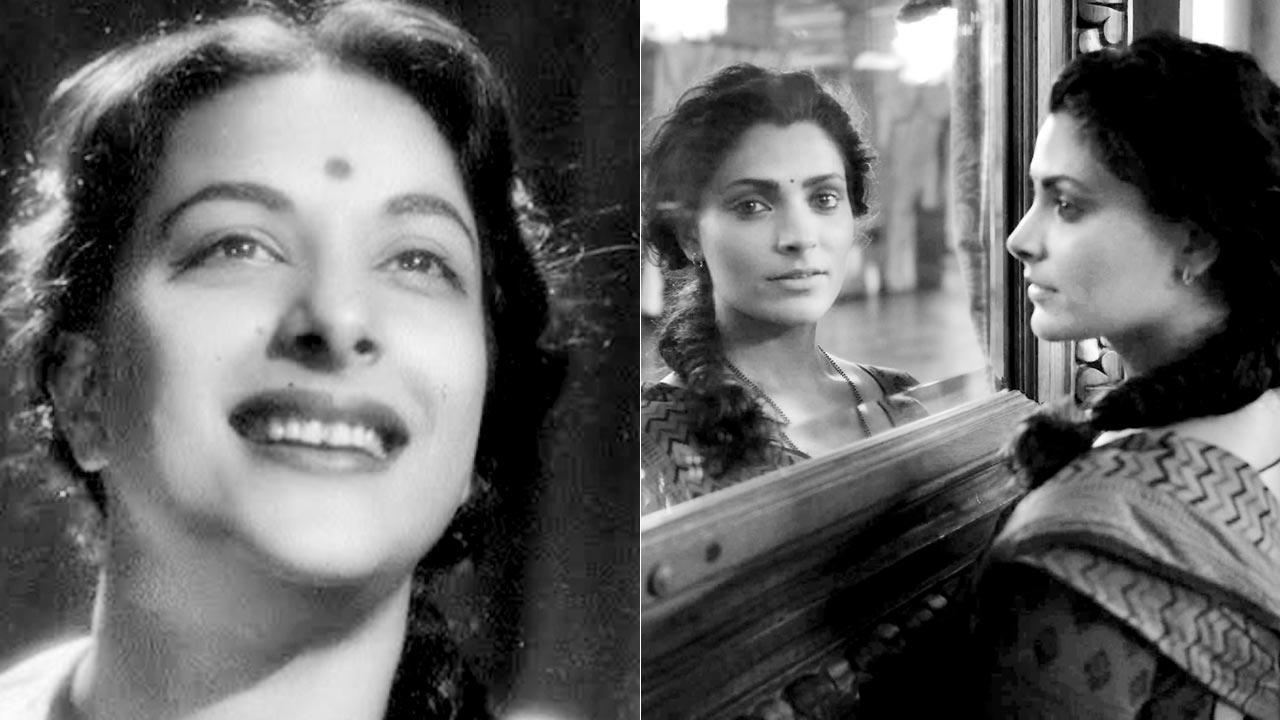
Saiyami on how her look in yet-untitled next is inspired by yesteryear actor Nargis
Uma Ramasubramanian (MID-DAY; September 19, 2022)
There is something about yesteryear actors and their inimitable grace. Leading ladies from the current crop will tell you how they, in their own ways, have paid tribute to these screen idols. The latest actor to do so is Saiyami Kher, who has modelled her look in her yet-untitled next on the late Nargis Dutt. Interestingly, the Anurag Kashyap production, which sees her opposite Gulshan Devaiah, is being shot in black-and-white, thus having an old-world charm to it.
A source tells us, “For Saiyami’s look, the makers wanted something elegant and classic. The styling team referenced for weeks, pulling out the on-screen avatars of Nutan, Madhubala and Meena Kumari. Since the role required a girl-next-door feel, Nargis ji’s look in Lajwanti [1958] came closest to their brief. In the film, Saiyami is wearing simple cotton sarees, completing the look with a bindi and braided hair.”
It’s a joy for Kher to travel back in time through the drama. The actor, who is currently shooting for the project in Hyderabad, is elated to don looks that are inspired by the late artiste. She says, “Nargis Dutt is a legend, and mere comparison with her is the biggest compliment I have got. She was perfect in terms of her acting, beauty and grace. I have loved most of her movies, with Shree 420 [1955], Aag [1948] and Mother India [1957] being my favourites. I always wondered how it would have been to live in that era. I love black-and-white movies. So, doing this black-and-white film is a dream come true.”
Spotlight dims on Dadar’s iconic India Photo Studio
8:35 AM

Mohammed Wajihuddin (THE TIMES OF INDIA; August 28, 2022)
Once when Sunil Dutt heard of his wife Nargis’ photos on the show windows of India Photo Studio, he came looking for them. “He was so impressed, he ordered many copies,” recalls owner Vimal Thakker, seated on a sofa where once stars like Raj Kapoor, Dilip Kumar, Nargis, Nutan, Waheeda Rahman, sat for hours chatting with Vimal’s father Jethalal Thakker over cups of chai.
The iconic studio is turning 75, but the spotlight is dimming for this landmark in Dadar as it is buffeted not only by the winds of change, but is also caught in a redevelopment wrangle.
-----------------------------------------
Mohammed Wajihuddin (THE TIMES OF INDIA; August 28, 2022)
Sepia-toned photographs peeping out from glass cases or fading frames on the walls testify that showbiz legends were once regulars at ground floor India Photo Studio at a decaying building near Chitra Cinema in Dadar (East). The cinema downed its shutters a couple of years ago. The studio too may not postpone its death for too long.
As this piece of the city’s cinematic and cultural history struggles to stay afloat, let us first see how it was born.
When Jethalal Thakker, a school dropout and partition refugee, reached Mumbai (then Bombay) in 1948 from Karachi, he did many odd jobs to survive before photography became his passion and profession too. “He would go to film sets to shoot the pictures. Then he thought of setting up his own studio and this place suited him because there were several film studios in the vicinity,” says his son Vimal, 69.
With studios like Roop Tara, Ranjit, Shree Sound, Kardar and Rajkamal not very far from this photo studio, it meant the actors kept visiting it regularly. “There were mainly two purposes of the stars getting photographed here. First, the stills had to be prepared for publicity and then, to remember the continuity between film frames, they needed to shoot photographs,” explains Vimal.
Senior photographer Pradeep Chandra credits this studio and its founder Jethalal for capturing some of the most memorable photographs of leading stars of the golden era. “He (Jethalal) was the only photographer of his generation who photographed even Madhuri Dixit at his studio,” says Chandra.
It so happened, recalls Vimal, that in 1995 a film magazine wanted to shoot Dixit, then at the peak of her career, and her secretary initially wanted it to be done on one of the film sets. “Film journalist Ali Peter John had approached us. My father and I said we would shoot at the studio. Madhuri had no problem and she came. We didn’t close the door so as not to give the impression that any celebrity was inside. At the reception, our man kept telling the customers that ‘andar kaam chalu hai’ till the time she was inside,” says Vimal.
In 2003, Jethalal died and Vimal inherited the rented studio. “While other smaller and newer studios charge Rs 60 or 70 for a few PPs, Vimal charges Rs 200 as he doesn’t compromise on quality,” says Vimal’s friend Prakash Nair.
A decade ago, a builder took consent of some tenants for the building’s redevelopment. “He is not agreeing to compensation at market rate and offering me space on the ground and first floors which doesn’t suit me,” complains Vimal.
“This property is certified under 33 (7) of MHADA and 80% of the tenants have consented. We are offering compensation as per redevelopment rules,” responds builder Ashok Doshi.
While the battle rages in MHADA, photographs at the iconic studio tell of its acche din.
At army quarter in Chittagong, Lata Mangeshkar helped me survive a minor crisis-Waheeda Rehman
8:31 AM

As told to Mohua Das (THE TIMES OF INDIA; February 7, 2022)
Lata ji and I knew each other for years but there were instances that brought us closer and I got to know the person Lata ji was. At first it was during the 1971 war when I was made chairperson of the Bangladesh Sahayak Samiti of Maharashtra. I had the responsibility of organising a concert at Brabourne stadium in its support. Among the artistes we called, it was natural Lata ji was top of mind.
I went over to invite her but she said ‘no’. She said she wouldn’t perform live in India. But she agreed when she learnt of the cause and the concert was successful. Later she joined us when Sunil Dutt’s troupe toured the war-torn zones to entertain jawans. Travelling with us were Nargis, Mala Sinha and others.
We were put up for a night at an army quarter in Chittagong when suddenly there was a water crisis. Now, I cannot go a day without having a bath. I wondered if I could shower in Lata ji’s room which still had some water left. Nargis warned: ‘Are you mad? Lata ji is very sensitive and may get upset if you intrude into her space. She might even refuse to sing’. Not heeding, I showed up at Lata ji’s door and she ushered me inside without hesitation.
But as luck would have it, the tap ran dry while I was still in the shower. So I knocked on the bathroom door. Lata ji came close and asked me what the matter was. On informing her of my plight, she arranged for two buckets of water and carried them with her own hands to the bathroom.
Later when I told Nargis of what had happened she was stunned! When we returned to India, Lata ji arranged for a dinner party where she cooked for us, made lovely kebabs and gifted us beautiful sarees.
Rajkumar Keswani reveals in his book on Mughal-E-Azam how Madhubala was considered a distraction by K Asif
9:27 AM

Author, poet and journalist Rajkumar Keswani shares lesser-known stories about Indian cinema’s most iconic film, which turns 60 this year
Kunal Guha (MUMBAI MIRROR; September 6, 2020)
When Madhubala first arrived on the sets of Mughal-e-Azam to essay her career-defining role of Anarkali, she brought her usual cheerful personality to work. Known to light up many a room, and to always leave her co-stars and crew rolling on the floor laughing, it dawned on her much later that not everyone was charmed by her ebullience. In fact, filmmaker K Asif found her a bit of a distraction. Soon enough, Madhubala’s shots began getting postponed and she went without shooting for several days. The actor was a little taken aback when, one day, Asif’s assistant Sultan Ahmed informed her that the filmmaker didn’t appreciate her behaviour and expected the cast “to take their job seriously”. The superstar accepted the feedback graciously, submitting to the filmmaker’s approach, and soon, the shoot commenced as planned.
It is anecdotes such as these that feature in plenty in poet, writer and journalist Rajkumar Keswani’s Daastan-e-Mughal-e-Azam, a literary tribute to the iconic film about unrequited love, which clocks 60 this year. Considered a milestone in Indian filmmaking, K Asif’s magnum opus took over 10 years to create. Keswani, who was 10 when it was released, remembers watching the film in Bhopal’s Bharat Talkies. “Those three hours in the theatre changed my life forever,” he says, adding that he was so charmed that he had memorised most of the film’s dialogues.
When he embarked on this project, Keswani’s passion for the film also drew him to follow the life of its director. Music director Naushad told him how Asif had started out as a tailor before going on to weave stories on celluloid when nudged in that direction by his brother-in-law and actor Nazir. In fact, the filmmaker also had a tailoring shop in Dadar’s Khodadad Circle at the time. “Famous heroes of the 1940s, Prem Adib and Jeevan [Narad of the screen], ran a restaurant in partnership in the same locality,” says Keswani about the neighbourhood, which was synonymous with tinseltown dreams at the time.
Most fans will know that development of the feature film began in 1944, but hit a roadblock during the time of Independence, only to commence again with a new cast in 1951. But few know about Asif’s struggle in casting for Anarkali’s role, after Nargis, his original choice, turned it down. Newspapers ads were published across the country, inviting women between the age of 16 and 22 to apply with photographs and biodata. Many actors approached the filmmaker for the role and Dilip Kumar, who was already cast as Salim, recommended the popular actor Vijaylaxmi. But the filmmaker didn’t find anyone suitable.
Asif had tried casting Madhubala for an earlier film, but her father Ataula Khan had set terms that weren’t agreeable with the director. “‘Keep your daughter in a showcase’, is what K Asif told him then,” says Keswani. He adds that the actor was cast as Anarkali only after she reached out to the filmmaker and agreed to work on his terms. “She arrived in her car and the meeting took place in the car itself. She asked him to forget his interaction with her father, and agreed to cooperate with him, because she really wanted to work with him.”
Maratha Mandir theatre, which had planned its gala launch with the release of Mughal-e-Azam had to launch with B R Chopra’s Sadhna (1958) since Asif’s film wasn’t completed by then. The theatre’s leasee owner Seth Mehtabchand Golcha set a clause for every filmmaker who wanted to screen his movie there: When Asif decides to release Mughal-e-Azam, their film would be replaced without notice. And when it did release, it even got travellers from Pakistan who would come only to watch the film. “In fact, Golcha had made special provisions for his Pakistani audience — they wouldn’t have to stand in queue to buy their tickets and could pick it up from inside the theatre itself,” says Keswani, adding that the theatre’s patrons also included filmmaker and actor Guru Dutt and Feroz Khan, who would turn up at Maratha Mandir to watch Mughal-e-Azam every week in the initial months.
“Shapoorji Mistry, the film’s financier, and who famously had several disagreements with Asif over his extravagant production, was no less in love with the director and the movie,” says Keswani. “Shapoorji seth was so obsessed with the dialogues that he would say them aloud as if in an elocution contest.”
Keswani’s book also includes 25 paintings by M F Husain, which were dedicated to Asif and his magnum opus. “Hussain made these paintings during his stay in London, as a guest of K Asif’s son Akbar Asif,” says Keswani of the works, which the renowned artist had gifted to Akbar’s daughter Haya Asif on her birthday.
It took Keswani 15 years to compile his research into a book, but stumbling upon gems about the film made the effort worthwhile. “I didn’t work like a scientist while writing and editing the book. I worked like a passionate lover,” he says.
All three films should do well and it should be a happy Diwali for everyone-Tushar Hiranandani
8:02 AM

Tushar Hiranandani, director of Taapsee Pannu, Bhumi Pednekar-starrer, on Diwali clash with two biggies and casting the actresses as octogenarians
Nishi Tiwari (MUMBAI MIRROR; October 15, 2019)
As a writer, you’ve worked on films like Masti, Double Dhamaal, Housefull and Ek Villain. But your directorial debut, Saand Ki Aankh, belongs to a completely different genre.
When you see the film, it is very commercial; it has dialogue, emotion, it’s got its fun moments. I’ve made it the way I’ve always written my films.
Tell us a little about bringing the story of the Revolver Dadis, Chandro and Prakashi Tomar, to the screen.
There were a lot of roadblocks, it took five years to release the film (from the time it was conceived). Anurag Kashyap, would tell me whenever we met, “Become a director” and I would think he was just trying to cut out one writer from the industry as he didn’t like the films I write. When he heard that I was doing this film, he came on board as one of the producers. Casting took a long time, but I couldn’t have asked for better actresses than Taapsee (Pannu) and Bhumi (Pednekar).
What was your brief for them?
The dadis are so much fun and so full of energy. That’s why I wanted to shoot the film in Johri, so Taapsee and Bhumi would meet them every day. My brief was to just imitate the dadis and to enjoy themselves.
There was a debate online (after Neena Gupta pointed it out) about casting age-appropriate actors in the film, which is about two octogenarians...
We did try that, but it didn’t work out for reasons I don’t want to get into. But Nargis ji did Mother India, one of my favourite films, in the prime of her career. It was the story of a woman from a young bride to an old matriarch. In my film also, which has Bhumi watching Mother India during her introduction scene, the story starts when the protagonists are 16 and goes on till they are 60. In hindsight, it was a good decision as it has become the biggest talking point of the film.
How involved was Anurag Kashyap?
He gave me one scene to add, which he had written, and it made a lot of difference in the pre-climax. He is the kind of a guy who throws you in the water and you have to start swimming on your own. He is the best producer one can find.
Are there apprehensions about coming out with your film on the same day as the star-studded Housefull 4 and the quirky comedy Made in China, the other two Diwali releases?
Every film has its own life and space. All three films should do well and it should be a happy Diwali for everyone. In fact, I am one of the writers of Housefull 4. Sajid bhai (Nadiadwala, producer) recently messaged me, saying, “Congratulations, this Diwali belongs to you; both the films are yours”.
It can be demanding but I want to make the most of my living years-Manisha Koirala
8:09 AM

Manisha Koirala's bucket list includes more acting and travelling, writing more books and directing a film
Himesh Mankad (MUMBAI MIRROR; September 5, 2019)
 After playing Sanjay Dutt’s mother, Nargis, in Rajkumar Hirani’s Sanju, Manisha Koirala has teamed up with the actor, whom she fondly calls Baba, for his upcoming home production, Prassthanam. This time, she plays his wife, Saroj. Talking about her three-decade association with the actor, Manisha says, “I became a big fan of Baba after watching Rocky and even had his posters up in my room. It was a fan-girl moment when I first worked with him, but over the years we have become good have seen him go through his ups and downs in life, and whenever I have a problem, I just have to tell him. A few days later, he will call to ask, ‘Manya, sab theek ho gaya na?’ We are very comfortable with each other now.”
Signing Prassthanam was a decision that came from the heart. “Maanayata ji (Sanjay’s wife) is producing the film, and I can’t say ‘no’ to Baba and her,” she says. The film, directed by Deva Katta, also features Jackie Shroff in a pivotal role, and is the remake of a Telugu film of the same name. Manisha however hasn’t seen the original film yet.
The second innings in her career is extremely important for her. “In the first, I was lucky I got to work with the best of directors and actors. I can’t hope for a repeat, I can only choose the best from the roles I get. But I now have the responsibility of doing a better job than before,” she reasons.
About the Sanjay biopic, she reveals that she had doubts about it. She wasn’t convinced if she should play a mother, afraid that she could get typecast. “Luckily, that hasn’t happened, the roles I’m getting offer a lot of scope to perform. I was also apprehensive if I’d be able to perform a character suffering from cancer as I’d just come out of it,” she explains. Eventually, she couldn’t say ‘no’ to playing a legend like Nargis. “More than Baba or Raju sir, I took up the film because of Nargis ji.” Manisha was diagnosed with the Big C in 2012. After several rounds of treatment, she is doing fine now.
Has life changed since? She points out that after any kind of life-threatening incident, one’s perception changes. “If there is heaven, it’s here. If there is hell, it’s here. When I was close to death, I realised how lucky I was to be born and be alive. When you are in danger of losing something, you start valuing it more. I love life and want to live it fully. It can be demanding but I want to make the most of my living years,” she says.
Manisha has a bucket list of things she wishes to do. She wants to act more, write more books, direct a film and travel more. “This year, I went to the Everest Base Camp. I want to climb more mountains. And finally, I want to be more useful in whichever part of the world and society I am. I want to live well and chase happiness,” she says.
Her inspiration when battling cancer was cricketer Yuvraj Singh who came out victorious. Sonali Bendre recently admitted that she found her inspiration in Manisha fighting the disease. “Sonali is a beautiful, strong woman. Cancer can shake you up, but one should ensure that it doesn’t get the better of you,” she says.
Salman Khan recently said that he met Sanjay Leela Bhansali through Manisha during Khamoshi: The Musical. Tell her that and she laughs, “I wish Salman and I got along during Khamoshi but we didn’t. Sanjay has always liked Salman, and I knew them both long before Khamoshi. We had our fights and our moments during the film, and I still think Salman’s best work is with Bhansali. I am fond of both of them, Bhansali is my jaan. He was on board as the assistant director on 1942—A Love Story,” she reminisces, revealing that she wasn’t the first choice for his directorial debut. “I had read his script long back, when he was looking to cast either one of his favourites—Kajol or Madhuri (Dixit)—but both rejected the film, and that’s when I came on board.”
I made sure Sanjay got off drugs and his career started picking up-Sunil Dutt
8:28 AM

Sunil Dutt with Sanjay, Rhea, Priya and Namrata; A still from Munna Bhai MBBS
Roshmila Bhattacharya (MUMBAI MIRROR; May 25, 2019)
He was always Dutt saab for me. A real-life hero who had jumped into an inferno, raced towards his on-screen mother, then, as everyone watched with bated breath, had swept her up in his arms and made a dash back for safety. His spontaneous knight-in-shining-armour action had ensured that though bruised and slightly burnt, both Nargis ji and he lived to see another dawn. That incident which took place on the afternoon of March 1, 1957, in the village of Umra in Gujarat, on the sets of Mehboob Khan’s epic drama Mother India, is Bollywood history today.
Sunil Dutt saab and Nargis ji went on to quietly get married in an Arya Samaj ceremony the following year on March 11. The romantic in me loved the fact that in an era when cell-phones didn’t exist and traffic jams roadblocked you for hours, Dutt saab did not stir from his position outside the Arya Samaj Hall for three hours as he waited for the bride. Sitting in her car, Nargis ji was convinced her groom had left while he worried that if she turned up to find him gone even for a second, she might drive off. The marriage that happened close to midnight, was not expected to last even six months. It lasted 23 years till Nargis ji’s demise on May 3, 1981.
I met Dutt saab under trying conditions. Sanjay had been arrested under the Terrorist and Disruptive Activities (Prevention) Act (TADA), after being whisked off for questioning, minutes after he got off the plane on April 19, 1993. Dutt saab moved heaven and earth to get his son out of jail. On May 5, after Sanjay’s lawyers moved the High Court, he was granted bail. TADA was lifted, he was put under the Arms Act. There was a sigh of relief as Baba drove home to his Pali Hill bungalow past 9 pm the following day.
Sanjay however was still in Arthur Road Jail when I took a seat opposite Dutt saab at the same bungalow. He looked drained and admitted that he was in Germany, on his way to the US for a medical check-up, having undergone a bypass surgery just six months ago, when he heard that his son was in trouble over illegal possession of arms. By the time he reached London, the reports had got stronger. When his elder daughter Namrata got a call from Sanjay telling her to inform him that he wanted to return home from Mauritius where he was filming Aatish, Dutt saab didn’t think twice about booking himself on a flight back to Mumbai. “I knew he needed me,” he told me simply.
When Nargis ji was around, Sanjay had always been closer to his mother. By the time he lost her to cancer, he was heavily into drugs. Dutt saab didn’t work for three years as he tried to wean him away from drugs. “At that point of time he needed me. I stood by him. I made sure he got off drugs and his career started picking up. And I am still doing what I can… For my boy,” he told me that day, his elder daughter beside him, eyes tired from lack of sleep but spirit still strong.
After Sanjay returned home, I got a personal letter from him thanking me for all the support. A letter with a lot of heart that I still treasure.
Five years later, I spotted him at an award show. I was backstage when he strode past, fit and smiling. At the time of his death, on May 25, 2005, Dutt saab was a sprightly 75, Union Minister for Youth Affairs and Sports. He gave my locality in his Mumbai North-West constituency, a joggers’ track that still draws residents.
Last year, I saw Paresh Rawal play him in the Dutt biopic, Sanju. Dutt saab had himself returned to acting two years before he passed away in his sleep, as Sanjay’s reel-life father in Rajkumar Hirani’s 2003 film Munnabhai MBBS.
While discussing Sanju, Raju recalled that when they were shooting the last scene of his debut directorial, Dutt saab had a frozen shoulder and could not lift his arms to give Sanjay a proper hug. “Sanju whispered to me not to pressurise him,” Raju recounted. “Dutt saab heard him and told me not to worry, he would do the scene the way I wanted. And after a few painful tries, he finally gave Sanju a jadoo ki jhappi.”
Most senior actors refused the role as they didn't want to be seen de glam-Saand Ki Aankh producer Nidhi Parmar
2:41 PM

After Saand Ki Aankh team faces flak for casting Taapsee Pannu, Bhumi Pednekar to play 60-year-olds, producer, without naming names, claims several senior actors turned down Shooter Dadis' roles
Mohar Basu (MID-DAY; April 27, 2019)
 When the first look of Saand Ki Aankh was released earlier this month, netizens criticised the makers for roping in Taapsee Pannu, 31, and Bhumi Pednekar, 29, to play the country's oldest women sharpshooters, 60-year-olds Chandro and Prakashi Tomar. In an industry where roles are unfortunately hard to come by for senior female artistes, detractors opined that the Anurag Kashyap-production should have stayed true to the story and cast age-appropriate actors.
Taking the critique head-on, co-producer Nidhi Parmar claims that the team had approached almost 15 senior actors for the role, before tapping the younger bracket. "We approached actors in the age bracket of 55 to 60 since we felt the portrayals would be more convincing. However, most declined the role as they didn't want to be seen in an unglamorous avatar, or felt that they weren't ready for the physical preparation that the film demanded," she says, refusing to name names. "Even younger actresses had the same concerns. Bhumi and Taapsee have shown a great deal of pluck in essaying a role that's almost twice their actual age."
On her part, Pannu says that it takes gumption to age on-screen, especially since Bollywood is obsessed with the idea of young-is-beautiful. "I have played a college kid after turning 30, and no one questioned me then. Instead of making an issue, people should be surprised that we took up these roles, as there are few actors who take the risk of ageing on screen unapologetically."
Pednekar echoes the sentiment, stating that no part should be off-limits for artistes. "In the past, people have played characters older than their age successfully. Anupam Kher in Saaransh (1984) and Nargis ji in Mother India (1957) are great examples. If we can play characters younger than our age, why can't we play older characters as well?"
Why Nargis said ‘Meena Kumari, Maut Mubarak Ho!’
7:50 AM

The Mother India actress wrote a piece on Meena Kumari’s death in 1972 which was published in an Urdu magazine. Excerpts from a translation by Yasir Abbasi
THE TIMES OF INDIA (December 2, 2018)
 Happy Birthday. Wishes for your wedding. Happy Diwali. Eid Mubarak. I have often offered as well as received these wishes on numerous occasions. But… “Congratulations on your death” I have neither heard nor said this earlier. Meena, today your baaji [elder sister] congratulates you on your death and asks you to never step into this world again. This place is not meant for people like you… Meena always called me ‘baaji’. It’s so strange that despite being in the same profession and staying not too far away from each other, we didn’t meet for several years… One day I received a call from my husband (Sunil Dutt) who was away in Madras shooting for Main Chup Rahungi. Since it was going to be a long schedule, he asked me to come over with the kids. I reached Madras with Sanjay, who was two and a half years old then, and Namrata, who was barely two months old. Meena’s room was close to ours. Accompanying Meena was her sister Madhu and also Baqar Ali (Kamal Amrohi’s assistant)... She greeted me as soon as she saw me and said, “I have great regard for you and I hope you won’t mind if I call you ‘baaji’.” An instant friendship developed between us.
Once, Dutt saheb wanted to go out for Chinese food and an invitation was extended to Meena too but she said that she was tired after the day’s work and had already eaten early. She also offered to take care of the kids while we were away.
When we returned at 11 o’clock, the kids’ nanny informed us that both the children were still with her. Entering her room quietly, I saw both of them asleep on either side of Meena. The nanny told us that Meena had duly tended to all the duties — from taking Sanjay to the toilet to changing Namrata’s nappies and from preparing their feeding bottles to singing them loris… We didn’t meet for several days after that but one night I saw her walking in the garden of the hotel. She was panting and when I asked her the reason, she said, “Baaji, I eat tobacco and sometimes that results in palpitations.”
“Meena, this is not due to tobacco,” I told her. “You look very tired. Why don’t you rest for a while?”
“Baaji, resting is not in my destiny. I will rest just one time...”
That night there was some noise in Meena’s room — sounds suggestive of violence. Next day we came to know that she wasn’t feeling well and would not report for work. Once Sunil had left, I went to her room. Her eyes were swollen and I could sense that she had cried a lot… I caught hold of Kamal saheb’s secretary Baqar and spoke to him in direct terms, “Why do you people want to kill Meena? She has worked enough for your sake... For how long is she going to feed you?” Baqar saheb replied, “Baby (Nargis’s nickname), why don’t you understand? When the right time comes, we will rest her…”
We couldn’t meet for a long time once we were back in Bombay… but one day I heard that she had walked out of Kamal saheb’s home and had started living in Mehmood’s house (Mehmood was married to her sister). Meena had a showdown with Baqar on the sets of Pinjre Ke Panchhi and matters got so turbulent that she did not step into Kamal saheb’s house again… The stories about her alcoholism had begun to surface… Soon enough, excessive consumption of alcohol had weakened her liver and she was down with jaundice. When I visited her at Saint Elizabeth Nursing Home, I was careful that I didn’t mention anything that could embarrass or hurt her… Then, mustering some courage I added, “Manju (Meena’s nickname), you are free, but of what use is such freedom when you are bent upon killing yourself ?” She replied, “Baaji, my patience has a limit. How dare Kamal saheb’s secretary raise his hand on me? When I got the incident communicated to Kamal saheb, I thought he’d come running and immediately fire Baqar, but he said, ‘Come home and I will decide things here.’ What was there for him to decide? Now it’s me who has decided to not go back to him…”
Then, a new person entered Meena’s life — Dharmendra. She was so happy — it was almost as if she had got hold of the entire wealth of the world… If Meena has ever loved anyone passionately, the person is Dharmendra. If Meena has ever turned crazy in love for someone, it is for Dharmendra.
This was the most beautiful phase of her life. However, the good times were short-lived as a misunderstanding resulted in the two of them drifting apart. Dharmendra walked out of her life and left her heart-broken. She couldn’t cope up with the loss and hit the bottle… She would say, “Baaji, solitude is my destiny. I do not pity myself and neither should you.” Slowly, Meena started to inch towards death.
Excerpted with permission from Yeh Un Dinoñ Ki Baat Hai: Urdu Memoirs of Cinema Legends by Yasir Abbasi, Bloomsbury India
Remembering Krishna Raj Kapoor, Bollywood's Lady in White: A tribute by Khalid Mohamed
9:16 AM

KRISHNA RAJ KAPOOR (1931 - 2018)
Krishna Raj Kapoor was a model star wife for whom the hearth and home mattered above all
Khalid Mohamed (MUMBAI MIRROR; October 2, 2018)
She was married to a showman, but any kind of attention embarrassed her. She was particularly adept at deflecting conversations that harked back to the good and bad old days. Instead, she’d want to know how you’d been doing, why you’d lost weight, and whether you had managed to make another trip to the Nantes film festival in France.
Krishna Raj Kapoor, who passed away following a cardiac arrest at the age of 87 on Monday morning, followed the cardinal rule of speaking only when spoken to. She was aware she could be glorified as a woman of forbearance. She was aware she could be extolled as a woman who remained rock firm against a shoal of calumnies. She didn’t need that. Her silence spoke volumes.
The only time I heard her murmur a sentence of regret, was when she couldn’t retrieve the hundreds of stills clicked by a photographer assigned to cover the studio shoots of the R.K. banner films. “Pata nahin,” she had smiled wanly, “he doesn’t wish to part with them or even make copies.”
Her eyes, though, would disclose a certain tenderness, touched by a hint of melancholia. Her self-discipline in serving as a binding force to India’s greatest showman, Raj Kapoor, must have taken a toll. If he exuded flamboyance, she radiated restraint. You could call it a classic case of opposites attract -- and despite hiccups -- be together till the last breath.
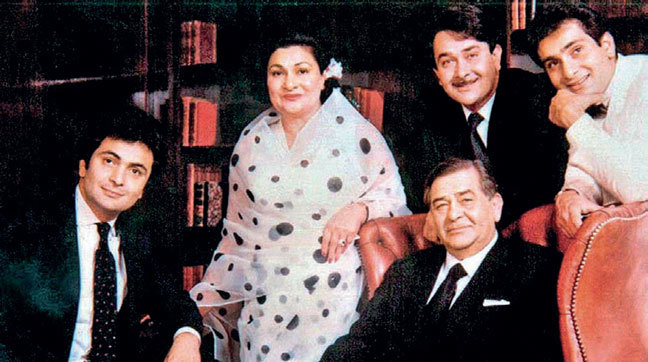
The couple with their sons Randhir, Rishi and Rajiv
Indeed, she became a role model for film star wives, inwardly conscious that it’s ultimately the hearth and home which matter. Subservient she could never be. She was an equal and at points, even the superior one, a status which can now be accorded to her unflinchingly. During her lifetime, she would have been offended by any form of panegyric.
The story of the Rewa born girl is the stuff that love stories are made of. At the age of 16, the daughter of police inspector general Raisaheb Kartar Nath Malhotra, married the upcoming actor Raj Kapoor who was 22 then. The blue-eyed dreamer had seen her play a tanpura on visiting the home of her brother actor Premnath.
Inspector general Malhotra was the maternal cousin of R.K.’s father Prithviraj Kapoor. So, they were distantly related. What is colloquially known as ‘an arranged love marriage’ was fixed. Rewinding to the wedding ceremony, the late thespian Ashok Kumar, would often chuckle, “Krishna peeked at me from under her ghunghat and told Raj, ‘Oh he’s so handsome!’ He didn’t quite like that and must have sworn that he would become much more famous than me. Which he did.”
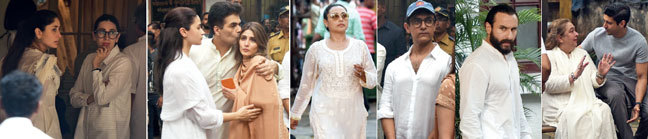
Sisters
Kareena and Karisma rushed to RK cottage with parents Randhir and
Babita in the morning; Karan Johar consoled Riddhima Kapoor-Sahni; Rani
Mukerji, Aamir Khan and Saif Ali Khan were among the visitors who turned
up to pay respects; Farhan Akhtar was seen with Rima Jain; PICS: RAJU
SHELAR
Accustomed to a large family – she had 11 siblings including Rajendra Nath and Narendra Nath who went on to become actors – the bride segued into the patriarchal Prithviraj Kapoor family which had anchored itself in a Matunga neighbourhood.
Raj Kapoor’s career was on the ascent, simultaneously as an actor, producer and director. Her family helped him with a financial loan to build the R.K. Studio in Chembur. “Dad and my grandfather weren’t flush with money those days,” son Rishi Kapoor has recalled, adding, “Relatively, my mother’s family was well-off.”
Raj Kapoor’s spiralling popularity was accompanied by his legendary romance with Nargis. The passion play between the creator and his muse was no secret. The on-screen chemistry, evidenced notably in Barsaat, Awara and Shree 420, was so palpable that the pair became socially acceptable off-screen even in the corsetted 1950s.
Krishna Raj Kapoor didn’t recoil or threaten the showman with ultimatums. Mother to five children — Randhir, Ritu, Rishi, Rajiv and Rima — her winning card was tolerance.
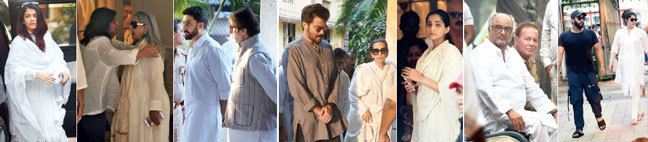
The
Bachchans — Aishwarya Rai, Jaya, Abhishek and Amitabh — arrived for the
last rites; Anil and Sunita Kapoor were among the early visitors, while
their daughter Sonam was also present; Boney Kapoor stayed close to
Salim Khan through the evening, as Arjun Kapoor turned up with sister
Anshula
Tolerance, in such a context, may sound regressive. For a mother, however, tolerance was the unalloyed strength and priority. Within and outside the film industry, polygamy was rampant. Suffice it to say she had to withstand it, an option which is exercised to this day and millennium by Bollywood’s first wives’ club — till it comes to a breaking point.
Raj Kapoor and Nargis parted ways without any demands on the wife’s part. The actress left the banner on her own volition to act in Mehboob Khan’s Mother India. Presumably, the showman was becoming far too possessive, she wanted to strike out.
The breaking point for Krishna Raj Kapoor came with the Raj Kapoor-Vyjayanthimala affair in the course of filming on the overseas locations for Sangam. Whispers about the liaison reached a crescendo point. With her children, Krishna moved out of the R.K. Cottage in Chembur to a suite at the then-Natraj Hotel on Marine Drive. No acrimonious statements, no arguments. Enough was enough.
Inevitably, the Vyjayanthimala chapter came to an end. The R.K children were back where they belonged: home. Other R.K. heroines, Padmini and Zeenat Aman, were linked with Raj Kapoor, transiently. It was the wife who became the irreplaceable Lady in White, an imagery associated with the showman who often showcased his heroines in spotless white costumes.
Krishna Raj Kapoor’s style was timelessly elegant. She would be seen most often in understated embroidered white and pastel shaded organza, chiffon and georgette ensembles. A string of pearls would be supplemented on festive occasions with diamonds. Right till advanced age prevented hours-long, traffic-clogged car rides, she would travel from Chembur to Kemp’s Corner in South Mumbai to get her hair coiffed by Ray George Stevenson of the six-decades-old Raechelle salon.
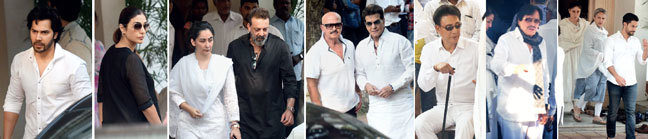
Varun
Dhawan, Tabu, Maanayata and Sanjay Dutt, Rakesh Roshan, Jeetendra,
Danny Denzongpa, Sanjay Khan dropped by to pay their respects; Kareena,
seen here with mother-in-law Sharmila Tagore and actor Kunal Kemmu
She allowed herself a few pleasures, like hosting a game of cards regularly at the R.K. Cottage. Her circle of friends included her sister Uma Chopra (wife of Prem Chopra), Shukla Kumar (wife of Rajendra Kumar), Salma Khan (wife of Salim Khan), Nirmal Kapoor (mother of Anil Kapoor) and Munni Dhawan.
Unlike quite a few star wives she didn’t interfere with R.K.’s creative process, keeping out of story, music and edit sessions, but ensuring that the bar and kitchen were kept open for the filmmaker’s collaborators around the clock.
Above all, the paramount joy in her life was to see her sons and grandchildren evolve in their careers. For instance, she had jetted off to Lake Placid in the U.S. to wait every evening for Rishi Kapoor to return to the unit hotel from the shoot of Aa Ab Laut Chalen. She’d ask, “Hope it all went off smoothly?” and if the first-time director wouldn’t answer, she’d say calmly, “Don’t worry, tomorrow all will go well.” This, in fact, was her credo.
Grandchildren Ranbir and Riddhima adored her. Although she had to travel in a wheelchair, she was at the centre of the celebrations of Neetu Singh Kapoor’s 60th birthday in Paris earlier this year.
You can detect the same look in the eyes, be it in the photographs of her as a young woman, as a resilient widow when Raj Kapoor passed away 30 years ago, or as a loving grandmother on Instagram.
The movies, star wives, relationships and tolerance levels have kept altering dramatically over time. That look of tenderness — with a hint of melancholia — in Krishna Raj Kapoor’s eyes never did.
What lies ahead for Aishwarya Rai Bachchan...
8:08 AM

Nayandeep Rakshit (DNA; August 30, 2018)
Ever since Aishwarya Rai Bachchan returned to the silver screen with Jazbaa (2015), she has been taking measured steps. In the last three years, she has been a part of four projects. The diva is clear that she wants to do movies that will help her portray diverse characters and make the audience see her in a new light. She talks to After Hrs about the films that she has greenlit and the ones that are still being worked on.
Couple Shenanigans
After the recently-released Fanney Khan, Ash will be seen in Anurag Kashyap’s Gulab Jamun opposite Abhishek Bachchan. The former beauty queen is excited to share screen space with her hubby after eight years. They were last seen together in Mani Ratnam’s Raavan (2010). Ash reveals, “I agreed on it early last year. At that time, Abhishek had taken a small break to review his work. It was a good move because I think every professional should do that. He just wanted to sit back and decide what he wanted to do next.” She adds, “He chose Manmarziyaan then, and now with Anurag directing this one (Gulab Jamun) too, people have incidentally put it together and there have been a lot of re-mentions. We will set the plan to do this one soon.”
No Clarity On Cop Drama Yet
Abhi-Ash were also approached to star together in Shailesh R Singh’s next production venture, where they were supposed to play cops. “The discussions stopped midway in February this year. Abhishek had asked them to rewrite some aspects of his character. I don’t know whether he continued to show interest in it or he dropped it completely. I couldn’t reconnect on my part.” Apparently, Junior Bachchan has not liked the final draft of the script and moved on. Quiz her if she will do the project and the light-eyed beauty says, “I’m not saying that it has to be Abhishek and me together, otherwise we won’t do the film. We are both liberated as artistes. But it still needs to be ideally cast. Only then you will see the magic on screen.”
Rewrite And Right Issues
After Fanney Khan, Aishwarya was also in the news for three other projects with the same producer. But none of them has materialised as yet. However, the Ae Dil Hai Mushkil heroine admits that there’s still a possibility with these movies. “I had asked the makers of the surrogacy story (Jasmine) for a rewrite. There were two remakes (Woh Kaun Thi and Raat Aur Din), which were interesting ideas. I respect the movies of those times (the ’60s). So, I asked them to get their rights in place,” she asserts. If all goes well, she will reprise Nargis’ iconic role in the Raat Aur Din remake. “When Sanju (Sanjay Dutt) and I were filming Shabd (2005), he had said that if there was ever a remake of Raat Aur Din, I should essay the protagonist. It made me happy that he believed I could play his mother’s role,” signs off Aishwarya.
Sridevi's Mom gets U/A certificate with no cuts from Censor Board
8:05 AM

Subhash K Jha (DNA; June 26, 2017)
Sridevi’s Mom has come in for high praise from the Central Board Of Film Certification (CBFC). The film has been granted a ‘UA’ with not a single visual or audio cut.
CBFC chairperson Pahlaj Nihalani describes Mom as a modern day Mother India. “Srideviji’s performance in Mom has the same impact as Nargisji in Mother India. They both define motherhood and the ingrained sacrifices that a mother makes for a child. I’d go as far as to say Mom is the contemporary Mother India. There will not be one dry eye in the theatres when the film opens.” The film which was viewed by the CBFC’s board members on Friday had the female members in tears. “It is probably Sridevi’s career’s best performance,” says a CBFC source.
I took my life for granted and paid the price for it-Manisha Koirala
11:11 AM

Rachana Dubey (BOMBAY TIMES; May 6, 2017)
They say, when the
realisation dawns that your life could be taken away from you is when
your perspective on life - its real meaning, purpose, the definition of
true happiness - changes. Manisha Koirala would know. One of the most
sought-after Bollywood heroines of the 90s, she has seen it all - fame,
success, adulation and stardom. But a battle with cancer changed it
all. Today, the Nepalese beauty is a transformed person, who values the
little joys of life that we all tend to take for granted in our pursuit
of a greater, elusive and delusive happiness. In an exclusive chat with
Bombay Times, the actress talks about her second innings on the silver
screen, the cinema of today and
how a close encounter with death can be a life-changing experience.
Excerpts...
What was your first response when you were offered Nargis Dutt's role in the Sanjay Dutt biopic?
I was thrilled. I adore Raj's (Rajkumar Hirani, director) work. There's a positive twang to every situation in his films. I'd seen the rushes even before I joined the cast. I must say, Ranbir (Kapoor) has done a fantastic job as Sanjay. To top it all, I was offered Nargis' role. I wish the entire film was based on her (laughs), but it's based on one of my favourite co-stars, so it's okay. It's a huge responsibility to play Nargis because people remember her vividly.
Any apprehension about playing a mom on screen?
I am apprehensive about all the work coming my way. In your 40s, you are too old to play the hero's love interest and too young to play the typical celluloid mother. As an artiste, I am looking for roles that allow me to act, but without the tag of mummyji and didiji. I wouldn't have taken up Raj's film if it had been a typical mummy role.
How did you prepare for the part?
We did look tests and I watched her movies and videos. Also, I rehearsed my scenes thoroughly. I've known about Nargisji as my colleague's mother and a legendary figure. She was a natural beauty, who seldom wore make-up and was effortlessly elegant. I relate to that aspect of her personality.
Let's rewind a bit. You quit movies when you were at the top...
I had some personal issues and then, I was diagnosed with cancer. There were bigger battles to be fought. Also, I was overworked. I once told Dimple Kapadia, 'I'm fed up of this routine of waking up, going to the shoots and coming home drained out after long hours'. She replied, 'Enjoy this while it lasts because it will not last forever.' You don't know when things will change. That's the truth of life.
Would you dole out Dimple's advice to younger actresses?
Not really. I respect what Dimple told me, but I would tell the girls, 'Do it for as long as you enjoy it. Don't do it because you have to do it. Grab the work if it makes you happy. If it doesn't pull you in, look around, there could be something more engaging.'
Where did you find support during your low phase?
During your low phase, people hardly come forth. And it's not because they are mean or selfish. Sometimes, people are genuinely scared to see you in a dreadful condition. I was hurt when I didn't find too many people around me, but I also realised that they would have felt very bad if they had seen me battling the disease. My family and friends like Jackie Shroff and Gulshan Grover stood by me. I was in the USA then; had I been in Mumbai, maybe more people would have been around me. I also had many cancer survivors write to me, which filled me with hope.
Post recovery, it took you long to make a comeback...
I wasn't happy with the work that was coming my way. I have decided to take up roles only if I am fully convinced. Fortunately, I don't have to work to sustain myself. So, quality of work matters more today than it ever did.
As one of the boldest heroines of the 1990s, how do you think cinema has evolved in recent years?
I don't think I was bold. I haven't gone beyond kissing on screen. Yes, I have been a bold person all along. I have been honest about my relationships, I smoked and drank openly... I've been frank about things that most people are shy and quiet about. I am a rebel by birth, I was never the timid, compromise-to-get-work type of girl. Yes, I was cornered and conned into doing Ek Chotisi Love Story. As for the cinema today, it's in one of its best phases with great storytellers and fantastic actors who are extremely professional and technically sound.
The audience is also open to all kinds of stories. Cinema is a much stronger part of our culture now. Do you feel it's a good time to be a leading lady today?
Yes, it is. I am sorry to say, but the 80s and 90s were mediocre times for Hindi cinema. We were too dramatic and loud. The line between art-house and commercial cinema has blurred now. Today, it's more real. In a lot of ways, the quality is as good as what we see in the West. As for my favourite performers, Alia Bhatt and Kangana Ranaut are brilliant. I watched Queen and thought to myself, 'I could never have done this so well.' Vidya Balan is also wonderful. They're all way better than me.
Looking back, do you feel that you took your life for granted?
Yes, I did and because of that, my health and career went for a toss. I paid the price for it. Now, I deliver talks about whatever I learnt from the dizzy heights of success and the pits of loneliness and professional downs.
How important is it for you to find a companion now?
It's not important at all. Look at my house; look at the beauty of nature that I enjoy and the kind of life I lead. I don't feel the need for a companion anymore.
Has battling cancer made you stronger and more worldly wise?
Sunsets and sunrises, birds, hills, sea, the sound of water hitting against the rocks...I find great joy in these small things. My life before cancer was about projected happiness. Today, I have a luxury car and my closet is full of brands, but I don't need them to make me happy. In our bid to find happiness, we forget to value what the nature gives us for free. I didn't care for my body, my work or my friends till I was face-to-face with cancer. Today, I focus on living my life well. I don't know when death will knock on my door again. So, I don't want to feel that I am wasting my days. I want to close my eyes with the feeling that I have lived my life to the fullest.
What was your first response when you were offered Nargis Dutt's role in the Sanjay Dutt biopic?
I was thrilled. I adore Raj's (Rajkumar Hirani, director) work. There's a positive twang to every situation in his films. I'd seen the rushes even before I joined the cast. I must say, Ranbir (Kapoor) has done a fantastic job as Sanjay. To top it all, I was offered Nargis' role. I wish the entire film was based on her (laughs), but it's based on one of my favourite co-stars, so it's okay. It's a huge responsibility to play Nargis because people remember her vividly.
Any apprehension about playing a mom on screen?
I am apprehensive about all the work coming my way. In your 40s, you are too old to play the hero's love interest and too young to play the typical celluloid mother. As an artiste, I am looking for roles that allow me to act, but without the tag of mummyji and didiji. I wouldn't have taken up Raj's film if it had been a typical mummy role.
How did you prepare for the part?
We did look tests and I watched her movies and videos. Also, I rehearsed my scenes thoroughly. I've known about Nargisji as my colleague's mother and a legendary figure. She was a natural beauty, who seldom wore make-up and was effortlessly elegant. I relate to that aspect of her personality.
Let's rewind a bit. You quit movies when you were at the top...
I had some personal issues and then, I was diagnosed with cancer. There were bigger battles to be fought. Also, I was overworked. I once told Dimple Kapadia, 'I'm fed up of this routine of waking up, going to the shoots and coming home drained out after long hours'. She replied, 'Enjoy this while it lasts because it will not last forever.' You don't know when things will change. That's the truth of life.
Would you dole out Dimple's advice to younger actresses?
Not really. I respect what Dimple told me, but I would tell the girls, 'Do it for as long as you enjoy it. Don't do it because you have to do it. Grab the work if it makes you happy. If it doesn't pull you in, look around, there could be something more engaging.'
Where did you find support during your low phase?
During your low phase, people hardly come forth. And it's not because they are mean or selfish. Sometimes, people are genuinely scared to see you in a dreadful condition. I was hurt when I didn't find too many people around me, but I also realised that they would have felt very bad if they had seen me battling the disease. My family and friends like Jackie Shroff and Gulshan Grover stood by me. I was in the USA then; had I been in Mumbai, maybe more people would have been around me. I also had many cancer survivors write to me, which filled me with hope.
Post recovery, it took you long to make a comeback...
I wasn't happy with the work that was coming my way. I have decided to take up roles only if I am fully convinced. Fortunately, I don't have to work to sustain myself. So, quality of work matters more today than it ever did.
As one of the boldest heroines of the 1990s, how do you think cinema has evolved in recent years?
I don't think I was bold. I haven't gone beyond kissing on screen. Yes, I have been a bold person all along. I have been honest about my relationships, I smoked and drank openly... I've been frank about things that most people are shy and quiet about. I am a rebel by birth, I was never the timid, compromise-to-get-work type of girl. Yes, I was cornered and conned into doing Ek Chotisi Love Story. As for the cinema today, it's in one of its best phases with great storytellers and fantastic actors who are extremely professional and technically sound.
The audience is also open to all kinds of stories. Cinema is a much stronger part of our culture now. Do you feel it's a good time to be a leading lady today?
Yes, it is. I am sorry to say, but the 80s and 90s were mediocre times for Hindi cinema. We were too dramatic and loud. The line between art-house and commercial cinema has blurred now. Today, it's more real. In a lot of ways, the quality is as good as what we see in the West. As for my favourite performers, Alia Bhatt and Kangana Ranaut are brilliant. I watched Queen and thought to myself, 'I could never have done this so well.' Vidya Balan is also wonderful. They're all way better than me.
Looking back, do you feel that you took your life for granted?
Yes, I did and because of that, my health and career went for a toss. I paid the price for it. Now, I deliver talks about whatever I learnt from the dizzy heights of success and the pits of loneliness and professional downs.
How important is it for you to find a companion now?
It's not important at all. Look at my house; look at the beauty of nature that I enjoy and the kind of life I lead. I don't feel the need for a companion anymore.
Has battling cancer made you stronger and more worldly wise?
Sunsets and sunrises, birds, hills, sea, the sound of water hitting against the rocks...I find great joy in these small things. My life before cancer was about projected happiness. Today, I have a luxury car and my closet is full of brands, but I don't need them to make me happy. In our bid to find happiness, we forget to value what the nature gives us for free. I didn't care for my body, my work or my friends till I was face-to-face with cancer. Today, I focus on living my life well. I don't know when death will knock on my door again. So, I don't want to feel that I am wasting my days. I want to close my eyes with the feeling that I have lived my life to the fullest.

There is no harm in mimicking me, but I don't think that imitation is always right-Lata Mangeshkar
7:52 AM

Renuka Vyavahare (BOMBAY TIMES; April 25, 2017)
What strikes you the most
about Lata Mangeshkar, 87, is her soft demeanour coupled with her
ability to speak her mind without mincing words. The nightingale of
India breaks into a childlike giggle when you ask her if she is
bombarded with song requests from family and friends even today. The
singing doyen was 12 when her father, Pandit Dinanath Mangeshkar, passed
away in 1942, but his values and principles have left a deep impact on
her. On the occasion of her father's 75th death anniversary yesterday,
the Bharat Ratna awardee talked to BT about his teachings and why she
isn't keen on playback singing anymore. Excerpts..
You seem to have taken a backseat from music. It's been long since we heard you sing for films...
I sing even today, it's just that I don't sing for films. I prefer devotional songs. Today's Bollywood music doesn't suit my singing. People like it and I don't want to comment on it or criticise it, but I don't think I'd be able to do justice to it. However, I ensure that I do my riyaaz often if not every day.
We've heard that before singing in a particular language, you'd learn it to get your pronunciation right.
That kind of dedication is rare today...Other than Marathi, which is my mother tongue and Hindi, I have sung in various languages, especially Bengali. It's important to study the language to do justice to the lyrics. You have to know their meaning, which actor is singing it on screen and the situation of the song. I've even learnt Urdu to get my pronunciation right.
Do your friends and family come up to you with song requests at home?
(Laughs wholeheartedly) No, that doesn't happen in my house as all five of us siblings (Lata, Asha, Hridaynath, Usha and Meena) are singers.
It's been 75 years since your father, renowned theatre actor and classical vocalist Pandit Dinanath Mangeshkar, passed away. You were very young at that time. Any memories of him that have stayed with you?
He used to tell me, 'Ya kopryath jo sadhu baslela aahe, mhanje Tambura tyala kadhi visru nakos. Tyavar kadhi dhul padu deo nakos.' (He referred to the musical instrument Tambura as a saint and asked us never to forget him.) I want to pass on the message that he gave us - to learn classical sangeet. Every singer should know at least the basics of classical music as it always helps. Every year on his death anniversary, we honour talented artistes from different walks of life with the Master Dinanath Mangeshkar Award. We hope to take our father's legacy forward.
Your duets with legends like Kishore Kumar, Mukesh and Mohammed Rafi are timeless. With whom did you enjoy singing the most?
I liked singing with everyone - Mukesh bhaiya, Rafi saab and Talat Mahmood - but I enjoyed singing with Kishoreda the most.

Which of your songs do you like listening to the most?
I like Chala Vahi Des - Meera's bhajans composed by my brother Hridaynath Mangeshkar and Lag Jaa Gale (Woh Kaun Thi? 1964).
Who, according to you, enacted your songs really well onscreen?
Actresses like Sadhana, Meena Kumari, Nargis, Madhubala and Kajol, took the effort to understand the song and act accordingly. Jaya Bachchan observed me well and got my mannerisms right starting with how I stand, how I sing and how I drape my sari. In Abhimaan (1973), she even chose to wear white saris like me. It was commendable.
Among the current singers, who are your favourites?
I like Sonu Nigam, Javed Ali, Shaan, KK and Shankar Mahadevan. Among female singers, there is Shreya Ghoshal, Sunidhi Chauhan, Chithra and Alka (Yagnik), though she doesn't sing much these days.
Any favourites as far as Western music is concerned?
I like symphonies. Nat King Cole was one of my favourite singers. I liked The Beatles too. I don't know much about today's singers.
You were heartbroken by the recent demise of one of India's finest classical vocalists, Kishori Amonkar...
Kishori's death has left a huge void in the Hindustani classical music arena. It's a massive loss. She was a brilliant singer, a doyen of the Jaipur gharana.
Not many know that you like to cook...
(Laughs!) I enjoy cooking. I can say with confidence that no one can make gajar ka halwa the way I do.
You've been honoured with almost every award in the country. Do awards still excite you?
Whether it is the Bharat Ratna or any other award, they all make me equally happy, as those who honour me do it with a lot of love and respect.
What's your take on comedians mimicking your style?
I haven't seen it so far. Mimicry karayla harkat nahi pan ti barobarch aste asa mala vatat nahi. (There is no harm in mimicking me, but I don't think that imitation is always right). It's common for people to mimic renowned personalities. When it comes to mimicry, no one is spared. If leaders like Narendra Modi ji are imitated, then who are we? I just feel that those who indulge in it should first take a close look at themselves and do it with some dignity.
You seem to have taken a backseat from music. It's been long since we heard you sing for films...
I sing even today, it's just that I don't sing for films. I prefer devotional songs. Today's Bollywood music doesn't suit my singing. People like it and I don't want to comment on it or criticise it, but I don't think I'd be able to do justice to it. However, I ensure that I do my riyaaz often if not every day.
We've heard that before singing in a particular language, you'd learn it to get your pronunciation right.
That kind of dedication is rare today...Other than Marathi, which is my mother tongue and Hindi, I have sung in various languages, especially Bengali. It's important to study the language to do justice to the lyrics. You have to know their meaning, which actor is singing it on screen and the situation of the song. I've even learnt Urdu to get my pronunciation right.
Do your friends and family come up to you with song requests at home?
(Laughs wholeheartedly) No, that doesn't happen in my house as all five of us siblings (Lata, Asha, Hridaynath, Usha and Meena) are singers.
It's been 75 years since your father, renowned theatre actor and classical vocalist Pandit Dinanath Mangeshkar, passed away. You were very young at that time. Any memories of him that have stayed with you?
He used to tell me, 'Ya kopryath jo sadhu baslela aahe, mhanje Tambura tyala kadhi visru nakos. Tyavar kadhi dhul padu deo nakos.' (He referred to the musical instrument Tambura as a saint and asked us never to forget him.) I want to pass on the message that he gave us - to learn classical sangeet. Every singer should know at least the basics of classical music as it always helps. Every year on his death anniversary, we honour talented artistes from different walks of life with the Master Dinanath Mangeshkar Award. We hope to take our father's legacy forward.
Your duets with legends like Kishore Kumar, Mukesh and Mohammed Rafi are timeless. With whom did you enjoy singing the most?
I liked singing with everyone - Mukesh bhaiya, Rafi saab and Talat Mahmood - but I enjoyed singing with Kishoreda the most.
Which of your songs do you like listening to the most?
I like Chala Vahi Des - Meera's bhajans composed by my brother Hridaynath Mangeshkar and Lag Jaa Gale (Woh Kaun Thi? 1964).
Who, according to you, enacted your songs really well onscreen?
Actresses like Sadhana, Meena Kumari, Nargis, Madhubala and Kajol, took the effort to understand the song and act accordingly. Jaya Bachchan observed me well and got my mannerisms right starting with how I stand, how I sing and how I drape my sari. In Abhimaan (1973), she even chose to wear white saris like me. It was commendable.
Among the current singers, who are your favourites?
I like Sonu Nigam, Javed Ali, Shaan, KK and Shankar Mahadevan. Among female singers, there is Shreya Ghoshal, Sunidhi Chauhan, Chithra and Alka (Yagnik), though she doesn't sing much these days.
Any favourites as far as Western music is concerned?
I like symphonies. Nat King Cole was one of my favourite singers. I liked The Beatles too. I don't know much about today's singers.
You were heartbroken by the recent demise of one of India's finest classical vocalists, Kishori Amonkar...
Kishori's death has left a huge void in the Hindustani classical music arena. It's a massive loss. She was a brilliant singer, a doyen of the Jaipur gharana.
Not many know that you like to cook...
(Laughs!) I enjoy cooking. I can say with confidence that no one can make gajar ka halwa the way I do.
You've been honoured with almost every award in the country. Do awards still excite you?
Whether it is the Bharat Ratna or any other award, they all make me equally happy, as those who honour me do it with a lot of love and respect.
What's your take on comedians mimicking your style?
I haven't seen it so far. Mimicry karayla harkat nahi pan ti barobarch aste asa mala vatat nahi. (There is no harm in mimicking me, but I don't think that imitation is always right). It's common for people to mimic renowned personalities. When it comes to mimicry, no one is spared. If leaders like Narendra Modi ji are imitated, then who are we? I just feel that those who indulge in it should first take a close look at themselves and do it with some dignity.

Rishi Kapoor reveals dad Raj Kapoor's affairs but mum about his own?
7:57 AM

The actor hasn’t addressed his own link-ups in his biography
DNA (January 24, 2017)
Rishi Kapoor makes some telling points in his pointedly blunt autobiography Khullam Khulla: Rishi Kapoor Uncensored. The title comes from an Asha Bhosle-Kishore Kumar number in a Rishi Kapoor-Neetu starrer Khel Khel Mein (which incidentally was directed by Raveena Tandon’s father Ravi Tandon). It is meant to reflect the bindaas no-holds-barred mood and tone of the confessional biography.
A fair affair?
However there are points in the narrative where the candour gets conditional and selective. While Rishi speaks about his father Raj Kapoor’s extra-marital relationships with Nargis and Vyjayanthimala (the latter denied any relationship beyond the professional in her memoir, and Rishi had responded by openly calling her a liar), there is not a word about his own link-ups, rumoured or real.
The living vs the dead
Says an industrywallah who has been very candid in his biography, “Are we to presume that the only woman Rishi Kapoor has ever been involved with is his wife Neetu Singh? If not, are we to presume that Rishi didn’t want to hurt any living person with his confessions? Is it all right to be candid about the relationships of the dead and not all right to speak honestly about relationships with people who are living?”
Subscribe to:
Posts (Atom)