Showing posts with label Nainital. Show all posts
Showing posts with label Nainital. Show all posts
Kajol plays a cop for the first time in Do Patti; picture from the shoot location out
8:58 AM

mid-day lays its hands on pictures from Do Patti shoot that sees Kajol playing a cop for the first time in her 31-year career; the actor chases Kriti Sanon’s character in the thriller
Upala KBR (MID-DAY; October 18, 2023)
For the past 12 years, we’ve seen Ajay Devgn roar on screen as the no-nonsense cop Bajirao Singham, a role that he is reprising in Singham Again. But it looks like he has another fierce cop right at home. One hears that Kajol plays a tough-as-nails police officer in Do Patti, which also stars Kriti Sanon and Shaheer Sheikh. Sanon and writer Kanika Dhillon’s maiden production went on floors on August 18 with a brief shoot in Mumbai, before the unit headed to Nainital. On Saturday, the unit wrapped up the Uttarakhand schedule.
mid-day laid its hands on a few pictures from the shoot, which have Kajol sporting the khaki uniform and shades. Those in the know say that the actor plays a fiery character in Shashanka Chaturvedi’s directorial venture. That’s not surprising considering Dhillon has a knack for writing strong-minded female protagonists—be it Rumi from Manmarziyaan (2018), or Rani in Haseen Dillruba (2021).
A source reveals, “Kajol portrays a tough-talking, sassy police officer from north India in the mystery thriller. Kriti’s role is equally exciting. In the movie, Kajol’s character is in hot pursuit of Kriti, chasing her across Mussoorie, Landour and Nainital. In her three-decade career, the actor has essayed diverse roles, but the opportunity to play a cop never arose before. She was immediately drawn to this complex role.”
While Kajol was an integral part of the Uttarakhand schedule, Sanon and Sheikh joined her last week. “The two actresses filmed some dramatic scenes. Brijendra Kala too was a part of these sequences. On Saturday, the unit wrapped up the schedule with a party,” adds the source.
The film’s third leg will begin in Mumbai by the month-end. It is Kajol’s third Netflix offering after Tribhanga (2021) and Lust Stories 2. In July, the actor made her web series debut with The Trial.
Since Girls Will Be Girls is set in a hill station boarding school, Uttarakhand will be the perfect location-Richa Chadha
8:12 AM

Wowed by the north Indian state’s beauty while shooting for a series, Richa decides to film maiden production in Nainital and Mussoorie
Mohar Basu (MID-DAY; October 5, 2021)
Earlier this year, Richa Chadha was Nainital-bound for the shoot of one of her projects. Little did she know that the filming of the eight-episode series in Uttarakhand would also serve as an unplanned recce of sorts for her maiden production venture, Girls Will Be Girls. The actor was so taken with the picturesque state that she has decided to shoot the film at the location.
The Shuchi Talati-directed movie, which revolves around a 16-year-old girl’s relationship with her mother, is set in a Himalayan boarding school in a north Indian hill station. After spending weeks in Uttarakhand, Chadha was convinced that it would serve as the perfect backdrop for the coming-of-age drama — a decision that was seconded by producer-boyfriend Ali Fazal.
“The location was so peaceful and serene that I found it easier to focus [on things] than when in the city. Since Girls Will Be Girls is set in a hill station boarding school, Uttarakhand will be the perfect location,” says Chadha, who along with Fazal, is setting the stage for the first project of their banner, Pushing Buttons Studios.
The film’s pre-production will kick off by the year-end, with shoots planned across Dehradun, Mussoorie and Nainital.
Unlike male cops, the female cops are burdened with the responsibility of a homemaker-Richa Chadha
9:57 AM
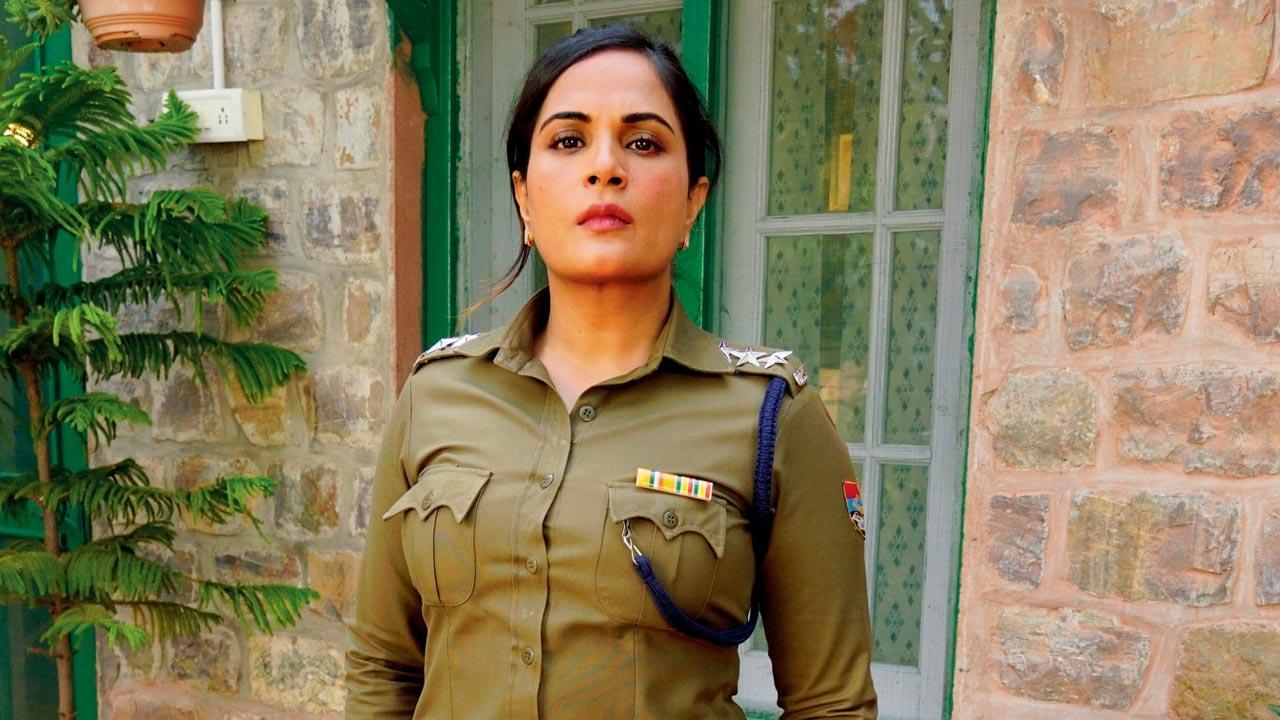
Richa Chadha, who plays a cop in Candy, on meeting women law enforcers to understand their work-life balance
Mohar Basu (MID-DAY; September 1, 2021)
Richa Chadha was drawn to Candy as it gave her the opportunity to play a cop for the first time. Though the Ashish R Shukla-directed web series — revolving around sinister murders in a hill station — is a murder mystery at heart, Chadha says it also examines gender dynamics and the pressures that women police officers face.
To do justice to her role, she met Nainital’s women cops in December 2020 before the project went on floors. “Portraying the role of a cop demanded a different mental make-up. I was lucky to be able to meet some women cops, and understand their dual pressures of managing the family’s needs and working as a law enforcer,” states the actor.
Learning of their first-hand experiences helped Chadha approach the character with a fresh gaze. “Unlike male cops, they are burdened with the responsibility of a homemaker. They still have to take care of the in-laws, the kids, their education, and ensure that food is cooked at home. Many of them said that their relatives [taunt them] about not being hands-on with their children due to the tough duty hours. Hearing these experiences can be eye-opening.”
The Voot Select series also features Ronit Roy.
The locals wait until the shoot is over to click selfies and get autographs-Ajay Bahl
8:08 AM
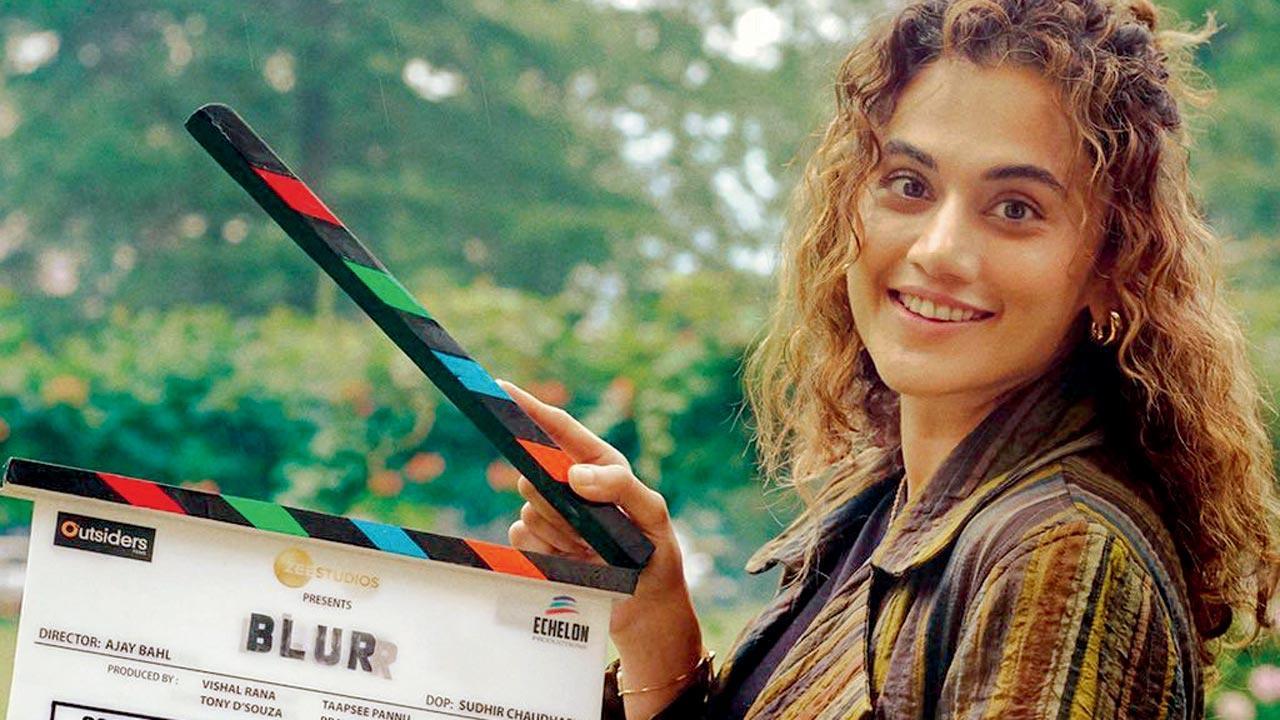
Fearing overcrowding on set, director Bahl films Taapsee-led Blurr at night in Nainital hotspots, including Mall Road
Uma Ramasubramanian (MID-DAY; August 20, 2021)
Given her keen eye for scripts, it was only a matter of time before Taapsee Pannu would take on the role of a producer and back stories she believed in. Last month, the actor kicked off her maiden production venture, Blurr, in Nainital under the watchful gaze of director Ajay Bahl. Shooting in real locations with celebrities can pose difficulties in terms of crowd management. The director, who is filming crucial sequences at Mall Road in the hill station, reveals that the team has been shooting at night to avoid overcrowding.
“The script of Blurr demanded [a hilly] landscape, and we have found perfect locations like the Mall Road and Nainital Lake to shoot at. Both these places are tourist hubs,” shares Bahl.
He walked into the shoot fully aware of the possible difficulties, but was pleasantly surprised by the outcome. “Shooting in real locations with a popular celebrity like Taapsee can be challenging, but thankfully, everyone has been patient. The locals wait until the shoot is over to click selfies and get autographs.”
The first project rolled out by Pannu’s Outsiders Films also stars Gulshan Devaiah. With the studio, the actor-producer hopes to empower new talent who “come with no [filmy] background like me.”
After wrapping up Blurr, Taapsee Pannu to kick off Shabaash Mithu next month
8:14 AM
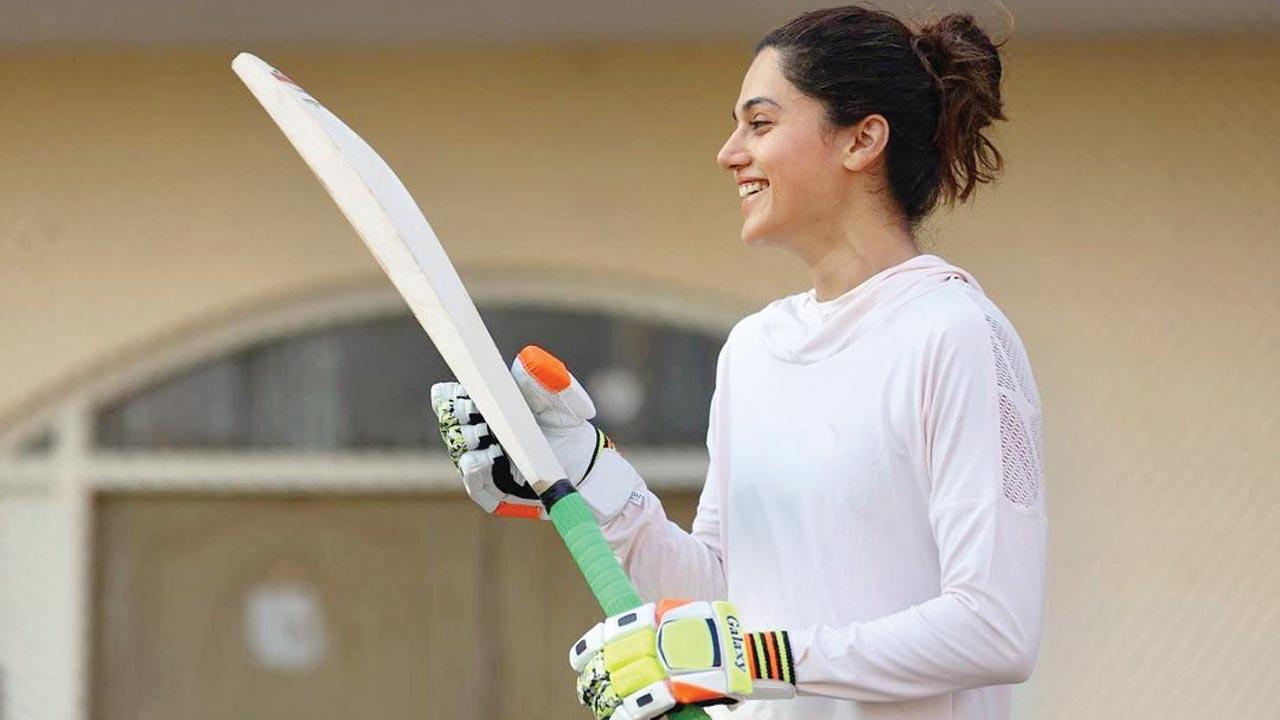
Mohar Basu (MID-DAY; August 4, 2021)
Like any first-time producer, Taapsee Pannu is giving undivided attention to her maiden project Blurr, which is being shot in Nainital. But before leaving for the hill station, the actor met Srijit Mukherji to understand the way forward for Shabaash Mithu. In June, the noted Bengali filmmaker replaced Rahul Dholakia as the director of the biopic on Indian women’s cricket team captain Mithali Raj.
It is heard that in the recent meeting, Pannu discussed at length her prep and notes on the character that she has been living for the past one year. After it’s a wrap on Blurr, she will begin shooting for the sports drama in early September.
A source reveals, “The biopic was slated to go on floors in April, but the second wave of the pandemic made the team hit the pause button. Srijit is currently in Mumbai, setting the groundwork for the ambitious movie. Once Taapsee returns to the city, the film will start rolling, followed by an international schedule. The director is expected to meet Mithali soon.”
Dilip Kumar's realism and brooding screen presence had a seminal influence on generations of actors to come
8:02 AM

Avijit Ghosh (THE TIMES OF INDIA; July 8, 2021)
Dilip Kumar’s best encapsulated the finest in popular cinema. Secure in his craft, he acted only in 60-odd films in a career spanning more than five decades. Kumar, whose real name was Yusuf Khan, even refused the part that made Omar Sharif a Hollywood star in David Lean’s Lawrence Of Arabia.
His brooding intensity and comic flair influenced Bollywood A-listers such as Rajendra Kumar, Manoj Kumar and Amitabh Bachchan. An obsessive perfectionist, he learnt to play the sitar for a song sequence in Kohinoor. Kumar was so immersed in the self-destructive protagonist of Devdas (1955) that he had to undergo psychiatric counselling. The doctor advised comedies as therapy. And he excelled in them too.
In the pre-independence era, Pramathesh Barua and K L Saigal had swayed a million hearts as Devdas. Yet a generation later Dilip Kumar made the part his own. He induced intensity into loving and losing in a way that pain became indistinguishable from pleasure.
His most-remembered performances had distinct tragic undertones. As a conflicted prince who rebels against his father, the emperor, for the woman he loves, Kumar was starch-perfect with his diction in Mughal-e-Azam. A scene with Madhubala, where he fondles her face with a peacock feather, is iconic for its eroticism.
A notable moment in his career came with Ganga Jumna (1961) where he conveyed the despair of the innocent villager forced to become an outlaw. “To me, it was his ultimate performance,” Amitabh Bachchan told TOI in 1990. Ironically, the Censor Board recommended major cuts to it on grounds of vulgarity and violence. The film was released following Prime Minister Jawaharlal Nehru’s intervention. But the struggle to get it exhibited took its toll on him. He never produced a film again.
Like Raj Kapoor, and Shah Rukh Khan, Kumar’s roots were in Peshawar where his father was a fruit merchant. The family shifted to Deolali near Nasik, and Bombay, in late 1920s.
He loved watching movies. Kumar once said he had watched For Whom the Bell Tolls, starring Ingrid Bergman, 21 times in seven days. Among others, he was influenced by the 1930s Hollywood star, Paul Muni.
A chance meeting in Nainital with Devika Rani, a top star of the 1930s who co-owned Bombay Talkies, led to his debut in Jwar Bhata (1944). He picked the screen name from three options -- Vasudev and Jahangir being the others -- provided by renowned Hindi writer Bhagwati Charan Verma, then associated with the film studio, revealed film historian Sanjit Narwekar in Kumar’s biography, The Last Emperor.
After watching it, Baburao Patel, the much-feared editor of Filmindia, whose reviews could make or mar a film those days, wrote, “Dilip Kumar, the new hero of Bombay Talkies, is an anaemic addition…He looks gaunt and famished and strikes one as a long ill-treated convict who has escaped from a jail…His acting efforts in this picture amount to nil.”
But Kumar improved in Nitin Bose’s Milan (1946), a profitable adaptation of Rabindranath Tagore’s Nouka Doobi. Kumar once said, “I learnt from Nitin Bose the value of silence,” as evident in his signature pauses in later films. His first superhit was the tragic Jugnu (1947), with Noorjehan as leading lady.
Historian Ashok Raj describes the years between Jugnu and Ganga Jumna (1961) as “the classical period” of his career, ranging from tragic love stories (Andaz, Devdas), swashbuckling costume dramas (Azad, Kohinoor) and semi-socialist yarns (Naya Daur, Paigham) to the romantic supernatural (Madhumati), the experimental (Musafir), where he sang his only film song (Laagi nahi chhute), and even a Left-leaning project (Footpath), a proto-Deewar.
After Ganga Jumna, Kumar took a break, acting in only two flops in the next five years. His marriage to Saira Banu in November 1966 -- he was 44, she was 22 -- proved lucky for him. Kumar’s double-role venture, Ram Aur Shyam, celebrated its golden jubilee. But by then middle-age had crawled onto his appearance. In the 1970s, Kumar was largely reduced to a yesteryear star.
The thespian made a stirring return in Kranti (1981) and Shakti (1981).The new Kumar was occasionally over the top. But superhits such as Vidhaata, Karma and Saudagar introduced him to a new generation of film buffs. A secret marriage and divorce to a Hyderabadi socialite, Asma, became fodder for gossip magazines during the same phase. There were other unpleasant memories too when he was targeted for his efforts to bridge ties between India and Pakistan.
Now he is gone. But in every movie rerun, Dilip Kumar will continue to astound and enrich us with his gift to lift a scene with silence and soul.
---------------------------

SUHANA SAFAR
- Born as Yusuf Khan on December 11, 1922. He was born in the same month as Raj Kapoor and in the same place, Peshawar, but was two years elder. Yusuf Khan's father was a fruit merchant
- Before joining films, Yusuf Khan worked in a military canteen at Poona; set up a fruit stall next to it with his employer's permission
- He was interviewed for a film career by Devika Rani, wife of Bombay Talkies boss Himanshu Rai. She asked four questions: "Have you ever acted on the stage?"; 'No madam" was his reply; "Would you like to act in films?"; "Yes madam" he said; "Do you smoke?"; "No madam"; "Can you speak Urdu fluently?" "Yes madam"
- He lost his parents and his disabled brother Ayub Khan in rapid succession. This is believed to have deeply affected him in his youth
- The phase from Devdas to Mughal-e-Azam is considered to be the best in his work
- In 1961, he turned producer with Ganga Jumna
- In 1962, he was offered Lawrence Of Arabia, which he turned down. The role was done by Omar Sharif
- In 1970s, his career took a dip with films like Gopi, Sagina and Bairaag failing at the box office. He took a break for six years and returned with Manoj Kumar’s Kranti in 1981
---------------------------

FAMOUS LINES
- Devdas Kaun kambakth hai jo bardasht karne ke liye peeta hai. Main toh peeta hoon ke bas saans le sakoon
- Saudagar Haq hamesha sar jhukake nahin... sar uthake maanga jaata hain
- Mughal-e-Azam Mera dil bhi aapka koi Hindustan nahi ... jispar aap hukumat karein Shakti Joh log sacchai ki tarafdari ki kasam khate hain... zindagi unke bade kathin imtihaan leti hain
- Vidhaata Jagawar agar zindagi mein bada banna hain... toh chhoti harkate chhod do
- Daag Din mein iski zaroorat hoti hai zaalim raat toh khud ek sharab hoti hai
- Aadmi Zindagi bhar doosron ka boj uthataa raha hoon aur aaj khud ek boj ban gaya hoon
---------------------------
FAMOUS SONGS
- Yahaan badla wafa ka bewafai ke siva kya hai Noorjehan-Rafi duet, composed by Firoz Nizami, was from 1947 hit Jugnu
- Gaaye ja geet milan ke Mela (1948) had great songs by Naushad. This one, sung by Mukesh, was memorable
- Meri kahani bhoolnewale Deedar reinforced the tragedy king image. This Naushad tune was sung by Rafi
- Yeh hawa yeh raat yeh chandni Talat Mehmood’s voice suited the thespian; this one by Sajjad Hussain is a classic from Sangdil (1952)
- Aye mere dil kahin aur chal From Daag (1952), composed by Shankar-Jaikishen and sung by Talat Mehmood
- Hum aaj kahin dil kho baithe Naushad’s score and Mukesh’s sonorous voice from Andaz (1949)
- Suhana safar aur yeh mausam haseen One of Dilip Kumar’s personal favourites, from Madhumati (1958), rendered by Mukesh, scored by Salil Chowdhury
- Nain lad jai hain Dilip Kumar did a fast-paced folk dance for this Ganga Jumna (1961) number. Naushad-Rafi combination again

From a rocky relationship, my father and I went on to become best buddies-Ram Kapoor
7:54 AM

The actor talks about his equation and love for his father, adman Anil Kapoor, who passed away recently
Tanvi Trivedi (BOMBAY TIMES; April 17, 2021)

Your father had been unwell and undergoing treatment in Singapore…
My father was detected with cancer 10 years ago and the doctors then said that he had around 6-12 months left. We started his treatment and miraculously he recovered, stunning the doctors. He lived a pain-free life for 10 years, travelled around the world, worked well and was fine. But last year around February, he travelled with his friends to Singapore and that’s when the cancer came back and his situation deteriorated. He also got stuck there because of the lockdown that followed in March. A few months ago, he called and told me that he wanted to return to India. It was challenging amidst COVID-19 restrictions, but we managed to get an air ambulance. He was admitted to a Mumbai hospital, where visitors were not allowed due to Coronavirus. But with precautions and permission, I stayed with him during his last few days in the hospital. My family was worried about how I was managing, but for me, it was a great sense of satisfaction and peace that I was around him.
While your father was one of the advertising industry veterans, you chose to become an actor. Why did you not want to use his name to get work?
I learnt a lot about theatre at Sherwood boarding school in Nainital. So when I told my father about my decision to pursue acting as a career, he did not take me seriously. He did not discourage me either and just told me to follow my dreams. Also, when I went abroad to learn acting, he thought I wasn’t serious and I would quietly come back and do something else after the initial struggle. So, it was a challenge within myself to prove to him that I would create my path and make him proud, one day. I wanted to prove to him that I could make my career without his help and support. I was highly inspired by Nicolas Cage, a Hollywood star who is also the nephew of director Francis Ford Coppola, but he never took the surname and created his own identity.
So, what was wrong in using your father’s name or his connections?
I don’t see anything wrong in fathers or mothers helping their kids in showbiz, but in my case, the reason why I never used his name was that his respect and confidence in me mattered to me the most. He was a self-made man and a true legend, and I wanted to prove to him that I could also be a self-made man like him. Today, I feel happy that I may not be a Khan, but I have carved a place for myself in the profession. People take my name with respect and though I am nowhere near my legendary father, my work and career has reached a stage, where people started identifying my father as Ram Kapoor’s father. It took me 10 years to impress him, and from a rocky relationship that I shared with him during those initial years, we went on to become great buddies. He used to proudly tell people how I was his best friend.
You mentioned how you bonded with him in the last few years…
Both he and I had busy careers and it was challenging to be physically present and share common things. But, we bonded a lot over phone calls and long conversations, which lasted for 2-3 hours. We used to fight, argue and have the best advice for each other. It is because we kept our work lives separate and were self-reliant, we became such a close father-son duo. In many ways, I am similar to my dad and that’s why I am what I am, today. And though I was aware of how he turned around a dying ad agency to one of the top five agencies in the country and his achievements, I always detached from his profession. Similarly, he must have watched all my films, my TV shows and series, but he never once complimented me on my work. Through my wife, mother or sister, he would convey that he was very happy with my achievements. He had a lot of expectations from me and I am happy I fulfilled them. In his last days, we discussed death, not in a morbid way but as a matter of fact. Even now, there are times when I wake up crying and miss him a lot, but in my heart, I know that I have healed, and feel a sense of satisfaction, I could give him a send-off, like the way he wanted.

Richa Chadha teams up with Bahut Hua Samman director for crime thriller set in Nainital
8:17 AM
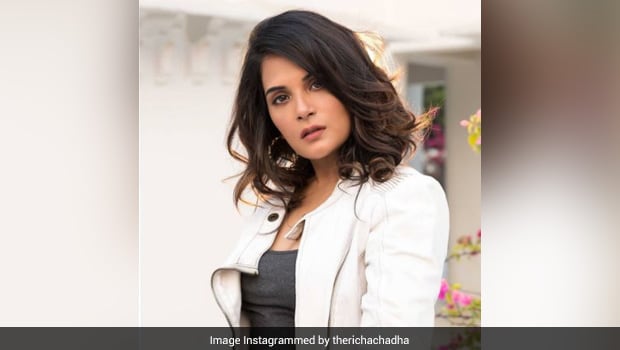
Mohar Basu (MID-DAY; January 12, 2021)
Richa Chadha has kicked off the new year with a new project. Currently stationed in Nainital, the actor is filming Candy, helmed by Ashish R Shukla of Bahut Hua Samman (2020) fame. Set in a boarding school, the noir thriller revolves around an investigation of a missing person that leads to a dark web of drugs, politics, and murder.
Excited about her first attempt at a psychological thriller, Chadha says, “The various dimensions to my role drew me to the script. I have always portrayed characters that have depth, and this was another opportunity to explore a nuanced part.” That the project unites Chadha with one of her dearest friends is the cherry on top. “Ashish Shukla was one of the first people I met in the industry, at the beginning of my career,” recounts the actor.
The Voot Select series, also featuring Ronit Roy, is scheduled to drop online later this year. Shukla, who has dabbled in different subjects, says he often finds himself returning to the crime genre after Undekhi. “From the taut storyline to the dramatic climax [that the genre offers], I enjoy creating a mystery that instantly captures the viewers’ attention,” he says.
It's not only because you got famous that you got a show, say Dolly Singh and Prajakta Koli
8:25 AM

Creators first, and now actors, Prajakta Koli and Dolly Singh talk about humble beginnings, the hustle of celebritydom and fighting new social media talent
Aastha Atray Banan (MID-DAY; December 13, 2020)
Dolly Singh and Prajakta Koli have never met. Yet, they catch up like old friends when we set up a meeting on Zoom. The Instagram, and now Netflix stars, are riding high. Singh has amazed audiences with her natural talent in the Swara Bhaskar-starrer film Bhaag Beanie Bhaag, and Koli has been all over social media in a magical career where people can't get enough of her. In the recent film, Mismatched, she makes her film debut.
Koli started her YouTube channel, Mostly Sane, in 2015, and Singh debuted in the South Delhi Girl videos on iDiva in 2017. The last few years have then been life-changing—in a recent post to celebrate her Netflix debut, Singh's celebratory cake said, "Nainital to Netflix", a hark back to her humble beginnings, when her parents used to run a gift shop, and live in a tiny house (she recently bought them a new home).
Ask them if their success is a result of being in the right place at the right time, or hustle and hard work, they say, both. "When I started my career almost six years ago, nobody saw this coming, right? Who knew this was going to blow up. Back then, my biggest dream was to have 30k followers. That's it! But so many avenues opened up—I can now act, write, edit, write songs. Nobody saw this coming. The audience is also more accepting of newer content," says Koli, 27, who managed 2.9 million followers.
Singh, who has 1.1 million followers, says it is them, the first generation of social creators, who are figuring out the medium as they go along. "We may be driving the audience to watch us now, as we already have big followings. But when we started, we had to audition for everything—multiple times. It's not only because you got famous that you got a show. It's a lot of hard work," she says.
The two are naturals, making good use of the training they received while playing different characters on their Instagram and YouTube videos. One of Singh's most loved characters has been Raju ki Mummy, whose typical Indian middle-class ways will have you in splits. Koli's videos which would feature her playing the dad and daughter, were also full of slice-of-life humour and wisdom. "I always had the Bollywood ka keeda. I loved performing. But when I started doing YouTube, it was so empowering, since we are not dependent on anyone. I could play whoever I wanted to. Maybe because of that, I wasn't looking at auditioning every day, but I did take up every opportunity I got."
For Singh, even saying that she wanted to be in Bollywood was like asking for too much. "I didn't even have the audacity to say it. But yes, TV pe aana tha. On my first day on set, I was overwhelmed, with so many people around. You had to now act with people, not just by yourself," says the 27-year-old.
Koli seconds her, adding that the "acting is reacting" bit hit her hard, especially on the first day she went on the sets of Mismatched, and had to shoot a scene with co-star Rohit Saraf. "That's when I realised, this was a whole different ballgame." They may have now started the superstardom journey, but they still get creator anxiety when they see all the new talent emerge on social media. "You always have to be relevant—I have been feeling old seeing all the new creators. But you just have to be true to yourself, or the fakeness will shine through."
Koli feels there is enough space for everyone given India's vast audience numbers. "There are so many people in India, so as creators grow, the platforms will grow." Singh insists that there isn't as much jealousy, as mutual respect within the community. At this point, Koli says she remembers watching Singh's first home tour videos, where she gave her audience a look into her Nainital home. "I watched her new home-tour video now, and I am so proud of Dolly. We all know where we have come from, and the struggle we have gone through."
For now, they are focused on moving upwards and onwards, with better content and maybe new shows. But as they both say, every day is still a challenge, and they are constantly trying to rise above their own insecurities. "I am very shy. So every time, I am in front of the camera, I have to let my inhibitions go. It's my place to be outgoing," shares Singh. For Koli, the challenge is to fight anxiety over running out of content ideas. "Earlier, I would get upset and think, 'oh, I will have to shut my channel now'. Now, I just relax, and let it [the ideas] come to me."

Dolly Singh and Swara Bhasker share screen space in Netflix's Bhaag Beanie Bhaag
Kedarnath release stalled in 7 districts of Uttarakhand; makers say film doesn’t promote any hidden agenda
8:29 AM

Rachana Dubey (BOMBAY TIMES; December 8, 2018)
A ban has been imposed on the screening of the film Kedarnath in seven districts of Uttarakhand, in view of protests by Hindu outfits, a senior official said on Friday. Citing a difficult law-and-order situation ahead, the District Magistrates concerned have asked for the screenings of the film to be suspended. The districts where Kedarnath has been banned include Dehradun, Haridwar, Nainital, Udham Singh Nagar, Pauri, Tehri and Almora, ADG (Law and Order) Ashok Kumar said. Religious outfits have taken offence to the Hindu-Muslim love story in the film that features Sushant Singh Rajput and debutante Sara Ali Khan, and is directed by Abhishek Kapoor. Some of the groups felt that it promoted the idea of love jihad and hence, must be banned across the state.
On Thursday, the Uttarakhand High Court dismissed a public interest litigation seeking a ban on the movie. “Don’t see the movie if you don’t like it. We are not the Censor Board. We are a democracy and everyone is free to exercise their rights. State shall ensure law and order is maintained,” the bench said.
However, according to an order passed by one of the district magistrates, the reason to stall the screenings stems from the fact that there have been several demonstrations, people have been doing dharnas and narebaazi outside cinema halls, posters of the film were recently torn off cinema buildings by protestors and all these incidents could snowball into a bigger security threat if the film is screened.
Yami Gautam to prep for Batti Gul Meter Chalu; attend workshops to master 'pahadi' Hindi
7:49 AM

Actress has come on-board Shree Narayan Singh’s social-drama that tackles the issue of electricity shortage in a small town
Natasha Coutinho (MUMBAI MIRROR; January 12, 2018)
After Shahid Kapoor and Shraddha Kapoor, Yami Gautam has come on-board Toilet Ek Prem Katha filmmaker Shree Narayan Singh’s next, the social-drama Batti Gul Meter Chalu, to play a lawyer. The actress, who begins shooting next month, told Mirror, “It’s a strong concept with an impactful message. The credit goes to producer Prernaa Arora and Shree Narayan Singh for picking such a bold subject.”
Yami, who was born in Himachal Pradesh and brought up in Chandigarh, believes portraying the character will be a cakewalk as the story is set in North India. “Besides, I have studied law in college but couldn’t pursue it further as acting happened. She’s a headstrong girl who stands for what she believes in,” the 29-year-old actress says.
Katrina Kaif who had earlier given her nod to the role bowed out because busy wth the SRK-starrer Zero, she wouldn’t have been able to spare time for prep that includes working on the dialect. “It’s the Hindi spoken in Nainital and nearby regions. Shahid and I, along wth the rest of the cast, will soon start attending workshops even as final dates for the upcoming schedule are being locked. I don’t have a reference point as such. Shree has asked me to come in to work just the way I am,” she says.
Last year was a mixed bag for Yami. While Kaabil worked, Sarkar 3 didn’t match up to expectations. “I’m happy I did Sarkar 3. It’s about making strong choices. For someone who is not from the industry, there is no way around hard work. The only way forward is to keep exploring,” she reasons.
Buzz is, she has been approached for Vikas Bahl’s Super 30 opposite her Kaabil co-star Hrithik Roshan. “I’m not aware of this but I would love to work with Hrithik again. The response to Kaabil was amazing,” she smiles.
While she is more forthcoming on her New Year celebrations, which happened at her 100-year-old heritage home in the hills this time, Yami who was reported to be dating her Sanam Re co-star Pulkit Samrat a while ago, refuses to reveal if she’s seeing anyone currently. “Let’s stick to films,” she signs off.
Films were sold on Dilip Kumar's name; in certain cases, he had no option but to intervene-Amrit Shah
7:54 AM

Roshmila Bhattacharya (MUMBAI MIRROR; January 11, 2018)
 Cinema was an integral part of my growing up years. My mother would drag
me to the theatres to see Roman Holiday, Quo Vadis and Spartacus. And
on Sunday evenings I was allowed to park myself in front of the TV and
catch a Hindi movie and Doordarshan was my introduction to Navrang, Hum
Dono, Chalia and Devdas. Thereafter, every time I met Dilip Kumar, I’d
remember him as Devdas slurring drunkenly, “Kaun kambakht hai jo
bardasht karne le liye peeta hai, main to peeta hoon ki bas saans le
sakoon.”
Cinema was an integral part of my growing up years. My mother would drag
me to the theatres to see Roman Holiday, Quo Vadis and Spartacus. And
on Sunday evenings I was allowed to park myself in front of the TV and
catch a Hindi movie and Doordarshan was my introduction to Navrang, Hum
Dono, Chalia and Devdas. Thereafter, every time I met Dilip Kumar, I’d
remember him as Devdas slurring drunkenly, “Kaun kambakht hai jo
bardasht karne le liye peeta hai, main to peeta hoon ki bas saans le
sakoon.”Amrit Shah, filmmaker Bimal Roy’s manager however reveals that while the actor was always in character through the making of the 1955 film, he never saw him inebriated. “Devdas might be drunk but Dilip Kumar never was,” asserts the nonagenarian, who goes on to recall how on the day of the film’s premiere in Kolkata, while the press was watching the tragic love story, Roy rushed Dilip Kumar and Suchitra Sen to New Theatres Studio where he shot a scene of Parvati returning home after her nuptials with a zamindar years older, to learn that Devdas has been drinking heavily. Since she still loves him, when they run into each other on the staircase, she stops for a brief chat, hoping to wean him off alcohol. “Even though the film was on the verge of being unveiled, Bimalda felt that the connecting link between two scenes was missing and when he got his actors together, he grabbed the opportunity to shoot it. It went by in a flash but he still incorporated it into the film later. That is the kind of meticulous director he was,” narrates Shah who’d joined Bimal Roy’s production company just six months before and remained close to the family even after his death on January 8, 1966.
 During Madhumati which was filmed in Ranikhet
and Ghorakhal in the Nainital district, Shah and Dilip Kumar lived under
the same roof, in adjacent six-by-eight-feet rooms with a cordoned-off
bath. The village was devoid of amenities, including bare necessities
like electricity, tea, milk and even water. But there were no airs or
starry tantrums from the leading man when he was asked to bathe rather
than shower with a bucket of hot water or given a stringed ‘khatiya’ to
sleep on. “He would eat meals with the unit, never missed his call time
and after shooting, we’d often sit together and chat about everything,
from cinema to religion,” narrates Shah, recalling how once, with the
boldness of youth, he had quizzed the actor on rumours of his
interference on the sets and how he had ghost-directed some of his
films. “Yusuf bhai asked me if I had ever seen him give Bimal da
instructions or even suggestions. But he admitted that in certain cases
he had no option but to intervene if unsatisfied with the director,
because films were being sold on his name and as the ‘hero’ he couldn’t
afford to disappoint his fans.”
During Madhumati which was filmed in Ranikhet
and Ghorakhal in the Nainital district, Shah and Dilip Kumar lived under
the same roof, in adjacent six-by-eight-feet rooms with a cordoned-off
bath. The village was devoid of amenities, including bare necessities
like electricity, tea, milk and even water. But there were no airs or
starry tantrums from the leading man when he was asked to bathe rather
than shower with a bucket of hot water or given a stringed ‘khatiya’ to
sleep on. “He would eat meals with the unit, never missed his call time
and after shooting, we’d often sit together and chat about everything,
from cinema to religion,” narrates Shah, recalling how once, with the
boldness of youth, he had quizzed the actor on rumours of his
interference on the sets and how he had ghost-directed some of his
films. “Yusuf bhai asked me if I had ever seen him give Bimal da
instructions or even suggestions. But he admitted that in certain cases
he had no option but to intervene if unsatisfied with the director,
because films were being sold on his name and as the ‘hero’ he couldn’t
afford to disappoint his fans.”That shoot was an eye-opener for Shah. He flashbacks to a drive from Delhi to Nainital, that took them past a famous temple. They had to drive across a river over a sheet which served as a makeshift road. Halfway down it, the car slipped and stalled. Dilip Kumar’s fans instantly spotted him inside and crowded the car. Even as visions of mob violence flitted through Shah’s mind, he stepped out and spoke to the star-struck devotees. While doing so, he casually rested his hand on the car and tried to push it. Instantly, everyone around gave him a hand and car was back on track. “Smiling at his fans, Yusuf bhai got into the car and we crossed the river. But after about 100 metres, he asked the driver to stop and reasoned that pilgrims came to the temple and to the river every day to pray and we were passing by without stopping,” narrates Shah. To his surprise, the actor got out again, walked down the river bank, and scooping up some water washed his hands and feet, closed his eyes and prayed before proceeding to shoot for his paranormal romance drama with Vyjayanthimala playing three characters. Madhumati bagged nine Filmfare Awards, including best director for Bimal Roy.
I was quite nervous but Nawazuddin Siddiqui made me really comfortable, says Haraamkhor actress Trimala Adhikari
2:34 PM

Trimala Adhikari – the name might not sound a bell but viewers will surely remember her as the wife of Nawazuddin Siddiqui in Haraamkhor. In the midst of Nawaz, Shweta Tripathi and the two kids, she left a huge impact in this small-budget, high concept flick. Not much is known about her and her struggles and hence, it was an exciting and curious experience to interview her. As we sat in a coffee shop in Lokhandwala, Trimala, who had then just came from the rehearsal of Nitin Bharadwaj's play Ek Rupaiya that will be staged at NCPA’s Experimental Theatre on May 7, talks about experience of doing Haraamkhor, her beginnings, theatre background, nepotism, her favourites in cinema and a lot more. Over to this beautiful and opinionated actress…
What kind of feedback did you receive for Haraamkhor? Most of the critics said very good things about you…
Yes and I got a lot of appreciation. The feedback was good and I am happy with the response.
The film took a long time to be made and then when it was ready, it was stuck for close to a year thanks to the Censors. Did that frustrate you?
Well, sometimes you are not aware of what exactly is happening. As in, once you finish your work as an actor, it’s difficult to understand the process later on and how much time it takes. But I’d say that the wait was worth it!
Director Shlok Sharma revealed that the film was shot in just 16 days in more or less the same location. How was the experience?
This was not my first film which was shot in such a short period of time. I did a film called Hansa, directed by Manav Kaul, which was also filmed in just 2 weeks. Hence, the Haraamkhor experience wasn’t new in that regard. Also, I shot only for 5-6 days. It was fun and moreover, I have never worked in a commercial film whose shoot goes on more for months. Films like Haraamkhor and Hansa on the other hand finish on time and are shot in just one go. There’s no long break which can be quite detrimental as it’s difficult to get back in the zone when you resume the shoot after a gap. In case of start-to-finish shoots, at least you are in the rhythm.

I was quite nervous since he’s such a great performer. But he made me really comfortable. He was ready to rehearse with me. He gives you as much time as you want. Acting after all is give and take. If I don’t give in properly, he also would not be able to react that well and vice versa. Also, he’s such a fun person to work with and he’s quite chilled out. He used to have food with us and talk to us. He used to share about his experiences during his struggling phase. He understands what I am going through and when you come across a person who has experienced all that and is doing so well today, it’s very motivating. He also pushes you to give your best and to not give up.
How was the experience of working with Shweta Tripathi? Were you in awe of the fact that she’s playing a character which is half of her real age?
Yes, of course I was. We in a way knew each other since we both do theatre. It was a good, fun experience working with her as well because when I shot for Haraamkhor, I was really new to Mumbai. But she made me comfortable.
Where are you from and how did you get into acting?
I am from Nainital where I did my schooling. I did my graduation from Delhi University (DU). My sister is from FTII (Film and Television Institute of India). She called me to shoot for a film when I was in my first year of college. That’s when the acting bug hit me. I always wanted to be a dancer – I am trained in Kathak. After my graduation, I came to Mumbai and I started working in plays. I did backstage and production too.
Tell us something about your struggling period? Were there moments where you really got frustrated?
When I came to Mumbai, I did my first play with Manav Kaul called Mamtaz Bhai Patang Waale. Soon, he signed me for his film Hansa as well. While filming for Hansa, I got the best supporting actor award from META (Mahindra Excellence in Theatre Awards). Once I was back from Hansa’s shoot, I was offered Haraamkhor. Life was going so well – after all, I was awarded for my play, I got 2 good films and I was working with such fine directors. Suddenly after Haraamkhor, I stopped getting films though I was constantly doing theatre. This taught me that you have to keep working. You can’t be asking that when will I get work. To survive in Mumbai, I have to push myself work hard. When I’ll get a film offer is something that’s not in my hand. If I keep thinking negatively, I’ll go into a shell. And this happened to me when both Hansa and Haraamkhor took a while to release. But I realized I shouldn’t be thinking that way.
How has been the experience of working with Manav Kaul?
I call him ‘dada’. I owe him a lot since I got to knew so many people thanks to him. One of the reasons why Haraamkhor was offered to me was because I did Hansa and the plays with Manav. So he’s like a big brother who has really helped me and pushed me to act. Watching films and then saying I am an actor doesn’t make you an actor! The discipline and the hard work required to be an actor is something I learnt from him.
 Did Hansa get a release?
Yes, it got a release under the PVR Director’s Rare initiative. Interestingly, we ourselves put up the posters of Hansa at night across Mumbai. It was quite fun! It was a small film and for it to get a release was a high for everyone in the team. It was a team of theatre people coming together to make a movie. Even Kumud Mishra was a part of it.
A lot is being spoken about nepotism nowadays especially after the Karan Johar-Kangana Ranaut row. As someone who didn’t have any connection with the industry, what are your views on this topic?
I think it’s okay and I don’t understand why people make a big thing about it. I agree why Kangana said so – she has also come a long way and so has someone like Alia Bhatt who’s also had her own journey. You can’t compare them. We should just keep working hard and we should always remember why we are here. For instance, we are nobody to pass judgements about a Tiger Shroff and whether he deserves to be in the industry. He’s here because people like him and he’s having a blast. If Karan Johar wants to cast me, he will cast me and if he doesn’t want to, he won’t. Also, we shouldn’t judge him for the kind of films he makes. After all, even he has to make money and survive. Hence, I don’t like to question somebody’s comfort zone.
Haraamkhor and even the short films that you have done like Hoop Diaries, Agli Baar etc were in the so-called ‘art films’ space. So do you do such films because you like such kind of movies?
No, I do these films because I get such kinds of films (laughs)!
But tomorrow, if you are offered a so-called typical Hindi masala film, would you do it? After all, you are trained dancer too…
Of course, I’d love to do it. If I like the script, I’ll do it. I don’t fear that a section of people would judge me. If a script requires a song and dance number and if the director wants it, it has to be there. Ask any actor who’s struggling or a part of indie cinema if they’ll like to do a commercial film and their answer definitely will be a ‘Yes’. I don’t understand when people say that they are more of an ‘indie’ actor’. But I am just an actor and there’s no division in my mind as such.

What upcoming projects are you a part of?
I finished shooting for Devashish Makhija’s Ajji. It’ll be releasing this year after doing the festival tour. Then I have done a film called Bhasmasur. It’s a small-budget but exciting project made my college passouts. I have a small part in the film as an actor but I did a lot of production, art direction, casting and workshop with them. Hence it’s very close to my heart and I am waiting for it to go to the film festivals. The film was shot in May 2015 in Rajasthan. This is partly a crowdfunded film and it will be great if people can support this film by logging onto Wishberry.
Tell us something about your FTII film Afternoon Clouds (pictured below). It’s the first FTII film to have been selected for the Cannes Film Festival…
Yeah, I was really happy when that happened. And the best part is that it’s just not a screening at Cannes. It is a part of the Cinéfondation section which is a competition section. Our film will be showcased alongside some brilliant flicks from all around the world. So it’s not like we have paid to get a screening. With no support, this film has managed to get selected which is quite brilliant. I have got an invitation and I might go to Cannes.
Do you have a wish list of directors you want to work with?
I really want to work with Christopher Nolan, which is kind of out of my reach. But I just don’t want to act on his film. I want to be there and see how he actually writes his script, what is his thought process, how does he function. If I get an invisibility cloak, I’ll definitely go to his house! Then I like the work of David Fincher and few others. In Bollywood, I’d really like to work with Devashish Makhija again. I love the way he makes cinema and hence he’s one of my favourite directors. I’d also love to work with Zoya Akhtar – the way she balances commercial as well meaningful cinema is praiseworthy. Dibakar Banerjee is also a favourite. I loved his film Shanghai and I wonder why people didn’t like it.
And who are your favourite actors?
One of my favourite actors, just like everyone, is Marlon Brando. I also like the work of Daniel Day Lewis – wish I was like him. Tom Hardy is also a favourite. In Bollywood, Adil Hussain and Geetanjali Kulkarni are two actors whose work I really love. I have worked with Geetanjali and the way she acts is just amazing. I’d love to work with Pankaj Tripathi. For me, he was the scene-stealer in Masaan.
Which of the films have impressed you over the years?
My all-time favourite is The Godfather followed by My Left Foot, Life Is Beautiful, Amélie etc. I also love Korean films basically like I Saw The Devil. In Hindi, I enjoy Jaane Bhi Do Yaaro, Lakshya, Dil Chahta Hai, Pyaasa, Teesri Manzil, Chalti Ka Naam Gaadi etc. In recent times, I loved Court, Killa. Dangal I felt was a good fun flick.

I would catch myself murmuring, 'What a shot'-Kaanchi DOP
7:56 AM

Ananya Ghosh (MUMBAI MIRROR; April 9, 2014)

“We shot in Nainital and Mumbai. It is a quintessential Ghai film with the only difference being the use of digital cameras. The film was shot with Arri Alexa with Codex Recorders and certain portions on Red EPIC,” says Sudhir Chaudhary, the Director of Photography for the film.
The brief given to him was to capture the journey of the girl in images — a transition from the beauty, peace and tranquility of mountains to the harshness, artificiality and din of the city. “I tried to capture the mountains in their natural glory by using more or less no lighting but just augmenting the ambience with bounce boards. On the other hand, while shooting in Mumbai, I used lots of light to heighten the sense of superficiality. I also used a lot of hand-held camera to add to the confusion and state of mind of the girl,” he says.
Although the picturesque valleys of Nainital gave the right setting to Ghai’s comeback film, shooting on location is never easy. “Since we were shooting in the hills the sun would often go behind a hill way before the actual sunset. But since Subhashji has shot so many films in the mountains he knew exactly how to use the fickle sun to our advantage,” Sudhir says adding, “Also, a major portion of the film was shot in a small village from where we could not access our power generators. So, we used lots of mirrors to bounce lights from areas that had patches of sun to generate that little fill light.”
But there were certain scenes that gave Sudhir a tough time and he recalls: “One scene involved hundreds of school children cycle racing through the meandering roads of Nainital. We were shooting with four cameras and another camera on the Octocopter that we rented from HELICAM, Sweden. Coordinating with the stunt team, the safety guys and the camera operators was a task and then right when everyone would be ready to roll, the sun would hide behind the clouds. Also, the wind made it almost impossible to keep the cameras steady. It took great team work to pull it off.”
And what about the ‘thunderous’ shot the poster boasts of? “It is a part of the climax,” he reveals, adding, “Certain portions of the climax were shot in heavy rains and thunderstorm. We were shooting on multiple digital cameras and using rain machines to create the desired effect. Parvez Bhai (Action Director) and second unit director (Kabir Sadanand) would call for action and there would be some hiccup with some camera or the other. I had a backup camera ready. Also, we were shooting with 22.5 and 45 degree shutter just to enhance the rain drops, so we really had to pump in a lot of light as it involved a lot of high-speed shots.”
Apart from the much-talked-about debutante Mishti, the film has veterans like Rishi Kapoor and Mithun Chakraborty sharing screen space. “There have been moments when I got so mesmerised by their performances for a split second I’d forget that I was operating the camera and catch myself murmuring: ‘What a shot’!” And the last words reverberate.
Subscribe to:
Posts (Atom)