Showing posts with label NH10. Show all posts
Showing posts with label NH10. Show all posts
Had I been an insider, mujhe sar aankhon par baitha liya hota-Darshan Kumaar
9:42 AM
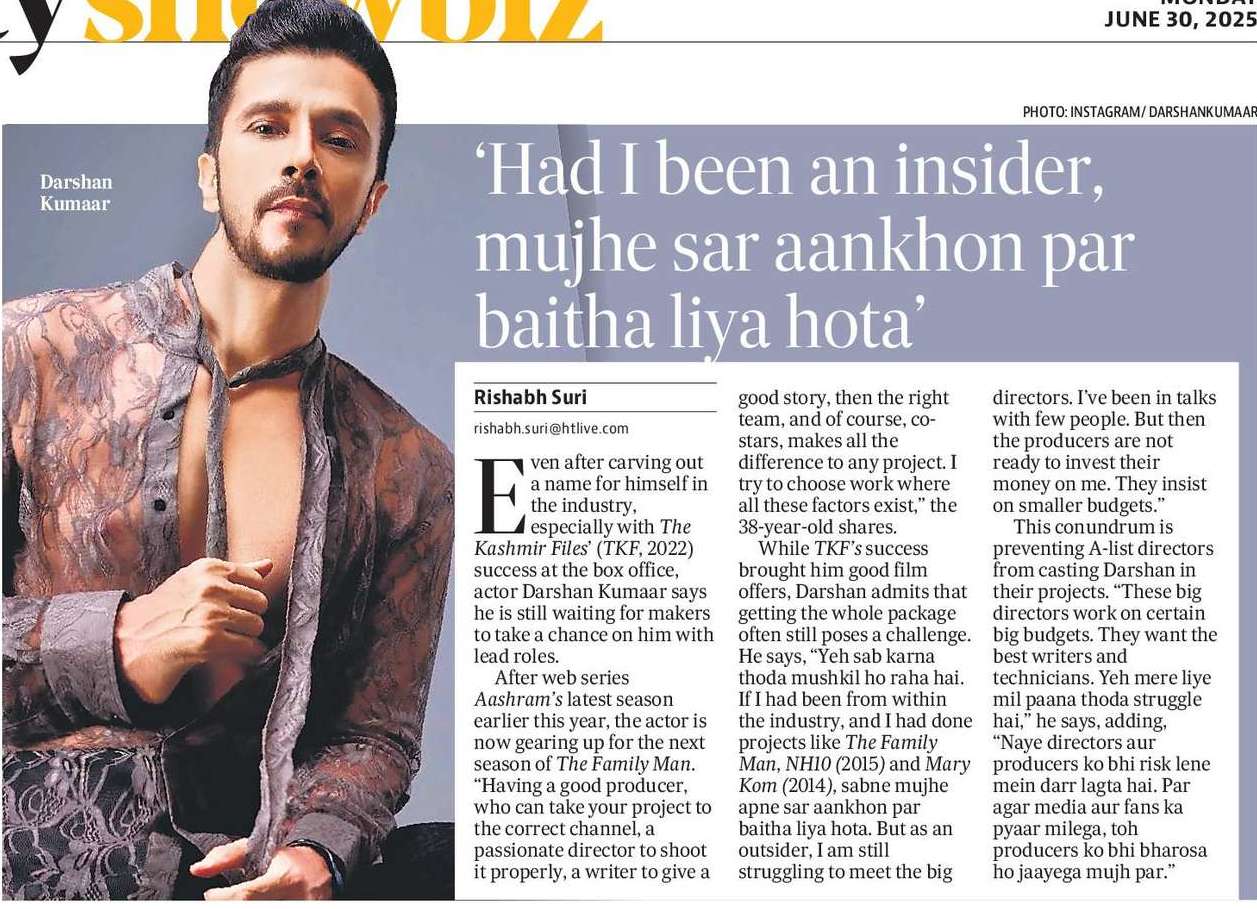
Rishabh Suri (HINDUSTAN TIMES; June 30, 2025)
Even after carving out a name for himself in the industry, especially with The Kashmir Files’ (TKF, 2022) success at the box office, actor Darshan Kumaar says he is still waiting for makers to take a chance on him with lead roles.
After web series Aashram’s latest season earlier this year, the actor is now gearing up for the next season of The Family Man.
“Having a good producer, who can take your project to the correct channel, a passionate director to shoot it properly, a writer to give a good story, then the right team, and of course, co-stars, makes all the difference to any project. I try to choose work where all these factors exist,” the 38-year-old shares.
While TKF’s success brought him good film offers, Darshan admits that getting the whole package often still poses a challenge.
He says, “Yeh sab karna thoda mushkil ho raha hai. If I had been from within the industry, and I had done projects like The Family Man, NH10 (2015) and Mary Kom (2014), sabne mujhe apne sar aankhon par baitha liya hota. But as an outsider, I am still struggling to meet the big directors. I’ve been in talks with few people. But then the producers are not ready to invest their money on me. They insist on smaller budgets.”
This conundrum is preventing A-list directors from casting Darshan in their projects. “These big directors work on certain big budgets. They want the best writers and technicians. Yeh mere liye mil paana thoda struggle hai,” he says, adding, “Naye directors aur producers ko bhi risk lene mein darr lagta hai. Par agar media aur fans ka pyaar milega, toh producers ko bhi bharosa ho jaayega mujh par.”
10 years of NH10: Lesser known facts about the sleeper hit thriller
9:48 AM

With the Anushka Sharma, Neil Bhoopalam and Darshan Kumaar-starrer recently turning 10, here are some lesser-known facts about the sleeper hit thriller
Compiled by Rishabh Suri (HINDUSTAN TIMES; March 17, 2025)
To prepare for his role as Satbir, the antagonist in the film, actor Darshan Kumar began closely interacting with people who lived near National Highway 10, and added Haryanvi songs to his playlist.
Anushka Sharma’s character Meera smokes cigarettes in the film. To prepare for the role, the actor started smoking too. However, she kicked the habit the moment the film wrapped.
Rajkummar Rao and Freida Pinto were director Navdeep Singh’s initial picks. Anushka had initially declined the role of Meera, but was convinced to take it on by filmmaker Anurag Kashyap while shooting for Bombay Velvet (2015). Actor Neil Bhoopalam was later cast as Meera’s husband, Arjun.
Anushka refused to have any song-dance or item songs in the film. “Someone suggested we have a typical song-and-dance sequence just before the most critical point. I was told it would be good to pause with a romantic song where the leads get out of the car and start singing. My reaction was a blank expression,” Pinkvilla quoted her as saying.
In 2015, the makers confirmed that the film would get a sequel titled NH12. But there have not been any developments since.
No one wants to make a film like NH10 or Udta Punjab for theatres today-Sudip Sharma
8:36 AM
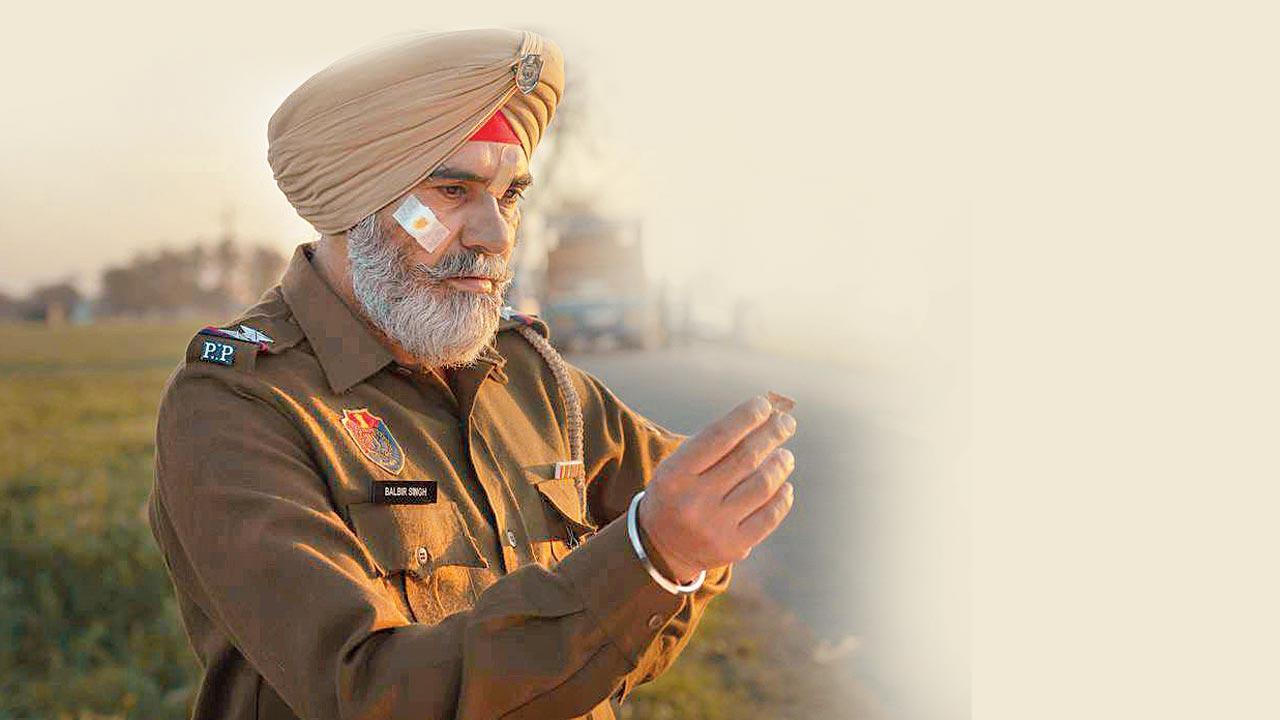
Kohrra creator Sudip on how theatrical movies have been ‘dumbed down’ in the name of entertainment, leading filmmakers to explore brave subjects on OTT
Priyanka Sharma (MID-DAY; July 20, 2023)
“I’m a non-violent person. I have never even got into a heated argument with anyone,” laughs Sudip Sharma, aware that his screen offerings might suggest otherwise. But then, it takes a calm mind to understand the complex subject of violence, its roots, and different manifestations.
After Paatal Lok (2020), Kohrra is creator-writer Sharma’s latest attempt to examine the dark side of humans. “We all carry that darkness inside us as individuals, families and societies. That’s fascinating to explore,” he begins.
The Netflix series sees Suvinder Vicky and Barun Sobti as cops investigating the murder of an NRI groom in Punjab. Under the disguise of a thriller, Kohrra tells a story about love and generational violence. Sharma, who has created the show with Gunjit Chopra and Diggi Sisodia, reveals that love was indeed its genesis.
“The starting point was the title of one of Charles Bukowski’s poems, Love is a dog from hell. We wanted to do a show about relationships. I was coming off Paatal Lok, which was a procedural. So, I didn’t want to do another. But when Gunjit and Diggi pitched the idea, I felt there was an opportunity to explore relationships and how love can be either uplifting or soul-crushing.”
When it came to casting, Sharma knew it was time to work with that actor who had left a lasting impression on him with his bit roles in Udta Punjab (2016) and Paatal Lok. Enter Vicky. “He had one scene in Paatal Lok. But he was so good in that scene that I knew I wanted to work with him again. When we started writing Kohrra, I knew he was the right choice for Balbir Singh. None of his breakthrough work like CAT [2022] and Meel Patthar [2020] had come out then.”
While Kohrra has opened to unanimous praise, Sharma has moved on to the second season of Paatal Lok, which is due next year. So, has he given up on theatrical offerings in favour of long-format stories? Something like that, says Sharma, whose last theatrical venture was Laal Kaptaan (2019), in which he served as a dialogue writer. Reason—“We stopped making films that interested people like me,” he says.
“No one wants to make a film like NH10 or Udta Punjab for theatres today. The thought—if it’s theatrical, it has to be entertaining and understood by all—basically means it has to be dumbed down. They want you to write the kind of films that are getting made. I don’t even watch those films. How can I make them?”
I won’t allow women to be depicted regressively-Anushka Sharma
8:06 AM

On Women’s Day, actor-producer Anushka Sharma discusses how she has tried to change female portrayal on screen by telling stories from feminist gaze
Mohar Basu (MID-DAY; March 8, 2021)
In her 13-year career so far, Anushka Sharma has showcased different shades of women — from the ambitious wedding planner in Band Baaja Baaraat (2010) to the spirited Aarfa in Sultan (2016) and the self-reliant Mamta in Sui Dhaaga (2018). Though the characters resided in different universes, a common thread tied them — each had a strong head on her shoulders and the agency to take life decisions. Sharma stepped up her efforts to change the depiction of women in Indian cinema as she launched her production house in 2015 and backed female-led stories.
As she puts her weight behind another powerful story Mai, the actor-producer says she knew early on in her career that she didn’t want to be boxed as the leading man’s arm candy. “I have been conscious enough to select roles that I felt could contribute towards changing the portrayal of women on screen. I was done seeing myself as an accessory. I vowed that as a producer, I will not allow women to be depicted regressively,” she says. Sharma admits it wasn’t easy to swim against the tide. “It took a lot of self-belief, but it was liberating to do this for myself.”
Her productions are proof that she walked the talk. If NH10 (2015) told the story of a woman raising her voice against honour killing, Bulbbul (2020) depicted the folklore of a blood-thirsty witch from a feminist gaze. Her upcoming offering Mai, headlined by Sakshi Tanwar, revolves around a mother who accidentally gets sucked into the world of violence and power. Sharma says that with each project, she aims to challenge society’s patriarchal ways. “Movies have the power to impact change and help people determine what is right and wrong. By being clear about how we will depict women in cinema, we can alter the mindset of people, and shatter age-old beliefs and customs. My film choices and productions are a testimony to the fact that I’m committed to sparking a conversation in society about equality, self-respect and empowerment.”
We’ve always chased unique ideas-Anushka Sharma
8:14 AM

The actor says that as a producer, she values a story more than its treatment
Juhi Chakraborty (HINDUSTAN TIMES; June 4, 2020)
As a producer, Anushka Sharma is not afraid to push the envelope and back edgy stories with darker narratives, something which began right from her debut production, NH10 (2015). So it came as no surprise when she chose a neo-noir subject, dealing with the underbelly of crime and politics as her production debut on the web.
“I’ve always been drawn to different kinds of things that happen around us in the world and wanted to present that through a story,” the actor tells us, adding, “(My brother) Karnesh and I always believe that content is everything. The most exciting part as a producer and as a creative person is to do films and series like Paatal Lok, which is different, clutter-breaking and progressive.”
Sharma emphasises that when it comes to backing a project, the storyline has been more important than the overall treatment. “So, we did a film like NH10 which was fierce, we also did Phillauri (2017) that is about a friendly ghost. I feel different, bold and out-of-the-box content has always been our interest,” she says.
Revealing how she decides which project to be associated with, the 32-year-old says the one common thread between everything she has produced so far is that the ideas have been “new and fresh”. She adds, “We’ve always chased unique ideas, that has been something we believed in whenever we took up a story.”
Regarding her involvement with a project as the producer, Sharma reveals she remains involved right from the ideation stage till the final product. “Sometimes, I’m physically unavailable as I’m doing so many other things at the same time. I’m involved nevertheless from the beginning to the end.”
The actor has been in lockdown with her parents and husband, cricketer Virat Kohli in Mumbai. She calls the experience “enlightening” and admits it has made her more aware of the world around.
“The current situation in the world is quite grim and unfortunate, it can make you feel helpless. But, the only thing, you realise that you can do during these times, is reach out to people as much as you can and ease someone’s load,” says the actor, who is making the most of the Coronavirus lockdown “focusing on family time and catching up on shows and films, taking care of my health and baking a bit to occupy my mind”.
Male actors are better valued than us in Hindi cinema-Anushka Sharma
7:56 AM

Mohar Basu (MID-DAY; July 25, 2017)
Anushka Sharma, one of Bollywood's most successful female actors, is not delusional about the power that she and her colleagues yield in the industry. She admits the scenario is skewed in favour of the boys.This means that male actors enjoy the privilege of receiving greater accolades and criticism than their female leads, depending on how the film fairs.
Her co-star from last year's hit, Ae Dil Hai Mushkil, and the not-so-lucky Bombay Velvet (2015), Ranbir Kapoor had in a recent interview shared the reactions he received after the latter bombed at the box office. "The hugs were longer than usual. It was as if they were offering condolences," he said. Sharma, who was cast opposite him in the Phantom Films production, didn't have it as tough. "What happened to him was unfair. He is one of the best actors we have today. But it's also because Bombay Velvet was Johnny's film more than Rosie's," she says of the characters the lead pair essayed. "I would have been held solely responsible if NH10 [Sharma's first film as producer and female lead] had flopped, not because I produced it, but because the film was riding on my shoulders. But, he continues to be targeted also because of other films he did [that didn't fare well]. I was relatively less affected because I had successful films before and after Bombay Velvet."
Sharma explains that the contribution and involvement of a male star in a film is way more than a female actor's. And it's years of social conditioning that's to blame. "Films led by female actors do not open to remarkable numbers. A lot of us are trying to change that with the kind of work we do," she adds. "Who said that the industry was fair? Talking of the gender divide won't make it go away. Male actors are better valued than us in Hindi cinema. As an actor, what I can do is choose roles that send out a message [of empowerment, both as actor and the character]. As producer, I am trying to foster a new value system that makes content king in the long run."
Nobody needs to help me financially-Anushka Sharma on doing things the right way
8:12 AM

Nayandeep Rakshit (DNA; March 23, 2017)
I walk into Anushka Sharma’s office and she Snapchats the moment and captions it: “He’s promised to finish the interview in three minutes.” She laughs at my shocked reaction. But then, we end up chatting for close to an hour. Eventually, her pet cats come knocking on the glass door to remind us that the clock is ticking. During that time, the actress talks about her upcoming film, her ideas behind production, her strategies as an actor and producer, and more. Read on...
Most ghost stories are scary. Phillauri isn’t.
We don’t know how ghosts behave, so we can take the leap of faith and decide that this one is a friendly ghost. Phillauri is definitely an interesting take on ghosts. It’s in a fun space. I did find that different and exciting.
Did you deliberately make a fun film because your first production (NH10) was hard-hitting and intense?
As producers, we just want to tell stories. Sometimes, it might be a thriller, or a film like Phillauri, which is a complete family entertainer and sometimes, it might just be a scary horror film. There are no pre-conceived ideas about what we want to do next. We just react to stories. That’s about it.
Do you like watching ghost films?
I do like watching them but I like thrillers more than ghost films. I don’t remember too many. The Conjuring was scary. The Exorcist was amazingly scary, too.
Do you get scared while watching a film?
Who doesn’t? If someone says they aren’t, they are lying. When you watch these films, you get scared, you close your eyes, watch it through the gaps of your fingers. And my brother Karnesh and I always used to watch the show called Woh like that. Do you remember? It was so good.
Reports suggest Phillauri is similar to The Corpse Bride...
Absolutely not! The only similarity is that there is a ghost and there’s a man and the marriage that happens between them. Our concept is about a man who gets married to a tree, which is an entirely Indian concept. Then, there is a love story of the ghost. In The Corpse Bride, the ghost forces the guy to get married to him because she wants marriage. This is completely the opposite. Here, the ghost is as scared as the guy.
The films you are producing might not be women-centric but they’re always from a female protagonist’s perspective. Does that play in your mind when you select scripts?
How you are as a person, what your sensibilities are — these things are parameters on the basis of which you will decide things in life. You will always get attracted to things that match your desires and sensibilities. So who I am as a person matters a lot when I say yes to a film. When I am narrated a story, I won’t relate to something which is regressive or isn’t the right portrayal of a character or a girl. That’s how I deal with my choices as an actor and a producer. In fact, even more so because my brother and I both strongly feel about this. It’s about our upbringing and the way we see the world that plays an integral role in the scripts we pick. And for me, I want my characters to have a voice. If I’m playing a character where I don’t have a perspective, a point of view or have anything to say, then I don’t understand what I’m doing in the film.
There’s a huge disparity in the wages of men and women in the industry. As a female producer, does the same disparity happen with investors and budgets?
I think you are addressing what Sonam said on the same issue. Honestly, I don’t know what the budget of her film is. So I won’t comment on it. But yes, I just know that with the success of NH10, it was a lot easier to get Phillauri greenlit. Also, I am in a different and I would say, in a better position in my career than what I was when I did NH10. So it depends from film to film. I don’t know what a male actors’ contract is with the studio when they make a film. But if there’s disparity in general, I’m sure it will be there in this equation. Exactly what it is, I don’t want to be careless and make a comment. But just knowing the way things are, it is possible. I also think that while we speak about all of this, which is correct and everyone should speak about, we should choose and do things that help change the system. And helps in making the stand of female actors stronger. Our choices should lend its way to doing all that and that will be the way forward. That is why I feel very empowered as an actress when I’m producing a film. It’s a bigger sense of responsilibility and ownership. The possibilities are so much more of what things can be and where you can take it to.
But had NH10 not worked, do you think situations would have been different now?
It’s a hypothetical question and I really don’t know. I am a very instinctive person and I react to everything. So I don’t know how I would have reacted had it not worked. I was quite confident of the film honestly and how the film would go on to do. I knew we had a great film in hand which will be respected. The fact that it made money as well is a big thing. So I didn’t think about the flip side of it. There’s no point also. I mean why? How would it help? I don’t think about a film’s failure that I have signed up for. It’s stupid. The time that you took to make a decision of whether to do it or not — that’s the time when all these questions should be answered within you. That itself is going to be the deciding factor. If you have chosen the film for wrong reasons, without enough understanding the potential of the film, then you can be worried about it. But when you choose a film with conviction, you go on the sets, do your best and then uske baad worry karna is mindless. As a producer, I am doubly sure before I do a film. With Phillauri, we have been involved with it since the inception, we know what we have in hand. But then again, it might not work because nobody really knows the hit formula for any film. But content driven films with unique subjects always do well and we have seen that in the past as well.
Your films PK and Sultan both did 300 crore business. Does it put more pressure on you to deliver with your other films?
I won’t say there’s pressure but obviously, you want to deliver at the box office with all your films. It is not a burden. I don’t take it as one because as a person, I don’t take myself too seriously. I am very practical about things. If I have taken a decision to produce, I have to be very confident about the content I have. Uske baad, how much the film does, no one can profess. But me being a bankable actress today or with the success of the films that you’ve mentioned, helps and allows me to get film greenlit if I’m in it. So it’s easy for me to make those films. The responsibility then is to make profits from it because there’s a studio involved in it. It is a business at the end of the day which you are working towards. But I don’t take baggage of some other film for this film. That’s why we call it Clean Slate Films. There’s no prejudice or baggage. We treat each film differently. This film has its own journey, life and its own audience. It’s a different space altogether. You don’t know what will happen because such a film has not been attempted before. Even I’m excited to find that out. The idea is to make your films financially viable and according to me, you do that by offering strong content, something new and extraordinary to people. See, Khan films are huge films because they are huge stars and they have been that over generations. That guarantees them a certain audience. Today, when you have access to so much with Netflix and all on your laptop, if you ask audiences to come and watch a film, you really have to offer them something very extraordinary or unique for them to increase footfalls at the theatre. We are creating that to intrigue people. That’s what I am doing. I won’t compare the success of some other film which is in a completely different space with this one.
When you are producing a film on a limited budget and getting big returns, is it more satisfying then doing a big with big budget and big numbers?
People don’t really understand the term ‘return on investment’ well. People only relate to a film doing so much money whether it’s 100 crore or whatever. Of course, Sultan and PK made a lot of money for the producers too. But I’m just talking in general. When people talk about films ki yeh film ne 100 crore kama liya, nobody is actually talking about how much the film is made for. It’s very fashionable to say it’s 100 crore film but what’s more important is the return on investment. That’s what we are interested in. NH10 returned on investment. How much it was made for and how much it made — that’s what is important and that’s our way of working. Sultan, PK, Dangal they obviously had made that much money and also in terms of ratios, they had higher returns. But then, there are also films where that is not the case. Only perception is created that these films are actually huge. I guess, with medium budget films, if they are made right, as we have seen in the past, the ratio of return on investment is much more.
In an interview, Kangana Ranaut said actresses who work with Khans don’t have longevity. You have worked with all of them. Your comment?
I cannot comment on what Kangana said because I don’t know what the context was and what she actually said. But I also have the same belief that I won’t just be a showpiece in a film. Just like Kangana thinks, rightfully so. I wouldn’t have done the film if I was just another showpiece. The fact that I’ve done the film is because I had a role to play and a contribution to make to the film which was recognised and stood out. So I won’t completely agree with that.
You have decided not to talk about your personal life...
I am not comfortable talking about my personal life and that’s completely my decision. It is not about actor or actresses. I might be an actor, but I am also a person with life principles and according to me, being open about my relationship is not something I feel I need to do. I’m guarded as a person and I have always been like this.
There was a time when people wrote about Virat backing your banner financially. Do you think people today don’t like watching a strong independent woman?
I think it comes from there — a very, very deep rooted misogyny. Where people feel that if a girl is doing something great on her own, obviously she has got some help. People who speak this way have no spine. All working women know this by now that we will experience such things because whenever there’s a change or you do something different from what people are used to, they will react this way. They are not used to a girl doing something on her own because they might not have ever done something like that. And then, suddenly they see a girl who is independently getting into something, obviously it is going to disturb them. When people are used to something and that is challenged or changed, it disturbs them. I think all of us should accept that this will happen. I felt sad, angry but I’m not going to let them get in the way. I believe that whenever you will do something good, there will always be someone to pull you down or make you feel like s**t. You just have to ignore it. Don’t give a damn and keep walking. And as you go further and further on the road, the noises become quieter and quieter.
Because of these rumours, would you never ask Virat for help, even if it’s not financial? Maybe just to avoid such stories?
Nobody needs to help me financially. I am very, very independent financially and I’ll be that for the rest of my life. I will never change the way I am because of what people expect or think of me because if I’d done that, I wouldn’t have come so far in my life. I don’t need any financial help from anybody and I don’t say that with arrogance, I say that with pride. It’s just that I have reached so far, on my own accord and nobody can take away my credit away from me.
Trolls are powerless people who have an issue with women expressing themselves-Anushka Sharma
8:04 AM

Madhureeta Mukherjee (BOMBAY TIMES; March 21, 2017)
Hate begets hate. Positivity
spawns positivity and failure is just one more step in our march to
success - this is the mantra that Anushka Sharma lives by. She shrugs
off slander, laughs away at the evils of social media and confesses that
she didn't have a clear vision from the beginning, but says, “I knew
what I didn't want to do.“ That's her - feisty and fearless. It reflects
in her choices of films, too. Like the upcoming Phillauri, which is also
her second production with brother Karnesh. How different can she be?
Read on to find out more about what makes Anushka tick...
For NH10, your first film as producer, you chose Navdeep Singh as your director, who was just one-film old. Now, for Phillauri, you are again working with a first-time director, Anshai Lal. You really vest a lot of faith in new talent, right?
I have worked in Band Baaja Baaraat with a new director, Maneesh Sharma, and that was a turning point in my career. In fact, at that point, when I was so new, I needed an established director even more, but I believed in him. I think at some point someone gave me a chance, so there is no reason why I shouldn't do the same. I hadn't seen Manorama Six Feet Under when I decided to work with Navdeep Singh. I judged him on the basis of how he had written the story and the way he narrated the film. Sometimes, your instinct tells you that something is right.
Anshai Lal, on the other hand, has been my brother Karnesh's (producer) friend for years and when he came up with the idea, we all liked it, but there was no story around it. I was intrigued by his take on something like a boy getting married to a tree because he is a manglik.
In Bollywood when a film does well, people rush to adapt, remake and repackage the same concept. Even actors follow suit, and it becomes a vicious cycle...
The industry likes to repeat things that have worked with the audiences. I am completely the opposite of that. I will not do something that I have done before. I have refused a lot of good scripts just on those grounds. The films were good and they did well too, but it didn't work in my scheme of things. After NH10, I was offered a lot of roles to play a strong woman avenging her husband's death, but I wasn't keen on doing them. If something has worked and it's repeated, how will it work again?
If you observe, often when people come to you with scripts, they give you a reference of some other film. Like that, NH10 became a reference film. And I want to create more such reference films. Today, people have access to all kinds of entertainment from around the world, so unless it is a Salman, SRK or Aamir film, which draws audience to the theatres owing to their huge fan following, you have to offer the film goers something different. That is the only way you can get them to the theatres. Even Sultan for that matter, was different for a Salman Khan film. In the same way, Phillauri is dealing with something new, even if it is a commercial family film. In fact, the way the character of the bhoot has been presented visually is something you have never seen before in films.
Do you think that when a film fails, the entire onus is on the actor?
That's not true. It affects everyone. But the thing with actors is that when a film fails, we can quickly move on to another film, but a director finds it harder to come out of a slump. The recovery is quicker for actors, because we can work on many films at the same time.
From the start, you seemed to have a clear vision of what you wanted to do, and the pressures of stardom haven't tempted you to do otherwise. Like resisting the need to work with only superstars so that your stock goes higher...
I haven't done it for nine years, why would I do it now? I didn't succumb when I was new, so there is no question of it at this stage. It's not like I had a clear vision, but from the beginning, I knew what I didn't want to do. I don't want to just look glamorous in a film because I believe I have more to offer. And I want chances to express that.
Your brother Karnesh and you seem to be great business partners, but do sibling squabbles ever come in the way?
We have our fights, but the truth is that when you are working with a family member, you forget about being tactful. On the contrary, when you are working with someone else, you are often careful about what you say and do. Karnesh and I had to travel this journey and reach a point where we could comfortably find a balance, which is important for a healthy partnership. The trust factor between us is immense, and our values are the same, as we have been brought up by the same people. We both deal with situations in a similar way. Our parents are proud and happy that we are doing something together, though they don't specifically discuss films, unless it comes up in conversations. They are not film parents who get involved in what we are doing.
A few years ago, you were advised to not get into the production business...
People say things to you depending on the way they understand the world. I don't think that they are doing it out of malice in their heart - that's what they know, so that's what they will tell you. If I was scared of failing as a producer, I wouldn't be in the business. I know that physically, I can't be everywhere, but I am wholly and entirely involved in everything along with my brother. I think responsibility pushes me and I'm not the kind to crack under pressure. There were people from the industry like Mukesh Bhatt who called me up and encouraged me when I turned producer. And there were some who didn't take me seriously. I guess they thought it's a random one-off thing, but now they have realised that I am serious about it. When people deter me, it only makes me stronger. I know being a producer is risky business, but what is not risky? Even when you act in a film its risky because you don't know what its fate will be. I don't work with fear, I work with conviction.
You have expressed you anger against trolls on social media. What is your way of dealing with them?
When my films are releasing, I look up a lot at my mentions, otherwise I don't bother. The best thing to do when someone is being inappropriate is just ignore and block them. Block the trolls - it is the best feeling. I believe that if you don't have anything good to say, don't say any thing at all. We live in a world where hatred is on the rise and people think it is okay to hate. I don't want to encourage it, even if it is on social media. As an actor, I don't need any of those people in my space. After a whole day of hard work, the last thing you need is people talking bulls**t and being nasty. Sometimes, you have to be come thick-skinned as an actor. You begin to understand how these people out there are insecure and unhappy about your life and success. There are a lot of misogynistic men out there, who have an issue with women expressing themselves. They cannot stand it and this is how they express it. They are actually powerless people. The only power they have is the 140-characters online.
Taking off from what you just said, have all these years in the industry made you thick-skinned?
I won't say that nothing bothers me, but I'm logical and practical. Once I understand why someone is saying something, I deal with it better. Yes, there are times when you get very shaky and upset, but you have to let it pass. For me, the most important thing in my life is to make peace with things and move on. Frankly, I have not faced extreme failure ever in my life. Also, given the number of years I've been around, I've done fewer films compared to my contemporaries. I leave no stone unturned to do my best; if it doesn't work, I just accept it. I know that we all like to be control freaks, but trying to control things too much can mess you up. I think it is important to go through failures to change the course of action in your life. Sometimes, failure is a telling sign, and you got to understand it and act on it.
There has been a lot of talk about your supposed engagement (to Virat Kohli). Is marriage on the cards soon?
It's not something I like to talk about. I want all the focus to be on my work and I am giving people enough reasons to talk about my work (smiles).
For NH10, your first film as producer, you chose Navdeep Singh as your director, who was just one-film old. Now, for Phillauri, you are again working with a first-time director, Anshai Lal. You really vest a lot of faith in new talent, right?
I have worked in Band Baaja Baaraat with a new director, Maneesh Sharma, and that was a turning point in my career. In fact, at that point, when I was so new, I needed an established director even more, but I believed in him. I think at some point someone gave me a chance, so there is no reason why I shouldn't do the same. I hadn't seen Manorama Six Feet Under when I decided to work with Navdeep Singh. I judged him on the basis of how he had written the story and the way he narrated the film. Sometimes, your instinct tells you that something is right.
Anshai Lal, on the other hand, has been my brother Karnesh's (producer) friend for years and when he came up with the idea, we all liked it, but there was no story around it. I was intrigued by his take on something like a boy getting married to a tree because he is a manglik.
In Bollywood when a film does well, people rush to adapt, remake and repackage the same concept. Even actors follow suit, and it becomes a vicious cycle...
The industry likes to repeat things that have worked with the audiences. I am completely the opposite of that. I will not do something that I have done before. I have refused a lot of good scripts just on those grounds. The films were good and they did well too, but it didn't work in my scheme of things. After NH10, I was offered a lot of roles to play a strong woman avenging her husband's death, but I wasn't keen on doing them. If something has worked and it's repeated, how will it work again?
If you observe, often when people come to you with scripts, they give you a reference of some other film. Like that, NH10 became a reference film. And I want to create more such reference films. Today, people have access to all kinds of entertainment from around the world, so unless it is a Salman, SRK or Aamir film, which draws audience to the theatres owing to their huge fan following, you have to offer the film goers something different. That is the only way you can get them to the theatres. Even Sultan for that matter, was different for a Salman Khan film. In the same way, Phillauri is dealing with something new, even if it is a commercial family film. In fact, the way the character of the bhoot has been presented visually is something you have never seen before in films.
Do you think that when a film fails, the entire onus is on the actor?
That's not true. It affects everyone. But the thing with actors is that when a film fails, we can quickly move on to another film, but a director finds it harder to come out of a slump. The recovery is quicker for actors, because we can work on many films at the same time.
From the start, you seemed to have a clear vision of what you wanted to do, and the pressures of stardom haven't tempted you to do otherwise. Like resisting the need to work with only superstars so that your stock goes higher...
I haven't done it for nine years, why would I do it now? I didn't succumb when I was new, so there is no question of it at this stage. It's not like I had a clear vision, but from the beginning, I knew what I didn't want to do. I don't want to just look glamorous in a film because I believe I have more to offer. And I want chances to express that.
Your brother Karnesh and you seem to be great business partners, but do sibling squabbles ever come in the way?
We have our fights, but the truth is that when you are working with a family member, you forget about being tactful. On the contrary, when you are working with someone else, you are often careful about what you say and do. Karnesh and I had to travel this journey and reach a point where we could comfortably find a balance, which is important for a healthy partnership. The trust factor between us is immense, and our values are the same, as we have been brought up by the same people. We both deal with situations in a similar way. Our parents are proud and happy that we are doing something together, though they don't specifically discuss films, unless it comes up in conversations. They are not film parents who get involved in what we are doing.
A few years ago, you were advised to not get into the production business...
People say things to you depending on the way they understand the world. I don't think that they are doing it out of malice in their heart - that's what they know, so that's what they will tell you. If I was scared of failing as a producer, I wouldn't be in the business. I know that physically, I can't be everywhere, but I am wholly and entirely involved in everything along with my brother. I think responsibility pushes me and I'm not the kind to crack under pressure. There were people from the industry like Mukesh Bhatt who called me up and encouraged me when I turned producer. And there were some who didn't take me seriously. I guess they thought it's a random one-off thing, but now they have realised that I am serious about it. When people deter me, it only makes me stronger. I know being a producer is risky business, but what is not risky? Even when you act in a film its risky because you don't know what its fate will be. I don't work with fear, I work with conviction.
You have expressed you anger against trolls on social media. What is your way of dealing with them?
When my films are releasing, I look up a lot at my mentions, otherwise I don't bother. The best thing to do when someone is being inappropriate is just ignore and block them. Block the trolls - it is the best feeling. I believe that if you don't have anything good to say, don't say any thing at all. We live in a world where hatred is on the rise and people think it is okay to hate. I don't want to encourage it, even if it is on social media. As an actor, I don't need any of those people in my space. After a whole day of hard work, the last thing you need is people talking bulls**t and being nasty. Sometimes, you have to be come thick-skinned as an actor. You begin to understand how these people out there are insecure and unhappy about your life and success. There are a lot of misogynistic men out there, who have an issue with women expressing themselves. They cannot stand it and this is how they express it. They are actually powerless people. The only power they have is the 140-characters online.
Taking off from what you just said, have all these years in the industry made you thick-skinned?
I won't say that nothing bothers me, but I'm logical and practical. Once I understand why someone is saying something, I deal with it better. Yes, there are times when you get very shaky and upset, but you have to let it pass. For me, the most important thing in my life is to make peace with things and move on. Frankly, I have not faced extreme failure ever in my life. Also, given the number of years I've been around, I've done fewer films compared to my contemporaries. I leave no stone unturned to do my best; if it doesn't work, I just accept it. I know that we all like to be control freaks, but trying to control things too much can mess you up. I think it is important to go through failures to change the course of action in your life. Sometimes, failure is a telling sign, and you got to understand it and act on it.
There has been a lot of talk about your supposed engagement (to Virat Kohli). Is marriage on the cards soon?
It's not something I like to talk about. I want all the focus to be on my work and I am giving people enough reasons to talk about my work (smiles).

We are living our dream-Anushka Sharma & Karnesh Sharma
8:24 AM

When younger, Anushka Sharma would find her brother Karnesh irritating. Today, they have teamed up to create magic on screen
Sonil Dedhia (MID-DAY; March 12, 2017)
Our conversation begins with some guy talk. Anushka Sharma's brother, Karnesh, enquires about the mid-day mate. "I remember it used to be popular," he says. A shocked Anushka is clueless about what her brother is talking about. When told it is a photograph of a sexy girl in a bikini, she quickly says, "Why isn't there a picture of a man too?" It's a hot afternoon and we are at Anushka's home in Versova. In a tete-a-tete with the siblings, who are ready with their second production Phillauri, we talk about filmmaking and bonding.
Your first production venture NH10 (2015) was a thriller which was critically-acclaimed. Did people approach you with scripts of the same genre?
Karnesh: Yes. It was not only newcomers, but established directors and writers as well who pitched women-centric thrillers or about a woman avenging her husband's death.
Anushka: It's funny because people should understand we will not make a film on the same subject again. Even as an actor, I do not. NH10 and Phillauri are such diverse films. We're trying to create different and new content.
What comes to your mind when people say womencentric film? Do you identify with the term?
Anushka: I don't identify with it because stories are about people. It can be a male or female protagonist. Phillauri is about a ghost; it is her love story. A woman-centric film is not always about strength, substance or fighting society.
Karnesh: It is only here that we talk about woman-centric films. It doesn't happen in Hollywood or European cinema. People are aware of telling stories with women as the protagonist; that's why there is a debate about women-centric films.
Phillauri deals with mangliks who are considered unfavourable for marriage? Do you believe in it?
Anushka: Karnesh is a manglik and I told him to get married to a tree for the film's promotions and he refused [laughs].
Karnesh: Not for film promotions [laughs]! On a serious note, I don't believe in it.
Anushka, do you find your brother annoying?
Anushka: There was a time when I would get irritated, but it was when I was younger. We would complain to our parents, but today we respect and accept each other.
Karnesh: I like how we are today, and not when we were younger. I am enjoying what we are doing. I wish it had came a little earlier in life, but probably we wouldn't have had the same understanding of each other. So, I guess everything has the right time.
How were you as kids? Anushka, being younger, would you always get away with tantrums?
Karnesh: I had more tantrums than her.
Anushka: I remember when I was seven, he coaxed me to ask my parents for a video game as a birthday gift. I was least interested in it. He told me, "Bahut mazza aayega saath main khelenge." I never saw the joystick of the game even once.
Karnesh: I have been manipulative, but now I am making up for it.
Karnesh, you were in the merchant navy. What made you get into film production?
Karnesh: I got bored of sailing. People think it's a cool job and you get to travel the world, but that's not the case. There were times when I was working for almost 20 hours a day. I thought if I continue, I will remain alone all my life. Maneesh Sharma was directing Shuddh Desi Romance (2013) and he suggested I should try it out with him.
Anushka: Maneesh directed me in Band Baaja Baaraat (2010). Whenever I make friends, I make sure they meet my brother because I don't know how to carry on friendships [laughs]. I am socially inept. Whenever Maneesh would write a script, he would call Karnesh as he has good judgement and gives an honest opinion. In fact, Adi [Aditya Chopra] has called him on several occasions too.
Anushka, you have starred in both your productions. Would you plan a film without starring in it?
Anushka: Of course. By God's grace, I am doing well in my career, so I don't need my production house to make films for myself. If I don't fit into the scheme of things, I will not.
Karnesh: Scripts are not written keeping Anushka in mind. We don't write scripts keeping any particular actor in mind.
What are your plans for the future?
Anushka: To be able to make the kind of films we want to. We have great ideas and plans. We don't look for other people's mistakes and what our action should be.
Karnesh: We are pursuing our dreams and we aren't going to change our plans according to others.

Girls all set to pack a PUNCH in 2017
8:08 AM

Rachana Dubey (BOMBAY TIMES; January 2, 2017)
Year 2017 has just kicked in
with some pleasant news. It is set to continue the successful run of
women-centric films at the box office, as leading ladies will slug it
out with solo heroine films. It's girl power all the way, with Anushka
Sharma, Kangana Ranaut, Vidya Balan, Sonakshi Sinha, Rani Mukerji, Sonam
Kapoor, Kareena Kapoor Khan and Shraddha Kapoor coming up with films in
which they play the protagonist.
Vidya is set to lead the girl pack with three films this year - Begum Jaan, Tumhari Sullu and Kamala Das' biopic, followed by Sonakshi in Noor, Kangana in Simran, Shraddha in Haseena and Kareena-Sonam's Veere Di Wedding. Besides acting in Phillauri, Anushka has also taken over as the producer - her second production after NH10. Rani's comeback vehicle post motherhood will roll mid-year, too.

LONGEVITY OF THE TREND
Says independent distributor Amod Mehra, “The boy-girl-romance-drama formula has run out of steam. We have progressed from the Main Chup Rahungi-type female-oriented stories to contemporary and bold ones like NH10. Content, in the last few years, has emerged as the king. And since there is acceptance for a great story, even those revolving around women are applauded.“ He adds that the longevity of this trend will depend on how hefty the pay packets of these heroines become eventually. “Actresses must take a cue from their male counterparts and partner as producers to reduce cost-driven risks. Anushka does that, others can do it too. Apart from the monetary factor, finding a suitable male lead is increasingly becoming a problem that has to be addressed.“

PAY GAP
Between 2014 and 2016, over two dozen films have been made with heroines playing dominant roles, with theirs as the only faces on the posters, like Queen, Mary Kom, Mardaani, NH10, Tanu Weds Manu Returns, Piku, Dear Zindagi, Neerja and Pink. Most of these films hit the bullseye, but heroines still don't earn as much as the heroes. The pay disparity in Bollywood continues.
Producer Vikram Malhotra, who is currently backing Noor, says that the gender pay gap is not only a subject of intense debate in India, but also in Hollywood. He adds, “The dominant female lead is an idea that has now found firm footing in the Hindi movie industry and is here to stay. Films like Queen, Neerja and Pink have not only garnered critical acclaim and awards, but have also set the cash registers ringing. Given this blend of creative and commercial success, the number of scripts being written with female protagonists will only shoot up. And like in any industry or business, compensation for talent, male or female, will have to be commensurate with the commercial results that an artiste can deliver directly or influence. So, the subject of higher fees for female movie stars will have to be seen in this light.“
Producer Mukesh Bhatt believes otherwise. He stresses that eliminating pay packet dis parity seems impossible. “For years, films have had strong heroines. But this is a male-dominated industry. Even when a woman plays an equally strong role as a man, her pay packet is not likely to match up to him, thanks to the age-old dynamics,“ he says.

BIASES BEYOND PAY GAP
Most gender biases begin at the writing stage. Hearsay is that NH10, one of 2015's critically acclaimed films, didn't have takers back then, despite an international female lead in place. It was reportedly titled Kaali and had Frieda Pinto in the lead. For the lack of studio backing, it almost didn't get made and the writers contemplated changing it from a female-driven film to a male-driven commercial movie. Luckily, Anushka's entry gave the project a new lease of life and the results are for everyone to see. Shoojit Sircar couldn't find a studio to back Pink either, but the filmmaker released it with his partners. The rest is history.
According to writer Juhi Chaturvedi, who wrote Piku, filmmakers, over the last few years, have consistently been making efforts to reduce the gap. “Shoojit, while making Pink, wasn't trying to 'repeat' the success of his past movie. But generally, films with heroines are becoming popular with the ticket buyers, and producers have no choice. Scripts are written with heroines in mind. As a creative industry, we're influencing change and are getting influenced too. Deepika Padukone, Kangana and even Alia Bhatt prove that actresses are more than just props. They've raised expectations so much that the audience questions if their roles are not finely written. And this, at some point, will reflect in their salaries, too,“ she says.

The writer is quick to add a word of caution. “Nothing must be done for the heck of it. Overindulgence is not a good idea. Don't put the heroines on a pedestal while trying to make them relevant. I agree that the importance heroines are enjoying today was long overdue, but a balance has to be struck. Otherwise, there might come a day when we'd be fighting gender bias from the other sex's point of view.“
The box office is the culmination point for every film. Ticket sales are the true deciders. Cinema-chain head honcho Manoj Desai believes that a male or a female can only create an initial draw. The sustenance depends on a film's subject and performances. He sums up, “It seems 2017 will be the year of heroines. The line-up is strong and the stories we hear are quite promising but we'll have to wait and watch what eventually happens. But if what is promised is delivered in these heroine-centric films, there's no stopping the girls at the box office.“
Vidya is set to lead the girl pack with three films this year - Begum Jaan, Tumhari Sullu and Kamala Das' biopic, followed by Sonakshi in Noor, Kangana in Simran, Shraddha in Haseena and Kareena-Sonam's Veere Di Wedding. Besides acting in Phillauri, Anushka has also taken over as the producer - her second production after NH10. Rani's comeback vehicle post motherhood will roll mid-year, too.
LONGEVITY OF THE TREND
Says independent distributor Amod Mehra, “The boy-girl-romance-drama formula has run out of steam. We have progressed from the Main Chup Rahungi-type female-oriented stories to contemporary and bold ones like NH10. Content, in the last few years, has emerged as the king. And since there is acceptance for a great story, even those revolving around women are applauded.“ He adds that the longevity of this trend will depend on how hefty the pay packets of these heroines become eventually. “Actresses must take a cue from their male counterparts and partner as producers to reduce cost-driven risks. Anushka does that, others can do it too. Apart from the monetary factor, finding a suitable male lead is increasingly becoming a problem that has to be addressed.“
PAY GAP
Between 2014 and 2016, over two dozen films have been made with heroines playing dominant roles, with theirs as the only faces on the posters, like Queen, Mary Kom, Mardaani, NH10, Tanu Weds Manu Returns, Piku, Dear Zindagi, Neerja and Pink. Most of these films hit the bullseye, but heroines still don't earn as much as the heroes. The pay disparity in Bollywood continues.
Producer Vikram Malhotra, who is currently backing Noor, says that the gender pay gap is not only a subject of intense debate in India, but also in Hollywood. He adds, “The dominant female lead is an idea that has now found firm footing in the Hindi movie industry and is here to stay. Films like Queen, Neerja and Pink have not only garnered critical acclaim and awards, but have also set the cash registers ringing. Given this blend of creative and commercial success, the number of scripts being written with female protagonists will only shoot up. And like in any industry or business, compensation for talent, male or female, will have to be commensurate with the commercial results that an artiste can deliver directly or influence. So, the subject of higher fees for female movie stars will have to be seen in this light.“
Producer Mukesh Bhatt believes otherwise. He stresses that eliminating pay packet dis parity seems impossible. “For years, films have had strong heroines. But this is a male-dominated industry. Even when a woman plays an equally strong role as a man, her pay packet is not likely to match up to him, thanks to the age-old dynamics,“ he says.
BIASES BEYOND PAY GAP
Most gender biases begin at the writing stage. Hearsay is that NH10, one of 2015's critically acclaimed films, didn't have takers back then, despite an international female lead in place. It was reportedly titled Kaali and had Frieda Pinto in the lead. For the lack of studio backing, it almost didn't get made and the writers contemplated changing it from a female-driven film to a male-driven commercial movie. Luckily, Anushka's entry gave the project a new lease of life and the results are for everyone to see. Shoojit Sircar couldn't find a studio to back Pink either, but the filmmaker released it with his partners. The rest is history.
According to writer Juhi Chaturvedi, who wrote Piku, filmmakers, over the last few years, have consistently been making efforts to reduce the gap. “Shoojit, while making Pink, wasn't trying to 'repeat' the success of his past movie. But generally, films with heroines are becoming popular with the ticket buyers, and producers have no choice. Scripts are written with heroines in mind. As a creative industry, we're influencing change and are getting influenced too. Deepika Padukone, Kangana and even Alia Bhatt prove that actresses are more than just props. They've raised expectations so much that the audience questions if their roles are not finely written. And this, at some point, will reflect in their salaries, too,“ she says.
The writer is quick to add a word of caution. “Nothing must be done for the heck of it. Overindulgence is not a good idea. Don't put the heroines on a pedestal while trying to make them relevant. I agree that the importance heroines are enjoying today was long overdue, but a balance has to be struck. Otherwise, there might come a day when we'd be fighting gender bias from the other sex's point of view.“
The box office is the culmination point for every film. Ticket sales are the true deciders. Cinema-chain head honcho Manoj Desai believes that a male or a female can only create an initial draw. The sustenance depends on a film's subject and performances. He sums up, “It seems 2017 will be the year of heroines. The line-up is strong and the stories we hear are quite promising but we'll have to wait and watch what eventually happens. But if what is promised is delivered in these heroine-centric films, there's no stopping the girls at the box office.“

I look at my company like a startup-Anushka Sharma
8:21 AM

Anushka Sharma on surging ahead as a producer with Phillauri, why she is okay with her films not making money right away and how she’s factoring that in
Nayandeep Rakshit (DNA; December 14, 2016)
It’s not easy being a female producer. Ask Anushka Sharma and she laughingly admits, “I can’t expect studios to give me a budget for my films, which they might give an Aamir Khan.” Run by Anushka and her brother Karnesh, Clean Slate Films is ready with their second release Phillauri, which releases next year on March 24. And when Anushka decided to jump into production, she had only one word in mind: content. Here, Anushka talks about being a young producer and the daily struggles that come with it. Over to her...
Is it difficult to produce content-oriented small budget films and release them?
Definitely. I did NH10 without charging a fee. I couldn’t. The film had to be budgeted well and that’s why it went on to be a profitable venture. I’ll explain it to you. See, if I am a studio and Rajkumar Hirani wants to make a film with Aamir Khan, obviously I will give up my entire life’s savings knowing well that the two of them will come up with something incredible. But when it comes to a newer director, situations are different. Since NH10 did not have commercial elements, for that film to work, I had to produce the film. For it to get a greenlight from the studio, we had to go all in.
With Phillauri, has that struggle ended?
Phillauri is a more commercial film than NH10. It’s a fun film with comedy and romance. So we definitely have a better budget for the film. Anshai is a new director. You don’t know anything about him and people can be sceptical about it. But when an actor backs a film like this, the studio feels more confident about it. Today, as an actress, I feel I have that bankability because of the films that I have done, that a studio feels some merit in the films I do and would readily okay a certain budget for it. That’s the reason why they would back a film like Phillauri. Because if I’m coming with something, I’m coming with content. It’s not going to be an empty film. It will be properly prepared, worked on and the script too will be checked before presenting it to anyone. That’s the way we will work. It’s difficult because we are new players. If people are basing their judgment just on the people attached to it, then it’s a problem. But if they give value to content and then me being a part of such a film adds more value to it, it becomes easier to make a film happen.
Recently, Sonam Kapoor said that women don’t get a certain budget for their films which probably a male actor does, which is why the scale of her film has dropped and she and Kareena have had to slash their prices. Comment...
See, I am not going to comment on that because I have absolutely no idea about what Sonam has said. I don’t even know the budgets of each of these films, so it will be a very careless comment if I make it. But only from my point of view, I will talk. Literally, I am making Phillauri with just a big heart. That’s the only way I would have been able to make the film. Every film has a different story and different challenges. This film is a VFX-heavy film so we needed a certain budget for it. We didn’t want to compromise on that in any case. So if that means that I have to compromise on my fee to make that film, I would readily do it.
Please continue...
See the thing is at the end of the day, my brother and I look at our company like a start-up. We can’t be making money right away. On the table, we don’t think we can make money, but we can with the success of our film. So if we feel there is potential in a film, we do it. We believe films like NH10 and Phillauri will rake in a certain money for us. I will not get into what the system the industry has in place with other people. I literally don’t know the paperwork that’s involved. If I knew that, I would have been able to comment on that. But in general, because there’s a huge disparity in your wages, so when you are making a film, you tend to keep that factor in mind. So if there’s a difference in what you want to pay an actor and an actress, then you would also bring in that difference in the budget of your film. That could be one of the reasons why it works out differently but I had to slash my fee, too.
And you’re okay with that?
That’s a decision I wanted to take because I wanted to make a film happen. For me, producing a film at this point is far more important because I am anyway making money acting in other films. So this is how I am going to work my way around. If this is the way the world and the industry is, right now, you have to find a way of working in it. So my contribution in changing the situation would be by producing and making films like Phillauri which are going to be commercially viable enough for studios for them to give the same kind of backing to women also.
When is Kaneda happening?
We are going to make an announcement soon. And yes, I will be acting in it.
I want to do a great Indian story-Freida Pinto
8:37 AM

Freida Pinto isn’t necessarily looking at a Bollywood film, though!
Nayandeep Rakshit (DNA; July 4, 2016)
With several international films to her name
post-Slumdog Millionaire, Freida Pinto is making quite a name in the
West. But at heart, the girl is still Indian. Meeting us at an awards
event in Madrid, Spain, she talks about her Hollywood journey and
reveals what she would love to do here in India....
Your advice to Bollywood actors picking up Hollywood projects now?
What happened to me may not necessarily be someone else’s path and vice versa. In many ways, I call this career ‘fickle’ because you can never put a method or a theory to make it. This is the combination of talent, creativity, hard work and being at the right place at the right time. So I feel there can’t be one formula and everyone has their own approach, their own sensibilities and they should chase it.
You have always worked towards a better world for women. Do you see a progression in Bollywood films with respect to women?
Absolutely! I don’t work in Bollywood actively. Whatever I hear is from you guys and my colleagues. But what I see as an audience and a spectator, I definitely feel there is a resurgence of the strong female character. That did exist actually in Indian cinema for quite some time. There are some iconic female characters and I’m not talking about just a Mother India, because it’s everyone’s favourite example. We had our own Smita Patil, Shabana Azmi and others, who have all done very strong female roles. It’s coming back for sure and I enjoy watching films. It does not have to be a female-centric film for a strong female character to be introduced to us. It can be a story of a couple and the female part might still be very strong.
But not many A-listers are willing to be part of such films... Why do you think that’s the case?
It’s unfortunate. Of course, I’ve noticed that.
Do women face similar problems in the West too?
It’s actually pretty similar there, too. There’s a way to put this. In Bollywood, there are a few actors who rule the roost. Those are the few actors you would want to see in those films and they probably have their own films and another 10 films happening at the same time. In Hollywood, you have a wide variety of what you call a star or an actor. Maybe, you would not see Leonardo DiCaprio in a supporting role to Carey Mulligan if she played the lead role. But at the same time, you do have actors of great calibre and when you say it’s not a superstar who’s played the role, I would like to think of it in a different perspective. The actor who played the role opposite Anushka in NH10 (Neil Bhoopalam) was brilliant and was the right person to play the part. That’s when the whole idea of who’s a star and who’s an actor fades in my mind. I just want to see a good performance. I really don’t care if I’m seeing a star.
When are you going to star in a Hindi film?
I guess you’ve asked me this enough number of times by now! (Laughs) I want to produce films here. It’s not necessarily me looking at doing a Bollywood film. I want to do a great film from this subcontinent. And of course because of what I love doing, I want to tell a story of a woman. I am currently looking at two different projects. They are going to be mostly in the local language that they belong to because I am all about authenticity and representing the culture as authentically as possible.
Have you watched Quantico?
I haven’t, actually, because of the time schedules I am at. I don’t even have cable. I watch everything on the Internet. I did watch a bit of the first episode when it was available on the Internet and I am really proud of Priyanka. What Priyanka has done, what she is continuing to do and will continue to do is unprecedented in so many ways. Everyone expects a Bollywood actor in the West to not be in the same lead role that they actually enjoy in Bollywood. She’s actually changed that. It’s very important and heartening to know that can happen.
Would you like to take up such a show?
I am producing and doing so much everywhere, there’s one thing my agents are very clear about. Actually, all the studios who know me and have interacted with me, they know that when I do something on TV, it needs to be in the short format where I can go in and then I am out into my film. So yeah, that’s the kind of shows I would love to be part of.
Any favourite genre?
Gritty dramas! I love watching them. I would do a comedy, but I would rather want to do a film before I do a TV series.
When you first meet Salman Khan, it has to be hatke-Anushka Sharma
7:58 AM

Anushka Sharma on her Sultan co-star, training for her role in the film and more...
Upala KBR (DNA; June 23, 2016)
Anushka Sharma stands apart from all actresses. Not
just in terms of roles, but the way she conducts herself professionally
and personally. She has some rules and she lives by them. She doesn’t
follow in the footsteps of her contemporaries or legends. She has
decided: ‘This works for me, so this is what I will do’. She is one of
the most sorted actresses I have met in B-Town. Also, one of the
brightest. And by that, I mean that she may not necessarily be street
smart but she is armed with IQ and EQ. Her next film Sultan is due to
release soon,On a Sunday afternoon, at her home, she tells me all about
the prep for the role, the difficulties she faced and her first meeting
with co-star Salman Khan. Read on...
For Sultan, how much did you push yourself?
If you have to play a wrestler on screen, you obviously know it’s going to be hard, but this was especially hard because I had very little time to do what I had to do. I had less than six weeks to prep before they began shooting my first bout as Arfa. There was a time crunch and I had a lot to do. I was also working with a disadvantage of the same perception that people have in their minds about what wrestlers look like.
Which was?
That most wrestlers are big and bulky. Then, I started researching and realised that there are different categories of wrestlers. Not everyone is in the same height or weight class. People fight in different weight classes. I researched some international and really tall and lean female wrestlers. The idea was to find someone with my body type. I found them quite toned and decided that was the way to go. I started working towards that. I was already working with a physio and trainer because I had a nagging back problem after NH10, so I had to be guided properly. My training for Sultan was hectic. At one point, I was doing 50-kg deadlift and 40-kg front squats, which is supposed to be great.
What came next?
I had a trainer, Jagdish Kaliraman, who has competed in professional wrestling. His father (Chandgi Ram) was a wrestler as well. His entire family is into wrestling. Jagdishji has an akhara in Delhi and would come down to Mumbai to train me. He had a male assistant I would train with as an opponent. He felt that as I didn’t have enough time, if I could wrestle with a guy, it would become that much easier wrestling a girl in the film. The thing is, though I was ready to begin wrestling, it’s an extremely physical contact sport and you have to be very close to somebody. At one time, your face is in someone’s armpit or close to their butt and as a girl and as an actor, you have your own sense of space and boundary. When someone comes too close to us, we feel uncomfortable and wrestling is much closer than that. I know this guy was amazing and focussed on what he was doing, but I would have been uncomfortable, even with a girl. In general, I am not a very physical person. I am not a touchy-feely person, so I was hesitant and wasn’t giving it my all because I wasn’t comfortable. I was doing what he was teaching me, but I wasn’t really going all out... Like yeh kya ho raha hai? But I had to get over that feeling as it was not natural. After a few days, I started watching a lot more videos and started saying to myself, ‘You are going to act when you are doing this!’ That’s what we are doing, right? I am in this business because I am acting out a role. Then I started doing it. My trainer said, “Aap sikhne lag gaye ho.” I told him I just started thinking that I was a wrestler and this is how I was going to do it. I have learned a lot about wrestling through the film. I can have a decent conversation with somebody on wrestling... I know the moves, how to do it. Wrestling is about power but also about your agility and ability to bend somebody’s technique to such an uncomfortable position that they have to give in. Arfa is like that— she has the ability and technique, so she’s quick. When you are quick, you may be able to overcome somebody who is more powerful than you. I was always asking about information not because I needed to know but because it was so interesting. I love gaining knowledge and learning things. I have learned these little tricks of the sport.
Apart from wrestling how did you prepare for your role?
I met many female wrestlers and talked to them, just to hear them speak in Haryanvi. That was the third thing I had to learn — the accent. So I used to tell them to keep talking to me and they would try to correct their Haryanvi. I would tell them, ‘No jaise aap baat karte ho, waise hi karte raho.’ I would try to understand their tone. They have a certain way of speaking, they don’t go singsong, they are quite flat in their expressions. So I had to change my way of talking also as I learned to speak like them. I also wanted to know from these girls what were the difficulties they faced as some of them are so young. They are so focused and so determined about what they want to do, that was wonderful to hear about. The kind of guru-shishya relationship that they had, has so much purity in it... it was just amazing to see that.
Is this the most physically demanding film that you have done?
Yes. I thought NH10 was the most physically demanding film but Sultan is more physically demanding, for sure. I had to work a lot on my body. I had turned vegetarian two years ago. If you have been a non-vegetarian all your life, you take your time to get used to being a vegetarian because now you are suddenly looking at these things on the menu. I met a nutritionist who told me I am supposed to eat, a high-protein veg diet. I had spirulina, which tastes disgusting, but I had to do it because it’s good for me! I had a lot of soya, tofu, paneer, peas, quinoa... People have this myth that only non-veg food builds up muscles. I don’t think that’s entirely true because I did it being a vegetarian. It was a very hectic time because while I was learning all these things, I was also shooting the film. Mornings, after waking up, I would train for a hour-and-a-half — and this included weight-lifting — and then, I would go shoot the entire day in the sun as we were shooting outdoors. After that, I used to come back to YRF Studios and practice wrestling for long hours. The only thing I had to ensure was that I was eating right and sleeping well because I had to recover also.
There was no heroine for Sultan for a long time. Did you feel comfortable coming on board much after the shooting had commenced?
Absolutely. These things don’t matter to me. The script was great. When the script was narrated to me, I didn’t know what had happened earlier. We have way too much information in our heads in any case and we really don’t need to do that if we want to stay stable and level-headed. So I don’t take in too much. I am not aware of what film someone is doing, who’s been offered, etc... My story with Sultan began the day Adi called me and said he wanted me to do it. I asked him if I could hear the script and he told me that director Ali Abbas Zafar would come in that day and that I should hear it. Ali came in at 11 pm after shooting the entire day for Sultan. I did not ask who had been offered the role earlier or if somebody else was even approached for it. I didn’t care because it didn’t serve any purpose.
Did you interact with Salman before the film?
While I had met Salman socially a couple of times, I didn’t know him at all. I met him for the first time when we did a photoshoot to announce the film. He was working out at the YRF gym when I walked in and he was lying down on the ground and looking up. When you see Salman for the first time it has to be something hatke. It can’t be a standard thing of him standing and us saying hi/hello.
Wrestling is a lot about technique-Anushka Sharma
8:09 AM

Anushka Sharma talks about her new role, career decisions and the way ahead
DNA (April 28, 2016)
Actor-producer Anushka Sharma is the queen of transformation. With Sultan (in which she plays a wrestler) and Ae Dil Hai Mushkil releasing this year, she is ready to show her true grit. What follow are excerpts from her interview in Vogue India’s May 2016 issue: “I pick a film that has a strong plot. I’d never pick one to piggyback on a big actor or director’s name,” she says.
Her decision to turn producer with NH10, an unconventional, dark action-thriller, speaks volumes about her intrepid nature. “People asked why I was doing it in the prime of my career. But we only say this about actresses because we assume that they need to do it to find work towards the end of their careers. I’m not into production to make films that glorify me or to replicate films that have worked at the box office; I’m doing it because I want to create quality cinema,” she argues.
She doesn’t seek validation in awards either. Despite portraying strong leads in films, Sharma, so far, has only won awards for supporting roles. “I genuinely don’t believe in awards. It’s rewarding enough that a film like NH10 (2015) got the response that it did, and that because of its success, I’m now producing a film, which is funny, romantic and poles apart from NH10,” she says about Phillauri, which stars Life Of Pi actor Suraj Sharma and Punjabi superstar Diljit Dosanjh alongside her.
7 years of Anushka Sharma in Bollywood: 7 filmmakers speak up
9:08 AM

Upala KBR (DNA; December 14, 2015)
Anushka Sharma completes seven years of her career in
Bollywood this year. Born in Ayodhya and raised in Bengaluru, she
started her career as a fashion model. She got her first film break with
Shah Rukh Khan when she acted as the romantic female lead opposite him
in Aditya Chopra’s Rab Ne Bana Di Jodi (2008). In a career spanning just
seven years, the actress has worked with directors like Rajkumar
Hirani (PK), the father-son duo Yash Chopra (Jab Tak Hai Hai Jaan) and
Aditya Chopra and Anurag Kashyap (Bombay Velvet). She is currently
working in Karan Johar’s directorial next Ae Dil Hai Mushkil opposite
Ranbir Kapoor. Anushka turned producer with crime thriller NH10, which
was made at a meagre budget of Rs 14 crore; the film grossed almost Rs 40
crore at the BO. Amazing journey, right? We got seven of her directors,
including the man who discovered her — director Maneesh Sharma — to
talk about working with her.
Maneesh Sharma
Band Baaja Baaraat (2010)
and Ladies vs Ricky Behl (2011)
 Anushka
has done not only my debut film Band Baaja Baaraat, but I was also very
involved with the casting process of Adi’s Rab Ne Bana Di Jodi. I was
an associate director when Adi was looking for a new girl for the film. I
was the one responsible for the casting and was meeting various girls.
At that point, it was under wraps that it was for an Aditya Chopra film.
We were casting it as a YRF film. During one of these screen tests, in
comes this girl… I was playing table tennis and perspiring a bit. When
Anushka saw me, she was initially a little disgusted seeing my sweaty
self, but then as we got talking, we became comfortable. My first
impression of her was — here’s this girl who has come to audition and
there was a strange self-assuredness and confidence. I have met lots of
young talent since then and most have been nervous, but Anushka was
professional, practical and gave it her best shot. I have always found this
self-assuredness of hers very non-filmi. This attitude she has carried
in her personality and for me, that’s the best part. I told Adi, ‘I
think we have found our Tani’. He asked me ‘Why do you say that?’ I
said, ‘Because she’s such a natural.’ Anushka has such a baggage-less
way of performing in front of the camera which is her USP. Adi told me
that Anushka acchi hai, but we should not stop our hunt. I next met
Anushka at one of the fashion weeks in Delhi. It was a good stop for
fresh talent, so I got an all-access backstage pass. I asked her to give
me a perspective on the other girls I was meeting there. She knew they
were potential competitors, but yet she participated whole-heartedly and
was very fair to all the girls I met, who’s good and what the model
excelled at. I told her, ‘I hope you realise that I am still looking for
a new girl to play the part,’ and Anushka looked at me and said simply,
‘That’s all about destiny.’ That had a lasting impression on me. Her
mixture of innocence, confidence and integrity played on me in a big
way. I came back to Mumbai, told Adi and as they say… the rest is
history. Maybe because we almost started our careers together, I had
that connect with Anushka. She sets herself apart as a presence. In the
first couple of years of her starting out, she couldn’t communicate too
well with the normal audience, but I had faith in her. When we started
Band Baaja Baaraat, I was adamant that Anushka play Shruti Kakkar, we
now just had to figure out our Bittu. There was never any doubt in terms
of her integral talent and it just became better and better. She was
doing a film with Aditya Chopra and Shah Rukh Khan at just 19. She could
have been a precocious kid, but she came without any baggage. Maybe
because I have grown up with Anushka with regard to our careers, I am a
little biased towards her.
Anushka
has done not only my debut film Band Baaja Baaraat, but I was also very
involved with the casting process of Adi’s Rab Ne Bana Di Jodi. I was
an associate director when Adi was looking for a new girl for the film. I
was the one responsible for the casting and was meeting various girls.
At that point, it was under wraps that it was for an Aditya Chopra film.
We were casting it as a YRF film. During one of these screen tests, in
comes this girl… I was playing table tennis and perspiring a bit. When
Anushka saw me, she was initially a little disgusted seeing my sweaty
self, but then as we got talking, we became comfortable. My first
impression of her was — here’s this girl who has come to audition and
there was a strange self-assuredness and confidence. I have met lots of
young talent since then and most have been nervous, but Anushka was
professional, practical and gave it her best shot. I have always found this
self-assuredness of hers very non-filmi. This attitude she has carried
in her personality and for me, that’s the best part. I told Adi, ‘I
think we have found our Tani’. He asked me ‘Why do you say that?’ I
said, ‘Because she’s such a natural.’ Anushka has such a baggage-less
way of performing in front of the camera which is her USP. Adi told me
that Anushka acchi hai, but we should not stop our hunt. I next met
Anushka at one of the fashion weeks in Delhi. It was a good stop for
fresh talent, so I got an all-access backstage pass. I asked her to give
me a perspective on the other girls I was meeting there. She knew they
were potential competitors, but yet she participated whole-heartedly and
was very fair to all the girls I met, who’s good and what the model
excelled at. I told her, ‘I hope you realise that I am still looking for
a new girl to play the part,’ and Anushka looked at me and said simply,
‘That’s all about destiny.’ That had a lasting impression on me. Her
mixture of innocence, confidence and integrity played on me in a big
way. I came back to Mumbai, told Adi and as they say… the rest is
history. Maybe because we almost started our careers together, I had
that connect with Anushka. She sets herself apart as a presence. In the
first couple of years of her starting out, she couldn’t communicate too
well with the normal audience, but I had faith in her. When we started
Band Baaja Baaraat, I was adamant that Anushka play Shruti Kakkar, we
now just had to figure out our Bittu. There was never any doubt in terms
of her integral talent and it just became better and better. She was
doing a film with Aditya Chopra and Shah Rukh Khan at just 19. She could
have been a precocious kid, but she came without any baggage. Maybe
because I have grown up with Anushka with regard to our careers, I am a
little biased towards her.She does films selectively and that’s a good thing. Anushka has achieved a position where she can choose to be selective. She is working with the best directors we have today and while she’s most passionate about her films, yet films are not the be-all and end-all for her. She loves to spend time with her family and friends and travel. Today, she can just take time and choose the scripts she wants to do and believes in. Anushka has an admirable integrity. The film she chose to produce first, shows that. Strangely, Anushka never surprises me that much while performing a scene. Her high degree of performance is a layered craft. As an actress and a director, we have an equation — we don’t talk much while shooting. I have to just say one line and she understands what I am trying to convey. We kind of know what’s expected, our connection is so strong. She stems from a place so honest and from the gut and heart, that individually, she strikes the right chord.
Zoya Akhtar
Dil Dhadakne Do (2015)
I met Anushka at Shah Rukh’s home at a party thrown by Gauri on their terrace. She and I hung out and spoke for some time and I found her refreshingly unaffected and unassuming after Band Baaja Baaraat’s success. I just liked her and connected with her energy and knew that at some point that I wanted to work with her. Anushka is a delight to work with — very easy and relatable. She’s into what she does and really cares about your film. There’s a mutual respect between us. Dealing with her was very simple. During the shooting of DDD, we would often dock at a town or city for a day, when we were not shooting. People would go out. Once in Rome, she was out for the day and it started raining. I called and told her that we can’t shoot the scene and if she could come back and shoot on board. Anushka came back and was ready in just half an hour! I think Anushka is doing very well in her career and making the right choices. I really look forward to working with her again.
Vishal Bhardwaj
Matru Ki Bijlee Ka Mandola (2013)
Though I loved Anushka right from Band Baaja Baaraat, I can’t forget her very impressive debut in Rab Ne Bana Di Jodi. She is one of the finest actresses among the new lot and always the first choice for Matru Ki Bijlee Ka Mandola. Anushka is a very professional actor. She did a very difficult ‘drunk’ scene opposite Pankaj Kapur in a completely sober state. Anushka not only stood her ground against an experienced actor like Pankaj Kapur but also delivered a layered, finely-nuanced performance way beyond her age and experience in the film.
Rajkumar Hirani
PK (2014)
 My
first encounter with Anushka was when she messaged me during Band Baaja
Baaraat asking me when I would like to watch the film. I had to
politely decline saying I wasn’t in town. Later, when I heard that the
film was very good I went one night to the theatre to watch it, I came
back completely blown by it. I called her after that saying how much I
loved it. Then, when I was writing for PK, I decided that Anushka was
the right girl to play Jagat Janani Sahni or Jaggu. I bumped into her at
a trial of Rockstar. After the trial, I went to her and told her that I
had written a script and would like to meet and talk to her about it.
She didn’t reply, but kept on talking about some scene in Rockstar and
how it made her cry. I was like ‘Oh, she’s not responding!’ but she
continued talking and not once mentioned my script. I thought, maybe she
wasn’t interested. When I got a call from her the next day asking, ‘Did
you offer me a film? I am sorry I was completely ignoring what you were
saying as I was into this and that.’ She was surprised that I didn’t
want to do an audition or even do a reading with her, but I was very
sure that only she could do it. Anushka is a wonderful actress to work
with. It took us some time to complete the film but she was there
everyday, sitting and reading. She is involved in everything, from the
way she would do her look to her character. We made her change her
hairstyle and she was so excited that she wanted to cut it short but
because she was doing Bombay Velvet, she couldn’t as there would be
continuity problems. Every person has a different way of working, Aamir
and Boman love rehearsals and with Anushka, we did lots of rehearsals
and she was always there. I knew what path she was taking. She would be
sitting and rehearsing quietly in a corner and doing her bit. She is
very dedicated. If she has an issue about something, she will call and
ask me ‘Can we do it like this?’ She’s involved and yet, not pushy.
Anushka has a very interesting voice and she uses that well. I saw NH10
and think it’s her finest work till date, PK included. I loved her in
BBB, it’s what made me take her in PK, but I was blown by her
performance in it. She made you scared, especially in the last scene. To
do a manly scene like that for a girl is very tough and yet, because
you believe in what she’s doing, you are rooting for her. Anushka is
still a middle-class girl from a small town. She still hasn’t got so
used to all the glamour and fame. I wish she stays like that forever.
My
first encounter with Anushka was when she messaged me during Band Baaja
Baaraat asking me when I would like to watch the film. I had to
politely decline saying I wasn’t in town. Later, when I heard that the
film was very good I went one night to the theatre to watch it, I came
back completely blown by it. I called her after that saying how much I
loved it. Then, when I was writing for PK, I decided that Anushka was
the right girl to play Jagat Janani Sahni or Jaggu. I bumped into her at
a trial of Rockstar. After the trial, I went to her and told her that I
had written a script and would like to meet and talk to her about it.
She didn’t reply, but kept on talking about some scene in Rockstar and
how it made her cry. I was like ‘Oh, she’s not responding!’ but she
continued talking and not once mentioned my script. I thought, maybe she
wasn’t interested. When I got a call from her the next day asking, ‘Did
you offer me a film? I am sorry I was completely ignoring what you were
saying as I was into this and that.’ She was surprised that I didn’t
want to do an audition or even do a reading with her, but I was very
sure that only she could do it. Anushka is a wonderful actress to work
with. It took us some time to complete the film but she was there
everyday, sitting and reading. She is involved in everything, from the
way she would do her look to her character. We made her change her
hairstyle and she was so excited that she wanted to cut it short but
because she was doing Bombay Velvet, she couldn’t as there would be
continuity problems. Every person has a different way of working, Aamir
and Boman love rehearsals and with Anushka, we did lots of rehearsals
and she was always there. I knew what path she was taking. She would be
sitting and rehearsing quietly in a corner and doing her bit. She is
very dedicated. If she has an issue about something, she will call and
ask me ‘Can we do it like this?’ She’s involved and yet, not pushy.
Anushka has a very interesting voice and she uses that well. I saw NH10
and think it’s her finest work till date, PK included. I loved her in
BBB, it’s what made me take her in PK, but I was blown by her
performance in it. She made you scared, especially in the last scene. To
do a manly scene like that for a girl is very tough and yet, because
you believe in what she’s doing, you are rooting for her. Anushka is
still a middle-class girl from a small town. She still hasn’t got so
used to all the glamour and fame. I wish she stays like that forever.Nikhil Advani
Patiala House (2011)
 Anushka
is an anomaly. She’s extremely headstrong. She came to my office when she
was signed by YRF for a three-film deal, so I thought she wasn’t doing
films outside. I felt I had to speak to Adi. She called me up and asked
me why I did that? Her whole point was – ‘Why do people assume I cannot
make decisions by myself?’ I thought I was making the right moves from
one producer to another and not offending anybody, but she was like,
‘Pick up the phone and speak to me! You don’t have to go through layers
to contact me.’ Even now, when I want to pitch stuff to her, I just send
her a message and she messages back. I find that a very endearing
quality in her. She keeps in touch with the people that she’s worked
with. What struck me about her, is her approach to their work. Anushka
becomes like an AD on the set, thinking not only what’s best for her own
characters, but things which contribute to the film as a whole. Yet,
she is very caring about her films and character and the people she
loves. She’s extremely bindaas about whatever she does. She says that
her private life is nobody’s business and sticks to that. She may be
called an ice maiden because of that, but she is ‘take it or leave it’.
Certain things are off-limits and she’s very clear about her boundaries
which few are allowed to transgress.
Anushka
is an anomaly. She’s extremely headstrong. She came to my office when she
was signed by YRF for a three-film deal, so I thought she wasn’t doing
films outside. I felt I had to speak to Adi. She called me up and asked
me why I did that? Her whole point was – ‘Why do people assume I cannot
make decisions by myself?’ I thought I was making the right moves from
one producer to another and not offending anybody, but she was like,
‘Pick up the phone and speak to me! You don’t have to go through layers
to contact me.’ Even now, when I want to pitch stuff to her, I just send
her a message and she messages back. I find that a very endearing
quality in her. She keeps in touch with the people that she’s worked
with. What struck me about her, is her approach to their work. Anushka
becomes like an AD on the set, thinking not only what’s best for her own
characters, but things which contribute to the film as a whole. Yet,
she is very caring about her films and character and the people she
loves. She’s extremely bindaas about whatever she does. She says that
her private life is nobody’s business and sticks to that. She may be
called an ice maiden because of that, but she is ‘take it or leave it’.
Certain things are off-limits and she’s very clear about her boundaries
which few are allowed to transgress.Parmeet Sethi
Badmaash Company (2010)
 "I
had seen Rab Ne… and seen this very Indian girl (Anushka Sharma) when
Adi suggested her name for my film. I was unsure as I didn’t know how
she would perform. Her Badmaash Company character Bulbul Singh was very
bold, outspoken and sexy and the complete opposite of the image she had
in RNBDJ. But then, the actor in me, questioned me and pointed out that
people did the same thing with me and typecast me. When I met Anushka
for the first time in the YRF office, she was very talkative. She
started chattering and I realised that this is exactly the character
that I wanted. I don’t have to direct her — she was such a motormouth! I
was like wow! That was my first impression of her. Through the making
of the film, I discovered that Anushka has so many layers to her.
According to me, she is the best actress in Bollywood today. She hasn’t
got her due yet though she’s doing great in her career. The beauty of
Anushka is that she understands what you want effortlessly. Just a nudge
and in the next shot, she will give you exactly that. She is
spontaneous and natural as an actor. she has just gone from strength to
strength in her career. Being selective is good for her as she wants to
make the right choice in scripts. She carried NH10 on her shoulders,
made the real moves and on a low budget.
"I
had seen Rab Ne… and seen this very Indian girl (Anushka Sharma) when
Adi suggested her name for my film. I was unsure as I didn’t know how
she would perform. Her Badmaash Company character Bulbul Singh was very
bold, outspoken and sexy and the complete opposite of the image she had
in RNBDJ. But then, the actor in me, questioned me and pointed out that
people did the same thing with me and typecast me. When I met Anushka
for the first time in the YRF office, she was very talkative. She
started chattering and I realised that this is exactly the character
that I wanted. I don’t have to direct her — she was such a motormouth! I
was like wow! That was my first impression of her. Through the making
of the film, I discovered that Anushka has so many layers to her.
According to me, she is the best actress in Bollywood today. She hasn’t
got her due yet though she’s doing great in her career. The beauty of
Anushka is that she understands what you want effortlessly. Just a nudge
and in the next shot, she will give you exactly that. She is
spontaneous and natural as an actor. she has just gone from strength to
strength in her career. Being selective is good for her as she wants to
make the right choice in scripts. She carried NH10 on her shoulders,
made the real moves and on a low budget.Navdeep Singh
NH10 (2015)
 I
first bumped into Anushka at Anurag Kashyap’s office but I don’t think
she remembers that meeting. I had sent across the NH10 script to her and
while she had read the script earlier, she couldn’t do it as she was
busy with Bombay Velvet. Then she contacted me and asked me to come over
to her house for a meeting. I was very impressed and taken aback by how
open and honest she was the first time I met her. She was not starry at
all and easy to connect with. The other producer had asked me to give a
particular pitch, but I gave her the real pitch and she was happy about
that. Anushka said, ‘You have told me the truth, now I really want to
do it.’ As a producer, she is totally supportive. She was the only
producer on set and gave us whatever resources we needed. She’s totally
supportive as a producer and very hands-off creatively. Best combo ever.
Before the shoot, we had workshops for a month. We shot the film in
Gurgaon near Haryana and parts of it, at a village near Jodhpur in
Rajasthan. The locales were gritty and real and I was worried if she
could handle it, being a star. But Anushka is very fit physically and
zero-fuss and handled it all with aplomb. She is up for just about
everything. Though we had a body double we didn’t end up using her as
most of the stunts have been done by Anushka. Once while shooting in
Haryana, a mob of 3000 men surrounded our car. It was on our fifth day
of shoot and I was terrified for Anushka. I thought now we can’t shoot
the film. There were just a few cops and couldn’t really do anything. We
sat inside the car and just locked the door. Anushka was completely
calm while I was panicking sitting in the backseat with the cameraman
and looking out. Anushka just sat calmly and asked, ‘Itne saare log
hamein dekhne aaye hain?’ As an actress, Anushka’s willing to go that
extra distance and be vulnerable on screen. She let herself look dirty,
muddied up and mascara running down her face which few actresses would
do. Anushka is not afraid of showing her vulnerability on screen which
is a great quality. She does not hide behind a shield or mask. So, I
connect to the person as opposed to the star. She’s talented, dedicated
and hard-working, combined with her ability to be vulnerable as an
actor. The whole shoot was memorable! All I will tell Anushka is, “Stay
real!”
I
first bumped into Anushka at Anurag Kashyap’s office but I don’t think
she remembers that meeting. I had sent across the NH10 script to her and
while she had read the script earlier, she couldn’t do it as she was
busy with Bombay Velvet. Then she contacted me and asked me to come over
to her house for a meeting. I was very impressed and taken aback by how
open and honest she was the first time I met her. She was not starry at
all and easy to connect with. The other producer had asked me to give a
particular pitch, but I gave her the real pitch and she was happy about
that. Anushka said, ‘You have told me the truth, now I really want to
do it.’ As a producer, she is totally supportive. She was the only
producer on set and gave us whatever resources we needed. She’s totally
supportive as a producer and very hands-off creatively. Best combo ever.
Before the shoot, we had workshops for a month. We shot the film in
Gurgaon near Haryana and parts of it, at a village near Jodhpur in
Rajasthan. The locales were gritty and real and I was worried if she
could handle it, being a star. But Anushka is very fit physically and
zero-fuss and handled it all with aplomb. She is up for just about
everything. Though we had a body double we didn’t end up using her as
most of the stunts have been done by Anushka. Once while shooting in
Haryana, a mob of 3000 men surrounded our car. It was on our fifth day
of shoot and I was terrified for Anushka. I thought now we can’t shoot
the film. There were just a few cops and couldn’t really do anything. We
sat inside the car and just locked the door. Anushka was completely
calm while I was panicking sitting in the backseat with the cameraman
and looking out. Anushka just sat calmly and asked, ‘Itne saare log
hamein dekhne aaye hain?’ As an actress, Anushka’s willing to go that
extra distance and be vulnerable on screen. She let herself look dirty,
muddied up and mascara running down her face which few actresses would
do. Anushka is not afraid of showing her vulnerability on screen which
is a great quality. She does not hide behind a shield or mask. So, I
connect to the person as opposed to the star. She’s talented, dedicated
and hard-working, combined with her ability to be vulnerable as an
actor. The whole shoot was memorable! All I will tell Anushka is, “Stay
real!”Anushka Sharma to produce 2 comedy dramas, reunite with Navdeep Singh
2:59 PM

Sanyukta Iyer (MUMBAI MIRROR; December 8, 2015)
After foraying into film production with Navdeep Singh's gritty slasher-thriller NH10, Anushka Sharma will reunite with the filmmaker for a new project and produce two other films which mark the directorial debut of Anshai Lal and Delhi Belly writer Akshat Verma, in the new year.
The 27-year-old actress, currently filming an upcoming romance-drama in London, says that producing films she believes in gives her immense satisfaction, but is quick to add that she has never chased after money and fame.
The actress-producer reveals that Anshai's script is a funny, happy romance with loads of humour. "It's heavy on content and technique. A proper feature film with songs too," she informs.
Her second film with Navdeep is a homecoming of sorts, with most of the NH10 team on board, including writer Sudip Sharma. Buzz is, she will also feature in it. "Navdeep's film is a thriller. I will be acting in any one of the three projects," she says, refusing to divulge which of the three she will feature in.
The third film, with Akshat, is a special one since it has been put together over some time. "It's hilarious!" she promises with a laugh.
Anushka and her brother Karnesh, who are supervising the scripts, had a "jamming session" with their writers and directors a couple of weeks ago, where the group bounced ideas off each other. Soon they will be ready to roll.
Censor Board lifts ban on cuss words; industry heaves a sigh of relief
8:03 AM

Apart from the ban on cuss words being lifted, the issue of recensorship of films for TV viewing was also addressed in the Censor Board meeting
Sonali Joshi Pitale (MID-DAY; August 3, 2015)
The battle of bleeps has finally come to an end with the infamous list of cuss words that was issued by Censor Board chief Pahlaj Nihalani earlier this year being withdrawn. Besides the film fraternity, a few Board members were also not in favour of a ban on 28 swear words; many even openly criticised the regressive decision. Nonetheless, quite a films had to bear the brunt of it during the certification process. A couple of days ago, the list was trashed after a majority of Censor Board members voted against it.
A source at the Board says, “There were 16 members in the meeting and they expressed resentment against it. It was decided that the cuss words will be allowed in films if used in appropriate context. The examining and revising committees will review the film taking into account where it has been set and if the words are important from the script’s point of view. For example, in case of Gangs of Wasseypur (2012), it was necessary for the filmmaker to include some expletives to establish the (rural) characters and it was integral to the film. So, the board had to pass it with a fitting certificate. Now we will follow general rules and won’t refer to the list at all.”
The list banning the use of “objectionable” and “abusive” words was circulated by Nihalani, but the Board had decided to put its implementation on hold after a controversy broke out and there was a dominant opinion that more consultation was required.
 Mukesh Bhatt, president of Film and Television Producers Guild of India,
welcomes the decision to scrap the cuss word list. “It is definitely a
good thing. When you have an adult film, filmmakers need to use certain
words and scenes. We also have children. We don’t incorporate such
content only for the sake of it. It is a welcome change and I consider
it as a good sign,” he says.
Mukesh Bhatt, president of Film and Television Producers Guild of India,
welcomes the decision to scrap the cuss word list. “It is definitely a
good thing. When you have an adult film, filmmakers need to use certain
words and scenes. We also have children. We don’t incorporate such
content only for the sake of it. It is a welcome change and I consider
it as a good sign,” he says. Agrees producer Ramesh Taurani. “No
one uses cuss words purposely; we add it to a script only when it so
demands. In fact, I feel 95 per cent of films do not use foul language.
But, thankfully, there are no restrictions anymore. As a
producer, I would say that the decision does not make a huge difference
to our films, but I will not deny that it is a positive change. It will
be like earlier times when the Board members took into account the
backdrop of the film and understood the entire context of scenes and
dialogues before giving it a certificate,” he asserts.
Agrees producer Ramesh Taurani. “No
one uses cuss words purposely; we add it to a script only when it so
demands. In fact, I feel 95 per cent of films do not use foul language.
But, thankfully, there are no restrictions anymore. As a
producer, I would say that the decision does not make a huge difference
to our films, but I will not deny that it is a positive change. It will
be like earlier times when the Board members took into account the
backdrop of the film and understood the entire context of scenes and
dialogues before giving it a certificate,” he asserts.Navdeep Singh, who helmed the A- rated NH10, says, “I have no details about it since I am travelling, but I am glad it has been taken down. The list was silly. It made the Censor Board seem like a prudish school teacher.” It is said that the members also discussed recensoring films for television screening. Normally, a film that has been awarded ‘A’ certificate goes through cuts before it is aired on television or shown late in the night.
The source adds, “The auditors had objected to recensoring of the film. It was proposed that films with adult certificate not be shown on television at all. However, it has been struck down. We will stick to the original process so that films which secure an ‘A’ certificate can get U/ A rating by effecting cuts here and there for the small screen audience.”

Stuck in a rut
The fate of Sunny Leone-starrer 'Mastizaade' hangs in balance as all three committees of the Censor Board having rejected the film for excess sexual content.
The Milap Zaveri-directed flick was supposed to hit the theatres on May 1, but the only option left with the makers is to move the High Court for its release. The Film Certification Appellate Tribunal, which watched the film in May-end, notified: "There is no redeeming feature of any sort in the film. The film is only concerned with the exploration of the different parts of the human anatomy, both male and female, and is such as to deprave the minds of the audience. We are thus constrained to hold that. Freedom of expression cannot and should not be interpreted as a license for the cine-magnates to make huge sums of money by pandering to shoddy and vulgar tastes."
This is a rare rejection by the board for any film. The last time a movie was rejected by all three committees was 36 years ago, for Raj Kumar Kohli's 'Jaani Dushman' (1979). 'Mastizaade' producer Pritish Nandy had reportedly met representatives of the Infromation and Broadcasting ministry last month hoping for relief, but in vain.

Facing the censor heat
>> 'NH10': The release of this Anushka Sharma-starrer got delayed by a week as the Censor Board took objection to the cuss words and violent scenes in the thriller. It cleared the film with an 'A' certificate after effecting nine cuts as opposed to the initially suggested 30 audio and video cuts.
>> 'Calendar Girls': The Madhur Bhandarkar film was supposed to hit theatres this Friday, but has now been pushed to September as the Censor Board has asked for deletion of 10 cuss words to secure U/A certificate. The board earlier rejected a bikini-babes-on-the-beach song from the film for television viewing.
>> Unfreedom: A modern-day thriller which explored a lesbian love story entangled within an Islamic terrorism-related angle was rejected by the Board for packaging two "taboos" in one film. It did no approve of the nudity and lovemaking scenes and was denied release in India.
>> Gandu: The black and white Bengali film was a rap musical, which irked the Censor Board with its explicit sexual scenes and was not allowed to enter theatres.
>> Paanch: The Anurag Kashyap, said to be based on the Joshi-Abhyankar serial murders in 1997, faced the Censor Board heat for its violence, crass language and drug abuse. It decided to ban the film and people awaiting the release of the film had to make do with its pirated version.

Subscribe to:
Posts (Atom)