Showing posts with label My Brother Nikhil. Show all posts
Showing posts with label My Brother Nikhil. Show all posts
At some screenings of My Brother Nikhil, audiences walked out at the interval when they realized Nikhil was gay-Onir
8:09 AM
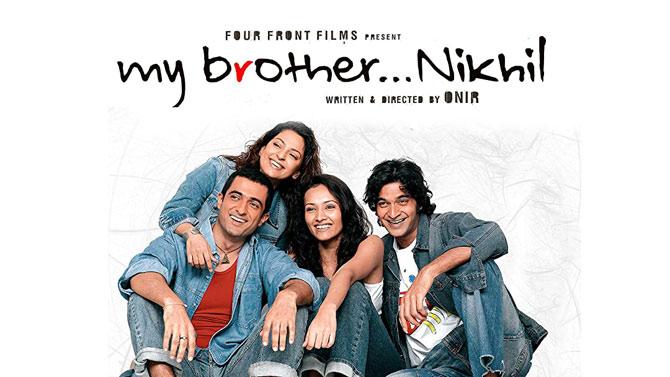
Niharika Lal (BOMBAY TIMES; March 27, 2025)
Onir's debut film My Brother Nikhil completed 20 years recently, Onir says that when he looks back at the film, he sees how the film continues to trigger conversations. In a recent chat, he looked back at the film and said he sees it as not a 20 but 30 years journey.
He says, "If I look back 30 years, since I came into the industry, and 20 years of My Brother Nikhil, I feel an immense sense of gratitude and happiness," he says. “I'm from Thimphu, Bhutan, born and raised in a middle-class family. As a boy in class eight, I had a dream to be a filmmaker. And to make my first film in the world’s largest film industry, to carve out even a tiny space for myself it’s empowering.”
'Teenagers who watched it growing up say they felt seen, represented'
Onir's debut film, My Brother Nikhil, released in 2005, was considered groundbreaking by critics. It told the story of Nikhil Kapoor, a champion swimmer diagnosed with HIV, at a time when cinema largely avoided LGBTQ+ narratives. The film was deeply personal for Onir, inspired by the life of Dominic D’Souza, India’s first known HIV/AIDS patient.
Dominic's story was so powerful that he couldn’t shake it off and started working on the film. “Even now, people message me about the film,” he shares. “Teenagers who watched it growing up say they felt seen, represented. Parents have told me it helped them understand their children better.”
During a recent screening celebrating 20 years of the film, Onir recalls a moment. “A woman stood up and said, ‘When I saw your last film, Pine Cone (2023), I learned something about my son that I had never understood. And when I watch My Brother Nikhil now, I realise that for so many years, I deprived my son of my love. The loss was mine, not just his."
Onir recalls walking the streets of San Francisco with lead actor Sanjay Suri after the first international screening. "People would shout, ‘Nikhil, we love you!’" he recalls.
Yet, in India, reactions were mixed. “At some screenings, audiences walked out at the interval when they realized Nikhil was gay. And despite critical acclaim, the industry did not recognize it. So I've never got any award in India, apart from my National Award in 2011 (For I Am), My brother Nikhil never got that recognition which was a little sad, but at the end of the day, after 20 years later, we are still talking about the firm and I feel that is beautiful. ”
'Making the film was not easy but the film is now archived in universities, cited in research'
The making of My Brother Nikhil was not easy. “Sanjay and his wife, Neha, cried when they read the script. Initially, I thought we’d shoot on a small video camera. But Sanjay said, ‘No, we have to make this into a film.’ They pooled personal savings and, along with friends, formed Four Front Films."
Yet, distribution was a nightmare. “Aisa kyu nahi kiya? They had all kinds of weird suggestions and there were people I remember from big distribution companies saying - are you showing us the rushes? So it was humiliating at times. And it was only when Sanjay showed the film to Karan (Johar) and Karan was really, really kind. It touched him. He suggested Aditya Chopra to watch the film, so for a debut person to get that big release - I felt that good energies got together, and made it possible, but it was not an easy journey. It took us years to recover because it was not easy. The struggle didn’t end with its release."
Onir admits, “But it was rewarding in other ways. The film is now archived in universities, cited in research. It has become part of Indian cinema history.”
In 2005, My Brother Nikhil got a U certificate and a theatrical release. In 2025, I still have to fight for certification
Looking back, Onir sees progress but says, “In 2005, My Brother Nikhil got a U certificate and a theatrical release. In 2025, I still have to fight for certification, and queer films struggle even more for distribution. People talk about progress, but tell me, how many queer-themed films did you see in cinemas last year? Very few. Streaming has opened doors, but even there, truly path-breaking Indian films are rare. The last important one I remember was Kaathal - The Core, with Mammootty playing a gay man.”
I wanted to tell this story to show that we all have the power to be better, to be more loving, understanding, and accepting
The film’s perspective - told through the eyes of Nikhil’s sister was intentional. “In an ironic full-circle moment, my sister co-wrote my biography, I Am Onir, in 2022.”
On set, Onir was quite focused. They shot in 27 days on a tight budget in Goa. Juhi Chawla, playing Nikhil’s sister, was used to a different kind of filmmaking.
He recalls, "After a few days, she came to me and said, ‘It’s my 77th film, your first. But you have to tell me what to do - I am a director’s actor.’ That gave me confidence.”
For Onir, filmmaking is about humanizing experiences. He says that he is branded as a filmmaker who makes issue-based stories, but he doesn't tell stories to highlight an issue, but to show life.
What did he want to say through the film? Onir says, "For me, Dominic’s story stayed with me - the sheer cruelty and unkindness he faced from society. I wanted to tell this story to show that we all have the power to be better, to be more loving, understanding, and accepting. I remember feeling Dominic’s pain and anguish so deeply while making My Brother Nikhil that it became internalized in the film. When my father watched it, he called me and said, ‘But I was never like that to you.’ And I told him, ‘It was never about you.’(laughs).”
He says, "At the heart of the stories I tell is this question - Why do we hesitate to offer a little more love, empathy, and acceptance to others? It costs us nothing, yet it enriches our lives in ways we don’t always realize. I feel that, both then and now, queer people are constantly navigating a world where finding love and support is not always easy due to lingering stigma. When I was making My Brother Nikhil in 2005, I wanted to explore that reality. In many ways, at that time the film also reflected my own longing for a love that endures."
He adds, "I feel that the film also gave me precious people in my life, like Sanjay Suri, Juhi Chawla, my cinematographer, and my sound recordist, with whom I have now worked for 20 years on all my films. It gave me lasting bonds. People talk about bonding in the film fraternity, and I truly feel that I have found so much love in this industry. Of course, there have been hurdles, but I believe I have found more love than challenges. I could be who I am today only because of the support I received even as an outsider in the film industry."
Sanjay Suri was always on Onir's mind for Nikhil. When it came to casting Juhi, Onir says that beyond her talent, she has this warmth and innocence and her smile alone radiates so much love. He says, "I was telling the story of a gay character - one of the first in mainstream Hindi cinema - and the audience was still raw about it. I felt that I needed an actor with a certain presence, someone whose warmth and sincerity could resonate with viewers. Juhi has such a warm, loving smile, and I believed that when the audience her character's love toward her brother, it would help them connect emotionally and be more accepting. For me, it was her innocence, warmth, and that beautiful smile that made her perfect for the role. Of course, I already knew what she could do as an actor."
Onir's favourite moments from the film
One scene that deeply touched me was the moment by the sea, when Juhi's character is at the sea and Sanjay is dying. She tries to be strong, but when Nigel tells her she must keep going, she simply says, ‘I’m tired of being strong.’ I remember that while filming, we were all overwhelmed with emotion and all of us were crying - it was as if the fear of losing someone dear became real for all of us.
---------------------------------------
“A journalist recently asked me, 'Onir, haven't you done enough?' (for queer narratives). I asked him - 'Would you ever ask a straight filmmaker that?"
I was told My Brother Nikhil was commercial suicide-Sanjay Suri
10:55 AM
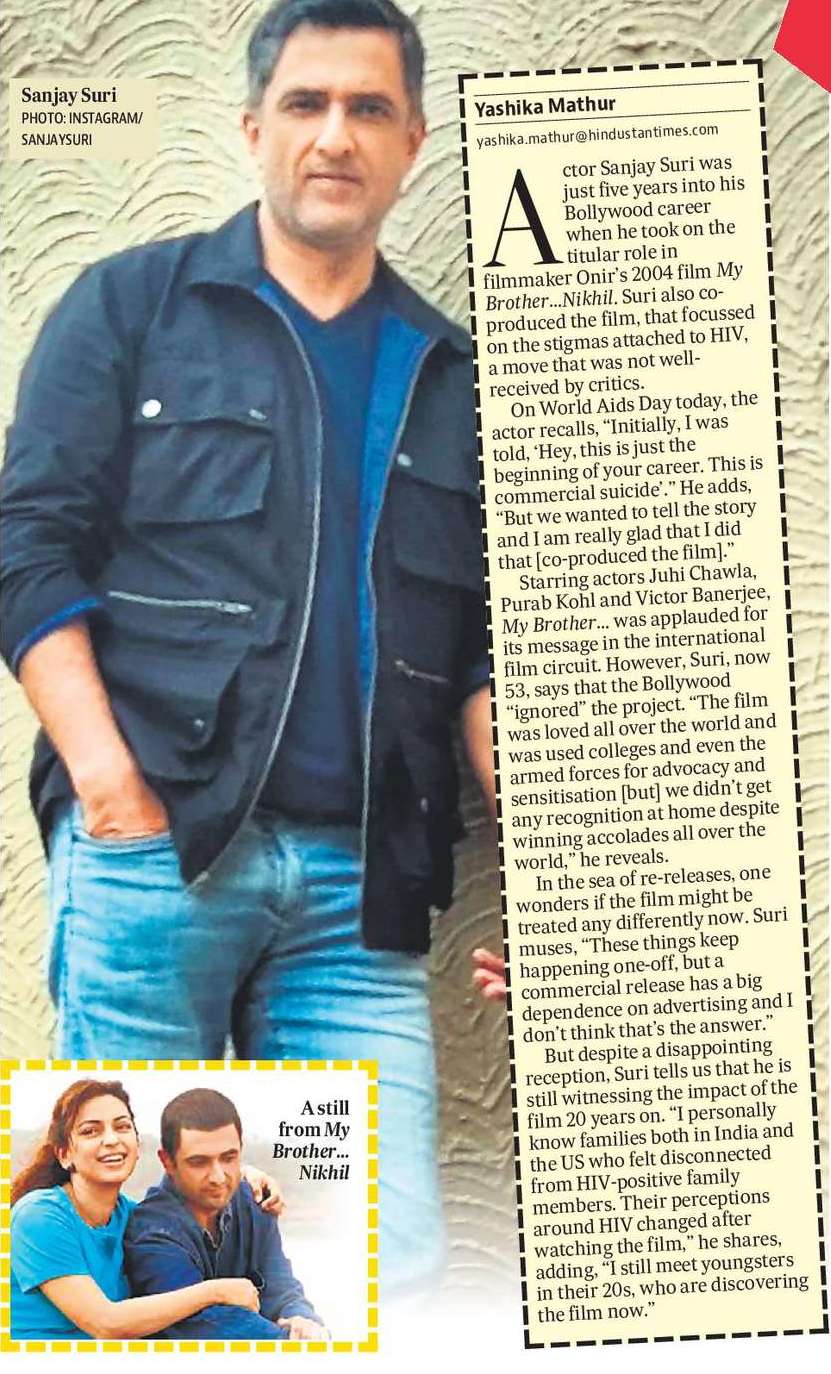
Yashika Mathur (HINDUSTAN TIMES; December 1, 2024)
Actor Sanjay Suri was just five years into his Bollywood career when he took on the titular role in filmmaker Onir’s 2004 film My Brother...Nikhil. Suri also co-produced the film, that focussed on the stigmas attached to HIV, a move that was not well-received by critics.
On World Aids Day today, the actor recalls, “Initially, I was told, ‘Hey, this is just the beginning of your career. This is commercial suicide’.” He adds, “But we wanted to tell the story and I am really glad that I did that [co-produced the film].”
Starring actors Juhi Chawla, Purab Kohl and Victor Banerjee, My Brother... was applauded for its message in the international film circuit. However, Suri, now 53, says that the Bollywood “ignored” the project. “The film was loved all over the world and was used colleges and even the armed forces for advocacy and sensitisation [but] we didn’t get any recognition at home despite winning accolades all over the world,” he reveals.
In the sea of re-releases, one wonders if the film might be treated any differently now. Suri muses, “These things keep happening one-off, but a commercial release has a big dependence on advertising and I don’t think that’s the answer.”
But despite a disappointing reception, Suri tells us that he is still witnessing the impact of the film 20 years on. “I personally know families both in India and the US who felt disconnected from HIV-positive family members. Their perceptions around HIV changed after watching the film,” he shares, adding, “I still meet youngsters in their 20s, who are discovering the film now.”
I started working in films at the age of 46-Lillette Dubey
8:29 AM
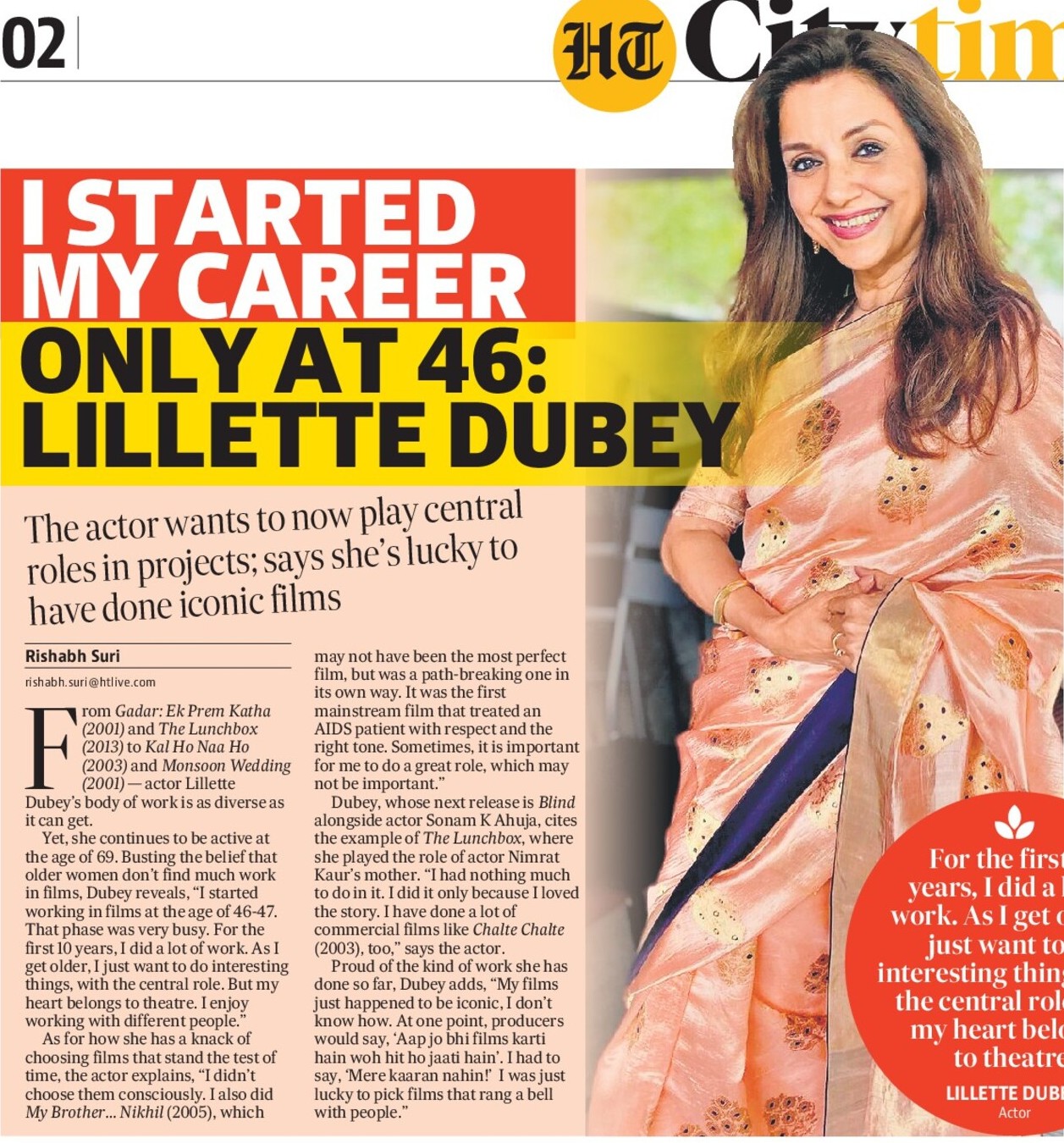
The actor wants to now play central roles in projects; says she’s lucky to have done iconic films
Rishabh Suri (HINDUSTAN TIMES; March 28, 2023)
From Gadar: Ek Prem Katha (2001) and The Lunchbox (2013) to Kal Ho Naa Ho (2003) and Monsoon Wedding (2001) — actor Lillette Dubey’s body of work is as diverse as it can get.
Yet, she continues to be active at the age of 69. Busting the belief that older women don’t find much work in films, Dubey reveals, “I started working in films at the age of 46-47. That phase was very busy. For the first 10 years, I did a lot of work. As I get older, I just want to do interesting things, with the central role. But my heart belongs to theatre. I enjoy working with different people.”
As for how she has a knack of choosing films that stand the test of time, the actor explains, “I didn’t choose them consciously. I also did My Brother... Nikhil (2005), which may not have been the most perfect film, but was a path-breaking one in its own way. It was the first mainstream film that treated an AIDS patient with respect and the right tone. Sometimes, it is important for me to do a great role, which may not be important.”
Dubey, whose next release is Blind alongside actor Sonam K Ahuja, cites the example of The Lunchbox, where she played the role of actor Nimrat Kaur’s mother. “I had nothing much to do in it. I did it only because I loved the story. I have done a lot of commercial films like Chalte Chalte (2003), too,” says the actor.
Proud of the kind of work she has done so far, Dubey adds, “My films just happened to be iconic, I don’t know how. At one point, producers would say, ‘Aap jo bhi films karti hain woh hit ho jaati hain’. I had to say, ‘Mere kaaran nahin!’ I was just lucky to pick films that rang a bell with people.”
We got blackmailed, but partied. Today’s queer are more scared-Onir
9:04 AM
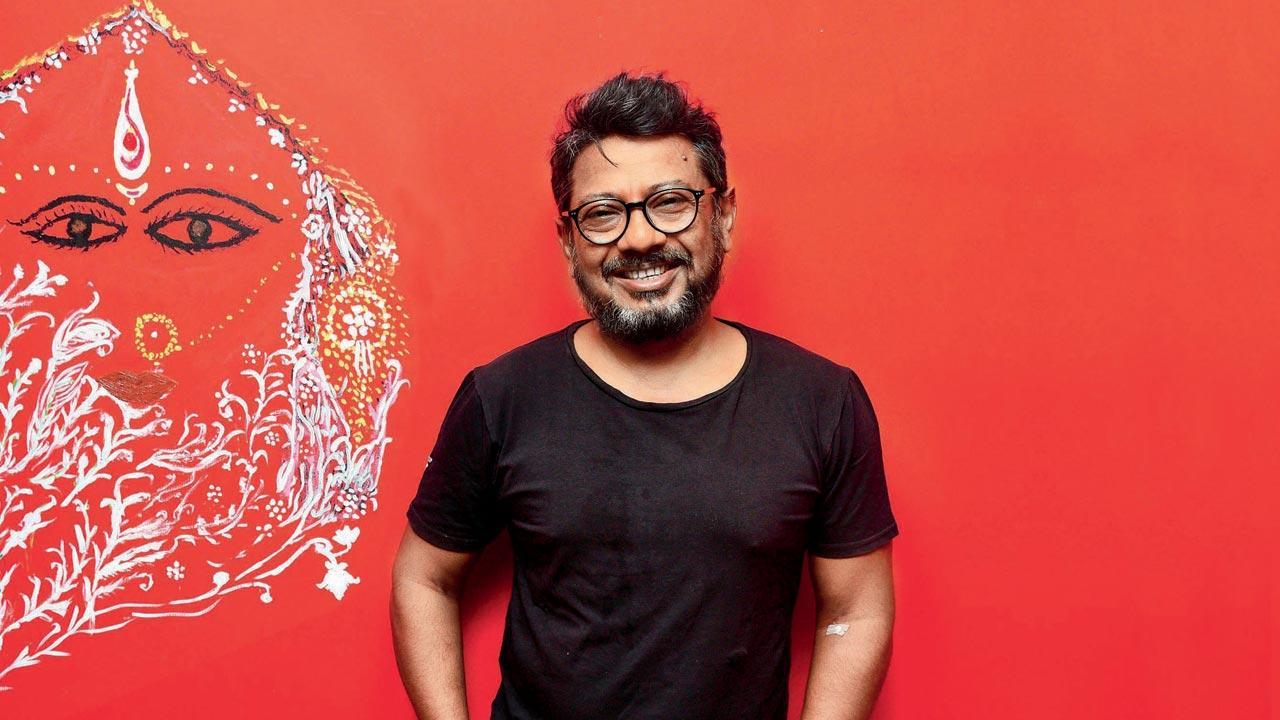
One of Bollywood’s few openly gay filmmakers Onir chooses Pride Month to launch biography that argues why he doesn’t mind paying the price for saying what no one else will
Aastha Atray Banan (MID-DAY; June 19, 2022)
Equality is non-negotiable. That’s the first line in Onir’s just released title, I Am Onir, And I Am Gay (Penguin India). The filmmaker, producer screen writer means it. He has proven it with his films. And in the personal choices he makes.
Controversy, therefore, has been a companion. In February this year, the script for his upcoming feature, We Are, on ex-army officer Major J Suresh’s life, was rejected by the Ministry of Defence. Junior defence minister Ajay Bhatt said in a written reply in Lok Sabha that the portrayal of a romantic relationship between a soldier and a local boy “casts the Army in poor light”. In a fresh appeal, Onir explained the script in full detail, making a case for conversation on diversity; arguing that it was his constitutional right to make the film.
With the just-released book, which he co-wrote with sister, film editor Irene Dhar Malik, he opens up his life and world, allowing the spotlight on his vulnerabilities. The young man from a Bengali family settled in Bhutan, speaks of his first crush and subsequent heartbreak, the despair of being a child darker than his siblings, his brush with excitement and danger while traversing Mumbai in the early 2000s as a gay man, his doomed relationships with men not yet out of the closet.
The book also looks at his first taste of cinema, as a student at Jadavpur University, and how Irene’s joining FTII paved the way for him.
His debut, My Brother Nikhil (2005), is considered a sort of masterclass on how a queer subject can be tackled in India. Since then, he has also made I Am (2010), an anthology of four shorts on single motherhood, displacement, child abuse and same-sex relationships. He won the National Award for it. Then came Kuchh Bheege Alfaaz (2017) with another National Award winner, Geetanjali Thapa.
The filmmaker has been living on the fringes of the film industry ever since he first decided to give this life a go. Onir speaks to mid-day about why he thinks he is a voice for the queer and if that mission is coming in the way of filmmaking.
Edited excerpts from the interview.
The relationship between brother and sister is complicated. How would you describe yours?
Onir: When growing up, it was the three of us—our younger brother Abhishek, Irene and I. But later, didi moved out, and my brother and I got closer. We did everything together.
Irene: They were like twins. Later, as we grew up, Onir and I developed similar interests.
Onir: We liked the arts, literature, so we spoke more. We even struggled in Bombay together. My father and his sisters share a similar bond. Although we hail from a patriarchal society, in my father’s family, the elder sister was the boss.
Irene: Before he says it, I am not the boss. That’s a myth. Onir pretends to be docile, but he gets his way a lot.
The first chapter is about your first great love, and first great heartbreak. Have you been shaped by the baggage?
Onir: I think we all heal. But there is always something that lingers. Till 2018, the identity of India’s queer was not decriminalized. We were not accepted; that has kind of stayed. Unfortunately, and coincidentally, the relationships I have had have been with people who have not come out to the world as homosexual. In a way, history repeats itself—and you fall into a trap. It’s not conscious. We are drawn to similar situations repeatedly.
Was Irene like Juhi Chawla is in My Brother Nikhil?
Onir: She was the one who protected me from questions, including, ‘Why are you so dark? Your siblings are fair?’ I was also the weakest at studies; she supported me when I wished to pursue Arts.
Irene: I paved the way. My father didn’t want me to go to the Film and Television Institute of India. But then once I had, it was easier [for Onir].
We see a lot of your mother in the book. We may sometimes idolise our fathers, but we become our mothers...
Onir: Both of us are a strange mix of our parents. My mother was interested in the arts and books, and my father was hardworking and independent. He gave our personalities a Leftist leaning—what is right and wrong. As kids, we have seen them work equally. We all do everything [in the family].
Irene: There was never a male or female thing. I think my brothers do more housework than I do, and likewise my father.
In your time at Jadavpur, you speak about the movies and filmmakers like Ritwik Ghatak, men whose work you watched and how they shaped you.
Onir: In Kolkata, that was all there was. Literature and cinema. We were always talking about the movies, which I feel I don’t do as much of now.
Irene: In those times, we couldn’t just go watch a movie anywhere. So we used to scout for film screenings. If I watch something really exciting, I still call him.
Onir: The art of having conversation is gone. We used to sit in the evenings and talk about what we had read and watched. That shaped us. We had more time back then. I can’t seem to analyse cinema anymore, especially when after you have become part of the industry. I don’t like publicly criticising something since it’s my own field. It’s different as a student when you are learning.
Irene: Maybe, you are more passionate when you are younger...
One of the most interesting aspects of the book is where you talk about your alter ego, Kamros, the gay man who spent his time in Mumbai in the early 2000s, being out and about.
Onir (laughs): Some of my friends from back then are still friends. It was nice for them to [read the book and] relive those days, because it was a different Bombay. Despite the fact that Section 377 criminalized homosexuality and knowing that when we partied, the police could come any time (which they used to), despite the dangers of being blackmailed and mugged (I have been through it all), we lived. It’s safer now. Today, I see people so afraid. I wonder, what has changed for them to be so scared?
Irene: How is it safer now? Back then, you could spend the night on Juhu beach!
Onir: The police come with dandas. How can you make people feel like thieves for just sitting on the beach or being romantic?
In the chapter on assisting filmmaker Kalpana Lajmi on Daman, you say you finally understood how Bollywood worked. People would give credit, but they didn’t want you to rise, or be more than an associate. Has that changed in the industry?
Onir: When Sushant [Singh Rajput] died, there was this whole conversation about outsiders, and about how the rise of content on OTT platforms would change things. But after a while, we realise that a set of new talent have becomes stars, and the gates are closed again. The cycle continues. If you speak to a platform, they have the same names. There are no new choices. Why don’t those in power create new talent? The onus is also partly on the audience—it doesn’t empower new talent.
You say, that after My Brother Nikhil, the floodgates didn’t open. You call it homophobia. Has your openness cost you work, unlike other gay members of Bollywood who have stayed in the closet.
Onir: Professionally, yes. People feel I assert my identity in too strong a manner. After 17 years [of making his debut in 2005], it’s still cis-gender people who are telling queer stories. Why am I not telling any of the stories that you see on the platforms? During Pride Month, they may celebrate my movies, but they are still not empowering us to make these films. Filmmakers make movies about the hetero-normative world accepting us. I don’t struggle to understand how straight people think when I make a film about them or go to inclusion workshops. Then why are my stories and my life about their acceptance?
Do you think people who are in the closet are complicit?
Onir: I am asked why I feel the pressure to be out. The reason I am the way I am, is because when I was growing up gay, I had no reference point. People like myself were invisible. It is important that I, who is privileged enough to talk about it, talk about it. Of course, no one should be forced, but when you are in a position to be open and out, you should give strength to others so that they can do the same. People hide because they see others hiding.
Irene: The book has given even parents the strength to talk to their kids.
And has the need to speak out typecast you into a filmmaker of queer stories?
Onir: I have been doing that [telling a variety of stories]. I have got stereotyped. Even My Brother Nikhil was actually about a brother and sister. I have got is bracketed because I speak about it [queer rights]. I am directing a series on the 2019 Pulwama terror attack [40 Central Reserve Police Force personnel were killed by a Jaish-e-Mohammed terrorist] for an OTT platform. My life goes beyond my queer identity.
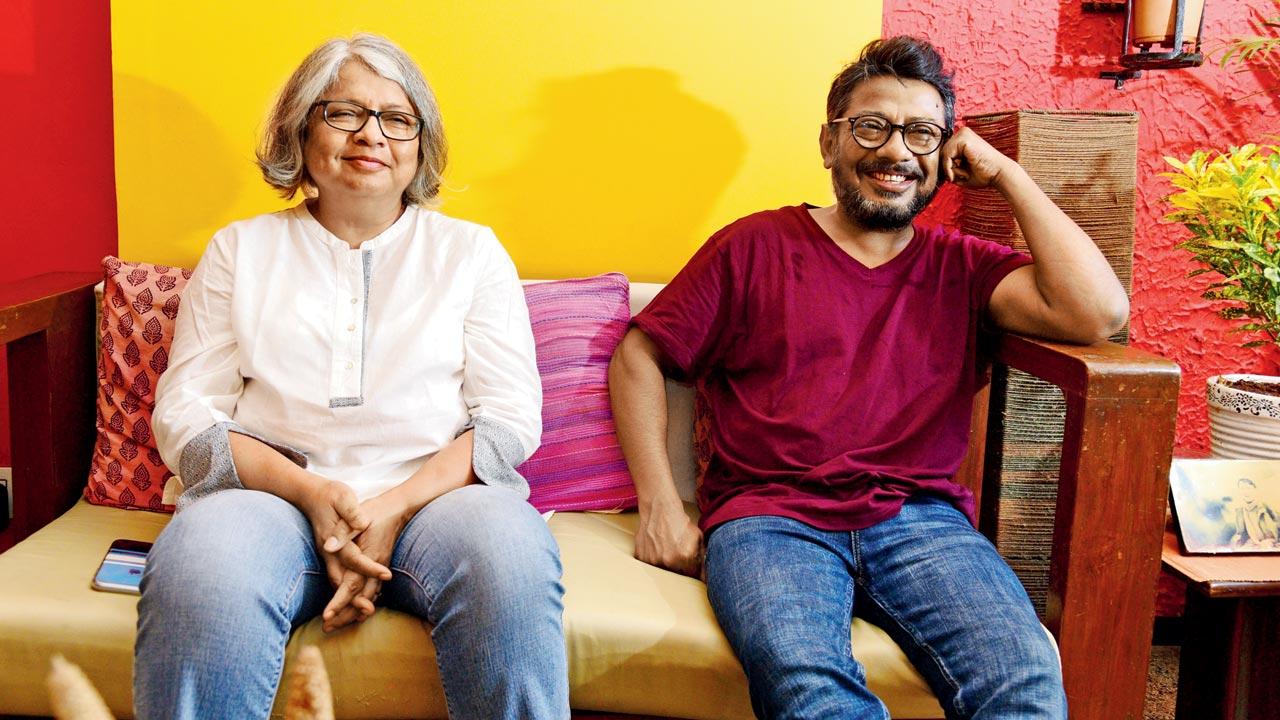
Filmmaker Onir and his film editor sister Irene Dhar Malik at his Versova residence. Pics/Ashish Rane
Before every take, Raj Kaushal would say energy instead of action-Sanjay Suri
8:02 AM
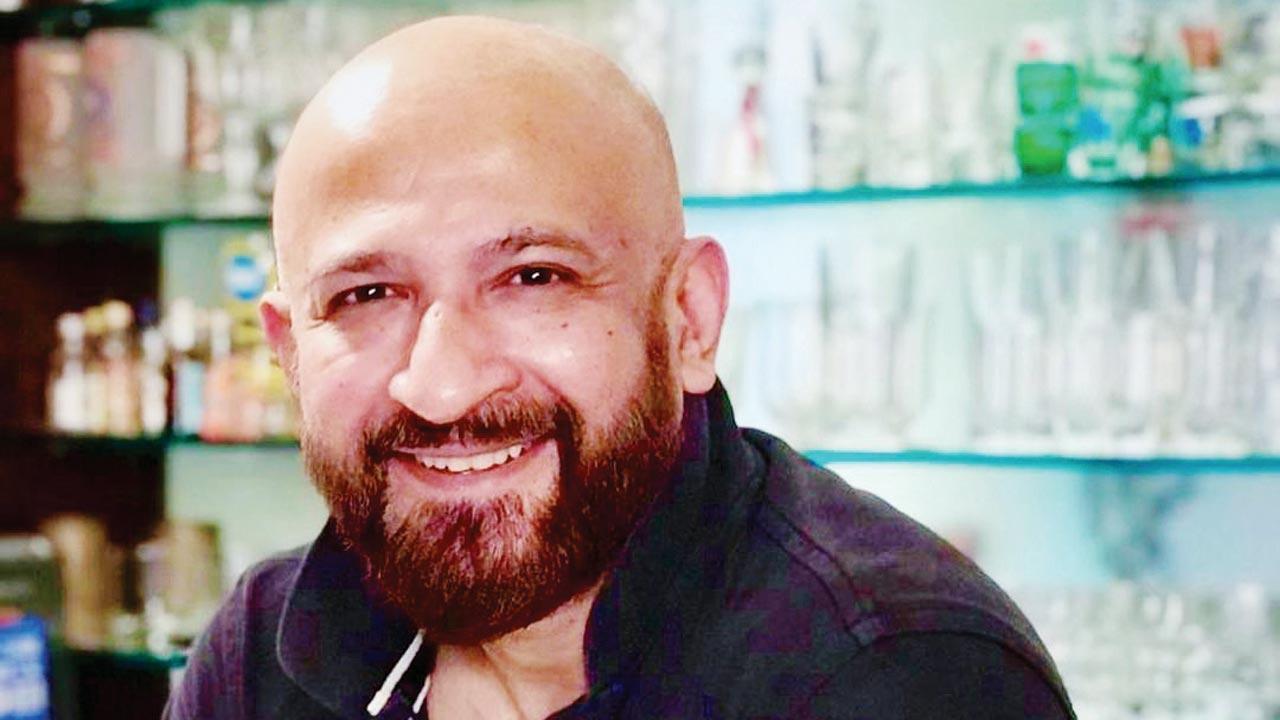
As Raj Kaushal’s sudden demise leaves family, friends shocked, Sanjay Suri and Dino Morea remember coming together for their maiden movie, Pyaar Mein Kabhi Kabhi
MID-DAY (July 1, 2021)
His friends remember him as someone with a ready smile on his face. And his Sundays were dedicated to what he treasured the most — friends and family. Over the weekend, Raj Kaushal’s heart was full as wife Mandira Bedi and he played host to their near and dear ones. Three days later, the film and television industry woke up to the shocking news of the filmmaker’s demise, the incident reminding us of the fragility of life.
Kaushal had forayed into filmmaking with Pyaar Mein Kabhi Kabhi (1999). The campus drama not only ushered in a new sound of music with Musu Musu Hasi and Woh Pehli bBaar, but also launched a string of new faces, including Dino Morea, Sanjay Suri and Rinke Khanna. “I get so many messages about the film’s songs to date. Raj knew how to make it special,” says Morea, remembering how Kaushal was completely in charge of the project. “My most striking memory of the film is Raj’s smiling face. No matter what went on around him, he had a positive energy that rubbed off on everyone. Mandira was a big part of the film’s making. Seeing her distraught today broke my heart. He was young, and has been taken away from us too soon.”
Suri, who had spoken to Kaushal four days ago, is shocked. “When we spoke, he said, ‘Bhai, milte hai aur kuch karte hai.’ I planned to meet him after returning from my shoot [in Uttarakhand],” says Suri, who had gone on to team up with him on Shaadi Ka Laddoo (2004) and My Brother Nikhil (2005).
“Not many know this, but he was one of the best narrators I have ever met. You could give him a boring one-liner, but he would narrate it with such skill that you could visualise it completely. He was always bursting with ideas. He inculcated a lot of confidence in his actors. We were all new, but he gave us complete freedom between ‘action’ and ‘cut’. It was liberating to work with him.”
The actor is grateful to Kaushal for co-producing My Brother...Nikhil when few had faith in the same-sex love story. “Raj played a big part in my career and my life. I called him a yaaron ka yaar. He had magnetic energy to him. In fact, before every take, he would say energy instead of action, and the vibe on the set would be so positive.”
Actor Manish Chaudhari, who recently shot for Kaushal’s web debut Akkad Bakkad, has yet to come to terms with the loss. “We had finished shooting only three weeks ago. He was happy to have wrapped up 10 episodes in less than 30 days of shooting. He was kicked about his first OTT project, and was looking forward to directing the second season. Mandira and he had recently adopted Tara, and he would keep sharing stories about his kids on the set.”
Bollywood director Raj Kaushal dies of cardiac arrest
7:58 AM

THE TIMES OF INDIA (July 1, 2021)
Mumbai: Filmmaker Raj Kaushal passed away of a cardiac arrest around 4.30 am Wednesday. He was in his fifties. Kaushal was actress Mandira Bedi’s husband. The couple have two children, 10-year-old Vir and a daughter Tara whom they adopted in 2020. Kaushal began his career as copywriter and went on to produce and direct scores of advertising films. He also directed three movies namely Pyar Mein Kabhi Kabhi, Shaadi Ka Laddoo, and Anthony Kaun Hai (2006). He produced ‘My Brother Nikhil’, a sensitive film on the subject of HIV-AIDS.
Kaushal’s sudden death evoked shock and sorrow in the entertainment industry. Actors Ashish Chowdhry, Apoorva Agnihotri, Rohit and Ronit Roy, Manasi Joshi Roy, Sameer Soni and Huma Qureshi arrived to console his wife and children. Meanwhile, Vicky Kaushal, Onir, Neha Dhupia, Arshad Warsi, Randeep Hooda, Boman Irani and Shekhar Ravjiani offered tributes on social media. Anupam Kher, Ronnie Screwvala and Sudhir Mishra also expressed sorrow.
Composer Vishal Dadlani tweeted, “The first person to trust me with making music for a film, @rajkaushal created so many careers with #PyaarMeinKabhiKabhi. Above that, he always stood with his friends.”
-------------------------------
BOMBAY TIMES (July 1, 2021)
Filmmaker Raj Kaushal, 49, who made his directorial debut in Bollywood with Pyaar Mein Kabhi Kabhi (1999), passed away yesterday morning after suffering a cardiac arrest. He is survived by wife Mandira Bedi and children Vir (10) and Tara (4).
The couple had adopted their daughter last year. Raj, who had directed many ads and helmed Shaadi Ka Laddoo (2004) and Anthony Kaun Hai (2006), had recently finished wrapping up a web series. While a few friends and colleagues from the industry were present for the final rites, others expressed grief on social media.
Remembering Raj, Onir, whose first directorial venture, My Brother…Nikhil (2005) was co-produced by the filmmaker, said, “He will always be remembered as someone who was always smiling and made everyone feel like a buddy. I am shocked that he left us at this very young age. He extended support for my first film at a time when nobody was willing to, and I give him credit for helping me fulfil my dream of becoming a director.”
Talking about the filmmaker, friend Rohit Roy said, “There is no way one can come to terms with Raj’s passing. He was one of the happiest, positive and vibrant people around. He never had anything negative to say about anyone… nor did anyone have anything negative to say about him. He was the kind of friend anyone would want to have in their life. He stood by people through thick and thin. I will never forgive him for going away without saying goodbye.”
Sudhanshu Pandey, who has known Raj since 24 years, shot with him a couple of weeks ago. “Raj was like a brother to me. I cannot come to terms with the fact that he is no more. We shot for something two or three weeks back and we had a great time on the sets. I didn’t know that it would be the last time I would meet Raj. I couldn’t attend his last rites. But my wife was there. We connected over a video call because I wanted to see him one last time,” he said.
The gay community was emotional and happy about the way they were represented in My Brother Nikhil-Purab Kohli
8:05 AM

Sanjay Suri and Purab Kohli talk about their film My Brother... Nikhil, which focussed on the relationship between a gay couple at a time when homosexuality had no place in mainstream Bollywood films
Onkar Kulkarni (BOMBAY TIMES; June 26, 2021)
At a time when homosexuality was rarely mentioned in Bollywood films and same-sex relationships were not a part of the mainstream narrative, Sanjay Suri and Purab Kohli dared to take on the film My Brother…Nikhil. The 2005-film, which portrayed the story of two gay men, also touched upon the subject of AIDS. The movie directed by Onir always wins a special mention for putting the spotlight on same-sex relationships.
In the ongoing Pride Month, we catch up with the film’s lead actors, Sanjay and Purab, who speak about being a part of the film and the kind of appreciation they received from the audience and gay community. Excerpts:
My Brother…Nikhil was made at a time when homosexuality was not a part of the mainstream narrative in Bollywood. What inspired you to take on a film that dealt with such a sensitive subject, and that too, helmed by a debutant director?
Sanjay: The first time I met Onir was when we were shooting for Daman: A Victim of Marital Violence (2001). He was working on the film as an editor. When Kalpana Lajmi, who was directing the film, had to leave the set for a day due to an emergency, she gave Onir the responsibility of managing the shoot. We all were happy with his job. I asked him to come up with a script, which I could produce. That’s when he showed me the script of My Brother…Nikhil. I was moved by the writing. I thought the story needed to be told, so I offered to co-produce it. As for acting in it, I didn’t think twice because I wanted the message to reach the audience. However, I was warned by many people who felt the film would finish my career. Frankly, such talk encouraged me to explore the subject more.
Purab: Initially, I was skeptical about taking up the project because just before I was offered the film, I had shot for Luke Kenny’s first directorial 13th Floor, in which I played a gay character. So, I took some time to read the script. It was so fine that I gave the nod immediately after reading it. I am glad that I did a film like My Brother…Nikhil. It happened at a time when I was enjoying my career as a VJ, but this movie made me realise that I should focus on acting as a career.
Was there a lot of research and prep involved to get the nuances of your characters and relationship in the film right?
Purab: To begin with, Onir wanted me to play the role of Nikhil, which eventually Sanjay did. For me, Nigel was more of an effeminate character, while Nikhil — a state-level swimmer — was the more masculine one. So, I had to process how I would go about playing this character. I was very young when I played this role, and I often drew references from my mother’s friend, who was gay. While shooting, there were certain activities that Onir introduced me to, which helped me portray Nigel better. For example, to understand the creative side of the character, Onir got me a lot of plain T-shirts and asked me to paint them. In fact, many T-shirts that I sport in the film were painted by me.
Did you concentrate a lot on how the relationship between the two of you would unfold on the screen?
Sanjay: Actually, it all happened very naturally. We didn’t rehearse much. It was so organic that if Onir had added a kissing scene or an intimate scene, I would have been comfortable doing that, too. However, we didn’t keep any such scenes as we didn’t want them to take away the focus from the issues that we wanted to highlight. For the same reason, in the film, we haven’t shown how Nikhil contracts HIV.
Purab: Sanjay and I were like two ingredients that blended well and that made our relationship seem real.
The film received a lot of appreciation from the critics, what kind of reception did it get from the gay community?
Purab: I remember we had hosted a special screening for the members of the gay community, who appreciated the film a lot and were emotional when they saw it. Probably, it was for the first time that they felt that they were being represented in the right manner in our cinema. Personally, I felt proud when my uncle appreciated me for doing this film. It came as a surprise as I wasn’t sure about his thought process and was skeptical about his reaction. More than the theatrical release, we got a lot of attention when the film premiered on TV many years later. In fact, today, it is available on an OTT platform, too, and I am happy that we have the younger generation watching it.
Sanjay: We had also invited HIV positive patients for the screening, as the film also dealt with that subject. After one of the screenings, a lady met me and said, ‘Thank you for making this film as it helped me understand my daughter better, who I lost to AIDS 10 years ago’.
Did the film make you popular with the gay community?
Sanjay: I remember when I was walking the streets of San Francisco with my wife, I had a couple of men screaming, ‘Hey Nikhil, I love you’. At that time, there were no social media, but my website had gone live and there were so many messages I received from gay men. Some of them were surprised and even disappointed that I was straight in real life and married to a woman.

If same-sex marriage is recognised in India, I would like to get married too-Onir
7:55 AM

Rishabh Deb (BOMBAY TIMES; June 8, 2021)
A few days ago, someone asked Onir on social media, “Why do queer people make coming out a big deal? Straight people don’t have to do the same.” The filmmaker responded, “Straight men and women do not have to be closeted. There is nothing for them to hide. Their existence, desire and love — it is all out in the open. And the reason we come out is to claim our spaces outside the closet so that we have a world where we don’t need to be in the closet.” In a Pride Month special interview with us, Onir shares, “The very fact that such questions are being asked is a sign that we have to keep educating people and keep making the right noise for visibility.” Excerpts from the chat:
‘QUEER PEOPLE ARE GOING BACK TO UNSAFE SPACES’
Onir feels that while many speak about the pandemic having brought them closer to their families, this period has been doubly tough for the queer community, “For a lot of queer people, being home means going back to a space where they are not accepted and celebrated. In such instances, they either have to hide their sexuality or face abuse and threats for expressing themselves freely. This causes anxiety and mental health issues, adding to the trauma that the queer community faces every day,” says the My Brother Nikhil director.
Onir adds that he regularly gets calls asking for work or seeking help regarding mental health issues from the community. He shares, “Mumbai is an expensive city to live in, and many people have left because they cannot afford it anymore. Queer people are constantly worried about how to escape the unsafe places they are returning to. It is really heartbreaking to see so many of them suffer like this. I wish I could help them all.”
‘PRIDE MONTH IS NEEDED TO MAKE THE RIGHT NOISE’
With the Pride Month celebrations, another important development is in the process right now. Onir explains, “We are also in the process of the Delhi High Court’s hearing about same-sex marriage, which is a very important step for us. The next hearing is soon (July 6). However, it is constantly debated by people who oppose it for the most ridiculous reasons. Having said that, this month is for the recognition of what we have achieved as a community. It has been a long struggle for us. I am often amazed by how many people choose to remain silent about LGBTQIA+ rights. So, Pride Month is needed to make the right noise.”
‘THE REAL REPRESENTATION OF QUEER PEOPLE ON SCREEN IS RARELY SEEN’
There’s been a discussion about queer representation in Indian cinema for a while now. Sharing his opinion on the same, Onir says, “People forget that we are the largest film making country in the world. To me, Dostana is not an LGBTQIA+ narrative. When I’m talking about real films that deal with our lives, I hardly see them, even today. The percentage is very small. Earlier, when I made My Brother... Nikhil, it was termed as 'not box office-friendly'. Today, the box office word has been replaced with eyeballs. When I did some of my best work, nobody told me about eyeballs.”
And have OTT platforms made a difference? He says, “The so-called freedom that one has with OTT platforms is an overhyped myth because whatever you do, it has to go through various levels of scrutiny by people who think they can evaluate what you have done. I won’t say everything is bad; the good stuff is also happening. But queer representation is very less.”
‘DATING FOR ME COMES WITH A BAGGAGE, NOT BECAUSE I’M GAY, BUT BECAUSE I’M A FILMMAKER’
Opening up about his dating life and thoughts on marriage, Onir shares, “For me, dating becomes a bit different because I am a filmmaker and it mostly comes with baggage. It is not about my age or me being gay. The only thing people see is that I am a filmmaker and I might be their roadmap to something. My parents feel that if they are not around, I should have a partner. The only thing is that I don’t have a partner right now, but the guys I dated, they lived with me, and my parents always graciously accepted them and loved them.”
He adds, “My parents want me to get married and if same-sex marriage is recognised in India, I would like to get married, too, not to conform to anything, but to make a statement that it is my right to get married, too. The sad part is that gay partners don’t even get legal rights. Hence, recognising same-sex marriage is very important.”
‘COMING OUT SHOULD BE CELEBRATED’
Onir is of the opinion that the society has been dominated by heteronormative narrative, and he stresses on the importance of coming out. He shares, “We have to come out of the closet to be visible. If we can’t be visible, that means there’s fear and shame. When Dutee Chand came out, it was absolutely inspiring that a sportsperson did it. I wish in my fraternity, too, people come out and celebrate themselves instead of playing hide and seek. Coming out will inspire not just youngsters, but their families, too, because they will understand and be accepting.”
Bollywood women inspire me to stand up against trolls-Onir
8:24 AM

The filmmaker talks about his take on the ongoing drug controversy in Bollywood, dealing with trolls, and the importance of queer gaze
Shamayita C (BOMBAY TIMES; October 2, 2020)
Bollywood is in the eye of the storm. Being someone who was critical of the industry in the past, what are your thoughts on the current developments?
It’s sad. Despite being a rank outsider, I am living my childhood dream of becoming a filmmaker — thanks to this industry. Bollywood supports the dreams and livelihoods of many others like me. I shudder to see the industry under attack. My surroundings look so unfamiliar now. It’s become too vicious.
What do you have to say about Bollywood’s alleged drug connection?
I don’t want to take sides. Law enforcement agencies should go after the drug cartel, dig into the root of the problem and not the users. Drug users need care, not shaming.
How do you deal with trolls?
Initially, it used to give me sleepless nights. But then I saw how Bollywood women like Swara (Bhasker) and Richa (Chadha) deal with way more viciousness. Despite repeated attacks, they dare to speak up and fearlessly voice their opinions. These women inspire me to be brave and stand up against trolls.
Your film My Brother... Nikhil released in 2005.When it comes to telling LGBTQIA+ stories, do you think Bollywood has become more inclusive now?
Sadly, no. Bollywood has a long way to go before it can be called inclusive. The recent example is Shakuntala Devi. The film merely paid lip service to the same-sex relationship issue. The problem is the lack of queer gaze. Women are portrayed with dignity and grace in Meghna (Gulzar) or Zoya’s (Akhtar) films because they see their characters from a female gaze. Similarly, queer gaze is important to deal with LGBTQIA+ stories. It is not just about changing a law, our society is not ready to internalise and accept queer people. That is why it is important to go out and be proud. Since our childhood, we have grown up with heteronormativity. When a family is portrayed, it is always a father, a mother and their children. Same-sex relationships have to be normalised in our society first. We don’t need a mic to talk about our sexual orientation. We need to talk and make things normal and regular.
With Durga Puja festival taking place this month, what are your plans for it?
I’ll celebrate with my parents in Mumbai, but avoid going out much. Durga Puja is special to me. It’s about nostalgia, kashphul, new clothes, kosha mangsho, luchi and much more.
Will Shubh Mangal Zyada Saavdhan be the first ever proper LGBT hit film of Bollywood?
2:38 PM

Times are changing and more and more novel and unconventional topics are being tackled in our films. But homosexuality is one such subject where we have slightly lagged behind. Here, we are not talking about caricature gay characters inserted in films for cheap laughs but realistic depiction of such people. Interestingly, Hollywood and many of our web series too are based on this idea. Even regional films on homosexuality have thrived. However, a handful of Hindi films have had protagonists playing gays.
So what’s stopping Bollywood for getting into it full throttle like its contemporaries? The biggest problem is that despite Supreme Court decriminalizing homosexuality and increase in awareness, it’s something that still remains a taboo. And films made on taboo topics can be detrimental. Akshay Kumar’s film on sanitation, Toilet – Ek Prem Katha, worked very well as this was a still a topic that can be discussed. But when he attempted to spread awareness about sanitary pads in Pad Man, the desired result was not achieved. Toilet – Ek Prem Katha earned Rs. 132.07 crore while Pad Man, despite having better word of mouth, could reach only till Rs. 78.22 crore.
Shockingly, none of the LGBT film of Bollywood has even seen a commercial success. Fire was the first such film in this genre. However, it was met with violent protests due to which the film was withdrawn. Sometime later, it was re-released after the Censor Board imposed cuts. Though it ran without any problem, the earnings were paltry.
Then, Split Wide Open, Rahul Bose-starrer, came next in this genre. But it was so niche that it went unnoticed. Karan Razdan’s 2004 flick, Girlfriend, was a story of an obsessive lesbian. It had immediately come after Murder, which popularized the idea of films with intimate scenes. It had loads of steamy and sleazy scenes and hence, it didn’t do much for the LGBT movement. And it was an average grosser at the ticket window.
Many other films then came up but were mostly small-budget. My Brother Nikhil, Onir’s first directorial, came all of a sudden, and as expected sank without a trace. Margarita With A Straw got a bit noticed but didn’t have any commercial trappings. Same happened with Aligarh. Angry Indian Goddesses was a fine piece of cinema and had an unexpected lesbian angle but viewers couldn’t give it a chance because of its very elite feel. Dunno Y Na Jaane Kyun, meanwhile, is considered to be a success story, and even has a sequel. But those who have seen it call it shoddy piece of cinema. And in cinemas, it was a big time disaster.
Karan Johar made two films and both have done a lot to make homosexuality mainstream. His 2008 flick Dostana was an average grosser and many even criticized for being cheap. However, homosexuals call this film a blessing as it at least ignited the conversation. During 10th anniversary of Dostana, prominent LGBTQ rights activist Harrish Iyer had told this writer, “Dostana broke the taboo. It was a landmark film as it mainstreamed the issue. It brought the conversation to the dining table. Dostana almost became a word for gays. People would say ‘Yeh log dono Dostana karte hai’ instead of saying ‘Yeh dono gay hai’!” He futher adds, “Karan Johar has done a lot of service to the homosexual community by bringing the conversation out from the closet into the open.” 8 years later, Karan Johar produced Kapoor & Sons. This was a hit film but homosexuality formed a very small part of the flick.
Last year, a lot of expectations were rested on Ek Ladki Ko Dekha Toh Aisa Laga. It featured a mainstream actor like Sonam K Ahuja in the role of a lesbian. What’s more, her real life father Anil Kapoor played the part of her dad, and there was also Rajkummar Rao and two popular songs too add to the impact. Sadly, the film received mixed response. On top of that, the taboo topic obviously and also the serious nature of the film kept audiences away.
But now, we have a film that can finally emerge as the first box office success in this space - Shubh Mangal Zyada Saavdhan. It stars Ayushmann Khurrana and Jitendra Kumar as the lovers with Neena Gupta, Gajraj Rao, Manu Rishi Chadha and Maanvi Gagroo playing supporting parts. The trailer was unveiled few days back and has been loved for its clever writing and the feel good mood of the film. What’s great is that someone like Ayushmann Khurrana has backed it and that too at this stage of his career. Right now, he’s on a roll and how. He has had 6 back-to-back hits, and it all started with the first part of this film, called Shubh Mangal Saavdhan, which was based on performance anxiety. Ayushmann is known to take up such topics in his films like sperm donation, late pregnancy etc in his films and these movies are family entertainers, without too many embarrassing moments for the traditional audiences.
Due to these reasons, Shubh Mangal Zyada Saavdhan has a very high chance of becoming a hit at the box office. The costs also seem limited and even if it does a business of around Rs. 55-60 crore, it’ll be in the safe zone. One might argue that a value of a film should not be judged by the amount of money it makes. After all, films like My Brother Nikhil, Fire etc also have been significant films of this movement, notwithstanding their box office outcome. But when a film on gays becomes a hit and gets whole-hearted acceptance, it’ll encourage more and more producers and even mainstream actors to back such projects. And this, in turn, will serve the larger cause and bring social acceptance to LGBT in a small but significant way. Hence, here’s hoping that Shubh Mangal Zyada Saavdhan turns out to be a great fare and that it gets the success it deserves!

The shift from masala to offbeat films is refreshing-Juhi Chawla
8:31 AM

Sangeeta Yadav (HINDUSTAN TIMES; November 8, 2019)
With over three decades in Bollywood, actor Juhi Chawla has worked in the best of both worlds — out-and-out commercial Bollywood movies and offbeat films. But what brought a huge transformation to her life and career was marriage and motherhood.
“There was a time when I used to do big-budget films with a huge troupe dancing in the background... some were commercial Bollywood or romance films. Then I got married and had kids and I stopped getting those kind of roles. What was offered to me was 3 Deewarein, Jhankaar Beats (both in 2003), My Brother Nikhil (2005) and many others that were very offbeat and not the typical Bollywood masala movies,” says Juhi.
When the actor started doing small-budget movies, she wasn’t “very comfortable”, but later she says she found the change “very refreshing”.
“Suddenly, I started doing small-budget films. The 30-40 dancers that I used to dance with disappeared. The actors were different, the sets looked more real, the unit would be smaller and you’d get to know everybody you worked with. Sometimes I’d even help them setup too,” says the Ek Ladki Ko Dekha Toh Aisa Laga actor.
She adds how her makeup didn’t take “an hour-and-a-half or more”. She says, “I used to take just 20 minutes to dressup. Even the way they’d require me to act was different from the dialogue-baazi I did in my previous films. It was like a breath of fresh air.”
After becoming a mother to Jhanvi (18) and Arjun (16), the actor made a conscious decision to be very particular about her work. Juhi says, “As my kids were also little, I was doing fewer films in a year. So, there was a slowdown, but the films kept coming.”
During that time, Juhi also started experimenting with Punjabi films, such as Des Ho Yaa Pardes (2004) and Waris Shah (2007). As of now, she is happy “work keeps coming” and that keeps her going.
I’m crying because I am happy. We are finally telling our stories-Apurva Asrani
8:42 AM

Film editor and screenwriter Apurva Asrani tracks the Hindi film industry’s transformative journey of coming out of the closet
Apurva Asrani (MUMBAI MIRROR; September 8, 2019)
Growing up in India in the 1980s, I remember stealing my father’s stash of Debonair magazines, rummaging through pages filled with nude women, and trying to find that image of a buff man. Often, he was in the same frame as the woman, and in my head, I would replace her face with that of another man, and pretend they were a gay couple. This was the best I could do as there was absolutely no imagery anywhere that alluded to homosexual existence.
The first time I saw a gay man on screen was in 1993 — in the hard-hitting film Philadelphia, where a cute Tom Hanks was in love with a dishy Antonio Banderas. After searching in the dark for 15 years, I was relieved to finally find an image which I could aspire to. This was around the same time that three brave young men — Ashok Row Kavi, Vivek Anand and Suhail Abbasi — were bringing out India’s first gay magazine, Bombay Dost. The representation in India had begun.
If you had told the 15-year-old me, about 26 years on, that I would be attending Mumbai’s own LGBTQ film festival — celebrating its tenth anniversary, and showcasing 160 LGBTQ-themed films — I would not have believed you.
Some 43 countries (with a maximum number of entries from India) sent in films for the four-day event that took place last June across the city’s most iconic theatres — Liberty Cinema and Metro INOX. Kashish’s opening night saw over 1,000 LGBTQ Indians proudly walk its glittering red carpet; Section 377 had been shown its place, and we were no longer criminals in the eyes of the law. It is heartening that the youth of today, who find themselves struggling with their sexuality, have a plethora of LGBTQ imagery to refer to, and need not feel isolated like people of my generation did. In the last few years alone, Indian audiences have been exposed to a diverse spread of queer cinema.
 The script of Aligarh (left), a film I worked on, was born out of a desperate need to end the lampooning of gay men in mainstream cinema. While we owe much of our early identity to Riyad Wadia’s Bomgay (1996), Mahesh Dattani’s Mango Souffle (2002) and Sridhar Rangayan’s Gulabi Aaina (2003), we were aware that these films weren’t co-opted into the mainstream. This may be partly because they were ahead of their time, and partly because society perceived them as ‘by’ and ‘for’ the community. BomGay, arguably the first gay film from India, reflected the angst of the repressed urban homosexual, and I remember being too afraid to watch the scenes of sodomy in a movie hall.
 Onir’s sensitive My Brother Nikhil (2005; right) was probably the first film about a gay man that captured the attention of the mainstream. The film, starring Sanjay Suri, Purab Kohli and Juhi Chawla, did for Indian gay men, what Fire (1996; left below) — starring Shabana Azmi and Nandita Das — perhaps had done for lesbian women. It paved the way for sensitive LGBTQ representation in Indian cinema. Alas, the doors that opened with My Brother Nikhil were shut tight with big-budget padlocks when Dostana (2007) — Tarun Mansukhani and Karan Johar’s gay parody — hit the theatres.
 While there were many who were thankful that Dostana brought the idea of being gay to family audiences, I was severely critical of how the film used the subject only for laughs, and remained homophobic till the very end. Films like Raja Babu, Mast Kalandar, Humshakals and Pyar Kiya Toh Darna Kya had also lampooned gay men in the past, the difference (and saving grace) here was that Dostana alluded to the possibility of a mainstream gay couple — well, almost. Karan Johar followed this up with Student Of The Year (2012), where Rishi Kapoor played a closeted school principal who lusts after a male teacher. “There’s so much more to gay men than just being over the top or sexual,” I wrote in a blog after Dostana released.
The biggest challenge with Aligarh was to write a character who, despite being in a sexual relationship with another man, refused to wear the many tags of sexuality. He belonged to a generation where the words ‘gay’ and ‘queer’ did not exist, a place where Professor Siras has to beg society to leave him to define himself. This was neither an activist film, nor did it ask for homosexuals to be treated specially. Instead, it asked for Professor Siras to be seen as a human being — and to award him the same constitutional right to life and privacy as anyone else.
Aligarh’s Siras is a private man, an award-winning poet, a man of letters, a respected academic, but most importantly, he is a man who treats others with respect. Siras never lusts after the handsome young male reporter interviewing him in his bedroom, and always conducts himself with dignity. That the brilliant Manoj Bajpayee broke Bollywood’s longstanding tradition of a mainstream actor refusing to “play gay” adds much value to the film.
Watching Aligarh with my father — who has struggled to make sense of my sexuality — was a surreal experience. He watched it with tears in his eyes, and identified with the loneliness of a senior citizen. I saw that Siras’ sexuality never got in the way of his empathy. At that moment, I knew Aligarh would achieve what it had set out to.
What surprised me though, is that Aligarh did not meet with strong opposition from either society or the censor board. While theatres screening Fire were vandalised in 1996, the CBFC had banned Gulabi Aaina in 2003, calling it ‘vulgar and offensive’, the times seem to have changed when Aligarh ‘came out’ of the censorship closet. While they muted the words ‘gay’ and ‘homosexual’ for its TV telecast, the film hit the cinemas without any major cuts. Even the kiss between Siras and the male rickshaw puller was retained without objection. And besides the city of Aligarh, where its mayor had banned the film, Aligarh ran all over India, for almost four weeks.
Incidentally, the last five years have seen a number of LGBTQ-related films play in cinemas. Shonali Bose’s terrific Margarita With A Straw (2015) saw Kalki Koechlin play a girl with cerebral palsy discovering her bisexuality. Karan Johar and Shakun Batra’s Kapoor & Sons (2016) brought us our first celluloid gay sex symbol — played gracefully by Fawad Khan.
Sudhanshu Saria’s urban gay love story LOEV (2017) focused on the emotional and sexual complexities between two friends; Sridhar Rangayan’s Evening Shadows (2018) told the emotional story of a mother coming to terms with her son’s sexuality; and Shelly Chopra Dhar’s Ek Ladki Ko Dekha To Asia Laga (2019) featured Bollywood star Sonam Kapoor as a small-town lesbian girl coming out to her traditional family.
The biggest leap in LGBTQ representation, however, has been in the digital space with Sacred Games (2018) and Made In Heaven (2019). Sacred Games by Anurag Kashyap and Vikramaditya Motwane, featured a trans character named Kukoo, played wonderfully by Kubbra Sait. Kukoo is an attractive dancer, a strong, self-respecting woman, in love with the leading character played by Nawazuddin Siddique, and also happens to have a penis. Made In Heaven by Zoya Akhtar and Reema Kagti is a current favourite with gay and straight people alike. It features Arjun Mathur in the lead, playing a Delhi wedding planner who gets in trouble with the law after he is filmed in his bedroom having sex with another man.
While the track bears an uncanny resemblance to Professor Siras’ in Aligarh, it is the writing and treatment that sets it apart. Arjun’s character Karan doesn’t wear his sexuality on his sleeve, yet he is seen as a ‘top’ who indulges in ‘no strings attached’ sexual relationships. And while I am grateful that the show normalises gay sex, Karan’s sexuality is never his identity. He is a bloody good wedding planner, a great friend, and a man who displays an astute sense of right and wrong.
I was privileged to have worked as an editor on Made In Heaven, cutting the episodes of Zoya Akhtar and show-runner Nitya Mehra. I suspect they brought me in because they wanted a gay man at the cutting table, to help them check on Karan’s character. The incredible response to the show is proof that characters like Karan are now seen as a legitimate part of society.
Before they began shooting, I was asked to read the scripts of Made In Heaven and offer feedback. I remember finishing reading them around midnight, and then bursting into tears. When my partner awoke to see me crying, he asked if the story made me sad. I turned to him and said, “No, I’m crying because I am happy. We are finally telling our stories.”
The writer is a National Award and Filmfare Award winning film editor and a Screen Award winning screenwriter. A version of this article appeared in Rainbow Reflections — An Anthology of LGBTQ Narratives in Indian Cinema, published by KASHISH Arts Foundation
A-list stars blatantly refused to play a gay character on screen-Onir
7:44 AM

Nayandeep Rakshit (DNA; July 2, 2017)
After Fawad Khan’s role in Kapoor & Sons and Randeep Hooda’s in Bombay Talkies before that, it may seem like Bollywood has become more receptive to playing homosexuals on screen. However, director Onir staunchly disagrees that much has changed since he made My Brother... Nikhil in 2005. “These films are too few to even count. Bollywood still portrays the LGBT community in the same stereotypical way, and that’s disgusting. It’s so regressive,” says Onir who has no qualms about being open about his sexual preference, and has been fighting to remove the social stigma attached with the LGBT community.
The director, whose Shab with Raveena Tandon will soon release, admits that he went through the same wringer as the makers of Kapoor & Sons did to cast for the role of Rahul Kapoor in the film. Before Fawad was finalised, the part was turned down by as many as six A-listers, including Hrithik Roshan, Saif Ali Khan, and Farhan Akhtar. “For Purab Kohli’s role in My Brother Nikhil, I had approached a few A-list stars who I don’t wish to name. They blatantly refused to play a gay character on screen. This has happened to me, too, so I know. There are very few actors who would be willing to portray such characters on screen. I have immense respect for them. But that again is a rare quality,” he signs off.
Subscribe to:
Posts (Atom)