Showing posts with label Muzaffar Ali. Show all posts
Showing posts with label Muzaffar Ali. Show all posts
When Rajiv Gandhi asked Rahi Masoom Raza "Do the dialogues in Mahabharat about janm and karm refer to me?"
11:09 AM

A century after Rahi Masoom Raza’s birth, Mahabharat remains his most widely remembered work. But the novelist, poet and screenwriter left behind a far richer legacy, shaped by the Ganga, Aligarh and a plural India, writes Mohammed Wajihuddin
Mohammed Wajihuddin (THE TIMES OF INDIA; September 16, 2026)
In the late 1980s, when Mahabharat brought India to a standstill every Sunday morning, director B R Chopra told its dialogue writer, Rahi Masoom Raza, that then Prime Minister Rajiv Gandhi wanted to meet him.
“Do the dialogues in the serial about janm and karm — birth and deeds — refer to me?” Gandhi asked. “The entire Bhagavad Gita is about janm and karma,” Rahi replied. Then, with characteristic deadpan humour, he added: “If you can guarantee my safety, I will write another Gita for you.” Gandhi smiled.
The brief Rajiv-Rahi encounter features in a dastan (a long oral tale in Persian, Turkic, and Urdu traditions) about the legendary poet and writer that theatre director Mahmood Farooqui has mounted as part of Rahi’s birth-centenary celebrations, which began August 1.
Nearly 35 years after his death, Rahi — who left behind 11 novels, seven collections of poetry and scripts, screenplays or dialogues for around 200 films — risks becoming a name remembered principally for Mahabharat. The centenary is an occasion to revisit the many worlds that made him, and the work through which he helped shape India’s cultural imagination.
The Writer With ‘3 Mothers’
Born in Gangauli, a village on the banks of the Ganga in eastern UP’s Ghazipur district, Rahi grew up amid the layered cultures of the Gangetic plains. That inheritance ran through his poetry, fiction and screenwriting. “Rahi writes that he had three mothers — his mother Nafisa Begum; the Ganga; and Aligarh Muslim University. His sensibilities were shaped by all three,” says Darain Shahidi, who wrote the dastan and performs it with Rajesh Kumar.
It was to the Ganga that Rahi turned when he faced one of the biggest predicaments of his professional life. He had initially declined B R Chopra’s offer to write the screenplay and dialogues for Mahabharat. But after Chopra announced his name, he was flooded with letters from Hindu zealots objecting to a Muslim being chosen to script the epic. Rahi changed his mind.
“I am a son of the Ganga,” he declared — and insisted that he, and no one else, would write it. “If Rahi could defend Mahabharat so confidently as an epic embodying our civilizational values, it was because of the forces that had shaped him,” says Farooqui.
Man Who ‘Saw’ Kurukshetra
What made Rahi’s Mahabharat memorable was not merely the force of its plot or the cadence of its dialogues. Those who performed his words felt that he inhabited the epic’s world.
“When we were shooting the serial, it seemed as if Rahi sahab had written it while watching the Mahabharata war at Kurukshetra,” says actor Surendra Pal Singh, who played Dronacharya.
Singh says he was the only actor Chopra selected without a screen test. But at 24, he was reluctant to play a character he imagined as an old man, fearing it would damage his prospects in Bollywood. It was during a visit to Chopra’s Juhu office that he met Rahi. “Young man, Dronacharya is not an old man. He is an army general. You will not regret playing him,” Rahi told him.
The words proved prophetic. “Even today, people at airports recognize me as Dronacharya from Mahabharat,” Singh says with a smile.
Village That Shaped His World
If Mahabharat took Rahi into millions of Indian homes, it was Gangauli that gave him his most enduring fictional landscape. The village and the Ganga form the backdrop to ‘Aadha Gaon (Half a Village)’, his best-known novel. “To him, Ghazipur was not just another town, nor Gangauli just another village. They shaped his imagination, prose and poetry,” says Ather Farooqui, general secretary of Anjuman Taraqqi Urdu (Hind).
With help from Rahi’s daughter, Maryam Moonis, the Delhi-based organisation has archived several of his original manuscripts, including those of ‘Aadha Gaon’ and Mahabharat. It now plans to publish his works, including Mahabharat, in Urdu.
Rahi’s native district is also joining in the centenary celebrations. Asif Azmi, director of the cultural organization Maati, plans to organise 100 programmes commemorating him. These include an event in Ghazipur that will bring together 100 prominent people from different fields. Jammu & Kashmir lieutenant-governor Manoj Sinha, himself a Ghazipur native, is among those Azmi plans to invite.
An Urdu Writer’s Hindi Classic
Anjuman’s announcement that it will publish ‘Aadha Gaon’ in Urdu has revived an old debate. Rahi was essentially an Urdu writer, yet the novel first appeared in Devanagari, or Hindi, in 1966.
‘Aadha Gaon’ was a landmark work: it brought Bhojpuri into the literary world of Urdu fiction and offered a rare portrayal of Shia life in the 1940s. Why, then, was it not originally published in the Urdu script?
Farooqui traces the answer to the politics of AMU’s Urdu department in the 1960s — and to the hostility Rahi faced over his marriage to Nayyar Jahan, a granddaughter of Sahebzada Aftab Ahmad Khan. She had previously been married to Lt Col Sahebzada Muhammad Yunus Khan and had three children.
The marriage unsettled sections of the entrenched elite on the otherwise quiet AMU campus. It is believed that a senior Urdu professor, who had earlier worked at a college owned by the nawab of Rampur, ensured that Rahi’s position as a lecturer was not confirmed.
Professor Shafey Kidwai, director of AMU’s Sir Syed Academy, offers a qualification. “It is true that Rahi’s marriage to Nayyar Jahan earned him considerable hostility on campus. But, sensing that the lecturer’s post would go to someone else, Rahi did not apply for it,” he says.
The rupture did not diminish AMU’s influence on Rahi. He earned his MA and PhD there, and the university became one of the ‘three mothers’ to whom he acknowledged his intellectual debt.
From Aligarh To Bombay
Filmmaker Muzaffar Ali first encountered Rahi at Aligarh. “Rahi had a magnetic pull for us. He was our main attraction in the Urdu department, where I spent hours even though I studied geology,” recalls the ‘Umrao Jaan’ director.
By 1967, however, Aligarh had become too difficult for Rahi. He moved to Bombay, where cinema embraced the prolific writer. Yet, Ali says, Rahi continued to feel “underutilised”.
His literary ambitions always stretched beyond the screen. Among his works was a long epic poem on the uprising of 1857, celebrating the heroes and rebels who rose against British rule. Ali now wants to build a ballet around it.
Rahi died in Mumbai in 1992, two years after Mahabharat completed its enormously successful run. He had wished to be buried near the Ganga, but was laid to rest in the Santacruz graveyard, not far from the Arabian Sea.
From Umrao Jaan to Pakeezah, how an archive frames Bollywood history
8:30 AM

From 1945, Kamat Foto Flash has been chronicling Hindi cinema’s most iconic movies through stills
Shruti Sonal (THE TIMES OF INDIA; July 8, 2025)
When Muzaffar Ali’s ‘Umrao Jaan’ released in 1981, its poetic storytelling, the enigmatic Rekha, Asha Bhosle’s unforgettable songs, and the stunning set and costume design made it an instant classic. Over 40 years later, Ali, Rekha, and Bhosle reunited in Mumbai to celebrate the release of the film’s beautifully restored 4K version in theatres.
Alongside the remastered film, Ali also launched a limited-edition coffee table book with photography stills that captured behind-the-scenes of the film’s making. “My background in advertising and painting has made me aware of the power that images hold. I thought a book would help in keeping the film’s stills zinda (alive) for a long time, along with the different layers of truth that go behind a single scene in the film,” Ali says.
To collect the stills for the book, Ali called up Neha Kamat, daughter of Vidyadhar, the film’s official photographer who captured not only the tragic beauty of Rekha but also the pre-colonial world the film evoked. The archive yielded not only the stills he sought, but also a treasure trove of memories from the shoot— like a black-and-white image of Ali by a lake, explaining a scene to Rekha and the late Farooq Shaikh. He also found rare photographs depicting scenes that never made it to the final edit preserved in the archives of the Kamat Foto Flash, which Ali calls an “institution” in itself.
This story of this institution dates back to 1945 when it was set up by Neha’s grandfather Damodar Kamat. Though he passed away long before she was born, the fascinating world of still photography in Hindi films that he built via his studio went on to shape not only her father’s life, but also hers.
“Most children in India grow up wanting to be engineers or doctors. But I grew up surrounded by reels, negatives, and photographs — of film sets, muhurats, promotional stills, and action shots,” says Neha. By the time she turned 18, Neha knew she had to digitize the vast archive she had inherited to save it from decay. The collection included over five lakh negatives, capturing behind-the-scenes moments from nearly 800 films, some as early as ‘Gajre’ (1948).
Most were taken by Damodar himself, a Belgaum-born photographer who discovered his love for cameras in his teens. In the 1940s, he travelled to Kolhapur, then a thriving photography hub, to work as an office boy before moving to Bombay to work briefly at Bombay Talkies. Soon after, he founded Kamat Foto Flash in Mahalaxmi — unusual in an era dominated by freelance photographers. The studio soon rose to prominence, earning credits in landmark films from ‘Pyaasa’ (1957) to ‘Sangam’ (1964). This journey was cut short after Damodar’s sudden death in 1967, when his son was just 13.
When Vidyadhar was a little more grown up, he took over the studio, not only continuing his father’s legacy, but taking it into a new era. After the transition to colour photography, the studio began keeping two negatives for each still: a colour one for the producers, and a black-and-white for publicity materials. Production houses like RK Films relied on the studio for its still photography. At its peak, Kamat Foto Flash had a team of over 40 photographers, capturing the moments that made a film, like brush strokes in a painting.
Today, the studio has moved out from its Mahalaxmi office into Goregaon, and much of the archive has been digitized — at the studio’s own cost, covered largely through rights sales, says 41-year-old Neha. Directors like Muzaffar Ali, pop culture researchers, film scholars, and even reality show producers regularly reach out to Neha with requests. Each is carefully searched from boxes of chronologically numbered stills, capturing stunt scenes, dance sequences, glitzy premieres and star-studded parties.
But most interestingly, the stills are also home to many untold stories of the filmy world, including how Dharmendra was replaced by Raaj Kumar in Kamal Amrohi’s musical blockbuster ‘Pakeezah’. The few scenes he shot are etched in memory, thanks to the Kamats. There are also promotional stills that Ajay Devgn and Shah Rukh Khan shot together for ‘Kayenaat’ — before Ajay was replaced by Salman Khan, and the movie became ‘Karan Arjun’.
The Kamats’ fascinating legacy has travelled beyond India. A few years ago, it featured in an exhibition in the UK curated by Rajinder Dudrah, professor of culture studies and creative industries at Birmingham City University.
“We wanted to showcase the stills but also the art that is inherent in the visual imagery. Hand painters turned some of them into billboards outside single screen theatres,” says Dudrah. Neha believes the stills serve a deeper purpose, capturing the often-overlooked contributions of those behind the scenes — technicians, light boys, choreographers, and assistants. “It’s their stories I want to preserve, as much as the stars.”

I didn’t watch Umrao Jaan’s remake; the audience won’t allow its contamination either-Muzaffar Ali
3:55 PM

Renuka Vyavahare (BOMBAY TIMES; June 17, 2025)
Come next week, Muzaffar Ali’s Umrao Jaan will be back in theatres, 44 years after its release. On June 26, ahead of its premiere in Mumbai, the veteran filmmaker will launch a book dedicated to his celebrated film. In a conversation with us, the filmmaker takes us down a nostalgic path as he revisits his timeless classic. Excerpts:
How would you describe Umrao Jaan, a film that went on to become a classic?
Umrao Jaan is a serious tragedy, a tale of entrapment. The story revolves around a woman’s helplessness and, at the same time, her resilience to face reality. When she wipes a mirror in which she sees herself, she comes to terms with what’s happened to her. It’s about the realization of losing yourself. The whole Lucknow ambience was so compelling and romantic that it gave birth to the persona of Rekha.
Your story is rooted in Lucknow and it’s fascinating how you cast Rekha, a south Indian actress for lead and made Asha Bhosle, a Maharashtrian singer, her voice.
Only Shahryar (lyricist) and I were from Lucknow. Farooq Shaikh was Gujarati, and the legendary music director Khayyam was Punjabi, yes. I wanted to break this myth of who’s from where. They belong to the world. When I chose Rekha, I realized that there was this resilience in her eyes which could make her fall and rise in the same moment. She can be broken and not defeated. I couldn't see that in anybody else. I found in her a sense of total surrender. For this film, she knew something organic was taking place in her system to become what she could never become otherwise. Had she been reluctant about it, she wouldn’t have reached where she did. She flowed with the wind. She was weightless. Asha ji and I had a lot of discussion, and she asked a lot of questions. Shahryar (lyricist) would complain, ‘why do you make me do women's poetry’? Mushkil nahi hai, kuch bhi agar thaan lijiye. He created that kind of optimism for a woman who was abducted from her home. That was special.
What inspired you to cinematically narrate this story, which is based on Mirza Hadi Ruswa’s 1899 Urdu novel Umrao Jaan Ada?
A lot of our imagination is based on truth. So, Umrao Jaan, for the writer, Mirza Ruswa, was also a compendium of many characters he must have met in life. Coming from Awadh, I wanted to tell the story of this region. I realized that many people who've come from Awadh have got lost in the ocean of Bollywood. They had these beautiful nuances, words and cultural imagination, which became a part of someone else's agenda. So, all these rich minds that went into Bollywood, they were not themselves, you know what I mean? Particularly the poets. Even Sahir Ludhianvi was not himself, in that sense. All these people probably had as rich an imagination as mine, and that imagination needed freedom. So, for me, it was that liberated mindset, which could create an authentic artistic statement. I wanted to tell the story of Umrao Jaan the way I felt it. Be it Umrao or the protagonist, who’s a taxi driver in my film Gaman (1978), the latter doesn’t realize that he would go to Mumbai and drive a taxi with no freedom and reason to come back to his village. Umrao was also trapped in a situation where she couldn't get out of it, and she then was also unacceptable in her own home. This was many people's predicament in Bollywood.
How did you navigate artistic vision and commercial expectations while making Umrao Jaan?
This is a good question because we were all battling between art and commerce at the time. Umrao Jaan is not a box office potboiler. My film was costless; it was the most inexpensive film made at the time. I don’t think expensive, and opulence translates into emotion. Fortunately, I didn't struggle as much because I was working for Air India while making the film. After six months into the film’s making, I myself decided to quit the job because I realized the film will take almost 3 years to be made. Mr. Ratan Tata was gracious and said, “Don't we have employees who play cricket and hockey? Let him make his movie.” I worked for them for 11 years. They were extremely generous.
What were your views on the remake of Umrao Jaan made by J P Dutta starring Aishwarya Rai Bachchan?
I didn't watch the remake but saw bits of it and I didn't find anything. I didn't want to disturb my own world of Umrao Jaan. I had no point of reference when I made Umrao jaan. My point of reference was me looking inside. The remake’s point of reference was my film. They had to reinterpret it to make it look originally different and that’s not an easy step. The thing is that people don't understand the kind of layering that goes into a film that’s emotional and artistic. You're telling the story of textiles, the story of sunsets and sunrises in Awadh. You're telling the story of this light going into Rekha's eyes and coming out as a tear, so these are the nuances that the story contains. It is not my story now. I'm very fortunate that it has gone into a domain where viewers are the fortress protecting the film. They won’t allow any contamination. They want the purity of what Rekha could present to the audience. A melody which goes into people’s souls cannot be erased by some limb shaking music.
If you were to make the film today, who would you cast as the lead?
It's not easy for Umrao Jaan to find Rekha and for Rekha to find Umrao Jaan. There were layers of preparation that went into essaying this role. You must also be the right age. Kareena Kapoor has something. Alia Bhatt has something. They have a lot of magic, but I can't say till I open the book. I think actors today work in shifts. They have too many commitments, they're spread out too thin, so they don't immerse themselves in their roles as much as they should. Also, it's not just them, everybody is in a hurry these days. Everyone’s attention span has depleted.
--------------------------------------------
Deep Saxena (HINDUSTAN TIMES; June 17, 2025)
Filmmaker Muzaffar Ali believes the 1981 cult movie Umrao Jaan, based on Mirza Hadi Ruswa’s novel, should not be reinterpreted. As the film prepares for a re-release in theatres later this month, he admits he wouldn’t even attempt to remake it.
“Rekha is not easy to find! You don’t people with such commitment — what she did, no one else can do today. Every person in the film was as real as Rekha, and she, too, became part of that milieu. It reflected in everything: Shahryar’s lyrics, Khayyam’s music, Kumudini Lakya’s choreography, Asha Bhosle’s playback singing, the characterization, the actors, the cinematography, and the costumes. Everything was crafted in layers,” he says.
Muzaffar adds, “The film has reached such a level that anything new should surpass it. Films aren’t made just with budgets; they’re made with commitment and passion. I haven’t felt that same passion again, and even I wouldn’t redo it. Closure is important — you can’t make it better than this. It can’t be recreated. Others have tried and failed, so why should I? Instead, I’d rather tell new stories with the same passion.”
The film has been restored in 4K by the National Film Archive of India (NFAI) and the National Film Development Corporation (NFDC). On the release date (June 27), he will also launch his coffee table book, featuring archival pictures and write-ups, including contributions from Rekha and Naseeruddin Shah.
Muzaffar Ali’s unreleased film Zooni to be restored
10:23 AM

Niharika Lal (BOMBAY TIMES; January 11, 2024)
Muzaffar Ali’s unreleased film Zooni (1988), starring Dimple Kapadia and Vinod Khanna, which revolves around the 16th-century Kashmiri poet Habba Khatoon, is set to be restored by the Film Heritage Foundation. Due to financial constraints and various other reasons, the film was halted midway in 1988.
'Muzaffar Ali has entrusted the script, reels of the film to the FHF'
Shivendra Singh Dungarpur, director FHF says, "I received a call from Muzaffar Ali last year, and he mentioned that he has two reel cans of Zooni, which could assist us in saving and digitizing the film. These films are in a severely deteriorated condition. We also received photos and the script of the film."
Whenever Muzaffar Ali shoots, he always has a photographer who captures the people and environment so that he can integrate those shots in the film. These stills will help in restoration of the film. Due to financial constraints and various reasons the film was halted midway in 1988.
I hope the essence of the film will emerge from restoration: Muzaffar Ali
Muzaffar Ali says, "I have great hope and expectations for Zooni. It was lying in the lab, and the lab didn't know what to do with it. As they were closing the celluloid section, we took the negatives and gave them to Shivendra, who has been meticulously working on film restoration. I think it's a wonderful job that FHF is doing, and that alone gives us hope. I can only say - ummeed ki tooti hui deewar se lag kar sau baar jo socha tha wohi soch raha hoon."
He adds,"I am quite impressed and amazed at what they are doing. I hope something beautiful will emerge, maybe not the real film but the essence and passion behind the film."

Mumbai is not conducive for filmmakers now; boycott trend comes later-Muzaffar Ali
7:42 AM
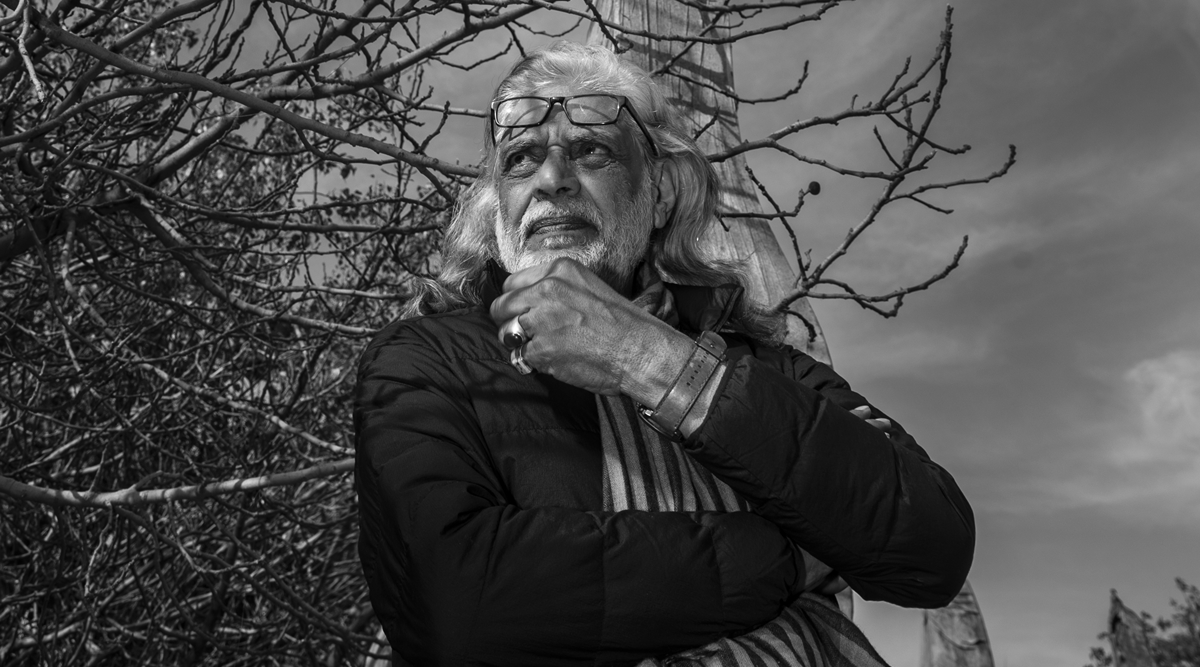
Sundas Jawed (CALCUTTA TIMES; January 17, 2023)
Muzaffar Ali recently weaved magic with his words at a literary festival in Kolkata. From sharing why Kolkata is significant for him to what went into finding his Umrao Jaan and why he is staying away from filmmaking, the 78-year-old actor-filmmaker-poet-designer touched upon topics close to his heart. Excerpts from his session and a chat with CT:
‘KOLKATA IS WHERE I GOT MY FIRST COMPLEX, CULTURAL & PROFESSIONAL EXPOSURE’
I got my first complex, cultural and professional exposure in Kolkata. Wherever I go, I go with a clean mind and when I came to Kolkata, I came with nothing but just Ghalib’s famous quote – Kalkatte ka jo zikr kiya tune humnashi, ek teer mere seene mein maara. I slowly began discovering the many layers of Kolkata, which I have never found in any other city. I got exposure to a more practical world, a world trying to make a difference through commerce, politics and at the same time helping me find myself. Kolkata in that sense became a significant place for me. Mumbai was as astounding as Kolkata, but one must come from Kolkata to understand Mumbai. And here I am not talking about the Bombay of business people, I am talking about the Bombay of the soul.
‘KOLKATA HAS GIVEN ME SO MUCH’
Kolkata is and was history in the making. It is a culturally rich city; it has always had a sense of poetry and appreciation for art, which still continues. It is a revolutionary place, and one must live here to understand the essence of the city. I have lived here for two-three years, and the city gave me so much. Kolkata is a place that challenges you, probes you, makes you think and makes you do things. Coming to its food, I don’t think there is anything like the kathi rolls of Kolkata. I first had them in the 1960s at a famous food joint in central Kolkata.
‘ART IS COMMERCIALIZED IN INDIA’
The ecosystem in Mumbai currently is not conducive for filmmakers to make movies; boycott culture comes much later in the scene. Me staying away from filmmaking has got nothing to do with boycotts. People should respect your taste and not think that your work isn’t commercial enough. Art is commercialized in India. The way money is handling art is not the way art should be handled. More than censorship, what is important is the freedom of art. The artist needs to feel a sense of elation with his art and expression.
‘IT WAS NOT EASY TO FIND UMRAO JAAN’
Casting of Rekha was another phenomenon. It was not easy to find Umrao Jaan, but I was lucky to find some photographs and after seeing them I was sure that Rekha’s eyes were the eyes that could tell the story I wanted to. However, transforming a woman into a character that could rule over the hearts of many was not easy. A lot of effort by many people had gone into bringing out the sensitive grace that Umrao Jaan needed – it required patience and creativity.
Muzaffar Ali rues as his life’s work was damaged by Gurugram’s September floods
7:20 AM
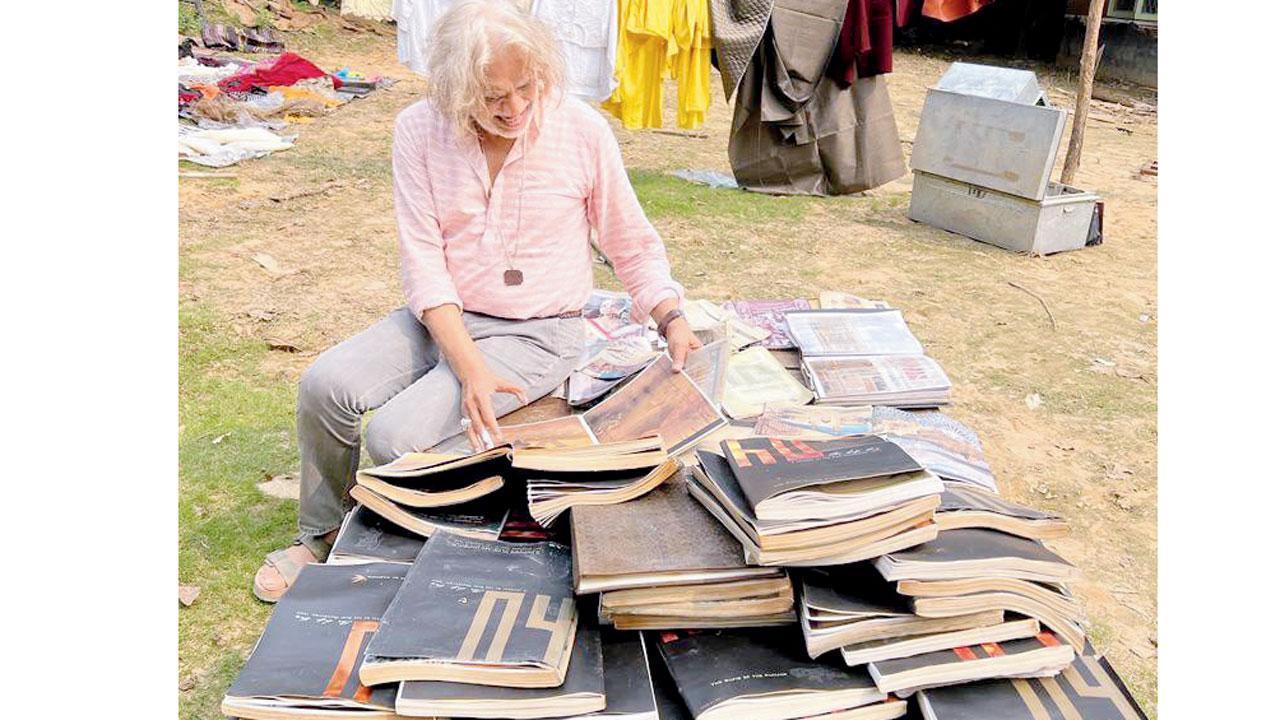
Amir Khusrau’s poem seems to have struck Khusrau festival founder and filmmaker Muzaffar Ali, quite literally, when his life’s work was damaged by Gurugram’s September floods
Yusra Husain (MID-DAY; October 9, 2022)
Arab ki Sarai at Delhi’s Humayun’s tomb was immaculately dressed up for the Jahan-e-Khusrau, an annual three-day Sufi music festival held to commemorate the death anniversary of Amir Khusrau. The year was 2001. Illustrious artistes joined the magnificent musical company of Pakistan’s Abida Parveen, Iran’s Rumi Group and Tunisia’s Lotfi Bouchnak, to regale an audience that sat in the open gardens under moonlight. Little did festival founder, filmmaker and Padma Shri awardee Muzaffar Ali know that 20 years later, just under 25 km away from this venue, a lifetime worth of work would see a “pani phir gaya” moment.
Kotwara Farm, Ali’s home in Gurugram’s Gwalpahari, sits in a nasheb (Urdu for slope) as he puts it, with the beautifully rugged Aravali mountain range in close proximity and a pond behind the residence. This beauty, Ali realised, now comes at a price since the area has seen a burgeoning urban township spring up. Ali says much of it has to do with ASF Infrastructure, a private firm, developing an Information Technology sector-specific Special Economic Zone (SEZ) in the area.
“There are high-rise buildings here now. Water from the pond and the storm water drainage that passes right next to our house, is blocked by new construction and the hillock made by TERI [The Energy and Resources Institute] in the name of a golf course,” Ali alleges.
Like always, the rainwater should have followed its course into the foothills of the Aravalis. As per the records at Delhi’s primary weather station, the Safdarjung Observatory, 16 per cent excess rainfall was recorded in Gurugram in just 24 hours, on September 23. Other weather stations at Palam, Lodhi Road, Ridge Ayanagar and Pusa also recorded heavier than normal rainfall during this period. The 36-hour rain spell made this September the second wettest in a decade.
Like with several other commercial and residential premises, Ali’s home saw water flood in. “In just about an hour, there was three feet of water in my home office. All the archival tapes of original music from the Jahane-e-Khusrau festival from 20 years ago, and master tapes of my films, were swimming in muddy water. Sab sarabor ho gaya hai; I don’t know what to do,” he says helplessly.
Not just the tapes, a number of costumes from the festival and his films, old newspaper cuttings that were stored in a trunk, issues of the coffee table journal by Rumi Foundation, HU-the Sufi way, which document the Sufis of Kashmir, Punjab, Awadh etc, exquisite durries made in his hometown of the erstwhile royal estate of Kotwara, and his personal curation of music, lie ruined. “These tapes also housed the sound tracks of Anjuman (1986) and Gaman (1978),” he says of his films, “The tapes contained the originals.”
Music for Anjuman was directed by Khayyam while Gaman won Jaidev the National Award for best music direction and the National Award for best playback singer female (Chhaya Ganguly).
The damaged lot includes quarter-inch tapes that are no longer in use; music cassettes that replaced these, and CDs that came after. “I am still trying to wrap my head around how much is lost, what can be redeemed and what will be history now,” Ali says, who together with architect-designer wife Meera Ali, has putting the material to sun every morning.
Ali has filed a complaint at Gwalpahari police station in Gurugram to report the loss of “rare and valuable archival records of my films and festivals” that have been destroyed. “Due to the criminal negligence of ASF and TERI, this water was let loose by ASF and not allowed to move out by TERI. This created a flooding situation resulting in huge financial loss and damage to life and property. From time to time, I have been warning the MCG [Municipal Corporation of Gurugram] about this.” Ali says he has not received any support from the film industry or the Haryana government. “I have credibility attached to my life and name and they [the administration] should understand the problems a person like me is facing. Why would people want to settle here?”
“On his complaint, we have asked the MCG to clear out the drains. TERI has also been reached out to and they say off-season rain has caused damage to them too. But we will keep Muzaffar Ali’s maan-samaan and resolve the issue soon. FIR can’t be lodged as this is a non-cognisable offence,” said Gwalpahari police station ASI Prem Chand.
Ali says he has shifted his archives between locations over the last few years—from Mumbai, a city long lashed by the rains, to Lucknow, and finally Delhi. “I still have a lot of original photographs and archives at my Lucknow residence. Artistes and filmmakers tend to have valuable documentation which needs to be preserved and shared. My father [erstwhile Raja of Kotwara] also kept records till his death in 1990, and I have tried to safeguard them. He gifted some of it to the Amir-ud-Daula public library in Lucknow, opposite our home. I am not sure if they will be interested in safekeeping my archives too,” he tells mid-day.
With climate change a reality, Ali wonders if there is merit in considering the setting aside of a budget for the creation of a dedicated space that can serve as an art and cultural archive that’s air-conditioned and moisture-free.
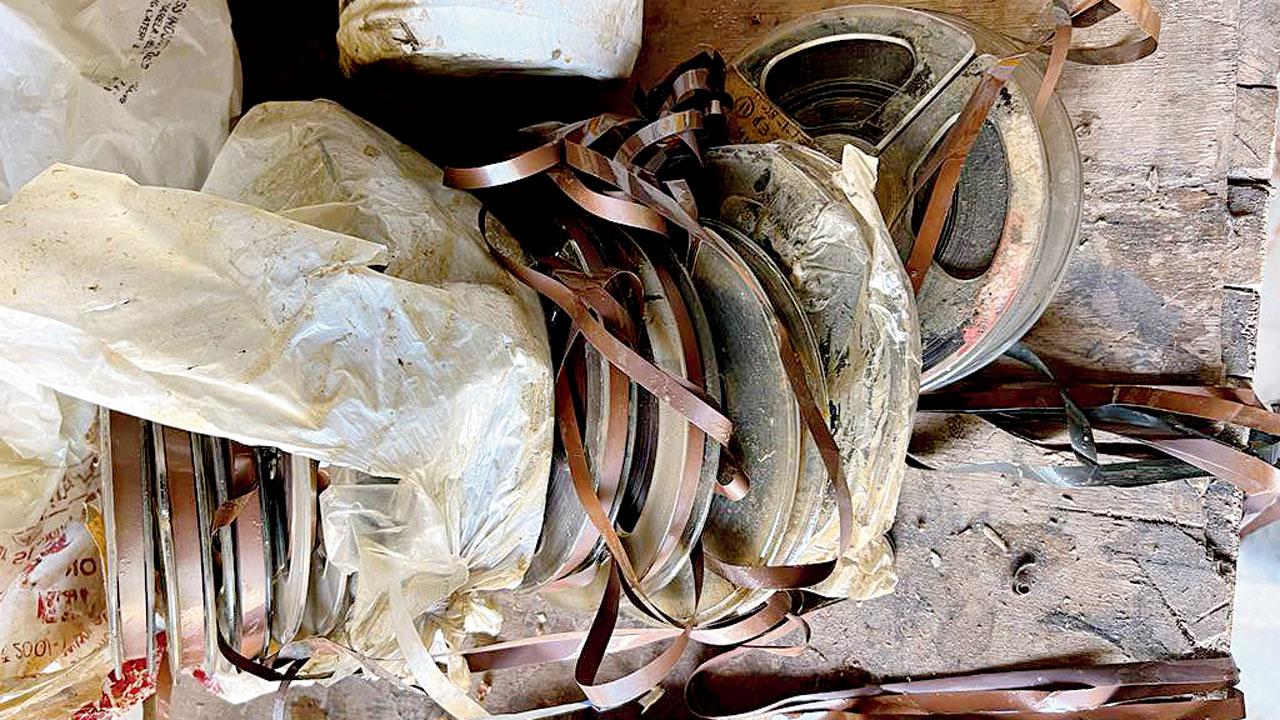

Out of fashion quarter-inch tapes, cassettes, CDs with original music from some of Ali’s best films lie in slush
The medium of Gaman came from Calcutta, inspiration from Aligarh and soul from Awadh-Muzaffar Ali
8:20 AM

Filmmaker Muzaffar Ali on his 1978 directorial debut — about a taxi driver from Uttar Pradesh in Bombay — which chronicles the plight of migrants in the big city
MUMBAI MIRROR (May 17, 2020)
 I was moved to read Trisha Gupta’s piece, Tell me how long the train’s been gone, which appeared in Mirror last week. I am happy to see Gaman is still relevant after so many years. Each film is a world in itself. A universe we create out of ideas and emotions that have been a part of our building blocks. It is a pictorial canvas of what we have seen, and would like to show to this world, with the utmost honesty and sincerity.
Many a time we make films that people would like to see with equal sincerity and artistry, yet there is a fine difference between the two, and people can see the difference. It is what you want them to see that lives on.
Gaman is about displacement. In scientific terms, it is the adding of an external element and thereby the replacement of the original organic element. I saw the emergence of a Gaman-like world in Bombay when I moved there in 1971: The influx of people from all over to displace the original character of the city. The making of a metropolis is the unmaking of a place. Spaces are threatened in layers, year after year, and each year changing the aesthetics of an urban cityscape, rendering the earlier out of date. The enormity of this tragedy was rendering people faceless.
‘Kya koi nayi baat nazar aati hai hammeiñ Aeina hameiñ dekh ke hairan sa kyoñ hai’
 A question of becoming a stranger to oneself: Bombay, to becoming Mumbai, a strange mirror that reflects our past with a perspective of the future. Bombay was a series of fading mirrors that pulled one, each time one saw oneself in them. Most of these mirrors find their way from sacred spaces to the crowded narrow gullies of places called Chor Bazaar.
Gaman is a journey of changing images in such mirrors. It is the reflection of the dynamics of roadscapes of a city, which never sleeps, in the rear-view mirror of a taxi in the eyes of a helpless driver. Spaces that are yours and not yours: A river that can never afford to stop. The protagonist of this ceaseless flow is a throbbing heart, beating, yet lifeless like a stone. Seeking reasons, yet finding none.
‘Dil hai to dharakne ka bahana koi dhoondhe Pathhar ki tarah behiss o bejaan sa kyun hai’
Where music is the melodic refrain for the orchestration of a mechanical world — this was me in Bombay in the 1970s, a city, which I saw from atop the Air India building, where I worked on the 18th floor. From where for hours on end, I watched yellow-roofed taxis crawl like ants. I wondered whether under those yellow metal sheet roofs was a man like me far away from his home. How far was his home; it was anybody’s guess. What he had left behind was beyond anyone’s imagination. The feeling was enough of an answer. Was it worthy of a film, I thought to myself? Was this loneliness our inevitable destiny — a wilderness beyond what meets the eye? On one hand, the ocean, and on the other, an endless sea of humanity...
‘Tanhai ki ye kaun si manzil hai rafiqo Ta hadde nazar ek biyabaan sa kyun hai...’
But certainly it was an emotion as deep as the Arabian Sea. It was an emotion in which I saw the fathomless tenderness of a thumri. Each time our eyes met in a rear-view mirror, a truth transpired. One saw beyond what the eyes could see. I saw the piercing eyes of Khairunnissa wait for Ghulam Hasan. I saw the eyes of Farooq Sheikh and beyond that the piercing helpless gaze of Smita Patil. Was it still worthy of a film?
What was beyond these frozen frames? There were moments of truths and more truths, of humans waiting at traffic lights on metalled roads and zebra crossings, metal bridges across mighty rivers ferrying helpless souls packed in metal cabins. Amidst this human exodus were shattered windows of glass, allowing the last ray of the setting sun play its flute on a windswept face.
‘Aaja sañwariya tohe garwa laga luñ Ras ke bhare tore nayan...’
It was a lonely journey. Can the loneliness of this phenomenon become a collective journey of a film? I had found the words, which described the emotional angst of the migrant. When Krishna leaves, would Radha’s tears drown Braj? In this diabolical answer, I felt, I was near the beginning and the end.
 Everything was in the mind of these mindless travellers, at times, bringing the odd tear when emotions aligned themselves to the sound of the changing tracks. But the sharp tearing horn of a railway diesel engine wiped it off in an instant as the morning sun rose in the formidable ghats and one was sucked into an endless tunnel. One wonders which side one is on. The ones in the train or those they are going to displace. I had become a ‘Ghati’ and a ‘Bhaiyya’ in the same breath. For many years I had been in that train not knowing the difference between the beginning and the end of these journeys.
Hence Gaman: A name given by my friend Asghar Wajahat to this feeling. Something I had begun to see with the inner eye. But Gaman was more than I could hold in one glimpse. It had too many metaphors, both vivid and fading. Khairunnissa sniffing and wiping her nose with her chadar as she extinguishes a night fire at dawn. Clothes becoming one’s second skin, fading and becoming sensuous, looking nostalgic and inviting with their faded textures under the smoke filled thatched roof, turning black with soot. The soot and the smoke was not different to the soot and the smoke from the speeding train... one was towards darkness and gloom and the other towards the light at the end of the tunnel.
‘Aap ki yaad aati rahi raat bhar Gham ki lau thartharati rahi raat bhar...’
One was static in a moving environment and the other moving in a static world.
‘Dard ke chaand dil mein utarte rahe Chandni muskurati rahi raat bhar...’
Gaman was yet to be born. And was it worthy of being a film? I didn’t care anymore. I had begun to unearth the city called Bombay.
The medium of Gaman came from Calcutta, inspiration from Aligarh and the soul from the heart of Awadh... and my palette from my paintings, having sketched out each frame. I was fascinated by khaki from the paper of my paintings and was fascinated by the khaki clad taxi driver protagonist of my film. Symbolically as a migrant taxi driver and as a migrant, he had no identity left but to become khaki, the colour of dust.
On Amitabh Bachchan’s recommendation, Khayyam saab landed Kabhi Kabhie-Talat Aziz
8:11 AM

Roshmila Bhattacharya (MUMBAI MIRROR; February 20, 2020)
In 1978, on a visit to Mumbai from Hyderabad, at a mehfil in Khar, singer Talat Aziz ran into music director Khayyam who complimented him on the purity of his voice and promised to record a song with him for a film if he got a chance. Talat saab did not hear from him till ’80-end when, one day, out of the blue, Khayyam saab called, saying he had a song for him and asked him to come over for rehearsals. “He was very particular about rehearsals. Even Lata ji (Mangeshkar) and Asha ji (Bhosle) had to drive down all the way from town, like me, to his apartment in the suburbs for 10-15 rehearsals before going in for recording. We would sit in his music room and Muzaffar Ali, the director, would be standing at the doorway, watching me go on and on. Sometimes his wife, Jagjit Kaur ji, would feel sorry for me and tell Khayyam saab to let me go, but he would argue that I could sing it better with practice,” Talat saab recounts.
Much later, the composer confided, that singer-actress Suraiya ji, who was among the guests at the mehfil, had been equally impressed by his voice and had urged Khayyam saab to give him a break only in a good film. “He’d retorted saying he only did good films,” Talat saab shares.
 Talat Aziz made his debut as a playback singer in Umrao Jaan with the ghazal “Zindagi Jab Bhi” (left). The song was not there in the original script. But Khayyam saab pointed out to Muzaffar Ali that the Umrao had plenty of suitors and the only way the courtesan would be drawn to Farooq Shaikh’s character, Nawab Sultan, was if he wrote nazms. “The film didn’t do well commercially, so I was surprised when, after its release, I was inundated by requests for this particular song at mehfils abroad and learnt that people there had heard it on video cassettes. In some cassettes though it was snipped out because the film was too long,” Talat saab laughs.
 The following year, they collaborated on the melodious “Phir Chhidi Raat Baat Phoolon Ki” (right) for Bazaar which was recorded at Bombay Lab. Talat saab recalls how nervous he was to be singing with the legendary Lata ji, and how, when he told her “darr lag raha hai”, she quickly put him at ease. After three takes, Khayyam saab’s voice boomed over the headphones, complimenting them and saying he was on the way to their booth. “Wait and watch, as soon as he comes in, he will say, ‘ek aur’, Lata ji told me, and that’s exactly how it happened. That ‘ek aur’ was Khayyam saab’s ‘safety’ take,” he informs.
Quiz Talat saab on the man himself, and the singer describes his mentor to be “frugal” in every sense. He visited Khayyam saab at home every Friday after prayers as the mosque was next door. The composer waited to have lunch with him. “It was a simple meal of tomato soup, dal, doodhi or turai ki bhaaji and a chapati for him, and overriding my objections, he’d insist his cook Nirmala make chicken for me. After the meal, brushing away my reluctance, he’d insist I eat an apple, at least a slice, as it was a healthy dessert,” he flashbacks.
 After that, they’d chat for hours. Sometimes Khayyam saab would recite verses— “he knew Sahir Ludhianvi’s book of poetry, Talkhiyan, by heart”—and sometimes he’d narrate stories, like how he landed the 1958 film, Phir Subah Hogi (left), which was a turning point in his career. “Khayyam saab had gone to RK Studio and played different tunes for Ramesh Saigal (the film’s producer-director), and Raj Kapoor, its hero, with his team of musicians for almost an hour. Raj saab had listened without expression, then gone into the room next door. Thinking he’d been rejected, Khayyam saab was packing up to leave, when Raj saab returned after around 30 minutes, and asked him to play some tunes again. He ended up getting the film which was a big deal then for a newbie composer as it was unthinkable for RK to do a film without Shankar-Jaikishen,” says Talat saab.
 The memories continue... How one day, after Kamaal Amrohi’s Mercedes had dropped him off at home close to midnight, Khayyam saab had come upon Sahir Ludhianvi taking a nightly stroll. The lyricist told him he was doing a film with Yash Chopra. Soon after, Jaya Bachchan turned up at his door, wondering if he had the Razia Sultan song, “Dil-e-Nadaan Tujhe Hua Kya Hai” which had become a craze, on a cassette. “Amit ji wants to hear it,” she told him. He didn’t, but the next day, when he told Kamaal saab this, the filmmaker had it recorded on a cassette and rushed to Bachchan’s office. “On Amit ji’s recommendation, Khayyam saab landed Kabhi Kabhie (right),” narrates Talat saab. The film remains unforgettable for Sahir and Khayyam’s evergreen “Neela Aasmaan”, “Main Pal Do Pal Ka Shayar Hoon” and of course, the title track, “Kabhi Kabhie Mere Dil Mein Khayal Aata Hai.”
Khayyam saab has given the music for many love stories, but the one Talat saab loves best is his own. He remembers how, after his mentor collapsed in his flat last year, on July 28, nattily dressed in jacket and trousers, his trademark topi on his head, they rushed Khayyam saab to the hospital, where, soon after, his wife, was admitted too. “Three days before he died, I wheeled Jagjit Kaur ji into the ICU where he lay, eyes closed. She took his hand and whispered, ‘Dekho saab, main aa gayi hoon. Kholo aankhen, mujhe chhod ke mat jao. I love you.’ I could see something flutter beneath his eyelids as if he was trying to come out of the coma. But this time even love failed,” he sighs.
Mohammed Zahur Khayyam Hashmi passed away on the night of August 19. The next morning when Talat saab gave the news to Lata ji she sighed, “He was the last of the Titans. With him an era has ended.”
Images: Bollywood personalities pay last respects to Shabana Azmi’s mother Shaukat Kaifi
7:40 AM

PTI | inputs by Onkar Kulkarni (BOMBAY TIMES; November 24, 2019)
 On Friday, veteran theatre and film actor Shaukat Kaifi passed away at her residence after suffering a cardiac arrest. The 93-year-old was unwell for a while. She is survived by daughter Shabana Azmi and son Baba Azmi. Kaifi’s son-in-law, veteran writer-lyricist Javed Akhtar, who is in the US, said, “She was 93, and she was having one problem after another. She was admitted to the hospital, for certain days she was in the ICU and then she was out of ICU. It was all age-related. Ultimately, they brought her home. She wanted to come back to her own room, she stayed for a day or two and then passed away. Shabana is in Mumbai."
 Tabu, Urmila Matondkar, Divya Dutta, Satish Kaushik and Boney Kapoor were among the film industry people, who visited the family to pay their last respects. Shaukat Kaifi was married to renowned Urdu poet and lyricist Kaifi Azmi, who passed away in 2002. She had also penned a memoir titled Kaifi and I. The theatre veteran has been part of films including Heer Ranjha (1970), Faslah (1974), Garam Hava (1974), Umrao Jaan (1981), Bazaar (1982) and Salaam Bombay! (1988) among others.
Remembering Kaifi, filmmaker Muzaffar Ali, who directed her in Umrao Jaan, said, “Shaukat had the versatility and guts to reinvent herself. Be it her role in Umrao Jaan or Anjuman (1986), she was so different in every character. She would always get nervous before her shot, but on the set, she used to be extremely bindaas. She had an amazing sense of humour and would often joke around with the cast and crew. The last time I met her was a year ago. I have many fond memories of her. Our birthdays were just a day apart and we often celebrated them together at each other’s homes in Juhu. Also, I remember that she had immaculate taste in sarees, and had a beautiful collection of handwoven, handspun sarees. I never saw her repeating them.”
Recalling a fond memory, Divya Dutta, who is close to the family, said, “Many years ago, I was shooting in a bad network zone in Rajasthan when I received a call from Shabana ji saying someone wants to talk to me. It was Shaukat aapa, who she passed the phone to. She had just seen Delhi-6 (2009) and had called me to talk about my performance. She told me, ‘Mujhe lagahi nahi ki tum actor ho, mujhe laga wahin se le aaye hain tumhein.’ She spoke to me with so much warmth that it felt like she knew me forever. From thereon, my bond with her became strong. I was invited to all the celebrations and special occasions. She had been unwell, but that smile and glint in her eyes was constant. I think very rarely do you have people who have seen it all, fought it all and yet have this incredible grit, grace and warmth, and Shaukat aapa was one of them. She was full of life. I think Shabana ji is a mirror image of her. Their relationship was so beautiful. I could relate to it because I too was very close to my mother.”


Khayyam saab and I shared that beautiful journey called Umrao Jaan-Muzaffar Ali
7:56 AM

Filmmaker Muzaffar Ali worked with Khayyam on films like Umrao Jaan and Anjuman
As told to Rachana Dubey (BOMBAY TIMES; August 21, 2019)
 Khayyam saab’s music is larger than life and his demise has created a vacuum that can only be filled by his greatness and creativity, which he has left behind as a legacy in abundance. Khayyam saab and I worked together on three projects. Umrao Jaan was a long, intense journey. We went through the throes of creating the characters and the lyrics because that film was poetry. Ek ek lamha was musically and poetically crafted. The time we invested in composing the songs is not something that often happens. Two years is a long time; we took long gaps between creating our songs so that each one sounds distinct and has the right mix of emotions.
Khayyam saab's process was long drawn out. Khayyam saab and I shared that beautiful journey called Umrao Jaan. It was a creative part of our lives that we shared with people at large, and no one can ever get it out of their mind. Creating that kind of music needs people who are rare to find like Khayyam saab. He was always ahead of his time and had the patience to nurture tunes.
The film Anjuman was a naayab project where I could make him sing. He sang a ghazal by Faiz Ahmad Faiz. Shabana Azmi sang her own songs, too, for that film. It was a dilchasp raasta where we explored the new and revolutionary phase of Lucknow, ek bilkul naye tareeqe se. It was an intense and interesting journey.
The third film we worked together for was titled Zooni, which was set in Kashmir. It was a dream which remained unfulfilled, although I want it to be fulfilled some day. I have preserved the songs that Khayyam saab had created for it, and for the sake of those, I want that film to see the light of day. The songs he created for this film deserve to reach their final destination -- the hearts of the listeners.
Unka yun guzar jaana ek bahut bada haadsa hai. It's a loss to the fraternity, because with him, we have lost a generation and a school of music. Some of us are fortunate to have worked with him and a lot of us are fortunate to have grown up on the songs he created.
Khayyam saab convinced Muzaffar Ali to add a male song in Umrao Jaan-Talat Aziz
7:54 AM

Talat Aziz bids farewell to his mentor and father figure
As told to Upala KBR (MID-DAY; August 21, 2019)
 I first met him during my performance at a private mehfil in Khar, in 1978. After my performance, Khayyam saab walked up to me and told me, ‘Beta, I like your voice. One day, I will give you a break.’ When Umrao Jaan (1981) was conceived, there was no male song in the original script. So, Khayyam saab told Muzaffar Ali [director] saab, 'I want you to include a male song so that it can lend a poetic vibe to Farooq Sheikh’s character and Umrao Jaan can fall in love with him.' That’s how the song, Zindagi Jab Bhi Teri Bazm Mein, was created, and I came into the picture. I remember going to his house for 15 days for rehearsals before we recorded the song.
Khayyam saab was a father figure to me. I used to meet him at his home every three-four days, and if I couldn’t make it, he would invariably check on me and ask me where I was. I learned the art of perfection from him. He made me record the ghazal, Nagma-e-Jaan Saaz-e-Dil, [Yatra, 2007] 20 times before he was satisfied.
He once narrated to me that when he was recording the song Hazar Raahein [Thodisi Bewafai, 1980] with Kishore Kumar, Kishore da wanted to sing the song without interludes while Khayyam saab wanted it with interludes. He let Kishore da sing it his way, but the singer was not happy with the result. That’s when Khayyam saab told him, ‘I put those interludes because the story is about an estranged couple. The director can show flashbacks of what happened in their relationship in those music pieces.’ This was the kind of detailing that Khayyam saab practised.
I was by his side all through his illness. I took care of him over the last 21 days in the hospital. I was praying by his bedside when he breathed his last.

Khayyam was accorded State Honours. Pics/ Sameer Markande, Yogen Shah
Khalid Mohamed pens a tribute as Khayyam passes away
7:46 AM

Khayyam with wife Jagjit Kaur at an event in 2017
Veteran composer Khayyam breathed his last in a Mumbai hospital around 9.30 pm on Monday
Khalid Mohamed (MUMBAI MIRROR; August 20, 2019)
He always had a furrowed brow, as if he was waiting to reach an errant melody he couldn’t quite perfect. When he did, his face would soften, he would dart a rare smile and get on to the next one, which perhaps would be recorded or stay with him.
There are scores of songs which did not reach us, and perhaps never will. His repertoire of unheard compositions have departed with Mohammed Zahoor Khayyam, who passed away on Monday night. The departure, I could see was coming, at the suburban hospital where he struggled to open his eyes at least for a flicker of a moment during a month-long stay at the Tulip cabin of the ICU unit. Yeh kya jageh hai doston, Hindi cinema could have well asked, but then I’m getting maudlin here.
The end is endemic as the last stanzas of the songs Khayyam saab had created, without ever caring for the A-listers of the geetmalas from the 1950s on to the turn of another century. To be sure, because of our limited memories, the 92-year-old icon—never called one during his lifetime will be associated most of all with the ever-resonating soundtrack of Umrao Jaan.
If he was bitter to a degree, I suspect, about the Umrao experience it was because he had topped it with the songs composed for its director Muzaffar Ali’s Kashmir-set love story Zooni. The film was left incomplete, but its songs are somewhere out there on tapes mouldering in the vaults somewhere.
Khayyam was not prolific by choice. If Yash Chopra called upon him to do Noorie, Nakhuda, Trishul and Kabhi Kabhie, it was obviously because the chartbusting music directors couldn’t have touched the composer who insisted on doing it his own way and wouldn’t be subjected to prolonged sessions at ‘sitting rooms’ as they are called. The Kabhi Kabhie score especially had that extraordinary poetic quality.
When Khayyam was no longer in the Yash Chopra ‘camp’ so to speak, he kept silent. In show business, one has to move on. When I had asked him to comment on this, he had shushed me up instaneously with a have-you-come-to-talk-about-my-work-or-gossip?
His music had the USP of pauses (check out Ae-Dil-e-Naadan from Razia Sultan). The orchestra comes to a standstill, when Lata Mangeshkar’s voice returns, it’s pure magic. Incidentally, stalwart writer Javed Siddiqui points that it was Khayaam who made the completion of Pakeezah possible. “Do you know he and his wife (Jagjit Kaur) kept trying to make peace between Kamal Amrohi and Meena Kumari. And they succeeded. The film was restarted only because of them.”
Right from Footpath and Phir Subah Hogi to Shagoon and Aakhri Khat, Khayyam’s track record is classic. He would agree to a TV serial occasionally but had stopped accepting film projects which would make him compromise with his signature style – soft, gentle, romantic and from the heart.
Khayyam saab has left the ICU unit. He can never leave us, ever, because without him will never be another subah, another song of such love and longing.
Asha Bhosle takes it personally when a particular dish had not turned out as well as the last time-Baiju Mangeshkar
7:55 AM

Baiju with his aunts, Lata Mangeshkar and Asha Bhosle
Roshmila Bhattacharya (MUMBAI MIRROR; September 6, 2018)
On September 8, Asha Bhosle turns 85, but for her nephew, Baiju Mangeshkar, she’s an evergreen 16 — the epitome of inexhaustible energy and a sparkling effervescence who has been inspiring him since his childhood. When he was a boy of four-five, Baiju remembered his Asha aunty as a tornado, sweeping in and out of the house. She was so busy with recordings that they hardly saw her even though she lived next door. But as he grew older, he became attached to her cousins, Varsha and Anand in particular, with whom he would chat till late into the night. That’s when he realised that she was a versatile singer par excellence... And also a gourmet master chef who, like her sisters, could not only whip up delicious Maharashtrian meals, but also specialised in pan-Indian cuisine, from Bengali to Awadhi.
“She can take censure about her singing in her stride, but a grouse that a particular dish had not turned out as well as the last time, she takes personally,” informs Baiju, rhapsodising over her chingri malai curry, sheikh kebab, mustard gosht and Awadhi biryani which she learnt from her Umrao Jaan director, Muzaffar Ali. “She has an anecdote for every dish and will rattle off the recipe the minute you compliment her on it. And no matter how exhausted she is, at the end of the day, she will still head to the kitchen and whip up a gargantuan spread in the shortest possible time,” he marvels.
Baiju also vouches for his Asha aunty sari-draping skills. She can do it in under a minute, he says, having seen it happen one night in a London hotel when they were woken up from sleep by the fire alarm at 2.30 am.
“We straggled out, rubbing our sleepy eyes, in our night clothes, to find Asha aunty who must have been 70-plus at the time, already out on the street. And what’s more, she had stolen a minute despite all the chaos around, to change into a sari as it wouldn’t be appropriate to step out in a nightdress,” he smiles at the memory.
Baiju has never seen his aunt lazing around the apartment, not even on a holiday. And no matter how long the day, she is ready to take off on a shopping spree without a second thought. “She only sits down when she is reading or watching a movie,” he informs.
Asha Bhosle is an avid movie buff, and surprising, while she has her Hindi film favourites, her choice usually veers towards Hollywood classics. Top of her list is William Wyler’s 1961 drama, The Children’s Hour (released as The Loudest Whisper in UK), featuring Audrey Hepburn, Shirley MacLaine and James Garner. Also in the same list is another comedy from the same year, Frank Capra’s Pocketful Of Miracles, with Bette Davis and Peter Falk.
“I am equally passionate about Hollywood cinema and recently recommended the Academy Award-winning La La Land to her. We went to see it together and on the way home, she thanked me,” smiles Baiju, pointing out that if she had had an English-medium education, he can easily see his Asha aunty singing English songs, like R&B.
Baiju, the son of music maestro Hridaynath Mangeshkar, is a singer and composer himself and confides that his veteran singer aunt has always “pushed” him to sing, even gently admonished him sometimes, after she secretly heard him sing when he was young.
For Baiju, his Asha aunty can sing anything, from “Kambakht Ishq” at 60-plus to Rabindra Sangeet and Natya Sangeet. “It’s incredible that the woman who sang 'Aaja Aaja' with so much oomph could also effortlessly pull off the classical-based 'Nandalala' for my father. She also sang the complex Ravindra Jain composition, 'Saathi Re Bhool Na Jaana' from Kotwal Saab, in one take after just one rehearsal directly on the mic, something that would have taken other singers at least 10 days to perfect. While a challenge would shake up many of us, with Lata aunty and Asha aunty it only stokes the fire in their belly,” he marvels, admitting that it’s his dream to sing a duet with her some day or maybe compose something special for her, like his father has so many times in the past.
Till then, they share something special, he whispers, which sets them apart from their illustrious family. “Her father and my grandfather, Deenanath Mangeshkar, had dimples and we are the only two after him to have them too,” Baiju reveals with a flash of his dimples. One can almost hear his Asha aunty laugh too.
I'll give it a shot-Shabana Azmi on the possibility of coming up with an album someday
7:46 AM

Shabana Azmi has taken several stabs at singing. Encouragement for her latest effort might see her work on a full-fledged album
Yogesh Pawar (DNA; April 25, 2017)
Shabana Azmi’s command over Rabindra Sangeet in the recently released Sonata caused the staunchest Bengali critics to call it the “only redeeming feature in a play masquerading as cinema”.
Azmi, who’s currently in London, shooting for an English TV series (not allowed to give details, she says, when pushed for details) in London, points out how she had very little training in singing. “I had two lessons in August and four in September in all. All the credit goes to my tutor Sharoni Sen, who was impossibly patient and encouraging. Without her, it couldn’t have worked at all.”
An adamant Aparna Sen, who directed Sonata insisted, “coaxed, cajoled and even bullied” Shabana into taking the risk. “And while we had recorded the song earlier, the day we shot the scene I was emboldened enough to sing it live on sets. That was Aparna’s plan all along!”
Before this, Shabana indulged a bit of Carnatic classical in Mahesh Dattani’s Morning Raga. And this was way back in 2003. That experience was decidedly tougher, she admits. She explains why. “Because it was Carnatic, a genre quite different from Hindustani with very rigorous, mathematical notations. To hold the swarams in a single shot was very, very challenging. However, unlike Sonata, where I’m actually singing, in MR I was only lip-syncing. I had to train to ensure the close-ups looked convincing.” The prep came handy when she hummed the same composition in a film anthology for a short film called Riceplate in 2007, where she played a staunchly Islamophobic and conservative Hindu grandmom.
But the actress’s first tryst with singing came far earlier. She has sung three songs for Muzaffar Ali’s Anjuman (1986), in which she also played the lead role opposite the late Farooque Shaikh. She remembers how reluctantly she sang under legendary composer Khayyam saab’s baton. “Muzaffar Ali had heard me sing in an IPTA play and suggested I sing my own songs in Anjuman because the character I played is a poet and sings in the ‘tarranum’ tradition of Lucknow. It needed to sound untutored. I was reluctant, but Khayyam saab was very supportive.” She adds, “It was terrifying. The first song was recorded a day after I got married. Instead of going off on a honeymoon, I was singing at Rajkamal Studios.”
She remembers how tabla maestro and composer Zakir Hussain used Anjuman to try and get her to sing in Ismail Merchant’s In Custody (Muhafiz) too. “But I pleaded to be excused and Kavita Krishnamurthy was roped in for the playback. In fact, in Mile Sur Mera Tumhara, many assume I sang my own lines, but it was Kavita Krishnamurthy. You know she’s herself admitted my singing sounds like hers. So I’m not surprised most people thought it was me.”
She credits her love for music and singing to her lyricist-poet father Kaifi Azmi. “Though Abba couldn’t hold a note, he’d make me sing to him quite a lot and was very keen I learn singing formally. But I never got down to it.
Actually, both my brother Baba and I have inherited sur from our mother Shaukat Kaifi. Her family has always been musically inclined.”
On being asked about plans for her own album she says, “Javed has been trying to convince me for a long time now. The response to Sonata’s singing has been so encouraging, maybe I’ll give it a shot!”
I will marry when the time is right-Pernia Qureshi
7:58 AM

Pernia Qureshi, after separating from ex-husband Arjun Prasad, has been juggling between Mumbai and Delhi; will be heading on a Kuchipudi India tour next
Sanyukta Iyer (MUMBAI MIRROR; August 7, 2015)
Daughter of Delhi-based meat magnate Moin Qureshi, Pernia Qureshi's wedding was the talk of the town after news spread that her John Galliano-designed gown had cost Rs 80 lakh. The actress tied the knot with UK-based banker, Arjun Prasad, in 2011, and they moved into an apartment in Lodhi Gardens, paid for by the bride's father. In less than a year, the couple split. Hot-headed Arjun reportedly got into a spat with Priyanka Gandhi's high-profile husband, Robert Vadra, at the launch of a nightclub. He also supposedly got into a verbal altercation with Amar Sareen, Pernia's former friend. There was also talk of Arjun taking off with some of his father-in-law's money. Last heard, Arjun was cooling his heels off in Dubai.
Elegant and dignified, Pernia insists that the experience hasn't put her off the institution. "At the moment I'm happy being single and busy with my work. But when the time is right, I will marry. Right now, I am focussing all my energy on work," she asserts, with her head held high. The fashionista-turned-fashion designer makes her acting debut today in Umrao Jaan director, Muzaffar Ali's comeback film, Jaanisaar. The period romance set 20 years after the First War of Indian Independence in 1857, has her as Noor, courtesan who has lost her heart to an Indian prince, Ameer, brought up in England, played by Pakistani actor, Imran Abbas Naqvi. Before the film went on the floors last year, Pernia trained with Kathak maestro, Pandit Birju Maharaj, in Delhi. "Not all dancers are great teachers but Maharajji is both. We grew close during the course of our one-on-one dance sessions and I will cherish his teachings forever," says Pernia, recalling how she kept looking towards Ali for approval when they were shooting a Kathak dance, but he kept a poker face, only complimenting her after the shoot was over. "His opinion really matters because I know Muzaffar sir never says anything flattering or frivolous. But he has always made his women look sensual and I trust him implicitly."
Next month, she takes off on a nationwide Kuchipudi dance tour and plans to start learning Odissi next year. What about movies? Pernia admits that there are no offers in hand, at the moment. "I'd rather wait and do a great film with a director I look up to than one just for the heck of it," she shrugs.
You only have to look into her beautiful face to know this isn't just another actress. Her parents insisted she complete her education before pursuing a Bollywood career.
She got a Masters degree in dance from the US and returned to India five years ago. Her first job was as costume designer for childhood buddy, Sonam Kapoor's home production, Aisha. "It was by a random coincidence that I got associated with the romcom. I was barely paid anything but I enjoyed it since it was my first real job," she reminisces with a smile.
She's often been in the news for her close bonding with Sonam Kapoor and of late, Jacqueline Fernandez. But she's quick to point out that they are not her only friends. "I have no hang-ups. I get along with everyone from my generation, even if they are rival designers like Masaba (Gupta) and Nikhil (Thampi). They are my close friends," says Pernia who has launched her own clothing line, a pop-up store and multiple fashion labels. "I want to go international with my line and store by year end," she signs off.
Rekha, Smita Patil were ladies with a dream; Shabana Azmi is a woman with a cause-Muzaffar Ali
8:15 AM

Priya Gupta (BOMBAY TIMES; August 6, 2015)
Muzaffar Ali, 70, may be
soft-spoken with impeccable manners, but he is also
invisibly headstrong. He is fixated to his environment, be it his
paintings or his ambience, and wants to have a constant dialogue with
it. A painter from his childhood, he is romantic and today has learnt to
have a great sense of record. He needs his family and friends to
put him together, but he's also extremely clear on
exactly what he wants. He may have married thrice, but has been
consistent with his commitment to Kotwara. In 1981, he created Rekha as
Umrao Jaan. Over two decades later, he has made Jaanisaar. Over an
hour-long conversation with Bombay Times, he talks about his best
companion his wife Meera, his commitment to Kotwara and why Smita Patil
was his favourite muse. Excerpts:
Tell us about your family background?
I was born in Lucknow but my father, Raja Sajid Husain Ali, was the raja of Kotwara. He had become a raja at a very young age and thus, there was an attempt on his life due to which there was a danger to his life. He was packed off to Edinburgh to study. He returned to India as a man ready to take on the world in 1936. The British opened us up to a strange sense of democracy, which later became communalised just before independence and that finally drove us to becoming two countries, India and Pakistan. I was very young at the time of Partition, but remember lot of family friends being separated from us. I studied at La Martiniere Lucknow after which I did my BSc at Aligarh Muslim University, where I got exposed to poetry that became a very important part of my evolutionary process of waking up to the world. Right from my school, I always won the first prize for painting and was always a painter that till today has helped me in my films as I sketch each scene out before I shoot it. I always wanted to do something creative and so moved to Calcutta to join advertising. I worked as the account executive to Satyajit Ray, who was the art director of Clarion McCann. I was very close to him and would go to his house. I learnt from him how you can take your culture to people through your cinema. I then joined another ad agency ASP where I worked with Shyam Benegal and Aziz Mirza after which I joined Air India where I made a couple of films for them and then made my first film Gaman. I won my first Filmfare Award. It also gave me the strength to make Umrao Jaan.
All your films, be it Gaman or Umrao Jaan, had a central powerful woman character.
Yes, for me the lady has to be strong. She has to make a difference and that comes from my mother. My mother's father was the nawab of Moradabad, but while she too came from a princely background, she always put things in perspective for me in a humane and practical way. In Jaanisaar, there is a scene inspired by the real-life incident that took place with her father. Because he was a revolutionary, the prince of Rampur spied on him, got him arrested and the British tied his body to an elephant's feet and dragged him around Moradabad and that is a very hair-raising thought. I loved my mother the most, I lost her to cancer when I was studying at Aligarh. And I still have very strong memories of her.
Talk about working with Smita Patil in Gaman?
Smita was a dream to work with. Like me, she too was a Libran and we were very similar. She could see the aesthetics in everything one was trying to do and she would respond to a lot of things that normally people don't respond to, like music, people, clothes, dialogues. We had great fun together. Asha Bhosle's daughter was her companion and the whole night, we would sit on the terrace in Kotwara and laugh and people would think that some bhoot had come.
You created Rekha as the Umrao Jaan. What is she like?
She's also a Libran but she's just he opposite of Smita. While Smita surrendered more, Rekha was more reserved. Smita was more stimulating as a muse. She had a different kind of imaginaion. Rekha has a lot of grace. She has a mystery and a quaint sense of humour. She's an interesting person, but we had a very professional relationship. She was a bit temperamental and knew what she was getting into. She was positioned within the the environment, be it the people, the music and everything else that made her Umrao Jaan.
You also worked with Dimple Kapadia in Zooni and with Shabana Azmi in Anjuman.
Dimple has a very interesting sense of romance in her. If Rekha, Smita and Dimple were ladies with a dream, Shabana is a woman with a cause.
Farooq Sheikh was a part of most of your films.
He was my alter ego. He was a gem and what he did for me, I don't think anyone could do for me on screen. He was perceptive, vulnerable, encouraging and supporting.
You lived in Mumbai. What made you move back to Lucknow and Kotwara?
When my father died in 1990, that's the time I left Mumbai to go back to live in Lucknow. I had to take on the responsibility of sorting everything out. In his will, he had said that he did not want to see anyone hungry in Kotwara. He was a big father figure there. Everything fell in place for me and I too felt that why should they have to migrate for work like in my film Gaman? That was also the time I had married my third wife Meera. The first thing I told her at the time of marriage was, 'You are marrying me and Kotwara.' Kotwara has been an important cultural influence on me and I am deeply linked to the people out there. I have also shot most of my films there.
You fought the Lok Sabha elections several times. What made you do that?
I got into politics due to Ayodhya as for me it was a watershed moment and I felt I had to say something politically. I fought against Atal Bihari Vajpayee and lost but still got 2.5 lakhs votes. I have been fighting all my life. In a way, I am fighting even in Bollywood to make films on my own terms. Now I am not politically-aligned but I like Akhilesh Yadav. I am happy that I have managed to convince him to extend the film subsidy to shoot in UP. I am not only politically aligned anymore but am aligned to humanism and secularism that is why my film Jaanisaar is important for me as it can humanise people.
You have married thrice. Talk about your relationship with Subhashini Ali (mother of director Shaad Ali).
We never divorced and are just separated. She was too much into her politics and I was too much into my own madness and our lives were just not fitting in. The whole period of 1988-1990 was the toughest and lowest for me. Zooni had got held up, my younger brother who lived in Liverpool died, I lost my father. When Zooni was stopped, I lost not just all my money, but also faith in people and politics. After Zooni, when I walked out of Kashmir I didn't know where I would go. First I thought I would just stay in Kashmir only as I had fallen in love with the valley. I had been promised many things from the government as a guarantee for my money, but I lost all my money. I came to Delhi and had to literally stand on my own again. I was living out of a suit case in a small room of a friend. And that's when I met Meera. She came as a breath of fresh air and has since been my best companion and wife. That's also when I got into making clothes as I thought that if I could make Rekha look beautiful, then I could also make other women look beautiful.
What do you like the most about Meera?
That she is very loving and compassionate and very responsible. She likes my madness.
What made you make a film like Jaanisaar after so many years?
I always try and live a film. 1857 is an important period in Indian history. Hollywood has explored the holocaust threadbare, we have done nothing for our history. I made Jaanisaar as I felt that the period of history post 1857 needed to be exposed. There was not a tree left from where there were no bodies hanging and I owed it to my country to talk about the sacrifices that have got pushed under the carpet. And while I don't know the market, I do know what goes into people's bloodstream. I still meet people every evening who fill up my glass with Umrao Jaan. It could be a matter of time but I feel Jaanisaar too will get into people's mental cache.
What did your father like the most about you?
He liked my honesty and that I was straightforward. I didn't hide anything from him though he was not always sure about how responsible I could be as I did certain things in my life that reflected my being irresponsible. For instance, he had a very beautiful Italian Rolls-Royce car that he had brought from England, which I just sold. He had a beautiful stamp collection, which I just threw around. Now I have developed a sense of record and that is also helping me with my work.
Do you wish he was alive to see you like this?
He would not have given me full marks even now. But, I do know that he is marking me.

People have been misled and misdirected-Muzaffar Ali
7:43 AM

Muzaffar Ali talks about putting the past into perspective and educating today’s youth on the cultural history of pre-Independent India
Shaheen Parkar (MID-DAY; August 3, 2015)
As we enter Muzaffar Ali’s Juhu bungalow, we are greeted by his pet dog, Masti, who lies sprawled on a couch specially made for him. The walls are adorned with his paintings and framed poetic verses — apart from being a producer-director, the 70-year-old is a painter, writer, poet and fashion designer too. Ali enters the living room, dressed in an ivory coloured shirt and grey trousers, his white mane kissing his shoulders. His grandchild, Imaan (son of filmmaker Shaad Ali) starts babbling away at his sight. We are meeting Ali to discuss his return to Bollywood after almost three decades with the soon-to-be-released Jaanisaar. Much like his Rekha-starrer classic, Umrao Jaan (1981), this film too is set around the time of India’s first war of independence in 1857. In a candid chat with hitlist , the multi-faced personality explains how he is getting a hang of the publicity blitzkrieg associated with films nowadays…
Do you feel like a beginner considering the filmmaking process has completely changed now?
Since my son (Shaad Ali) is also a filmmaker, there is always talk of films at home. So, it is not that I was totally cut off from it. I might be making a film after years, but there’s other stuff that has kept me busy — from my fashion label to my Sufi music festivals to art and poetry. The people I work with are all young, so I am attuned to what is happening now. What I am learning to grapple with is the market realities of today — how to get an opening with less pressure.
Why do you choose the Indian Rebellion of 1857 as the backdrop for all your films?
That’s because I want to put the past into perspective for the cultured evolution of our society. Today’s youth is evolving with a lot of gaps. There are certain things they ought to know. Some things have been purposely taken out. People have been misled and misdirected. Our democracy is in the doldrums. We are at a crossroads — who to choose, why to choose. In a way, we are going through the dark ages. We need to know what has been going wrong since our first war of independence in 1857. We have to put on our thinking caps. Why does Hollywood keep making films on the American civil war and the holocaust? To make the newer generations aware of what went wrong.
You have always worked with stars. Why did you decide to cast new faces in Jaanisaar?
It is what I, as a director, perceive of them and what I can make of them. This is where the challenge lies for a filmmaker. I cast Imran Abbas after seeing his snapshots. I had not seen him in his Pakistani TV shows and had no idea of his Bollywood aspirations. As far as designer Pernia Qureshi is concerned, I saw her as an interesting raw material that I could mould.
Have you seen the remake of Umrao Jaan by J P Dutta in 2006?
I had heard of it, but I have not seen it. But what is heartening for me is that my film even three decades later is appreciated. There are people who have been born years after Umrao Jaan was made and have seen it… its songs are still remembered.
You have also turned actor with your upcoming film…
This is one more facet to me. My son, Shaad, has directed the scenes featuring me. As my character had to have coloured eyes, I wore contact lenses and due to the discomfort, I wanted him to shoot the scenes as fast as possible.

I felt like a princess in Jaanisaar-Pernia Qureshi
10:08 PM

Chaya Unnikrishnan (DNA; August 2, 2015)
Pernia Qureshi, who
has designed clothes for the likes of Sonam Kapoor in Aisha and has her
own fashion shop Pop-Up, is all set to foray into acting. She is making
her Bollywood debut with Muzaffar Ali’s Jaanisaar. Here, the
designer-turned-actress tells us about her fondness for costume dramas
(no surprise there), why she is the best person to play Noor and the
directors on her wishlist.
Jaanisaar starts 20 years after where Umrao Jaan ended. Why do you think you are the best choice to take the journey ahead?
(Laughs) I think this question should be asked to director Muzaffar Ali. I think he wanted a fresh face for the role. A girl who can live and breathe the role of Noor (her character in the film). Also, she had to be somebody, who is interested in dance because dance and Noor are synonymous with each other. I have been dancing since the age of three and dancers have a certain body language that non-dancers lack. Also, they can effortlessly sport the ethnic look. Muzaffar saab saw me at several dance recitals — I even performed at his sufi festival. He must have liked the way I expressed and emoted to cast me as Noor. Now, that I have lived and breathed Noor for a year, I can’t see anybody else playing her. Noor and I have become best friends. Not only did I get to play a character which has dance at its core, I got to dance to steps choreographed by Kathak legends. It’s a dream debut.
You must have seen Rekha’s Umrao Jaan...
Yes, I have seen it 30 times. Umrao Jaan has been my favourite movie since college days. Rekha is one of the finest actresses we have. She is an example to live by— even if I manage half of what she has achieved it’ll be great. I loved her in Khoobsurat, she was so good in comedy. Actually, she was good in every genre, great at drama — showing a vulnerable, emotional side to her. She is also a fashion icon — so effortlessly stylish and sophisticated. She is an inspiration for all the young girls.
What is the best part about doing a costume drama?
I loved it. I am a girlie girl and love to dress up. I got to wear beautiful clothes and exquisite jewellery. I felt like a princess. In fact, I watch a lot of movies for costumes. My favourite costume drama is Vyjayanthimala’s Amrapali. I would love to remake the film just so that I can wear each and every costume she wore in it. I also like Jodha Akbar and Lagaan. Muhgal-e-Azam is another favourite. The clothes were so feminine, so conservative covering the heroine from top to toe, but yet so sexy. It helped that the most beautiful woman —Madhubala was wearing it! In recent times, Baahubali has some of the best costumes.
After Muzaffar Ali, which other directors do you want to work with?
I enjoy family dramas, that’s my favourite genre. I love Sooraj Barjatya’s films, epecially the way all the traditional functions are shown. Another director I would love to work with is Mani Ratnam. He is a sensitive filmmaker — the way he tells stories, the characters, and shoots his films is visually appealing. He has a great sense of music. He is a genius.
Subscribe to:
Posts (Atom)