Showing posts with label Mrinal Sen. Show all posts
Showing posts with label Mrinal Sen. Show all posts
"People would champion my father Mrinal Sen while being unnecessarily critical of Satyajit Ray"
9:28 AM
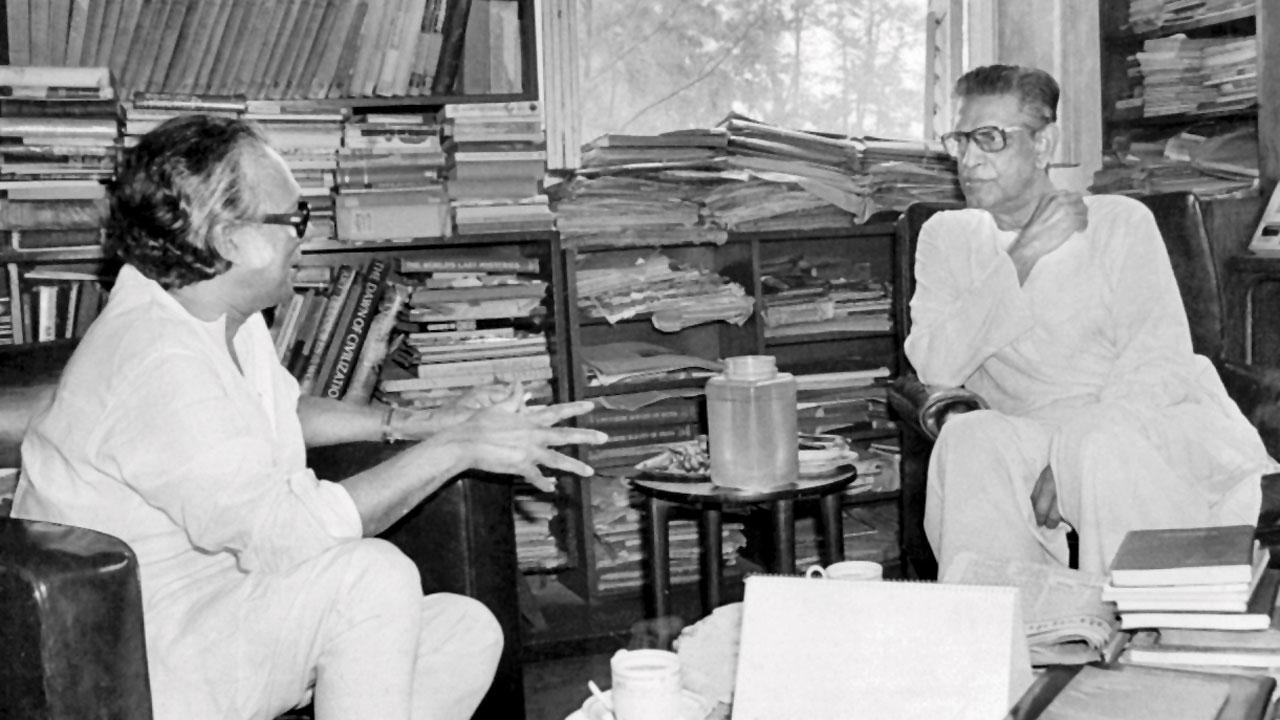
Mrinal Sen and Satyajit Ray
Why did the legendary director Mrinal Sen fall out with his equally talented friend, Ritwik Ghatak?
MID-DAY (May 28, 2023)
He was always surrounded by friends, though the nature of the circle changed over time. In the early days, they were all fellow travellers, equals, with similar views, similar ambitions, similar trajectories. Many from that group drifted away over the years, for various reasons. Tapas Sen was the only one who stayed close all through my father’s life. Hrishikesh Mukherjee and Salil Chowdhury moved to Bombay and became part of the commercial film world. Though every time they met my father, which was no longer very often, I could still see a spark of the old camaraderie.
Whenever Salil-kaka came home, he and my father would ask each other about common friends from the IPTA days. Sometimes Salil-kaka would sing songs from their activist past. But it was also clear that they lived in different worlds now, that the only common thread was the nostalgia for their time together, when they shared the dreams of a revolutionary future.
My father would sometimes stay with Hrishi-kaka in Bombay. Once, when I was four or five, my father took Ma and me to Bombay, and we all stayed at Hrishi-kaka’s Andheri home. Later, Hrishi-kaka’s son became a good friend of mine through a shared interest in electronics, and I’ve stayed quite a few times at their beautiful sea-facing bungalow in Bandra. However, my father and Hrishi-kaka were making different kinds of films, and slowly it was but inevitable that their intellectual lives would drift far apart.
Ritwik-kaka stayed in Calcutta, and though he and my father were both trying to make films with the same objective, another force was pulling them apart—Ritwik-kaka’s severe alcoholism. I don’t recall ever seeing him sober. No one in my immediate surroundings drank. Therefore, as a child, I was both curious and afraid of drunkenness. Whenever he came to our house, he would be senselessly drunk and abusive, often accompanied by people who could hardly stand straight. I don’t recall a day when he and my father had a normal conversation.
During my high-school and early college days, on numerous occasions, local boys would knock on our door and report that they’d found Ritwik-kaka lying drunk somewhere. It was then my job to organize a rickshaw to take him home. I was afraid of him if he visited us when my father was not home; he would engage in incoherent and dismissive conversations about my education.
Unfortunately, Ritwik-kaka and my father, who could have had the most meaningful conversations, never did so in their later years. They occasionally met, there were casual exchanges of information, but those lacked any kind of depth. The constant veil of an alcohol-induced haze made impossible any meaningful communication.
In the winter of 1976, after many such incidents, Ritwik-kaka was admitted to the hospital for what would be the last time. My father was beside him when he died. His wife, Surama, taught in a school far away, trying to protect her three children from the chaotic life he had created. All of them came to Calcutta and stayed with us until things settled down. It was as if we were one big family. What his addiction took away, it tried to return on his death.
When my mother died, I found a tattered letter addressed to her from Surama Ghatak, in which she’d written about the deep bond between the two families. My mother, for some reason, saved the letter in her handbag. I will never understand why we have such romantic notions about extreme addiction among artists.
It is nothing but a disease that destroys families, destroys integrity and ultimately destroys humanity. Even though his earliest circle dissipated over time, my father continued to surround himself with friends.
My earliest memories are from the early sixties, when we lived in a tiny two-room ground-floor flat on Manoharpukur Road. The living room was small, almost entirely occupied by a sofa bed and a few low cane stools or moras. And by visitors who came to my father throughout the day, friends as well as co-workers from his latest production. The friend circle in those days comprised people connected with the film-society movement, writers, family friends and artists. As far as I remember, the topics of their conversation spanned cinema, politics, literature and everyday banter. My father wasn’t that successful yet, so there were no fans or admirers.
That changed after his success in the late sixties and early seventies. I was older by then, and since that small living room was also where I was supposed to study, I became a silent participant in those conversations. There was a growing group of visitors who admired his work. Some were genuine well-wishers, but an increasing number hoped to benefit from the alliance or simply enjoyed belonging to a polarized camp. I am not sure my father could distinguish these factions as easily as I can today, in hindsight.
Praise can be a potent tool to blunt one’s ability to judge the real intent of people. Bengalis have a strange propensity to split any position into two opposite camps. Be it the support for a football team or the way a particular dish should be cooked or how a song should be sung, we indulge in strictly binary choices. If you belong to one side, you must oppose the other with all fury. The same thing happened then: people would champion my father while being unnecessarily critical of Satyajit Ray, with the reverse happening in Ray’s circle. A few people had access to both households, and they carried the conversations from one living room to another. They enjoyed the reactions they provoked. I think both Ray and my father were very respectful of each other, but this poisonous atmosphere did stain their thinking. Such is the power of sycophancy.
Excerpted with permission from Bondhu: My Father, My Friend by Kunal Sen, published by Seagull Books
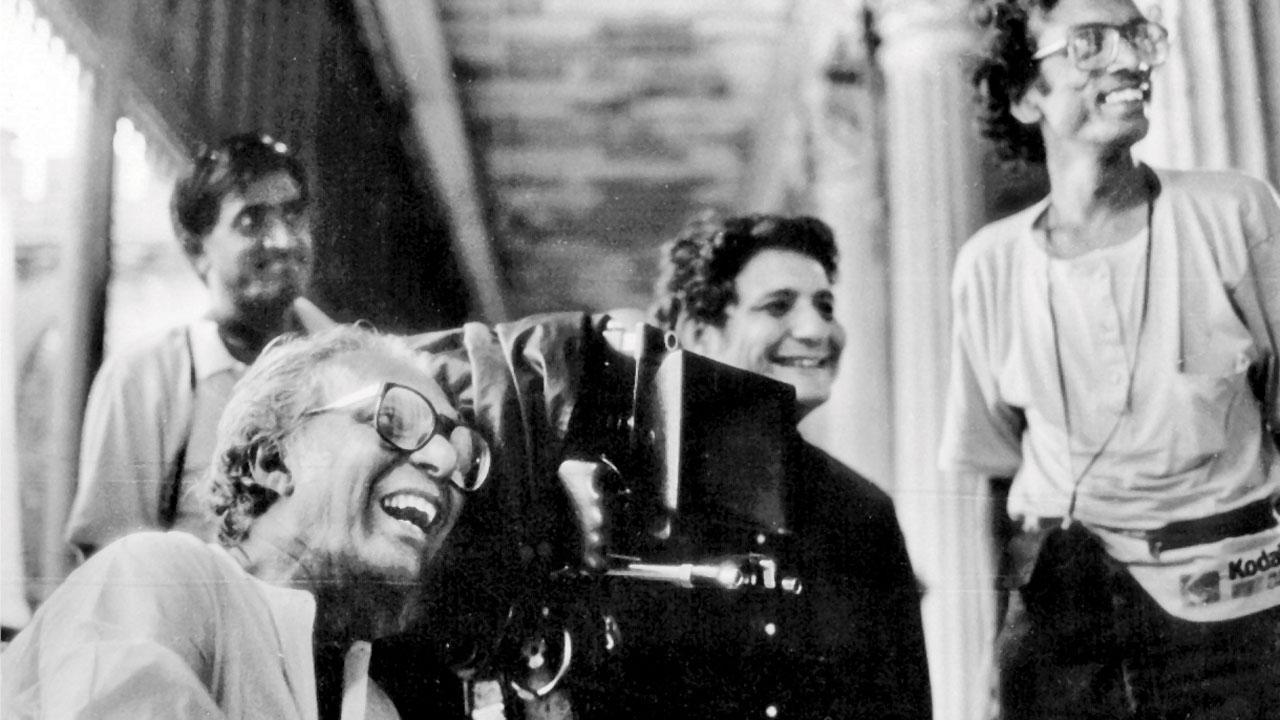
A lighter moment during the making of Antareen. PIC/SUBHASH NANDY
Kunal Sen and his wife, Nisha Ruparel-Sen, with actor Shabana Azmi, during the shooting of Khandhar. PIC/SUBHASH NANDY
34 years on, Mrinal Sen's son shares his ‘lost’ Hindi shorts for online viewing
8:11 AM

Priyanka Dasgupta (THE TIMES OF INDIA; July 21, 2021)
Kolkata: Thirty-four years after Kolkata Doordarshan apparently lost the original magnetic tapes of Mrinal Sen’s 12 Hindi short films, the director’s son has converted one of them — starring Girish Karnad and Aparna Sen — and shared it online on Monday.
Since he has low resolution VHS copies of nine to 10 of these shorts made in 1986-87, Kunal Sen has decided to convert them one by one to a format that can be viewed on YouTube.
Calling the series “Kabhi Door Kabhi Paas”, Sen said each episode was an independent short film that is around 22 minutes in length. The original magnetic tapes were in the “custody” of Kolkata Doordarshan. Kunal said, “Someone decided to reuse those tapes to record some other programme,” soon after the initial telecast.
“Since we were not living in Calcutta then, my father sent me a low resolution VHS copy of some of these short films,” he wrote on Facebook while posting the link. Kunal says the USP of this series is that most of the films dealt with “man-woman relationship, a subject that he rarely focused on”.
“After a Decade”, the pilot episode, was about the meeting of an estranged couple after 10 years. Others in the series include ‘Aajnabi’, ‘Shawl’, ‘Saalgira’, ‘Aajkal’, ‘Aina’, ‘Ravivar’, ‘Jit’, ‘Swayamvar’, ‘Kabhi Door Kabhi Paas’, and ‘Aparajit’.
Arunava Roy, assistant director (programmes) of Kolkata Doordarshan Kendra, said: “This is the first time I am hearing about this. We will try and see if the tapes are still available. The problem lies with the technology, which is not currently available with us for conversion of the magnetic tapes to the new format.”
Women in Satyajit Ray’s films could be both chirpy and reticent, but always real-Mamata Shankar
8:14 AM

On Satyajit Ray’s 100th birth anniversary yesterday, actress Mamata Shankar spoke about her experience of working with the legendary filmmaker in three films
As told to Shamayita Chakraborty (BOMBAY TIMES; May 3, 2021)

One could just keep on looking at Manik kaka while he was shooting. There was a certain aura he had about him. He would treat each of his actors differently — according to their nature, age. While working with a child actor, he spoke their language. With senior actors, he was a very different man. He would explain every shot in detail, exactly the way he had visualised it. If he was not happy, he would go for retakes. Even then, if it did meet his expectations, he would say, “There seems to be a technical problem with the camera, we need a retake. And while we are at it, can you please try to do the scene like this?” We realised he did this so that he did not hurt anyone’s pride, especially if it was a veteran actor that he was dealing with. He would not instruct actors unless it was necessary. It is important to remember that those days there were no actual monitors. All he had was the camera, his sense of precision and his impeccable eye for detail.
There was a stark difference between Mrinal da’s and Manik kaka’s floors. Mrinal da was very focused while taking the shot, but a fun person otherwise. He would chat with us, discuss scripts and so on. Manik kaka, on the other hand, would remain extremely composed throughout the shooting. He would talk and be lighthearted, but with restraint.
In my opinion, there were two kinds of female characters in Manik kaka’s cinema — one would be a down-to-earth, chirpy, affable and extrovert kind of person. The other would be more of a reticent, quietly dignified and more into intellectual pursuits. While Lily Chakraborty’s character in Shakha Proshakha is an example of the first kind, my character in the film was more of the latter. And you see this in many of his films — from Aranyer Din Ratri to Nayakto Ghare Baire, Seemabaddhaand so on. This by no way meant either of these women were superior or inferior to the other. Just that they were all just different, real, relatable and well-etched out.
There is a difference between a classic and just a good film. There are films that I might have enjoyed in my childhood, but they fail to engage me or entertain me the same way. When I recommend such films to my sons and we start watching it together, I may find it a bit immature now. But Ray’s films are classic. Every time you watch his films, they grow on you. You discover something new. That is how Manik kaka stays in my heart.
Door handles and dining plates..: What celebs do with awards
11:06 PM

Pt Vishwa Mohan Bhatt (above) holds a Grammy he won in 1993 at his Jaipur residence; (below) Bhatt’s son Salil
Top artistes end up with many trophies in their lifetimes, leaving no room for them
Priyanka Dasgupta (THE TIMES OF INDIA; February 3, 2020)
On a December evening that marked the first anniversary of film-maker Mrinal Sen’s death, his Chicago-based son and daughter-in-law opened the door of their Kolkata flat to friends and well-wishers. In an act of unusual generosity, the duo decided to give away the maestro’s possessions, including some of the trophies awarded to him.
Apart from awards like Dadasaheb Phalke, Padma or National Awards, an increasing number of honours — medals, figurines, framed citations — are bestowed on doyens in the film industry. Consequently, celebrity households often run out of storage space and have to constantly devise ways to preserve their prizes.
While trophies awarded to director Buddhadeb Dasgupta were remodelled as door handles of a bungalow he once owned in Kolkata, another veteran director had melted medals to make dining plates. “Preservation of awards is tricky,” said Poulomi Bose, daughter of Dadasaheb Phalke winner Soumitra Chatterjee, admitting the actor — who worked in 14 Satyajit Ray movies since his debut in 1959 — receives 15-odd recognitions a month.
“My father doesn’t like to display or discard them since they’ve been given with love and respect. Many awards are kept in my mother’s almirah or father’s office. We’ve carved out space to keep some at the landing near the staircase. Now he even keeps some underneath his bed,” she said. That seems to be a popular choice of space. Mrinal Sen also kept some awards under his bed.
But Dasgupta, who has 32 National Awards including seven Golden Lotus Awards (Swarna Kamal) to his name, has used some of his trophies for interior decoration. “While some figurines were turned into door handles, others are mounted on the wall,” he said.
The director recounted how once at a party in Raj Kapoor’s house, he found the actor’s awards sitting atop a rotating disc. “I don’t attach much importance to awards and can’t think of displaying them in such a way,” said Dasgupta. His wife and director, Sohini, added she has even given away some awards to relatives and domestic help due to space crunch.
Many other celebrities are also reluctant to turn their residences into a museum of sorts with a “display of achievements” so they put their awards to other uses.
Film-maker Rituparno Ghosh had once narrated how a renowned director served him dinner on plates made from medals he had won and each plate had the year of the award inscribed on it. He had also mentioned that another director — like Dasgupta — had had his awards turned into door handles of his farmhouse.
The celebrities, however, agree on one thing — special awards do get special treatment. Mohan veena player Pt Vishwa Mohan Bhatt has kept the Grammy award that he received in 1993 in the drawing room of his Jaipur residence along with his Padma Shri, Padma Bhushan and Global India Music Award. “Initially, I kept my Grammy in an almirah. Later, I made a glass case as so many people wanted to see it. I also have a theft alarm at home,” said Bhatt.
Satyajit Ray’s family has kept the honorary Oscar that was awarded to him in 1992 and the Golden Lion for ‘Aparajito’ from the Venice Film Festival in a vault. But at home, no one is surprised with a trophy popping out of every cupboard.
With his son director Sandip Ray winning awards too, Sandip’s wife Lalita said storage was becoming a problem.
So sometimes the A-listers part with their awards as soon as they are received. “Carrying home framed citations is difficult since the glass is fragile. Sometimes, I give them away to students in the city I am performing in,” Bhatt told TOI.
Durga Jasraj, daughter of 90-year-old vocalist Pt Jasraj, said awards he won have been distributed to music schools across the globe. “Once when heavy artefacts were awarded to performers at a concert in Mumbai, a certain musician mentioned his humble home was too small to keep them. But the organisers took offence and banned the musician from performing at their institute.”
Some organisers are aware of this challenge, but say appearances have to be kept up. “It’s difficult to carry heavy metal trophies past security checks at airports. But as a festival organiser, I can’t give light-weight trophies since they will look cheap,” said Sangeet Natak Akademi winning sarod player Tejendra Narayan Majumdar, who also organises music festivals.
Shawls that accompany awards hardly take up space. And it’s common practice to distribute them. At Sen’s house last month, a shawl had been kept aside for actor Nandita Das while other belongings went to ordinary people, giving them a chance to own a piece of cinematic history.

House of filmmaker Mrinal Sen to be sold
8:29 AM

Family keeps his shawl for Nandita Das and gifts memorabilia to Mamata Shankar
Priyanka Dasgupta (BOMBAY TIMES; January 4, 2020)
 It is said one dies twice in life. First, when the heartbeat stops. Then, sometime later, when one’s name is uttered for the last time. On his first death anniversary recently, when one entered the Kolkata flat of filmmaker Mrinal Sen, it was amply clear that the master-director had cheated death the second time around even though he had long stopped breathing. This game of hide-and-seek with death actually started some time back when his Chicago-based son and daughter-in-law, Kunal and Nisha, who have no children, took a unique decision to distribute his belongings and awards among anyone who cared to look after them.
Sometime back, Left Front chairperson Biman Basu came over and took Sen’s hospital bed that he used at home. It was then given over to the People’s Relief Committee. Berhampore Film Society has taken his telephone and specs for preservation. Some 422 books were picked up by archivist Arindam Saha Sardar. A cupboard full of mementos was left ajar for anyone to pick them up while old family acquaintances and young cinelovers queued up to collect what they will show their grandchildren as their most precious collection. Three prospective buyers have already had talks about buying the flat, but nothing has yet been signed on the dotted line.
‘PLAN TO DONATE THE AWARDS TO UNIVERSITY OF CHICAGO AND STANFORD UNIVERSITY’
It was not an overnight decision to dispose off the flat that had been the director’s address for the last 15 years. What made things a little simpler was that the icon had not really left behind too many precious belongings. Years back, while moving apartments, he had disposed off most of his papers. Important awards, however, were kept in the locker. The couple had taken his Padmabhushan, the Silver Bear from Berlin, the French award (Commander of the Ordre des Arts et des Lettres) and an award bestowed on Mrinal Sen’s wife, Gita Sen on their last visit to Kolkata. This time around, they intend to take some others back.
Film archivist Shivendra Singh Dungarpur had collected Mrinal’s kurta, pen and chair for his foundation on an earlier visit. “Recently, he took film stills and major awards. That includes the Dadasaheb Phalke, Filmfare and many National Awards. Initially, I am taking all the international awards and keeping them with myself. I plan to donate 80 per cent of them right away to University of Chicago and Stanford University. I will keep the rest at home for sometime and subsequently, give them away. Four hundred years later, even if someone wants to see them, I am certain that they will be preserved well by these two universities,” Kunal said.
Nisha, meanwhile, has collected his passports and checked the stamps to keep record of where he went when. “I also took some of his books from his collection of 3,000 works. Apart from Arindam, there are others who have taken some 50 more,” he added. Kunal gave a beautiful white idol of Shiv and Parvati to one of Mrinalda’s favourite actors, Mamata Shankar. What about his starch-white kurtas and shawls? “Some had specifically asked for his shawls and we gave them away. The rest, which could be used, were given away to common people. Nandita (Das) had wanted a shawl and we have kept one for her,” he said. Anything for Shabana Azmi? “She never asked for anything. It is hard for me to presume who will want anything and I do not want to burden anyone,” he pointed out.
‘WHAT WE ARE DOING IS PROBABLY WHAT MY PARENTS WOULD HAVE LIKED US TO DO’
Giving away personal belongings isn’t easy. More so, if one has to relinquish the rights of inheritance and willingly turn personal possessions into public property. “These are personal threads. I know now my connection with my parents will be at a conceptual level. I tried to take a long perspective and see if some of the materials will be available hundreds of years from now for scholarly research. I don’t know if there will be any interest in him in even 50 years, but I’d rather the future decide that. I think what we are doing is probably what my parents would have liked us to do. Neither of them liked pomp and show nor any fuss around them,” said Kunal. But by donating these to one and all, he has given strangers a chance to create personal memories of the master.
I even begged Mrinal Sen, Aparna Sen to cast me-Anil Kapoor
8:17 AM

Avinash Lohana (MUMBAI MIRROR; February 20, 2019)
After collaborating with Indra Kumar on five films, starting with Mohabbat (1985), and more than a dozen with Madhuri Dixit, the last being Rajkumar Santoshi’s Pukar (2000), Anil Kapoor reunites with the duo for Total Dhamaal. And while he admits that nothing has really changed with them, he did something new this time in the film which surprised even his family.
“I played a Gujarati for the first time with help from Indu ji who is one himself, and attended a workshop to play the part convincingly. My family thought I’d lost it, doing workshops for an Indra Kumar film as if I was prepping for Christopher Nolan or Steven Spielberg,” guffaws Anil, admitting that after diving into it, he realised it wasn’t an easy role to play despite the laughs.
CGI was also relatively new for the actor. “I’ve done a lot of stuff on the blue screen earlier, but not so extensively. This was another first for me,” he acknowledges, pointing out that he had worked with most of his coactors, except for Riteish Deshmukh and Arshad Warsi. He will be reuniting with Arshad for Anees Bazmee’s Pagalpanti. “I leave for London to start shooting on Friday,” he informs, looking forward to meeting John Abraham, his Welcome Back co-star, and Mubarakan co-star Ileana D’Cruz. “Ileana is a lovely girl. Also, this film is true to the Anees Bazmee-style which is unique, like a Manmohan Desai or Prakash Mehra film. A total masala entertainer, it should be a lot of fun,” he beams.
In the last few years, Anil has done a lot of out-and-out comedies. He admits that he has enjoyed the genre, situational comedies in particular, since the beginning of his career. “While out-and-out comedies are fairly recent, my earlier films, including Mr India and Woh Saat Din had a lot of laughs. Padmini (Kolhapure), Nilu Phule and I had a great time shooting for the latter,” he reminisces.
Anil also reminds you that he had worked with Hrishikesh Mukherjee in Jhooth Bole Kauwa Kaate and had done Chameli Ki Shaadi with Basu Chatterjee at a time when out-and-out comedies weren’t the trend. “I am a huge admirer of these directors and wanted to work with all of them. I even begged Mrinal Sen and Aparna Sen to cast me, another mainstream star may not have done it, but I wanted to learn from them,” he explains.
The actor also believes that age can’t restrict one from doing a comedy, citing the examples of American actors Ben Stiller and Steve Martin from the 1991 comedy Father of the Bride. “It’s not easy to make people laugh, but you can get away with it with the right timing,” Anil avers.
Speaking of Mr India, buzz is a sequel is in the works. “We haven’t cracked a story yet. I’m a part of several franchises, but I’m not making a sequel for the heck of it, ditto for Boney (producer-brother Boney Kapoor). Also, both Sriji (co-star Sridevi) and Amrish Puri saab are irreplaceable,” he reasons.
Meanwhile, he is gearing up for the Abhinav Bindra biopic, in which his son Harsh Varrdhan will play the titular role while he essays the Olympian shooter’s father Apjit Bindra. “The script is still being worked on, we’ve seen two-three drafts but are still waiting for the right one which will make everyone happy. The film requires a lot of workshops which we will start once the final script is locked,” says Anil.
The third instalment of the Race franchise failed to impress. Anil begs to differ, saying, “It did pretty well. When I did Part Two, some said it was not like the original, by the time we reached the third instalment, they were saying ‘after the success of one and two’. I promise you whenever we make Race 4, they will say ‘after the success of one, two, three’.”
Anil who so far has been answering every question candidly, clams up when asked about the Hindi adaptations of American shows Prison Break and Modern Family that he had announced. He doesn’t wish to talk before it’s time. He also refuses to divulge details on the next season of 24. “We will talk about it when the time is right,” he signs off.
Nandita Das talks about Mrinal Sen as the filmmaker takes his final journey
8:07 AM

Nandita Das, who featured in the filmmaker’s last directorial, Amar Bhuvan, on why he threw away most of his awards
Jayatri Nag (MUMBAI MIRROR; January 2, 2019)
“My Baba (father) thought it was a huge task to organise his awards. So, he threw them all away… it was out of absolute laziness,” Kunal Sen told Mirror as people from various walks of life assembled in front of his father, legendary filmmaker Mrinal Sen’s Deshapriya Park residence in South Kolkata on Tuesday. Kunal informed that the auteur, who passed away at 95 on December 30, had lived in the house from 1968 to 1980.
Indian People’s Theatre Association (IPTA), known as the oldest organisation of theatre activists in India of which Sen was a member, had recently expressed eagerness to build a museum with his memorabilia, including film scripts, books, props and awards. Sen is said to have won at least 10 international and 27 national awards, including Dadasaheb Phalke, the highest film honour in the country.
Nandita Das, who played the lead in Sen’s last directorial, Amar Bhuvan (2002) echoed the sentiment, pointing out that there was a lot to learn from the filmmaker’s personal items. “Mrinal da believed in simple living and was not attached to things. That is why he could throw away his awards. I have been coming to his house for 20 years but there was no change in his way of living,” the actress-filmmaker said, adding that in November 2017, she had visited the filmmaker with her son. “He held on to my hands and I showed him pictures of a film festival I had just attended. With a childlike innocence, he told me that he was not invited to the event.”
Several other luminaries joined Sen’s final journey, including actress-filmmaker Aparna Sen, actor Prosenjit Chatterjee, yesteryear actresses Mamta Shankar and Madhabi Chatterjee, poet Shankho Ghosh, actress and Parliamentarian Rupa Ganguly, filmmaker Srijit Mukherji, politicians Shyamol Chakrabarty and Sujan Chakrabarty, among others.
“He was my father’s friend. I knew him before coming to the film industry,” said a grieving Aparna Sen, while Satyajit Ray’s filmmaker son, Sandip, who was also in attendance, added, “He had immense knowledge of world cinema, was multi-faceted and knew so many forms of art. I think his films should be revived and screened.”

Twenty six films, sixteen National Awards...who can match Mrinal Sen’s record?-Rituparna Sengupta
8:12 AM

Rituparna Sengupta shares her thoughts on the veteran filmmaker, who passed away on December 30
As told to Rachana Dubey (BOMBAY TIMES; January 1, 2019)
I consider myself quite unfortunate that I never got a chance to work with Mrinal da. It’s a disappointment that will remain with me for as long as I live. I met him a couple of times. Once I presented a film to him called Icche, which had a lot of newcomers. He was very happy with what we had tried to do. Later on, we met at film gatherings and he would often bless me with kind words and lots of praises for my films. He had loved Tohon, a film that fetched me the National Award. He loved the movie so much so that he told me, ‘I think you have something very special in you. You are very talented and meticulous. Keep that going.’ I was over the moon. A few years later, his health began to deteriorate. He hadn’t been keeping well lately. His social appearances dropped in numbers, but we would all make time to wish him on his birthday. I remember hosting him at home once on his birthday. We also spent some time with special kids that day.
Over the years, his cinema has influenced me in a big way. His contribution to world cinema is remarkable. Khandhar, Neel Akasher Neeche, Mrigaya — his films were so nuanced. His belief in his stories was so strong that people, who watched his films, left the cinema hall feeling exactly what he felt for his story and its characters. His demise marks the end of an era in world cinema. Out of 26 films, 16 won National Awards. Who can ever match Mrinal Sen’s record? His death is an irreparable loss to us. Of course, he lived a full and illustrious life, which will continue to inspire art and artistes alike.
Mrinal Sen wore his fame lightly-Shabana Azmi
9:11 AM

With a first-person account published in Mumbai Mirror on February 21, 2018, Shabana Azmi had recounted her visit to the filmmaker to present him with the Filmfare trophy. We reproduce it as her tribute to him
MUMBAI MIRROR (December 31, 2018)
“Would you like to present Filmfare’s Lifetime Achievement Award to Mrinal Sen?” asked Jitesh Pillai, editor of Filmfare. I jumped at the offer. “He isn’t keeping well and his son Kunal is wary of cameras and crew invading his privacy. But when he got to know that it was you who would be the presenter, he relaxed,” added Jitesh.
A few days later, after Kunal and I had exchanged a few emails and I’d assured him that we would be discreet and sensitive, I got permission from his doctor and was on my way to Kolkata, completely prepared that anything could go wrong, and we might have to return disappointed.
It was with great trepidation that I entered Mrinal da’s home. This was a flat I’d never visited, but the sketches and photographs on the wall were comfortingly familiar. With his back to the door, he was sitting at the dining table with Dr Adhrishya, a friend of many years. I sat down beside him gingerly. “Ah Shabana!” he exclaimed and held my hand tightly. I wasn’t expecting this. I had been told his memory is fading and my heart leaped with joy as he recognised me.
I presented the award to him, draped a shawl over his shoulders, offered a bouquet and sat down next to him. He hugged me, not once or twice, but several times, touching my face tenderly like my mother does. My tears dropped silently on the table. Mrinal da is as fond of me as I am of him, but in all the years that I’ve known him, there had never been such an open display of affection. I was overwhelmed!
The first question he asked was “Did you think Gita was a good actress?” His wife, Gita, his muse, his critic and his steadfast partner, had passed away some months ago. Kunal had told me that Mrinal da misses her every minute. And now he wanted validation for her. Swallowing the lump in my throat, I said, “Gita di was a brilliant actress and a lovely human being.” His face lit up with a broad smile. I then narrated how Gita di, who had played my invalid mother in Khandhar, had given me acting tips which I use to this day. He listened like a proud mother listening to the accomplishments of her child, basking unabashedly in the reflected glory.
Pointing to a big photograph of himself, he asked, “Do you know who that man is?” “Mrinal Sen,” I replied, “a terrific filmmaker and a wonderful human being.” He responded in a soft voice, saying, “It’s not good to live so long. Do you know I’m 90 years old?” He didn’t sound broken, only matter-of-fact. I hugged him tightly and we sat there wordlessly.
Dr Adhrishya whispered that I should try and make him speak because he has become very quiet. The effort to engage is fatiguing. I tried to make some conversation, even Jitesh asked me a few questions about my experience of working with Mrinal da. I answered distractedly, before I asked him, “Which is your favourite film, Mrinal da?” “A difficult question to answer,” he replied, and I knew that it was not right to have him prod his memory.
I could see that he was getting tired and it was time to go. Dr Adhrishya brought out a copy of his memoirs, Always Being Born: Mrinal Sen, and I asked him to sign it for me. It was a huge effort. He scrawled something indecipherable and then signed off with ‘Mrinal Sen’ in that familiar handwriting. I took the pen and told him, “I will keep this with me, always.” Along with the wonderful memories I have of working with Mrinal da in three films; Khandahar, Genesis and Ek Din Achanak.
The world might know him as this effusive, confident man, often with his foot in his mouth, an iconoclast. But during the making of Khandahar, I discovered that Jamini, the character he had written for me, was also drawn from the recesses of Mrinal da’s being. He is gentle and shy too — a facet he liked to keep hidden from the world. And in these contradictions lies the strength of Mrinal Sen, the filmmaker.
This once garrulous man has fallen silent, but his films will continue to speak to us....
---------------------------------
Shabana Azmi pens a personal tribute to the giant of world cinema, Mrinal Sen, who passed away on Sunday
Shabana Azmi (MID-DAY; December 31, 2018)
I cannot separate the man from the filmmaker. He was like his films, a bundle of paradoxes - strong but gentle, urbane but rustic, both a creator and an iconoclast who was very sensitive and very human.
He was deeply invested in the world around him, and did not hesitate to question his own frailties through his films. That's what made his such a strong voice. I remember a very moving afternoon during the making of Ek Din Achanak. Mrinal da was in an unusually quiet mood. When I asked what was bothering him, he said, "Perhaps the character [played by Dr Sriram Lagoo] disappears in the film because he has come to terms with his own mediocrity. Maybe it's time I face my own.
I didn't say anything, only sat by his side holding his hand. I knew he needed quiet time. Mrinal Sen was by no means mediocre. But the fact that he had the courage to question himself, with objectivity, made him who he was. I drank back the tears that had filled my eyes, and quietly started humming a tune. We sat there, hand-in-hand, for what seemed like an eternity.
He loved his wife Geeta, and would always look for her approval. He'd often get impatient when it took its time to come. Theirs was a beautiful relationship. They depended heavily on each other, but both had strong individual identities. When I last met him earlier this year, he could speak very little. Geeta di's name came up frequently. It was obvious hers was the presence he missed the most.
He wore his fame lightly, but when attacked, would fight back tooth-and-nail. That's what kept the child in him alive, I guess. Mrinal da was an extraordinarily important filmmaker, because he had a maverick streak that made his films edgy and unpredictable. Most of the times, they worked. Sometimes, they didn't. But they could not be ignored. His body of work is prolific. Kharij, Ek Din Achanak and Khandhar are my favourites. I loved working with him in all three films - Khandar, Genesis, and Ek Din Achanak. I consider Khandar to be the film in which I made the least number of mistakes. The protagonist, Jamini, is a character I love deeply, and, strange though it may seem, saw a lot of Mrinal da in her - her vulnerability, self-respect, her refusal to be a victim.
I was traumatised when Mrinal da decided that my last shot in the film Khandar - where my face appears to be embedded into the ruins - would be shot first. I protested, but he would have none of it. In hindsight, I think that is what helped me internalise Jamini. It was a risk, but it worked owing to his confidence that he could pull it off! I was surprised to discover that, on the outside, I may have a gregarious front, but there is also a shy Jamini in the recesses of my being. I'm thankful to Mrinal da for helping me discover that.
I am deeply saddened by Mrinal da's loss. But I seek consolation in the fact that the last time I met him will be the one I will always cherish. I was asked to give him the Filmfare Lifetime Achievement Award and was warned he was frail and uncommunicative. I approached him with some trepidation, but was delighted to find that not only did he recognise me, he also hugged me warmly. We spent time holding each other's hands in silence, as we had once done.

Mrinal Sen loved to gossip and was inquisitive-Suhasini Mulay
9:09 AM

Suhasini Mulay remembers first director, Mrinal Sen; tributes from industry pour in
MID-DAY (December 31, 2018)
Mrinal da was known for his serious and art [house] cinema, but, personally, he was one of the nicest and coolest human beings. He loved to gossip, and was inquisitive, always eager to know what was happening around him.
I made my debut in Bhuvan Shome when I was 15 years old. I was blissfully oblivious about who I was up against until I chatted with my fellow actors, Utpal Dutt and Shekhar Chatterjee at the shoot. If I had known anything about Mrinal da before [we began shooting], I would have surely developed cold feet. But, once we sat [together] I had no fear. Also, I wasn't aware of the film's success, as I had already left for Canada for my further studied [after it released]. It was only when I was invited for a film festival that I learnt of it.
Later, I worked as an assistant [editor] on Mrigayaa (1976), and that's when I got to know him better. His wife [Geeta Sen] and he were like family. I would often visit them. It was like going to my second home. We would often have heated discussions about politics and cinema, and even the state of the country.
He always had an opinion, and would crack jokes, mostly on himself. The last time I met him was two years ago; a month before Gita ji passed away. He was fragile and ailing. He told me, 'Suhas, you have to come and stay as often as you can since we don't see young people around too much.' I laughed and opened my eyes wide, because I am 66 years old. He still found me young, but, I guess, he still had the image of that young girl form Bhuvan Shome in his mind.
He also gave me the silver buttons from Utpal Dutt's costume from the film, and asked me to stitch a kurta and wear it the next time I came to visit him. I still have it, because I haven't made a kurta yet. I was planning to meet him in April since I was set to visit Kolkata, but, I guess, destiny had other plans. I will sorely miss him.
Sen's award winning films
* Bhuvan Shome (1969, National Film Award for Best Feature)
* Calcutta 71 (1972, National Film Award for Second Best Feature)
*Akaler Sandhane (1980, National Film Award for Best Direction)
* Parashuram (1979, Berlin International Film Festival - Interfilm Award )
* Oka Oori Katha (1977, Karlovy Vary International Film Festival - Special Jury Prize)
* Kharij (1983, Cannes Film Festival - Jury Prize)
* Ek Din Achanak (1989, Venice Film Festival - OCIC Award - Honorable Mention)

End of an era as Mrinal Sen passes away
9:07 AM

Dadasaheb Phalke awardee and last of the triumvirate that included Satyajit Ray and Ritwik Ghatak, is no more
Jayatri Nag (MUMBAI MIRROR; December 31, 2018)
The legendary Mrinal Sen passed away at his South Kolkata residence on Sunday following cardiac arrest. The 95-year-old filmmaker is survived by his son, Kunal. His actress-wife, Gita Sen, passed away in January last year.
As the third pillar of the triumvirate that included Satyajit Ray and Ritwik Ghatak, Sen narrated contemporary realities of life through his films and was one of the pioneers of the Indian newwave cinema.
Winner of innumerable national and international awards, Sen won the highest film honour, Dadasaheb Phalke award, in 2005. He was honoured with the Padma Bhushan, India’s third highest civilian award, in 1983.
Sen won five National Awards, for Akaler Sandhane, Chorus, Parashuram, Kharij and Khandahar, and one National Award for his Telegu film, Oka Oori Katha (1977).
The auteur made his first film Raat Bhore in 1955, with Uttam Kumar, and gained international recognition in 1960, with Baishey Shravan. Mrigaya (1976), which portrayed the plight of tribals in rural India, marked the debut of Mithun Chakrabarty. His 1986 directorial Genesis, featuring Naseeruddin Shah, Om Puri and Shabana Azmi, also told a story of slavery and freedom. His last directorial was Amar Bhuvan in 2002.
Born in Bangladesh’s (erstwhile Bengal) Faridpur in 1923 on May 14, Sen had arrived in Kolkata to study Physics at Scottish Church College and Calcutta University. After completing his education, he was forced to take up a job as a medical representative but he eventually returned to Kolkata to work as an audio technician at a city film studio.
President Ram Nath Kovind condoled Sen’s death on Twitter, sharing, “Sad to learn of the passing of acclaimed film-maker Mrinal Sen. From Bhuvan Shome to the Calcutta trilogy, his penetrating and sensitive portrayal of social realities made him a fine chronicler of our times. A loss to Bengal, to India and to the world of cinema.”
West Bengal Chief Minister Mamata Banerjee said, “Mrinal Sen’s death is an immense loss to the film industry.” Filmmaker Buddhadeb Dasgupta called it an “end of an era.” Union Minister Rajyavardhan Rathore and Sitaram Yechury also condoled his death. Veteran actor Soumitra Chattopadhyay was at a loss of words. “I have no words to express my grief.” Shabana Azmi was distraught. “I am deeply saddened by the news. Mrinal da was a very important filmmaker because he had a maverick streak in him that made his films edgy and unpredictable. He was deeply invested in the society around him and did not hesitate to question his own frailties through his films. He was deeply sensitive and humane. I consider Khandhar to be the film in which I have made the least number of mistakes (as an actress). Undoubtedly, he will live on through his films. My deepest condolences to Kunal and Nisha (Sen’s son and daughter-in-law).”

When an 'overwhelmed' Shabana Azmi presented Filmfare Award to Mrinal Sen
4:26 PM

Shabana Azmi presenting Filmfare’s Lifetime Achievement Award to living legend Mrinal Sen
MUMBAI MIRROR (February 21, 2018)
"Would you like to present Filmfare’s Lifetime Achievement Award to Mrinal Sen?” asked Jitesh Pillai, editor of Filmfare. I jumped at the offer. “He isn’t keeping well and his son Kunal is wary of cameras and crew invading his privacy. But when he got to know that it was you who would be the presenter, he relaxed,” added Jitesh.
A few days later, after Kunal and I had exchanged a few emails and I’d assured him that we would be discreet and sensitive, I got permission from his doctor and was on my way to Kolkata, completely prepared that anything could go wrong and we might have to return disappointed.
It was with great trepidation that I entered Mrinalda’s home. This was a flat I’d never visited, but the sketches and photographs on the wall were comfortingly familiar. With his back to the door, he was sitting at the dining table with Dr Adhrishya, a friend of many years. I sat down beside him gingerly. “Ah Shabana!” he exclaimed, and held my hand tightly. I wasn’t expecting this. I had been told his memory is fading and my heart leaped with joy as he recognised me.
I presented the award to him, draped a shawl over his shoulders, offered a bouquet and sat down next to him. He hugged me, not once or twice, but several times, touching my face tenderly like my mother does. My tears dropped silently on the table. Mrinalda is as fond of me as I am of him, but in all the years that I’ve known him, there had never been such an open display of affection. I was overwhelmed!
The first question he asked was “Did you think Gita was a good actress?” His wife, Gita, his muse, his critic and his steadfast partner, had passed away some months ago. Kunal had told me that Mrinalda misses her every minute. And now he wanted validation for her. Swallowing the lump in my throat, I said, “Gitadi was a brilliant actress and a lovely human being.” His face lit up with a broad smile. I then narrated how Gitadi, who had played my invalid mother in Khandhar, had given me acting tips which I use to this day. He listened like a proud mother listening to the accomplishments of her child, basking unabashedly in the reflected glory.
Pointing to a big photograph of himself, he asked, “Do you know who that man is?” “Mrinal Sen,” I replied, “a terrific filmmaker and a wonderful human being.” He responded in a soft voice, saying, “It’s not good to live so long. Do you know I’m 90 years old?” He didn’t sound broken, only matter-of-fact. I hugged him tightly and we sat there wordlessly.
Dr Adhrishya whispered that I should try and make him speak because he has become very quiet. The effort to engage is fatiguing. I tried to make some conversation, even Jitesh asked me a few questions about my experience of working with Mrinalda. I answered distractedly, before I asked him, “Which is your favourite film, Mrinalda?” “A difficult question to answer,” he replied, and I knew that it was not right to have him prod his memory.
I could see that he was getting tired and it was time to go. Dr Adhrishya brought out a copy of his memoirs, Always Being Born: Mrinal Sen, and I asked him to sign it for me. It was a huge effort. He scrawled something indecipherable and then signed off with ‘Mrinal Sen’ in that familiar handwriting. I took the pen and told him, “I will keep this with me, always.” Along with the wonderful memories I have of working with Mrinalda in three films; Khandhar, Ek Din Achanak and Genesis.
The world might know him as this effusive, confident man, more often than not with his foot in his mouth, an iconoclast. But during the making of Khandhar, I discovered that Jamini, the character he had written for me, was also drawn from the recesses of Mrinalda’s being. He is gentle and shy too — a facet he liked to keep hidden from the world. And in these contradictions lies the strength of Mrinal Sen, the filmmaker.
This once garrulous man has fallen silent but his films will continue to speak to us....
Aamir, Salman Khan, Priyanka Chopra, Deepika, Aishwarya, Big B invited to have a say at Oscars
8:13 AM

B’wood
actors to filmmakers and technicians, the Academy, in its most diverse
list yet, invited a record 774 film personalities to be new members
Sanyukta Iyer (MUMBAI MIRROR; June 30, 2017)
On Wednesday, the Academy of Motion Picture Arts and Sciences issued a record 774 invitations to new members, which included 14 Indian film personalities, outdoing its record of 683 invitations in 2016.
Rubbing shoulders with Hollywood stars Chris Evans, Riz Ahmed, Dwayne Johnson and Kristen Stewart are Amitabh Bachchan, Aishwarya Rai, Aamir Khan, Priyanka Chopra, Deepika Padukone, Salman Khan and Irrfan Khan. Internationally acclaimed filmmakers Mrinal Sen, Goutam Ghose, Sooni Taraporevala and Buddhadeb Dasgupta, documentary filmmaker-activist Anand Patwardhan, costume designer Arjun Bhasin and sound designer Amrit Pritam Dutta have also made the cut. Also in the list are India-born Mohit Kallianpur and Mahesh Ramasubramanian, who’ve done the animation and visual effects of films like Frozen and Shrek.
Patwardhan hailed the move as “surprising but much-needed”. He pointed out that for a long time the Oscars have been dominated by American and British ideologies and Hollywood has been pushing the American propaganda. “Apart from horror, the James Bond franchise and war films, powerful and progressive pieces of work need to be brought to the forefront,” he asserted, citing Michael Moore’s 2003 win, Bowling for Columbine (Best Documentary Feature) to emphasise how he used the platform to speak up about the Iraq war and rebel against the media. “Since there is a fairly closed system of naval-gazing at the Oscars, more people from different countries will fuel the rebel culture and that’s a healthy sign.”
However, his enthusiasm is tinged with scepticism as he wonders if all 14 Indians will actually be flown to Los Angeles for the ceremony or will it be only the stars. “How are they going to fit all 774 people?” he ruminates but says he’ll definitely exercise his vote.
Dasgupta is not only an invitee but also a member of the jury. “It’s a huge honour and I am definitely going to make my presence felt. I don’t care about categories, I plan on enjoying all kinds of good cinema,” he exults, insisting the number of Indian invitees will have no bearing on India’s performance at the awards.
In the last 80 years, only three Indian films – Mother India, Salaam Bombay and Lagaan-- have made it to the last five in the Foreign Language category, with Mother India losing to Federico Fellini’s Nights of Cabiria by a single vote. “It is difficult to lobby for an Oscar at a ceremony dominated by English-speaking content. A country like India should be allowed a minimum of four-five entries and Indian federations need to write to the Academy on this,” suggests Ghose, speaking from Satara where he is scouting locations for his next film. The National Award winning filmmaker learnt of his invitation through the media.
Taraporevela who wrote the screenplays of Mira Nair’s Mississippi Masala, Salaam Bombay and The Namesake before making her own film Little Zizou, has been a member of the Writers Guild of America since 1988. She woke up to an email congratulating her and woke up her husband with a delighted scream. “They used to choose actors and technicians of Oscar-nominated films before, now they have opened up the field. I’ve been a working screenwriter for nearly 30 years and in my mind, this is a prize for staying the course and not giving up,” she says.
Speaking to Mirror from New York, where he is presently filming his next Hollywood film Puzzle, Irrfan agreed that invitations to Indian actors would impact the representation of Indian film in the Foreign Language category. “But they don’t work as a boosting mechanism and will have no effect on the kind of movies we make in India. I am excited because I will now be updated on the nominated movies and as a privileged member of the Academy, I’ll get to watch them before the voting process,” he avers.
The actor whose repertoire boasts of Ang Lee’s Life of Pi and Dany Boyle’s Slumdog Millionnaire, has walked the Oscar red carpet in 2009 but adds that now that he’s an official member, “his fondest memory is yet to come!”
Priyanka Chopra is presently filming in New York for her second Hollywood film, A Kid Like Jake. “I’m so grateful, such an honour! I’m excited about the Academy inviting me and all these amazing women into the fold. There’s Naomi Harris, Gal Gadot, Leslie Jones… It’s so good to see all these wonderful women on the list. And it’s good that the Academy included some guys too,” she quipped.
On Wednesday, the Academy of Motion Picture Arts and Sciences issued a record 774 invitations to new members, which included 14 Indian film personalities, outdoing its record of 683 invitations in 2016.
Rubbing shoulders with Hollywood stars Chris Evans, Riz Ahmed, Dwayne Johnson and Kristen Stewart are Amitabh Bachchan, Aishwarya Rai, Aamir Khan, Priyanka Chopra, Deepika Padukone, Salman Khan and Irrfan Khan. Internationally acclaimed filmmakers Mrinal Sen, Goutam Ghose, Sooni Taraporevala and Buddhadeb Dasgupta, documentary filmmaker-activist Anand Patwardhan, costume designer Arjun Bhasin and sound designer Amrit Pritam Dutta have also made the cut. Also in the list are India-born Mohit Kallianpur and Mahesh Ramasubramanian, who’ve done the animation and visual effects of films like Frozen and Shrek.
Patwardhan hailed the move as “surprising but much-needed”. He pointed out that for a long time the Oscars have been dominated by American and British ideologies and Hollywood has been pushing the American propaganda. “Apart from horror, the James Bond franchise and war films, powerful and progressive pieces of work need to be brought to the forefront,” he asserted, citing Michael Moore’s 2003 win, Bowling for Columbine (Best Documentary Feature) to emphasise how he used the platform to speak up about the Iraq war and rebel against the media. “Since there is a fairly closed system of naval-gazing at the Oscars, more people from different countries will fuel the rebel culture and that’s a healthy sign.”
However, his enthusiasm is tinged with scepticism as he wonders if all 14 Indians will actually be flown to Los Angeles for the ceremony or will it be only the stars. “How are they going to fit all 774 people?” he ruminates but says he’ll definitely exercise his vote.
Dasgupta is not only an invitee but also a member of the jury. “It’s a huge honour and I am definitely going to make my presence felt. I don’t care about categories, I plan on enjoying all kinds of good cinema,” he exults, insisting the number of Indian invitees will have no bearing on India’s performance at the awards.
In the last 80 years, only three Indian films – Mother India, Salaam Bombay and Lagaan-- have made it to the last five in the Foreign Language category, with Mother India losing to Federico Fellini’s Nights of Cabiria by a single vote. “It is difficult to lobby for an Oscar at a ceremony dominated by English-speaking content. A country like India should be allowed a minimum of four-five entries and Indian federations need to write to the Academy on this,” suggests Ghose, speaking from Satara where he is scouting locations for his next film. The National Award winning filmmaker learnt of his invitation through the media.
Taraporevela who wrote the screenplays of Mira Nair’s Mississippi Masala, Salaam Bombay and The Namesake before making her own film Little Zizou, has been a member of the Writers Guild of America since 1988. She woke up to an email congratulating her and woke up her husband with a delighted scream. “They used to choose actors and technicians of Oscar-nominated films before, now they have opened up the field. I’ve been a working screenwriter for nearly 30 years and in my mind, this is a prize for staying the course and not giving up,” she says.
Speaking to Mirror from New York, where he is presently filming his next Hollywood film Puzzle, Irrfan agreed that invitations to Indian actors would impact the representation of Indian film in the Foreign Language category. “But they don’t work as a boosting mechanism and will have no effect on the kind of movies we make in India. I am excited because I will now be updated on the nominated movies and as a privileged member of the Academy, I’ll get to watch them before the voting process,” he avers.
The actor whose repertoire boasts of Ang Lee’s Life of Pi and Dany Boyle’s Slumdog Millionnaire, has walked the Oscar red carpet in 2009 but adds that now that he’s an official member, “his fondest memory is yet to come!”
Priyanka Chopra is presently filming in New York for her second Hollywood film, A Kid Like Jake. “I’m so grateful, such an honour! I’m excited about the Academy inviting me and all these amazing women into the fold. There’s Naomi Harris, Gal Gadot, Leslie Jones… It’s so good to see all these wonderful women on the list. And it’s good that the Academy included some guys too,” she quipped.
Subscribe to:
Posts (Atom)