Showing posts with label Mohan Agashe. Show all posts
Showing posts with label Mohan Agashe. Show all posts
Bigger movies like Kalki 2898 AD is attracting audience, but I like smaller movies like Laapataa Ladies-Sharmila Tagore
10:31 PM
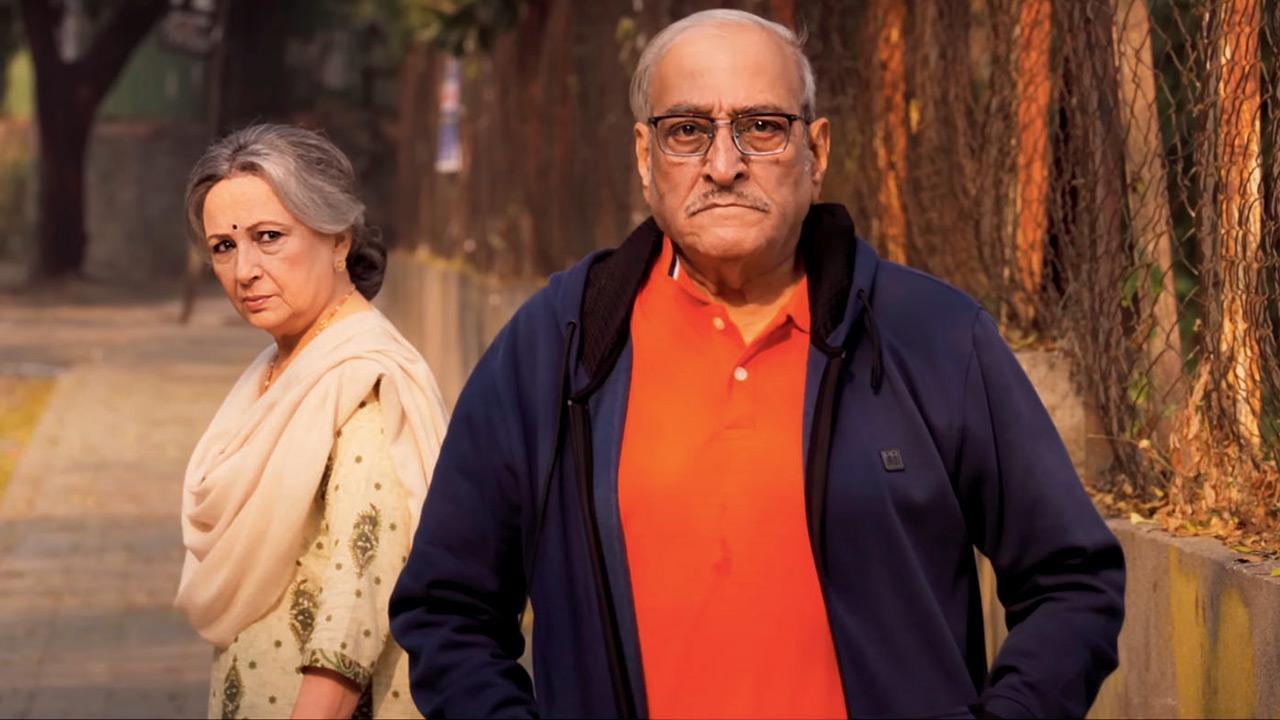
Noting that violent actioners are dominating the box office today, veteran actors Sharmila Tagore and Mohan Agashe say their feel-good film Outhouse serves as a ‘detox’
Upala KBR (MID-DAY; December 21, 2024)
Gulmohar (2023) reminded us how much we had missed seeing Sharmila Tagore on screen. Over a year later, the veteran actor has faced the camera again for Outhouse, teaming up with her Mississippi Masala (1991) co-star Dr Mohan Agashe. In Sunil Sukthankar’s directorial venture, Tagore plays a successful illustrator, who develops an unlikely friendship with an elderly neighbour while babysitting her grandson over a weekend. It was the director’s sensitive gaze towards the plight of senior citizens that drew her to Outhouse.
“The film brings forth the different needs of old age, and how the intergenerational gaps can be filled by communicating, with some humour and understanding,” starts Tagore.
The film, which hit the screens yesterday, marks Agashe’s last collaboration with writer Sumitra Bhave, who passed away in 2021. Having worked together in notable Marathi films, including Kaasav (2017) and Dithee (2019), the senior actor wanted Bhave to explore how the lives of elderly people are impacted by the breakdown of traditional family dynamics and a change in the caregiving system. But Agashe had a caveat—it should not be a tear-jerker.
Remembering Bhave, he says, “After I read the script, Sumitra asked me, ‘Do you think Sharmila would act in this?’ I told Sumitra that I would ask her. Fortunately, Sharmila liked the script.”
At a time of big-scale entertainers, the slice-of-life film comes as a fresh breath of air. Tagore believes it is a much-needed departure from the actioners that are currently dominating the box office.
“A lot of violent films have done well. I don’t mind violent films. If it has a theme or there is a reason for that violence, I’m open to seeing it. I can’t stomach films that are violent for the sake of violence. At the moment, films are going through a rough time. The actors are charging so much money. From what I hear, bigger films like Kalki 2898 AD and Brahmāstra: Part One—Shiva [2022] attract the audience. But personally, I like smaller movies like Laapataa Ladies,” she smiles.
Agashe echoes her sentiment, adding that “the world of movies is becoming a bit toxic”. “There is a lot of violence and sex in today’s films. When it hits a certain threshold of toxicity, it needs a good detox. I preferred this film because there is no sex, violence, killings or religious propaganda. It’s about the pure friendship between a child and a puppy, and the lives of two elderly singles.”
I have stepped out of that zone where I’d think about how much business my film has done-Sharmila Tagore
8:31 AM

Following up Gulmohar with adventure drama Outhouse, Sharmila Tagore on going beyond roles of the family matriarch and feeling liberated as an actor
Upala KBR (MID-DAY; March 28, 2023)
Gulmohar was one of those well-rounded Hindi films that boasted of several sterling qualities, from mature performances to competent direction. But to many ardent fans, the biggest highlight of Rahul V Chittella’s directorial offering was seeing Sharmila Tagore back on the screen after over 12 years. Fortunately, we’ll be seeing more of the veteran actor in the coming months. Tagore has wrapped up the shoot of Outhouse, an adventure drama that sees her as a grandmother who joins her grandson in his search for his dog.
Tell her the premise sounds charming, and Tagore says National Award-winning director Sunil Sukthankar’s film has a big heart. “Outhouse also stars my dear friend, Mohan Agashe. All of us loved the script, and made it on a shoestring budget, shooting in a start-to-finish schedule in Pune. It’s an independent film that [at the moment] doesn’t have any OTT backing, so I don’t know what its fate will be. But I have no doubt that it will be liked by people, if and when it is released,” smiles the senior actor.
In the slice-of-life movie, she plays a graphic designer who, on an occasion, has to babysit her grandson. “Unknown to her, the grandson also has a dog. In the morning when they wake up, the dog is missing, and that’s how their [adventure] begins.”
With the Hindi film industry telling unheard stories, now is fortunately a good time for female actors as well as senior artistes. Tagore agrees, noting that she is cherry-picking projects and ensuring that she goes beyond the roles of a family matriarch. She is looking forward to playing complex parts.
“I am open to playing a grey role. I have stepped out of [that zone] where I’d think about how much business my film has done, compare [myself] to others, or feel the insecurity that comes with a film not doing well. All that angst is behind me. I almost feel like a newcomer now.”
Today, she is doing movies only for her love for the craft. “I don’t have any of that competitiveness in me. God has been kind. With humility, I can say today that I don’t need the money because my needs are not complex. I don’t need fancy cars, houses, or even shoes because I cannot wear high heels. Maybe I have distanced myself [from such needs] because I have so many other things happening in my life that I don’t consider myself only an actor.”
Filmmaker Sumitra Bhave passes away
8:01 AM

Swati Shinde Gole (THE TIMES OF INDIA; April 20, 2021)
Pune: Veteran filmmaker Sumitra Bhave, 77, winner of the 64th National Award for best film for Kaasav, died of prolonged illness at a private hospital in Pune on Monday.
She has also directed acclaimed films like Devrai, Doghi, Dahavi Fa and Ha Bharat Maza that won national accolades. Bhave is survived by her daughter.
She was known for her out-of-the-box content and for the way she handled social issues in her films. She has directed 14 films, over 50 documentaries and written four television series. Bhave has bagged many international awards for her work.
Veteran filmmaker Mohan Agashe, who has worked with Bhave, said, “No other filmmaker has handled as sensitively and sensibly five highly stigmatized illnesses as she did in her films — Zindagi Zindabad, Devrai, Nital, Astu and Kaasav dealing with HIV, schizophrenia, leucoderma, dementia and depression.”
Agashe said Bhave, a social scientist and researcher, studied sociology at Tata Institute of Social Sciences. “She realised the power of cinema as the most effective medium to communicate authentic scientific information in an entertaining manner to combat stigma and dispel misunderstandings and myths about these illnesses in a simple language, while stressing the vital role of humanity in medicine. It is a great loss for viewers of her films and a personal loss for me as producer of her last two films,” he added.
Filmmaker Sunil Sukthankar said Bhave had been undergoing treatment in a city hospital since January when she started having health issues. “She was in hospital since the past few days, but I was Covid positive and recovering. I completed my quarantine and was able to be with her for the last three days,” he added.
Sukthankar, who co-directed quite a few films with Bhave, said, “She had two major projects in hand — one was a documentary on vocalist Prabha Atre and a film for the elderly, which she had jointly scripted with Agashe. After she started having health issues in January, she settled down a bit and started reading, watching films and began recording her memories that she thought should be documented.”
Mental disorders are considered 'low caste' in the hierarchy of medicine-Mohan Agashe
7:49 AM

The veteran actor on his tryst with mental illness, his jinxed FTII stint and why he desperately needs a secretary
Angona Paul (MUMBAI MIRROR; July 31, 2016)
Kitted out in his trademark Nepali cap and a trendy little bluetooth headset, Dr Mohan Agashe strikes a stark contrast to the Alzheimer's-stricken Dr Chakrapani Shastri he portrays in the recently-released Astu. Little surprise there, given that the man is a psychiatrist by profession.
The National Award-winning film is about a retired professor (Shastri), who suffers from Alzheimer's and gets lost when he steps out of his daughter's car to follow an elephant in a busy market area. Agashe has been working in the field of mental health for some time now; in 1991, he was instrumental in establishing the Maharashtra Institute of Mental Health in Pune. The film, according to him, is "about the magic of empathy". "It focuses not simply on cognizance of the disease, but the importance of understanding and accepting the afflicted," says Agashe, adding that overthinking and analysing makes people insensitive. For this character, Agashe reached back to his empathetic self of yore. "Years ago, when I wasn't a seasoned doctor, and therefore more sensitive, I had seen a case of nominal aphasia," he recalls. The condition makes it difficult for patients to remember the name of an object although they can clearly describe what its functions are. "I remember the struggle as the poor man tried in vain to put a name to the object — a set of keys. The expressions of joy and embarrassment on his face when someone finally helped him with the word were engraved on my mind," shares the actor, who also co-produced the film.
Becoming a producer happened by default, insists Agashe. After the producer, who was to fund the post-production, backed out, the team — helmed by directors Sumitra Bhave and Sunil Sukhtankar, and producer Sheela Rao — resorted to crowd-funding. Afraid that the time it was taking would result in "a miscarriage of a perfectly fine film", Agashe decided to chip in. "I thought... I am retired and I do have some money from my provident fund and pensions, so let's finish the film," he says.
The decision turned out to be a learning experience about the economics of film distribution. "Earlier, I used to curse my friend, Jabbar Patel, saying 'how come you make films and don't bother releasing them!'. I know better now," laughs Agashe.
Astu, completed in 2013, was well-received across the festival circuit and even picked up National Awards for Best Screenplay (Sumitra Bhave) and Best Supporting Actress (Amruta Subhash). But after the festival fever subsided, the team realised that distributors were wary of picking it up. "It was a case of content versus commerce," says Agashe.
"So as an experiment, in July 2014, the directors and I requested the owners of City Pride and Prabhat to give us at least one show. The film ran for six weeks, which convinced us that it had potential." However, the returns from ticket sales were abysmal after the theatre owners had taken their share. "That made me realise how many screens a film had to get, and how many tickets need to sell for it to recover its costs just from the box office," he adds, ruing, "Unless you spend big on publicity or have a big star, it's not possible."
The challenges notwithstanding, the actor also had the satisfaction of several audience members coming up to him and admitting that if they had seen such a film before, they might have behaved differently with their parents or grandparents. "Mental disorders, you see, are considered 'low caste' in the hierarchy of medicine," says Agashe. "You wait till dark to go to your doctor. You refuse to recognise him in public," he half-jokes. Astu, according to him, taught him how films can help in "subtly smuggling in education".
Quiz him on FTII and the recurrent strikes, and the actor, who also had a controversial stint at the institute, bristles up. "Going on strike is a way to rebel for youth, in general. Even when Adoor Gopalakrishnan, an ex-student of FTII and a brilliant filmmaker, was at the helm and suggested changes in the syllabus, students had opposed," he avers, adding, "Don't blame students; they are a transient population. This is politics — exploiting the emotional energy of former and current students."
That said, he is visibly excited about his next film with Astu director Bhave. Titled Kaasav, the film will explore depression. "I also want to work on a book called Behind the Mask, on doctor-patient relationships and the role of faith in healing. It will be a one-man show, in the format of direct or intimate theatre," he shares. Looks like a lot is on his plate. Any other projects, we query. "I am looking for a woman, for all kinds of relationships...," he declares, pausing for dramatic effect. "Except that of a wife," he concludes with a guffaw. "I need a caretaker or manager — you see, my house and affairs are in utter disarray," explains the 69-year-old bachelor, whose latest flick, Lost & Found, a treatise on love and loneliness, has just hit the screens.
FTII 2009 batch was given priority over the 2008 batch-Resul Pookutty
8:20 AM

Resul Pookutty (THE TIMES OF INDIA; August 23, 2015)
I finished my diploma
course at the Film and Television Institute of India (FTII) in
1995, within the stipulated three-year time frame. Up until 2000,
batches following mine too completed their course in time, give or take
small delays.
When I was studying at FTII, there were four disciplines--direction, camera, sound and editing--which could take 10 students each. So, in any given year, there were 120 students on the campus. But, around 1999, three more disciplines were added--production, acting and screenwriting. But, the infrastructure remained the same and soon, problems started.
In 1999, under the directorship of Mohan Agashe, the administration came up with a new course structure. Instead of a three-year course there would be three one-year courses. At the end of each year a student would have to reapply for specialization and they could be either eliminated from or elevated to next year. As per this decision, 80 students were to be admitted in that academic year (as against 32 students earlier). This was a seriously flawed decision and the idea of forced elimination of students was severely criticized. The old system was then reinstated within a year. The elimination process had half the number of students reaching the final year, but once it was removed, the entire batch was pushed up, adding 50% more students than planned. This even as the infrastructure remained the same.
The 2008 batch suffered the most for these decisions because by then, a huge backlog of delayed projects had built up. It was clear to the faculty in 2000 itself that the incoming batch of students would not be able to complete their studies in three years. The faculty and the administration knew the 2008 batch was in for delayed courses. Then how can the batch be blamed for the delay? The faculty recommended that 2008 be declared a zero year. The crucial seat of the head of the department of direction too had been lying vacant for three years. But at the ministry's instance, FTII announced admissions for 2008.
Around this time, the SC had asked FTII to implement the 27.5% OBC reservation without reducing the strength of the general category. So, in September 2008, 94 more students were added to the batch. The first year went of smoothly and then everything started falling apart. In late July 2009, swine flu forced the closure of the hostels and the institute.
This was followed by other disruptions. The International Students Film Festival was held to celebrate 100 years of Indian cinema, followed by the National Students Festival. In 2009, the government appointed the consultancy, Hewitt Associates, to recommend steps to upgrade FTII. Its report, which led to an uproar, was a barely disguised recommendation to privatize the institute. The government was forced to scrap this report. A new committee was appointed under the chairmanship of P K Nair, the former director of National Film Archives. Many famous alumni spent over a year analyzing various issues--the change from analogue to digital and possible ways to clear the academic backlog. This effort was made without any grant and everyone worked selflessly on it. But till date, the Nair committee report has not even been tabled.
The 2009 batch, whose classes started in January 2010, managed to complete the course by January 2015. This was made possible by giving it priority over the 2008 batch! No one knows the logic for this decision. In effect, the 2009 batch finished its course in five years pushing the 2008 batch to its seventh year. It is these students who suffered the most for FTII's reckless decisions, and also faced assessment and expulsion threats. This crisis spiraled into the gherao and the infamous midnight arrest.
FTII's core problem lies in the functioning of its director who holds all powers. He has to function not only as a guide but also as a mentor, rector, psychologist and mediator. But most FTII directors come from IAS or allied services and are not prepared to play these roles.
The biggest problem is that FTII is only a tiny blip on the I&B ministry's large radar. For them it's a media wing, not an academic institution. All the educational institutions under the I&B ministry account for less than 3% of its budget. The HRD ministry on the other hand understands how crucial teachers researchers and faculty are to an institution.
Early in the ongoing crisis, one of the senior-most I&B officials called me to discuss FTII's problem. A group of us had a four-hour meeting with the officials. A five-point agenda was submitted on the immediate steps that needed to be taken. The minister himself admitted to us that, “we haven't made the best of the choices, but as a government we cannot retract“. We were asked for recommendations to save the “face“ of the government. We were assured that all our recommendations would be implemented.
But nothing happened. We continued our dialogue and then Vidhu Vinod Chopra and Rajkumar Hirani too stepped in. Vinod even agreed to play the mentor at FTII. But the core issues that provoked the strike were not resolved. It took the ministry almost 45 days and a midnight arrest to send a panel to assess the situation.
The ministry wants the FTII to be a place of excellence and a proposal to this effect was also to be tabled in the monsoon session of Parliament. We now suggest a committee with the outgoing chairman and vice-chairman of the previous society and three other members chosen by the ministry to create guidelines for appointments and end this impasse.
The author is an alumni of FTII and an Oscar-winning sound designer
Subscribe to:
Posts (Atom)