Showing posts with label Mission Kashmir. Show all posts
Showing posts with label Mission Kashmir. Show all posts
An actor should do everything, not just lead roles-Jackie Shroff
9:45 AM
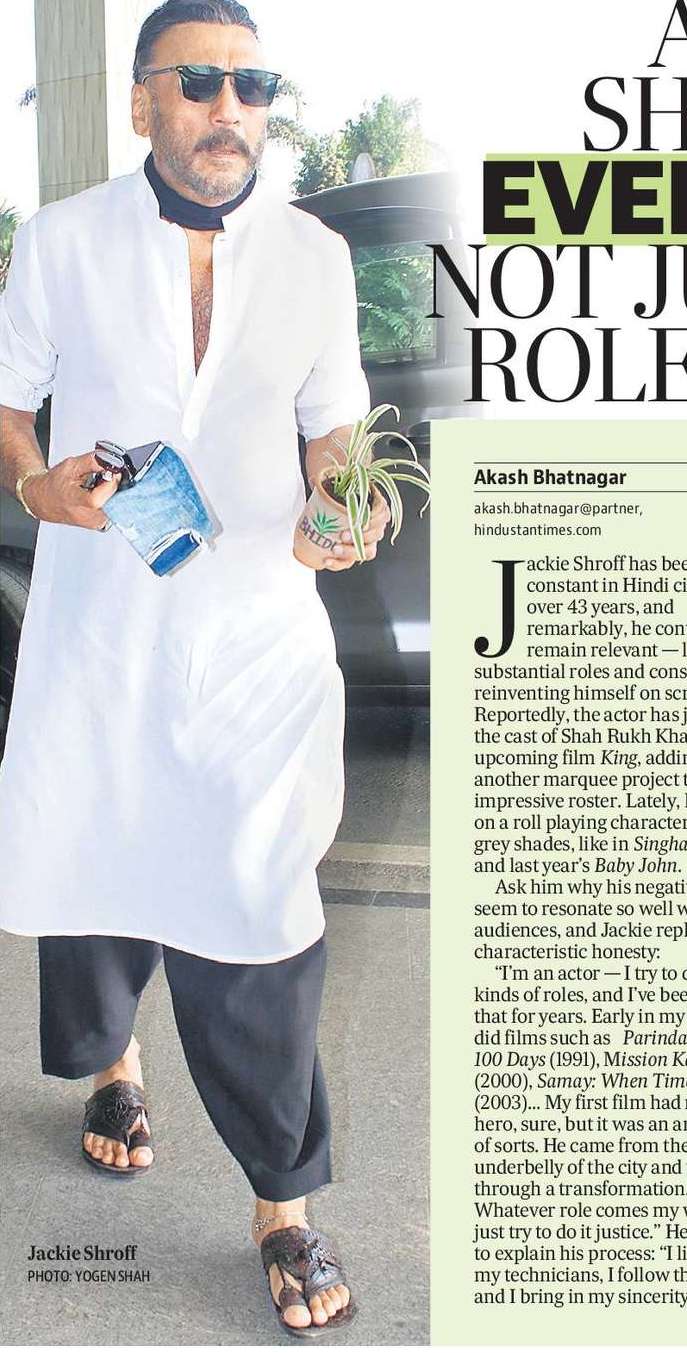
Akash Bhatnagar (HINDUSTAN TIMES; May 21, 2025)
Jackie Shroff has been a constant in Hindi cinema for over 43 years, and remarkably, he continues to remain relevant — landing substantial roles and constantly reinventing himself on screen. Reportedly, the actor has joined the cast of Shah Rukh Khan’s upcoming film King, adding yet another marquee project to his impressive roster. Lately, he’s been on a roll playing characters with grey shades, like in Singham Again and last year’s Baby John.
Ask him why his negative roles seem to resonate so well with audiences, and Jackie replies with characteristic honesty:
“I’m an actor — I try to do all kinds of roles, and I’ve been doing that for years. Early in my career, I did films such as Parinda (1989), 100 Days (1991), Mission Kashmir (2000), Samay: When Time Strikes (2003)... My first film had me as a hero, sure, but it was an anti-hero of sorts. He came from the underbelly of the city and went through a transformation. Whatever role comes my way, I just try to do justice to it.”
He goes on to explain his process: “I listen to my technicians, I follow the script, and I bring in my sincerity and emotions. Whether it’s the bad guy, the good guy, a cameo — I enjoy it all. I genuinely love my work, and when you love what you do, that connects with people.”
So what’s his secret to staying relevant even today? “There is no strategy,” Jackie shrugs, “I never plan or calculate. I work on impulse — I decide things on the spot. Sometimes, I take up a film because the writer’s a friend or a camera person says, ‘Do din ka kaam hai, kar le.’ Sometimes it’s because I need the money, or a big banner offers me good work along with good money.”
Importantly, he has no regrets about any of the choices he’s made: “I’m not complaining about the kind of roles I’m getting. An actor should do everything, not just lead roles. A chair has four legs — take one away, and it collapses. I aim to be that pillar in the film, whichever one it may be. I’m doing a bit of everything and having a great time.”
Even today, Jackie remains one of the busiest actors in the industry — arguably working more than some of the younger stars. “I’ve never really thought about whether I’m doing more or less work,” he laughs. “Back in the day, we used to juggle two or three films in one day. Now, I’m doing one film a day. And honestly, sometimes even that feels like a lot!”
People kept tossing me around like a ping pong ball-Jackie Shroff
7:58 AM

Actor Jackie Shroff says he has never refused any roles, big or small, and keeps experimenting to stay relevant
Rishabh Suri (HINDUSTAN TIMES; April 12, 2023)
Staying relevant isn’t easy for an actor, but Bollywood’s bindaas bhidu, Jackie Shroff, even after spending close to four decades in the film industry, continues to stride ahead successfully.
Ask him what the secret is, and the 66-year-old, who is currently working on a film that stars Suniel Shetty, Sunny Deol and Mithun Chakraborty, laughs: “I have no idea. I kept playing around and experimenting. Be it a police officer or a crook, or even Sai Baba in films (or taking up varied projects including) Ram Lakhan (1989), Khalnayak (1993), Mission Kashmir (2000). People kept tossing me around like a ping-pong ball. I didn’t go against the tide; I flowed with it and respected my technicians.”
The times were different earlier, he acknowledges. “The producers would come to us (actors) with either a simple love story or to play a good cop. I’d never refuse. I don’t care about my role; I look at the project in its totality. It doesn’t have to be that I sing a song or get a good line. I am part of a chair, and who sits isn’t important. If one of the legs isn’t there, you will fall,” he says, adding, “I have had the opportunity to work with some great directors, and now I am getting to work with some great youngsters.”
His biggest takeaway is that he got to learn a lot from people such as the late actor and filmmaker Dev Anand. “Dev sahab got me a role in Swami Dada (1982) and made me realise what ethics are. Someone shouted at me, but he said, ‘Naya ladka hai, seekh jaayega’. Look at that concern about protecting a young artiste. (Filmmaker) Subhash Ghai, when I worked with him in Hero (1983), guided me in my first shot. I had to drive a jeep, and he told me, ‘I had to do the same thing, but I broke the set of Aradhana (1969)’. He made himself fall down to make me feel that if you do fall down, it doesn’t matter. Those are things I learned from my seniors; I didn’t put anyone down to become big,” he smiles.
Poet Rahat Indori, who tested Covid positive, passes away at 70
6:27 PM

Avijit Ghosh & Jamal Ayub | TNN (THE TIMES OF INDIA; August 12, 2020)
New Delhi/Indore: He wrote stirring couplets that even politicians quoted in Parliament. And his poems of ardour and abandon made him a major crowd puller. Rahat Indori, one of the most-quoted Urdu poets of his generation, who also frequently collaborated with producer-director Vidhu Vinod Chopra, passed away following a string of heart attacks in Indore on Tuesday. He was 70.
“After the first attack, he seemed to be stabilising. But two more attacks followed,” Dr Vinod Bhandari, director, Sri Aurobindo Institute of Medical Sciences told TOI. A social media regular with over 860k followers on Twitter, the poet had tweeted on Tuesday that he was Coronavirus positive. In his last tweet, he requested people not to call him, saying he would update his status. He was also a diabetic and had cardiac issues. His death was widely mourned.
Indori’s association with Hindi cinema was fruitful but not memorable. He wrote lyrics in over 20 films and worked with Vidhu Vinod Chopra for Kareeb (1998), Mission Kashmir (2000) and Munnabhai MBBS (2003). Bumbro bumbro was one of his biggest hits.
The son of a textile mill employee, Indori was a PhD in Urdu literature. He taught at Devi Ahilya Vishwavidyalaya for many years. He was married to fellow poet Anjum Rehbar. “He was a poet of mushairas, whose work was much loved by audience but he never lowered his standard please them,” says poet Hasan Kamal.
There’s no question of buying the rights as we are by the original folk song of Bhumro-Vishal Mishra
8:12 AM

Vishal Mishra insists his song has nothing to do with the number from Mission Kashmir
Natasha Coutinho (MUMBAI MIRROR; February 7, 2019)
 Salman Khan’s next co-production, Notebook, which opens in March and introduces Pranutan, Mohnish Bahl’s daughter, opposite another debutant, Zaheer Iqbal, features the Kashmiri folk song “Bhumbro”. But producer Murad Khetani and composer Vishal Mishra are quick to add that their song is not inspired by “Bhumbro” which was picturised on Hrithik Roshan and Preity Zinta in Vidhu Vinod Chopra’s 2000 drama, Mission Kashmir.
“It is not a recreation, we have used the traditional Kashmiri folk song and shot it on Zaheer dancing with some local kids. It’s apt for a situation in our film,” says Murad. The new “Bhumbro” has been sung by Amit Mishra and was shot on a school set in Kashmir. Mudassar Aziz has choreographed it for the Nitin Kakkar directorial.
Vishal reveals that they have added some new Kashmiri lyrics to their song. Quiz him on whether they have bought the rights to the song from Chopra, and he retorts, “There’s no question of buying the rights as we have been inspired by the original folk song. I have even used the Kashmiri musical instrument, rubab, extensively in the song. We are making sure Notebook has only original songs, so it stands out among all the recreations in films at the moment.”
He adds that Salman was equally involved with the music and was insistent on original music. “That’s a blessing for musicians like me,” he smiles.
Renu Saluja would never support me if I was wrong; she was more popular than me-Sudhir Mishra
7:47 AM

Renuka Vyavahare (BOMBAY TIMES; March 24, 2018)
 Over the years, Bollywood has seen directors offering a peek into their personal lives through their films. For example, Mahesh Bhatt’s Zakhm and Arth were taken out of the pages of his own life, and are also considered as some of the most moving semi-autobiographical films of Hindi cinema.
Speaking of which, Sudhir Mishra’s upcoming film Swaha reminisces the life and times of his late partner — renowned film editor Renu Saluja. The story revolves around his relationship with her and their last days together before her death in 2000, following a battle with cancer. While Aditi Rao Hydari will be seen essaying the lead role of Saluja, the actor who will play Sudhir, is yet to be cast.
Renu, an FTII (Film and Television Institute of India) alumna and four-time National Award-winning editor for Parinda (1989), Dharavi (1991), Sardar (1993) and Godmother (1999), was revered by filmmakers like Shekhar Kapur, Govind Nihalani, Kundan Shah and Vidhu Vinod Chopra.
Some of her other well-known films include Jaane Bhi Do Yaaro (1983), Kabhi Haan Kabhi Naa (1993), Bandit Queen (1995), Pardes (1997), Rockford (1999) and Hey Ram (2000). Nagesh Kukunoor’s Bollywood Calling and Sudhir’s Calcutta Mail, released in 2003, were her last edited films.
In an exclusive chat with Bombay Times, Sudhir revealed, “I became who I am because of her. I’ve been meaning to make a film on her life for the longest time and I am glad it’s happening now. She was way ahead of her time and one of the most brilliant and compassionate women who I have known. I will be directing the film and have co-written it as well.”
 About the film, he explained, “Towards the end of her life, she started rejecting me and I had to stand by her, no matter what. Those were trying times as she was going through a lot after being diagnosed with cancer. She began introspecting, reexamining her own life as one tends to do towards the end. My film is predominantly about that — from her point of view and in context to our relationship during that period. It compels you to think, ‘Can you stand by a person who wants to push you away?’”
Renu was previously married to filmmaker Vidhu Vinod Chopra. When asked if he, too, will be portrayed in the film, Sudhir said, “There will be references. As an individual, you make certain choices and other relationships are a part of it. She and Vinod continued to be friends and worked together even after they separated. In fact, she was editing Vidhu’s Mission Kashmir before she passed away. Director Rajkumar Hirani eventually completed the film.”
There were reports of Vidhu also planning to make a film on her, many years ago. Speaking of it, Sudhir added, “I had heard about it. If he wants to do it, he should. It’s always interesting to see the other person’s point of view as well. I don’t own her. It’s his right, as they shared a beautiful friendship. Vidhu and I have never had any problems with each other, contrary to speculations. He is a great guy and we were there, together, at her funeral.”
The film will also shed light on Saluja’s fiercely independent nature and her ability to call a spade a spade. Sudhir said, “She wasn’t biased. If I had an argument with someone, she would never support me if I was wrong. She would always do and say what she thought was right. We talk about feminism today, but what she did years ago was empowering for women — making a mark in a field (film editing) that was essentially dominated by men. She was financially independent, more successful, liked and popular than me.”
As far as Aditi Rao Hydari’s casting is concerned, the director reasoned, “I like Aditi as an actor. She lends that soft sensitivity to a character. Renu was best known for two things — her infectious laughter and impromptu singing. She would constantly laugh despite the serious nature of her work and would sing Hindi songs at any given point. Aditi can sing and has that smile as well, so she was the perfect choice. The film is slated to go on floors this year.”
When I first got in Mumbai, I took a big gulp of the sea water-Vidhu Vinod Chopra
10:20 AM

Vidhu Vinod Chopra (63), Anupama Chopra (48), Vikram Chandra (54)
An abiding interest in Mumbai brings together an acclaimed author, his journalist sister and filmmaker brother-in-law
Shreevatsa Nevatia (MUMBAI MIRROR; December 6, 2015)
Flanked by writer Vikram Chandra and filmmaker Vidhu Vinod Chopra, journalist Anupama Chopra is arguably more than just a familial bridge. Obvious affection for her brother Vikram helps make somewhat earthly his literary celebrity, while her few amused interjections render mellow her husband Vinod's many boisterous assertions. As director of this year's MAMI Festival, film critic Anupama's confessed obsession with cinema tangibly transformed into a contribution Mumbaikars could identify. Chandra speaks of their itinerant childhood — they moved from Delhi to Kolkata to Baroda — and Anupama instinctively completes his thought. "Bombay was home," they say together.
Unlike Chandra who moved here when he was in Class X, the Srinagar-born Vidhu Vinod Chopra came to the metropolis only after graduating from Pune's FTII. "I was more of a villager," the director-producer confesses. "When I first got here, I went to the sea and wondered how salty could the water possibly be. I took a big gulp. I instantly threw up." Unmistakably shaped by their experience of the city, the collective work of all three does seem to owe a certain debt to their arrival here. Chandra's gritty and masterful Sacred Games (2006), in particular, has been hailed by many as the quintessential Mumbai novel. His story of the Hindu mobster Ganesh Gaitonde and insomniac inspector Sartaj Singh appeared to make conspicuous this town's much-famed underbelly. Crime, even hardened city reporters agree, had finally, and rather definitively, been elevated to high literature.
Chandra says that in 1991, he was with his father in a car when they heard guns being fired. The Lokhandwala Complex shootout, it turned out, was unfolding nearby. "During that time, you opened the papers to read that two or three people had been shot. There were encounters. Every day, the death count resembled a cricket scorecard." A decade later, the threat from the underworld became even less abstract when Chopra received threatening calls from extortionists. After initially being "freaked out", Chandra took to discussing cricket with his brother-in-law's armed bodyguards. "It gets ordinary very quickly," admits Anupama.
For all its palpable menace, however, gang-related crime has given many a Bollywood filmmaker adequate narrative nourishment. Parinda (1989) had virtually pioneered the modern mafia movie. Chopra, though, claims his acclaimed film wasn't a by-product of lawlessness' lure. "I came from Kashmir and I had seen enough violence while growing up. Jean-Luc Godard had once said, 'You can make the film you want to make, but to make it interesting, make your lead either a cop or a gangster'. My intention was never to make something as real as Vikram's fiction." Careful research, it is evident, inspires Chandra's realism. In his essay, 'The Cult of Authenticity', the author writes about interviewing the Dagdi Chawl don Arun Gawli on the terrace of his house.
Anupama remembers she had accompanied Chandra for that meeting. "I thought I could protect him from Arun Gawli." Chandra explains his sister's courage — "She believed the power of a journalist would help."
Anupama goes on to say that much like her, Chandra, the author of Geek Sublime, was quite the nerd when growing up. "My abiding memory is Vikram with his collar in his mouth, and a book in front of him all day." Chandra remembers having signed up for science at St Xavier's College. "I lasted three weeks." Anupama breaks into a chuckle and says, "He quit, saying the chicks were damn ugly." Chandra corrects her, "It was the other way around. The art chicks were damn hot."
Credited for having worked on the story of Chopra's Mission Kashmir (2000), Chandra was also instrumental in putting together the script of the forthcoming Wazir, which the Broken Horses director and screenwriter Abhijat Joshi had imagined would be an English-language film. "We would send him these pages. He'd FedEx them back to us, saying, 'Rubbish. Bulls**t'. He once sent us our pages all torn up, with the remark, 'That explains it'. It took us four years to please him. The day he sent us one uncorrected page, Abhijat and I celebrated with wine."
Chandra, who teaches creative writing at Berkeley, blames his usual adherence to the workshop format of creation. "I must say, I am not meant to be in cinema. I am used to working on my own, and maybe then showing some pages to my wife Melanie [writer Melanie Abrams] who never pulls her punches." Anupama and her filmmaker sister Tanuja Chandra had read the early drafts of Chandra's first novel Red Earth and Pouring Rain, but the National Award-winning film writer confesses she suspends some of her critical faculties when responding to the work of both Chandra and Chopra. "I haven't read enough to be able to criticise Vikram's work, and think I am too close to the making of Vindod's films to ever be entirely objective."
Chandra's 'The Cult of Authenticity' was a response to the charge that the compulsions of a Western audience had somehow diluted his Indianness. His deconstruction of a mythical 'Real India' seems pertinent in a climate where several actors of Chopra's films are being forced to decry intolerance. "The essential question always is — what does it mean to be Indian? That just keeps reincarnating itself." Making the case for a conciliatory compromise, he adds, "If you look at Indian history, debate has always outlined public thought. But there's a difference between vivaad and samvaad. The former lays stress on winning an argument, while samvaad, by insisting on respect of one's opponent, is a more holistic search for truth." Chopra seems delighted.
"Bahut accha hai yaar. Learning hai isme. I really understood it." Anupama reaches for his hand. "Very good. Will you be calmer now?" She smiles, looks away, and adds, "Now, only if we were that lucky."
Subscribe to:
Posts (Atom)