Showing posts with label Milkha Singh. Show all posts
Showing posts with label Milkha Singh. Show all posts
Sonam Kapoor only charged Rs. 11 for Bhaag Milkha Bhaag-Rakeysh Omprakash Mehra
9:07 AM

Renuka Vyavahare (BOMBAY TIMES; July 24, 2025)
As Bhaag Milkha Bhaag turns 12, director Rakeysh Omprakash Mehra looks back at the film’s journey, relevance and longevity in an exclusive conversation with us.
‘Farhan’s eyes reminded me of Milkha sir’
On casting Farhan for the role, the director says, “I have often been asked if Farhan Akhtar was my first choice to play Milkha. He was the right choice. Let me put it like that. His eyes reminded me of Milkha sir. The way he looks at you – they have the same intensity and depth. I knew Farhan was a good athlete, and he kept himself fit. When you’re playing a character like Milkha, something intangible happens to you. Farhan didn’t play the role, he became the part.”
What makes Bhaag Milkha Bhaag (BMB) relevant even today?
Some stories don’t fade, they mature with time. Bhaag Milkha Bhaag is one of them. The story is timeless, not topical, so it does not lose its relevance. I wanted to tell a story woven around the Partition of the country, and in Milkha Singh’s biography, I found that. Besides being the first biopic of a sportsman in our country, there were two tracks in the film. One was Milkha Singh’s journey, and the other was one of the most seminal points in modern Indian history – the Partition. I am glad it’s re-releasing in theatres on August 8. Certain films are meant for the big screen. We should develop a culture of revisiting our classics, not just for business, but legacy.
Why did you want to tell a story that was woven around the Partition?
The Partition is a seminal point because millions were celebrating the independence of the country, and millions were suffering. I was born in the 60s. I grew up listening to both horrific and beautiful stories of that time. They left an indelible mark on me. When I joined college, we shifted to a colony in Delhi, which was given to refugees of Partition, and they rebuilt their lives from scratch there. Borderline politics is another thing. I see myself through the lens of human beings. I am drawn to the common man. Ek aam aadmi kya kar raha hai, kya soch raha hai, uske sukhdukh kya hai. What moves them is very important for me. As a filmmaker, you get to choose your gaze, and mine is human.
While the story belongs to Milkha Singh, it also resonates with your past. Tell us about that.
It is a story of have-nots. Milkha had nothing to lose. When you don’t come from privilege and you make it, that resonates with me a lot. I grew up in Delhi. I used to swim and play cricket in the National Stadium. Before my time, Milkha Singh, Dara Singh and Dhyan Chand used to practise there. We grew up on these three names. They were our Sachin Tendulkar and Virat Kohli. Milkha ji didn’t have shoes at one point and ran barefoot. We all identified with it because our entire generation grew up without having proper facilities. I come from a lower middle-class family. I could relate to characters who were thrilled when they got to wear a Team India blazer like Milkha ji did. He won his first race for a glass of milk and two eggs. He didn’t win to make a world record or become a great athlete. I have practiced swimming because at the end of the practice section, we would get a glass of warm milk with Horlicks and two boiled eggs. It was great breakfast and that too for free. This is everybody’s story in India.
At three hours and six minutes, the film’s duration was much talked about. In hindsight, would you make any changes in terms of length or otherwise?
It was a difficult story to mount because everyone said, ‘Where is the romance? The hero is just running. Where is the action? Athletics kaun dekhta hai India mein?’ Saare sawaal sahi thay. But it was important for me to prove the detractors wrong. If I didn’t believe in what I made, I wouldn’t make it in the first place. Pacing derives its essence from the story and how it is told. Look at the modern-day epics like Avatar, Oppenheimer and Brutalist. When you’re enjoying a movie, you are completely lost in that world and time flies. This whole length concern came from distribution, it never came from the audience or critics.
‘Sonam only charged Rs. 11 for Bhaag Milkha Bhaag’
“When I approached Sonam Kapoor, I clearly told her she would appear for 15 minutes. Her character changes Milkha’s life by making him question his choices. I told her she won’t appear later in the film, and I don’t know if she will appear in the trailer or the poster. She heard me out and said the film must be made, and she will charge me a bomb for it. I told her bata dena fees, koshish karenge. Her contract came, and she had only charged me Rs, 11 as a shagun. She brought so much dignity to the part.”
10 years of Bhaag Milkha Bhaag: Farhan Akhtar-starrer to re-release on August 6
8:10 AM
Rishabh Suri (HINDUSTAN TIMES; July 25, 2023)
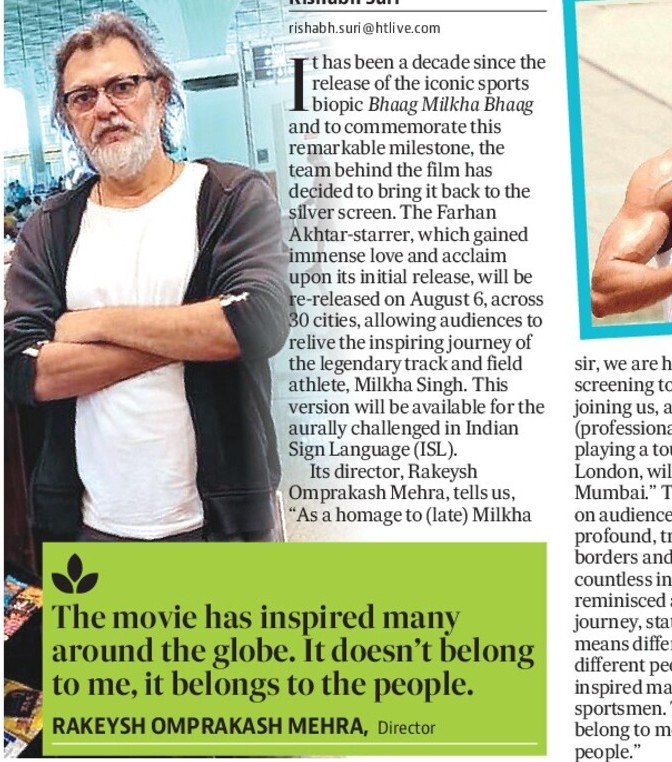
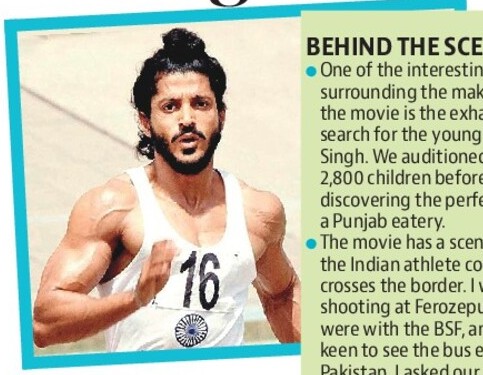
It has been a decade since the release of the iconic sports biopic Bhaag Milkha Bhaag and to commemorate this remarkable milestone, the team behind the film has decided to bring it back to the silver screen. The Farhan Akhtar-starrer, which gained immense love and acclaim upon its initial release, will be re-released on August 6, across 30 cities, allowing audiences to relive the inspiring journey of the legendary track and field athlete, Milkha Singh. This version will be available for the aurally challenged in Indian Sign Language (ISL).
Its director, Rakeysh Omprakash Mehra, tells us, “As a homage to (late) Milkha sir, we are holding a special screening too. His daughter is joining us, and his son, Jeev (professional golfer), who is playing a tournament in London, will try to join us in Mumbai.”
The movie’s impact on audiences has been profound, transcending borders and inspiring countless individuals. Mehra reminisced about the film’s journey, stating, “The movie means different things to different people and has inspired many, not just sportsmen. The movie doesn’t belong to me; it belongs to the people.”
BEHIND THE SCENES
- One of the interesting trivia surrounding the making of the movie is the exhaustive search for the young Milkha Singh. We auditioned nearly 2,800 children before discovering the perfect fit in a Punjab eatery.
- The movie has a scene where the Indian athlete contingent crosses the border. I was shooting at Ferozepur; we were with the BSF, and I was keen to see the bus enter Pakistan. I asked our officers to request the Pak officer if I could step into their country just to shoot this scene. And he actually allowed us! We walked inside without our passport or visa for 50 metres.
- In a scene Milkha, reunites with his sister, played by actor Divya Dutta, while she is washing utensils with ash. The moment I said cut, Divya started washing her hands with cold water. The art department forgot to separate the hot coal from the ashes, but Divya didn’t flinch even once.
10 Years of Bhaag Milkha Bhaag: Films that can stand the test of time, are the ones that mean something-Farhan Akhtar
3:02 PM

Renuka Vyavahare (BOMBAY TIMES; July 12, 2023)
Rakeysh Omprakash Mehra’s celebrated biographical sports drama Bhaag Milkha Bhaag (BMB) completed 10 years yesterday. Farhan Akhtar, who ably carried the huge responsibility of essaying the Flying Sikh on his sculpted shoulders, looks back at the film, its legacy and his own casting that was judged by many and other finer details in this interaction with BT. Read on...
When Lagaan completed 20 years, Aamir Khan had said that a film’s ultimate test is how well it ages. “Every film cannot stand the test of time,” he said. Do you think Bhaag Milkha Bhaag has aged well? Looking back, is there anything that you would do differently today?
My opinion on this will be biased because I truly loved the film. I genuinely believe without a doubt that it’s a well-made film with a powerful story. I am just very fortunate to be in it. I would have loved it as much if it was someone else’s. I agree with what Aamir has said that films that can stand the test of time, are the ones that mean something. They change the way you think or perceive and approach life. When you leave the theatre thinking something inside you has inherently changed, that emotion will always stay with you. I feel BMB is one such film.
What do you think the film truly stands for on a human level, beyond marking the sporting achievements of a legend?
It speaks about the triumph of the human will, of achieving things in the face of the most incredible odds and biggest adversities. It’s a tremendous human story of rising from nothing to great heights, which makes it so inspirational. What sets the film apart is how grounded and rooted the story is. It is a human story told in a simple, organic way by Rakeysh and Prasoon Joshi (writer). It didn’t manipulate you. From Milkha ji running for milk… to all the real-life moments of his life placed in the right order, touched people’s hearts. The film put the spotlight back on athletics and the role of fitness in one’s life. BMB has a legacy of its own.
Though the film back then was widely appreciated, some also thought it was too long (3 hours 9 minutes). Did you have any reservations about it?
We were talking about a person’s life story from the time that he was a little boy, all the way to his 20s. It required the viewer to feel what Milkha ji sees in the end, that cathartic moment when he goes to Pakistan and faces his past. That needed an understanding of the hell that he went through and his arduous life journey, so I never had any issues with the length of the film. There are many people who were moved by the film, and they too will disagree with this point of view. I feel these things are also subjective. Two people sitting next to each other in a theatre can have completely different opinions.
You have spoken about being judged when you were cast for the movie (for not being a Punjabi actor). It was also said that Akshay Kumar was the first choice for the film. Did these initial opinions pump you up to push yourself even harder?
Any form of adversity can lead to two things - you either crumble under pressure or you rise, face it and challenge it in the best possible way. I have always been someone who likes to challenge the status quo. It’s difficult for me to fall prey to a popular opinion or an opinion that someone has of me that I don’t agree with. It gave me a great impetus to perform better, to prove anybody who may have had a doubt about me in their head, wrong. It was one of the many driving forces through the making of that film. I feel that when it comes to casting, films have a destiny. I have directed and written films. When I start writing them, I have certain actors in mind, and it pans out differently. You end up working with someone else. When you look back, you realise that no one could have done it better than the one who made the cut. Films have a destiny. They eventually attract the cast that is right for them and vice versa. It’s what Rumi says, ‘What you seek is seeking you’.
A decade later, what about the film continues to stay with you?
It’s the entire process. Right from meeting Rakeysh in the edit studio where he first told me about the film until the final day of the shoot, I remember everything vividly. The most striking memory is of me meeting Milkha ji and his family for the first time and hearing his story from him. The lasting impression, the one that has stayed with me is seeing other sportsmen around Milkha Singh and the respect he commanded. They looked up to him for motivation and he took time regardless of what he was doing to speak with each and every athlete that he met. He asked them about their training and goals. For me that was fulfilling to see and learn from. Not many people know that Milkha ji came to our set just once. We were shooting one of the races in Delhi and I remember asking him why he won’t come again. He said it was a life he had lived a long time ago and seeing it happen again would bring back too many memories, so he’d just wait and watch the film instead.
Any inspiring words of Milkha ji that you still remember?
He spoke about his life in detail but otherwise he was a man of few words. He told me, “The only thing I expect from you is for you to work hard.” As an athlete he worked harder than anyone else. He is remembered for that. In that vein, as an actor my attempt was for people to recognize that hard work. My fuel for discipline came from him asking me, ‘I hope you are working hard (smiles).”
You were 38 when you worked on the film. The body transformation was insane. How tough was it to achieve that in your late 30s?
Whenever you need to undergo any sort of transformation in a shorter span of time, it’s essential to have a good team around you. I had the best people around me. It was less about what the body is going to look like and more about how I am going to feel as an athlete. To get into the mindset of an athlete was the larger challenge. When you train that hard, the body eventually follows. Your muscles don’t have a choice. The body will start looking good. It’s about getting the discipline of an athlete right. No matter where your friends are heading, who is celebrating what anniversary, you need to sleep, eat and work out on time. That for me was the bigger challenge.
Did you ever have a moment of self-doubt while prepping for the character? How did you overcome that feeling?
Especially when you are portraying someone flesh and blood, bringing someone’s real story to screen, there is always doubt. It keeps you on your toes. The minute you take things for granted, ‘oh I can do this with my eyes closed’ mindset, is when you begin to make mistakes. Going back to your earlier question, of someone asking me ‘Why you’ for this film, it’s a reason to perform better. It’s walking a really fine line between being confident in the performance but at the same time having an element of doubt. Someone as incredibly gifted as Mike Tyson, has said that every time he walked into a ring, he would portray that he was the most confident boxer who cannot be beaten but, on the inside, he was anxious. Instead of suppressing, you need to channelize that worry as your fuel.
Filmmaking is beyond only the box office performance of a movie-Farhan Akhtar
8:12 AM

Harshada Rege (BOMBAY TIMES; August 26, 2021)
Over the years in Bollywood, a film’s value has been increasingly judged by its box-office numbers. The chatter about whether a film has made an entry into the coveted Rs 100 crore or Rs 200 crore club has been dominating conversations within the trade circles and sometimes even the audience. However, there are classics like Mughal-E-Azam comedies like Andaz Apna Apna or even a contemporary film on friendship, Dil Chahta Hai, to name a few, that are remembered for their content and cinematic appeal over their monetary success. Farhan Akhtar’s film Lakshya is one of those movies, which didn’t see enormous success, but continues to win him praise each time it clocks in another year.
Ask him whether judging a film success solely by its box office performance takes away from the creative success of a filmmaker, and he says, “The fact is that filmmaking is an art form as well as a business, so both are important, but one cannot overshadow the other. In recent times, it had become an unfortunate reality where the box-office figures overshadowed the strength of the content, and if something had strong content, but didn’t have a business to boast of, it was not be considered a successful film. But filmmaking is beyond only the box office performance of a movie. That is something that we must respect.”
Farhan feels that it is the industry that needs to change its outlook of judging a film based on its performance at the box office. “If we, the people within the fraternity, don’t respect it, then we can’t expect others to do it,” he says, adding, “That change really has to start from within us. If we can make the audience believe that we think that it is the content that’s important and it needs to be respected, then everybody will follow it.”
Not only do filmmakers have to contend with the pressure of the box office, but these days they also have to pay attention to people’s strong opinions about casting an actor from a certain background for specific roles. For instance, there was a lot of conversation and heated debates on whether or not Priyanka Chopra was the right fit to play boxer MC Mary Kom in the biopic on the athlete. During the release of Bhaag Milkha Bhaag, Farhan, too, was also asked why a Punjabi actor was not chosen to portray the legendary sprinter.
Farhan shares, “On a huge level, it depends on who the director wants in the film, and as an actor, it depends on what inspires them to do the role to the best of their abilities, which is their job. We choose from what comes to us. If a director wants to cast me in a film as Milkha Singh, it is his vision. I connect to that vision and story and do the best that I can.”
As a filmmaker, would he pay heed to such suggestions or prefer to go with his instinct? “You have to go with your instinct. Though you are making the film for the audience, your work has to be honest, you have to be honest with yourself first. If you can’t do that, then you can’t be honest with the audience.”
My relationship with Milkha Singh was like that of a father and son-Rakeysh Omprakash Mehra
8:04 AM

The filmmaker, who directed Bhaag Milkha Bhaag, a biopic on the legendary sprinter, talks about the close bond they shared
Rachana Dubey (BOMBAY TIMES; June 24, 2021)

Remembering the iconic sportsman, Rakeysh says, “A personality like Milkha Singh lives on forever. Yes, you might cremate his mortal remains, but what he stood for, the inspiration he gave all of us and his achievements, will live on forever.”
Talking about the late legendary sprinter Milkha Singh, Rakeysh adds, “For me, he was the first international sporting hero of independent India. People across the board — athletes, business professionals, politicians and filmmakers — have been inspired by him. The outpouring of love from every corner of the world speaks of that. I must have spoken to him a month or two before he passed away. We would always check on each other. Our relationship was like that of a father and son. It was special in many ways.”
Milkha Singh’s wife, Nirmal Kaur, succumbed to Coronavirus on June 13, five days before his demise. Rakeysh says, “When they fell sick, I thought the family should have their space and privacy. I stayed in touch with the family checking on Nimmi aunty and him. His passing has affected me a lot.”
Describing his equation with Milkha Singh and his family, the filmmaker shares, “Nimmi Aunty and he were like a second family to me. They were like parents to me, and we would keep checking on each other every few days. He was an extremely revered figure whose story, I felt, should reach the younger generation. Pop culture elements like movies and music help a story travel to a wider audience. I wanted people of this generation to connect with him and experience his story.”
Rakeysh has around 6,000 hours of recording in which Milkha Singh gave a deep insight into his life and shared the minutest details with the filmmaker, who, at that time, was researching the biopic. Does he intend to go back to that material and create something from it? “I think the movie said it all,” says Rakeysh, adding, “It was loved across the world. The response was just as overwhelming as it was in India. It received the same kind of adulation. People connected with his emotions. A sportsman like Carl Lewis, who is extremely revered for his achievements, saw the film and sent a baton to Milkha Singh saluting his efforts. They didn’t know each other, but Milkha Singh’s journey connected them.”
Speaking about some of Milkha Singh’s beliefs that made an impact on him, Rakeysh says, “He said that there is no substitute for hard work. He always said that it’s great to have talent that you can hone, but you have to go through fire and come out on the other side to excel in life. He believed that there are no shortcuts if you want to be the best in the world. His words will be my mantra for life.”

We have much to learn from Milkha Singh ji , no matter what our pursuit is-Prasoon Joshi
8:07 AM

By Prasoon Joshi (BOMBAY TIMES; June 20, 2021)

Charaiveti Charaiveti — keep walking, keep walking and keep inspiring, this seemed to be the mantra of Milkha Singh.
I knew little about athletics before I started writing Bhaag Milkha Bhaag. Milkha ji knew this early in our interactions that I am more interested in exploring a side and those dimensions, which probably a very few knew. After our many conversations over weeks and months, he did tell me that such intense discussions about his own life he hadn’t had with anyone before we interacted.
I know I made him visit painful alleys of this past and recall some best-forgotten incidents, and it was gracious of him to allow a writer to do his job and peel off layers. Some parts of his journey resonated with mine, and I could find my pen flow more smoothly — the fight to withstand adversity, endure unsavoury incidents and yet be up against all odds. And that the significant hurdle is placed not by strangers but by those familiar, claiming to be well-wishers but not indeed so. This is the hardest one to cross, and it must be.

We have much to learn from Milkha ji , no matter what our pursuit is.
First, be good at what you do — hone your craft. Milkha Singh used to run so hard during his races, even during some practice ones, that he would often faint after completing them; this is what you call giving your 100%. Then, believe in yourself and the force above at the same time. More importantly, as I have written in the climax, the bigger battle in life is to face your demons. When you do, you realise that they are not as big as they were in your mind.
Whilst meeting him in Delhi sometime in April, I happened to ask him how he felt now that he is running his 92nd year, especially about life and death. Without a second of hesitation, he responded, “I look at the positive side of things, I look at Fauja Singh who, at the age of 110, is still running. Life and death are not in our hands but staying optimistic is.”
Bhaag Milkha Bhaag encapsulated his journey. Life had thrown enough at him for anyone to run away. But Milkha ji bhaage nahi. Woh daude.
Daudna ek decision hai, a determined endeavour. Mushkilon se bhagna nahi hai — daud lagani hai unke saath.
Milkha Singh ji will continue to inspire all and especially us — Rakesh, Farhan and all the team of Bhaag Milkha Bhaag.
-----------------------
YOUR STORY WAS A CONSTANT SOURCE OF INSPIRATION: FARHAN ON MILKHA SINGH
Dearest Milkha ji,
A part of me is still refusing to accept that you are no more. Maybe it’s the stubborn side I inherited from you... the side that when it sets its mind on something, just never gives up.
And the truth is that you will always be alive. Because you were more than a large hearted, loving, warm, down to earth man. You represented an idea. You represented a dream. You represented (to use your own words) how hard work, honesty and determination can lift a person off his knees and get him to touch the sky.
You have touched all our lives. For those who knew you as a father and a friend, it was a blessing. For those who didn’t, your story was a constant source of inspiration and a reminder of humility in success.
I love you with all my heart.

Madhur Bhandarkar and Rakeysh Omprakash Mehra tell IIT students to not fear failure
7:45 AM

Amidst a hall full of enthusiastic students at IIT Bombay’s annual cultural fest, filmmakers Madhur Bhandarkar and Rakeysh Omprakash Mehra threw the crowd into a frenzy with interesting anecdotes from their lives
Pallabi Purkayastha (BOMBAY TIMES; December 27, 2017)
Madhur Bhandarkar, the critically-acclaimed director, who is known for making hard-hitting cinema about the darker side of life, had to overcome some mammoth obstacles to get to where he is today. Talking about his struggling years, Bhandarkar said, “I come from a middle-class family. So I had to struggle a lot... I sold video cassettes on cycles. As a delivery boy, I have given cassettes to every person— from dance bar girls to people from the underworld. I used to meet film actors during those days. One person who knows that I am the same video cassette delivery boy who used to go around on his bicycle is Mithun Chakraborty. He remembers me well because I used to go to his place for four years. He cannot believe it that I am that same guy. At the success party of Corporate, he went on stage and said ‘half chhaddi main aata tha mere paas.’ It was so sweet of Dada.”
Bhandarkar also spoke about the pay disparity in showbiz and had a powerful message to convey when a student quizzed him about his take on the glaring issue. “Like I always say, all superhit films are not good films and films that do not work are not bad films. Bollywood is definitely star-driven. As a consumer, if you go to a shop, you prefer to buy a trusted brand. Similarly, you will go for a small budget film only when you start hearing good things about it. A lot of people ask me why heroines face pay disparity, as opposed to heroes in films. To which, I reply ‘Aap hamesha puchte ho hero kaun hai, aapne kabhi pucha heroine kaun hai?’ Nobody asks that. The priority is always given to the male lead. Everyone wants to know only about the actor and not the actress. The day we change this mindset and go to watch a female-centric movie with the same zeal as we have for a male-lead film, that day the actress will be paid equally,” he said. Needless to say, the answer was received with a thunderous applause.
While the students were bowled over by Bhandarkar’s brutal honesty, Rakyesh Omprakash Mehra left everyone in splits with his tongue-in-cheek humour. When he was asked to impart life lessons to the young generation, he said, “There is a price you have to pay, whether you like it or you don’t. There are many who manage to do that (excel in academics) and lose out on life. I would rather not lose out on life chasing a certain percentage. I cannot speak for others but for myself. Some people have the ability to multitask, I cannot.”
Mehra, who is known for his films like Rang De Basanti and Bhaag Milkha Bhaag, shared how failures and rejections instilled a sense of fearlessness in him and urged him to go on. “Rang De Basanti was supposed to be a Box Office disaster. We all knew it. It is a miracle that it worked. Nobody was financing us, nothing was happening and for us, it was even more fun. Every time we hit a wall, we said aur maza aayega. We went to every actor from A to Z and all of them rejected it. I went to Amitji (Amitabh Bachchan) and told him that there is this character of a 22-year-old, which has been rejected by everyone. He said when he looked at me for the first time, he thought I was crazy. Now he is sure that I am totally mad. That was his way of encouraging me.” The director is clear in his thoughts that he would rather learn from his mistakes than repeat his success.
While talking about the process behind making the biopic Bhaag Milkha Bhaag, he made a startling revelation. He shared, “Every time I would interview Milkha Singh, I would ask him to repeat his stories. He welled up on two occasions — when he lost the 400 metres Rome Olympics and second, when he spoke about the massacre. Milkha Singh had demons in his heart about the partition. I don’t blame him; he has witnessed the massacre of his mother, sister, brother and cousin. When he saw the film, he broke down. He held my hand and said ‘jitni nafrat thi aaj sab nikal gayi’.”
Both Madhur and Rakeysh urged the youth to chase their dreams without an iota of hesitation and told them that they should never let anyone plant the seed of self-doubt in their beaming minds.

I would love to see Budhia Singh run in the Olympics-Milkha Singh
3:04 PM

MUMBAI MIRROR (August 4, 2016)
Budhia Singh's story almost sounds like a roller coaster potboiler, the difference being that it's not a work of fiction but of hard core facts. An overnight celebrity at 5, he was known as the wonder kid who ran 48 Marathons and was projected as India's big Olympic hope. Today, he is a 14 year old at odds with his life who has been banned from doing the one thing he loves - Running.
His achievements as well as his ban were widely discussed both in India and Internationally. But then the nation forgot about him and his fate was just a piece of paper. But will his talent be wasted? His dreams crushed forever? Or will the boy make India's marathon medal hopes come true?
Talking about the plight of many such natural athletes, the legendary former sprinter Milkha Singh said, "India has a lot of talent and what is missing is determined effort from the athletes, coaches and administrators. When we spot any talent that shows determination, we should do our best to nurture it and motivate it to reach the highest possible standards. Budhia Singh is a fine example of a boy who was born with a talent, a talent that should now be allowed to bloom under expert supervision and the right training. I would love to see him run in the Olympics and put India on the global map in the field of marathon running.'
The film on his life called Budhia Singh Born To Run releases this week, a unique biopic that is not just a story of something in the past but one with a hope for the future. Will the nation sit up and take notice or whether Budhia will run again yet remains to be seen.

It was Farhan Akhtar who helped the Milkha biopic to become a legendary film-Suniel Shetty
8:02 AM

Suniel Shetty holds forth on Milkha Singh’s irritation with Salman Khan being selected as a Goodwill Ambassador for Rio Olympics
Upala KBR (DNA; April 26, 2016)
The appointment of Salman Khan as the Goodwill
ambassador of India’s Olympic contingent, has irked some sports people.
The legendary sprinter Milkha Singh is one such critic who feels that a
sportsperson from shooting, athletics, volleyball or other sports should
have been picked instead. Suniel Shetty, the former brand ambassador for
Indian hockey and someone who has always encouraged the growth of
sports in India, disagrees. He feels that selecting Salman as the
Goodwill Ambassador is a good decision. “Salman is the most popular
star in the country today. The world knows him. Selecting him as the GA
is not going to harm the sports fraternity, but only going to help as
through Salman they can get media attention and if in this way we can
get attention to various sports in India, why not? If they want they can
also have a sports ambassador from the sports fraternity like PT Usha
or Rajyavardhan Singh Rathod as they are legends. It would be such a
dynamic and crazy combo if say a Virat Kohli and Salman came together!”
While Suniel understands the sentiments of Milkha Singh, he feels Salman’s appoinment is not wrong. “One can have anybody who is popular. It’s like saying only cricketers should own cricket teams. As long as it benefits the sports it doesn’t matter. Stars make a difference, and you can’t deny that. Gujarat used Amitji (Amitabh Bachchan) as their brand ambassador even though he’s not a Gujarati. The entrance of Shah Rukh and Preity Zinta in IPL has made it the biggest cricket league in the world. Ranbir Kapoor in ISL and Abhishek Bachchan in Kabaddi have inspired millions of young boys to join the sports. When two things can combine and give you crazy prominence in the social media why not? Salman has a humongous fan following and can inspire so many. Aamir, Shah Rukh, Amitji... They are so hugely popular too and can become ambassadors too. When such famous figures become brand ambassadors they can pull up the sport though their popularity, wake up the rest of India and educate them more.”
Suniel questions, “Why bash a Bollywood star? Let’s not look at things negatively. It was Farhan Akhtar who helped the Milkha biopic (Bhaag Milkha Bhaag based on the life of Milkha Singh) become a legendary film. Bollywood is a medium like sports and if you can get oil and water to mix it would be an explosive combo!”
He concludes by saying, “Maybe this time we will have more sports persons than officials in the Olympics.”
After Milkha Singh, Rakeysh Omprakash Mehra to bring 22-year-old martyr to the screen
7:35 AM

New biopic on rifleman Jaswant Singh Rawat is expected to roll towards the year-end
Natasha Coutinho (MUMBAI MIRROR; April 13, 2016)
 Rakeysh Omprakash Mehra's biopic on Jaswant Singh Rawat, a 22-year-old
soldier who was martyred in the 1962 Indo-China war, is all set to roll
around September. The team is currently scouting for an actor to play
the protagonist and is contemplating between casting a new face or an
established actor.
A source close to the development revealed that Jaswant's brother is on board to help with details of his life. His mother, who passed away recently, was also assisting with research over the last two years. In the battle of Nauranang, which started on November 17, this rifleman of the 4 Garhwal, along with two other soldiers, held his post for 72 hours, 21 kms from the Sela Pass near Tawang and killing over 300 Chinese soldiers. According to some reports, a wounded Jaswant was eventually captured and shot but by then Indian army reinforcements arrived stopping the Chinese progress into Arunachal Pradesh.
He was posthumously decorated with a Mahavir Chakra, but over half a century after his untimely demise, the Indian Army continues to treat him as a serving officer. "He gets regular promotions as the army believes he still guards India's Eastern border. It's a story of the exemplary courage and patriotism and a major part of the film will be shot in Arunachal Pradesh where the battle took place. Parts will also be shot at Singh's village in Uttarakhand," informs the source.
Director Sanjay Khanduri who has almost completed his script told Mirror, "Jaswant Singh was a real hero and to commemorate him the locals built a memorial at the spot where he was shot and continue to talk of him as if he were still alive. Writer Kamlesh Pandey and I met with his family and his colleagues from the army who are helping us do justice to this story that needs to be showcased to the world."
The memorial has a bed which is made up everyday by one of the five army jawans posted at the post. His shoes are polished everyday, letters from admirers brought to 'Baba' and taken away the next day "after he's gone through them".
Open up... share what’s ugly-Farhan Akhtar's mantra for good biopics
7:48 AM

Farhan Akhtar on what makes for good biopics
Chaya Unnikrishnan (DNA; December 24, 2015)
Farhan Akhtar, who won acclaim for his turn as Milkha Singh
in Bhaag Milkha Bhaag feels there are several personalities on whom
biopics can be made.
He reasons, “A million stories can be told, but the important thing in a biopic, as in the Milkha film, is he was willing to share every aspect of his life. Not just about his victories, but also the dark side of his life. His romances with women before his marriage, his failures, etc. The person has to open himself up. That’s where the story lies, not in what the world knows about them. That makes for a good biopic.”
He has already played one sportsperson on screen, but there’s another personality from sports whose biopic Farhan is interested in making (not necessarily portraying) and that is former cricket captain Kapil Dev. “He led us to our first World Cup victory. It was a great moment for India, but today’s generation does not know much about him. Of course, during his time people knew lot about him, and his story is very inspirational,” says Farhan.
The actor-singer feels that apart from sports, many people from the world of music make a good subject for biopics. “From KL Saigal to composers and lyricists, they make for some great stories.” Tell him that attempts have been made to produce a biopic of the legendary singer-actor Kishore Kumar, but it hasn’t taken off — the latest being Anurag Basu’s biopic that was to star Ranbir Kapoor and he says, “That’s the thing. It’s important for people who are responsible for his life, to share his story. It all depends on how much they are willing to share. When you are making a biopic, people watching it have to take something back. They have to share what on the face of it could be ugly. That’s what makes it interesting.”
Check out Dil Dhadakne Do team with Milkha Singh
8:04 AM

BOMBAY TIMES (June 2, 2015)
The Dil Dhadakne Do team met athlete Milkha Singh at his home in Chandigarh recently and posted some endearing pictures. His wife Nirmal Kaur had specially prepared home cooked parathas and also had called for a special cake for them. While Anil Kapoor enjoyed the rich Punjabi cuisine, Priyanka Chopra flaunted an autograph of The Flying Sikh. Ranveer Singh posted a selfie with the legend and Farhan Akhtar, the screen Milkha, posed with the real one.


Farhan Akhtar to take the 'Mehra' family to meet Milkha Singh & family at Chandigarh
7:43 AM

Priya Gupta (BOMBAY TIMES; May 30, 2015)
 Ever since his movie outing
Bhaag Milkha Bhaag, where he played India's most high profile and
loved athlete; Farhan Akhtar has shared a very warm relationship with
Milkha Singh. It therefore comes as no surprise that on this Sunday,
Farhan will take the Mehra family of Zoya Akhtar's Dil Dhadakne Do - Anil
Kapoor, Shefali Shah, Priyanka Chopra and Ranveer Singh to visit Milkha
Singh at his Chandigarh residence and enjoy the world famous Sikh
hospitality.

Rakeysh Mehra not honoured his commitment of donating BMB profits to Milkha Singh’s trust?
8:49 AM

Bharati Dubey (MID-DAY; July 14, 2014)
Congress leader Charanjit Singh Sapra has gone on record to say that filmmaker Rakeysh Omprakash Mehra has not honoured his commitment of donating a certain portion from his film’s profit to legendary sportsman Milkha Singh’s trust.
Sapra says, “Milkha Singhji is a family friend; recently he told me that Rakeysh Mehra is yet to give his trust 10 per cent of the profit he made from the film, Bhaag Milkha Bhaag. Turns out that Milkha Singhji has received nothing so far.”
It may be recalled here that Milkha Singh had only taken one rupee from Mehra when the filmmaker had showed an interest in making a film based on his life. Sapra says, “Milkha told me that he did not ask the makers to donate any money to the trust but it was Mehra who offered to do so after the film’s release. That said, the filmmaker has not honoured this promise. Milkha tried to get in touch with him but there has been no response. This is why Milkha asked me to speak to Mehra and I have done so. But now I am being told that there is a dispute and Mehra still hasn’t got his share from the other party (Viacom 18).’’
The politician says that he can’t believe that Mehra does not have enough money to donate to Milkha’s trust. He says, “The film won appreciation and it also did good business across the world. I am sure Mehra must have got a certain amount from the film’s revenue; he could easily give a portion to the trust as the film got made in the first place because of Milkha Singh.’’ He adds, “Milkha helped the film’s crew get permissions to shoot in stadiums, not to mention liaising with the army. I will speak to Mehra again.”
The filmmaker was unavailable for comment, but Milkha replied, “I’m in England; I’ll come back and talk.”
Subscribe to:
Posts (Atom)