Showing posts with label Mere Pyare Prime Minister. Show all posts
Showing posts with label Mere Pyare Prime Minister. Show all posts
The more I write, the more I understand acting-Hussain Dalal
7:56 AM

Praised for his acting gig in Toofaan, Hussain Dalal discusses how his writing skills have honed him as an artiste
Mohar Basu (MID-DAY; July 27, 2021)
Although he has earned his bread and butter being a writer in the industry, with the films like Yeh Jawaani Hai Deewani (2013) and 2 States (2014), among others to his credit, over the last week, Hussain Dalal has been in the news for an acting gig. The writer landed the role of Munna in Toofaan after a bizarre phone call from director Rakeysh Omprakash Mehra. “He directed a film I had written — Mere Pyare Prime Minister [2018]. Every time we wrote something together, he would say, ‘Yeh role kar le.’ After he watched Judgementall Hai Kya [2019], he called to read out the opening scene of Toofaan and I knew I had to do it,” he says.
With his latest outing in front of the camera, Dalal has realised that he enjoys both writing and acting deeply. But does he prefer one over the other? “The more I write, the more I understand acting. I understand the challenges and frustrations of an actor, which improves my writing. I have 10 films a year, but for me, it has never been about picking what’s better. I just want to go to work every day.”
The writer has big projects in the pipeline, including Brahmastra, Ajay Devgn’s Rudra for Disney+ Hotstar, Suresh Triveni’s Jalsa, Dongri To Dubai, and Raj-DK’s next with Amazon Prime Video. Making time for acting in between his writing deadlines can’t be easy, but he says his passion for the art form drives him. “It’s easy to get lazy, but magic is created by the virtue of showing up everyday. I tread carefully with acting. I don’t need to pick up gigs to run my kitchen. It’s only now after Toofaan that I am considering acting as a viable career option.”
On the writing front, one of his most interesting projects is perhaps Applause Entertainment’s adaptation of Call My Agent, the French series that became a global rage. Set in the corridors of a Paris-based talent management company, the series gives a peek into the lives of stars and the PR machinery that keeps them shining. For Dalal, working on its adaptation has been a long party. “We have to tap that ‘chai se zyada kettle garam’ culture into a narrative. The star always walks alone; insecure actors bring an army of people. This industry doesn’t have an agent culture, so this was a tough show to adapt.”
Was he flooded with calls from stars, requesting not to bring the skeletons out of their closets? “The beauty of good writing is to attack culture and society, and not people. So, there are the satirical touches we’ve given, while retaining the format of the original.”
This adaptation is starkly different from Dongri To Dubai, inspired by Hussain Zaidi’s book of the same name. Dalal informs that the screenplay has been created by Zaidi and Rensil D’Silva. “Abbas [Dalal] and I joined in later to do dialogues and additional tweaking of the material. It’s a classic story of a boy who came from poverty and ruled the city; it’s in the same beat as Narcos, only rooted in Bombay of the ’60s.”
Fenil’s Bollywood Talk # 560
11:31 AM

It's going to be an insignificant Friday as the three major Hindi releases tomorrow hardly carry any hype. My analysis:
PHOTOGRAPH: It is directed by Ritesh Batra, who gave the global hit The Lunchbox. His new film stars Nawazuddin Siddiqui and Sanya Malhotra. Photograph is also niche but the excitement level is hardly there and definitely not as much as The Lunchbox. It has got a better release in urban areas. However the business is going to be disastrous on the first day and might be in the range of Rs. 20-25 lakhs. If response is very positive, only then will the collections will get doubled on Saturday.
MERE PYARE PRIME MINISTER: It is directed by Rakeysh Omprakash Mehra and that's quite shocking since he's one of the most significant filmmakers around. Yet this film has not been able to make any noise. The trailer is heartwarming as well as shocking although it also gives one the deja vu of My Name Is Khan. However the hype and even awareness is so low that opening will be negligible - around Rs. 10-20 lakhs. With such an opening, it is impossible for this film to even collect more than Rs. 2.5-3 crore lifetime.
MILAN TALKIES: It is directed by Tigmanshu Dhulia and is a project he's been itching to make since 6 years. Earlier, Imran Khan and Priyanka Chopra were to play the lead role. Then Aditya Roy Kapur and Shraddha Kapoor were also seriously considered. This is when Ekta Kapoor was to produce. However the script was not ready and the film was then put in the backburner. It's only last year that it went on floors, with Ali Fazal and Shraddha Sainath in the lead. One expected this film to be something since so many prominent actors wanted to do it at one point. However the trailer is shockingly disappointing. The buzz is negligible. But due to the fact that it looks like the most commercial film out of the three, it'll have the best opening. But even then it can't do more than Rs. 60-70 lakh.
With Shahid Kapoor, it’s like finding a DNA match-Rakeysh Omprakash Mehra
8:38 AM

Rakeysh Omprakash Mehra admits to talks with actor, says film with Farhan Akhtar rolls in August and reveals why he lived in slums for a fortnight
Natasha Coutinho (MUMBAI MIRROR; February 9, 2019)
 Six years after collaborating on the Milkha Singh biopic, Rakeysh Omprakash Mehra and Farhan Akhtar are reuniting for Toofan, a love story with boxing being a part of it. “The film happened organically. Farhan and I had a wonderful partnership while making Bhaag Milkha Bhaag so, part two had to happen sometime,” he smiles. “It rolls in August and releases next year.”
Not just that, the director has already planned his next after Toofan. “Over the last couple of years, I’ve been really intrigued by the Generation Z which succeeds the millennials. My daughter has just turned 19 and son is 17 years, so I have started looking at the world through their eyes. Their approach to life and the kind of pressures they deal with is fascinating. I love connecting with the youth as it keeps me young,” asserts Mehra who often visits schools and colleges to give motivational talks. “But I’m the one who gains the most from hanging out with these kids and I am looking forward to this film which will kick off immediately after Toofan. It doesn’t have a title or cast yet, but the script is 90 per cent complete,” he says.
 Meanwhile another film, Mere Pyare Prime Minister, is gearing up for release next month. He recounts that he was shooting one night at Film City for Bhaag Milkha Bhaag and at around 4am while leaving the studio, he saw groups of women pulling their saris up and pulling down their salwars and walking out to defecate with dabbas in their hands. “That image stayed in my subconscious and when UNICEF figures revealed that 50 per cent of rapes happen when women go out to relieve themselves, it became the basic thrust of the film,” he adds.
Point out that the theme of open defecation is similar to Akshay Kumar’s Toilet - Ek Prem Katha and he smiles, “When I was making Rang De Basanti everyone told me it’s about Bhagat Singh and five films had already been made on him. But while RDB had the spirit of the martyr, it was a different story. During Bhaag Milkha Bhaag too everyone jumped to the conclusion that I was making a film about an athlete, but I knew I was making one about the Partition and how Milkha and his sister among others suffered through it. Similarly, while this film is set in the slums of Mumbai, it’s about the human spirit.”
The filmmaker lived in a kholi for a fortnight to better understand life in a slum and says that except for civic amenities that they can’t do much about, there’s a lot of camaraderie there and despite getting water for just half an hour a day, the place was spotless. “We got almost 2000 people from the slums to act in our film,” he adds.
The director also confirms the buzz that he is in talks with Shahid Kapoor for a future collaboration. “Shahid and I really want to do a film together. He’s such a fabulous actor and someone I feel I would have so much fun working with. With him it’s like finding a DNA match. Conversations are on and I think we will be able to reach common point if things work out,” he says.
While things are looking positive on the work front, his last production, Fanney Khan, didn’t meet up to expectations despite the presence of big names like Aishwarya Rai Bachchan, Anil Kapoor and Rajkummar Rao. “It was a beautiful story about body shaming and well told. A new director, Atul Manjrekar, and a new actress, Pihu Sand, were born with the film. I loved the music too. It may not have set the box-office on fire but I’m sure it will grow on other mediums like digital and satellite,” he asserts.
Mehra goes on to say that anything to do with women empowerment or rather human empowerment is dear to him. "Body shaming is an issue that needed to be addressed in our country. There is no law to curb it so there can only be a social consciousness,” he says.
Speaking about the kind of films he wants to experiment with in the future, he reveals, “I want to make a film on the farmers in our country, an action caper around Indian mythology and I also want to get into the costume drama space.”

Rakeysh Omprakash Mehra's Mere Pyare Prime Minister in a legal dispute?
8:00 AM
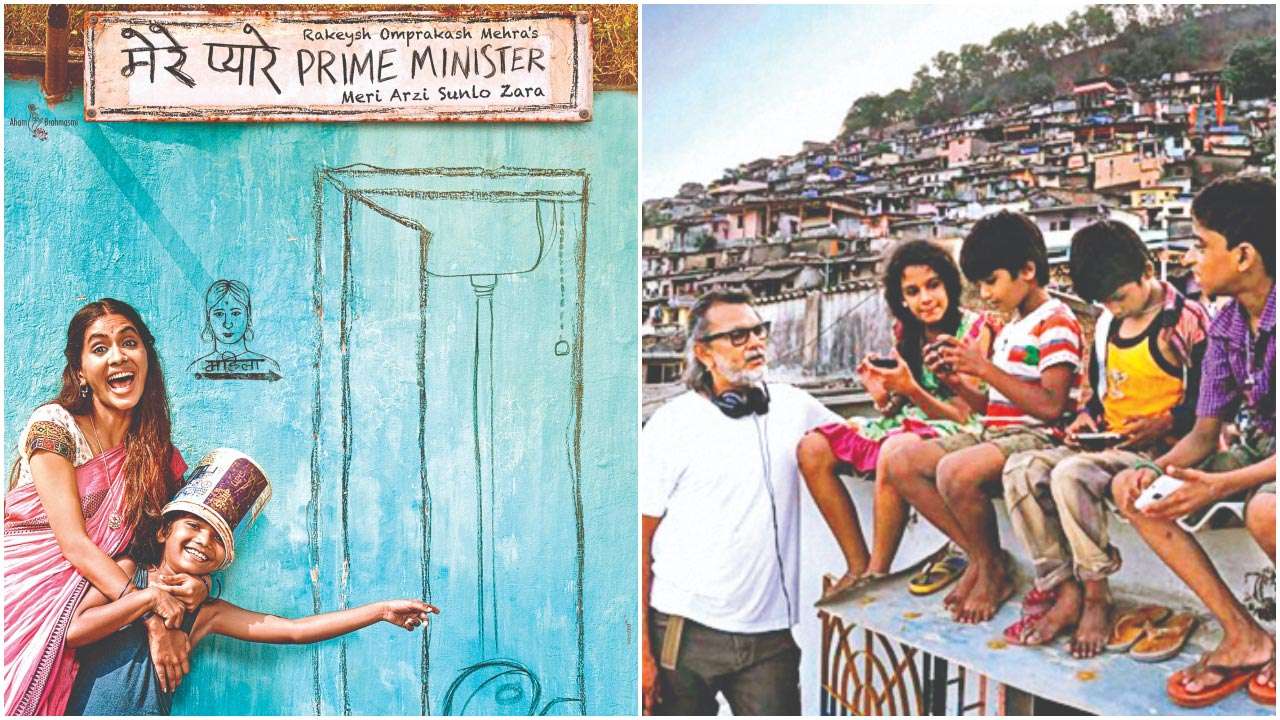
Hiren Kotwani (DNA; October 15, 2018)
Even as Bollywood gets increasingly corporatised, we continue to hear stories of someone being shortchanged. More often than not, it’s the writer. The latest, in this case, is Manoj Mairta, who says Rakeysh Omprakash Mehra is not giving him his rightful credit in the upcoming film, Mere Pyare Prime Minister. The writer also sent a legal notice to the filmmaker. He says that since he hasn’t received any response in the stipulated 15 days, he will pursue the matter in court.
Manoj tells us that he had registered the script in 2014 before he contacted Rakeysh. Eventually, they entered into an agreement in April 2015. It was only a while after Mirzya released in 2016, that he began working on Mere Pyaare Prime Minister. The movie revolves around an eight-year-old boy (played by Om Kanojiya) living in a Mumbai slum who wants to build a toilet for his mother (played by Anjali Patil).
However, after the film’s completion when its first look was unveiled in 2017, Manoj learnt that he was not getting the credit as promised. When his repeated requests failed to get an appropriate response, he approached the Screen Writers Association (SWA) in October 2017. When both, Manoj’s and Rakeysh’s scripts were evaluated, the Dispute Settlement Committee (DSC) observed that the latter’s was ‘merely a rewritten and polished’ version of the writer’s work.
After evaluating their scripts and agreement, the DSC noted that the writer should be given a solo credit for the story and first credit for the screenplay and dialogues, while the filmmaker should be given the second credit for the screenplay and dialogues and no credit for the story.
Manoj maintains that in the communication of the film, whether the first poster or the news of the movie being selected for the upcoming Rome International Film Festival, his name is being left out even as those of others working on the project are being mentioned.
When contacted, Mehra replied via a text message, “He (Manoj) has made a default representation at SWA. There is another writer in question, Hussain Dalal, whose rights we need to protect. So, the matter will come up for discussion and all will be resolved soon. If you look at our IMDB post, he (Manoj) is very much there as the writer.”
The 50s is the new 18 and this is the most exciting time of my life-Rakeysh Omprakash Mehra
8:34 AM

Filmmaker Rakeysh Omprakash Mehra, who turns 55 today, on birthdays, films and the future of Hindi cinema
Natasha Coutinho (MUMBAI MIRROR; July 7, 2018)
How will you be ringing in your birthday?
My daughter Bhairavi, who is studying in the US, is back home so we will all be going to our home in Pawna, along with the dogs. We will spend the day there before returning to the city on Sunday. I try to steal as much time away from Mumbai as I can. I love animals and nature and I like being in their midst.
Any reflections on the year?
It’s been exciting so far. For the last couple of years, I’ve been developing scripts and working towards what doors they will open for us. For the longest time, I was the only director in my production house. Now, we’ve grown into a boutique studio.
And how are the 50s treating you?
The 50s is the new 18 and this is the most exciting time of my life. In the ‘kal aaj aur kal’ I’m only concerned with the ‘aaj’.
Your musical drama, Fanney Khan, is up for release with co-producers Bhushan Kumar and Anil Kapoor...
Fanney Khan is a film we have been savouring for eight years. I was looking for the right director and found him in Atul Manjrekar who started his internship with us. I’m excited and how!
Whose idea was it to fly down international choreographer, Frank Gatson Jr, for a song featuring Aishwarya?
It was the brainchild of Bharathi, my creative producer. Since she was returning to the screen after a couple of years, we wanted the audience to see a new Aishwarya. We have world class choreographers in our country too whom I love but with Frank you get a different body language. It just worked out.
What’s the status of Mere Pyare Prime Minister?
It’s ready but will open on October 2 because it’s an ode to Mahatma Gandhi. We’ll bring in his 150th birth anniversary with the film.
What changes have you noted in cinema and the industry in general during your 17–year stint?
Change is always for the better and right now, I believe we are on the brink of an absolutely glorious time. I use the phrase ‘on the brink’ because I’m not euphoric. But this is an opportunity we need to grab with both hands and break out of our existing mindset. The more Indian we get, the more global we will become. It’s all about taking desi ideas and showcasing them to the world. When I look back, I feel blessed. My first film, Aks, was with my mentor Amitabh Bachchan. It also featured amazing talents like Manoj Bajpayee, Nandita Das and Raveena Tandon. Then came Rang De Basanti, a collaboration with Aamir Khan, AR Rahman and Waheeda Rahman. And the list continues.
Any plans of a Rang De Basanti sequel?
There have been so many films inspired by Rang De Basanti. But it is not a Superman or Batman film that can be spun into a franchise. Back then, it was just my own angst that manifested on the screen with this film.

Bollywood steps out of its comfort zone; shoots in Mumbai's most unconventional locations
8:08 AM

Sanyukta Iyer (MUMBAI MIRROR; December 14, 2017)
Fanne Khan – Bhandup
Aishwarya Rai Bachchan, Anil Kapoor and Rajkummar Rao recently wrapped up a 10-day schedule of Atul Manjrekar’s musical-comedy-drama, Fanne Khan, in the north-west suburb of Bhandup. “We started shooting just before the unprecedented showers hit Mumbai in December and despite the threat of cyclone Ockhi, the team braved the inclement weather to trudge to the off-beat location,” producer Prernaa Arora told Mirror. According to the makers, there are two big, well-lit studios in close proximity in the area that allowed the film’s lead trio to shoot individual scenes as well as the joint ones. “Also, it was great to see that none of them seemed to mind the commute,” Prernaa added.

Gold – Ghodbunder Road, Wadala cricket ground
Ashutosh Gowariker filmed his 2016 historical romance, Mohenjo Daro, at Thane’s Ghodbunder Road with Hrithik Roshan and Reema Kagti went back to the same location earlier this month with Akshay Kumar for her sports drama, Gold. On December 1, Akshay shot from 7:30 am to 5:30 pm with over 20 bouncers and a dozen security personnel deployed to monitor the crowds. After a three-day shoot there, the unit shifted to the Wadala cricket ground for a rain sequence for the film which is inspired by India’s first hockey gold in the 1948 London Olympics.

Kaala Karikaalan – Sion’s Pratiksha Nagar, Masjid Bunder, Grant Road
Rajinikanth’s upcoming Tamil-Hindi gangster flick got into action in May at Grant Road, before moving to Sion, Masjid, Marine Drive and Wadala over 40 days. The Thalaiva plays a man from Dharavi who becomes a notorious criminal, and a chawl at Sion’s Pratiksha Nagar served as his character’s house in the early days.

Munna Michael – Mulund, Vasai highway
Three massive sets were built in Mulund for Tiger Shroff and Nawazuddin Siddiqui to film dance sequences. The climax was shot on the Vasai highway which passed off as the Delhi-Agra Expressway. “When shooting on Mumbai streets, the crowds are unmanageable. Also, several permissions are needed. So, the freedom of shooting outside city limits is liberating,” producer Viki Rajani reasons.

Beyond The Clouds – Sewri
Iranian filmmaker Majidi Majidi kicked off his upcoming sibling drama, Beyond the Clouds, at Mukesh Mills in Colaba before moving to Versova where they filmed extensively. The team also spent a week at the Sewri creek capturing over 2000 flamingos at daybreak. “For one crucial action scene, Ishaan (Khatter) fought off two co-stars at Sewri jetty. He had to jump into the muck 64 times before Majidi was satisfied,” informs producer Shareen Mantri.

Noor – Reay Road
Sonakshi Sinha as Noor and Purab Kohli as Ayan filmed a romantic song sequence across the salt pans at BPT Colony, Wadala’s railway yard and the cement yard in Reay Road in January. Debutant director Sunhil Sippy admits that he has long been fascinated by the serenity of Eastern Mumbai and has been documenting the area from Reay Road to Wadala for five years through his photographs. “Here you see acres of industrial land, neglected and crumbling, with barely a person in sight most mornings. It has a strange, contemplative beauty and was the perfect setting for Noor to be reintroduced to a city she thought she knew so well,” says Sunhil.

Baadshaho – Dahisar, Mira Road
Milan Luthria canned a gritty torture and rescue sequence on a police station set in a Bhandup studio with Ajay Devgn for Baadshaho over two days in June, following up with a four-day shoot in Mira Road and Dahisar. The Bhandup studio made for an ideal dilapidated, down-market setting while Sansi village was created in Dahisar and Mira Road for the pre-climax sequences,” the film’s spokesperson informed, pointing out that the studio runs alongside a narrow path on Mira Road which worked perfectly to shoot a looting sequence.
Mere Pyare Prime Minister – Slums in Ghatkopar and Powai
Rakeysh Omprakash Mehra filmed his upcoming social, Mere Pyare Prime Minister, at a slum in Ghatkopar near Khandooba on May 3 before moving to another slum behind Powai Lake in mid-June. His film revolves around four slum kids, one of whom wants to build a toilet for his single mother and makes an appeal to the Prime Minister. Mehra chose these two slums because of the complete lack of sanitation facilities. “The slum-dwellers behind Powai lake get water for just 30-45 minutes in a day and have no toilets. During monsoon, they are forced to defecate on the railway tracks. I read a story in Mumbai Mirror about a woman who was run over by a train while defecating and wondered, ‘Is a toilet worth losing your life over?’” Mehra had pointed out.

Financially, Mirzya didn't just pinch me; it knocked me out-Rakeysh Omprakash Mehra
7:51 AM

Rachana Dubey (BOMBAY TIMES; November 10, 2017)
After the lavishly shot
Mirzya in 2016, Rakeysh Omprakash Mehra's next is a modestly-budgeted
film with an acknowledged actress (Anjali Patil) and some children whom
he personally selected from the slums where he was shooting. The
director-writer was shooting in the slums of Mumbai for a film that
highlights a son's love for his mother and his fight for her dignity. In
a candid chat with BT on the sets of
the movie, the filmmaker opened up on the failure of Mirzya, why most of
his films are set in North India and his commitment to the cause of
sanitation. Excerpts...
After a much-publicised project like Mirzya, your next is a smaller film titled Mere Pyare Prime Minister. Can we safely call this your attempt at reinvention?
Yes, I am trying to reinvent myself as a filmmaker. Of course, I have always avoided repeating myself and have attempted different genres and subjects, right from my first film, Aks. After that, Rang De Basanti was about being the change you want to see in others, while Delhi 6 addressed religious intolerance and Bhaag Milkha Bhaag was about a boy, who braved odds to break a world record. Mirzya was about women and their illogical behaviour when they're in love. We mounted the film well, but couldn't nail it. I am sure that with my second, third or fourth attempt at a musical, I will finally get the genre right. I am not letting it go till I crack it. Also, financially, Mirzya didn't just pinch me; it knocked me out. But like they say, you live and learn. So, I continue to tell stories.
You have shot Mere Pyare Prime Minister inside some remote pockets of Mumbai. Considering it's the first time you have set a film in such areas, how was the experience?
My films have been largely shot in North India because I am a Delhi boy. Though I migrated to this city about 30 years ago, most of my stories except Aks belong there. When I came to Mumbai, there was just one slum - Dharavi. Now, there are hundreds of such colonies. When you walk through them, you realise how big an issue sanitation is. There are very few public toilets, and women are the worst affected. While men can opt to defecate in the open, women have to find enclosures, or relieve themselves when hopefully, no one's watching. It's not only extremely unhygienic, but also raises a question on their safety.
Your team has built a toilet in one such area where you shot the film. Looks like you are strongly committed to the cause...
While I was researching on the issue, I got associated with an NGO. During one of our visits to Sabarmati, I found that even Mahatma Gandhi was associated with the cause of building toilets and improving sanitation in India. That's when we thought of supporting the cause till we die. In the next two years, we want to cover as many as 5,000 sites in India. We started with Gujarat, travelled to Rajasthan and then, Maharashtra and Telangana. It's a self-sufficient module that sustains itself.
Eventually, my team also came up with a story revolving around the acute shortage of toilets. We've have built toilets smartly. When we started building them in Gujarat, we realised that in a lot of remote pockets, girls would quit studies after puberty because the schools lacked sanitation. However, after building a few toilets, they started coming back, and that felt great. The situation is worse in cities like Mumbai where there are plenty of unauthorized colonies. The BMC cannot give them permission to construct toilets as these colonies are built on encroached land. Fortunately, the colony where we shot the film had a water connection, so we could build a loo for the residents.
Few filmmakers have shown Mumbai's slums in a positive manner. Was that ever a worry for you while writing the story?
The film doesn't look down upon slums. On the contrary, it celebrates the life that people lead here, despite all the odds faced by them. My film is about a boy's struggle for his mother - he wants to build a toilet for her. I've also realised that these slums have a concept of neighbourhood...khule ghar aur khuli Diwali hoti hai yahan. When I was shooting at this slum (in Ghatkopar), I filmed inside real homes and the people there fed me from their kitchens. I even stayed in these houses for six days to understand what it is like to wake up here in the mornings. I even used the toilets, which are used by them. Unless you understand a situation, you cannot project it correctly. Most of my stories are based on my experiences and so, this too, had to be experiential.
Moving on, for the last couple of years, you have been toying with the idea of a film centered around the education system and the school admission racket in Delhi. Since a few movies in recent times have already tackled the issue, do you still plan to make your film?
I am not just toying with the idea, I am working on the story. So much has changed over the last three years. Our education system needs to cater to students as individuals and not as a bunch; it's about learning, not competing. We have to abolish grades. Today's kids are smart, but they are under a lot of pressure - societal, peer and parental. As far as my children are concerned, I always tell them that grades are not important, learning and becoming a good citizen is.
Talking about learning, what did you finally learn while making a modest-sized film, in an environment you are not as familiar with?
It taught me a lot about my own craft. I experienced indie cinema first hand, and it was poignant and in-your-face. I feel, we've lost social and socio-political cinema to escapist films. We need the latter too, but I wish we could strike a balance.

Rajinikanth was told that I’d been waiting to meet him and he called to apologize-Anjali Patil
7:45 AM

Avinash Lohana (MUMBAI MIRROR; September 22, 2017)
After Rakeysh Omprakash Mehra’s 2016 fantasy romance Mirzya and his next, Mere Pyare Prime Minister, National Award winner Anjali Patil will be seen next in the Rajinikanth-starrer Kaala. She plays a Maharashtrian girl, Koel, living in the Dharavi slum.
“I’ve been shooting since the last four months and only returned from Chennai two days ago. We shot extensively for a month in Dharavi, then recreated it on a set in Chennai. The story revolves largely around those migrants from Tiruvannamalai. Rajini sir who plays Kaala lives in Dharavi,” informs the 29-year-old actress who is gung-ho about her action sequences in the Tamil film and that she got to dance with the superstar.
Anjali also recalls how her staff had wanted a keepsake picture with the Thalaiva but were disappointed when told that he had to leave early. “On the way he was told that I’d been waiting to meet him with my staff and he called to apologize. He’s so humble, I’ve learnt so much working with him,” she says, admitting Rajini will be mouthing a few lines in Marathi in the film.
Before Kaala, which has been produced by Dhanush, Anjali shot with the 34-year-old actor for Aanand L Rai’s Nimmo which is directed by his Raanjhanaa and Tanu Weds Manu assistant director Rahul Shanklya. “Nimmo is a love story of a little boy who falls in love with a 21-year-old girl who is about to get married. It is set in Jabalpur. While shooting for it, I told Dhanush who has a cameo in the film that I was meeting Kaala director, Pa Ranjith, and he asked me if I knew he was producing it. I laughed and admitted I did,” says Anjali who bonded with Huma Qureshi, who plays Rajini’s love interest.
Mere Pyare Prime Minister in which she plays the single mother of an eight-year-old boy who wants to build a toilet for her, is complete. Anjali describes Rakeysh as a “dream-come-true director for all actors” and says their friendship, which stated during Mirzya, has only strengthened during their second collaboration.
Who better than Aishwarya Rai Bachchan to play a star singer-Rakeysh Omprakash Mehra
8:02 AM

Rakeysh Omprakash Mehra on his next that kicked off on Sunday with the actress, Anil Kapoor, Rajkummar Rao and debutant Pihu Sand
Roshmila Bhattacharya (MUMBAI MIRROR; September 5, 2017)
 Six–seven years ago, Rakeysh Omprakash Mehra saw the Oscar-nominated
2000 Dutch film, Everybody’s Famous, and fell in love with its
storyline. It revolved around 17-year-old Marva Vereecken, who is a
regular at singing contests but never wins. Her desperate dad, Jean,
kidnaps Debbie, the country’s top singer, following which the sales of
her latest single escalates to the delight of her manager, Michael, who
brokers a secret deal with Jean. He will make Marva a star if Jean keeps
Debbie hidden. Mehra had no doubt that it could be adapted into a
beautiful Indian film and set out to buy the rights. “It was a long
process as the subject is close to producer– director Dominique
Deruddere’s heart. Eventually I convinced him and towards the end of
Bhaag Milkha Bhaag, we started developing it, while I was working on
Mirzya and Mere Pyare Prime Minister,” he informs.
The filmmaker admits that the thought of directing it flashed through his mind but he and his producer partner Rajiv Tandon wanted to work with new writers and directors who’d ring in a fresh perspective. Since they already had a story, the hunt for a debutant started, ending with Atul Manjrekar, Mehra’s assistant director from Rang De Basanti, who’d worked with him for 10 years on Aks and other projects, and was successfully running his own ad film company. “I threw the ball to Atul, who was hungry to step into the film arena and came up with a wonderful adaptation. His tone and style is amazing!” Mehra exults.
Fanney Khan went on the floors on Sunday, reuniting Anil Kapoor and Aishwarya Rai Bachchan. Mehra reveals that since it’s a father–daughter story at its core, Anil was the natural choice to play the father and the actor came on board instantly after Atul narrated the concept to him. They found his daughter in Pihu Sand after five–six months of auditions. “I won’t use the term ‘a star will be born’ but Pihu can sing a bit and has the acting chops,” Mehra smiles. Pihu is 18, the same age as Mehra’s daughter Bhairavi who’s studying liberal arts at Oberlin College in the US. “Since it is about the youth — how they see themselves and their aspirations — I bounced the script off her,” says the dad who proudly informs that at 15, Bhairavi had written a short avant garde film, The Girl Who Kicked the Ball, for him. A blend of computer generated animation and black-andwhite photographs it was a metaphorical portrayal of the polio virus as aliens and the human spirit that defeats it by creating the anti-virus in a “vaccine”, highlighting the power of immunisation. It featured 30 artistes from across the world. Does he see Bhairavi following in his footsteps? “I’ll leave the choice to her. Once she understands the art of writing, she could go into fiction or feature films, documentary or journalism,” he says.
Mehra hopes to wrap up Fanney Khan by October 20, with a five-day schedule in November, when choreographers from the West will fly in for the songs. He leaves it to his producer partners, Bhushan Kumar and Prernaa Arora, to figure the D-day but is targetting a summer 2018 release. The belle of this ball is Aishwarya. Mehra explains his reasons for casting the diva, “Since everybody wants to be famous, who better than Ash to play the star singer.”
There’s a controversy over the choice of actor to play Ash’s husband, with reports suggesting that Mehra wanted R Madhavan while she was set on Rajkummar Rao. He shares that his first choice was Raj but since the actor was busy with the shooting of Bose then, they took the idea to Madhavan who liked it but was also committed. “While he was struggling to work out his dates, the shoot got pushed to August and Raj’s dates opened up so we went back to our first choice,” he explains, saying Ash is too busy with prep for her performance-oriented role to get into a controversy.
He adds that music is an integral part of the story and since Anil is an aspiring singer who wants to fulfil his playback dreams through his daughter, we will hear him humming as Irshad Kamil’s lyrics have emerged from the script. Will we hear Aishwarya sing on screen too? “I’ll leave the decision to Atul and Amit (composer Amit Trivedi),” he says.
Meanwhile, Mehra has finished his own directorial Mere Pyare Prime Minister, and is editing it, hoping for a first quarter or summer release for this little big film too. Will Toilet - Ek Prem Katha, which was based on a similar theme, cut into its impact? “I haven’t seen Toilet but from what I have heard and seen in its trailer, they’re different films. Mine is a story of an eight-year-old boy who wants to build a toilet for his 25-year-old single mother in their slum but finds it difficult as these hutments are unauthorised and so takes the problem to the PM,” opines Mehra, who has been building toilets across Gujarat, Rajasthan and Maharashtra over the last four years and now has built some in the slums where he filmed.
What next? He doesn’t know but admits his ambitious film on Krishna, Raja and the Legend of the Flute, is going through a rewrite. “Over the last few years, with greater connectivity, storytelling has gone through a metamorphosis, hence the rewrite. Every film has its own destiny. Some get made in six months, some take a lifetime,” he smiles.
My toilet film different than Akshay Kumar's-Rakeysh Omprakash Mehra
3:43 PM

Mohar Basu (MID-DAY; June 27, 2017)
 That helming a Bollywood project on the subject of toilets could be a profitable venture was discussed when Akshay Kumar announced his forthcoming film, 'Toilet - Ek Prem Katha', alongside Bhumi Pednekar. Now, Rakeysh Omprakash Mehra is also set to explore the topic with his next, 'Mere Pyare Prime Minister'.
Mehra is quick to clear the air when we raise the question of how his film will differ from Akki's film. "My film is set in a slum, where the issue is more acute. Besides being a hygiene issue, living in those conditions is unsafe. It is a mother-son story which kicks off with a young boy's letter to the PM requesting that a toilet be made for his mother," he tells mid-day, adding that Anjali Patil is set to play mother to a "spunky young boy" named Om. "This is nothing like Akshay's film, which is a love story at heart. And even if it is, there is never enough said about subjects like this."
That the subject affects him greatly is evident when Mehra points to the plight of women in the country. "Women's safety is a prime concern. Rapes are a given when women go out to defecate, as per UNICEF figures. The problem of sanitation in urban areas is bigger than it is in rural areas. Rural India has culturally adapted to defecation outside. In the khet, recycling is easier."
Mehra, who has taken on the responsibility of a social entrepreneur, along with NGO Yuva Foundation says, "We realised that girls stop coming to school after puberty. Along with Yuva, we decided a change is needed. When we revamped the first municipal school, it took us Rs 5 lakh. The girls started coming back. We got donation for 20 more schools. Now, we have 1,20,00 volunteers. By 2020, we plan to install 5000 toilets. Ian Botham has come on board as a patron and helped us build toilets in Worli Village. All my movies have been an extension of a piece of my mind, and this one is the same."
Rakeysh Omprakash Mehra builds toilets in slums where he shoots Mere Pyare Prime Minister
7:42 AM

Sanyukta Iyer (MUMBAI MIRROR; June 13, 2017)
 Rakeysh Omprakash Mehra who began filming
his next film, Mere Pyare Prime Minister, in a slum in Ghatkopar on May
3, has now got a NOC from the city civic body, the Brihanmumbai
Municipal Corporation (BMC), to build 20 toilets there, including five
separate toilets for men and women, as also teachers in two municipal
schools in the Khandooba area. He’s also re-building a community toilet
in the slum where he was filming till recently, which is expected to
benefit over 1000 families.
The filmmaker, whose repertoire includes acclaimed films Rang De Basanti and Bhaag Milkha Bhaag, has been collaborating with the NGO, Yuva Unstoppable, for the last four years to transform slums by building toilets. When questioned on the subject, he insists that his contribution is “not even a drop in the ocean”. “We don’t just build toilets and walk away but we also make sure the locals maintain them. We’ve been having meetings with slum-dwellers and corporators of the area, urging them to put one rupee in the donation box so that the community workers can be given their dues. The new toilets are as good as the ones in private buildings, with proper pipelines and extensions with taps where they can get clean, drinking water,” informs Mehra who after seeing the Gandhi’s model toilets at the Sabarmati Ashram was motivated to pick up this cause and has so far built over 800 toilets. “The slum dwellers have TV sets and mobile phones but no toilets and during the monsoons are forced to defecate on the railway tracks. I remember reading a Mirror story about a woman who got run over while defecating on the tracks and wondered, ‘Is a toilet worth losing your life over?’”
Mehra has now moved shooting to a slum settlement behind the Powai Lake, where the men have been going near secluded pipelines to defecate. “The area gets water for just 30-45 minutes a day. We are panning to build adequate toilets in this area too,” he says, admitting that while the Maximum City has been absorbing immigrants like a sponge, its infrastructure hasn’t grown at the same pace.
His film revolves around four kids living in a Mumbai slum. One of them wants to build a toilet for his single mother and makes an appeal to the Prime Minister. The biggest hurdle Mehra faces is that the city’s slums are built on unauthorised land owned by the BMC so he cannot legally build a toilet as there are no pipelines or water connections available. “But I am working around it at the community level,” assures the director who plans to introduce a social card next, whereby anyone, in particular housewives, can give two hours of social work a day to the community. These hours will add up to an accomplishment.
After Chakravyuh, I was offered similar roles - a naxal, a maid, a village girl-Anjali Patil
8:04 AM

The National Award winner on sharing the screen with Rajnikanth, battling stereotypes and travelling between films
Kunal Guha (MUMBAI MIRROR; June 11, 2017)
A lead in a Rakeysh
Omprakash Mehra film, a dark comedy opposite Rajkummar Rao which won at
the Berlinale this year, a festival favourite opposite Nagraj Manjule
and a part in a Thalaivaa film that she's presently shooting for - 2017
is a busy one for Anjali Patil. But when we meet the 29-year-old at an
Andheri café, she tells us it wasn't so a few years ago. The actor, who
made her debut in Delhi in a Day, post graduating from the National
School of Drama, had been out of work for a couple of years. “After
Chakravyuh (2012), which was my first big banner film opposite Arjun
(Rampal) and Abhay (Deol), I was only offered similar roles - a naxal, a
maid, a village girl. I didn't want to do parts which were offered to me
because I look a certain way,“ says the actor who didn't want her skin
tone to limit her aspirations. “Our obsession with light skin has to do
with colonization and also says that our society hasn't evolved. We are
OK with fair girls who can't act as lead but not the other way around.“
But Patil seems to have navigated the prejudices of the film industry.
In fact, she won a National Award and the Nandi Award for her
performance in the Telugu film Naa Bangaaru Talli and a Silver Peacock
at IFFI for her Sri Lankan film With You, Without
You. “I can play five maids but all will be distinctly different from
the other. But that doesn't mean I am slotted into a box and restricted
to certain characters,“ says Patil.
Owing to lack of relevant offers coming her way, Patil decided to break away from the city in 2015 to invest in some soul searching. She also “renounced“ all her belongings, barring four pairs of clothes, and embarked on a road trip from Rishikesh to Ladakh - a trip that lasted for a year-and-a-half, during which, she lived in ashrams and monasteries and even learnt Buddhist philosophy. “Travel helped me connect with myself. Everything you do, you learn something about yourself,“ says Patil, who discovered that she was “intuitive“ and “not receptive to being told what to do“.
It was during this trip that she was offered Rahul Shanklya's Nimmo. “I agreed to do it because they were shooting in Jabalpur and I didn't need to move back to Mumbai,“ says Patil. She completed the shoot and disappeared to Nepal to live in a monastery again. “Every film is like a love affair and once it's over, you need to forget it and begin on a clean slate.“
During this quest, the actor rejected projects because they “required a year's commitment“ and that didn't agree with her “bohemian nomad self“. “The day I switched on my phone in Nepal, I got a call from Amit (Masurkar). I read the brilliant script of Newton and just had to do it,“ she says of the film which won the CICAE Art Cinema Award at Berlinale this year.
But it is only when she bagged the lead in Mehra's Mere Pyare Prime Minister, which narrates the story of a slum kid who strives to build a toilet for her mother, that she moved back to Mumbai. Accepting to play a character who hails from humble surroundings - basically a part that restricts her to the same stereotype she has been striving to break - Patil took it up because she wanted to “experience the process“ of working with Mehra.
But it was working with Rajinikanth in Kaala (presently under production) that altered her perception of the craft. “He is every bit of enigma. There's celebration in the air when he's around and I wouldn't have believed it if I hadn't met him,“ she says. Patil recalls shooting with the South superstar in Grant Road recently. “Since it was time for iftaar, it was crowded. But he got off his car and requested the crowd to cooperate and everyone obliged.“ This is when Patil learnt about “the influence that comes with stardom“ and that it can be used for larger good.
Growing up in Nashik before she moved to Pune to pursue her graduation in performing arts, Patil's earliest association with the craft was her ability to come up with elaborate lies. “If I skipped tuitions, I'd tell my mother that I was on my way to classes but a huge cow blocked my path and I couldn't get past it despite my best efforts,“ she laughs. While her exposure to films was limited during childhood, she credits her father for introducing her to the works of K L Saigal and films such as Do Bigha Zameen, which most of her peers were unaware of. “Hemant Kumar and Manna Dey's songs would be lullabies and my father had a collection of his favourites, which became mine too.“ Following her graduation, when she applied to the National School of Drama, she took up the direction course as she was “unhappy about how directors treated actors“. “I had long hair so I'd play Stella in Street Car Named Desire and similar parts. I felt being just an actor was limiting at the time.“
Patil also has two Marathi releases this year - Silence with Manjule and Bardo with Makarand Deshpande. Yet, she feels she has barely managed to make the most of the renaissance in Marathi cinema. “No one reached out to me. Sometimes, when you're perceived as an intense actor and you win a National Award, people feel you're a certain kind of actor and slot you,“ she says.
Rakeysh Omprakash Mehra spins slumdog story around a toilet
9:06 AM

The RDB filmmaker has been quietly shooting his buddy film with four kids
Roshmila Bhattacharya (MUMBAI MIRROR; May 18, 2017)
Since May 3, Rakeysh Omprakash Mehra has been quietly shooting his next directorial, Mere Pyare Prime Minister, in a Ghatkopar slum. The film revolves around four kids—Kanhaiya (played by Om), Nirala (Prasad), Ringtone (Adarsh) and Mangala (Saina) who is the leader of the group—who live in a Mumbai slum.
“The subject has been simmering on a slow fire for three years. I’m a Delhi boy and all my films—Rang De Basanti, Delhi 6, Bhaag Milkha Bhaag and Mirzya—were all set in the North. But I’ve been living in Mumbai since 1988 and seen it transform into a world city. The buildings are taller now but there are still slums around them that have always intrigued me and made me follow the path of Salaam Bombay, Slumdog Millionaire and other stories which have grown out of them,” says the filmmaker.
Wondering about these slums, he ventured into them during a month-long reccee and while hanging out with kids was amazed at how vibrant their life was despite all the challenges. “Your mindset is shaped by your perceptions. Someone living in a taller building would look down on the slums and their inmates without realising that someone living in a high-rise would also be looking down at them. Ditto developing countries viz-a-viz richer nations. My film is not so much about comparisons as it is a story of people and relationships, survival and not giving up, the endeavour to lead a better life. There is no attempt to overplay or undermine, it’s about seeing this world through different eyes and finding beauty and inspiration in it,” he asserts, pointing out that they started out shooting a Holi song with 200 people and by the time it was over there were 1,000 people around and everyone was drenched in colour.
Like his 2006 cult film, Rang De Basanti, Mere Pyare Prime Minister, which makes an appeal to the PM is also a buddy film exploring the theme of friendship through these four kids. It’s evident that he’s having the time of his life as he hangs out with these super smart kids who sit on pipelines with their smart phones, using the free wifi from a nearby luxury resort to learn about WWE, Real Madrid and stay connected with the world.
Three years ago, Mehra, with an NGO from Ahmedabad, which was inspired by Rang De Basanti wanted to bring about change, visited the Gandhi Ashram and after seeing the Mahatma’s model toilets started an initiative to build toilets in municipal schools. “In the first year we built 20, then, over the next two years, we’ve built 800,” says the filmmaker whose eight-year-old protagonist, Kanhaiya aka Kanu wants to build a toilet for his young, single mother Sargam played by National Award winner Anjali Patil.
He goes on to recall that one day when he was looking up at the city’s skyline from the slum and chatting with the kids, they zeroed in on one high-rise and figured that going by the number of floors, the flats on each floor and the toilets attached to each flat, one building would have at least 1,000 toilets while the 5000 shanties around it didn’t have even one. “These 10x10-feet shanties are spotlessly clean with a one-in-all living room, kitchen and bedroom, only no bathroom,” Rakeysh points out.
Was the film inspired by our Prime Minister Narendra Modi’s Swachh Bharat campaign? “The idea was with me before the present government came to power and raised awareness about cleanliness. I was just not in a hurry to make it till I hit on the right story,” he says.
Akshay Kumar’s upcoming film, Toilet - Ek Prem Katha, also deals with the same subject. Will that cut into his audience? “Five Bhagat Singh films had been made before but I still made Rang De Basanti. I’m happy another film is being made on this topical subject. It’s a story that needs to be told to a larger audience across the country and the world and the more the merrier,” the filmmaker signs off with a smile.

Subscribe to:
Posts (Atom)