Showing posts with label Mera Naam Joker. Show all posts
Showing posts with label Mera Naam Joker. Show all posts
Raj Kapoor himself knew I wouldn’t do Satyam Shivam Sundaram-Hema Malini
3:38 PM

Vinay MR Mishra (BOMBAY TIMES; August 21, 2026)
Hema Malini has spent nearly six decades in the spotlight, but she says her journey was never driven by the pursuit of stardom. From films and classical dance to family and politics, the veteran actress has built a life guided by passion. Looking back at her career, she says, “I never expected to become a star. My only aim was to prove that I am good, so I worked hard. At that point, there was no time to think much, I simply started enjoying what I was doing.”
‘Returning to acting isn’t something I think about anymore’
Ask if she would like to return to acting and Hema replies, “It’s difficult to answer that because I don’t think about it anymore. I’m happy with whatever I’m doing. I spend time in my constituency, working for people, and then I’m at home with my children and grandchildren. They need me. I am also living with memories of Dharam ji. That itself fills my life.”
‘Dharam ji’s void can never be filled’
Talking about Dharmendra, she says, “I got such a wonderful soulmate. I have memories of him that I will cherish till the end of my life. He supported me in everything I did. He would say, ‘Go ahead. Don’t stop. Continue with your dance.’ He believed dance was spiritual, and that it brought me happiness and kept me healthy. If I am doing anything today, it is because of his support and strength. Now I miss that. He is not there and this void can never be filled. I think of him every minute. People ask whether I have processed the loss, but I don’t think grief ever goes away. I miss him so much.”
‘We were meant for each other’
Over the decades, Hema and Dharmendra’s relationship remained under public scrutiny, but she says they never allowed outside opinions to dictate how they lived. “We never bothered about any of that. We lived our lives according to us, not for people who wanted to criticize or judge us. We lived with true love. Right from the beginning, we knew we were meant for each other. Nobody could change that,” she shares.
Responding to rumours of differences within the Deol family, Hema says much of what circulates online today is fabricated. “Ours is a very united family. That’s all I can say. We are all happy with each other. Please don’t believe everything that is created through AI,” she says.
‘I have never performed film songs on stage’
Hema’s love for creativity has remained constant throughout her life, finding expression not just in films but also in direction, television and classical dance.
“When I decided to get married and have children, films naturally became fewer. But I never stopped working. I turned to direction, making the television serial Noopur, which became popular, followed by the film Dil Aashna Hai and other television projects, including Women of India. I also immersed myself in dance, creating ballets such as Durga, Mahalakshmi, Radha Krishna and Draupadi. They were all based on mythology and classical dance. I have never performed film songs on stage. If I had, I would have earned much more, because classical dance doesn’t bring that kind of money. But I had decided that I would perform only classical dance on stage, and I stood by that decision.”
‘Raj Kapoor himself knew I wouldn’t do Satyam Shivam Sundaram’
Over the years, Hema has turned down several films. Among them was Satyam Shivam Sundaram, for which Raj Kapoor had approached her. “After Sapno Ka Saudagar, I always wanted to work with Raj Kapoor saab again. After some years, he wanted me to do Satyam Shivam Sundaram. But he himself told me, ‘I know you won’t do it.’ I told him that I would love to work under his direction, but I wouldn’t be able to do this film.”
She also reveals that Raj Kapoor had once envisioned another collaboration. “There were discussions about another part after Mera Naam Joker, but since the film didn’t do well, that never happened.”
From Ranbir Kapoor’s screen-worn jacket to Mogambo’s uniform, the afterlife of Bollywood’s material history
10:37 AM

In the absence of a formal museum, iconic artifacts — from Ranbir Kapoor’s screen-worn jacket to Mogambo’s uniform — are recirculated and stored across an unofficial ecosystem of godowns, trunks, and prop houses
Nisrin Saria (MUMBAI MIRROR; July 12, 2026)
A yellow Ambassador glides onto the red carpet. Flashbulbs erupt as Shanti Priya (Deepika Padukone) steps out in blush pink silk, her wave choreographed for stardom. Moments later, the fabric catches Om’s sleeve, setting in motion one of Hindi cinema’s most cherished meet-cutes. Years earlier, audiences had travelled to an altogether different world, where Helen danced to Mehbooba Mehbooba inside a cave lit by flickering torches. One film recreated the glamour of 1970s Bombay. The other conjured a ravine that never existed. Both persuaded millions that these worlds were real.
If you’ve ever visited the Harry Potter studio outside London, wandered through Warner Bros’ archives in Hollywood or admired K-pop exhibitions in Seoul, you know some entertainment industries preserve their history behind glass. Bollywood, for some reason, has never done so. Here, the cave comes apart plank by plank, the palace becomes plywood again, costumes disappear into garment bags and props are counted, labelled and packed into trucks. Still almost nothing is truly discarded.
“Most costumes and many props are hired,” says veteran filmmaker Prahlad Kakkar. “You use them for the shoot, return them afterwards and pay the rental.” Furniture, crockery, chandeliers, doors, windows and architectural fragments all begin another journey once the cameras stop rolling. Every item is checked against an inventory, packed away and stored until another script calls it back into service.
Ad filmmaker and photographer Sunhil Sippy says production designers often become collectors by default. “Many own prop houses themselves, or they’ve spent years building collections from Chor Bazaar and antique markets.” It’s not unusual for things from their own homes and studios to even find a way into frames. “For close-ups, I’d often bring something from my own house, an object I lived with every day because I knew I wouldn’t find it in a rental house. The right object gives a frame its truth.”
Cement brains and books
Not every prop returns to a rental house. Some end up at Many Many Things, a Versova prop studio run by production designers Shaira Kapoor and Dhara Jain, whose work covers Gully Boy, Bombay Velvet and The Archies. Over the years, productions have left behind what many would see as a museum-worthy collection of collectibles: a miniature red vintage car sourced for a Lays commercial featuring Ranbir Kapoor, gold bricks made for a smuggling sequence in Bombay Velvet, even two cement brains created as paperweights for a radio station set in Tumhari Sulu.
“We never planned to start a prop house,” says Kapoor. “Some pieces stayed back after productions, others came from family, and many were simply too special to let go.” Every object is catalogued, barcoded and tracked before heading out to its next assignment.
That, they insist, is how Bollywood has always worked. Doors, windows, plywood, lights, furniture and fabrics are dismantled, stored and reinvented. “We pride ourselves on making the same object look completely different,” Kapoor says.
“A new lampshade, fresh upholstery or different artwork can transform it.” Nothing illustrates that better than Zoya Akhtar’s The Archies. The pair sourced nearly 10,000 vintage books, along with vintage cookware and utensils, for Betty’s (Khushi Kapoor) home from Mumbai, Bengaluru, Ooty, Bangkok, and international Etsy sellers. Once filming ended, most were sold on. “We don’t know exactly where they went,” Jain says. “But they’re still in the ecosystem. They’ve simply moved to another shelf.”
History in mulmul
While a handful of props are preserved, Kakkar says that remains the exception. “Commercials work on rentals. Keeping elaborate sets after a shoot isn’t practical. The economics just don’t support preserving every unique creation.”
Costumes have had an even more uncertain fate. Academy Award-winning costume designer Bhanu Athaiya treated preservation as second nature, says her daughter, Radhika Gupta. “She never folded old saris or fabrics. She rolled them, wrapped them in mulmul cloth and stored them in steel trunks.”
Even that could not protect them from the weather and termites that infested them. Athaiya began designing in 1953, long before climate-controlled storage. Studio lights generated intense heat, makeup stained fabrics and colours faded under harsh lamps. “The costumes didn’t survive very well,” Gupta says, “More importantly, they belonged to the production houses, not to her.”
Until the 1970s, few studios archived costumes. Raj Kapoor was among the exceptions, though many garments, including costumes from Mera Naam Joker, were later lost in the RK Studios fire. Gupta still remembers actors arriving at their home to try on costumes as tailors and embroiderers worked around them. “My mother was a director’s designer,” she says. Directors described the character and mood of a scene, and Athaiya translated them into attire, even using colours in the black-and-white era to create tonal contrasts on screen.
Not quite Narnia
Looking back, Gupta believes preserving costumes is about far more than saving clothes. “As Indians, we don’t really have a strong culture of preservation,” she says. “We tend to discard things and take them for granted.” Conservation, she adds, requires time, expertise and sustained funding.
Some of Athaiya’s surviving work has reached the public through the People of Mumbai exhibition at CSMVS, where costumes, sketches and archival material traced both her career and the city’s cinematic journey. “Bhanu Athaiya became a natural choice because her journey from the Sir JJ School of Art to costume design reflects that evolution,” says the exhibition’s architect, Nandini Somaya.
Displaying the collection required a careful process. Costumes were protected under acrylic sheets, while larger garments—including the landmark sari worn in Gandhi—were mounted on custom plastic supports and enclosed in protective cases to prevent stress on the fragile fabric. But such examples remain rare.
Madhav Agasti, who tailored costumes for more than 350 films, including Mr India and Andaz Apna Apna, says costumes usually remained with producers once filming ended. Mogambo’s military-inspired uniform, he believes, is still with Boney Kapoor. Lead costumes are never really reused, Kakkar explains. Designed for one actor and one character, they often end up with producers, collectors or members of the crew. Sometimes they become personal keepsakes. Shivam Hingorani, an assistant director on Yeh Jawaani Hai Deewani, still treasures the brown AllSaints jacket worn by Ranbir Kapoor. “The moment I saw it, I knew I wanted it.” And once production wrapped up director Ayan Mukerji handed it to him.
And, thus, Bollywood’s best stories survive in fragments: a sari wrapped in mulmul, a villain’s uniform in a producer’s cupboard, or a prop on someone’s shelf. They may never draw museum crowds, but for the person who recognizes one from the screen, those ordinary objects still possess the power to collapse time, carrying them back to the moment the story first came alive.
It’s no longer possible to make films like Gangs Of Wasseypur fearlessly today-Anurag Kashyap
2:24 PM

Yemen S (BOMBAY TIMES; February 6, 2026)
Filmmaker and actor Anurag Kashyap says his biggest fear today is not being able to make the kind of cinema he truly believes in. Speaking at the 17th Bengaluru International Film Festival (BIFFES) 2026 during the Fearless Filmmaking session on Saturday, Anurag said films such as Gangs Of Wasseypur and Mukkabaaz would not be made in the current climate.
“Gangs Of Wasseypur or Mukkabaaz would not have been made today because of the themes I chose to tell those stories with. And even if they were released, they would be heavily censored,” he said.
Anurag also noted that several honest filmmakers are attempting to find ways around censorship. “India is still better, and that gives me hope. If filmmakers can make cinema in Russia and China, we can too,” he said in conversation with critic and writer Baradwaj Rangan. “Movies that spark important conversations will be made in India at some point. We just need to wait,” he said.
‘The OTT format has destroyed the way cinema is experienced’
Cinema, Anurag said, has always been meant for the big screen. However, with the rise of OTT platforms and the convenience they offer, audiences are increasingly consuming films on smaller devices. “When I made Nishaanchi, I envisioned it entirely for the big screen. But times have changed. People now watch films at their convenience. The format has destroyed the way cinema is experienced,” he said.
Emphasizing the importance of the theatrical experience, he added, “The joy of cinema is watching it on a big screen. You can’t watch Mera Naam Joker or Sholay on a phone. These films are made for the theatre, and it’s a disgrace if they’re watched otherwise.”
‘Reaction to Toxic trailer was blown out of proportion due to social media’s controlled narrative’
Responding to the backlash around the trailer of the upcoming Kannada film Toxic, Kashyap said he enjoyed it and felt the reaction on social media was exaggerated.
“When a woman is in control of her sexuality and enjoys it on screen, it becomes a problem. But when male actors do the same, no one says anything,” he said, adding, “Social media controls the narrative, and this was blown out of proportion.”
Manoj Kumar and his wife's hospitality reflected their roots and show business of that time-Bhawana Somaaya
3:15 PM

Renowned film journalist and author Bhawana Somaaya bids farewell to the actor and filmmaker, whose love for movies and the country brought forth a new cinematic language
Bhawana Somaaya (MID-DAY; April 5, 2025)
It was a sunny afternoon, sometime in the 1980s, when I was visiting Manoj Kumar for an interview at his Juhu residence. The filmmaker and actor was narrating stories related to his movies, when it suddenly started raining. Kumar got up to shut the windows and said, “Aise mausam mein pakode khaane ko jee karta hai”.
A while later, the house-help entered with a tray of fragrant tea and hot pakodas. Kumar smiled and said, “My wife always knows what I’m thinking”. The attendant skilfully served us tea and snacks, and added, “Bhabhi ji ne kaha hai ke pakode ghar par bane hai, zaroor khaiyega”. It was the sweetest line any homemaker had addressed to a guest, and I was touched. Their hospitality reflected their roots and show business of that time.
Kumar loved cinema, was passionate about homoeopathy and was an engaging speaker, which explains why journalists frequently sought him. He had a traumatic childhood and the wounds reflected in his characters. During the 1947 riots, he saw his baby brother collapse in his mother’s arms on a hospital bed when the hospital staff deserted all the patients and ran away. Kumar was only 10 years old and unable to help his mother!
His family migrated from Pakistan to Delhi, India, and for a long time lived in the refugee camp. Kumar was always interested in movies, and rushed to the cinema halls whenever he had a few coins in his pocket. His friends encouraged him to travel to Bombay and try his luck in movies, so he strolled inside a suburban studio seeking work. Initially, he did odd jobs like moving camera trolleys, and sometimes sweeping the set floor, till one day, he was asked to stand in for a missing actor. That’s when the cameraman declared that the 20-year-old had something in him!
Kumar’s debut film Fashion [1957] led to eight more movies, but none of them succeeded till Hariyali Aur Rasta [1962] launched him as a star. The magic truly started with Woh Kaun Thi? [1964], followed by two more murder mysteries Gumnaam [1965] and Anita [1966].
Playing a patriot in Shaheed [1965] impacted him deeply. It is said that our then Prime Minister, Lal Bahadur Shastri, invited him to Delhi and asked him to make a film promoting the slogan, Jai Jawan Jai Kisaan. “Do it fast before the climate changes,” Shastri ji is supposed to have told him. Kumar had never written or directed a film earlier. He didn’t wish to work in isolation, and came up with a unique plan of writing the script. He booked himself on a Rajdhani train to Delhi and finished writing the film’s first half from Bombay to Delhi. The second half, he completed from Delhi to Bombay.
Upkar [1967] won two National Awards, but the person for whom Kumar made the film was no more. Shastri ji died on January 11, 1966, in Tashkent. The film was a turning point in his career, and made him a multi-hyphenate as he wrote, directed and acted in all his films—Purab Aur Paschim [1970], Shor [1972], Roti Kapda Aur Makaan [1974], and more.
His acting assignments continued simultaneously, and he was overjoyed when Raj Kapoor cast him in Mera Naam Joker [1970]. When the film bombed, a heartbroken Kumar watched it again and again to understand what went wrong. When he arrived at the answer, he phoned Kapoor to share that had he switched the second and the third story, the audience may have been more receptive. Kapoor agreed, but by then it was too late.
In 1980, he fulfilled his dream of working with his idol Dilip Kumar in Kranti. The film was a grosser, but by the end of the decade, he was losing interest in movies. A personal tragedy where his father died under unusual circumstances put him in depression. Slowly, he stopped meeting people. The only one he stayed connected to was his heartbeat, Sai Baba. Wherever he went, he carried a picture of the deity with him.
Rest in peace, Pandit ji [as his friends called him], and walk into the clouds with your deity.
Raj Kapoor believed that his films should definitely carry a social message-Rahul Rawail
8:00 AM

Avijit Ghosh (THE TIMES OF INDIA; December 18, 2021)
Film director Rahul Rawail (‘Betaab’, ‘Arjun’) worked as an assistant to Raj Kapoor in ‘Mera Naam Joker’ and ‘Bobby’. In a conversation with Avijit Ghosh, Rawail talks about his book, ‘Raj Kapoor: The Master At Work’, which offers a first-hand view of the art and craft of the filmmaker who regaled millions in India and the world with his conscientious social dramas and passionate romances. Edited excerpts:
What was unique about Raj Kapoor the director?
The way he organised everything, the way he paid attention to all the departments. He was like a music director conducting a symphony.
Can you give an example?
The circus scene in Mera Naam Joker. He was working with a unit of 300 people, 5,000 junior artistes, 100 Russian circus artistes. Indian circus artistes. Animal trainers. And there was this one man controlling everything like clockwork, like he knew everything that he was doing.
What were the key features in his work? His driving force?
His attention to detail. And also his thinking about the film all the time. That process never ended. The driving force was to deliver the best possible film that he could. That’s what he aimed for and wanted to achieve.
You write about the party scene in Bobby.
Normally in a party scene, you have people who are supposed to be drinking alcohol. You mixed Thums Up with water to make it look like whiskey. To the viewer, it was normal; to the unit it was inexpensive. In Bobby, he wanted champagne to be served for the scene. So we mixed Limca with soda. He said: “This is a billionaire’s party. It has to be real champagne.” I said that would be very expensive. He said: “I don’t care. The look of the man drinking champagne would be different from the look he would have when drinking Limca with soda.”
Raj Kapoor not only made great films, he also built a great banner, set up a studio.
It was just the passion with which he made films. It was all a master plan in his mind which he executed piece by piece.
Along with B R Chopra, Raj Kapoor was a rare filmmaker of his generation who started out in the 1950s but he was still in his creative prime when he passed away in 1988.
He believed that his films should definitely carry a social message. He did what he believed in. That’s why the films worked and in a big way. His last film, Ram Teri Ganga Maili, was the biggest hit R K Films ever had. Starting from Aag in 1948, we can see flashes of a genius. The progression was huge. Technology was changing but he didn’t pay much attention to it. He said: “What I say is from my heart. That doesn’t change. There may be a different way to shoot it. But I shoot a film, the way I see it.” He never went for any kind of gimmickry.
As a filmmaker, what are the key lessons you learnt from him?
Pay attention to your film, think about it all the time. Don’t let your mind waver from the film. Do what your heart says. Almost 95%, it will be the right thing. Maybe 5% it will not. But it doesn’t matter. And if it doesn’t work, don’t give up hope.
Not many know that Raj Kapoor was also a foodie and every meal at RK studio was an elaborate spread. Can you talk about it?
He was a complete foodie. His life revolved around films and food. He used to drive from Chembur to the town, then an hour’s drive, to take the Deccan Queen to Pune for the food it served. I think even when he was eating, his mind was working on the film. Suddenly, he would say, I am thinking about this and let us do it like this in the shooting tomorrow. I think those were just tools which he used for his mind to be working.
There was also a democratic aspect to the way food was served during shootings or editing.
Absolutely. We were all given the same food to eat. There was never any differentiation. We would have chicken, fish, mutton, prawns or crabs. It was a huge spread. The food was laid on one table together. Everybody had to come there to eat. During a film’s final editing, he would first sit and work out the menu. Somebody would say, the dal is very good, or the chicken there is very good. He would say write it down. Then 2-3 cars would go in various directions to pick up the food. That’s the way he worked. Somewhere that not only made him happy but also made people working for him happy.
50 years of Mera Naam Joker: How Manoj Kumar halted students' protests happening on the sets at Ooty station
8:08 AM

Roshmila Bhatthacharya (MUMBAI MIRROR; December 19, 2020)
Raj Kapoor had booked the Udagamandalam railway station in Ooty, part of the Nilgiri Mountain Railway, a World Heritage Site, for his four-hour cult classic Mera Naam Joker. They were shooting the scene where the schoolboys chug back to their boarding school after a vacation. Sixteen-year-old Raju, the chubby class clown, played by Rishi Kapoor, is waiting to receive his favourite teacher, Mary (Simi Garewal), with a bouquet of flowers, and admits it’s been lonely without her.
To the filmmaker’s dismay, the station was crowded with agitating students who, while admitting that they personally liked Hindi movies, were part of the Tamil Nadu Students’ Anti-Hindi Imposition Agitation Council. The Council was demanding the scrapping of the three-language formula and an end to teaching Hindi in the state. It also wanted to abolish the use of Hindi commands in the National Cadet Corps (NCC) and have Hindi films and songs banned, along with the closure of the Dakshina Bharat Hindi Prachar Sabha (Institution for Propagation of Hindi in South India).
In the face of the protests, shooting was cancelled for the day and Raj Kapoor returned to the hotel, with his co-actor Manoj Kumar. The latter was entrusted with the responsibility of speaking to the students and their leaders the next morning, to persuade them to let work continue smoothly. Mr Bharat was quick to point out that he had crossed over from Lahore in the wake of the Partition and learned Hindi here. “I would have joined your protests if you had wanted Tamil as the national language, but you are campaigning for English over Hindi, and so I cannot respect you,” Manoj saab thundered. Raj saab broke into appreciative applause and told the protestors that he was ready to return home but that didn’t stop him from agreeing with Manoj saab. “But by then the students were so shamefaced, they promised to let us shoot, without interruption or disruption,” he reminisces.
By pointing out a discrepancy in K A Abbas’s screenplay, Manoj saab had earned the showman’s lifelong respect and had reworked the entire first chapter of Mera Naam Joker. “Raj saab would quietly sit in my hotel room while I was writing, occasionally ordering a cup of tea for me or putting the ashtray closer to my hand. It amazed me that this man, whose films I went to watch, first day, first show, was doing all this for me,” marvels Manoj saab, adding that the showman believed that his late lyricist-friend Shailendra’s spirit had entered him, which explained his beautiful thoughts and lines.
Prod him on the RK he got to know in Ooty and when they were in Delhi together for over a month, representing the film industry in the taxation case to the government, and pat comes the answer, “He was not a hypocrite; he said what he believed, and while he was fond of food and drinks, he did not touch a drop of alcohol when he was working. I agreed to do a cameo in Mera Naam Joker not because he was a superstar or the showman but because he was a karam yogi who worked without thinking of rewards. Main koi heera nahin, par Raj saab johri zaroor the.”
Manoj saab was to write the Joker sequel, but after Part 1 bombed, the idea was shelved. “I then took a story to him, revolving around a man and a dog who dies for him. I called it Sahab ji—that’s how we addressed each other and wanted to direct it. Raj saab liked it but told me it was too late for him,” rues the actor-filmmaker, who would prescribe homeopathy pills for Raj saab who was suffering from chronic asthama.
Raj Kapoor was born on December 14, 1924. He passed away on June 2, 1988. He was only 63. Mera Naam Joker released 50 years ago on December 18, 1970. Remembering his Sahab ji, Mr Bharat says, “Joker ka show khatam nahin hua. The show goes on…”

Simi Garewal, Manoj Kumar and Rishi Kapoor in Mera Naam Joker
In Urdu, ‘awara’ means ‘khushboo’ and even today, the ‘fragrance’ of Raj Kapoor fills our senses-Manoj Kumar
8:22 AM

Manoj Kumar with wife Shashi and Raj Kapoor at a suburban hotel, celebrating his National Award win for Shaheed; with Rishi Kapoor in Mera Naam Joker (below; right)
Roshmila Bhattacharya (MUMBAI MIRROR; June 3, 2020)
 I knew about the Joker long before Joaquin Phoenix brought him home to me. And unlike his trigger-happy Arthur Fleck or Pennywise the Dancing Clown of It, my funnyman with the painted smile and cherry nose did not give me the shakes; he made me smile, sigh and sing, “Jeena Yahaan, Marna Yahaan, Iske Siva Jaana Kahaan.” On Raj Kapoor’s 32nd death anniversary on June 2, I decided to rewind to the film closest to his heart, Mera Naam Joker, with the man, who, though on screen for a short time as David who woos Mary away from an adolescent Raju, had a major role to play in this 224-minute story.
Let’s start with Raj Kapoor’s Shree 420, which released in the Capital’s Regal cinema. Among those who queued up for tickets, first day, first show, was a young boy fondly called Ghulu. He entered the auditorium, took a corner seat and, as the lights dimmed, gave himself up to the story of Raj, Vidya, Maya and a life gone astray. Suddenly, when the song, “Shaam Gayi, Raat Aayi Ki Balam Aaja” came on, a group of men stood up, started to whistle and create a commotion.
“In a flash, a man dressed in white raced past me towards the stage. As he went up on the dais, the lights came on and I saw an enraged Raj saab calling the men, hired by rival distributors to run down the film, ‘bhaade ke tattu’. He told them that he’d made the film with heart and honesty and God would reward him. Pointing to the door, he told them to get out and shame-faced, the men complied,” Ghulu, who grew up to become Manoj Kumar, reminisces, adding that at night, when his naani wondered why he couldn’t sleep, he told her all that had transpired and asked her who was this man who could talk so fearlessly. “‘He’s a karmayogi—one who connects with God through actions’—she told me, and the words stayed with me.”
A decade later, Manoj saab was shooting for Raj Khosla’s Anita at Mehboob Studio when he got a call from Raj saab, who wanted to come over and meet him. He offered to drop by himself and a couple of days later, was at RK Cottage at 2 pm, where Raj saab requested that he oblige him by doing a cameo in Mera Naam Joker. “I immediately agreed. We decided to shoot after I’d released my Upkar,” he narrates.
Soon after, while he was away in Delhi or maybe Kolkata, Raj saab tried calling him and was brusquely told he had got the wrong number. On his return, Manoj saab was surprised when singer Mukesh relayed this to him, saying Raj saab was upset, thinking that he was being avoided as Manoj saab didn’t want to do Mera Naam Joker. Almost immediately, Manoj saab called Raj saab and asked to see him.
“We met at 4 pm at (composer) Jaikishan’s residence, where I assured Raj saab that neither I nor my wife Shashi would dare discomfit him. I told him I was looking forward to working with not the showman but a karmayogi and went on to tell him about the earlier incident at Regal. Raj saab quietly heard me out, then, put his head in my lap and started crying,” he recounts.
Soon after, Manoj saab flew down for the shoot in Ooty where, while narrating a scene that they were to shoot the following day, Raj saab stopped abruptly, alerted by the expression on his face that he didn’t agree with something. When prodded, Manoj saab pointed to a certain dialogue which made a reference to Gandhi ji’s assassination. He pointed out that since Raju was an adolescent then, the Father of the Nation would have been alive. Taken aback, Raj saab retreated to his room on the first floor, but after half an hour, came down, telling Shashi ji to persuade Manoj saab to re-write the scene for him. “When I demurred, pointing out that (K A) Abbas saab (who had penned the story and screenplay) was a senior writer, he made me speak to him on the phone and he gave me his permission,” the writer-actor-filmmaker reveals.
Raj saab was so impressed with his dialogue, particularly one where, in response to young Raju’s query about who’s the biggest joker till date, David points his thumb towards the sky and reacting to Raju’s “Bhagwan” reasons that God, like the joker, does everything for others, apne liye kuchh nahin. “Appreciating that dialogue, Raj saab called (DoP) Radhu Karmakar and a few others to listen to me as I narrated what I’d written, pointing out that I had encapsulated the philosophy of the joker in these lines,” Manoj saab recalls, adding, “The first story in this three-story film was reworked by me, but I didn’t do it for name, fame or money. I paid for my travel expenses and hotel stay and refused to take credit as writer. Mera Naam Joker was my tribute to karmayogi Raj Kapoor. In Urdu, ‘awara’ means ‘khushboo’ and even today, the ‘fragrance’ of Raj Kapoor fills our senses.”
Rishi Kapoor delivered solo grossers of the 70s in the midst of multi-starrers
8:42 AM

Box Office India Trade Network
Rishi Kapoor who had a huge body of work with fifty years as an actor is no more. The actor had been suffering from leukemia for two years and passed away on Wednesday morning. The actor had a great innings as male lead with some hugely popular musical films which are remembered till date. It is a very sad day for the industry as it loses a huge personality.
The actor started his career as a child artist in the 1970 film MERA NAAM JOKER and then made his full fledged debut in 1973 with BOBBY which is probably the biggest debut ever. The film smashed all records and was not just the biggest hit of that year but remains one of the biggest blockbusters of Hindi cinema till date.
BOBBY made Rishi Kapoor a sensation and the stardom was consolidated a few years later with blockbusters like LAILA MAJNU (1976) and HUM KISISE KUM NAHEEN (1977). The 70's was the golden period of Hindi cinema with huge multi starrer blockbusters but it was Rishi Kapoor who delivered the biggest solo grossers of the 70's. It was the time of box office titans but Rishi Kapoor made a place for himself among these titans.
A sign of a huge popular career in Hindi cinema is a silver jubilee (25) or more HIT films as male lead and Rishi Kapoor is one of those very few actors in over 100 years of the industry who achieved this. There will be around ten actors who have achieved this in history which puts the popularity and career of Rishi Kapoor into perspective.
Rishi Kapoor: The original 'chocolate boy' passed on
8:02 AM

Rishi Kapoor took stage-exit, just as he'd dived headlong into the most eclectic stage of his career!
Mayank Shekhar (MID-DAY; May 1, 2020)
Actor Rishi Kapoor died young, at 67. If he'd passed on few decades later, he would've still died young. And I don't mean that cliché about being 'young at heart' and all. I mean, literally, young in the head—where it counts.
Think he was between 25 to 30 years old; tops. This infused into his natural persona that casual aliveness of late youth—he's the guy you could chill at the corner-bar with, all through a party, as I did, couple of times. Feel blessed.
It also made him impulsive, tad impatient, moody, on occasion; unreasonable, even. Not an easy man to know and walk around, without care. Also he was therefore (mentally) a decade younger to me, and so there arose the minor/moral dilemma over what to call him! He didn't like Mr Kapoor ("Waddyathink, am an uncle or what?"). Rishi ji wouldn't cut it. He preferred Rishi. I carried on with Mr Kapoor.
In the hierarchy of naam-karan (naming ceremony) in Indian popular culture, the apex of the pyramid belongs to the person the public bestows upon a common nickname, short-form, or epithet. It's not so much a mark of honour as it denotes the level of familiarity the public feels with a public figure!
This cuts across professions. It is most common in films—whether that be Shahenshah or Big B for Amitabh Bachchan; or Baadshah, King Of Romance, King Khan or SRK for Shah Rukh Khan. Tells you something about their image too.
Rishi went by the short, cute sobriquet, Chintu, at best, Chintuji—eternally that boy, at any rate India's first 'chocolate hero', who debuted as the National Award winning child-star of Raj Kapoor's magnum opus, Mera Naam Joker (MNJ; 1970). In fact, if you observed him closely, when he spoke with that impish smile—he still had a sweetly chubby face—it was quite easy to transpose him into the little Raju, besotted by his teacher Mary (Simi Garewal), from MNJ.
Thereafter he held a list of firsts for Bollywood that may not occur to you instantly, if I don't bring them to mind here. For one, up until Rishi's debut as the lead actor in Bobby (1973), he told me, Bollywood's heroes and heroines used to be men and women—holding books and going to college in their 30s and 40s! It's true. Rishi was 21; his leading lady, Dimple Kapadia, after whose character the film is titled, was 16.
While Bobby gave birth to a super-hit romantic pair, Dimple got married, and quit movies altogether. This posed a peculiar problem for Rishi. He was left to swim around a leading ladies' pool—Zeenat Aman, Parveen Babi, etc—that was considerably older, and therefore unfit to be cast as his conventional, romantic leads. There was Neetu Singh, absolutely his perfect onscreen better-half— later his off-screen wife. "But then, how many films could I do with her? So it had to be Neetu, or a new girl," he said.
Don't know if such an entry is allowed into the Guinness book, Rishi held the glorious record of introducing 23 female leads as his on-screen partner in the movies. And even that number he wasn't sure about. Besides that he wished to add even Alia Bhatt (Student Of The Year; 2012), Taapsee Pannu (Chashme Baddoor; 2013), into the list, since they had debuted in Bollywood with him, although he wasn't the lead in those movies.
Did he even remember all those 23 heroines he worked with; was he in touch with any of them? "Don't know where's Kajal Kiran (Hum Kisise Kum Naheen; 1977), Shoma Anand (Barood; 1976), Bhavana Bhatt (Naya Daur; 1978)…" Gah! Would've been a great idea to click Rishi seated in the centre as the good old Gopi surrounded by his debuting leading ladies — an eclectic array, almost stacked up like sardines — to celebrate 50 years of his debut, which falls on September 28, 2020.
A mart is really how the movie business/trade has traditionally perceived itself — setting a price for what sells, and a sell-by-date for what doesn't. This is as true for stars as the image or genres associated with them. In that sense Rishi, although he liked to call himself the "right person at the wrong time", had an absolutely uninterrupted 25-year run at the movies — between 1973 and 1998 (averaging around five to six films a year) — which for its time is also a record of sorts: "Shelf life for a hero then was 20 years; 10 years for heroines."
He said the reason to quit films was also his. He had just got bored of the proverbial dancing around trees. Nothing exciting seemed to exist in the horizon. And so one fine day, he rounded up the four to five producers he owed advances to, and simply returned them their money.
This is when Rishi was 46. Shammi Kapoor, Rishi's uncle, and the seminal singing-dancing star of the generation he took over from, had retired at 37. Amitabh Bachchan, Rishi's older contemporary, left films (to return only much later) at 40. Of course none of these age restrictions/rules for retirement matter anymore. Shah Rukh Khan, 54, has currently taken a break to recalibrate his leading man's career.
Note: I mention Shahenshah, and Badshah or King Of Romance, again! This is because in the pantheon of Bollywood stars, Rishi saw himself sandwiched between the two: "I should've entered films in the '90s," he said. The year of Rishi's debut, 1973, is also when Prakash Mehra's Zanjeer proclaimed Amitabh Bachchan as the 'angry young man'— simultaneously killing that flowery phase of Rajesh Khanna romances; and gently pricking at the bud the romantic Rishi Kapoor from coming into full-potential, glorious bloom.
At the box office, Rishi, in many ways, would've been Rajesh Khanna's natural successor. In terms of a female fan-following, he sort of already was — with hordes of women, by his own account, taking their clothes off, so he could autograph their bras! And special 'Bobby buses', matched with theatre timings, plying between Punjab, Faridabad and (what was then) Gurgaon, so people from far-off towns could catch his first film.
Except the phase that followed, especially in the '80s, was full of, as he put it, "B and C centre maar-peet; Lahu Ke Khoon [both mean blood] kind of films, and some skin-show. The ambience, mahaul, was only for action." Rishi, on the other hand, had been secure enough in his masculinity to go drag with Rafoo Chakkar (1975). One such "totally wahiyaat (crappy)" film, he told me about, was called Hawalaat (1987), where he starred alongside the 'action types', Mithun Chakraborty and Shatrughan Sinha. He was of course the "guitar and dafli playing type." When it came to promoting the film, the producer asked him "to pose with a chaku (knife)" for the poster, to draw in audiences!
It is in this backdrop that one has to register the fact that Subhash Ghai's cracker musical Karz (1980) had tanked at the box-office. Ghai recently sold its remake rights for Rs. 3 crore, which is a sum he'd not even come close to with the original. Likewise, Rishi's Tina Munim, Poonam Dhillon, Rakhee Gulzar co-starrer, Yeh Vaada Raha (1982), based on Danielle Steele's novel The Promise, showed no promise either. Neither did Zehreela Insaan (1974). Nor was Ramesh Saagar (1985) quite the Sholay!
The above is merely a short Spotify playlist I'm making for you, so after you're through with the Hum Kisise Kum Naheen medley, you check out the opening riffs of Karz's Ek Hasina Thi, the title track of Yeh Vaada Raha, and the finest R D Burman number, O Hansini, from Zehreela Insaan, or O' Maria from Saagar. These soundtracks have been around us all along. Post Rajesh Khanna, R D arguably equalled Rishi, on screen. R D is very much alive. So will Rishi. Music is the medium through which Hindi movies survive public memory.
Also, only a proper desi film aesthete would be able to tell how Rishi was uniquely gifted at lip-syncing, to perfectly own a song, before the camera. It's called song-acting—a talent that has no use in any another film culture. The first time Rishi was asked to perform a track (Main shayar toh nahin, from Bobby), he recalled, his father, Raj Kapoor, allowed him no choreographer. The logic being the choreographer would give him steps that other stars had already performed to. He would automatically be compared to them!
Even as an actor, it can be argued, Rishi looked and behaved like no one else—of his time, or from the generations before. Let alone other Kapoors. None of whom seemed like shadows of each other — carving niches of their own — while being raised under the banyan tree of Prithviraj, a full-time theatre and later film-studio actor, who began a four-generational legacy that Rishi was a proud and aware progeny of.
Contrary to popular perception — mainly because so many get to take a shot at stardom in the first place — most superstar-kids don't make it in the movies. Comparisons do them in. What separated Rishi from his father Raj, for one, was the lack of being — a word he used himself — the "stylised" actor.
By which you mean certain tics, manners, or andaaz, as it were, that instantly marked out say Dilip Kumar, Raj Kapoor, Dev Anand, and others. Rishi didn't have that. And this is what made his return to "character-driven" or more realistic films, at a larger stage, easily possible. Which wasn't the case with most others before him. It's the lightheartedness of his films that rendered him an underrated actor—hardly ever taken seriously by the critical establishment; something that bothered him much. He told me comedian Johnny Lever had a bone to pick with him. Rishi was the only star who'd been around for so long, that Lever couldn't find a way to mimic on stage! Fair point.
In 2017, I had the honour to host Rishi's first (and as yet only) retrospective of films at the Jagran Film Festival. From a filmography of over 150, we had to pick five. This was impossible. Going back and forth with his suggestions, we kept widening the quota. Until we reached a point that we could no longer accommodate more than eight films. And yet, how could MNJ be left out? We decided to play eight and half films in all—the half comprising Rishi's section from the three-part MNJ!
To be fair, an artiste/entertainer's self-perception should be at the core of his fan-base. And for this moment, don't care what Rishi Kapoor gems you've found — let's make it about the jeweller foremost. According to him, besides Karz and Bobby, Rishi's greatest works were—Habib Faisal's Do Dooni Char (2010), Raj Kapoor's Prem Rog (1982), Karan Malhotra's Agneepath (2012), Shakun Batra's Kapoor & Sons (2016), Manmohan Desai's Amar Akbar Anthony (1977), and Yash Chopra's Chandni (1989).
Notice his latent bias towards more recent releases. You can gauge the phase he was enjoying the most — placing his acting chops on display. It doesn't seem as if fate had mortally attacked a man who's young or old — just someone with such vitality and zest for life, that he was looking to soar. That's what hurts far more. Rishi had battled leukemia for two years.
The reason for his return to films, he told me, was a lovers' tiff of sorts that he'd had with his filmmaker buddy Rakesh Roshan, who'd pricked his ego with some loose talk about his career (or the lack of it). The expectedly emotional Rishi reasoned that he had retired from stardom, yes, but not from acting. He decided to stage a comeback — also to prove a point to Roshan, who, along with Jeetendra, Prem Chopra, and his Campion schoolmate, director Rahul Rawail, were known to be his close friends.
Basically the Rishi Kapoor I observed from a private quarter was no different from the Rishi Kapoor one experiences from a distance, in public. Meaning, what you saw is what you got. No overt agendas as such. This often cofounded political coteries on social media, with a lot of his tweets driving traffic to the Right, and then swerving conveniently to the Left-Liberal, as they say!
Guess if you've lived your adult life entirely in the public eye, you'll either always fake it, or just stop caring beyond a point. Of course he also had a socially well-connected, mature, adult side to him, with an eye on the lay of the land. But for the most part, it seemed, Rishi kept it real.
With personal disclaimers, he had no qualms admitting to the world he'd frickin' bought the Filmfare Award, for Bobby! He wrote it in his book, and explained further at an interview with me before a live audience. What're you gonna shame him for?
As a Bollywood star, he didn't think twice before drunk-dialing me past midnight, referring to how I had obliquely compared his son Ranbir's performance in Rockstar (2011) to Amitabh Bachchan, Aamir Khan, Hrithik Roshan — "Abey, beta toh mera hai!" True.
He could get childishly excited even about wearing a delegate-badge at a film festival, given that he said, surprisingly (for me), he'd never been formally invited to one before. But then again, despite his first and only retrospective being held across 16 cities over three months, he could bail out a day before the all-important closing ceremony, for a conversation before a packed house.
Because? He had an issue with an absolutely random cartoon published in Mid-day, about the fire at R K Studio. No, you couldn't console him. Just couldn't. That was Rishi. His friends say the same. Everyone loved him just the way he was though. Good luck God. And thank you, Mr Kapoor.

Bobby (1973)
The movie fraternity shouldn’t do business like stock market-Imtiaz Ali
2:30 PM

Neha Maheshwri (BOMBAY TIMES; November 27, 2019)
 Day six of the ongoing International Film Festival of India (IFFI) in Goa got movie enthusiasts hooked to a session on ‘The Contemporary Filmmakers of Different Generations’, which was spearheaded by filmmakers Imtiaz Ali and Rahul Rawail. Just as the moderator kick-started the session, Ali requested to be allowed to interview his co-panelist and thus began an interesting trail of conversation. Right at the start, Ali told us how he ended up on stage. He shared, “We often give interviews, in which we are asked the same questions and we give the same answers, which makes us feel that our life is boring. So, when I got a call from Mr Rahul Rawail asking me to come as a guest to IFFI, I gladly accepted his invite, but had just one request — that I would like to interview him.”
‘WATCHING RAJ KAPOOR AT WORK CHANGED MY OUTLOOK TOWARDS FILMS’
Interestingly, Rawail said that he didn’t want to become a filmmaker to start with. He recalled, “My childhood friend Chintu (Rishi Kapoor) invited me to watch the shoot of a circus sequence in Mera Naam Joker (1970). I was 15 then. I wasn’t interested initially, but then he told me that there will be Russian girls in skimpy clothes (laughs!). On the set, when I saw Raj Kapoor at work for the first time, it changed my outlook towards cinema and I decided to become a filmmaker.”
Talking about the influence of Rawail’s film Arjun (1985) on his life, Ali said, “I remember how my friends stayed over at my house and watched Arjun back-to-back two times on a VCR. After that, we came out on the street, trying to pick a fight with everyone, ki maarte hain kisi ko.”
Rawail recalled, “We struggled for six months to crack the story. Then one day in Khandala, we read an article on the growth of Dawood and Pathan gangs. I was woken up at 3 am by Javed ji (Javed Akhtar is the writer of the film). He called me over to his room, as he wanted to narrate something to me. He had this habit of writing on scraps of paper, including toilet paper. In three hours, he had written an entire script, which was an absolute achievement.”
Praising Ali, Rawail said, “I feel a great connect with Highway (2014), because somewhere, the atmosphere of the hut where they (characters played by Randeep Hooda and Alia Bhatt) lived reminded me of Betaab (1983).” Ali agreed, “Yes, it was shot in the same terrain. There is a place in Pahalgam, called the Betaab valley. The scene in my film was shot a bit ahead of Pahalgam.”
‘THERE HAVE BEEN TIMES WHEN I HAVE GOT THE ANSWER WHILE MAKING A FILM AND NOT WHILE WRITING IT’
The filmmakers also got candid about their inspirations. Rawail explained why most of his male characters displayed a lot of fury. “Those films came at a time when the educated youth was unemployed, and it was a huge problem. Aaj bhi hai, but uss zamaane mein bahut tha,” he said. On his part, Ali said, “The stories that I have written are about things that have not happened directly in my life. But because of imagination and a certain type of sensitivity, I might have felt strongly about it.”
When asked by an audience member if he gets closure while writing or directing, Ali replied, “Sometimes, I don’t understand the difference between writing and direction. There have been times when I have got the answer while making a film and not while writing it. In a way, it’s the question that leads me into making that film or scene. For example, I had this recurring dream of missing a train before I made Jab We Met (2007). A few months after the film, I stopped seeing that dream, so in a way, something was addressed.”
‘IT’S NOT FAIR TO JUDGE A FILM ON THE BASIS OF THE AUDIENCE’S REACTION DURING INTERVAL’
Talking about the perception that networking is necessary to land work, Ali said, “Chahe jitni bhi dosti ho, but kaam jiska achha hota hai kaam ussi ke pass aata hai. In that sense, every filmmaker is selfish; he wants the best actor and director. There are actors like Ranbir Kapoor, who don’t socialise, and he is not on social media either, but is doing pretty well.”
When asked what was plaguing the industry, Ali said, “Business is very myopic. If a film doesn’t work in the first two shows on a Friday, toh iska matlab hai usko utaar do. There are movies that are made with a legacy and love. There are movies that are not like T-20 matches. They can give you a lot of money, but you have to be patient. I feel that that the movie fraternity shouldn’t do business like the stock market. We may perish, but our films will remain. So, that should be kept in mind and it’s not fair to judge a film on the basis of the audience’s reaction during interval.”
Rawail added, “The degradation of cinema is that we are not shooting movies, we are shooting numbers, which is a big crime. People are only bothered about what happens on a Friday, Saturday and Sunday.”
‘WHAT GUARANTEES PROFIT IS THE QUALITY OF THE FILM’
Talking about what makes a film successful, Rawail said, “What guarantees profit is the quality of the film, which according to me is completely dependent on the director.” On his part, Ali said, “Going by the success and failure of my own films, I can tell you that the movie has to be good qualitatively. We need a bit more vision from the fraternity that sells the film. They need to believe in somebody’s vision and story, only then can a director make a good film. Then, there are greater chances of success with or without stars.”
Meena Iyer pays a wonderful tribute to Krishna Raj Kapoor
9:19 AM
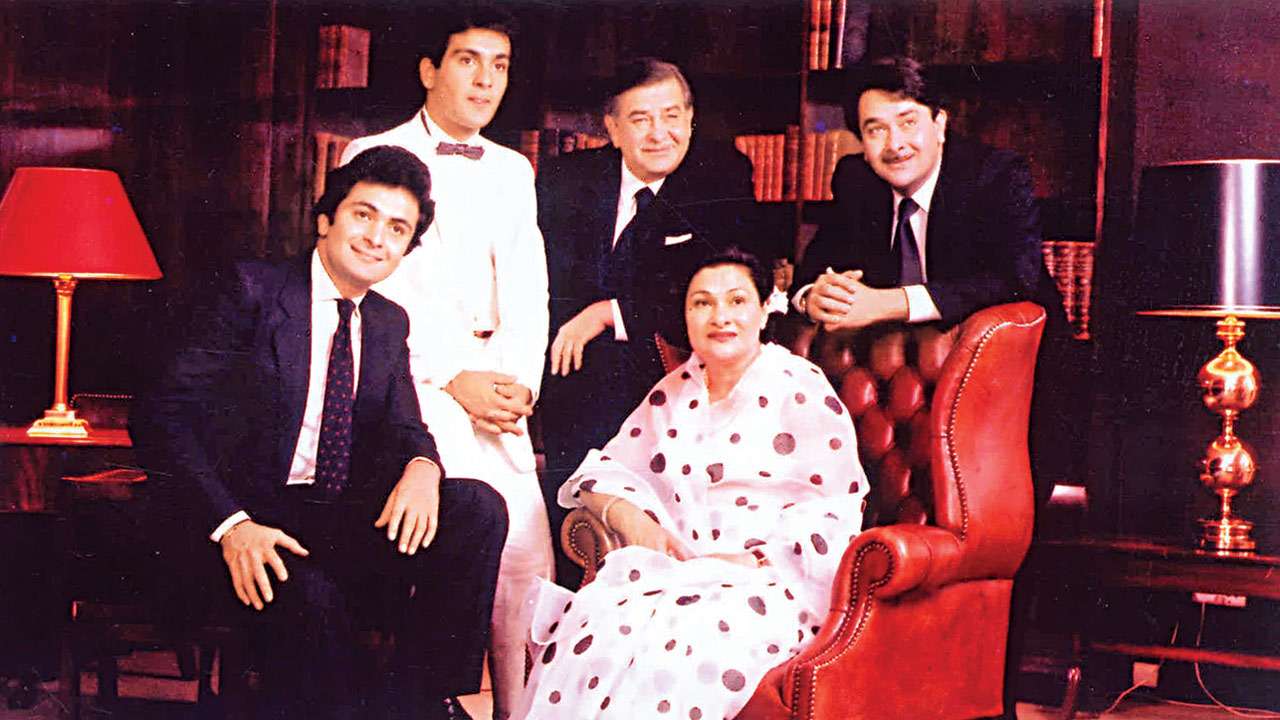
Krishna Raj Kapoor With her hubby and sons — Rishi, Rajiv and Randhir Kapoor
Meena Iyer (DNA; October 2, 2018)
On Monday morning, the Hindi film fraternity woke up to the extremely sad news of Krishna Raj Kapoor’s demise. I will always remember her as the First Lady of Bollywood. It was her elder son, Randhir, who said, “I regret to announce that I lost my mother early this morning. She died peacefully.” The wife of Padma Bhushan recipient and Dabasaheb Phalke awardee, filmmaker Raj Kapoor, Krishnaji (88) died of a cardiac arrest at 5 am on October 1, 30 years after she lost her husband on June 2, 1988.
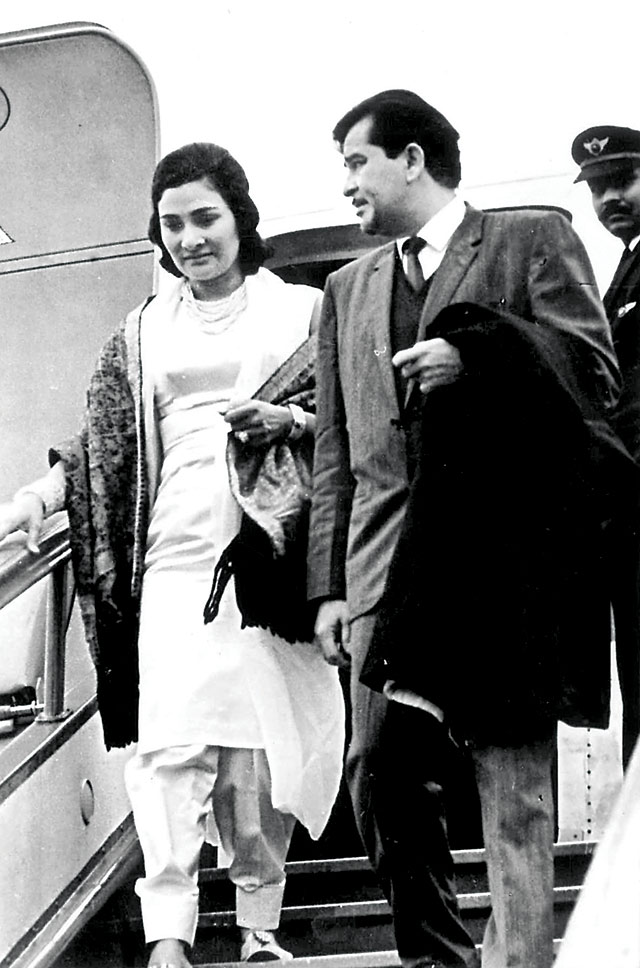 Krishna Raj Kapoor with husband Raj Kapoor
While friends and family members poured in to pay their last tributes, her son Rishi, who left for the US with Neetu and Ranbir on Saturday, couldn’t be present for the last rites. Speaking of Krishnaji, well, a hundred memories live with me. From her immaculate, usually, clad-in-white appearance to her bright lipstick and well-manicured painted nails, almost everything is etched vividly in my mind. Apart from being a benevolent human being, she was also extraordinarily sharp.
A CHARMING HOST
On one of my visits to her Deonar residence two years ago, I bent to touch her feet and she reprimanded me saying, “Betiyaan, pair nahin chhooti.”
Yes, the Punjabis do not permit their daughters to touch the feet of
elders because they feel a girl should never have to ‘bend’ as they are
considered Goddesses. So, while Rishi Kapoor, with whom I had gone to
their family home, touched his mum’s feet and got blessed in turn, I got
a hug from the lady.Next, we were treated to a glass of chaas. And, then asked to go about our business. We were picking out photographs for Rishi’s autobiography, Khullam Khulla. And, Krishnaji had kindly given us access to the treasure trove of family albums spanning seven decades that are lying safe in aluminium trunks on the bungalow’s first floor.
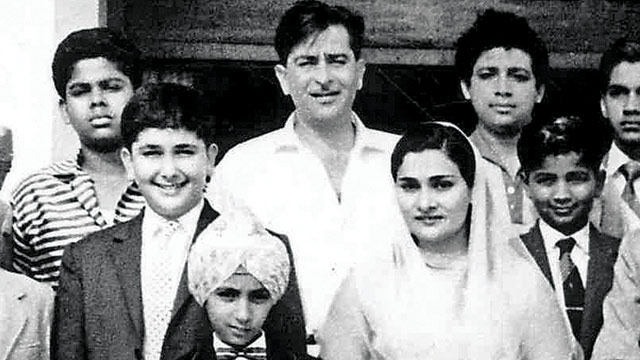 Krishna Raj Kapoor with Raj Kapoor and a young Rishi
At lunchtime, the lady of the house appeared dressed in a dark-coloured salwar kameez, her sartorial choice a rare exception. When we requested her for a photograph, she promptly pulled out her orange lipstick, dabbed her lips and said, “I’m ready.” Like the rest of her khandaan, she didn’t relish the fact that I was a vegetarian because the choices for a herbivorous person are limited at the Kapoor lunch table. Once that hurdle was crossed, she enthusiastically fed me aloo-gobhi and garam parathas, explaining how the cauliflower was broken into pieces, not cut in the Kapoor family kitchen. Minutes later, she saw Chintu eating without wearing a napkin. She wrinkled her nose and said, “Napkin pehen loh.” It was sweet to see a 64-year-old Rishi (in 2016) being pulled up by his mother for his lack of table manners on that occasion.
A WOMAN OF STEEL
Like I said at the start, Krishnaji
was her own person. She didn’t suffer fools and though the world
believed that she lived in her legendary husband Raj Kapoor’s shadow,
this was not true.In his book, Chintu spoke so affectionately of his mother. He said, “When my dad wanted to cast me as the young Raju in Mera Naam Joker (1970), he had to take permission from my mother, who gave him the go-ahead with a caveat saying — it should not interfere with my school studies.”
Not many may know this. Chembur would not have been the destination for the famed RK Studios that came up on a barren plot of land there seven decades ago. Bollywood’s showman wanted the studio to be built at Tardeo back in the day. Legend has it that when Krishna heard that Raj saab had a choice of choosing between Tardeo and Chembur, she promptly told him to choose the latter. The reason, according to the family grapevine, is that Nargis had a home in South Mumbai and Krishna didn’t want anything too close to her place as she was romantically involved with Raj for many years.
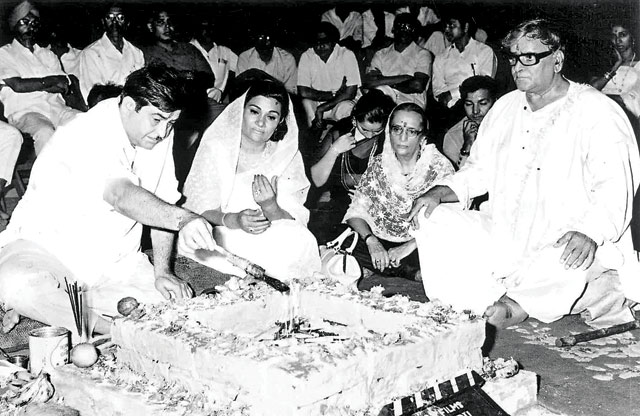 Krishna Raj Kapoor with Raj Kapoor and Prithviraj Kapoor
It is also a legendary tale that when Krishna learnt of Raj saab’s reported involvement with Vyjayanthimala, she walked out of her home with her children and headed to Natraj Hotel in South Mumbai. Raj later bought his estranged family a home in another location but, eventually, Prithviraj Kapoor intervened and the domestic squabble was sorted. Yet years later, Krishnaji had matured and mellowed. She was a changed person altogether. Rishi also recalled how, when Nargis set foot in the R K Studios compound after 36 years, in January 1980 on the occasion of his marriage to Neetu Singh, she was nervous. But it is said that Krishna took her aside and put her at ease saying, “My husband is a handsome man. He is also a romantic. I can understand the attraction. I know what you are thinking, but please don’t beat yourself up over the past. You have come to my home and I cannot tell you how happy I am.”
A DOTING MOTHER-IN-LAW
Neetu Kapoor, who
spoke to her mother-in-law every single day after her marriage until the
very end, addresses her as her most favourite person in the world. Mrs
Kapoor made a few daily calls. Besides Rishi and Neetu, Amitabh
Bachchan, whose daughter Shweta is married to Krishna’s grandson, Nikhil
Nanda, used to chat with her almost daily when he was in Mumbai. Big B
always made it a point to inquire about her health and she, in turn,
told him details of her failing health and she blessed him.When Neetu turned 60 on July 8 and was heading to Paris for the celebrations, her only wish was that her ma-in-law should accompany her! Here in Mumbai, too, the saas-bahu had a fixed routine. Krishnaji and Neetu usually frequented a Chinese restaurant at a five-star in BKC. Besides eating there, the senior Mrs Kapoor would also carry a parcel of their signature Peking Duck back with her to Deonar to share it with her other two sons — Randhir and Rajiv — who spent time with her at the bungalow.
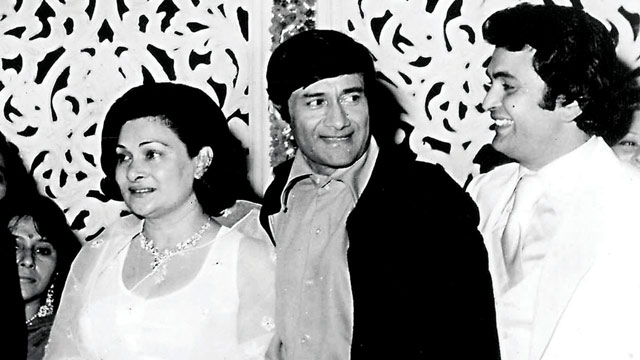 Krishna Kapoor, Dev Anand and Rishi Kapoor
There are innumerable stories about the senior Mrs Kapoor, but one of my favourite ones is the one where she called Rishi and Neetu on New Year’s Eve last year to ask them about their plans. “We are listening to Shirdi Sai Baba bhajans,” said Neetu because both Chintu and she had stopped going out on NYE for a few years now. To which the matriarch of the khandaan told her, “I am out in Khandala partying with my friends. They will ring in my birthday (January 1) in just a bit. So, you old people listen to bhajans, I will party on your behalf.”
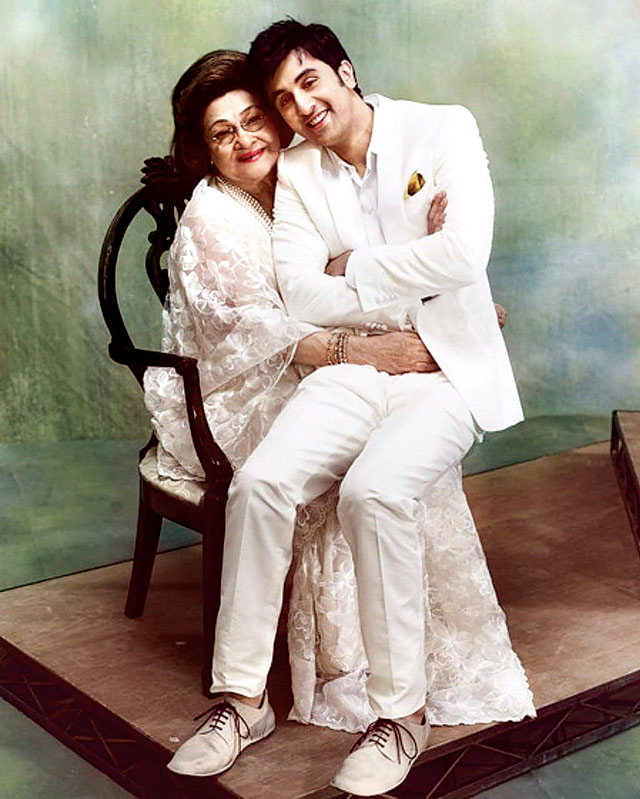 She shares a laugh with grandson Ranbir Kapoor
FOR THE LOVE OF HER GRANDSON
Ranbir Kapoor had grown particularly fond of his grandma when he
stayed with her a couple of years ago. The duo spent hours bonding,
watching television and generally chatting about cinema. And though Mrs
Kapoor was slightly uncomfortable around his two Mastiffs, Leo and
Guido, she was happy to have them around because it also meant keeping
her grandson close. She tiptoed around them, but was happy to watch her
favourite pota play in the garden with his pets.
NOT WITHOUT HER SISTERHOOD
Besides her family, Krishnaji’s
favourite people were journalist Nishi Prem (who was virtually a
neighbour in Chembur) and Dimple Kapadia. Until a few years ago, Salman
Khan’s mother Salma was also extremely close to Krishna. However, of
late, Salma hadn’t been such a regular with this gang. They were part of
her kitty group and the girls met up regularly for some food and fun.
Neetu recently hosted them at her Bandra residence and their joie de vivre reverberated around her Bandra residence, long after Krishnaji and Nishi had driven off to Chembur.Actually, some people never really go away. They continue to live in your memory forever.
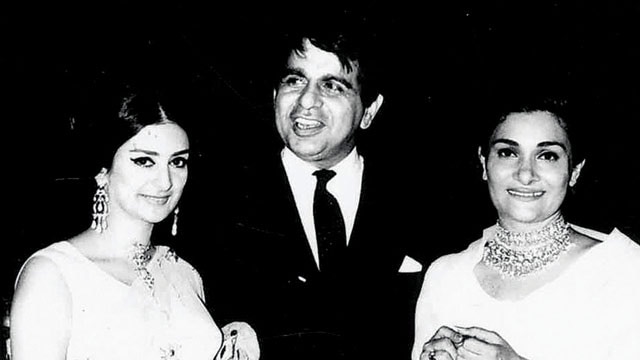 Krishna Raj Kapoor with Saira Banu and Dilip Kumar
Shooting for Salman Khan's Bharat kicks off this Sunday with a circus sequence
8:15 AM

Ali Abbas Zafar’s next rolls on Sunday with the two actors; Priyanka Chopra to join the shoot in August
Natasha Coutinho (MUMBAI MIRROR; July 19, 2018)
Ali Abbas Zafar’s period drama, Bharat, featuring Salman Khan, Priyanka Chopra and Disha Patani, rolls on Sunday. The team will begin shooting on an elaborate set in Mumbai’s Filmistan Studio and continue till August, after which they will move to Malta, followed by a schedule in Abu Dhabi.
 Ali has been planning the shoot for months and will be starting with
an elaborate circus sequence set in the late ’60s. “The idea is to
create an Indian-Russian circus like Raj Kapoor’s Mera Naam Joker.
Performers from all over the world are flying down for the circus tricks
which will be a mix of trapeze hoops and rope stunts. This is Salman
and Disha’s introduction. He plays a daredevil stunt motorcyclist in the
circus while she is a trapeze artiste,” informs the director. The
actor, who was away in the US and Canada on his Da-bangg concert tour,
began training from Tuesday while Disha has been prepping up for a while
now.
Priyanka Chopra, who turned 36 yesterday, is currently in the US wrapping up her Hollywood commitments. “We will be ending the Mumbai schedule with a Holi song featuring Priyanka and Salman. She joins the shoot in August and will have different looks in the film which the team has been working on in great detail as the film travels from the 1960s to the present day,” informs the director.
Salman and Disha will also go through a metamorphosis through the course of the film and Ali shares that prosthetics will take Salman back to his Karan Arjun days.

Raj Kapoor was at the airport, inconsolable, when I returned with papa’s body-Nitin Mukesh
7:55 AM

Nitin with father Mukesh, Raj Kapoor, Jaikishan, Randhir and Rishi Kapoor and recordist Minoo Kartik at the song recording for the film Mera Naam Joker
Roshmila Bhattacharya (MUMBAI MIRROR; December 14, 2017)
With a cheer, not a tear in your eye, Wish me luck as you wave me goodbye, Give me a smile, I can keep for a while, In my heart while you are away, Till me meet once again, you and I, Wish me luck as you wave me goodbye...
 These were the first lines Nitin Mukesh recorded for Mera Naam Joker at Mumbai’s Famous Studio. He was then about 15, and he was recording for Rishi Kapoor, younger by two years, who played the young Ranbir Raj aka Raju in the 1970 film. Rishi was present on the occasion along with his older brother Randhir and father Raj Kapoor as also was Nitin’s own papa, the legendary singer Mukesh.
“Raj uncle decided on the spur of the moment that he wanted Mukesh’s son to sing for his son. Papa asked me if I could and I assured him I would. Jaikishan saab (of the composer duo Shankar-Jaikishen) rehearsed the popular song during World War II with me for a couple of days before I recorded it live with the other children singing in chorus,” recalls the singer. He chuckles and says that his father was more nervous than he was. Raj Kapoor was emotional, and showered him with blessings. He predicted he’d become as famous as his father. “I’d later joke with Chintu that my voice made him a star while he would attribute his success to papa who sang 'Teetar Ke Do Aage Teetar' for him in the same film.”
The actor-filmmaker was a permanent fixture in Mukesh’s life and when rehearsing or recording with him, Raj Kapoor’s Chevrolet Impala would often land up outside the singer’s one-room-kitchen apartment in Napean Sea Road in the middle of the night and bring gawking neighbours to their doors. Mukesh’s five children, who would be sleeping on the floor, would be hurriedly woken up, and his wife would rush to the kitchen to rustle up dinner for the showman who’d relax with Mukesh over a drink.
“When we moved to a three-BHK close by, he was the only outsider present at the house-warming and after walking through the rooms, he announced that he liked the children’s bedroom best but it needed an air-conditioner. The next day his gift arrived, making us feel like little emperors in our palatial bedroom, because air-conditioners were a luxury those days,” says Nitin.
He says that while most people referred to Mukesh as Raj Kapoor’s voice, the filmmaker himself admitted to Simi Garewal in her documentary that after Jaikishen passed away he felt like he’d lost an arm and after Shailendra’s demise the other, but after Mukesh succumbed to a sudden heart attack in Detroit on August 27, 1976 while on a concert tour, he realised he had lost his soul. “Raj uncle was with us at home till we left for the airport. Little did he know then that this was the last time he’d see his Mukesh Chand alive (Kapoor always addressed him by his full name). He was at the airport, inconsolable, when I returned with papa’s body. He’d been filming the flood sequences for Satyam Shivam Sundaram near Pune when he got the news and despite knowing how difficult it would be to get a busy Shashi Kapoor’s combination dates with Zeenat (Aman), and without a thought for the losses he’d incur, he drove down to be with our family for the next 10 days,” says Nitin Mukesh. Kapoor kept in touch via frequent phone calls and his wife Krishna would drop by to ensure that the singer’s family was doing well.
The times were tough for Mukesh’s family, and Nitin Mukesh would accept show offers for as little as Rs 100 to keep the kitchen fires burning. So, when Swami Chidanand Maharaj, for whose Divine Light Society his father had done a fund-raiser every year for free, offered to organise a show for him for which he was willing to pay him Rs 50,000, he was delighted. The only condition was that Raj Kapoor had to present Nitin Mukesh.
“Raj uncle had returned to shoot Satyam Shivam Sundaram but since the money would make things easier for us, I went to meet him and sounded him out. He agreed immediately and put the RK Studio machinery to work to invite the entire film industry for the show. The Kapoor family was present, along with Amitabh Bachchan, several actors and other big names from the music fraternity. It was a full house and it set the ball rolling for me,” acknowledges the grateful singer.
“Chanchal Sheetal Nirmal Komal” was the last song my father recorded for Satyam Shivan Sundaram before we left for the US. On his return he was to sing “Woh Aurat Hai Tu Mehbooba”, but I ended up crooning it with Lataji and after that I never looked back,” says Nitin Mukesh. As a tribute to his ‘Raj uncle’, who would have turned 93 on December 14, he begins every show with Mukesh’s Mera Naam Joker song, “Jeena Yahan Marna Yahan” and ends the show with his own, “With A Cheer, Not A Tear…”
R K Studios fire: A legacy gutted, and the Kapoors are mourning
8:10 AM

Raj Kapoor's iconic Mera Naam Joker mask, and costumes worn by all R K banner heroines from Nargis to Aishwarya among the memorabilia lost in Saturday's fire at R K Studios, says Rishi Kapoor
Meena Iyer (MUMBAI MIRROR; September 18, 2017)

Just the memory of the calamity brought a lump to Rishi's throat. “I still cannot believe it. I'm partially in denial even now. I spent several hours looking around the studio and as the embers fell, I felt distressed and helpless. Yet, here I am at home and I'm still thinking that perhaps it was just a bad dream,“ Rishi told Mumbai Mirror. His son Ranbir, who heard about the incident in London, is rushing back.
Rishi was not in a position to comment on the exact cause of the fire because everything he heard was “conjecture“. While the police and the Fire Brigade officials have begun the process of a panchnama to ascertain the exact cause, it is said that on Friday, a reality show, Super Dancer 2, was shot on the floor till the early hours of Saturday. Post pack-up, the lights on the set and in the makeup rooms were switched off.
Rishi recalled some of the films that were shot in the studio, on the very stage that has now been gutted: Awara, Shree 420, Jis Desh Mein Ganga Behti Hai, Mera Naam Joker, Satyam Shivam Sundaram, Ram Teri Ganga Maili, Dharam Karam, Prem Rog, to Rishi's own directorial film, Aa Ab Laut Chalen in 1999... “My own journey at the R K Studio started at the age of two when I shot with my elder siblings, Randhir and Ritu, for the song 'Pyaar Hua Iqraar Hua' from Shree 420. I kept crying because I had to walk through heavy rain and Nargisji bribed me with a Cadbury chocolate, promising to give it to me if I did what my father asked me to do. That aside, can you now imagine, how devastated I was when I saw the fire destroy everything around me? I am 65 now. It's a place I have been frequenting for 63 years. So have my siblings. It is an equally big blow for Randhir and Rajeev,“ Rishi said.
He said it was all the more heart breaking for the matriarch, Krishna Raj Kapoor, who has been a gracious host at countless events at the studio. “My mother is devastated. She keeps indifferent health and we asked her not to come to the studio because the fire was quite bad. There was smoke bellowing all around,“ he said.
When asked about the losses, Rishi said “everything was gone“, including the famous joker mask Raj Kapoor wore in Mera Naam Joker. “There were costumes from every RK film, from Awara to Chalen. Most of the stuff was kept neatly in trunks and some of it was even labelled. The costumes worn by every RK heroine, from Nargis to Aishwarya Rai Bachchan, is lost. The jewellery worn by Padmini in Jis Desh Mein Ganga Behti Hai was also stored here with a lot of love. There were spears, sabres, artefacts, furniture and other regalia used for the various shoots. The Mera Naam Joker mask and clothes... Dabboo and I couldn't believe what hit us. This is probably why they say that one should never put all eggs in one basket. But for us, this was our father's legacy, and it was a treasure trove.“
R K Studio had seen several tragedies. In 1970 when Mera Naam Joker flopped, Raj Kapoor had to mortgage the studio. Then, towards the end of his life, the Kapoor patriarch sold two stages of RK Studios for a paltry sum. But even after Raj Kapoor's death, his sons never contemplated selling any part of the property. “We hung on to our father's legacy,“ Rishi said. “Today I feel a sense of deep bereavement because we lost all of this.“ Echoing Randhir Kapoor's statement that the family may come to terms with the financial loss but not with the emotional loss, Rishi said, “My father didn't buy a home for his family until Bobby's success. He put all his earnings into the studio because cinema was his religion.“
 It is said that back in 1951, Raj Kapoor had constructed just four
walls on Stage One, which didn't even have a proper roof because he used
natural light to shoot. “My brothers and I can build the four walls
again and even add a roof. But how can we compensate the loss of the
precious memorabilia? That will never come back. Countless films,
besides those made under our home banner, have been shot at R K Studio. It
has also been the venue for our Holi and Ganpati celebrations. The loss
is not just ours as a family, it is a loss for the entire film
fraternity,“ said Rishi.
He recalls that RK came into being in the year of Awara. “My father shot the famous dream sequence here. At that time there were just four walls and no roof. The entire dream sequence was shot after sundown because Chembur got electricity only in the nights in the 1950s. During the day, my father toiled for other filmmakers as an actor...and then at night he put his earnings into his own film,“ he said.

R K Studios: Raj Kapoor shot all his movies after 1950 in 4-acre space
8:02 AM

Bella Jaisinghani (THE TIMES OF INDIA; September 17, 2017)
Hindi cinema's famous showman Raj Kapoor constructed R K Studios in Chembur in 1950, reportedly with profits earned from his first hit picture, Barsaat in 1949.
This sprawling four-acre campus also served as the headquarters of his film company, RK Films, which had been founded two years earlier in 1948. His first film as independent director was Aag.
Raj Kapoor reportedly shot all his pictures after 1950 here at RK, beginning with the famous dream sequence of Awara to Mera Naam Joker, Bobby, Jis Desh Mein Ganga Behti Hai, Kal Aaj Aur Kal, Satyam Shivam Sundaram and Prem Rog. Shree 420 and Sangam were also filmed in studio.
Over the decades, the fortunes of RK Studios peaked as hundreds of popular movies, not just those under the home banner, were shot here. Studio representative Kishore Darekar said on Saturday, “Manmohan Desai shot all his pictures here. Newer RK productions such as Henna, Ram Teri Ganga Maili and Aa Ab Laut Chalein were filmed here.“
As time passed, private bungalows and outdoor locations became more economically viable and a popular option to shoot rather than creating lavish expensive sets in film studios. The family stopped making films a few years after Raj Kapoor's death. Television shows do continue to rent the space, though.
Compensating distributors is a noble initiative from Salman and Salim Khan-Distributor J P Choksey
7:54 AM

Manishaa R (DNA; July 23, 2017)
A fortnight ago, there was news that Salim Khan had announced his decision to compensate distributors for their losses in Tubelight, after some of them had met Salman at his Galaxy residence in Bandra. According to sources, Khan Sr has now called for a meeting with leading distributors to discuss and evaluate the extent of losses they suffered with the film. Prior to that, he has also asked for a list of exhibitors to examine the terms and look into possible losses. Apparently, some exhibitors had booked the film on huge Minimum Guarantees, expecting it to make box-office history keeping in mind that it was an Eid release.
Veteran Central India distributor J P Choksey, who has been consistently releasing Salman starrers in the past, has hailed the gesture. “My office releases all the films directly through Salim Khan’s office, but it is true that Khan Sr has called for this meeting. Salim saab felt that the distributors who had released the film needed to be compensated to some extent. It is a very noble initiative from Salman and his father and it will set a precedent to all other stars to follow,” he said.
According to Choksey, this would be the second big instance after Raj Kapoor where a producer is going ahead to compensate his distributors, “Raj Kapoor was a generous person at heart. When Mera Naam Joker flopped, he told the distributors of the subsequent film Bobby, to deduct the losses before fixing the price of the film. It had come as a huge relief,” Choksey said, adding that another great actor is Rajinikanth, “Rajinikanth’s films hardly suffer losses, but when there was an exception like Lingaa, he compensated each and every distributor.”
The former FFI (Film Federation of India) President insists it wasn’t Salman’s star value but the script and story of Tubelight that got the disastrous response, “Salman’s presence in the film saved it to an extent, but it was his submissive characterization that went completely against his image. The story was a letdown towards the end when the girl who was initially projected as Chinese, went on to reveal her real identity from Kolkata. It didn’t seem convincing.”
Meanwhile, the exhibitors have hailed the decisions. Leading exhibitor, Akshaye Rathi, who released the film at several theatres, feels it would be a big step in ensuring the well-being of the industry, “It’s a thoughtful gesture for the health of the industry. Distributors invest crores of rupees and it is the responsibility of producers to make sure that they at least don’t lose money. Raj Kapoor and Rajinikanth have done it in the past and that’s what makes them the superstars of stars,” he said, adding that even Shah Rukh had done it in Dilwale and several other occasions when he along with Juhi Chawla and Aziz Mirza had their company, Dreamz Unlimited.
I will pay back distributors if my movie fails-Ranbir Kapoor
7:58 AM

MID-DAY (July 13, 2017)
After superstar Salman Khan decided to compensate the distributors over Tubelight’s debacle, looks like Ranbir Kapoor is following in his footsteps. The actor said that if he makes money out of a film which hasn’t fared well at the box-office, he will definitely pay back the distributors.
At a promotional event of his upcoming film, Jagga Jasoos, Kapoor said, “The trend has been going on since my grandfather’s (Raj Kapoor) time in the 1950s... The style of making films where everyone makes money, not just the producers, but also distributors and exhibitors. It is a healthy exercise. If someone loses money on something and you have made money out of it, it’s good to compensate. But that depends on the person and film.”
Kapoor cited the example of his grandfather who followed a similar practice. “When Mera Naam Joker (1970) released, distributors incurred losses. So when Bobby (1973) released, my grandfather gave a bigger share to the distributors than the exhibitors. Personally, if my film fails and I am making money out of it, then I will pay back the distributors,” said Kapoor.
Trapeze artist in Mera Naam Joker Kseniya Ryabinkina in Mumbai to celebrate Raj Kapoor's 92nd birth anniversary
8:06 AM

Kseniya Ryabinkina, the trapeze artiste from Raj Kapoor’s classic Mera Naam Joker is in Mumbai to celebrate the late showman’s 92nd birth anniversary
Khalid Mohamed (MUMBAI MIRROR; December 14, 2016)
"Ohhhhhh, difficult, difficult?” her sapphire yellow eyes dart. “Yes, yes, I remember now. The most difficult scene in Mera Naam Joker was when… How do you say it? cry? Cry when Raju’s mother dies. I don’t, can’t cry easy.”
I’m in an eye jugalbandi of sorts with Kseniya Ryabinkina at Mumbai’s Russian Centre for Science Culture where the maddening honking traffic on Peddar Road is silenced by sound-proof windows. Now 74, the heartbreaker from Moscow, is in town to attend the 93rd birth anniversary memorial event of her Raju, Raj Kapoor. “My family calls me Ksana.You can call me that if you like,” she makes life easier for me, adding, “Sorry my English, it is not so very good. Okay?”
Ksana, it is then. And our interpreter du jour, director and vice-consul of the Centre, Googles quickly to assert Kseniya means many things: Faith, Someone of Noble Character, Trustworthy. “Really, I did not know this,” laughs the trapeze artiste of RK’s four-hour-four-minute opus which unless you were hiding in a circus tent for decades, should know is justly considered a cult classic, never mind its no-show at the ticket windows way back in 1970s.
Ksana looks baffled when the irony is pointed out, “Really?” she asks incredulously. “Well. I got thousands of letters for the movie.” Vice consul pitches in with the take, “Maybe, people couldn’t adjust to the lengthy duration then.”
This interview isn’t going to be smooth vodka, must proceed soberly and methodically, to know the dropdead stunner of Mera Naam Joker whose impact has been as lasting as the opus which had the audacity of studying the tears of a clown at its own pace and magnitude. The part of Marina came to her “suddenly”, the showman of all showmen had scouted for talent at Russian circus shows. He wasn’t exactly thrilled till he saw Ksana performing at the famed Bolshoi ballet.
Elena, her elder sister by four years, was “the celebrity, I was not so much of celebrity-celebrity but he asked to meet me. I did, accompanied by officials from Sovexportfilm. The role was offered just like that. It was my second film. I had acted in one film before. In all I must have done 15 to 16 films. But I’m most remembered as the Marina of Raj Kapoor.”
Cups of cream-flaked materialise. Not surprisingly, they’re all left untouched. Ksana, a pukka Muscovite was born to a ballerina mother and a geo-physics doctor.
Naturally ballet was on their daughter’s mind. Not “acting of dramatic kind, that happened only because of Raj Kapoor.” A kind man, a gentle man, he asked her to use glycerine for that lachrymose death scene. She wouldn’t, thought of the saddest things she could, and the tears dropped. "After that shot, I felt… how do you say it?...empty.”
Must be my eyes now but I detect a trace of a fog in her sapphires. Getting quite befikre now, I bring up her kissing scene with Raj Kapoor. The vice consul isn’t pleased, he’s turned fire-engine red. “Ohhhhhh that!” she tut tuts. “Nothing, nothing, felt nothing, in ballet dancers touch bodies. Only here... on the sets the camera and lights were adding to the summer temperature.” Shrugs she, too, to the fact that stunt artistes had to stand in for her for the trapeze act. “I wanted to fly,” she recalls. “Raj Kapoor wouldn’t allow it. Two different girls, one from Moscow and one from a circus here, did that job for me.”
During the shoot of Mera Naam Joker, she stayed at hotels, other filmmakers wished to cast her, didn’t work out. Back home close to the Kremlin, she returned to ballet, acted some and retired at the age of 40 which is “normal”.
Her inability to cry stokes my curiosity. So when was the last time she cried? Blank, sound-proof silence. Prod her to recollect and Ksana states, “When my husband Alexei died. Suddenly. Heart attack, at home. No warning. He was 56. Healthy, not classic handsome but the only man I have ever loved in all my life.”
Their son Eugene, is a frontline actor. Ksana has three grandkids, one an expert at the violin, another at the piano, the third one “still decide… they are my jewels.” Speaking of jewels, Raj Kapoor gifted her a gold ring encrusted with pearls. He told her it was on behalf of an Indian delegation to the Moscow film festival but she suspects “he was shy to tell me it was a personal gift...and no, he never wrote any letters to me. How I remember his eyes, so blue, a clear ocean.”
Ksana did visit India briefly, Chandigarh specifically, for a cameo in Chintuji seven years ago. Bring up Mumbai of the Joker days and now. She pauses, the vice consul looks askance. “Like all cities, Mumbai has changed, it is not better,” she says gently. “I went out to the city today. I loved driving past the VT (CST) railway station. Architecture, magnificent, preserved, beautiful.”
We talk books (Tolstoy, Dostoevsky, Hemingway top her favourites), movies (Nikita Mikhalkov she raves about), and the Kapoors. “I am guilty,” she surrenders, “I have not seen the films of Raj Kapoor’s grandchildren yet. I must.”
Before I call it quits for the evening, she stops me, says give me five minutes. And returns with a photograph showing her at a ballet performance. It shows her with a co-dancer, reminiscent of Raj Kapoor-Nargis on the R K banner. “I think he saw me in that pose,” her eyes sparkle.” And that’s how Mera Naam Joker happened for me. Suddenly.”
The showman’s story
Mera Naam Joker is one of the lengthiest Indian films ever made. The 1970 release, written by Khwaja Ahmad Abbas, marked the acting debut of director Raj Kapoor’s second son, Rishi, and took six years to make. Publicised as autobiographical, the film follows a clown who makes his audience laugh at the cost of his own sorrows. While it was a critical and commercial disaster upon release, putting RK in a financial crisis, Mera Naam Joker has, over the years, gained a cult classic status. Today, film experts label it a ‘misunderstood masterpiece’.
Subscribe to:
Posts (Atom)