Showing posts with label Melwyn Crasto. Show all posts
Showing posts with label Melwyn Crasto. Show all posts
Shah Rukh Khan used to run 100 metres in 12 seconds; the record for an Indian is 10 seconds-Melwyn Crasto
8:18 AM
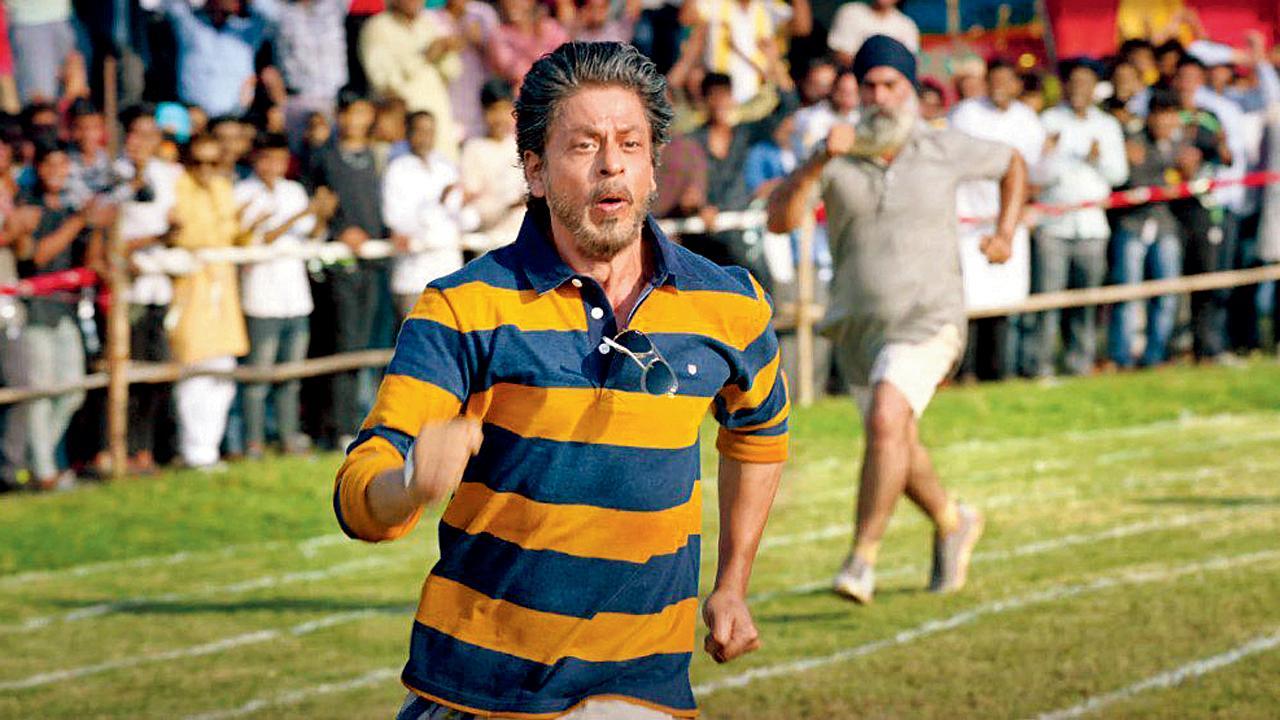
With Dunki, athletics coach Melwyn Crasto adds another achievement to his resume—he has now trained all three ruling Khans of the film industry. In this interview, he chronicles addressing different cinematic needs
Sonia Lulla (MID-DAY; January 3, 2024)
Called on by director Rajkumar Hirani to train Shah Rukh Khan and Dunki’s supporting actors for a running sequence, athletics coach Melwyn Crasto found relief in the fact that the actor did not need to appear technically sound.
“He had to participate in a 400-metre sprint, and I was told that he did not need to have the precise form. All the runners were around 50 to 55 years old. And while we had access to a running track, the scene was set in a Punjab village, amid a mela, where, along with the stalls, [an area] for games was present. It was a muddy and stony track that they had to run on.”
Introduced to Khan as the man who would choreograph the sequence and train him for the part, Crasto recalls the actor’s first reaction. “He told me that he was a good sportsman when he was in school, and that he used to run [100 metres in] 12 seconds, and was the champion for about six years. I was impressed, because not many can pull off a race in such a short interval. The record for a 100-metre sprint by an Indian is, after all, 10 seconds,” he says, making a case for Khan’s athletic levels while revealing that he’d pull off “race after race” while filming the part.
In Khan’s regimen, his warm-up routine was non-negotiable. “Because he was set to sprint, and wasn’t pulling off a slow, endurance run, the warm-up was crucial to preventing injuries. These entailed stretches for the hamstrings, and the other muscles of the legs and shoulders. Subsequently, I’d train him in running techniques, such as how he needed to use his hands. I told him how to overtake other runners, as was needed in the scene, and how to navigate a turn and run around the curve.”
Not one to be easily impressed by his Bollywood clients, Crasto doesn’t hold back when heaping praise on Hrithik Roshan.
“He has a fantastic body that is [suited for] athletics. He had initially approached me to train his sons, and subsequently wanted me to train him as well, for general fitness. Athleticism involves learning how to sprint, throw and jump, apart from running. I call it the mother of all games because if you want to be an athlete, you need to learn athletics. [Ideally], you can start training at the age of eight. So, our association began with training sessions for his boys. When he saw the things I was doing with them, he said he wanted to do them too. He said that while he had been heading to the gym, he wanted to [train differently]. We began with basic running drills, like high knees, back kicks and running lunges, and he would immediately grasp them. After six months of training, his body began to look like that of an athlete, not a body-builder. Of course, owing to his knee [injury] and back issues, I couldn’t give him many jumping movements, but he could do the agility drills, and could also sprint very well.”
Preparing for the long jump
Roped in to train Vicky Kaushal to pull off action sequences in Sam Bahadur, Crasto recalls teaching him to execute a high-jump in the film. “It is a highly technical move because one needs to jump between two vertical stands. An athlete is given only about two metres of space to pull it off, which is what makes this technical. We had four months to train for it.”
After ascertaining that Kaushal’s “basic fitness levels” were retained, Crasto trained him in a variety of drills. “We executed standing jumps, broad jumps and a variety of exercises in circuit training. He was taught to shift his body weight, because pulling off a vertical jump requires immense strength and power. So, we executed plyometric drills. We also had to work on strengthening his core and practiced eight different exercises to do that. If one isn’t fit enough to carry his weight, attempting this jump can be risky. Finally, we moved on to agility and mobility work, so that he could [use the momentum] from his run-up for his jump. Translating the run into the jump is also a technical move that needs explosive power,” shares Crasto, adding that Kaushal nabbed his first jump in three months.
Crasto, the athletic coach for Central Railway, expresses his gratitude towards them for “letting me pursue these projects”.

Until he perfects a drill, Aamir Khan won’t call it a day-Melwyn Crasto
8:05 AM

While highlighting how he trained Laal Singh Chaddha star Aamir to sprint, track and field coach Melwyn Crasto says character did not have to resemble professional runner
Sonia Lulla (MID-DAY; May 18, 2022)
Gym-goers, here’s a question. If your coach concludes an exhausting training session with tips on improving a certain exercise for the next session, what would you do? You’d probably nod your head, and consider his suggestions in the next session. But, if you’re Aamir Khan, you’ll hold your coach back and insist on executing it correctly, right there, right then. “Until he perfects a drill, he won’t call it a day. His coordination was not correct for one drill, and when I told him how he could correct it for the next session, he refused to leave until he learnt it, right then,” says track and field coach Melwyn Crasto, who, after training Farhan Akhtar (Bhaag Milkha Bhaag) and Taapsee Pannu (Rashmi Rocket), trained Khan over four months for the forthcoming film, Laal Singh Chaddha.
Crasto is usually frugal with his praise, but Khan seems to have worked his charm on him. “The first day with him was satisfactory.” (Frugal, remember?) “Even athletes take time to learn running drills, but he was sharp and picked them up immediately after one or two demonstrations. He made the task easy for me because only rarely did I have to correct him. Another plus point is that he has been able to retain his flexibility. That’s something I struggled with while training Farhan. Having a good range was important because we had to showcase him with a good stride as he propelled himself ahead.”
Their initial sessions began with analysing the actor’s physical capabilities. Since the 400-metre race that the character would be shown executing on screen would be filmed in short sections of 50 to 100 metres, Crasto knew he wouldn’t have to worry about building Khan’s stamina. Also, since the character isn’t a professional runner, Khan did not need to look like one either.
“But the character needed to have speed. At his age, doing a 100 metre run is a [tough] task. Without preparation, he could invite injuries. Since he had to shoot simultaneously, we had to keep him in good health, else the schedule would go for a toss. It was important to ensure that his hamstrings did not get pulled. If that happened, then forget jogging, Aamir wouldn’t even be able to walk.”
Foot gymnastics — involving movements like walking back-and-forth, sideways, on the heels, or with the inside or outside of the foot raised — are methods that are employed to improve the strength and health of the ankles. “We followed that up with the 14 running drills, involving movements called high-knees, butt kicks, ostrich dance, Russian dance, and karaoke dance, among others. The more you practice the drills, the better the runner you will become. From there, we moved on to sprinting sessions. I’d make him run for 30 seconds, then 60 seconds, then 90 and 120. Then we’d do the same set in reverse. I had to give him longer sets of recovery. For instance, if I’d give Taapsee 30 seconds to recover, I’d give him a minute.”
Within a span of four months, Crasto was able to shave off a second from Khan’s 100-metre record to finish at 13.6 seconds. During their practice sessions in Delhi, he’d ensure that other runners accompany Khan during his running sessions. And while he worked with Khan on the field, he encouraged his physical fitness trainers to amend his routine in the gym. “He needed to change the sequence of his weight-training pattern. It wasn’t about lifting heavy weights because that would make him bulky and stiff. He had to lift lighter weights, and execute quick repetitions. Resistance training also helped him enhance his strength on the field as a runner.”
Crasto has been an athletic coach for the central railway. “I’d like to thank the Central Railway Sports Association for giving me the permission to take on this assignment.”

I love my job but I will never want to do something to my body that I will regret all my life-Taapsee Pannu
8:10 AM

Having kicked off Rashmi Rocket shoot earlier this week, Taapsee Pannu says she is taking cues from Dutee Chand, Hima Das's careers for athlete act
Mohar Basu (MID-DAY; November 12, 2020)
Every day is admittedly a challenge for Taapsee Pannu, who has shed the lockdown lethargy and hit the running track with a vengeance. The actor kicked off the shoot of Rashmi Rocket in Pune earlier this week. While the Akarsh Khurana-directed venture was to originally roll in March-end in Kutch, the pandemic not only put the brakes on the impending shoot, but also on Pannu's rigorous two-month prep for her sprinter act.
"I had to start from scratch when I resumed my training," exclaims Pannu, who began training anew in September while shooting for Haseen Dillruba and her upcoming Tamil film. "I had trained from January to March for the film but through the lockdown it was hard to maintain the fitness levels. Gyms were shut and there were limited resources at home. Training after lockdown is mentally exhausting. I was shooting for my Tamil film, Haseen Dillruba and simultaneously training. Food limitations are far too many. My body went through quite a shock because the diet was completely altered. The one thing I was clear, though, was that I will never take any steroids. I have achieved my fitness in the healthiest way possible. It's not about hitting a mark and then giving it up. Fitness is a lifestyle choice and I don't want to do something that has far reaching side effects. There's more to life than a film. This is my job and I love it but I will never want to do something to my body that I will regret all my life. It took more effort, more work and to achieve this physique in three months."
The actor credits her fitness army – gym coach Sujeet Kargutkar, track trainer Melwyn Crasto, physiotherapist Prachi Shah and nutritionist Munmun Ganeriwal – for seeing her through the phase. "Sujeet's patience at my lack of doing heavy weightlifting is amazing. Melwyn has been a coach in Indian railways; he trained Farhan [Akhtar] in Bhaag Milkha Bhaag [2013]. After every day, after the strenuous workout, Prachi saves me. Munmun makes sure I am eating the right meals," she says, noting that the producers have invested deeply in her training. "It's a big scale film. The producers have monetarily and emotionally invested in me and shown such faith and patience, that I don't want to let them down."
Though the movie is a fictional story about a Kutch-based girl who discovers her athletic prowess, Pannu is drawing inspiration from sprinters Dutee Chand and Hima Das. "I have been observing Indian and international athletes and their running patterns, body forms and style. If it were a biopic, the approach would have been different. This is inspired by real incidents that happened to sprinters. The film touches on many aspects – from the society's response to female athletes to the politics of the sporting universe. Most of my films question the elephant in the room, and this will be no exception."
Alternating Rashmi Rocket with Looop Lapeta, Pannu is booked out for the next 6 months. "After February I start Anurag Kashyap's film and then I move to Shabash Mithu. There are a few announcements in the pipeline as well," she says, signing off.
Ideally, it takes six months to prepare an actor for such a film. But Taapsee is a fast learner-Melwyn Crasto
8:43 AM

Man who made Bollywood's Milkha Farhan Akhtar 'bhaag', on prepping Taapsee Pannu for Rashmi Rocket
Sonia Lulla (MID-DAY; July 8, 2020)
 Endurance is a term broadly used to analyse an athlete's ability to perform a task over a long period of time, without tiring. While it is not a primary demand for a sprinter — for whom the bout of activity lasts a mere few seconds — one would still assume that the amount of endurance training given to a sprinter would be more than that given to an actor replicating one, for cinema. Imagine our surprise then when Melwyn Crasto, an athletic coach with the Central Railways since 25 years, tells us that he devotes more sessions of endurance training with Taapsee Pannu than he does with athletes. "An athlete is made to run a 100-metre race, and that's the end of it. But, an actor may only commence running when the director may cut the shot, complaining about an incorrect running form of either the actor, or another runner in the frame. This is something I learnt when training Farhan [Akhtar] for Bhaag Milkha Bhaag. Often, the actor is made to run repeatedly throughout the day. Even then, only half a race would be shot. Hence, endurance training is necessary for them to sustain such high levels of activity without compromising on the form," says Crasto, who would use therabands to couple endurance work with strength-related routines.
Crasto, who is also training Aamir Khan for Laal Singh Chaddha, has been whipping Pannu into shape to play a sprinter in the fictional tale, Rashmi Rocket. For the trainer, the grace with which an actor executes movements is of prime importance. "If it looks graceful, 50 per cent of my job is done, because, as with Bhaag Milkha Bhaag, the makers did not wish to appoint a body-double, or use VFX. In Taapsee's case, I had to remind her to keep her hands tucked in, and drive them up to her shoulders before driving them back."
It helped that Pannu, Crasto believes, is inclined to sprinting. He believes she has a high number of fast-twitch fibres, which facilitate the seamless execution of quick movements. "Ideally, it takes six months to prepare an actor for such a film. But Taapsee is a fast learner. We had to focus on her speed, strength and explosive power, and agility."
Sessions began by merely deciphering Pannu's weak-points, and rectifying them, before teaching her the technique of running. Crasto would be welcomed by the punctual actor at 6 am for sessions that lasted two hours. "Apart from circuit training, accelerated running enabled Taapsee to enhance her performance. This essentially involves placing three cones across her running path, asking her to commence running at a steady pace, and accelerating as she crosses each cone. This improves the form, and enhances speed."
Only a few weeks before the lockdown interrupted their regimen, Pannu had taken to running with spike shoes as she entered the last phase of her prep-work. "In competition, she had to be seen running in spikes. That's not something you can subject someone to at the onset since it can cause injuries. We had to up her workout routine to include core work, so that this leg could become easier," says Crasto, expressing gratitude towards the Central Railway Sports Association for giving him the nod to train Pannu.

The Training
Foot gymnastics
Intricate athletic forms, including ballet and pilates, will stress on the importance of training the feet to generate the power to propel. "Foot gymnastics strengthens the ankles, shin, Achilles tendon and planta fascia. Those who don't practice it usually complain of pain because their feet are weak. Just like you train the biceps, and triceps, your feet too need work. It includes six drills, like taking small steps on your toes, and moving forward, and sideways, with similar movements. Another one involves walking on the heels; yet another has an athlete walk on the outer edge of the foot. These workouts take about 10 minutes."

Warm up
A 20-minute warm-up routine precedes any activity, and includes repetitive movements of the major muscles of the body. "The warm up prevent the chances of incurring injuries, which was specifically important in this case since Taapsee had only four months to train, and we couldn't afford a setback. Also, it signals the body to prepare for the upcoming workout, thereby facilitating better performance," says Crasto, who would make the actor take to routine exercises like rotation of the hips, and shoulders, lateral movement of the arms, and 12 stretches, involving the shoulders, triceps biceps and the calf muscles.

Drills
Crasto compares running drills to the art of learning the alphabets, and hence, aptly calls them Running ABC. "It involves breaking down the act of running into small components that must be mastered before being put together for the final sport. There are about 14 drills, like high knees, butt kicks, lunges and then running lunges. The benefit of working with Taapsee is that her coordination is good. Being a squash player worked to her advantage, because she could pick up exercises that would take 15 sessions to learn, in five." However, given that Pannu wasn't trained for athletics, Crasto had to limit the distance he set for her drills, truncating it from 50 metres, to about 20.
It was also during these sessions that he watched her with vigilance and enabled her to train like a sprinter. "In the first 15 classes, we only focused on her form. We worked on shorter strides so that muscle memory could be built using the correct form. During these sessions, we rectified her technique and noticed aspects like whether or not her hip flexors were being employed, if her back was upright, and whether she was landing on the ball of her foot, and not the heel," says the trainer, who made Pannu work to only 60 per cent of her capacity so that she could be mindful of her movements.
"Once she nabbed them, we began to execute the final run. Once those fundamentals are in order, she will be technically correct, no matter [the distance] she is made to run." Crasto would wind up with floor stretches so that the actor could recover in time for the next session.

Body language consultants, sprint trainers: Authenticity in Bollywood creates new jobs
8:33 AM
Sharmila Ganesan-Ram | TNN (THE TIMES OF INDIA; March 9, 2014)
Everything in the frame is blue. The sky. The desert. Alia Bhatt. She is running towards you in tears as if you could save her from her kidnappers. Her feet seem to be on autopilot and with each second, her breath is getting heavier and her lips drier. She trips, falls, gets up and runs some more. Finally, her knees buckle, she collapses on the parched earth and breaks down. Then, she gets up and runs away from you.
To prepare for such scenes, Bhatt was made to thrash around angrily on a cold, concrete floor several times in her hotel room in Ajmer. Holding a man’s hands she would repeatedly dip her head to the floor and straighten up. “These (exercises) allow instinct rather than intellect to dictate physical actions,” says 46-year-old Ashley Lobo, who is also responsible for the way Bhatt’s Delhi-based character in Highway tears her chapatis, works her hips and squats on the ground in the film. Lobo’s name appears in the film credits under the title ‘Body Language Consultant’.
This designation, along with other credits such as ‘dialogue coach’ and ‘sprint trainer’, is the result of Bollywood’s new marriage with realism. To make their stories appear more authentic, filmmakers are not only giving characters last names and doing away with lip-synced songs but also enlisting professional help for verbal and non-verbal intricacies. How to do an authentic job of strumming a guitar, for instance, or saluting smartly when one is playing an Army officer.
Imtiaz Ali, director of Highway, wanted to convey the protagonist’s transition from a guarded city girl to a wild, uninhibited character using mostly body language and few dialogues. “Since this was a big change, I needed an expert,” adds Ali, who entrusted the job to Lobo, a choreographer in his previous films.
Besides body language, even the clothes actors wear add meaning. It’s no longer startling when costume designers say they borrowed from locals or doused the actor’s hair in Brylcreem because the character demanded it. “Everything in the frame must have meaning,” says filmmaker Alankrita Shrivastava of Turning 30 fame, who came away impressed with the attention to detail in films such as The Lunchbox and Dedh Ishqiya. “Bollywood is moving toward a situation where we know exactly where each character comes from,” says Shrivastava, who is now writing a film set in small-town India.
Since small India is where many cinematic characters now come from, a dialect coach has become a regular. Actor Nikhil Dwivedi had one teach him crude Avadhi for his role as a gangster from UP in the upcoming film Tamanchey. Dwivedi, who once approached a cop to master his salute, feels the constant comparisons to Hollywood are making such training inevitable. “Even Al Pacino had a dialogue coach teach him Cuban for the film Scarface,” says Dwivedi. “It has to look believable.”
Actor Vikas Kumar, who has worked as a dialogue coach on films such as Gulaal to Aurangzeb, is from Bihar. His services are sought for films that are infused with regional flavours — Bihari, Bhojpuri, Dakhani or Bhopali. Though he is now comfortable with most dialects, there are times when “I call up friends and interact with locals to pick up certain phrases,” says Kumar. He discovered, for instance, that in Bhopal, “acidity” is often pronounced as “STD”. That nugget made its way into Arshad Warsi’s lines in the film Ishqiya.
Interestingly, it is chiefly Hindi dialogue coaching that is seeing a spurt in demand, says Kumar, who has even opened a centre called Strictly Speaking along with other accent trainers. “Many young city-bred hopefuls today are more comfortable with English. Besides, more foreign actors and NRIs are entering Hindi cinema,” says Kumar, who has invented various teaching tactics to make his English-savvy students sound more desi — pressing their tongue down with a spoon to unroll the ‘r’, for instance, or tutoring them to pronounce the nasal sound in words like “main”.
But authenticity is not always a priority in Hindi films. Indian Railway coach Melwyn Crasto, who was actor Farhan Akhtar’s sprint coach for Bhaag Milkha Bhaag (BMB), thought that the actors in Chak De India could have done with seven to eight months of pre-shoot training. Crasto had spent a year and a half imparting athletic and altitude training to Akhtar.
All the training in the world can’t guarantee a great performance. “An actor can still be terrible if he does not reveal the inner life of the character,” says actor Tillotama Shome of ‘Shanghai’ fame. “I would be more unforgiving of a person whose performance was insipid than a person whose performance was honest but the accent flawed.”
THE
WORD GURU: Dialogue coach Vikas Kumar (above, on the sets of ‘Ishqiya’
with the cast) has invented various teaching tactics to make his
English-savvy students sound more desi — for instance, by pressing their
tongue down with a spoon to unroll the ‘r’
Subscribe to:
Posts (Atom)