Showing posts with label Meenakshi Shedde. Show all posts
Showing posts with label Meenakshi Shedde. Show all posts
Those who hadn’t watched Sereng tried to create a narrative that I was showing love jihad-N P K Purshotam
2:36 PM

As Sereng, a film from Jharkhand, becomes a breakthrough for the local film industry with shows planned for Delhi and Mumbai, Sunday mid-day speaks to its director about making an inter-faith love story that’s being panned for having a Muslim protagonist
Priyanka Sharma (MID-DAY; May 31, 2026)
Over 1000 km north from Mumbai, a love story is causing a rebellion, albeit on screen. Quintessentially, Bollywood has been the stable of romances of all kinds for a huge part of the Indian audience. But it seems like the intimate, largely overlooked film industry of Jharkhand has delivered a story of love that its people can call their own: Sereng, a film in the Nagpuri language.
But the rousing success of the feature is significant not only because it’s a huge win for the local cinema, but also because it’s political and defiant, something mainstream Hindi cinema has strictly stayed away from, lest it receives the wrath of the country’s volatile political climate.
“We are planning to arrange select shows in Mumbai, Chennai, Delhi, Hyderabad, Bengaluru, and Goa,” director N P K Purshotam tells Sunday mid-day over a phone call. Sereng, which stars Vivek Nayak and Shweta Prajapati, registered the biggest ever opening week collection — Rs 10 lakh — for a film from the Jharkhand industry.
Released on May 8, the film has so far amassed Rs 25 lakh. It isn’t that the film industry hasn’t seen such acclaim before. In fact, the 2024 Hindi-Kurukh film Humans Of Loop earned a terrific response internationally, so much so that it entered the Oscars 2025 race in the best original screenplay category.
But what Sereng does is use something as commercial as a boy-meets-girl story to speak on all matters considered taboo. And with packed cinema halls, it only shows that the Jharkhand film industry has a voice that cannot be ignored anymore.
“Weeks ago, I had emailed Meenakshi Shedde [film curator] about my film and just a day before its release, I got an email from her that said she wanted to send the film to the Toronto International Film Festival [TIFF]. I have submitted it. Let’s see what happens,” he smiles.
A tribal girl, Maaghi Munda, migrates to Ranchi after surviving a tragedy and finds an unlikely companion in Seraj Ansari, a musician. The film explores the themes of displacement, women’s agency, and corruption, but a section is not able to move beyond the names of the lead characters — Maaghi Munda and Seraj Ansari. As Purshotam sees people walk out of theatres visibly moved by the film, he finds it hard to make sense of the word “love jihad” that some are attaching with it.
“When we released our visual assets, no one objected to anything. The romance between the two characters is in the trailer itself. But just before the release, a big group started calling for a boycott. I was shocked. When the film released, word-of-mouth was so strong that the second show was housefull. Many political leaders praised it. But those who hadn’t watched the film tried to create a narrative that I was showing love jihad. But there is no love jihad in the film. There’s a dream that the two characters weave of getting married to each other. The story shows the guy’s contribution to her evolution, and she wants to be with him. There are some propagandists, some adivasi leaders, who wanted to hog the limelight, hence claiming that the film was a negative influence on women,” he explains.
Puroshotam is unfazed, owing to his conviction in his creation. “I told these people to watch the film and then debate with me. But no one dared to do that. A Hindu nationalist leader, Bhairav Singh, who is a big face of RSS-BJP in Jharkhand, said that he would burn effigies after watching the film. After watching the film, he hugged both the actors and praised the film. In an interview, he said that the film should be sent for the Oscars, but added, ‘Seraj se bachke rahiye [Be wary of Seraj]’. He is repeatedly making that statement. So I told him, ‘The Seraj that you have seen might be different. But if my Seraj is not hurting you, then why are you saying all this?’”
What makes the filmmaker particularly happy is that the things he has achieved with this film are far greater than the controversy it finds itself in. For a man born in the small town of Simdega, who would borrow cameras from his friends to shoot for a day, and made his first short film in just Rs 60, Sereng is a big-screen expression of his socially conscious voice.
Seraj is shown as a Pasmanda Muslim. But this is not the first time that the director has brought in front under-represented communities. In his claim-to-fame short, Bandha Khet (2021), which he shot in his village with a Rs 500 budget, his protagonist belonged to a marginalized caste.
“When I screened the film in my village, I was asked by savarna people, ‘Why have you made a scheduled caste person as your hero?’ I don’t know how they look at this but, for me, it’s a character. I have always felt that cinema is a medium through which you can give a very strong message to society. My village falls under the red zone area. It is a huge area for the Maoists. I remember how the village used to be shut at least three days a week because of the Maoist movement. In Sereng, I have explored why a young person becomes a Maoist. There are job issues, internal conflicts, political conflicts, and outer interference. But when he turns into one, he criticizes it. He tells his sister, ‘Hum ek aise daldal mei phas gaye hain jahan se nikalna mushkil hai [I am stuck in a marsh which is difficult to escape]’,” he shares.
Sereng is Purushotam’s second feature after Dahleez (2022), which was removed from theatres within a week, “despite running housefull,” he says, “Because Yash Raj Films’ Jayeshbhai Jordar (2022) had arrived.” Now, it’s been almost a month, but Sereng continues its run in theatres.
From Kanu Behl to Chaitanya Tamhane, filmmakers are challenging a system that decides what India can and cannot watch
9:52 AM

Jane Borges (MUMBAI MIRROR; November 23, 2025)
“It’s taken me over nine years, a large chunk of my life and a lot of blood, sweat, toil and tears to make Agra,” filmmaker Kanu Behl shares over a phone call, “I couldn’t have let this go.” Agra, which won Best Indie Film at the Indian Film Festival of Melbourne and premiered at the Cannes Directors’ Fortnight to critical acclaim, is a psychological drama, exploring sexuality and loneliness. Earlier this week, after being given severely limited screenings for his film—only 70 screens across the country—the filmmaker took to social media to call out the “long-standing systemic pattern affecting all independent films in India”: the denial of theatrical access.
His post immediately found support within the community, with 46 filmmakers, including Chaitanya Tamhane, Payal Kapadia, Shaunak Sen, Vasan Bala, co-signing a statement demanding fair access for independent films.
“The group is expanding as we speak,” Behl told Mirror, “We are now in the process of forming a body that will come together to talk about our collective rights.”
Reel dreams, real struggle
Directors Alankrita Shrivastava and Arati Kadav, co-signees to the statement, say their solidarity stems from having experienced similar helplessness. Shrivastava remembers the difficulty she faced in getting a theatrical release for her film Turning 30 (2011), a romantic comedy, starring Gul Panag, revolving around an ad executive who gets dumped and has her ideas stolen before her 30th birthday.
“We got screens in certain places where the film honestly did not have any resonance, whereas we needed more screens in places where the film was doing well,” she says.
For Kadav, who found OTT fame with Mrs (2023) — a remake of the Malayalam film, The Great Indian Kitchen — bootstrapping her career had been the norm for the longest time. Her sci-fi fantasy film Cargo (2019), starring Vikrant Massey and Shweta Tripathi, set aboard a spaceship where souls of the deceased arrive before they are prepared for reincarnation, went to over 25 festivals, including the Miami International Science Fiction Film Festival (MiSciFi).
“Though it was lapped up by everyone outside India, I struggled with distribution for about one-and-a-half years. I had put in a lot of money into this project, and felt quite dejected,” she says.
While the film didn’t get a theatrical release — Kadav says she understands “theatrical reservations for some festival films”, though the need of the hour is to find “incentives for them”—it was eventually picked up by Netflix where it had a decent five-year run. Having the backing of an industry powerhouse like Anurag Kashyap, who was among Cargo’s many co-producers helped. “I got lucky,” Kadav admits.
Showtime comes at a price
The fight at the ground level for independent films is getting harder with each passing year, says Kimaya Hemdev, director and head of acquisition at Star Entertainment Pvt Ltd. “Companies that were once only theatre owners have now also become distributors. So, you’re competing with a distributor who also has the bargaining power of a theatre,” she explains.
When producers, distributors and exhibitors are the same people, it creates a monopoly—one where, she says, “there’s a clear preference for the films they distribute, especially studio movies.”
Quality time slots and cinemas are carved out for the big studio films, which are also exonerated from paying a Virtual Print Fee —a charge producers pay to exhibitors to help cover the costs of converting to digital cinema projectors — which Hemdev says is anywhere between Rs 25,000-Rs 50,000 per screen, per show, and can be prohibitive for independent filmmakers. If a film had to run for a week with a single show daily, it would translate to Rs 3.5 lakh approx.
Audience is king
The long-held argument that there’s no audience for independent films, Behl says, is “fallacious”. “On Tuesday night, when I finally got a show [for Agra] at PVR Citi Mall in Andheri, there were 119 people who came to watch it,” he says.
According to Shrivastava, what’s happening right now is neither fair to independent films, nor the audience. “If the audience can’t access these films, how will they ever get a taste of another kind of cinema?”
Vishek Chauhan, CEO of Rupbani Cinemas, Purnia, Bihar, says that ultimately, “the programming power lies only with the audience.” He stresses that no exhibitor in their right mind would deliberately refuse a good film that promises viewership, because theatres operate as businesses and decisions depend on demand and viability. He finds it unfair to pin the blame solely on exhibitors.
Theatrical success, he says, is no longer the only metric of a film’s performance. The majority of the viewers consume films at home on OTT or television, with theatre earnings form only “12–20 per cent of a film’s overall pie.” Therefore, he says, forcing exhibitors to run films with low turnout “jeopardizes other films that could do better.”
Kerala files
Down South, in the Malayalam film industry, filmmakers working with novel scripts have tried to negotiate the system to reach the right kind of viewers. A case in point is the 2023 National Award-winning drama Aattam, written and directed by Anand Ekarshi, which turns the spotlight on a theatre group whose sole actress faces sexual assault by one of the men. According to him, “shooting and making the film is actually the easiest part; releasing the film is the toughest.”
As an early business strategy, Ekarshi raised funds to make a 10-minute pilot of his film to show producers. “The idea was to give them a glimpse of the script, understand the characters, and see what the actors could pull off.” Joy Movie Productions came on board soon after. Aattam, despite its experimental nature, turned into commercial project. It was made on a shoestring budget of Rs 3 crore, of which Rs 80 lakh was dedicated solely to marketing—the movie enjoyed a successful theatrical run and bagged a prime OTT release.
Meanwhile, the theatre run of Prasanth Vijay’s Ithiri Neram, a romantic drama starring Zarin Shihab and Roshan Mathew, earlier this month in Kerala has been hard-won. Vijay has made two critically acclaimed films before, Athisayangalude Venal and Daayam, funded by a school friend and his wife respectively, which didn’t make it to theatres. He tried to cut the risks with Ithiri Neram by getting a producer — Jomon Jacob of Mankind Cinemas and four others — who shared his sensibility. “Even after the film was made, it took a while to find the right distributor,” he says.
“But I waited, because I wanted the film to reach the last mile, even if it were fewer theatres.” The goal was also to be able to get a good OTT platform for wider reach. The film opened in 60 theatres in the first week of November and continues to reach newer audiences.
The fact that the Kerala state government has taken up initiatives to support the arts, has also come to the aid of filmmakers. Debutante filmmaker Sivaranjini J won a Rs 1.5 crore woman’s empowerment programme grant for her film, Victoria in 2022 — there is no such equivalent grant in Maharashtra for women. The production was taken care of by the Kerala State Film Development Corporation and the movie, when it releases next week, will be shown across eight government-run theatres in major cities. A government grant comes with its own set of challenges with filmmakers having to deal with red-tapeism and mounds of paperwork. “But it gives you a good start,” she admits.
Meenakshi Shedde, Senior Programming Advisor-South Asia at the Toronto International Film Festival (TIFF) and South Asia Delegate to the Berlin Film Festival for 27 years, says that in contrast with Bollywood, Kerala has a very strong grassroots film movement.
“Even the rice farmers know their cinema, and that’s unthinkable in most parts of the country,” she says, adding “that the International Film Festival of Kerala and film societies have played a huge role in shaping their taste”.
Alternative script
Internationally, independent American production house A24 has been backing indie and artistically driven films in its attempt to push high-quality cinema. Closer home, Manish Mundra, filmmaker and founder-producer, Drishyam Films has emerged as an unlikely champion of independent films — Masaan (2015) and Newton (2017) are part of the success story.
“For things to change, everyone must play a part. Producers and distributors cannot do it alone. Audiences need to show up for these films, and the government needs to recognize that cinema is a cultural resource. We need more single screens, art-house theatres and community spaces across the country, and not just urban and expensive multiplexes focused on mainstream releases,” Mundra says.
Shedde believes that independent filmmakers should also tap into movements taking place within cities like Mumbai, that provide platforms to showcase good, quality cinema. “Film Heritage Foundation and VHS [Versova Homage Screenings], for instance, regularly screen indie productions and also get audiences for these screenings.” She stresses the need for filmmakers to think more about “how to help create an audience for their films as well.
Karan Talwar, filmmaker and co-founder of Harkat Studios, has for the last decade been building an alternative community-driven space for independent and experimental films. “Harkat now screens nine to 10 films a month under our independent calendar, with guest curators and rotating themes,” he says. They operate on a 50-50 box-office sharing model, to help filmmakers earn revenue.
“We are seeing a massive uptick of people who want to come in for these screenings,” he says, adding. He believes that the one way to fight this system is to make new inroads and find new friends.
Bayaan shows courage, redeems Bollywood-Meenakshi Shedde
9:46 AM
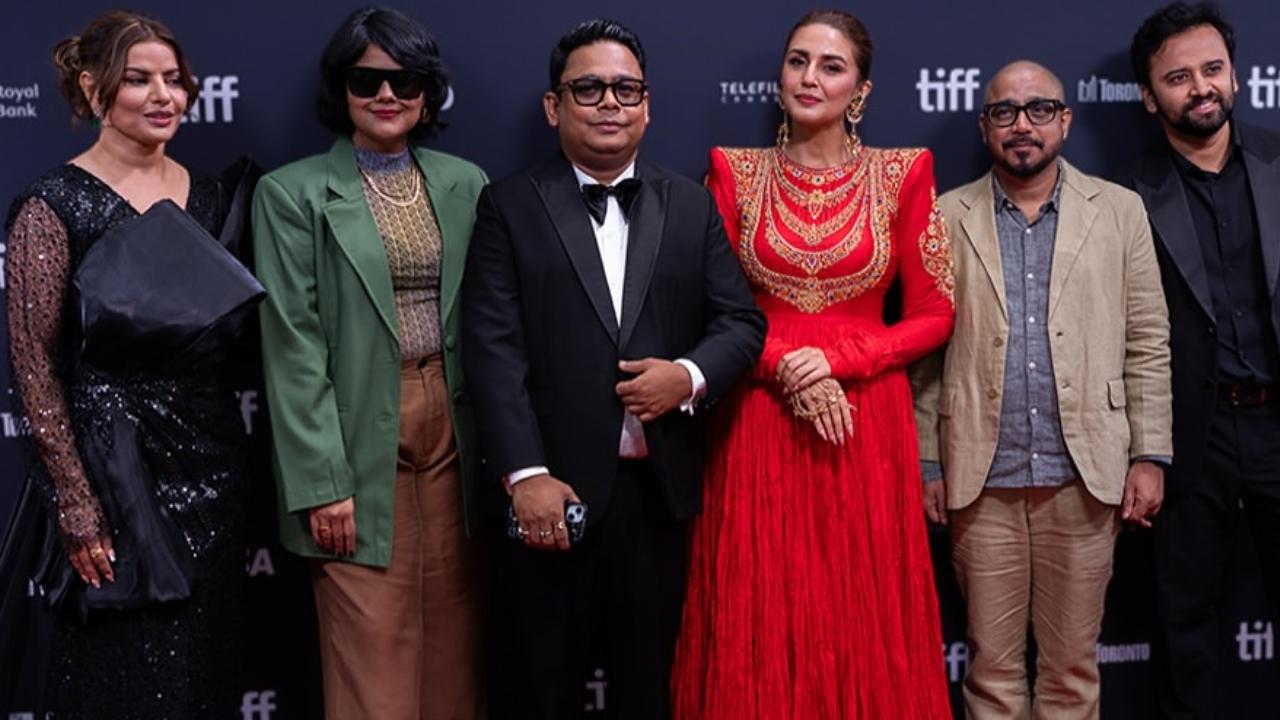
Bikas Mishra’s thriller is among a record mix of 17 Indian films and series being showcased at Toronto
Meenakshi Shedde (MUMBAI MIRROR; September 10, 2025)
Bikas Mishra’s powerful thriller Bayaan, Testimony, is one of the record 17 films and series selected at the 50th Toronto International Film Festival, TIFF, from India, South Asia and Diaspora. The film had its world premiere in the Discovery section of the festival, that runs from September 4-14.
The Indian films and series in official selection at TIFF are Anurag Kashyap’s Monkey In A Cage (Bandar, with Bobby Deol, in the Special Presentations section), Neeraj Ghaywan’s Homebound (Ishaan Khatter, Vishal Jethwa, Janhvi Kapoor, Gala Presentations); Bikas Mishra’s Bayaan (Huma Qureshi, Discovery), and Jitank Singh Gurjar’s In Search Of The Sky (Vimukt, Centrepiece).
Also selected officially are Gandhi, the series co-created by Hansal Mehta and Sameer Nair (Primetime), Satyajit Ray’s Aranyer Din Ratri (Days And Nights In The Forest, 1970, TIFF Classics), Ramesh Sippy’s Sholay (1975, restored by the Film Heritage Foundation and Sippy Films, Gala Presentations); and Sohrab Hura’s Disappeared (India/Nepal), short, in the Wavelengths: Map of Traces section.
Bayaan is Mishra’s second feature after Chauranga, that won the Grand Jury Prize at the Indian Film Festival of Los Angeles in 2015. Set in small town Rajasthan, Bayaan is a police procedural about a rookie police officer detective Roohi Kartar (Huma Qureshi) investigating the case of a ‘Maharaj,’ the head of a cult, who has raped countless girls in the ashram he heads. He has also given shelter and an education to these destitute women and orphans, who might otherwise never get the opportunity. He changes all the girls’ names, and gets inconvenient girls married to men of his choice, to cover up his tracks. He is an all-powerful figure, with influence over the police, judicial and political system, and is not seen until the last quarter of the film. Indeed, the entire system—through silence, patriarchy and misogyny--empowers the Maharaj.
Roohi finds it near impossible to get a bayaan, a testimony from the survivors that would enable her to nail the criminal. The locals are terrorised – her first witness is shot dead – and police and judiciary block her at every turn. But she refuses to give up, not even when it sets her on a collision course with her own father, also a senior police investigating officer. The film is inspired by real life events.
First of all, kudos to Mishra and producer Shiladitya Bora (Platoon One Films, along with Summit Studios and Guidant Films) for making a film on bringing a criminal cult figure to justice, in today’s India. Second, kudos for redeeming much of mainstream Bollywood with a strong woman-led film, and a competent woman police officer--without a hero. Mishra’s direction makes for a compelling thriller, and a technically accomplished one.
Huma Qureshi is in command of her role: playing the tough guy in a suit, or an empathetic listener, when required. There is an unforgettable scene in which all the ashram devotees bang thalis with spoons (oho!) to protest a summons being served on their Maharaj, described as Holy Father.
The ensemble cast, including Sachin Khedekar, Chandrachur Singh, Vibhore Mayank, Swati Das and Sampa Mandal, is very good. Mishra’s screenplay is excellent and layered, and rich with contradictions and dramatic twists at every turn, investing issues with personal stakes. Udit Khurana’s cinematography is a stand-out, creating atmospheric, delicately lit, dark and melancholic spaces, while Sreekar Prasad’s superb editing keeps the film taut. Ajay Jayanthi’s music and Pragyan Gogoi’s sound are an asset. The women crew include producer Madhu Sharma and Costume Designer Shilpi Agarwal Bora. Bollywood is in good hands with this team.
Bravo for making this powerful film - a must-see.
Do films, acclaimed at prestigious festivals, make a recovery for it's makers?
8:30 AM
Shakti Shetty (MID-DAY; May 1, 2014)
67th Cannes Film Festival is slated to commence from May 14 onwards and as has been the case over the past few years, the presence of Indian films — even if not Bollywood — will be duly noted this time too.
Last year, Ritesh Batra’s The Lunchbox won the Grand Rail d'Or before winning rave reviews in other film festivals and releasing in India. In fact, it went on to become the highest grossing foreign language film in the US in 2014. Here was a rather rare case of an Indian film not only earning recognition on an international platform but also successfully translating it into commercial gains.
This begs the question: What happens to the majority of films from India that do the rounds of film festivals? Do the filmmakers earn much in the long run? Not really, says Vikramjit Roy, general manager, National Film Development Corporation of India (NFDC). He says, “A film like The Lunchbox created a new benchmark because it had the potential to engage audiences at film festivals. But in the international market, a film’s success depends entirely on its quality. If a film has universal charm, then it’s going to get eyeballs even in non-NRI areas. What else can explain The Lunchbox’s screening and subsequent popularity in so many countries?” It’s worth noting that The Lunchbox released in India much after its festival run.
Hansal Mehta’s Shahid, Anand Gandhi’s Ship of Theseus and Ashim Ahluwalia’s Miss Lovely too tasted fame in the festival circuit before winning favour among the masses. Vasan Bala’s Peddlers, however, hasn’t been so fortunate. After premiering at Cannes in 2012, the crime thriller is yet to release in India.
Reach over profit?
On being asked whether the festival circuit helped him financially, Bala shrugs saying that it’s a matter of perception more than statistics. “A film sent to a film festival may or may not make considerable amount of profit but the primary idea is to seek an audience. If my country doesn’t want my film, I’ll search for eyeballs somewhere else. And all this while, I can’t keep looking at the accounts. I will keep moving ahead.”
Ahluwalia takes a more holistic approach though. “You don’t send a movie to a film festival with the sole objective of reaping profits. Sometimes, it’s solely about prestige.”
Win-win for everyone
However, that is not to say that producers don’t seek a proper Friday release. In fact, thanks to increasing awareness about film festivals, these challenges are being met head on by filmmakers.
For instance, Ship of Theseus, which recently won the National Award for Best Feature Film, began its journey at the Toronto Film Festival in 2012. Gandhi is grateful to the festival machinery as it helped him build the momentum. But he points out that there’s much more to overseas screenings than instant commercial advantage. “Film festivals give us access to international markets. The idea is to make audiences watch a different kind of cinema. A film festival also lends a film much needed visibility that might just help in making more money,” says the 33-year-old filmmaker.
Meenakshi Shedde, film critic and film festival curator, states that film festivals are all about the profit. “Sadly, in our country, we think every festival-hopping film is non-commercial. This mentality is the reason why we are left behind in the global markets, especially in the non-diaspora countries. All over the world, film fests help increase box returns. After all, film festivals are meant to benefit both sides — the festival organisers as well as the filmmakers,” she says.
Subscribe to:
Posts (Atom)